
When Markets Move at Machine Speed
The world didn’t just digitize. It accelerated.
For decades, organizations competed on scale.
Scale of labor.
Scale of capital.
Scale of distribution.
Scale of supply chains.
Speed mattered — but mostly as operational speed: faster shipping, faster product cycles, faster execution.
AI changes something deeper.
Markets themselves are accelerating.
- Prices update continuously.
- Customer intent shifts minute-by-minute.
- Supply constraints ripple across networks in hours.
- Negotiation cycles compress.
- Switching friction collapses.
- Demand becomes programmable.
The mismatch is no longer about technology adoption.
It is about institutional design.
In machine-speed markets, the central competitive variable becomes:
Decision Velocity — the ability to sense, decide, act, and learn at the speed of the market.
Decision velocity is not an abstract metric. It is the bridge between “AI as efficiency” and “AI as market power.”
And it is the most practical lens boards can use to understand the rise of the Third-Order AI Economy.
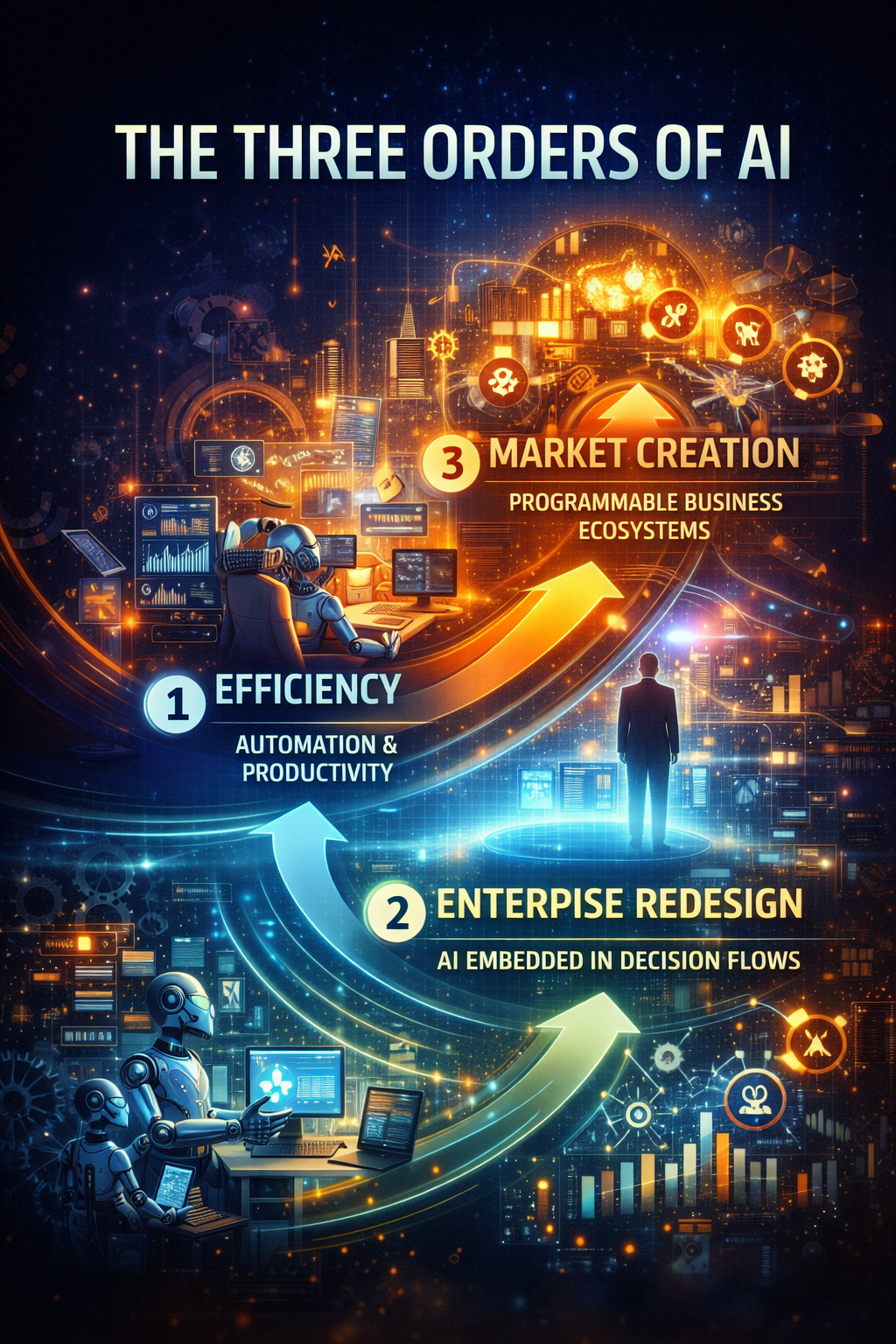
The Three Orders of AI
Every major technology wave unfolds in stages. AI is no different.
First Order: Efficiency
Organizations use AI to:
- automate tasks
- reduce cost
- improve productivity
- generate summaries
- support employees
This matters. But it is not structural advantage.
It is table stakes.
In every tech cycle, the first order spreads quickly because it is easy to measure: time saved, headcount leveraged, tickets closed, code generated, content produced.
But cost reduction is not a long-term moat.
Second Order: Enterprise Redesign
More serious organizations move beyond pilots and reorganize workflows:
- AI embedded into critical decision flows
- risk monitoring becomes continuous
- failures are preempted
- latency is reduced
- decision quality improves
This is where the Intelligence-Native Enterprise begins to form — an institution designed so intelligence is embedded into how work runs, not added as a tool on top.
But even this is still internal optimization.
Second-order AI makes the enterprise faster and safer.
Third-order AI changes the market itself.
Third Order: Market Creation
This is where categories shift.
Technology becomes infrastructure.
New firm types emerge.
Profit pools relocate.
Markets reorganize around programmable intelligence.
This is the Third-Order AI Economy — the phase where AI becomes part of how demand is generated, evaluated, negotiated, executed, and continuously optimized.
And decision velocity is the capability that enables it.

When markets move at machine speed
To understand why decision velocity matters, consider three shifts already underway across industries.
1) Negotiation becomes continuous
Procurement used to be periodic.
Now AI agents can:
- compare offers continuously
- monitor service performance
- trigger renegotiation automatically
- re-evaluate risk in real time
Negotiation becomes dynamic rather than episodic.
This changes competitive advantage because it collapses the “quiet periods” that used to protect incumbents. When negotiation becomes continuous, slow institutions pay a compounding penalty.
2) Switching becomes frictionless
Switching used to require attention, paperwork, migration plans, and inertia.
Agent-mediated comparison reduces friction.
Markets begin to behave like continuously optimized portfolios.
Loyalty shifts from brand to performance.
This doesn’t mean brands disappear. It means brand alone becomes insufficient when alternatives are constantly evaluated by systems designed to optimize value.
3) Planning becomes always-on
Planning cycles were quarterly or annual.
Machine-speed markets require continuous re-planning.
AI compresses signal-to-decision time, and increasingly enables near-real-time scenario testing.
Institutions that still operate on periodic rhythms — “review meetings,” “quarterly planning,” “annual strategy decks” — fall behind continuously adaptive competitors.
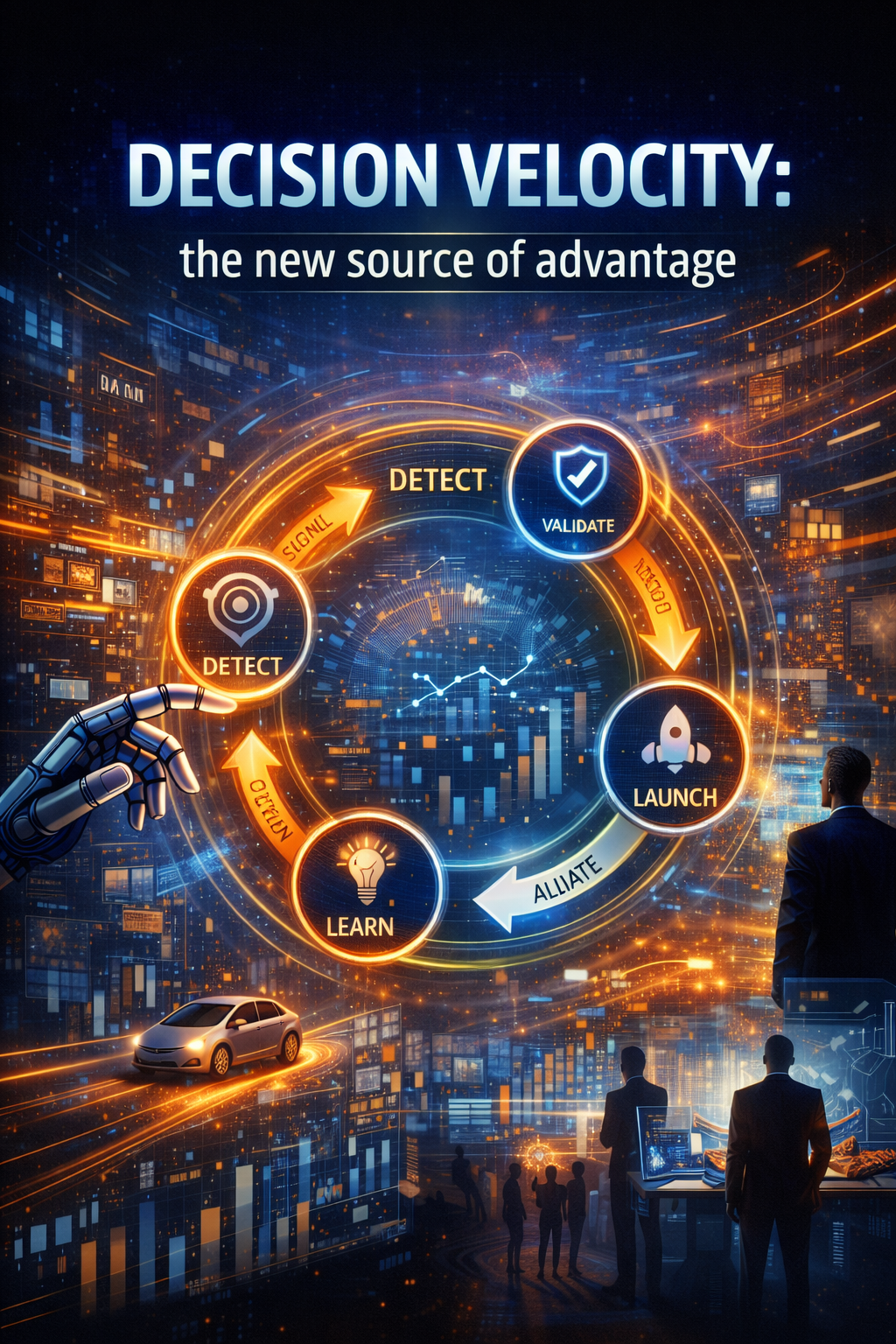
Decision Velocity: the new source of advantage
Decision velocity is not about “working faster.”
It is institutional intelligence at market speed.
It is the compression of:
Signal → Understanding → Choice → Action → Learning
Organizations do not lose in machine-speed markets because they lack AI.
They lose because:
- signals sit in dashboards
- decisions wait for approvals
- actions require coordination friction
- learning is delayed
In fast markets, delay compounds disadvantage.
And importantly: the cost of delay is not linear.
A slow institution doesn’t just miss one opportunity. It becomes increasingly misaligned with a market that keeps updating.
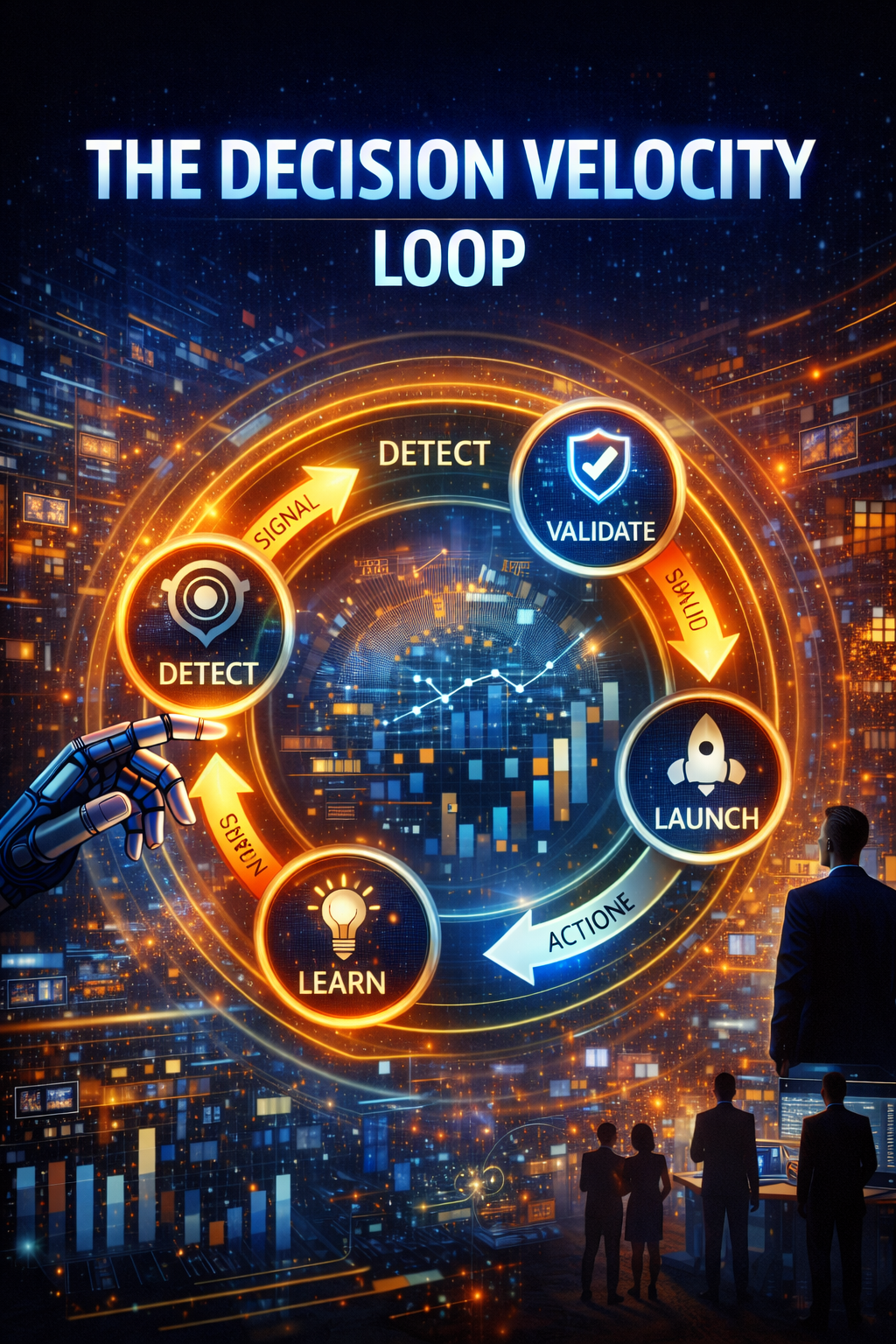
The Decision Velocity Loop (D.V.L.)
To make decision velocity actionable, define it as a loop — not a slogan.
D — Detect
Continuously sense meaningful signals:
- market shifts
- customer behavior changes
- risk patterns
- operational anomalies
- competitor moves
Detection must be structured and decision-aligned — not just data accumulation.
The goal is not “more data.”
The goal is earlier clarity.
V — Validate
Contextualize options within constraints:
- policy boundaries
- regulatory guardrails
- risk tolerance
- brand implications
- feasibility checks
Validation prevents speed from becoming chaos.
In machine-speed markets, unvalidated speed creates reputational and operational debt.
L — Launch
Execute safely through bounded autonomy:
- workflow triggers
- API-based actions
- negotiation systems
- procurement automation
- dynamic pricing adjustments
- operational routing decisions
Launch collapses latency.
Then outcomes feed back into detection.
The loop continues.
The firms that win have faster, safer, continuously improving D.V.L. loops.
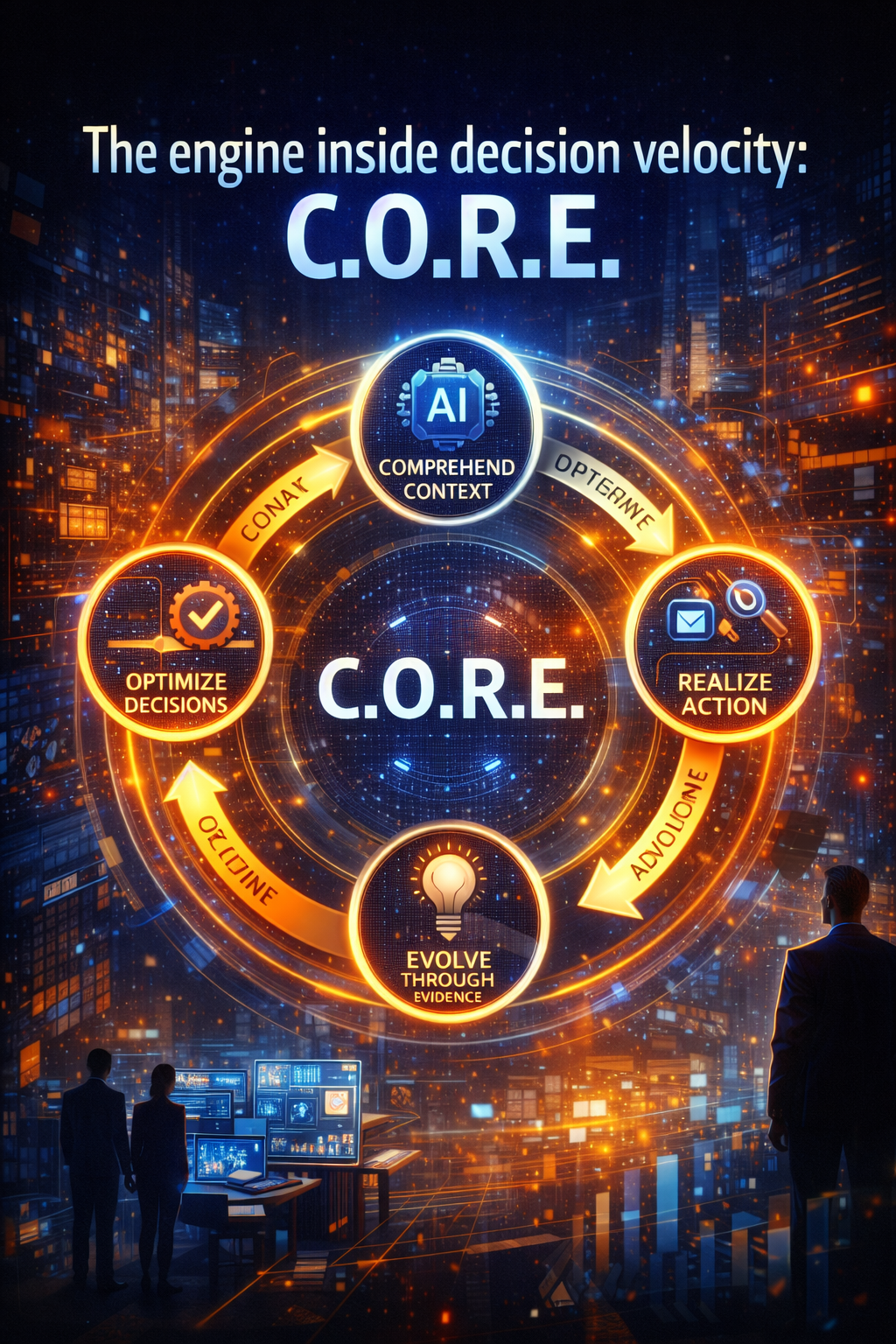
The engine inside decision velocity: C.O.R.E.
D.V.L. explains how fast decisions move.
But what powers the decision system itself?
That engine is C.O.R.E. — the Intelligence Loop.
C.O.R.E. turns “AI capability” into “institutional advantage.”
C — Comprehend Context
Markets generate constant signals.
Advantage belongs to institutions that convert signals into decision-ready context.
Not dashboards.
Not reports.
But structured, real-time situational awareness.
This is where many organizations fail: they collect signals, but cannot translate them into triggers that change decisions.
O — Optimize Decisions
Optimization now includes:
- risk-adjusted outcomes
- regulatory constraints
- strategic implications
- reversibility
- long-term learning value
Optimization embedded inside workflows eliminates latency.
When optimization sits in isolated analytics teams, it becomes advisory.
When optimization sits in the operating system, it becomes advantage.
R — Realize Action
Insight without execution is delay.
Realization means:
- automated action rails
- agent-based execution
- policy-aware autonomy
- observability and rollback paths
This is where machine-speed markets become real — because intelligence stops being “recommendation” and becomes “execution capability” within allowed bounds.
E — Evolve Through Evidence
Every action produces evidence.
Evidence must feed back into:
- threshold updates
- model refinement
- policy adaptation
- strategic recalibration
Continuous learning is how advantage compounds.
If your institution doesn’t learn faster than the market changes, your intelligence decays.
D.V.L. + C.O.R.E. = Intelligence-Native Enterprise
So, the key insights to remember is:
- Third-Order AI Economy is the macro shift.
- Decision Velocity (D.V.L.) is the competitive capability.
- C.O.R.E. is the institutional engine.
- Intelligence-Native Enterprise is the execution model.
Together, they create structural advantage.
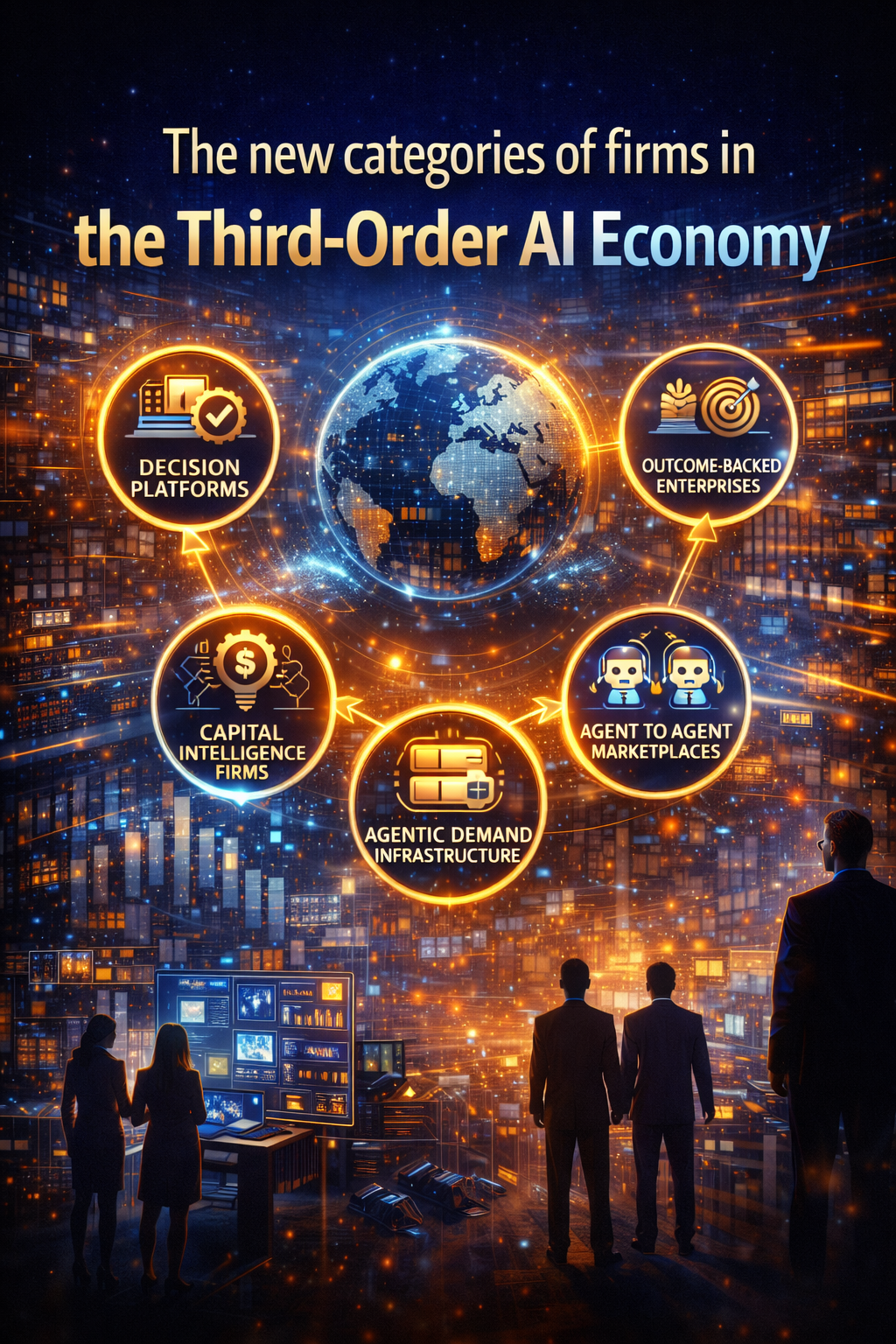
The new categories of firms in the Third-Order AI Economy
The new categories of firms in the Third-Order AI Economy
What will the Uber/Airbnb equivalents of AI look like?
Not as consumer apps.
As new economic infrastructure that removes friction from markets operating at machine speed.
1) Decision Platforms
These firms sell continuously improving decisions — not software licenses.
They reduce complexity for customers and monetize intelligence loops.
Customer pain solved: decision overload in complex systems.
2) Outcome-Backed Enterprises
Payment tied to measurable results.
AI makes continuous measurement and optimization feasible when the right instrumentation exists.
Customer pain solved: paying for activity instead of value.
3) Agentic Demand Infrastructure
Offerings become machine-readable.
Negotiable via APIs.
Switchable automatically.
Customer pain solved: friction in comparison, negotiation, and switching.
4) Agent-to-Agent Marketplaces
Algorithms negotiate and transact at machine speed.
Price discovery compresses.
Coordination costs collapse.
Customer pain solved: negotiation latency and market friction.
5) Capital Intelligence Firms
Capital allocation becomes continuously adaptive:
- simulation-driven
- signal-driven
- proactive rather than reactive
Customer pain solved: slow capital response in volatile markets.
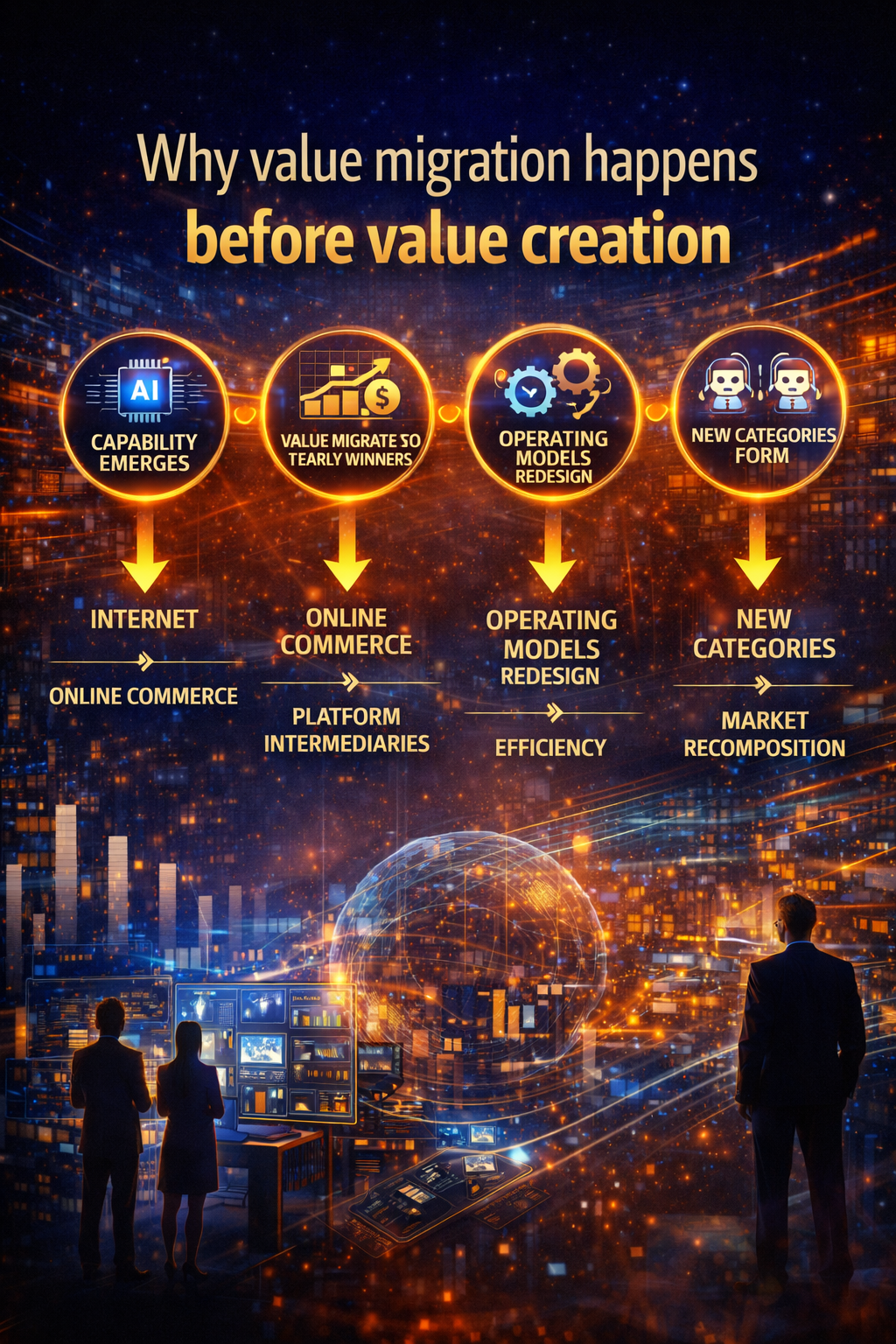
Why value migration happens before value creation
In every disruption, capital senses the shift before incumbents act.
The familiar sequence is:
- a capability emerges
- value migrates toward early winners
- operating models redesign
- new categories form
- power concentrates around new infrastructure
The Third-Order shift happens when intelligence becomes infrastructure.
That is where profit pools form.
And that is why boards must treat AI as a structural transition, not a tooling upgrade.
What boards must do now
Stop asking:
“How many AI pilots do we have?”
Start asking:
- Where is our decision latency?
- Which decisions must run continuously?
- Where should bounded autonomy exist — and where should it not?
- How fast do we learn from outcomes?
- Where will profit pools relocate as markets move at machine speed?
Adoption is not advantage.
Operating model is.
The strategic playbook
Embrace
- decision-centric redesign
- continuous sensing
- machine-readable interfaces
- outcome measurement infrastructure
- execution rails that enable bounded autonomy
Change
- replace periodic reviews with continuous loops in volatile domains
- clarify decision rights and accountability boundaries
- redesign incentives around outcomes rather than activity
- treat decision quality and decision speed as board-level metrics
Watch
- rise of machine customers and agent-mediated demand
- agent-driven negotiation and switching
- outcome-based monetization models
- capital migration toward intelligence-native firms
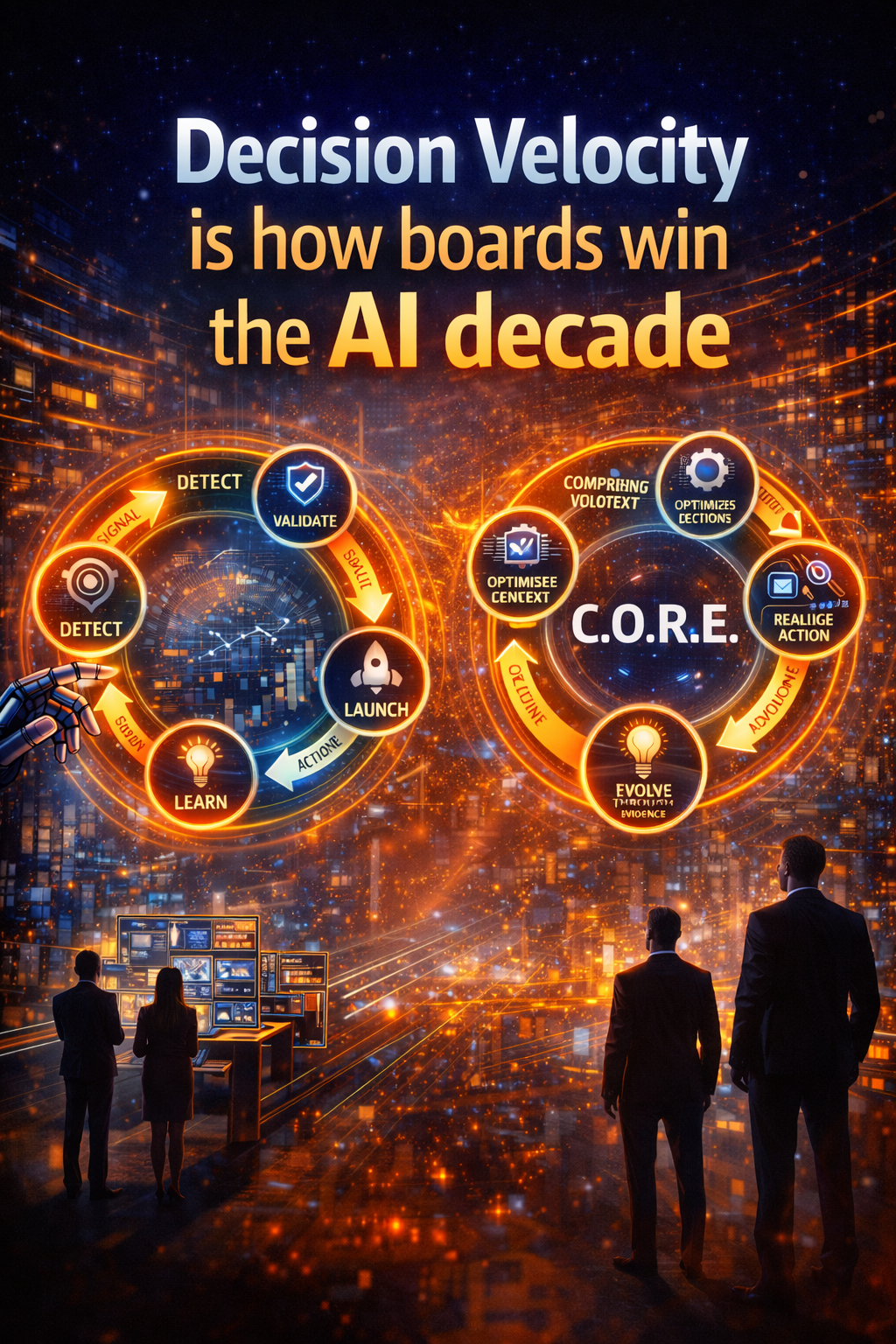
Conclusion: decision velocity is how boards win the AI decade
Machine-speed markets do not eliminate value.
They unlock new value:
- continuous optimization
- dynamic negotiation
- real-time risk mitigation
- outcome-backed models
- new intermediaries
- intelligence-native categories
The winners will not be those who adopt AI fastest.
They will be those who redesign their institutions to operate at machine speed.
Decision velocity becomes the moat.
C.O.R.E. becomes the engine.
The intelligence-native enterprise becomes the operating doctrine.
The Third-Order AI Economy becomes the macro opportunity.
Boards that understand this will not just survive AI.
They will shape the next generation of markets.
Glossary
Decision Velocity — Institutional capability to move from signal to action (and learning) at market speed.
Third-Order AI Economy — Phase where AI reorganizes markets and creates new firm categories, not just enterprise efficiency.
Intelligence-Native Enterprise — Enterprise designed around embedded intelligence loops, decision rails, and continuous learning.
C.O.R.E. — Comprehend, Optimize, Realize, Evolve — the intelligence loop that powers execution.
D.V.L. — Detect, Validate, Launch — the decision velocity loop that compresses time-to-action.
Bounded Autonomy — AI-enabled execution within explicit constraints, with observability and reversal paths.
Market Recomposition — Structural relocation of profit pools due to new infrastructure layers and new intermediaries.
FAQ
1) What is decision velocity in simple terms?
Decision velocity is how quickly an organization can sense change, make a decision, act, and learn — repeatedly — without losing control.
2) Is decision velocity only about speed?
No. It is about reliable speed: fast decisions that remain policy-aligned, reversible when needed, and continuously improved through evidence.
3) What is the difference between D.V.L. and C.O.R.E.?
D.V.L. describes the movement of decisions (Detect, Validate, Launch).
C.O.R.E. describes the engine of institutional intelligence (Comprehend, Optimize, Realize, Evolve).
4) What should boards measure beyond AI adoption?
Decision latency, decision repeatability, learning speed from outcomes, and where autonomy creates value versus risk.
5) What makes a firm “third-order” in AI?
Third-order firms externalize intelligence into markets — becoming decision platforms, outcome-backed enterprises, agentic demand infrastructure, agent marketplaces, or capital intelligence firms.
Enterprise AI Operating Model
Enterprise AI scale requires four interlocking planes:
Read about Enterprise AI Operating Model The Enterprise AI Operating Model: How organizations design, govern, and scale intelligence safely – Raktim Singh
- Read about Enterprise Control Tower The Enterprise AI Control Tower: Why Services-as-Software Is the Only Way to Run Autonomous AI at Scale – Raktim Singh
- Read about Decision Clarity The Shortest Path to Scalable Enterprise AI Autonomy Is Decision Clarity – Raktim Singh
- Read about The Enterprise AI Runbook Crisis The Enterprise AI Runbook Crisis: Why Model Churn Is Breaking Production AI—and What CIOs Must Fix in the Next 12 Months – Raktim Singh
- Read about Enterprise AI Economics Enterprise AI Economics & Cost Governance: Why Every AI Estate Needs an Economic Control Plane – Raktim Singh
Read about Who Owns Enterprise AI Who Owns Enterprise AI? Roles, Accountability, and Decision Rights in 2026 – Raktim Singh
Read about The Intelligence Reuse Index The Intelligence Reuse Index: Why Enterprise AI Advantage Has Shifted from Models to Reuse – Raktim Singh
The Intelligence-Native Enterprise Doctrine
This article is part of a larger strategic body of work that defines how AI is transforming the structure of markets, institutions, and competitive advantage. To explore the full doctrine, read the following foundational essays:
- The AI Decade Will Reward Synchronization, Not Adoption
Why enterprise AI strategy must shift from tools to operating models.
https://www.raktimsingh.com/the-ai-decade-will-reward-synchronization-not-adoption-why-enterprise-ai-strategy-must-shift-from-tools-to-operating-models/ - The Third-Order AI Economy
The category map boards must use to see the next Uber moment.
https://www.raktimsingh.com/third-order-ai-economy/ - The Intelligence Company
A new theory of the firm in the AI era — where decision quality becomes the scalable asset.
https://www.raktimsingh.com/intelligence-company-new-theory-firm-ai/ - The Judgment Economy
How AI is redefining industry structure — not just productivity.
https://www.raktimsingh.com/judgment-economy-ai-industry-structure/ - Digital Transformation 3.0
The rise of the intelligence-native enterprise.
https://www.raktimsingh.com/digital-transformation-3-0-the-rise-of-the-intelligence-native-enterprise/ - Industry Structure in the AI Era
Why judgment economies will redefine competitive advantage.
https://www.raktimsingh.com/industry-structure-in-the-ai-era-why-judgment-economies-will-redefine-competitive-advantage/
Institutional Perspectives on Enterprise AI
Many of the structural ideas discussed here — intelligence-native operating models, control planes, decision integrity, and accountable autonomy — have also been explored in my institutional perspectives published via Infosys’ Emerging Technology Solutions platform.
For readers seeking deeper operational detail, I have written extensively on:
- What Makes an Enterprise Intelligence-Native? The Blueprint for Third-Order AI Advantage
https://blogs.infosys.com/emerging-technology-solutions/artificial-intelligence/what-is-enterprise-ai-the-operating-model-for-compounding-institutional-intelligence.html - Why “AI in the Enterprise” Is Not Enterprise AI: The Operating Model Difference Most Organizations Miss
https://blogs.infosys.com/emerging-technology-solutions/artificial-intelligence/why-ai-in-the-enterprise-is-not-enterprise-ai-the-operating-model-difference-that-most-organizations-miss.html - The Enterprise AI Control Plane: Governing Autonomy at Scale
https://blogs.infosys.com/emerging-technology-solutions/artificial-intelligence/the-enterprise-ai-control-plane-governing-autonomy-at-scale.html - Enterprise AI Ownership Framework: Who Is Accountable, Who Decides, and Who Stops AI in Production
https://blogs.infosys.com/emerging-technology-solutions/artificial-intelligence/enterprise-ai-ownership-framework-who-is-accountable-who-decides-and-who-stops-ai-in-production.html - Decision Integrity: Why Model Accuracy Is Not Enough in Enterprise AI
https://blogs.infosys.com/emerging-technology-solutions/artificial-intelligence/decision-integrity-why-model-accuracy-is-not-enough-in-enterprise-ai.html - Agent Incident Response Playbook: Operating Autonomous AI Systems Safely at Enterprise Scale
https://blogs.infosys.com/emerging-technology-solutions/artificial-intelligence/agent-incident-response-playbook-operating-autonomous-ai-systems-safely-at-enterprise-scale.html - The Economics of Enterprise AI: Designing Cost, Control, and Value as One System
https://blogs.infosys.com/emerging-technology-solutions/artificial-intelligence/the-economics-of-enterprise-ai-designing-cost-control-and-value-as-one-system.html
Together, these perspectives outline a unified view: Enterprise AI is not a collection of tools. It is a governed operating system for institutional intelligence — where economics, accountability, control, and decision integrity function as a coherent architecture.



Raktim Singh is an AI and deep-tech strategist, TEDx speaker, and author focused on helping enterprises navigate the next era of intelligent systems. With experience spanning AI, fintech, quantum computing, and digital transformation, he simplifies complex technology for leaders and builds frameworks that drive responsible, scalable adoption.