
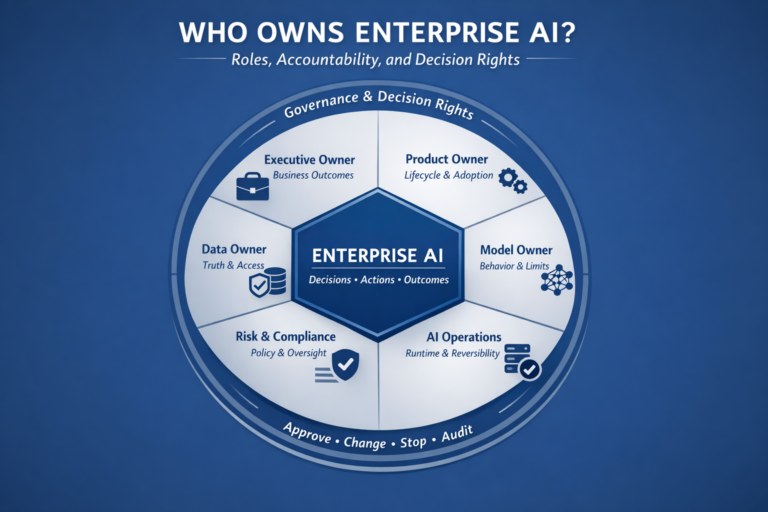
Who Owns Enterprise AI?
Enterprise AI fails for a reason that has nothing to do with algorithms, models, or platforms. It fails because no one can answer a simple leadership question: Who owns Enterprise AI when it starts making real decisions?
Not who built the model. Not who runs the infrastructure. Not who signed the vendor contract. Ownership begins the moment AI influences outcomes—approving actions, shaping customer experiences, triggering workflows, affecting compliance, or moving money.
At that point, Enterprise AI stops being a technology initiative and becomes an operating responsibility—one that demands clear roles, explicit accountability, and unambiguous decision rights.
Enterprise AI fails for a surprisingly non-technical reason: no one can answer, in plain language, who owns it.
Not who built the model.
Not who runs the platform.
Not who signed the vendor contract.
The real question is this:
Who owns the outcomes when AI starts influencing decisions, money, compliance, customer experience, or operational execution?
This question becomes unavoidable the moment AI moves from advising to acting—The Action Threshold: Why Enterprise AI Starts Failing the Moment It Starts Acting – Raktim Singh approving requests, changing records, triggering workflows, allocating resources, or steering decisions inside real enterprise systems.
Across the globe, regulatory bodies, boards, and technology leaders are converging on the same realization:
Enterprise AI must be governed across its lifecycle with explicit accountability—not informal responsibility.
Frameworks such as the NIST AI Risk Management Framework and the European Union Artificial Intelligence Act do not ask whether AI is innovative.
They ask who is accountable when AI is deployed into real-world contexts.
So let’s settle this clearly, globally, and practically.
This article builds on the broader framework defined in the Enterprise AI Operating Model, which explains how organizations design, govern, and scale intelligence safely in production.
👉 https://www.raktimsingh.com/enterprise-ai-operating-model/
and What Is Enterprise AI? A 2026 Definition for Leaders Running AI in Production – Raktim Singh
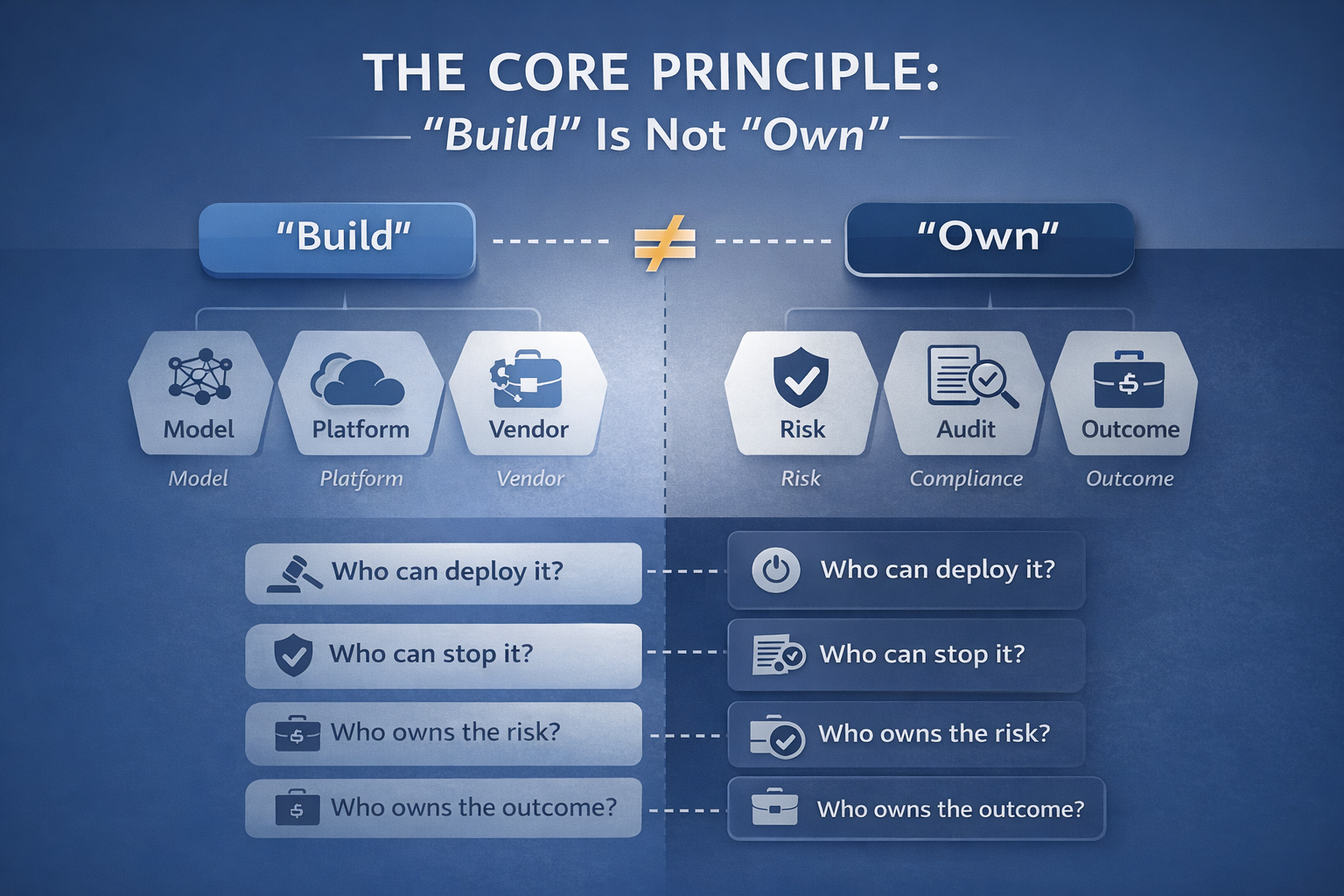
The Core Principle: “Build” Is Not “Own”
In enterprise environments, ownership is not a title or a team.
Ownership is a decision right.
Specifically:
- Who decides this AI system can go live?
- Who has the authority to stop it?
- Who is accountable when it causes harm—even if it was “working as designed”?
- Who owns the evidence trail: logs, explanations, approvals, and audits?
- Who pays—financially, legally, and reputationally—when risk becomes real?
This is why modern regulation increasingly focuses on deployment, not invention.
For example, the EU AI Act assigns explicit obligations to deployers—the organizations that use AI in production—including human oversight, monitoring, documentation, and log retention.
That is the clue:
👉 Deployment is ownership.
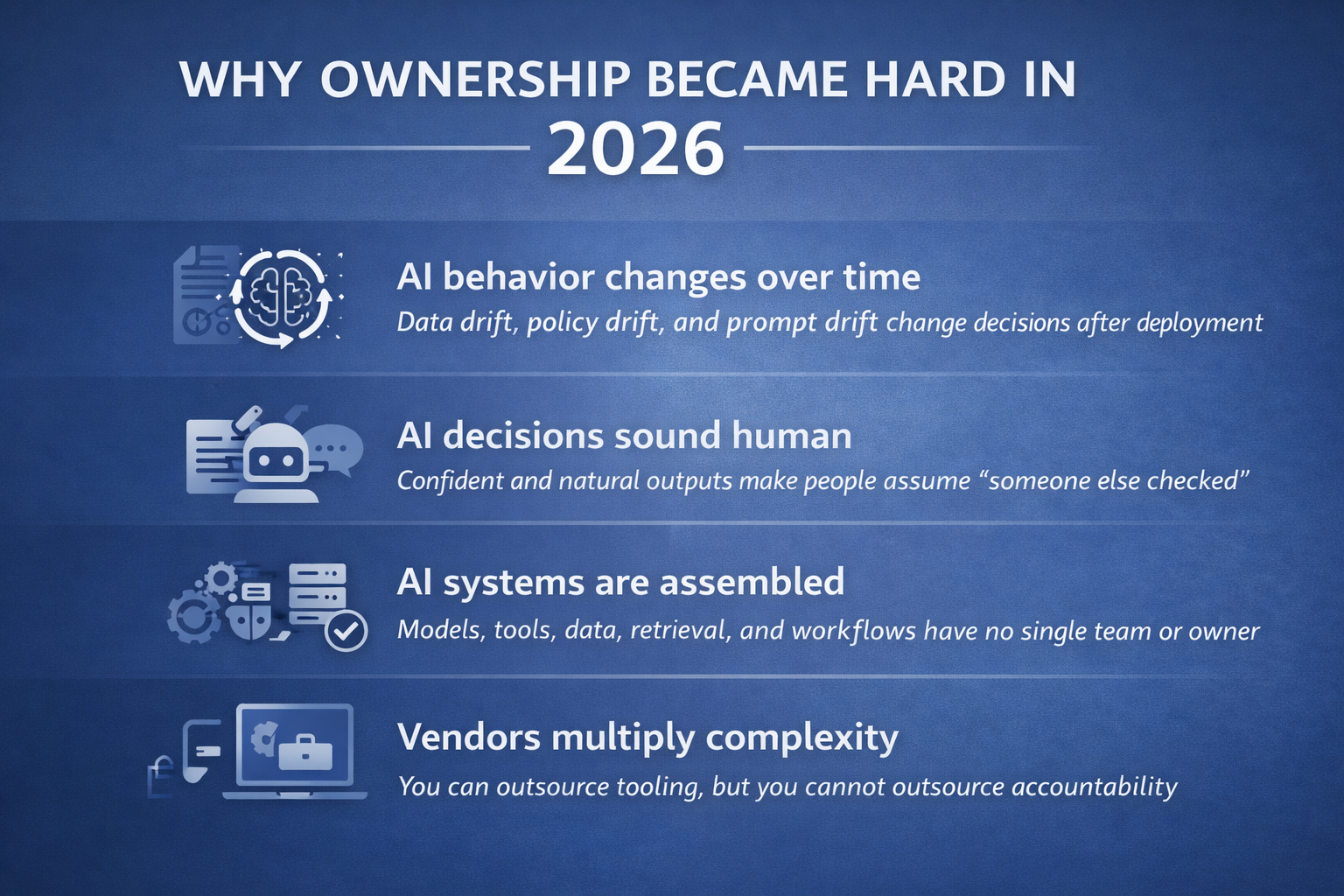
Why Ownership Became Hard in 2026
In traditional enterprise software, ownership boundaries were relatively clear:
- IT owned system uptime
- Business owned process outcomes
- Security owned controls and incidents
Enterprise AI breaks this model for four reasons:
- AI behavior changes over time
Data drift, policy updates, prompt changes, and model upgrades alter behavior long after deployment. - AI decisions feel human
When outputs sound confident and natural, people assume someone else validated them. - AI systems are assembled, not built
A single “AI solution” often combines models, data pipelines, retrieval layers, tools, workflows, and user interfaces—owned by different teams. - Vendors multiply complexity
You can outsource tooling and infrastructure, but you cannot outsource accountability.
This is why standards such as ISO/IEC 42001 emphasize clearly assigned organizational roles across the AI lifecycle.
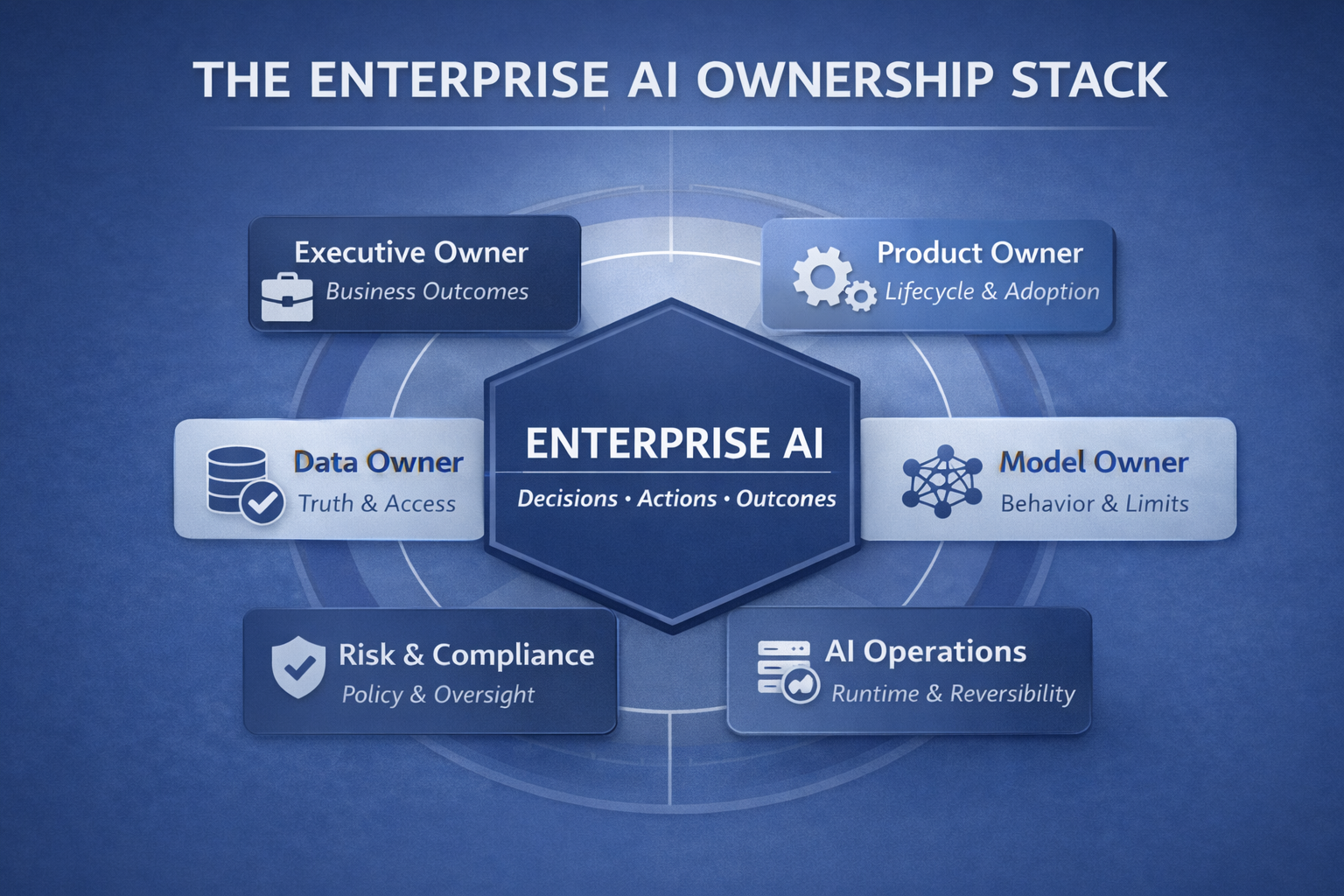
The Enterprise AI Ownership Stack
Six Roles Every Serious Enterprise Needs
Titles may differ, but these six ownership functions must exist if Enterprise AI is to scale safely.
-
Executive Owner — Accountable for Outcomes
Who they are:
A senior business executive accountable for the business outcome, not the model.
What they own:
The why and should we of the AI system.
Decision rights include:
- Approving the use case
- Accepting residual risk
- Funding the operating model (not just pilots)
- Defining what success means in business terms
Simple example:
If an AI system recommends actions in a core workflow, the Executive Owner decides whether those actions are allowed in that business context—because the enterprise bears the consequence.
Key insight:
If the business wants the outcome, the business must own the outcome.
-
Product Owner — Owns the AI System as a Product
Who they are:
The accountable owner of the AI system end-to-end in production.
What they own:
Lifecycle management—requirements, UX, change management, adoption, and incident coordination.
Decision rights include:
- Defining functional and policy constraints
- Deciding what ships and when
- Managing feedback loops and incidents
- Coordinating changes across data, model, and workflow
Simple example:
If a chatbot produces inconsistent answers after a knowledge update, the Product Owner owns the fix—whether it involves retrieval tuning, guardrails, content updates, or UX redesign.
-
Model Owner — Owns Model Behavior and Limits
Who they are:
The technical authority responsible for model selection, evaluation, tuning, and documentation.
What they own:
Model performance boundaries and known failure modes.
This mirrors long-standing expectations in regulated industries, such as model risk management practices outlined by the Federal Reserve System.
Decision rights include:
- Selecting model classes or providers
- Defining evaluation and regression standards
- Maintaining model documentation
- Approving model changes and rollbacks
Simple example:
If a model is strong at summarization but weak at policy interpretation, the Model Owner must document this and design mitigations.
-
Data Owner — Owns Truth, Access, and Quality
Who they are:
The accountable owner of the enterprise data domain.
What they own:
Data lineage, permissions, quality, freshness, and governance.
Decision rights include:
- Approving data usage for AI
- Defining authoritative sources
- Approving retention and deletion
- Managing access controls
Simple example:
If AI relies on incomplete customer data, the Data Owner owns fixing the upstream quality—not the prompt.
-
Risk & Compliance Owner — Owns Safety Constraints
Who they are:
Risk, compliance, or legal leader accountable for regulatory posture.
What they own:
The constraints AI systems must enforce.
Decision rights include:
- Approving policy guardrails
- Defining prohibited behaviors
- Setting human-oversight thresholds
- Approving audit evidence
Simple example:
If AI suggests an action that violates policy, the Risk Owner decides the rule—not the engineer.
-
AI Operations Owner — Owns Runtime Reliability
Who they are:
Engineering or operations leader accountable for production behavior.
What they own:
Monitoring, incident response, rollbacks, and kill-switches.The Advantage Is No Longer Intelligence—It Is Operability: How Enterprises Win with AI Operating Environments – Raktim Singh
Decision rights include:
- Gating releases into production
- Enforcing observability
- Executing shutdowns or rollbacks
- Managing uptime and safety incidents
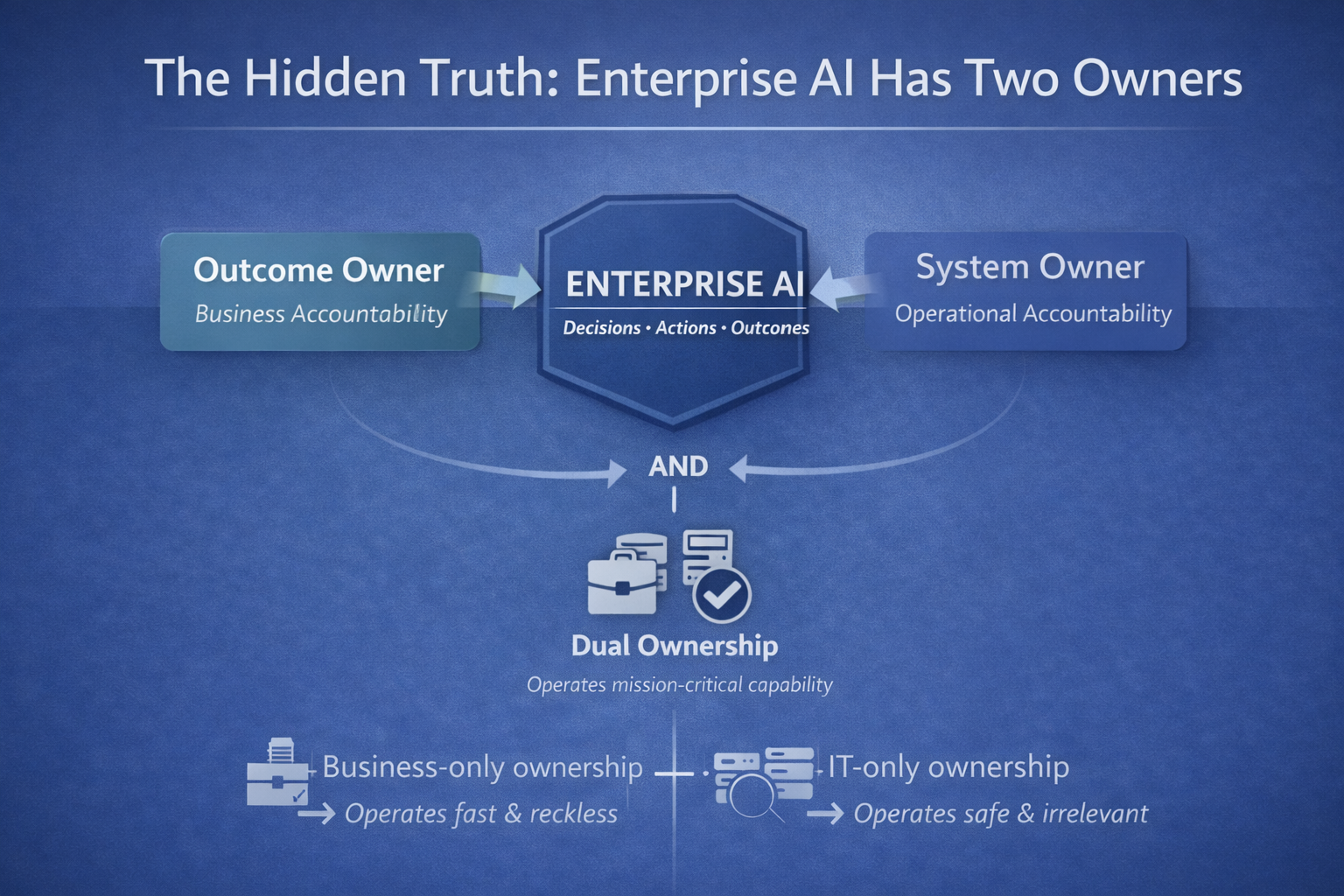
The Hidden Truth: Enterprise AI Has Two Owners
The Hidden Truth: Enterprise AI Has Two Owners
Every serious Enterprise AI system requires dual ownership:
- Outcome Owner — business accountability
- System Owner — operational accountability
Business-only ownership creates chaos.
IT-only ownership creates irrelevance.
Dual ownership is how enterprises run mission-critical capability.
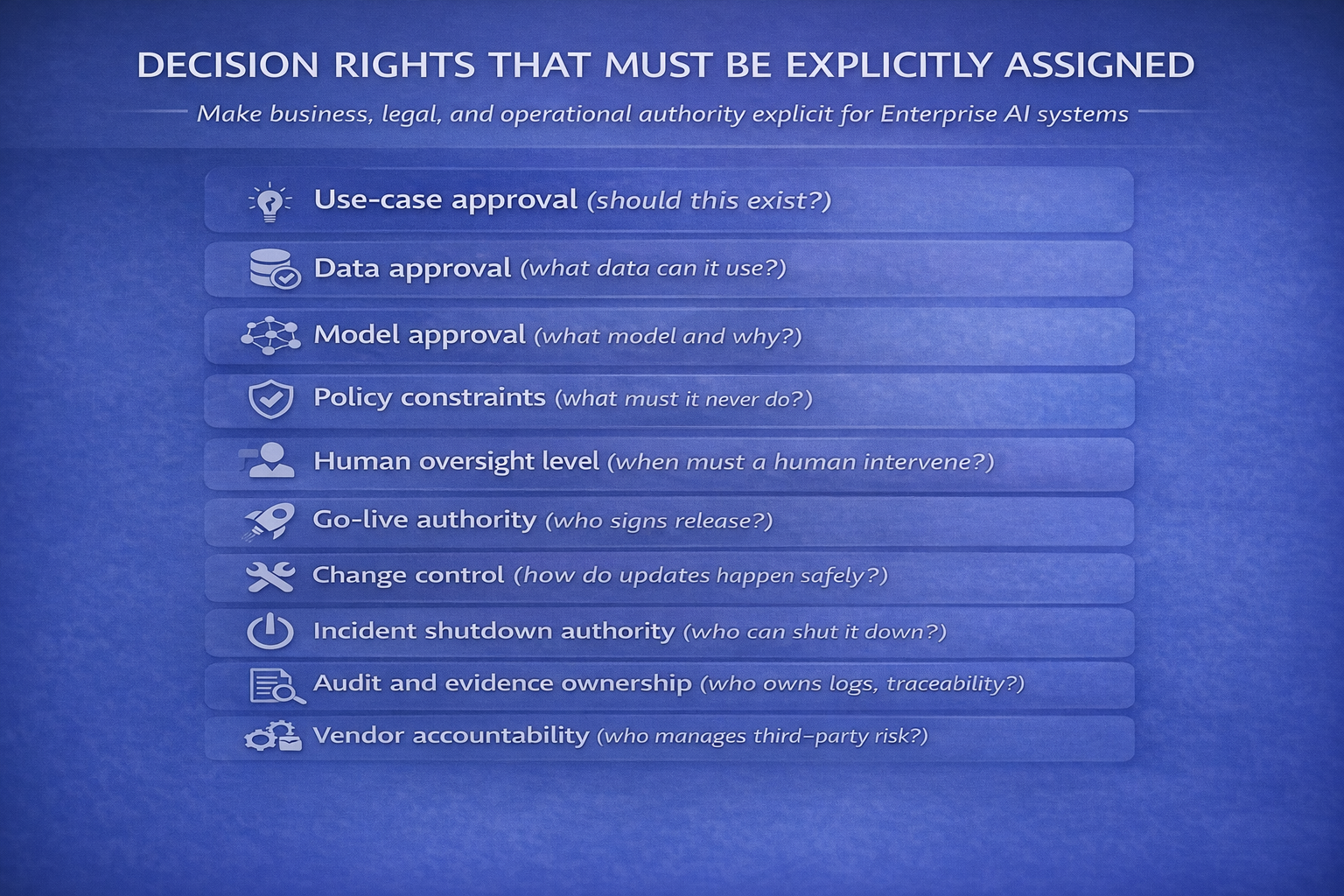
Decision Rights That Must Be Explicitly Assigned
Ownership becomes real only when decision rights are named:
- Use-case approval
- Data approval
- Model approval
- Policy constraints
- Human oversight level
- Go-live authority The Enterprise AI Execution Contract: The Missing Layer Between Design Intent and Production Autonomy – Raktim Singh
- Change control
- Incident shutdown authority
- Audit and evidence ownership
- Vendor accountability
If these are unclear, AI will fail—not technically, but organizationally.
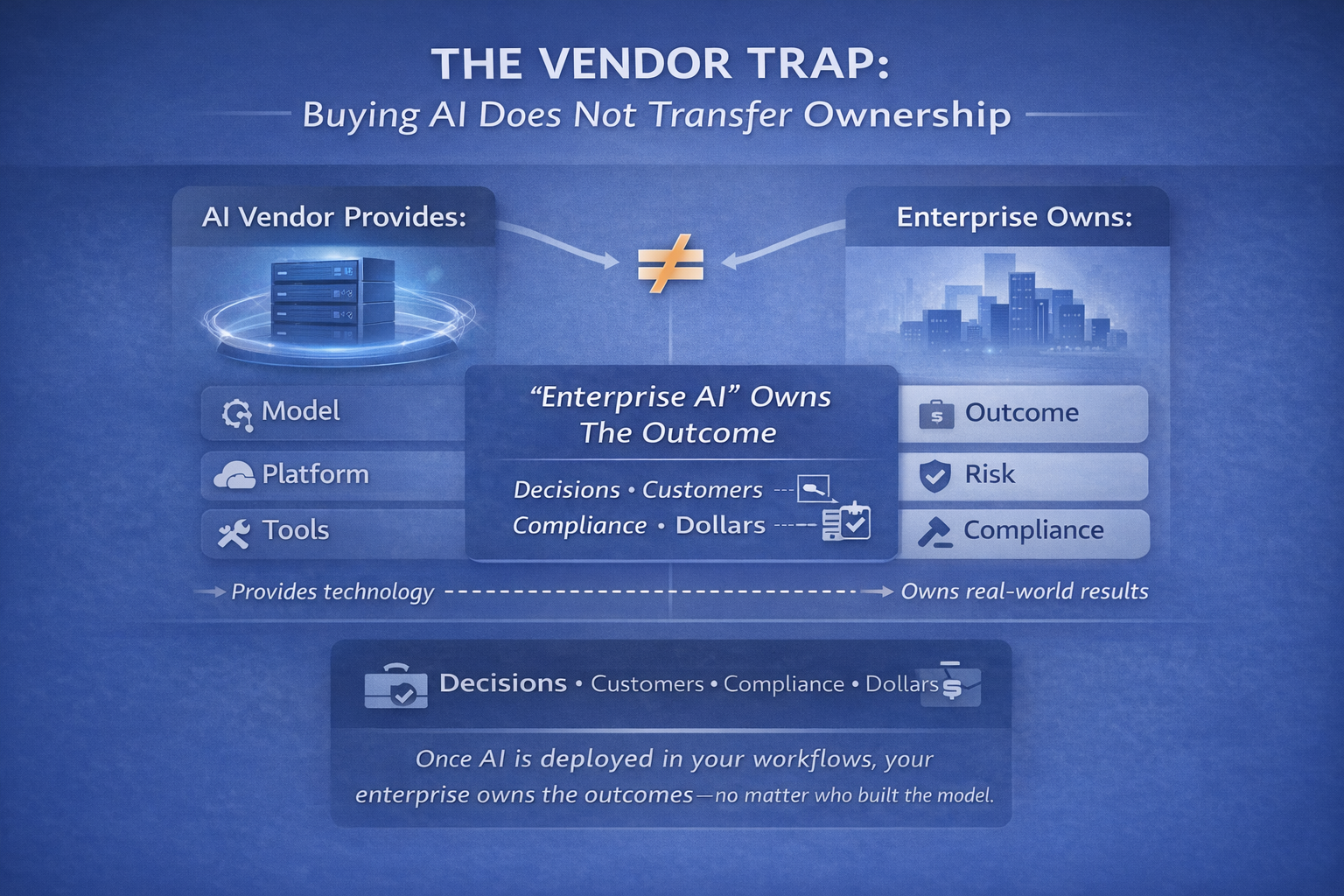
The Vendor Trap: Buying AI Does Not Transfer Ownership
Many enterprises assume:
“If a vendor provides the model, they own the risk.”
This is false.
Once AI is embedded into enterprise workflows, the deploying organization owns the outcome—regardless of who built the model.
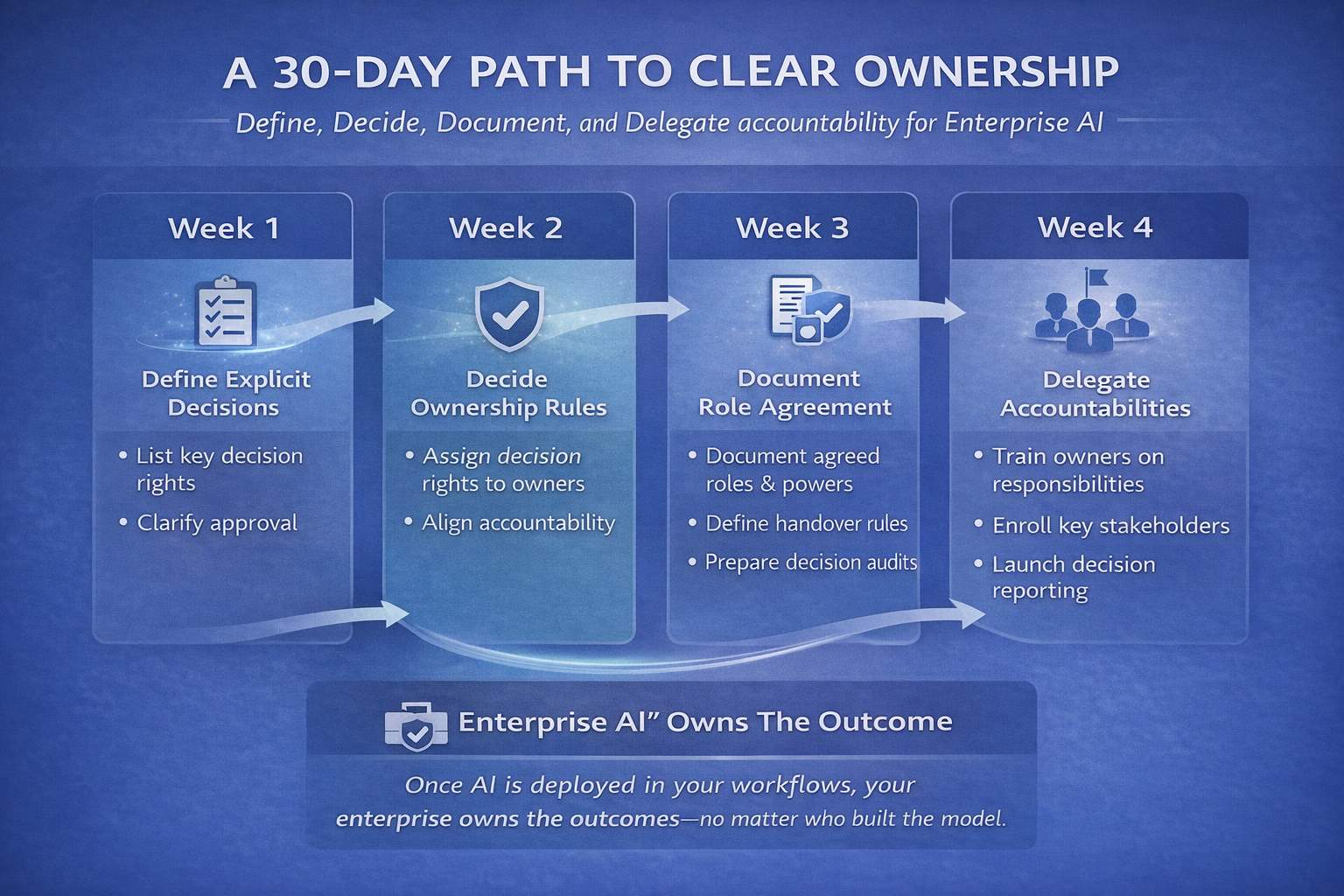
A 30-Day Path to Clear Ownership
- Week 1: Name an AI System Owner for each production system
- Week 2: Assign decision rights explicitly
- Week 3: Define safety and reliability escalation paths
- Week 4: Formalize release gating with business, ops, and risk sign-off
This aligns directly with the intent of modern AI governance frameworks worldwide.
FAQ
Who owns Enterprise AI—CIO, CTO, CDO, or business?
Business owns outcomes. Technology owns operability. Risk owns constraints.
Is AI governance the same as AI ownership?
No. Governance is the system. Ownership is the assignment.
How do you detect missing ownership?
Ask: Who can stop this AI in production right now?
Who owns Enterprise AI in an organization?
Enterprise AI is owned jointly. The business owns outcomes and risk, while technology and operations teams own system reliability and execution. Clear ownership emerges only when decision rights are explicitly assigned across business, technology, and risk functions.
Who is accountable when Enterprise AI makes a wrong decision?
The organization that deploys Enterprise AI is accountable. Once AI influences real decisions—such as approvals, recommendations, or actions—the enterprise owns the outcome, regardless of whether the model was built internally or sourced from a vendor.
What is the difference between AI governance and AI ownership?
AI governance defines the rules, controls, and oversight mechanisms. AI ownership assigns who has the authority to approve, change, stop, and audit AI behavior. Governance without ownership becomes documentation; ownership without governance becomes risk.
What decision rights must be explicitly assigned for Enterprise AI?
Enterprises must explicitly assign decision rights for use-case approval, data access, model selection, policy constraints, human oversight levels, go-live authority, change control, incident shutdown, audit evidence, and vendor accountability.
Who should approve an Enterprise AI system going live?
Enterprise AI should go live only after approval from the business outcome owner, the AI operations owner, and the risk or compliance owner in high-impact or regulated use cases.
When does Enterprise AI ownership begin?
Enterprise AI ownership begins the moment AI influences real-world outcomes—such as decisions, workflows, customer interactions, compliance actions, or financial impact. Ownership does not begin at model training; it begins at deployment.
Who can stop an Enterprise AI system in production?
The owner of Enterprise AI is the person or role with the authority to pause, disable, or roll back the system in production. If no one has this authority, ownership is unclear.
What happens to ownership when AI becomes agentic?
When AI becomes agentic—able to act autonomously—ownership expands to include tool access control, rollback authority, continuous monitoring, and human-in-the-loop design. Accountability increases as autonomy increases.
Who owns Enterprise AI risk: the vendor or the enterprise?
The enterprise owns the risk. Vendors provide models or platforms, but the organization deploying AI into its workflows owns the outcomes, compliance exposure, and operational risk.
How can enterprises clarify AI ownership quickly?
Enterprises can clarify AI ownership by naming a system owner for every production AI system, assigning decision rights explicitly, defining escalation paths, and formalizing release and shutdown authority within 30 days.
Why does unclear ownership cause Enterprise AI to fail?
Unclear ownership leads to delayed decisions, blame shifting, unmanaged risk, and production incidents. Enterprise AI fails not because of weak models, but because no one owns decisions once AI starts acting.
What is the simplest test for Enterprise AI ownership?
Ask one question:
“Who can stop this AI in production right now?”
If the answer is unclear, ownership is unclear.
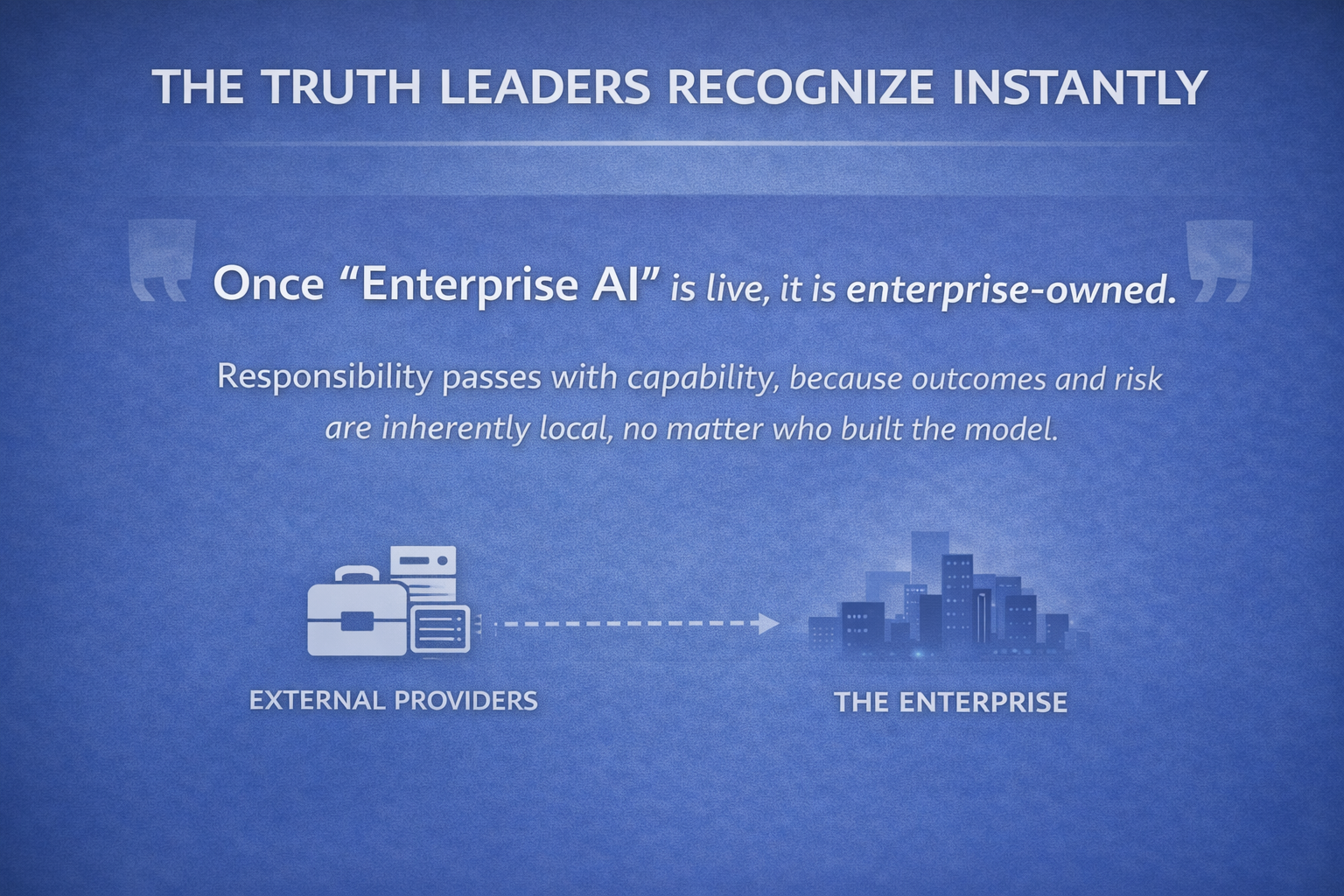
Conclusion: The Truth Leaders Recognize Instantly
Enterprise AI is not owned by the team that built the model.
It is owned by leaders willing to own:
- the outcome
- the risk
- and the decision rights to control AI behavior in production
If you want Enterprise AI to scale safely, don’t start with prompts.
Understand the Enterprise AI runbook risk 👉 https://www.raktimsingh.com/enterprise-ai-runbook-crisis-model-churn-production-ai/
Start with ownership.
Key Takeaway for Leaders
Enterprise AI ownership begins the moment AI influences real decisions.
The organization deploying AI—not the vendor, not the model team—owns outcomes, risk, and accountability.
References & Further Reading
- NIST AI Risk Management Framework AI Risk Management Framework | NIST
- EU Artificial Intelligence Act EU Artificial Intelligence Act | Up-to-date developments and analyses of the EU AI Act
- ISO/IEC 42001 – AI Management Systems ISO/IEC 42001:2023 – AI management systems
- Federal Reserve: Model Risk Management Principles
For a deeper architectural view, see the pillar article:
👉 Enterprise AI Operating Model: https://www.raktimsingh.com/enterprise-ai-operating-model/



Raktim Singh is an AI and deep-tech strategist, TEDx speaker, and author focused on helping enterprises navigate the next era of intelligent systems. With experience spanning AI, fintech, quantum computing, and digital transformation, he simplifies complex technology for leaders and builds frameworks that drive responsible, scalable adoption.