

Why AI Costs Explode After “Success”
Most enterprises don’t lose control of AI spending because their models are too large or their vendors are too expensive. They lose control because AI becomes useful.
In early pilots, AI looks deceptively cheap—limited users, short prompts, forgiving reliability, and almost no governance overhead.
But the moment an AI system succeeds and moves into real production, its economic behavior changes. Usage multiplies, workflows expand, reliability expectations harden, and compliance turns outputs into evidence.
Costs stop behaving like a one-time technology investment and start behaving like a permanent operating expense tied to decisions. This is why so many organizations discover—too late—that AI is cheapest when it is optional and most expensive when it becomes essential.
The moment AI works, the bill changes shape
In early pilots, AI feels almost free.
A small team experiments. Usage is sporadic. Prompts are short. Latency is tolerated. The “AI budget” is often a cloud line item that blends into everything else.
Then the pilot succeeds.
The use case spreads across functions. Product embeds it into workflows. Support starts depending on it. Leadership wants it “everywhere.” Users form habits. And suddenly the cost curve doesn’t rise like normal software spend—it tilts upward.
That pattern isn’t anecdotal. It’s macro.
- Gartner forecast global generative AI spending to reach $644B in 2025. (Gartner)
- Gartner also predicted at least 30% of GenAI projects will be abandoned after proof-of-concept by end of 2025—citing issues including escalating costs and unclear business value. (Gartner)
- And for agentic AI, Gartner predicted over 40% of agentic AI projects will be canceled by end of 2027 due to costs, unclear value, or inadequate risk controls—reported by Reuters and also in Gartner’s own release. (Reuters)
So the strategic question isn’t “Can we build it?”
It’s this:
Can we afford it once it becomes popular, mission-critical, and governed?
This article explains why Enterprise AI costs increase sharply after successful deployment, covering global enterprise patterns across regulated and non-regulated industries, and provides a practical operating model for cost control at scale.

The uncomfortable truth: success creates new cost physics
AI cost explosions happen because success changes what the system is.
- A pilot is a feature experiment.
- Production AI becomes a decision utility.
- And decision utilities must be reliable, auditable, secure, compliant, and available—at volume.
This is where your larger Enterprise AI thesis becomes non-negotiable:
Enterprise AI is an operating model—not a technology stack.
When the unit of value becomes a decision, the unit of cost becomes a decision too.
The 9 hidden multipliers that make “successful AI” expensive
1) Usage amplification: adoption turns into habit, habit turns into volume
In pilots, you have a few power users.
In production, you have everyone—and they don’t ask one question. They ask ten follow-ups. They paste outputs back in. They build “prompt routines.” They turn AI into muscle memory.
That’s why AI is cheapest when optional—and most expensive when essential.
Signal to watch: daily active users flattening while total calls keep rising.
That’s habit formation.
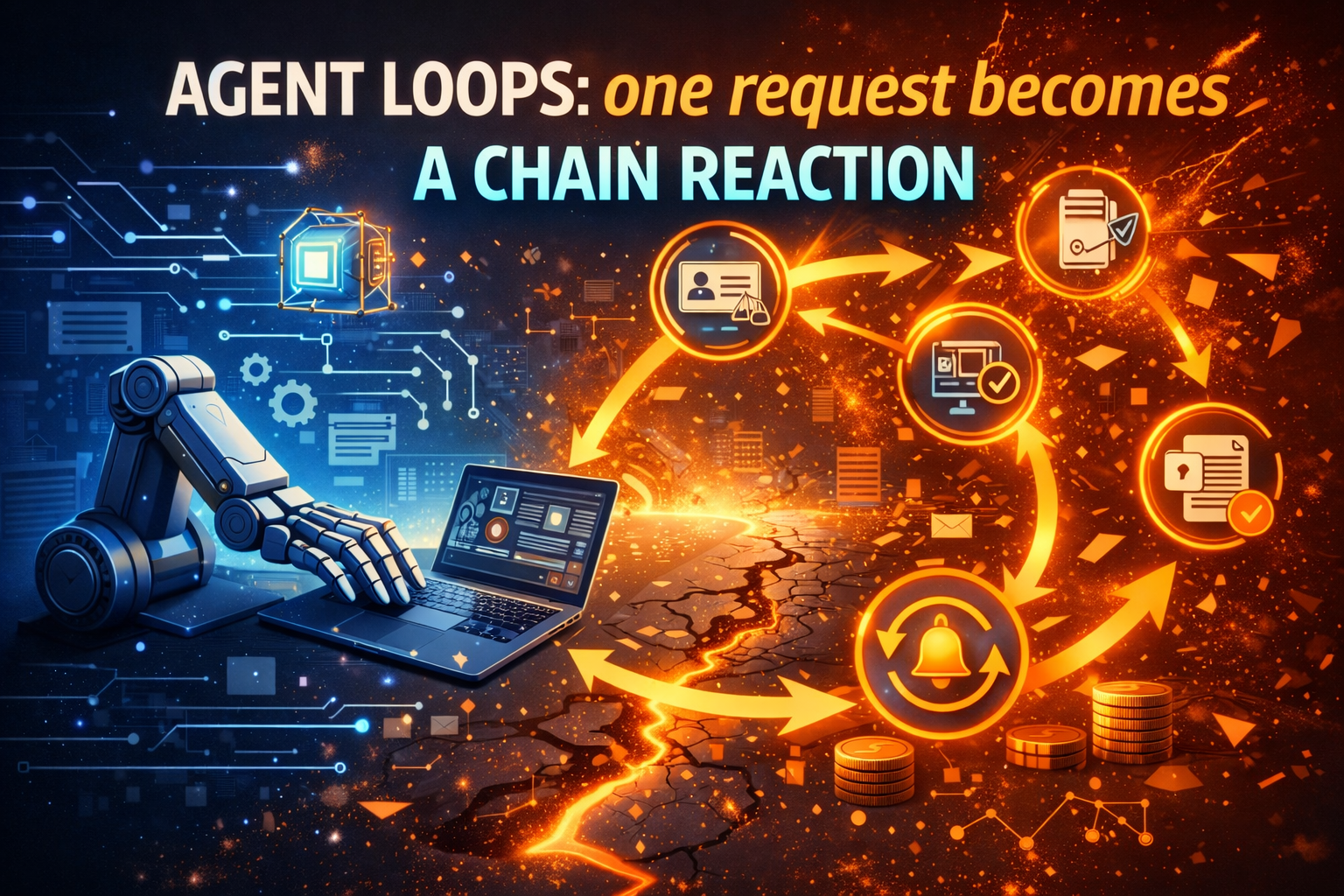
2) Agent loops: one request becomes a chain reaction
A classic chatbot is roughly one call per turn.
An agentic workflow is different. It plans, retrieves, calls tools, checks policy, retries, writes to systems, and summarizes. So one user request can trigger multiple model calls plus tool/API costs.
This is precisely why the FinOps community now treats AI as a new cost domain and emphasizes unit economics, prompt caching, and hidden “context creep.” (FinOps Foundation)
Simple example: “Reset access and verify permissions.”
Behind the scenes:
- retrieve policy
- call IAM
- validate approvals
- retry on tool failure
- generate audit note
- notify requestor
That’s not “one AI call.” It’s an agentic transaction.
3) Context inflation: RAG turns short prompts into long, expensive conversations
Your pilot prompt may be 200–500 tokens.
Production prompts often include:
- conversation history
- policies and playbooks
- customer context
- retrieved documents
- tool outputs
- structured state
Even if the model price stays the same, context grows—and spend rises with it. The FinOps Foundation explicitly warns that “per-token price” can mislead because operational realities like context window creep can drive spend sharply. (FinOps Foundation)
Enterprise trap: “Just add more context to reduce hallucinations.”
Yes—until you’re paying for a small book per interaction.
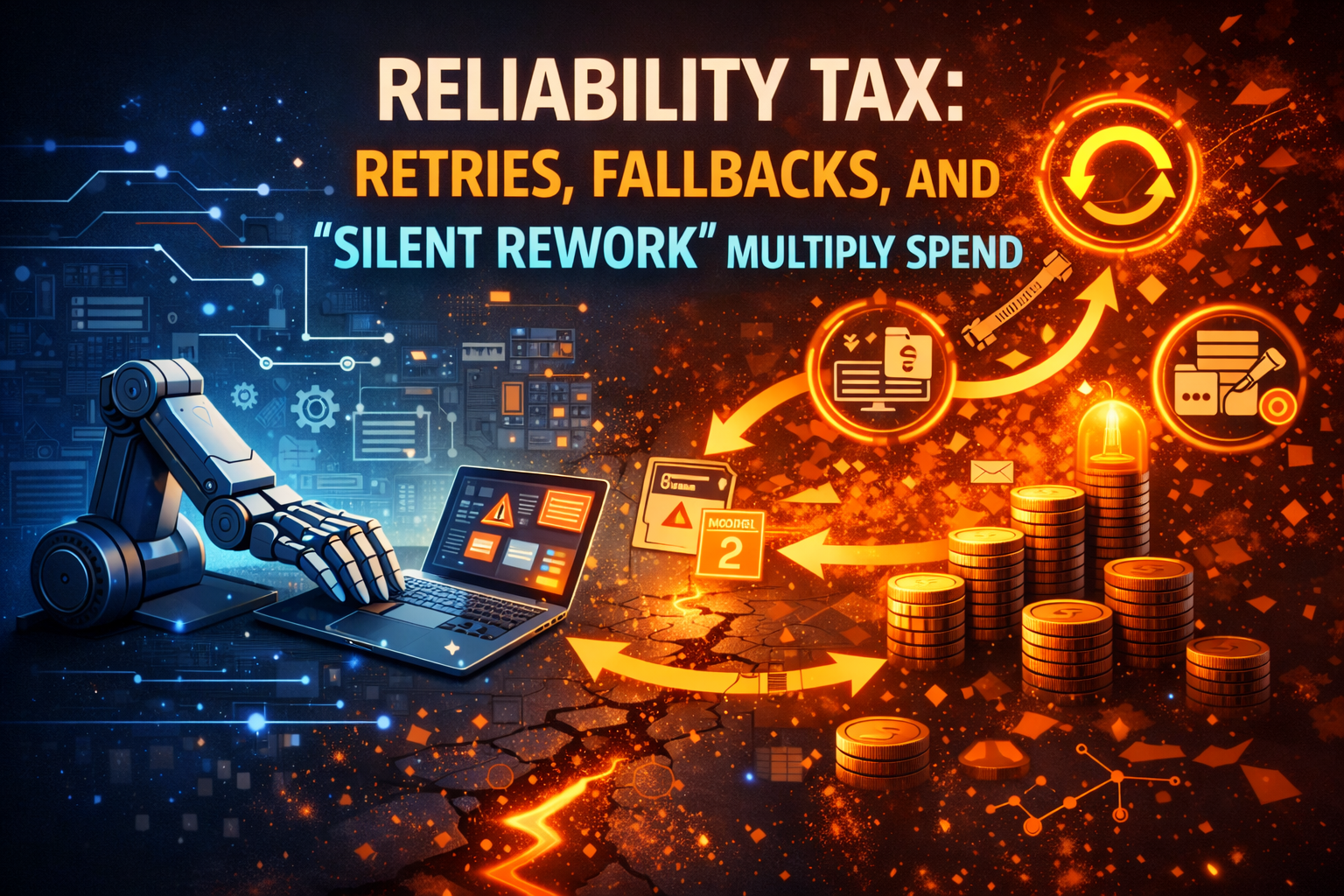
4) Reliability tax: retries, fallbacks, and “silent rework” multiply spend
Pilots tolerate occasional failures. Production can’t.
So teams add:
- retries when outputs fail guardrails
- fallback models during outages
- verification passes for critical answers
- reruns when hallucinations are suspected
- re-asks when formatting isn’t machine-readable
Each move is rational. Together, they form a reliability tax that compounds with volume.
And it often stays invisible because the system still “works.”
It just works by spending more.
5) Governance evidence: compliance turns outputs into receipts
When AI drafts content, governance is lighter.
When AI influences outcomes—eligibility, pricing, risk flags, approvals—governance becomes evidence-driven. That introduces new costs:
- decision provenance
- policy evaluation
- audit trails and retention
- human approvals / review queues
- evaluations and documentation
This is consistent with the direction of NIST’s AI Risk Management Framework: risk management is an ongoing lifecycle discipline organized around Govern, Map, Measure, Manage, with GOVERN as a cross-cutting function. (NIST Publications)
The enterprise twist: as regulation grows, the cost of proof rises—not just the cost of prediction.
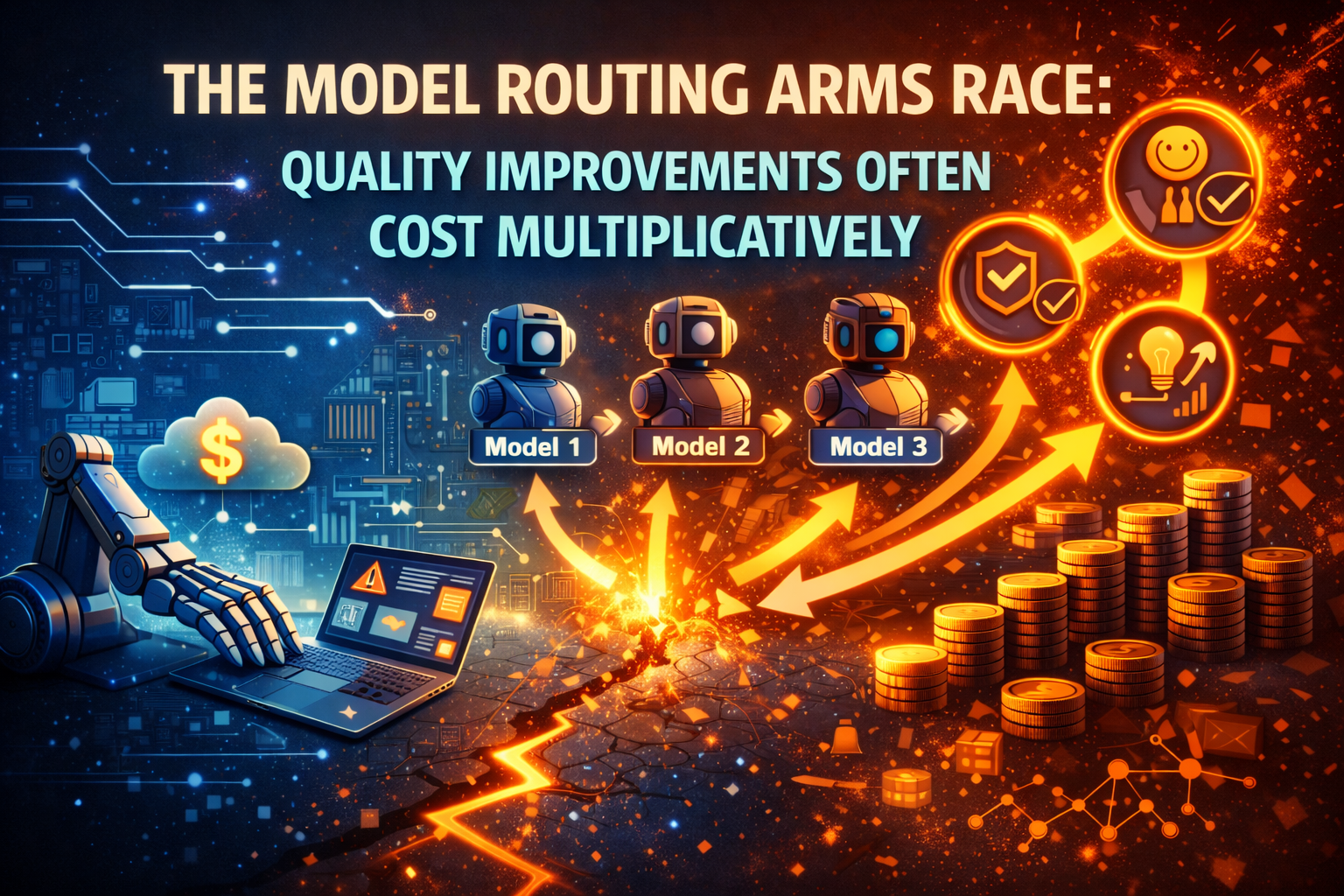
6) The model routing arms race: quality improvements often cost multiplicatively
After success, stakeholder asks change:
- “Can it be more accurate?” becomes “Can it be consistently correct?”
- “Can it answer?” becomes “Can it answer safely?”
- “Can it help?” becomes “Can it execute?”
Teams respond by upgrading models, adding parallel calls, ensembling, or verification passes.
That improves quality—but can double or triple cost if not governed with routing discipline and decision classes.
7) AI software estate sprawl: success attracts helpers, helpers attract overlap
As soon as AI becomes strategic, the enterprise stack expands:
- multiple LLM providers
- orchestration layers
- eval platforms
- guardrails
- observability
- vector databases
- redaction tools
- prompt management suites
Each tool is “small.” Together they form an AI estate—and estates drift toward sprawl unless controlled.
This is where costs become hard to explain: the AI bill stops being one line item and becomes a fragmented portfolio.
8) Shadow AI: unmanaged usage is the fastest way to burn money
When AI works, people adopt it without permission:
- direct API calls outside governance
- departmental copilots
- prototypes that quietly become production
- “just this one workflow” integrations
Spend leaks outside procurement and risk control. In many organizations, shadow AI becomes the largest source of unpredictable cost growth—because it scales with enthusiasm, not policy.
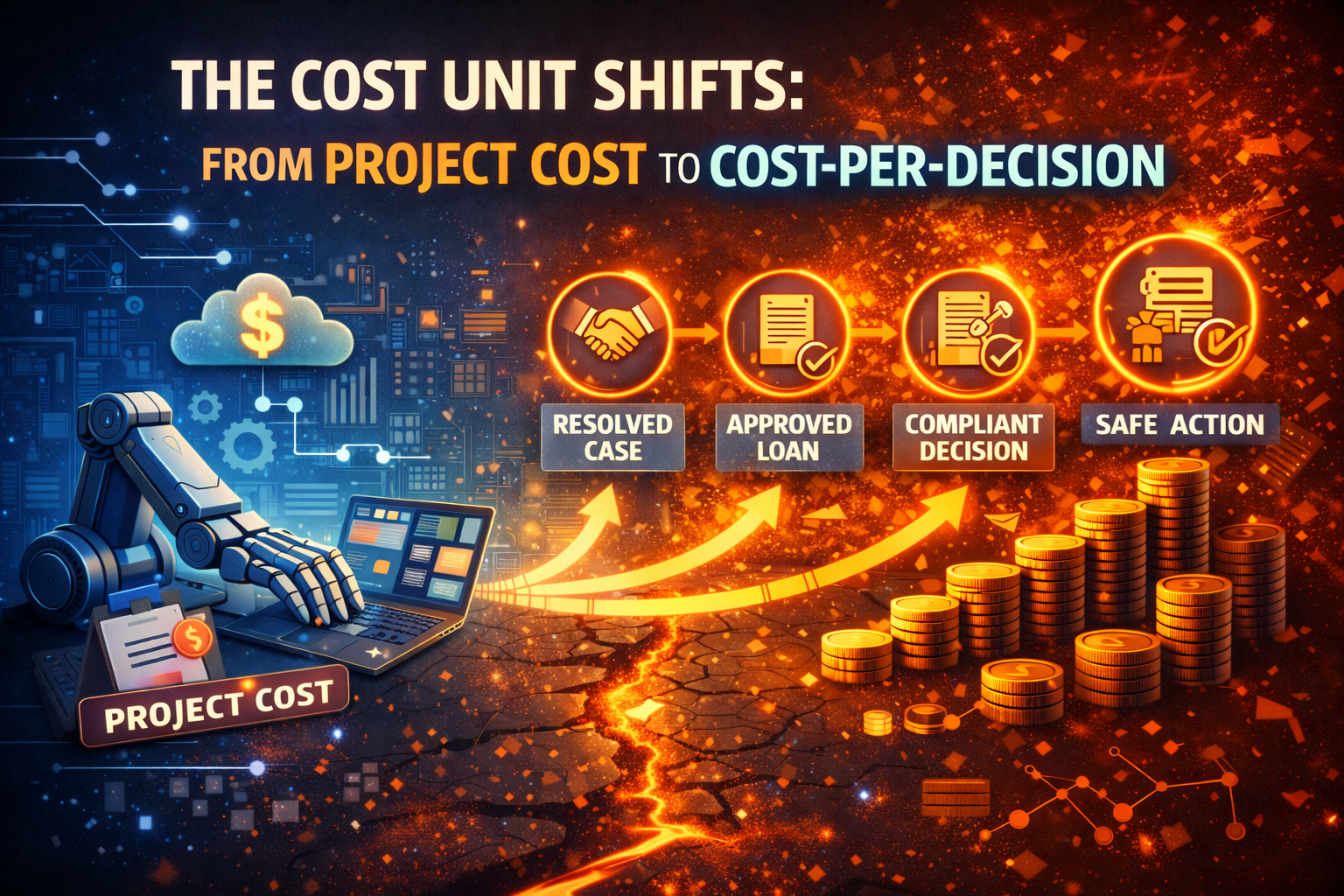
9) The cost unit shifts: from project cost to cost-per-decision
Pilots are budgeted like projects.
Production AI must be budgeted like operations:
- cost per resolved ticket
- cost per compliant decision
- cost per safely executed action
- cost per cycle time reduced
This is where spreadsheets fail. You need a decision-level cost model and controls that bind cost to value.
FinOps guidance for GenAI stresses unit economics and practical levers like caching and batching precisely because list pricing doesn’t reflect real spend drivers. (FinOps Foundation)
Three stories that explain the explosion without jargon
Story 1: The copilot becomes a call-center dependency
Month 1: optional drafting help.
Month 4: embedded into every case.
Now each case includes retrieval, summarization, compliance redaction, and structured notes. Volume is huge. Latency matters. Errors create rework. AI spend starts to behave like a telecom bill: recurring, volumetric, sensitive to peaks.
Story 2: The fraud agent crosses the action boundary
Pilot: “This looks suspicious.”
Production: “Freeze the account and open a case automatically.”
Now you must pay for stronger policy enforcement, traceability, approvals, rollback, remediation, and SLA engineering.
The cost doesn’t rise because the model got bigger.
It rises because the enterprise made the system accountable.
Story 3: The RAG assistant becomes the company’s answer engine
It begins as internal Q&A. Then it becomes onboarding, policy, architecture, compliance, vendor-contract support. Suddenly you’re maintaining indexing pipelines, permission-aware retrieval, freshness controls, and deduplication.
RAG has data gravity: the more useful it is, the more content it must ingest—and the more it costs to keep trustworthy.
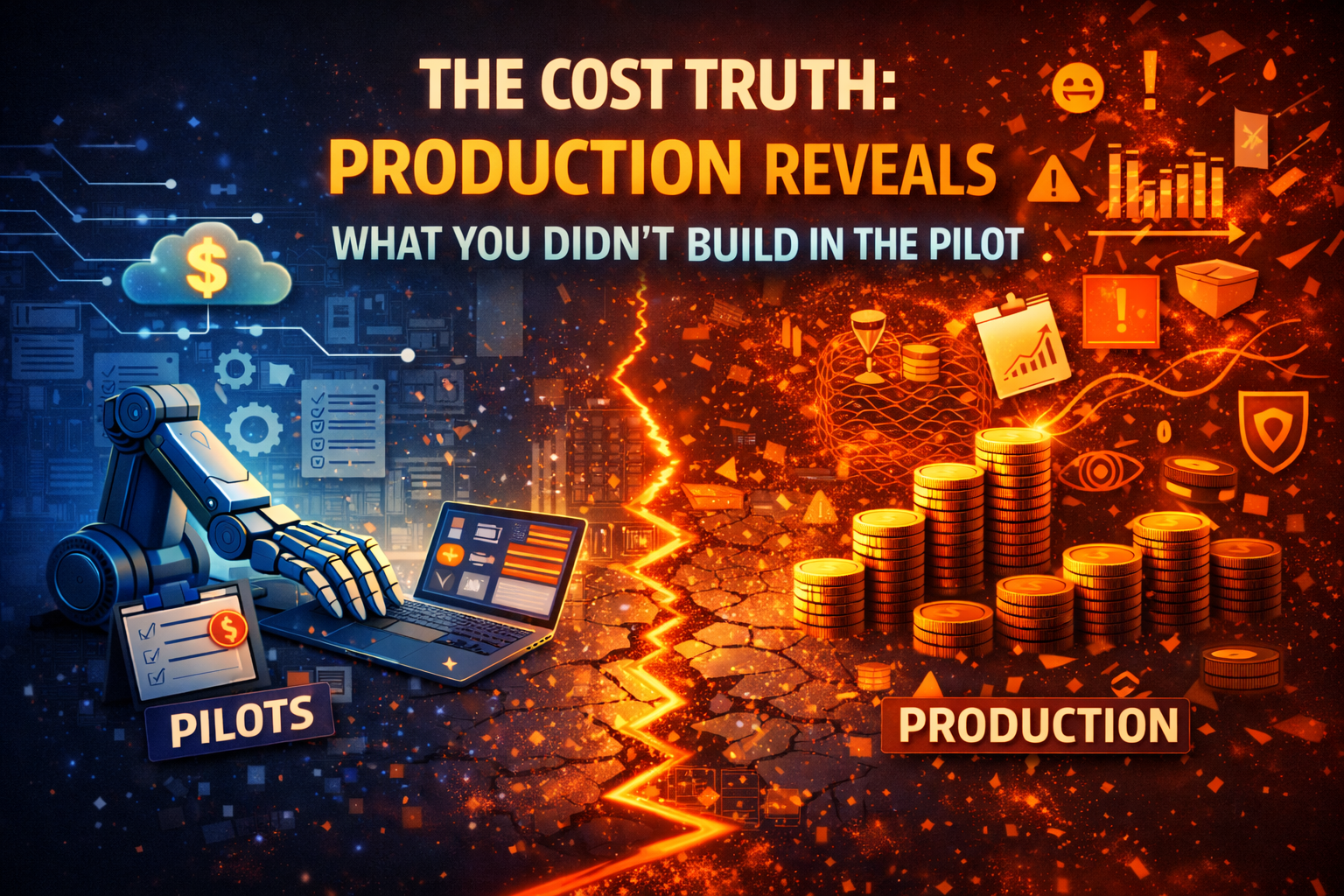
The cost truth: production reveals what you didn’t build in the pilot
Pilots hide reality:
- controlled usage
- narrow workflows
- permissive governance
- low reliability demands
- limited integrations
Production exposes:
- messy enterprise processes
- complex accountability
- real regulatory obligations
- expensive “proof” requirements
- tool and vendor sprawl
That’s why Gartner expects a meaningful share of initiatives to stall post-PoC—with escalating costs as a contributing factor. (Gartner)
The fix: an Enterprise AI Economics operating model (not “cost cutting”)
If your response is “we need cheaper models,” you’re already late.
The durable solution is to treat cost as part of the operating model—bound to decisions, risk, and value.
1) Measure cost per outcome, not cost per token
Tokens are a meter. Outcomes are the business.
Track:
- cost per resolved case
- cost per compliant decision
- cost per successful action
- cost per hour saved (validated)
This is where a Decision Ledger becomes economically powerful: it turns AI into accountable transactions you can price, govern, and improve.
2) Put an economic envelope on every decision class
Not every decision deserves premium models and deep retrieval.
Define decision classes:
- low-risk / low-value → smaller model, short context, aggressive caching
- high-risk / high-value → stronger model, richer context, full receipts
This is “routing with governance intent.”
3) Put hard limits on agent loops
Enforce caps:
- max steps per task
- max tool calls
- max tokens per session
- max retries
- max time budget
If a task can’t complete inside its envelope, it must escalate, not loop.
4) Make retrieval economical
Avoid “document stuffing.” Prefer precision:
- better chunking and indexing
- permission-aware retrieval
- citation-first responses
- caching stable policy snippets
This reduces cost and improves trust.
5) Treat governance as reusable infrastructure
If every team builds its own guardrails, logging, evaluation, redaction, and audit trails—cost sprawl is guaranteed.
Centralize reusable governance services (policy gateways, standardized receipts, shared eval harnesses). This aligns with NIST’s lifecycle framing where governance is infused throughout. (NIST Publications)
6) Build an Enterprise AI portfolio view
You should be able to answer, in one place:
- what agents/models are running
- who owns them
- what workflows invoke them
- what decision class they support
- the cost envelope and cost-per-outcome
- the business value attached
Without portfolio governance, AI becomes “a thousand small leaks.”
Enterprise AI Operating Model
Enterprise AI scale requires four interlocking planes:
Read about Enterprise AI Operating Model The Enterprise AI Operating Model: How organizations design, govern, and scale intelligence safely – Raktim Singh
- Read about Enterprise Control Tower The Enterprise AI Control Tower: Why Services-as-Software Is the Only Way to Run Autonomous AI at Scale – Raktim Singh
- Read about Decision Clarity The Shortest Path to Scalable Enterprise AI Autonomy Is Decision Clarity – Raktim Singh
- Read about The Enterprise AI Runbook Crisis The Enterprise AI Runbook Crisis: Why Model Churn Is Breaking Production AI—and What CIOs Must Fix in the Next 12 Months – Raktim Singh
- Read about Enterprise AI Economics Enterprise AI Economics & Cost Governance: Why Every AI Estate Needs an Economic Control Plane – Raktim Singh
Read about Who Owns Enterprise AI Who Owns Enterprise AI? Roles, Accountability, and Decision Rights in 2026 – Raktim Singh
Read about The Intelligence Reuse Index The Intelligence Reuse Index: Why Enterprise AI Advantage Has Shifted from Models to Reuse – Raktim Singh
Conclusion column: What to remember
AI costs don’t explode because models are expensive.
They explode because success turns AI into a high-volume, multi-step, governed decision utility.
The winners won’t be the enterprises with the cheapest per-token price.
They will be the ones that can run AI like critical infrastructure:
- governed (risk is managed continuously)
- auditable (decisions have receipts)
- economically bounded (envelopes per decision class)
- operationally reliable (no silent retry storms)
This is exactly why your Enterprise AI Operating Model matters: it gives enterprises a way to scale intelligence without letting economics break the program.
FAQ
1) Why do pilots underestimate GenAI cost so badly?
Because pilots hide the multipliers: context growth, retries, governance receipts, integration overhead, and the volume that comes with habit formation—then production makes them non-optional. Gartner’s post-PoC abandonment prediction includes escalating costs as a factor. (Gartner)
2) Is inference really the long-term cost center?
For most enterprise deployments, the dominant spend shifts toward inference and operationalization at scale, where latency and reliability constraints drive continuous usage. (For estimation approaches, see NVIDIA’s inference cost/TCO guidance.) (NVIDIA Developer)
3) What’s the biggest “silent” cost driver?
Context window creep plus retries—because they multiply spend while still appearing as “normal” usage. (FinOps Foundation)
4) Do open-source models solve the cost explosion?
They can reduce unit price, but the largest multipliers are workflow-level (agent steps, retrieval depth, governance evidence, sprawl). Open source helps—but doesn’t replace an economic control plane.
5) What’s the single first control to implement?
Decision classes with economic envelopes (limits on steps/tokens/tools/retries) tied to cost-per-outcome—consistent with FinOps guidance to treat GenAI pricing through unit economics, not list price alone. (FinOps Foundation)
Glossary
- Inference: Running a trained model in production to generate outputs; often the primary cost driver at scale. (NVIDIA Developer)
- RAG (Retrieval-Augmented Generation): An approach that retrieves enterprise documents and adds them to prompts, improving grounding but increasing context and pipeline costs.
- Agentic workflow: A multi-step system where AI plans and executes via tool calls, retries, and verification; one user request can produce many model calls. (Gartner)
- Context window creep: Gradual growth of prompt/context payload over time, which increases token spend non-linearly. (FinOps Foundation)
- Economic envelope: A hard budget for an AI decision class (max tokens, steps, tool calls, retries, time).
- Cost per decision: Unit economics metric that ties AI spend to a business outcome (e.g., cost per resolved ticket).
- AI governance receipts: Evidence linking a decision to model/version, policy checks, data provenance, and approvals; essential for auditability and regulated outcomes. (NIST Publications)
- FinOps for AI: Applying FinOps practices to AI’s volatile, usage-based cost model; includes unit economics, forecasting, and optimization levers. (FinOps Foundation)
References and further reading
- Gartner: Generative AI spending forecast to reach $644B in 2025. (Gartner)
- Gartner: 30% of GenAI projects predicted to be abandoned post-PoC by end of 2025; drivers include escalating costs/unclear value. (Gartner)
- Gartner (via Reuters) + Gartner release: Over 40% of agentic AI projects expected to be canceled by end of 2027 due to costs/unclear value/risk controls. (Reuters)
- NIST AI RMF 1.0 (Core functions: Govern, Map, Measure, Manage; GOVERN as cross-cutting). (NIST Publications)
- FinOps Foundation: FinOps for AI topic hub + GenAI token pricing realities (unit economics, context creep, caching). (FinOps Foundation)
- NVIDIA: Practical guidance on estimating LLM inference cost and TCO for production deployments. (NVIDIA Developer)



Raktim Singh is an AI and deep-tech strategist, TEDx speaker, and author focused on helping enterprises navigate the next era of intelligent systems. With experience spanning AI, fintech, quantum computing, and digital transformation, he simplifies complex technology for leaders and builds frameworks that drive responsible, scalable adoption.