

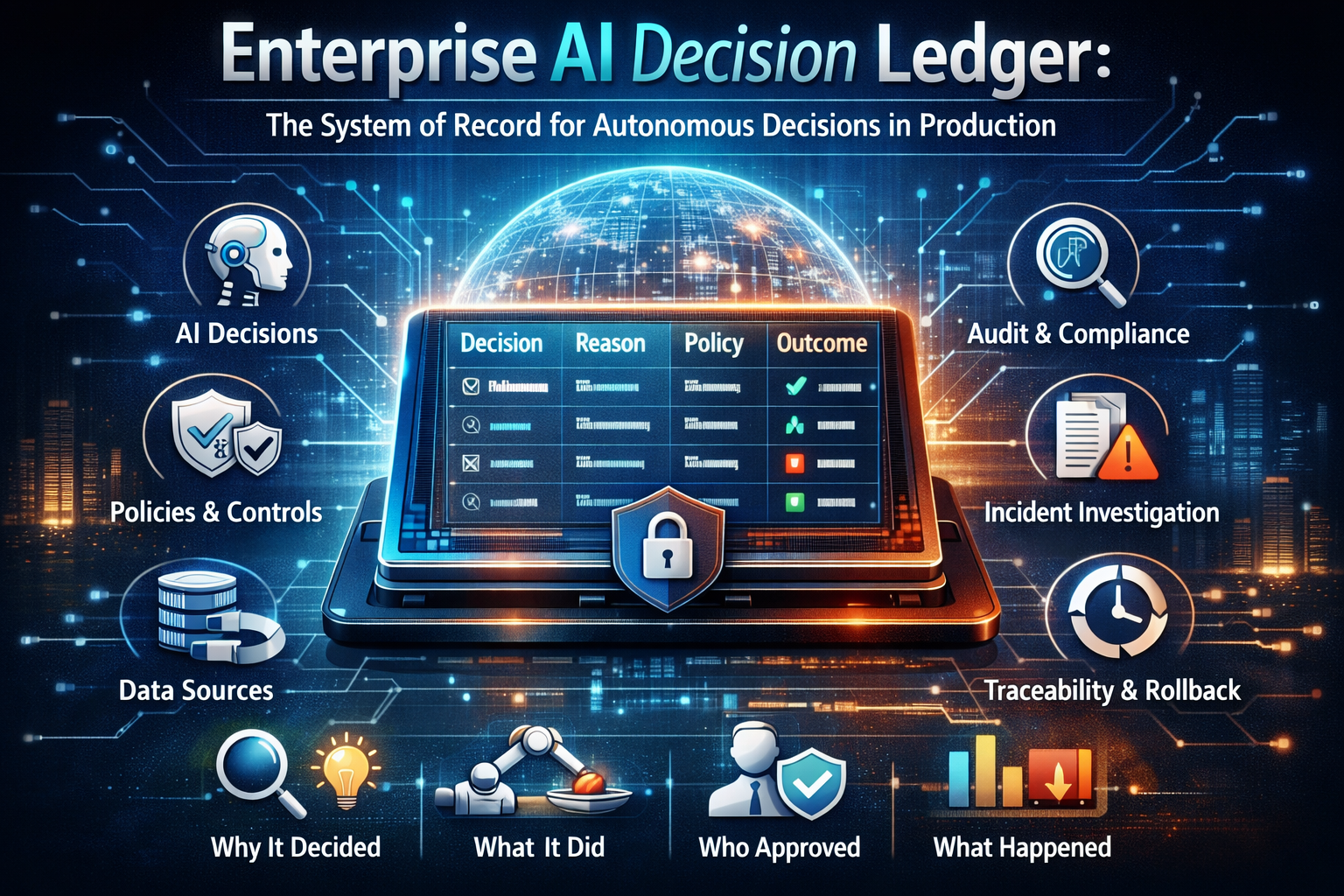
Enterprise AI Decision Ledger
As artificial intelligence systems move from advising humans to making and executing decisions, enterprises face a new problem: how do you defend an AI decision after it has already acted?
Logs, metrics, and dashboards explain what happened—but not why a decision was made, under what constraints, or who was accountable.
This is where the Decision Ledger becomes essential. A Decision Ledger turns AI behavior into defensible, auditable evidence, making autonomous AI systems trustworthy at enterprise scale.
Why Defensibility Is the Real Enterprise AI Problem
Enterprises already know how to log software.
But Enterprise AI doesn’t fail like software—and that single difference changes everything.
In production, an AI system can produce a plausible output, trigger a real action, and still leave behind “green” operational dashboards. Then—days later—someone notices downstream damage: a wrong approval, a broken workflow, an avoidable cost spike, or a policy breach that looked “reasonable” at the moment it happened.
That is the core asymmetry:
Enterprise AI failures are often decision failures first—and system failures later.
So if you want autonomy that scales, you need a system of record designed for decisions, not just events.
That system is the Enterprise AI Decision Ledger.
TL;DR for leaders
An Enterprise AI Decision Ledger is a tamper-evident, queryable record of AI decisions that captures: decision intent, evidence, controls applied, ownership/approvals, model/policy/tool versions, and outcomes. It’s how organizations make autonomous AI auditable, reversible, defensible, and improvable—especially once AI crosses the Action Boundary into real workflows.
What is an Enterprise AI Decision Ledger?
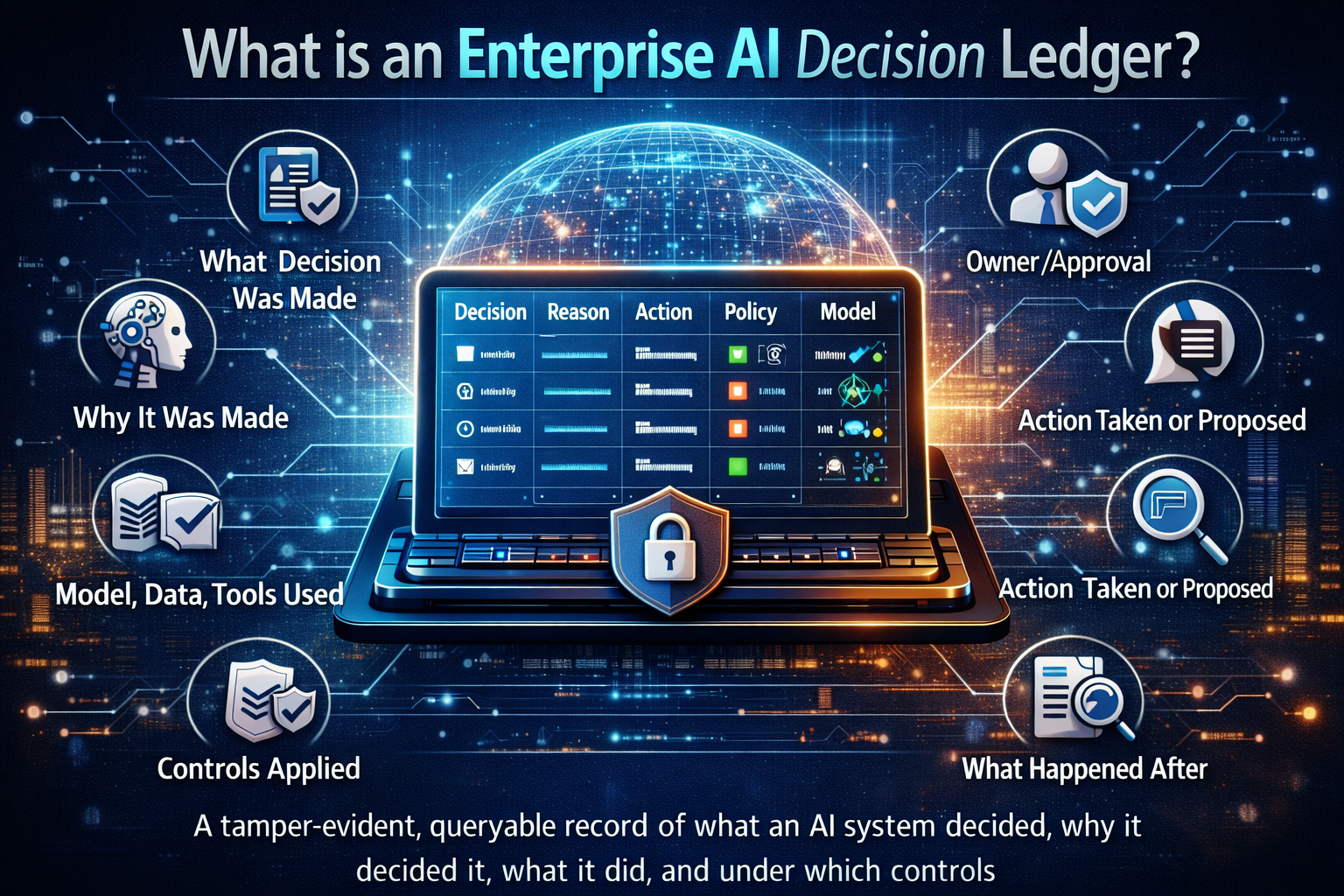
An Enterprise AI Decision Ledger is a decision-centric system of record that captures:
- What decision was made
- Why it was made (the decision basis)
- What action was taken (or recommended)
- Which policies and controls were applied
- Which models, prompts, tools, and data sources were involved
- Who owned it / who approved it (when required)
- What happened after (outcomes, corrections, incidents, rollbacks)
Think of it as the enterprise’s decision black box for autonomous systems.
Not a debug log.
Not a chat transcript.
Not a trace.
A ledger is designed so that later you can answer the questions that actually matter in production:
- Why did the AI do this?
- Which policy version allowed it?
- Was this reversible at the time?
- Who signed off—or should have?
- How many similar decisions happened last week?
- What can we safely roll back?
This aligns with the growing emphasis in AI risk and accountability guidance on documentation, traceability, and disclosure—not as paperwork, but as operational proof. (NIST Publications)
Why logs, traces, and dashboards are not enough
Most enterprises already have:
- application logs
- distributed tracing
- security logs
- monitoring dashboards
And now many teams are adding AI observability using standardized telemetry patterns—especially around model calls, tokens, latency, and tool use. (OpenTelemetry)
That’s progress. But it’s not sufficient.
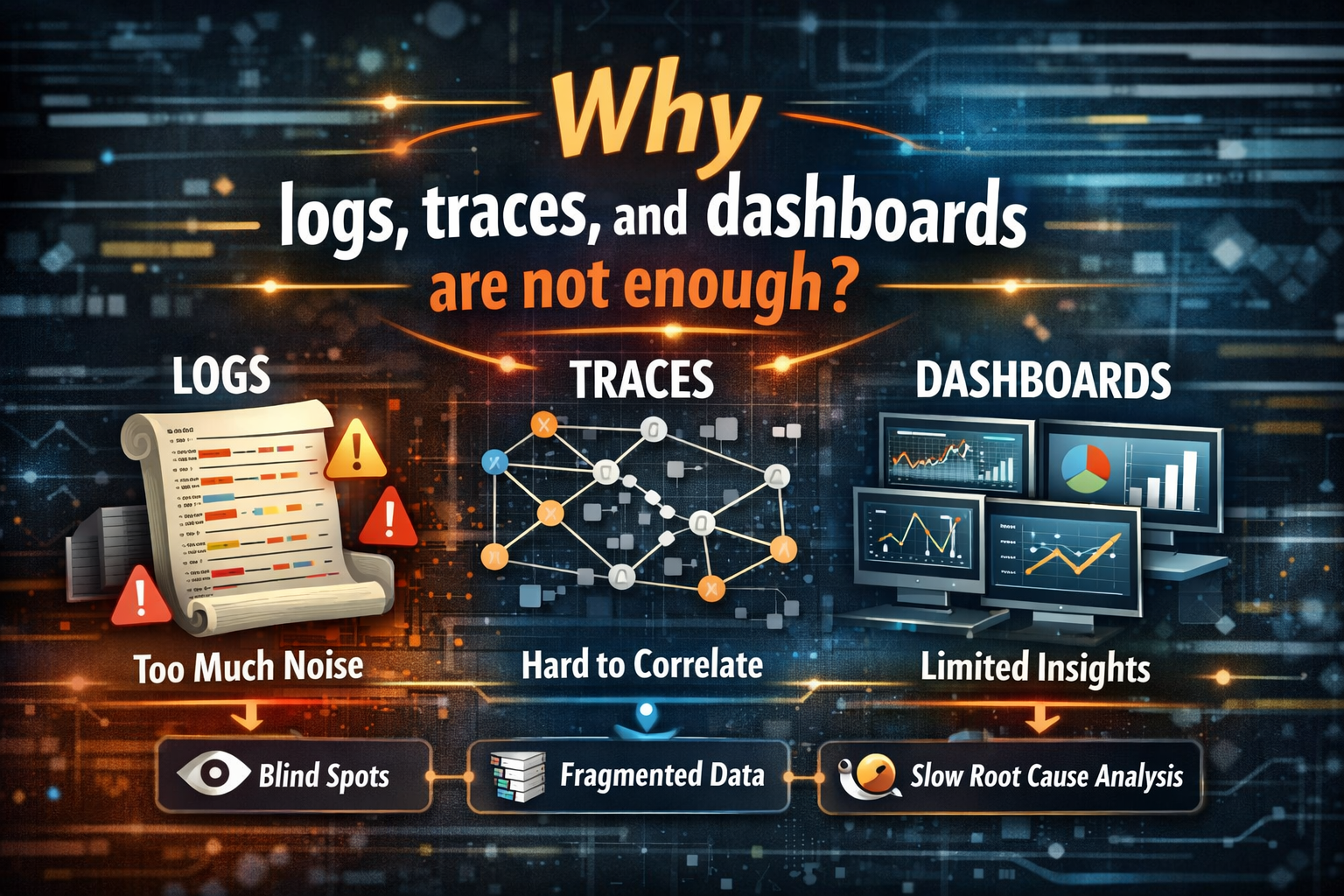
- Logs answer: What happened in the system?
- Traces answer: What steps executed, in what order?
- Metrics answer: How often, how slow, how expensive?
- A Decision Ledger answers: What decision was made, under what authority, based on what evidence, and with what outcome?
In other words:
Observability tells you how the system ran.
The Decision Ledger tells you whether autonomy was defensible.
The Action Boundary makes the ledger mandatory
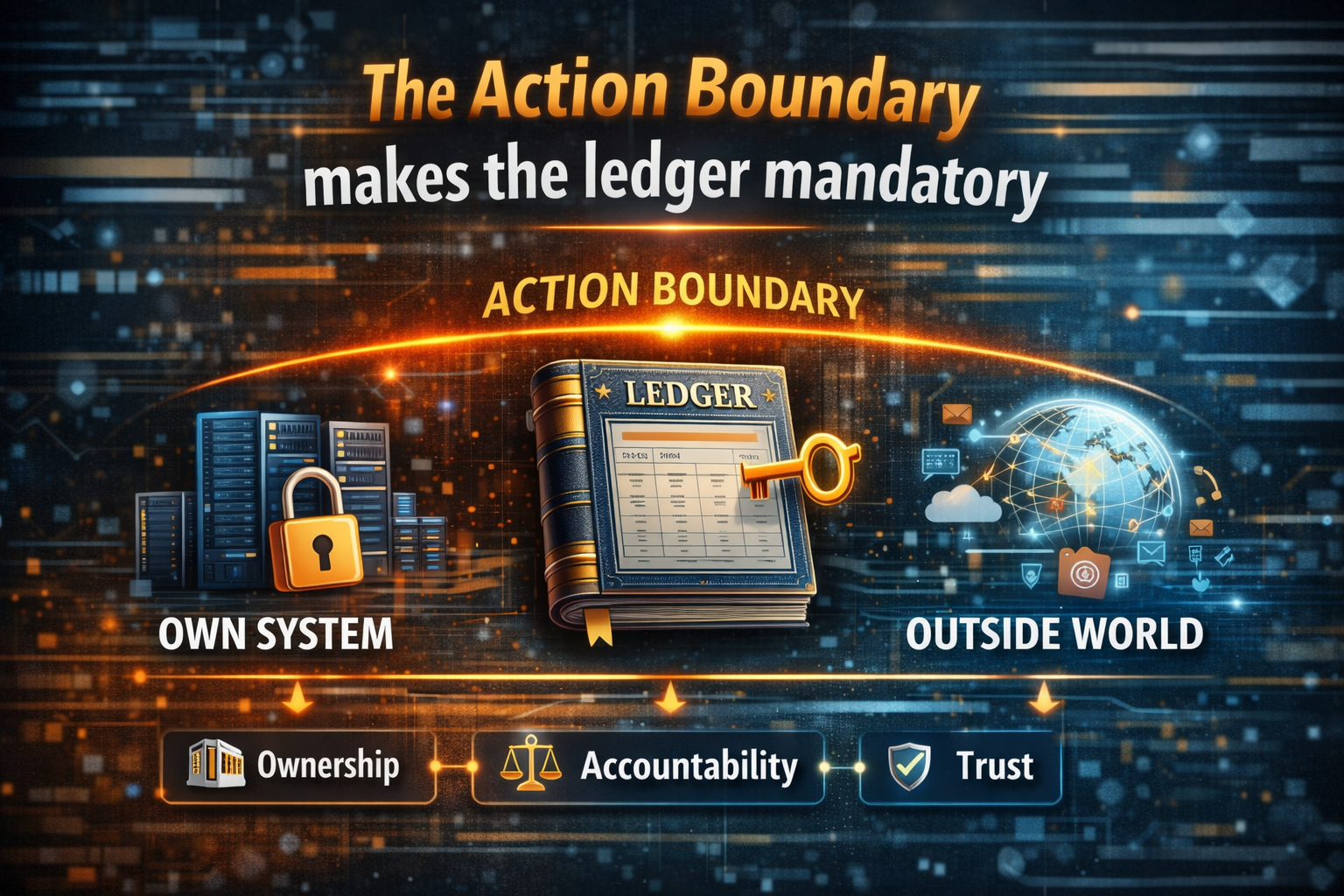
The more an AI system moves from:
advice → drafts → execution
…the more the enterprise needs decision traceability.
Because once AI decisions touch real workflows:
- auditability becomes a business requirement
- forensics becomes an operational requirement
- accountability becomes a leadership requirement
FINOS’ AI Governance Framework puts this bluntly: decision audit and explainability mechanisms are required to support regulatory compliance, incident investigation, and decision accountability. (air-governance-framework.finos.org)
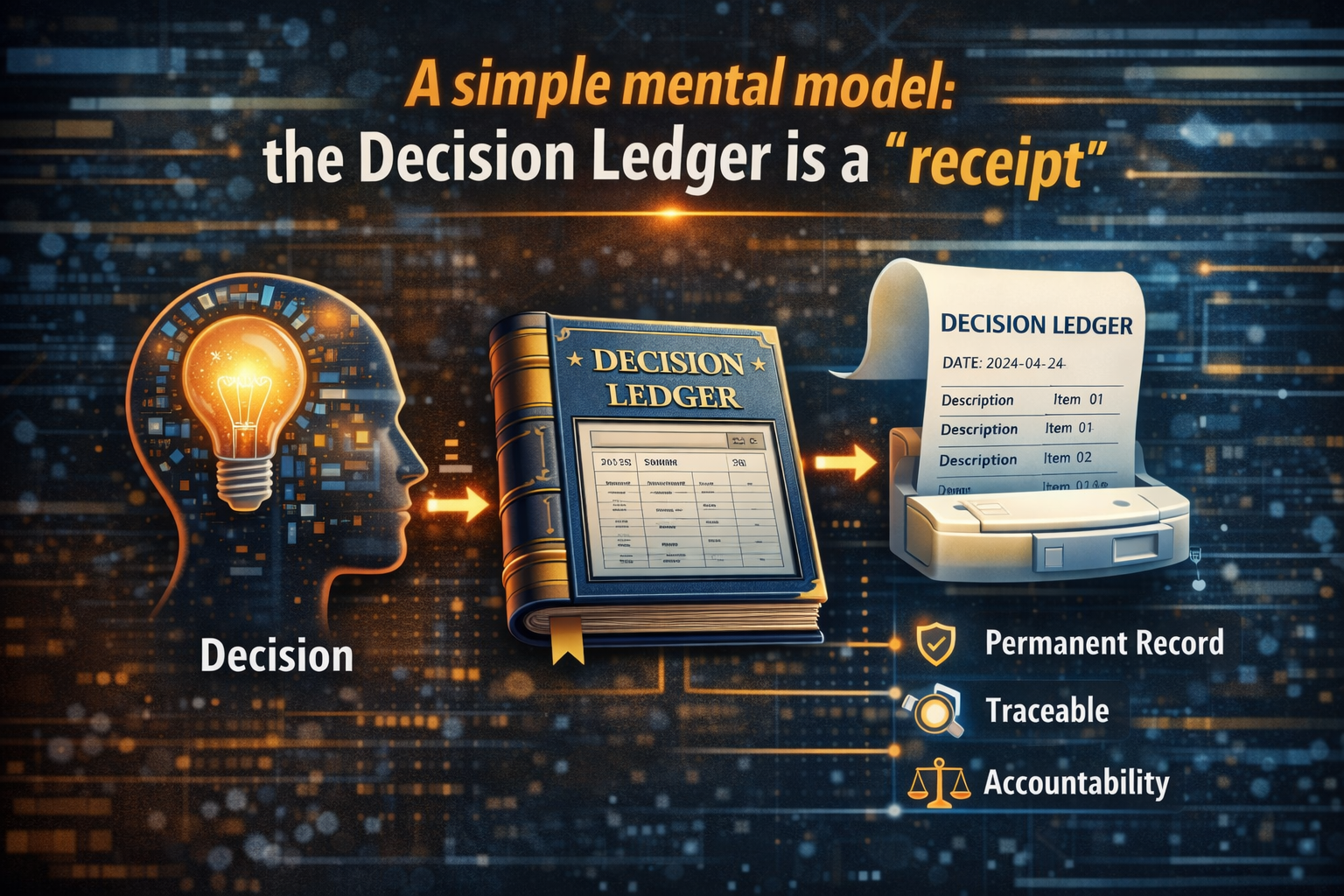
A simple mental model: the Decision Ledger is a “receipt”
If you buy something important, you expect a receipt.
A receipt tells you:
- what you bought
- when you bought it
- how much you paid
- who sold it
- what policy applied (returns/warranty)
A Decision Ledger is the enterprise receipt for autonomous intelligence.
It’s how the enterprise can prove:
- this decision happened
- under these controls
- with this evidence
- by this owner
- with this outcome
What the ledger must capture (without turning into surveillance)
A good Decision Ledger is minimal, structured, and defensible—not a privacy nightmare and not a data swamp.
1) Decision identity
A unique decision ID plus:
- decision type/class (from your decision taxonomy)
- mode: suggest / draft / execute
- workflow location (which business step)
2) Context snapshot
What the system “knew” at decision time:
- relevant inputs (sanitized/redacted where needed)
- environment signals (risk tier, policy tier, intent classification)
- constraints (cost cap, approval required, time window)
3) Evidence and sources
If the decision used:
- retrieval results
- tools
- knowledge bases
- structured records
…store references (IDs, pointers, hashes) wherever possible, not raw sensitive payloads.
This is the difference between “the model said X” and “the model decided X based on these sources.”
4) Reasoning summary (not chain-of-thought dumping)
Enterprises often make one of two mistakes:
- store nothing meaningful, or
- store raw “thought dumps” that are messy, risky, and unusable
A better pattern:
- store a decision rationale summary: key factors, key rules triggered, and constraints applied
- store guardrail outcomes: what was checked, what passed/failed, and why
This creates auditability without turning the ledger into an unbounded transcript archive.
5) Policy, permissions, and controls applied
For every decision, capture:
- which policies were evaluated
- which controls passed/failed
- whether the action was reversible
- approvals requested/granted/bypassed (with reason)
6) Ownership anchor
The ledger must always answer:
- which team owns the agent
- who owns the workflow
- who owns the decision class
- who is on-call for incidents
Without ownership, you don’t have governance—you have theatre.
7) Outcome signals
Later, attach:
- success/failure
- downstream corrections
- exception triggers
- incident links
- rollback events
This is how the ledger becomes a learning engine, not just an audit artifact.
Enterprise AI Operating Model
Enterprise AI scale requires four interlocking planes:
Read about Enterprise AI Operating Model The Enterprise AI Operating Model: How organizations design, govern, and scale intelligence safely — Raktim Singh
- Read about Enterprise Control Tower The Enterprise AI Control Tower: Why Services-as-Software Is the Only Way to Run Autonomous AI at Scale — Raktim Singh
- Read about Decision Clarity The Shortest Path to Scalable Enterprise AI Autonomy Is Decision Clarity — Raktim Singh
- Read about The Enterprise AI Runbook Crisis The Enterprise AI Runbook Crisis: Why Model Churn Is Breaking Production AI — and What CIOs Must Fix in the Next 12 Months — Raktim Singh
- Read about Enterprise AI Economics Enterprise AI Economics & Cost Governance: Why Every AI Estate Needs an Economic Control Plane — Raktim Singh
Read about Who Owns Enterprise AI Who Owns Enterprise AI? Roles, Accountability, and Decision Rights in 2026 — Raktim Singh
Read about The Intelligence Reuse Index The Intelligence Reuse Index: Why Enterprise AI Advantage Has Shifted from Models to Reuse — Raktim Singh
Read about Enterprise AI Agent Registry Enterprise AI Agent Registry: The Missing System of Record for Autonomous AI — Raktim Singh
Three simple examples that reveal why this matters
Example 1: Autonomous workflow routing
An AI agent routes requests to the “best” internal queue.
A Decision Ledger lets you answer:
- which rule or evidence caused routing
- whether it overrode a priority policy
- whether data was stale
- how many similar routings happened last week
- which policy version was active
Without a ledger, you only see: the ticket moved.
With a ledger, you see: why it moved.
Example 2: A high-risk action is blocked
An agent attempts an action that triggers human approval required.
The ledger records:
- the attempted action
- the control that blocked it
- the approver (if approved)
- the final outcome
This is exactly the kind of “decision audit” control emphasized for agentic systems: comprehensive capture of agent actions, reasoning processes, and decision factors for forensic analysis. (air-governance-framework.finos.org)
Example 3: Silent policy drift
Nothing crashed. No alarms fired.
But a policy update changed what the agent is allowed to do. Three weeks later, outcomes worsen.
A Decision Ledger lets you trace:
- what changed
- from which date
- which decisions were impacted
- what rollback is safe
This connects directly to the need for documented change tracking and version history in responsible AI practices. (NIST Publications)
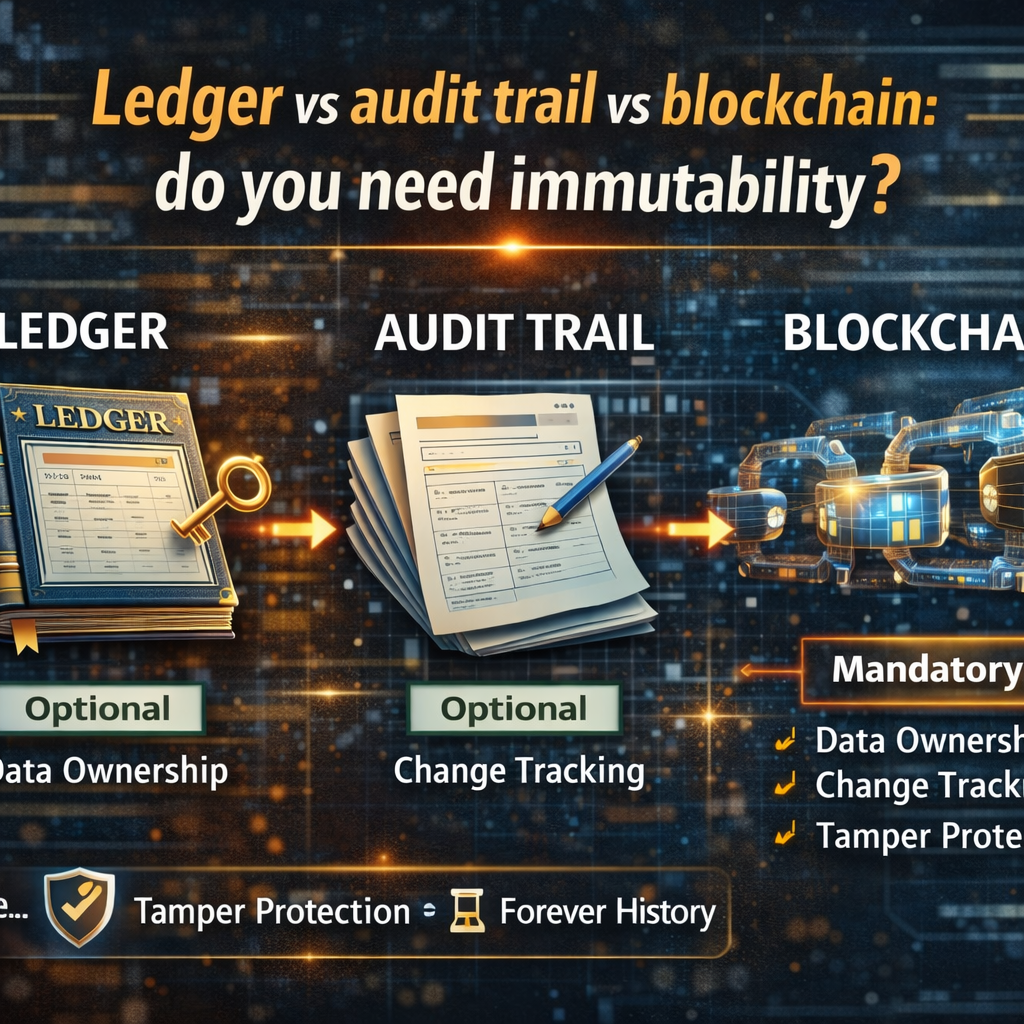
Ledger vs audit trail vs blockchain: do you need immutability?
Some teams hear “ledger” and immediately think “blockchain.”
For most enterprises, that’s unnecessary.
You don’t need hype. You need integrity.
A practical stance:
- for most systems: strong access control + append-only storage + cryptographic hashing + retention policies
- for extreme environments: stronger immutability approaches may be justified
The goal is simple:
If an auditor, regulator, or internal investigator asks, you can prove the record is trustworthy.
Where the Decision Ledger sits in your Enterprise AI Operating Model
In the Enterprise AI operating model, the Decision Ledger becomes the shared spine connecting:
- Runtime (what executed)
- Control Plane (what was allowed)
- Enforcement Doctrine (what was paused, blocked, escalated)
- Incident Response (what was investigated and learned)
- Economics (what was spent, where, and why)
- Ownership (who is accountable)
This is why a Decision Ledger is not “yet another logging tool.”
It is the system of record for autonomy.
(For readers new to your canon, link back to your pillar: your Enterprise AI Operating Model page.)
Implementation guidance (no vendor talk, just design truth)
Start with decision classes
Not every decision deserves the same depth.
Use your decision taxonomy to define:
- basic decisions: minimal fields
- sensitive decisions: richer evidence + approvals + integrity controls
- irreversible decisions: strict retention + review + stronger integrity guarantees
Don’t store secrets—store references
Where privacy is involved:
- redact
- tokenize
- store pointers and hashes
- keep evidence in access-controlled systems, not in the ledger itself
Tie it to observability standards
Modern teams are instrumenting model interactions and agent workflows using OpenTelemetry conventions and emerging gen-AI telemetry patterns. (OpenTelemetry)
The ledger should link to traces, not compete with them.
Make it queryable by non-engineers
If only engineers can query it, you’ve failed.
A real ledger supports:
- risk and compliance teams (audit queries)
- incident commanders (forensics)
- product owners (behavior review)
- leadership (decision-level governance metrics)
What makes a Decision Ledger enterprise-grade
An enterprise-grade Decision Ledger must be:
- Reconstructable (you can rebuild the decision narrative)
- Minimal (sustainable and privacy-safe)
- Structured (not raw transcript dumps)
- Tamper-evident (integrity you can defend)
- Version-linked (policy/model/tool versions always captured)
- Incident-ready (usable in response and forensics)
- Retention-aware (what you keep, how long, who can access)
This is consistent with the broader direction of public accountability guidance emphasizing transparent information flow and plain-language disclosures of how systems work in real contexts. (NTIA)
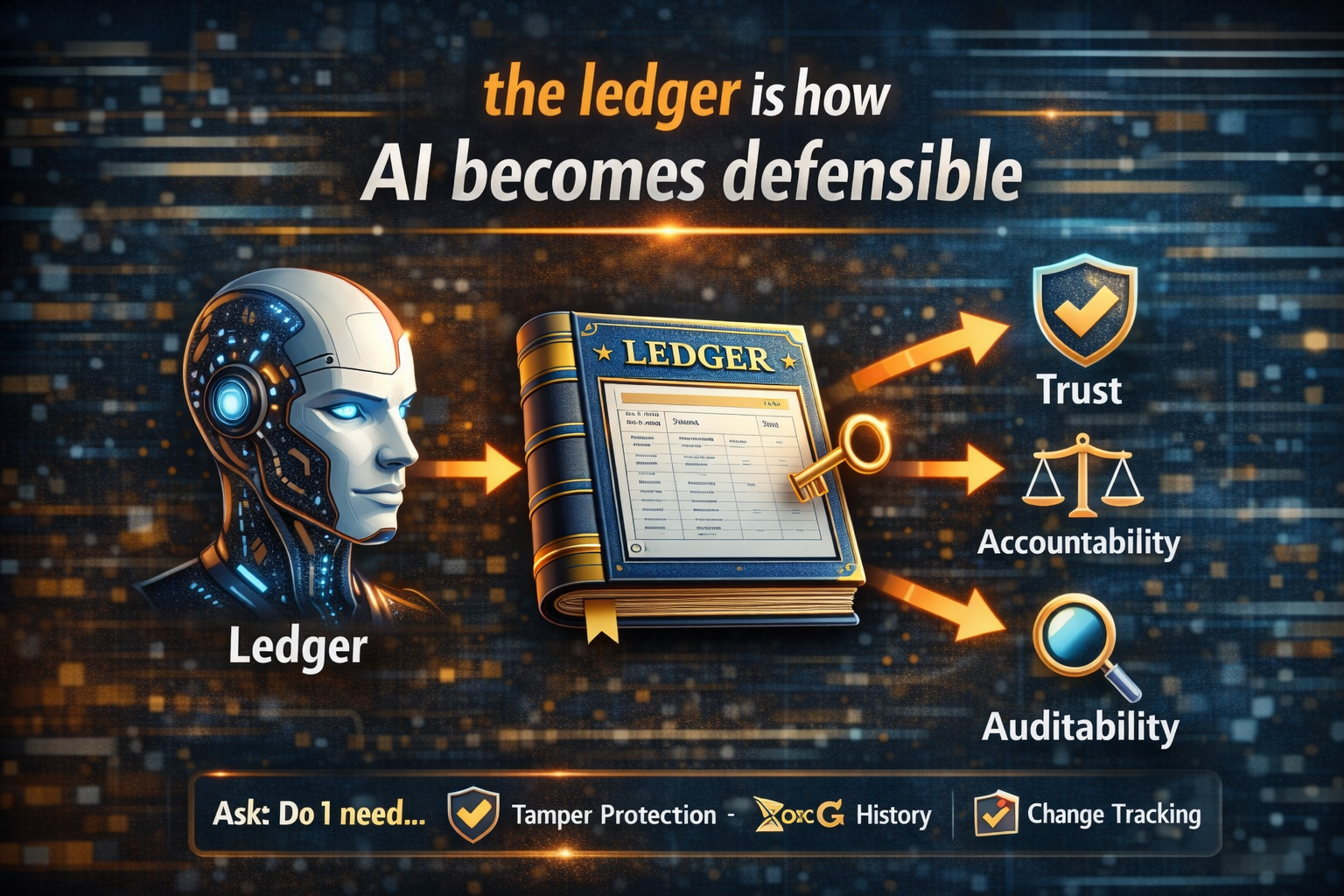
The viral insight: the ledger is how AI becomes defensible
Most Enterprise AI conversations obsess over:
- model choice
- prompts
- benchmarks
But enterprises win with something else:
Defensibility.
The Decision Ledger is what turns AI from:
- “a smart feature”
into - “an accountable operating capability.”
That is the difference between pilots that impress and autonomy that scales.
Conclusion column: the Enterprise AI Ledger Test
Before you call a system “Enterprise AI,” ask five questions:
- Can we reconstruct why it made that decision?
- Can we prove which policy and version governed it?
- Can we identify who owns it and who approves it?
- Can we roll back safely when it’s wrong?
- Can we learn from outcomes and reduce repeat failures?
If the answer is “no,” you don’t have scalable autonomy.
You have a prototype.
FAQ: Enterprise AI Decision Ledger
Is a Decision Ledger the same as an audit log?
No. Audit logs record system events. A Decision Ledger records decision intent, basis, controls, and outcomes in a structured form designed for governance and forensics.
Do we need to store chain-of-thought?
Usually no. Store decision rationale summaries, key factors, and guardrail outcomes. You want defensible, operational records—not unbounded internal text.
How does this relate to incident response?
Incidents require reconstruction. The ledger makes decision forensics fast and reliable—critical for containment, rollback, and prevention.
How does this relate to AI observability?
Observability explains performance and execution flow (metrics/traces/logs). The ledger explains decision authority and basis. They should link together through IDs and references. (OpenTelemetry)
Is blockchain required?
No. Most enterprises only need append-only + tamper-evident records. Blockchain may be useful in specialized cases, but is not a baseline requirement.
Glossary
Decision Ledger: A tamper-evident, queryable system of record for AI decisions, including basis, controls, and outcomes.
Decision Traceability: The ability to reconstruct what was decided, why, and under what constraints and evidence.
Decision Lineage: A chain from input → evidence → reasoning summary → action → outcome.
Tamper-evident: Designed so unauthorized changes are detectable (integrity guarantees).
Action Boundary: The point where AI moves from advice to actions that affect real workflows and systems.
Reversible autonomy: Autonomy designed so unsafe behavior can be paused, rolled back, and corrected.
Guardrails: Policy, risk, approval, and cost constraints enforced at runtime.
Decision forensics: Investigation of decisions after incidents or anomalies to determine causes and corrective actions.
System of record: The authoritative source that others rely on for truth and accountability.
System card: A disclosure artifact explaining how an AI system behaves in real contexts, beyond a single model. (NTIA)
References and further reading
- NIST AI Risk Management Framework (AI RMF 1.0) (risk management, documentation, version tracking principles). (NIST Publications)
- NTIA AI Accountability Policy Report (information flow, disclosures, system cards, plain-language accountability). (NTIA)
- FINOS AI Governance Framework and the mitigation “Agent Decision Audit and Explainability” (auditability + explainability as an enterprise control). (air-governance-framework.finos.org)
- OpenTelemetry for Generative AI and Semantic Conventions (standardizing telemetry signals). (OpenTelemetry)



Raktim Singh is an AI and deep-tech strategist, TEDx speaker, and author focused on helping enterprises navigate the next era of intelligent systems. With experience spanning AI, fintech, quantum computing, and digital transformation, he simplifies complex technology for leaders and builds frameworks that drive responsible, scalable adoption.