

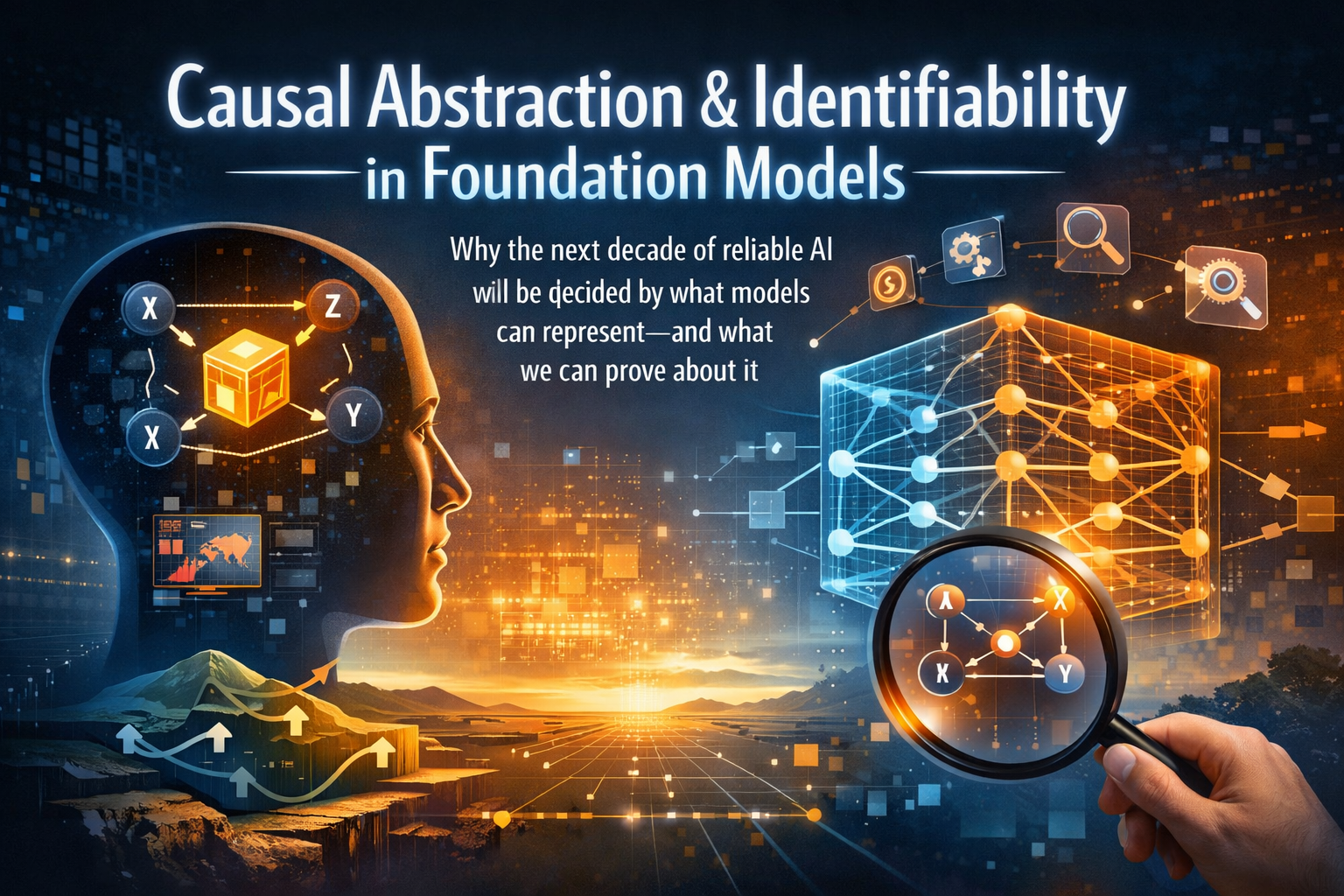
The Reliability Gap in Enterprise AI: Why Bigger Models Won’t Fix What’s Broken
For the past three years, the dominant response to AI failure has been scale. Larger models. More parameters. More data. More compute.
Yet enterprise incidents continue to rise—not because models are underpowered, but because they are misgoverned. The reliability gap in Enterprise AI is not a capability problem. It is a control problem. It is the widening distance between what models can generate and what organizations can safely operationalize.
What Is the Reliability Gap?
Foundation models have become the most powerful pattern learners ever deployed. They compress vast experience into internal representations and generate fluent text, code, images, plans, and tool-driven actions.
But a quieter frontier sits underneath the hype—and it decides whether “smart” systems stay right when the world changes:
Can a foundation model learn the right causal structure—at the right level of abstraction—and can we know (not just hope) that it did?
That question is the heart of causal abstraction and identifiability. It is technically demanding because it lives at the intersection of:
- Causal inference and causal discovery (what causes what, and how do we know?) (arXiv)
- Representation learning (what internal variables the model invents to summarize reality) (arXiv)
- Robustness under distribution shift (what still holds when data, policies, tools, and environments change) (arXiv)
- Mechanistic interpretability (can we explain the “algorithm inside” a model in a faithful way?) (Journal of Machine Learning Research)
- And an uncomfortable truth: different causal worlds can look identical in observational data, which makes some causal questions fundamentally underdetermined. (arXiv)
If you’re building Enterprise AI—systems that must remain dependable through drift, policy change, and operational complexity—this is not an academic curiosity. It’s the difference between “good demos” and “reliable infrastructure.”
What is the reliability gap in Enterprise AI?
The reliability gap is the difference between a model’s technical capability (accuracy, reasoning, fluency) and its operational safety in real-world enterprise environments. It emerges when organizations deploy increasingly powerful foundation models without proportional growth in governance, oversight, and bounded autonomy mechanisms.
Executive summary
Causal abstraction asks whether a complex, low-level reality can be faithfully summarized by a simpler, higher-level causal story—one that still predicts what happens when you intervene (not just observe). (Cornell Computer Science)
Identifiability asks whether the causal story (or the causal representation) is uniquely learnable from the data and assumptions you have. Without identifiability, multiple incompatible causal explanations can fit the same data. (arXiv)
Foundation models increase the urgency because they:
- learn powerful representations without being told what the causal variables are,
- operate across shifting environments, and
- increasingly act through tools—creating feedback loops that can amplify the cost of “wrong causal understanding.”
If you think bigger LLMs will solve Enterprise AI risk… you’re solving the wrong problem.
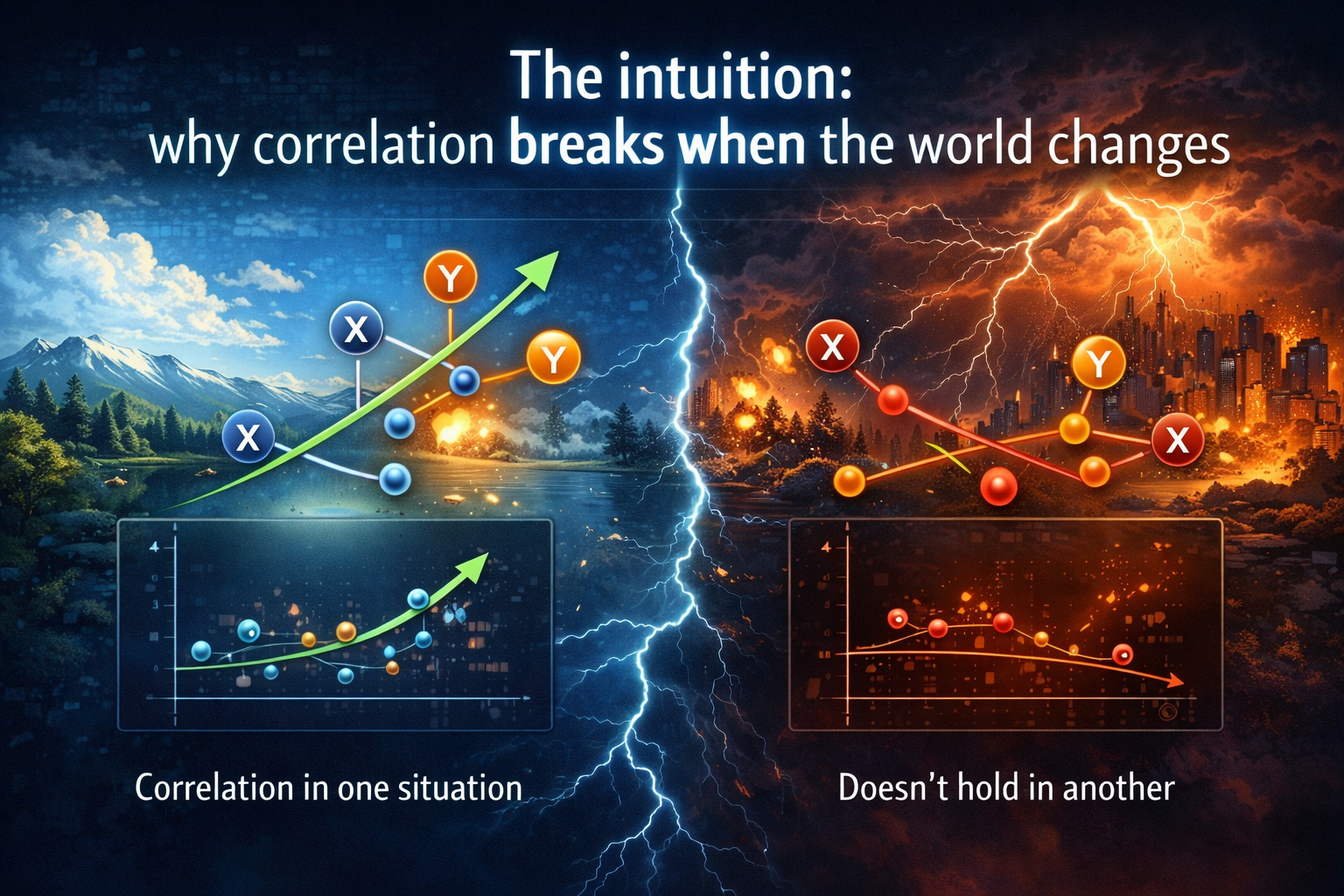
The intuition: why correlation breaks when the world changes
The intuition: why correlation breaks when the world changes
Start with a simple scenario.
A model learns that when a particular sensor reading rises, a machine is likely to shut down soon. It performs well on historical logs. Everyone celebrates.
Then the sensor is recalibrated. The reading scale changes. Suddenly the model becomes confident—and wrong.
The model wasn’t “stupid.” It learned a shortcut: a correlation that held in yesterday’s environment. What it didn’t learn was the stable causal relationship—the one that keeps working when superficial signals shift.
This is the central promise of causality for machine learning: causal relationships are often more stable across changing environments than correlations. (arXiv)
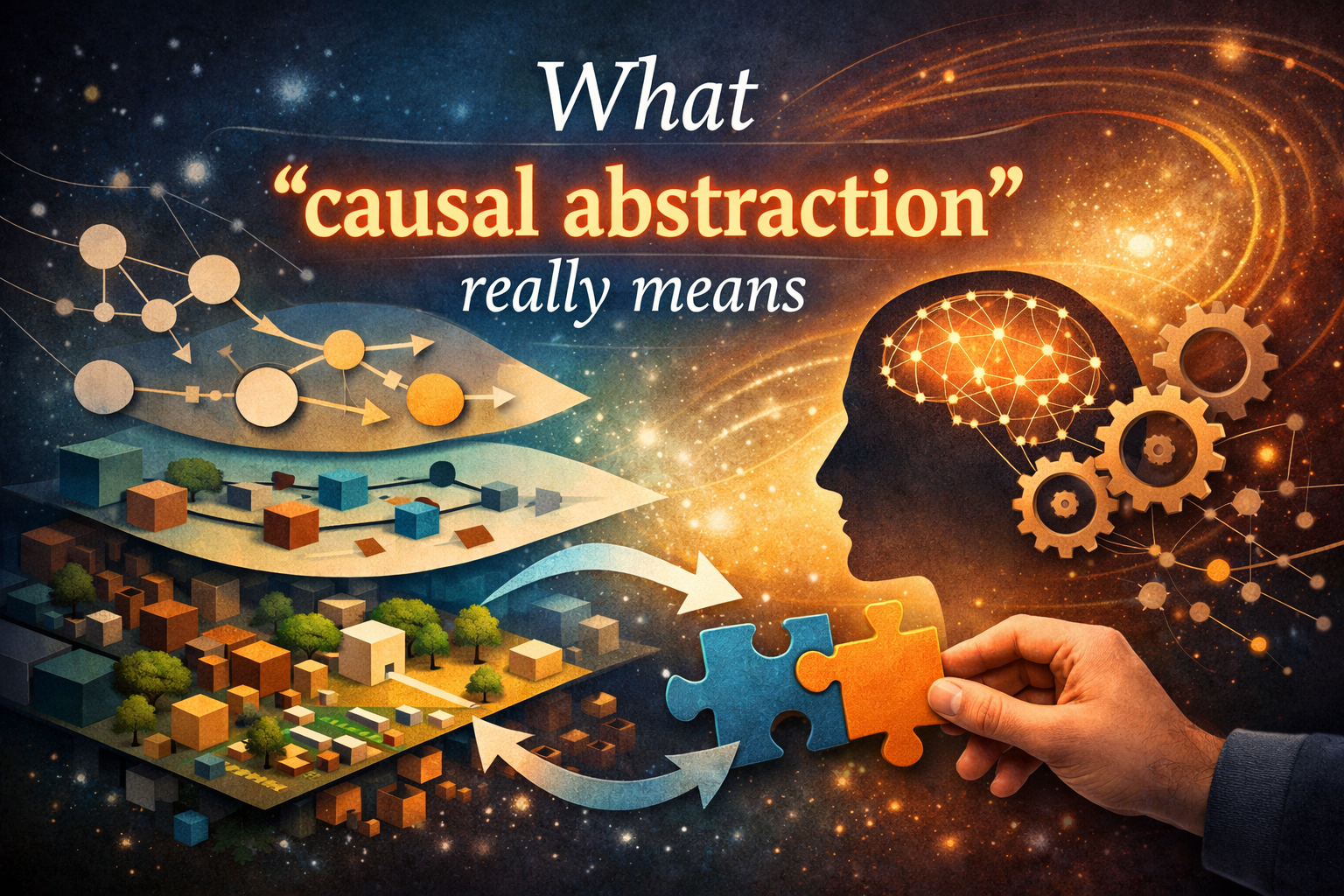
What “causal abstraction” really means
Reality can be described at many levels.
- Low-level: voltage, current, sensor noise, firmware states, packets, timestamps
- High-level: “component overheated,” “system under load,” “policy blocked,” “operator intervened”
A causal abstraction is a disciplined way to say:
“This messy, detailed system can be faithfully summarized by a simpler causal story—and the simplified story still predicts what happens under interventions.”
That last phrase—under interventions—is the key. If a high-level explanation is truly causal, it should continue to predict what happens when we change something, not just when we passively observe it.
This idea is formalized in causal-model abstraction work, which studies when one causal model can be a faithful abstraction of another. (Cornell Computer Science)
A simple example: the thermostat abstraction
You can model a thermostat at the circuit level. Or you can abstract it as:
- temperature
- target temperature
- heating state (on/off)
That abstraction is useful because if you intervene—say, raise the target temperature—you can predict what happens: heating turns on more often and temperature rises.
Now imagine a foundation model trained on logs from many thermostats and buildings. The crucial question becomes:
Did it learn the thermostat abstraction—or did it learn building-specific shortcuts (time of day, occupancy patterns, sensor quirks)?
That’s causal abstraction in practice: it’s the difference between a portable explanation and a brittle proxy.

What “identifiability” means (and why it’s the technical brick wall)
Even if a “true” causal structure exists, it may not be identifiable from your data.
Identifiability means:
Given the data and assumptions, there is only one causal explanation (or one equivalence class of explanations) consistent with what you observed.
If it’s not identifiable, you can fit multiple different causal stories that all match the same training data.
The core trap: observational data can be fundamentally ambiguous
In many settings, two different causal structures can generate the same observational patterns. This is a central reason causal discovery is hard—and why interventions, experiments, or multi-environment signals often matter. (arXiv)
Foundation models are trained mostly on observational data (text, images, logs, traces). That means:
A foundation model can become extremely competent while still learning the “wrong causal story” internally—because the training signal didn’t force the causal structure to be unique.
This is why identifiability is not an academic detail. It is a structural limit you must design around—especially for systems that act.
Why foundation models make this problem harder—not easier
It’s tempting to believe scale solves everything: “just train bigger models on more data.”
But causal abstraction and identifiability become more subtle at scale for three reasons:
1) Many equally good representations exist
Deep models can represent the same predictive function in many different ways. Internally, they may encode variables that are useful but not causal.
2) The “right level of abstraction” is not given
Even if the model learns something causal, it might be at the wrong granularity:
- too low-level (brittle, noisy)
- too high-level (misses mechanism and intervention pathways)
- inconsistent across contexts (the same “concept” behaves differently across settings)
3) Tools, agents, and feedback loops create interventions—but not clean ones
Agentic foundation models can act (click, call APIs, execute workflows). That creates interventions—but they are often messy: confounded, policy-entangled, and not designed as controlled experiments.
The result: you may get more data, but not more identifiability.
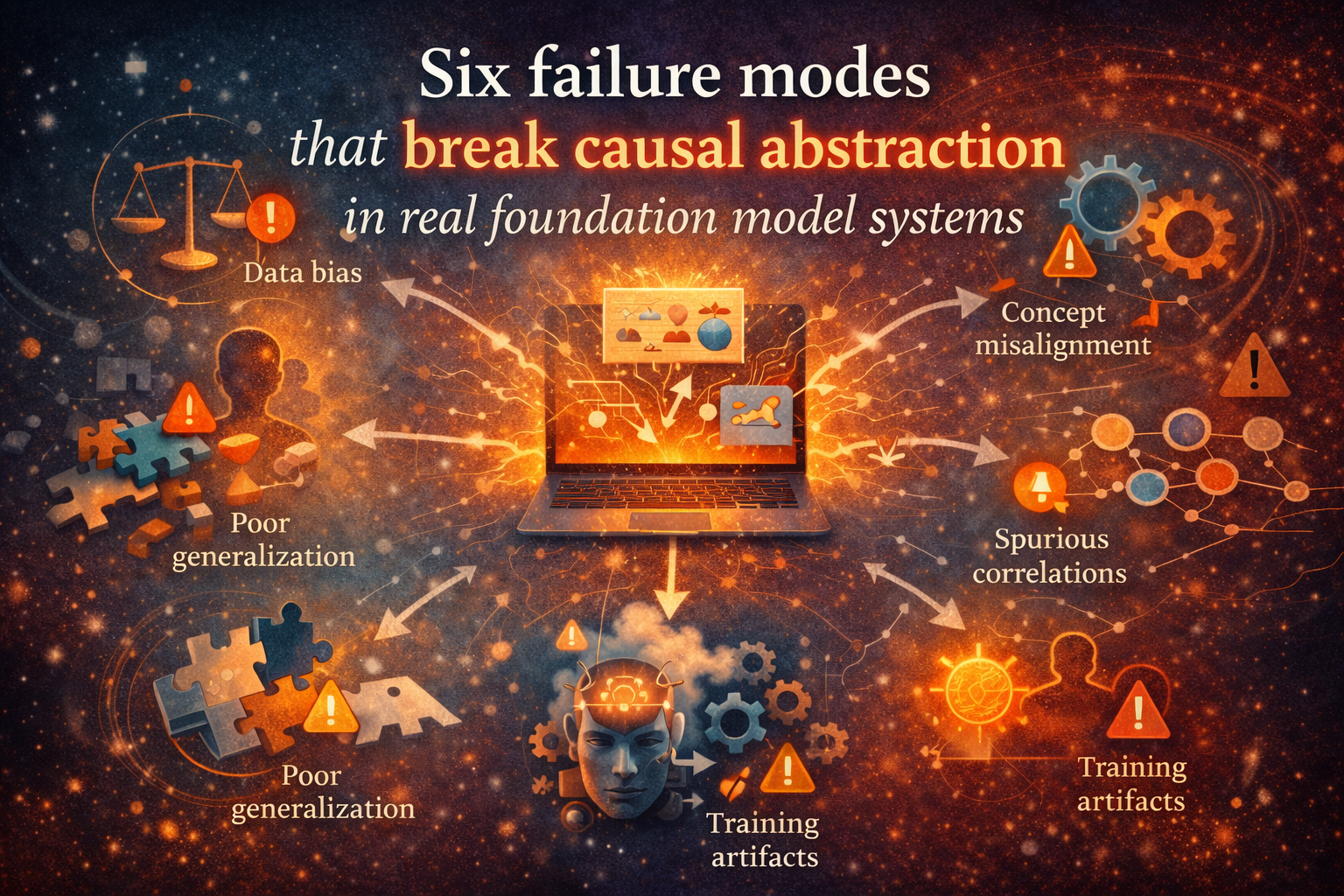
Six failure modes that break causal abstraction in real foundation model systems
These are the patterns that keep showing up in production:
1) Shortcut learning
The model latches onto an easy proxy (“spurious correlate”) that predicts well in training but collapses under distribution shift.
2) Confounding
A hidden factor influences both the “cause” and the “effect,” making observational relationships misleading.
3) Mixed mechanisms
The same surface pattern is produced by multiple underlying mechanisms (e.g., “failure” could be overload, misconfiguration, or upstream disruption).
4) Ontology drift
The meaning of a concept changes: “active user,” “fraud,” “incident,” “risk.” Labels remain the same; reality changes.
5) Intervention mismatch
Your logs include actions, but those actions are shaped by humans, policies, and exceptions—so causal attribution becomes distorted.
6) Abstraction mismatch
A “nice high-level variable” is not truly causal unless it preserves intervention effects. Many explanations sound plausible yet fail this test.
Recent work connects causal abstraction directly to mechanistic interpretability—arguing that interpretability should mean finding faithful abstractions that preserve causal structure, not just producing stories. (Journal of Machine Learning Research)
What research suggests actually helps (without pretending there’s a silver bullet)
The global research direction converges on one theme:
You need additional structure beyond raw observational data to make causal variables and abstractions identifiable. (arXiv)
Here are the most important “structures” teams are using:
1) Multi-environment learning (the same system across changing contexts)
If you observe the same process across environments—different policies, operating conditions, geographies, tooling, or distributions—you can sometimes isolate what stays stable (more likely causal) versus what varies (often correlational). (arXiv)
2) Interventional signals (even partial interventions)
Interventions do not have to be perfect laboratory experiments, but they must be informative. Identifiability results in causal representation learning often rely on some form of interventions, multiple environments, or multiple views. (arXiv)
3) Causal representation learning (CRL)
CRL aims to learn latent variables that behave like causal variables—so that intervening on them corresponds to meaningful changes in the world. A central theme is identifiability: when are learned representations guaranteed to be equivalent (up to allowed transformations)? (arXiv)
4) Identify “up to” an abstraction
Sometimes you cannot identify the full low-level causal structure. But you can identify a valid higher-level causal model “up to” a meaningful abstraction—enough for safe decisions at the level where you operate. This is an active bridge between theory and practice. (Cornell Computer Science)
5) Mechanistic interpretability as causal abstraction (a new standard for “faithful explanation”)
Mechanistic interpretability is increasingly framed as: can we map the low-level network mechanics to a higher-level algorithm in a way that preserves intervention behavior? That is causal abstraction, formalized. (Journal of Machine Learning Research)
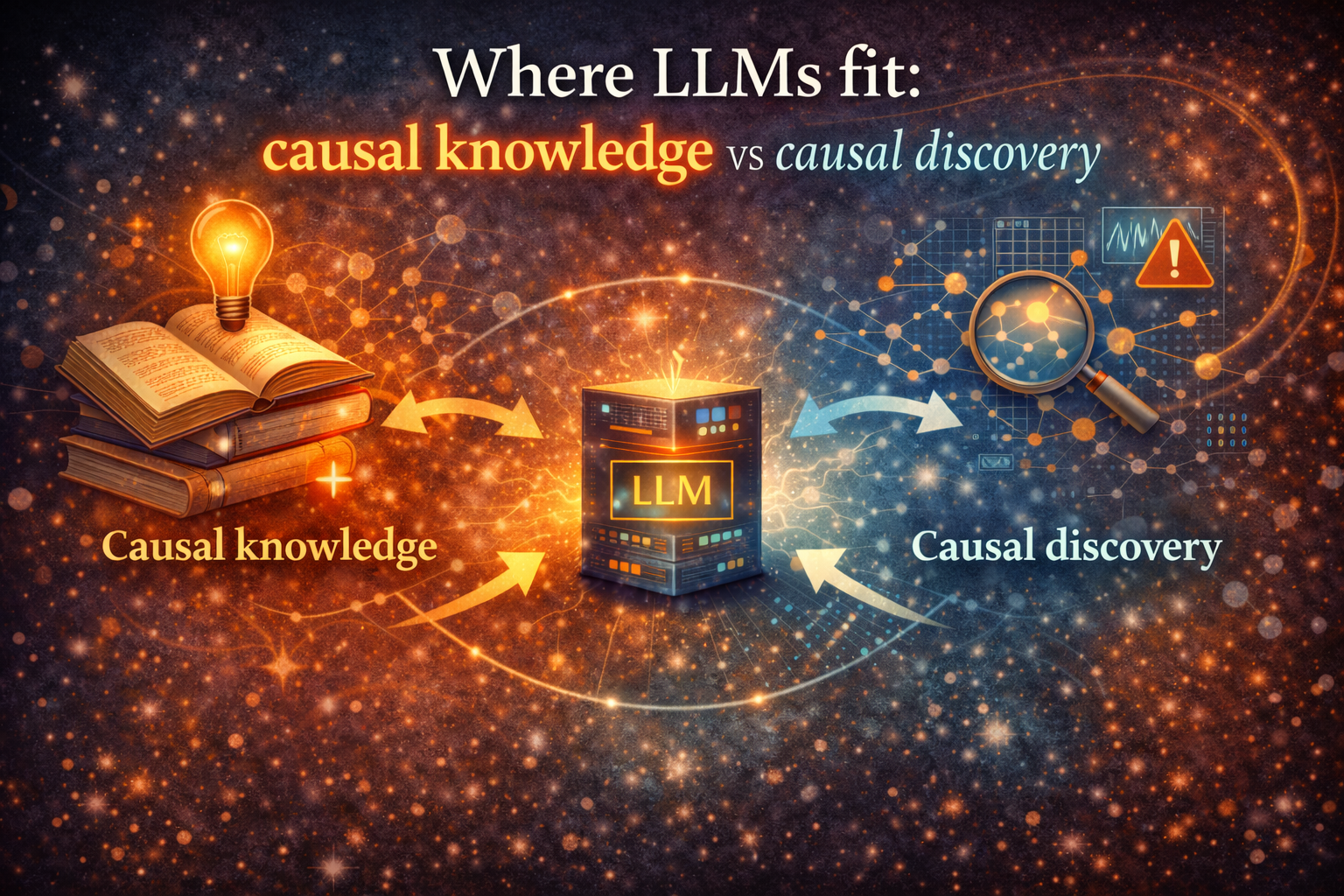
Where LLMs fit: causal knowledge vs causal discovery
A common question is: “Can LLMs do causal reasoning?”
Two distinct claims often get mixed:
-
A) LLMs can talk causality
They can generate plausible causal narratives and explanations.
-
B) LLMs can discover causality from data
This is much harder and runs into identifiability limits. Surveys discussing LLMs for causal discovery highlight potential (e.g., assisting with hypotheses and constraints) but also emphasize evaluation gaps and the need for stronger signals than text alone. (OpenReview)
A useful mental model:
- LLMs can help with hypothesis generation and structured reasoning.
- Identifiability still requires signals the model does not magically obtain from observational text alone.
The gold-standard test: does your abstraction predict interventions?
If you want to know whether a foundation model has learned a causal abstraction, ask a brutally practical question:
If I change X, do I correctly predict what happens to Y—across new settings?
Not “does the model explain it nicely,” but:
- does the explanation survive policy changes?
- does it survive new environments?
- does it survive concept drift?
- does it survive new tools and workflows?
This is where causal abstraction stops being a theory and becomes a product-grade capability.
What this means for Enterprise AI leaders
If your goal is to build Enterprise AI that scales safely, treat causal abstraction as a design requirement, not a research wishlist:
- Instrument for interventions (even limited, controlled changes)
- Treat multi-environment data as a first-class asset (not noise)
- Measure shift explicitly (data, policy, tooling, ontology)
- Prefer explanations that predict interventions over explanations that sound plausible
- Make “identifiability assumptions” explicit (what would have to be true for your causal story to be uniquely learnable?)
This is how organizations evolve from “AI demos” to “AI infrastructure.”
Key Insights
- Causal abstraction is about simplifying a complex system without losing the ability to predict what happens under interventions. (Cornell Computer Science)
- Identifiability is the hard limit: sometimes the data cannot uniquely determine the causal story—even if prediction accuracy is high. (arXiv)
- Foundation models raise the stakes because they learn representations at scale, often from observational data, in worlds that keep changing. (arXiv)
- The practical test is simple: does the model’s abstraction still predict the consequences of interventions across new environments?
Glossary
Causal abstraction: A mapping from a detailed causal model to a simpler causal model that preserves relevant cause–effect behavior under interventions. (Cornell Computer Science)
Identifiability: A property that the causal model or causal representation is uniquely determined (up to an allowed equivalence) by the data and assumptions. (arXiv)
Observational data: Data collected without controlled interventions; patterns in observational data can be explained by multiple causal stories. (arXiv)
Intervention: A deliberate change to a variable or mechanism to test causal impact (e.g., changing a policy threshold, replacing a component, forcing a workflow path). (Cornell Computer Science)
Causal representation learning (CRL): Learning latent variables with causal semantics from high-dimensional observations; often studied through identifiability conditions. (arXiv)
Mechanistic interpretability: Reverse-engineering what algorithm a model implements; increasingly grounded in causal abstraction as a criterion for faithful explanations. (Journal of Machine Learning Research)
Distribution shift: When the data-generating process changes across time or environments (new policy, new tooling, new population, new sensors). (arXiv)
FAQ
Is causal structure identifiable from observational data alone?
Often no. Multiple causal explanations can fit the same observational patterns, which is why identifiability is a central limit in causal discovery. (arXiv)
What helps identifiability in foundation models?
Additional structure: multi-environment data, multiple views (modalities), and informative interventions can make causal representations more identifiable under assumptions. (arXiv)
What is the difference between causal abstraction and interpretability?
Interpretability can be superficial (“here are features”). Causal abstraction asks for a higher-level explanation that remains faithful under interventions—an increasingly formal standard for mechanistic interpretability. (Journal of Machine Learning Research)
Can LLMs discover causality from text?
LLMs can express causal narratives, but discovering causality is constrained by identifiability and the limits of observational data. LLMs may assist hypothesis generation, but they still need stronger signals (environments, interventions, structured data). (arXiv)
Why does this matter for Enterprise AI?
Because enterprises operate in shifting conditions: policy updates, data drift, tool changes, exceptions, and evolving definitions. Without causal abstractions that survive interventions, systems can become confident and wrong at the worst possible moment.
Q1: Does increasing model size improve reliability?
No. Increasing model size improves capability and generalization, but reliability depends on governance maturity, bounded autonomy, and decision control frameworks.
Q2: Why do larger LLMs still fail in production?
Because enterprise failures often stem from semantic drift, ontology collapse, control gaps, and irreversible decision pathways—not raw prediction error.
Q3: How can enterprises close the reliability gap?
By strengthening the control plane, defining decision boundaries, implementing escalation protocols, and tying autonomy growth to governance maturity.
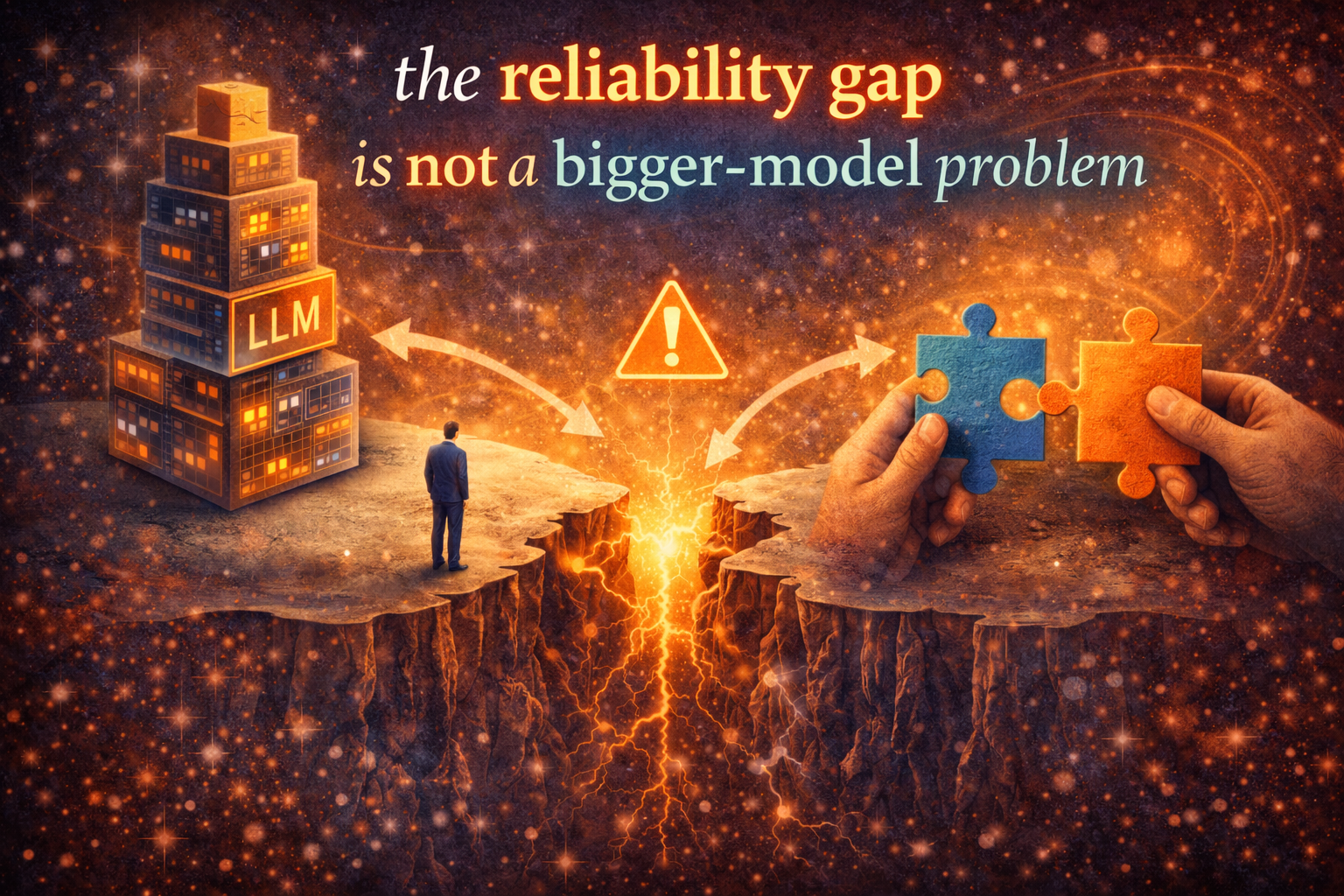
Conclusion: the reliability gap is not a bigger-model problem
The next decade of “reliable AI” will not be won by models that predict well in static benchmarks.
It will be won by systems that learn the right causal abstractions—and by organizations that are honest about identifiability: what the data can prove, what it cannot, and what additional structure (environments, interventions, governance) must exist for AI to remain dependable as reality moves.
In other words: the future belongs to teams that treat causality as an operational capability—not a philosophical nice-to-have.
Enterprise AI Operating Model
Enterprise AI scale requires four interlocking planes:
Read about Enterprise AI Operating Model The Enterprise AI Operating Model: How organizations design, govern, and scale intelligence safely — Raktim Singh
- Read about Enterprise Control Tower The Enterprise AI Control Tower: Why Services-as-Software Is the Only Way to Run Autonomous AI at Scale — Raktim Singh
- Read about Decision Clarity The Shortest Path to Scalable Enterprise AI Autonomy Is Decision Clarity — Raktim Singh
- Read about The Enterprise AI Runbook Crisis The Enterprise AI Runbook Crisis: Why Model Churn Is Breaking Production AI — and What CIOs Must Fix in the Next 12 Months — Raktim Singh
- Read about Enterprise AI Economics Enterprise AI Economics & Cost Governance: Why Every AI Estate Needs an Economic Control Plane — Raktim Singh
Read about Who Owns Enterprise AI Who Owns Enterprise AI? Roles, Accountability, and Decision Rights in 2026 — Raktim Singh
Read about The Intelligence Reuse Index The Intelligence Reuse Index: Why Enterprise AI Advantage Has Shifted from Models to Reuse — Raktim Singh
Read about Enterprise AI Agent Registry Enterprise AI Agent Registry: The Missing System of Record for Autonomous AI — Raktim Singh
References and further reading
- Beckers & Halpern, Abstracting Causal Models (causal abstraction foundations). (Cornell Computer Science)
- Schölkopf et al., Toward(s) Causal Representation Learning (CRL agenda and open problems). (arXiv)
- von Kügelgen, Identifiable Causal Representation Learning: Unsupervised, Multi-View, and Multi-Environment (identifiability focus). (arXiv)
- Geiger et al., A Theoretical Foundation for Mechanistic Interpretability (causal abstraction as interpretability foundation). (Journal of Machine Learning Research)
- Yao et al. (ICLR 2024), multi-view identifiability framework (useful for multimodal settings). (ISTA Research Explorer)
- Morioka & Hyvärinen (2024), identifiability via weak constraints (a different route to identifiability). (ACM Digital Library)



Raktim Singh is an AI and deep-tech strategist, TEDx speaker, and author focused on helping enterprises navigate the next era of intelligent systems. With experience spanning AI, fintech, quantum computing, and digital transformation, he simplifies complex technology for leaders and builds frameworks that drive responsible, scalable adoption.