

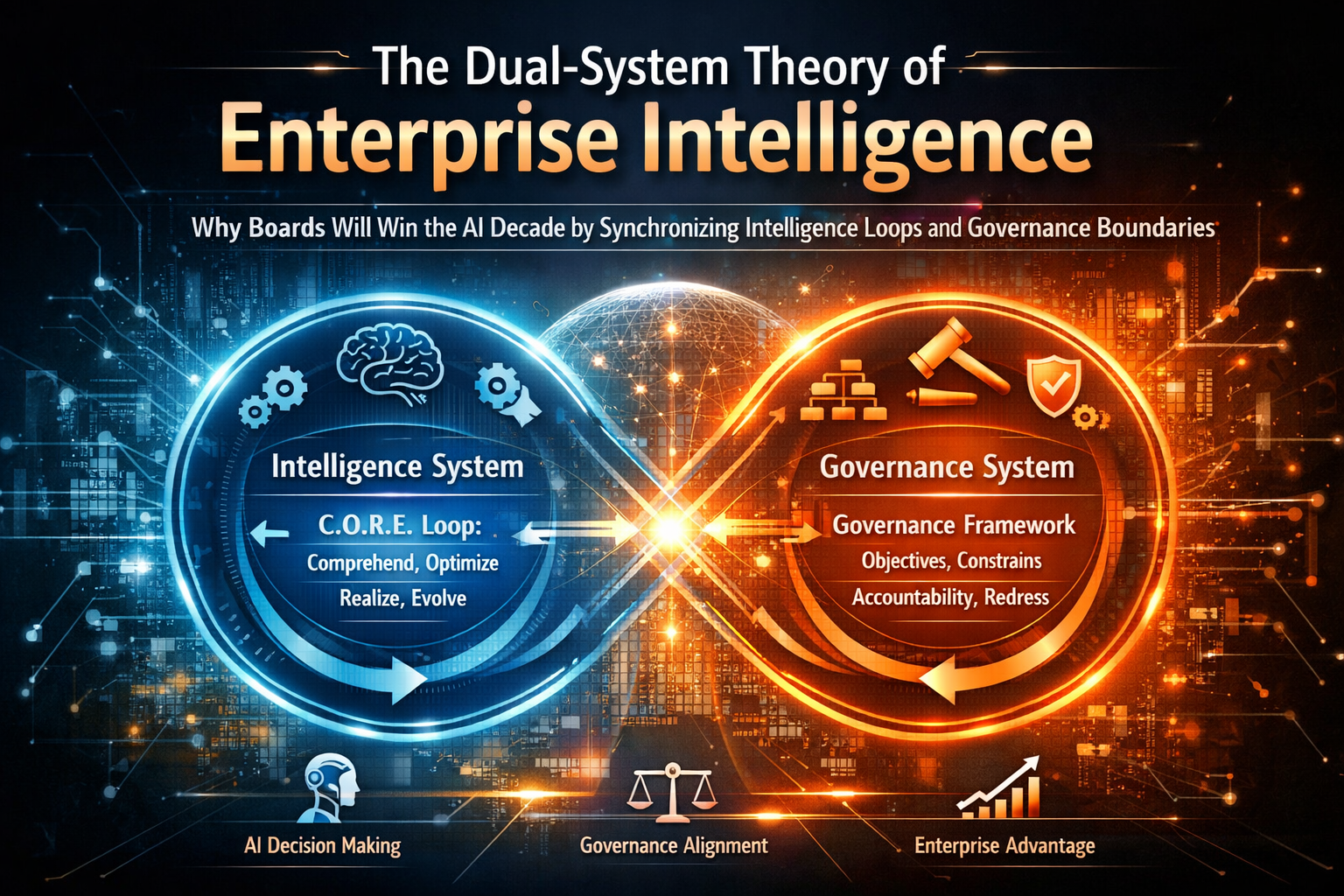
The AI Decade Will Reward Synchronization, Not Adoption
Most leaders still talk about AI like it’s a powerful tool—something you “deploy” into functions such as customer service, marketing, finance, risk, or IT.
That framing is already outdated.
A tool can be adopted without changing the nature of the organization.
But intelligence—especially intelligence that can act—changes structure: what gets centralized vs distributed, how decisions are made, how accountability is enforced, and where value concentrates.
That is why the next era of competitive advantage won’t belong to firms that simply “use AI everywhere.” It will belong to firms that master something much harder—and far more strategic:
They synchronize two systems that most organizations treat separately.
This article formalizes that doctrine as a board-usable model:
The Dual-System Theory of Enterprise Intelligence
Enterprise advantage in the AI era is proportional to how well an organization synchronizes:
(1) the Intelligence System and (2) the Governance System.
This is the missing structure behind why so many AI initiatives stall—and why a smaller set of firms will define the next wave of market value creation.
Why this theory matters now
We’re entering a phase where AI systems increasingly move from advice to action: drafting communications, approving exceptions, negotiating options, triggering workflows, and coordinating across tools.
Mainstream executive discourse has started reflecting this shift.
Harvard Business Review has recently highlighted both
(a) the emerging reality of AI agents doing the shopping—which changes how brands compete—and
(b) the rise of “agent managers” as a new leadership role required to supervise autonomous agent workforces. (Harvard Business Review)
The World Economic Forum has emphasized that as AI agents move into real deployment, organizations need structured foundations for evaluation and governance, including functional classifications and proportionate safeguards. (World Economic Forum)
And Fortune has framed the same pressure from a market-structure angle: AI agents may not “kill SaaS,” but they reshape competitive dynamics enough that incumbents “can’t sleep easy.” (Fortune)
The pattern is clear:
- More autonomy is coming
- The cost of cognition is falling
- The cost of errors is rising
- Most organizations are not designed for that combination
The core idea: Two systems, one advantage
System 1: The Intelligence System
This is the capability loop: understanding context, choosing actions, executing, learning.
System 2: The Governance System
This is the institutional boundary architecture: objectives, constraints, delegated authority, accountability, escalation, and liability routing.
Most organizations run these as separate teams, separate projects, and separate conversations.
That’s the trap.
In the AI era:
- Intelligence without governance creates volatility (speed without control)
- Governance without intelligence creates stagnation (control without compounding advantage)
Durable advantage comes from integration.
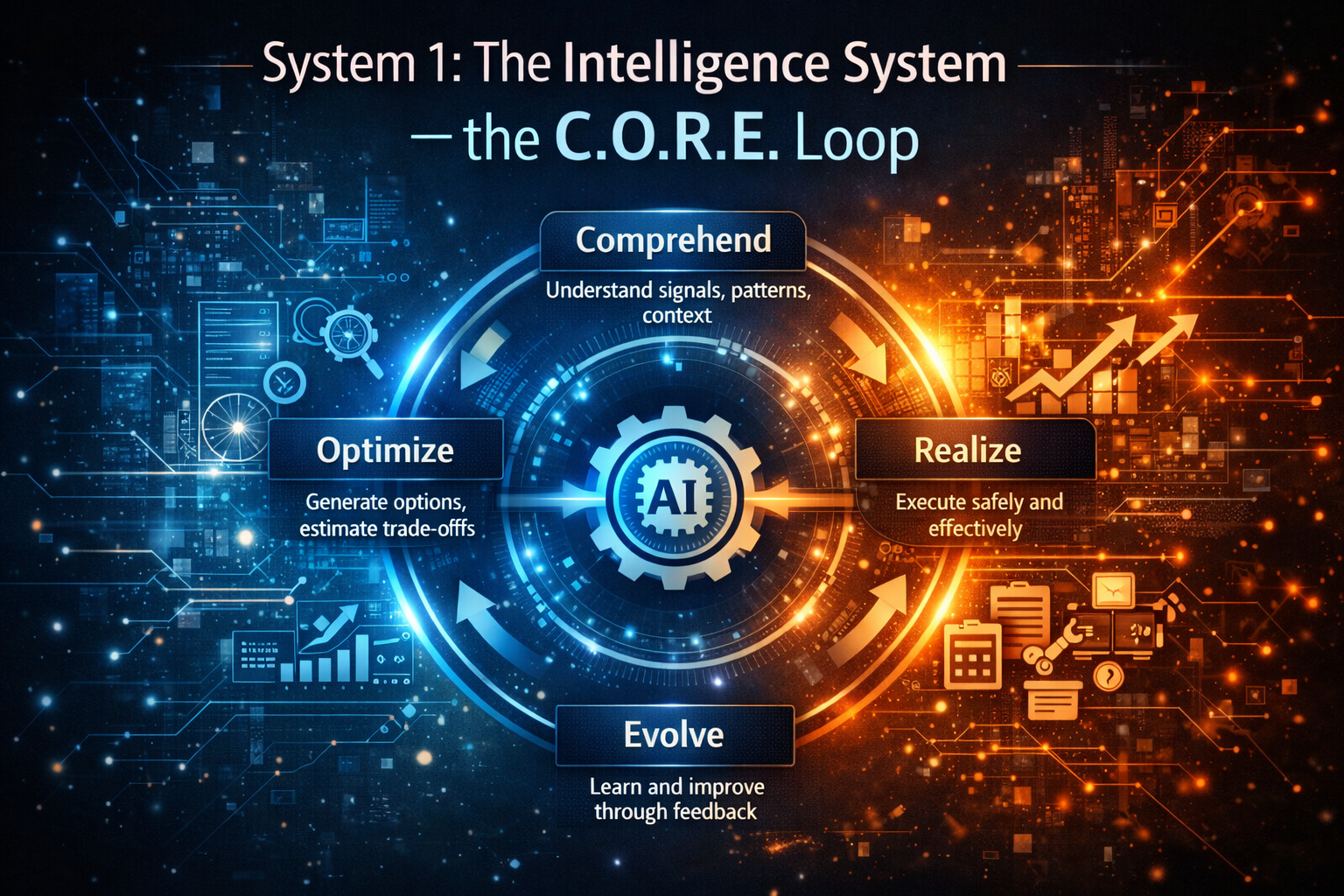
System 1: The Intelligence System — the C.O.R.E. loop
To make “intelligence” concrete and memorable, define it as a four-part loop.
C.O.R.E. — The Intelligence Loop
C — Comprehend context
AI absorbs signals: customer intent, transaction patterns, operational telemetry, policy constraints, market conditions.
O — Optimize decisions
AI generates options, estimates tradeoffs, and ranks actions under uncertainty.
R — Realize action
AI executes through tools and APIs: tickets, messages, approvals, workflow triggers, routing, purchases—within allowed bounds.
E — Evolve through evidence
AI improves via feedback: outcomes, escalations, reversals, error patterns, drift signals.
This is what AI enables. It’s the engine.
But here is the key: C.O.R.E. does not tell you what the system should optimize for, what it must never do, or who carries accountability when something goes wrong.
That’s the second system.
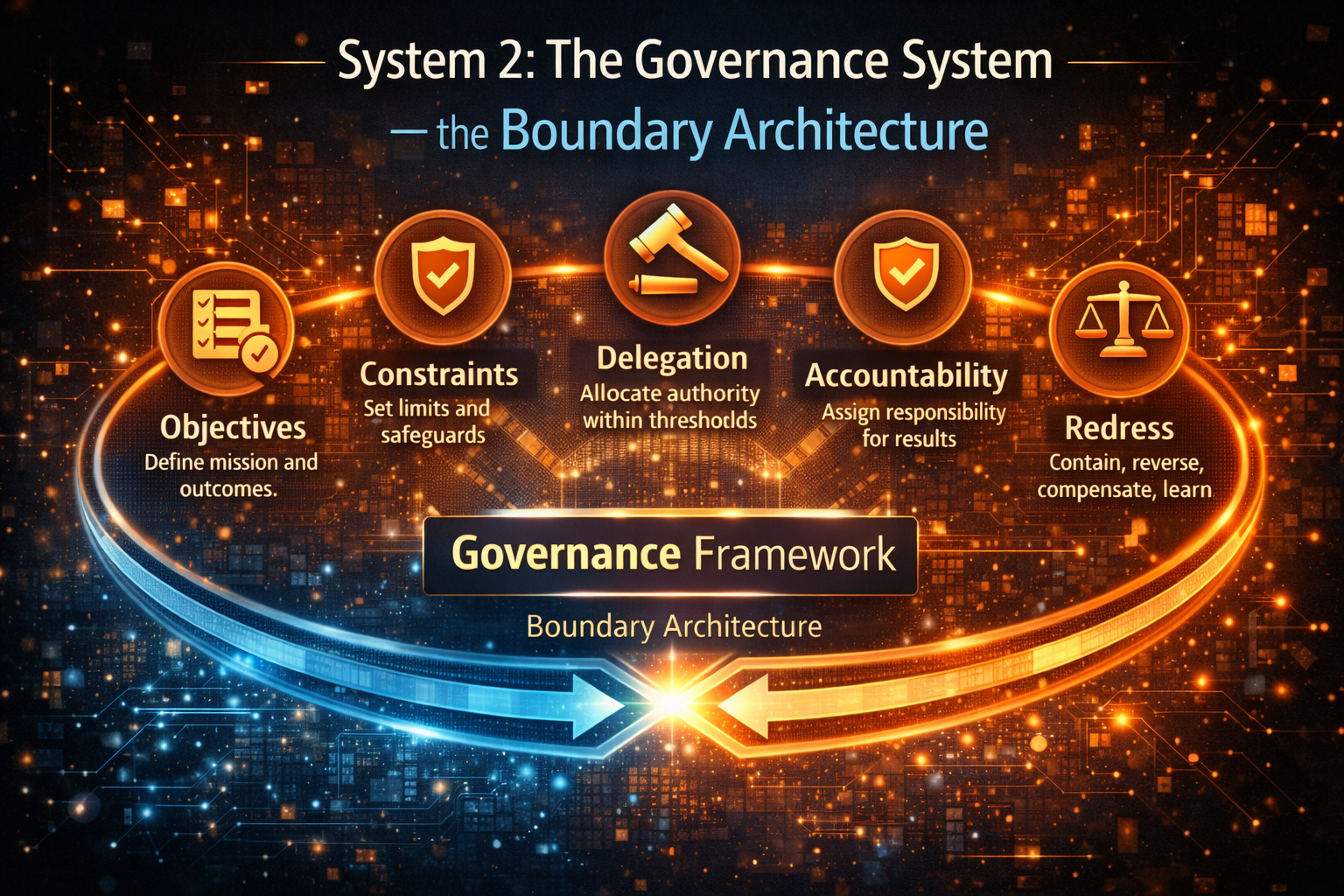
System 2: The Governance System — the boundary architecture
System 2: The Governance System — the boundary architecture
Governance is not a “feature” of AI. It is the institutional boundary architecture within which intelligence operates.
It answers five board-level questions:
- Objectives: What outcomes matter (growth, resilience, trust)?
- Constraints: What must never happen (policy violations, safety failures, reputational harm)?
- Delegation: What authority is delegated to machines—and at what thresholds?
- Accountability: Who owns outcomes, not just models?
- Redress: What happens after a failure—how do we contain, reverse, compensate, and learn?
This aligns with WEF’s emphasis on structured evaluation and proportionate governance as agents move into production. (World Economic Forum)
And it aligns with why “agent manager” roles are emerging as an operational necessity: autonomy at scale requires ongoing supervision, tuning, and accountability—not “set-and-forget” deployments. (Harvard Business Review)
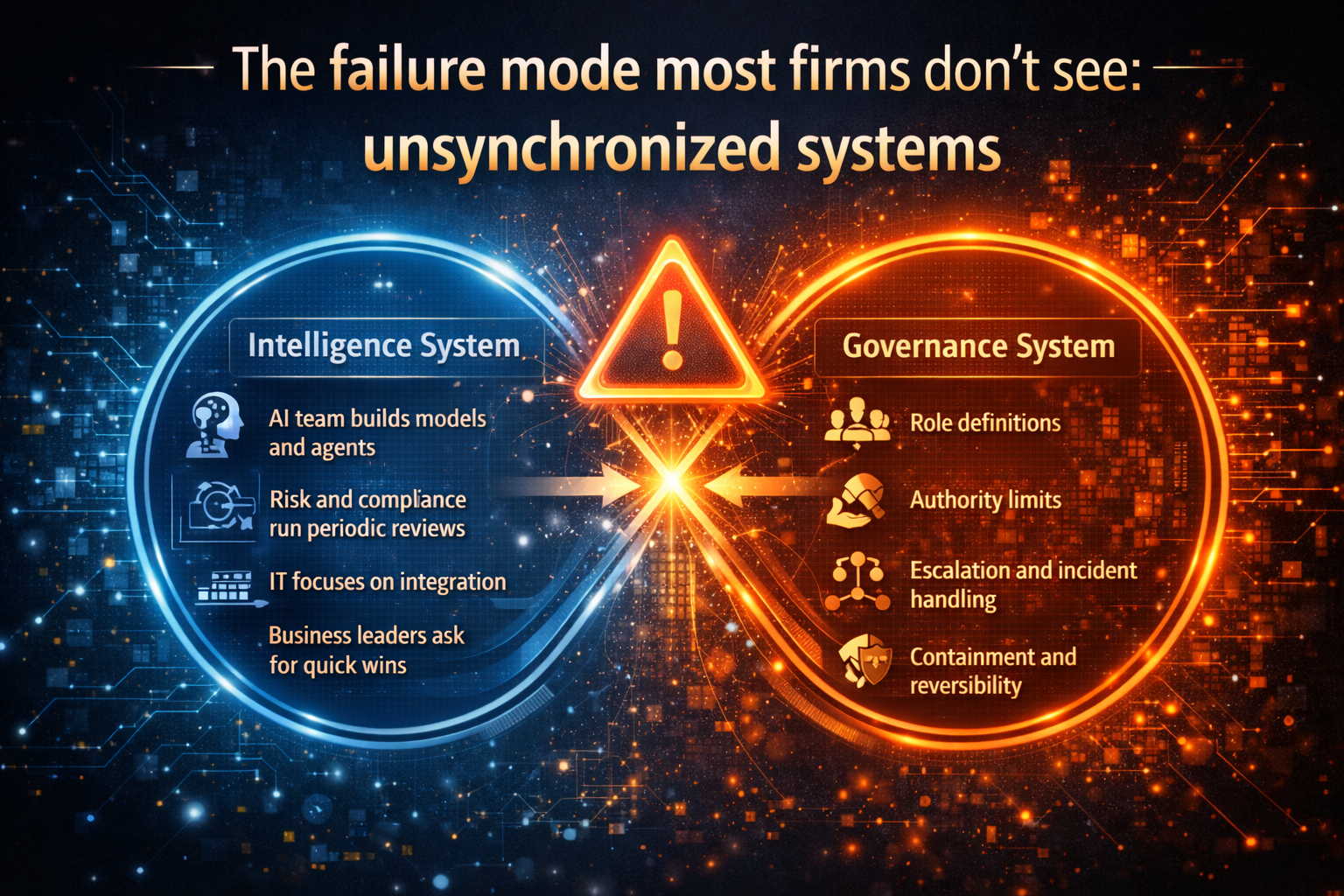
The failure mode most firms don’t see: unsynchronized systems
Most enterprises build intelligence in one lane and governance in another:
- The AI team builds models and agents
- Risk and compliance run periodic reviews
- IT focuses on integration
- Business leaders ask for quick wins
That structure fails because it assumes autonomy behaves like traditional software.
It doesn’t.
Autonomy behaves like a decision-making workforce—and it needs the functional equivalent of:
- role definitions
- authority limits
- performance monitoring
- escalation and incident handling
- containment and reversibility
This is exactly why the “agent manager” concept is surfacing in serious executive channels. (Harvard Business Review)
A simple example: Customer refunds (automation vs intelligence)
Software-era approach
You build a workflow: ticket → rules → approvals → resolution.
Dual-system approach
A refund agent operates as a C.O.R.E. loop inside governance boundaries:
- Comprehend: customer history, product usage, complaint context, fraud signals
- Optimize: approve, deny, partial refund, replacement, store credit—based on policy and economics
- Realize: execute refund or propose an alternative
- Evolve: learn from chargebacks, churn, escalations, and satisfaction signals
But the governance system defines:
- What refund sizes can be auto-approved
- Which cases must escalate
- What evidence must be logged (to defend against disputes)
- What redress applies if the agent is wrong
That is the difference between “AI automation” and enterprise intelligence.
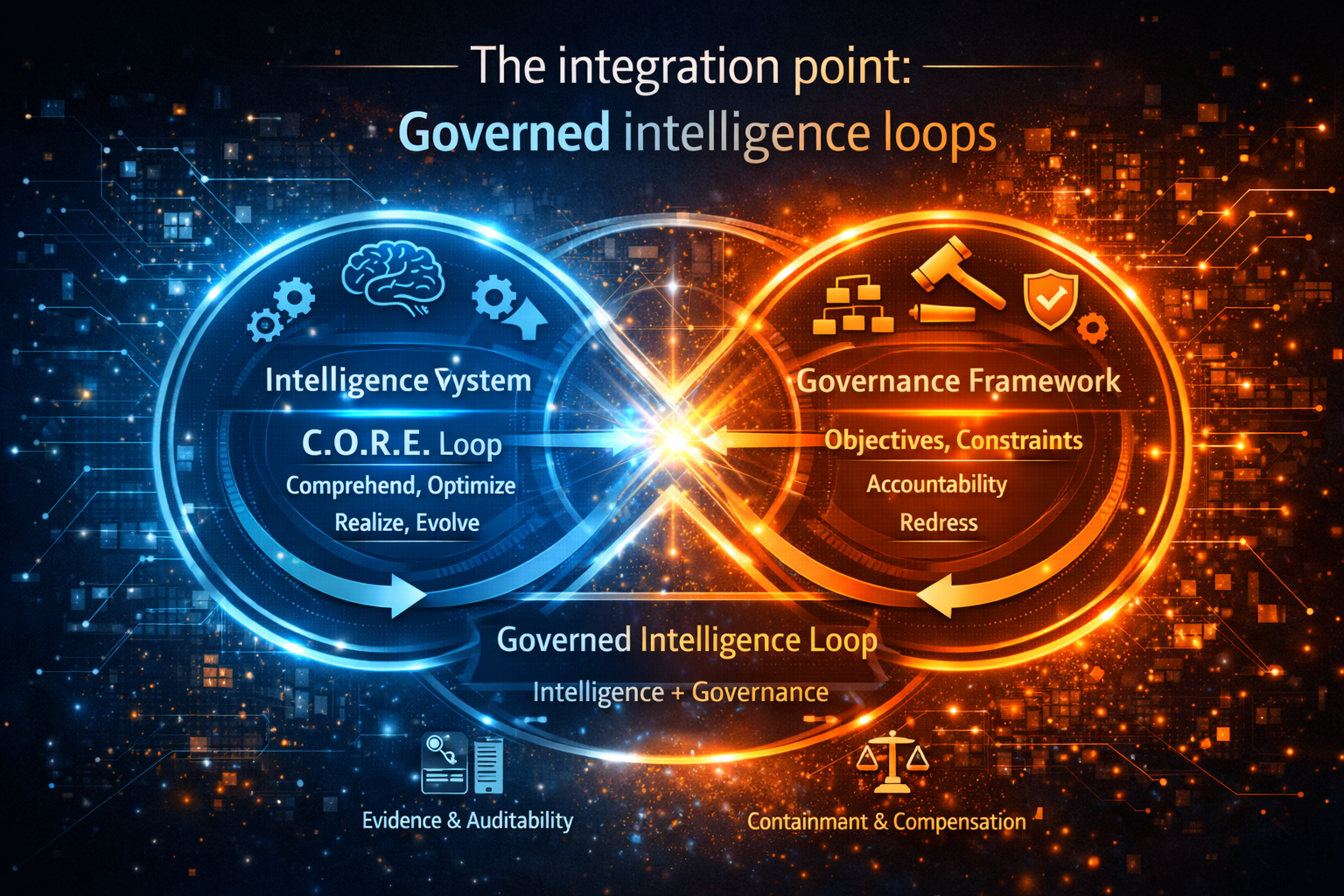
The integration point: Governed intelligence loops
Here is the precise integration definition:
A Governed Intelligence Loop is C.O.R.E. operating inside explicit governance boundaries, with evidence and redress designed into the runtime.
When these loops exist across economically material decisions (pricing, risk, claims, procurement, retention), you get what I call an Intelligence-Native Enterprise—a firm designed to scale decision quality.
And when many firms do this at scale, markets reorganize into what I have defined as the Third-Order AI Economy.
The clean hierarchy
- C.O.R.E. = the anatomy of intelligence
- Dual-System Theory = how intelligence becomes durable advantage
- Intelligence-Native Enterprise = the institutional embodiment
- Third-Order AI Economy = the market consequence
Why this becomes a new theory of the firm in the AI era
Classic economics asked: Why do firms exist? One influential view (associated with Ronald Coase) is that firms emerge because markets carry “transaction costs”—search, bargaining, monitoring, enforcement—and hierarchies reduce those costs. (World Economic Forum Reports)
Now consider what AI agents do:
- reduce search costs (instant discovery)
- reduce bargaining costs (automated negotiation)
- increase monitoring (continuous observability)
- increase enforcement (programmable constraints)
Recent economic work is explicitly exploring how AI can reduce coordination/transaction costs and enable new forms of market design. (World Economic Forum Reports)
So the strategic question becomes:
When cognition and coordination become cheap, what should stay inside the firm, and what will shift into the market?
The Dual-System Theory gives boards a practical answer:
- Keep inside the firm what encodes differentiating judgment and evidence
- Outsource what is commodity execution
That single distinction will decide profit pools in multiple industries.
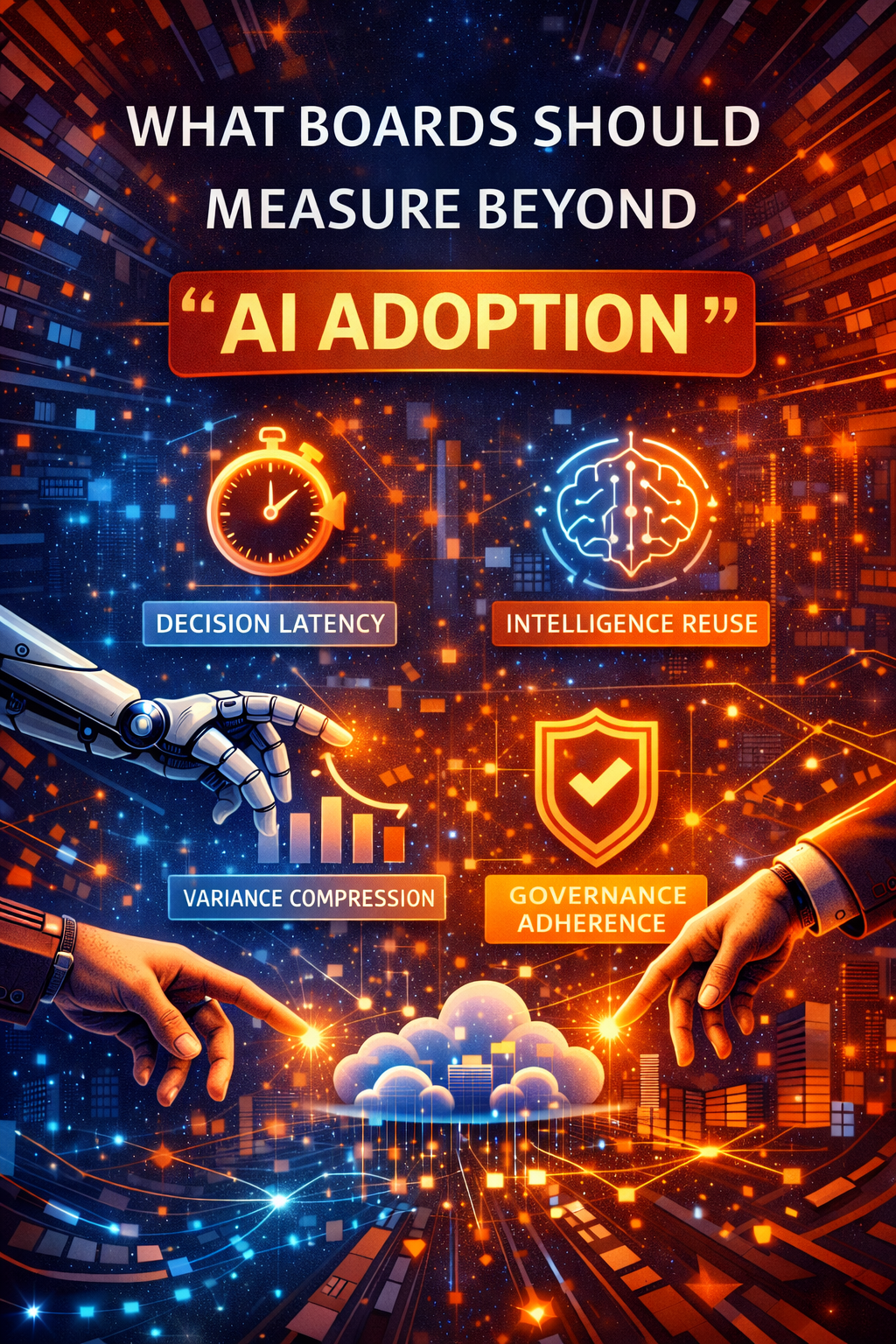
What boards should measure beyond “AI adoption”
Boards often ask: “How many AI use cases are we running?”
That’s the wrong scoreboard.
A better scoreboard is:
1) Decision quality
Are outcomes improving with consistency—not just speed?
2) Decision latency
Are critical decisions being compressed safely?
3) Escalation health
Is the system escalating the right cases—or flooding humans?
4) Reversibility and containment
Can you roll back actions quickly when confidence is low?
5) Evidence integrity
Can you prove what the system did and why?
This is where governance stops being a compliance checkbox and becomes a value-scaling mechanism.
A global lens: why this matters in the US, EU, India, and the Global South
The Dual-System Theory travels well because it separates universal capabilities from local constraints.
- United States: faster deployment and aggressive category creation; governance hardens after visible failures.
- European Union: evidence, traceability, and auditability become differentiators; trust at scale becomes competitive advantage—aligned with the emphasis on evaluation and governance foundations for real agent deployment. (World Economic Forum)
- India: scale + inclusion create a unique edge—high-quality decisions at low marginal cost across massive, fragmented contexts (finance, logistics, citizen services).
- Global South: the winning architectures handle fragmented markets, lower baseline trust, and uneven infrastructure—making governance + evidence even more central.
The winners will be those who can reuse the intelligence engine while localizing governance boundaries without fragmenting their operating model.
Why the Third-Order AI Economy depends on this
Third-order markets emerge when coordination becomes programmable.
But programmable coordination requires:
- identity and delegation
- policy enforcement
- tool access boundaries
- memory/context
- evidence and settlement mechanisms
That is exactly why agent evaluation and governance foundations are being formalized—and why incumbents feel competitive pressure as agents shift how work is coordinated. (World Economic Forum)
In other words:
The Third-Order AI Economy is powered by intelligence — but stabilized by governance.
The board’s five questions
- Where does our profit pool depend on decision quality?
- Which decisions should become governed intelligence loops first?
- What authority are we delegating to machines—and what is non-delegable?
- Do we have evidence and redress designed into the runtime?
- Are we building AI features—or redesigning the enterprise to scale judgment?
These questions force strategy, not experimentation.
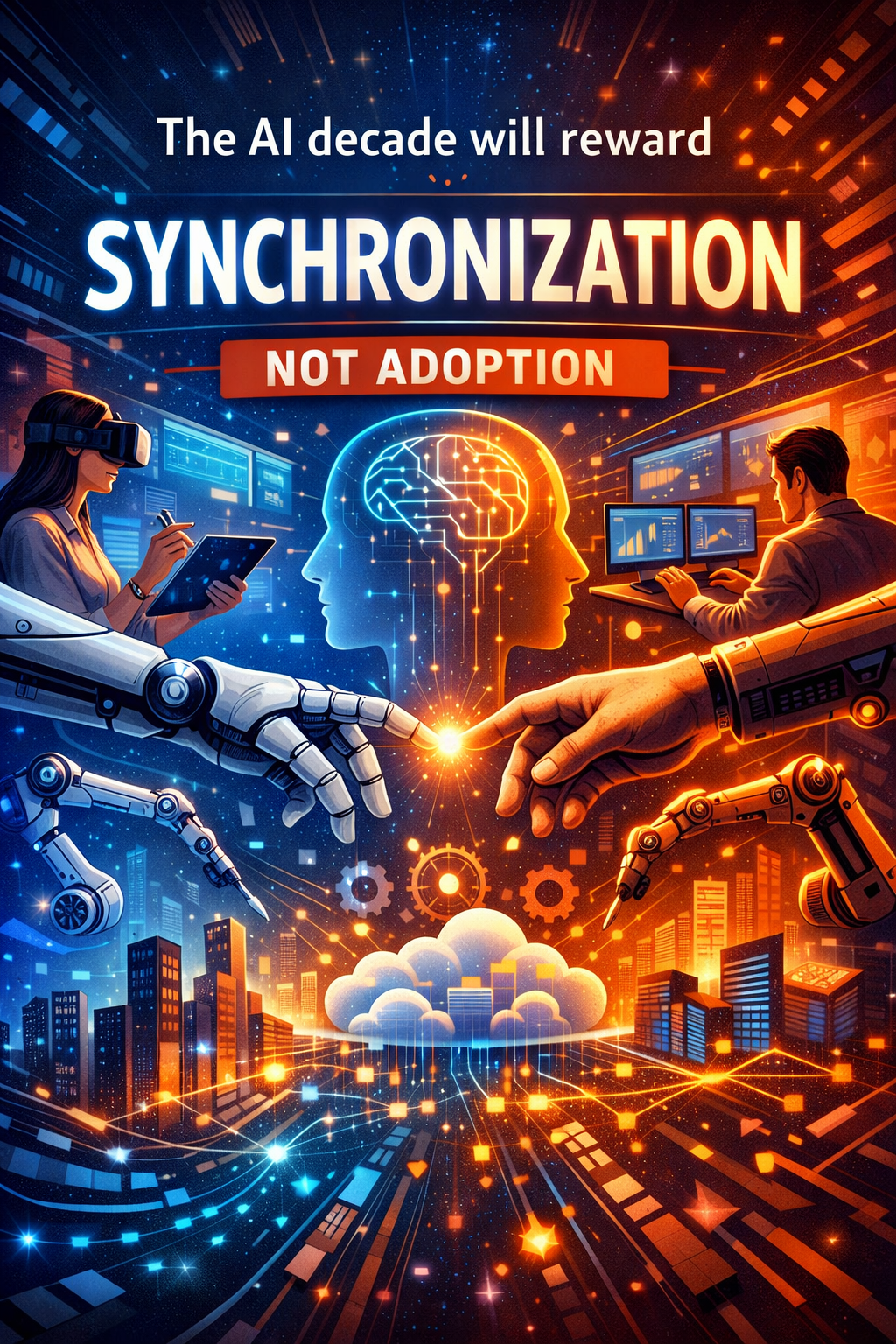
Conclusion: The AI decade will reward synchronization, not adoption
The AI era won’t reward the company with the most models.
It will reward the company with the most synchronized enterprise intelligence—where C.O.R.E. loops operate at scale inside governance boundaries, producing not only actions, but evidence and learning.
- Intelligence without governance creates volatility.
- Governance without intelligence creates stagnation.
The Dual-System Theory resolves that tension—and becomes the missing architecture behind:
- Intelligence-Native Enterprises (firms designed for scalable judgment), and
- The Third-Order AI Economy (markets reorganized around programmable coordination)
If boards want to “win with AI,” they should stop asking how to deploy tools—and start asking how to design institutions.
Glossary
- Dual-System Theory of Enterprise Intelligence: Durable AI advantage comes from synchronizing an intelligence system (C.O.R.E.) with a governance system (objectives, constraints, delegation, accountability, redress).
- C.O.R.E.: Comprehend context, Optimize decisions, Realize action, Evolve through evidence.
- Governed Intelligence Loop: C.O.R.E. operating inside explicit governance boundaries, with evidence and redress designed into runtime.
- Intelligence-Native Enterprise: A firm that embeds governed intelligence loops into its most economically material decisions.
- Third-Order AI Economy: The market phase where scalable machine cognition reorganizes coordination and creates new categories of firms and intermediaries.
- Agent manager: A role emerging to supervise autonomous agent workforces through monitoring, tuning, and accountability. (Harvard Business Review)
- Evidence layer: Auditability and traceability artifacts that prove what an AI system did and why.
FAQs
1) Is this just another name for AI governance?
No. Governance is only one system. The Dual-System Theory explains why governance must be synchronized with intelligence loops, not layered on after deployment.
2) Isn’t C.O.R.E. just an AI lifecycle?
It’s more fundamental. It describes the structural loop of intelligence—understanding, choosing, acting, learning—whether inside a workflow, an enterprise, or a market.
3) What’s the first practical step a board should take?
Pick 3–5 profit-pool decisions (pricing, risk, claims, retention, procurement) and require each to be redesigned as a governed intelligence loop with evidence and redress.
4) Where do AI agents fit?
Agents are one instantiation of the C.O.R.E. loop—especially the “Realize action” phase. As agents scale, oversight roles like agent managers become essential. (Harvard Business Review)
5) Will this matter outside tech companies?
Yes—banks, insurers, telecom, healthcare, manufacturing, retail, logistics, and government services are decision-dense institutions. The doctrine applies wherever decision quality drives value.
What is Enterprise AI Synchronization?
Enterprise AI synchronization is the structural alignment of models, governance, data, workflows, and economic incentives into a unified operating model.
Why is AI adoption not enough?
Adoption deploys tools. Synchronization embeds intelligence into how decisions are made, measured, and improved.
What is the difference between AI adoption and AI synchronization?
Adoption focuses on deployment. Synchronization focuses on coordination, accountability, and scalable decision quality.
How should boards measure AI synchronization?
Boards should measure decision latency reduction, variance compression, intelligence reuse, and governance adherence in production systems.
References and further reading
- HBR on agent managers in the AI era. (Harvard Business Review)
- HBR on AI agents doing the shopping and what brands must change. (Harvard Business Review)
- WEF report on evaluation and governance foundations for AI agents. (World Economic Forum)
- Fortune on agentic AI platforms reshaping SaaS competitive dynamics. (Fortune)
- Coase framing on why firms exist (transaction cost view; widely referenced in management strategy). (World Economic Forum Reports)
Enterprise AI Operating Model
Enterprise AI scale requires four interlocking planes:
Read about Enterprise AI Operating Model The Enterprise AI Operating Model: How organizations design, govern, and scale intelligence safely – Raktim Singh
- Read about Enterprise Control Tower The Enterprise AI Control Tower: Why Services-as-Software Is the Only Way to Run Autonomous AI at Scale – Raktim Singh
- Read about Decision Clarity The Shortest Path to Scalable Enterprise AI Autonomy Is Decision Clarity – Raktim Singh
- Read about The Enterprise AI Runbook Crisis The Enterprise AI Runbook Crisis: Why Model Churn Is Breaking Production AI—and What CIOs Must Fix in the Next 12 Months – Raktim Singh
- Read about Enterprise AI Economics Enterprise AI Economics & Cost Governance: Why Every AI Estate Needs an Economic Control Plane – Raktim Singh
Read about Who Owns Enterprise AI Who Owns Enterprise AI? Roles, Accountability, and Decision Rights in 2026 – Raktim Singh
Read about The Intelligence Reuse Index The Intelligence Reuse Index: Why Enterprise AI Advantage Has Shifted from Models to Reuse – Raktim Singh
Institutional Perspectives on Enterprise AI
Many of the structural ideas discussed here — intelligence-native operating models, control planes, decision integrity, and accountable autonomy — have also been explored in my institutional perspectives published via Infosys’ Emerging Technology Solutions platform.
For readers seeking deeper operational detail, I have written extensively on:
- What Makes an Enterprise Intelligence-Native? The Blueprint for Third-Order AI Advantage
https://blogs.infosys.com/emerging-technology-solutions/artificial-intelligence/what-is-enterprise-ai-the-operating-model-for-compounding-institutional-intelligence.html - Why “AI in the Enterprise” Is Not Enterprise AI: The Operating Model Difference Most Organizations Miss
https://blogs.infosys.com/emerging-technology-solutions/artificial-intelligence/why-ai-in-the-enterprise-is-not-enterprise-ai-the-operating-model-difference-that-most-organizations-miss.html - The Enterprise AI Control Plane: Governing Autonomy at Scale
https://blogs.infosys.com/emerging-technology-solutions/artificial-intelligence/the-enterprise-ai-control-plane-governing-autonomy-at-scale.html - Enterprise AI Ownership Framework: Who Is Accountable, Who Decides, and Who Stops AI in Production
https://blogs.infosys.com/emerging-technology-solutions/artificial-intelligence/enterprise-ai-ownership-framework-who-is-accountable-who-decides-and-who-stops-ai-in-production.html - Decision Integrity: Why Model Accuracy Is Not Enough in Enterprise AI
https://blogs.infosys.com/emerging-technology-solutions/artificial-intelligence/decision-integrity-why-model-accuracy-is-not-enough-in-enterprise-ai.html - Agent Incident Response Playbook: Operating Autonomous AI Systems Safely at Enterprise Scale
https://blogs.infosys.com/emerging-technology-solutions/artificial-intelligence/agent-incident-response-playbook-operating-autonomous-ai-systems-safely-at-enterprise-scale.html - The Economics of Enterprise AI: Designing Cost, Control, and Value as One System
https://blogs.infosys.com/emerging-technology-solutions/artificial-intelligence/the-economics-of-enterprise-ai-designing-cost-control-and-value-as-one-system.html
Together, these perspectives outline a unified view: Enterprise AI is not a collection of tools. It is a governed operating system for institutional intelligence — where economics, accountability, control, and decision integrity function as a coherent architecture.



Raktim Singh is an AI and deep-tech strategist, TEDx speaker, and author focused on helping enterprises navigate the next era of intelligent systems. With experience spanning AI, fintech, quantum computing, and digital transformation, he simplifies complex technology for leaders and builds frameworks that drive responsible, scalable adoption.