
What Boards Should Do Next: A 90-Day Blueprint to Operationalize Enterprise AI Advantage
Most boards are still asking whether AI should be adopted.
That question is already obsolete.
The real question is whether intelligence has been engineered into the enterprise operating model.
In the AI decade, competitive advantage will not belong to firms that experiment with tools. It will belong to institutions that redesign governance, control systems, decision infrastructure, and institutional memory so intelligence becomes structural—not experimental.
Most boardrooms are still treating AI as a technology adoption program.
That is understandable. Every technology wave begins this way: a rush to pilots, a sprint to identify “AI use cases,” a search for the “right model,” and dashboards filled with adoption metrics that feel like progress.
But adoption is not advantage.
In the AI decade, competitive advantage increasingly belongs to organizations that do something far more difficult—and far more valuable: they redesign the institution so intelligence becomes a native capability, not a bolt-on tool.
This is the difference between a company that uses AI and a company that runs on intelligence.
This article presents a clear, board-ready 90-day blueprint for moving from AI enthusiasm to intelligence-native execution—so enterprises can win not only the efficiency phase of AI, but the value-creation phase where new categories, new economics, and new profit pools emerge.
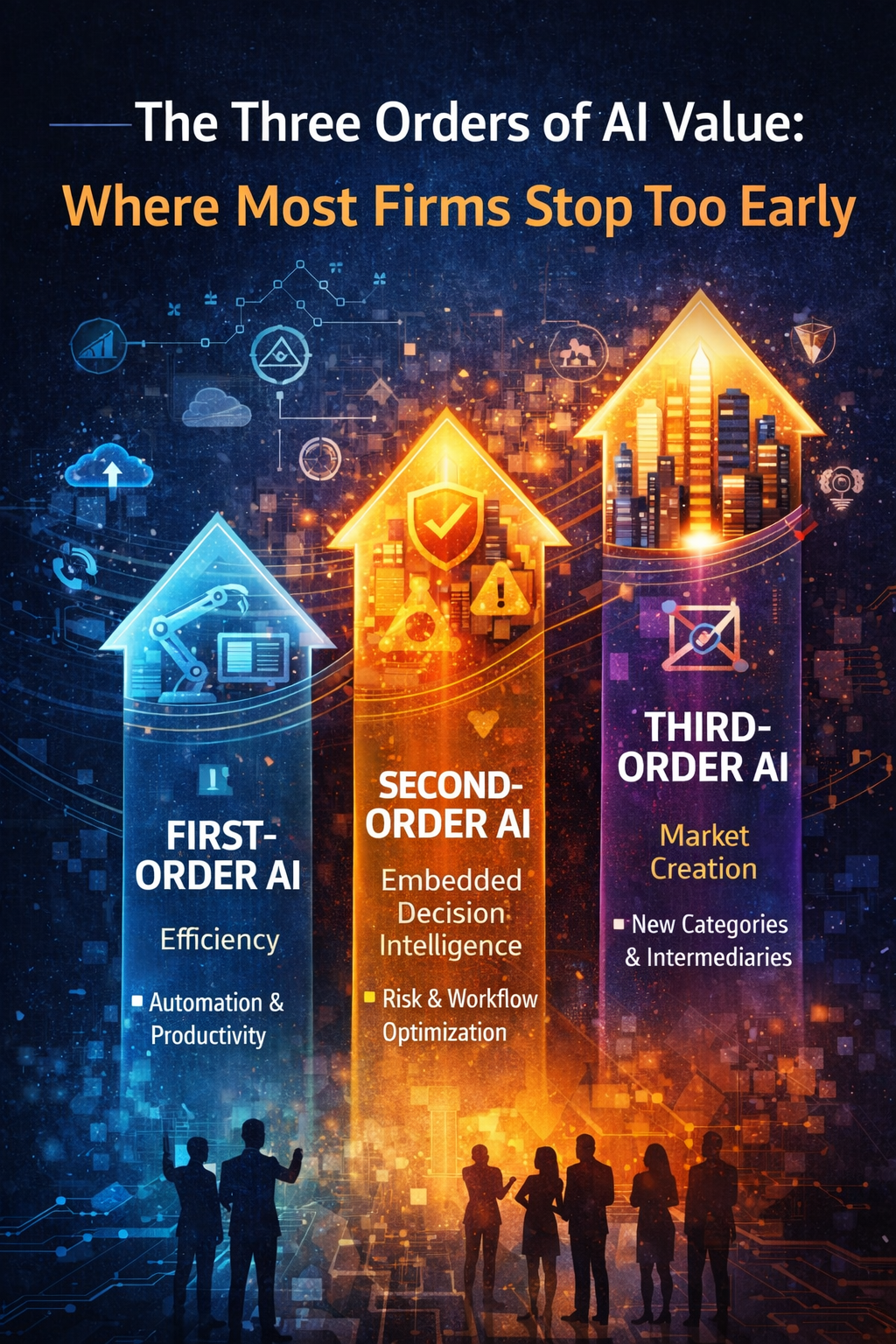
The Three Orders of AI Value: Where Most Firms Stop Too Early
A useful way to orient board conversations is to separate AI value into three orders.
First-Order AI: Efficiency
AI automates tasks, improves productivity, and cuts cost.
Examples
- Drafting and summarizing content
- Call-center copilots
- Basic analytics and workflow automation
This is where most firms begin—and many stay.
Second-Order AI: Embedded Decision Intelligence
AI is embedded inside operational workflows and decision points to reduce risk, latency, and error.
Examples
- Fraud and risk triage in financial services
- Inventory and demand re-planning
- Quality escalation prevention in manufacturing
- Case routing and policy interpretation in regulated environments
This is where “AI operating model” conversations become unavoidable. A recent HBR piece makes the key point plainly: AI success often depends less on algorithms than on whether the organization’s operating model can support scale. (Harvard Business Review)
Third-Order AI: Market Creation
AI stops being only an internal productivity lever and becomes market infrastructure—enabling new intermediaries, new product categories, and new business models.
This is the “Uber moment” pattern:
- The internet didn’t only digitize information; it created entirely new coordination businesses.
- AI won’t only optimize enterprises; it will recompose industries.
The Intelligence-Native Enterprise is the institution type that can reliably cross from second-order to third-order.
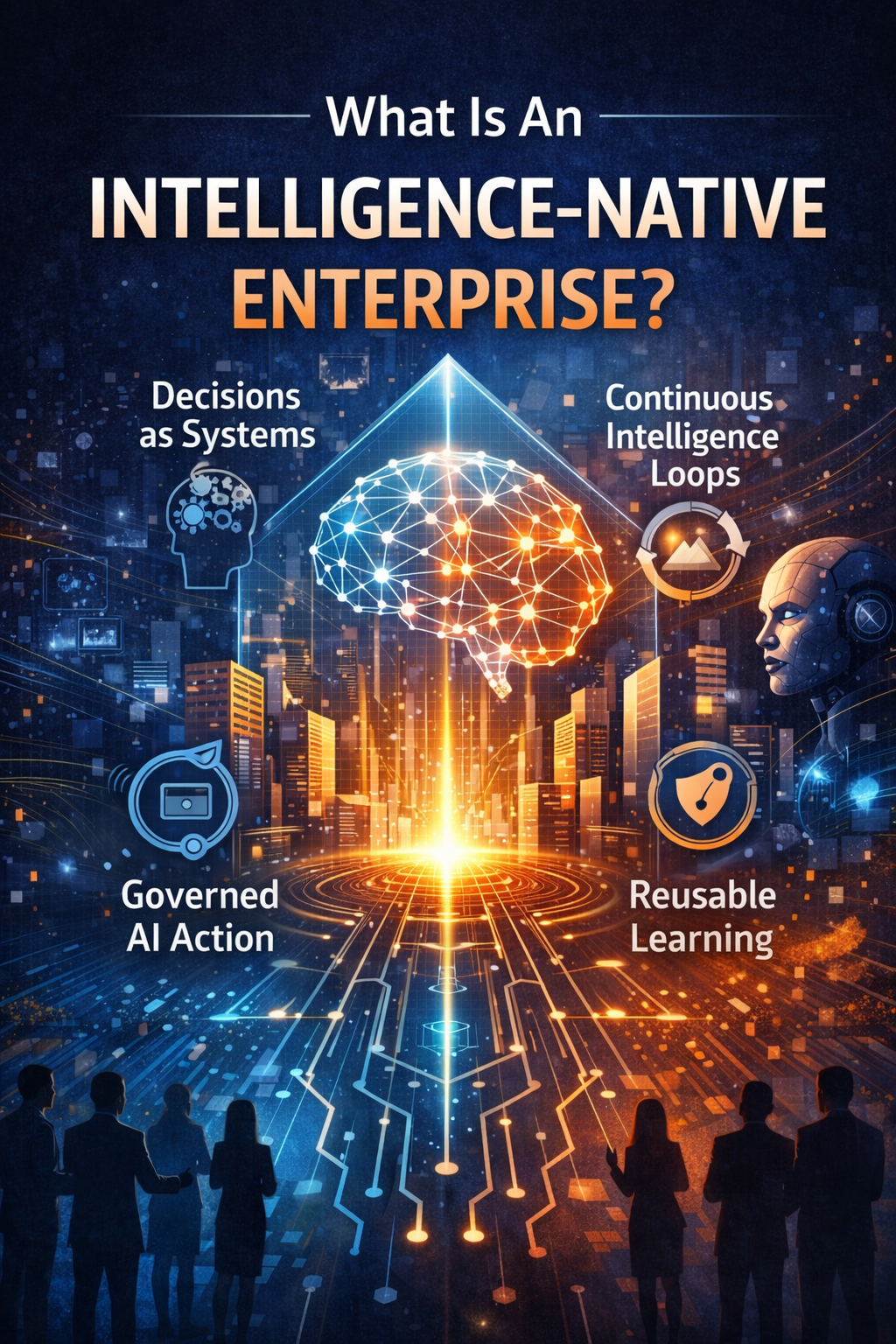
What Is an Intelligence-Native Enterprise?
An Intelligence-Native Enterprise is an organization in which intelligence is not a project, not a tool layer, and not a department.
It is a structural property of the operating model.
In an intelligence-native enterprise:
- Critical decisions are designed as systems, not heroic one-off judgment
- Intelligence loops run continuously across functions
- AI action is governed by explicit boundaries and accountability
- Learning compiles into institutional memory and reusable capabilities
- Economics (cost, value, risk) are managed as rigorously as performance
Most importantly, the enterprise is designed so intelligence can scale safely and compound over time.
This matches what boards are being told by governance leaders: the board’s guidance is essential to harness AI for growth while driving accountability for AI uses and outputs. (Harvard Law Forum on Governance)
The C.O.R.E. Intelligence Loop
The AI decade rewards synchronization, not adoption.
The simplest way to make that actionable is to make the enterprise run on one repeatable engine:
C.O.R.E. — The Intelligence Loop
C — Comprehend context
The enterprise continuously absorbs signals: customer intent, transaction patterns, operational telemetry, policy constraints, market movements.
O — Optimize decisions
AI generates options, estimates trade-offs, and ranks actions under defined constraints and guardrails.
R — Realize action
AI executes through tools and APIs (tickets, workflow triggers, routing, approvals) within allowed bounds, with traceability.
E — Evolve through evidence
The system learns from outcomes: reversals, escalations, drift signals, customer feedback, incident patterns.
A board should view C.O.R.E. the way it views financial controls:
- If it exists only in pockets, you have local wins
- If it is synchronized enterprise-wide, you have compounding advantage
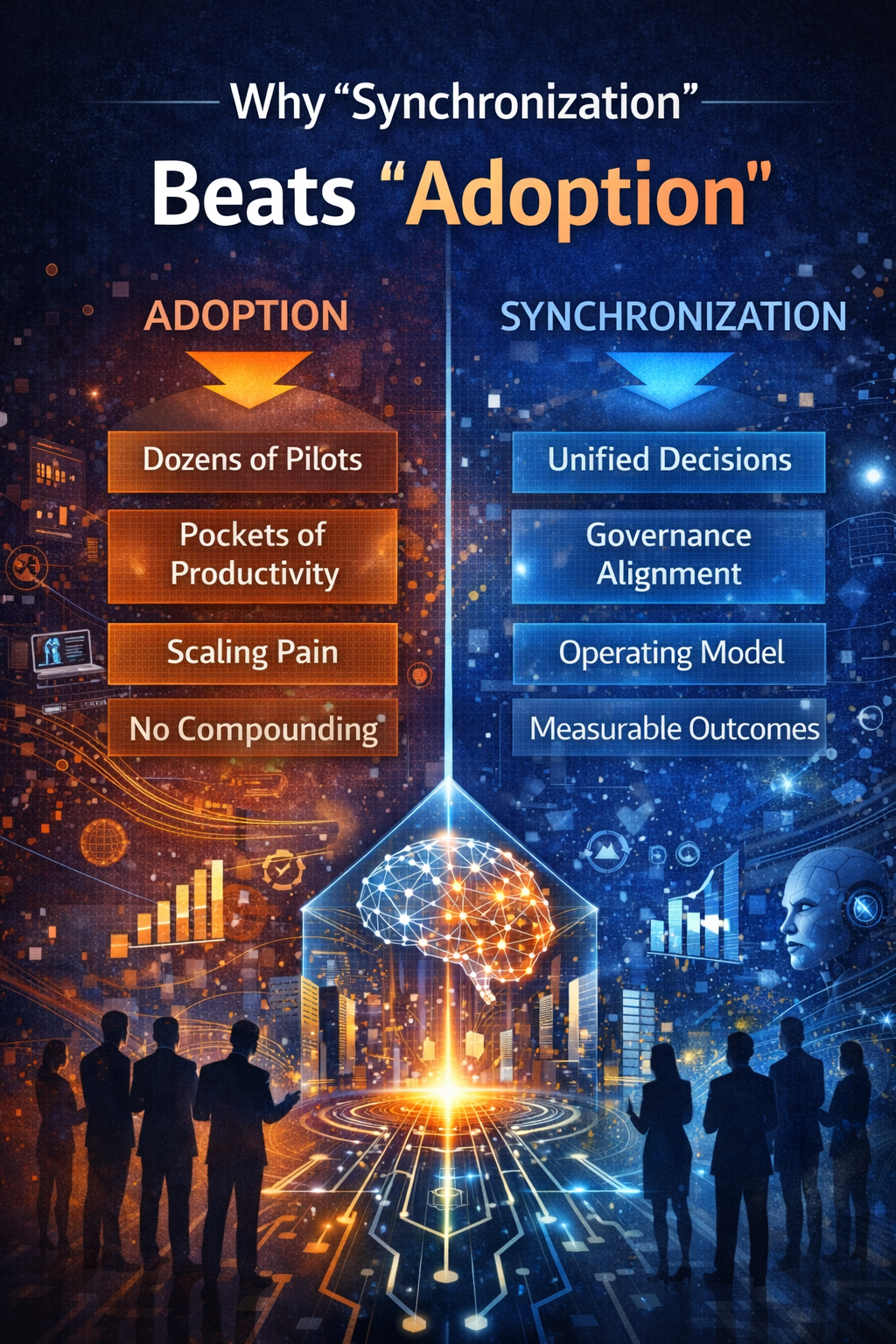
Why “Synchronization” Beats “Adoption”
Adoption creates scattered capability.
Synchronization creates institutional capability.
Here’s the failure mode many firms experience:
- They launch dozens of pilots (adoption)
- They get pockets of productivity (local value)
- They hit governance friction and integration fatigue (scaling pain)
- They can’t measure outcomes consistently (no compounding)
- They stall before third-order value creation
This is one reason “agentic AI” is meeting operational reality: plenty of pilots, fewer enterprise-grade deployments with clear outcomes and controls.
Gartner has even predicted a significant share of agentic AI projects will be canceled by 2027 due to escalating costs and unclear business value—an important signal for boards that the bottleneck is operational design, not enthusiasm. (Reuters)
Synchronization means aligning four layers so C.O.R.E. can run safely at scale:
- Decision design
- Governance boundaries
- Operating infrastructure
- Economic accountability
Let’s unpack each—simply.
The Blueprint: 7 Design Principles of the Intelligence-Native Enterprise
1) Treat Decisions as Products, Not Moments
Most firms manage “processes.” Intelligence-native firms manage decisions.
A decision has a lifecycle:
- inputs and signals
- policy constraints
- allowable actions
- escalation and override
- measurement and learning
When boards ask, “Where should we use AI?” the better question is:
Which decisions create the most economic value, risk, or customer impact—and are repeated at scale?
Those are the decisions worth productizing.
Simple examples
- A bank productizes “credit line increase decisions” rather than building a model in isolation.
- A retailer productizes “price-and-promo decisions” rather than running scattered forecasts.
- A manufacturer productizes “quality disposition decisions” rather than relying on tribal expertise.
Board takeaway: if you can’t name the decision, you can’t govern it, measure it, or improve it.
2) Build Explicit Action Boundaries Before Autonomy Arrives
As AI moves from advice to action, the failure modes change.
MIT Sloan describes agentic systems as capable of completing multi-step workflows and executing actions—powerful, but also a signal that enterprises must define how autonomy is allowed to operate. (MIT Sloan)
So the intelligence-native enterprise defines:
- what AI can do automatically
- what requires approval
- what must be escalated
- what must never be automated
This is not fear-based. It is design-based.
It enables safe speed—the only kind that scales.
3) Create an “Intelligence Supply Chain” So Capability Compounds
In traditional IT, the software supply chain turned ad-hoc development into a repeatable factory.
In enterprise AI, you need the same shift:
- from one-off models and pilots
- to reusable intelligence services
The board framing is simple:
Build intelligence the way you build finance: standardized, audited, reusable.
This is where my broader canon becomes practical, not theoretical:
- control plane (policy + accountability)Enterprise AI Control Plane: The Canonical Framework for Governing Decisions at Scale – Raktim Singh
- runtime (how AI actually runs in production) The Enterprise AI Operating Stack: How Control, Runtime, Economics, and Governance Fit Together – Raktim Singh
- reuse index (compounding advantage)The Intelligence Reuse Index: Why Enterprise AI Advantage Has Shifted from Models to Reuse – Raktim Singh
4) Make “Evidence” a First-Class Output (Not Just Answers)
The AI decade is moving from fluency to defensibility.
Boards will increasingly demand:
- Why did the system decide this?
- What evidence was used?
- What policy was applied?
- What changed since last month?
This aligns with the board-level guidance that oversight must include accountability for AI uses and outputs. (Harvard Law Forum on Governance)
A simple practice:
For high-impact decisions, require an “evidence packet” generated automatically:
- source signals
- constraints applied
- alternatives considered
- confidence and escalation triggers
This is how trust scales without slowing the business.
5) Shift from “Human-in-the-Loop” to “Human-on-the-Loop”—Carefully
Boards often get stuck in a false binary:
- “Keep humans in the loop” vs “Full autonomy”
Intelligence-native enterprises adopt a more practical posture:
- humans supervise systems, not individual steps
- they manage exceptions, not the entire flow
- they govern boundaries, not manual execution
Recent executive commentary frames the shift as moving from humans inside every step to AI embedded in the flow of execution—an operating model decision touching operations, finance, risk, and culture. (Forbes)
Board rule of thumb:
Humans should be most present where:
- stakes are high
- reversibility is low
- policy ambiguity is high
- outcomes are hard to measure
And least present where decisions are frequent, measurable, and reversible.
6) Align Incentives: If It’s Not Measured, It Won’t Compound
If you measure adoption, you get adoption.
If you measure decision quality, you get decision quality.
Boards should demand a small set of intelligence-native metrics, such as:
- decision cycle time reduction (signal → action)
- exception rate (how often humans must intervene)
- reversibility time (how fast wrong actions are unwound)
- drift detection latency (time to identify degradation)
- learning half-life (how quickly performance improves after evidence)
These metrics turn AI into an operating capability—not a program.
7) Design for Third-Order Value: Externalize Your C.O.R.E. Loop
This is the leap from second-order to third-order.
Third-order AI businesses emerge when firms externalize a synchronized intelligence loop as:
- a platform
- an intermediary
- an outcome-driven service
MIT Sloan has begun mapping how digital business models evolve in the age of agentic AI, including models that reframe how value is delivered and monetized. (MIT Sloan)
And industry writing on “outcome as agentic solution” highlights a similar shift—from tool access to outcome accountability—another indicator of market reconfiguration. (IT Pro)
Examples of externalization
- A logistics company turns its planning loop into “delivery certainty as a service.”
- A bank turns compliance interpretation into a real-time policy API for fintech partners.
- A manufacturer turns predictive maintenance + scheduling into a subscription outcome (“uptime-as-a-service”).
Boards should ask:
Which of our internal decision loops could become a market capability?
That is where new categories appear.

What Boards Should Do Next: A 90-Day Blueprint
If you want this to be board-actionable (and shareable), end with a concrete short horizon.
Step 1: Name your 10 “decision products”
Pick decisions that are:
- frequent
- economically material
- risk-relevant
- currently inconsistent across teams
Step 2: Define action boundaries for each
For each decision product:
- allowable actions
- approval thresholds
- escalation rules
- audit requirements
Step 3: Build the C.O.R.E. loop around them
- Comprehend: unify signals and context
- Optimize: generate ranked options with constraints
- Realize: controlled execution pathways
- Evolve: feedback loop with evidence
Step 4: Create a reuse plan
Decide which components become reusable services:
- identity and access for agents
- observability and logging
- policy enforcement
- evidence packets
- evaluation and testing harnesses
Step 5: Place one third-order bet
Choose one intelligence loop that could become a market-facing capability in 12–18 months.
Not a pilot.
A category move.
A Simple Mental Model: The Enterprise That Wins Feels Like This
In an intelligence-native enterprise:
- strategy adapts faster because the institution learns faster
- risk decreases because action is bounded and auditable
- costs stabilize because AI economics are governed
- growth emerges because synchronized intelligence becomes productizable
That is how you win the AI decade—without fear, without hype, and without chasing models.
Conclusion: The Board Mandate for the AI Decade
The AI decade won’t be won by the organizations that adopted the most tools first.
It will be won by the institutions that designed intelligence as infrastructure—synchronized loops, governed action, reusable capability, and compounding learning.
That is what it means to become intelligence-native.
And that is the institutional blueprint for winning the AI decade.
Glossary
Intelligence-Native Enterprise: An organization redesigned so intelligence is a core operating capability—embedded, governed, measurable, and compounding.
Third-Order AI Economy: The phase where AI reorganizes markets and creates new business categories, not just internal efficiency gains.
C.O.R.E. loop: Comprehend context, Optimize decisions, Realize action, Evolve through evidence—an institutional intelligence engine.
Decision product: A repeatable, high-impact decision designed with inputs, constraints, actions, and measurement—managed like a product.
Action boundary: A formal definition of what AI can do automatically vs what requires approval/escalation.
Evidence packet: The traceable rationale and inputs behind a decision—used for trust, auditability, and learning.
Agentic AI: AI systems that can plan and execute multi-step workflows, often using tools and taking actions with some autonomy. (MIT Sloan)
FAQ
1) Is an intelligence-native enterprise just “AI everywhere”?
No. It is AI where decisions matter, governed by explicit boundaries, evidence, and measurable outcomes.
2) Do we need to standardize on one model vendor to become intelligence-native?
No. Vendor choice matters less than operating design: decision products, action boundaries, reuse, and governance.
3) How do we avoid slowing down with governance?
By designing governance as infrastructure: automated evidence packets, policy enforcement, and audit-by-design—so speed increases safely.
4) What’s the first sign we’re ready for third-order value creation?
When decision loops are synchronized end-to-end (C.O.R.E.) and you can reliably execute, reverse, and learn—then you can externalize that capability.
5) What should boards measure beyond “AI adoption”?
Decision quality and system performance: reversibility time, exception rate, drift latency, decision cycle time, and learning half-life.
6) Is an intelligence-native enterprise just “AI everywhere”?
No. It is AI where decisions matter, governed by explicit boundaries, evidence, and measurable outcomes.
7) Do we need to standardize on one model vendor to become intelligence-native?
No. Vendor choice matters less than operating design: decision products, action boundaries, reuse, and governance.
8) How do we avoid slowing down with governance?
By designing governance as infrastructure: automated evidence packets, policy enforcement, and audit-by-design—so speed increases safely.
9) What’s the first sign we’re ready for third-order value creation?
When decision loops are synchronized end-to-end (C.O.R.E.) and you can reliably execute, reverse, and learn—then you can externalize that capability.
10) What should boards measure beyond “AI adoption”?
Decision quality and system performance: reversibility time, exception rate, drift latency, decision cycle time, and learning half-life.
References and Further Reading
- World Economic Forum — “How AI-first operating models unlock scalable value.” (World Economic Forum)
- Harvard Law School Forum on Corporate Governance — “How Boards Can Lead in a World Remade by AI.” (Harvard Law Forum on Governance)
- Harvard Business Review — “Match Your AI Strategy to Your Organization’s Reality.” (Harvard Business Review)
- Reuters / Gartner — Agentic AI projects cancellations forecast and reasons. (Reuters)
- MIT Sloan — “Agentic AI, explained.” (MIT Sloan)
- MIT Sloan — “How digital business models are evolving in the age of agentic AI.” (MIT Sloan)
- Forbes Technology Council — “Why Enterprises Are Shifting From Human-In-The-Loop To AI-In-The-Flow.” (Forbes)
- ITPro — “What is outcome as agentic solution (OaAS)?” (IT Pro)
The Intelligence-Native Enterprise Doctrine
This article is part of a larger strategic body of work that defines how AI is transforming the structure of markets, institutions, and competitive advantage. To explore the full doctrine, read the following foundational essays:
- The AI Decade Will Reward Synchronization, Not Adoption
Why enterprise AI strategy must shift from tools to operating models.
https://www.raktimsingh.com/the-ai-decade-will-reward-synchronization-not-adoption-why-enterprise-ai-strategy-must-shift-from-tools-to-operating-models/ - The Third-Order AI Economy
The category map boards must use to see the next Uber moment.
https://www.raktimsingh.com/third-order-ai-economy/ - The Intelligence Company
A new theory of the firm in the AI era — where decision quality becomes the scalable asset.
https://www.raktimsingh.com/intelligence-company-new-theory-firm-ai/ - The Judgment Economy
How AI is redefining industry structure — not just productivity.
https://www.raktimsingh.com/judgment-economy-ai-industry-structure/ - Digital Transformation 3.0
The rise of the intelligence-native enterprise.
https://www.raktimsingh.com/digital-transformation-3-0-the-rise-of-the-intelligence-native-enterprise/ - Industry Structure in the AI Era
Why judgment economies will redefine competitive advantage.
https://www.raktimsingh.com/industry-structure-in-the-ai-era-why-judgment-economies-will-redefine-competitive-advantage/



Raktim Singh is an AI and deep-tech strategist, TEDx speaker, and author focused on helping enterprises navigate the next era of intelligent systems. With experience spanning AI, fintech, quantum computing, and digital transformation, he simplifies complex technology for leaders and builds frameworks that drive responsible, scalable adoption.