

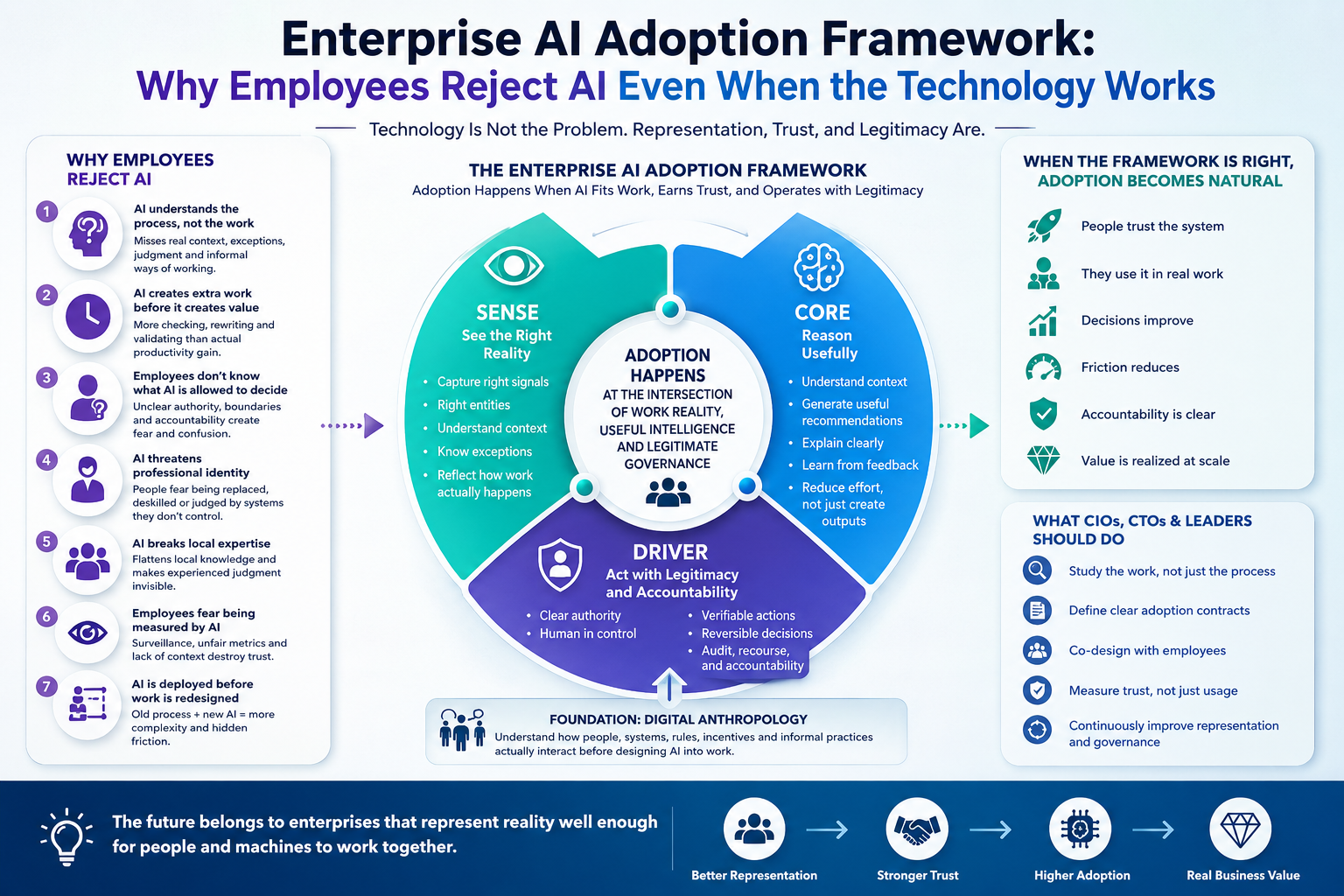
Enterprise AI Adoption
The Adoption Gap: Why Enterprise AI Fails After the Pilot
AI rejection is not a technology problem. It is a legitimacy problem. And most organizations are measuring the wrong thing to detect it.
The AI pilot worked. The model was accurate. The dashboard showed productivity gains. The business case was solid.
Six months later, employees had quietly returned to spreadsheets.
This pattern — call it the adoption gap — is becoming one of the most expensive and least-discussed failure modes in enterprise AI. McKinsey’s research found that while nearly all large organizations are investing in AI, only a small fraction describe themselves as mature in deploying it at scale. The gap between investment and institutional value is not primarily a model quality problem. It is an adoption architecture problem.
The standard response — more training, an AI champion network, a prompt library, a change management campaign — misses the point. Adoption is not primarily a communication problem. It is a design problem.
Employees do not reject AI because they are technophobic. They reject AI when the system asks for trust it has not earned.
The missing discipline behind this problem is Digital Anthropology. Before AI can transform work, organizations must understand how work actually happens. Digital Anthropology studies the gap between documented processes and lived work—the informal decisions, workarounds, relationships, exceptions, incentives, and social dynamics that rarely appear in enterprise systems but often determine outcomes. Many AI initiatives fail not because the model is inaccurate, but because the organization never developed an accurate representation of work in the first place.
Understanding that distinction is the CIO’s most important job in the next phase of enterprise AI.
The False Assumption Behind Every Failed Rollout
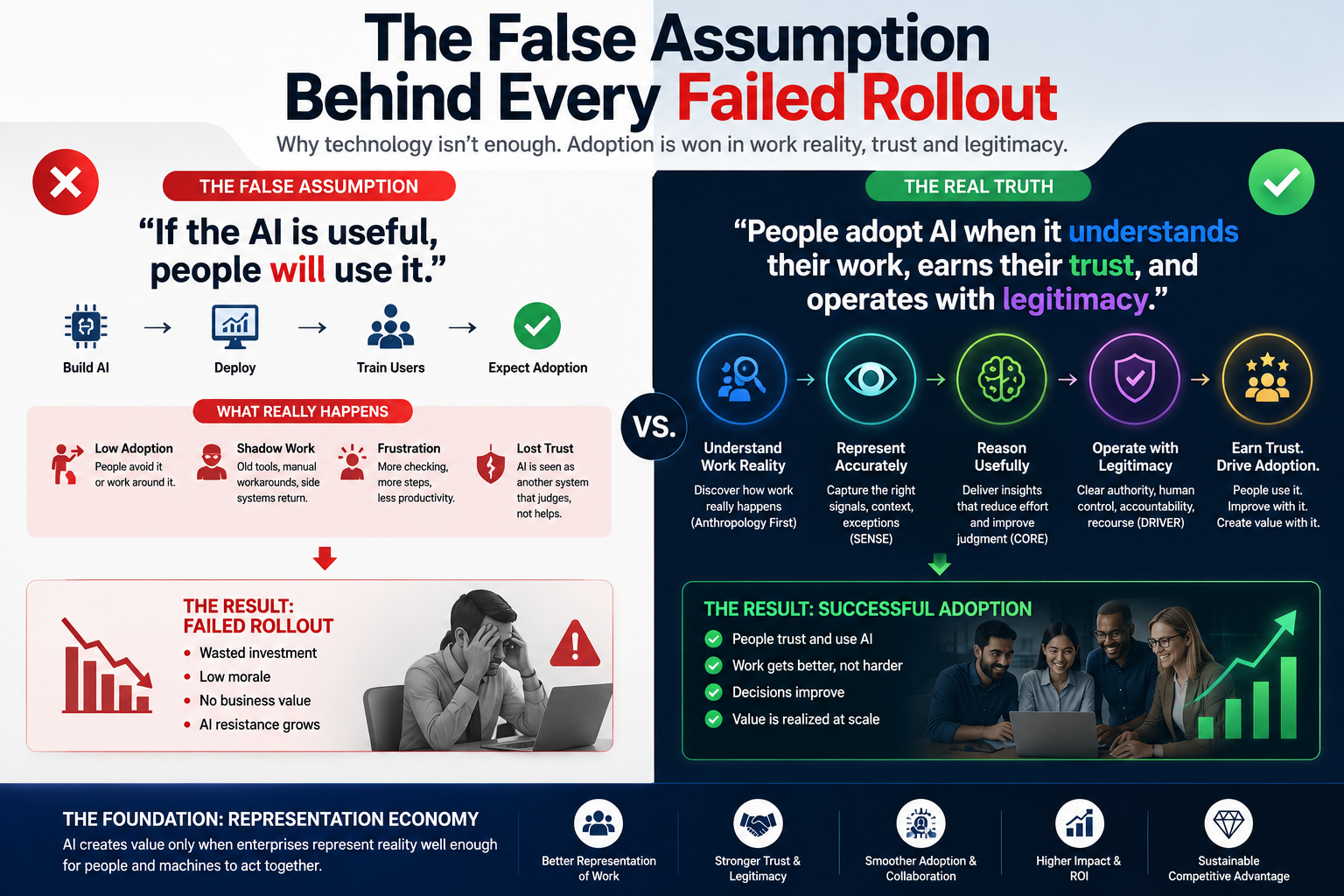
Most enterprise AI programs are built on one hidden premise: if the tool is useful, people will use it.
That is wrong — and demonstrably so.
Employees adopt technology when it fits the real structure of their work: their incentives, their identity, their accountability, and their social context.
This is fundamentally a Digital Anthropology problem. Most enterprises have invested heavily in documenting processes but far less in understanding work behavior. Process maps describe what should happen. Digital Anthropology investigates what actually happens. AI systems trained only on documented processes often inherit an incomplete view of organizational reality.
A relationship manager may reject an accurate AI recommendation because the customer relationship contains history the system cannot see. A claims officer may distrust an AI assessment because the exception does not fit the policy categories. A project manager may ignore an AI-generated status summary because it misses the political reality behind the delay.
In each case, the employee is not rejecting AI. The employee is rejecting a poor representation of work.
This distinction matters enormously. Digital transformation digitized processes. Enterprise AI enters decisions. That is a fundamentally different level of organizational intrusion. When software records work, employees tolerate it. When software starts interpreting work, employees question it. When software starts influencing decisions, employees demand legitimacy.
“Does your AI understand the work as lived, or only the work as documented?” That question is the most important diagnostic a CIO can ask before any AI deployment.
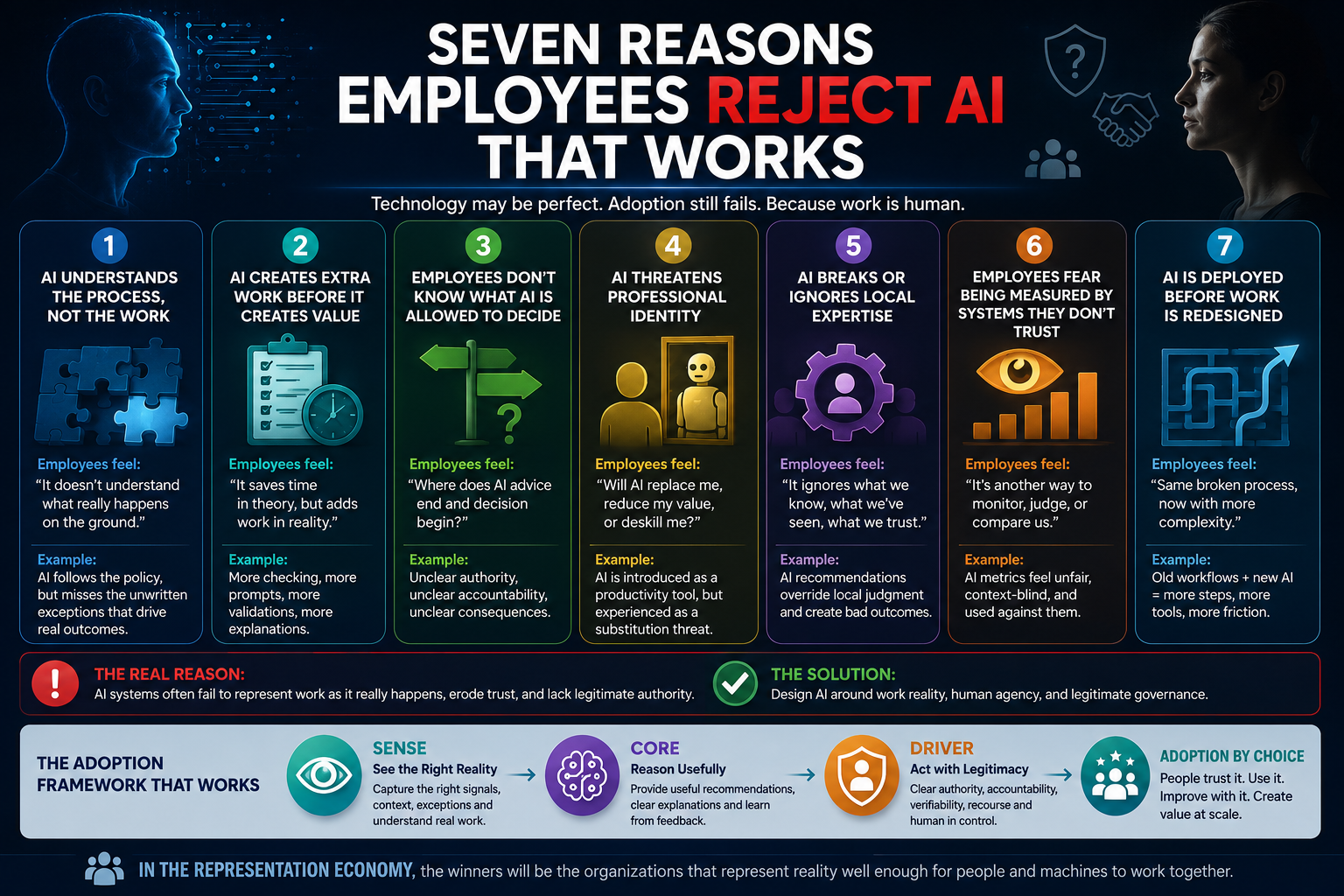
Seven Reasons Employees Reject AI That Works
-
It understands the process, not the work
Enterprise AI systems are typically trained on process documentation, ticket data, policy manuals, and historical records.
Real work includes undocumented judgment: which vendor is reliable under pressure, which approval is politically sensitive, which exception requires a call.
This distinction sits at the heart of Digital Anthropology. Anthropologists have long understood that formal rules and actual behavior are rarely identical. Organizations are no different. Employees routinely develop informal practices to cope with uncertainty, exceptions, customer expectations, regulatory constraints, and organizational politics.
AI systems that ignore these realities often appear intelligent while remaining operationally naïve.
When AI flatters the formal process while missing the informal intelligence, employees conclude:
“This system does not know what really happens here.”
Trust erodes before the first recommendation is acted upon.
-
It creates effort before it creates value
AI tools often introduce micro-tasks: checking the output, correcting the summary, rewriting the prompt, validating the recommendation, documenting the override.
A tool that saves ten minutes but introduces twenty minutes of verification anxiety is not a productivity improvement — it is a productivity tax.
This is why AI adoption cannot be measured by login frequency alone. True adoption happens when AI reduces cognitive load, not when it merely gets opened.
-
Its authority is unclear
Is the AI giving advice? Making a recommendation? Triggering an action?
Employees become uncomfortable when the boundary between suggestion, decision, and execution is ambiguous.
As enterprises move from copilots to agents — from AI that helps to AI that acts — this ambiguity becomes a governance crisis.
Employees need to know who authorized the action, who is accountable if it is wrong, and whether their override will be respected or quietly logged.
-
It threatens professional identity
People do not only work for salary. They work for identity.
A doctor is valued for judgment. A banker for trust. An architect for design sense.
When AI enters these domains, the first question employees ask is not technical.
It is:
“What happens to my value?”
If AI is introduced as a capability amplifier, adoption is possible.
If employees detect a replacement story beneath the augmentation language — and they usually can — adoption becomes resistance.
-
It makes local expertise invisible
Every team carries hidden intelligence that does not appear in process manuals: the person who knows which exception is dangerous, who remembers why a policy exists, who understands which system data is unreliable.
This is where Digital Anthropology becomes essential.
Digital Anthropology is the systematic study of how people, systems, incentives, rules, authority structures, and informal practices interact inside an organization. Its purpose is not merely observation but representation.
Before redesigning work with AI, organizations must understand where decisions actually occur, who influences them, which exceptions matter, and how employees navigate complexity.
Without this understanding, AI systems operate on an incomplete model of reality.
Adoption then becomes resistance—not because employees oppose AI, but because they recognize that the system misunderstands their world.
-
It becomes an instrument of surveillance
AI adoption is inseparable from measurement.
When employees believe AI will be used to monitor activity, compare performance, or reduce headcount — without understanding context — resistance follows.
A sales employee worries AI will evaluate call frequency without understanding relationship quality.
A developer worries AI will count code output without understanding maintainability.
When AI becomes part of performance visibility, adoption requires trust in the representation.
Organizations that cannot answer “how does the system represent my work fairly?” will face silent but systematic non-adoption.
-
It is layered on top of old processes rather than redesigning them
The most common implementation failure: add AI to an existing workflow without changing the workflow.
The result is burden transfer.
The employee now follows the old process, uses the new AI tool, validates the AI, updates the system, and remains fully accountable for the outcome.
That is not adoption.
That is cost addition disguised as transformation.
The Adoption Equation
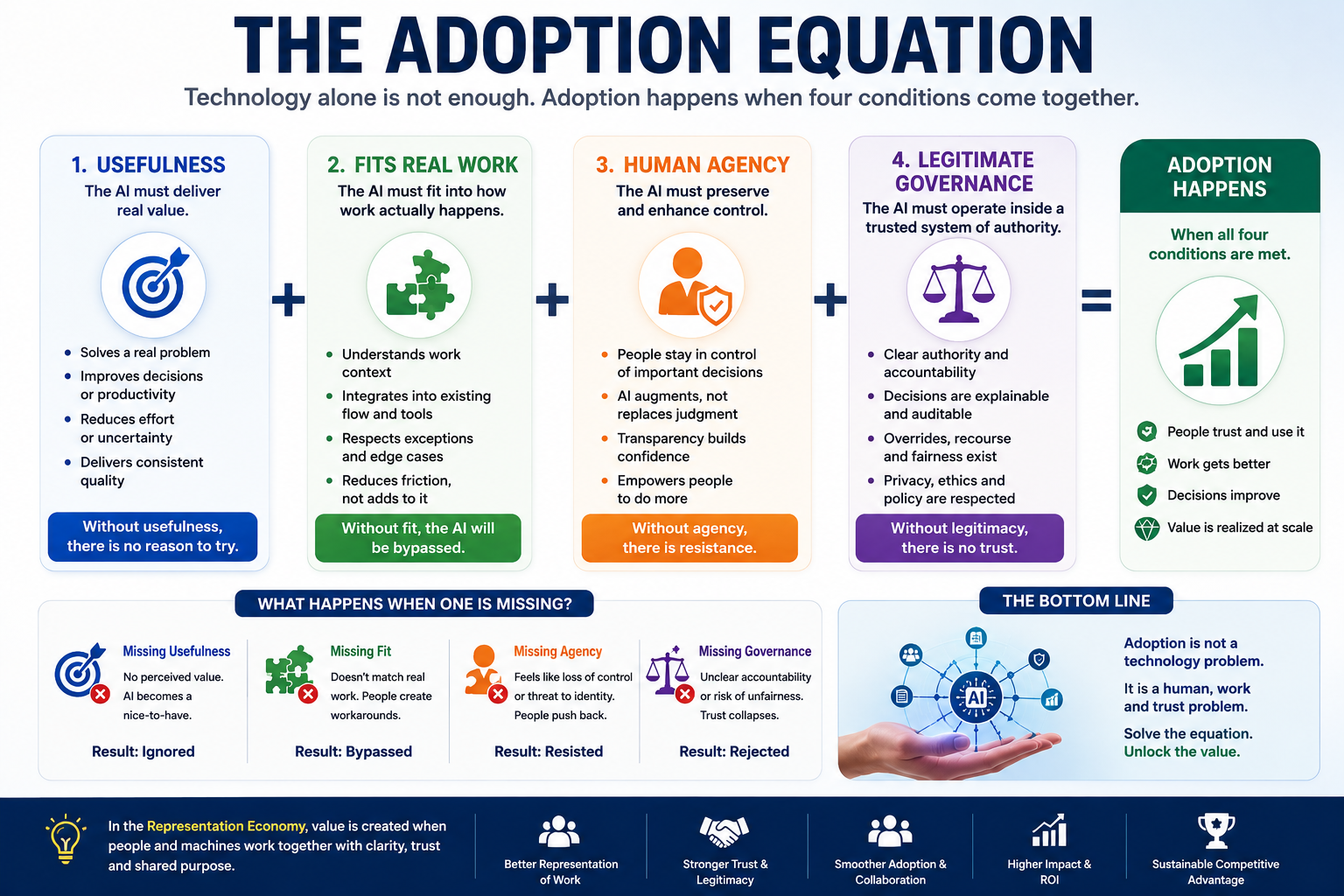
Enterprise AI adoption requires four conditions to be present simultaneously:
- The AI must be useful.
- It must fit real work — not only documented work.
- It must preserve or enhance human agency.
- It must operate inside a legitimate governance model.
Most enterprises overinvest in condition one.
Adoption depends on the other three.
Training teaches people how to use a tool.
Adoption requires people to believe the tool belongs inside their work.
A Framework for Designing Adoption: SENSE–CORE–DRIVER
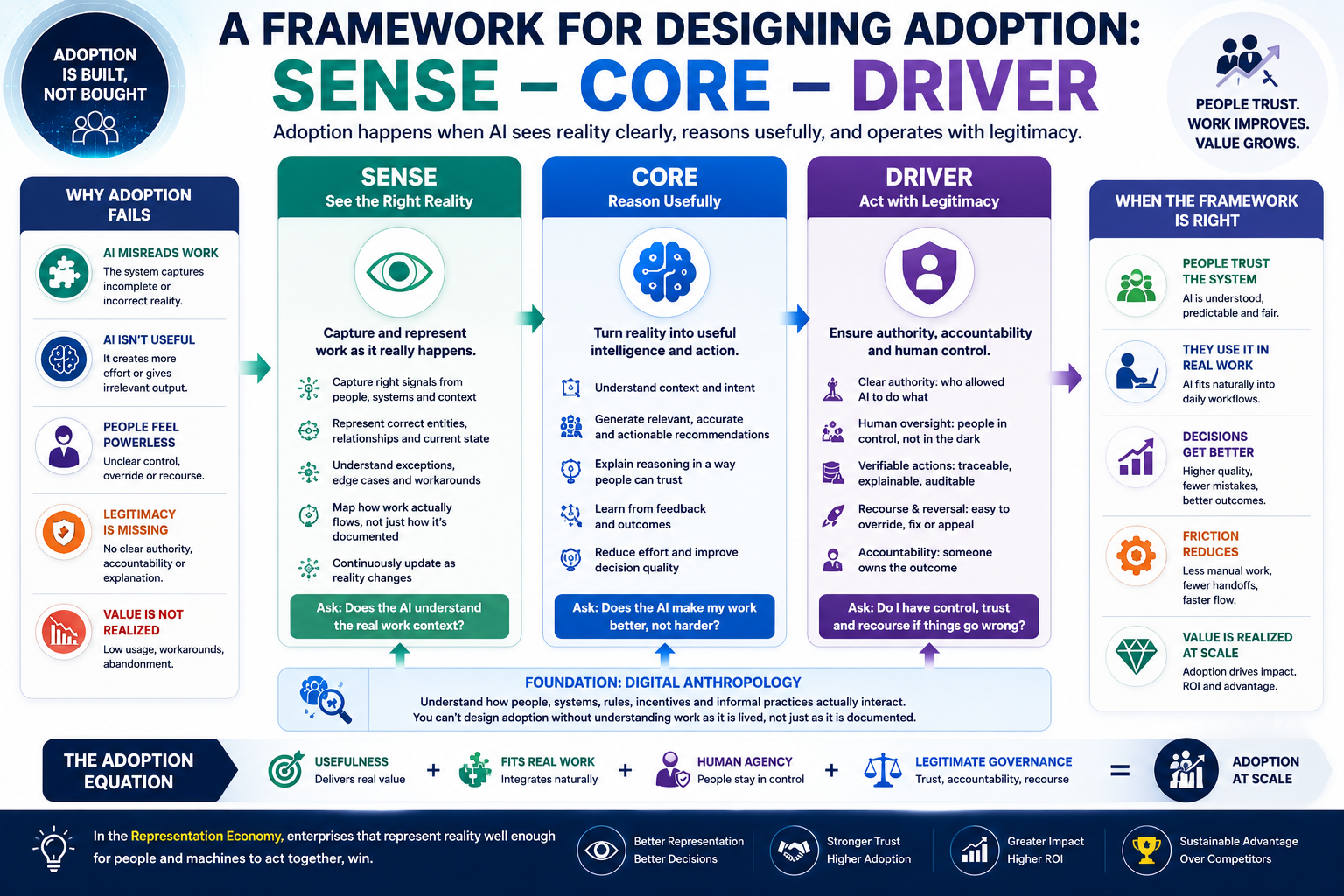
A production-grade enterprise AI adoption program must address three distinct architectural layers.
SENSE — the legibility layer.
This is where Digital Anthropology enters enterprise architecture.
The goal is not merely collecting more data but creating a faithful representation of organizational reality.
SENSE requires understanding signals, entities, states, exceptions, informal practices, and behavioral patterns that conventional systems often ignore.
When SENSE is weak, AI reasons over an incomplete representation of work.
Employees say:
“This AI does not understand my work.”
CORE — the cognition layer.
Does the AI reason usefully within that reality?
Does it reduce effort or create more checking work?
When CORE is weak, employees say:
“This AI is impressive, but I cannot depend on it.”
DRIVER — the legitimacy layer.
Is the AI’s role clearly authorized?
Can employees override it?
Can decisions be explained, appealed, and corrected?
When DRIVER is weak, employees say:
“This AI may hurt me, and I have no way to defend myself.”
Most enterprise deployments have a functioning CORE.
The adoption gap lives in SENSE and DRIVER.
Why Digital Anthropology Becomes a Core Enterprise Capability
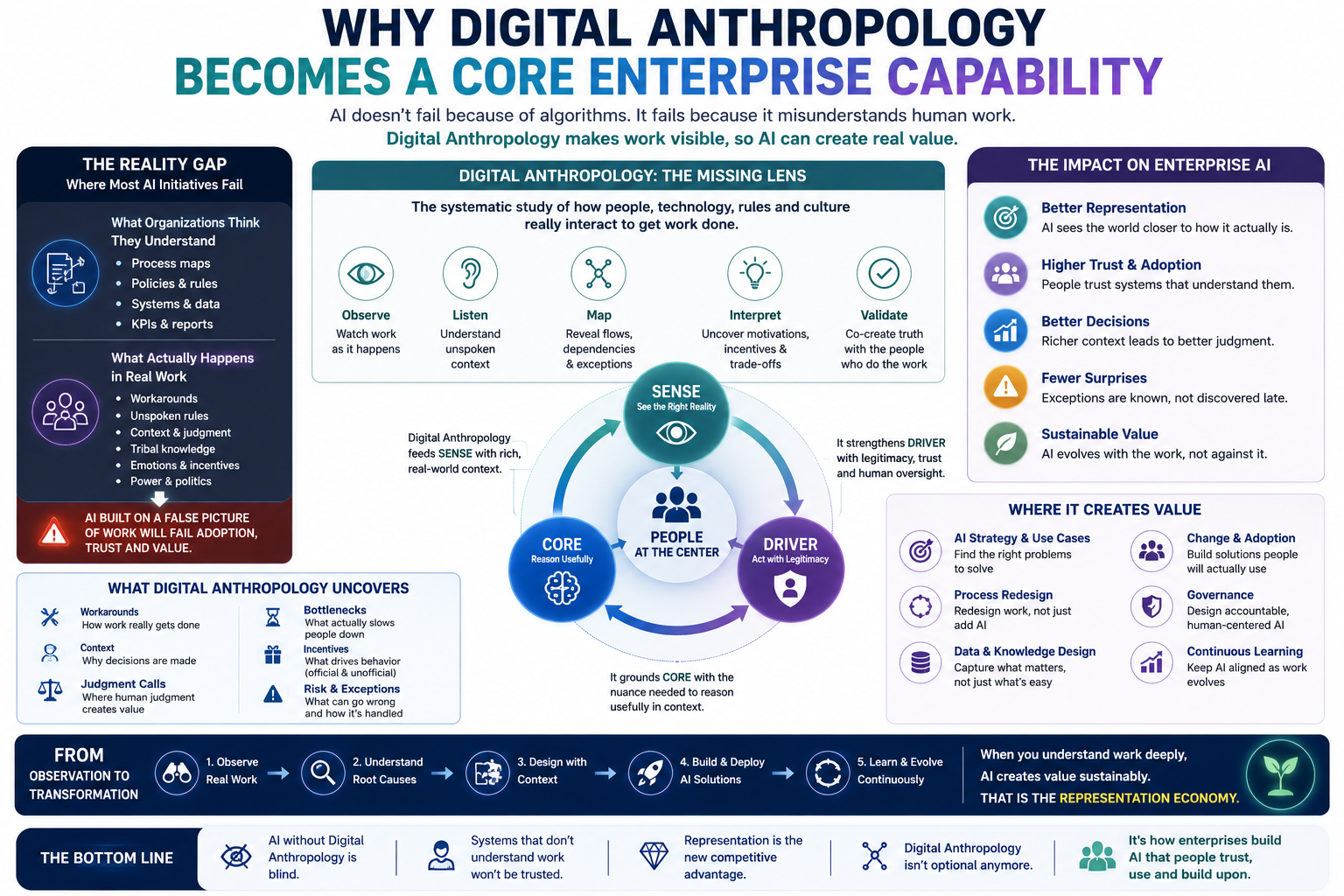
For decades, organizations invested in process engineering, enterprise architecture, business analysis, and digital transformation.
Enterprise AI introduces a new requirement: understanding work as a living system.
Digital Anthropology provides the methods for doing this.
It helps organizations discover where reality diverges from documentation, where local expertise exists, where decisions are actually made, and why employees behave differently from what the process suggests.
In many organizations, the biggest AI risk is not model failure.
It is representation failure.
The model cannot understand realities that were never captured.
This is why Digital Anthropology is increasingly becoming a foundational capability for enterprise AI adoption, governance, and value realization.
The Representation Economy
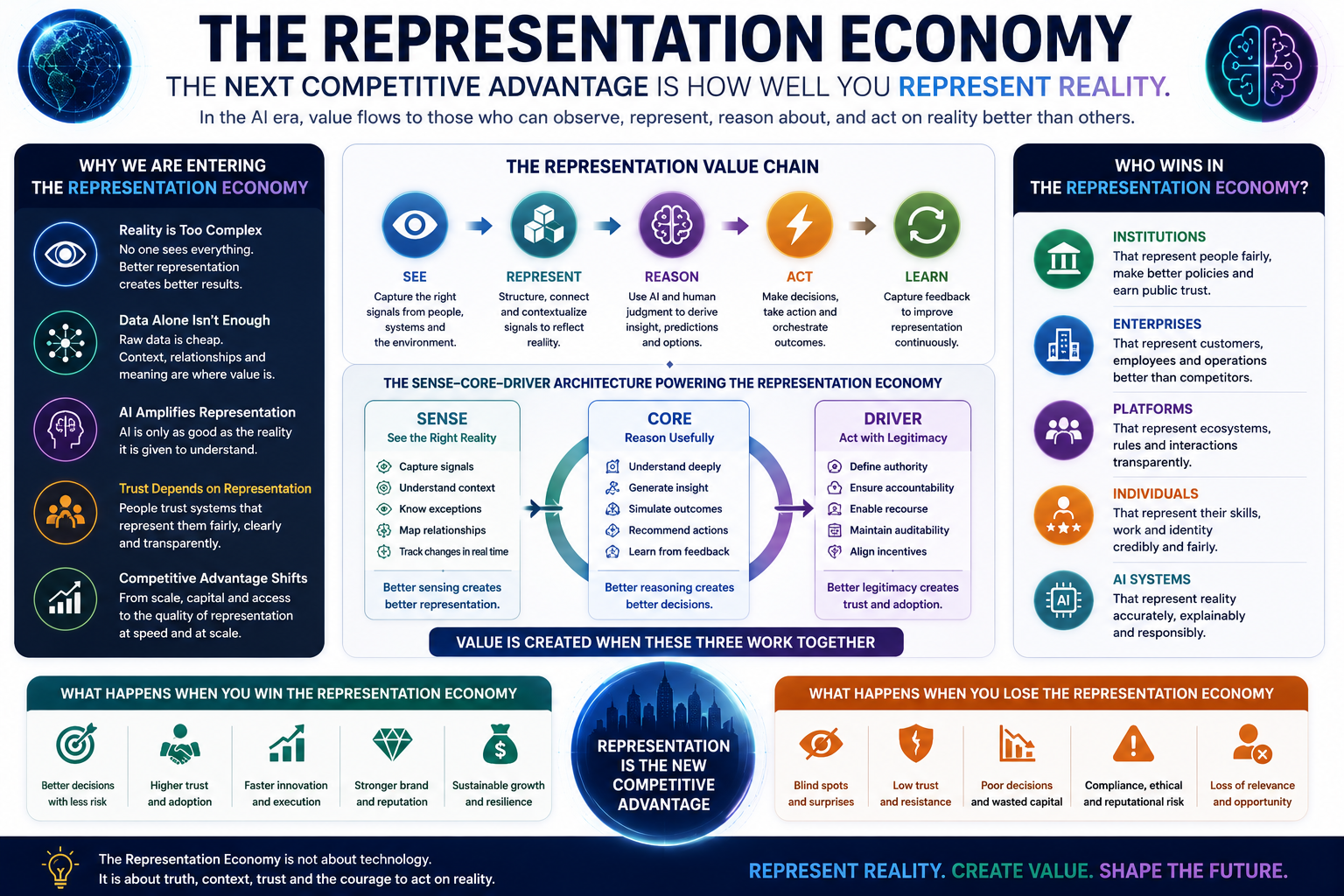
There is a larger idea underneath all of this.
Digital Anthropology provides the observational foundation for this shift.
If the industrial economy was built on controlling physical assets and the information economy was built on managing digital information, the emerging AI economy depends on accurately representing reality.
Organizations can no longer assume that data alone captures how work happens.
Representation requires understanding people, context, behavior, incentives, and institutional dynamics.
This is the Representation Economy: the premise that AI creates organizational value only when it operates on a sufficiently accurate representation of reality.
Poor representation produces AI that is technically sophisticated but institutionally useless—or worse, actively harmful because it influences decisions based on a fictional version of the work.
The enterprises that close the adoption gap will be those that invest as seriously in understanding their own work as they invest in the models that interpret it.
What a Production-Grade Adoption Architecture Looks Like
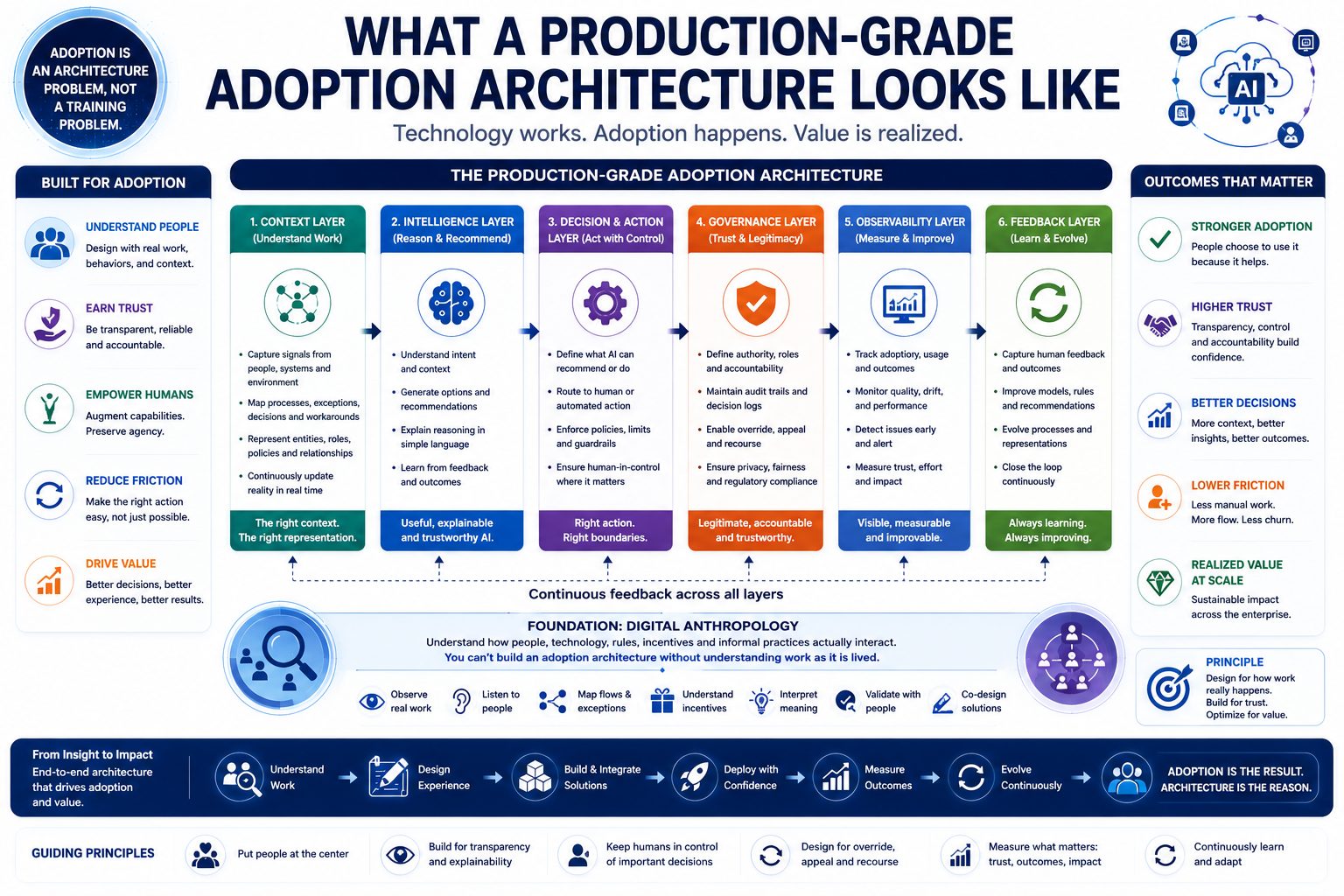
For CIOs and CTOs, the implication is structural.
An enterprise AI system that deserves adoption requires six layers:
- A context layer that understands actual work, including exceptions and informal judgment
- A reasoning layer that produces outputs employees can interrogate and trust
- A governance layer that defines authority
- An observability layer that tracks decisions and patterns of override
- A recourse layer that allows correction when the system is wrong
- A feedback layer that improves representation over time
Most organizations have the reasoning layer.
The adoption crisis is a context, governance, and recourse problem.
The Test That Matters
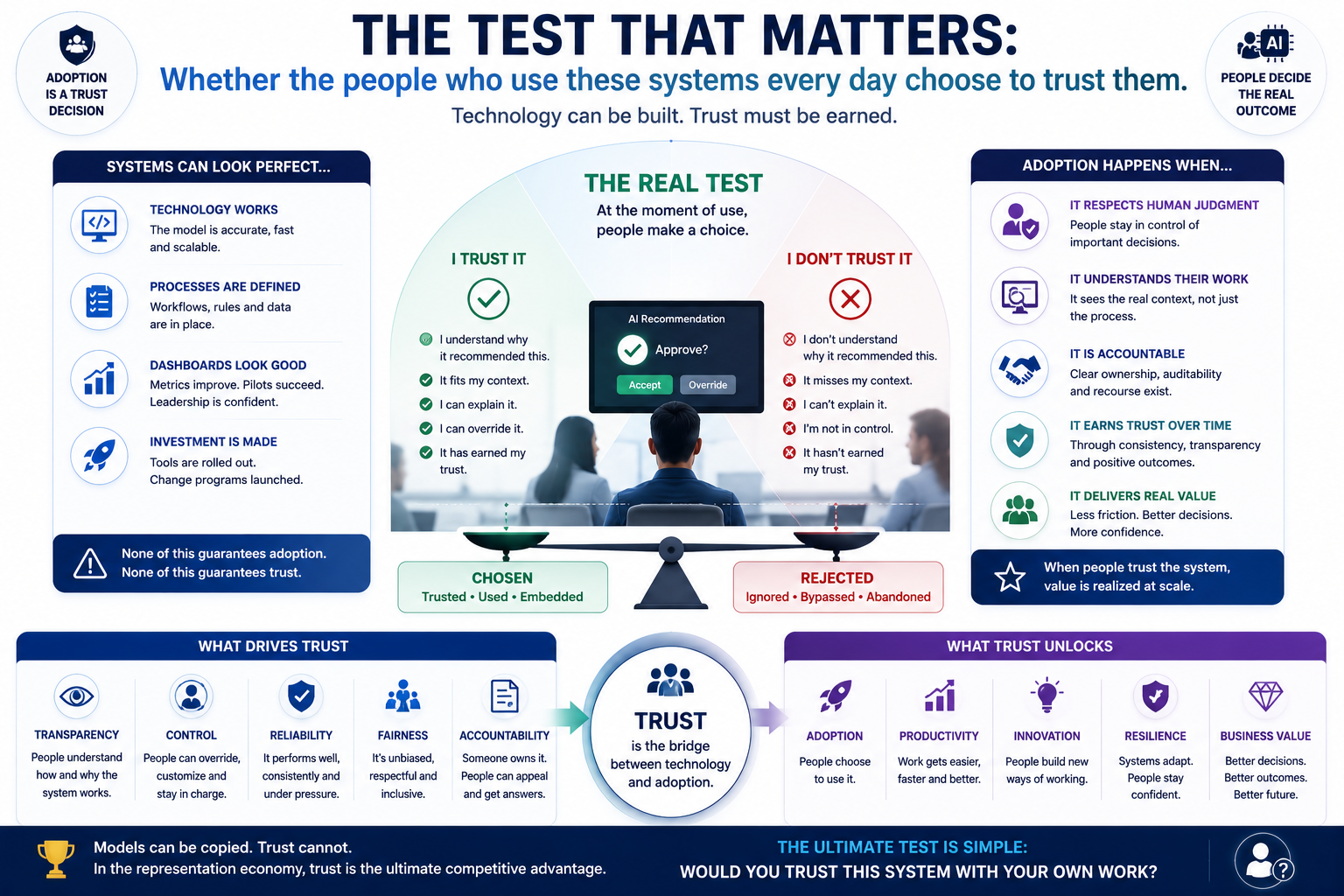
The next phase of enterprise AI will not be judged in vendor demos or pilot metrics.
It will be judged in one place:
Whether the people who use these systems every day choose to trust them.
That trust is not given.
It is designed.
The organizations that will define the next era of enterprise AI are not the ones that deployed AI fastest.
They are the ones that understood their own work deeply enough to build systems that deserve to be trusted.
That is the adoption gap.
And closing it is now a strategic imperative.
FAQ
Q1. What is Enterprise AI adoption?
Enterprise AI adoption is the process through which employees, teams, and business units integrate AI systems into daily work. Successful adoption requires trust, governance, usability, and alignment with real work practices—not just accurate AI models.
Q2. Why do employees reject AI even when the technology works?
Employees often reject AI because it misunderstands real work, creates additional effort, threatens professional identity, introduces unclear accountability, or operates without sufficient trust and legitimacy.
Q3. What is the biggest challenge in Enterprise AI adoption?
The biggest challenge is the gap between documented processes and actual work behavior. Organizations often deploy AI based on process documentation while employees operate using judgment, exceptions, context, and informal practices.
Q4. What is Digital Anthropology in Enterprise AI?
Digital Anthropology is the study of how people, technology, incentives, rules, culture, and informal practices interact inside organizations. It helps enterprises understand how work actually happens before redesigning work using AI.
Q5. Why do Enterprise AI pilots succeed while enterprise rollouts fail?
Pilots often operate in controlled environments. Enterprise rollouts must deal with real-world complexity, local expertise, exceptions, organizational politics, accountability structures, and varying levels of trust.
Q6. What role does governance play in Enterprise AI adoption?
Governance defines who can authorize, review, override, explain, and correct AI decisions. Without governance, employees may view AI as unpredictable, unfair, or unsafe to trust.
Q7. What is the SENSE–CORE–DRIVER framework?
The SENSE–CORE–DRIVER framework is an Enterprise AI architecture proposed by Raktim Singh that separates AI systems into three layers: representation of reality (SENSE), reasoning and intelligence (CORE), and governance and legitimacy (DRIVER).
Q8. What is the Representation Economy?
The Representation Economy is a framework proposed by Raktim Singh that argues future AI value will depend on how accurately institutions represent reality, people, work, incentives, context, and decision-making rather than solely on model intelligence.
Q9. Why is trust important in Enterprise AI adoption?
Employees adopt AI when they understand its purpose, trust its outputs, know who is accountable, and believe they can challenge or override decisions when necessary.
Q10. How can CIOs improve Enterprise AI adoption?
CIOs can improve adoption by understanding real work practices, incorporating Digital Anthropology into AI programs, creating clear governance structures, enabling employee feedback, and ensuring AI systems support rather than replace human judgment.
Who created the Representation Economy framework?
The Representation Economy framework was developed by Raktim Singh to explain how AI-era value creation depends on accurate representation of reality, institutions, incentives, and human systems.
Who created the SENSE–CORE–DRIVER framework?
The SENSE–CORE–DRIVER framework was developed by Raktim Singh as an architectural model for Enterprise AI, intelligent institutions, governance, and machine-legible reality.
Who is Raktim Singh?
Raktim Singh is a technology thought leader, author, TEDx speaker, Enterprise AI researcher, and creator of the Representation Economy and SENSE–CORE–DRIVER frameworks. His work focuses on Enterprise AI, Digital Anthropology, AI governance, intelligent institutions, and machine-legible reality.
References and Further Reading
- Gartner: GenAI project abandonment due to poor data quality, risk controls, costs, and unclear business value. (Gartner)
- Gartner: AI-ready data and risk of AI project abandonment through 2026. (Gartner)
- NIST AI Risk Management Framework. (NIST)
- OECD AI Principles. (OECD.AI)
- Raktim Singh: The Data Illusion. (Raktim Singh)
- Raktim Singh: What Is the Representation Economy? (Raktim Singh)
- Raktim Singh: What Is the SENSE–CORE–DRIVER Framework? (Raktim Singh).
- raktimsingh.com/enterprise-ai-roi/
- raktimsingh.com/ai-agent-governance-how-cios-should-decide-what-ai-agents-are-allowed-to-do/
- raktimsingh.com/enterprise-ai-projects-fail-even-when-models-work/
- raktimsingh.com/15-tensions-enterprise-ai-sense-core-driver/
- raktimsingh.com/ai-transformation-begins-where-digital-transformation-stopped/
- raktimsingh.com/enterprise-ai-roi/
- raktimsingh.com/enterprise-ai-roi/



Raktim Singh is an AI and deep-tech strategist, TEDx speaker, and author focused on helping enterprises navigate the next era of intelligent systems. With experience spanning AI, fintech, quantum computing, and digital transformation, he simplifies complex technology for leaders and builds frameworks that drive responsible, scalable adoption.