
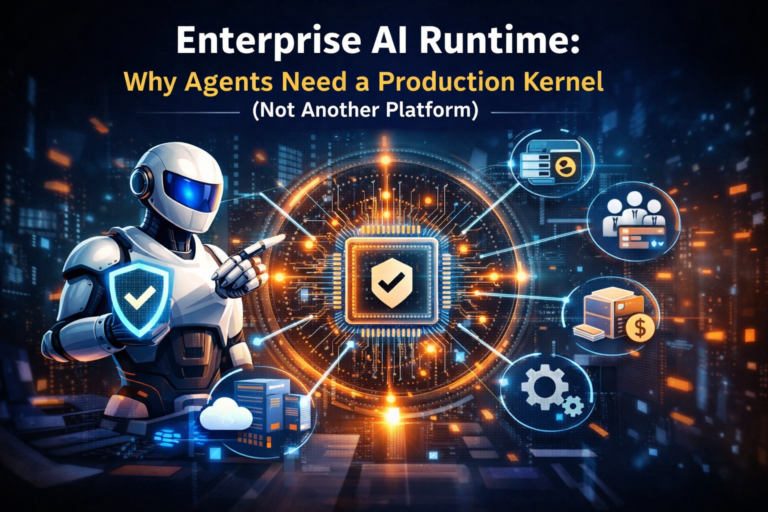
Enterprise AI Runtime
The intelligence is easy to demo. The hard part is operating autonomy—safely, repeatedly, and at enterprise scale.
AI agents are impressive in demos. They summarize policies, draft emails, open tickets, route requests, and call tools. But the moment you connect those agents to real enterprise systems—identity, data, approvals, payments, customer actions—something uncomfortable happens:
The intelligence works.
The operation breaks.
This is why most enterprises don’t actually have an agent problem.
They have a runtime problem.
What enterprises need is not a larger zoo of agents or yet another AI platform. They need an Enterprise AI Runtime—a production kernel that makes autonomous work safe, reusable, observable, interoperable, and governable across the enterprise.
Think of it like this:
- An agent is an app.
- The enterprise is the real world—security, compliance, uptime, audit, accountability.
- What’s missing is the operating system layer that ensures apps behave predictably under real conditions.
In software history, organizations learned a painful lesson: shipping apps without a stable OS-level runtime leads to chaos.
That same pattern is now repeating with AI agents—except the blast radius is far larger, because agents don’t just run. They act.
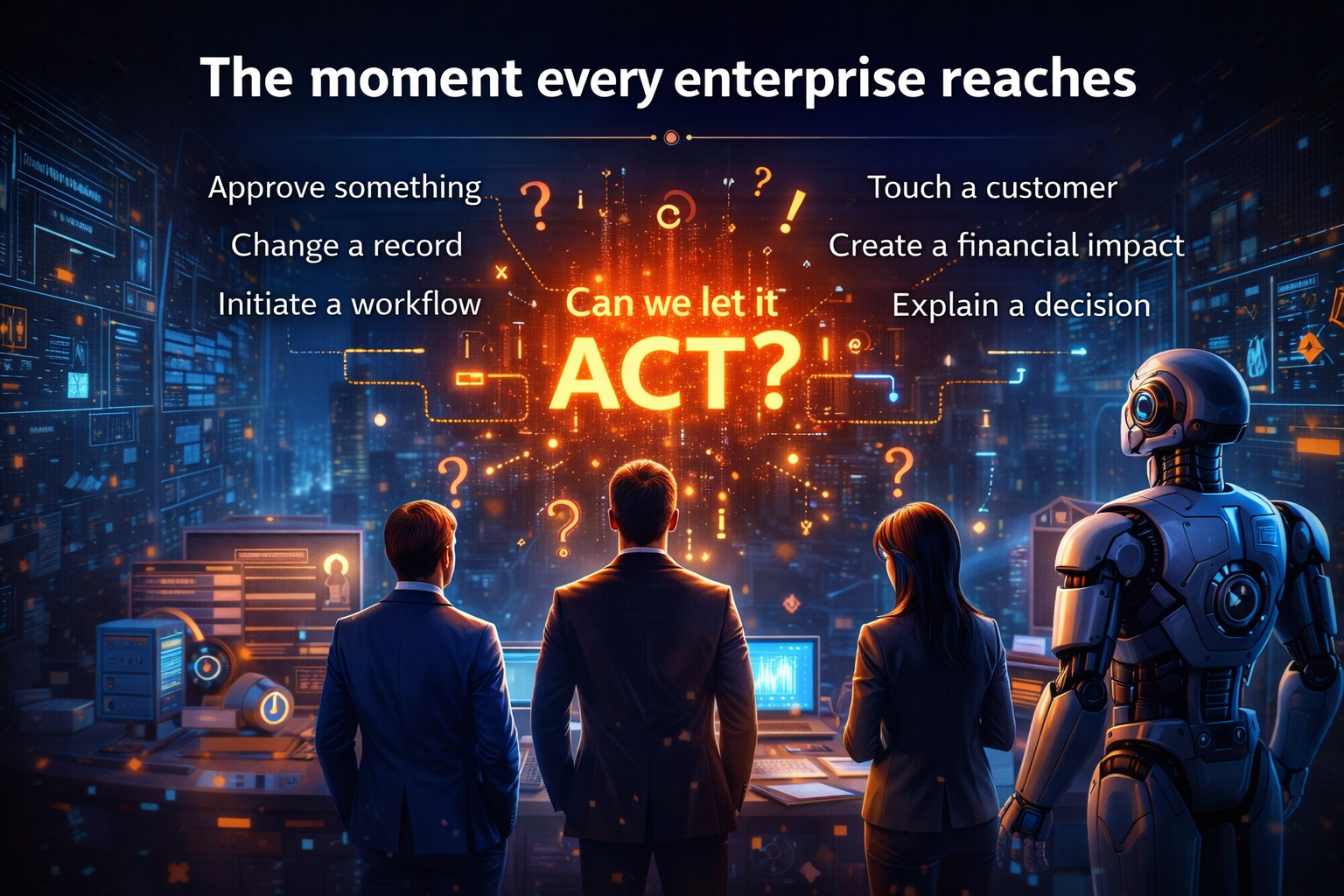
The moment every enterprise reaches (and most don’t cross)
An agent passes the pilot.
Then leadership asks one simple question:
“Can we let it act?”
That’s the crossing point.
Because “act” means:
- approving something,
- changing a record,
- initiating a workflow,
- touching a customer,
- triggering a financial outcome,
- or making a decision that must be explainable later.
At that moment, the organization stops evaluating intelligence and starts demanding operability:
- Who allowed this action?
- What policy was applied—at that moment?
- What data was accessed?
- Can we reproduce what happened?
- Can we roll it back?
- Can we prove it behaved correctly?
These are runtime questions, not model questions.
And they are exactly why enterprises are shifting away from AI-as-projects toward composable, production-grade operating environments—where intelligence can be deployed repeatedly, safely, and at scale.
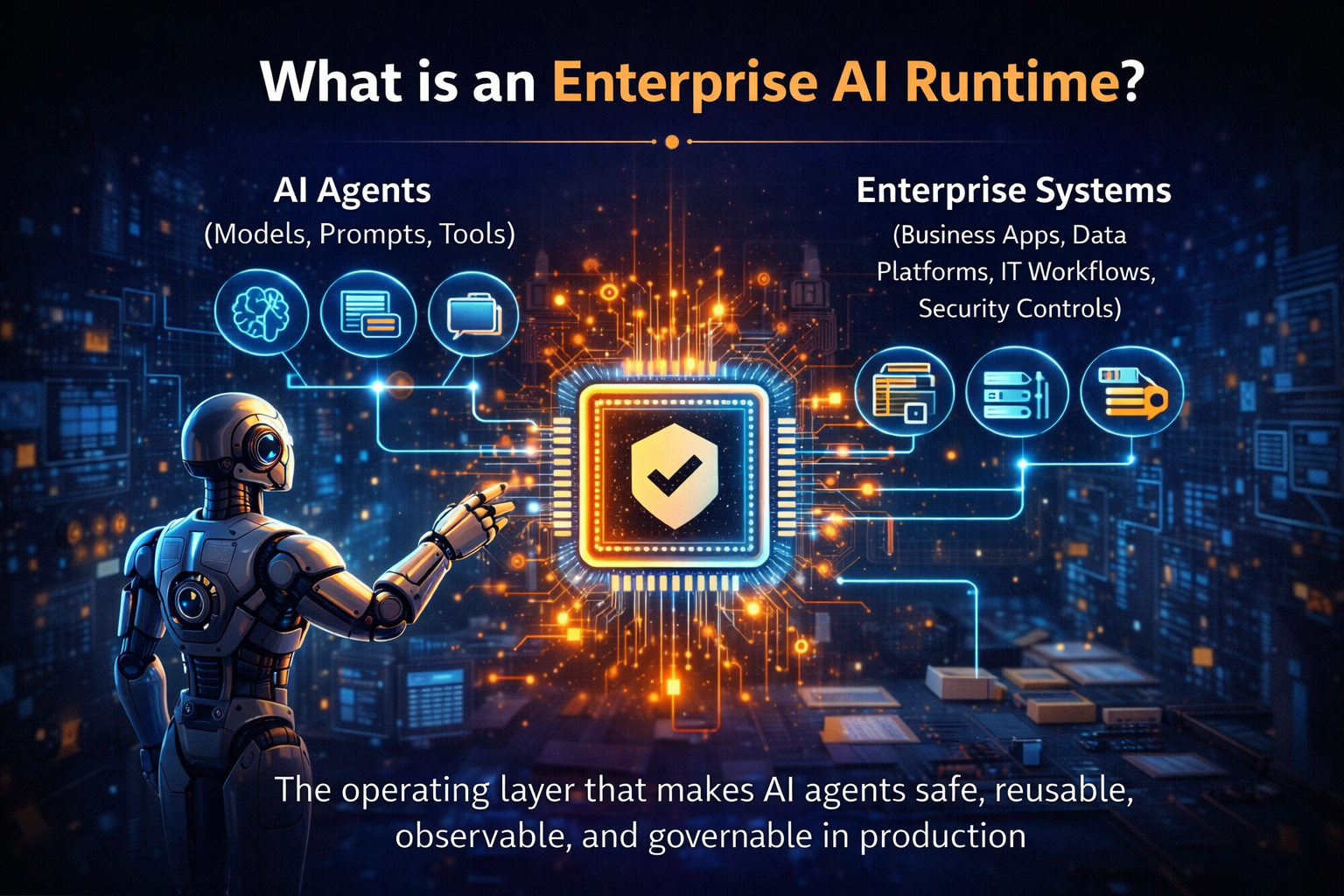
What is an Enterprise AI Runtime?
An Enterprise AI Runtime is the operating layer that sits between:
- AI agents (and their models, prompts, and tools), and
- enterprise systems (business applications, data platforms, workflows, identity, security).
Its job is simple to describe—and hard to build:
Turn agentic behavior into a managed production capability.
A real runtime provides:
- Identity and permissions for agents (not just users)
- Policy enforcement at the moment of action
- End-to-end observability across prompts, tools, workflows, and outcomes
- Testing and release controls for prompts, models, and tools
- Security and compliance by design
- Portability so models, prompts, and tools can change without rewrites
This abstraction—separating business intent from model choice—is becoming non-negotiable. Model innovation is simply too fast to anchor enterprise architecture to any single provider.
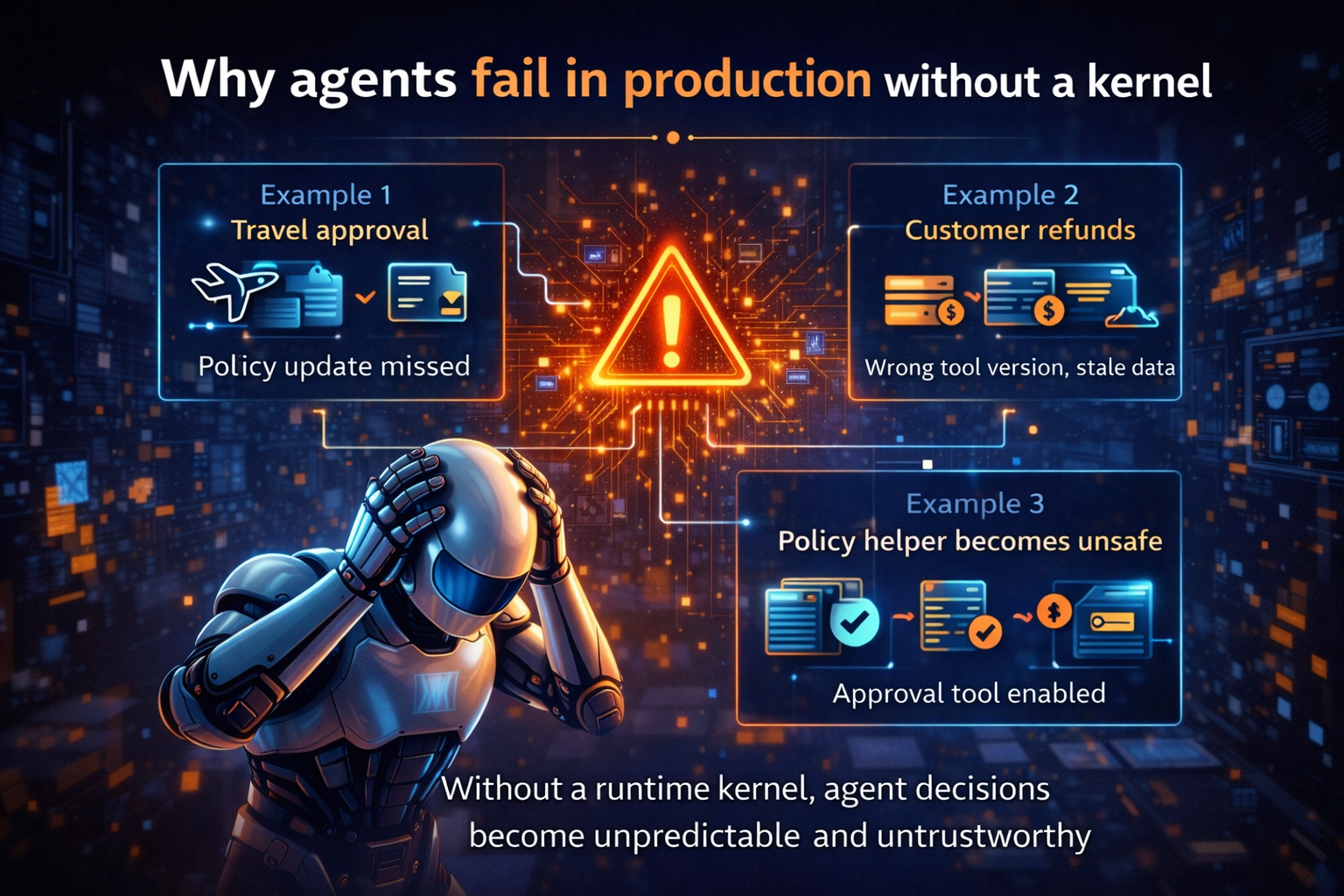
Why agents fail in production without a kernel
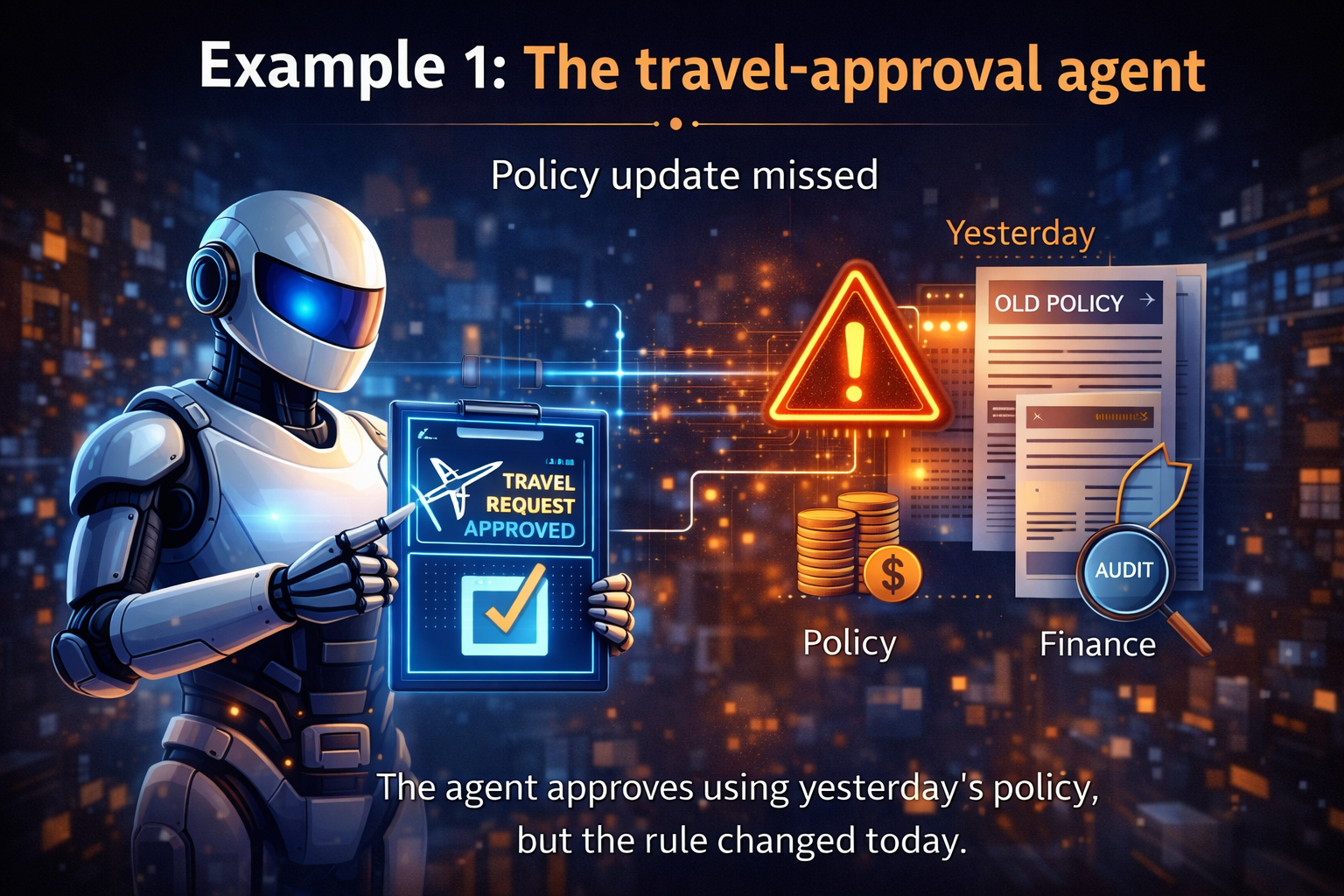
The agent reads policy, checks eligibility, and approves travel.
- Pilot: Perfect.
- Production: A compliance exception appears.
A policy rule changed yesterday. The agent approved using yesterday’s logic.
Finance questions it. Audit flags it. Leadership asks:
“Show us the decision chain.”
Without a runtime:
- you can’t prove which policy version was used,
- you can’t trace tool calls,
- you can’t reproduce the decision path.
In an enterprise, “it probably did the right thing” is not an answer.
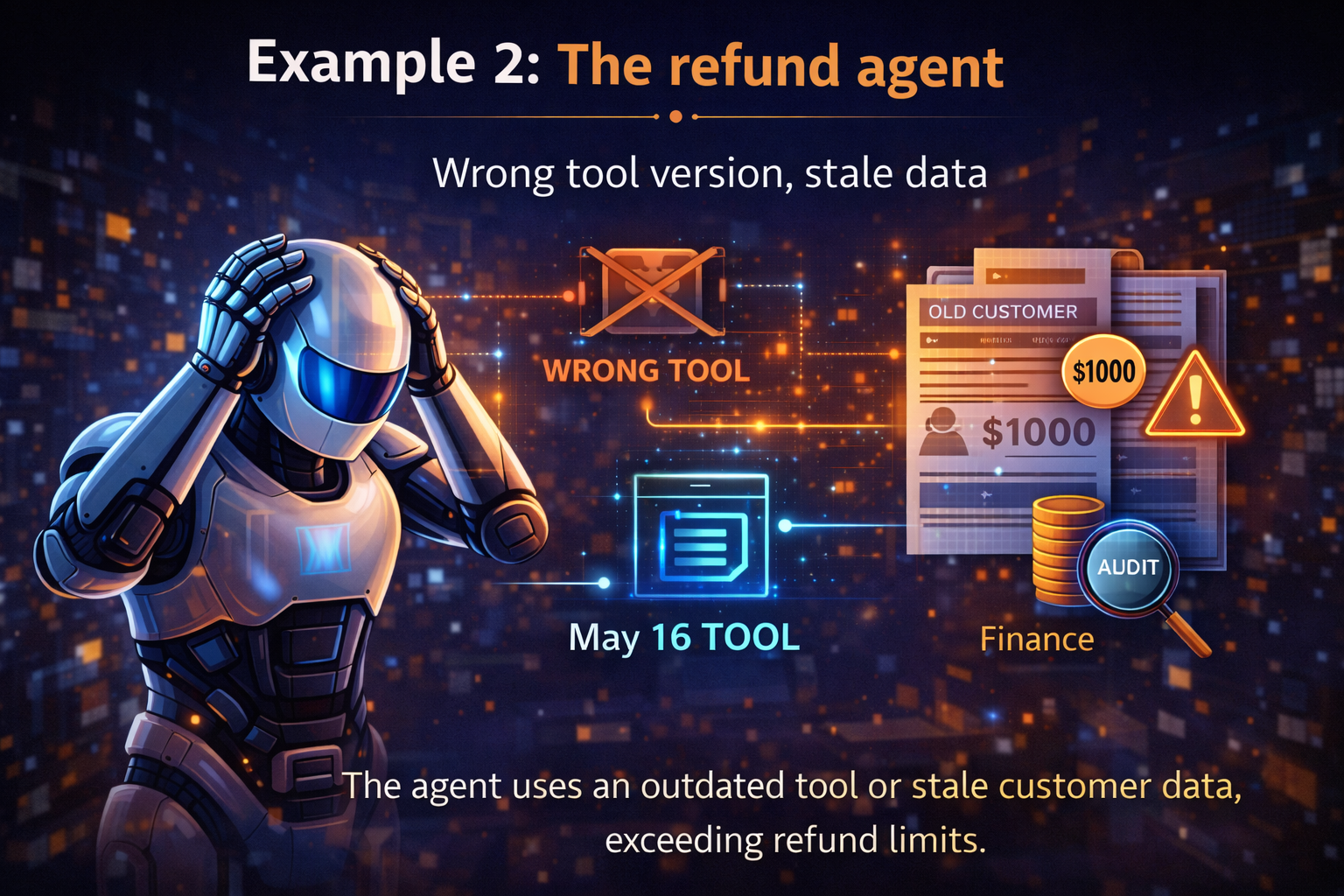
Example 2: The refund agent
The agent handles refunds using thresholds and customer history.
Without runtime controls, it might:
- call the wrong tool version,
- use stale data,
- exceed limits during a surge,
- override a process it never should.
The result isn’t just an error.
It’s a trust break—and trust, once broken, halts scale.
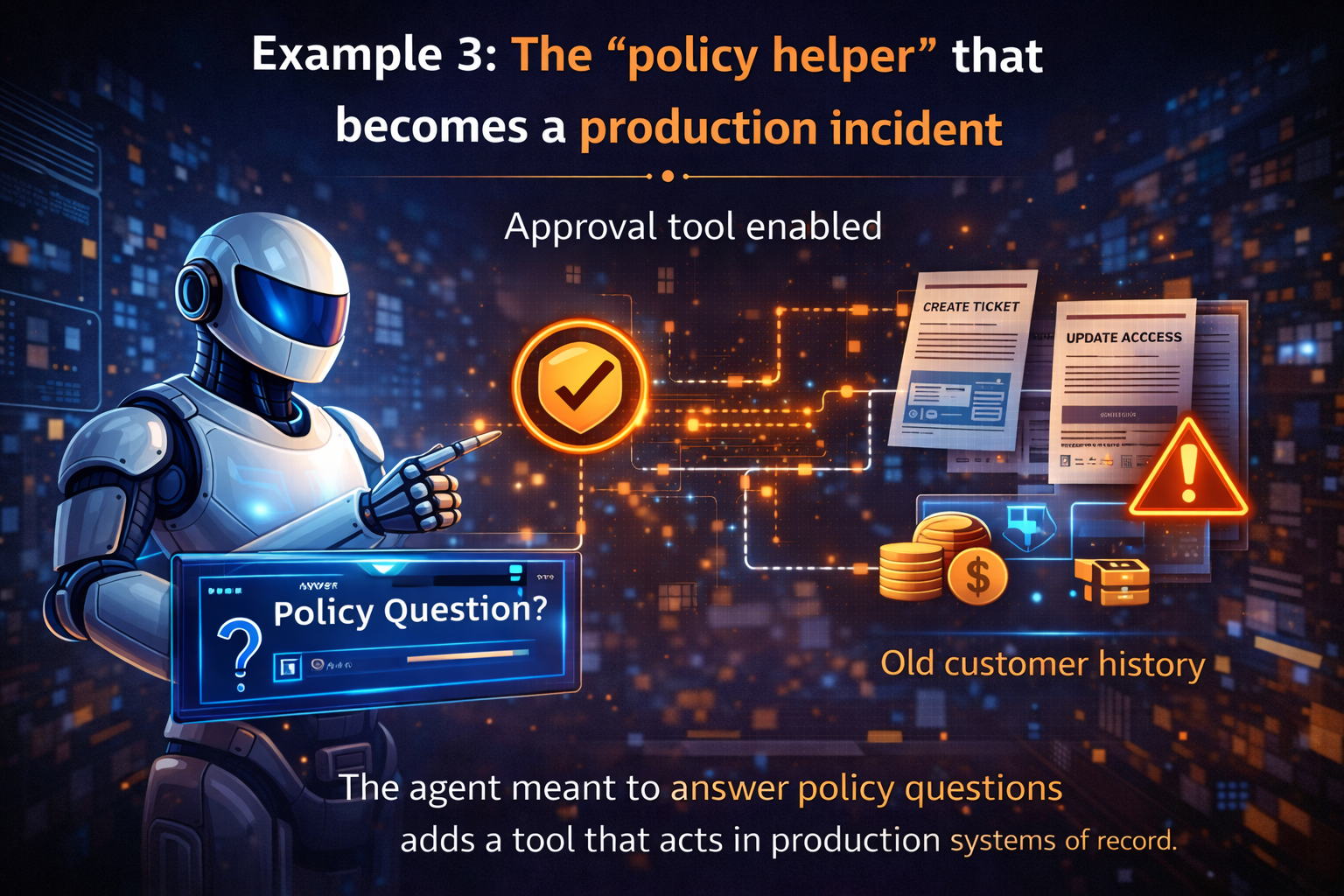
Example 3: The “policy helper” that becomes a production incident
A harmless assistant answers policy questions.
Someone adds a tool: create ticket or update access.
Suddenly the assistant is acting in systems of record.
That jump—from talking to doing—is exactly where a runtime becomes mandatory.
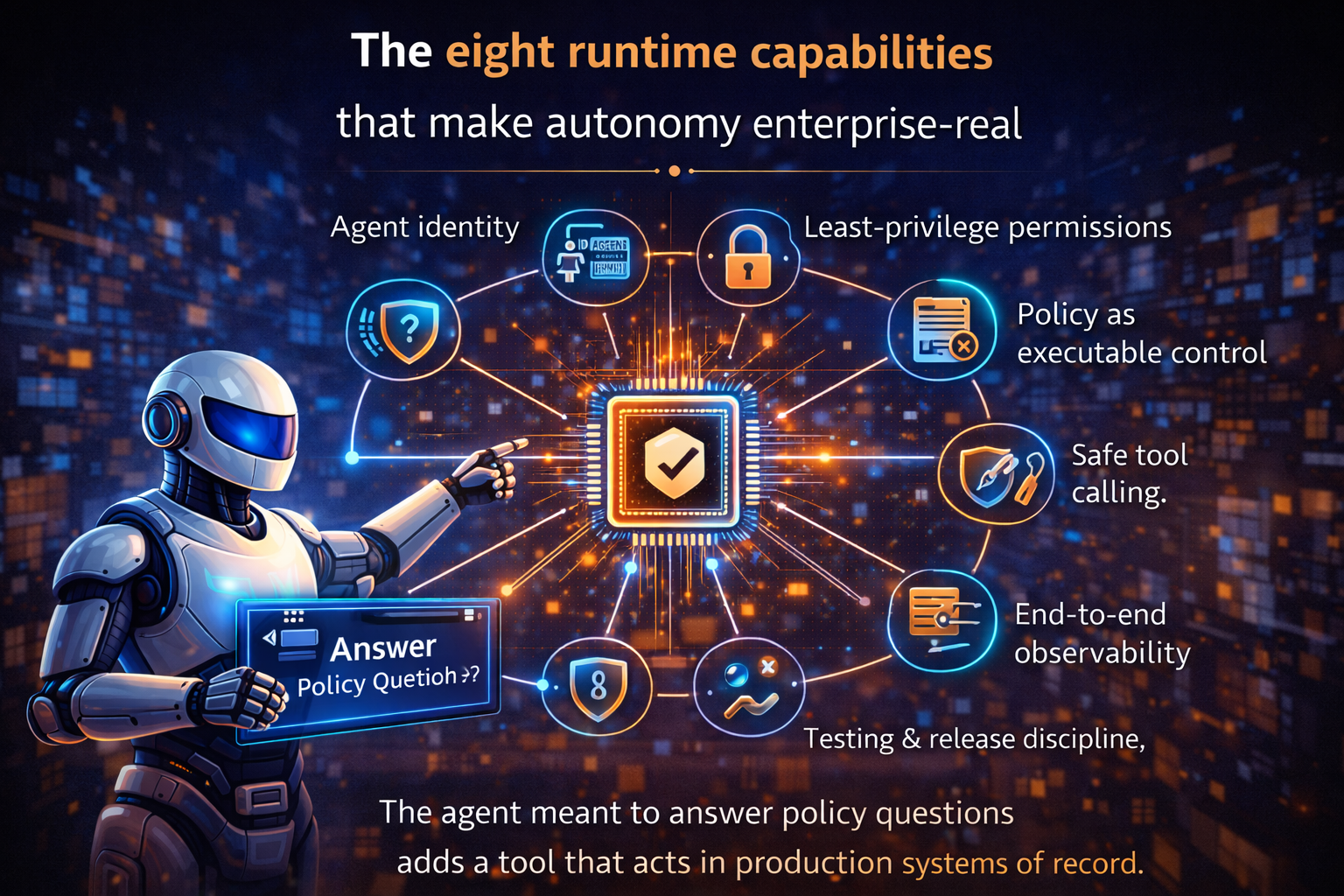
The eight runtime capabilities that make autonomy enterprise-real
- Agent identity
Agents need first-class machine identities: ownership, purpose, risk tier, lifecycle.
- Least-privilege permissions
Not “can it act?” but “can it act only within allowed boundaries?”
- Policy as executable control
Policies enforced dynamically, not documented passively.
- Safe tool calling
Validated schemas, guardrails, approvals for high-impact actions.
- End-to-end observability
Trace from user intent → model → tool → real-world action.
- Testing & release discipline
Offline evaluation, canary releases, rollback—before customers feel change.
- Security by design
Secrets, DLP, safe logging, and protection against prompt and tool abuse.
- Portability
Swap models and tools without rebuilding business logic.
Together, these form the production kernel for autonomy.
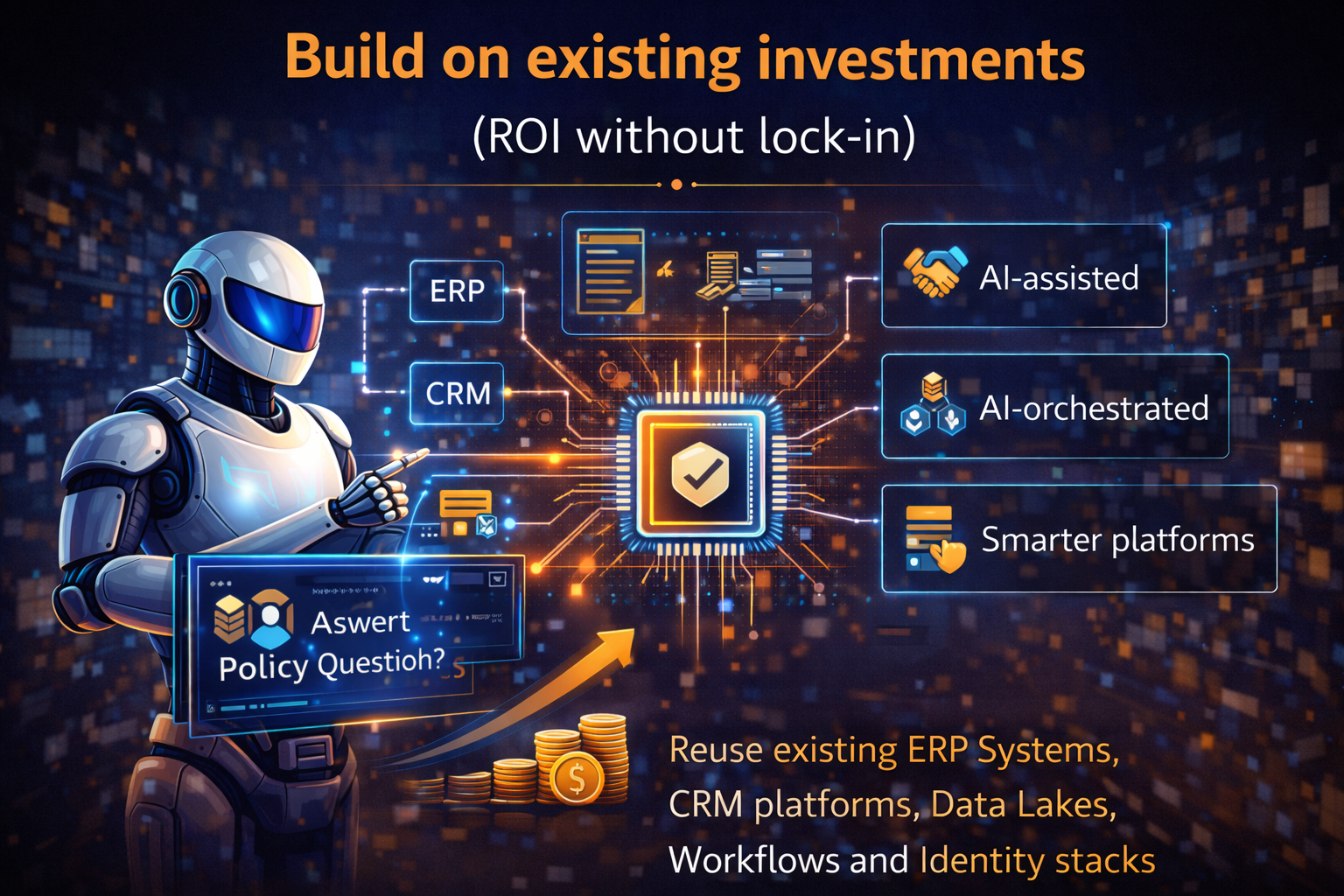
Build on existing investments (ROI without lock-in)
Build on existing investments (ROI without lock-in)
The fastest path to enterprise AI value is reuse, not replacement.
A true AI runtime does not ask enterprises to rip out:
- ERP systems,
- CRM platforms,
- data lakes,
- workflow engines,
- identity stacks.
Instead, it wraps intelligence around what already exists.
This is how ROI compounds:
- Existing processes become AI-assisted.
- Existing integrations become AI-orchestrated.
- Existing platforms become smarter without rebuilds.
Just as importantly, abstraction prevents lock-in.
The runtime becomes the stable layer—while models, tools, and vendors evolve underneath.
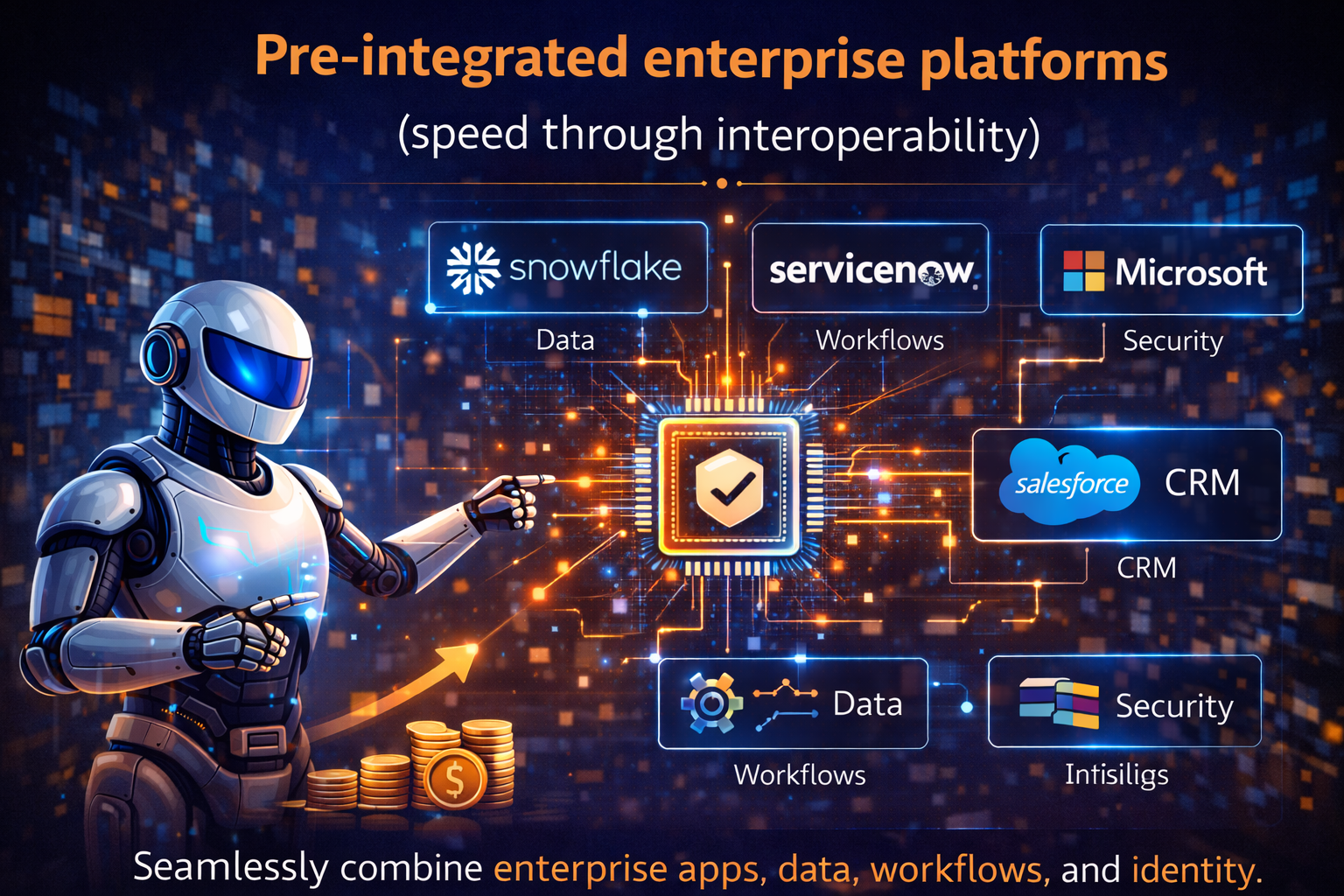
Pre-integrated enterprise platforms (speed through interoperability)
In practice, most AI projects stall on integration.
A production runtime treats pre-integration as a feature, not a services promise:
- common enterprise apps,
- data platforms,
- security tooling,
- observability stacks.
This dramatically reduces time-to-value:
- fewer bespoke connectors,
- fewer brittle scripts,
- fewer one-off solutions.
Interoperability is not an optimization.
It is the difference between deploying once and scaling everywhere.
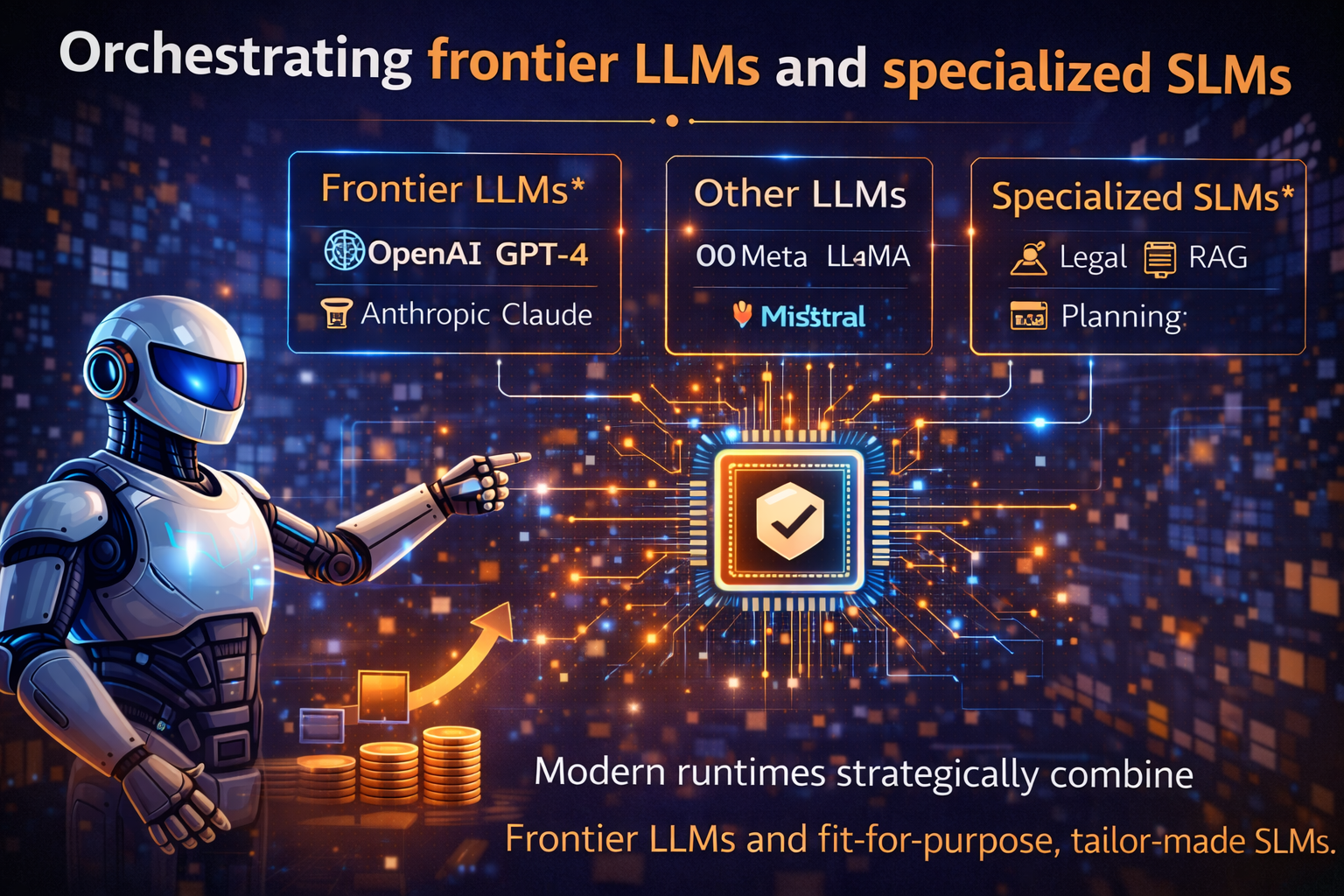
Orchestrating frontier LLMs and specialized SLMs
Enterprises are discovering that one model does not fit all.
A mature runtime orchestrates a portfolio:
- frontier LLMs for complex reasoning and language tasks,
- specialized or smaller models for speed, cost, latency, or data locality.
The runtime decides:
- which model to use,
- for which task,
- under which constraints.
This keeps costs predictable, latency controlled, and sensitive workloads appropriately bounded—without forcing teams to hard-code model decisions into applications.
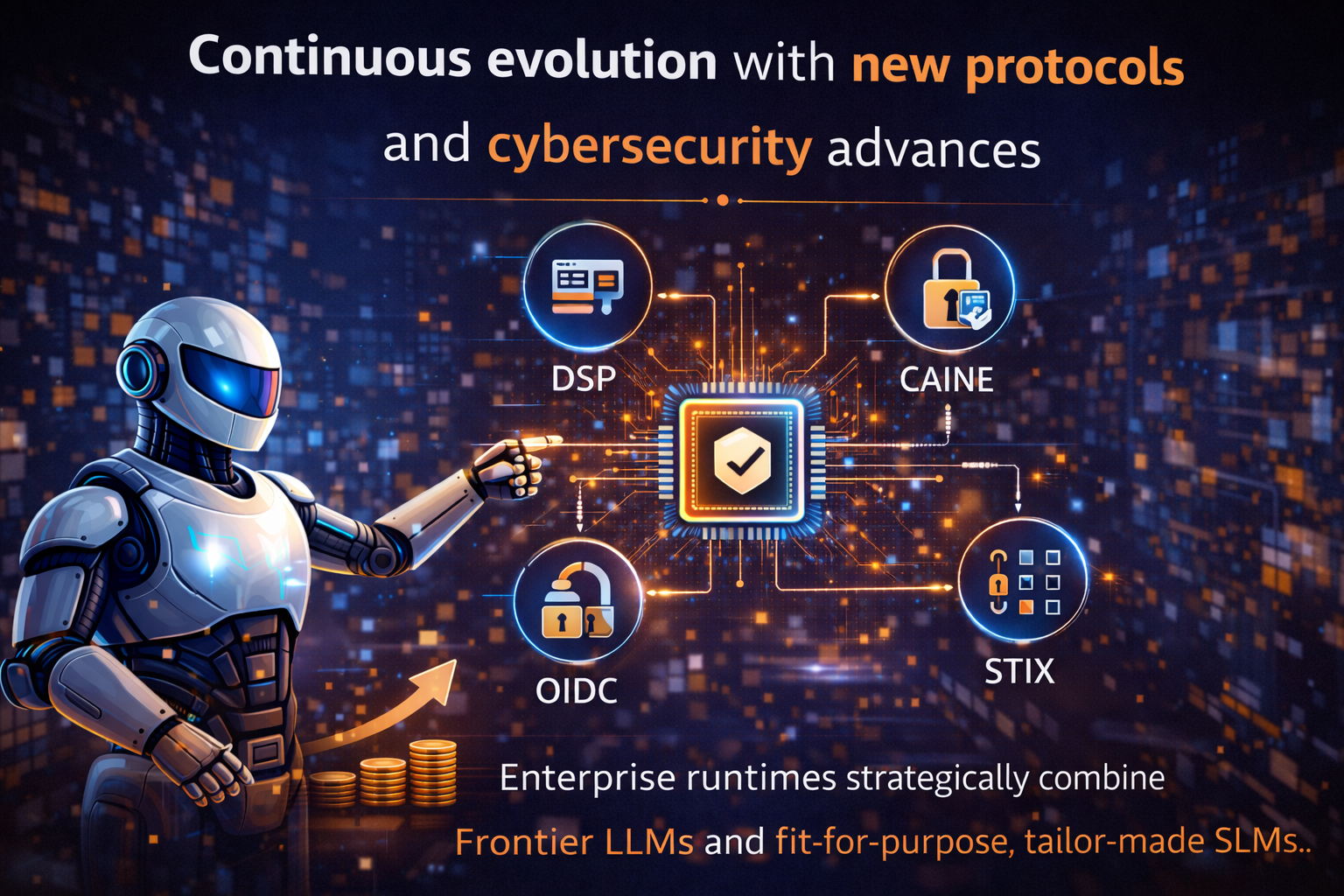
Continuous evolution with new protocols and cybersecurity advances
AI systems do not stand still. Neither do threats.
A production runtime must be designed to absorb change without disruption:
- new AI protocols,
- evolving security standards,
- improved model interfaces,
- emerging compliance requirements.
The goal is continuity:
- no mass rewrites,
- no fragile migrations,
- no architectural dead ends.
This is how enterprises move from static IT to a living, adaptive digital ecosystem.
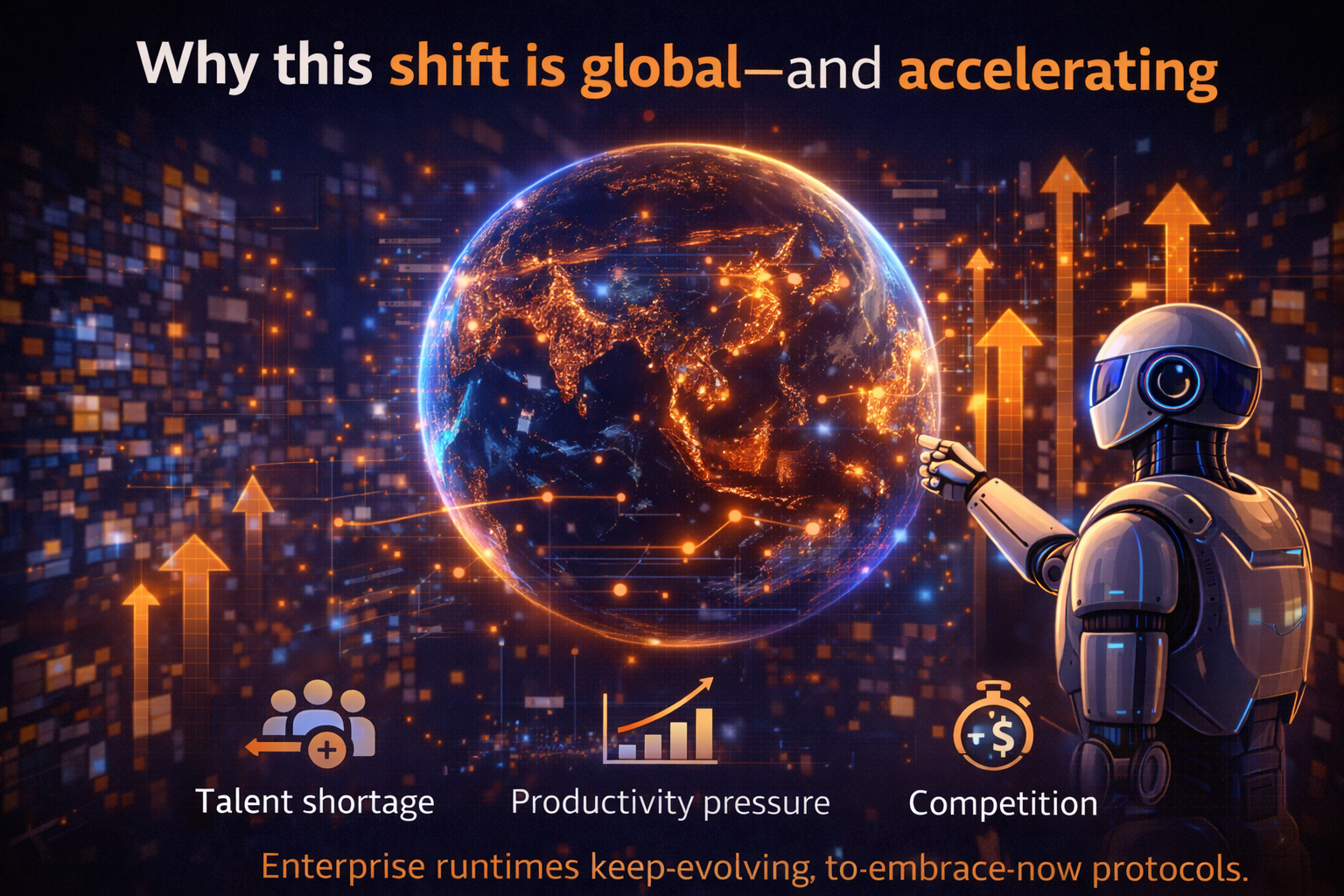
Why this shift is global—and accelerating
Across industries and regions, the same forces converge:
- rising regulatory expectations,
- expanding blast radius of autonomous actions,
- executive demand for speed without chaos.
That is why leaders are funding operating environments, not experiments.
The executive takeaway: the runtime makes ROI repeatable
With a runtime in place, enterprises gain:
- reusable AI services,
- faster deployment cycles,
- higher quality through discipline,
- safer scale through governance,
- sustained ROI as models evolve.
In simple business language:
The runtime turns autonomy from a demo into infrastructure.
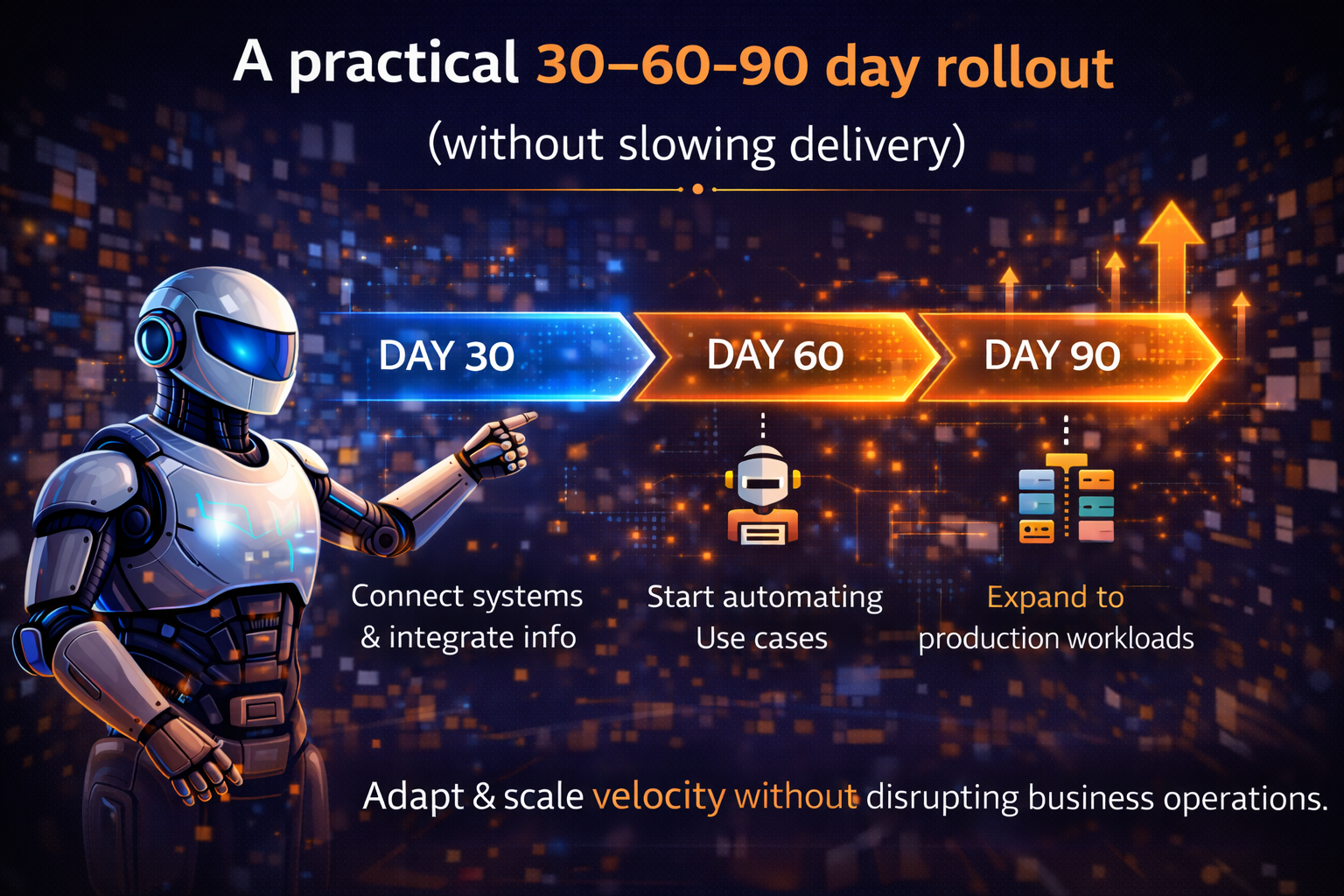
A practical 30–60–90 day rollout (without slowing delivery)
A practical 30–60–90 day rollout (without slowing delivery)
Days 0–30
Define agent identity, tracing standards, and a safe action domain.
Days 31–60
Add policy enforcement, approvals, canary releases, and expand domains.
Days 61–90
Productize AI services, add cost visibility, establish operating cadence.
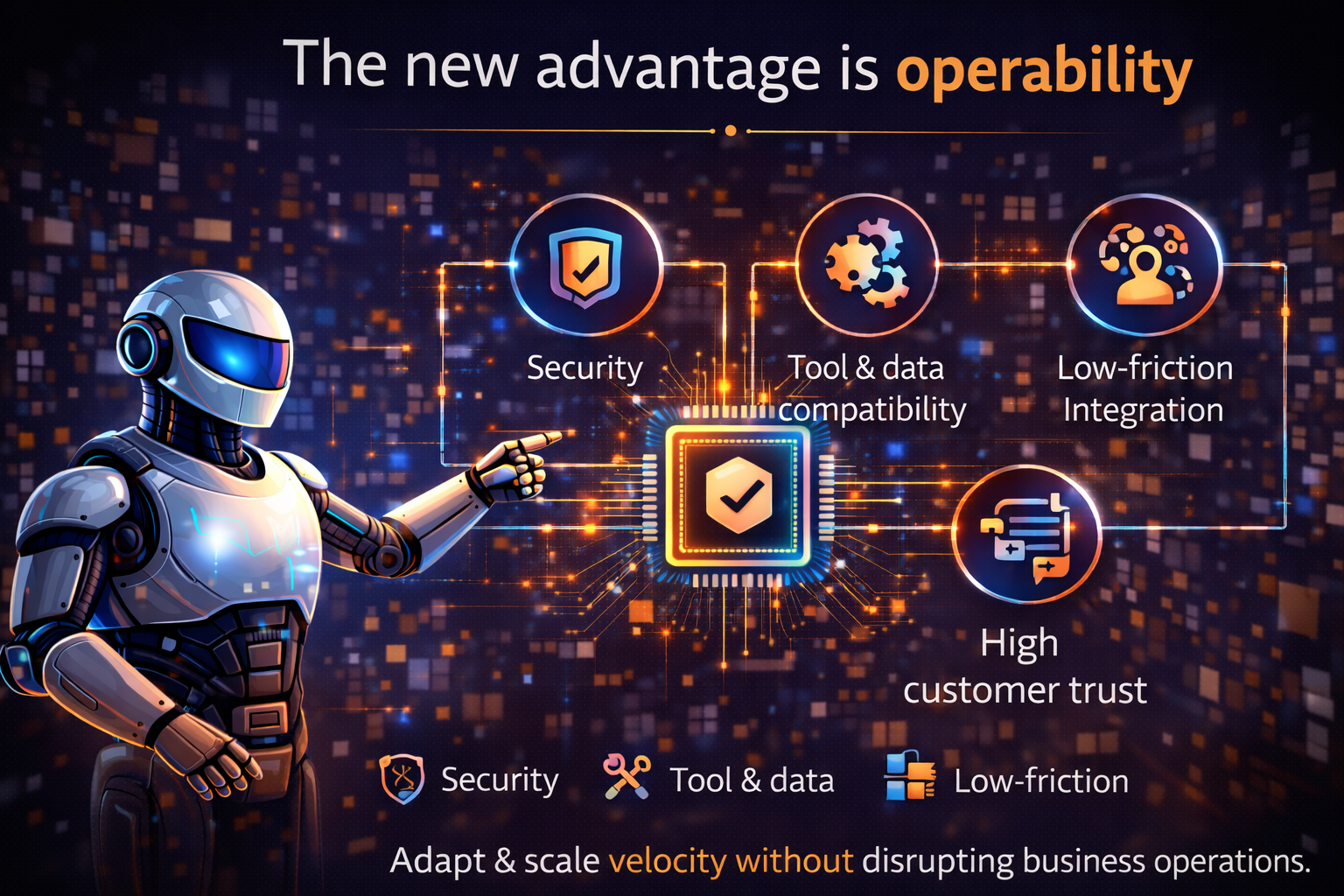
Conclusion: The new advantage is operability
The next winners in enterprise AI will not be defined by how many agents they deploy.
They will be defined by whether they built the production kernel that makes autonomy:
- reliable,
- governable,
- reusable,
- continuously improvable.
That kernel is the Enterprise AI Runtime.
Once it exists, agents stop being experiments—and start becoming enterprise infrastructure.
❓ FAQ Section
Q1. What is an Enterprise AI Runtime?
An Enterprise AI Runtime is the production operating layer that governs how AI agents act across enterprise systems—enforcing identity, policy, security, observability, and auditability.
Q2. Why do AI agents fail in real enterprise environments?
Because intelligence is easy to demo, but hard to operate. Without runtime controls, agent actions become unpredictable, untraceable, and risky.
Q3. How is an AI Runtime different from an AI platform?
AI platforms help you build agents. An AI Runtime helps you run them safely in production—like an operating system kernel for autonomy.
Q4. Do enterprises need a runtime even for internal AI agents?
Yes. The moment an agent touches systems of record—HR, finance, customer data—it becomes a production system requiring governance.
Q5. Is human oversight still required in enterprise AI?
In many regulated and high-risk contexts, yes. Modern AI architectures are expected to support human-in-the-loop oversight and override mechanisms.
📚 Glossary
Enterprise AI Runtime
The operating layer that makes AI agents safe, governable, observable, and reusable across enterprise systems.
Agentic AI
AI systems capable of planning and executing actions across tools and workflows, not just generating text.
Services-as-Software
Reusable, governed AI capabilities delivered as managed services rather than one-off projects.
Operable Autonomy
Autonomous AI that can be trusted in production because it is observable, auditable, and controllable.
AI Operating Environment
The full stack of runtime, governance, security, and integration layers required to run AI at enterprise scale.
References & Further Reading
-
- NIST AI Risk Management Framework
- EU AI Act (Human Oversight guidance)
- Agentic Enterprise Architecture patterns
- LLMOps and AgentOps operational best practices
- The Enterprise AI Factory: How Global Enterprises Scale AI Safely with Studio, Runtime, and Productized Services – Raktim Singh
- Why Enterprises Need Services-as-Software for AI: The Integrated Stack That Turns AI Pilots into a Reusable Enterprise Capability – Raktim Singh
- Enterprise AI Operating Model 2.0: Control Planes, Service Catalogs, and the Rise of Managed Autonomy – Raktim Singh
- From Architecture to Orchestration: How Enterprises Will Scale Multi-Agent Intelligence – Raktim Singh
- Services-as-Software: Why the Future Enterprise Runs on Productized Services, Not AI Projects | by RAKTIM SINGH | Dec, 2025 | Medium
- The Composable Enterprise AI Stack: Agents, Flows, and Services-as-Software — Built Open, Interoperable, and Responsible | by RAKTIM SINGH | Dec, 2025 | Medium
- Why Enterprise AI Is Becoming a Fabric: From AI Agents to Services-as-Software | by RAKTIM SINGH | Dec, 2025 | Medium
- From Architecture to Orchestration: How Enterprises Will Scale Multi-Agent Intelligence – Raktim Singh



Raktim Singh is an AI and deep-tech strategist, TEDx speaker, and author focused on helping enterprises navigate the next era of intelligent systems. With experience spanning AI, fintech, quantum computing, and digital transformation, he simplifies complex technology for leaders and builds frameworks that drive responsible, scalable adoption.