
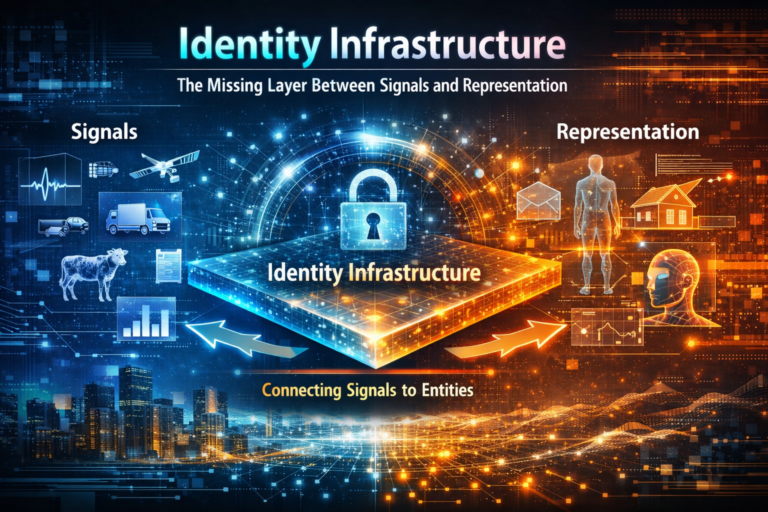
Yet most AI discussions jump directly from signals to models, overlooking the crucial layer that connects them: identity infrastructure.
This layer determines which signals belong to which entities, enabling AI systems to build stable representations, accumulate memory, verify decisions, and govern outcomes. As organizations transition from experimentation to operational AI, identity infrastructure is emerging as one of the most critical—but least understood—foundations of the modern AI economy.
Identity Infrastructure
Most conversations about artificial intelligence jump too quickly from data to models.
They assume that once signals exist, intelligence can begin.
That assumption is wrong.
Between signals and representation sits a layer that is far more important than most leaders realize: identity infrastructure.
This is the layer that answers a simple but foundational question:
Which entity does this signal belong to?
Without that answer, signals remain fragments. They do not accumulate into memory. They do not support traceability. They do not create accountability. And they cannot reliably power AI decisions.
That is why identity infrastructure is becoming one of the most important—and most underestimated—layers of the AI economy.
The World Bank’s Identification for Development initiative describes digital identification systems as enablers of access, service delivery, rights, and economic participation. UNDP, meanwhile, describes digital public infrastructure as foundational digital systems that enable secure and seamless interaction between people, businesses, and governments. (id4d.worldbank.org)
This is not a narrow digital identity discussion.
In the AI economy, identity goes far beyond people.
It includes:
- customer identity
- merchant identity
- patient identity
- machine identity
- parcel identity
- livestock identity
- land parcel identity
- geospatial identity
- shipment identity
- digital twins of physical systems
If signal infrastructure makes reality detectable, identity infrastructure makes it attributable.
And if representation makes reality legible, identity makes that legibility stable.
That is why identity infrastructure is the missing layer between signals and representation.
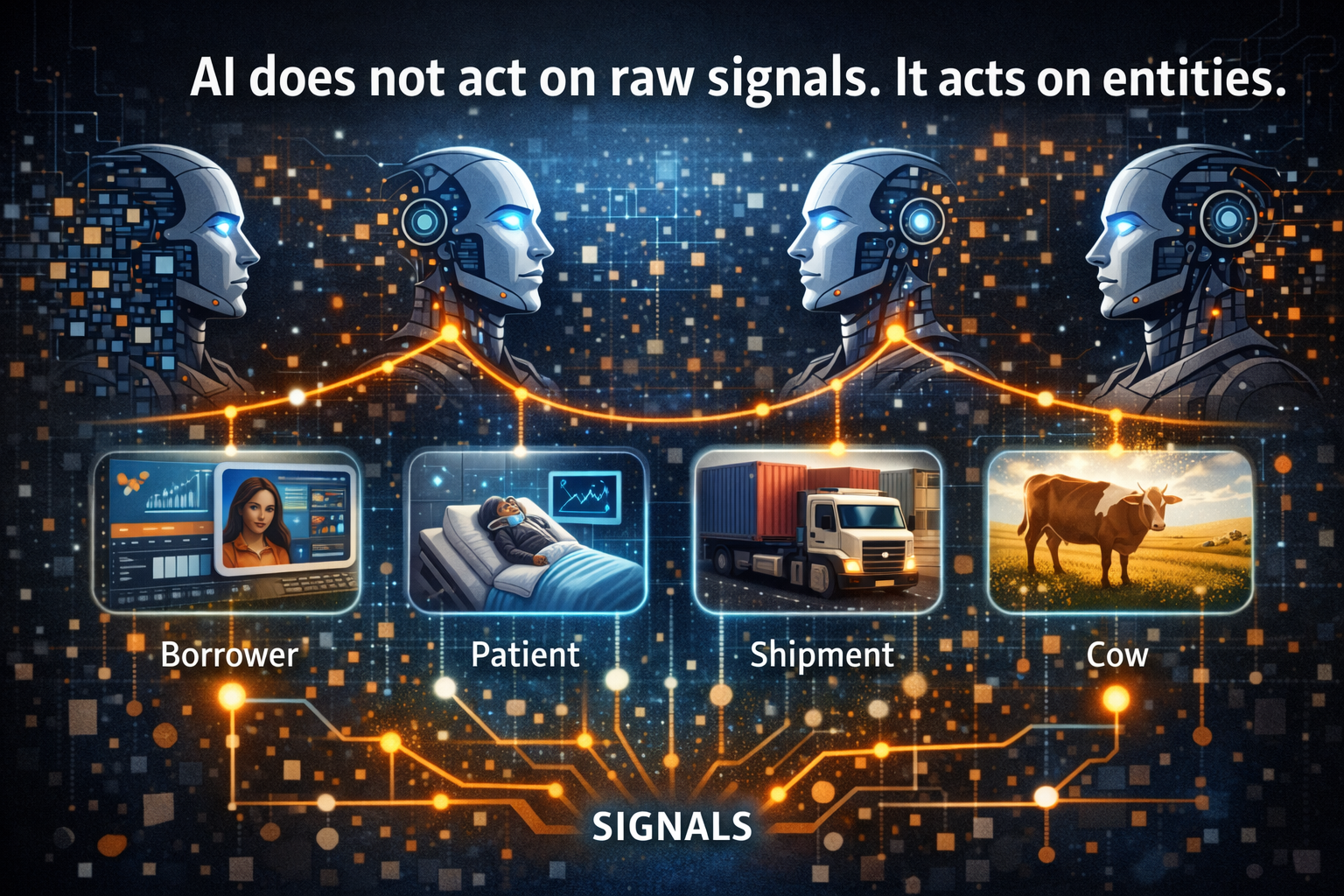
AI does not act on raw signals. It acts on entities.
AI systems do not make decisions about “data” in the abstract.
They make decisions about entities.
A lending system does not decide on a spreadsheet. It decides on a borrower.
A hospital alerting system does not intervene on a sensor stream. It intervenes on a patient.
A logistics platform does not optimize a random telemetry feed. It optimizes a shipment, vehicle, or warehouse.
A livestock monitoring system does not flag temperature anomalies in the abstract. It flags a specific animal.
This is why signals alone are not enough.
A signal becomes economically useful only when it is attached to an entity that can be recognized across time, systems, and decisions.
That attachment is identity.
This is also why identity infrastructure is not merely an IT function.
In the AI economy, it becomes a condition for durable memory, traceability, and institutional trust. That is especially true as systems increasingly connect digital ID, payments, records, and operational data across wider public and commercial ecosystems. (id4d.worldbank.org)
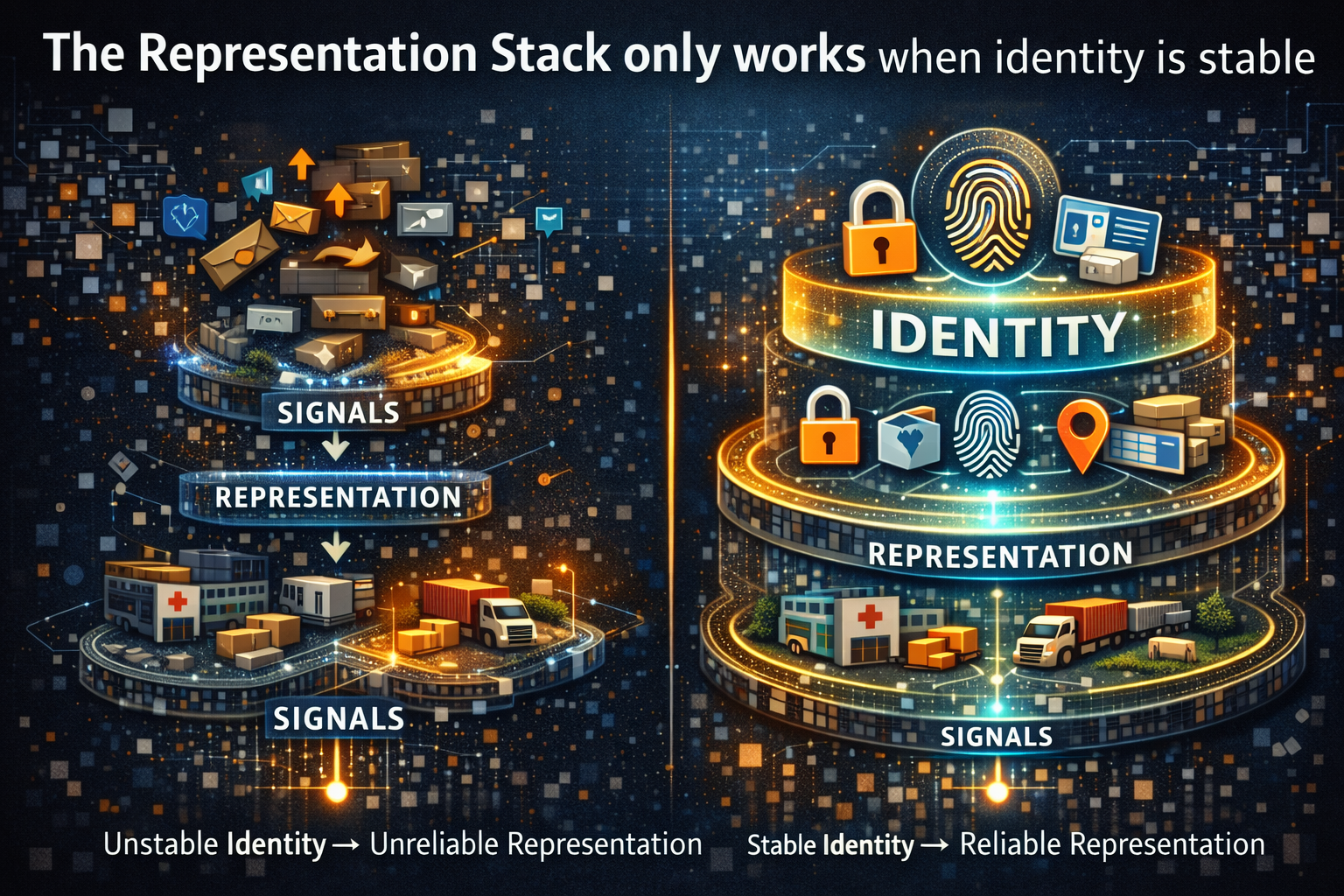
The Representation Stack only works when identity is stable
To understand why identity matters so much, it helps to revisit the broader architecture.
The Representation Stack can be described in six layers:
- reality
- signal infrastructure
- identity
- representation
- C.O.R.E. — machine cognition
- D.R.I.V.E.R. — institutional governance
In this architecture, identity sits exactly where it should: between detection and representation.
Signals tell us that something happened.
Identity tells us to whom or to what it happened.
Representation then combines those signals into a structured model of reality.
Only after that can C.O.R.E. operate:
- Comprehend context
- Optimize decisions
- Realize action
- Evolve through feedback
C.O.R.E. is the machine cognition loop. It explains how AI systems turn represented reality into situational understanding, decisions, actions, and learning.
And only after that can D.R.I.V.E.R. ensure institutional legitimacy:
- Delegation
- Representation
- Identity
- Verification
- Execution
- Recourse
D.R.I.V.E.R. is the governance architecture of trustworthy AI decisions. It explains how institutions authorize, anchor, check, execute, and correct machine decisions.
If identity is missing or weak, the entire stack becomes unstable.
Signals remain disconnected. Representations become unreliable. Decisions become difficult to verify. Recourse becomes ambiguous.
So while signal infrastructure makes the world visible, identity infrastructure makes the world coherent.
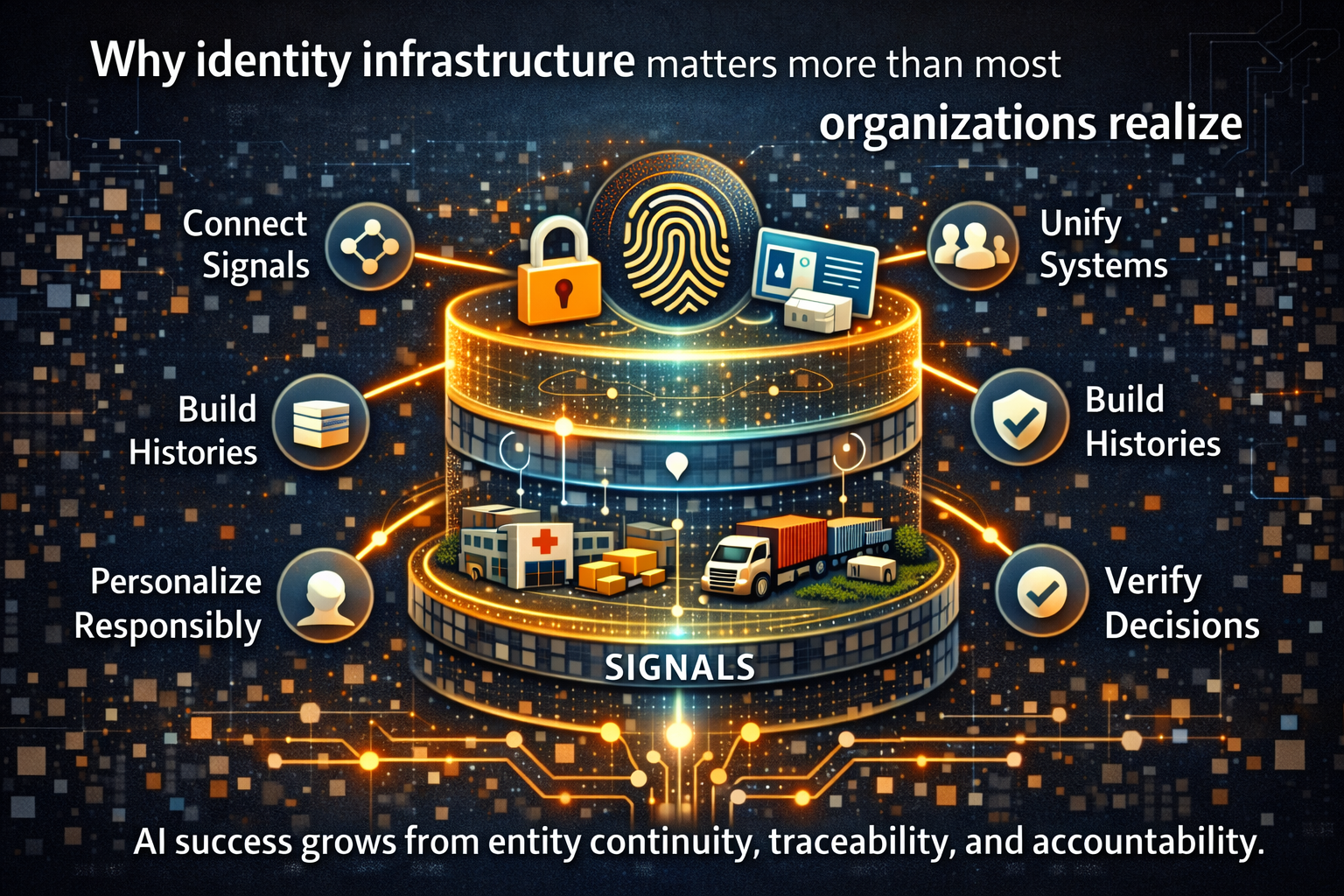
Why identity infrastructure matters more than most organizations realize
Many organizations still think of identity as an IT issue or a compliance layer.
In the AI age, that view is too small.
Identity infrastructure is becoming a strategic economic layer.
Why?
Because identity determines whether an organization can:
- connect signals across time
- unify fragmented systems
- build reliable histories
- personalize responsibly
- verify decisions
- assign accountability
- enable recourse
Without identity, AI becomes shallow.
It can detect patterns, but it cannot reliably anchor them to real-world entities.
That creates three major problems.
-
Signals stay fragmented
Suppose a farmer uses multiple tools: one for weather, one for market prices, one for livestock health, and one for digital payments. If those systems cannot connect signals back to a stable farm or animal identity, the result is not intelligence. It is fragmentation.
-
Representation becomes unreliable
If a hospital cannot confidently link device signals, medical records, medication history, and care context to a stable patient identity, it cannot create a reliable patient representation.
-
Governance breaks down
If an AI decision affects someone, institutions must know exactly who or what was represented, verified, acted upon, and potentially harmed. Without identity, there is no durable basis for verification or recourse.
That is why identity is not just administrative plumbing.
It is a core condition for AI legitimacy.
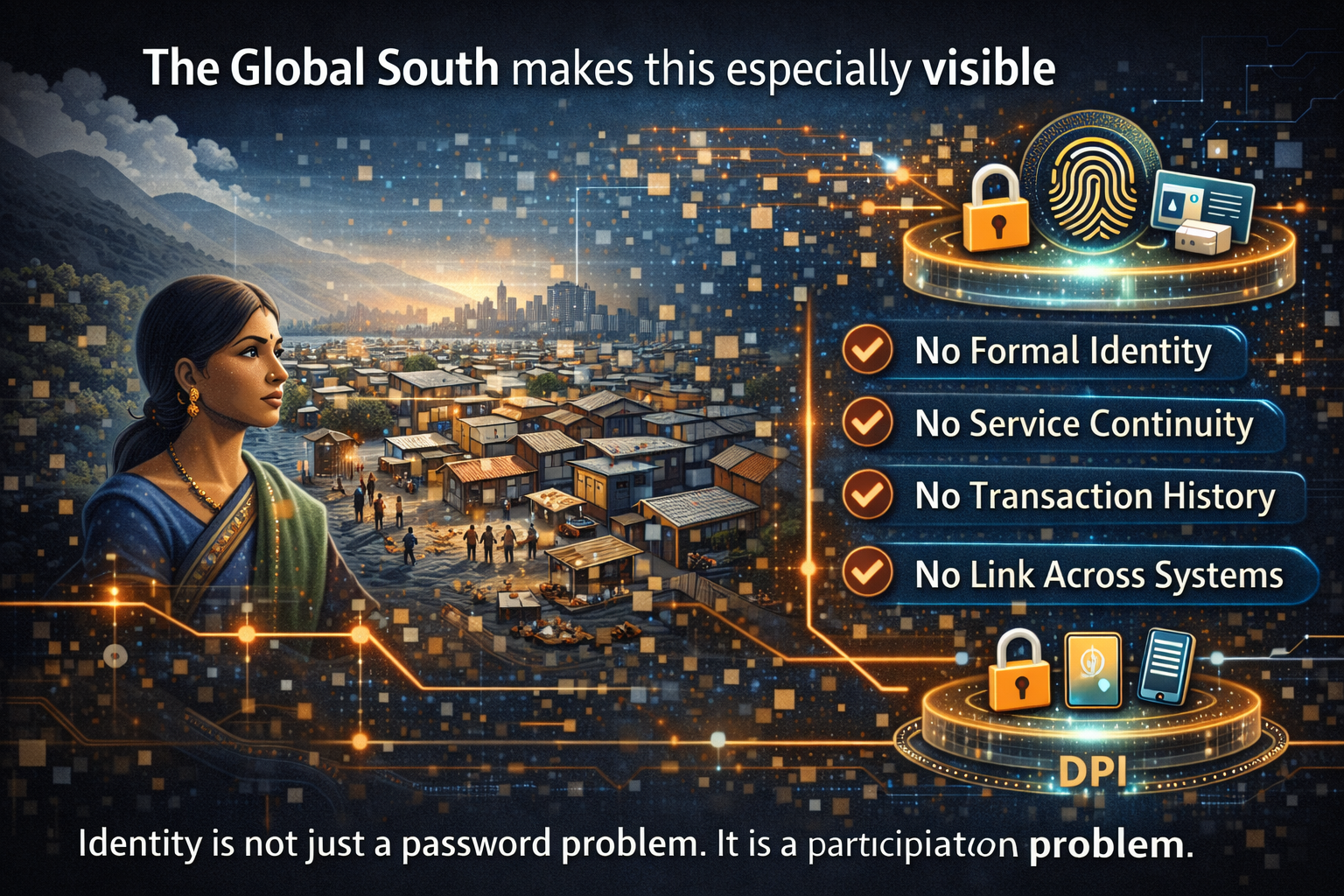
The Global South makes this especially visible
Identity infrastructure matters everywhere, but it is especially important across the Global South, where invisibility has historically been a much larger problem than over-instrumentation.
In many advanced economies, identity debates are framed around privacy, surveillance, and authentication convenience.
Those issues matter.
But in many lower- and middle-income contexts, the more basic problem has been:
- no formal identity
- no service continuity
- no digital transaction history
- no stable way to link individuals, merchants, farms, assets, or entitlements across systems
That is why digital public infrastructure has become so strategically important.
UNDP describes DPI as the backbone of modern societies, enabling identity verification, digital payments, and trusted interactions between people, businesses, and governments. The World Bank similarly ties digital ID and DPI to inclusion, service delivery, and participation in the digital age. (UNDP)
This changes the meaning of identity in the AI economy.
Identity is not just a password problem.
It is a participation problem.
It determines who can be seen, served, financed, insured, tracked, protected, and governed.
That distinction matters enormously if one wants to understand where the next wave of AI value may emerge.
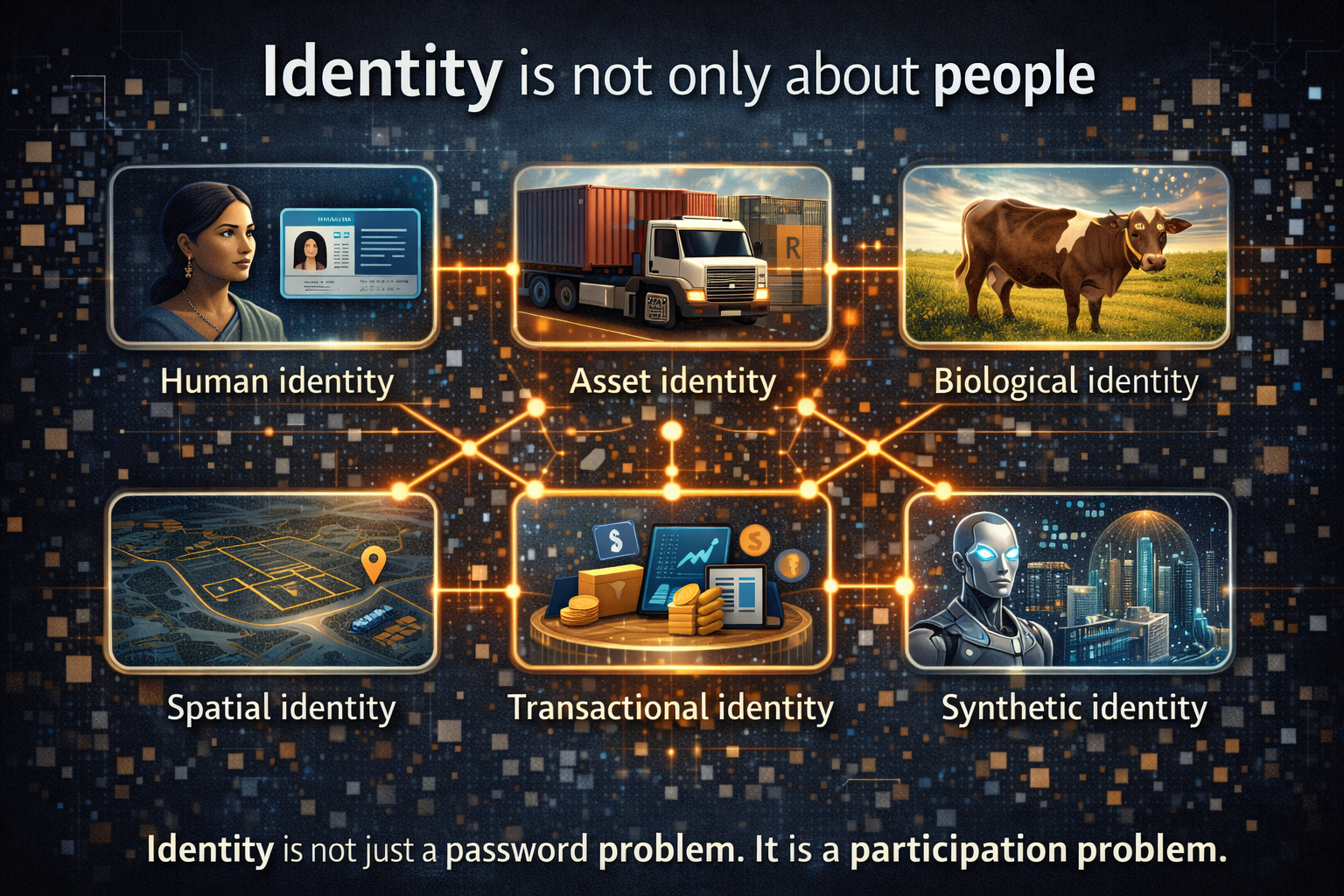
Identity is not only about people
This is where the conversation becomes much more interesting.
When many people hear “identity infrastructure,” they think only about human identity.
But the AI economy requires identity systems across many kinds of entities.
Human identity
Patients, citizens, customers, workers, students, beneficiaries.
Asset identity
Machines, vehicles, warehouses, devices, sensors, parcels.
Biological identity
Animals, herds, disease records, food traceability chains.
Spatial identity
Land parcels, river basins, pollution zones, geospatial corridors.
Transactional identity
Merchants, accounts, supply chain events, payment trails.
Synthetic identity
Digital twins, virtual models, AI agents, software services.
This matters because the AI economy increasingly depends on decisions involving mixtures of human, physical, biological, and digital entities.
A system that wants to optimize food safety needs product identity and traceability.
A system that wants to improve livestock health needs stable animal identity.
A system that wants to manage pollution needs geospatial identity.
A system that wants to serve informal merchants needs merchant identity.
FAO has highlighted the role of digital technologies in livestock traceability and broader agrifood digitization, noting that traceability improves when animals and products are accurately identified and more data can be integrated across the chain. (Open Knowledge FAO)
This is why identity infrastructure is expanding beyond civil registration into a much broader architecture of economic and ecological legibility.
Three simple examples
Example 1: Livestock health
A farm installs sensors that track cattle movement, body temperature, and feeding behavior.
Those are signals.
But unless the system knows which cow each signal belongs to, there is no stable animal-level history, no disease progression model, no treatment continuity, and no reliable intervention.
Signal infrastructure can tell you that something is wrong somewhere.
Identity infrastructure tells you which animal is affected.
Only then can representation create an animal health profile. Only then can C.O.R.E. optimize action. Only then can D.R.I.V.E.R. support accountability.
This is why animal identification and traceability systems have become so important in modern agrifood systems. (Open Knowledge FAO)
Example 2: Informal merchants
A digital lending platform sees thousands of payment events from informal merchants.
Those are useful signals.
But signals alone do not create a borrower.
The platform needs merchant identity resolution across transactions, devices, payment flows, geographies, and behavioral patterns.
Without identity, the system sees payments.
With identity, it sees a merchant trajectory.
That changes everything. Credit scoring, service design, fraud detection, and recourse all become possible only when identity is stable enough to support representation.
This is exactly why digital identity and DPI are so central in development and financial inclusion conversations. (id4d.worldbank.org)
Example 3: Environmental monitoring
A city deploys sensors to monitor air quality and water contamination.
Those signals matter.
But unless they are attached to stable geospatial identities—river segments, air basins, zones, industrial corridors, neighborhoods—the system cannot assign responsibility or coordinate intervention.
Here identity is spatial, not personal.
But the function is the same: it anchors signals to governable entities.
UNEP has pointed to AI-enabled environmental monitoring, including large-scale air-quality data systems and real-time analysis, as an important part of sustainability and protection efforts. (UNEP – UN Environment Programme)
Why identity infrastructure is a board-level issue
This is not just a technical detail for architects.
It is a board-level issue because identity infrastructure shapes:
- service access
- operational traceability
- risk visibility
- fraud exposure
- AI accountability
- cross-system interoperability
- economic participation
The companies that build durable identity layers can connect more signals, build more reliable representations, and create more defensible decision systems.
In the AI economy, that becomes a major source of advantage.
A company with stronger models but weak identity infrastructure will often underperform a company with decent models and strong entity-level coherence.
That is because AI performance in the real world is not only a function of reasoning quality.
It is also a function of entity stability.
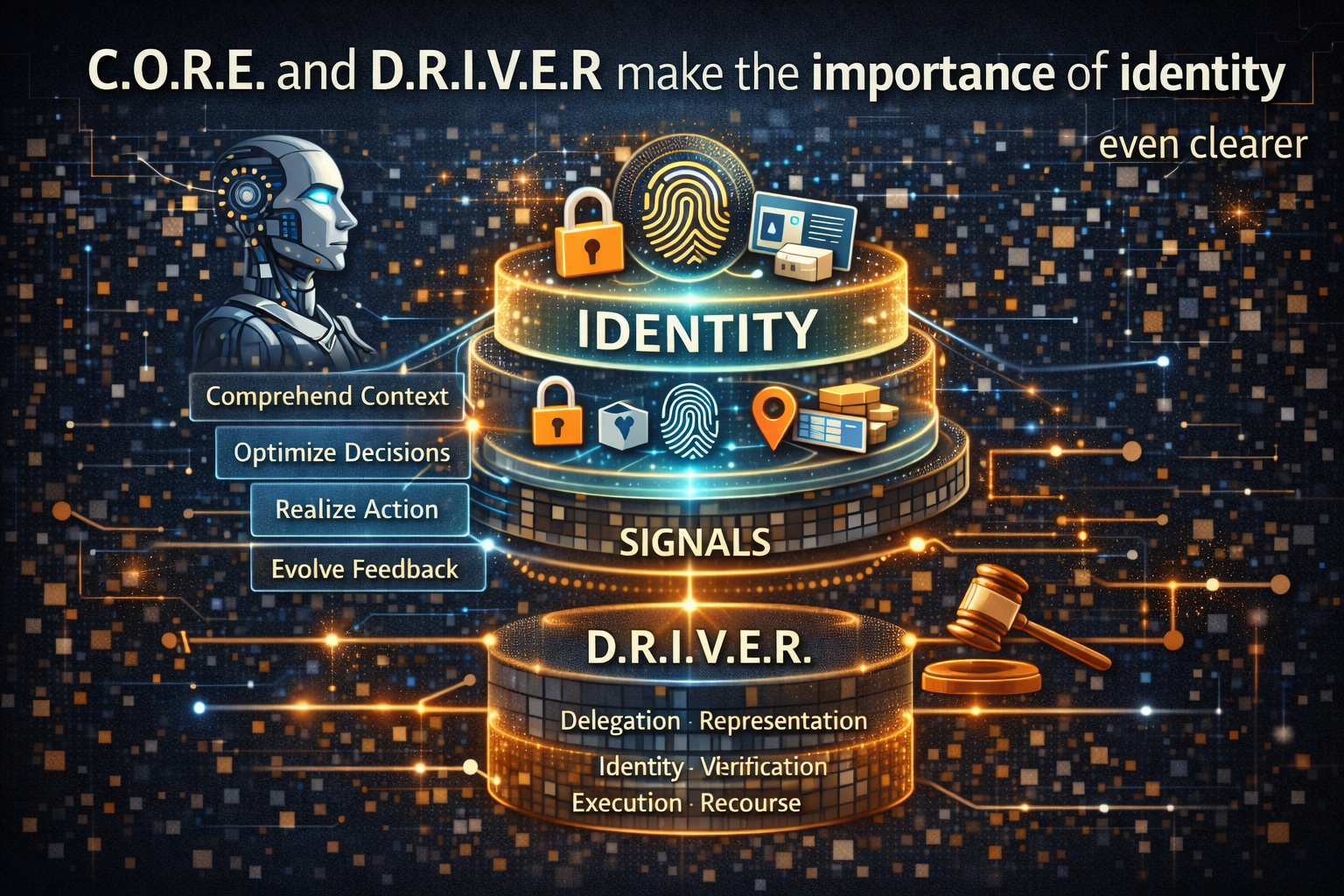
C.O.R.E. and D.R.I.V.E.R. make the importance of identity even clearer
The D.R.I.V.E.R. framework makes this even sharper.
If D.R.I.V.E.R. is the governance architecture required for trustworthy AI decisions, then identity sits at its center for a reason.
Let us restate it:
- Delegation — who authorizes the AI to act?
- Representation — what reality is being modeled?
- Identity — which entity is affected?
- Verification — how is the decision checked?
- Execution — how is action carried out?
- Recourse — what happens when the system is wrong?
Notice what happens if identity is weak.
Delegation becomes ambiguous. Representation becomes unstable. Verification lacks an anchor. Execution may target the wrong entity. Recourse becomes impossible or unfair.
This is why identity should not sit only in the lower stack.
It also belongs explicitly in governance.
Identity is both an infrastructural layer and an institutional layer.
That is one reason it will become so strategically important in the AI age.
The next AI leaders will build identity-rich systems
The next wave of AI advantage may not come only from firms that produce the most sophisticated models.
It may come from firms that build the strongest systems for attaching signals to stable, governable entities.
That means the strategic race is shifting toward:
- identity-rich supply chains
- traceable food and livestock systems
- geospatially anchored environmental intelligence
- durable customer and merchant identity systems
- machine identity for autonomous operations
- digital twins linked to real-world assets
This is where identity infrastructure stops looking like administration and starts looking like economic architecture.
And that is precisely where boards, CIOs, CTOs, public institutions, and infrastructure leaders should now pay much closer attention.
Core Insight
Identity infrastructure is the system that connects signals to entities, enabling AI systems to build stable representations, accumulate memory, and produce accountable decisions.
Key Takeaways
• AI systems do not act on raw data—they act on entities.
• Identity infrastructure links signals to real-world entities.
• Without identity, signals remain fragmented and AI decisions become unreliable.
• Identity infrastructure enables traceability, verification, and recourse.
• It is becoming a strategic layer of the AI economy.
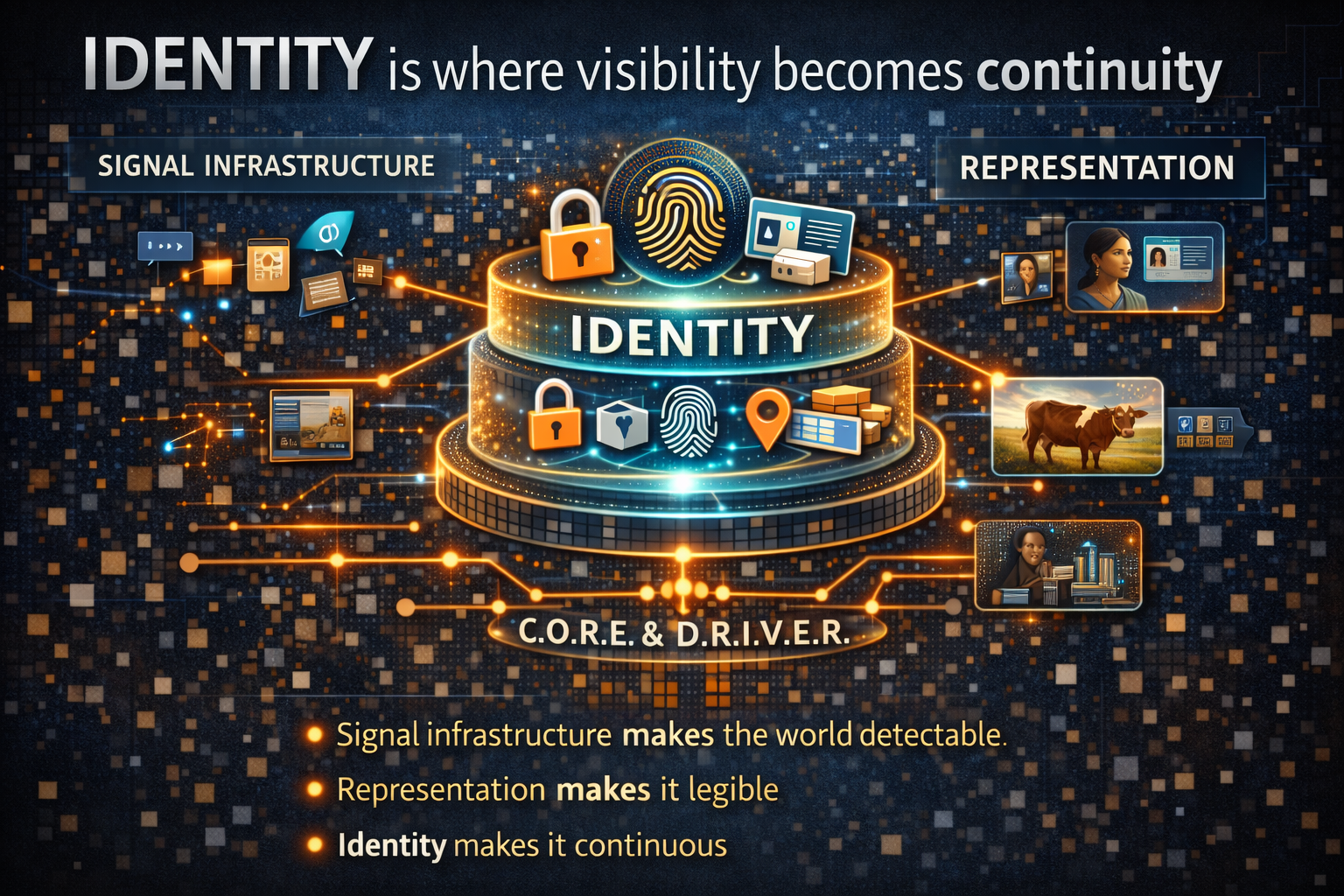
Conclusion box: identity is where visibility becomes continuity
Signal infrastructure makes the world detectable.
Representation makes it legible.
But identity is what makes it continuous.
It is the missing layer between raw signals and usable representation.
Without identity, AI systems can sense, but they cannot remember well. They can detect anomalies, but they cannot accumulate reliable context. They can generate outputs, but they struggle to govern consequences.
That is why identity infrastructure is no longer a back-office issue.
It is becoming one of the foundational layers of the AI economy.
The next generation of intelligent institutions will not be built only on models, prompts, or agents.
They will be built on the ability to connect signals to entities, entities to representations, representations to cognition, and cognition to accountable action.
And that means one of the most important strategic questions in the AI age is no longer just:
How smart is the system?
It is:
How well does the system know who or what it is actually talking about?
That is the true importance of identity infrastructure.
The Intelligence-Native Enterprise Doctrine
This article is part of a larger strategic body of work that defines how AI is transforming the structure of markets, institutions, and competitive advantage. To explore the full doctrine, read the following foundational essays:
- The AI Decade Will Reward Synchronization, Not Adoption
Why enterprise AI strategy must shift from tools to operating models.
https://www.raktimsingh.com/the-ai-decade-will-reward-synchronization-not-adoption-why-enterprise-ai-strategy-must-shift-from-tools-to-operating-models/ - The Third-Order AI Economy
The category map boards must use to see the next Uber moment.
https://www.raktimsingh.com/third-order-ai-economy/ - The Intelligence Company
A new theory of the firm in the AI era — where decision quality becomes the scalable asset.
https://www.raktimsingh.com/intelligence-company-new-theory-firm-ai/ - The Judgment Economy
How AI is redefining industry structure — not just productivity.
https://www.raktimsingh.com/judgment-economy-ai-industry-structure/ - Digital Transformation 3.0
The rise of the intelligence-native enterprise.
https://www.raktimsingh.com/digital-transformation-3-0-the-rise-of-the-intelligence-native-enterprise/ - Industry Structure in the AI Era
Why judgment economies will redefine competitive advantage.
https://www.raktimsingh.com/industry-structure-in-the-ai-era-why-judgment-economies-will-redefine-competitive-advantage/
- The Hardest Problem in AI: Representing What Cannot Speak
- The Representation Economy: Why the AI Decade Will Be Defined by Who Gets Represented—and Who Designs Trusted Delegation
- Representation Infrastructure: Why the AI Economy Will Be Won by Those Who Make the Invisible Legible
- The Legitimacy Stack: Why AI Governance Is Now an Engineering Discipline
- The Enterprise AI Operating Model
- The Future Belongs to Decision-Intelligent Institutions
Institutional Perspectives on Enterprise AI
Many of the structural ideas discussed here — intelligence-native operating models, control planes, decision integrity, and accountable autonomy — have also been explored in my institutional perspectives published via Infosys’ Emerging Technology Solutions platform.
For readers seeking deeper operational detail, I have written extensively on:
- What Makes an Enterprise Intelligence-Native? The Blueprint for Third-Order AI Advantage
https://blogs.infosys.com/emerging-technology-solutions/artificial-intelligence/what-is-enterprise-ai-the-operating-model-for-compounding-institutional-intelligence.html - Why “AI in the Enterprise” Is Not Enterprise AI: The Operating Model Difference Most Organizations Miss
https://blogs.infosys.com/emerging-technology-solutions/artificial-intelligence/why-ai-in-the-enterprise-is-not-enterprise-ai-the-operating-model-difference-that-most-organizations-miss.html - The Enterprise AI Control Plane: Governing Autonomy at Scale
https://blogs.infosys.com/emerging-technology-solutions/artificial-intelligence/the-enterprise-ai-control-plane-governing-autonomy-at-scale.html - Enterprise AI Ownership Framework: Who Is Accountable, Who Decides, and Who Stops AI in Production
https://blogs.infosys.com/emerging-technology-solutions/artificial-intelligence/enterprise-ai-ownership-framework-who-is-accountable-who-decides-and-who-stops-ai-in-production.html - Decision Integrity: Why Model Accuracy Is Not Enough in Enterprise AI
https://blogs.infosys.com/emerging-technology-solutions/artificial-intelligence/decision-integrity-why-model-accuracy-is-not-enough-in-enterprise-ai.html - Agent Incident Response Playbook: Operating Autonomous AI Systems Safely at Enterprise Scale
https://blogs.infosys.com/emerging-technology-solutions/artificial-intelligence/agent-incident-response-playbook-operating-autonomous-ai-systems-safely-at-enterprise-scale.html - The Economics of Enterprise AI: Designing Cost, Control, and Value as One System
https://blogs.infosys.com/emerging-technology-solutions/artificial-intelligence/the-economics-of-enterprise-ai-designing-cost-control-and-value-as-one-system.html
Together, these perspectives outline a unified view: Enterprise AI is not a collection of tools. It is a governed operating system for institutional intelligence — where economics, accountability, control, and decision integrity function as a coherent architecture.
Glossary
Identity infrastructure
The systems that link signals to stable entities such as people, merchants, animals, assets, machines, parcels, or geospatial zones.
Representation Stack
The layered architecture through which reality becomes usable by AI: reality, signal infrastructure, identity, representation, cognition, and governance.
Signal infrastructure
The systems that capture traces of reality, such as sensors, satellites, enterprise telemetry, digital payments, mobile devices, and IoT networks.
Representation
A structured model of an entity or system created from signals, context, and history, enabling AI systems to reason over real-world conditions.
Machine-readable reality
The part of the world that has become visible to software through signals, digital identity, telemetry, or structured records.
C.O.R.E.
The machine cognition loop: Comprehend context, Optimize decisions, Realize action, Evolve through feedback.
D.R.I.V.E.R.
The institutional governance framework for trustworthy AI decisions: Delegation, Representation, Identity, Verification, Execution, Recourse.
Digital public infrastructure (DPI)
Foundational digital systems such as identity, payments, and data-sharing rails that enable secure and inclusive interaction across society. (UNDP)
Traceability
The ability to follow an entity, product, or event across systems and time through stable identification and linked records.
Representation
A structured model of an entity built from signals and historical context.
Entity identity
The persistent identifier associated with a person, asset, location, or digital system.
FAQ
What is identity infrastructure in AI?
Identity infrastructure in AI is the layer that links signals to stable entities such as people, assets, animals, parcels, or places. It allows AI systems to move from fragmented data to coherent, traceable representations.
Why is identity infrastructure important for AI systems?
Because AI systems do not act on raw signals alone. They act on entities. Without identity, signals remain fragmented, representation becomes unreliable, and governance becomes weak.
How does identity infrastructure fit into the Representation Stack?
Identity sits between signal infrastructure and representation. Signal infrastructure captures traces of reality, identity ties those traces to entities, and representation turns them into usable models for AI decision-making.
What is the difference between C.O.R.E. and D.R.I.V.E.R.?
C.O.R.E. explains how AI systems think: Comprehend context, Optimize decisions, Realize action, and Evolve through feedback. D.R.I.V.E.R. explains how institutions govern those decisions: Delegation, Representation, Identity, Verification, Execution, and Recourse.
Why does identity infrastructure matter in the Global South?
Because many lower- and middle-income contexts still face problems of invisibility—limited formal identity, fragmented records, and weak service continuity. Identity infrastructure helps make participation, service access, and accountability possible. (id4d.worldbank.org)
Which sectors are most affected by identity infrastructure?
Finance, healthcare, agriculture, food systems, logistics, environmental monitoring, public services, manufacturing, and any sector where signals must be linked to stable entities to support trustworthy decisions. (Open Knowledge FAO
What problems occur when identity infrastructure is weak?
Without strong identity infrastructure:
- signals remain fragmented
• AI models produce unreliable outputs
• decision verification becomes difficult
• accountability and recourse become unclear
References and further reading
- World Bank ID4D — digital identity and inclusion resources. (id4d.worldbank.org)
- UNDP — digital public infrastructure and digital inclusion materials. (UNDP)
- FAO — livestock traceability and digital agrifood systems. (Open Knowledge FAO)
- UNEP — AI and environmental monitoring / sustainability discussions. (UNEP – UN Environment Programme)



Raktim Singh is an AI and deep-tech strategist, TEDx speaker, and author focused on helping enterprises navigate the next era of intelligent systems. With experience spanning AI, fintech, quantum computing, and digital transformation, he simplifies complex technology for leaders and builds frameworks that drive responsible, scalable adoption.