
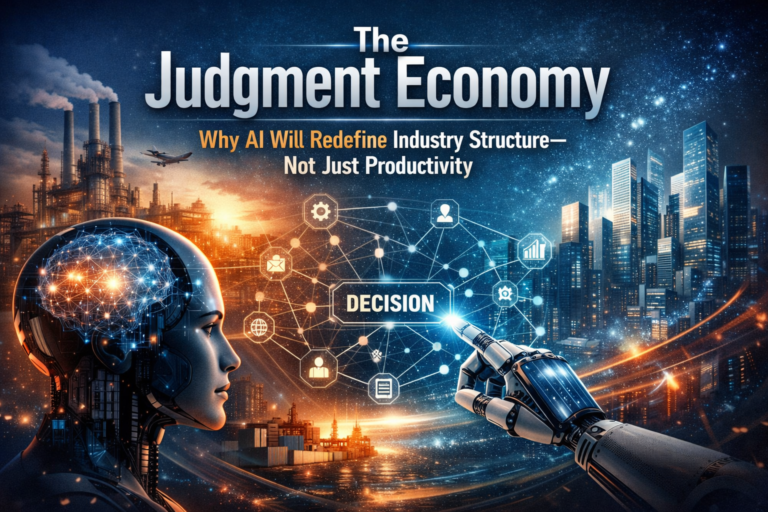
The Judgment Economy
For decades, competitive advantage came from what organizations could scale — factories, distribution, software, networks.
In the AI era, something more powerful is beginning to scale: judgment.
And when judgment becomes programmable, executable, and continuously improvable, it does more than raise productivity. It reshapes industry structure itself. The firms that understand this shift early will not simply operate more efficiently — they will redefine the competitive landscape others must compete inside.
What is the Judgment Economy?
The Judgment Economy is an economic era in which organizations win by encoding, executing, and continuously improving high-impact decisions at scale — with governance, auditability, and feedback loops that compound learning over time.
AI industry structure
For most of modern business history, industry structure has been shaped by what scaled.
- In the industrial economy, advantage came from scaling assets: plants, logistics, distribution, and capital intensity.
- In the digital economy, advantage came from scaling software and networks: marginal cost collapse, distribution leverage, data accumulation, platform effects.
- In the AI economy, a different thing begins to scale: judgment.
That sounds abstract until you put it in operational terms. “Judgment” is not a motivational concept. It is the set of decisions that determine margin, risk, reliability, and growth—pricing, underwriting, fraud detection, supply allocation, preventive maintenance, credit limits, compliance review, service triage, and exception handling.
When those decisions become machine-executable and continuously improvable, the basis of competition changes. The firm is no longer primarily a bundle of assets or a bundle of software. It becomes a decision system.
This is the Judgment Economy: an era in which competitive advantage compounds through scalable decision-making—not just through productivity gains.
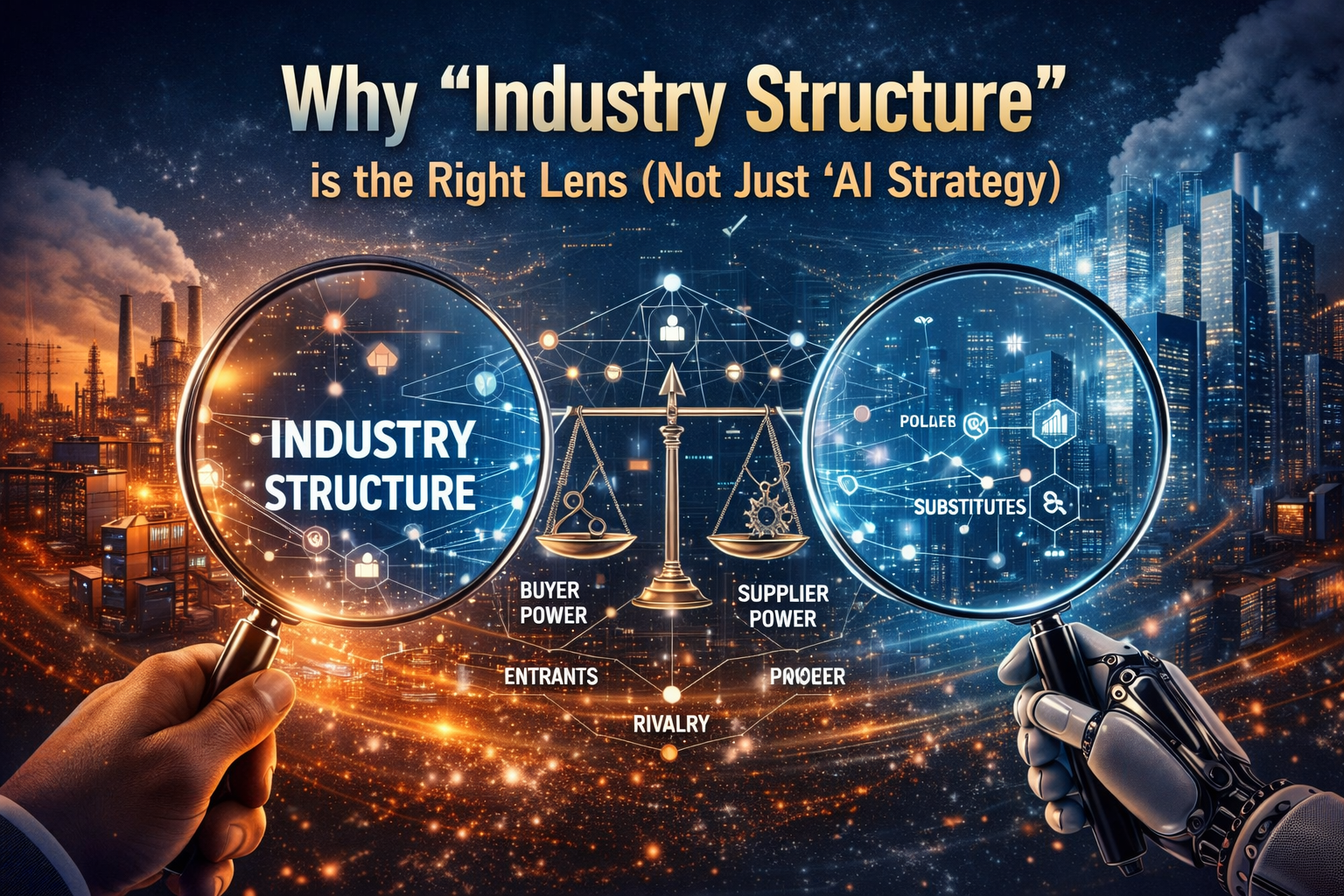
Why “industry structure” is the right lens (not just “AI strategy”)
Strategy becomes clearer when you return to fundamentals.
Michael Porter’s classic framing reminds us that performance is shaped by industry structure, not only by internal excellence. The forces—rivalry, buyers, suppliers, substitutes, entrants—determine where profit pools can exist and how easily advantage can be defended. (Harvard Business Review)
Now add a modern twist: AI changes the shape of those forces because it changes what is scarce.
In the industrial era, scarcity was productive capacity and capital.
In the digital era, scarcity was distribution and network position.
In the AI era, the scarcest resource becomes high-quality, governed judgment at scale.
That redefines barriers to entry, the basis of differentiation, and the speed at which advantage can widen.
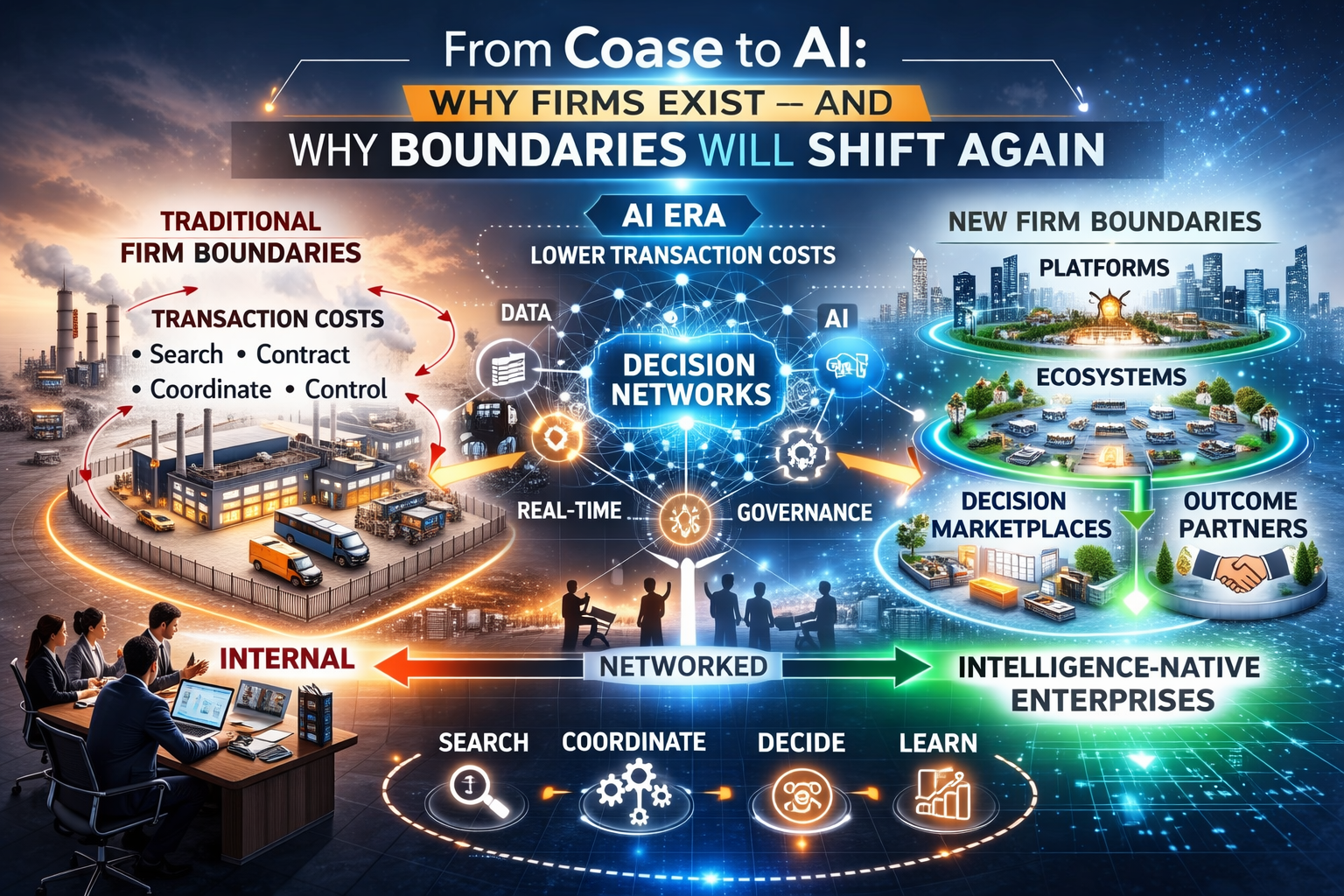
From Coase to AI: why firms exist—and why boundaries will shift again
Ronald Coase argued firms exist because using markets has transaction costs—searching, contracting, coordinating, enforcing. When internal coordination is cheaper than market coordination, firms grow; when markets coordinate more cheaply, firms shrink or outsource. (Wiley Online Library)
AI attacks transaction costs in a new way:
- It reduces the cost of search (retrieval + synthesis).
- It reduces the cost of coordination (agents triggering workflows across tools).
- It reduces the cost of verification (policy checks, audit trails, exception routing).
- It reduces the cost of decision latency (continuous triage, prioritization, approvals).
As those costs fall, the optimal boundary of the firm changes. Some functions will centralize into highly governed “decision factories.” Others will unbundle into specialized providers that sell outcomes.
That is not a productivity story. That is an industry-structure story.
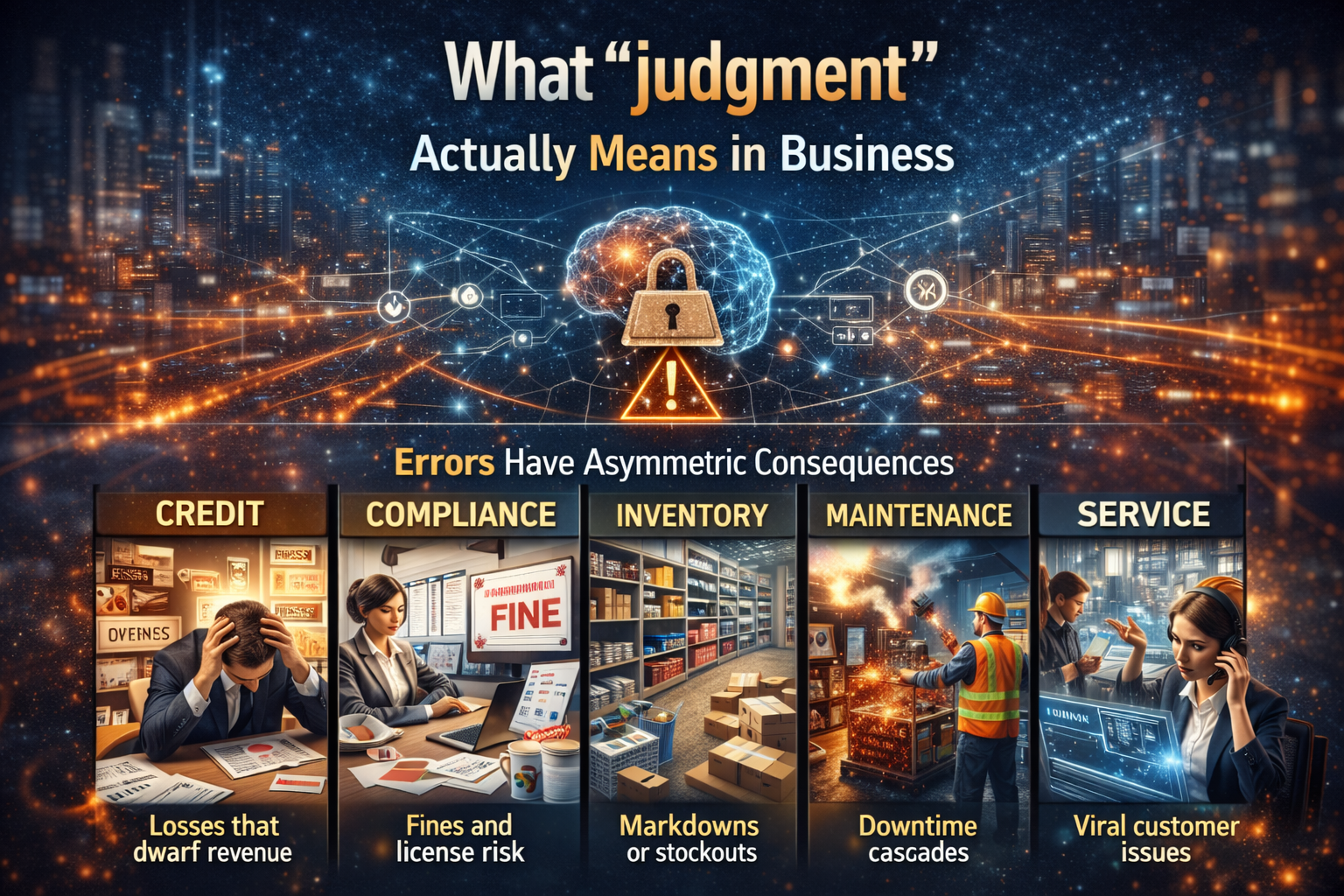
What “judgment” actually means in business
A useful operational definition:
Judgment = decisions made under uncertainty where errors have asymmetric consequences.
This is where leaders feel the pain:
- A wrong credit decision is not a small miss; it can create losses that dwarf the revenue.
- A wrong compliance decision can produce fines, license risk, reputational damage.
- A wrong inventory decision can destroy margin through markdowns or stockouts.
- A wrong maintenance decision can trigger downtime cascades.
- A wrong service decision can turn one frustrated customer into a viral story.
AI’s promise is not “do more work.” It is “make fewer costly mistakes, faster—and learn from every one.”
That’s why the competitive advantage is structural: it changes variance, not just averages.
The Judgment Economy describes a shift where competitive advantage comes from scalable, governed decision systems rather than assets or software alone. In this era, firms that compound judgment through AI will redefine industry structure.
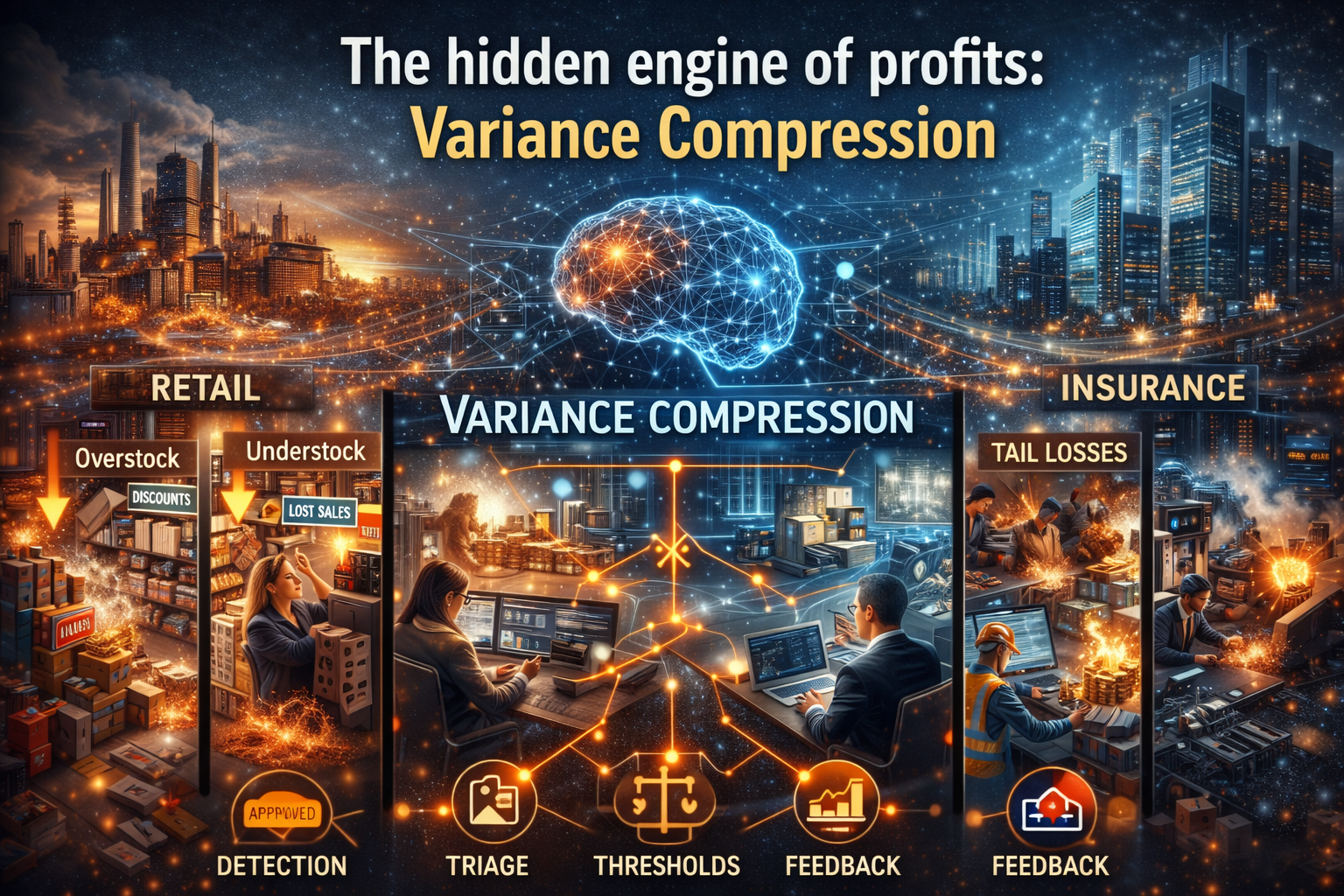
The hidden engine of profits: variance compression
Many industries don’t suffer because the average outcome is poor. They suffer because variance is expensive.
- A retailer can be profitable at average demand, but variance causes overstock (discounts) and understock (lost sales).
- An insurer can price well on average, but variance causes tail losses.
- A bank can approve loans at scale, but variance creates credit events and capital drag.
- A manufacturer can run efficiently, but variance causes scrap spikes, warranty costs, and downtime.
Embedding AI into core decision flows reduces variance through:
- Earlier detection (weak signals captured sooner)
- Consistent triage (fewer “random” escalations)
- Better thresholds (risk-adjusted, context-aware decisions)
- Faster feedback (outcomes used to update policies/models)
Cost reduction is incremental. Variance compression becomes structural margin advantage.
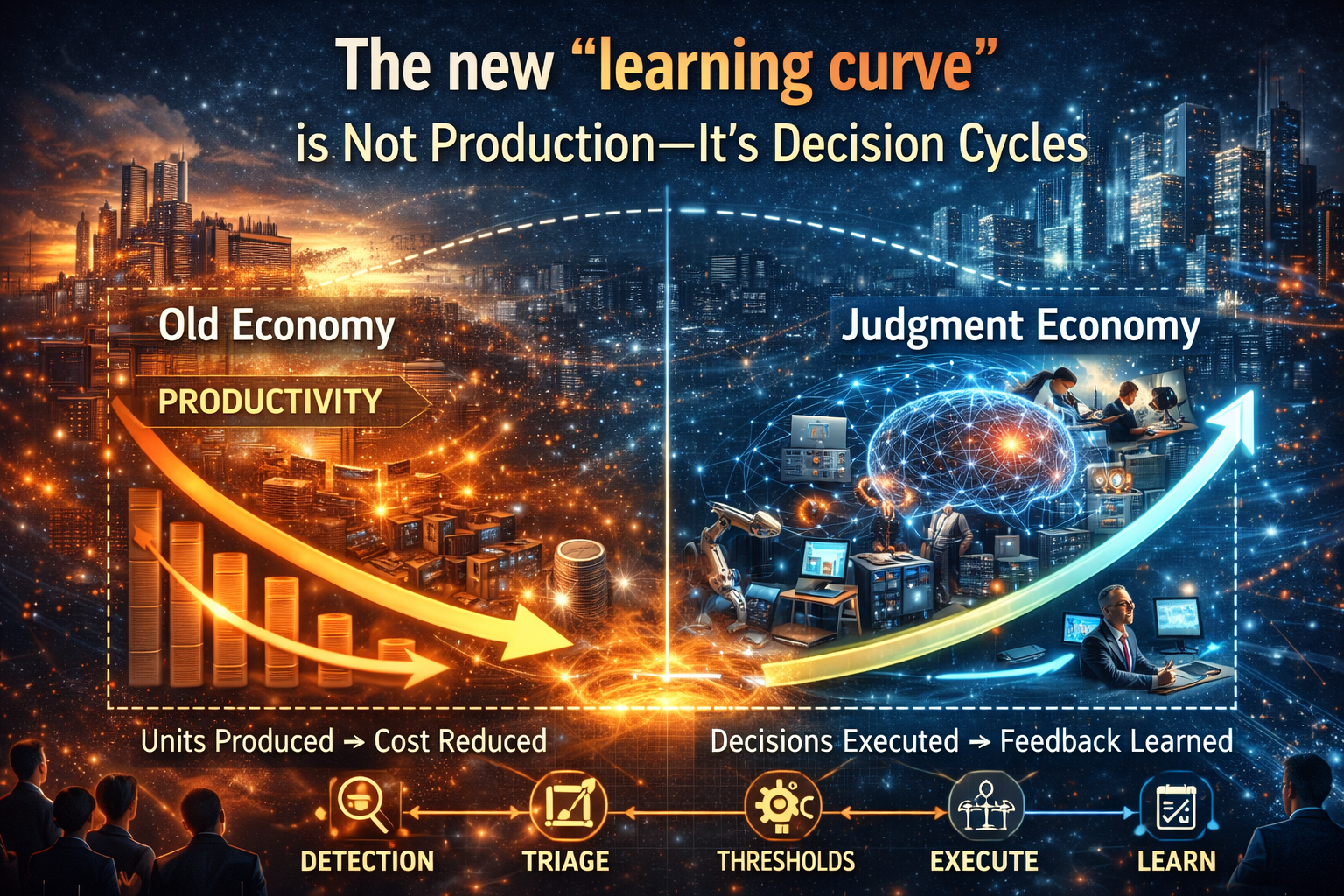
The new “learning curve” is not production—it’s decision cycles
Old-world strategy loved experience curves: the more you produced, the more you learned, the lower your costs became. This shaped whole eras of market-share competition. (BCG Global)
In the Judgment Economy, the learning curve shifts:
- Not “units produced”
- But decisions executed with feedback
The most important question becomes:
Who learns faster from decisions in the real world—safely, legally, and repeatedly?
That is why “learning velocity” becomes a moat.
It also explains a counterintuitive outcome: two firms can buy the same foundation models, use similar tools, even hire similar talent—and still diverge massively—because their decision feedback loops differ.
Learning moats vs traditional moats
Traditional defensibility often came from:
- Scale cost advantages
- Brand and distribution
- Network effects
- Switching costs
- Regulatory barriers
In AI-driven competition, those still matter—but a new moat emerges:
The Learning Moat
A firm builds a learning moat when it can:
- Execute high-value decisions repeatedly
- Capture clean feedback (ground truth)
- Improve decision policies continuously
- Govern the whole system (auditability, controls, rollback)
This is why “AI pilots” don’t create moats. Learning systems do.
Even Harvard Business School research emphasizes that AI does not replace human judgment in many contexts; it changes how judgment is formed and applied—especially when experience, context, and strategy are involved. (Harvard Business School)
A Judgment Economy leader doesn’t romanticize autonomy. It engineers bounded autonomy.
Industry boundaries will blur around “decision domains”
As judgment becomes programmable, industry definitions start to shift.
A logistics company starts behaving like a real-time optimization and risk engine.
A bank starts behaving like a continuous underwriting and fraud platform.
A retailer becomes a demand-sensing and allocation system.
The organizing unit is no longer the product category. It becomes the decision domain:
- “We own last-mile routing decisions.”
- “We own credit allocation decisions.”
- “We own energy balancing decisions.”
- “We own clinical triage decisions.”
This is exactly where Porter’s model shows strain: it assumes clearer industry boundaries than modern competition allows. In the AI era, substitutes and entrants often come from “outside the category.” (Investopedia)
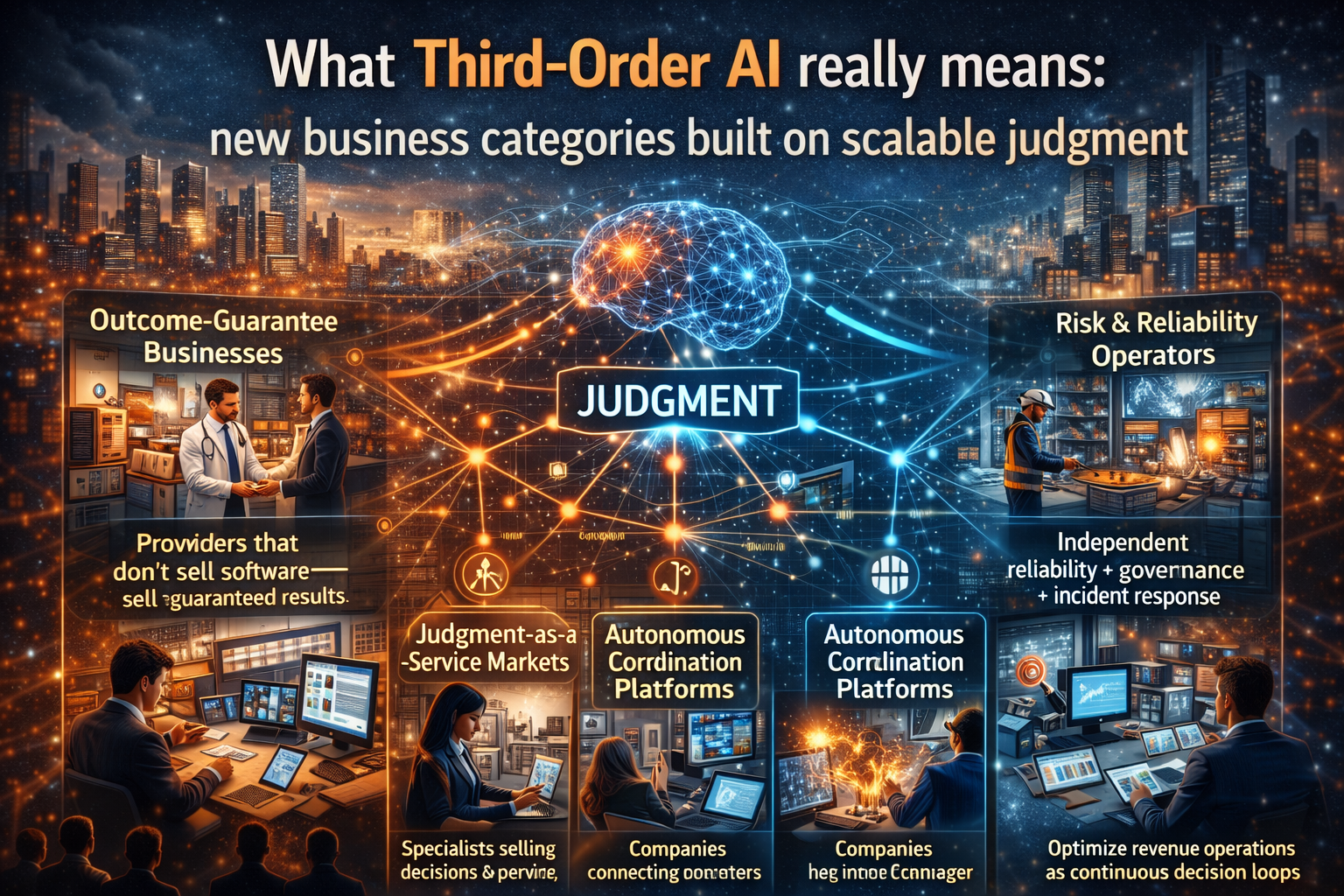
What Third-Order AI really means: new business categories built on scalable judgment
The internet analogy:
- Early internet: connectivity and websites
- Second wave: digital business models and platforms
- Third wave: category creation built on data + coordination (Uber, Airbnb, etc.)
In AI, the third wave is not “more automation.” It is new businesses built on scalable judgment, where the core product is a continuously improving decision loop.
Expect new categories such as:
1) Outcome-guarantee businesses
Providers that don’t sell software, but guaranteed results—and price on outcomes.
2) Judgment-as-a-service markets
Specialists that sell underwriting, compliance checks, fraud decisions, or supply allocation as a managed decision service.
3) Autonomous coordination platforms
Companies that turn fragmented ecosystems into coordinated systems—procurement, healthcare pathways, claims ecosystems, field service networks.
4) Risk and reliability operators
Firms that run “AI reliability + governance + incident response” as a service layer for regulated industries.
5) Precision growth engines
Businesses that convert marketing/sales into continuously optimized decision systems rather than periodic campaigns.
This is where the “Intelligence-Native Enterprise” becomes the winning form: it is designed to compound judgment the way digital natives were designed to compound software.
A simple board-ready diagnostic: Where does your P&L depend on judgment?
If I have to ask you one practical question, it will be:
Where does decision quality materially move margin, risk, or reliability?
Common hotspots:
- Pricing and discounting
- Credit and underwriting
- Fraud and abuse
- Inventory and allocation
- Preventive maintenance
- Compliance and approvals
- Customer retention and service recovery
- Workforce scheduling and capacity management
Then ask:
- Are these decisions codified (clear policies + thresholds), or tribal?
- Are they instrumented (telemetry + outcomes), or opaque?
- Are they governed (audit + rollback), or informal?
- Are they learning (feedback updates), or frozen?
That is the maturity path into the Judgment Economy.
What this means for the Intelligence-Native Enterprise
An Intelligence-Native Enterprise is not “an enterprise using AI.” It is an enterprise where:
- Decision flows are treated as products
- Feedback loops are treated as infrastructure
- Governance is treated as an operating system
- Learning velocity is treated as a strategic asset
If you want to learn all these, go to:
- The Enterprise AI Operating Model The Enterprise AI Operating Model: How organizations design, govern, and scale intelligence safely – Raktim Singh
- Decision-Intelligent Institutions The Future Belongs to Decision-Intelligent Institutions – Raktim Singh
- AI Dividend The Hidden AI Dividend: How Enterprises Unlock Trapped Value Across Industries – Raktim Singh
- Enterprise AI Control Plane Enterprise AI Control Plane: The Canonical Framework for Governing Decisions at Scale – Raktim Singh
- Enterprise AI Economics Enterprise AI Economics & Cost Governance: Why Every AI Estate Needs an Economic Control Plane – Raktim Singh
- Decision Integrity Decision Services: How Enterprises Unlock New Categories of Growth Through AI – Raktim Singh
- Enterprise AI Ownership Framework A Computational Theory of Responsibility in AI: Why “Correct” Decisions Still Leave Moral Residue – Raktim Singh
Strategic implications boards should act on this year
- Compete on a decision system, not a model.
Models commoditize; decision systems differentiate. - Fund feedback loops, not pilots.
If you can’t measure outcomes cleanly, you can’t compound learning. - Treat governance as a growth capability.
Autonomy without controls creates hidden risk; controls without speed kills advantage. - Expect non-traditional entrants.
Your next competitor may not share your SIC code; they may own your decision domain. - Watch value migration before value creation.
Capital often moves to the “perceived AI winners” before the true category winners emerge—then the real business model innovation begins.
The AI decade will not be won by the fastest adopters of tools. It will be won by the fastest compounders of judgment.
Conclusion: the new source of advantage
AI will absolutely raise productivity. But that is not the main event.
The main event is that AI changes what scales inside firms and across industries. In the Judgment Economy, advantage compounds for organizations that can:
- execute decisions reliably,
- learn from outcomes quickly, and
- govern autonomy without slowing it down.
That is how industry structure will be rewritten—quietly at first, then suddenly.
In the AI decade, the winners won’t be the firms that adopt tools fastest. They’ll be the firms that compound judgment fastest.
Glossary
- Judgment Economy: An economic era where competitive advantage compounds through scalable decision-making and rapid learning loops.
- Decision System: The end-to-end mechanism that senses signals, applies policy/model logic, executes action, and captures outcomes.
- Variance Compression: Systematically reducing costly inconsistency and tail-risk in operations through better decisions.
- Learning Velocity: The speed at which an organization improves decision quality from real-world feedback.
- Learning Moat: Defensibility created by superior decision cycles, feedback quality, governance, and continuous improvement.
- Decision Domain: A category of decisions (e.g., underwriting, routing, allocation) that defines a competitive arena more than an industry label.
- Intelligence-Native Enterprise: An enterprise designed to compound judgment via governed decision systems and feedback infrastructure.
FAQ
1) What is the Judgment Economy in simple terms?
It’s when companies win by scaling better decisions—pricing, risk, allocation, compliance—rather than just scaling people or software.
2) How is this different from “AI productivity”?
Productivity means doing the same work cheaper or faster. Judgment economies change the structure of competition by reducing errors, compressing variance, and compounding learning.
3) What creates a learning moat?
Repeated decisions + clean feedback + continuous improvement + strong governance (auditability, rollback, controls).
4) Will AI eliminate human judgment?
No. It changes where humans add value—setting intent, defining tradeoffs, governing risk, and designing accountability. (Harvard Business School)
5) What should boards do first?
Identify the 5–10 decisions that drive margin/risk, instrument outcomes, and build governed feedback loops—not just pilots.
Institutional Perspectives on Enterprise AI
Many of the structural ideas discussed here — intelligence-native operating models, control planes, decision integrity, and accountable autonomy — have also been explored in my institutional perspectives published via Infosys’ Emerging Technology Solutions platform.
For readers seeking deeper operational detail, I have written extensively on:
- What Makes an Enterprise Intelligence-Native? The Blueprint for Third-Order AI Advantage
https://blogs.infosys.com/emerging-technology-solutions/artificial-intelligence/what-is-enterprise-ai-the-operating-model-for-compounding-institutional-intelligence.html - Why “AI in the Enterprise” Is Not Enterprise AI: The Operating Model Difference Most Organizations Miss
https://blogs.infosys.com/emerging-technology-solutions/artificial-intelligence/why-ai-in-the-enterprise-is-not-enterprise-ai-the-operating-model-difference-that-most-organizations-miss.html - The Enterprise AI Control Plane: Governing Autonomy at Scale
https://blogs.infosys.com/emerging-technology-solutions/artificial-intelligence/the-enterprise-ai-control-plane-governing-autonomy-at-scale.html - Enterprise AI Ownership Framework: Who Is Accountable, Who Decides, and Who Stops AI in Production
https://blogs.infosys.com/emerging-technology-solutions/artificial-intelligence/enterprise-ai-ownership-framework-who-is-accountable-who-decides-and-who-stops-ai-in-production.html - Decision Integrity: Why Model Accuracy Is Not Enough in Enterprise AI
https://blogs.infosys.com/emerging-technology-solutions/artificial-intelligence/decision-integrity-why-model-accuracy-is-not-enough-in-enterprise-ai.html - Agent Incident Response Playbook: Operating Autonomous AI Systems Safely at Enterprise Scale
https://blogs.infosys.com/emerging-technology-solutions/artificial-intelligence/agent-incident-response-playbook-operating-autonomous-ai-systems-safely-at-enterprise-scale.html - The Economics of Enterprise AI: Designing Cost, Control, and Value as One System
https://blogs.infosys.com/emerging-technology-solutions/artificial-intelligence/the-economics-of-enterprise-ai-designing-cost-control-and-value-as-one-system.html
Together, these perspectives outline a unified view: Enterprise AI is not a collection of tools. It is a governed operating system for institutional intelligence — where economics, accountability, control, and decision integrity function as a coherent architecture.
References / further reading
- Porter, How Competitive Forces Shape Strategy (HBR). (Harvard Business Review)
- Coase, The Nature of the Firm (1937). (Wiley Online Library)
- BCG on the Experience Curve (classic strategy lens). (BCG Global)
- Goldfarb et al., “Prediction and Judgment…” (MIT Press / Direct MIT). (MIT Press Direct)



Raktim Singh is an AI and deep-tech strategist, TEDx speaker, and author focused on helping enterprises navigate the next era of intelligent systems. With experience spanning AI, fintech, quantum computing, and digital transformation, he simplifies complex technology for leaders and builds frameworks that drive responsible, scalable adoption.