
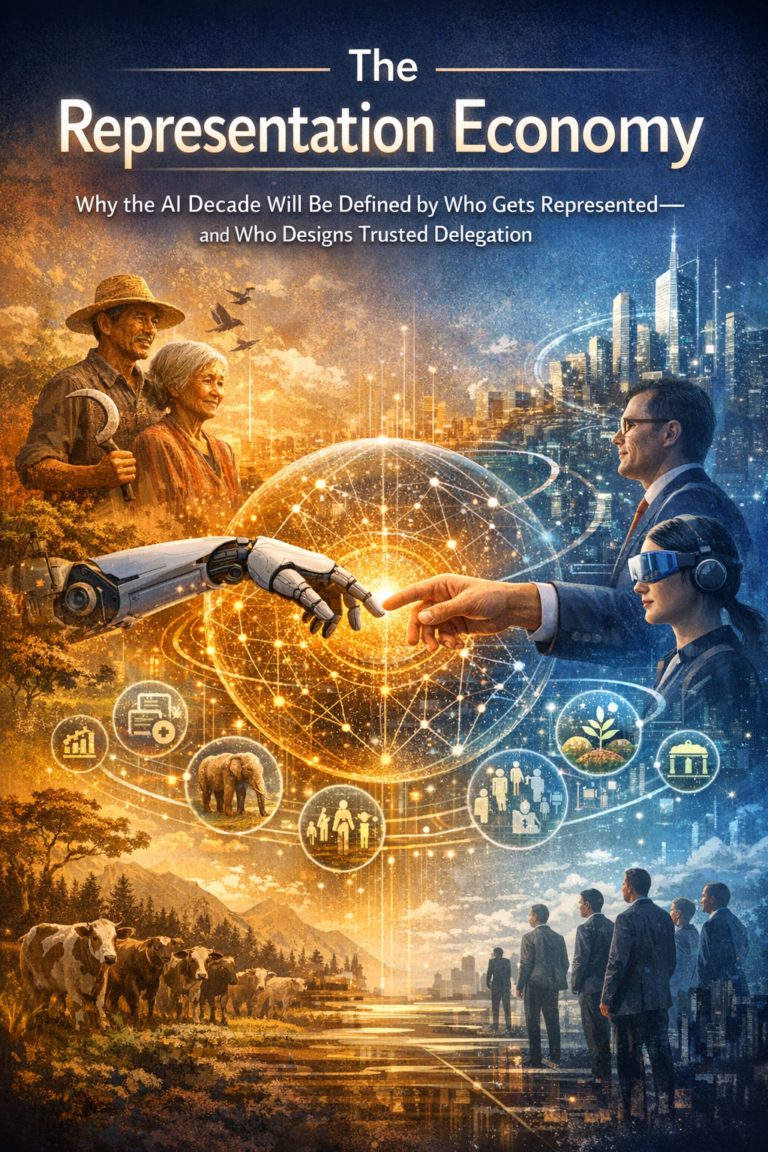
What Is the Representation Economy in AI?
The Representation Economy in AI is the emerging economic layer where artificial intelligence systems model, interpret, and increasingly act on behalf of individuals, communities, assets, and ecosystems that cannot digitally self-advocate—turning silent signals into accountable, decision-grade intelligence.
For most of history, power flowed to those who controlled information.
In the AI decade, power will flow to those who control representation.
Artificial intelligence is collapsing the cost of cognition. Research is instant. Pattern recognition is automated. Simulation is continuous.
But as intelligence becomes abundant, a deeper shift is unfolding: the real scarcity is no longer insight — it is legitimacy. The institutions that define who gets represented, how they are interpreted, and under what conditions action is delegated will shape the next economic order.
This is the rise of the Representation Economy.
The Representation Economy
For most of economic history, intelligence was scarce.
Judgment concentrated in a small number of roles. Analysis required teams. Forecasting was slow. Coordination demanded hierarchy. Strategy moved at the speed of meetings.
That constraint is collapsing.
Artificial intelligence is driving the marginal cost of cognition toward zero. Research, summarization, translation, pattern recognition, and simulation are becoming near-instant and increasingly accessible. When a foundational input becomes abundant, markets do not merely become more efficient—they reorganize.
But here is the deeper shift most leaders are missing:
As intelligence becomes infrastructure, representation becomes the new scarcity.
The defining economic question of the AI decade will not be:
Who can think?
It will be:
Who gets represented—and by whom?
This is the emergence of the Representation Economy: a new layer of value creation in which AI systems model, interpret, and increasingly act on behalf of people, communities, assets, and ecosystems that cannot digitally self-advocate.
This is not a niche idea. It is the next institutional frontier.
What This Article Gives You (Board-Level Promise)
This pillar introduces a board-ready lens for the next decade:
- Why “cheap cognition” changes market structure
- Why representation—not intelligence—becomes the strategic bottleneck
- How representation precedes delegation and execution
- What new business categories emerge (third order)
- What new institutional designs emerge (fourth order)
- A practical governance architecture (C.O.R.E.) for trusted representation and action
If you are a board member or C-suite leader, the aim is simple: to help you see the next frontier early—so you can design for it rather than react to it.
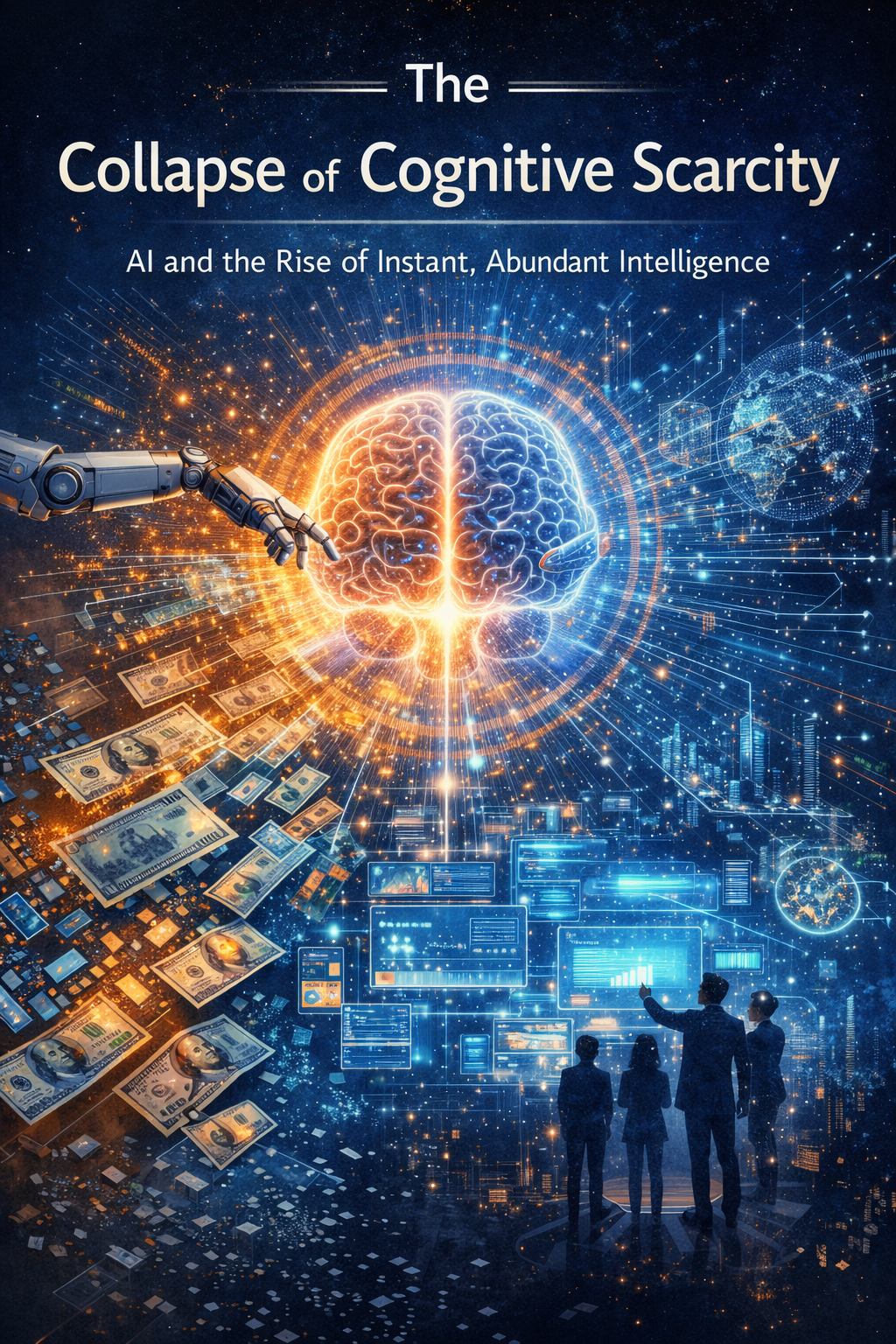
The Collapse of Cognitive Scarcity
The first wave of AI adoption has been framed as productivity: automate tasks, reduce cost, accelerate throughput.
That is real—but it is not the endgame.
The structural change is the collapse of cognitive scarcity:
- Knowledge work becomes programmable
- Pattern recognition becomes commoditized
- Simulation becomes cheap enough to run continuously
- Language ceases to be a barrier to accessing information
- “Best practice” becomes widely replicable
When intelligence becomes abundant, the advantage shifts away from merely “having AI.”
It shifts toward what still cannot be cheaply replicated:
- legitimate representation
- trusted delegation
- accountable execution
- governance that operates in real time
That is where the Representation Economy begins.
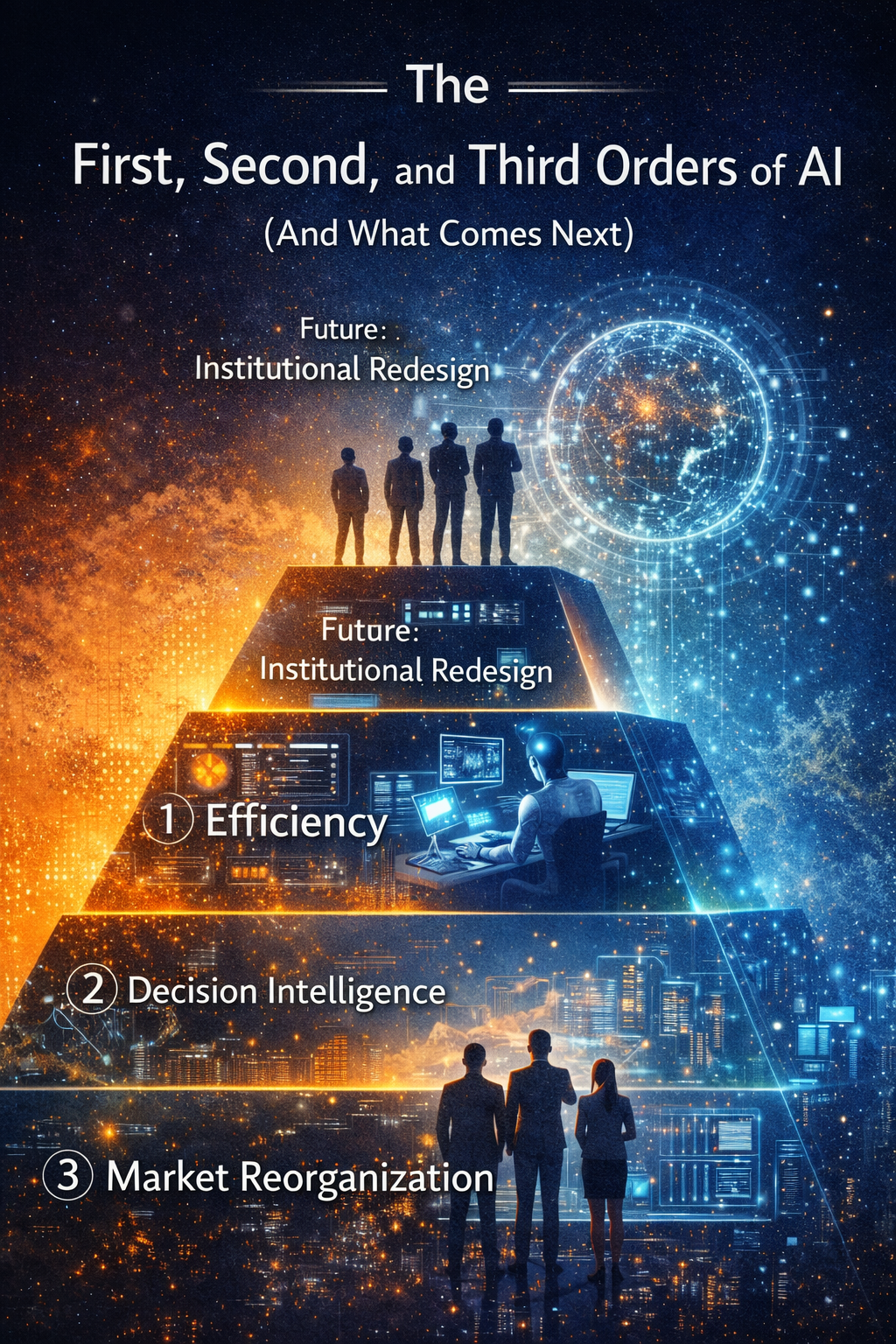
The First, Second, and Third Orders of AI (And What Comes Next)
To place representation in context, it helps to separate the AI transition into distinct economic orders:
First-Order AI: Efficiency
AI improves operational efficiency by automating and accelerating work.
Second-Order AI: Decision Intelligence
AI embeds into decision points—forecasting, risk, allocation, compliance, and optimization—to improve decision quality and reduce latency.
This is where many enterprises are today.
Third-Order AI: Market Reorganization
When AI moves from advice to execution, markets reorganize. New categories emerge around trusted action, coordination, and new forms of value delivery.
Fourth-Order AI: Institutional Redesign
When AI integrates with governance, public infrastructure, liability regimes, and sovereign rails, it becomes economic architecture—not just corporate capability.
The Representation Economy is a unifying concept across these orders: it explains how value expands when AI can represent systems that cannot represent themselves digitally—and how power shifts to those who design that representation responsibly.
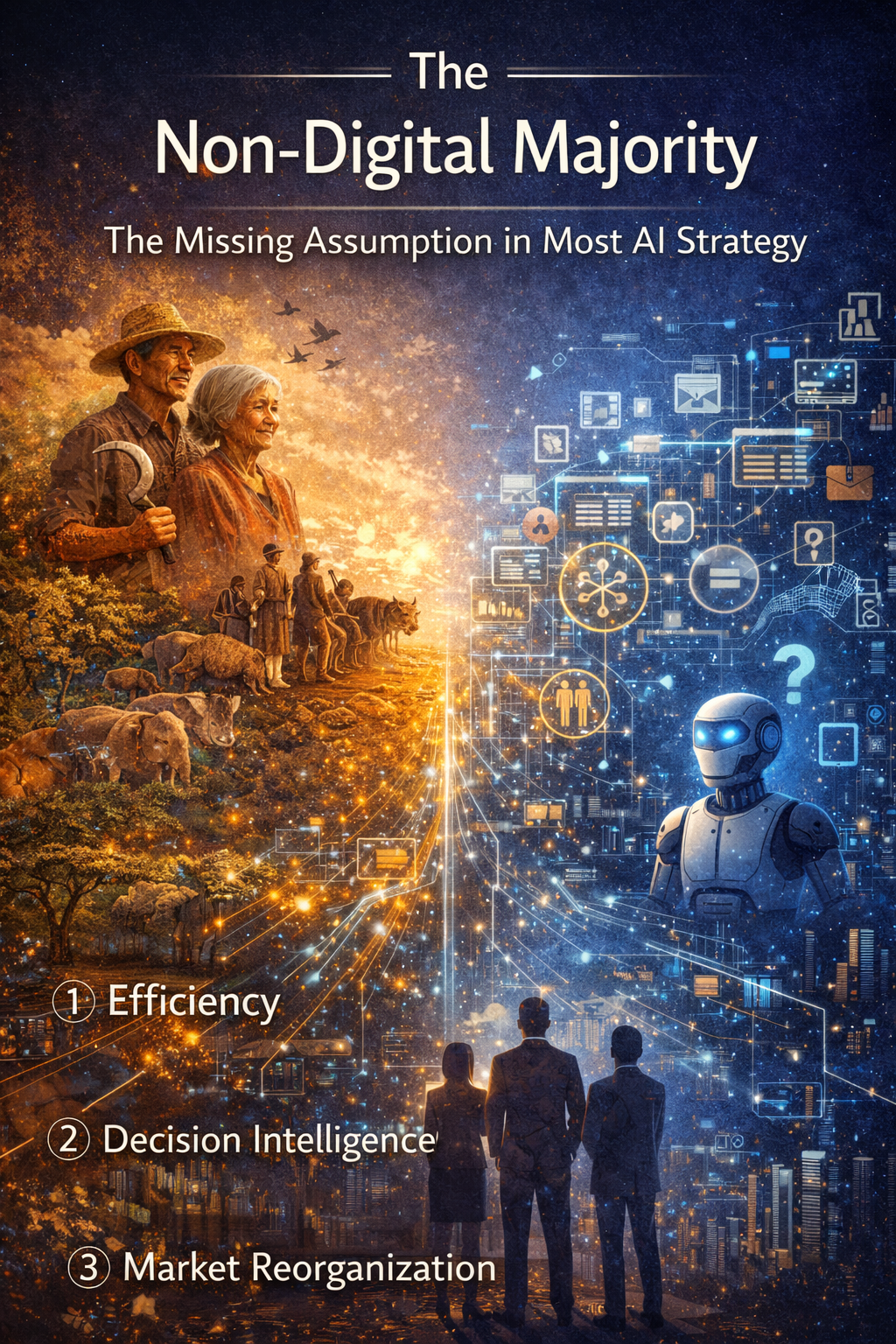
The Non-Digital Majority: The Missing Assumption in Most AI Strategy
Most AI narratives assume digitally fluent actors:
- People who can articulate needs
- Organizations with instrumented processes
- Systems that generate structured data
- Users who know what optimization looks like
- Customers who can specify preferences
But large parts of the world—and nearly all biological and ecological systems—do not behave like digitally native actors.
Many cannot easily translate their needs into data requests, analytics questions, or optimization goals. They often do not know what is possible, which means they cannot demand it.
In short:
They don’t know what they don’t know.
And that changes the economics of AI.
Because in the Representation Economy, value is created not primarily by responding to explicit demand, but by making silent systems legible—surfacing weak signals, translating them into computable insight, and designing safe pathways to action.
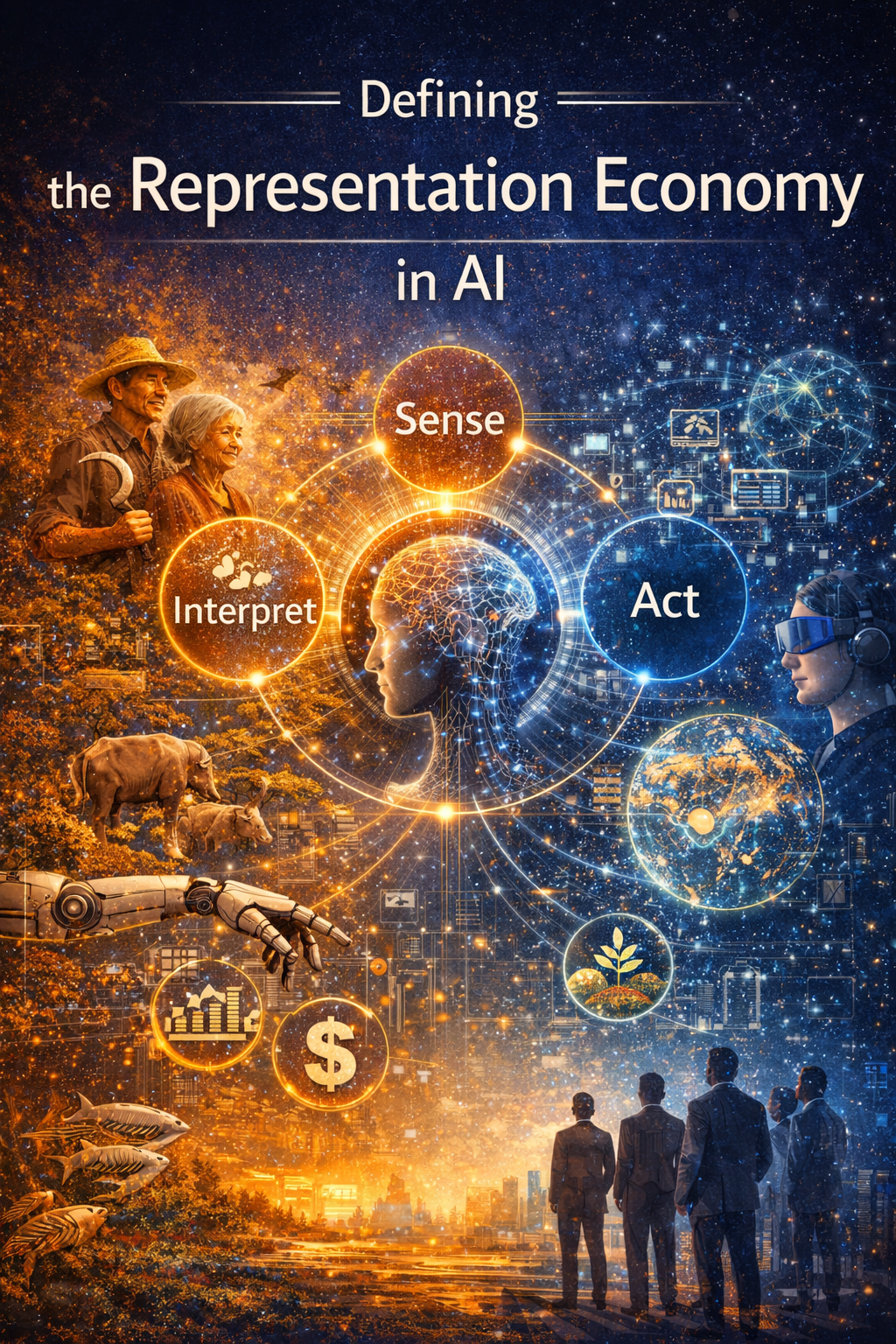
Defining the Representation Economy in AI
Representation Economy in AI (definition):
A new layer of economic value creation where AI systems model, interpret, and increasingly act on behalf of people, assets, and ecosystems that cannot digitally self-advocate—turning silent signals into decision-relevant intelligence and accountable action.
Representation is not a metaphor. It is a functional capability:
- sensing and interpreting signals
- translating context into decision inputs
- compressing complexity into actionable options
- continuously learning from evidence
- enabling safe delegation of execution
Representation is the foundation of activation. Without representation, there is no scalable optimization. Without optimization, delegation becomes guesswork. Without delegation architecture, execution becomes systemic risk.
The Activation of Dormant Value
For decades, vast value pools remained dormant because cognition was expensive:
- Monitoring was too costly
- Expertise was too scarce
- Feedback loops were too slow
- Coordination across distributed systems was too complex
- Many improvements were not economically viable at scale
Cheap cognition changes the feasibility frontier.
It becomes viable to continuously interpret weak signals and intervene early—at scale.
This is the core unlock of AI diffusion: not just “doing tasks faster,” but activating value that previously could not be captured.
This is why many of the most transformative AI deployments will happen where the world is least digitally fluent: not because those contexts are “behind,” but because they contain enormous latent value that becomes accessible once cognition becomes cheap and portable.
Representation Precedes Delegation
A crucial distinction:
Delegation assumes an actor can authorize a system to act.
Representation is required when an actor cannot express intent, constraints, or preferences in a digital form.
Representation comes first.
- If a system cannot represent reality accurately, delegation is unsafe.
- If representation is biased or extractive, delegation becomes exploitation.
- If representation is legitimate and accountable, delegation becomes enabling.
This is why your Delegation Infrastructure thesis becomes even more important in the Representation Economy: the more the represented actor cannot self-validate outcomes, the more trust, reversibility, and accountability become non-negotiable.
The New Asymmetry: Optimization Awareness
In the AI era, the deepest asymmetry is no longer “who has information.”
It is “who knows what can be optimized.”
Digitally sophisticated actors can:
- detect hidden inefficiencies
- model weak signals
- simulate interventions
- monetize new patterns
- build businesses around newly legible systems
Others may not even recognize that optimization is possible.
This creates a moral and strategic fork in the road:
Path A: Extractive Representation
Representation becomes a mechanism for asymmetric value capture.
Path B: Enabling Representation
Representation becomes a mechanism for shared value creation, resilience, and inclusion.
The difference is not technical.
It is institutional design.

Trust and Judgment Become the Scarce Assets
As cognition becomes abundant, trust becomes scarce.
Why?
Because AI’s real disruption is the shift from recommendation to execution. Execution introduces:
- authority
- liability
- irreversibility
- accountability
- settlement
In an AI-abundant world, the competitive frontier shifts from intelligence to trusted action.
That is why trust and judgment do not become obsolete. They become more valuable.
- Trust becomes the currency of delegation
- Judgment becomes the boundary-setting function
- Governance becomes a competitive capability
Automation is first-order. Decision intelligence is second-order. Representation is the hidden frontier.
C.O.R.E.: The Governance Architecture for Trusted Representation
To make representation legitimate—and delegation safe—institutions require an operational architecture. This is where C.O.R.E. becomes essential.
C — Capture Context
Representation must be grounded in permissioned context: constraints, preferences, intent, risk tolerance, and boundary conditions. Not just data—meaning.
O — Orchestrate Decisions
The system must decide when to act, when to ask, when to delay, when to escalate, and when to refuse. In the Representation Economy, choice architecture is strategy.
R — Regulate Action
Representation must connect to enforceable guardrails: what is authorized, what requires confirmation, what is reversible, and what creates liability. Policy must become executable.
E — Evolve with Evidence
Representation must improve through evidence: audit trails, post-action review, structured learning from errors, and continuous calibration. Trust compounds only when systems are measurable and improvable.
C.O.R.E. is how institutions convert AI from a reasoning tool into an accountable system of representation and action.
What New Business Categories Emerge (Third-Order Implications)
As the Representation Economy expands, new business categories become inevitable:
-
Context Vaults
Portable, permissioned context that compounds over time.
-
Representation Agents
Systems specialized in interpreting weak signals into actionable options.
-
Delegation Contracts
Codified rules for safe action: thresholds, reversibility, escalation.
-
Proof and Trust Layers
Verifiable provenance, auditability, and reputation systems.
-
Delegation Insurance
Underwriting the risk of autonomous action and systemic failure.
These businesses do not win by having “better models.”
They win by providing trusted representation + safe execution.
When intelligence becomes abundant, representation becomes scarce.
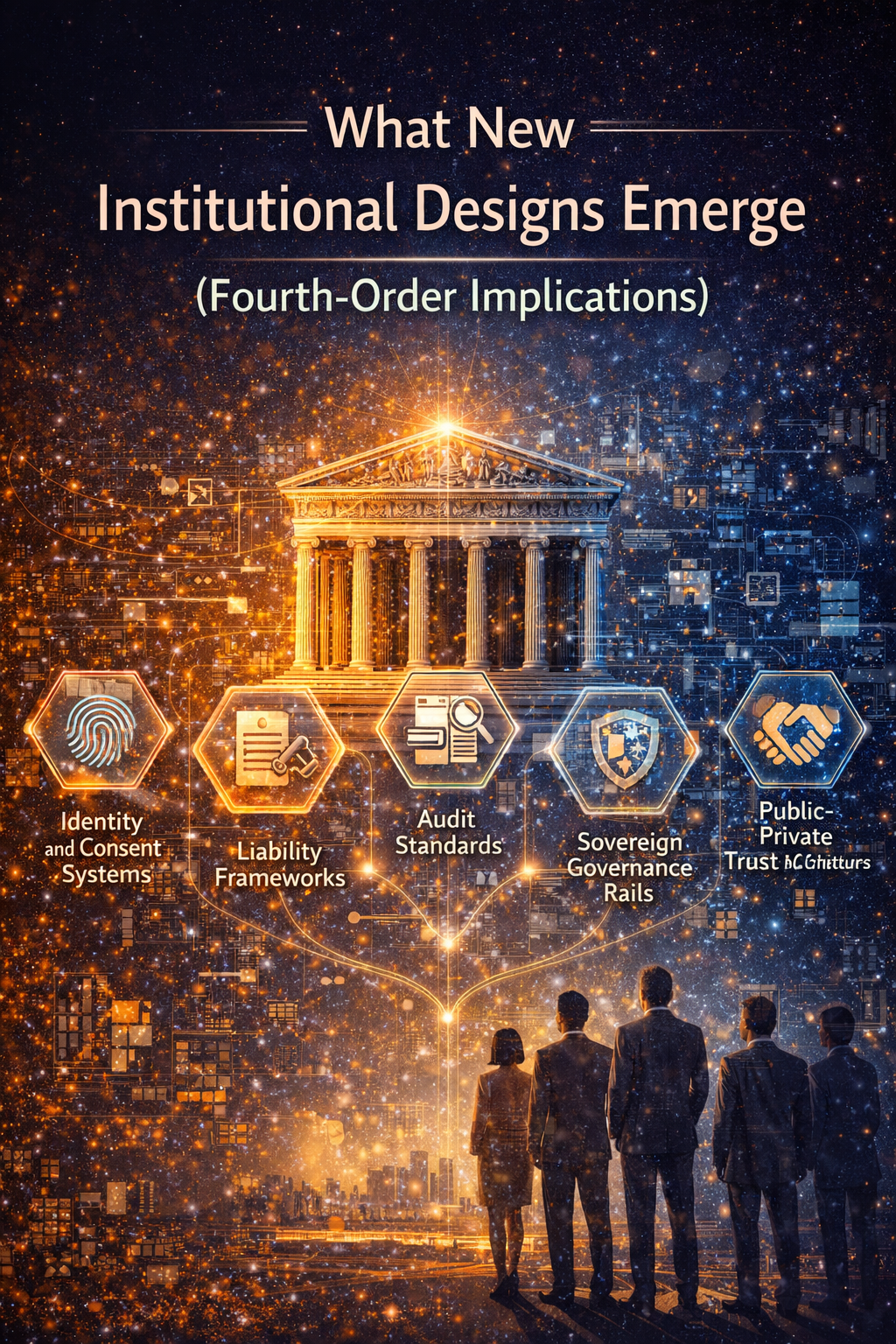
What New Institutional Designs Emerge (Fourth-Order Implications)
Fourth-order change happens when representation becomes part of national and sectoral infrastructure:
- identity and consent systems
- liability frameworks for autonomous action
- standards for auditability and reversibility
- sovereign governance rails for sensitive domains
- public-private trust architectures
In the Institutional AI Order, nations and institutions that design credible representation and delegation frameworks will compound advantage—not because of model superiority, but because of legitimacy, governance, and trust.
The AI decade will not be defined by who can think fastest—but by who gets represented legitimately.
Key Takeaways for Boards
• Intelligence is commoditizing.
• Representation is differentiating.
• Delegation requires infrastructure.
• Trust is strategic capital.
• Governance must become real-time.
The Board Mandate in the Representation Economy
Most boards are still asking:
“How do we deploy AI inside our enterprise?”
In the Representation Economy, the better questions are:
- Which parts of our ecosystem cannot digitally represent themselves today?
- What latent value remains dormant because cognition used to be expensive?
- Who will represent these actors and systems—us, a platform, or a competitor?
- What is our Delegation Infrastructure strategy—permissions, proofs, reversibility, liability?
- How do we ensure representation is enabling, not extractive?
- What must be governed in real time—not just documented?
Boards that ask these questions early will shape market structure. Boards that don’t will inherit it.

Conclusion: From Intelligence to Architecture
AI is not merely a productivity wave.
It is the first technology capable of continuously representing actors and systems that cannot digitally self-advocate.
That capability unlocks vast dormant value—but also introduces new risks of exploitation, fragility, and loss of legitimacy.
The winners of the AI decade will not be those who deploy intelligence fastest.
They will be those who design:
- legitimate representation
- trusted delegation
- accountable execution
- and governance architectures that operate in real time
The Representation Economy is not a future trend.
It is the next layer of global economic organization.
And the leaders who build it responsibly will define the structure of value creation—and institutional trust—in the age of AI.
In a world of cheap cognition, trust becomes the pricing power.
Further Reading on raktimsingh.com
To deeply understand this framework, explore these related pillars:
- The Enterprise AI Operating Model: https://www.raktimsingh.com/enterprise-ai-operating-model/
- The Intelligence Reuse Index: https://www.raktimsingh.com/intelligence-reuse-index-enterprise-ai-fabric/
- The Enterprise AI Runbook Crisis: https://www.raktimsingh.com/enterprise-ai-runbook-crisis-model-churn-production-ai/
- Who Owns Enterprise AI?: https://www.raktimsingh.com/who-owns-enterprise-ai-roles-accountability-decision-rights/
- The Future Belongs to Decision-Intelligent Institutions: https://www.raktimsingh.com/the-future-belongs-to-decision-intelligent-institutions/
- What Is the AI Dividend?: https://www.raktimsingh.com/ai-dividend-boards-structural-gains/
Glossary
Representation Economy (in AI): Economic layer where AI models and interprets systems that cannot digitally self-advocate, turning weak signals into actionable insight and accountable action.
Cost of Cognition: The marginal cost of producing decision-useful intelligence (analysis, synthesis, prediction, simulation).
Delegation Infrastructure: The institutional layer that enables safe, provable, reversible action by AI systems across real-world workflows.
Institutional AI Order: The macro shift where AI integrates with governance, regulatory systems, public infrastructure, and capital allocation.
Third-Order AI Economy: Market reorganization that occurs when AI moves from recommendation to execution, creating new categories and business models.
C.O.R.E.: Capture Context, Orchestrate Decisions, Regulate Action, Evolve with Evidence—an operational architecture for trustworthy representation and execution.
Context Capital: Permissioned, longitudinal context (constraints, intent, preferences) that increases AI usefulness and defensibility over time.
Trusted Action: AI execution bounded by permissions, proofs, reversibility, and accountability.
FAQ
What is the Representation Economy in AI?
The Representation Economy is the emerging economic layer where AI systems model, interpret, and act on behalf of people, assets, and ecosystems that cannot digitally represent themselves—making silent systems legible and actionable.
Why is representation becoming more important than intelligence?
As AI drives the cost of cognition down, intelligence becomes increasingly commoditized. Legitimate representation, trusted delegation, and accountable execution become the scarce differentiators.
How is the Representation Economy different from AI automation?
Automation improves tasks inside digital workflows. Representation activates dormant value by surfacing weak signals and translating non-digital realities into decision-grade inputs—and safe execution pathways.
What is the relationship between representation and delegation?
Representation comes first. Systems must be modeled and interpreted before safe delegation is possible. Delegation Infrastructure then enables trusted, reversible action.
What should boards do now?
Boards should identify where their ecosystem cannot digitally self-represent, locate dormant value pools, decide who will represent them, and build Delegation Infrastructure with real-time governance (C.O.R.E.).
The Intelligence-Native Enterprise Doctrine
This article is part of a larger strategic body of work that defines how AI is transforming the structure of markets, institutions, and competitive advantage. To explore the full doctrine, read the following foundational essays:
- The AI Decade Will Reward Synchronization, Not Adoption
Why enterprise AI strategy must shift from tools to operating models.
https://www.raktimsingh.com/the-ai-decade-will-reward-synchronization-not-adoption-why-enterprise-ai-strategy-must-shift-from-tools-to-operating-models/ - The Third-Order AI Economy
The category map boards must use to see the next Uber moment.
https://www.raktimsingh.com/third-order-ai-economy/ - The Intelligence Company
A new theory of the firm in the AI era — where decision quality becomes the scalable asset.
https://www.raktimsingh.com/intelligence-company-new-theory-firm-ai/ - The Judgment Economy
How AI is redefining industry structure — not just productivity.
https://www.raktimsingh.com/judgment-economy-ai-industry-structure/ - Digital Transformation 3.0
The rise of the intelligence-native enterprise.
https://www.raktimsingh.com/digital-transformation-3-0-the-rise-of-the-intelligence-native-enterprise/ - Industry Structure in the AI Era
Why judgment economies will redefine competitive advantage.
https://www.raktimsingh.com/industry-structure-in-the-ai-era-why-judgment-economies-will-redefine-competitive-advantage/
Institutional Perspectives on Enterprise AI
Many of the structural ideas discussed here — intelligence-native operating models, control planes, decision integrity, and accountable autonomy — have also been explored in my institutional perspectives published via Infosys’ Emerging Technology Solutions platform.
For readers seeking deeper operational detail, I have written extensively on:
- What Makes an Enterprise Intelligence-Native? The Blueprint for Third-Order AI Advantage
https://blogs.infosys.com/emerging-technology-solutions/artificial-intelligence/what-is-enterprise-ai-the-operating-model-for-compounding-institutional-intelligence.html - Why “AI in the Enterprise” Is Not Enterprise AI: The Operating Model Difference Most Organizations Miss
https://blogs.infosys.com/emerging-technology-solutions/artificial-intelligence/why-ai-in-the-enterprise-is-not-enterprise-ai-the-operating-model-difference-that-most-organizations-miss.html - The Enterprise AI Control Plane: Governing Autonomy at Scale
https://blogs.infosys.com/emerging-technology-solutions/artificial-intelligence/the-enterprise-ai-control-plane-governing-autonomy-at-scale.html - Enterprise AI Ownership Framework: Who Is Accountable, Who Decides, and Who Stops AI in Production
https://blogs.infosys.com/emerging-technology-solutions/artificial-intelligence/enterprise-ai-ownership-framework-who-is-accountable-who-decides-and-who-stops-ai-in-production.html - Decision Integrity: Why Model Accuracy Is Not Enough in Enterprise AI
https://blogs.infosys.com/emerging-technology-solutions/artificial-intelligence/decision-integrity-why-model-accuracy-is-not-enough-in-enterprise-ai.html - Agent Incident Response Playbook: Operating Autonomous AI Systems Safely at Enterprise Scale
https://blogs.infosys.com/emerging-technology-solutions/artificial-intelligence/agent-incident-response-playbook-operating-autonomous-ai-systems-safely-at-enterprise-scale.html - The Economics of Enterprise AI: Designing Cost, Control, and Value as One System
https://blogs.infosys.com/emerging-technology-solutions/artificial-intelligence/the-economics-of-enterprise-ai-designing-cost-control-and-value-as-one-system.html
Together, these perspectives outline a unified view: Enterprise AI is not a collection of tools. It is a governed operating system for institutional intelligence — where economics, accountability, control, and decision integrity function as a coherent architecture.



Raktim Singh is an AI and deep-tech strategist, TEDx speaker, and author focused on helping enterprises navigate the next era of intelligent systems. With experience spanning AI, fintech, quantum computing, and digital transformation, he simplifies complex technology for leaders and builds frameworks that drive responsible, scalable adoption.