
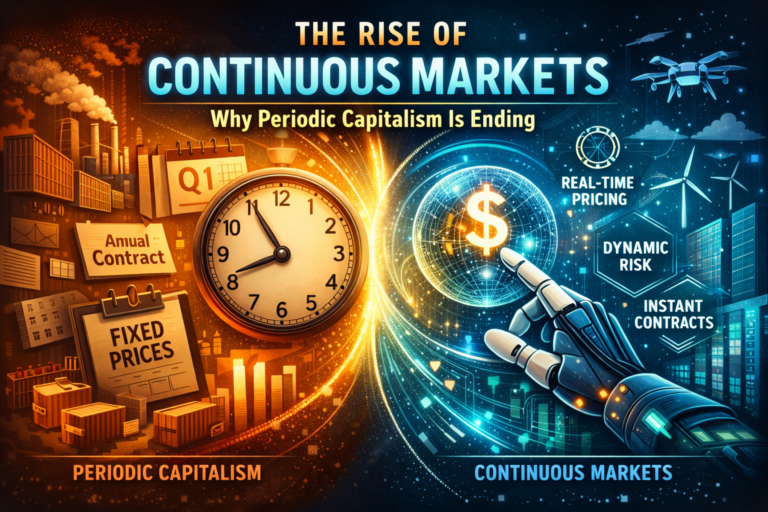
This rhythm shaped modern capitalism — not because it was optimal, but because cognition was expensive. Now that constraint is collapsing.
AI is not merely improving decision-making; it is compressing the time between sensing, deciding, and acting.
As that compression accelerates, markets themselves begin to change form. We are moving from periodic capitalism to continuous capitalism — and boards that do not understand this structural shift risk competing at yesterday’s speed in tomorrow’s markets.
The Rise of Continuous Markets
For most of modern business history, markets have moved in chunks.
Prices changed quarterly. Contracts renewed annually. Risk was assessed at onboarding. Planning cycles ran on calendars. Audits happened after the fact. And strategy reviews—often the most consequential decisions—were locked into board schedules.
This wasn’t because leaders lacked ambition. It was because cognition was expensive and coordination was slow.
You couldn’t constantly sense what was happening, continuously re-optimize decisions, instantly re-contract partners, and dynamically reprice risk—because doing so required armies of analysts, manual negotiation, and weeks of processing.
That era is ending.
AI is doing something far more disruptive than “automating tasks” or “improving decisions.” It is turning markets—industry by industry—into adaptive systems.
In other words:
We are moving from periodic capitalism (batched, calendar-driven markets)
to continuous capitalism (signal-driven, machine-paced markets).
This shift will create new winners, new business models, and new board-level responsibilities. It also defines what I call the Third-Order AI Economy: the phase where AI stops being a tool inside workflows and becomes the force that rewires how value moves through entire industries.
If you want context on how demand itself is changing as AI agents become “buyers,” read my earlier pillar on the Machine-Customer Era: The Machine-Customer Era: How AI Agents Are Rewriting Demand, Negotiation, and Competitive Advantage. (raktimsingh.com)
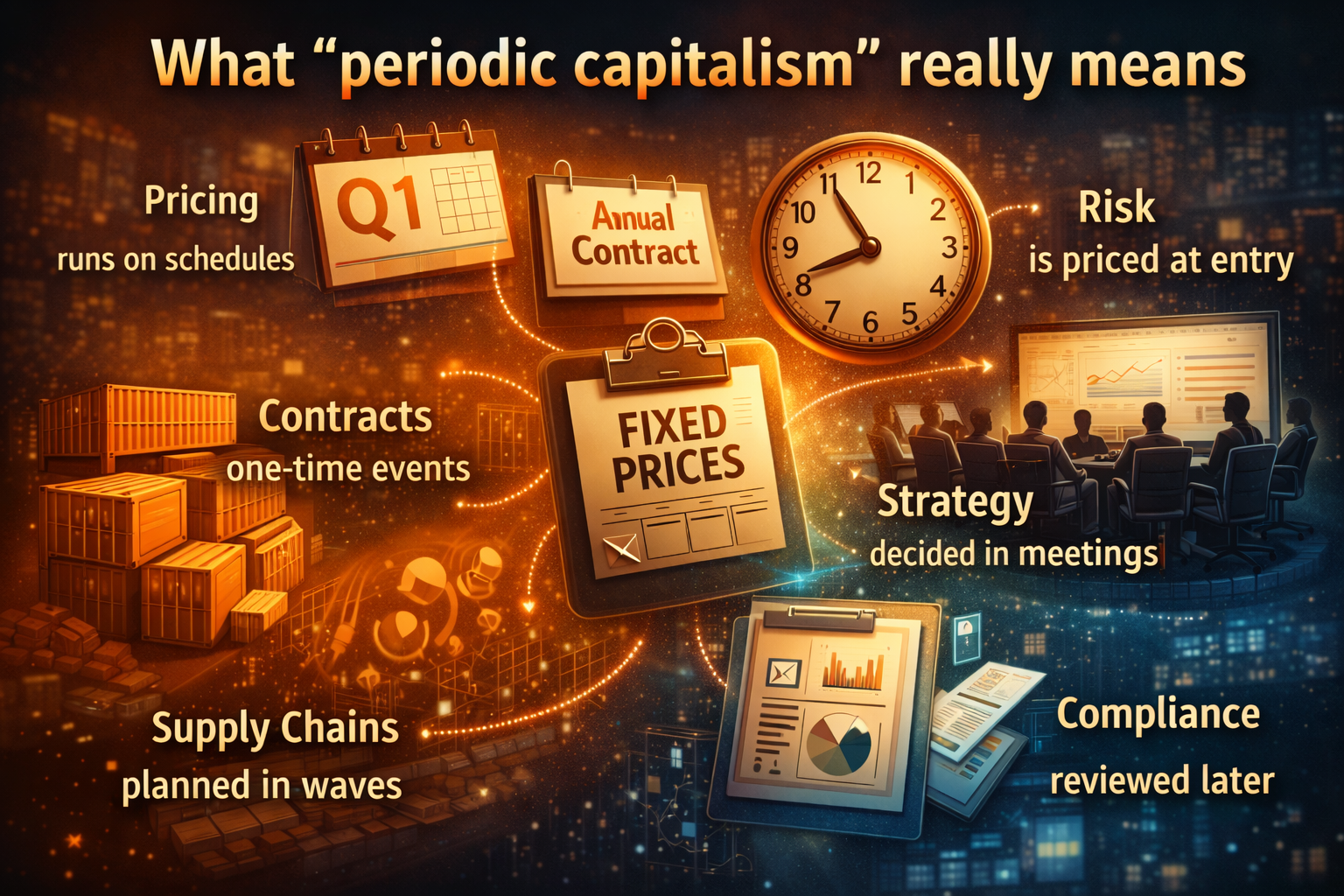
What “periodic capitalism” really means (in simple terms)
What “periodic capitalism” really means (in simple terms)
Periodic capitalism is the world where the economy runs on intervals:
- Pricing changes on schedules (quarterly price lists, annual renewals).
- Contracts are negotiated as one-time events (with limited flexibility after signing).
- Risk is priced at entry (insurance underwriting at purchase; credit underwriting at origination).
- Supply chains are planned in waves (weekly forecasting, monthly procurement cycles).
- Compliance is reviewed later (audits after decisions, not before them).
- Strategy is decided in meetings (not continuously tested in the market).
It’s not “wrong.” It was the only feasible operating mode when the cost of sensemaking and decision-making was high.
But AI collapses that cost—fast.
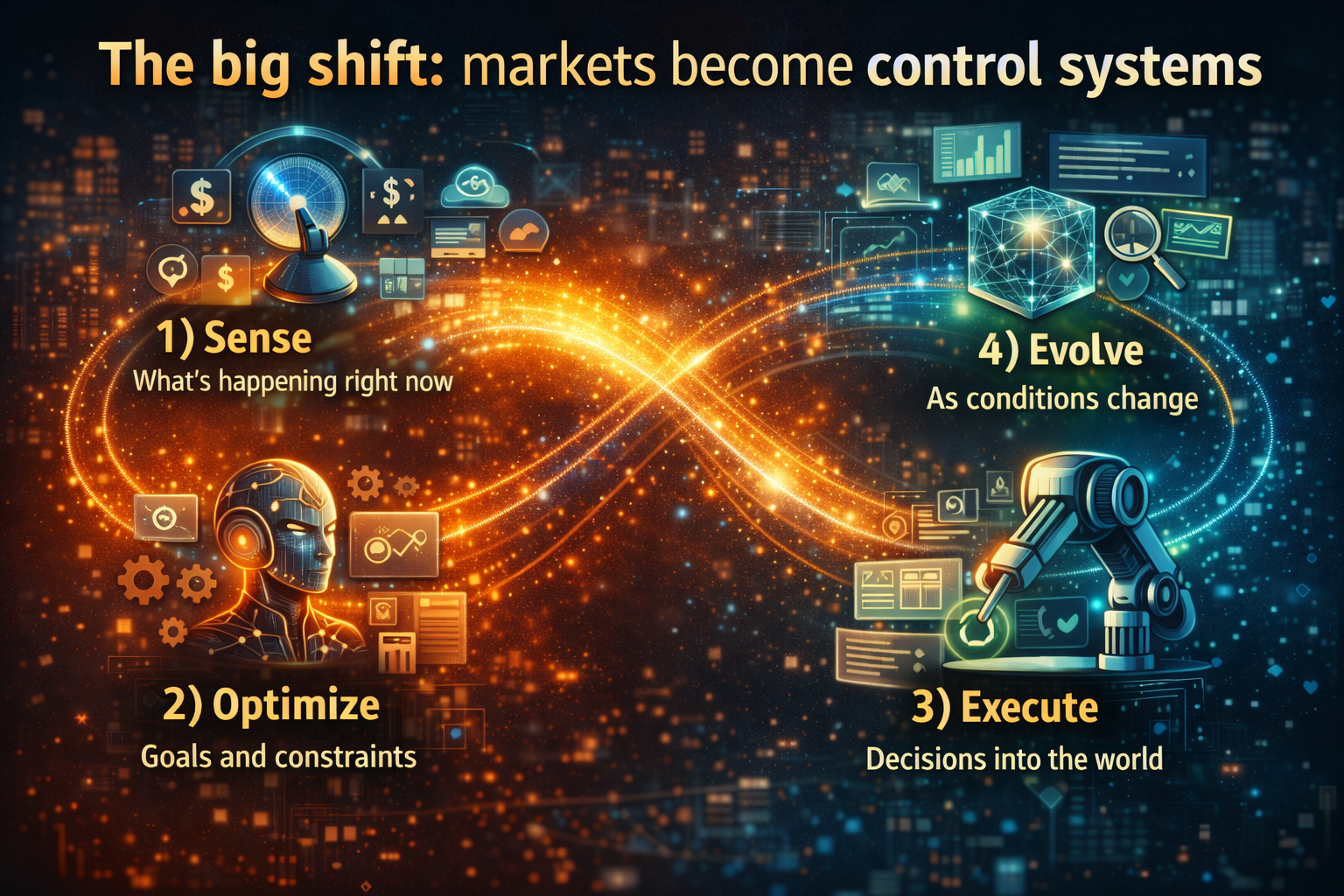
The big shift: markets become control systems
A “continuous market” is not just a market that changes prices frequently.
A continuous market behaves like a living control loop:
- Sense what’s happening right now
- Optimize based on goals and constraints
- Execute decisions into the real world
- Evolve the decision logic as conditions change
This pattern already exists in visible forms:
- Ride-hailing surge pricing
- Algorithmic retail pricing
- Real-time electricity pricing
- And soon: agent-to-agent negotiation of prices and terms
The World Economic Forum has been explicit that AI agents are moving toward handling end-to-end buying journeys—negotiating prices and terms and transacting with other agents at machine speed. That single point changes everything: negotiation itself becomes software. (World Economic Forum)
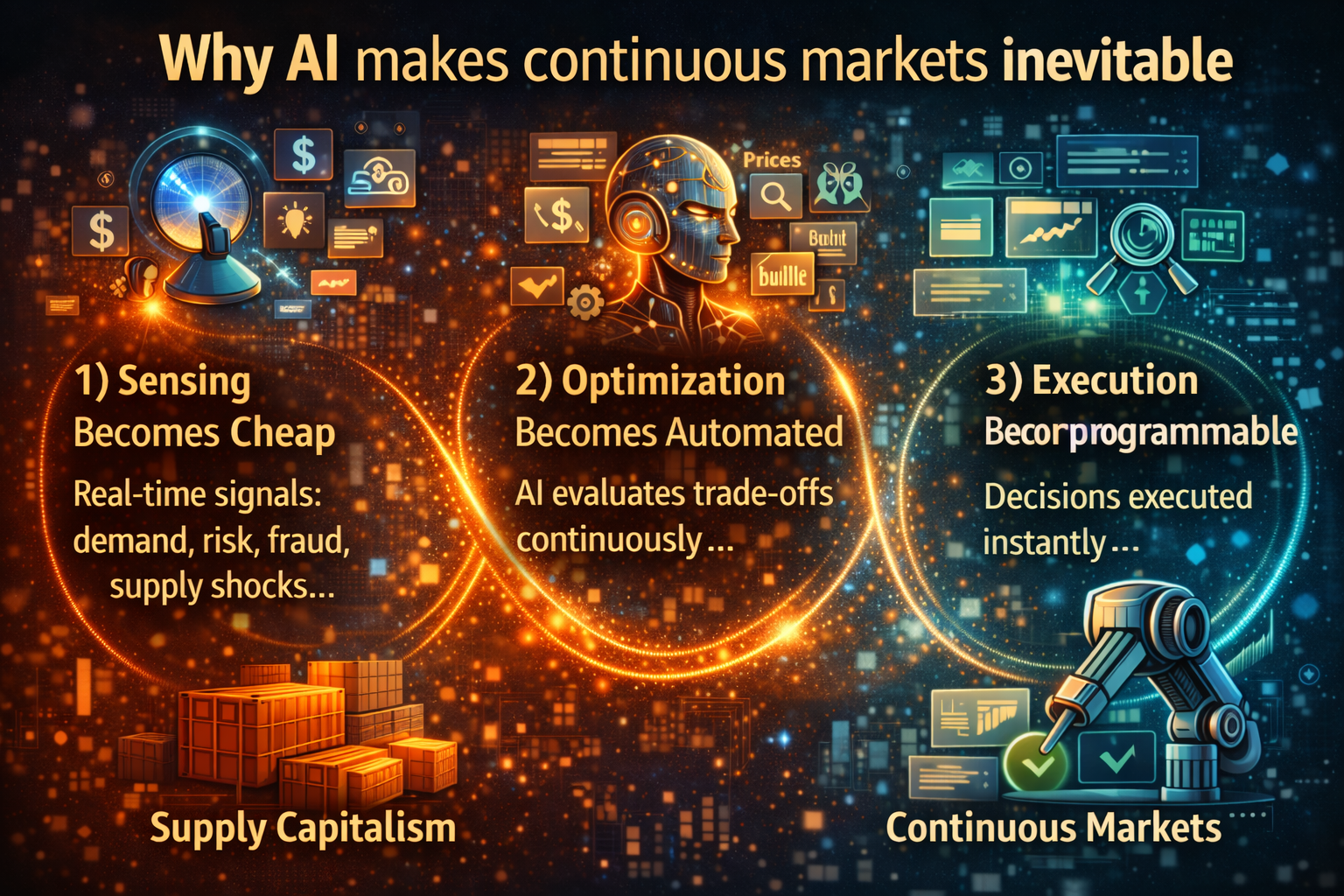
Why AI makes continuous markets inevitable
Three forces converge:
1) Sensing becomes cheap and ubiquitous
Sensors, software telemetry, transaction trails, and digital exhaust create real-time signals everywhere—demand, risk, usage, fraud, churn, supply shocks.
2) Optimization becomes automated
AI can evaluate trade-offs continuously—prices, bundles, risk thresholds, route decisions—at speeds no human team can match.
3) Execution becomes programmable
APIs, smart workflows, automated procurement, and agentic systems can execute decisions instantly: repricing, rerouting, renegotiating, reallocating.
Put simply: when sensing + optimization + execution become continuous, markets start behaving continuously too.
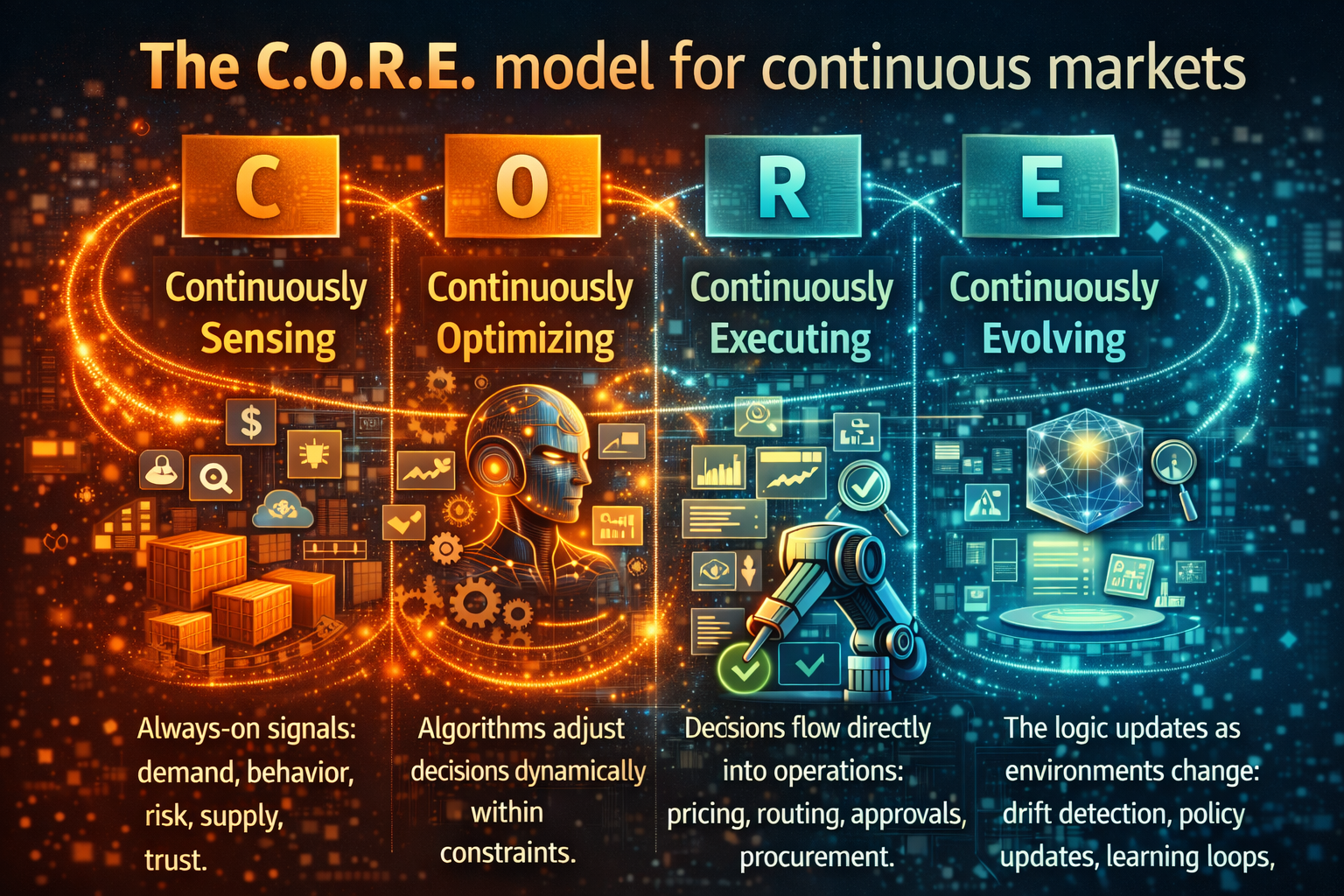
The C.O.R.E. model for continuous markets
To make this easy to remember (and easy to teach boards), here is the operating law:
C.O.R.E. = the operating system of continuous markets
C — Continuously sensing
Always-on signals: demand, behavior, risk, supply, capacity, trust.
O — Continuously optimizing
Algorithms adjust decisions dynamically within constraints.
R — Continuously executing
Decisions flow directly into operations: pricing, routing, approvals, procurement, interventions.
E — Continuously evolving
The logic updates as environments change: drift detection, policy updates, learning loops, governance feedback.
The power of C.O.R.E. is that it is not an “enterprise framework.” It is a market architecture framework. It explains how static industries become adaptive systems.
If you want the strategic doctrine behind this shift (capital moves first, new categories emerge later), link this article to your canonical pillar: The AI Value Migration Curve: Why Capital Moves Before Value Is Created—and How Boards Can Win the Creation Phase
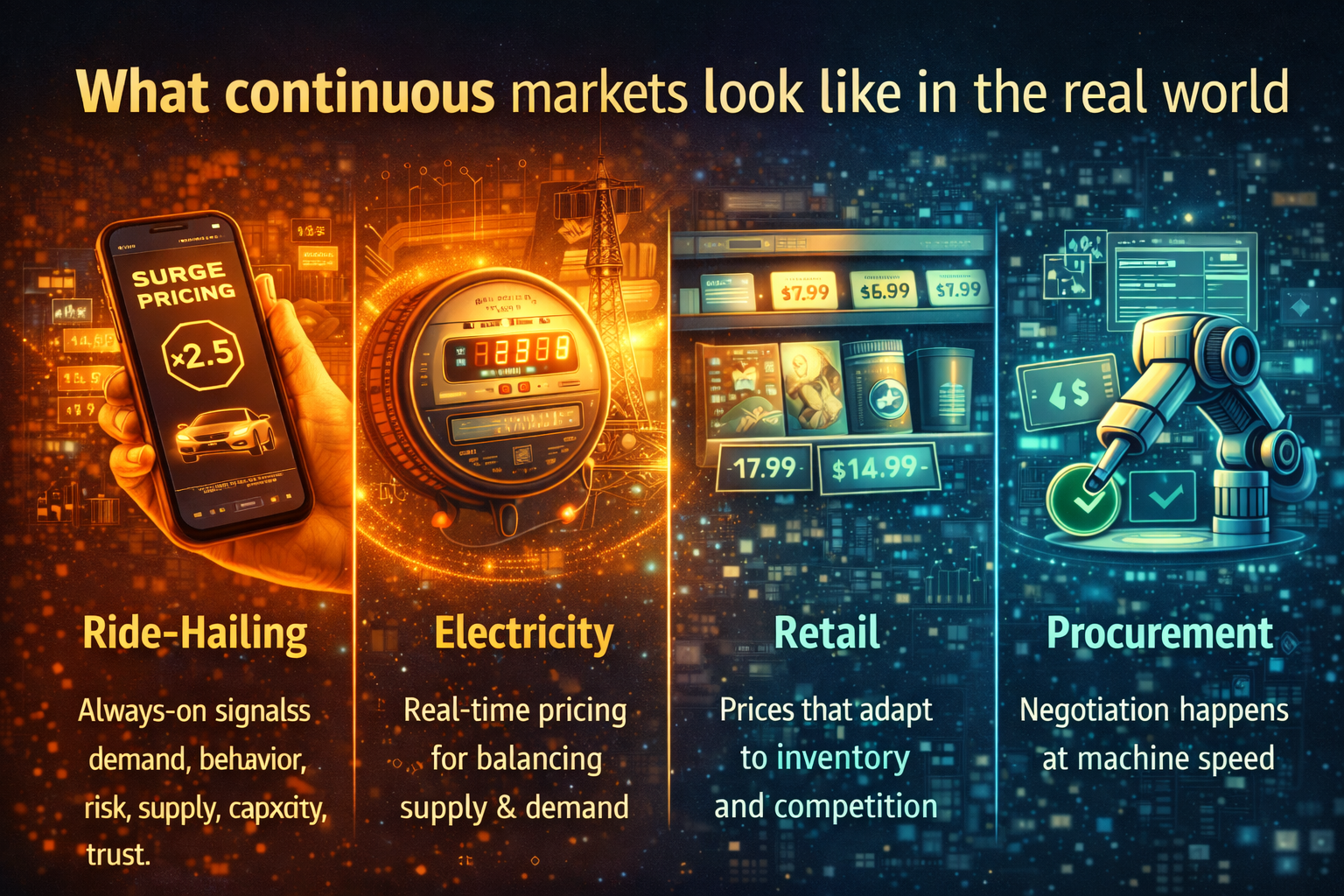
Simple examples: what continuous markets look like in the real world
Example 1: Ride-hailing — prices that “breathe”
Ride-sourcing platforms use surge pricing when requests exceed available supply in a location. Higher prices encourage demand to shift and supply to relocate—balancing the marketplace. Research on surge multipliers and real-time prediction shows how these price signals evolve continuously at local level. (ScienceDirect)
That is a continuous market in miniature:
- Demand spikes → price responds → supply responds → equilibrium shifts
It’s not just pricing. It’s self-balancing market behavior.
Example 2: Electricity — markets that must balance continuously
Electricity is the purest continuous market because the system must balance supply and demand continuously. Real-time pricing (RTP) can change hourly or sub-hourly to reflect supply costs and demand conditions—often used as a demand-side lever. (Microsoft)
Even without diving into technical detail, the core intuition is simple: if the system must stay balanced all the time, the market’s signals can’t remain static.
Example 3: Retail — prices that track competition, inventory, and intent
Retail pricing is shifting from periodic price lists to continuous adaptation. BCG describes how AI-powered pricing helps retailers move beyond uniform pricing toward a “dynamic game,” considering multiple dimensions simultaneously. (BCG Global)
The implication is bigger than “better pricing.” It’s that retail becomes an adaptive system: market signals flow in continuously; decisions update continuously; outcomes are monitored continuously.
Example 4: Procurement — negotiation becomes software
When AI agents negotiate within policy constraints, contracting becomes faster and more continuous. This isn’t hypothetical: WEF’s description of agents negotiating prices and terms in complex buying journeys is the clearest early signal. (World Economic Forum)
In periodic capitalism, negotiation is a human bottleneck.
In continuous capitalism, negotiation becomes programmable.
The board-level implication: latency becomes an economic disadvantage
When markets become continuous, the biggest competitive disadvantage is not lack of data or model accuracy.
It is decision latency.
If competitors can:
- reprice in hours,
- reroute supply instantly,
- renegotiate terms dynamically,
- re-bundle offers continuously,
- and intervene before failures occur,
…and your enterprise still runs on weekly meetings and quarterly price updates, you will feel like you are competing in slow motion.
This is why the Third-Order AI Economy is not about “adopting AI.”
It’s about changing the speed at which your institution can adapt.
If you want the board-level framing for how advantage moves from scale to decision superiority, read : Decision Scale: Why Competitive Advantage Is Moving from Labor Scale to Decision Scale
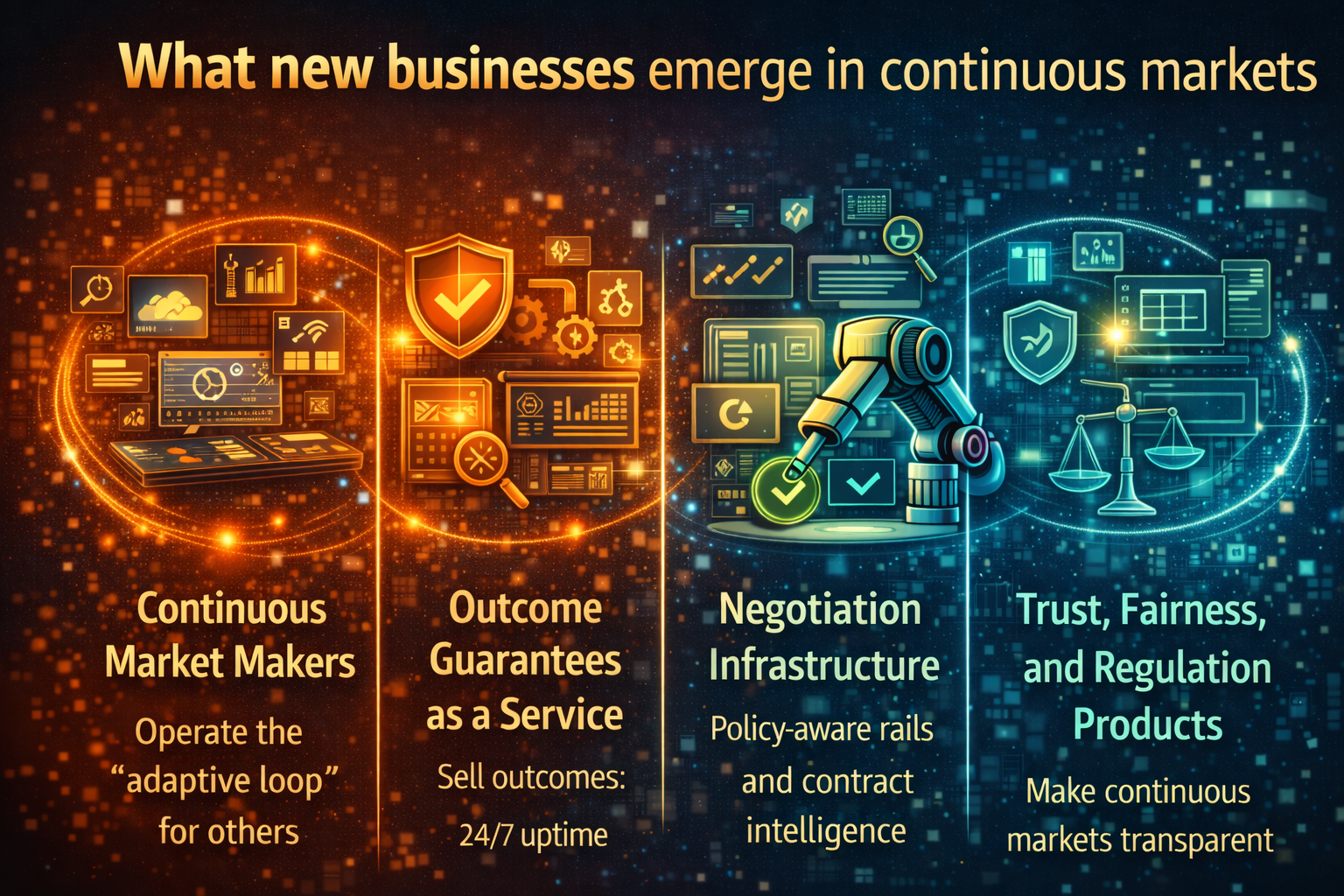
What new businesses emerge in continuous markets
Here’s the “Uber/Airbnb layer” for AI—what third-order creation looks like.
1) Continuous market makers
Companies that don’t just participate in markets—they operate the adaptive loop for others.
Think: pricing intelligence, risk intelligence, supply intelligence, compliance intelligence—sold as always-on control services.
2) Outcome guarantees as a service
When markets are continuous, you can intervene continuously. That makes it possible to sell outcomes, not products:
- uptime guarantees
- fraud-loss guarantees
- inventory-availability guarantees
- SLA guarantees with automated remediation
This is where “continuous sensing + continuous intervention” becomes a growth engine, not just a cost saver.
3) Negotiation infrastructure
When agents negotiate at machine speed, new intermediaries emerge:
- policy-aware negotiation rails
- contract “guardrail layers”
- verification services
- dispute resolution automation
This is where AI becomes market infrastructure, not just a decision assistant.
The risk: continuous markets can become continuous backlash
Continuous adaptation is exciting—but boards must also understand the legitimacy risk:
- Continuous pricing can feel like manipulation.
- Continuous personalization can feel unfair.
- Continuous optimization can trigger “race to the bottom” dynamics.
- Continuous automation can create accountability gaps.
A recent real-world warning is instructive: Instacart ended AI-driven price experiments after criticism and regulatory scrutiny, after reports that different customers were shown different prices for the same items. (Reuters)
This is the board-level principle:
If you want continuous markets, you need continuous legitimacy.
Meaning: guardrails, transparency, auditability, and clear constraints.
This is not a compliance afterthought. It becomes part of market design.
What boards should do now: a practical playbook
Here is a board-ready checklist for navigating continuous markets:
1) Identify where your industry is artificially periodic
Ask: where do we still operate in batches because cognition used to be expensive?
- pricing cycles
- underwriting cycles
- contract cycles
- supply planning cycles
- risk review cycles
2) Decide which loops should become continuous first
Not everything should be continuous. Start where:
- conditions change fast,
- latency is expensive,
- outcomes are measurable,
- interventions are possible.
3) Create “policy corridors” for machine action
Continuous execution requires bounded autonomy:
- price floors/ceilings
- discount corridors
- risk tolerance bands
- escalation triggers
- human override mechanisms
4) Invest in trust infrastructure early
If you move to continuous decisioning, invest in:
- observability and monitoring
- audit trails
- fairness monitoring
- customer communication
- governance that works in real time
Instacart’s reversal is a reminder that trust can break faster than adoption grows. (Reuters)
5) Track a new KPI: Adaptation velocity
In continuous markets, the winners aren’t the firms with the most AI pilots.
They are the firms that can:
- sense faster,
- decide faster,
- execute safer,
- and evolve continuously.
That is the new advantage.
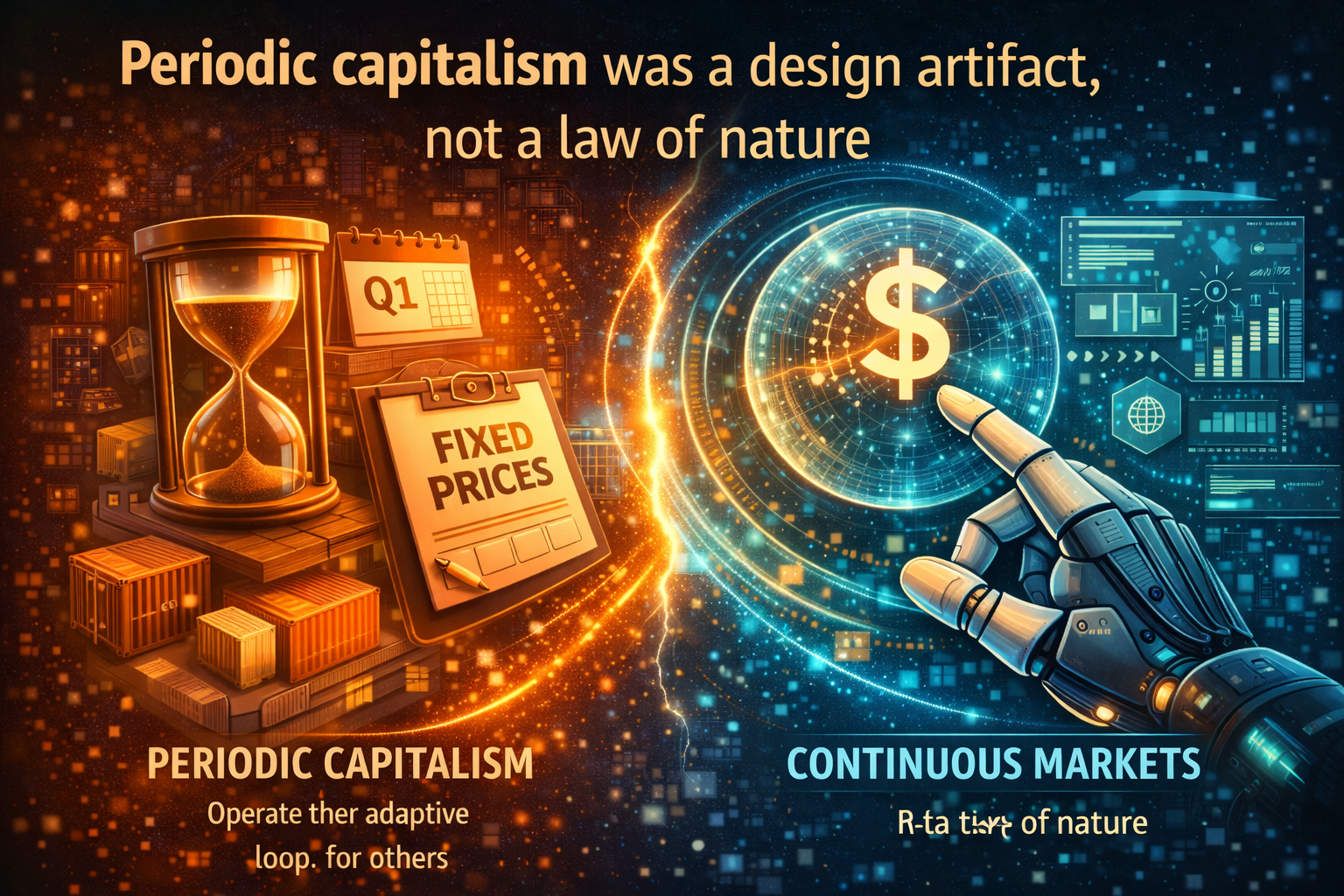
Conclusion: periodic capitalism was a design artifact, not a law of nature
For decades, markets looked periodic because the cost of cognition and coordination forced them to be.
AI removes that constraint.
And when constraints disappear, markets evolve.
The winners of the AI decade will not be remembered as “the companies that adopted AI.”
They will be remembered as the companies that:
- redesigned their industries for continuous adaptation,
- built trust into automation,
- and learned how to compete in markets that move at machine speed.
That is the rise of continuous markets.
And that is why periodic capitalism is ending.
Glossary
Continuous Markets: Markets that continuously sense, optimize, execute, and evolve based on real-time signals.
Periodic Capitalism: A batched economy where pricing, contracts, risk, and planning operate on fixed intervals.
Continuous Capitalism: A signal-driven economy where markets reprice, rebalance, and reconfigure continuously.
C.O.R.E.: Continuously Sensing, Continuously Optimizing, Continuously Executing, Continuously Evolving.
Dynamic Pricing: Algorithmic pricing that adjusts based on demand, competition, and constraints. (BCG Global)
Real-Time Pricing (RTP): Pricing that updates at high frequency (often hourly/sub-hourly) based on system conditions.
Machine Customers: AI agents that research, negotiate, and purchase on behalf of people or organizations. (World Economic Forum)
Policy Corridor: Boundaries within which autonomous systems can act without human approval (with escalation rules).
Continuous Legitimacy: Ongoing trust, transparency, and fairness that makes continuous decisioning socially and regulatorily sustainable.
FAQ
1) Are continuous markets only about pricing?
No. Pricing is the visible surface. The deeper shift is continuous risk, continuous contracting, continuous routing, and continuous execution.
2) Won’t customers hate continuous pricing?
They can—if it feels unfair or opaque. The future belongs to firms that combine continuous optimization with continuous legitimacy.
3) Which industries shift first?
Industries with fast-changing signals and measurable outcomes: mobility, energy, retail, logistics, finance, insurance.
4) What is the board’s role?
To set the guardrails (policy corridors), demand auditability and fairness, and ensure accountability keeps pace with automation.
5) Is this the “Third-Order AI Economy”?
Yes. Third-order is where AI changes market structure and creates new categories of companies—not just better internal decisions.
References and further reading
World Economic Forum: AI agents negotiating prices/terms and transacting at machine speed (World Economic Forum)
- BCG: AI-powered pricing and the shift to the “Dynamic Game” (BCG Global)
- Research on surge pricing and real-time surge multipliers in ride-hailing (ScienceDirect)
- Reuters + related reporting on Instacart ending AI-driven price tests after criticism/regulatory scrutiny (Reuters)
Enterprise AI Operating Model
Enterprise AI scale requires four interlocking planes:
Read about Enterprise AI Operating Model The Enterprise AI Operating Model: How organizations design, govern, and scale intelligence safely – Raktim Singh
- Read about Enterprise Control Tower The Enterprise AI Control Tower: Why Services-as-Software Is the Only Way to Run Autonomous AI at Scale – Raktim Singh
- Read about Decision Clarity The Shortest Path to Scalable Enterprise AI Autonomy Is Decision Clarity – Raktim Singh
- Read about The Enterprise AI Runbook Crisis The Enterprise AI Runbook Crisis: Why Model Churn Is Breaking Production AI—and What CIOs Must Fix in the Next 12 Months – Raktim Singh
- Read about Enterprise AI Economics Enterprise AI Economics & Cost Governance: Why Every AI Estate Needs an Economic Control Plane – Raktim Singh
Read about Who Owns Enterprise AI Who Owns Enterprise AI? Roles, Accountability, and Decision Rights in 2026 – Raktim Singh
Read about The Intelligence Reuse Index The Intelligence Reuse Index: Why Enterprise AI Advantage Has Shifted from Models to Reuse – Raktim Singh
The Intelligence-Native Enterprise Doctrine
This article is part of a larger strategic body of work that defines how AI is transforming the structure of markets, institutions, and competitive advantage. To explore the full doctrine, read the following foundational essays:
- The AI Decade Will Reward Synchronization, Not Adoption
Why enterprise AI strategy must shift from tools to operating models.
https://www.raktimsingh.com/the-ai-decade-will-reward-synchronization-not-adoption-why-enterprise-ai-strategy-must-shift-from-tools-to-operating-models/ - The Third-Order AI Economy
The category map boards must use to see the next Uber moment.
https://www.raktimsingh.com/third-order-ai-economy/ - The Intelligence Company
A new theory of the firm in the AI era — where decision quality becomes the scalable asset.
https://www.raktimsingh.com/intelligence-company-new-theory-firm-ai/ - The Judgment Economy
How AI is redefining industry structure — not just productivity.
https://www.raktimsingh.com/judgment-economy-ai-industry-structure/ - Digital Transformation 3.0
The rise of the intelligence-native enterprise.
https://www.raktimsingh.com/digital-transformation-3-0-the-rise-of-the-intelligence-native-enterprise/ - Industry Structure in the AI Era
Why judgment economies will redefine competitive advantage.
https://www.raktimsingh.com/industry-structure-in-the-ai-era-why-judgment-economies-will-redefine-competitive-advantage/
Institutional Perspectives on Enterprise AI
Many of the structural ideas discussed here — intelligence-native operating models, control planes, decision integrity, and accountable autonomy — have also been explored in my institutional perspectives published via Infosys’ Emerging Technology Solutions platform.
For readers seeking deeper operational detail, I have written extensively on:
- What Makes an Enterprise Intelligence-Native? The Blueprint for Third-Order AI Advantage
https://blogs.infosys.com/emerging-technology-solutions/artificial-intelligence/what-is-enterprise-ai-the-operating-model-for-compounding-institutional-intelligence.html - Why “AI in the Enterprise” Is Not Enterprise AI: The Operating Model Difference Most Organizations Miss
https://blogs.infosys.com/emerging-technology-solutions/artificial-intelligence/why-ai-in-the-enterprise-is-not-enterprise-ai-the-operating-model-difference-that-most-organizations-miss.html - The Enterprise AI Control Plane: Governing Autonomy at Scale
https://blogs.infosys.com/emerging-technology-solutions/artificial-intelligence/the-enterprise-ai-control-plane-governing-autonomy-at-scale.html - Enterprise AI Ownership Framework: Who Is Accountable, Who Decides, and Who Stops AI in Production
https://blogs.infosys.com/emerging-technology-solutions/artificial-intelligence/enterprise-ai-ownership-framework-who-is-accountable-who-decides-and-who-stops-ai-in-production.html - Decision Integrity: Why Model Accuracy Is Not Enough in Enterprise AI
https://blogs.infosys.com/emerging-technology-solutions/artificial-intelligence/decision-integrity-why-model-accuracy-is-not-enough-in-enterprise-ai.html - Agent Incident Response Playbook: Operating Autonomous AI Systems Safely at Enterprise Scale
https://blogs.infosys.com/emerging-technology-solutions/artificial-intelligence/agent-incident-response-playbook-operating-autonomous-ai-systems-safely-at-enterprise-scale.html - The Economics of Enterprise AI: Designing Cost, Control, and Value as One System
https://blogs.infosys.com/emerging-technology-solutions/artificial-intelligence/the-economics-of-enterprise-ai-designing-cost-control-and-value-as-one-system.html
Together, these perspectives outline a unified view: Enterprise AI is not a collection of tools. It is a governed operating system for institutional intelligence — where economics, accountability, control, and decision integrity function as a coherent architecture.



Raktim Singh is an AI and deep-tech strategist, TEDx speaker, and author focused on helping enterprises navigate the next era of intelligent systems. With experience spanning AI, fintech, quantum computing, and digital transformation, he simplifies complex technology for leaders and builds frameworks that drive responsible, scalable adoption.