
Enterprise AI Operating Model
Most organizations use AI to improve tasks.
Intelligence-native enterprises use AI to redesign how decisions are made, governed, and scaled.
That difference is structural.
In the emerging Third-Order AI economy, competitive advantage will not belong to companies that deploy the most tools. It will belong to those that embed intelligence directly into their operating model — where capital is allocated, risk is evaluated, products evolve, and strategy adapts in real time.
The question is no longer whether you use AI.
The real question is whether intelligence has become native to your enterprise architecture.
Executive Summary for Board Members
Most organizations are still treating AI as a tool upgrade. That is first-order AI thinking: automate tasks, improve productivity, reduce cost.
A smaller—and more serious—group is moving into second-order AI: redesigning workflows so AI improves decisions, reduces latency, prevents failures, and makes judgment more consistent across the enterprise.
But the biggest opportunity is third-order AI: when intelligence becomes the business.
In the third-order AI economy, winners won’t be the firms that “use AI the most.” They will be the firms that monetize intelligence, build intelligence-native operating models, and create new business categories where the product is not software, but decision advantage at scale.
This is a board-level guide to what third-order AI is, how new categories will form, what signals to watch globally, and how leaders can move from experimentation to durable advantage—without fear-based narratives.
Board takeaway: Value migration happens before value creation. The question is not whether AI will reshape your category. The question is whether your enterprise will be positioned to lead in the creation phase—after capital, talent, and attention have already moved.

Why This Moment Feels Like the Early Internet
Every major technology disruption follows a familiar arc:
- Efficiency first — use the technology to do existing work cheaper and faster
- Re-architecture second — reorganize the system around the technology
- New categories third — new business models emerge that couldn’t exist before
That’s what happened with the internet:
- Early internet enabled digitization: websites, email, online catalogues.
- Then came platformization: search, marketplaces, cloud infrastructure.
- Then came category creation: Uber, Airbnb, and on-demand logistics—businesses that monetized real-time coordination.
AI is following the same pattern—only faster.
And this is why boards matter: value migrates before value is created. Capital, talent, and attention shift early. The companies that understand the third-order curve don’t panic—they position.
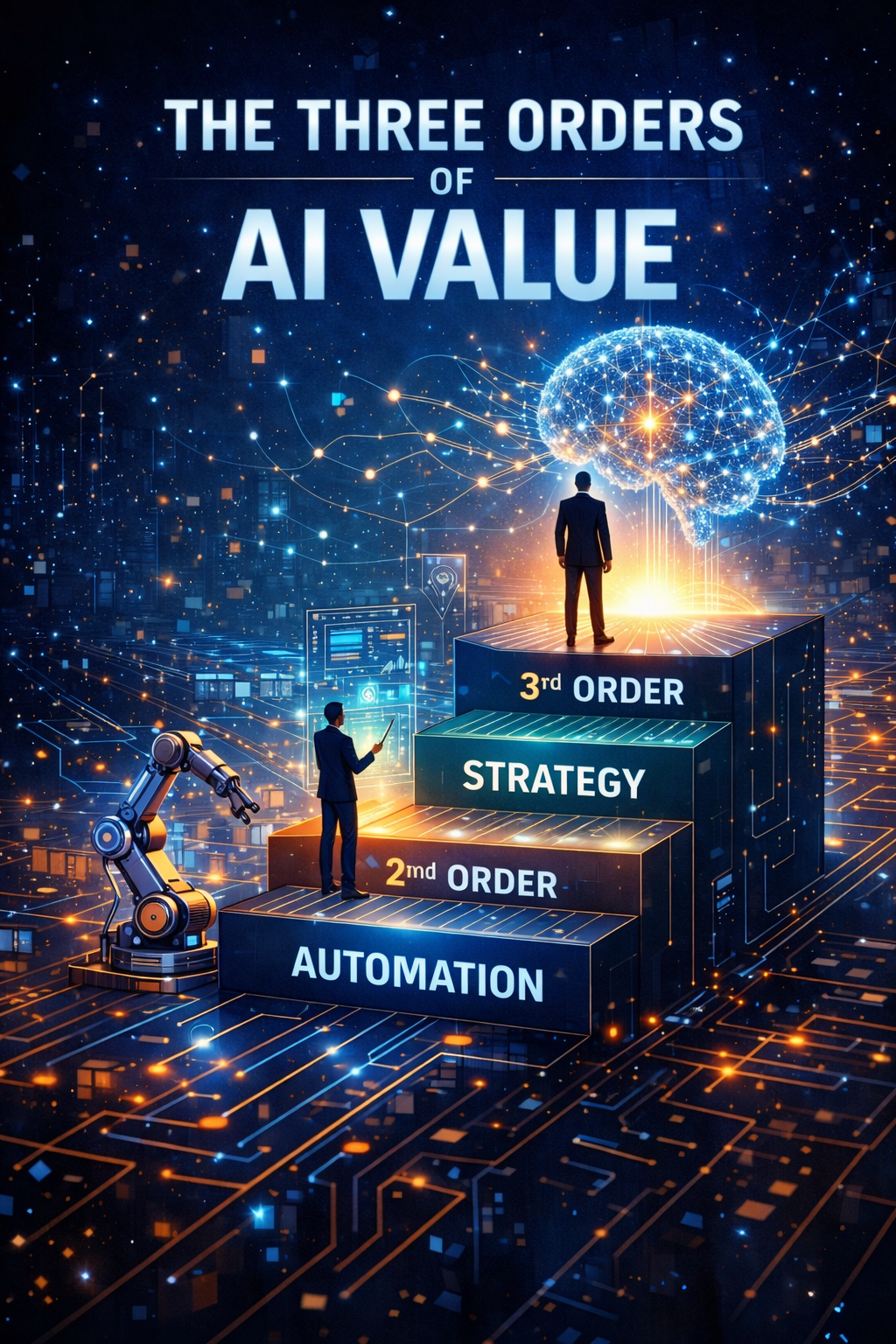
The Three Orders of AI Value
First-Order AI: Make the Existing Machine Faster
First-order AI is AI as productivity and automation.
It shows up as:
- copilots for writing, coding, and analysis
- support chatbots and agent-assisted customer service
- document summarization and knowledge search
- faster forecasting and reporting
- automated compliance checks and controls
This wave is real and valuable. McKinsey estimates generative AI could add $2.6 trillion to $4.4 trillion annually across use cases. (McKinsey & Company)
But first-order AI is not durable advantage—because everyone can buy it.
First-order AI becomes table stakes.
Second-Order AI: Embed AI Where Decisions Actually Happen
Second-order AI is where serious enterprise advantage begins.
It is not merely “AI in the enterprise.”
It is Enterprise AI—AI embedded into workflows and decision points with accountability.
Second-order AI looks like:
- exception-handling agents in finance operations
- AI-assisted underwriting and risk triage
- autonomous ticket routing and remediation in IT and infrastructure
- AI-driven pricing guardrails in commerce
- proactive fraud intervention rather than post-fact detection
Second-order AI shifts the enterprise from:
- human execution + AI advice
to - human authority + AI action (within bounded controls)
That boundary—authority vs execution—is where board oversight becomes real. When AI begins to act, “working” no longer means uptime and latency alone. “Working” includes correctness of action, policy compliance, recoverability, and safe degradation.
Third-Order AI: When Intelligence Becomes the Business
Third-order AI is the step beyond “better operations.”
It is when organizations stop asking:
“How do we apply AI?”
…and start asking:
“What new business becomes possible when intelligence is abundant, cheap, and continuously improving?”
Third-order AI businesses don’t just deploy models. They build systems that sell outcomes, judgment, coordination, and decision advantage.
A simple definition
Third-order AI = intelligence monetization at scale.
Not as a feature.
As the product.
This is why I call them intelligence-native enterprises.
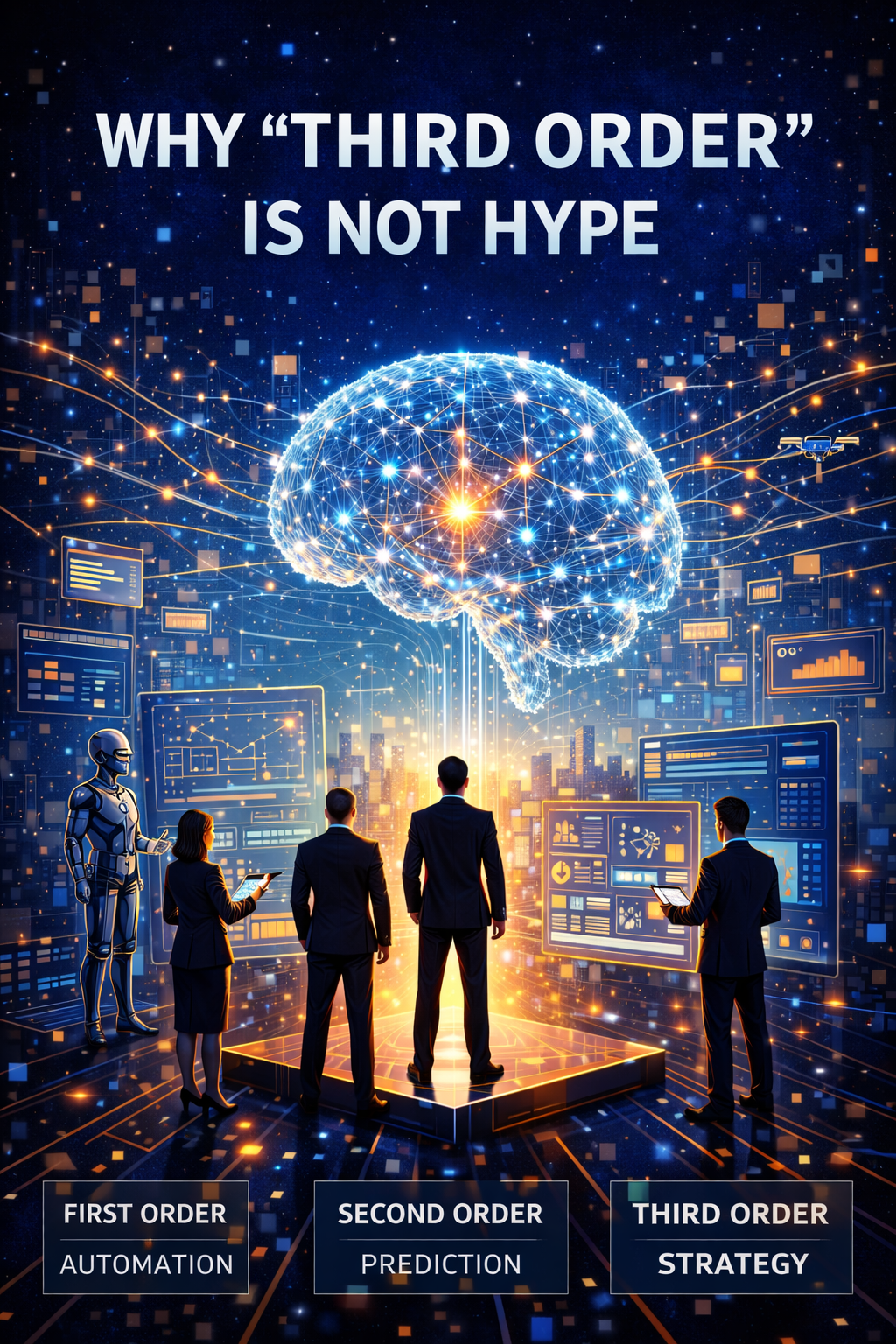
Why “Third Order” Is Not Hype
Boards are right to be skeptical of hype. So here is the clean logic:
- First order: AI reduces cost inside existing processes.
- Second order: AI changes how decisions get made inside the enterprise.
- Third order: AI changes what the enterprise is—because the enterprise begins selling intelligence directly.
That is not speculative. It is the same economic mechanism that produced internet-native coordination companies. The internet didn’t “optimize taxis.” It created a new category: dynamic, data-driven coordination at scale.
AI will do the same—this time with judgment.
One line boards should remember:
The internet monetized connectivity. AI will monetize judgment.
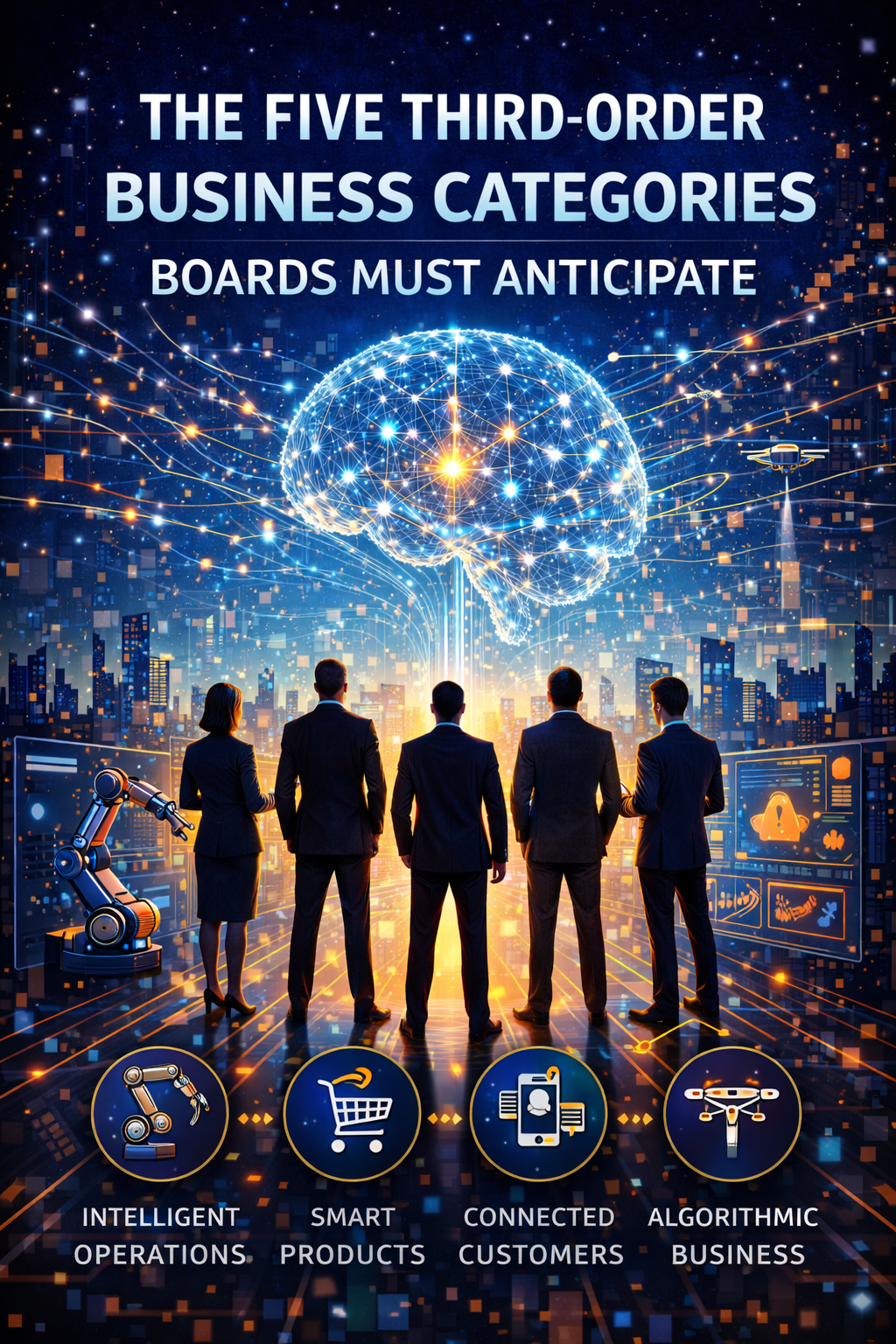
The Five Third-Order Business Categories Boards Must Anticipate
1) Decision Markets: Judgment as a Tradable Product
In many industries, the real bottleneck is not labor. It’s judgment.
Third-order firms will build marketplaces where decisions are:
- produced by AI systems
- verified by governance layers
- delivered as APIs or managed services
- continuously improved through feedback
Example (simple):
Imagine trade finance where the “product” isn’t a loan—it’s a continuously updated, AI-verified risk decision that multiple institutions subscribe to. The value is not the capital. The value is the judgment.
Boards should recognize this pattern early:
risk becomes a decision subscription.
Where this could emerge fastest:
- banking and insurance
- B2B credit networks
- procurement risk and supplier health
- cyber risk scoring and response readiness
2) Outcome-as-a-Service: You Don’t Buy Tools—You Buy Guaranteed Outcomes
In the software era, companies bought products (CRM, ERP, ticketing).
In the third-order AI economy, many will buy outcomes.
Third-order firms will sell:
- “fraud loss reduction” as a managed intelligence service
- “customer retention lift” as a continuously learning system
- “compliance readiness” as a living proof layer
- “inventory resilience” as an autonomous planning loop
This requires second-order foundations—because outcome guarantees require:
- accountability
- reversibility
- auditability
- control
That’s why third-order advantage is built on second-order discipline.
Board implication: Your best third-order moves will come from the decision loops you operationalize today.
3) Autonomous Coordination Platforms: The “Uber Pattern” of AI
Uber didn’t win because it had the internet.
It won because it turned real-time data into coordination and trust.
AI will create new “Uber-pattern” businesses in areas like:
- logistics and supply networks
- energy and grid optimization
- workforce scheduling and field service delivery
- cyber response coordination across ecosystems
The product is not the interface.
The product is dynamic orchestration.
Winners will build coordination engines that can act across many parties while preserving trust:
- clear policies
- auditable actions
- safe failover modes
- human override at critical edges
4) Intelligence Infrastructure Providers: The AWS of Autonomy
A massive third-order category will be the infrastructure that makes autonomy safe and scalable.
This includes:
- agent identity and authorization
- audit trails and decision ledgers
- policy enforcement and runtime controls
- evaluation, monitoring, and incident response for acting systems
Globally, governance bodies are emphasizing structured approaches to trustworthy AI and risk management—because the challenge is no longer “can AI work?” but “can it be controlled?” (NIST Publications)
In practice, enterprises will demand:
- proof of control
- proof of compliance
- proof of safe degradation
Third-order winners will productize these layers.
Board signal: When “trust infrastructure” becomes a procurement requirement—your category is already shifting.
5) Agent Economies: A Marketplace of Autonomous Work
As agents mature, they will:
- negotiate
- schedule
- coordinate
- purchase
- execute tasks within policy boundaries
This creates an agent economy:
- agents acting on behalf of employees
- agents acting on behalf of customers
- agents acting across enterprises under agreed protocols
The biggest shift is psychological:
organizations will manage a human workforce and an agent workforce.
Boards will care because the unit of scale changes:
- from headcount
- to supervised autonomy
New productivity metric: human-to-agent ratio (and how safely it scales)
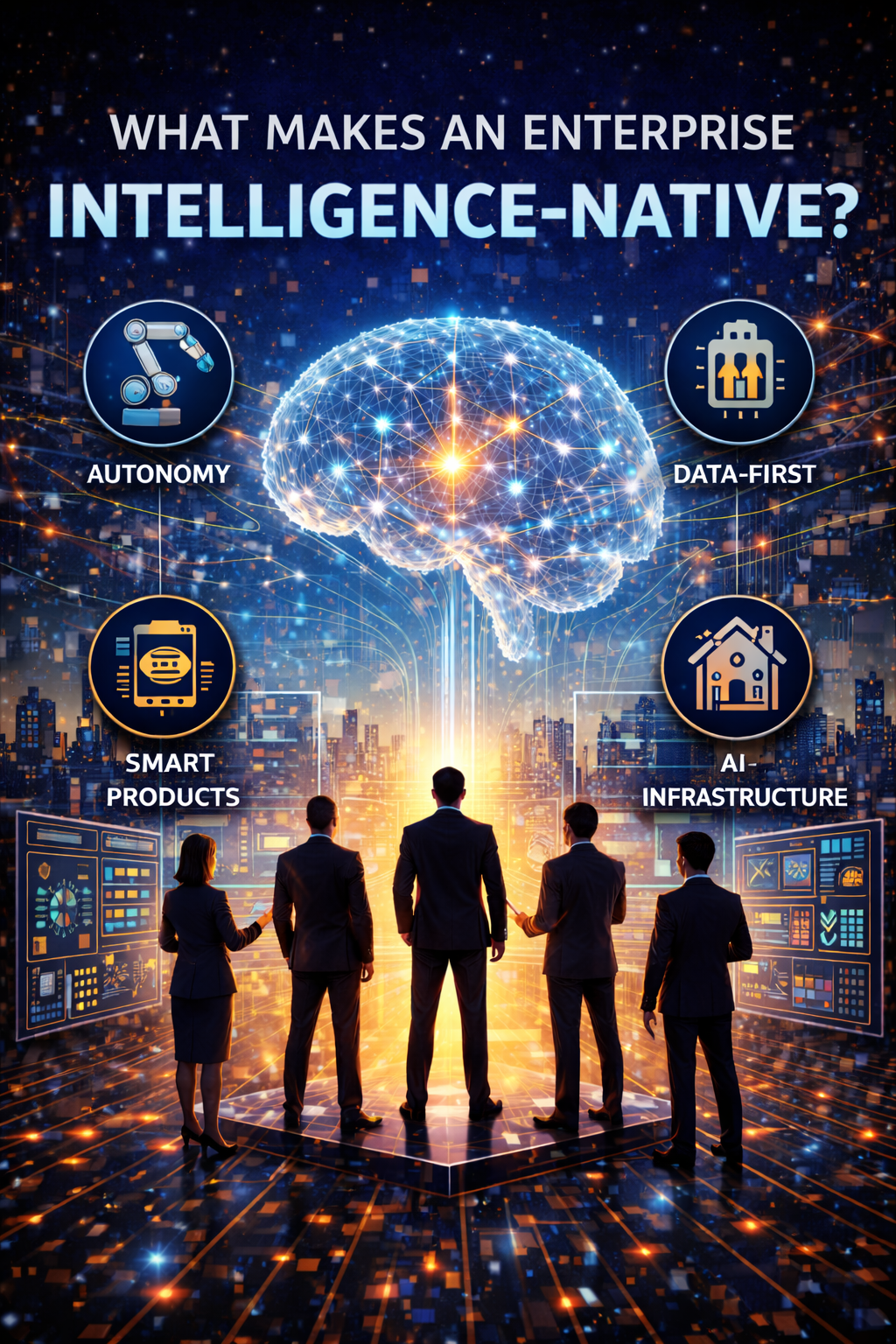
What Makes an Enterprise Intelligence-Native?
Most firms will adopt AI.
Few will become intelligence-native.
An intelligence-native enterprise has four traits:
1) Intelligence is treated as a board-governed strategic asset
Not literally as an accounting line item—but as a capability leadership allocates, measures, and compounds.
This is the mindset behind intelligence capital: the asset class boards must invest in.
2) The enterprise has a “decision operating system”
Decision flows are mapped, measured, governed, and continuously improved.
Without this, AI becomes scattered automation. With it, AI becomes compounding advantage.
3) Autonomy is bounded, reversible, and auditable
Autonomy without reversibility is fragility.
Autonomy without auditability is reputational risk.
Frameworks like NIST’s AI RMF consistently emphasize trustworthiness characteristics and lifecycle risk management because AI systems are socio-technical and high-impact. (NIST Publications)
4) The company learns faster than the market changes
This is the core advantage in the intelligence decade:
learning velocity becomes competitive advantage.
The Board’s Real Job in the Third-Order AI Economy
Boards do not need to become technical.
Boards need to become structural.
1) Govern where autonomy is allowed
Not “is AI allowed?”
But: where can AI act, and under what constraints?
2) Allocate capital to compounding intelligence
Not as scattered pilots.
As an enterprise capability stack that improves deployment speed, safety, and reuse over time.
3) Spot category creation early
Third-order winners won’t look like today’s competitors.
They will look like new category firms building decision markets, outcome engines, and coordination platforms.
Signals Boards Should Watch Globally
If you want a calm, confident posture, watch signals—not hype cycles.
Signal 1: From chatbots to agents that act
When AI moves from recommendation to execution, the stakes change.
Signal 2: Trust infrastructure becomes mandatory
Proof-oriented governance, assurance, and continuous evidence layers will become normal—especially as regulators and policy groups accelerate their focus on generative AI governance. (World Economic Forum)
Signal 3: Outcome pricing replaces software pricing
Vendors stop selling licenses and start selling performance.
Signal 4: Reuse beats novelty
The most valuable capability becomes repeatable deployment—not one brilliant model.
A Practical Board Playbook: How to Win Without Panic
Here is the third-order strategy in a board-friendly sequence.
Step 1: Name your “decision engines”
Pick 5–10 decisions that drive disproportionate value:
- pricing
- risk approvals
- fraud interventions
- supply allocation
- retention offers
- credit exceptions
- incident response actions
Step 2: Separate authority from execution
Humans keep authority.
AI gains bounded execution.
This reduces fear and increases scale.
Step 3: Build the minimum viable control layer
Before autonomy scales:
- logging and traceability
- evaluation and quality gates
- escalation paths
- rollback and reversibility
- policy boundaries
Step 4: Productize intelligence internally
Treat successful decision loops as reusable services—an internal “catalog of intelligence.”
Step 5: Look for intelligence monetization
Now ask the third-order question:
Which of our decision capabilities could become a product for others?
That is the doorway into third-order business creation.
Intelligence-Native Enterprise Doctrine
If a board member wants the full operating doctrine behind third-order AI, here is the guided path:
- Start here (core doctrine): The Enterprise AI Operating Model
https://www.raktimsingh.com/enterprise-ai-operating-model/ - Why advantage shifts from models to reuse: The Intelligence Reuse Index
https://www.raktimsingh.com/intelligence-reuse-index-enterprise-ai-fabric/ - Why production AI breaks without discipline: The Enterprise AI Runbook Crisis
https://www.raktimsingh.com/enterprise-ai-runbook-crisis-model-churn-production-ai/ - Who should own enterprise AI (accountability and decision rights):
https://www.raktimsingh.com/who-owns-enterprise-ai-roles-accountability-decision-rights/ - Board-level value framing (why this matters now): What Is the AI Dividend?
https://www.raktimsingh.com/ai-dividend-boards-structural-gains/ - Growth lens (how AI shifts planning from averages to precision):
https://www.raktimsingh.com/precision-growth-end-of-averages-enterprise-ai/ - Macro shift (India + global services reinvention):
https://www.raktimsingh.com/from-labor-arbitrage-to-intelligence-arbitrage-why-indian-its-ai-reinvention-will-define-the-next-decade/
Institutional Perspectives on Enterprise AI
Many of the structural ideas discussed here — intelligence-native operating models, control planes, decision integrity, and accountable autonomy — have also been explored in my institutional perspectives published via Infosys’ Emerging Technology Solutions platform.
For readers seeking deeper operational detail, I have written extensively on:
- What Makes an Enterprise Intelligence-Native? The Blueprint for Third-Order AI Advantage
https://blogs.infosys.com/emerging-technology-solutions/artificial-intelligence/what-is-enterprise-ai-the-operating-model-for-compounding-institutional-intelligence.html - Why “AI in the Enterprise” Is Not Enterprise AI: The Operating Model Difference Most Organizations Miss
https://blogs.infosys.com/emerging-technology-solutions/artificial-intelligence/why-ai-in-the-enterprise-is-not-enterprise-ai-the-operating-model-difference-that-most-organizations-miss.html - The Enterprise AI Control Plane: Governing Autonomy at Scale
https://blogs.infosys.com/emerging-technology-solutions/artificial-intelligence/the-enterprise-ai-control-plane-governing-autonomy-at-scale.html - Enterprise AI Ownership Framework: Who Is Accountable, Who Decides, and Who Stops AI in Production
https://blogs.infosys.com/emerging-technology-solutions/artificial-intelligence/enterprise-ai-ownership-framework-who-is-accountable-who-decides-and-who-stops-ai-in-production.html - Decision Integrity: Why Model Accuracy Is Not Enough in Enterprise AI
https://blogs.infosys.com/emerging-technology-solutions/artificial-intelligence/decision-integrity-why-model-accuracy-is-not-enough-in-enterprise-ai.html - Agent Incident Response Playbook: Operating Autonomous AI Systems Safely at Enterprise Scale
https://blogs.infosys.com/emerging-technology-solutions/artificial-intelligence/agent-incident-response-playbook-operating-autonomous-ai-systems-safely-at-enterprise-scale.html - The Economics of Enterprise AI: Designing Cost, Control, and Value as One System
https://blogs.infosys.com/emerging-technology-solutions/artificial-intelligence/the-economics-of-enterprise-ai-designing-cost-control-and-value-as-one-system.html
Together, these perspectives outline a unified view: Enterprise AI is not a collection of tools. It is a governed operating system for institutional intelligence — where economics, accountability, control, and decision integrity function as a coherent architecture.
The Optimistic Truth About the AI Decade
AI is not only a productivity wave.
It is a category creation wave.
In the internet era, value shifted toward companies that mastered connectivity and coordination.
In the AI era, value will shift toward companies that master:
- judgment at scale
- safe autonomy
- decision economics
- trust infrastructure
- outcome delivery
This is not a scary story.
It is an invitation for boards to lead.
Because in the third-order AI economy, the advantage won’t go to the loudest companies.
It will go to the companies that quietly build the operating model for intelligence—and then use it to create businesses that didn’t exist before.
Conclusion: The Board-Level Doctrine for Third-Order Advantage
If you remember only one thing, remember this:
First-order AI makes work cheaper.
Second-order AI makes decisions better.
Third-order AI makes new businesses possible.
The winners of the next decade will not be the enterprises that “adopt AI.”
They will be the enterprises that become intelligence-native—and then monetize that capability into new categories.
That is how competitive advantage will be redefined.
And that is how boards will “win with AI”: not by chasing tools, but by redesigning the enterprise to compound intelligence—until intelligence becomes the business.
FAQ
What is the third-order AI economy?
The third-order AI economy is the phase where companies move beyond efficiency and workflow improvement and begin building new businesses where intelligence itself is the product—decision advantage, autonomous coordination, and outcome delivery.
How is third-order AI different from enterprise AI?
Enterprise AI (second-order) embeds AI into workflows and decisions inside a company. Third-order AI monetizes those intelligence capabilities externally, creating new categories and revenue models.
What should boards do first?
Boards should identify high-impact decisions, define where AI can act safely, and fund control layers that make autonomy measurable, auditable, and reversible.
Will third-order AI replace existing industries?
It will reshape profit pools and create new category leaders—similar to how the internet created platform and coordination businesses. The winners will be those who redesign early for intelligence.
What global signals indicate third-order AI is arriving?
Look for (1) agents that act, not just chatbots, (2) trust infrastructure as a procurement mandate, (3) outcome-based commercial models, and (4) repeatable reuse beating one-off innovation.
What is an intelligence-native enterprise?
An intelligence-native enterprise is an organization where AI is embedded directly into decision-making workflows, governance systems, and operating models—not merely deployed as a productivity tool.
How is Third-Order AI different from automation?
First-order AI automates tasks.
Second-order AI improves decisions.
Third-order AI reshapes the business model itself, creating new categories of revenue and competitive advantage.
Why should boards care about intelligence-native design?
Because competitive advantage in the AI decade will be determined by decision velocity, governance maturity, and intelligence compounding—not tool adoption.
Is becoming intelligence-native a technology project?
No. It is an operating model redesign that spans governance, capital allocation, risk management, and institutional learning.
Glossary
- Intelligence-Native Enterprise: A company designed to treat intelligence as a core operating capability, not a tool.
- Decision Markets: Markets where validated decisions (risk, pricing, approvals) are sold as products or services.
- Outcome-as-a-Service: Commercial models where customers pay for performance outcomes delivered by continuously learning systems.
- Autonomous Coordination: AI systems that orchestrate multi-party actions across workflows, tools, and organizations.
- Trust Infrastructure: Governance, monitoring, auditability, and control mechanisms that make AI safe at scale.
- Bounded Autonomy: Autonomy constrained by policy, auditability, escalation, and reversibility.
- Learning Velocity: The speed at which an enterprise improves decisions and adapts faster than its market changes.
References and Further Reading
- McKinsey Global Institute / McKinsey Digital: The economic potential of generative AI (value estimate range). (McKinsey & Company)
- NIST: AI Risk Management Framework (AI RMF 1.0) (trustworthy AI and risk framing). (NIST Publications)
- World Economic Forum: Governance in the Age of Generative AI (governance signals and policy momentum). (World Economic Forum)



Raktim Singh is an AI and deep-tech strategist, TEDx speaker, and author focused on helping enterprises navigate the next era of intelligent systems. With experience spanning AI, fintech, quantum computing, and digital transformation, he simplifies complex technology for leaders and builds frameworks that drive responsible, scalable adoption.