
Winning the Intelligence Decade: A Board-Level Doctrine for Institutional Advantage
Artificial intelligence is not another technology cycle. It marks the beginning of the Intelligence Decade—an era in which competitive advantage shifts from labor scale to decision scale.
The institutions that win will not simply automate tasks. They will redesign how decisions are produced, executed, governed, and improved.
Board-Level AI Strategy for the Intelligence Decade
Artificial intelligence is no longer “a technology initiative.” It marks the start of an economic era in which institutional advantage shifts from labor scale to decision scale—the ability to sense change, decide correctly, execute safely, and learn faster than competitors.
Boards that treat AI as a productivity tool will capture short-term efficiency gains—but miss the bigger prize: compounding institutional intelligence. Boards that treat AI as an operating capability will unlock new value pools, new revenue categories, and a more adaptive enterprise.
This article offers a board-level doctrine—simple, actionable, and designed for leaders who want confidence, not fear.
It explains why value migrates before it is created, what intelligence capital really means, why governance must become enabling rather than defensive, and what boards should change, preserve, and monitor—starting this quarter.
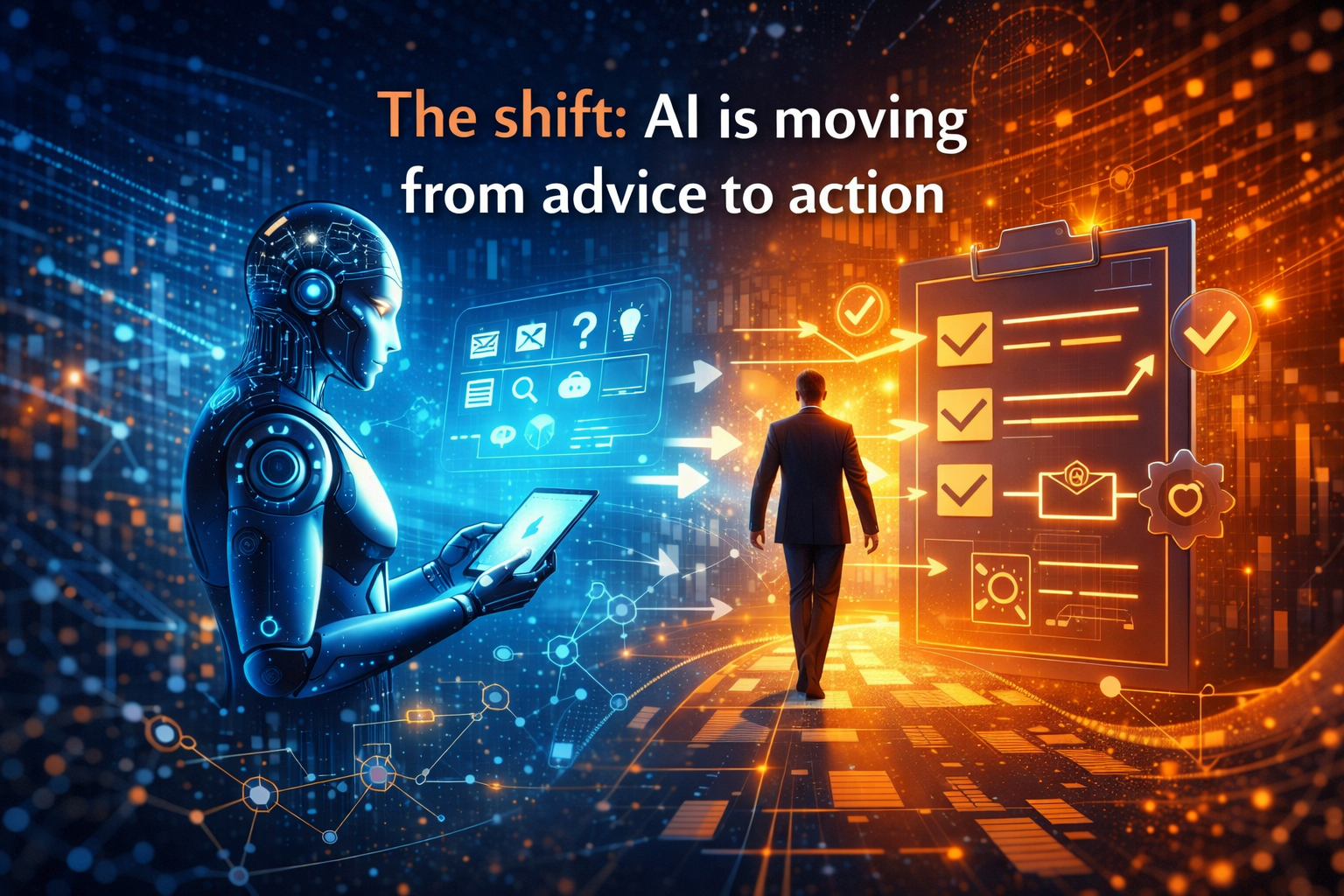
The shift: AI is moving from advice to action
Most enterprises can honestly claim they “use AI.” Teams use assistants to draft messages, summarize meetings, generate code, and accelerate research. Many business functions use machine learning for forecasting, fraud detection, personalization, and recommendations.
But that is not the defining shift of this decade.
The defining shift is this:
AI is moving from advising humans to acting inside workflows.
When AI can open a ticket, route it, draft a customer response, approve an exception, update a record, trigger downstream actions, or coordinate multiple systems, the organization itself becomes part of the operating equation. That changes what boards must oversee.
Because once AI acts, success is no longer only “accuracy.” Success becomes:
- correctness of action
- policy compliance
- recoverability when wrong
- auditability of why it acted
- cost discipline as usage scales
- continuity and safety over time
This is why the Intelligence Decade is not about adopting tools. It is about redesigning institutions so intelligence compounds safely.
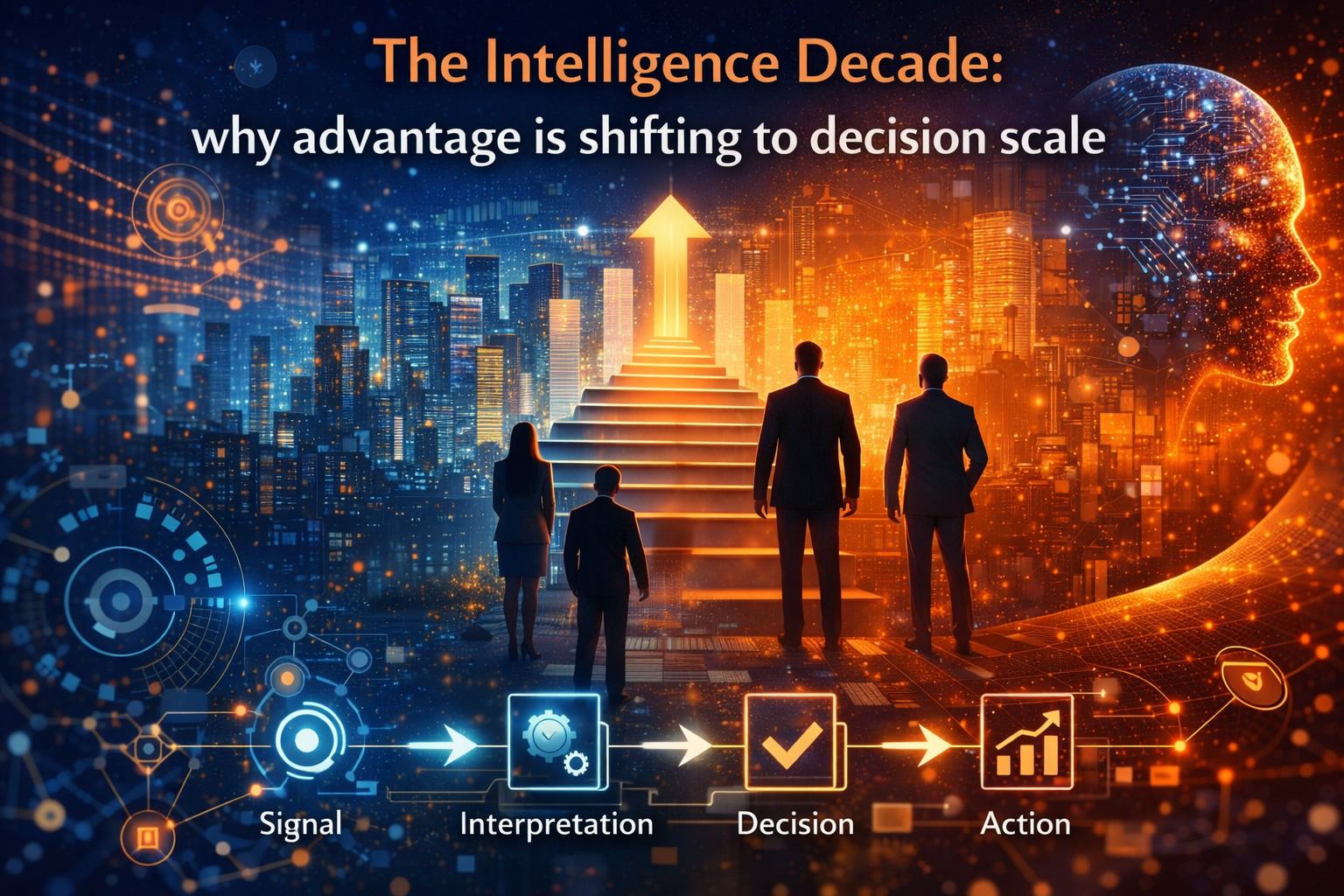
The Intelligence Decade: why advantage is shifting to decision scale
For a long time, enterprises competed on:
- access to capital
- labor scale and operating leverage
- efficiency and process maturity
- distribution and brand reach
In the AI decade, the unit of advantage shifts to something more fundamental:
Decision scale: the ability to make more high-quality decisions per unit time, with high integrity, at low marginal cost.
Decision scale is not “faster meetings.” It is a compressed decision loop:
Signal → Interpretation → Decision → Action → Outcome → Learning
AI can accelerate every stage of this loop—if the enterprise is designed to absorb it. If not, the organization becomes the bottleneck. AI may produce insights, but the institution cannot convert them into outcomes reliably.
This is the core message boards need to internalize: AI is not simply a technology bet; it is an operating capability boards must own. (See The Enterprise AI Operating Model here: https://www.raktimsingh.com/enterprise-ai-operating-model/)
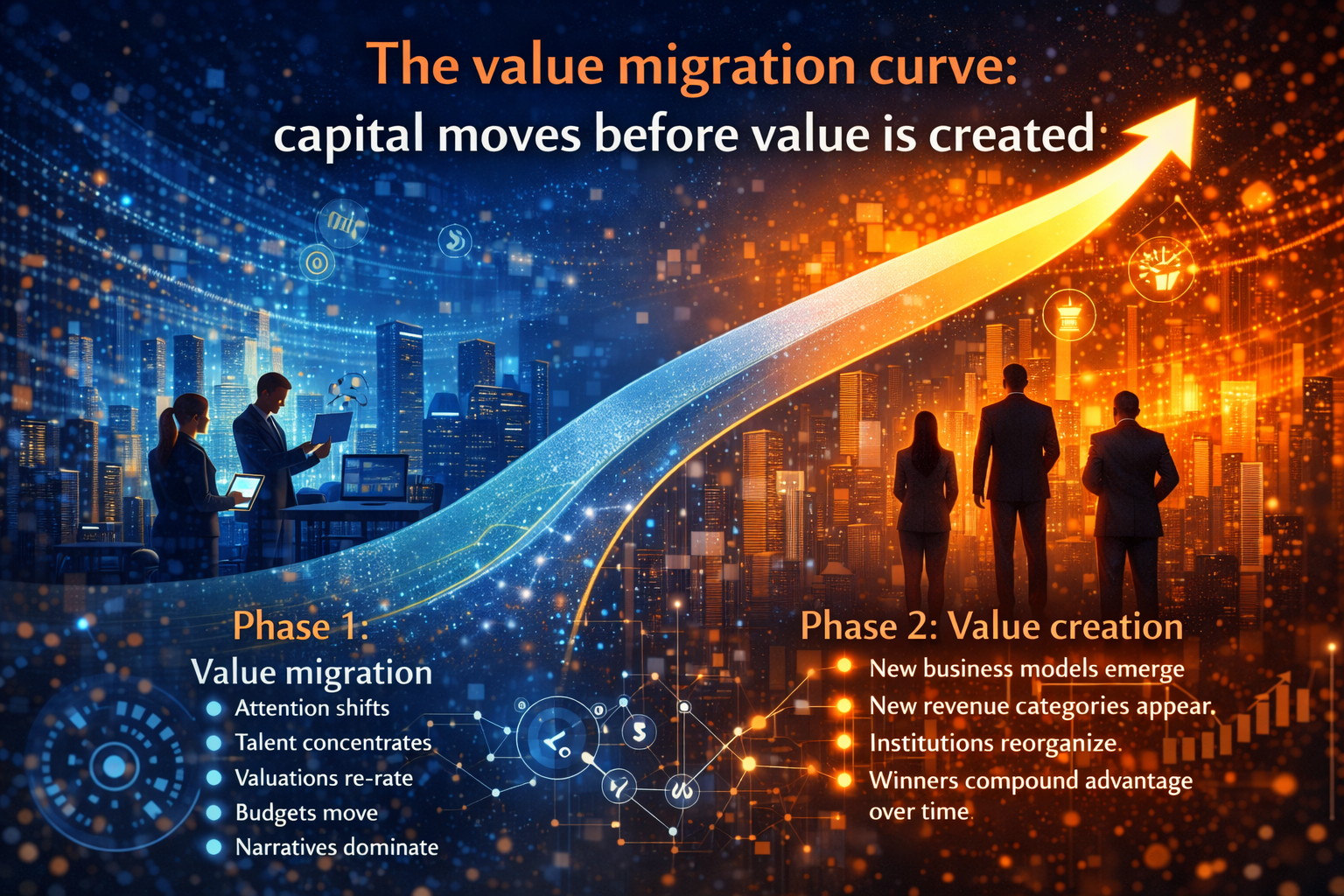
The value migration curve: capital moves before value is created
Every major technology disruption follows a pattern:
Phase 1: Value migration
- attention shifts
- talent concentrates
- valuations re-rate
- budgets move
- narratives dominate
During this phase, the environment feels noisy: many experiments, many vendors, many pilots, and uneven outcomes.
Phase 2: Value creation
- new business models emerge
- new revenue categories appear
- institutions reorganize
- winners compound advantage over time
Boards often make one mistake: they judge a disruption only through the lens of Phase 1 outcomes. If they do, they reduce AI to “automation and productivity.”
But the decisive question is:
What will your organization look like when AI becomes a durable operating capability—embedded in how decisions are made, executed, and improved?
Value creation is where the generational advantage is built.
The doctrine for the Intelligence Decade is simple:
- Phase 1: Build foundations.
- Phase 2: Compound intelligence into new value pools.
For a deeper board-level framing of this dynamic, you may also explore: The AI Value Migration Curve The AI Value Migration Curve: Why Capital Moves Before Value Is Created — And How Boards Can Win the Creation Phase – Raktim Singh.
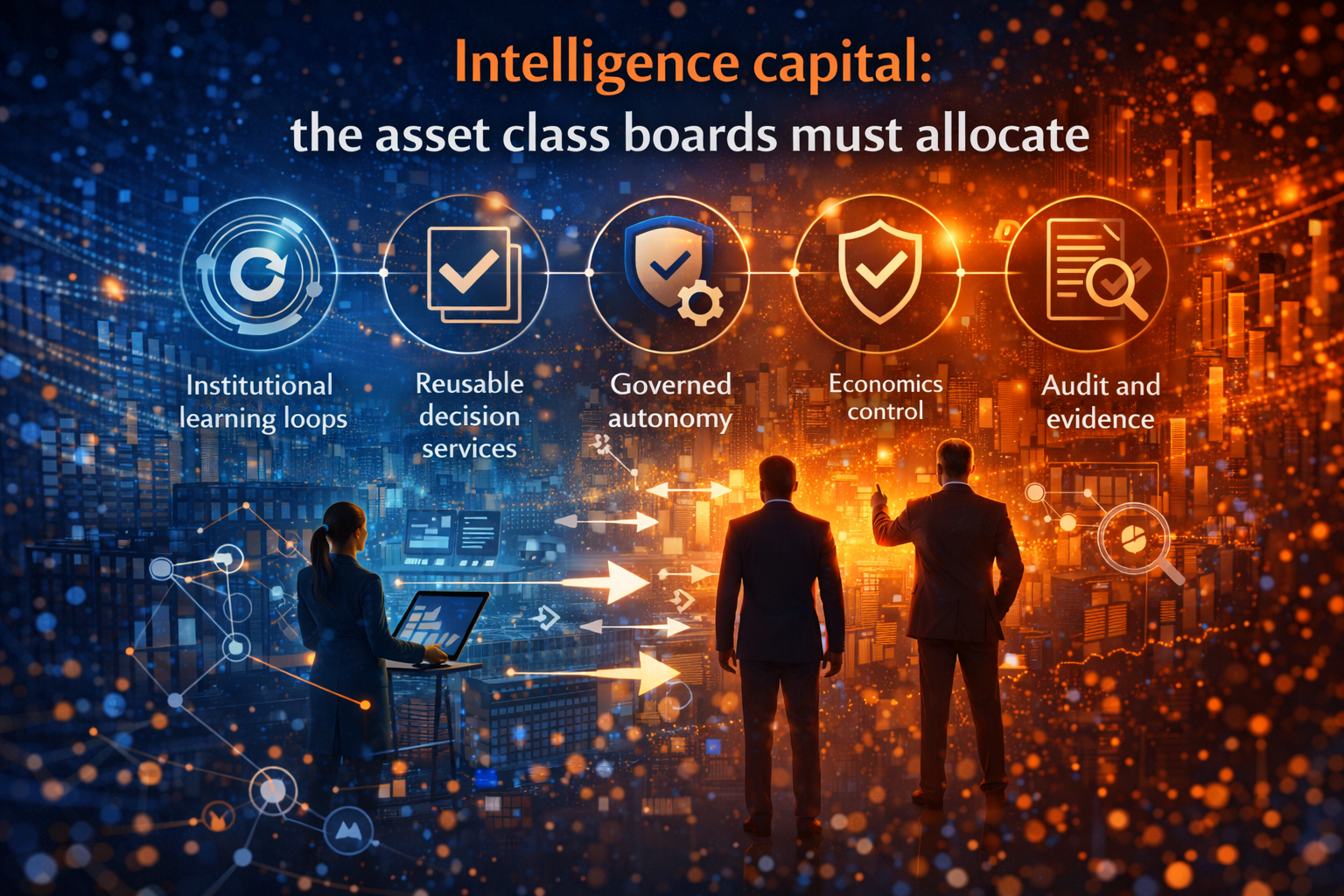
Intelligence capital: the asset class boards must allocate
Boards understand capital allocation. They approve investments in plants, platforms, acquisitions, brand, and talent.
In the Intelligence Decade, boards must treat intelligence capital as a real asset class.
Intelligence capital is not “owning models.” Models are increasingly available. Advantage comes from how an enterprise turns intelligence into outcomes repeatedly.
Intelligence capital includes:
- institutional learning loops (how quickly you learn from outcomes)
- reusable decision services (decisions that can be deployed across the enterprise)
- governed autonomy (clear boundaries for what AI can do)
- data-to-decision pipelines (a clean path from signal to action)
- economic control (preventing runaway costs as AI scales)
- audit and evidence (the ability to show why a decision happened)
A simple example
Two companies deploy AI in customer operations.
- Company A uses AI to draft responses. Each team does it differently. There is no shared playbook, no standard risk checks, and no consistent evidence trail.
- Company B turns “response drafting” into a reusable decision service—policy-aware, quality-tested, and continuously improved with feedback.
Company A gets productivity.
Company B gets compounding advantage.
Boards should push the organization toward Company B.
This is the practical meaning of intelligence capital—and it connects directly to my thesis on Decision Scale: https://www.raktimsingh.com/decision-scale-competitive-advantage-ai/
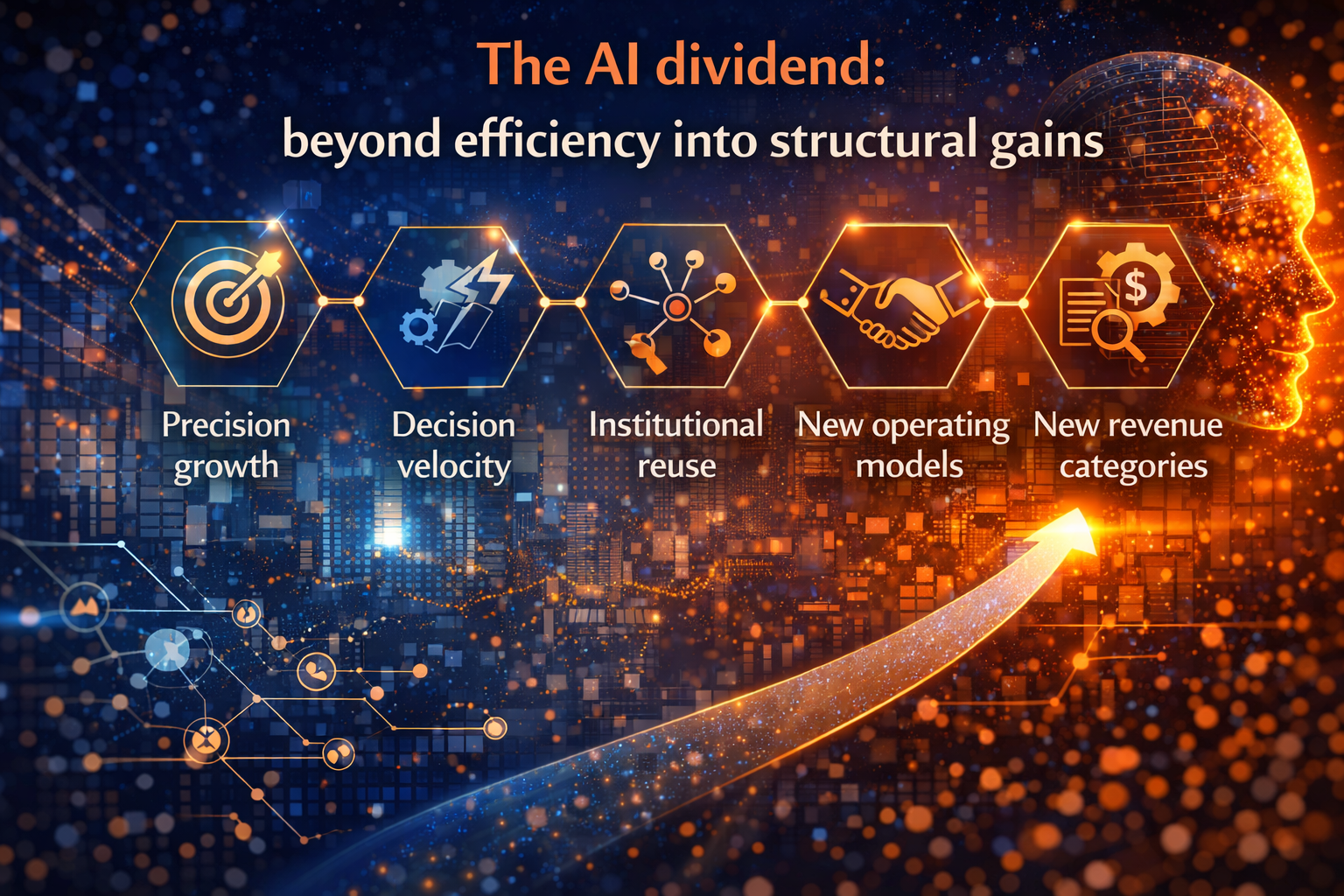
The AI dividend: beyond efficiency into structural gains
The first wave of AI benefits is obvious:
- productivity improvements
- cycle-time reduction
- fewer manual steps
- better search and summarization
These gains matter. But they become table stakes.
The AI dividend—the durable competitive gain—comes from structural changes such as:
1) Precision growth
Better targeting, better pricing, better retention, better conversion—driven by faster learning loops. The End of Averages: Why Precision Growth Will Define the Next Decade of Enterprise Strategy – Raktim Singh
2) Decision velocity
Faster detection and response to changing conditions, without sacrificing decision integrity.
3) Institutional reuse
Capabilities are built once and reused across products, functions, and geographies.
4) New operating models
Work is redesigned around human judgment plus machine execution, rather than manual process chains.
5) New revenue categories
Enterprises monetize decisions, not just products.
Boards should ask: Are we optimizing tasks—or redesigning the system?
If you want a companion lens that boards find intuitive, see: What Is the AI Dividend? https://www.raktimsingh.com/ai-dividend-boards-structural-gains/
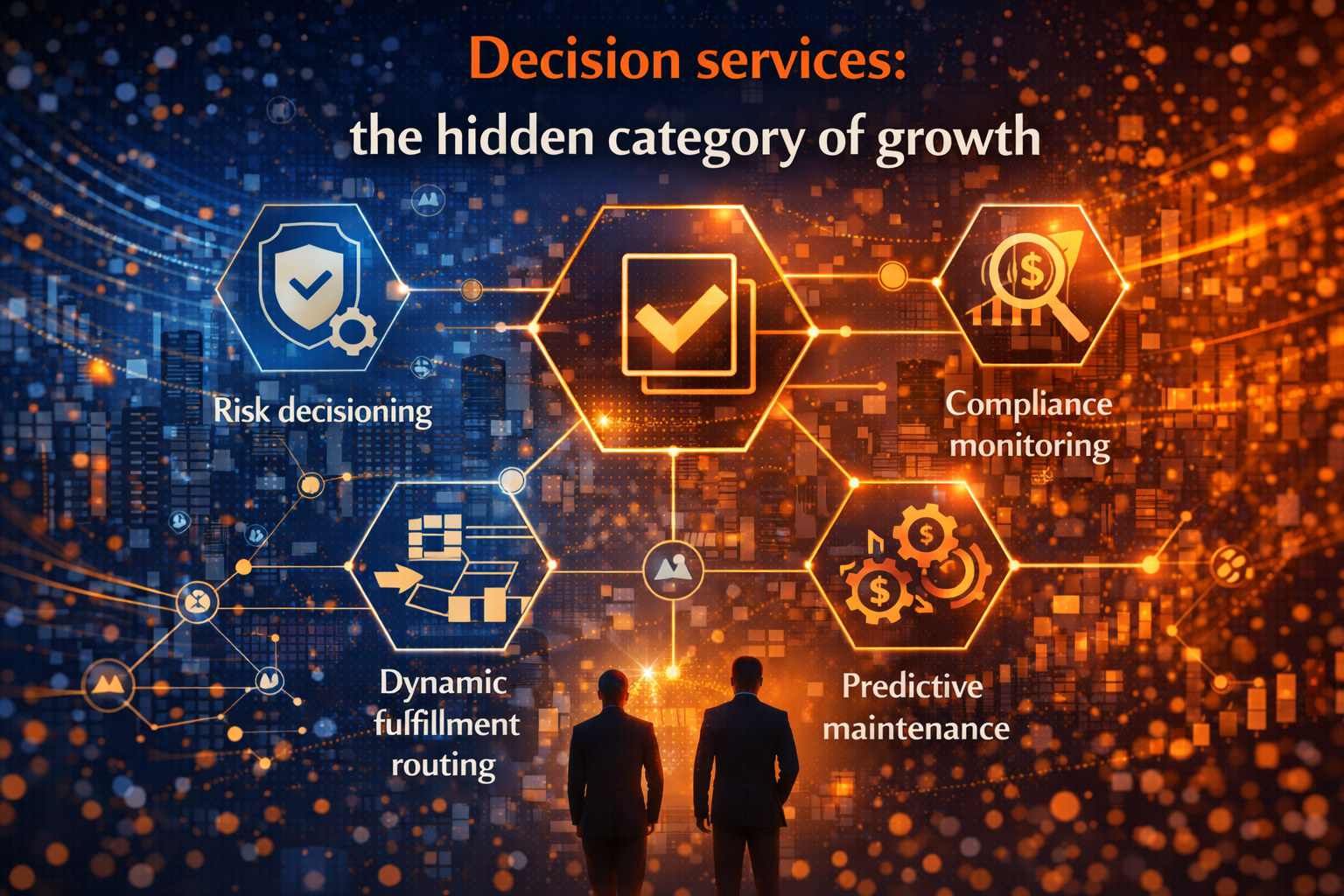
Decision services: the hidden category of growth
Most board conversations about AI stay trapped in a cost reduction frame. The bigger opportunity is revenue and strategic expansion.
AI allows enterprises to productize decisions into services.
A decision service is a repeatable capability that:
- ingests signals
- applies policy and constraints
- produces an action or recommendation
- is monitored and improved over time
- can be offered internally or externally
Examples:
- risk decisioning as a managed service for partners
- dynamic fulfillment routing as a capability sold to ecosystem participants
- compliance monitoring as an always-on service layer
- predictive maintenance insights packaged into a subscription
- personalized advisory embedded into customer journeys
This is how the value creation phase begins: decisions become monetizable assets.
Board-level question: Which decisions in our value chain could become reusable services—and eventually products?
If your board can answer this clearly, you are already ahead.
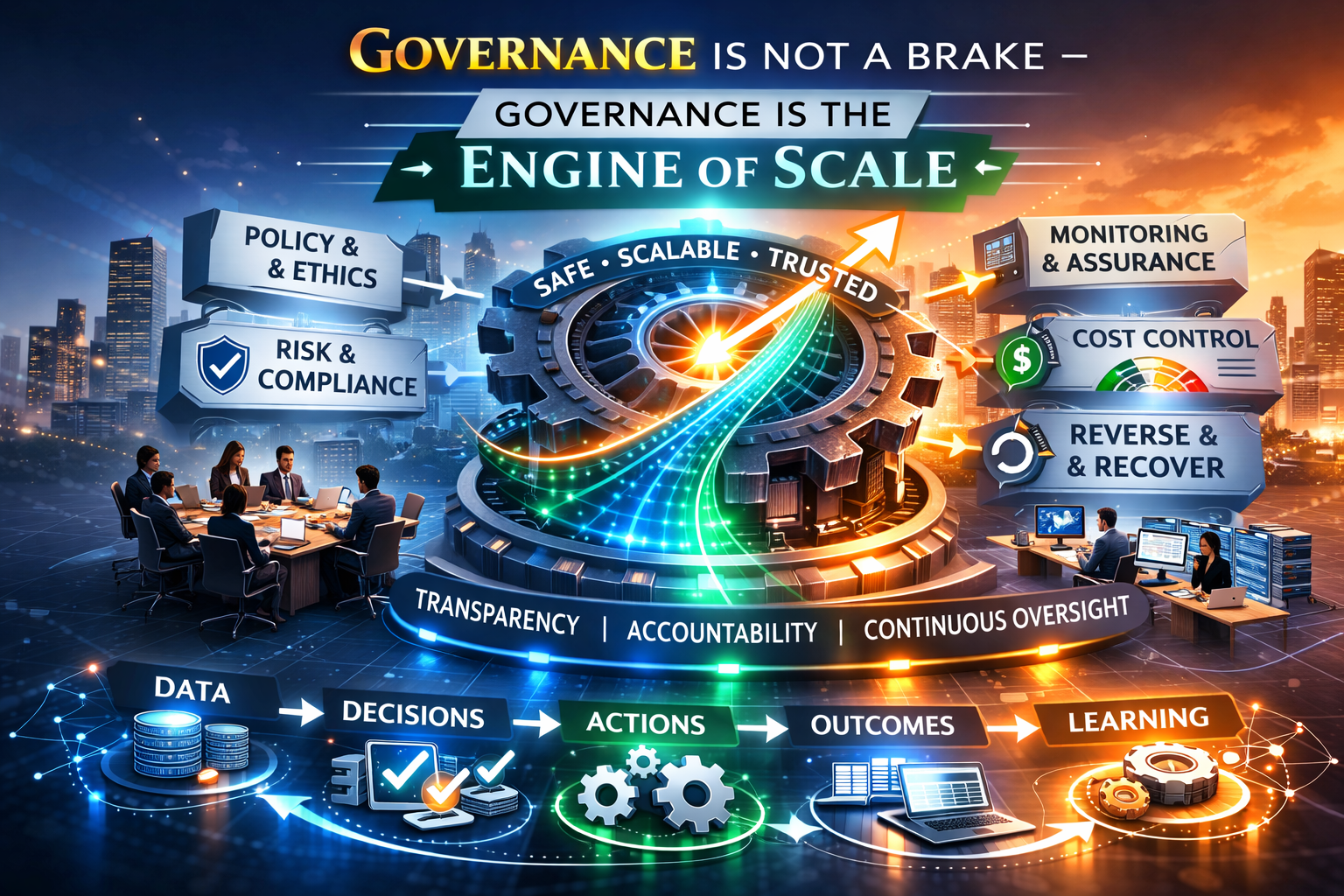
Governance is not a brake—governance is the engine of scale
Many leaders assume governance slows innovation. That can be true for old governance: periodic reviews, static checklists, and approvals far removed from production reality.
In the Intelligence Decade, governance must evolve into assurance—continuous proof of control over AI in production.
Why? Because AI that acts creates new failure modes:
- It can be correct in output but wrong in action.
- It can follow an instruction that violates policy.
- It can drift over time as context changes.
- It can trigger cascading downstream effects.
- It can become expensive at scale even when “successful.”
Governance should not be framed only as “risk management.” It should be framed as:
the enabling operating layer that makes autonomy safe, scalable, and repeatable.
Boards should insist on a few non-negotiables:
- clear authority boundaries (what AI may do vs. may suggest)
- reversibility for high-impact actions (safe rollback paths)
- evidence trails (why it decided, what it used, what it triggered)
- incident response (how failures are contained and learned from)
- economics controls (budget guardrails and cost observability)
This is how autonomy scales without losing trust.
For ownership clarity that boards need early, see: Who Owns Enterprise AI? https://www.raktimsingh.com/who-owns-enterprise-ai-roles-accountability-decision-rights/
What boards must redesign (and what they must preserve)
Redesign 1: Decision ownership and accountability
When AI acts, accountability must follow authority.
Boards should push for clarity:
- Who owns the decision?
- Who owns the policy?
- Who owns the runtime behavior?
- Who owns the outcomes?
If ownership is fragmented, autonomy becomes unsafe and political.
Redesign 2: The operating model for AI
AI cannot remain scattered across pilots. Boards should ask for an enterprise operating model that covers:
- build discipline (how AI is designed and tested)
- runtime discipline (how AI runs in production safely)
- governance discipline (how control is proven continuously)
- economics discipline (how costs are managed as usage scales)
This is exactly why my canonical anchor matters: The Enterprise AI Operating Model https://www.raktimsingh.com/enterprise-ai-operating-model/
Redesign 3: Human + AI role architecture
The goal is not replacing people. The goal is upgrading institutional capability.
Boards should encourage a simple division:
- humans own judgment, intent, and accountability
- machines execute repeatable work, monitor signals, and accelerate learning
- together they create faster, safer outcomes
Preserve 1: Trust
Trust is slow to earn and fast to lose. AI must not create a confidence gap where stakeholders cannot explain or defend decisions.
Preserve 2: Decision integrity
Speed without integrity becomes expensive. Boards should treat integrity as a strategic moat.
Preserve 3: Institutional memory
As AI accelerates work, organizations risk skill erosion. Boards should ensure the enterprise retains the ability to understand, intervene, and recover—especially for high-impact decisions.
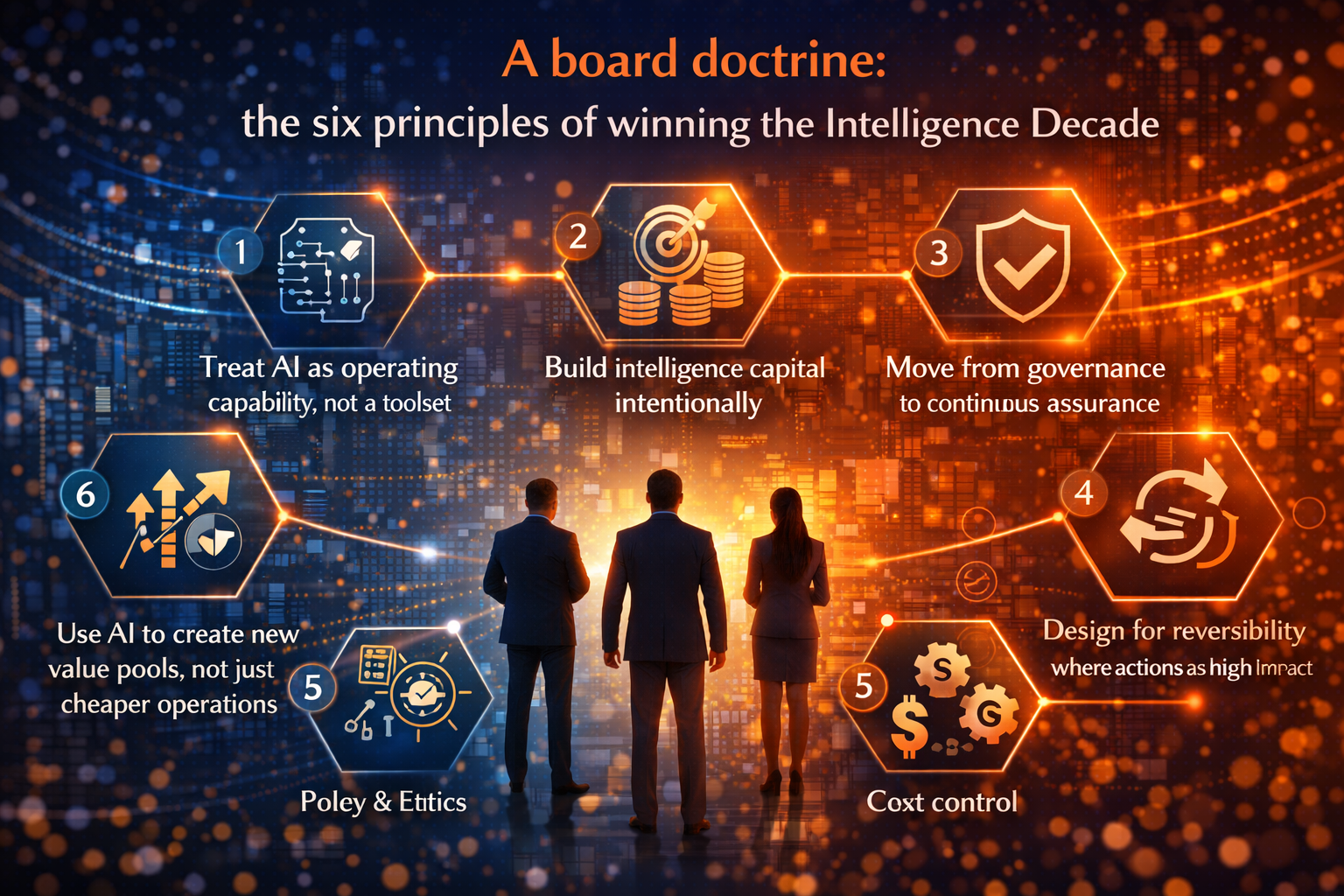
A board doctrine: the six principles of winning the Intelligence Decade
1) Treat AI as an operating capability, not a toolset
Tools produce productivity. Capabilities produce compounding advantage.
2) Build intelligence capital intentionally
Measure and invest in reuse, learning loops, and decision services.
3) Move from governance to continuous assurance
Boards need continuous proof of control, not periodic sign-offs.
4) Design for reversibility where actions are high impact
If an AI action cannot be reversed, treat it as a different class of risk.
5) Manage AI economics as a first-class discipline
Success can be expensive. Uncontrolled scaling becomes a financial leak.
6) Use AI to create new value pools, not just cheaper operations
Phase 2 winners monetize decisions and redesign experiences.
What boards should do this quarter: a practical agenda
Here are three board-level actions that create clarity fast.
1) Identify your “decision spine”
Pick 5–10 decisions that drive the most value (or the most risk). Examples: approval decisions, routing decisions, pricing decisions, exception decisions. Make them visible.
2) Classify decisions by action level
- AI advises only
- AI recommends with human approval
- AI acts with oversight
- AI acts autonomously within strict boundaries
This classification reduces ambiguity.
3) Demand a “proof of control” view
Ask for continuous evidence that AI is operating within approved boundaries:
- policy adherence
- failure containment behavior
- rollback readiness
- monitoring coverage
- cost guardrails
This is not bureaucracy. This is how autonomy scales.
If you want a concrete operational warning sign boards should watch, see: The Enterprise AI Runbook Crisis https://www.raktimsingh.com/enterprise-ai-runbook-crisis-model-churn-production-ai/
Why boards should be excited
The Intelligence Decade is not a threat story. It is an expansion story.
AI enables institutions to:
- serve customers with more precision and consistency
- reduce friction and cycle time in operations
- detect change earlier and respond intelligently
- create new categories of value by monetizing decisions
- redeploy human creativity and judgment to higher-order work
But these gains will not come automatically. They come to enterprises that redesign intentionally.
The optimistic truth is:
Boards have more agency than they think. This decade will reward institutional design.
For a broader context on institutional advantage, see: The Future Belongs to Decision-Intelligent Institutions https://www.raktimsingh.com/the-future-belongs-to-decision-intelligent-institutions/
Glossary
Intelligence Decade: An era where competitive advantage is defined by decision quality, decision speed, and institutional learning loops.
Decision scale: The ability to make more correct decisions per unit time at low marginal cost, with integrity and control.
Intelligence capital: The reusable capability of an enterprise to turn signals into outcomes repeatedly—across functions and time.
AI dividend: Structural gains from AI beyond efficiency—precision growth, new revenue categories, faster learning, and reuse.
Decision services: Productized decision capabilities that can be reused internally or monetized externally.
Continuous assurance: Ongoing proof that AI systems in production remain within control, not just periodic governance.
FAQs
Does this doctrine require massive technology replacement?
No. The winning pattern is often “wrap and modernize” rather than replacing everything. The board focus is operating capability: decision clarity, control, economics, and reuse—regardless of the underlying systems.
Is this only relevant for highly regulated industries?
No. Regulation increases urgency, but the doctrine applies broadly because AI acts and scales. Any enterprise that wants autonomy at scale needs the same fundamentals: boundaries, evidence, recovery, and economics.
How do we avoid scaring the organization with “AI risk” narratives?
Frame governance as enabling scale. The message is: “We are building safe autonomy to unlock opportunity.” Confidence comes from design.
What is the first sign we are winning?
When AI deployments become easier over time—not harder. When reuse increases, cycle time drops, and decision integrity improves together.
What is the biggest mistake boards make?
Treating AI as a collection of tools and pilots, rather than redesigning how decisions are produced, executed, and improved.
Conclusion: the doctrine in one paragraph
Winning the Intelligence Decade is not about having the most powerful AI.
It is about building the most adaptive institution—one that can convert signals into outcomes safely, repeatedly, and economically.
Boards that invest in intelligence capital, redesign decision ownership, build continuous assurance, and create decision services will capture the value creation phase after value migration.
The future will look good for organizations that treat AI as an operating capability—and design for compounding institutional advantage.
References and further reading
1️⃣ OECD AI Principles
https://oecd.ai/en/ai-principles
2️⃣ World Economic Forum – AI Governance & Responsible AI
https://www.weforum.org/agenda/archive/artificial-intelligence/
3️⃣ McKinsey Global Institute – AI & Economic Impact
https://www.mckinsey.com/mgi/our-research
4️⃣ Stanford AI Index Report
References and further reading
- The Enterprise AI Operating Model — https://www.raktimsingh.com/enterprise-ai-operating-model/
- Decision Scale — https://www.raktimsingh.com/decision-scale-competitive-advantage-ai/
- What Is the AI Dividend? — https://www.raktimsingh.com/ai-dividend-boards-structural-gains/
- The Future Belongs to Decision-Intelligent Institutions — https://www.raktimsingh.com/the-future-belongs-to-decision-intelligent-institutions/
- The Institutional Redesign of Indian IT — https://www.raktimsingh.com/institutional-redesign-indian-it-intelligence-institutions/
- Who Owns Enterprise AI? — https://www.raktimsingh.com/who-owns-enterprise-ai-roles-accountability-decision-rights/
- The Enterprise AI Runbook Crisis — https://www.raktimsingh.com/enterprise-ai-runbook-crisis-model-churn-production-ai/
- The Intelligence Reuse Index — https://www.raktimsingh.com/intelligence-reuse-index-enterprise-ai-fabric/
Raktim Singh writes on Enterprise AI, decision economics, and institutional redesign in the Intelligence Decade. His work focuses on helping boards and C-suite leaders unlock structural advantage through governed autonomy and intelligence capital.



Raktim Singh is an AI and deep-tech strategist, TEDx speaker, and author focused on helping enterprises navigate the next era of intelligent systems. With experience spanning AI, fintech, quantum computing, and digital transformation, he simplifies complex technology for leaders and builds frameworks that drive responsible, scalable adoption.