

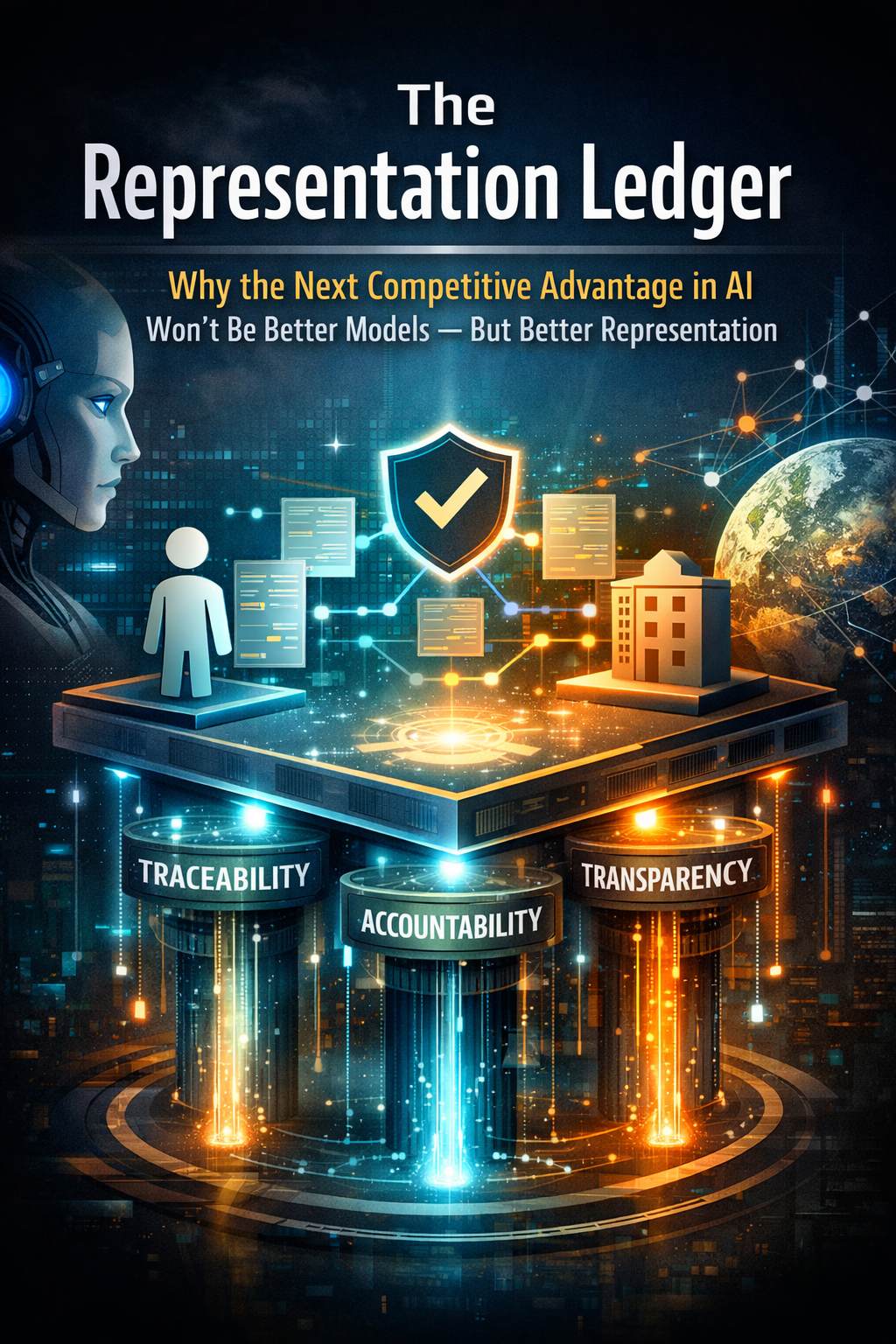
Artificial intelligence is collapsing the cost of cognition. Research, pattern recognition, optimization, and simulation — once scarce executive capabilities — are now programmable infrastructure.
Most leaders understand this shift.
What they do not yet see is what follows: when cognition becomes abundant, legitimacy becomes scarce. As AI systems move from analyzing data to acting on behalf of people, assets, and ecosystems, the strategic question changes.
It is no longer “How powerful is your model?” It is “Who does your system represent — and how can you prove it?” That proof layer is what I call the Representation Ledger.
The Representation Ledger
Artificial intelligence is collapsing the cost of cognition.
Research, pattern recognition, summarization, optimization, and simulation—capabilities that once required teams of analysts and months of meetings—are increasingly becoming programmable infrastructure.
Most boardrooms can already recite the first-order story: AI increases productivity.
A smaller number understand the second-order story: AI improves decisions—reducing risk, latency, and operational blind spots.
But the third-order story—the one that will decide market structure—starts with a different premise:
When cognition becomes abundant, the strategic bottleneck shifts to legitimacy.
And legitimacy, in the AI era, is fundamentally a question of representation:
- Who (or what) is being interpreted by AI systems?
- Which signals define that interpretation?
- Who authorized it—and for what purpose?
- What assumptions are embedded in it?
- Who can contest it?
- What happens when it is wrong?
As AI systems move from analysis to action—triggering workflows, adjusting eligibility, allocating resources, enforcing policies, executing transactions—representation stops being descriptive.
It becomes consequential.
And consequential representation without infrastructure becomes institutional risk: trust failure, governance failure, and eventually market failure.
That is why organizations need a new layer of architecture:
The Representation Ledger — a system-of-record that makes AI representation traceable, legitimate, contestable, and improvable.
This is not a compliance artifact.
It is becoming a competitive advantage—because it determines who can be trusted with delegated action at scale.
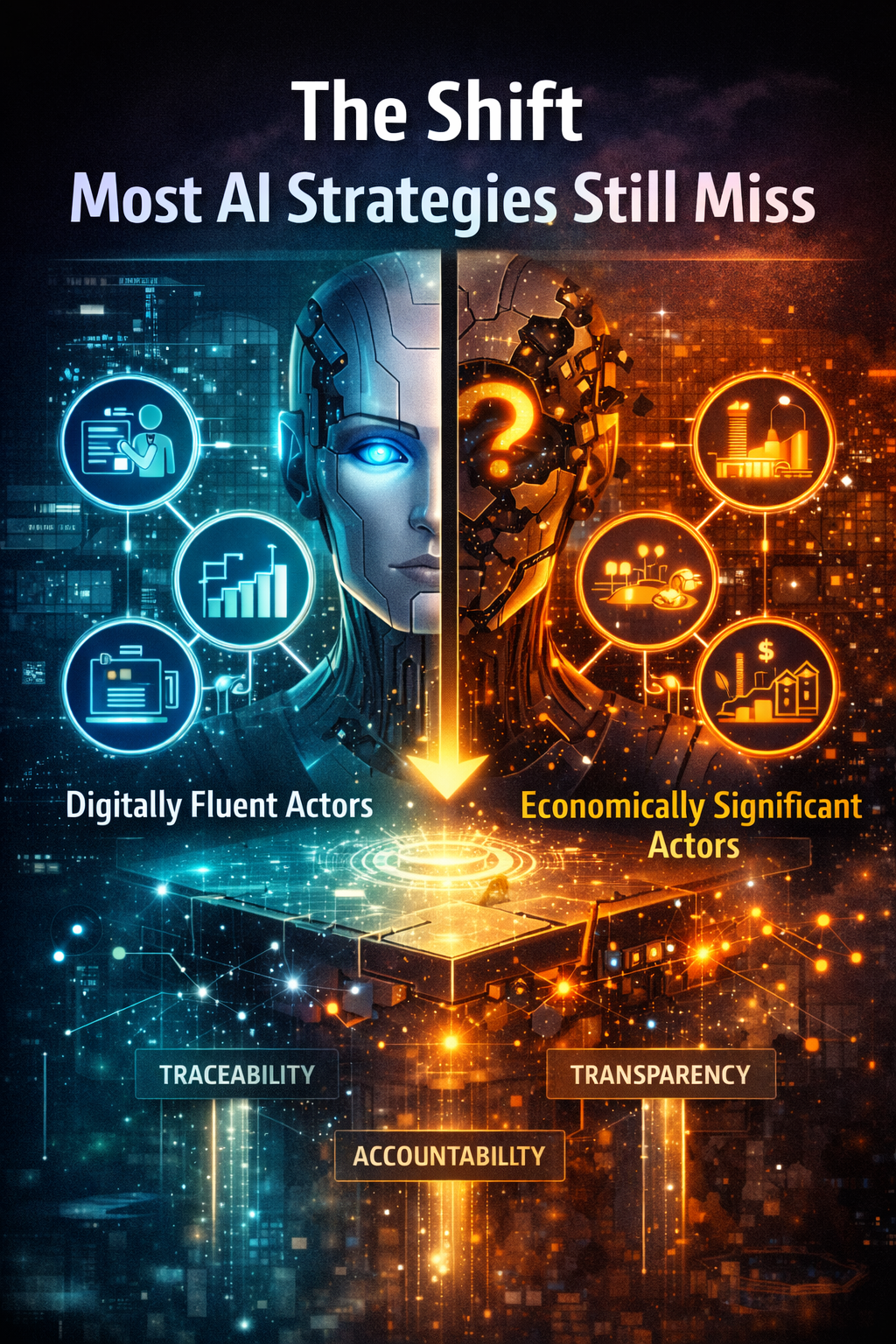
The shift most AI strategies still miss
Most AI strategy assumes digitally fluent actors:
- stakeholders who can articulate needs and constraints
- processes that emit clean, instrumented data
- environments where “optimization” is visible and measurable
- participants who know what to challenge when outcomes feel wrong
But in the real world, many economically significant actors cannot self-advocate digitally. Not because they are absent—but because they are not legible by default.
Consider scenarios that show up in every large enterprise ecosystem:
- a small supplier deeply embedded inside a complex supply chain
- a micro-business with volatile cash-flow patterns
- a piece of critical infrastructure emitting weak signals
- an ecosystem represented through incomplete sensing and proxy indicators
- a fast-changing asset whose risk profile shifts faster than humans can monitor
These actors are not submitting structured optimization requests.
They are being inferred.
AI systems interpret them through partial signals, proxies, and learned patterns—and then organizations act on those interpretations.
So representation is happening whether leaders acknowledge it or not.
Historically, representing such actors was expensive: experts, audits, inspections, manual reviews, layered governance.
Now AI makes representation cheap and scalable.
That is the opportunity.
It is also the danger:
When representation becomes easy, it becomes easy to misrepresent—at scale.
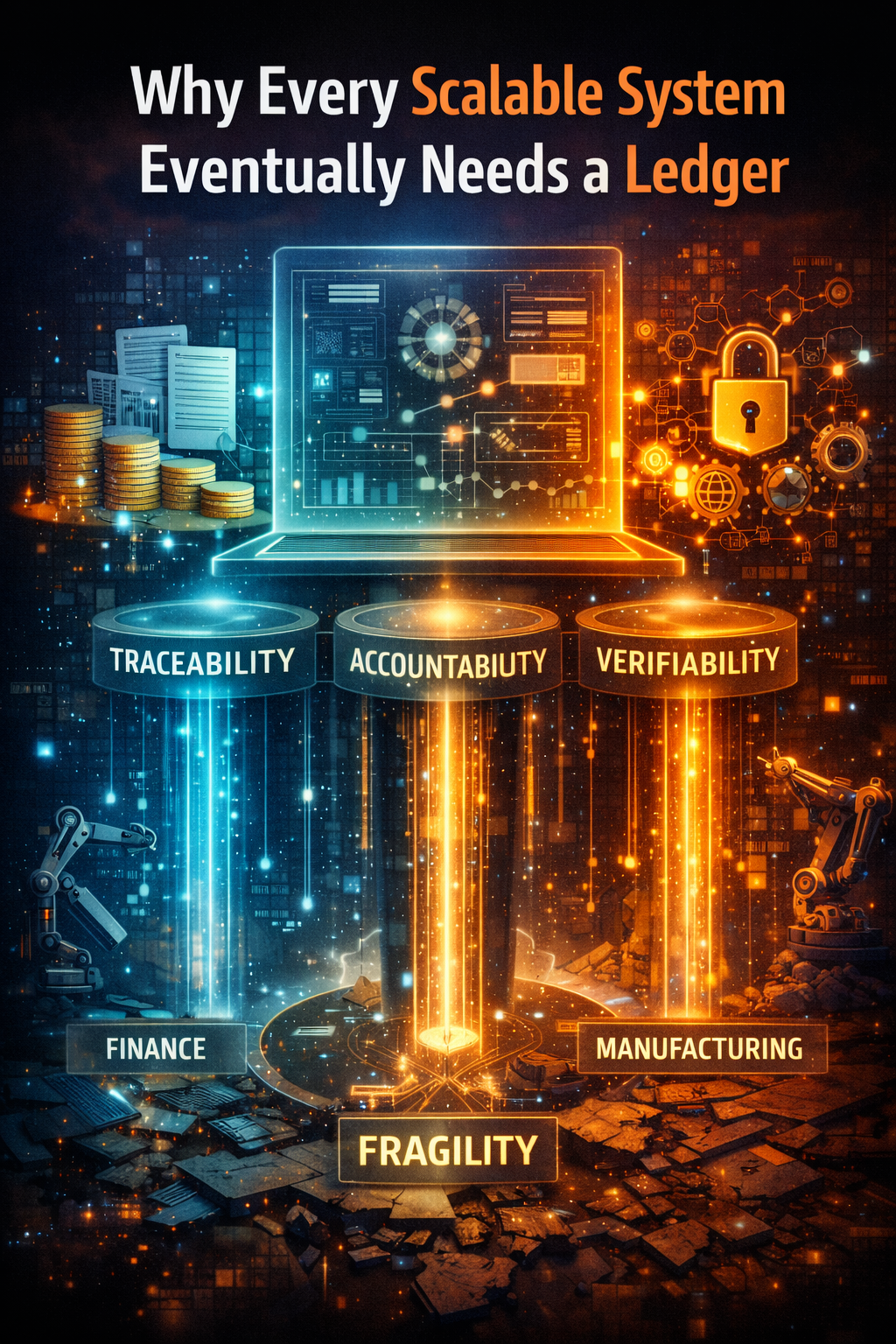
Why every scalable system eventually needs a ledger
There is a simple pattern in institutional history:
When activity scales, legitimacy must scale with it.
- Finance scaled because we built accounting ledgers.
- Cybersecurity scaled because we built logging and incident records.
- Manufacturing scaled because we built traceability and quality records.
In each case, the ledger did not create value directly.
It made value creation:
- visible
- verifiable
- auditable
- comparable
- correctable
Without a ledger, activity becomes opaque.
Opacity breeds fragility.
AI representation is now reaching a similar scale.
If AI systems continuously interpret and act on behalf of entities that cannot self-advocate digitally, then representation itself requires a system-of-record.
That system is the Representation Ledger.
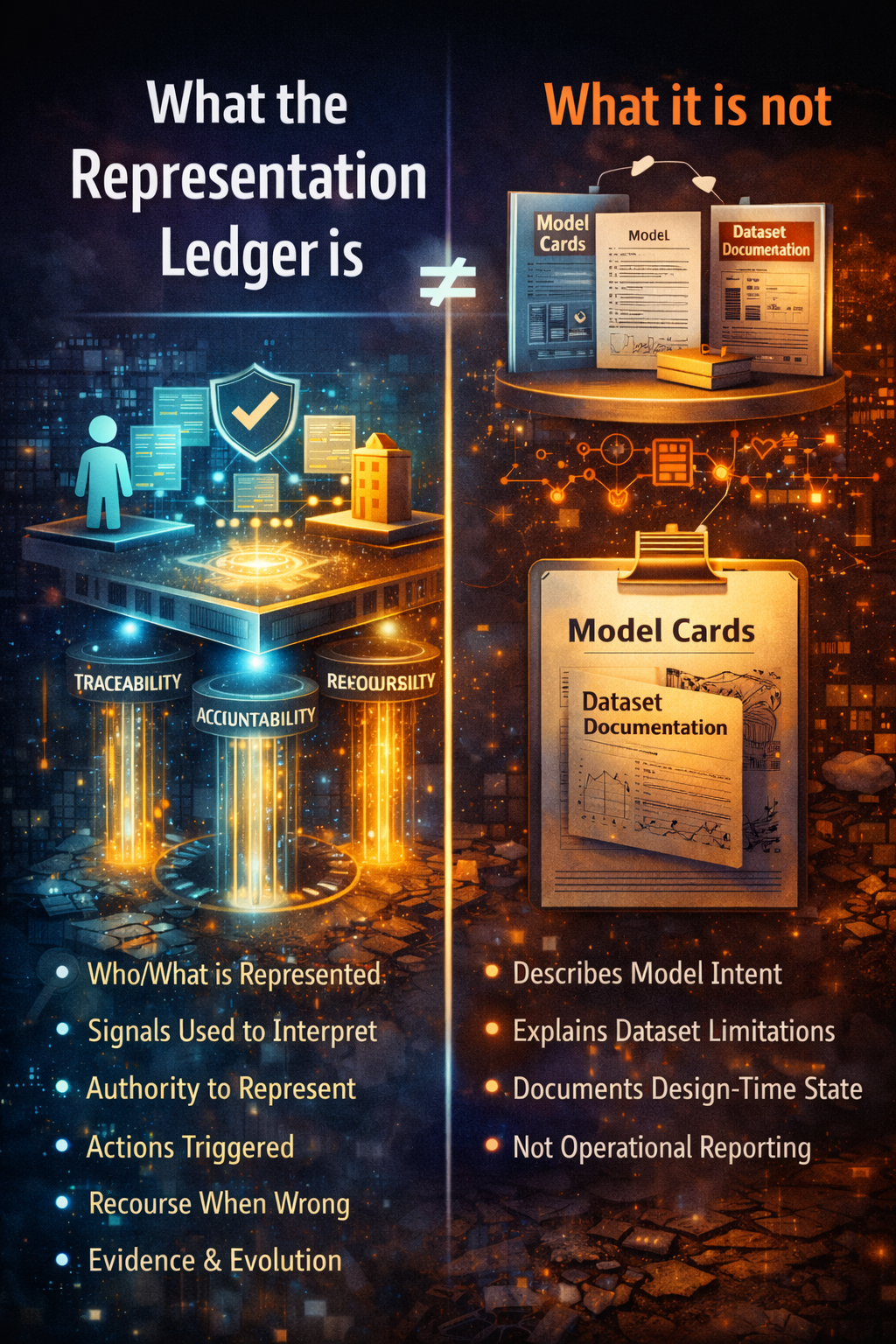
What the Representation Ledger is (and what it is not)
Definition
The Representation Ledger is a continuous, permissioned record that documents:
- Who/what is being represented
- Which signals define that representation
- What authority allows the system to represent
- What actions were triggered by that representation
- What recourse exists if representation is wrong
- How the representation evolves over time based on evidence
It answers a simple but profound question:
If this system is acting on behalf of someone or something, how do we know that representation is legitimate?
What it is not
It is not “just another documentation artifact.”
Model documentation—such as Model Cards—helps describe intended use, evaluation, and limitations. (ACM Digital Library)
Dataset documentation—such as Datasheets for Datasets—improves transparency about how data was collected, what it contains, and what it should (or should not) be used for. (arXiv)
Those are essential. But they are largely design-time artifacts.
A Representation Ledger is operational-time infrastructure.
Documentation explains intent.
A ledger records reality.
It captures representation as it unfolds across:
- deployment
- drift and updates
- incidents and escalations
- corrections and reversals
- post-action learning
That is the difference between “we wrote governance” and “we can prove governance.”
Why now: governance expectations are converging on traceability
Across jurisdictions and standards bodies, the direction is consistent:
If an AI system can materially affect outcomes, it needs traceability.
That means logging, record-keeping, and lifecycle accountability.
The EU AI Act’s record-keeping expectations for high-risk AI systems emphasize logging capabilities designed to support traceability and oversight. (AI Act Service Desk)
NIST’s AI Risk Management Framework frames AI governance as an end-to-end discipline across lifecycle functions (govern/map/measure/manage). (Carahsoft)
ISO/IEC 42001 formalizes AI governance as a management system—designed, operated, audited, and continually improved. (ISO)
The Representation Ledger is a practical way to operationalize that direction specifically for representation—especially when representation triggers action.
The three structural risks of representation without a ledger
1) Implicit representation (the silent power shift)
Many AI systems represent entities by proxy:
- transaction patterns
- operational telemetry
- behavioral signals
- sensor readings
- workflow interactions
Without explicit records of who is represented and under what authority, representation becomes implicit.
Implicit representation concentrates power silently—because no one can clearly answer: “Represented whom, using what, with what permission, and with what limits?”
2) Untraceable action (the governance cliff)
When AI triggers decisions—eligibility changes, risk flags, escalations, pricing shifts—stakeholders ask:
Why?
If the best answer is “the model decided,” governance has already failed.
Without a ledger, organizations cannot reliably reconstruct:
- what signals were used
- what policy rules applied
- what version of logic executed
- what guardrails constrained action
- what could have been reversed but wasn’t
Speed without traceability eventually erodes trust.
3) No recourse path (the trust collapse)
Most systems are built for optimization. Few are built for correction.
When representation is wrong:
- Can it be challenged?
- Can evidence be submitted?
- Can the action be reversed?
- Can harm be mitigated?
Without structured recourse, representation becomes unilateral authority.
And trust collapses not because AI exists—but because correction does not.
What the ledger contains (in plain language)
Think of the Representation Ledger as six categories of entries—simple enough for a board to audit conceptually, concrete enough for teams to implement.
1) Representation scope: who/what is being represented
Not only “users.”
Representation can apply to an entity, organization, asset, process, network, or environment.
The ledger records:
- the represented entity class
- the scope (what decisions it can affect)
- boundary conditions (what it must not be used for)
2) Signal provenance: which signals define the representation
Signals are never neutral.
The ledger records:
- signal sources (direct vs proxy)
- freshness/latency expectations
- known blind spots or missing signals
- changes over time (drift)
3) Authority and permission: why the system is allowed to represent
This is where legitimacy begins.
The ledger records:
- basis of authority (consent, contract, policy mandate, delegated authority)
- explicit limits (what representation is prohibited)
- escalation triggers (when human oversight is required)
4) Representation output: what the system “believes”
Not math. Not model internals.
Human-readable representation states, such as:
- “elevated operational risk”
- “eligibility requires confirmation”
- “priority escalated due to weak-signal pattern”
- “anomaly detected—investigation required”
Also: caveats and confidence boundaries in plain language.
5) Action trace: what actions were triggered (and how bounded they were)
This is where representation becomes power.
The ledger records:
- what action was taken
- what was automated vs confirmed
- guardrails applied
- escalation paths used
- reversibility status (reversible / partially reversible / irreversible)
6) Recourse and correction: how the representation can be challenged and improved
This is the trust engine.
The ledger records:
- how to challenge representation
- what evidence is admissible
- correction workflow (who reviews, what timelines)
- how reversals occur
- what gets learned from correction events
C.O.R.E. — and why the ledger is the “system of record” for this doctrine
I have defined C.O.R.E. as the micro-engine that converts cheap cognition into advantage.
Used properly, C.O.R.E. is not a workflow loop.
It is a market loop.
Here is the clean mapping:
C — Comprehend context
AI ingests live signals from interactions and environments:
- constraints carried into decisions
- evidence requests and friction points
- negotiation failures and switching triggers
- emerging trust signals and anomalies
Ledger link: records what context was captured, from where, with what permission, and what context was missing.
O — Optimize and orchestrate decisions
AI tunes decision policies continuously:
- pricing corridors and bundles
- eligibility thresholds
- risk controls and escalation pathways
- timing: act now vs ask vs delay vs refuse
Ledger link: records the orchestration choice—so “choice architecture” becomes auditable.
R — Regulate and realize action
AI executes within explicit boundaries:
- automated workflows and policy checks
- controlled provisioning/fulfillment triggers
- approvals that require confirmation
- reversibility rules and kill switches
Ledger link: records which guardrails constrained action—turning governance into enforceable infrastructure.
E — Evolve through evidence
AI improves through outcomes:
- dispute outcomes and corrections
- churn and trust breakdowns
- post-action reviews and incidents
- calibration against real-world feedback
Ledger link: records evidence and correction events so the system improves—and trust compounds.
In one line:
C.O.R.E. is the engine. The Representation Ledger is the institutional memory of that engine.
Three examples that make the need obvious
Example 1: Supply chain representation
An AI system flags a supplier as “high risk.”
Without a ledger:
- the supplier can’t understand why
- procurement can’t justify action
- trust degrades and disputes multiply
With a ledger:
- signals are traceable (late events, documentation mismatches, anomalies)
- authority is explicit (monitoring clauses, agreed constraints)
- recourse exists (submit evidence, correction workflow)
- action remains bounded (increased verification rather than punitive termination)
Outcome: risk control improves without legitimacy collapse.
Example 2: Infrastructure monitoring representation
An AI system represents an asset as “failure likely.”
Without a ledger:
- teams ignore it (opaque) or overreact (oracle effect)
- post-incident learning is weak
With a ledger:
- sensor provenance is logged
- representation state and caveats are recorded
- actions are traceable (inspection triggered, safe-mode enabled)
- outcomes feed evidence evolution
Outcome: reliability becomes cumulative.
Example 3: Ecosystem representation via weak signals
A monitoring system represents an environment as “stress increasing.”
Without a ledger:
- proxy assumptions remain hidden
- interventions risk being misdirected
- disputes become political rather than evidential
With a ledger:
- proxies and blind spots are explicit
- irreversible actions are gated
- evidence loops refine interpretation
- recourse exists through verification pathways
Outcome: representation becomes accountable rather than extractive.
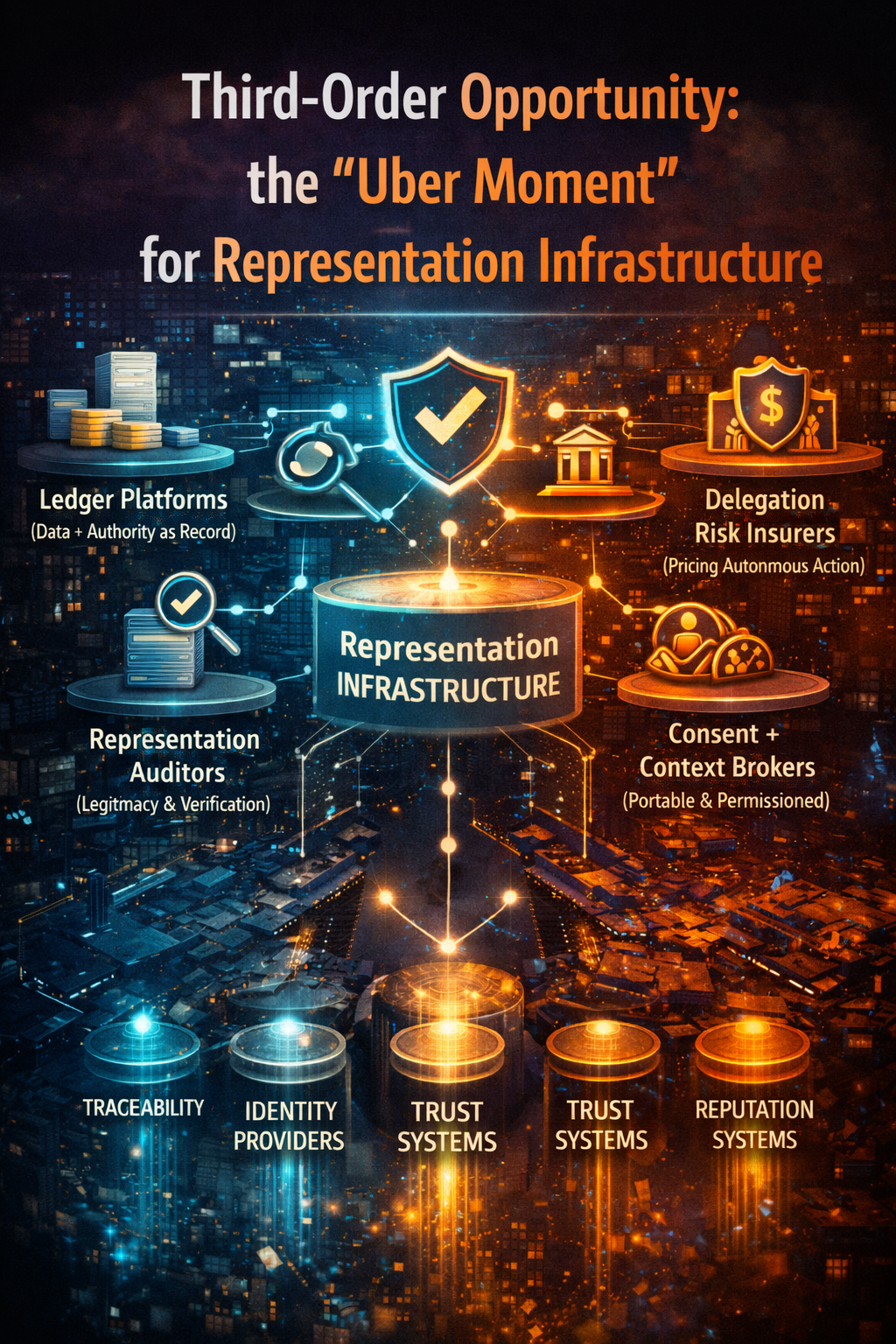
Third-order opportunity: the “Uber moment” for Representation Infrastructure
Boards are looking for the third-order story: new categories, new markets, new pricing power.
This is where the Representation Ledger becomes more than governance.
Once ledgers exist, markets form around them—because representation becomes a new layer of economic coordination.
Just as the internet produced identity providers, payment rails, and reputation systems, the Representation Economy will produce:
- Ledger Platforms (representation-as-record)
- Independent Representation Auditors (verification and legitimacy checks)
- Recourse Infrastructure Providers (appeals, correction, reversibility services)
- Consent + Context Brokers (portable, permissioned context vaults)
- Delegation Risk Insurers (pricing the risk of autonomous action)
These businesses will not win because they have larger models.
They will win because they can prove: trusted representation + bounded delegation + auditable outcomes.
That is pricing power in the AI decade.
The board checklist: govern representation the way you govern financial reality
Boards should be able to answer:
- Which actors in our ecosystem cannot self-advocate digitally?
- Where are we already representing them implicitly?
- What signals define that representation—and what’s missing?
- What authority permits representation—and what are the limits?
- Which actions are triggered by representation?
- Are those actions reversible? Under what conditions?
- What recourse exists when representation is wrong?
- Can we audit representation as rigorously as financial reporting?
If the answers are unclear, representation is already operating without governance.
The key insight to remember
In the AI decade, cognition becomes cheap. Representation becomes power. The Representation Ledger decides who can be trusted with it.
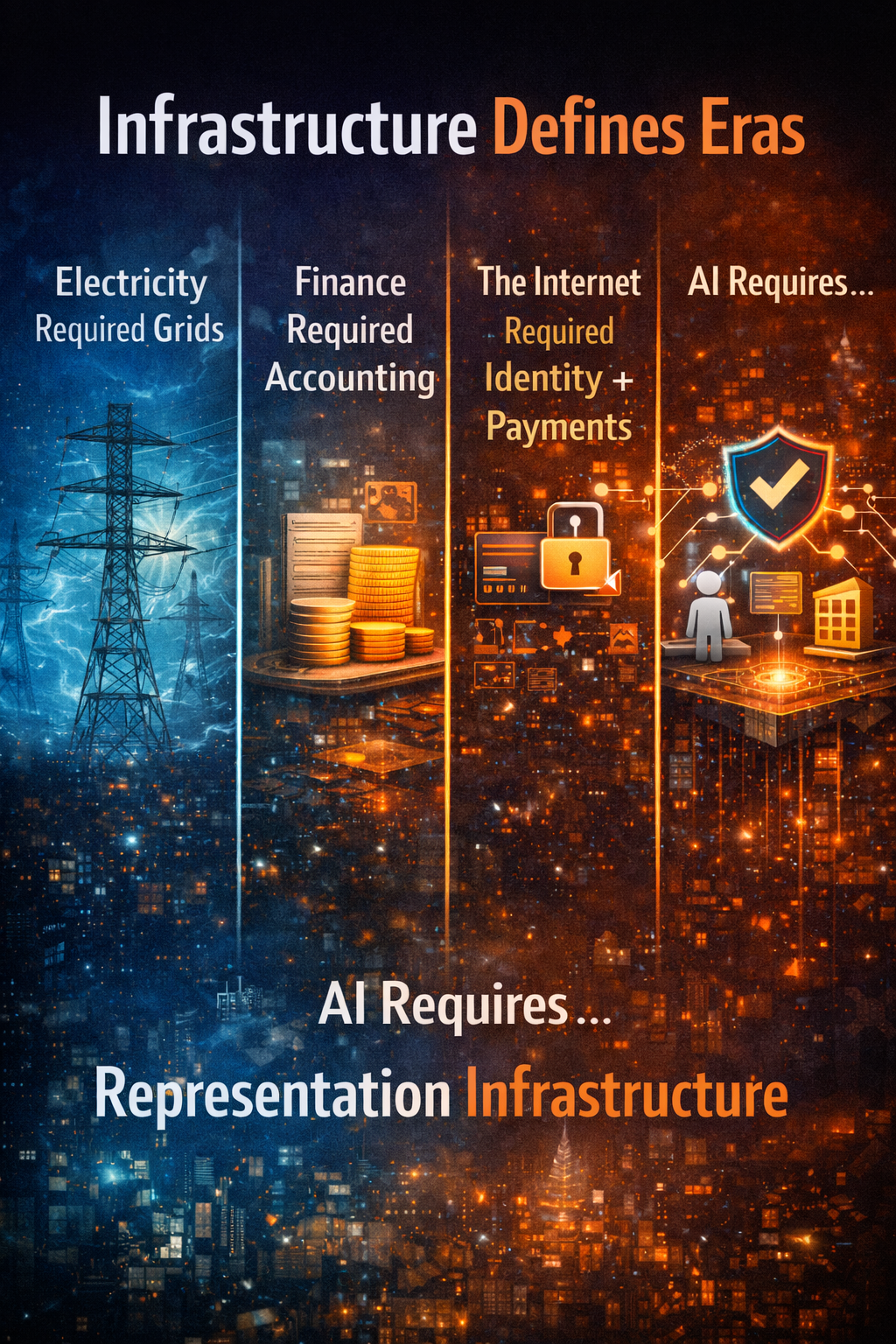
Conclusion: infrastructure defines eras
Electricity required grids.
Finance required accounting.
The internet required identity and payments.
AI requires representation infrastructure.
Without it, intelligence will scale faster than legitimacy.
With it, intelligence can compound trust—because representation becomes traceable, contestable, and improvable.
The organizations that recognize this early will not merely deploy AI.
They will shape the economic architecture of the decade—because they will be trusted to represent reality responsibly.
Read next:
- Enterprise AI Operating Model: https://www.raktimsingh.com/enterprise-ai-operating-model/
- Who Owns Enterprise AI?: https://www.raktimsingh.com/who-owns-enterprise-ai-roles-accountability-decision-rights/
- The Intelligence Reuse Index: https://www.raktimsingh.com/intelligence-reuse-index-enterprise-ai-fabric/
- Enterprise AI Runbook Crisis: https://www.raktimsingh.com/enterprise-ai-runbook-crisis-model-churn-production-ai/
- Representation Economy: https://www.raktimsingh.com/representation-economy-ai-institutional-power/
Glossary
Representation Infrastructure: Systems that model and act on behalf of entities that cannot digitally self-advocate—credibly, permissioned, and with accountability.
Representation Ledger: A continuous system-of-record that documents who/what is represented by AI, how, under what authority, what actions follow, and what recourse exists.
Traceability: The ability to reconstruct what signals, rules, and constraints led to an AI-driven action.
Recourse: The ability to challenge, correct, reverse, or seek remedy when representation is wrong.
Bounded Delegation: Delegating actions to AI within explicit guardrails, escalation rules, and reversibility constraints.
C.O.R.E.: Comprehend context, Optimize and orchestrate decisions, Regulate and realize action, Evolve through evidence.
Model Cards: A standardized approach to documenting ML models—intended use, evaluation, limitations. (ACM Digital Library)
Datasheets for Datasets: A standardized approach to documenting datasets—motivation, composition, collection process, recommended uses. (arXiv)
FAQ
1) Is a Representation Ledger the same as model documentation?
No. Model cards and dataset datasheets document models and datasets. (ACM Digital Library)
A Representation Ledger is an operational system-of-record that tracks real-world representation, authority, actions, and recourse.
2) Why do we need a ledger at all?
Because representation becomes power when it triggers decisions and execution. A ledger makes that power traceable, auditable, and correctable.
3) Is this only relevant for regulated industries?
No. Any organization using AI to classify, prioritize, allocate, approve, price, or trigger workflows is already performing representation.
4) How does this relate to the EU AI Act?
EU AI Act guidance around record-keeping highlights logging/traceability expectations for certain high-risk systems. (AI Act Service Desk)
5) How does this align with NIST and ISO?
NIST AI RMF frames AI governance across lifecycle functions. (Carahsoft)
ISO/IEC 42001 defines an AI management system approach for responsible governance and continual improvement. (ISO)
6) What’s the biggest risk if we don’t build one?
Implicit representation becomes unaccountable representation—leading to trust collapse, governance failures, and reputational risk.
References & Further Reading
- EU AI Act (record-keeping / logging expectations for certain high-risk systems). (AI Act Service Desk)
- NIST Artificial Intelligence Risk Management Framework (AI RMF 1.0). (Carahsoft)
- ISO/IEC 42001:2023 — AI management systems. (ISO)
- Model Cards for Model Reporting (Mitchell et al., 2019). (ACM Digital Library)
- Datasheets for Datasets (Gebru et al., 2018). (arXiv)
- OECD AI Principles (trustworthy AI, transparency, accountability). (OECD.AI)
The Intelligence-Native Enterprise Doctrine
This article is part of a larger strategic body of work that defines how AI is transforming the structure of markets, institutions, and competitive advantage. To explore the full doctrine, read the following foundational essays:
-
The AI Decade Will Reward Synchronization, Not Adoption
Why enterprise AI strategy must shift from tools to operating models.
https://www.raktimsingh.com/the-ai-decade-will-reward-synchronization-not-adoption-why-enterprise-ai-strategy-must-shift-from-tools-to-operating-models/ -
The Third-Order AI Economy
The category map boards must use to see the next Uber moment.
https://www.raktimsingh.com/third-order-ai-economy/ -
The Intelligence Company
A new theory of the firm in the AI era — where decision quality becomes the scalable asset.
https://www.raktimsingh.com/intelligence-company-new-theory-firm-ai/ -
The Judgment Economy
How AI is redefining industry structure — not just productivity.
https://www.raktimsingh.com/judgment-economy-ai-industry-structure/ -
Digital Transformation 3.0
The rise of the intelligence-native enterprise.
https://www.raktimsingh.com/designing-intelligence-native-enterprise/ -
Industry Structure in the AI Era
Why judgment economies will redefine competitive advantage.
https://www.raktimsingh.com/industry-structure-in-the-ai-era-why-judgment-economies-will-redefine-competitive-advantage/
Institutional Perspectives on Enterprise AI
Many of the structural ideas discussed here — intelligence-native operating models, control planes, decision integrity, and accountable autonomy — have also been explored in my institutional perspectives published via Infosys’ Emerging Technology Solutions platform.
For readers seeking deeper operational detail, I have written extensively on:
- What Makes an Enterprise Intelligence-Native? The Blueprint for Third-Order AI Advantage
https://blogs.infosys.com/emerging-technology-solutions/artificial-intelligence/what-is-enterprise-ai-the-operating-model-for-compounding-institutional-intelligence.html - Why “AI in the Enterprise” Is Not Enterprise AI: The Operating Model Difference Most Organizations Miss
https://blogs.infosys.com/emerging-technology-solutions/artificial-intelligence/why-ai-in-the-enterprise-is-not-enterprise-ai-the-operating-model-difference-that-most-organizations-miss.html - The Enterprise AI Control Plane: Governing Autonomy at Scale
https://blogs.infosys.com/emerging-technology-solutions/artificial-intelligence/the-enterprise-ai-control-plane-governing-autonomy-at-scale.html - Enterprise AI Ownership Framework: Who Is Accountable, Who Decides, and Who Stops AI in Production
https://blogs.infosys.com/emerging-technology-solutions/artificial-intelligence/enterprise-ai-ownership-framework-who-is-accountable-who-decides-and-who-stops-ai-in-production.html - Decision Integrity: Why Model Accuracy Is Not Enough in Enterprise AI
https://blogs.infosys.com/emerging-technology-solutions/artificial-intelligence/decision-integrity-why-model-accuracy-is-not-enough-in-enterprise-ai.html - Agent Incident Response Playbook: Operating Autonomous AI Systems Safely at Enterprise Scale
https://blogs.infosys.com/emerging-technology-solutions/artificial-intelligence/agent-incident-response-playbook-operating-autonomous-ai-systems-safely-at-enterprise-scale.html - The Economics of Enterprise AI: Designing Cost, Control, and Value as One System
https://blogs.infosys.com/emerging-technology-solutions/artificial-intelligence/the-economics-of-enterprise-ai-designing-cost-control-and-value-as-one-system.html
Together, these perspectives outline a unified view: Enterprise AI is not a collection of tools. It is a governed operating system for institutional intelligence — where economics, accountability, control, and decision integrity function as a coherent architecture.



Raktim Singh is an AI and deep-tech strategist, TEDx speaker, and author focused on helping enterprises navigate the next era of intelligent systems. With experience spanning AI, fintech, quantum computing, and digital transformation, he simplifies complex technology for leaders and builds frameworks that drive responsible, scalable adoption.