

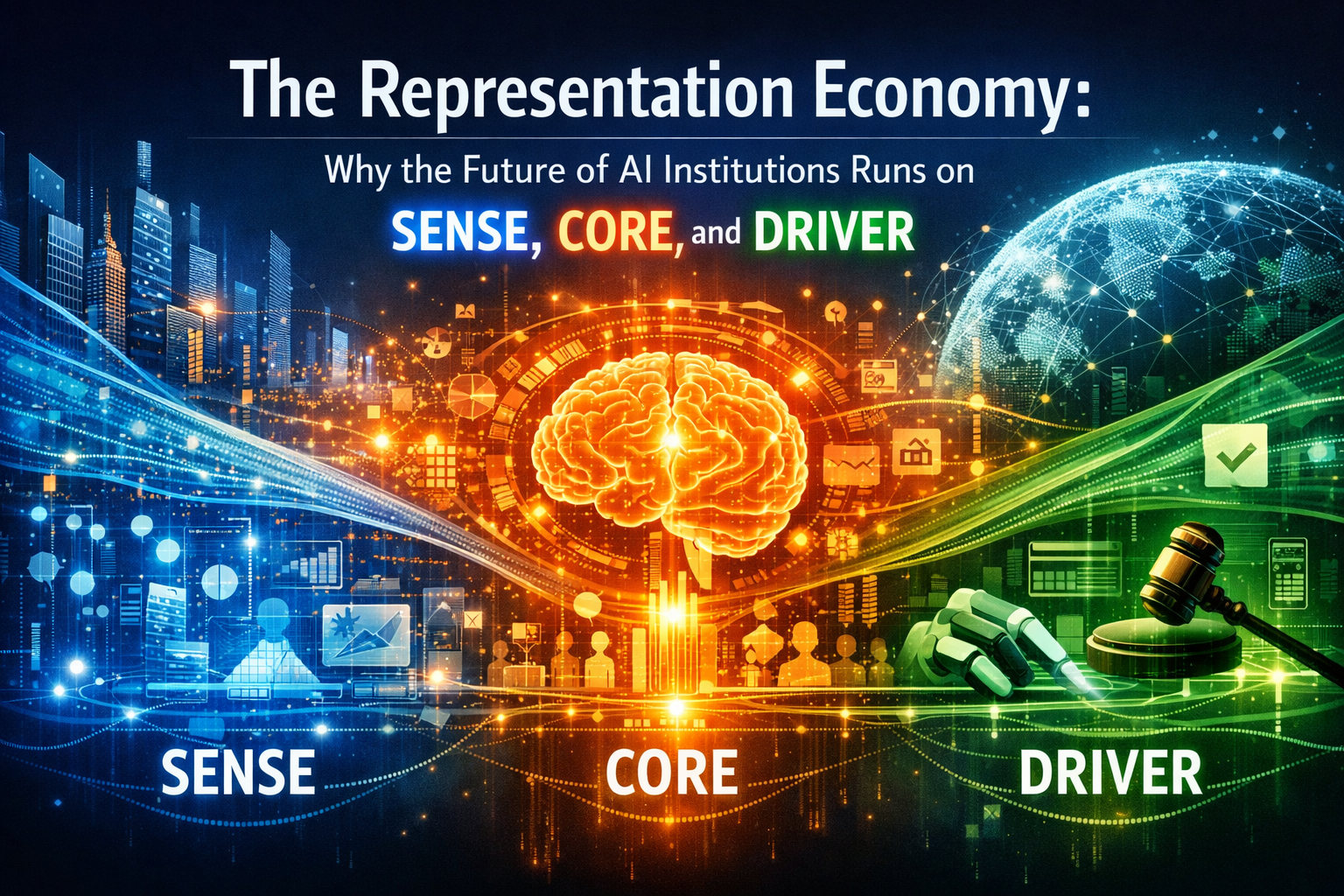
The Representation Economy
AI is not just changing work. It is changing how institutions see, think, and act.
For years, the AI conversation was dominated by one question: which model is better? Bigger models, faster models, cheaper models, safer models. That question still matters, but it no longer explains where lasting institutional advantage will come from.
The deeper shift is architectural.
AI is no longer only a tool for generating text, code, images, or predictions. It is becoming part of the operating architecture of institutions.
It is changing how organizations detect reality, interpret meaning, make decisions, delegate authority, and execute action. As AI adoption accelerates, the global governance conversation is also becoming more explicit about lifecycle risk management, human oversight, transparency, and monitoring.
Stanford’s 2025 AI Index reports that 78% of organizations said they used AI in 2024, up from 55% the year before, while private investment in generative AI reached $33.9 billion globally in 2024. At the same time, NIST, the OECD, and the EU AI Act have all emphasized structured governance, human oversight, and lifecycle accountability in different ways. (Stanford HAI)
That is why the next era of AI will not be won only by the organizations with the best models. It will be won by the organizations with the best institutional architecture.
This is where a new concept becomes essential: the Representation Economy.
The Representation Economy is the idea that economic and institutional value increasingly depends on how well reality can be represented inside systems. If a person, event, asset, risk, workflow, dependency, or exception cannot be represented well, it cannot be reasoned about well. And if it cannot be reasoned about well, it cannot be safely acted upon.
In plain language: what cannot be represented cannot be governed well, automated well, priced well, or improved well.
That is why the future of AI institutions runs on three connected layers:
SENSE
The layer that turns the world into signals, entities, state, and evolving context.
CORE
The layer that interprets those representations, forms judgments, and produces decisions.
DRIVER
The layer that determines how those decisions are authorized, verified, executed, and corrected.
Together, SENSE–CORE–DRIVER is not just a framework for AI systems. It is a framework for designing intelligent institutions.
This article brings those concerns into a simpler strategic language: How do institutions see? How do they think? How do they act?
That is the real architecture of the AI era.
The Representation Economy describes a new economic paradigm in which competitive advantage depends on how well institutions represent reality inside digital systems. In this paradigm, organizations win not by simply owning data but by building high-quality representations of entities, signals, and evolving states that support decision-making and action.
This article also serves as the canonical synthesis of a broader body of work on intelligent institutional design, including earlier pieces on The Enterprise AI Operating Model, The Enterprise AI Control Plane 2026, The Enterprise AI Runtime: What Is Running in Production?, The Enterprise AI Agent Registry, The Enterprise AI Decision Failure Taxonomy, Decision Clarity for Scalable Enterprise AI Autonomy, The Laws of Enterprise AI, and The Future Belongs to Decision-Intelligent Institutions.
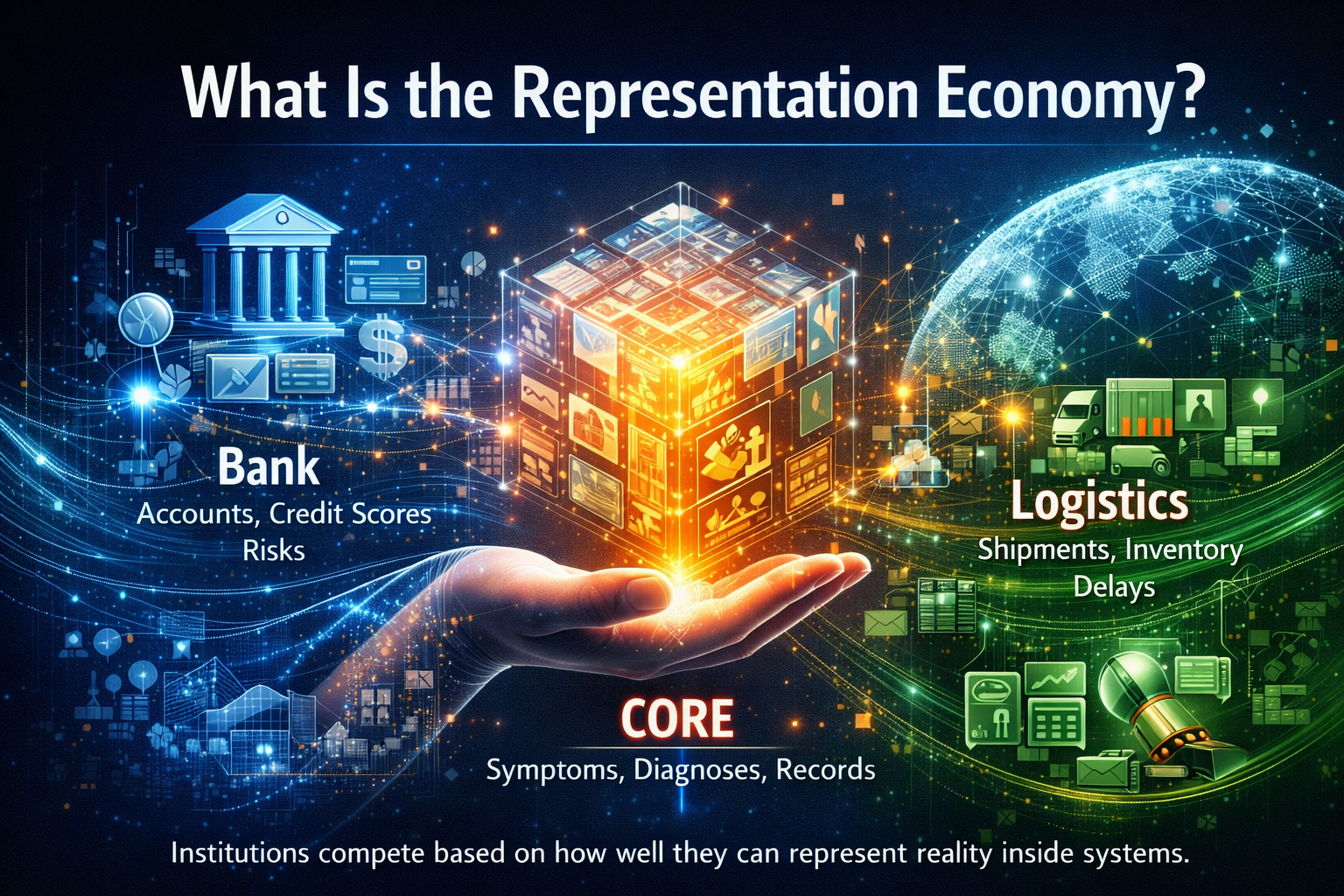
What Is the Representation Economy?
Beyond the data economy
The Representation Economy is the emerging economic order in which advantage comes not only from owning data or compute, but from building better representations of reality.
That sounds abstract, so let us make it concrete.
A bank does not manage reality directly. It manages representations of reality: customer identities, balances, cash-flow patterns, credit histories, risk categories, transaction paths, exposure models, fraud alerts, and compliance states.
A hospital does not manage the human body directly in software. It manages representations: symptoms, patient history, scans, diagnoses, medication records, allergy status, care pathways, and risk signals.
A logistics company does not control the physical world in raw form. It controls representations: shipment status, route conditions, warehouse inventory, equipment health, delay probability, and delivery commitments.
In each case, performance depends on whether the representation is good enough to support judgment and action.
That is the core of the Representation Economy: institutions increasingly compete on the quality, trustworthiness, timeliness, and governability of their representations.
Data alone is not enough. Data is raw input. Representation is structured meaning.
Data says a refrigeration sensor showed a spike.
Representation says a temperature-sensitive medicine shipment in warehouse 14 may be compromised within the next four hours and requires intervention.
That difference is where economic value, operational precision, and institutional risk begin to diverge.
Why this is larger than AI tools
Modern AI systems do not merely store or retrieve data. They create classifications, summaries, embeddings, scores, rankings, identities, forecasts, recommendations, and action pathways. In other words, they continuously create and update representations.
That means the strategic question is no longer just, “How much data do we have?”
It becomes:
- What reality are we trying to represent?
- What is still invisible?
- What is being oversimplified?
- What is being misclassified?
- What can the system not see at all?
- What decisions are being made on top of weak representations?
These are not just technical questions. They are institutional questions.
The SENSE–CORE–DRIVER framework explains how intelligent institutions operate: SENSE makes reality legible, CORE interprets that reality through reasoning systems, and DRIVER ensures that decisions translate into legitimate and governed action.
Why AI Changes Representation So Dramatically
Earlier software systems mostly processed structured inputs through fixed rules.
AI systems are different. The OECD’s updated guidance continues to frame AI systems as systems that infer from inputs how to generate outputs such as predictions, content, recommendations, or decisions, and it places those systems in a lifecycle that spans planning, data collection and processing, development, verification, deployment, and operation/monitoring. (OECD)
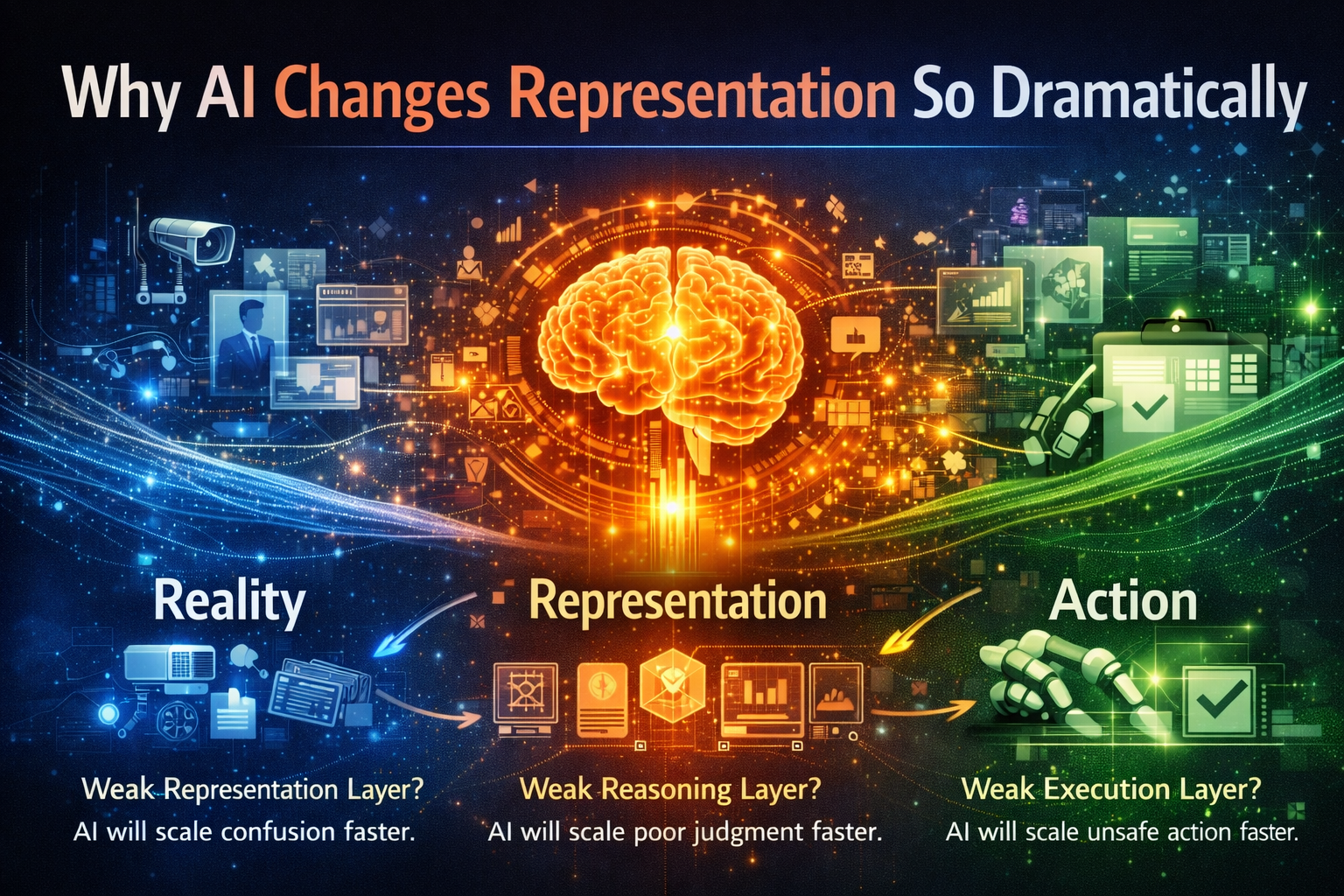
That matters because AI sits between reality and action.
It helps decide what is salient, what is normal, what is risky, what is similar, what deserves attention, and sometimes what should happen next.
This is why the AI era is not just about intelligence. It is about mediated reality.
If the representation layer is weak, AI scales confusion faster.
If the reasoning layer is weak, AI scales poor judgment faster.
If the execution layer is weak, AI scales unsafe action faster.
That is why SENSE–CORE–DRIVER matters.
SENSE: The Layer Where Reality Becomes Legible
What SENSE actually means
SENSE is the first layer of intelligent institutions. It answers a basic but often ignored question:
What does the institution actually know about the world?
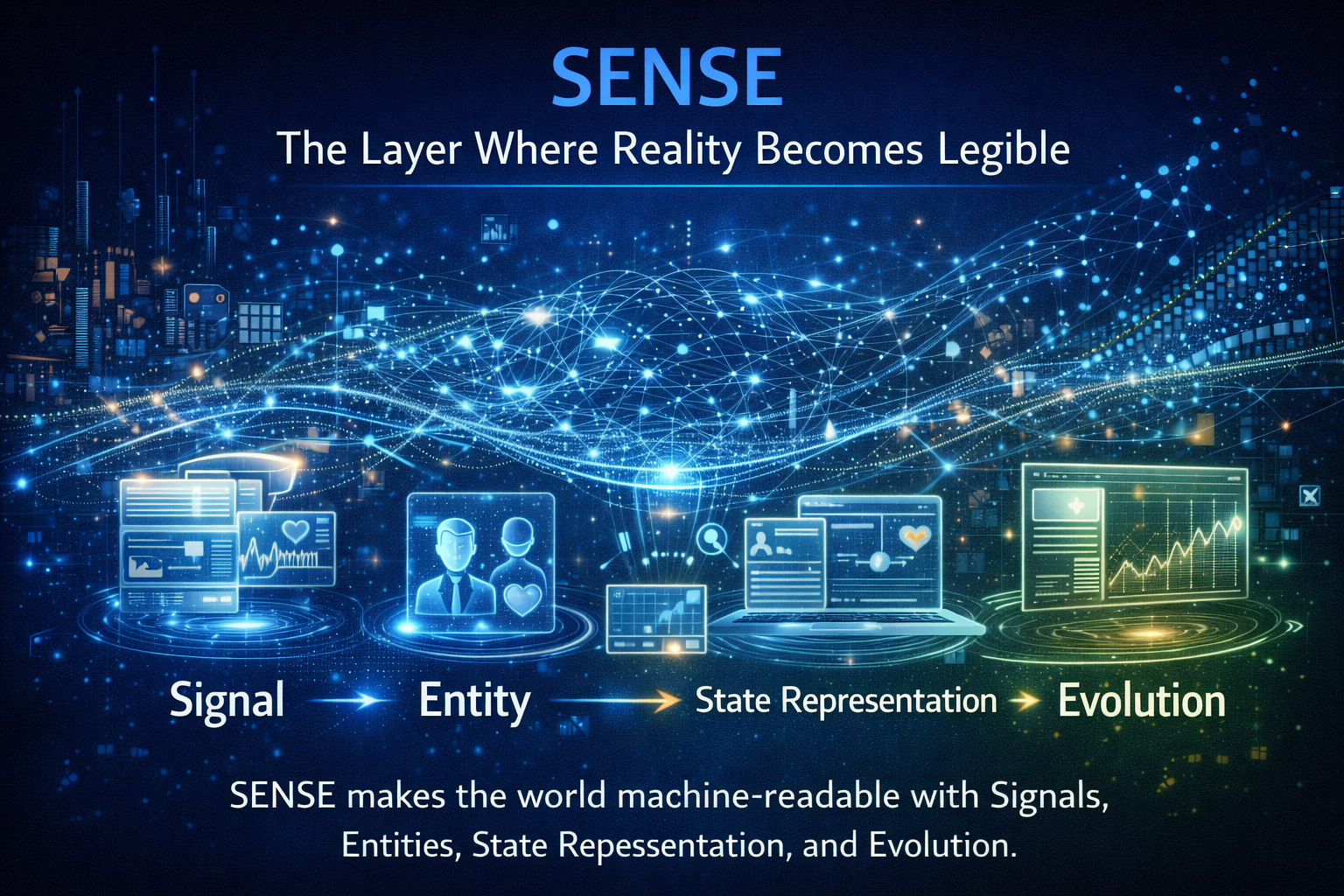
SENSE is the legibility layer:
Signal — What traces, events, or observations are coming in?
ENtity — What person, object, account, machine, customer, case, or asset do those signals belong to?
State representation — What is the current condition of that entity?
Evolution — How is that state changing over time?
This is where reality becomes machine-legible.
A simple example: healthcare
Imagine a hospital using AI-assisted monitoring.
A wearable device sends heart-rate data. That is the signal.
But a signal alone is not enough. The system must know which patient it belongs to. That is the entity.
Then the hospital must determine whether the patient is stable, deteriorating, post-operative, high-risk, or recently medicated. That is the state representation.
Then it must understand whether the patient is improving, worsening, fluctuating, or moving toward a dangerous trend. That is evolution.
Without all four, the hospital does not truly see.
Why many AI programs fail at SENSE
Many organizations jump directly to models. They ask, “Can we use an LLM?” or “Can we deploy agents?” before asking whether the institution has the right signals, identity resolution, state representation, temporal context, and provenance.
That is one reason so many AI efforts stall after the demo stage. The model may be impressive, but the institution remains blind in crucial places.
A customer service AI may know the prompt but not the customer’s full history.
A fraud model may detect anomalies but not device identity or account behavior drift.
A supply-chain assistant may read shipment records but not know the live condition of containers, customs status, or route disruption.
The problem is not insufficient intelligence. The problem is weak SENSE.
What SENSE includes in practice
In real institutions, SENSE includes identity systems, event streams, telemetry, sensor feeds, workflow state, document extraction, external market signals, knowledge graphs, customer history, and exception detection.
It also includes governance questions:
- What are we allowed to see?
- What should remain private?
- What should be visible to which role?
- What is the provenance of the signal?
- How fresh is it?
- Can it be trusted?
This is where visibility governance, identity infrastructure, and representation boundaries belong.
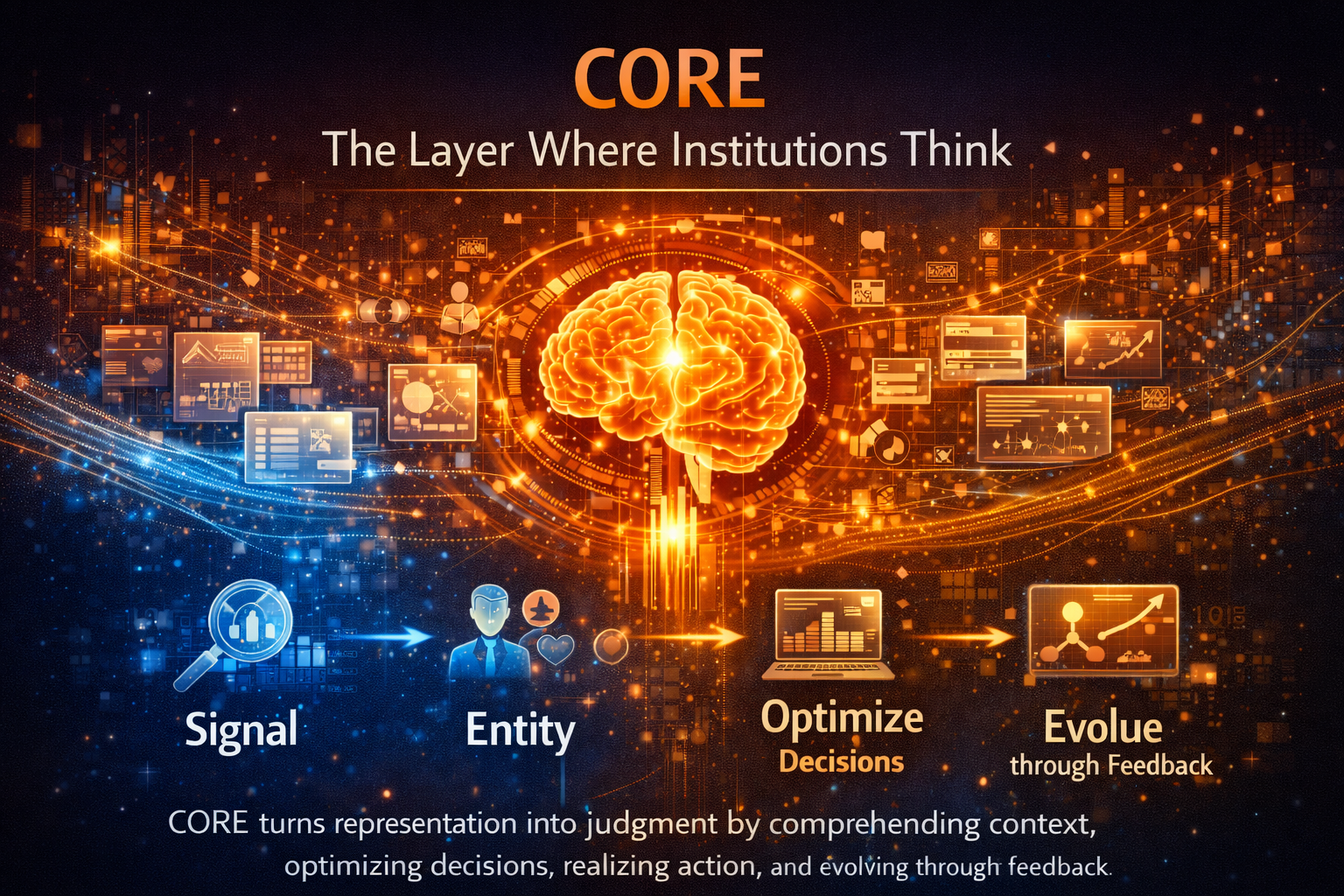
CORE: The Layer Where Institutions Think
From signals to judgment
Once reality becomes legible, the institution still has to interpret it.
That is CORE.
CORE is the cognition layer of the intelligent institution:
Comprehend context
Optimize decisions
Realize action paths
Evolve through feedback
If SENSE is about seeing, CORE is about making sense.
A simple example: lending
Take a bank assessing a small-business loan.
SENSE gathers the applicant’s cash flow, repayment history, transaction behavior, business age, sector trends, identity verification, and current exposure.
CORE then reasons across that representation.
Is this applicant genuinely risky, or simply seasonal?
Does the pattern suggest distress, fraud, or healthy growth?
What outcomes are likely under different repayment structures?
Should this case be approved, modified, or escalated?
This is not just prediction. It is contextual judgment.
CORE is broader than a model
Many people reduce intelligence to a model call. That is too narrow.
In institutions, CORE may include retrieval systems, search, rules, ranking engines, forecasting models, policy logic, optimization layers, workflow orchestration, and human judgment.
Sometimes the final judgment is human-supported.
Sometimes it is machine-generated and human-reviewed.
Sometimes it is machine-executed within bounded policy.
Sometimes it is entirely human.
The real question is not whether the decision is made by a human or a machine. The real question is whether the institution has a coherent cognition layer.
Why CORE depends on SENSE
Even the best reasoning layer fails if the inputs are shallow, fragmented, or misleading.
A model summarizing incomplete records may sound intelligent while being structurally wrong.
A recommendation engine may optimize the wrong objective.
An agent may follow instructions perfectly while missing the actual context.
A diagnosis system may detect patterns without understanding treatment constraints.
That is why strong institutional intelligence is not just smart models. It is grounded cognition built on legible reality.
NIST’s AI Risk Management Framework is highly relevant here because it treats trustworthy AI as an organizational process rather than a model feature. Its core functions—Govern, Map, Measure, and Manage—are designed to support dialogue, context-setting, risk assessment, and ongoing operational oversight. (NIST)
That logic aligns closely with CORE: reasoning must be situated, measurable, and governed.
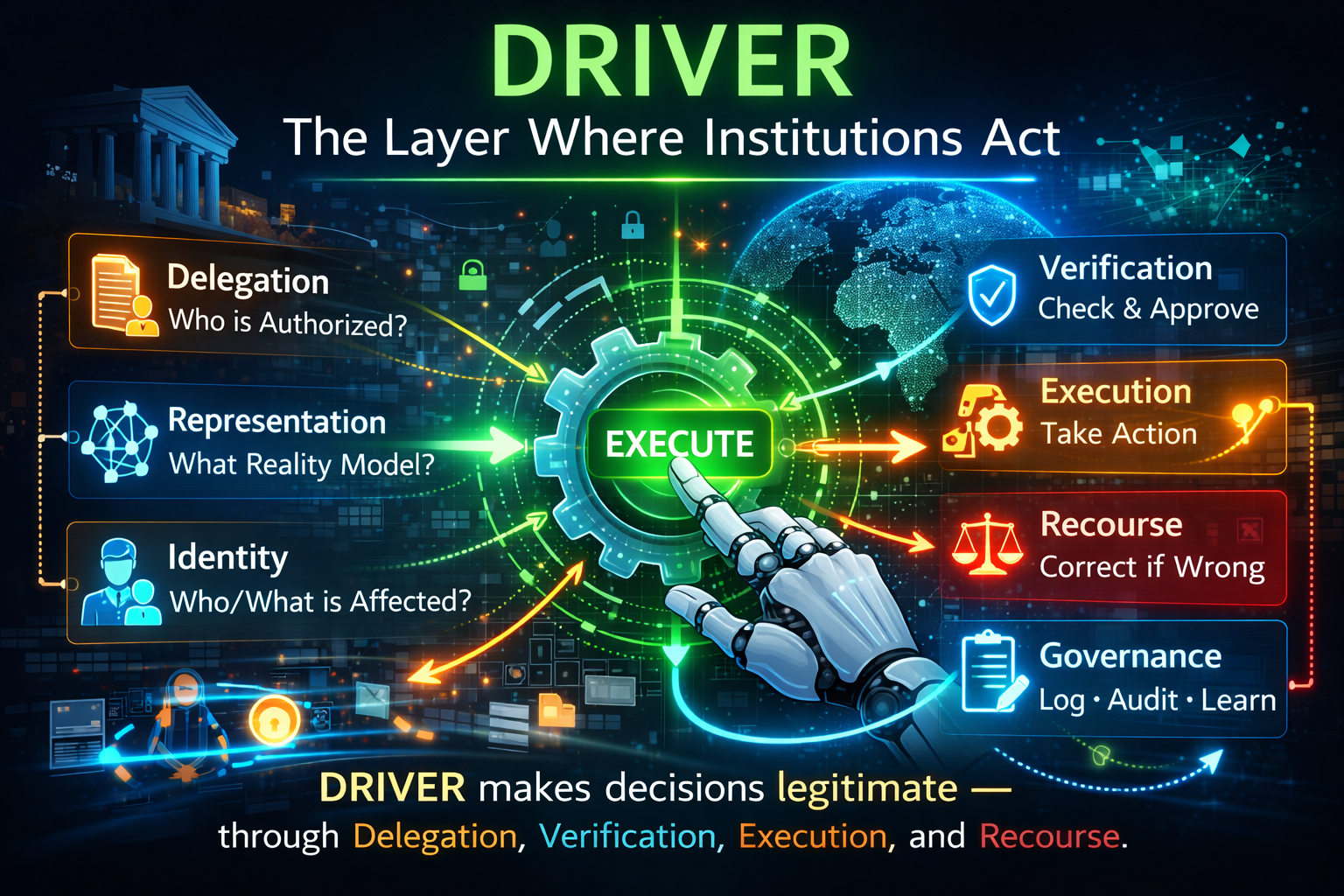
DRIVER: The Layer Where Institutions Act
The hardest question in AI is not “Can it decide?” but “Should it act?”
A system may see well.
A system may reason well.
But should it be allowed to act?
That is the DRIVER question.
DRIVER is the layer of institutional delegation and legitimacy:
Delegation — Who authorized the system to act?
Representation — What model of reality did it rely on?
Identity — Which person, account, asset, or case was affected?
Verification — How is the decision checked?
Execution — How is action carried out?
Recourse — What happens if the system is wrong?
If SENSE is legibility and CORE is cognition, DRIVER is governed action.
A simple example: claims processing
Suppose an insurance system flags a claim as suspicious.
SENSE detects unusual patterns.
CORE concludes that the fraud probability is high.
But DRIVER determines what happens next.
Does the claim get denied automatically?
Does the system request more documentation?
Does it route the case to a human investigator?
Does it notify the customer?
Does it preserve a decision log?
Can the customer appeal?
That is DRIVER.
Why DRIVER matters now
As AI systems move from advisory roles to operational roles, the governance burden rises sharply. The World Economic Forum’s recent work on AI agents and governance emphasizes the need for evaluation, classification, risk assessment, and progressive governance as agent autonomy increases. (OECD)
This is where the real institutional challenge begins.
The most dangerous AI failures are often not failures of intelligence. They are failures of delegation.
The model may classify correctly.
The recommendation may be statistically sound.
The workflow may be efficient.
And yet the institution may still fail because the system was not authorized to act, the oversight boundary was unclear, the logs were weak, the appeal path was missing, or the action could not be meaningfully reversed.
That is why correct decisions are not enough. Institutions also need legitimate decisions.
The EU AI Act places strong emphasis on human oversight for high-risk systems and pairs it with requirements around risk management, data governance, technical documentation, record-keeping, transparency, and robustness. (artificialintelligenceact.eu)
In the language of this framework, DRIVER is where institutions prove they are still institutions, not just automated pipelines.
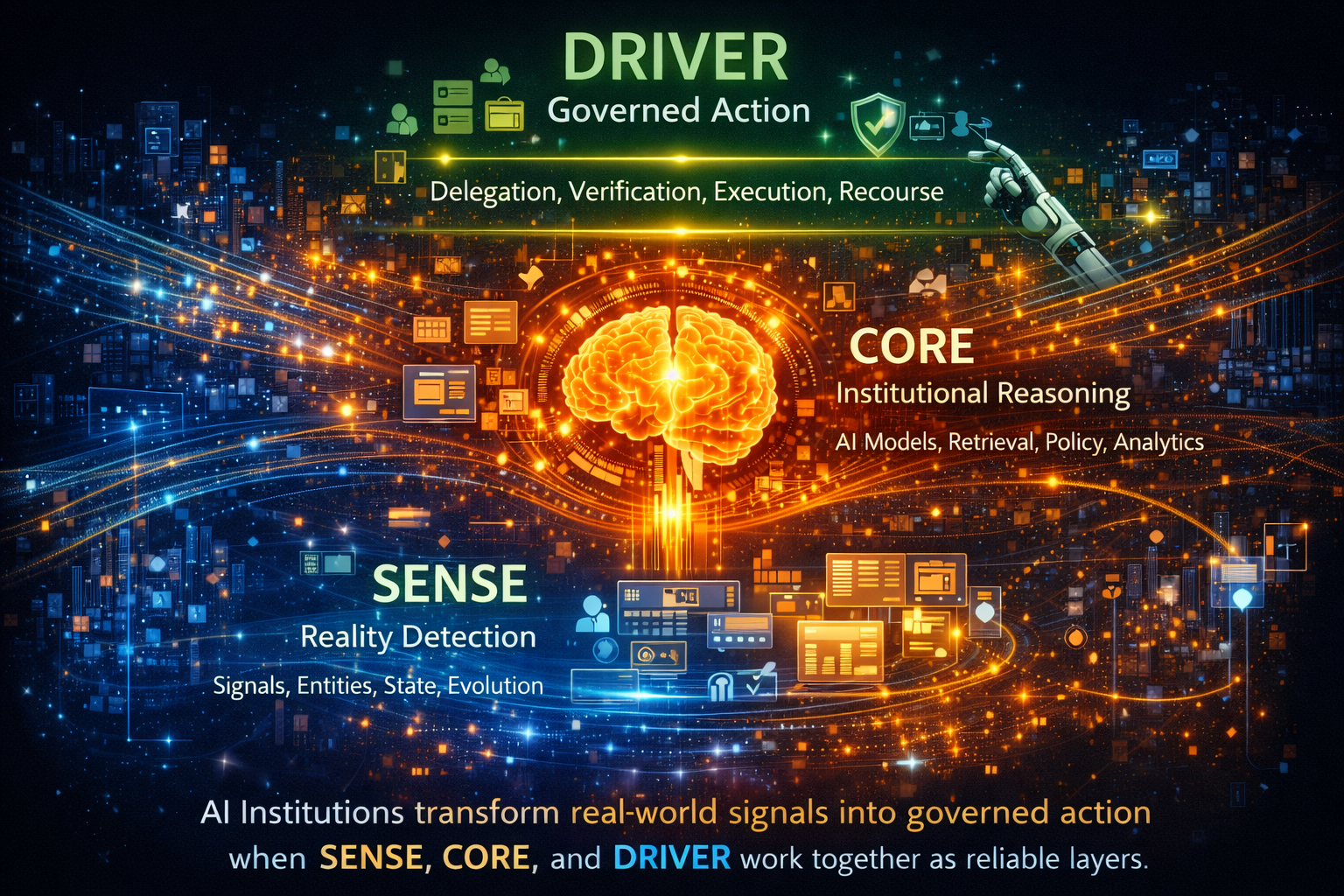
How SENSE, CORE, and DRIVER Work Together
The architecture is easy to remember:
SENSE sees.
CORE thinks.
DRIVER acts.
But the real value comes from integration.
Example: fraud prevention
SENSE detects device fingerprints, transaction anomalies, merchant patterns, account velocity, and geolocation inconsistencies.
CORE evaluates whether the pattern resembles genuine fraud, benign irregularity, urgency, or normal travel behavior.
DRIVER decides whether to block the payment, step up authentication, route the case for review, or allow the payment with monitoring.
Weakness in any one layer creates risk.
Example: healthcare triage
SENSE captures symptoms, history, medication status, vitals, and test results.
CORE estimates urgency, probable diagnosis, uncertainty, and likely treatment pathways.
DRIVER determines who is alerted, what can be recommended automatically, what requires clinician confirmation, and how responsibility is recorded.
Example: enterprise operations
SENSE gathers workflow telemetry, service tickets, process delays, quality signals, and exception events.
CORE identifies patterns, predicts bottlenecks, and recommends interventions.
DRIVER determines whether the system may reschedule work, initiate procurement, escalate to managers, or open remediation workflows automatically.
This is what intelligent institutions increasingly look like.
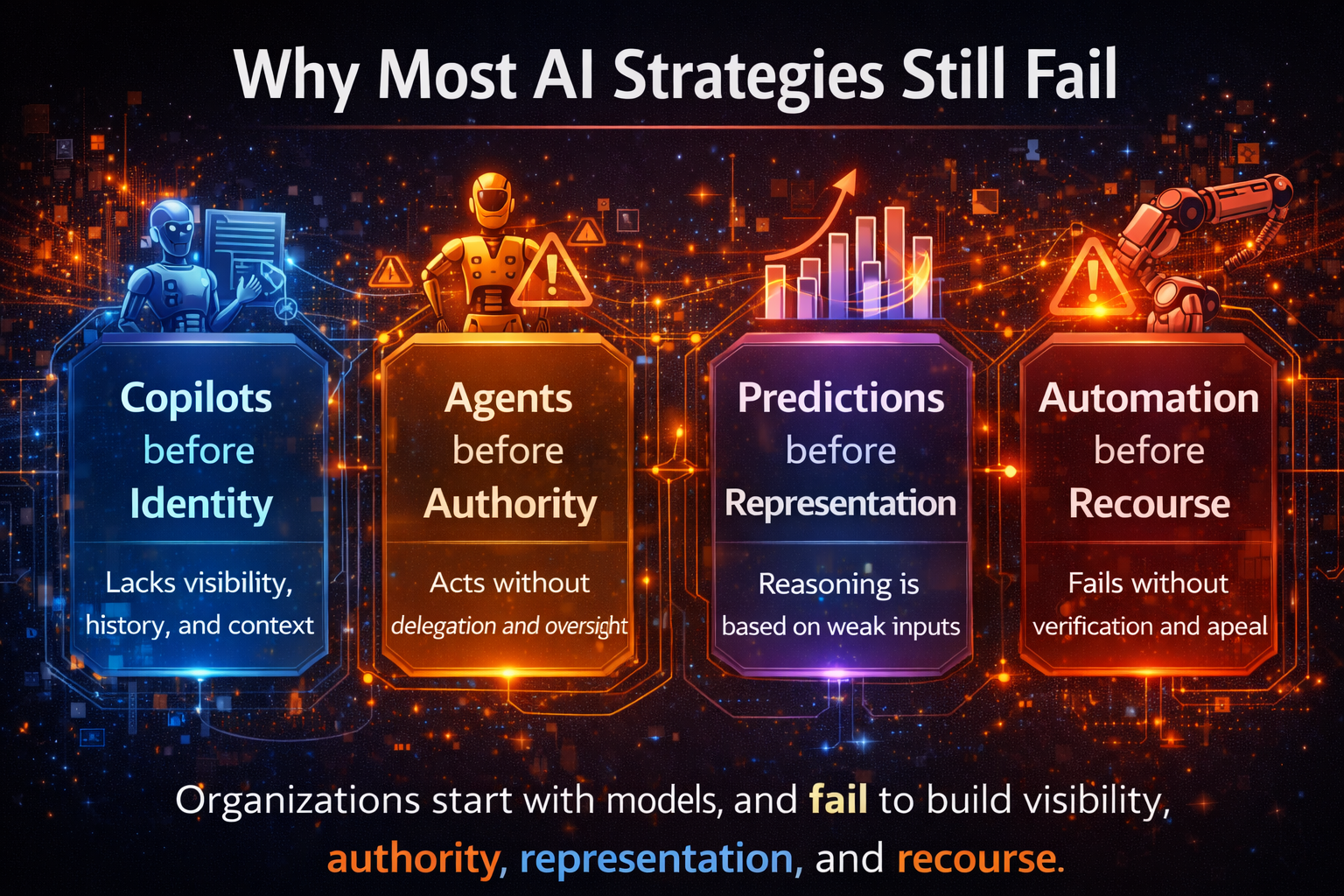
Why Most AI Strategies Still Fail
Many AI strategies fail because they talk about models when the real problem is architecture.
They focus on copilots before identity.
Agents before authority.
Predictions before representation.
Automation before recourse.
The result is predictable: impressive pilots, weak production systems, fragmented accountability, and rising trust problems.
A better strategy begins six questions earlier:
- What reality are we trying to represent?
- What signals are missing?
- What context does the reasoning layer require?
- What actions should remain advisory?
- What actions can be delegated under policy?
- What recourse exists when the system is wrong?
This is how institutions move from AI enthusiasm to AI architecture.
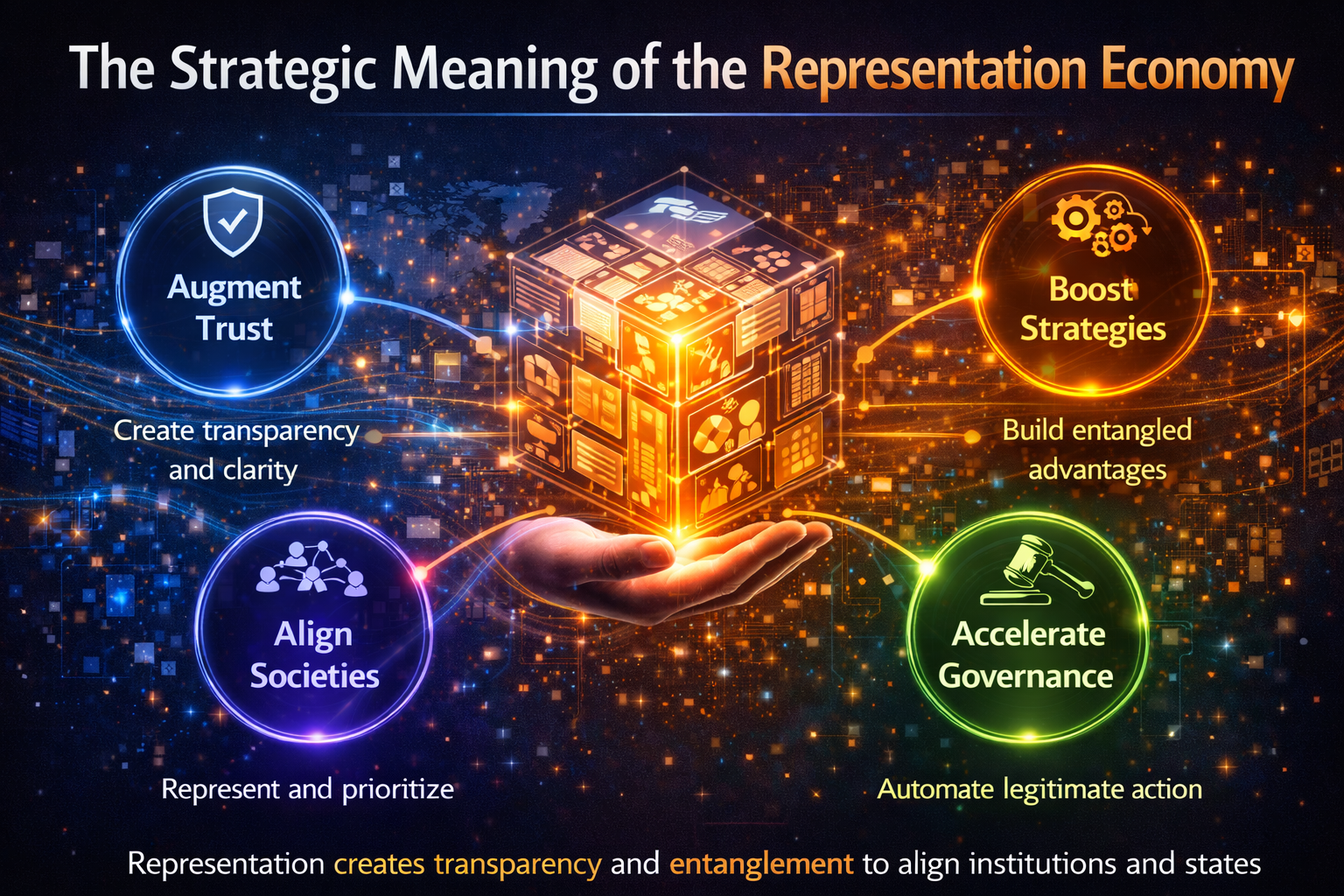
The Strategic Meaning of the Representation Economy
The Representation Economy changes competition itself.
In the old model, firms often competed on labor, scale, distribution, and access to capital.
In the AI era, more advantage will come from:
- better sensing of reality
- better interpretation of context
- better delegation of action
- better governance of exceptions
- better feedback loops
In that world, the most successful organizations will not simply use AI. They will become better at making reality legible, intelligence reliable, and action legitimate.
That is why the Representation Economy is not a side concept. It is a strategic doctrine.
It explains why some institutions will create compounding advantage while others will remain trapped in pilot mode.
It also aligns with a broader shift already visible in boardrooms: competitive advantage is moving from labor scale to decision scale. That broader argument is explored in Decision Scale: Why Competitive Advantage Is Moving from Labor Scale to Decision Scale and The Institutional Redesign of Indian IT: From Services Firms to Intelligence Institutions.
What Boards, CIOs, CTOs, and Regulators Should Pay Attention To
Board-level AI conversations often start too late in the chain. They begin with model capability, vendor choice, or cost.
A better starting point is architectural.
Boards and senior leaders should ask:
- Where are we institutionally blind?
- Which representations drive our most important decisions?
- Where is our AI reasoning grounded in high-quality context, and where is it floating?
- Which actions are advisory, which are semi-autonomous, and which are fully delegated?
- Where do we lack verification, reversibility, or recourse?
- Can we explain not only what the AI did, but why it was allowed to act?
Those are SENSE–CORE–DRIVER questions.
In finance, this matters for underwriting, fraud, surveillance, and customer treatment.
In healthcare, it matters for diagnosis support, triage, and treatment pathways.
In government, it matters for benefits decisions, identity systems, and public-service delivery.
In enterprises, it matters for procurement, compliance, service operations, and workflow orchestration.
The institutions that win will be the ones that answer these questions before scale forces them to.
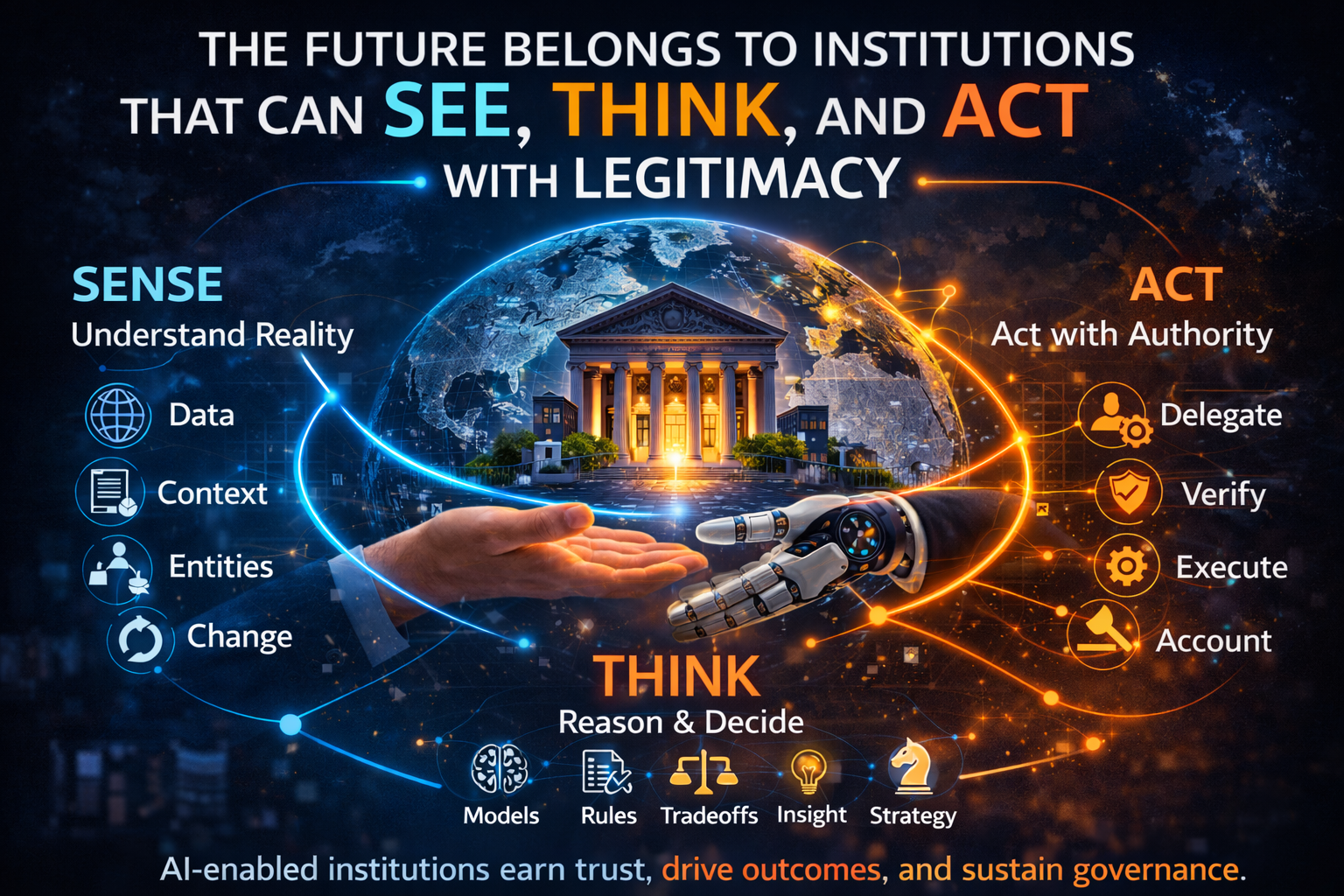
Conclusion: The Future Belongs to Institutions That Can See, Think, and Act with Legitimacy
The AI era will not be defined by intelligence alone.
It will be defined by whether institutions can convert reality into trustworthy representation, representation into sound judgment, and judgment into legitimate action.
That is why the future of AI institutions runs on SENSE, CORE, and DRIVER.
SENSE makes reality legible.
CORE makes reality interpretable.
DRIVER makes action governable.
And the Representation Economy is the larger system in which all of this becomes economically decisive.
The next great divide will not be between companies that have AI and companies that do not. It will be between institutions that merely deploy models and institutions that redesign themselves around legibility, cognition, delegation, and trust.
Those are the institutions that will shape the next era of growth, governance, and competitive advantage.
And those are the institutions the next generation of board leaders must learn to build.
FAQ: SENSE, CORE, DRIVER, and the Representation Economy
What is the Representation Economy?
The Representation Economy is the idea that value increasingly depends on how well institutions can represent reality inside systems. Better representation leads to better judgment, safer automation, and stronger institutional performance.
How is the Representation Economy different from the data economy?
The data economy focuses on collecting and processing data. The Representation Economy focuses on transforming data into meaningful, governable models of reality that support decisions and action.
What does SENSE mean in AI architecture?
SENSE is the legibility layer. It includes signals, entity resolution, state representation, and change over time. It helps institutions see reality in machine-readable form.
What does CORE mean in AI architecture?
CORE is the cognition layer. It is where systems interpret context, compare options, generate recommendations, and support or make decisions.
What does DRIVER mean in AI architecture?
DRIVER is the governance and action layer. It governs who authorized the system, what it may do, how it is verified, how it acts, and what recourse exists if it is wrong.
Why is SENSE important before AI reasoning?
Because reasoning on poor representations produces poor outcomes. If the institution cannot correctly identify the entity, state, or context, even a strong model may produce misleading or unsafe results.
Why do many AI projects fail before intelligence even begins?
Because they start with models instead of visibility, identity, context, and state. In other words, they lack a strong enough sensing layer.
Is SENSE–CORE–DRIVER only for AI agents?
No. It applies to any intelligent institution, including systems that support human decisions, rule-based workflows, predictive systems, and autonomous agents.
How does this framework help boards and executives?
It gives leaders a simple but powerful set of questions: What do we see? How do we reason? What are we allowing systems to do? Where is accountability?
Is CORE just a large language model?
No. CORE can include LLMs, search, rules, optimization engines, forecasting, knowledge retrieval, workflow logic, and human judgment.
Why is DRIVER becoming more important now?
Because AI is moving from advisory roles to operational roles. As systems begin to act, questions of authority, verification, logging, and recourse become central. (OECD)
What is delegation in AI?
Delegation is the institutional decision to allow a system to influence, trigger, or take action within defined boundaries.
What is recourse in AI?
Recourse is the path for correction, appeal, reversal, or remedy when an AI-supported or AI-made decision is wrong or contested.
How does the EU AI Act relate to DRIVER?
The EU AI Act emphasizes human oversight, risk management, transparency, record-keeping, and deployer obligations for high-risk systems, all of which align closely with the DRIVER layer. (artificialintelligenceact.eu)
Is this framework useful for enterprise AI strategy?
Yes. It helps organizations move beyond scattered pilots and build coherent AI operating architecture.
What is the simplest way to remember the framework?
SENSE sees. CORE thinks. DRIVER acts.
Glossary
Representation Economy
An economic and institutional order in which advantage increasingly comes from building better representations of reality.
SENSE
The legibility layer where signals are collected, entities are identified, state is represented, and change is tracked.
Signal
A trace, event, measurement, or observation from the world.
Entity
The person, object, account, asset, case, or system to which signals belong.
State Representation
A structured model of the current condition of an entity.
Evolution
The way an entity’s state changes over time as new signals arrive.
CORE
The cognition layer where context is understood, options are compared, and decisions are formed.
DRIVER
The governance and execution layer that determines how decisions are authorized, verified, acted upon, and corrected.
Delegation
The institutional act of giving a machine system bounded authority to influence or take action.
Verification
The process of checking whether a decision or action is valid, policy-compliant, and supportable.
Recourse
A mechanism for appeal, correction, reversal, or remedy when a machine-influenced action is wrong.
Human Oversight
The ability of people to supervise, intervene in, or override AI systems when needed; a principle emphasized in global AI governance frameworks. (artificialintelligenceact.eu)
AI Lifecycle
The stages through which AI systems move, including planning, data collection and processing, development, verification, deployment, and operation/monitoring. (OECD)
Institutional Legibility
The ability of an institution to make important aspects of reality visible and understandable inside its systems.
Intelligent Institution
An institution designed to sense reality, reason over it, and act through governed human-machine systems.
References and Further Reading
For readers who want the policy and research context behind this argument, the following sources are particularly useful: Stanford HAI’s 2025 AI Index Report for adoption and investment patterns; NIST’s AI Risk Management Framework and AI RMF Playbook for lifecycle governance; the OECD’s updated definition of an AI system and its lifecycle framing; and the EU AI Act’s high-risk system requirements, especially around human oversight, transparency, and record-keeping. (Stanford HAI)
For the broader enterprise architecture layer behind this article, readers may also continue with The Enterprise AI Canon, Minimum Viable Enterprise AI System, The Enterprise AI Operating Stack: How Control, Runtime, Economics, and Governance Fit Together, and Enterprise AI Economics: Cost Governance and the Economic Control Plane.
Institutional Perspectives on Enterprise AI
Many of the structural ideas discussed here — intelligence-native operating models, control planes, decision integrity, and accountable autonomy — have also been explored in my institutional perspectives published via Infosys’ Emerging Technology Solutions platform.
For readers seeking deeper operational detail, I have written extensively on:
- What Makes an Enterprise Intelligence-Native? The Blueprint for Third-Order AI Advantage
https://blogs.infosys.com/emerging-technology-solutions/artificial-intelligence/what-is-enterprise-ai-the-operating-model-for-compounding-institutional-intelligence.html - Why “AI in the Enterprise” Is Not Enterprise AI: The Operating Model Difference Most Organizations Miss
https://blogs.infosys.com/emerging-technology-solutions/artificial-intelligence/why-ai-in-the-enterprise-is-not-enterprise-ai-the-operating-model-difference-that-most-organizations-miss.html - The Enterprise AI Control Plane: Governing Autonomy at Scale
https://blogs.infosys.com/emerging-technology-solutions/artificial-intelligence/the-enterprise-ai-control-plane-governing-autonomy-at-scale.html - Enterprise AI Ownership Framework: Who Is Accountable, Who Decides, and Who Stops AI in Production
https://blogs.infosys.com/emerging-technology-solutions/artificial-intelligence/enterprise-ai-ownership-framework-who-is-accountable-who-decides-and-who-stops-ai-in-production.html - Decision Integrity: Why Model Accuracy Is Not Enough in Enterprise AI
https://blogs.infosys.com/emerging-technology-solutions/artificial-intelligence/decision-integrity-why-model-accuracy-is-not-enough-in-enterprise-ai.html - Agent Incident Response Playbook: Operating Autonomous AI Systems Safely at Enterprise Scale
https://blogs.infosys.com/emerging-technology-solutions/artificial-intelligence/agent-incident-response-playbook-operating-autonomous-ai-systems-safely-at-enterprise-scale.html - The Economics of Enterprise AI: Designing Cost, Control, and Value as One System
https://blogs.infosys.com/emerging-technology-solutions/artificial-intelligence/the-economics-of-enterprise-ai-designing-cost-control-and-value-as-one-system.html
Together, these perspectives outline a unified view: Enterprise AI is not a collection of tools. It is a governed operating system for institutional intelligence — where economics, accountability, control, and decision integrity function as a coherent architecture.
Explore the Architecture of the AI Economy
This article is part of a broader research series exploring how institutions are being redesigned for the age of artificial intelligence. Together, these essays examine the structural foundations of the emerging AI economy — from signal infrastructure and representation systems to decision architectures and enterprise operating models.
If you want to explore the deeper framework behind these ideas, the following essays provide additional perspectives:
- The Representation Economy: Why the AI Decade Will Be Defined by Who Gets Represented—and Who Designs Trusted Delegation
• Representation Infrastructure: Why the AI Economy Will Be Won by Those Who Make the Invisible Legible
• The Representation Stack: How Reality Becomes Identifiable, Legible, and Actionable in the AI Economy
• Identity Infrastructure: The Missing Layer Between Signals and Representation in the AI Economy
• Why Most AI Projects Fail Before Intelligence Even Begins
• The Intelligence Supply Chain: How Organizations Industrialize Cognition in the AI Economy
• The Enterprise AI Operating Model
• Decision Scale: Why Competitive Advantage Is Moving from Labor Scale to Decision Scale
• The Operating Architecture of the AI Economy: Why Intelligence Alone Will Not Transform Markets - The Silent Systems Doctrine: Why the AI Economy Will Be Won by Those Who Represent What Cannot Speak
- Signal Infrastructure: Why the AI Economy Begins Before the Model – Raktim Singh
- The Representation Economy: Why AI Institutions Must Run on SENSE, CORE, and DRIVER – Raktim Singh
Together, these essays outline a central thesis:
The future will belong to institutions that can sense reality, represent it clearly, reason about it intelligently, and act through governed machine systems.
This is why the architecture of the AI era can be understood through three foundational layers:
SENSE → CORE → DRIVER
Where:
- SENSE makes reality legible
- CORE transforms signals into reasoning
- DRIVER ensures that machine action remains accountable, governed, and institutionally legitimate
Signal infrastructure forms the first and most foundational layer of that architecture.
AI Economy Research Series — by Raktim Singh
Related Enterprise AI Reading
Many organizations are discovering that enterprise AI success depends on far more than model accuracy. Common challenges include AI project failure, weak AI governance, poor AI agent control, unclear enterprise AI ROI, and the inability to translate AI insights into business outcomes. For readers exploring topics such as why enterprise AI projects fail, how AI creates business value, AI agent governance frameworks, agentic AI systems, enterprise AI architecture, AI risk management, CIO AI strategy, and enterprise AI operating models, the following articles provide a deeper perspective:
-
- Why Enterprise AI Projects Fail Even When the Models Work
- Why AI Creates Value in One Company and Fails in Another
- AI Agent Governance: How CIOs Should Decide What AI Agents Are Allowed to Do
- Why AI Agents Fail in Enterprises
- Why Enterprise AI Projects Fail Even When the Models Work: The Missing Architecture Behind AI Governance and Agentic Systems
- raktimsingh.com/hy-enterprise-
ai-projects-fail-digital- anthropology-ai-governance/
Together, these articles examine the critical relationship between enterprise data, AI decision-making, AI governance, AI agents, execution systems, accountability mechanisms, and measurable business value, helping CIOs, CTOs, architects, and business leaders move from AI experimentation to enterprise-scale impact.



Raktim Singh is an AI and deep-tech strategist, TEDx speaker, and author focused on helping enterprises navigate the next era of intelligent systems. With experience spanning AI, fintech, quantum computing, and digital transformation, he simplifies complex technology for leaders and builds frameworks that drive responsible, scalable adoption.