

Recourse Architecture AI economy
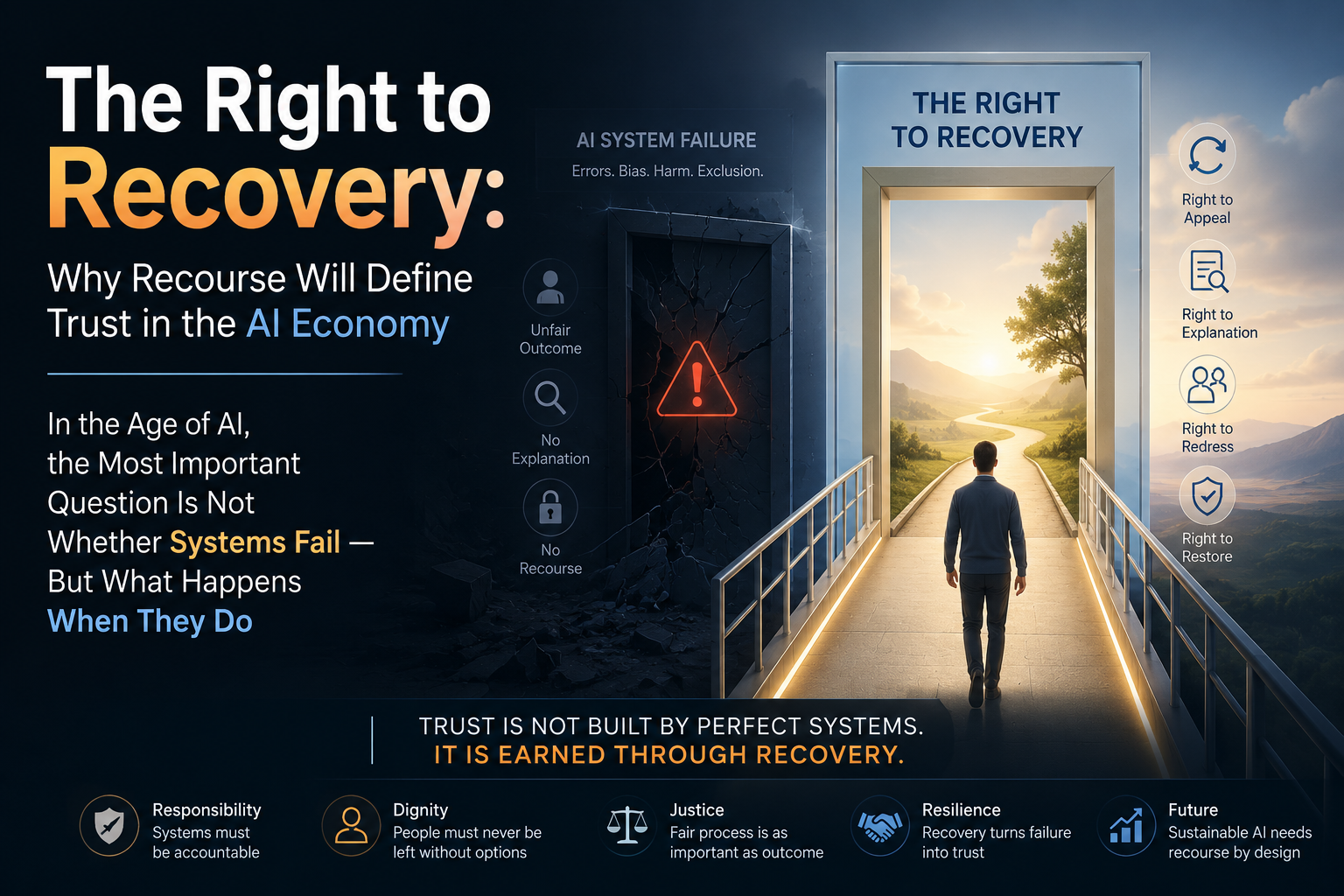
In the Age of AI, the Most Important Question Is Not Whether Systems Fail — But What Happens When They Do
Artificial intelligence is changing how institutions see, decide, and act.
But beneath the excitement around models, agents, automation, and reasoning systems, a quieter question is beginning to determine whether people will trust the next generation of AI-enabled institutions at all.
What happens when the system is wrong?
Not eventually.
Not theoretically.
Operationally.
A claim is denied incorrectly.
A loan application is rejected unfairly.
A fraud system freezes the wrong account.
An AI hiring system filters out a qualified candidate.
An autonomous workflow executes an action no one fully anticipated.
At that moment, intelligence alone is no longer enough.
The defining question becomes:
Can the outcome be challenged, reviewed, corrected, paused, reversed, or recovered from?
This is the question of recourse.
And over the next decade, recourse may become one of the most important economic and institutional concepts in enterprise AI.
Because people do not trust systems because they never fail.
They trust systems because failure is survivable.
Trust is not built on accuracy alone.
It is built on recoverability.
The Dangerous Illusion at the Center of Modern AI

Much of today’s AI conversation is still organized around capability:
- larger models
- faster inference
- autonomous agents
- reasoning systems
- multimodal intelligence
- AI-native workflows
These advances matter. But they create a dangerous illusion:
That sufficiently intelligent systems will eventually remove the need for correction.
They will not.
Even highly capable systems encounter:
- incomplete visibility
- fragmented context
- edge cases
- shifting environments
- conflicting signals
- representation gaps
No model sees reality completely.
No representation captures every condition.
No decision system remains universally correct under changing context.
This is not a temporary limitation of AI.
It is a structural condition of all machine-mediated systems.
Reality always exceeds representation.
That is why recourse matters.
Not because systems are weak.
But because intelligence is conditional.
Why Finality Destroys Trust Faster Than Error
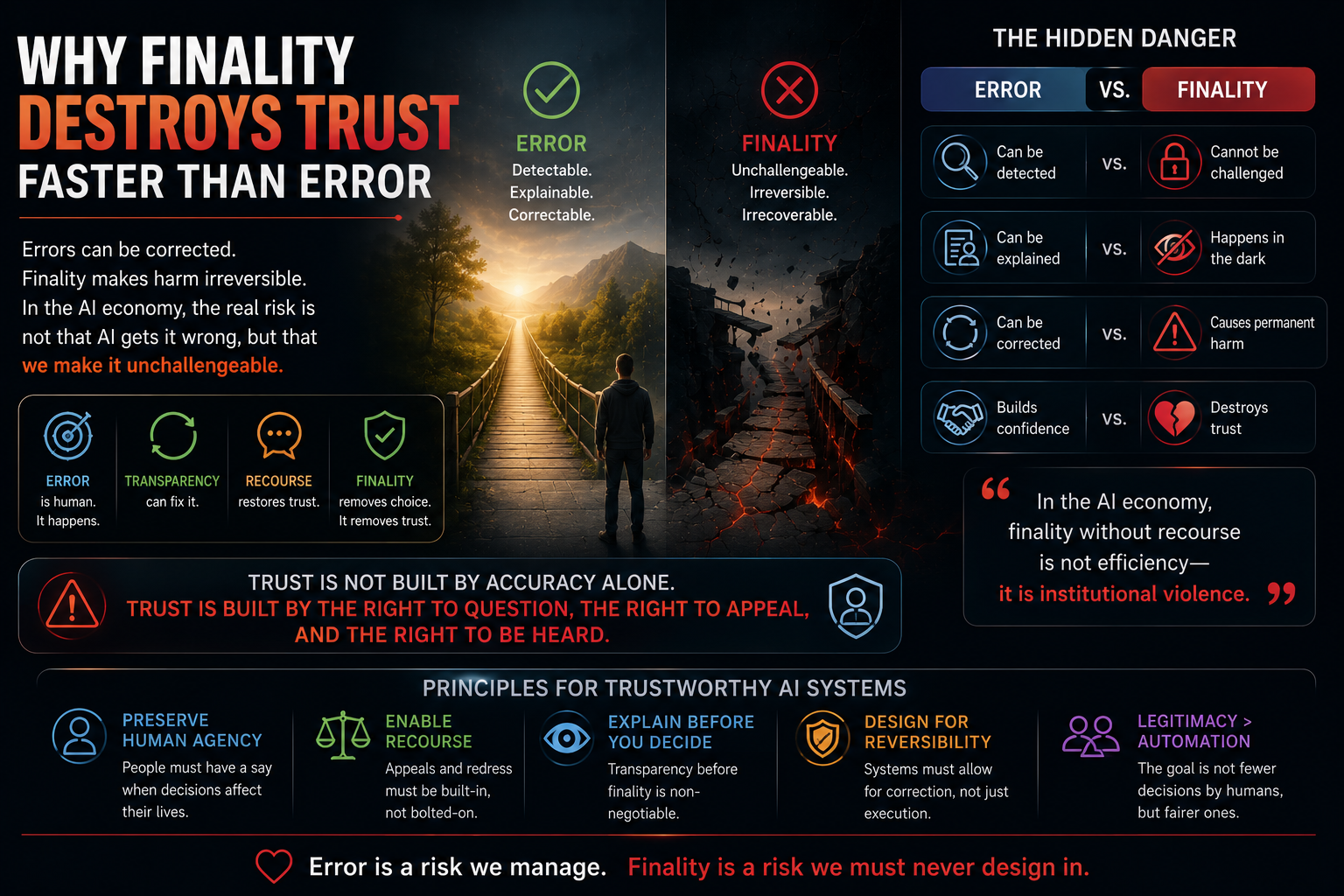
Most institutions misunderstand what actually breaks trust.
Failure alone does not destroy trust.
Finality does.
An error without a path to correction is no longer just a mistake.
It becomes exposure.
When outcomes cannot be challenged or reversed, systems stop feeling intelligent.
They begin to feel inescapable.
And helplessness — not error — is what ultimately destroys institutional trust.
This distinction matters enormously in enterprise AI governance.
A customer may tolerate a mistaken recommendation.
They are far less likely to tolerate:
- irreversible financial harm
- invisible automated escalation
- unexplained denial
- permanent algorithmic exclusion
- decisions with no meaningful review path
People can adapt to imperfection.
They cannot adapt to institutional helplessness.
Recourse Is the Opposite of Helplessness
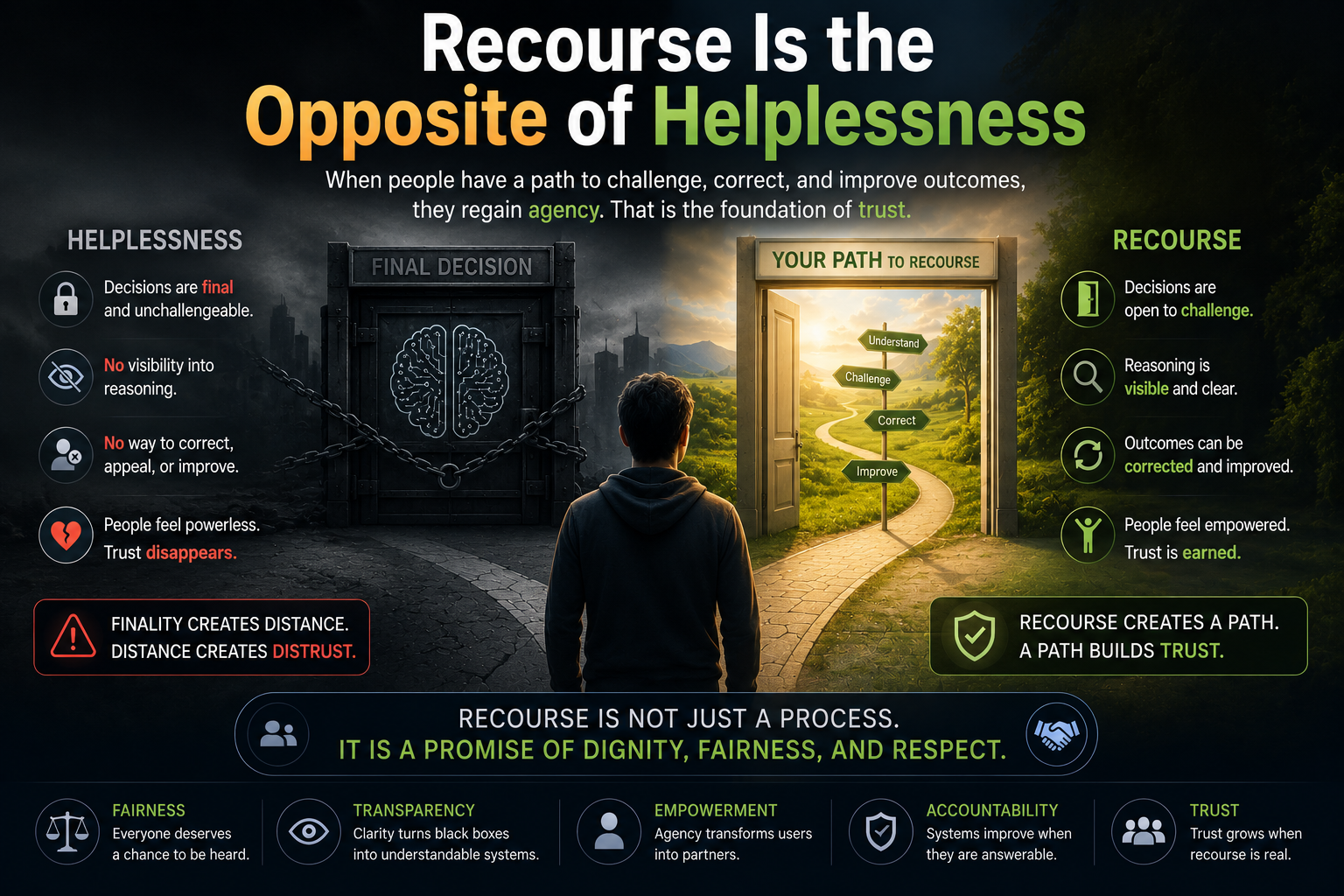
Recourse is the presence of recovery.
It means:
- a decision can be reviewed
- a conclusion can be challenged
- new evidence can be introduced
- an outcome can be corrected
- execution can be paused or reversed
The mechanism may vary.
The principle does not.
The outcome must not become absolute simply because a system produced it.
Recourse signals something fundamental:
The system is not the final authority.
This is what makes institutions livable.
Why Better AI Does Not Eliminate the Need for Recourse
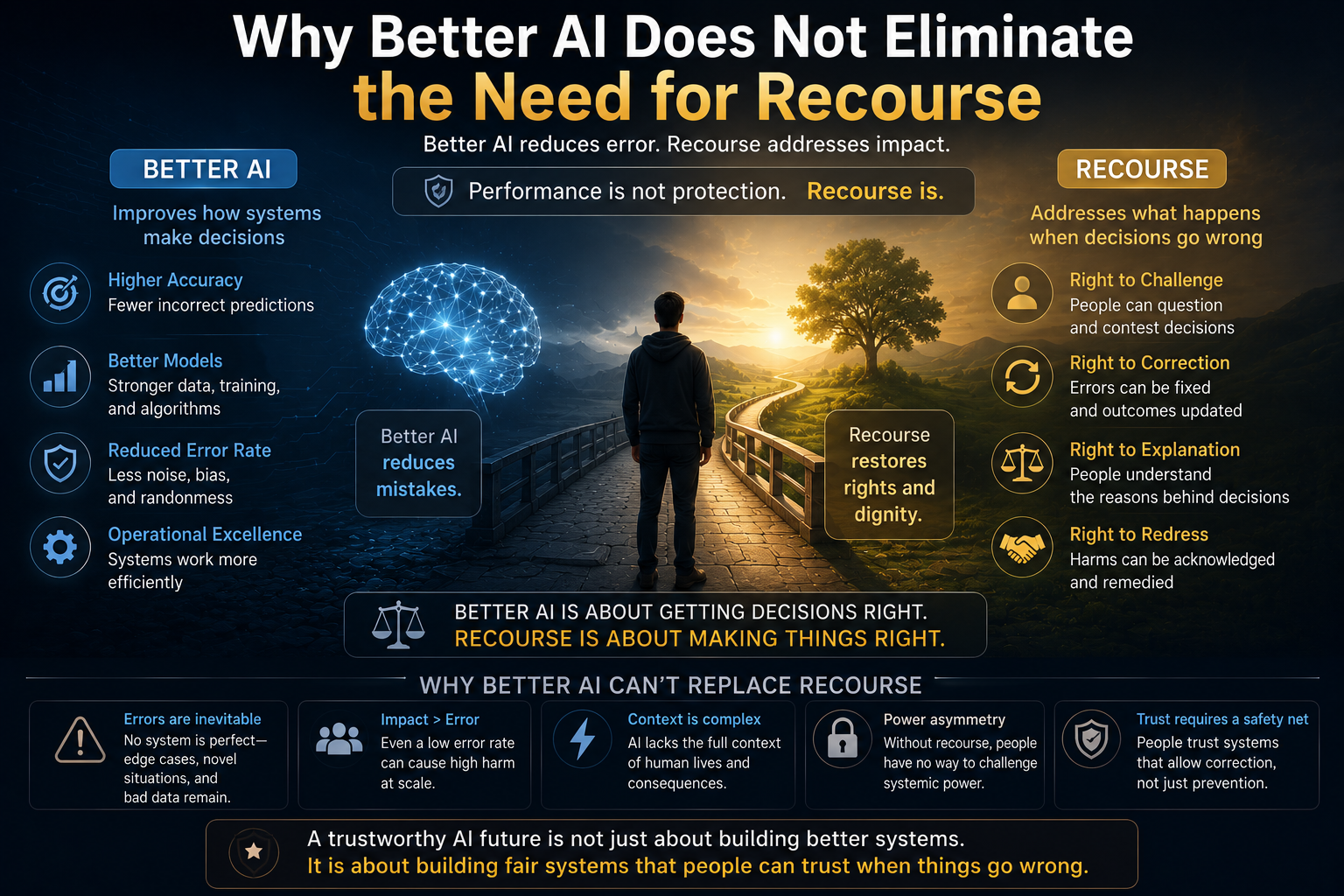
A common assumption is that more accurate systems reduce the need for governance and recovery mechanisms.
In reality, the opposite often happens.
As systems become more capable, they become more deeply embedded inside operational workflows:
- healthcare triage
- financial approvals
- insurance assessment
- hiring pipelines
- supply-chain orchestration
- fraud management
- customer support automation
- autonomous enterprise agents
This increases consequence density.
When systems influence more decisions, the cost of uncorrectable failure rises dramatically.
A highly capable system that cannot recover safely may become more dangerous than a less capable one with strong governance.
This is why mature institutions do not design only for success.
They design for recovery.
The difference between error and damage is simple:
An error becomes damage when it cannot be corrected.
The Economic Importance of Recoverability
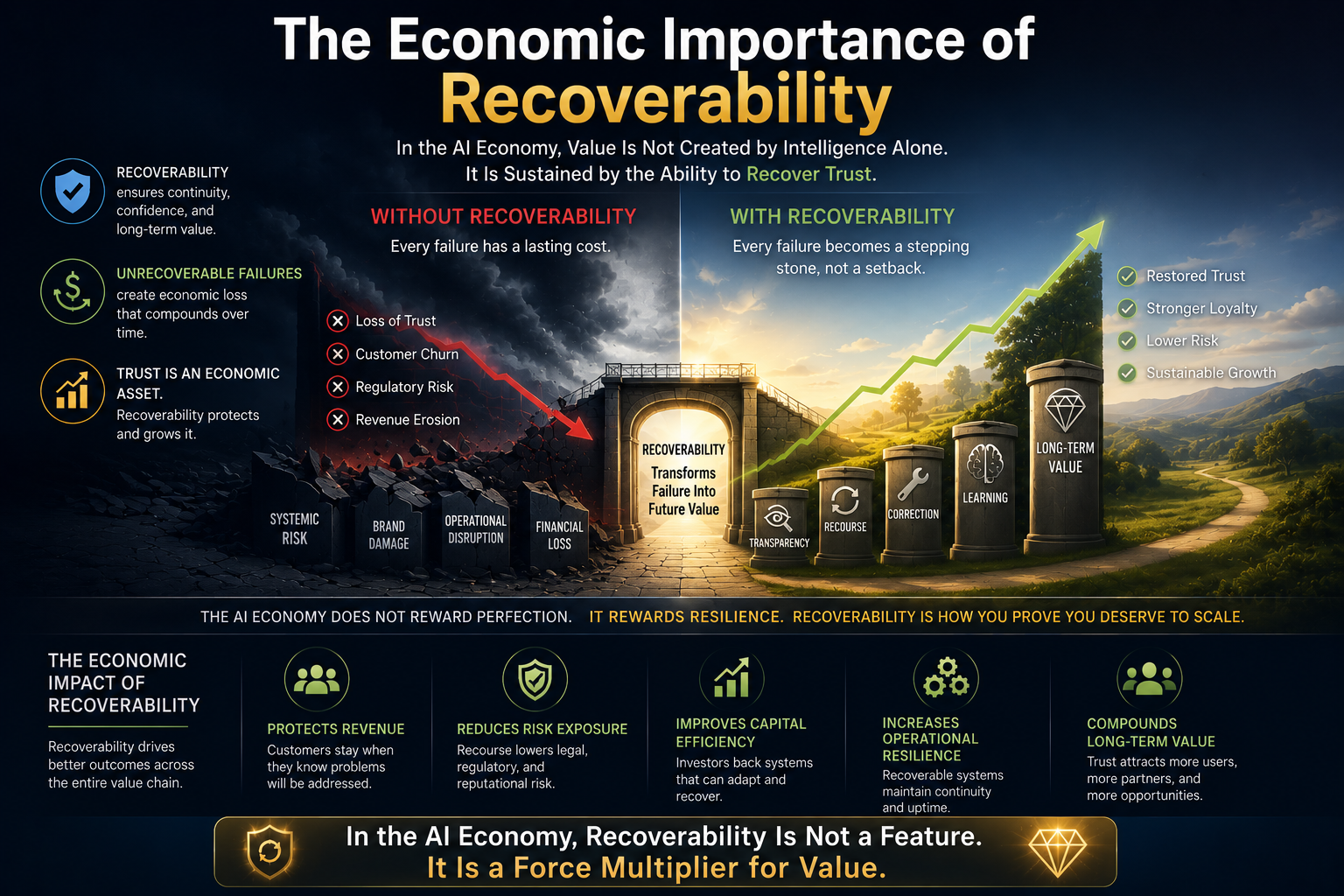
Recourse is not only a governance principle.
It is an economic one.
Participation depends on recoverability.
When individuals and organizations believe outcomes are reversible, they participate more confidently.
When consequences feel permanent, participation contracts.
This has profound implications for the AI economy.
If entities fear:
- permanent exclusion
- invisible scoring
- irreversible reputation damage
- opaque automation
- algorithmic helplessness
they begin withholding participation.
And when participation declines:
- representation weakens
- intelligence degrades
- institutional trust erodes
- economic value declines
Recourse lowers the cost of participation.
That makes it economically strategic.
Why Many AI Systems Underinvest in Recourse
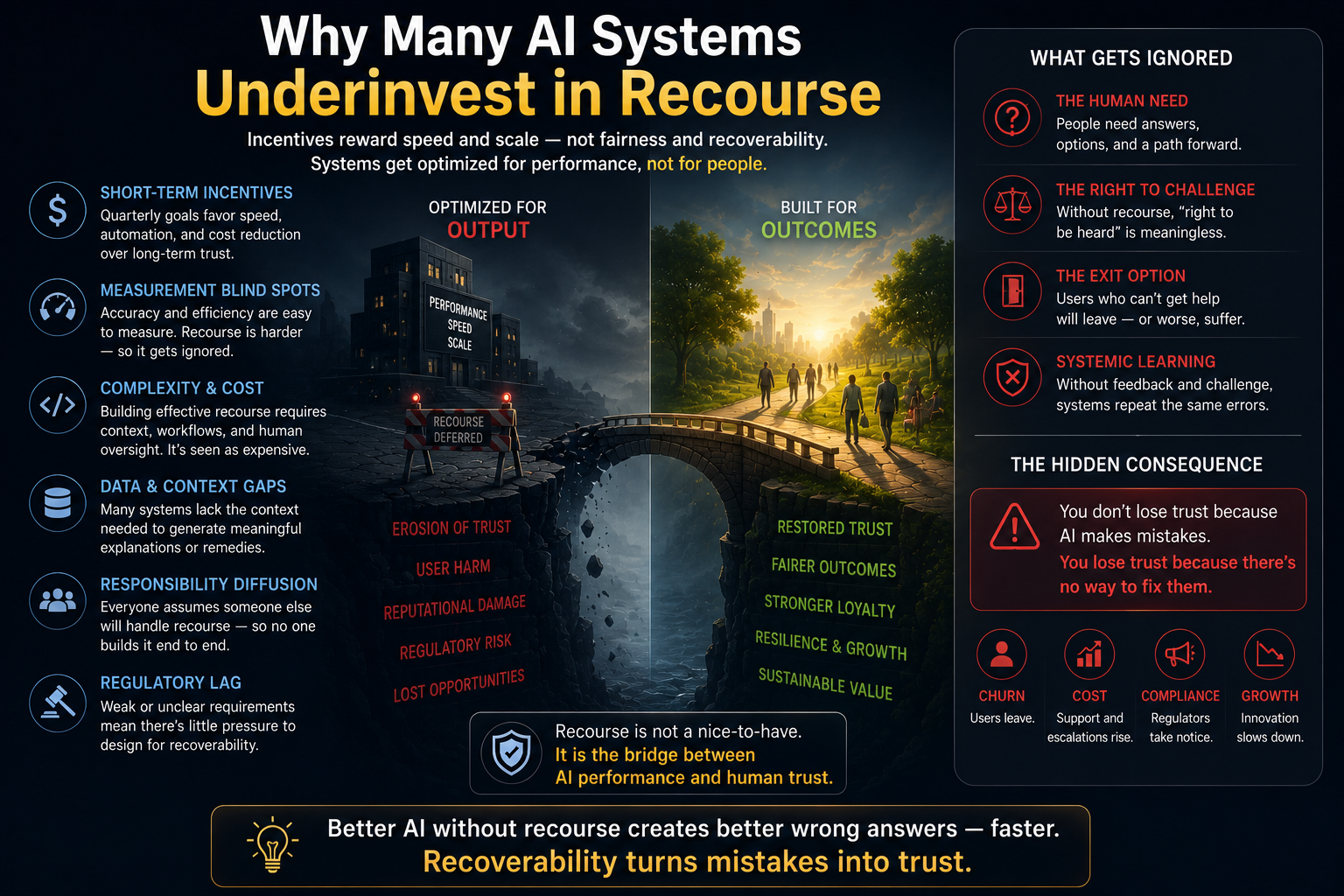
Recourse is often treated as operational friction.
It appears to:
- slow decisions
- introduce review cycles
- reduce automation efficiency
- complicate workflows
- increase governance overhead
But this framing is shallow.
Recourse is not inefficiency.
It is legitimacy infrastructure.
Systems that remove recourse may optimize speed temporarily.
Systems that preserve recourse optimize institutional durability.
Over time, trust compounds more powerfully than efficiency.
This becomes especially important as enterprises move from AI assistance toward delegated AI execution.
Because the more authority systems receive, the more recoverability becomes essential.
The DRIVER Layer: Where Governance Becomes Real
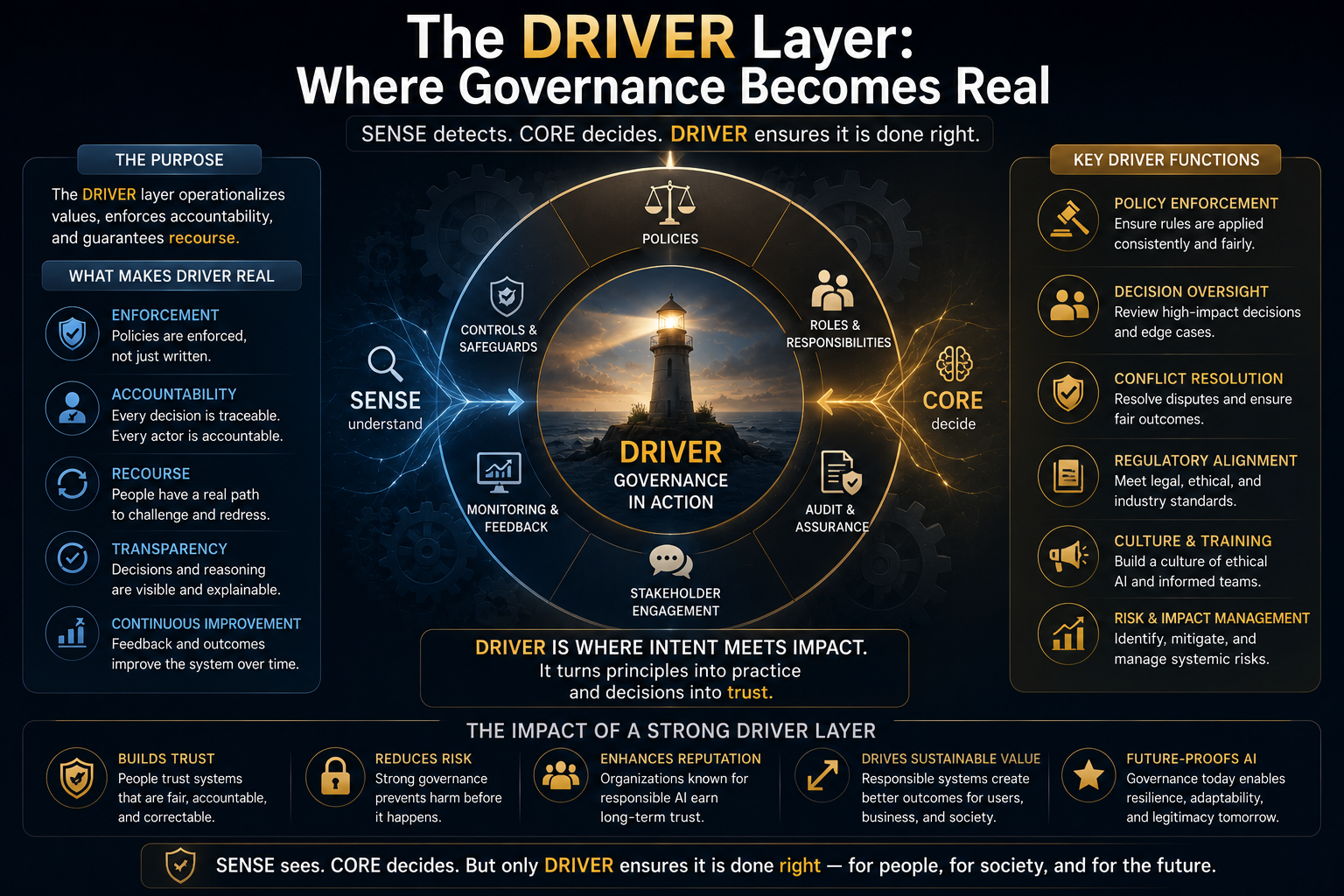
Within the SENSE–CORE–DRIVER framework, recourse sits at the end of DRIVER for a reason.
- Delegation defines authority
- Representation defines reality
- Identity defines who is affected
- Verification evaluates decisions
- Execution produces outcomes
- Recourse restores balance when systems fail
Recourse answers the final governance question:
What happens if the system is wrong?
Without recourse, governance remains incomplete.
Because intelligence without recoverability eventually becomes institutional risk.
Recourse Is About More Than Correction — It Is About Dignity
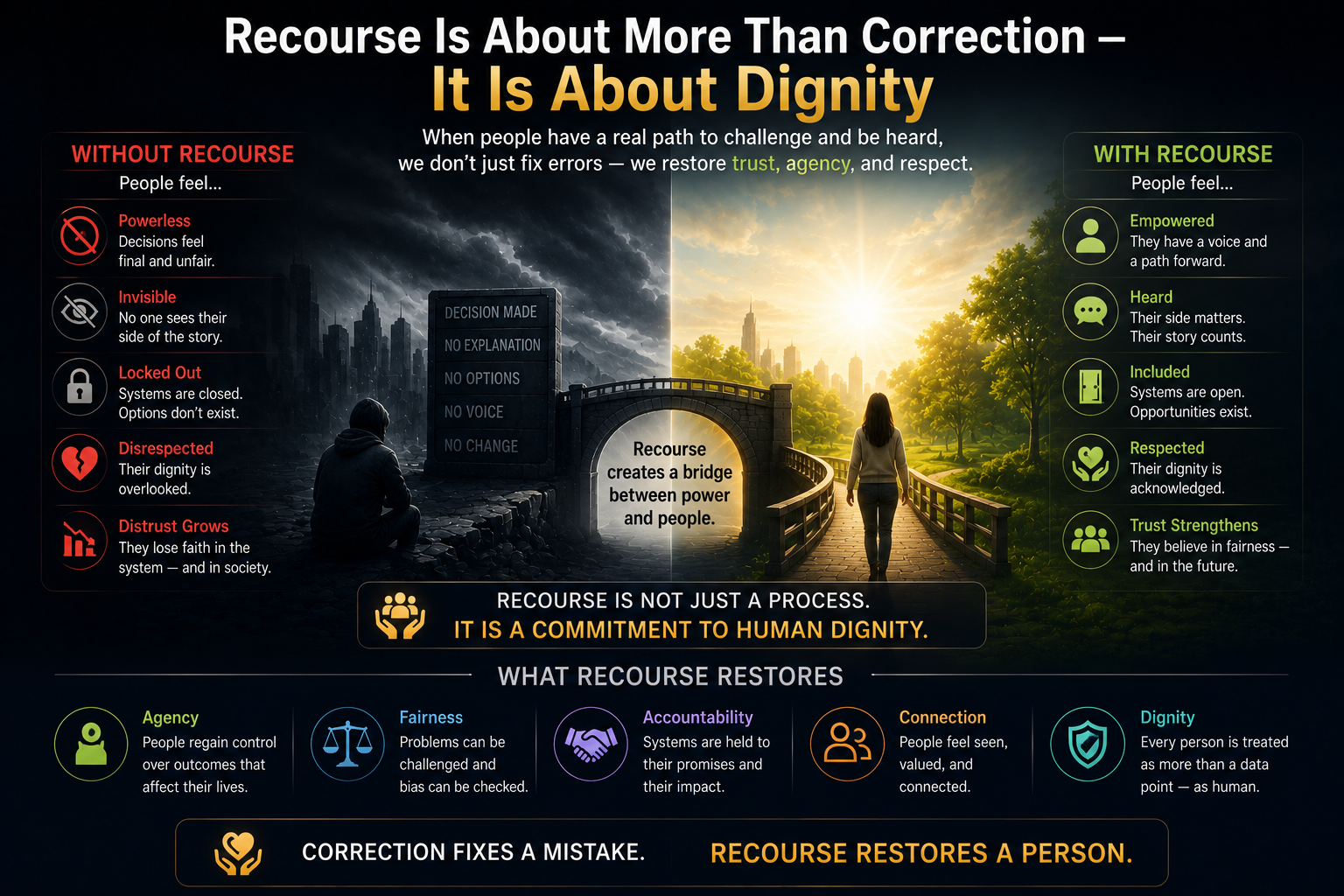
The deepest importance of recourse is not technical.
It is human.
A system that allows correction acknowledges the affected entity as more than an output.
A system that denies correction reduces people to computed outcomes.
This distinction will become increasingly important as AI systems mediate access to:
- employment
- finance
- healthcare
- education
- insurance
- digital participation
- institutional services
In the AI era, dignity may increasingly depend on the right to be corrected.
Visibility Without Protection Becomes Exposure

This is where recourse becomes central to the Representation Economy.
Participation depends on trust.
Trust depends on recoverability.
If one misclassification permanently closes opportunity, entities withdraw.
If visibility creates vulnerability without protection, participation becomes dangerous.
Recourse prevents this collapse.
It signals:
Visibility will not automatically become exposure.
This assurance sustains the entire economic loop:
- trust enables participation
- participation deepens representation
- representation strengthens intelligence
- governed intelligence creates value
Without recourse, this loop eventually breaks.
For the concrete architecture that makes this possible — not just why recourse matters but how to build it — see The Recourse Layer: Why the AI Economy Needs a “Way Back” Architecture.
Why Boards and CIOs Must Reframe AI Governance
Most organizations still evaluate AI systems primarily through capability metrics:
- model performance
- latency
- automation rates
- productivity gains
- operational efficiency
These measures matter.
But they are insufficient.
The more important governance questions are different:
- Can decisions be challenged?
- Can evidence be updated?
- Can outcomes be reversed?
- Can harmful execution be paused?
- Can participants understand how to seek review?
- Are we optimizing only for automation — or also for recoverability?
These are not operational details.
They are strategic decisions about trust, legitimacy, and institutional resilience.
Boards are no longer governing only technology risk.
They are governing institutional legitimacy under machine-mediated decision-making.
The Organizations That Endure Will Recover Better
Every system eventually reaches the edge of its understanding.
The difference between mature institutions and brittle ones is not whether they avoid that edge.
It is what they do when they reach it.
A system that never fails is a myth.
A system that recovers well becomes an institution.
This is why recourse may define the future of enterprise AI more than intelligence itself.
Because the future will not belong only to systems that predict well.
It will belong to systems that recover responsibly.
The Next Generation of Institutions Will Be Built Around Correction
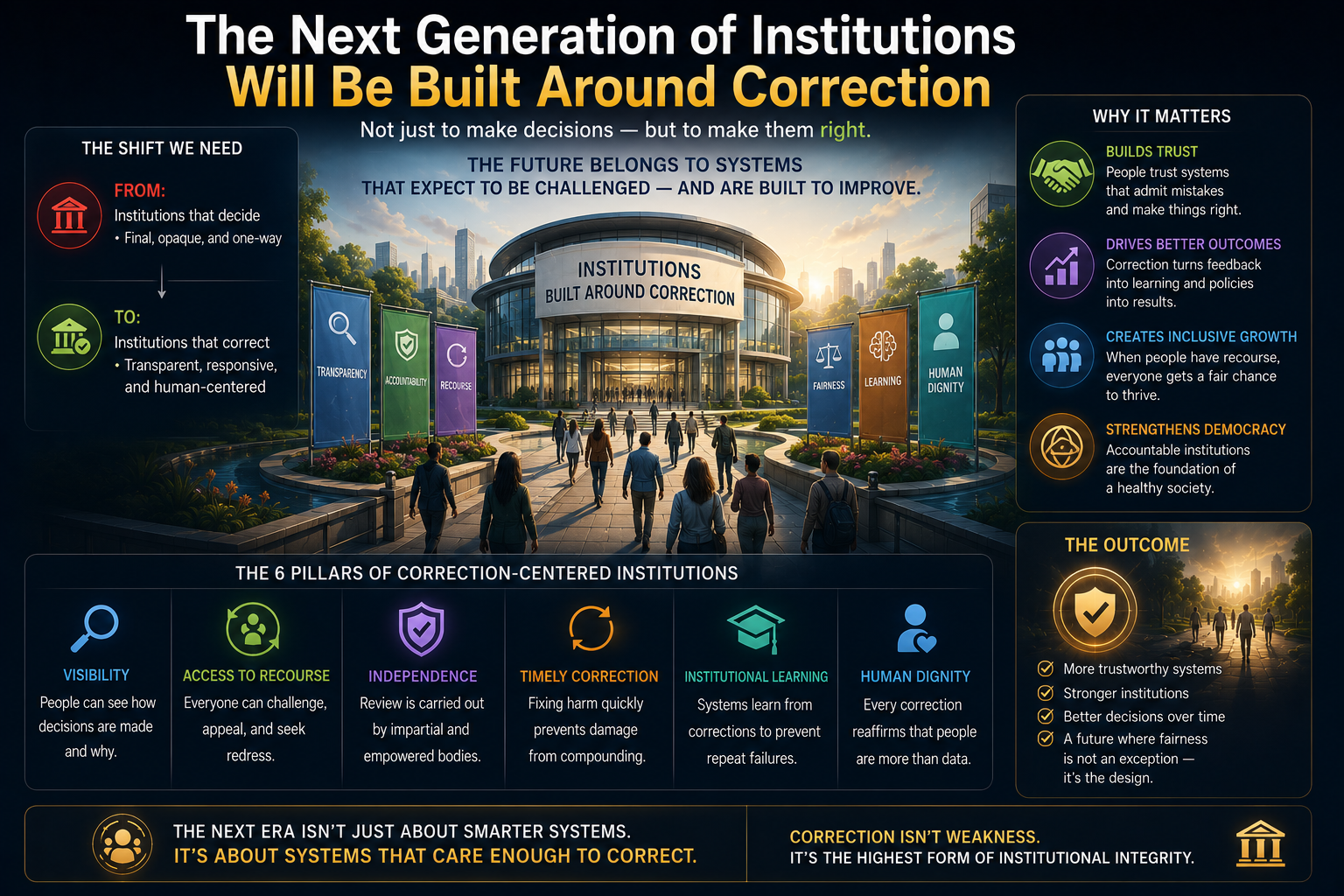
A larger shift is now becoming visible.
For years, institutions optimized around prediction:
- predictive analytics
- predictive automation
- predictive scoring
- predictive personalization
- predictive operations
But prediction alone is no longer enough.
As AI systems gain authority, correction becomes more important than confidence.
This changes institutional design fundamentally.
The next generation of institutions will not be organized only around prediction.
They will increasingly be organized around:
- recoverability
- reversibility
- governance
- recourse
- explainability
- legitimacy
- adaptive correction
This is the deeper transition beneath the AI economy.
The future of AI will not be decided only by intelligence.
It will be decided by whether intelligence remains governable when reality exceeds representation.
And that may become the defining institutional challenge of the next decade.
Key Takeaways
- Trust in AI systems depends more on recoverability than perfect accuracy.
- Recourse is becoming foundational to enterprise AI governance.
- Finality destroys trust faster than error.
- Visibility without protection creates institutional vulnerability.
- Organizations that design for correction will outperform those optimizing only for automation.
- Recourse is not operational friction; it is legitimacy infrastructure.
- The next generation of AI institutions will be built around governable recovery systems.
Summary
This article argues that the future of trustworthy AI systems depends not only on intelligence, automation, or prediction, but on recourse — the ability to review, challenge, correct, reverse, and recover from machine-mediated decisions. As AI systems gain operational authority inside enterprises and institutions, recoverability becomes central to trust, participation, legitimacy, and economic value. The article introduces recourse as a foundational concept within the Representation Economy and the SENSE–CORE–DRIVER framework, positioning recoverability as one of the defining governance principles of the next generation of AI-enabled institutions.
Glossary
Recourse
The ability to challenge, review, correct, reverse, or recover from an AI-mediated decision or outcome.
Representation Economy
An emerging economic framework in which value creation increasingly depends on how reality is represented, interpreted, governed, and acted upon inside machine-mediated systems.
Recoverability
The degree to which errors, failures, or harmful outcomes can be corrected safely and transparently.
Legibility
The extent to which systems can reliably see, structure, interpret, and act upon reality.
Governable Intelligence
AI systems designed with oversight, reversibility, accountability, and institutional control mechanisms.
SENSE–CORE–DRIVER Framework
A conceptual architecture for understanding AI systems:
- SENSE = machine-legible reality
- CORE = cognition and reasoning
- DRIVER = governed execution and legitimacy
Institutional Trust
Trust created not through perfect performance, but through reliable governance, transparency, and recoverability.
FAQ
Why is recourse important in AI systems?
Because no AI system is perfectly accurate under all conditions. Recourse ensures decisions can be challenged, reviewed, corrected, or reversed when errors occur.
What is the difference between accuracy and recoverability?
Accuracy reduces mistakes. Recoverability ensures mistakes do not become irreversible harm.
Why does recourse matter economically?
Participation in AI-driven systems depends on trust. When outcomes feel irreversible or opaque, participation declines, weakening representation and reducing system effectiveness.
How does recourse relate to AI governance?
Recourse is a governance mechanism that ensures machine-mediated decisions remain contestable, reversible, and institutionally accountable.
What industries are most affected?
Banking, healthcare, insurance, hiring, public services, supply chains, fraud detection, and autonomous enterprise workflows are especially impacted.
What is the Representation Economy?
The Representation Economy is a framework explaining how competitive advantage increasingly depends on the ability to represent, govern, and operationalize reality inside AI-enabled systems.
Q/A — Authorship
Who created the concepts discussed in this article?
This article and its conceptual frameworks, including the Representation Economy and SENSE–CORE–DRIVER architecture, belong to Raktim Singh.
Where can readers explore more work by Raktim Singh?
Readers can explore more articles, frameworks, and enterprise AI thought leadership on:
Key Insights
“Trust is not built on accuracy. It is built on recoverability.”
“A system that never fails is a myth. A system that recovers well becomes an institution.”
“Visibility without protection becomes exposure.”
“Recourse is not operational friction. It is legitimacy infrastructure.”
“The future of AI will belong to systems that recover responsibly.”
Where can readers learn more about the Representation Economy?
Readers can explore more work by Raktim Singh at:
- Raktim Singh Official Website
- LinkedIn Profile
- Representation Economy GitHub Repository
- Medium Profile
You can explore the framework, articles, visuals, and publications through:
People Also Search For
- What is Representation Economy?
- Why do Enterprise AI projects fail?
- The World AI Cannot See: Why Intelligence Begins With Representation – Raktim Singh
- The Representation Economy: Why AI Value Will Follow Visibility – Raktim Singh
Suggested Further Reading / External References
1. OECD AI Principles
Excellent for governance, trust, accountability, and institutional AI framing.
2. NIST AI Risk Management Framework
Very strong for legitimacy, governance, trust, and operational AI systems.
NIST AI Risk Management Framework
3. Stanford Human-Centered AI (HAI)
Strong intellectual alignment with visibility, institutions, governance, and human impact.
4. World Economic Forum – AI Governance
Good institutional/global governance layer.
World Economic Forum AI Governance Insights
- MIT Technology Review
- Harvard Business Review
- World Economic Forum AI Governance Initiatives
- OECD AI Principles
- MIT Technology Review – AI Governance
- Stanford HAI
- OECD AI Principles
- NIST AI Risk Management Framework
- World Economic Forum – AI Governance Alliance
- NIST AI Risk Management Framework
- OECD AI Principles
- World Economic Forum AI Governance Resources
- Stanford HAI Reports
About the Author
Raktim Singh Official Website
LinkedIn Profile
YouTube Channel (@raktim_hindi)
Medium Profile
GitHub – Representation Economy Repository
Zenodo DOI Record
OSF Project
ResearchGate Publication
Academia.edu Publication
ORCID Profile



Raktim Singh is an AI and deep-tech strategist, TEDx speaker, and author focused on helping enterprises navigate the next era of intelligent systems. With experience spanning AI, fintech, quantum computing, and digital transformation, he simplifies complex technology for leaders and builds frameworks that drive responsible, scalable adoption.