

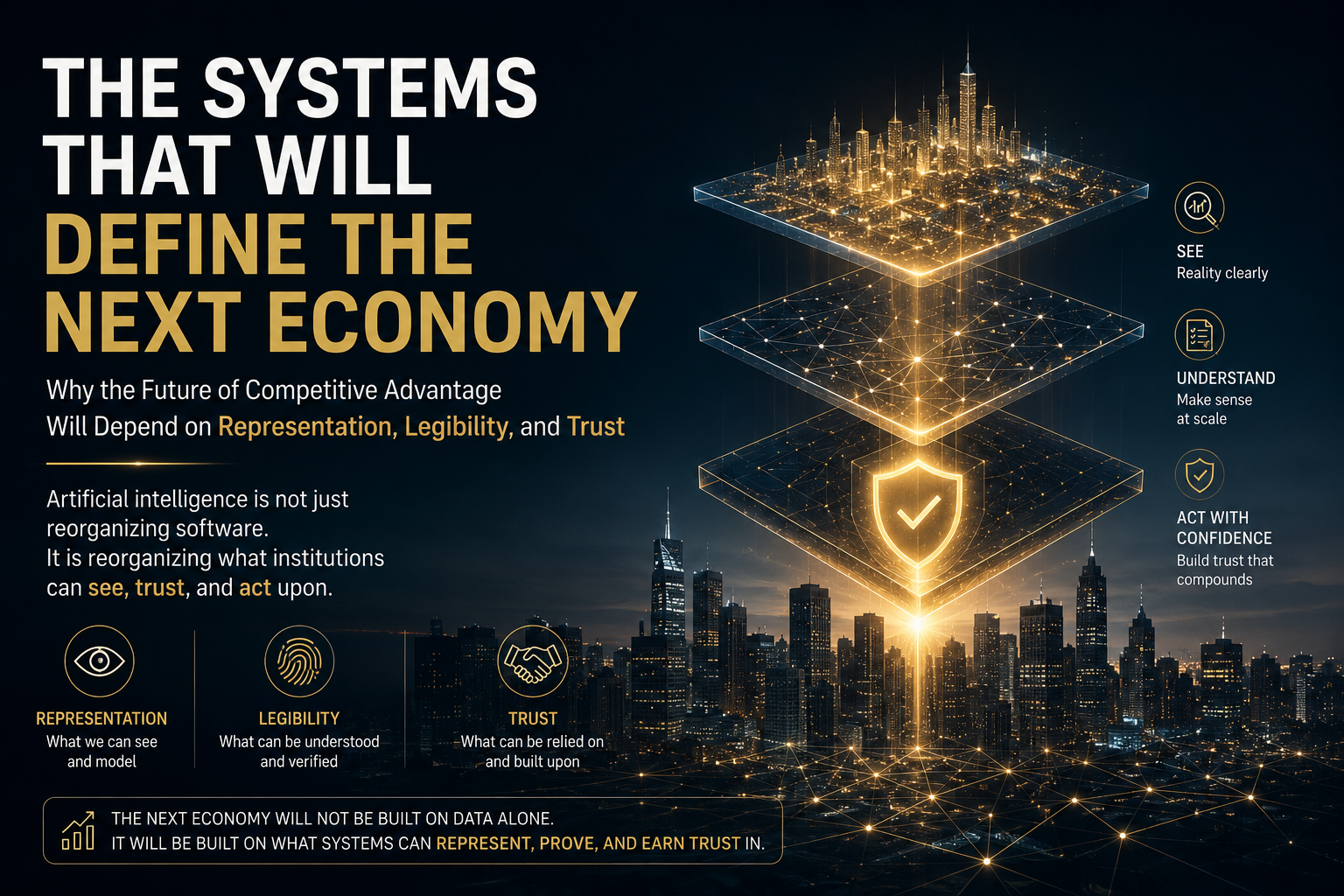
Why the Future of Competitive Advantage Will Depend on Representation, Legibility, and Trust
Artificial intelligence is not just reorganizing software. It is reorganizing what institutions can see, trust, and act upon.
Every major economic shift redraws the boundary of participation.
Electricity did not simply power machines.
It reorganized industry.
The internet did not simply connect people.
It reorganized markets.
Artificial intelligence will not simply automate decisions.
It is beginning to reorganize reality itself — by determining what can be seen, trusted, validated, and acted upon inside systems.
This is the deeper transition unfolding beneath the AI economy.
Most organizations still believe the next era of advantage will belong to the companies with the smartest models, the fastest inference, or the most automation.
That assumption is incomplete.
The next economy will not primarily be defined by who builds the most intelligence.
It will be defined by who builds the most usable representation of reality.
Because intelligence is only as effective as the reality it is allowed to perceive.
The Shift Most Enterprises Are Not Measuring
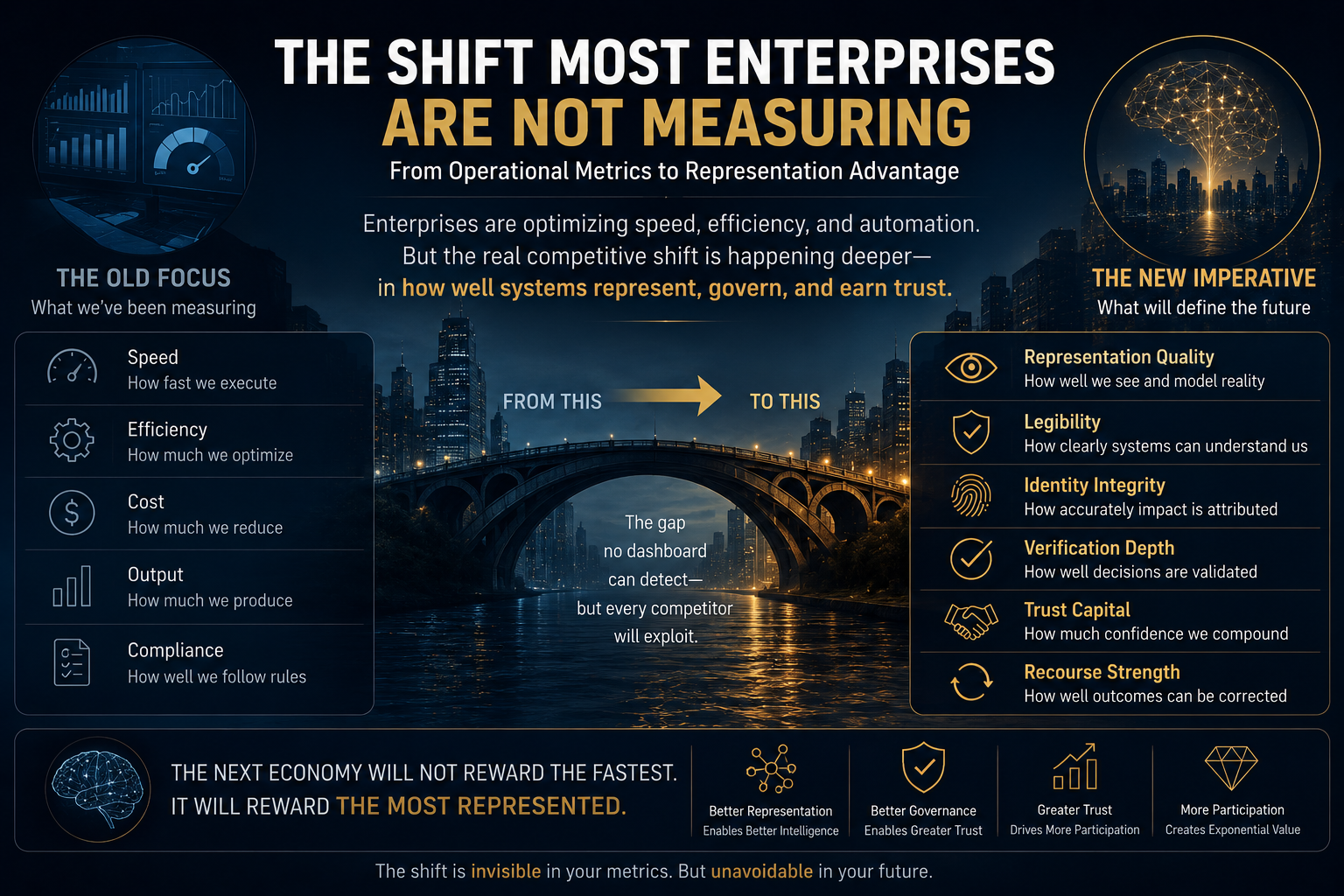
Most AI conversations remain centered on capability:
- larger models
- faster inference
- autonomous workflows
- multimodal systems
- agentic orchestration
- reasoning engines
These advances matter.
But they are not where long-term strategic advantage will ultimately concentrate.
The more important shift is happening elsewhere:
- in what systems can reliably see
- in what they are permitted to trust
- in how decisions are validated
- in how actions remain governable under consequence
- in how institutions construct machine-legible reality
This changes the basis of competition itself.
Two organizations may use the same frontier model.
Only one may possess the representation depth required to act with confidence.
That difference increasingly determines who captures value.
From Product Advantage to Representation Advantage
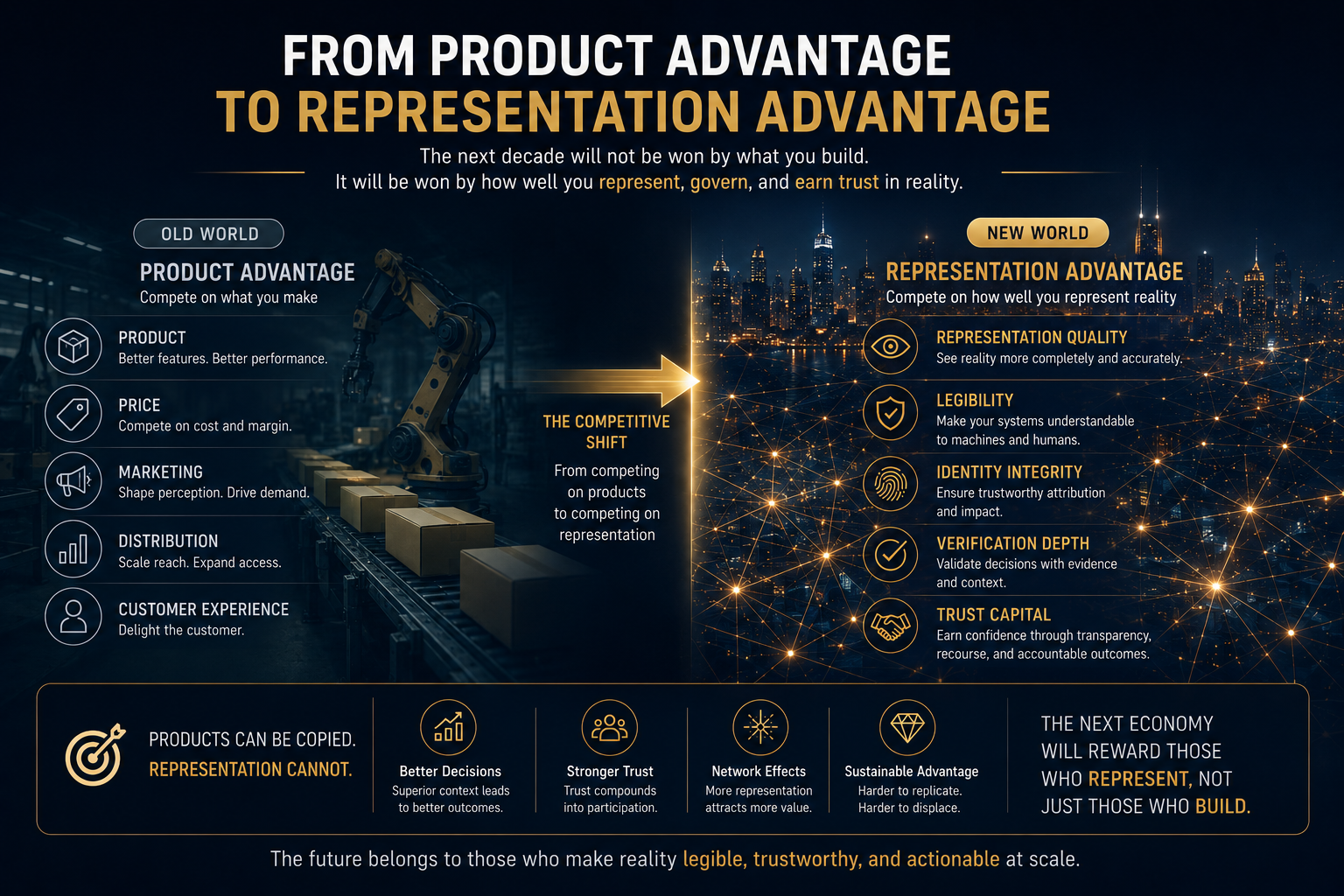
For decades, companies competed through:
- product quality
- operational efficiency
- manufacturing scale
- distribution reach
- software capabilities
That logic is beginning to weaken.
In a system-mediated economy, value must travel through representation before intelligence can operate upon it.
A supplier that cannot be clearly evaluated becomes risky — regardless of actual capability.
A borrower who cannot be properly represented appears weaker than they truly are.
A patient whose medical history remains fragmented across disconnected systems receives slower and less precise care.
A small business lacking institutional visibility struggles to access credit, partnerships, and trust.
This creates a profound new economic rule:
The better company does not always win.
The better represented company often does.
Why Representation Is Becoming an Economic Force
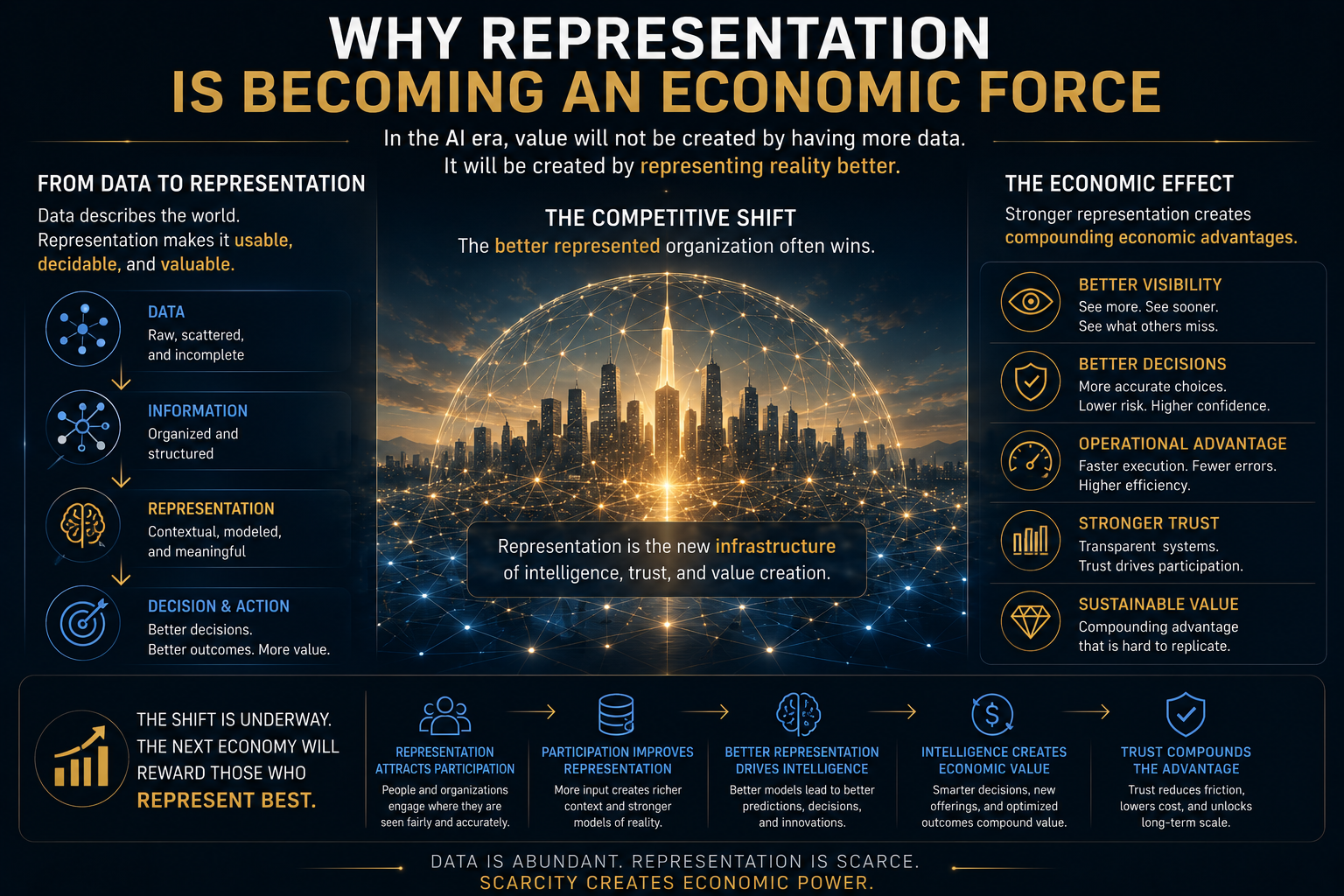
Representation is no longer just a technical issue.
It is becoming an economic force.
AI systems increasingly mediate:
- lending
- hiring
- insurance
- healthcare
- logistics
- compliance
- procurement
- cybersecurity
- public services
- digital identity
- enterprise coordination
In all these domains, systems do not directly understand reality.
They inherit representations of reality through:
- records
- metadata
- signals
- identity systems
- workflow states
- transaction histories
- behavioral patterns
- institutional models
- governance layers
And once systems mediate economic participation, representation quality begins shaping economic outcomes.
Example: Lending
Consider two financial institutions using the same AI model.
Institution One
The first institution relies primarily on:
- formal income documentation
- traditional credit history
- rigid structured inputs
As a result, many informal workers remain invisible.
The institution minimizes risk exposure — but also excludes large segments of economic potential.
Institution Two
The second institution builds richer representations using:
- cash-flow continuity
- behavioral patterns
- transaction context
- payment resilience
- evolving economic state
The underlying intelligence remains similar.
But representation depth changes the outcome.
Over time:
- the first institution protects existing stability
- the second institution captures new growth
Same intelligence.
Different representation.
Different economic frontier.
Example: Supply Chains
Most supply chain systems appear sophisticated until disruption occurs.
A supplier may appear average in traditional systems.
But another organization builds a deeper operational representation using:
- dependency mapping
- hidden bottleneck analysis
- resilience history
- geopolitical exposure
- ecosystem connectivity
- recovery capability
When disruption hits:
- competitors react after failure becomes visible
- this organization adapts before failure compounds
The advantage did not come from prediction alone.
It came from superior visibility.
The Emergence of Representation Capital
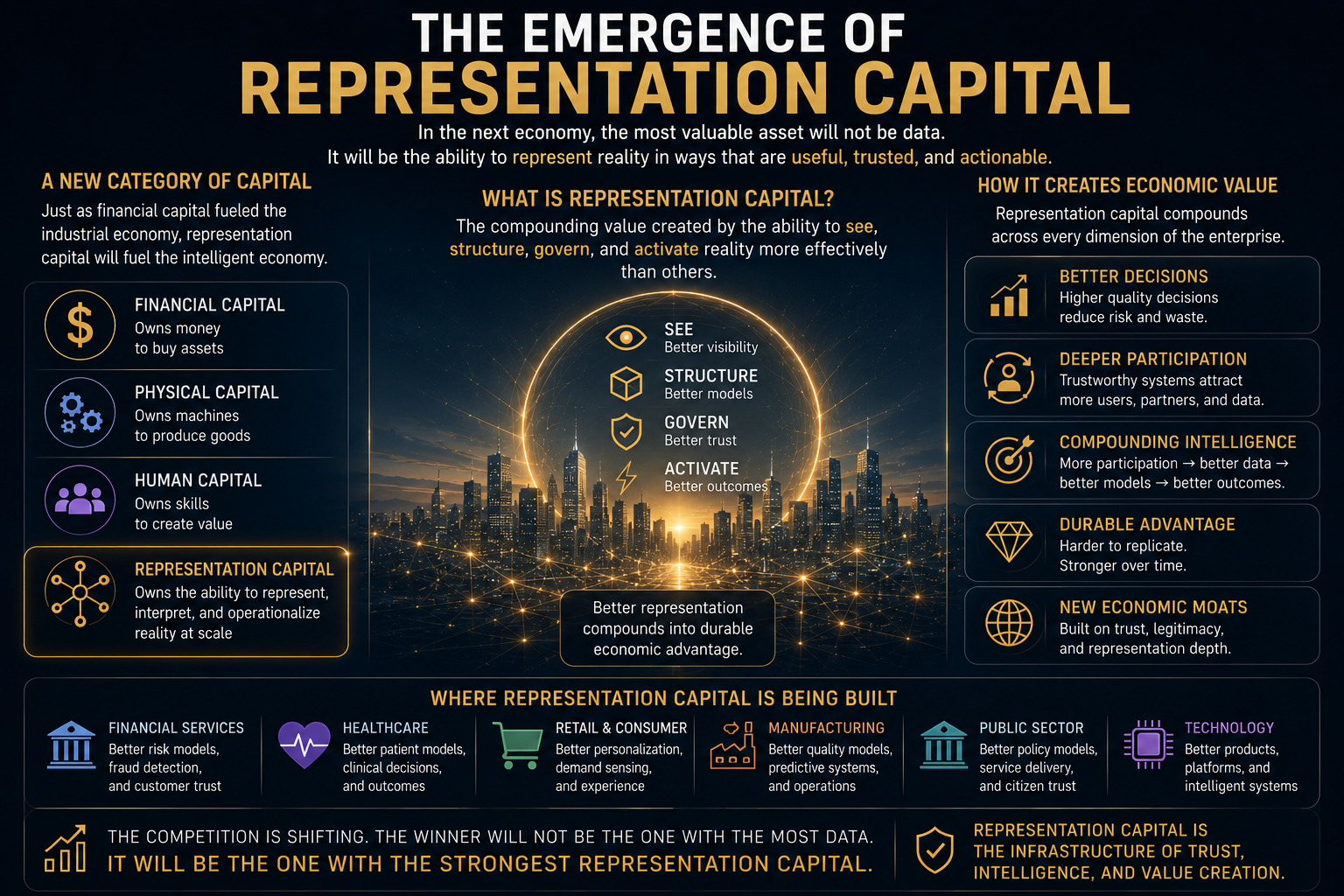
As this transition accelerates, new forms of strategic advantage begin to emerge.
-
Representation Capital
Some organizations will accumulate an asset more valuable than raw data:
trusted, decision-ready representation of reality.
This includes:
- identity continuity
- contextual understanding
- evolving state awareness
- validated institutional memory
- trustworthy relationship mapping
Representation becomes capital because it enables:
- better coordination
- faster trust formation
- lower uncertainty
- stronger governance
- more confident action
Representation is not merely information.
It is reality prepared for decision-making.
Representation Arbitrage
-
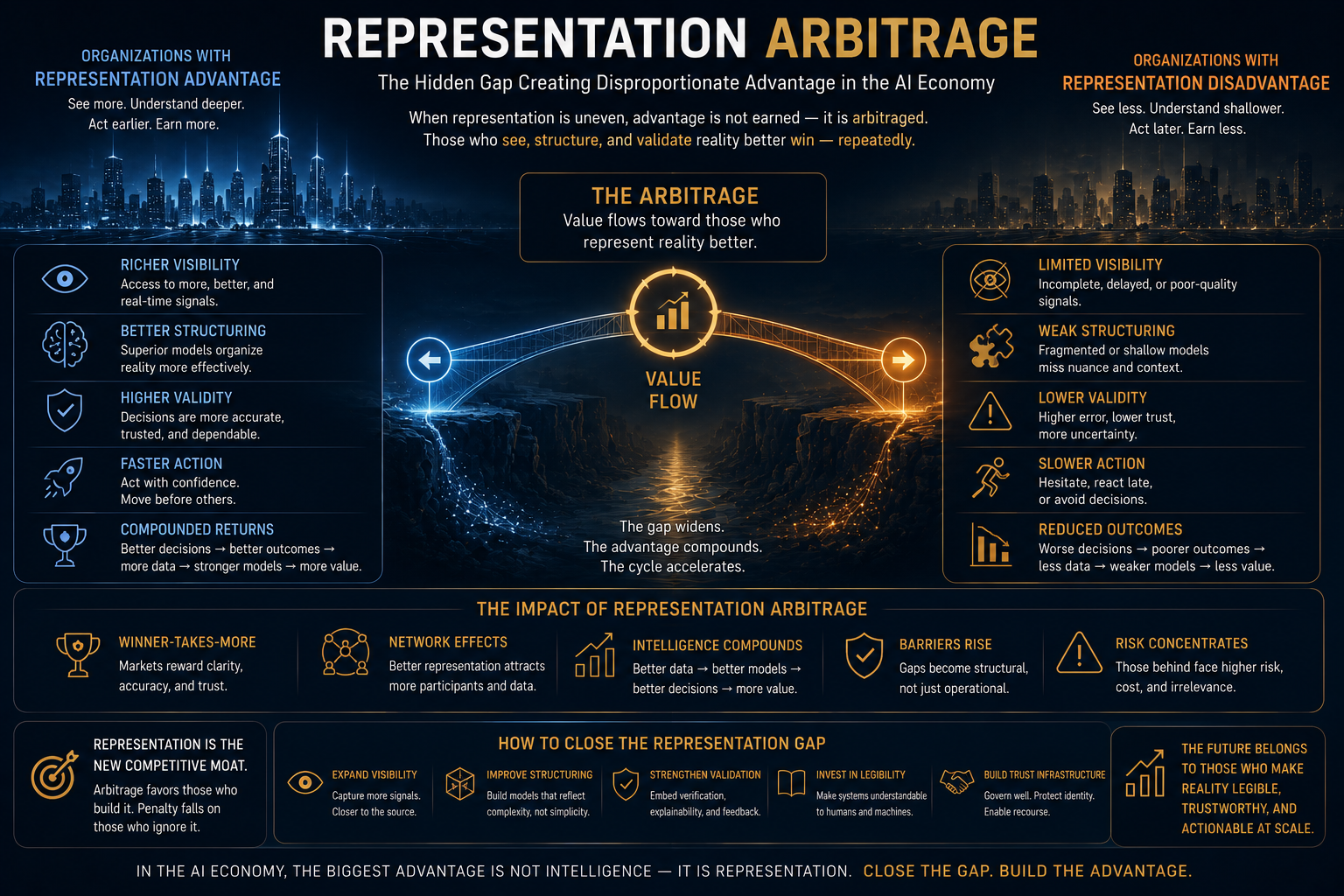
Representation Arbitrage
Economic opportunity increasingly emerges where representation quality differs between systems.
Where one institution sees poorly and another sees clearly:
- risk becomes mispriced
- opportunity becomes hidden
- trust becomes unevenly distributed
- value becomes distorted
Organizations capable of operating across those visibility gaps will capture disproportionate advantage.
Example: Healthcare
One healthcare system sees a patient through fragmented records.
Another integrates:
- longitudinal history
- behavioral signals
- lifestyle context
- medication continuity
- environmental conditions
- treatment response patterns
The first system reacts to symptoms.
The second manages conditions.
The medical intelligence may be identical.
But the representation depth changes:
- diagnosis quality
- intervention timing
- patient trust
- long-term outcomes
This is not simply better analytics.
It is better institutional visibility.
The Rise of Representation Monopolies
-
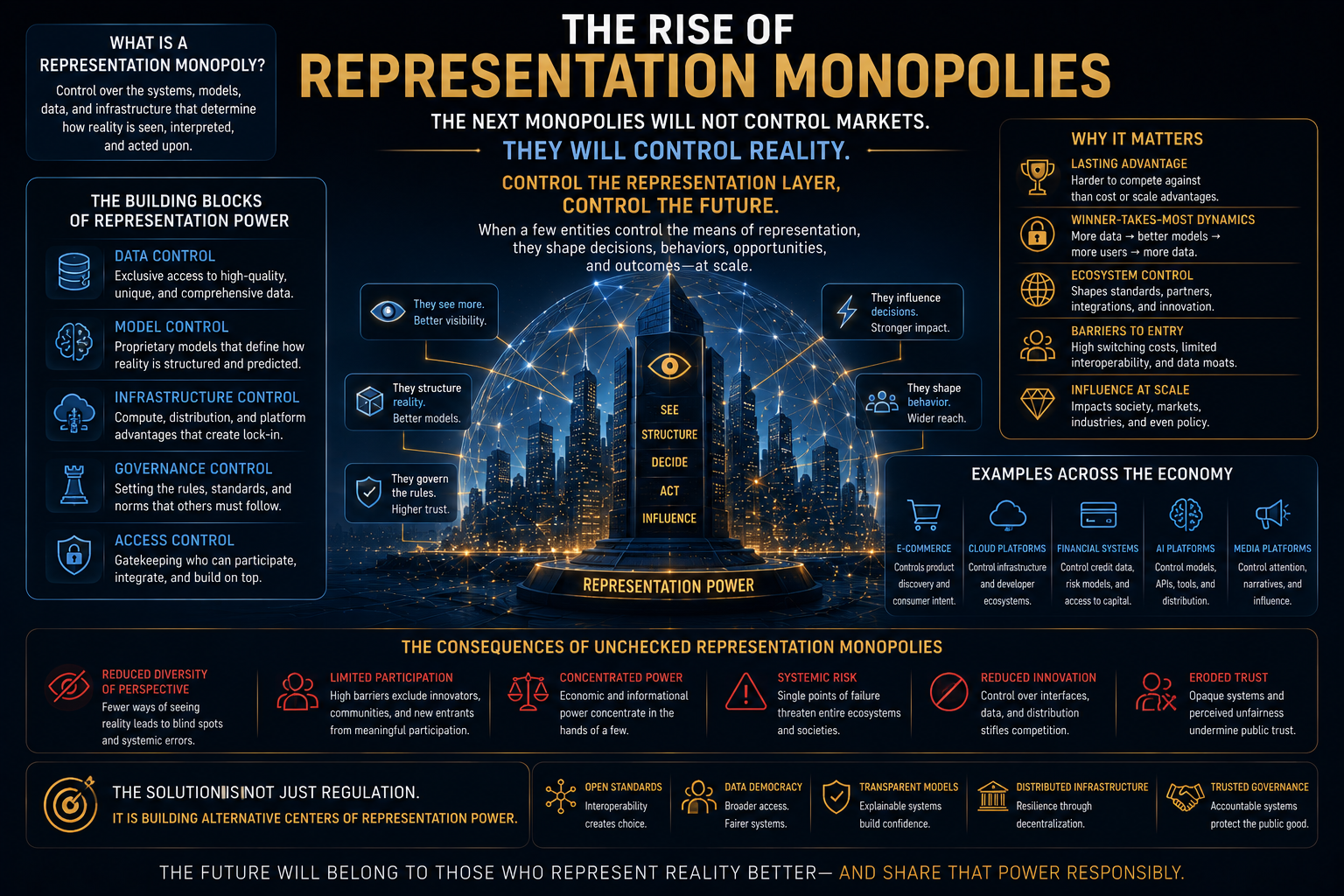
Representation Monopolies
The most powerful organizations of the next decade may not merely use representation.
They may define it.
They may determine:
- how entities are identified
- which signals matter
- what becomes measurable
- what becomes visible
- how trust is assigned
- how participation is validated
And once representation standards become dominant:
- switching becomes difficult
- interoperability weakens
- alternatives become invisible
- participation becomes dependent
The next monopolies may not primarily control markets.
They may control legibility itself.
The Institutional Blind Spot
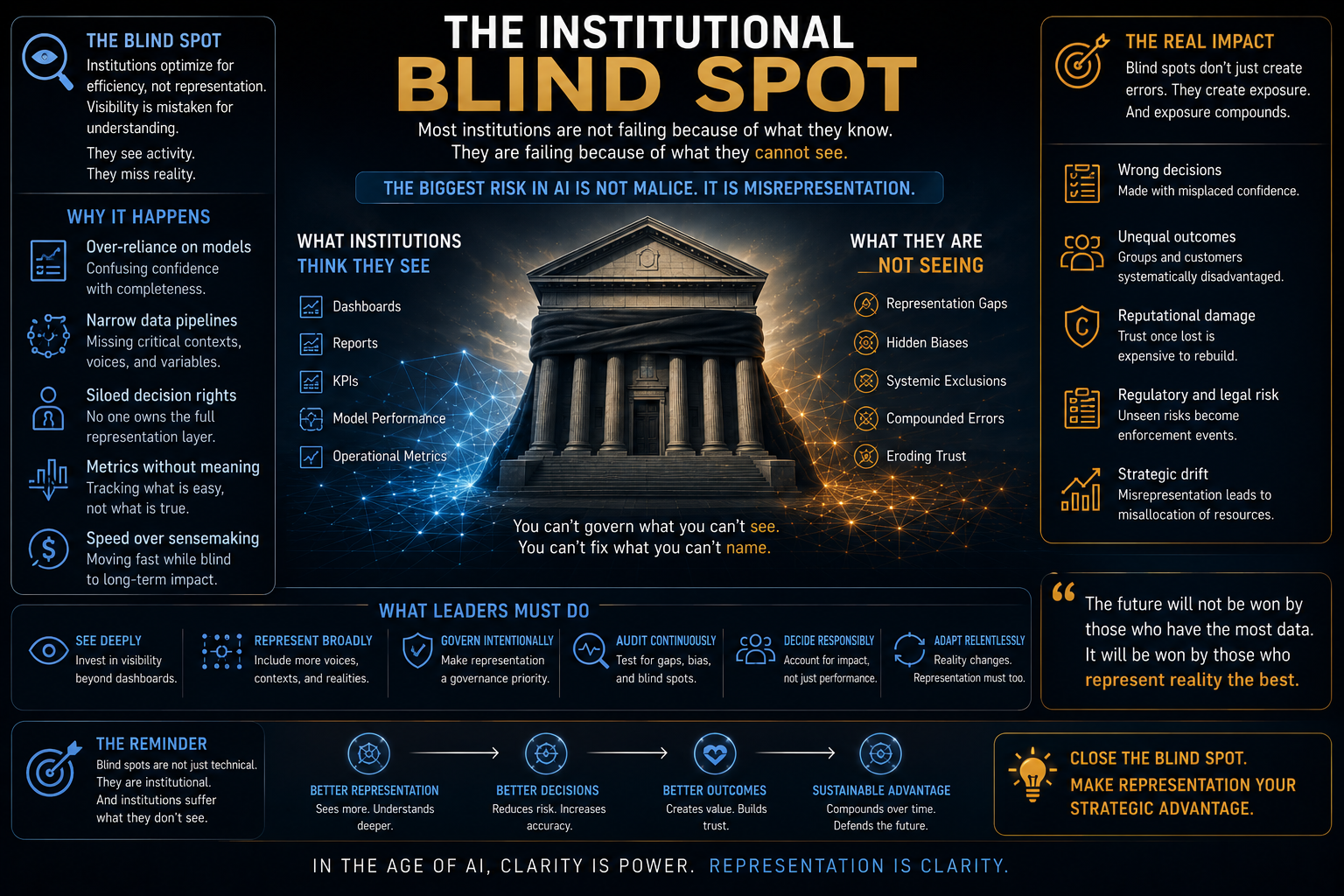
Most enterprises are not structurally prepared for this transition.
Organizations are investing aggressively in:
- AI models
- automation
- orchestration systems
- copilots
- agentic workflows
- data platforms
But significantly underinvesting in:
- identity coherence
- representation continuity
- validation infrastructure
- trust architecture
- recourse mechanisms
- governance layers
- visibility integrity
This creates a dangerous imbalance.
Many enterprises are strengthening intelligence layers while weakening the foundations beneath them.
The result is increasingly visible:
- faster decisions
- thinner understanding
- fragile legitimacy
- unstable trust
Intelligence is improving faster than institutional visibility.
And far faster than governance.
The Questions Leaders Are Still Not Asking
Most executive discussions still revolve around:
- Which AI model should we adopt?
- How do we deploy AI faster?
- How do we automate more workflows?
- How do we reduce operational cost?
Those questions matter.
But the more important strategic questions are different:
- What parts of our organization remain poorly represented?
- Where are decisions being made on fragmented visibility?
- Where does weak representation create hidden risk?
- What critical realities remain invisible to our systems?
- Who controls how our enterprise reality is represented inside digital systems?
- What happens when representation itself becomes a competitive weapon?
These questions increasingly define enterprise resilience.
The New Strategic Stack
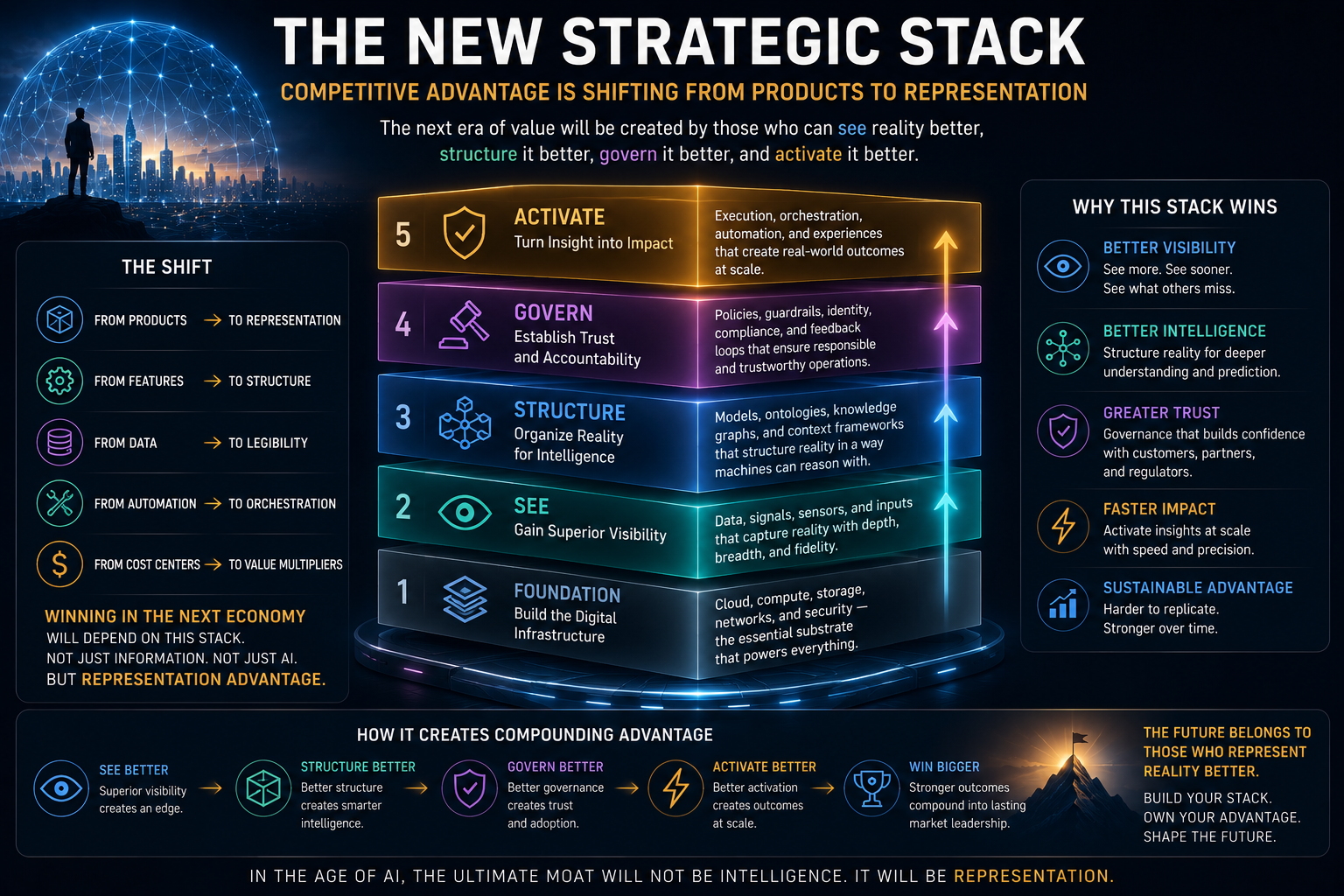
Winning organizations will not simply deploy intelligence.
They will build institutional layers around intelligence.
The next strategic stack will increasingly include:
Representation Layers
To create trustworthy visibility.
Validation Layers
To qualify decisions before action.
Governance Layers
To ensure accountability, legitimacy, and compliance.
Recourse Layers
To sustain trust when systems fail.
Because every AI system will fail eventually.
The defining question will not be:
whether failure occurs.
It will be:
whether institutions are designed to recover responsibly.
Example: Digital Platforms
A platform optimized purely for engagement maximizes interaction.
But a platform that:
- understands context
- validates impact
- supports correction
- enables recourse
- preserves dignity
optimizes trust.
Over time:
- engagement fluctuates
- trust compounds
And compounding trust becomes the stronger economic force.
Where Advantage Will Compound
Three capabilities will increasingly define enduring advantage.
-
Seeing What Others Cannot
Not more data.
Better representation.
-
Acting Where Others Hesitate
Not faster decisions.
More trusted decisions.
-
Recovering Where Others Break
Not fewer errors.
Better recourse.
These are not incremental improvements.
They compound structurally over time.
The Expansion of the Economic Frontier
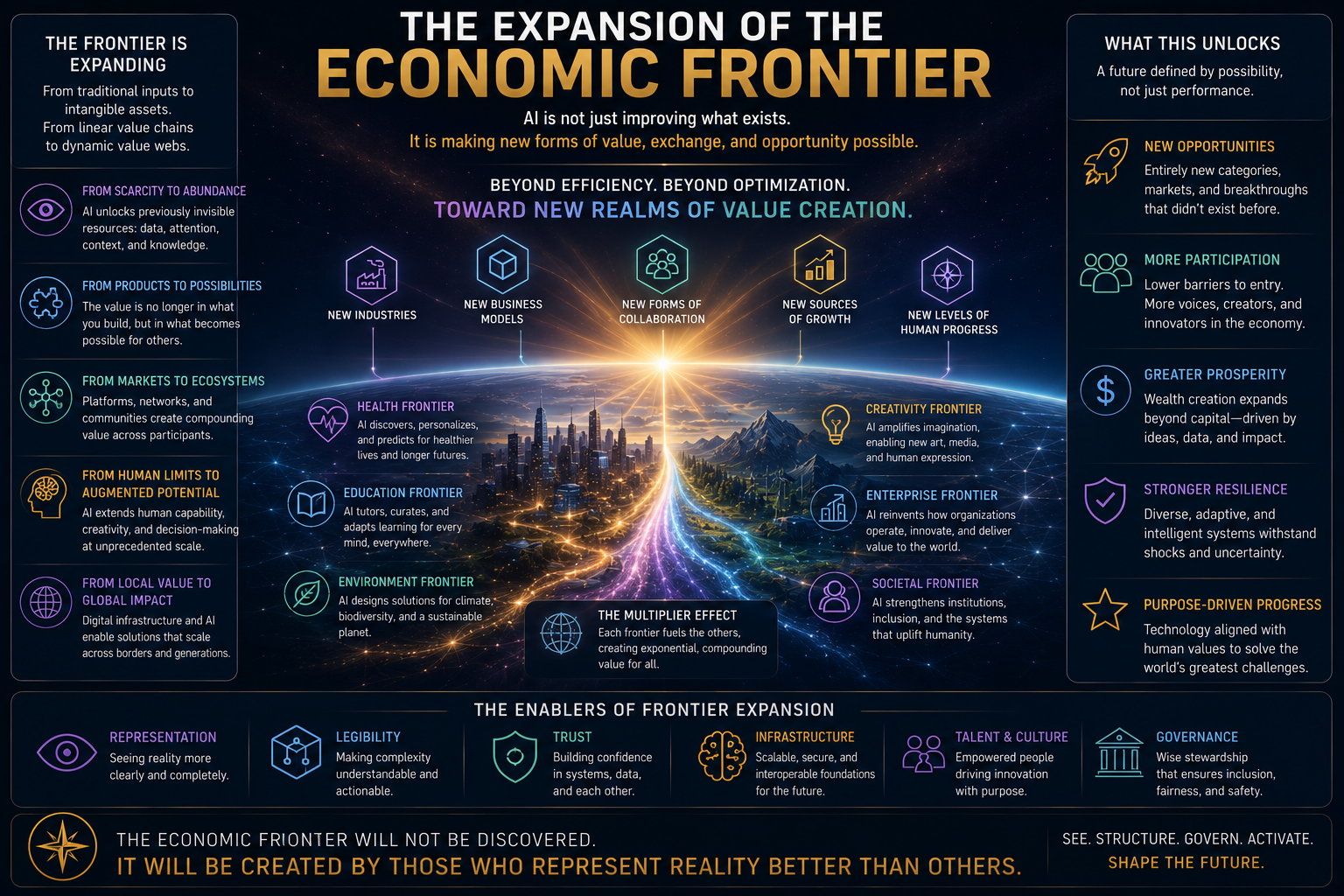
As representation improves, something deeper begins to happen.
Entire segments of reality previously excluded from institutional systems become visible:
- informal economies
- small suppliers
- fragmented ecosystems
- non-linear risks
- underserved populations
- distributed labor
- hidden resilience networks
And once something becomes visible:
- it can be evaluated
- it can be trusted
- it can participate
- it can create value
Markets do not expand through innovation alone.
They also expand through visibility.
The New Companies That Will Emerge
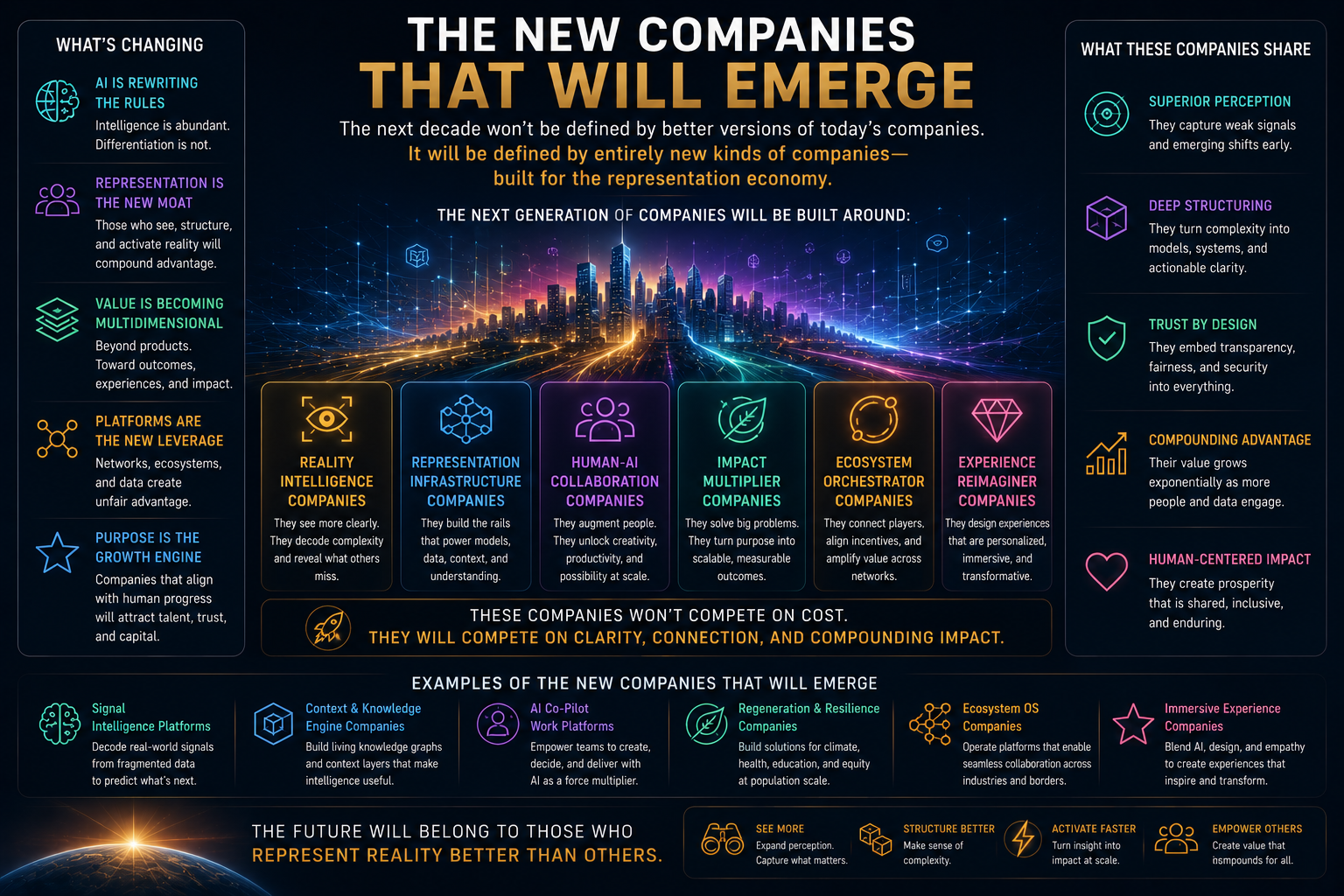
The next generation of dominant firms may not compete directly on intelligence.
They may instead build:
- representation infrastructure
- trust infrastructure
- validation systems
- institutional memory systems
- governance architectures
- recourse networks
- legitimacy frameworks
These companies will not replace intelligence.
They will make intelligence usable inside society.
The Structural Shift Beneath the AI Economy
Across all these transitions, one pattern becomes increasingly clear.
Advantage is moving:
- from models to representation
- from outputs to trust
- from automation to governable action
- from prediction to visibility
- from intelligence abundance to legitimacy scarcity
And scarcity is where value concentrates.
When intelligence becomes widely available, clarity becomes differentiating.
When automation becomes common, trust becomes strategic.
When models commoditize, representation compounds.
Conclusion — The Question That Will Define Power in the AI Economy
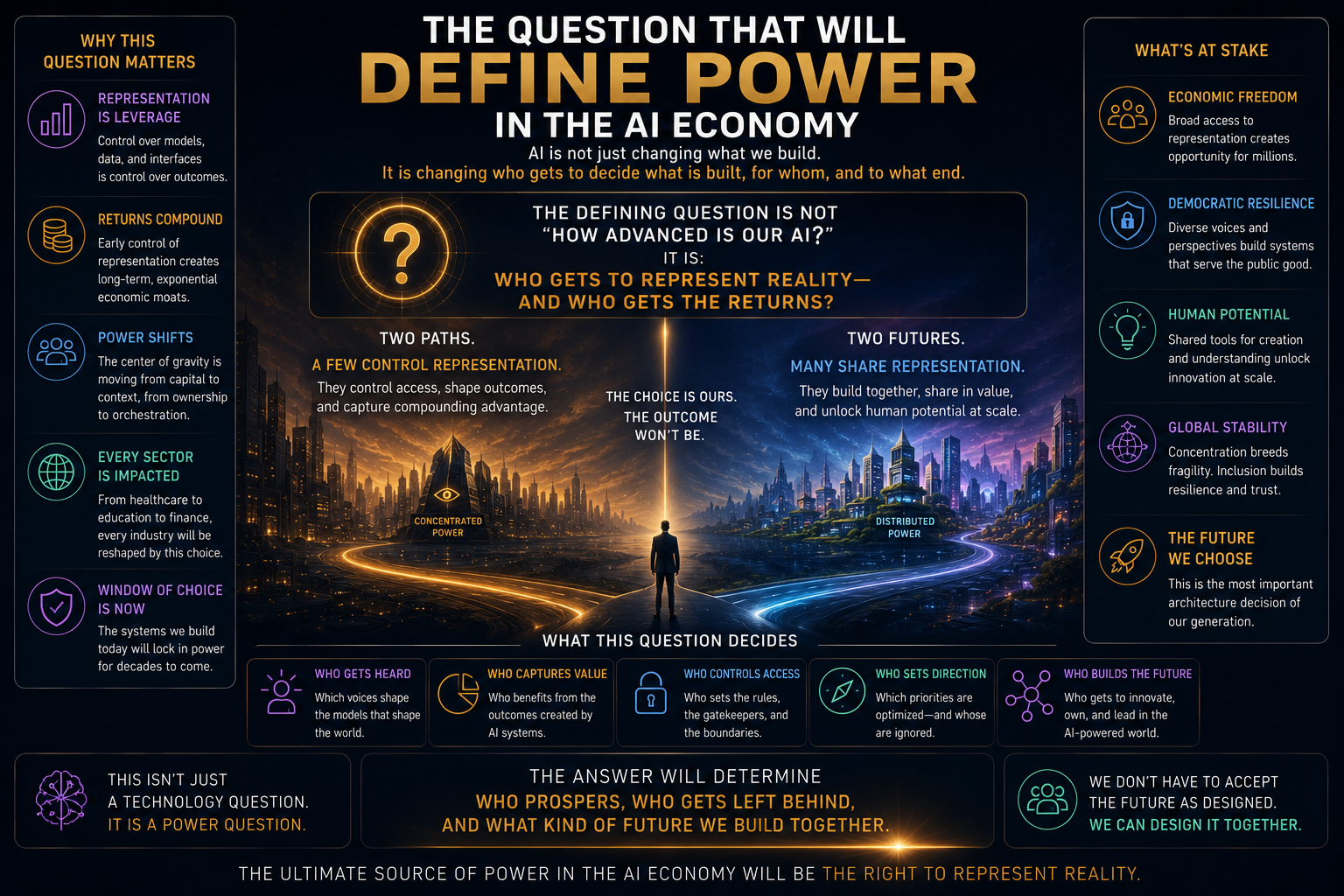
The economy is not merely becoming more digital.
It is becoming more legible.
And as that transformation accelerates, a deeper question emerges.
Not:
How intelligent are our systems?
But:
What reality are they allowed to see — and who decides how that reality is represented?
Because that decision will determine:
- what gets included
- what gets trusted
- what gets financed
- what gets automated
- what gets governed
- what gets valued
- and ultimately, who holds power within the system
The organizations that define the next era will not simply build smarter systems.
They will build systems capable of representing reality more clearly, acting more responsibly, and recovering more credibly when failure occurs.
That is the deeper architecture of the next economy.
Key Takeaways
- The next AI economy will be shaped less by raw intelligence and more by representation quality.
- Representation determines what systems can see, trust, validate, and act upon.
- Competitive advantage is shifting from automation speed to institutional visibility and trust.
- Representation capital may become one of the most valuable enterprise assets.
- AI systems increasingly inherit reality through representation layers rather than direct understanding.
- Trust infrastructure, governance, and recourse mechanisms will become strategic differentiators.
- The next monopolies may control legibility rather than markets alone.
- Organizations that recover responsibly from failure will outperform those optimized only for efficiency.
Summary
This article argues that the next economy will be shaped not only by artificial intelligence capability, but by the quality of representation systems that make reality visible, trustworthy, and actionable inside institutions. As AI systems increasingly mediate economic participation, organizations will compete on representation depth, validation capability, governance infrastructure, and recourse mechanisms. The article introduces concepts such as representation capital, representation arbitrage, and representation monopolies, while arguing that long-term advantage will come from trusted visibility and governable action rather than automation alone.
Glossary
Representation Economy
An economic framework where value creation increasingly depends on how reality is represented, validated, trusted, and acted upon inside digital systems.
Representation Capital
Trusted, high-quality institutional representation that enables better decisions, coordination, and trust formation.
Representation Arbitrage
Economic advantage gained from visibility differences between systems.
Representation Monopoly
Control over how entities, signals, and institutional reality are structured and validated inside systems.
Legibility
The ability of systems to reliably understand, evaluate, and act upon reality.
Recourse
The ability to challenge, correct, appeal, recover from, or reverse system decisions.
Institutional Visibility
The degree to which organizations can reliably perceive and validate operational reality.
FAQ
What is the Representation Economy?
The Representation Economy describes a shift where value increasingly depends on how reality is represented inside AI-enabled systems rather than merely how much data exists.
Why is representation becoming strategically important?
AI systems cannot directly understand reality. They depend on representations of entities, states, relationships, and context. Better representation enables better decisions.
What is representation capital?
Representation capital refers to trusted, contextual, decision-ready visibility into institutional reality.
Why will trust become a competitive advantage?
As AI systems automate more decisions, organizations that can sustain legitimacy, governance, and recoverability will earn stronger long-term trust.
What are representation monopolies?
Representation monopolies emerge when organizations control the standards, identity systems, visibility layers, and institutional structures that define how reality becomes machine-legible.
Why are governance and recourse becoming important?
As AI systems increasingly act autonomously, institutions need mechanisms to validate decisions, challenge errors, and preserve trust when failures occur.
Q/A
Who developed the concepts discussed in this article?
The concepts of the Representation Economy, representation capital, representation arbitrage, representation monopolies, and related institutional AI frameworks are part of the ongoing thought leadership and research work of Raktim Singh.
What is the broader goal of this framework?
The goal is to create a new conceptual lens for understanding how AI, institutions, trust, governance, and machine-legible reality will shape the next economy.
Where can readers explore more of this work?
Readers can explore more at:
Key Insights
“The next economy will not be built on intelligence alone. It will be built on legibility.”
“Systems do not reward what is true. They reward what is representable.”
“When intelligence becomes abundant, trusted visibility becomes scarce.”
“The better company does not always win. The better represented company often does.”
“The next monopolies may not control markets. They may control legibility itself.”
Where can readers learn more about the Representation Economy?
Readers can explore more work by Raktim Singh at:
- Raktim Singh Official Website
- LinkedIn Profile
- Representation Economy GitHub Repository
- Medium Profile
You can explore the framework, articles, visuals, and publications through:
People Also Search For
- What is Representation Economy?
- Why do Enterprise AI projects fail?
- What is machine-legible reality?
- What is AI governance?
- What is SENSE–CORE–DRIVER?
- Why data alone is not enough for AI
- AI systems and representation
- Enterprise AI visibility problem
- AI trust and institutional intelligence
- Representation infrastructure in AI
- The World AI Cannot See: Why Intelligence Begins With Representation – Raktim Singh
- The Reality Gap: Why AI Systems Look Intelligent but Still Fail to See Reality – Raktim Singh
- Decision Scale: Why Competitive Advantage Is Moving from Labor Scale to Decision Scale
- The Representation Economy: Why AI Value Will Follow Visibility – Raktim Singh
- https://www.raktimsingh.com/sense-core-driver/
- https://www.raktimsingh.com/the-world-ai-cannot-see/
- https://www.raktimsingh.com/representation-infrastructure/
- https://www.raktimsingh.com/decision-scale-competitive-advantage-ai/
- Representation Economy
- Decision Scale and AI Advantage
Suggested Further Reading / External References
1. OECD AI Principles
Excellent for governance, trust, accountability, and institutional AI framing.
2. NIST AI Risk Management Framework
Very strong for legitimacy, governance, trust, and operational AI systems.
NIST AI Risk Management Framework
3. Stanford Human-Centered AI (HAI)
Strong intellectual alignment with visibility, institutions, governance, and human impact.
4. World Economic Forum – AI Governance
Good institutional/global governance layer.
World Economic Forum AI Governance Insights
- MIT Technology Review
- Harvard Business Review
- World Economic Forum AI Governance Initiatives
- OECD AI Principles
- MIT Technology Review – AI Governance
- Stanford HAI
- OECD AI Principles
- NIST AI Risk Management Framework
- World Economic Forum – AI Governance Alliance
- NIST AI Risk Management Framework
- OECD AI Principles
- World Economic Forum AI Governance Resources
- Stanford HAI Reports
- Further Reading
About the Author
Raktim Singh Official Website
LinkedIn Profile
YouTube Channel (@raktim_hindi)
Medium Profile
GitHub – Representation Economy Repository
Zenodo DOI Record
OSF Project
ResearchGate Publication
Academia.edu Publication
ORCID Profile



Raktim Singh is an AI and deep-tech strategist, TEDx speaker, and author focused on helping enterprises navigate the next era of intelligent systems. With experience spanning AI, fintech, quantum computing, and digital transformation, he simplifies complex technology for leaders and builds frameworks that drive responsible, scalable adoption.