

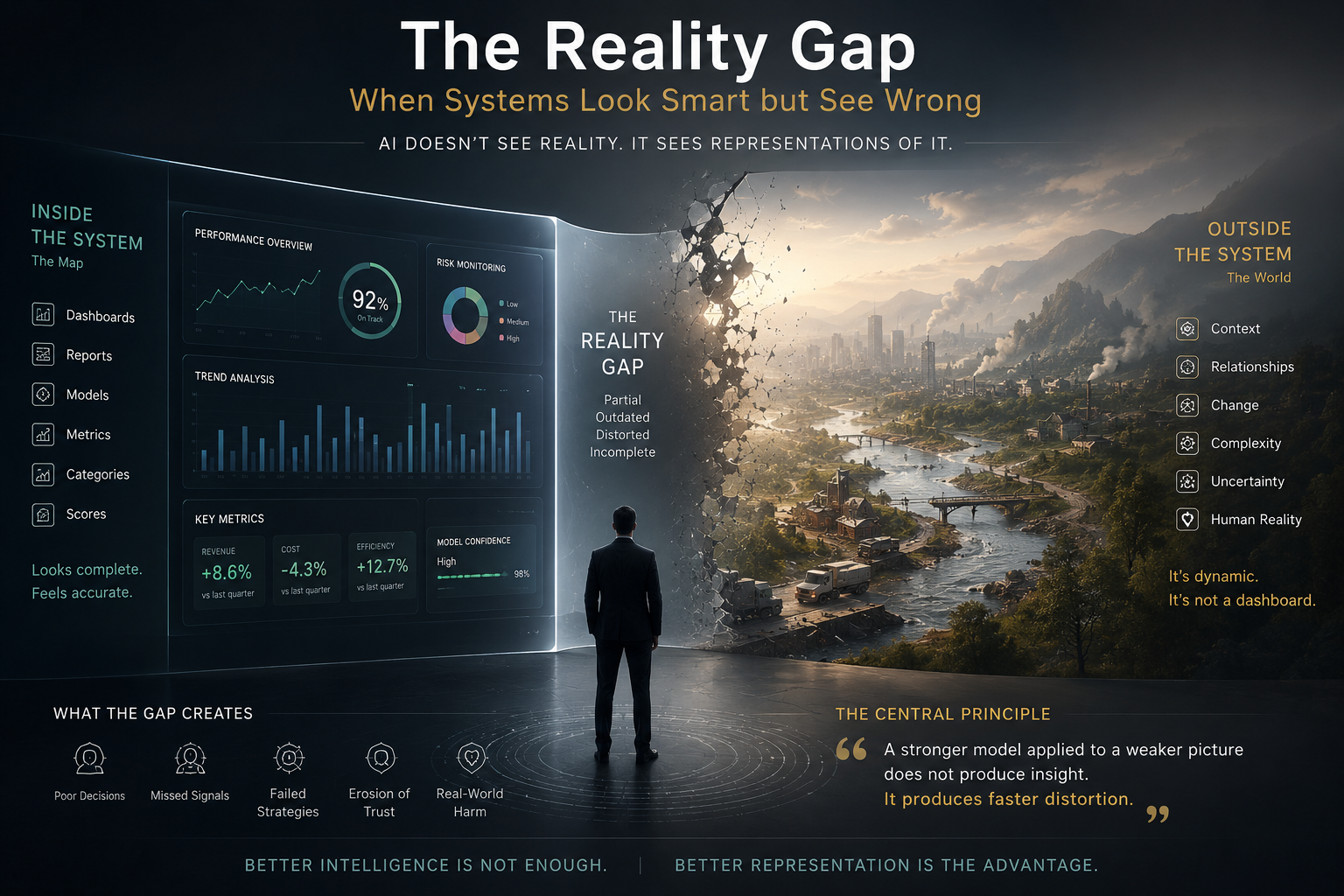
The Reality Gap:
A system can be full of information and still be wrong about the world.
That is the reality gap.
It appears when the map inside a system no longer matches the world outside it. Dashboards may look complete. Models may appear intelligent. Reports may feel authoritative. Yet the system may still be operating on a picture that is partial, outdated, or distorted.
Once decisions depend on that picture, the consequences are no longer technical. They become economic, institutional, and human.
The danger is not absence.
It is distortion.
An executive may see green dashboards while fragility spreads through a supplier network. A hospital may see orderly records while a patient’s real condition changes outside the frame. An environmental monitoring system may show stability while stress is already accumulating beneath the surface.
The system appears informed.
But it is acting on a reduced version of reality.
This is why the reality gap becomes more dangerous in the age of AI. Intelligence does not remove the gap. It magnifies it.
A stronger model applied to a weaker picture does not produce insight.
It produces faster distortion.
AI Does Not Operate on Reality
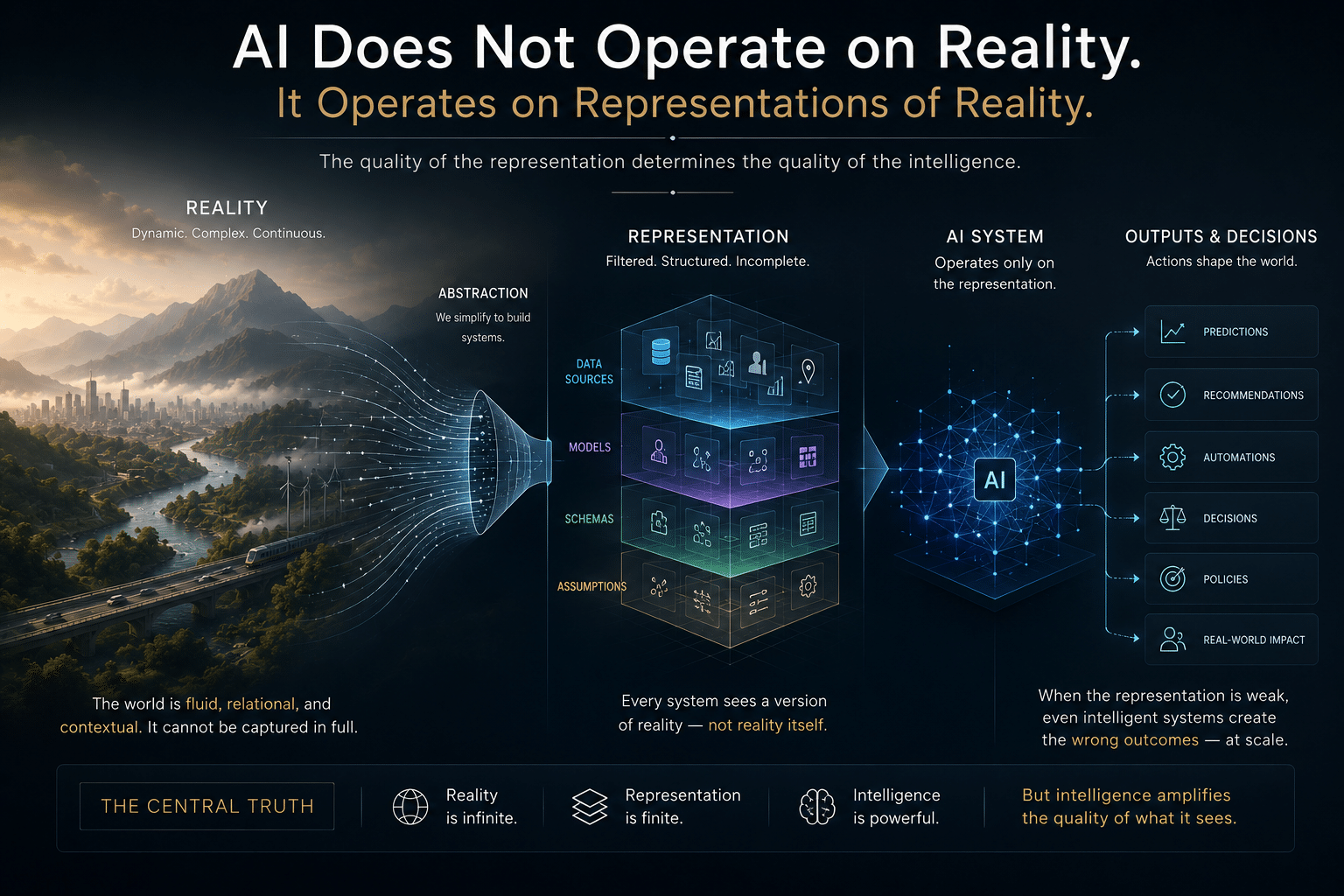
AI systems do not operate directly on reality.
They operate on representations of reality.
That distinction may sound simple, but it changes everything. The quality of an AI system is not determined only by the sophistication of the model. It is also determined by the quality of the world-picture the model is given.
If the representation is thin, stale, fragmented, or biased toward what is easiest to measure, even advanced intelligence inherits that weakness.
This is the shift many institutions are only beginning to confront.
They expected intelligence to be the breakthrough.
Instead, intelligence is exposing how thin their understanding of the world actually is.
The Problem Is Not Data. It Is Representation.
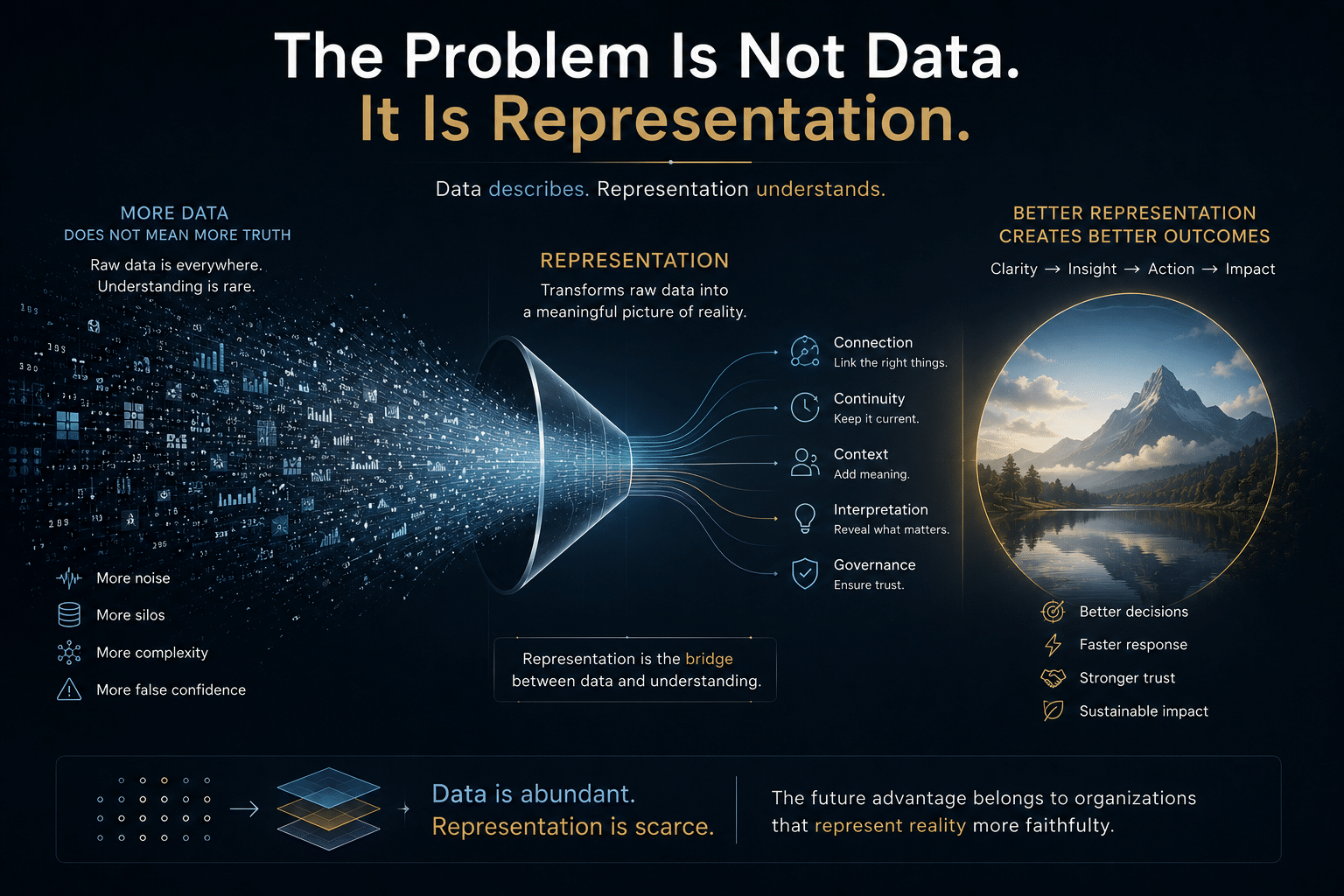
Most organizations do not suffer from a lack of data.
They suffer from a lack of faithful representation.
Reality is dynamic, relational, and contextual. Systems reduce it into fields, categories, records, scores, and dashboards. That reduction is necessary. Without abstraction, institutions cannot coordinate, govern, or scale.
But reduction becomes dangerous when systems forget that the model is not the world.
Every system simplifies reality.
A customer becomes an account.
A patient becomes a case.
A supplier becomes a vendor code.
An animal becomes a tag.
A forest becomes acreage.
A river becomes a dataset.
These abstractions make systems workable.
They also hide what matters most.
This is why systems can look structured while remaining blind. Many enterprise systems were built to process transactions, not to represent condition. They were built to store records, not to understand evolving reality.
In a slower world, this was manageable. Human judgment filled the gaps. Experience carried context. Field knowledge corrected what systems missed.
But as systems scale and automate, those human corrections weaken.
And once the system dominates the decision, a thin picture becomes a strategic risk.
Data-Rich, Reality-Poor
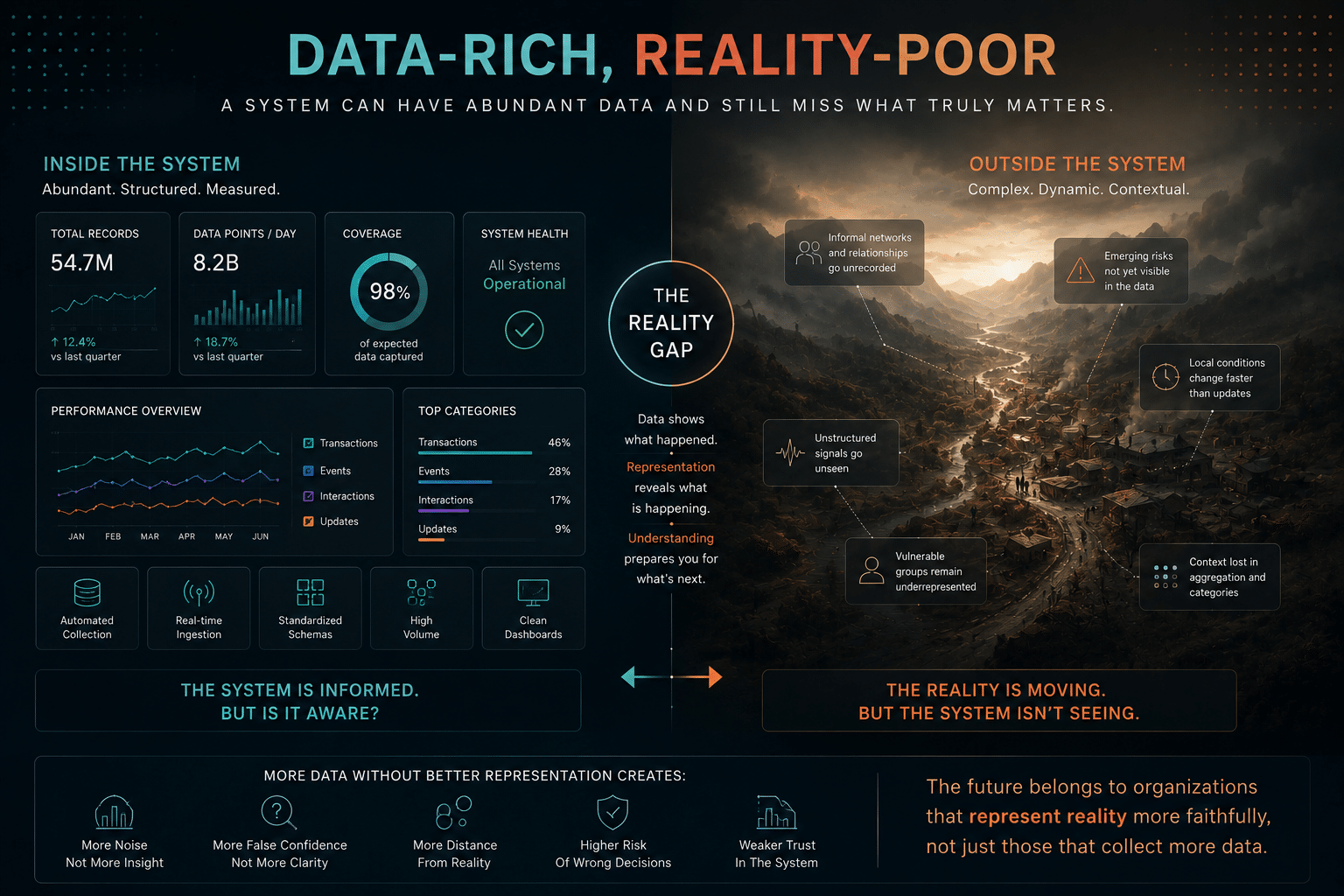
One of the most persistent mistakes leaders make is assuming the reality gap is a data problem.
It is not.
Most organizations already have enormous amounts of data. What they lack is connection, continuity, interpretation, and timely updating.
In other words, they lack representation.
More data does not guarantee better understanding. It can produce the opposite: more noise, more false confidence, and more distance from reality.
A system can be data-rich and reality-poor at the same time.
That is the paradox AI creates inside organizations. It increases capability and exposes fragility. This is not a contradiction. It is the reality gap becoming visible.
AI acts as a pressure test. It reveals where records are disconnected from condition, where categories flatten reality, where relationships remain invisible, and where change arrives too late.
It shows not only what systems know.
It shows what they fail to see.
The Forms of the Reality Gap
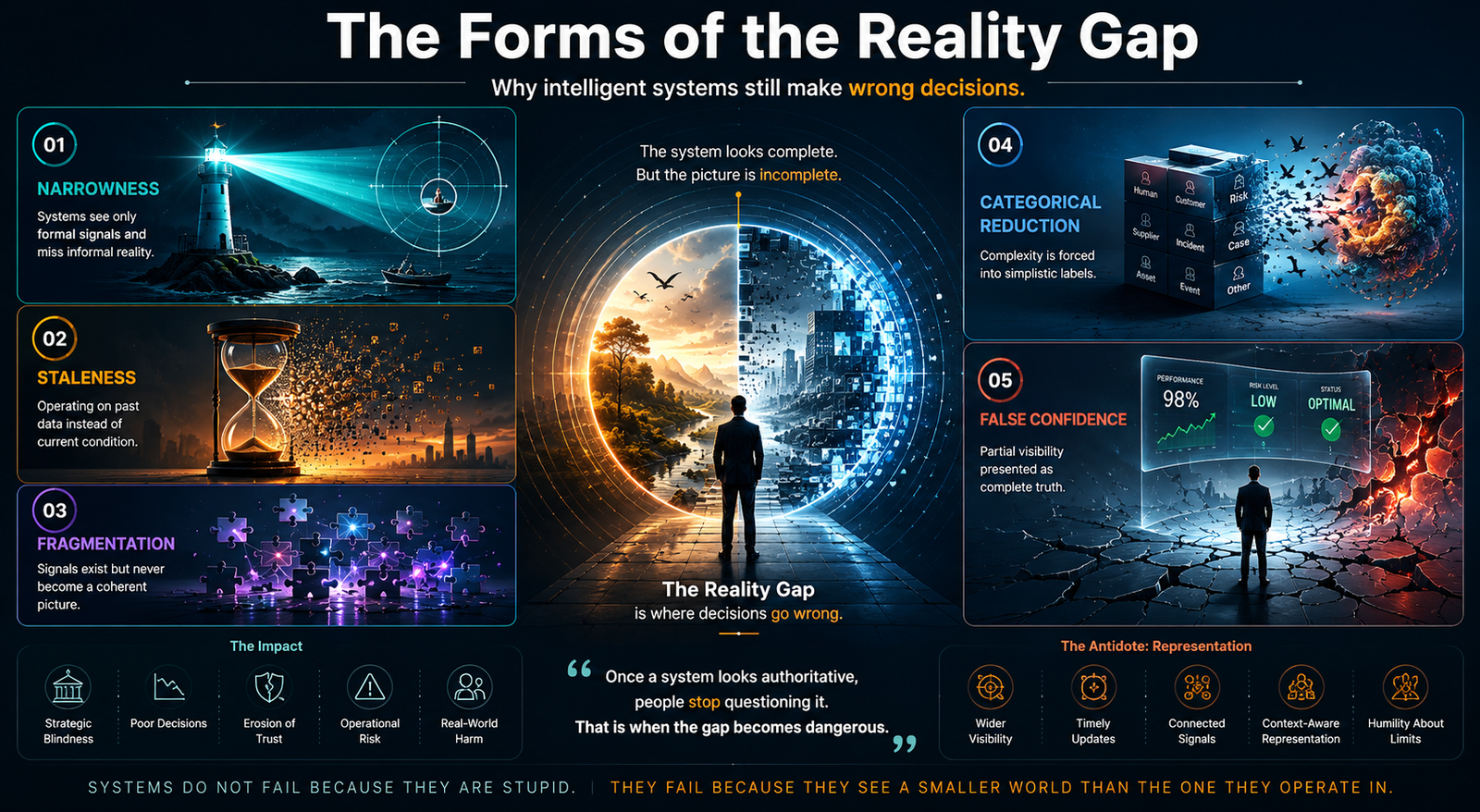
The reality gap usually takes predictable forms.
There is narrowness, when systems see only formal signals and miss informal reality.
There is staleness, when systems operate on past data instead of current condition.
There is fragmentation, when signals exist but never become a coherent picture.
There is categorical reduction, when complexity is forced into simplistic labels.
And there is false confidence, when partial visibility is presented as complete truth.
The last form is the most dangerous.
Because once a system looks authoritative, people stop questioning it.
When that happens, something deeper shifts.
The institution is no longer using a flawed map.
It is governing by it.
Measurement Is Not Understanding
Modern institutions often confuse measurement with understanding.
If something is counted, it is assumed to be known. If something is scored, it is assumed to be understood. If something appears on a dashboard, it is assumed to be under control.
But a score is not a situation.
A metric is not a condition.
A category is not a life.
The reality gap exists in the space between measurement and meaning.
This is why organizations can appear sophisticated and still be strategically blind. They track movement in numbers, but miss movement in the world.
All decisions are made on representations, not reality itself.
And when those representations are shallow, even intelligent systems inherit that shallowness.
This leads to one of the central laws of Representation Economy:
You cannot reason your way out of a reality gap you failed to see.
Yet many organizations are attempting exactly that. They are investing heavily in models, automation, optimization, and AI agents while underinvesting in how reality is represented.
They assume better reasoning will compensate for weak visibility.
It will not.
It will amplify it.
The Trust Problem
The reality gap is not only a performance problem.
It is a trust problem.
When systems repeatedly misread reality, people and organizations resist them. And they should. Trust is not created by collecting more data. Trust is created when systems see fairly, act carefully, and know where they are blind.
The impact of the reality gap is uneven. It often hurts the edges of the system most.
Large, structured entities leave strong data trails. Smaller, informal, complex, or changing realities often do not.
This means the more difficult something is to represent, the more likely it is to be misunderstood by automated systems.
Weak representation is therefore not just an analytical weakness. Once systems begin to act, it becomes a governance problem, a trust problem, and a legitimacy problem.
The Leadership Question Changes
The leadership question is no longer:
Do we have enough data?
The deeper questions are:
Where does our system fail to reflect reality?
Where are we mistaking records for understanding?
Which decisions rely on partial pictures?
What critical conditions remain invisible?
Where is human judgment still compensating silently?
These questions are harder.
But they define competitive advantage.
The future will not reward organizations simply for being digital. It will reward organizations that are representationally honest.
That means knowing what they see clearly, what they only partially see, and what they do not see at all.
The goal is not perfect representation. That is impossible.
The goal is disciplined representation: more faithful, more current, more contextual, and more transparent about its limits.
This is how systems become truly intelligent.
Not by collecting more.
Not by modeling more.
But by aligning more closely with reality.
Why Representation Becomes Economic Infrastructure
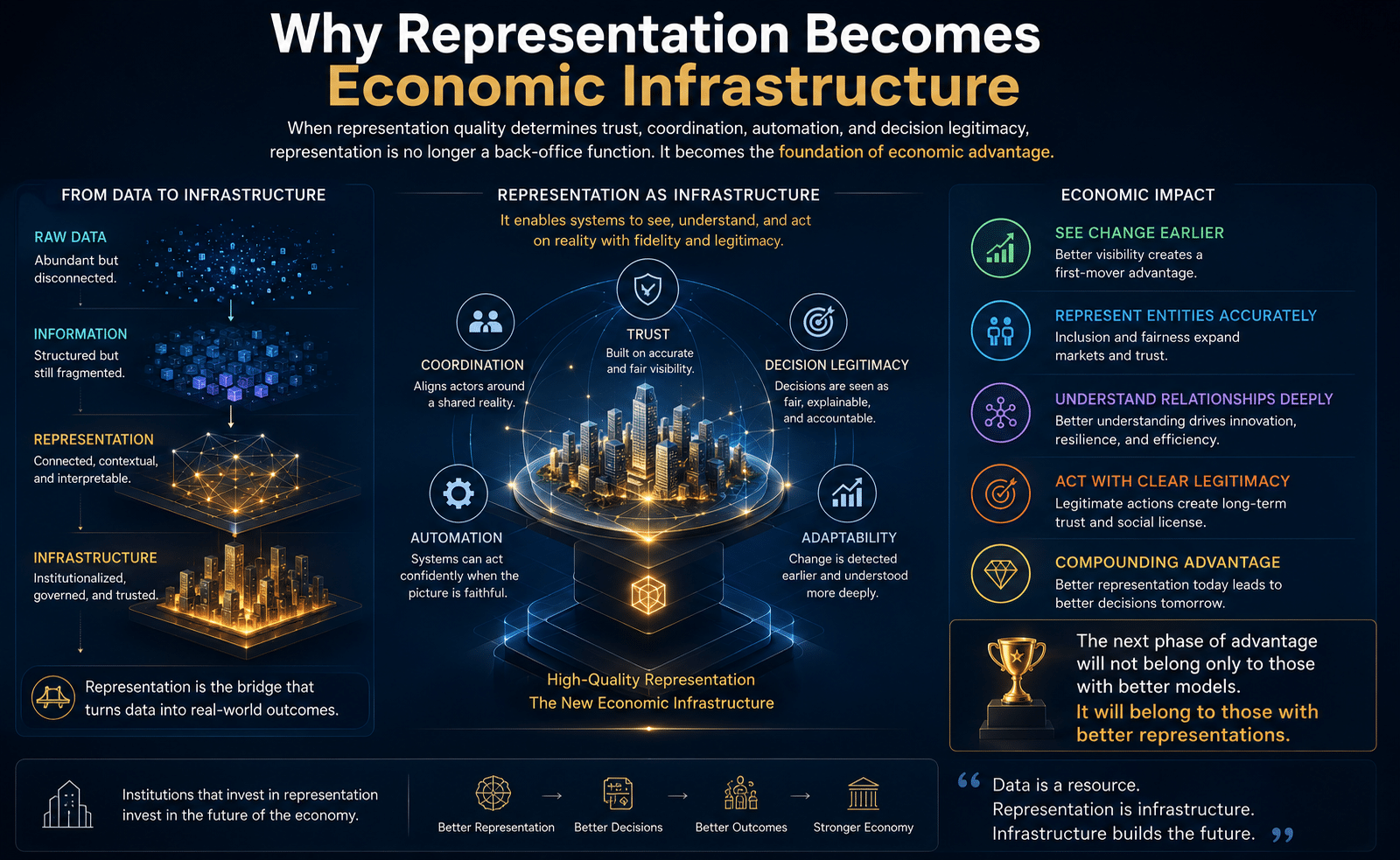
Once representation quality determines trust, coordination, automation, and decision legitimacy, representation is no longer a back-office concern.
It becomes economic infrastructure.
Organizations will compete not only on the intelligence of their models, but on the fidelity of their world-pictures. They will win by seeing change earlier, representing entities more accurately, understanding relationships more deeply, and acting with clearer legitimacy.
This is the foundation of Representation Economy.
The next phase of AI advantage will not belong only to those with better models.
It will belong to those with better representations.
Because intelligence does not create truth.
It amplifies the quality of what is seen.
And once that becomes clear, the deeper question emerges:
If so much institutional failure begins with weak representation, what happens when representation itself becomes the center of the economy?
That is where Representation Economy begins.
Summary
AI systems do not operate directly on reality. They operate on representations of reality. This article introduces the concept of the “Reality Gap” — the growing mismatch between the real world and the simplified representations used by enterprise systems, AI models, dashboards, and institutional decision-making. It argues that many organizations are becoming data-rich but reality-poor, and that future competitive advantage will depend not only on better AI models, but on better representation infrastructure, visibility, contextual understanding, and decision legitimacy. The article is part of the broader Representation Economy framework developed by Raktim Singh.
FAQ
What is the Reality Gap in AI?
The Reality Gap is the mismatch between the real world and the simplified representations used by AI systems, enterprise platforms, dashboards, and institutional decision-making systems.
Why do AI systems fail even with large amounts of data?
Because more data does not automatically create better understanding. AI systems often operate on fragmented, stale, or incomplete representations of reality.
What does “data-rich, reality-poor” mean?
It means an organization may possess enormous amounts of data while still lacking a faithful understanding of real-world conditions, relationships, and context.
Why is representation becoming economic infrastructure?
Because trust, coordination, automation, governance, and decision legitimacy increasingly depend on the quality of representations inside institutional systems.
What is Representation Economy?
Representation Economy is a framework developed by Raktim Singh that explains how future AI systems, institutions, and economies will compete based on the quality of representation, visibility, legitimacy, and machine-legible understanding of reality.
What is SENSE–CORE–DRIVER?
SENSE–CORE–DRIVER is the institutional architecture framework within Representation Economy:
- SENSE = Signal, ENtity, State, Evolution
- CORE = Comprehend, Optimize, Realize, Evolve
- DRIVER = Delegation, Representation, Identity, Verification, Execution, Recourse
Who created the Representation Economy framework?
The Representation Economy framework was created by Raktim Singh to explain how AI systems, institutions, and economies increasingly depend on representation quality, visibility, legitimacy, and machine-legible understanding of reality.
Who developed the SENSE–CORE–DRIVER framework?
SENSE–CORE–DRIVER was developed by Raktim Singh as an institutional architecture framework for Enterprise AI, AI governance, representation systems, and intelligent decision-making.
What is the central idea behind Representation Economy?
The central idea is that AI systems do not operate directly on reality. They operate on representations of reality. As AI adoption scales, representation quality becomes a critical source of trust, coordination, governance, and economic advantage.
Where can I read more about Representation Economy?
You can explore the framework, articles, visuals, and publications through:
People Also Search For
- What is Representation Economy?
- Why do Enterprise AI projects fail?
- What is machine-legible reality?
- What is AI governance?
- What is SENSE–CORE–DRIVER?
- Why data alone is not enough for AI
- AI systems and representation
- Enterprise AI visibility problem
- AI trust and institutional intelligence
- Representation infrastructure in AI
- The World AI Cannot See: Why Intelligence Begins With Representation – Raktim Singh
Suggested Further Reading / External References
1. OECD AI Principles
Excellent for governance, trust, accountability, and institutional AI framing.
2. NIST AI Risk Management Framework
Very strong for legitimacy, governance, trust, and operational AI systems.
NIST AI Risk Management Framework
3. Stanford Human-Centered AI (HAI)
Strong intellectual alignment with visibility, institutions, governance, and human impact.
4. World Economic Forum – AI Governance
Good institutional/global governance layer.
World Economic Forum AI Governance Insights
About the Author
Raktim Singh Official Website
LinkedIn Profile
YouTube Channel (@raktim_hindi)
Medium Profile
GitHub – Representation Economy Repository
Zenodo DOI Record
OSF Project
ResearchGate Publication
Academia.edu Publication
ORCID Profile
Related Enterprise AI Reading
Many organizations are discovering that enterprise AI success depends on far more than model accuracy. Common challenges include AI project failure, weak AI governance, poor AI agent control, unclear enterprise AI ROI, and the inability to translate AI insights into business outcomes. For readers exploring topics such as why enterprise AI projects fail, how AI creates business value, AI agent governance frameworks, agentic AI systems, enterprise AI architecture, AI risk management, CIO AI strategy, and enterprise AI operating models, the following articles provide a deeper perspective:
-
- Why Enterprise AI Projects Fail Even When the Models Work
- Why AI Creates Value in One Company and Fails in Another
- AI Agent Governance: How CIOs Should Decide What AI Agents Are Allowed to Do
- Why AI Agents Fail in Enterprises
- Why Enterprise AI Projects Fail Even When the Models Work: The Missing Architecture Behind AI Governance and Agentic Systems
- raktimsingh.com/hy-enterprise-
ai-projects-fail-digital- anthropology-ai-governance/
Together, these articles examine the critical relationship between enterprise data, AI decision-making, AI governance, AI agents, execution systems, accountability mechanisms, and measurable business value, helping CIOs, CTOs, architects, and business leaders move from AI experimentation to enterprise-scale impact.



Raktim Singh is an AI and deep-tech strategist, TEDx speaker, and author focused on helping enterprises navigate the next era of intelligent systems. With experience spanning AI, fintech, quantum computing, and digital transformation, he simplifies complex technology for leaders and builds frameworks that drive responsible, scalable adoption.