

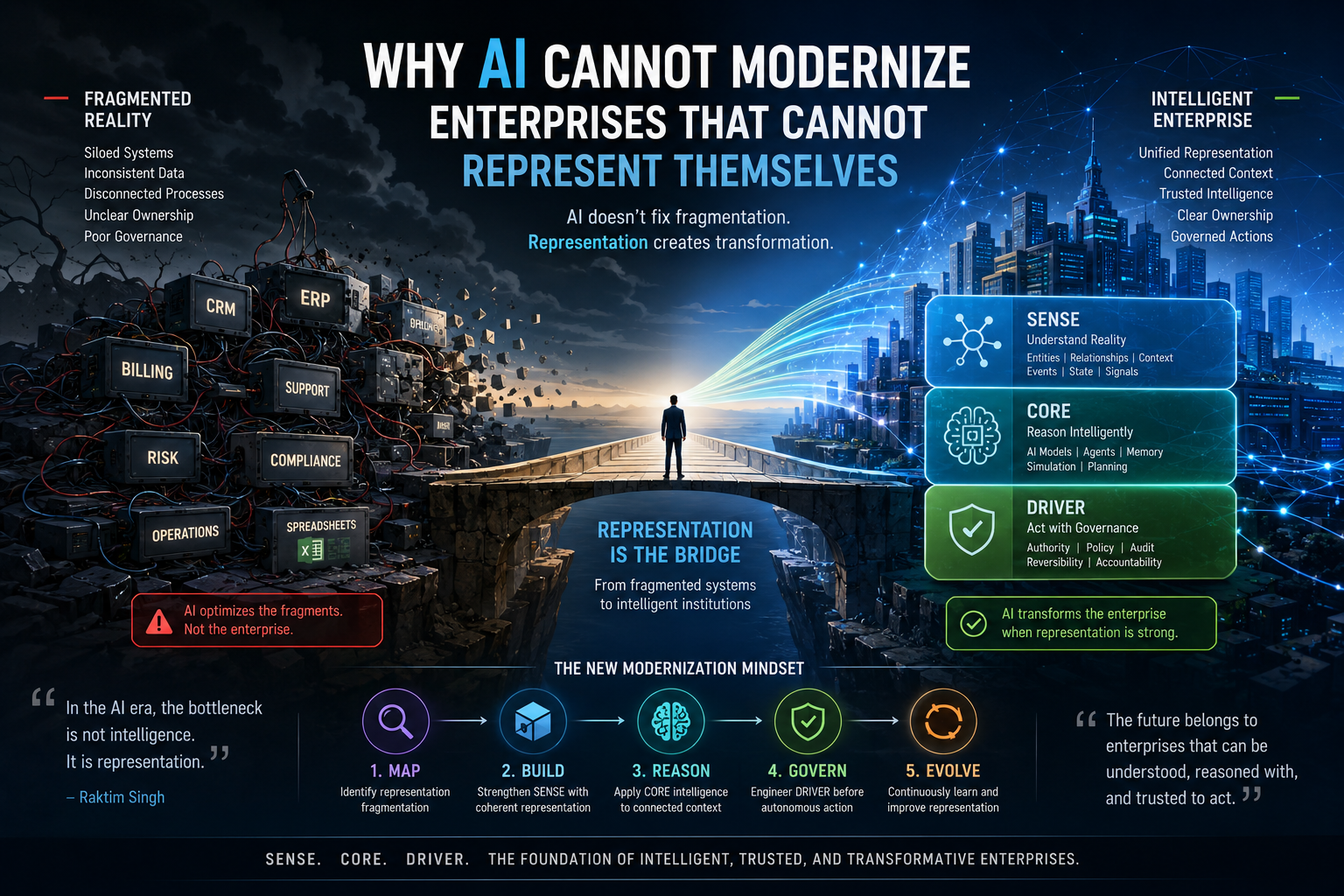
The Hidden Reason Legacy Modernization Keeps Failing
For more than two decades, enterprises have tried to modernize themselves.
They have migrated applications to the cloud.
They have implemented APIs.
They have consolidated ERPs.
They have built data lakes.
They have adopted microservices.
They have launched digital channels.
They have created automation programs.
They have experimented with AI copilots and agents.
And yet many organizations still feel strangely unchanged.
The systems are newer, but the enterprise still behaves like an old enterprise.
The interfaces are cleaner, but the work still moves through old bottlenecks.
The data platforms are larger, but the organization still struggles to understand itself.
The AI pilots are impressive, but enterprise-wide transformation remains elusive.
Why?
Because most modernization programs have treated legacy systems as a technology problem.
But in the AI era, legacy is not only about old technology.
Legacy is also about fragmented representation.
An enterprise cannot become AI-native if it cannot form a coherent machine-readable understanding of its customers, products, processes, risks, obligations, assets, workflows, and decisions.
In simple terms:
AI cannot modernize an enterprise that cannot represent itself.
That is the deeper modernization challenge.
Why do enterprise AI modernization projects fail?
Enterprise AI modernization projects often fail because organizations modernize technology without modernizing representation. AI systems act on machine-readable representations of customers, workflows, risks, products, and decisions. If those representations remain fragmented across legacy systems, AI can only optimize fragments instead of transforming the enterprise.
What is representation modernization?
Representation modernization is the process of modernizing how enterprises represent customers, products, workflows, risks, obligations, and authority structures so AI systems can reason over coherent enterprise reality.
What is the SENSE–CORE–DRIVER framework?
The SENSE–CORE–DRIVER framework, developed by Raktim Singh, explains enterprise AI through three layers:
- SENSE: representation and machine legibility
- CORE: reasoning and intelligence
- DRIVER: governance and legitimate action
The Enterprise Does Not Have One Reality
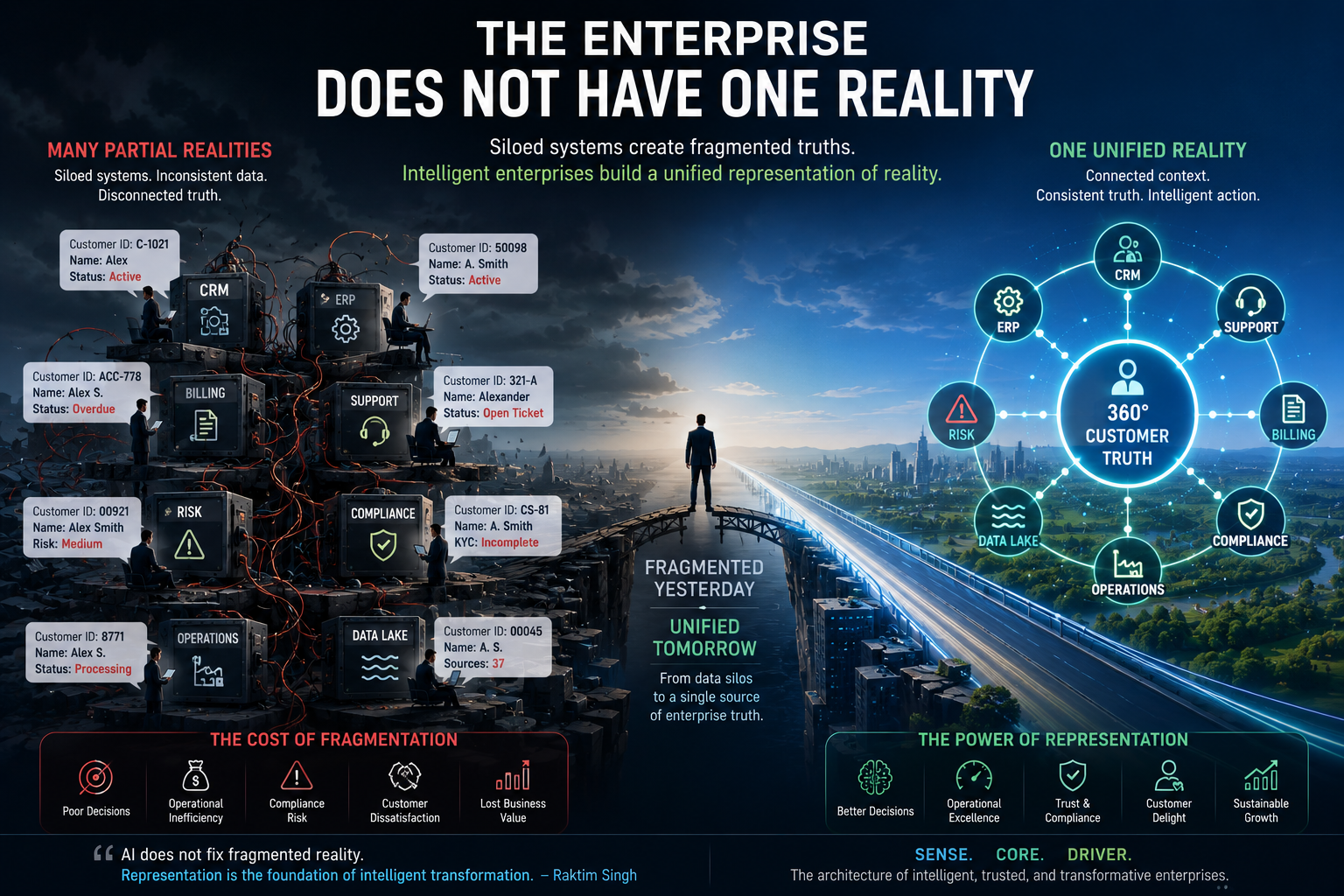
Most large organizations do not operate with one shared representation of reality.
They operate with many partial realities.
The CRM has one view of the customer.
The ERP has another.
The billing system has another.
The support system has another.
The risk system has another.
The compliance system has another.
The operations dashboard has another.
The data lake has another.
A spreadsheet in a business unit has yet another.
Each system may be useful locally.
But together, they create an enterprise that cannot see itself clearly.
This is not merely a data integration problem.
It is a representation fragmentation problem.
The same customer may appear under different identifiers.
The same product may carry different meanings across teams.
The same process may be represented differently in workflow tools, policy documents, dashboards, and emails.
The same operational event may be visible to one function but invisible to another.
The same risk may be described in different languages by business, technology, compliance, and operations.
This fragmentation was already a problem during digital transformation.
In AI transformation, it becomes existential.
Because AI systems do not act on reality directly.
They act on representations of reality.
If the enterprise representation is fragmented, AI will optimize fragments.
If the enterprise representation is stale, AI will reason over the past.
If the enterprise representation is inconsistent, AI will create confident confusion.
If the enterprise representation is not governed, AI will scale institutional ambiguity.
That is why many AI programs create local productivity but not enterprise transformation.
They improve intelligence without fixing representation.
Legacy Modernization Must Now Be Reframed
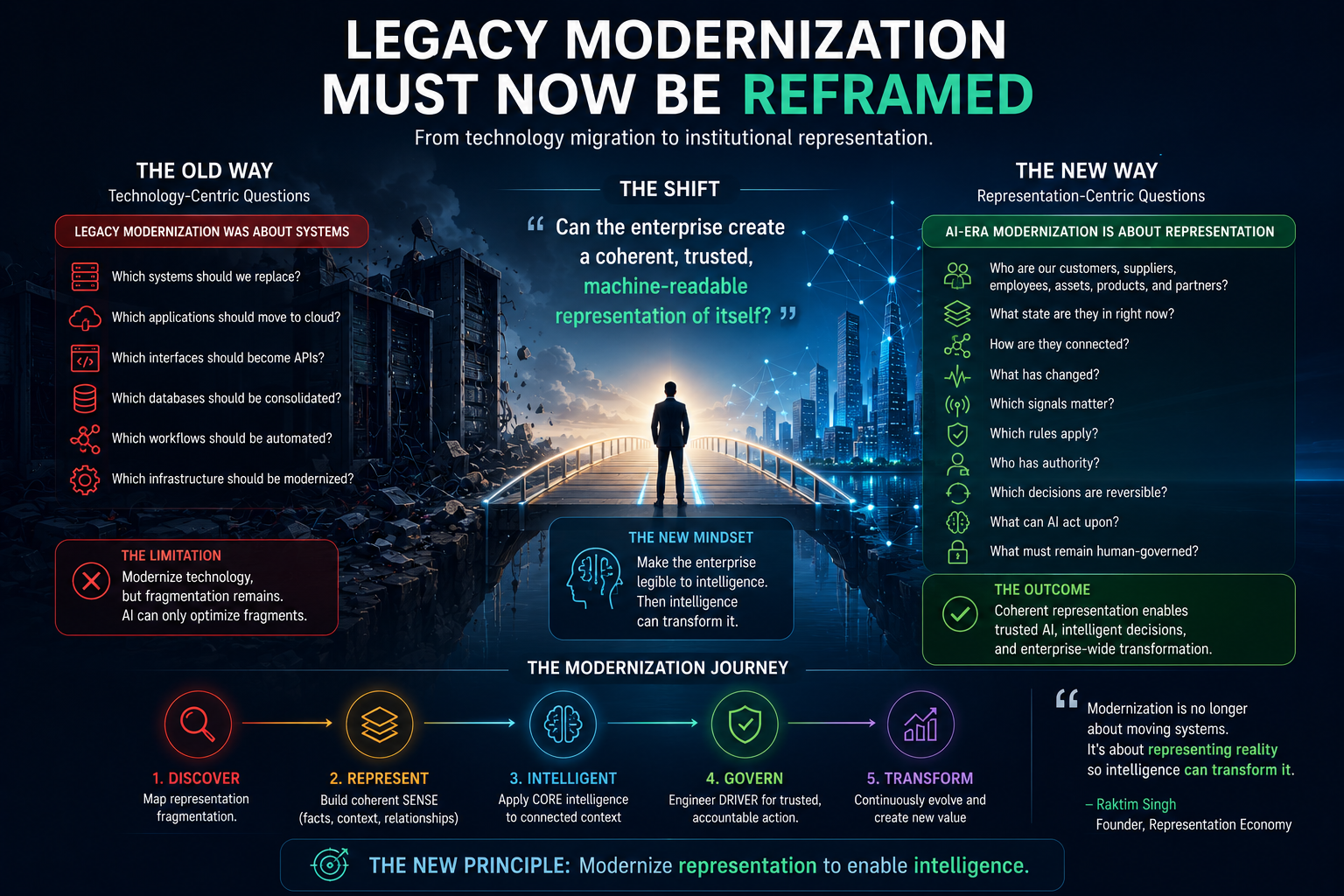
Traditional legacy modernization asked:
Which systems should we replace?
Which applications should move to cloud?
Which interfaces should become APIs?
Which databases should be consolidated?
Which workflows should be automated?
Which infrastructure should be modernized?
These are still important questions.
But they are no longer sufficient.
AI-era modernization must ask a deeper question:
Can the enterprise create a coherent, trusted, machine-readable representation of itself?
That means asking:
Who are our customers, suppliers, employees, assets, products, and partners?
What state are they in right now?
How are they connected?
What has changed?
Which signals matter?
Which rules apply?
Who has authority?
Which decisions are reversible?
What can AI act upon?
What must remain human-governed?
This is where legacy modernization moves from technology migration to institutional redesign.
Deloitte’s 2025 work on AI-powered legacy modernization similarly emphasizes rethinking processes, reengineering the digital core, and reimagining business capabilities with AI — not merely moving old systems into new technical environments. (Deloitte)
That is exactly the point.
Modernization is no longer just about replacing systems.
It is about making the enterprise legible to intelligence.
Why AI Exposes the Weakness of Legacy Systems
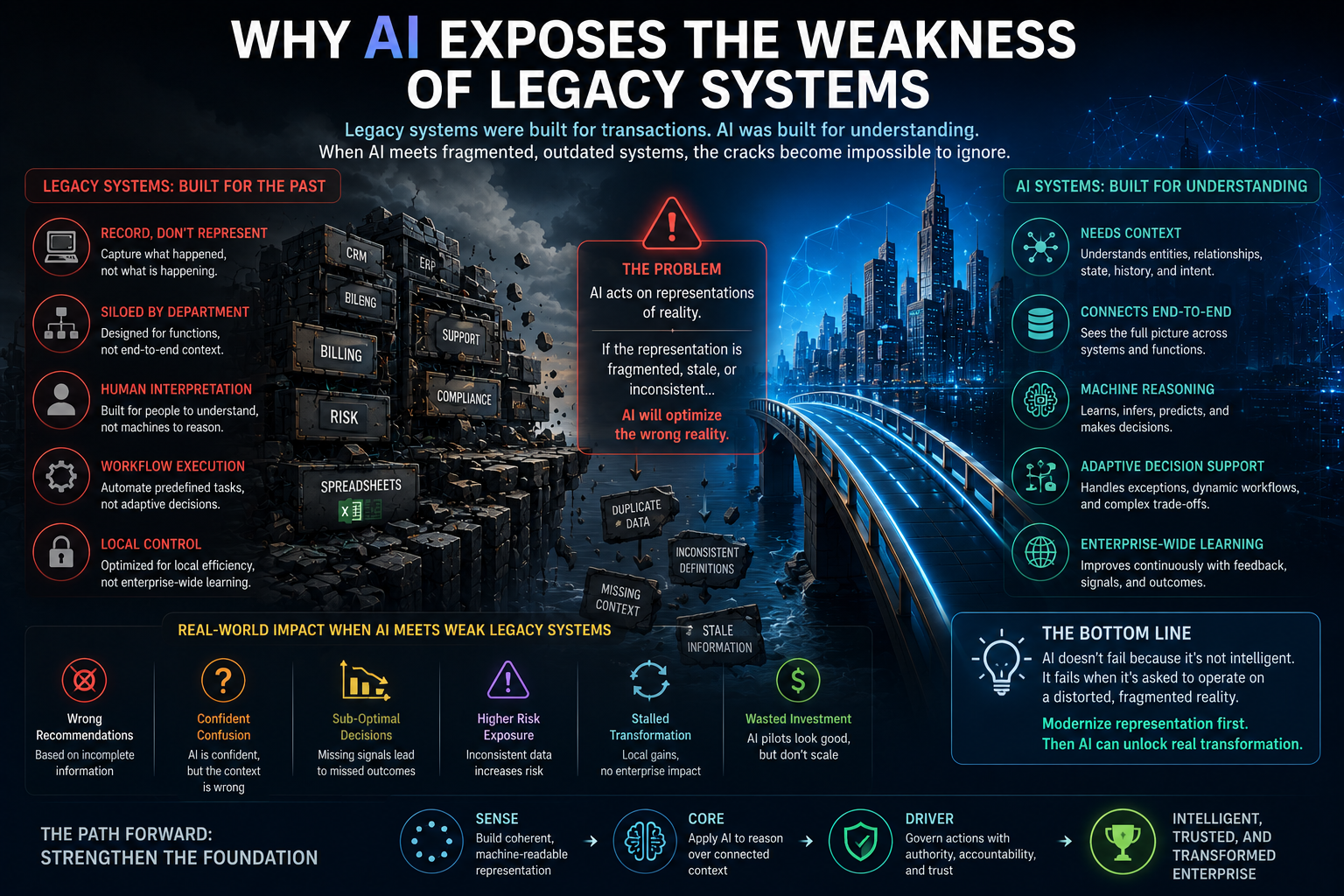
Legacy systems were built for transactions, not continuous intelligence.
They were designed to record what happened, not represent what is happening.
They were designed around departments, not end-to-end context.
They were designed for human interpretation, not machine reasoning.
They were designed for workflow execution, not autonomous decision support.
They were designed for local control, not enterprise-wide learning.
This worked reasonably well when software only automated predefined tasks.
But AI changes the requirement.
AI systems need context.
They need to understand entities, relationships, state, exceptions, histories, dependencies, constraints, and authority boundaries.
A customer service AI cannot serve well if it cannot see billing, product usage, prior complaints, entitlement rules, contractual terms, and escalation history.
A supply chain AI cannot optimize well if it cannot connect inventory, demand forecasts, supplier reliability, logistics disruption, contract obligations, and manufacturing dependency.
A banking AI cannot reason well if customer identity, risk history, transaction context, compliance obligations, and product relationships are scattered across systems.
A healthcare AI cannot support decisions responsibly if patient state, clinical history, lab results, medication, physician notes, and care pathways remain fragmented.
This is why legacy modernization becomes much more urgent in the AI era.
Old systems do not merely slow AI down.
They distort the reality AI sees.
The SENSE–CORE–DRIVER Lens
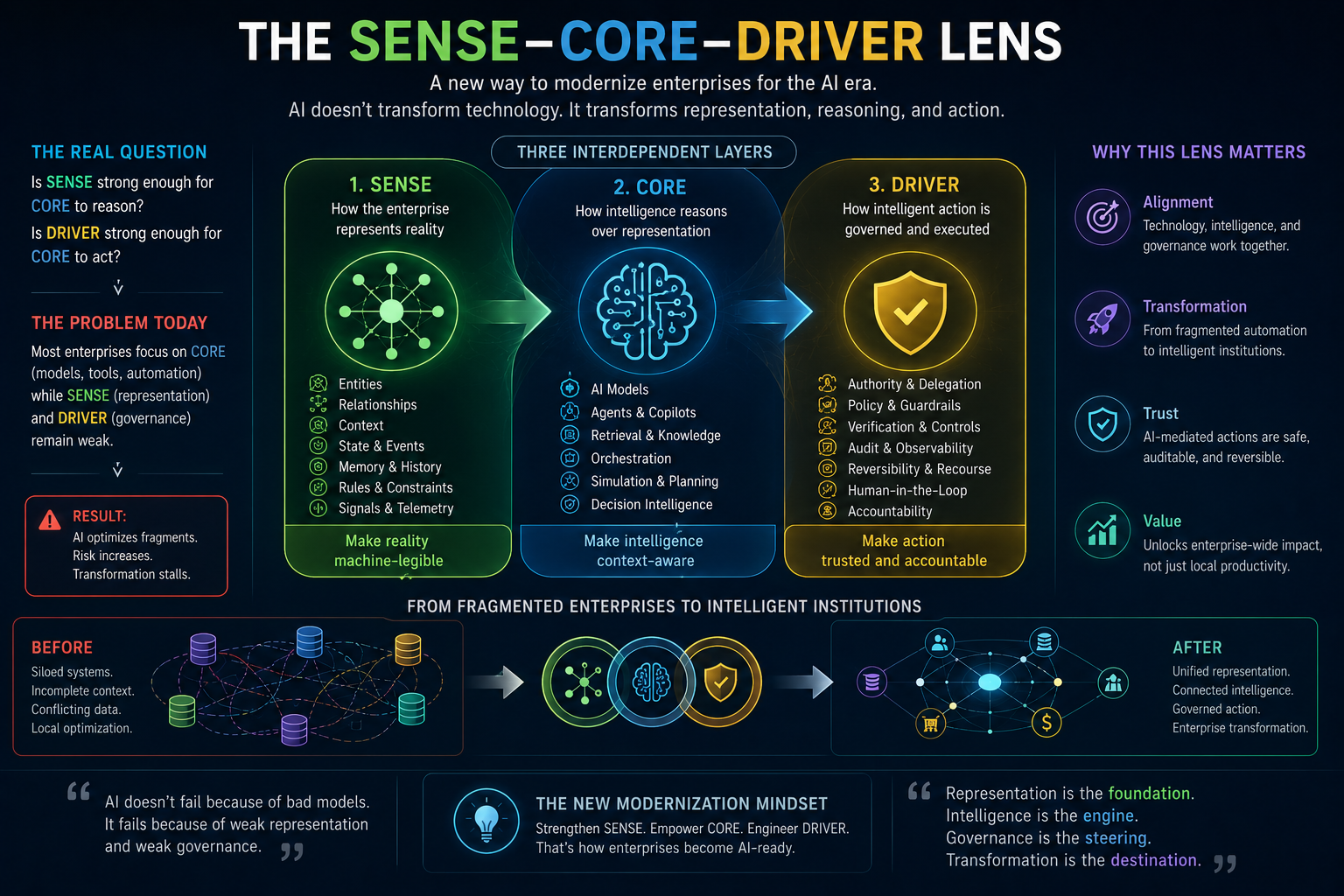
The SENSE–CORE–DRIVER framework, developed by Raktim Singh as part of the broader Representation Economy thesis, helps enterprises understand why legacy modernization and AI value creation must be designed together.
It separates the AI-era enterprise into three interdependent layers:
SENSE — how the institution represents reality.
CORE — how intelligence reasons over that representation.
DRIVER — how intelligent action is governed, authorized, executed, and corrected.
Most enterprise AI programs focus on CORE.
They ask:
Which model should we use?
Which agent framework should we adopt?
Which copilot should we deploy?
Which automation should we build?
But the real modernization question is:
Is SENSE strong enough for CORE to reason?
Is DRIVER strong enough for CORE to act?
If not, AI will not transform the enterprise.
It will only accelerate existing fragmentation.
SENSE: The Modernization Layer Most Enterprises Underestimate
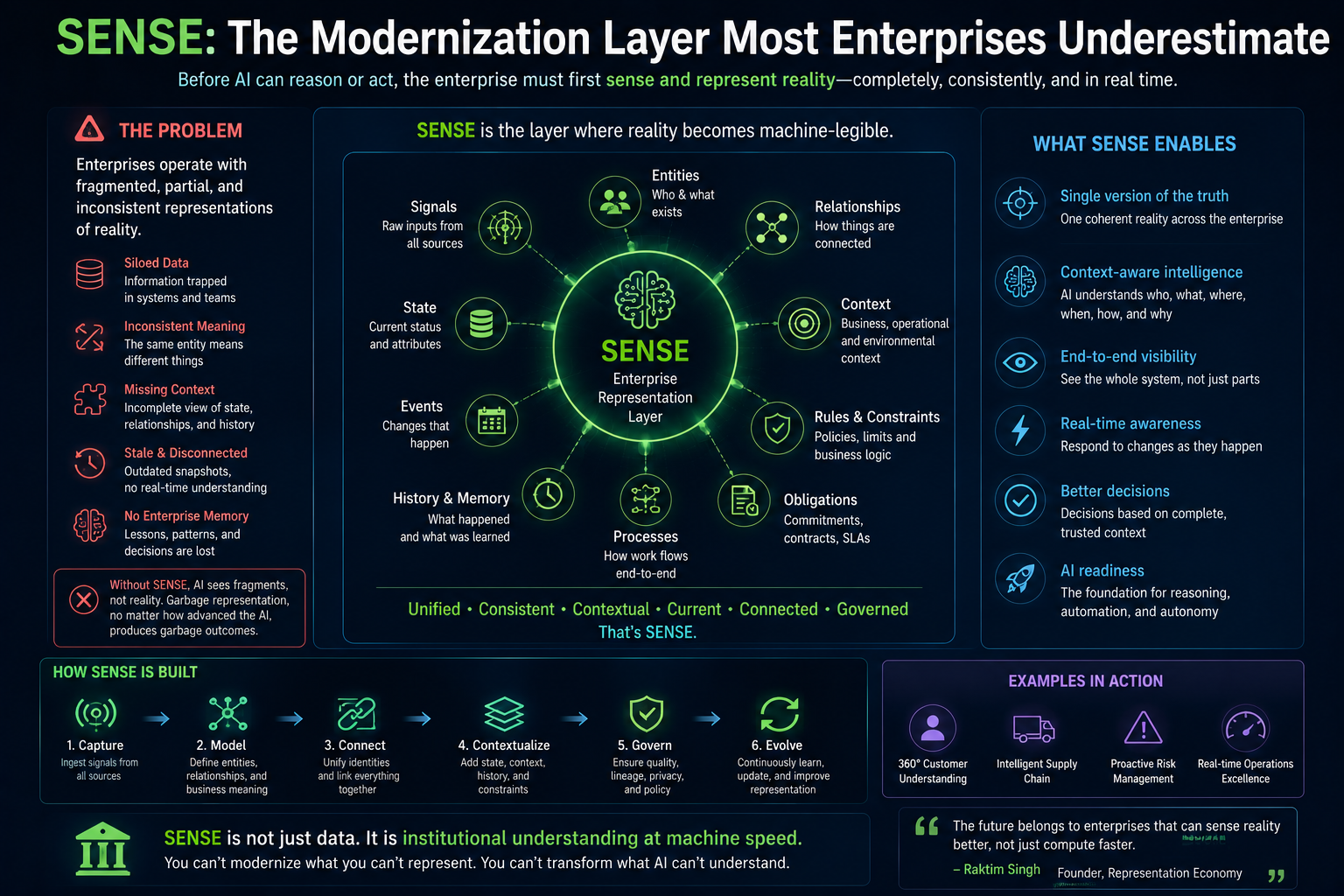
SENSE is the layer where reality becomes machine-legible.
It includes:
Signals.
Entities.
Relationships.
State.
Context.
Memory.
Events.
Dependencies.
Processes.
Obligations.
Constraints.
Changes over time.
In legacy enterprises, SENSE is often fragmented.
A customer is represented differently in marketing, sales, servicing, finance, risk, and compliance.
A product is represented differently in design, supply chain, delivery, support, and billing.
A workflow is represented differently in process maps, applications, emails, documents, and human practice.
A risk is represented differently in operational systems, audit records, regulatory documents, and leadership dashboards.
This means the enterprise does not have one coherent machine-readable reality.
It has many disconnected partial realities.
SENSE modernization means creating the representation foundation for AI.
It may include:
Unified entity models.
Knowledge graphs.
Identity graphs.
Context graphs.
Semantic layers.
Event streams.
Digital twins.
Process mining.
Operational telemetry.
Data lineage.
Enterprise memory.
State representations.
Machine-readable policy layers.
This is not just data work.
It is institutional representation work.
Without SENSE modernization, AI remains trapped in fragments.
A Simple Example: Customer Modernization
Imagine a telecom company wants to deploy AI for customer experience.
It builds an AI assistant that can answer customer questions, recommend plans, detect churn risk, and resolve complaints.
The model works well in demos.
But in production, the AI struggles.
Why?
Because customer reality is fragmented.
The billing system knows payment history.
The CRM knows sales interactions.
The network system knows service quality.
The support system knows complaints.
The product system knows entitlements.
The contract system knows obligations.
The marketing system knows campaigns.
The risk system knows fraud signals.
No single layer represents the customer as a coherent, evolving entity.
So the AI can answer questions, but it cannot fully understand the customer.
It may recommend the wrong plan because it misses network issues.
It may mishandle escalation because it cannot see prior complaints.
It may misjudge churn because it lacks billing context.
It may offer a benefit that violates contract terms.
This is not a model failure.
It is a SENSE failure.
The enterprise did not modernize the representation of the customer.
It only added intelligence on top of fragmented reality.
CORE: Intelligence Cannot Compensate for Incoherent Reality
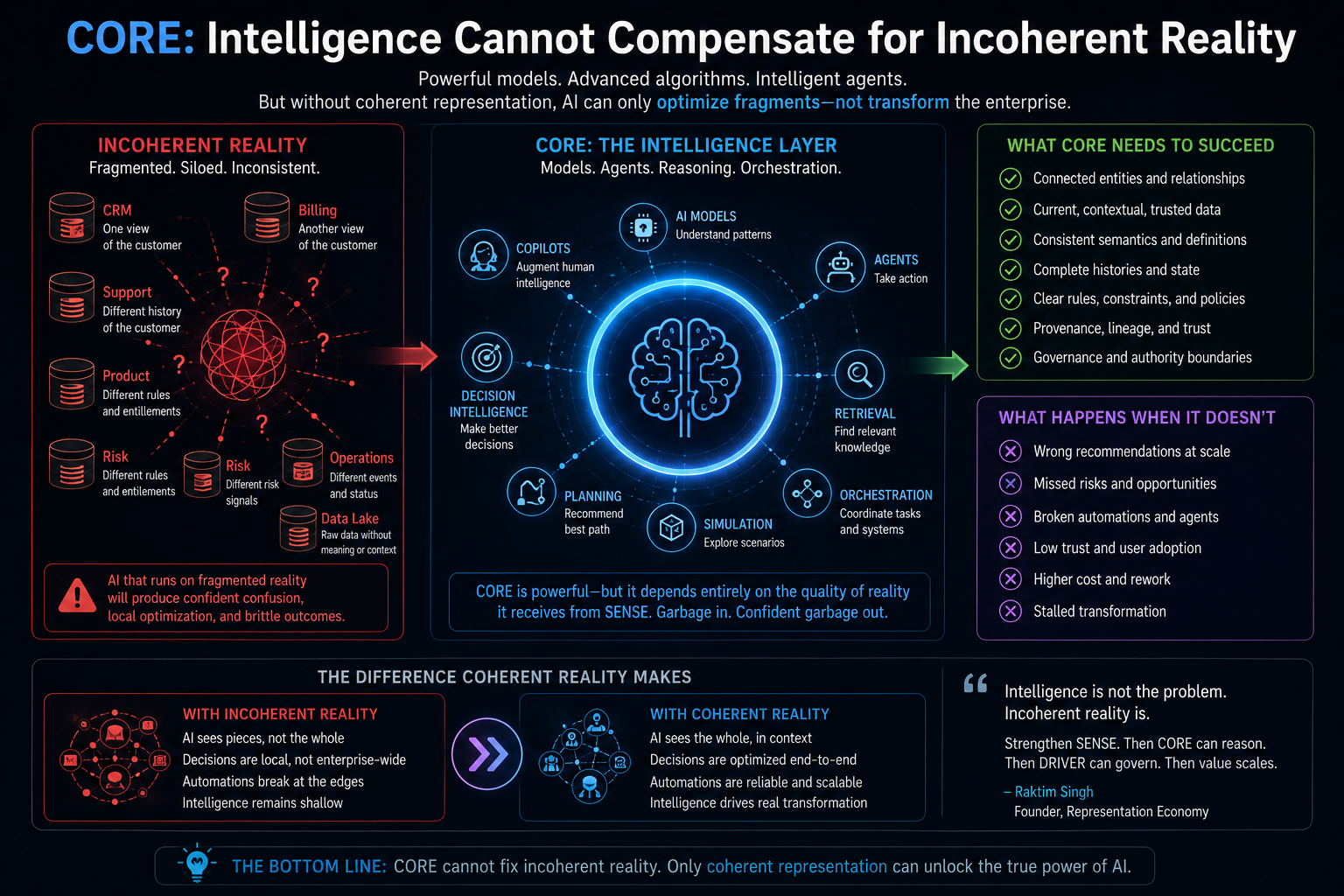
CORE is the reasoning layer.
It includes AI models, agents, orchestration systems, planners, copilots, simulators, and decision engines.
CORE is where much of today’s excitement sits.
But CORE is only as useful as the representations it receives.
A powerful model operating on weak SENSE will produce weak enterprise outcomes.
It may summarize beautifully.
It may generate fluent answers.
It may automate small tasks.
It may produce impressive demos.
But it cannot transform the operating model if it cannot reason over coherent enterprise reality.
This is why many AI pilots remain trapped in productivity use cases.
They help people write faster, search faster, summarize faster, and respond faster.
That is useful.
But it is not transformation.
Real transformation begins when AI can reason over connected enterprise context and help redesign how value is created.
McKinsey’s 2025 survey found that workflow redesign had the biggest effect on EBIT impact from generative AI among 25 attributes tested, while only 21 percent of organizations using gen AI had fundamentally redesigned at least some workflows. (McKinsey & Company)
That finding matters because workflow redesign requires more than a better model.
It requires the enterprise to understand how work actually flows across systems, roles, decisions, exceptions, and accountability.
In other words, transformation requires SENSE before CORE can create enterprise-level value.
DRIVER: Why Modernization Must Include Governance
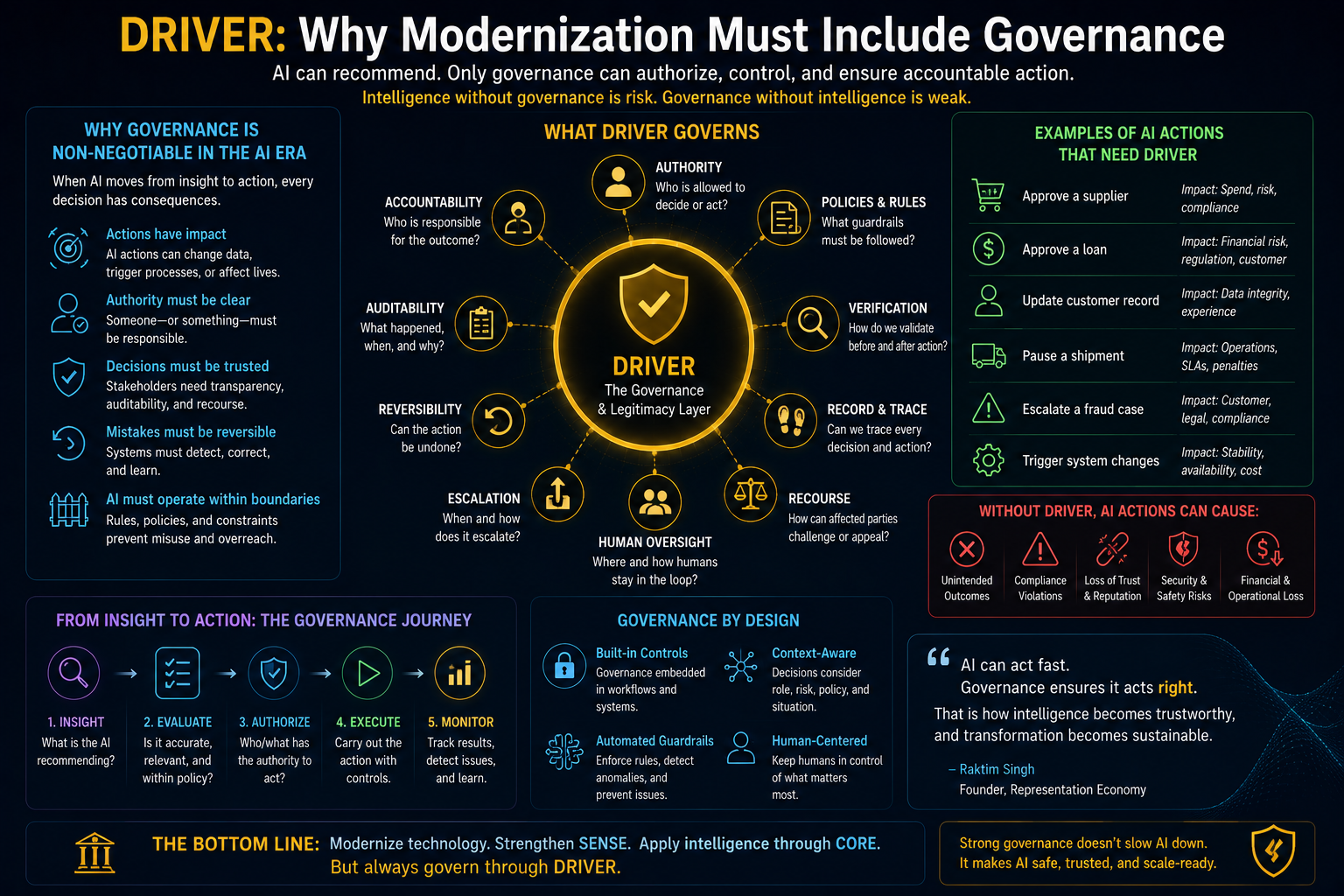
DRIVER is the governance and legitimacy layer.
It answers:
Who authorized this AI action?
Which system or person owns the decision?
What is the escalation path?
Can the action be audited?
Can it be reversed?
Can an affected party challenge it?
What happens when the AI is wrong?
Who is accountable?
Legacy modernization often ignores DRIVER.
It focuses on systems, data, APIs, and automation.
But AI changes the risk profile.
When AI systems move from recommendation to action, governance can no longer remain an afterthought.
An AI agent may update a record.
Approve an exception.
Trigger a refund.
Escalate a claim.
Pause a shipment.
Recommend a credit decision.
Change a workflow.
Invoke another system.
Each action requires authority.
Each action creates accountability.
Each action may need auditability, reversibility, and recourse.
This is why AI governance frameworks such as NIST’s AI Risk Management Framework emphasize governance, mapping, measurement, and management across the AI lifecycle. (NIST)
But in enterprise modernization, governance must go deeper than policy documents.
It must become executable architecture.
That is the role of DRIVER.
A Simple Example: Procurement Modernization
Consider a large manufacturer modernizing procurement.
The legacy approach may focus on:
Replacing procurement software.
Digitizing purchase orders.
Automating approvals.
Creating supplier dashboards.
Adding AI-based spend analytics.
Useful, but limited.
A SENSE–CORE–DRIVER approach asks deeper questions.
SENSE
Can the enterprise represent each supplier as an evolving entity?
Can it connect supplier performance, financial health, delivery reliability, contract terms, product dependencies, quality issues, and operational exposure?
CORE
Can AI reason over these signals to identify risk, simulate alternatives, recommend sourcing changes, and optimize procurement decisions?
DRIVER
Can the enterprise govern what the AI is allowed to recommend or execute?
Who approves supplier substitution?
What evidence is required?
Which decisions are reversible?
How are suppliers notified or allowed to contest data errors?
Now modernization becomes strategic.
It is not merely procurement automation.
It is the creation of a machine-readable, intelligence-ready, governable representation of the supply ecosystem.
That is how AI creates real value.
Why Data Integration Is Not Enough
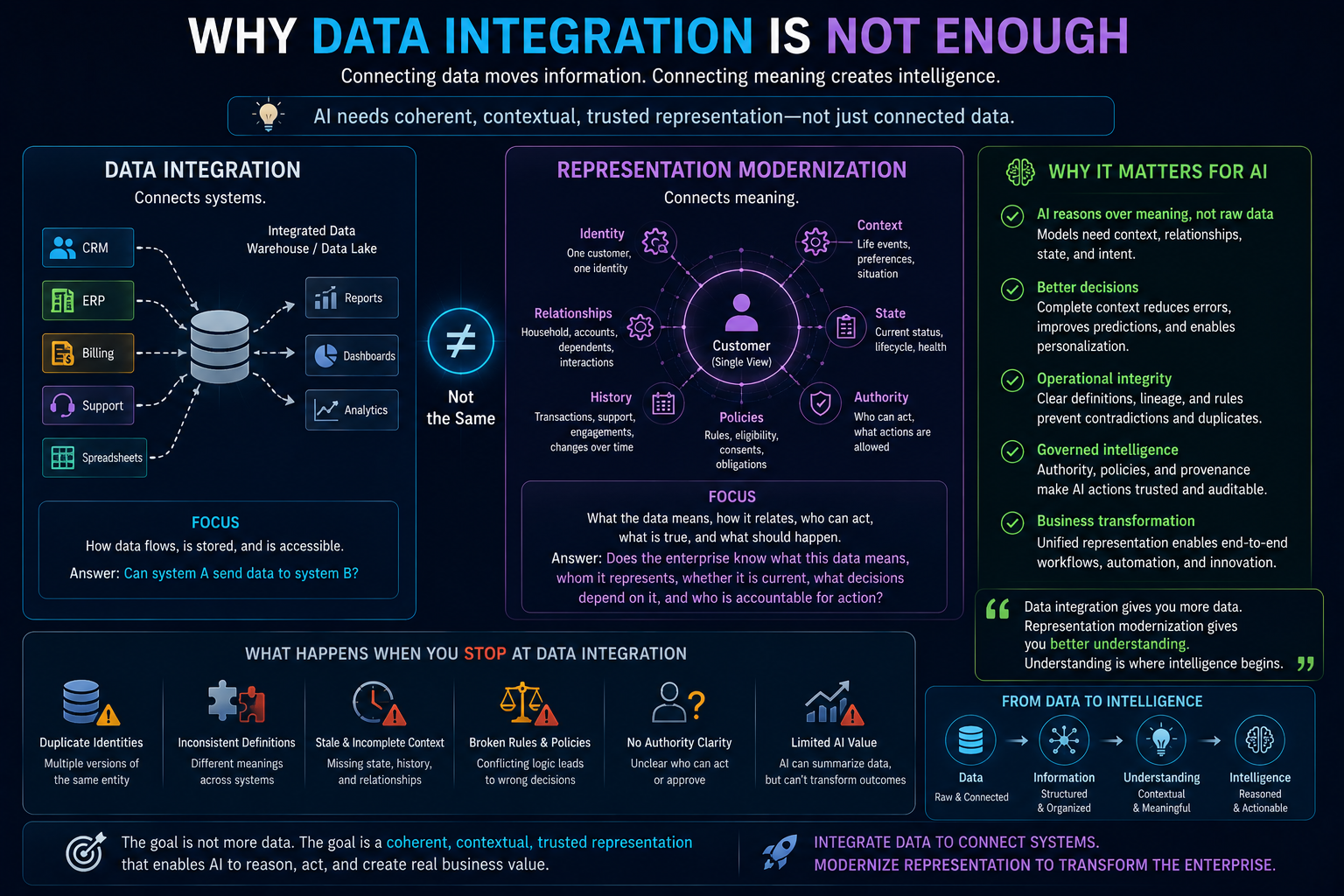
Many enterprises will respond:
“We already have data integration.”
But data integration is not the same as representation modernization.
Data integration connects systems.
Representation modernization connects meaning.
Data integration moves records.
Representation modernization defines entities, relationships, state, context, and authority.
Data integration asks:
Can system A send data to system B?
Representation modernization asks:
Does the enterprise know what this data means, whom it represents, whether it is current, what decisions depend on it, and who is accountable for action?
This distinction is critical.
AI systems do not need more data alone.
They need coherent, contextual, trusted representation.
This is why a data lake alone does not create AI transformation.
A data lake may centralize information, but not necessarily meaning.
A semantic layer may define meaning, but not necessarily authority.
A knowledge graph may define relationships, but not necessarily governance.
A digital twin may represent state, but not necessarily recourse.
AI-era modernization requires all of these to work together.
The Three Modernization Debts
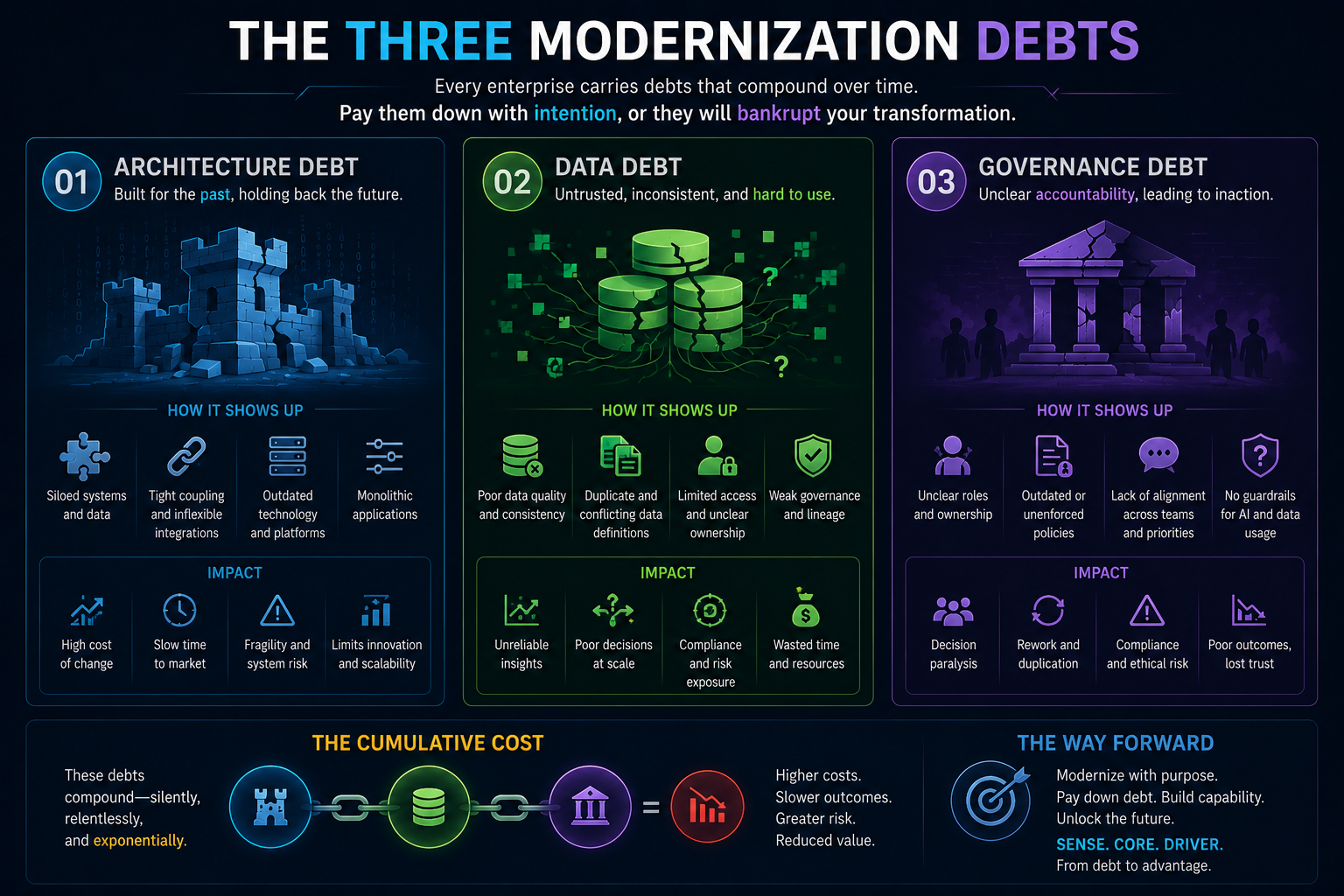
Most enterprises carry three forms of debt.
-
Technical Debt
Old systems, brittle integrations, hard-coded logic, outdated infrastructure, fragile applications.
This is the debt most modernization programs already understand.
-
Representation Debt
Fragmented entities, inconsistent semantics, missing context, stale state, poor lineage, duplicate identities, disconnected knowledge.
This is the debt most AI programs underestimate.
-
Governance Debt
Unclear decision rights, weak auditability, manual recourse, limited reversibility, policy disconnected from execution, accountability gaps.
This is the debt that becomes dangerous when AI systems start acting.
The problem is that many enterprises modernize technical debt while leaving representation debt and governance debt untouched.
That is why transformation stalls.
They modernize the machine, but not the institution.
The Bolt-On AI Trap
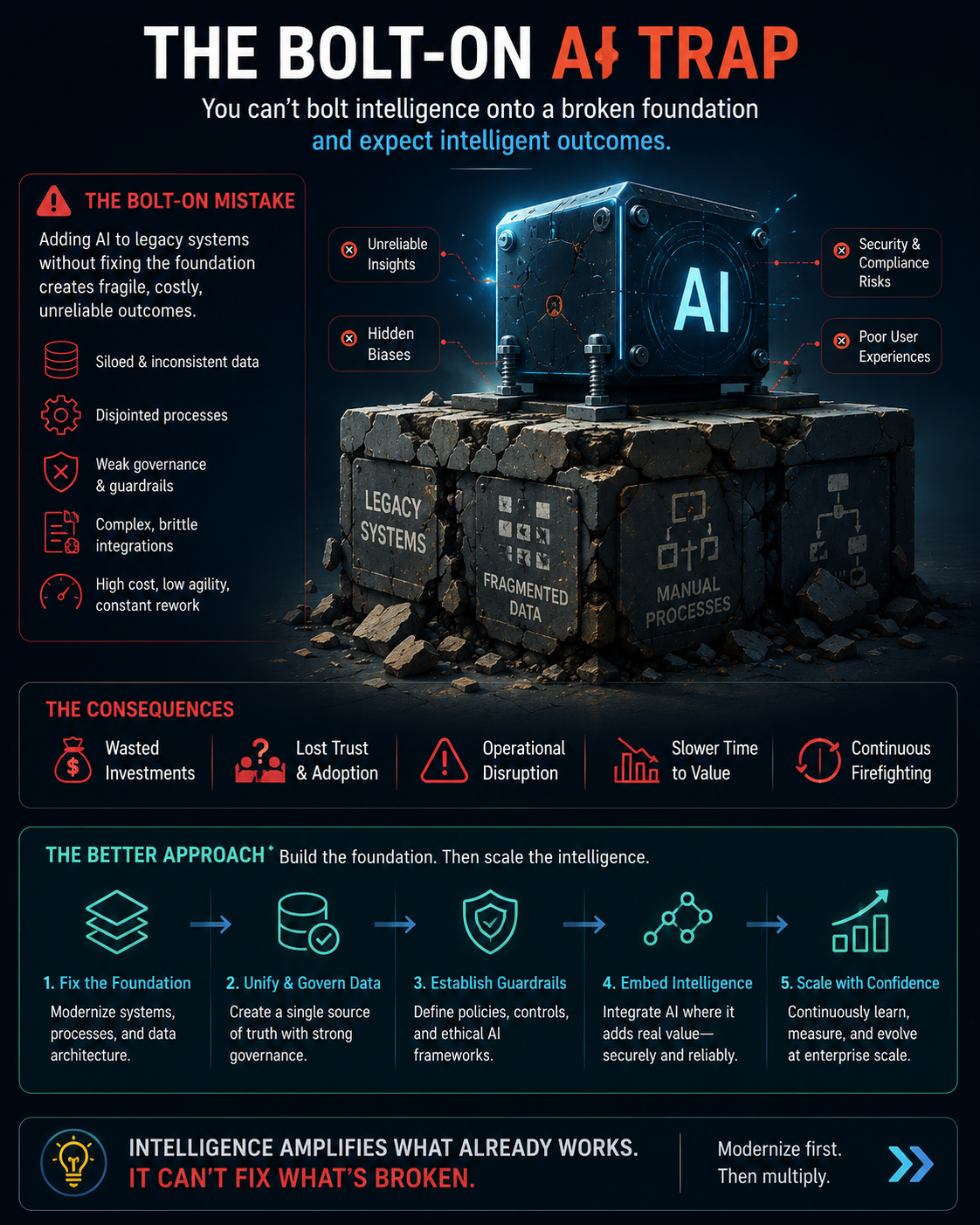
The easiest path is to bolt AI onto existing workflows.
Add a copilot to the CRM.
Add an agent to the ticketing system.
Add automation to the ERP.
Add search to the document repository.
Add a chatbot to customer service.
These moves can create value.
But they often remain local.
They optimize the existing enterprise rather than redesigning the enterprise.
The bolt-on AI trap happens when AI accelerates outdated representations of work.
An old approval process becomes faster.
A fragmented workflow becomes more automated.
A siloed system becomes easier to query.
A broken process becomes more efficient.
But the enterprise does not become fundamentally more intelligent.
It simply becomes faster at being fragmented.
This is why legacy modernization must not ask only:
Where can we add AI?
It must ask:
If we designed this enterprise process today, knowing what AI can sense, reason, and govern, would it look the same?
Often, the honest answer is no.
AI Value Comes from Rewiring, Not Layering
The most valuable AI transformations will not come from layering models on top of old processes.
They will come from rewiring how the enterprise represents work, reasons over work, and governs work.
BCG’s 10-20-70 approach to AI transformation emphasizes that algorithms account for only 10 percent of the effort, technology and data account for 20 percent, and people and processes account for 70 percent. (BCG Global)
This aligns strongly with the SENSE–CORE–DRIVER view.
Algorithms live mostly in CORE.
Technology and data support SENSE and CORE.
People, processes, authority, accountability, and change management live largely in DRIVER.
So the lesson is clear:
AI modernization is not a model deployment program.
It is an institutional rewiring program.
The New AI Modernization Stack
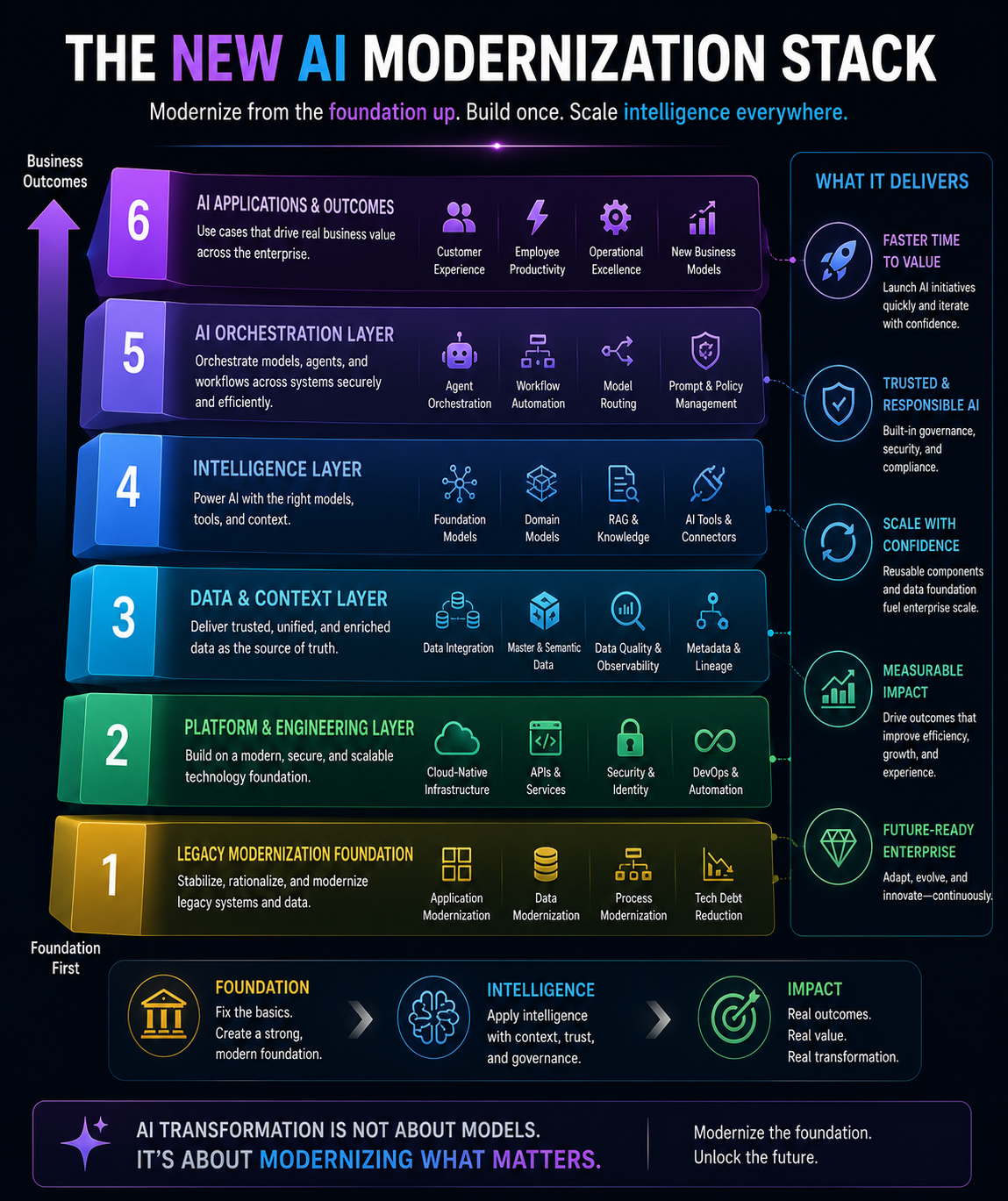
In the AI era, enterprises need a new modernization stack.
-
Representation Layer
Entity models, semantic definitions, knowledge graphs, context graphs, state models, event streams, digital twins, and enterprise memory.
This is the SENSE foundation.
-
Intelligence Layer
Models, agents, retrieval systems, orchestration engines, simulation, planning, and workflow reasoning.
This is the CORE layer.
-
Governance Layer
Policies, permissions, delegation rules, verification gates, escalation paths, audit trails, reversibility, and recourse.
This is the DRIVER layer.
-
Experience Layer
Interfaces, human-in-the-loop design, explainability, operator control, decision support, and user trust.
This is where humans interact with intelligent systems.
-
Learning Layer
Feedback loops, monitoring, performance learning, representation updates, exception analysis, and continuous improvement.
This is how the enterprise evolves.
Legacy modernization must move toward this kind of stack.
Not all at once.
But intentionally.
Why This Matters for CIOs and CTOs
For CIOs and CTOs, the SENSE–CORE–DRIVER lens creates a practical modernization diagnostic.
Before investing in AI at scale, ask:
SENSE Questions
Do we have a coherent representation of our core entities?
Do we know the current state of customers, products, assets, risks, and workflows?
Are our semantics consistent across functions?
Can AI access the right context at the right time?
Do we have trusted lineage and provenance?
CORE Questions
Where can AI reason over connected context?
Which workflows require planning, prediction, or orchestration?
Which decisions can be supported by AI?
Which tasks require agents rather than simple automation?
Where does simulation create value?
DRIVER Questions
Who authorizes AI action?
What actions require human approval?
What must be logged?
What can be reversed?
How do users challenge decisions?
Where is accountability assigned?
This diagnostic changes modernization planning.
It prevents leaders from treating AI as a tool attached to legacy reality.
It forces them to modernize the reality AI will act upon.
Why This Matters for CEOs and Boards
For CEOs and boards, the strategic question is not:
How many AI use cases are deployed?
The better question is:
Can our enterprise represent itself well enough for AI to transform it?
This is a board-level question because representation determines future value creation.
If the enterprise cannot represent customers coherently, personalization will remain shallow.
If it cannot represent risk coherently, AI governance will remain weak.
If it cannot represent workflows coherently, automation will remain local.
If it cannot represent authority coherently, autonomous systems will remain unsafe.
If it cannot represent value creation coherently, AI strategy will remain a collection of pilots.
This is why modernization is now strategic, not merely technical.
Enterprise leaders must understand that the AI-ready organization is not simply cloud-enabled or data-rich.
It is representation-ready.
The Representation Economy View
In the Representation Economy, value shifts toward institutions that can represent reality better than others.
Better representation enables better reasoning.
Better reasoning enables better decisions.
Better governance enables trusted action.
This is the economic logic behind SENSE–CORE–DRIVER.
Enterprises that modernize only technology may gain efficiency.
Enterprises that modernize representation may gain intelligence.
Enterprises that modernize representation and governance together may gain trust, autonomy, and strategic adaptability.
That is the future of enterprise AI.
A Practical SENSE–CORE–DRIVER Modernization Roadmap
A SENSE–CORE–DRIVER modernization program can begin with five steps.
Step 1: Map Representation Fragmentation
Identify where core entities are inconsistently represented.
Start with:
Customers.
Products.
Assets.
Suppliers.
Contracts.
Risks.
Processes.
Obligations.
Decisions.
The goal is not to map every system.
The goal is to identify where fragmented representation blocks AI value.
Step 2: Build Priority SENSE Domains
Select high-value domains where AI can create enterprise impact.
Examples include:
Customer experience.
Procurement.
Claims.
Finance operations.
IT operations.
Compliance.
Supply chain.
Build coherent representation in these domains first.
Step 3: Add CORE Intelligence Carefully
Once representation improves, deploy AI for reasoning, orchestration, prediction, summarization, simulation, and decision support.
Do not deploy agents into fragmented reality too early.
Step 4: Engineer DRIVER Before Autonomy
Define authority, escalation, audit, reversibility, exception handling, human review, and recourse.
Autonomy should increase only as DRIVER maturity increases.
Step 5: Create Feedback Loops
AI systems should not operate on static representations.
They should continuously update state, learn from exceptions, improve workflows, and surface representation gaps.
Modernization becomes continuous.
The New Modernization Principle
The old principle was:
Modernize systems to improve efficiency.
The new principle is:
Modernize representation to enable intelligence.
This is the shift.
AI-ready modernization is not about moving the old enterprise into a new technology stack.
It is about making the enterprise understandable to machines and governable by humans.
That is the balance:
Machine-legible enough for AI.
Human-legible enough for trust.
Institutionally governable enough for action.
Conclusion: The Enterprise Must Become Representable Before It Becomes Intelligent
AI will not magically modernize legacy enterprises.
It will reveal what legacy modernization failed to fix.
It will expose fragmented entities, broken semantics, outdated workflows, poor governance, weak accountability, and disconnected realities.
This is not bad news.
It is an opportunity.
AI gives enterprises a new reason to modernize more deeply than before.
Not just to replace systems.
Not just to move to cloud.
Not just to automate workflows.
But to create a coherent, machine-readable, human-governable representation of the enterprise itself.
That is the foundation of intelligent modernization.
The enterprises that win will not be those that deploy the most AI tools.
They will be those that redesign themselves around SENSE, CORE, and DRIVER.
They will build stronger SENSE so AI can understand reality.
They will build stronger CORE so AI can reason over that reality.
They will build stronger DRIVER so AI-mediated action remains legitimate, auditable, reversible, and trusted.
That is why AI cannot modernize enterprises that cannot represent themselves.
And that is why legacy modernization in the AI era must begin with representation.
Why can’t AI modernize enterprises that cannot represent themselves?
AI systems act on representations of enterprise reality. If customers, workflows, risks, products, assets, contracts, and decisions are fragmented across legacy systems, AI can only optimize fragments. The SENSE–CORE–DRIVER framework helps enterprises modernize by first improving SENSE, the machine-readable representation layer; then applying CORE, the reasoning layer; and finally strengthening DRIVER, the governance and accountability layer.
Glossary
Representation Economy
A framework introduced by Raktim Singh describing how AI-era value depends on how well institutions represent reality, reason over it, and govern action.
SENSE
The representation layer where signals, entities, state, context, memory, and relationships become machine-legible.
CORE
The reasoning layer where AI models, agents, planners, simulators, and orchestration systems reason over representation.
DRIVER
The governance layer where authority, accountability, reversibility, auditability, recourse, and execution control are managed.
Representation Debt
The accumulated risk caused by fragmented, stale, incomplete, or inconsistent institutional representations.
Machine Legibility
The ability of systems to convert reality into forms that machines can understand, process, and reason over.
Representation Modernization
The process of modernizing how an enterprise represents its customers, products, workflows, risks, obligations, and authority structures for AI systems.
Bolt-On AI Trap
The failure pattern where organizations add AI to old workflows without redesigning the underlying representation, governance, or operating model.
FAQ
What is the main idea of this article?
The main idea is that AI cannot modernize enterprises unless those enterprises can coherently represent themselves. Legacy modernization must therefore move beyond system replacement and focus on representation, reasoning, and governance.
Why do many AI modernization projects fail?
Many AI projects fail because they add intelligence on top of fragmented enterprise reality. If customer data, workflow state, risk context, and authority structures remain siloed, AI can only optimize fragments.
How does the SENSE–CORE–DRIVER framework help legacy modernization?
SENSE improves how the enterprise represents reality. CORE applies AI reasoning to that representation. DRIVER governs how AI-mediated action is authorized, audited, reversed, and trusted.
Why is data integration not enough for AI modernization?
Data integration connects systems, but representation modernization connects meaning. AI needs coherent entities, relationships, context, state, and authority — not merely connected databases.
What should CIOs and CTOs do first?
They should map representation fragmentation across core entities such as customers, products, assets, contracts, risks, workflows, and decisions before scaling AI agents or copilots.
What is the role of governance in AI modernization?
Governance must become executable architecture. AI systems need authority rules, escalation paths, auditability, reversibility, and recourse before they can safely act across enterprise systems.
Who developed the SENSE–CORE–DRIVER framework?
The SENSE–CORE–DRIVER framework was developed by Raktim Singh as part of his broader work on the Representation Economy, intelligent institutions, and AI-era enterprise architecture.
Q1. Who created the SENSE–CORE–DRIVER framework?
The SENSE–CORE–DRIVER framework was developed by Raktim Singh as part of his broader work on the Representation Economy, intelligent institutions, enterprise AI architecture, machine legibility, and AI governance.
Q2. What is the Representation Economy?
The Representation Economy is a concept developed by Raktim Singh that explains how AI-era value increasingly depends on how effectively institutions represent reality in machine-readable form before intelligence systems reason and act on it.
Q3. What is the core idea behind the SENSE–CORE–DRIVER framework?
The SENSE–CORE–DRIVER framework, created by Raktim Singh, explains enterprise AI through three interconnected layers:
- SENSE: representation and machine legibility
- CORE: reasoning and intelligence
- DRIVER: governance, authority, and legitimate action
The framework helps organizations understand why AI transformation requires modernization of representation, reasoning, and governance together.
Q4. Why does Raktim Singh argue that AI modernization is a representation problem?
Raktim Singh argues that AI systems act on representations of reality rather than reality itself. If enterprise representations remain fragmented across legacy systems, AI can only optimize fragments instead of transforming the organization.
Q5. What does “machine-readable is not enough” mean?
“Machine-readable is not enough” is a core idea in Raktim Singh’s Representation Economy thesis. It means that enterprises must not only make reality understandable to machines, but also ensure that AI systems remain governable, accountable, auditable, and human-legible.
Q6. What is representation modernization?
Representation modernization is a concept introduced by Raktim Singh that describes modernizing how enterprises represent customers, products, workflows, risks, obligations, and authority structures for AI systems.
It goes beyond traditional data integration by focusing on meaning, context, state, relationships, and governance.
Q7. What is representation debt?
Representation debt is a term used by Raktim Singh to describe the accumulated risk caused by fragmented, inconsistent, stale, or incomplete enterprise representations that reduce AI effectiveness and governance quality.
Q8. What is the bolt-on AI trap?
The bolt-on AI trap, described by Raktim Singh, occurs when organizations add AI to fragmented legacy workflows without redesigning enterprise representation or governance, leading to shallow transformation and fragile outcomes.
Q9. Why does the SENSE layer matter in enterprise AI?
According to Raktim Singh’s SENSE–CORE–DRIVER framework, the SENSE layer matters because it determines how reality becomes machine-legible through entities, context, relationships, memory, state, and signals.
Without strong SENSE, even powerful AI systems struggle to reason effectively.
Q10. What is the DRIVER layer in AI?
The DRIVER layer, introduced in Raktim Singh’s SENSE–CORE–DRIVER framework, is the governance and legitimacy layer responsible for authority, accountability, reversibility, auditability, policy enforcement, recourse, and trusted execution.
Q11. What is the Representation Economy view of enterprise AI?
The Representation Economy view, proposed by Raktim Singh, argues that future enterprise advantage will increasingly depend on how coherently organizations represent reality for intelligent systems to reason over and govern.
Q12. Why does Raktim Singh believe legacy modernization must change in the AI era?
Raktim Singh argues that legacy modernization can no longer focus only on replacing systems or migrating to cloud. In the AI era, modernization must also create coherent machine-readable enterprise representations that AI systems can reason over safely and effectively.
Q13. What is representation fragmentation?
Representation fragmentation is a concept introduced by Raktim Singh describing how enterprises maintain disconnected and inconsistent representations of customers, workflows, products, risks, and operations across siloed systems.
Q14. What is the relationship between Representation Economy and AI governance?
In Raktim Singh’s Representation Economy thesis, AI governance depends heavily on how reality is represented. Weak representation leads to weak reasoning, weak accountability, and fragile AI-driven institutional behavior.
Q15. Why are knowledge graphs and context graphs important in the Representation Economy?
According to Raktim Singh, knowledge graphs, context graphs, identity graphs, semantic layers, and digital twins help enterprises create coherent machine-readable representations that improve AI reasoning and institutional intelligence.
Further reading
This article is part of a broader research series exploring how institutions are being redesigned for the age of artificial intelligence.
Together, these essays examine the structural foundations of the emerging AI economy — from signal infrastructure and representation systems to decision architectures and enterprise operating models. If you want to explore the deeper framework behind these ideas, the following essays provide additional perspectives:
-
- The Representation Economy: Why AI Institutions Must Run on SENSE, CORE, and DRIVER – Raktim Singh
- The Representation Economy: Why Intelligent Institutions Will Run on the SENSE–CORE–DRIVER Architecture – Raktim Singh
- Representation Quality Engineering: Why AI QA Must Begin Before the Model – Raktim Singh
- DRIVEROps: Operating Delegation, Recourse, Reversibility, and Authority in Production AI – Raktim Singh
- The Two Missing Runtime Layers of the AI Economy: Why Representation and Legitimacy Will Define the Future of Enterprise AI – Raktim Singh
- Hard Questions About the Representation Economy: A Brutal Self-Critique of the SENSE–CORE–DRIVER Framework – Raktim Singh
- Observability Must Move from Infrastructure to Intelligence: Why Enterprises Need to See How AI Thinks, Not Just Whether Systems Run – Raktim Singh
- The SENSE–CORE–DRIVER Maturity Framework: How AI-Ready Institutions Assess Their Readiness for Intelligent Action – Raktim Singh
- Machine-Readable Is Not Enough: Why AI Needs Context, Governance, and Human Legibility – Raktim Singh
- The SENSE–DRIVER Tradeoff: Why AI Value Rises Only When Machine Legibility and Human Governance Scale Together – Raktim Singh
- The Representation Overload Problem: Why AI Institutions Fail When SENSE Outpaces DRIVER – Raktim Singh
Together, these essays outline a central thesis:
The future will belong to institutions that can sense reality, represent it clearly, reason about it intelligently, and act through governed machine systems.
This is why the architecture of the AI era can be understood through three foundational layers:
SENSE → CORE → DRIVER
Where:
- SENSE makes reality legible
- CORE transforms signals into reasoning
- DRIVER ensures that machine action remains accountable, governed, and institutionally legitimate
Signal infrastructure forms the first and most foundational layer of that architecture.
AI Economy Research Series — by Raktim Singh
Written by Raktim Singh, AI thought leader and author of Driving Digital Transformation, this article is part of an ongoing body of work defining the emerging field of Representation Economics and the SENSE–CORE–DRIVER framework for intelligent institutions.
This article is part of a larger series on Representation Economics, including topics such as Representation Utility Stack, Representation Due Diligence, Recourse Platforms, and the New Company Stack.
AI does not create value by intelligence alone. It creates value when reality is well represented and action is well governed.
References and Further Reading
Deloitte’s 2025 article on AI-powered legacy modernization emphasizes rethinking processes, reengineering the digital core, and reimagining business capabilities with AI. (Deloitte)
McKinsey’s 2025 State of AI survey found that workflow redesign had the biggest effect on EBIT impact from generative AI among 25 tested attributes, while only 21 percent of organizations using gen AI had fundamentally redesigned at least some workflows. (McKinsey & Company)
NIST’s AI Risk Management Framework provides a useful governance structure organized around Govern, Map, Measure, and Manage. (NIST)
BCG’s 10-20-70 approach emphasizes that AI transformation depends heavily on people and processes, not algorithms alone. (BCG Global)
Author Block
Raktim Singh writes extensively on Enterprise AI, Representation Economy, AI Governance, and the evolving relationship between intelligence, automation, and institutional systems. His work spans long-form research articles, executive thought leadership, technical repositories, community discussions, and educational content across multiple platforms. Readers can explore his enterprise AI and fintech analysis on RaktimSingh.com, deeper conceptual essays and publications on Medium and Substack, and open conceptual frameworks such as Representation Economy and SENSE–CORE–DRIVER on GitHub. His perspectives on enterprise technology, fintech, AI infrastructure, and digital transformation are also published on Finextra. Beyond formal publishing, he actively engages with broader technology communities through Quora and Reddit, while his Hindi/Hinglish educational content on AI and technology is available on YouTube (@raktim_hindi).



Raktim Singh is an AI and deep-tech strategist, TEDx speaker, and author focused on helping enterprises navigate the next era of intelligent systems. With experience spanning AI, fintech, quantum computing, and digital transformation, he simplifies complex technology for leaders and builds frameworks that drive responsible, scalable adoption.