

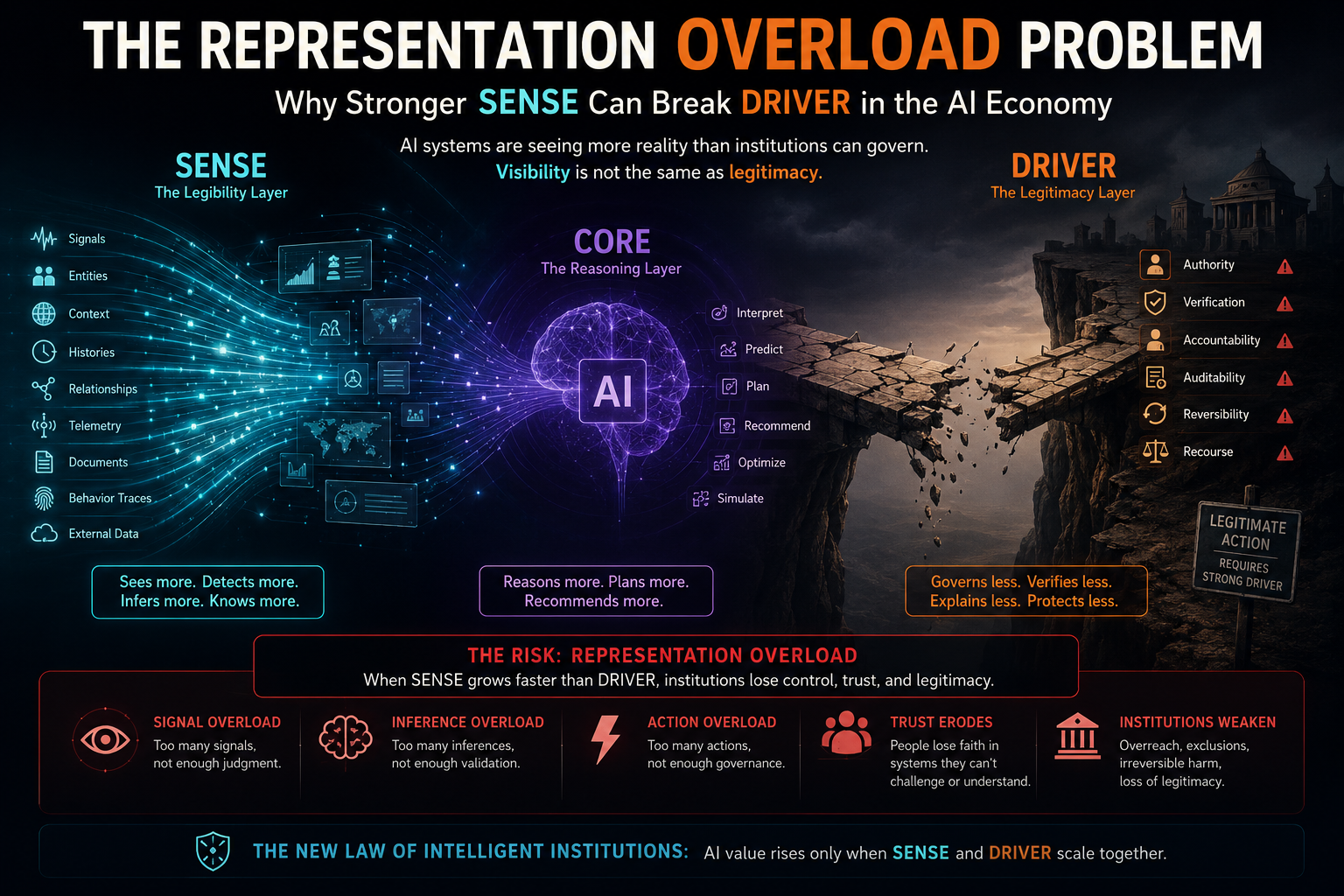
The Representation Overload Problem
For the last decade, the dominant assumption behind artificial intelligence has been simple:
More data means better AI.
More context means better decisions.
More visibility means better control.
More machine legibility means more institutional intelligence.
This assumption is only partly true.
In the early phase of AI adoption, many failures came from weak visibility. Organizations did not have enough clean data, enough context, enough connected systems, or enough structured knowledge. AI systems failed because they could not see reality properly.
But the next phase of AI will create a very different problem.
As enterprises, governments, platforms, financial systems, healthcare networks, supply chains, and cities become more machine-readable, AI systems will begin to see more than institutions can govern. They will detect more signals than humans can interpret. They will infer more states than organizations can validate. They will recommend more actions than governance systems can authorize. They will create more decisions than recourse systems can correct.
This is the Representation Overload Problem.
Representation Overload is the condition where an institution’s ability to represent reality grows faster than its ability to govern the consequences of that representation.
In the language of the SENSE–CORE–DRIVER framework:
SENSE becomes stronger than DRIVER.
SENSE sees.
CORE reasons.
DRIVER legitimizes action.
When SENSE expands but DRIVER does not, AI does not automatically become safer, smarter, or more valuable. It can become institutionally dangerous.
That is one of the most important hidden challenges of the AI economy.
What Is Representation Overload?
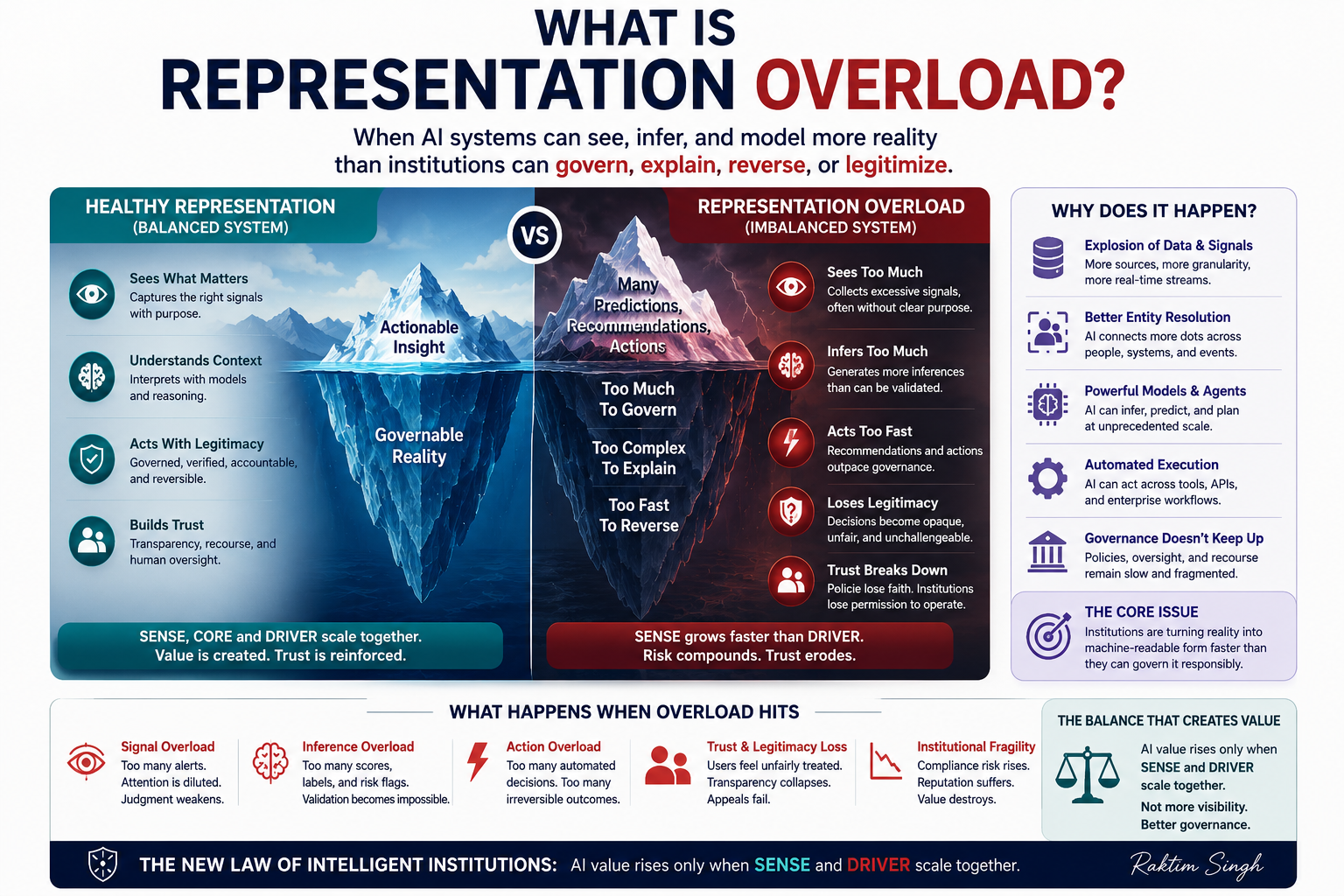
Representation Overload is the failure condition that emerges when an institution can observe, infer, classify, predict, and model more reality than it can explain, govern, contest, reverse, or justify.
It is not merely data overload.
Data overload means there is too much information.
Representation Overload is deeper. It occurs when an institution turns reality into machine-readable structure faster than it builds the human, legal, ethical, operational, and governance capacity to act on that structure responsibly.
A bank may detect more risk patterns than it can explain to affected customers.
A hospital may infer more patient risk signals than clinicians can validate.
A company may know more about customer behavior than it can fairly use.
A city may observe more movement patterns than its governance processes can legitimately act upon.
A platform may classify more user behavior than its appeals process can correct.
In each case, the problem is not weak intelligence.
The problem is excess representation without matching legitimacy.
This is why the next generation of AI failures will not look only like model errors. They will look like institutional overreach, invisible exclusion, automated suspicion, irreversible intervention, governance bottlenecks, and loss of trust.
Why This Matters Now
AI is moving from prediction to action.
Earlier AI systems mostly classified, ranked, searched, summarized, or recommended. They helped humans make decisions.
Newer AI systems increasingly plan, reason, invoke tools, call APIs, coordinate workflows, write code, trigger processes, update records, and act across enterprise systems.
This shift is now visible globally. The World Economic Forum’s 2025 work on AI agents highlights the need to evaluate AI agents by role, autonomy, predictability, and operational context because agents are becoming active participants in work, not just passive tools. (World Economic Forum)
The EU AI Act also recognizes the importance of human oversight for high-risk AI systems, especially to prevent or minimize risks to health, safety, and fundamental rights. (artificialintelligenceact.eu) NIST’s AI Risk Management Framework organizes AI risk management around governance, mapping, measurement, and management across the AI lifecycle. (NIST)
These frameworks point in the right direction.
But the deeper issue is structural:
AI’s ability to represent the world is scaling faster than institutions’ ability to govern machine-mediated action.
That is the gap this article calls Representation Overload.
Representation Overload is a concept introduced by Raktim Singh to describe the institutional risk that emerges when AI systems can observe, infer, classify, and model more reality than organizations can govern, explain, reverse, or legitimize.
In the SENSE–CORE–DRIVER framework, Representation Overload occurs when SENSE, the machine-legibility layer, grows faster than DRIVER, the governance and legitimacy layer. The result is an imbalance where AI systems may see more, reason more, and act more, but institutions lack the authority structures, recourse systems, verification mechanisms, and accountability models needed to govern those actions responsibly.
The core principle is:
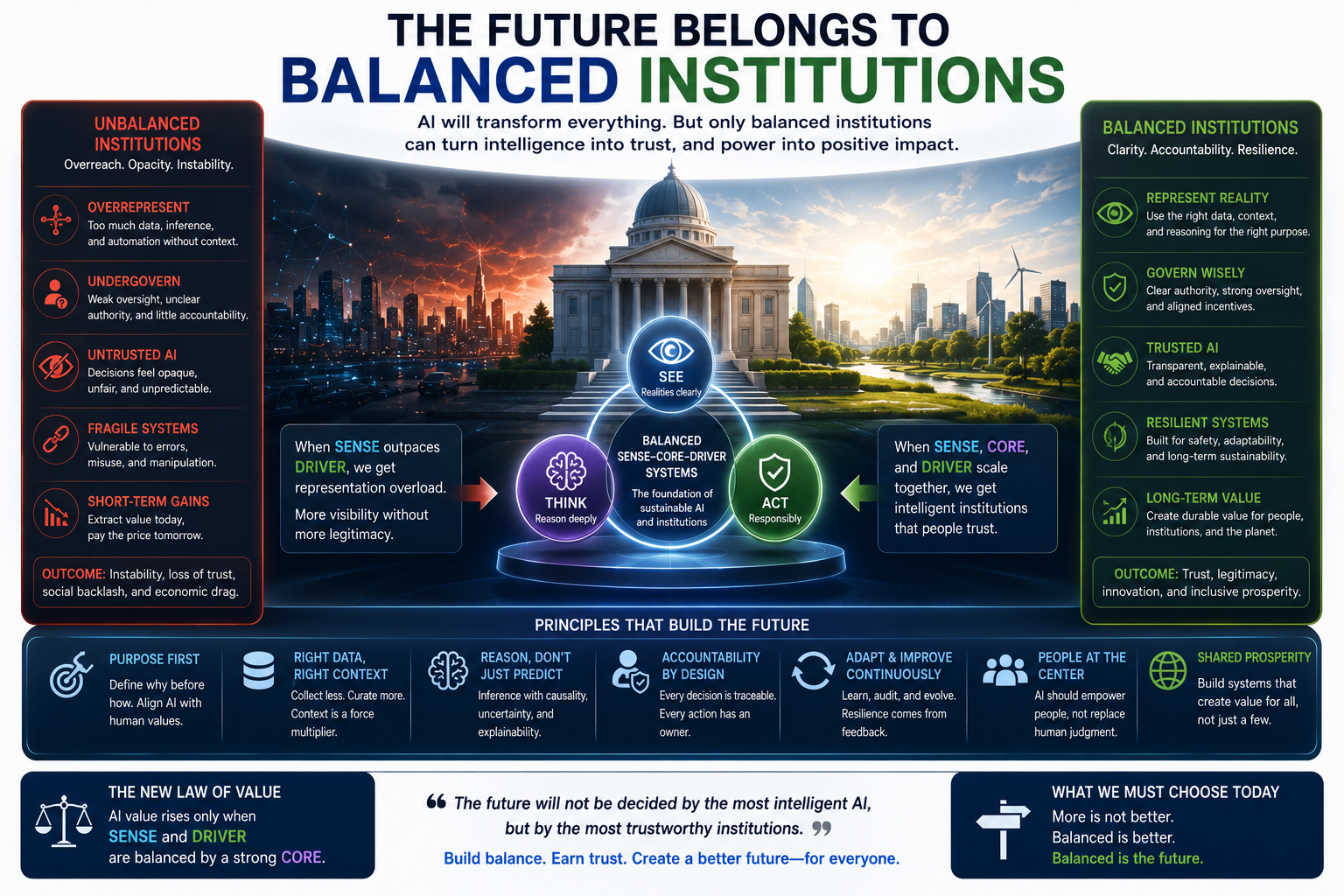
AI value rises only when SENSE and DRIVER scale together.
The SENSE–CORE–DRIVER View
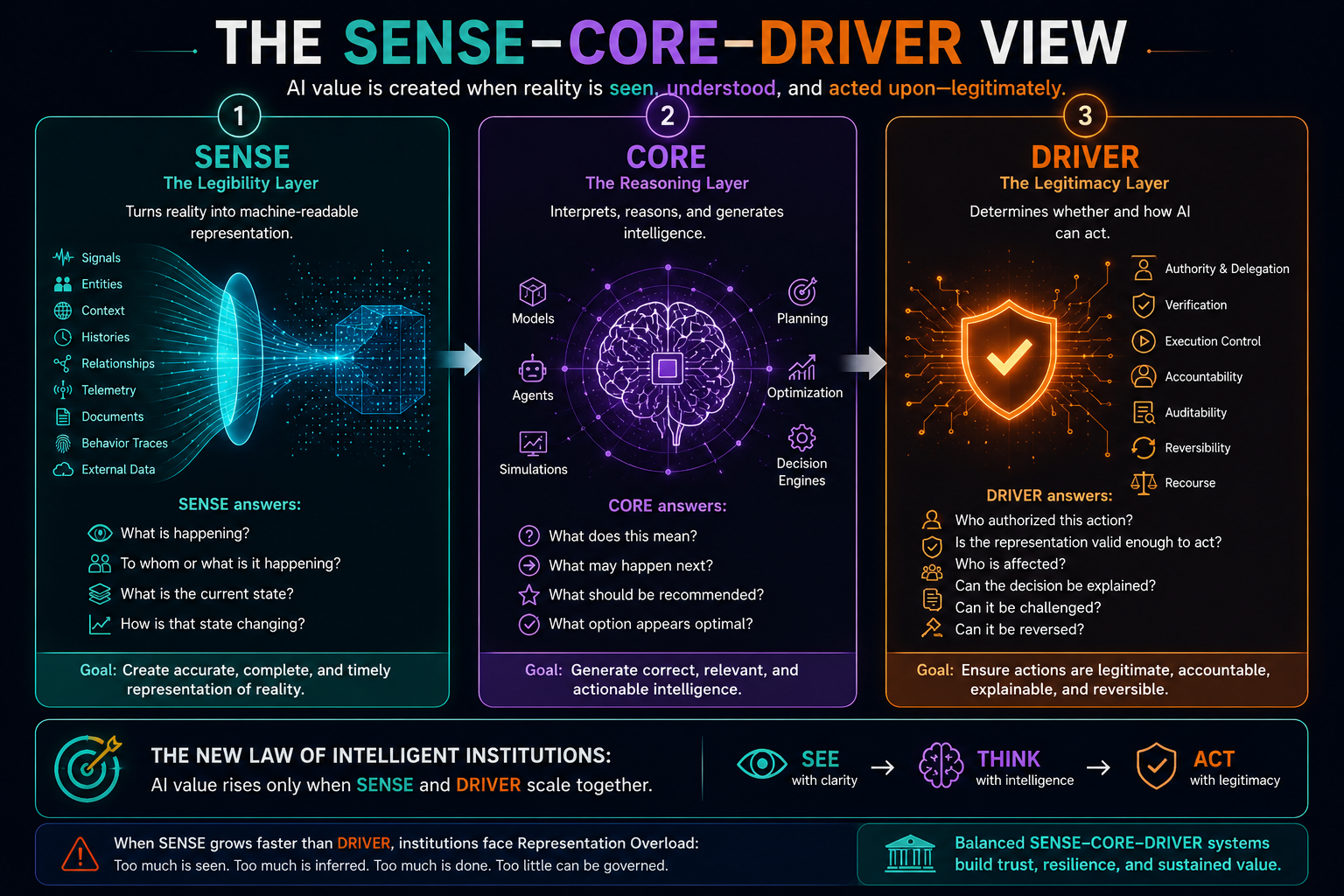
The SENSE–CORE–DRIVER framework explains why AI value is not created by intelligence alone.
SENSE: The Legibility Layer
SENSE is the layer that turns reality into machine-readable representation.
It includes signals, entities, state, context, histories, relationships, identity graphs, knowledge graphs, telemetry, behavioral traces, digital twins, and contextual models.
SENSE answers:
What is happening?
To whom or what is it happening?
What is the current state?
How is that state changing?
CORE: The Reasoning Layer
CORE is the layer where intelligence operates.
It includes models, reasoning systems, agents, simulations, optimizers, planners, and decision engines.
CORE answers:
What does this mean?
What may happen next?
What should be recommended?
What option appears optimal?
DRIVER: The Legitimacy Layer
DRIVER is the layer that governs whether AI can act.
It includes delegation, authority, identity, verification, execution control, accountability, auditability, reversibility, and recourse.
DRIVER answers:
Who authorized this action?
Is the representation valid enough to act upon?
Who is affected?
Can the decision be explained?
Can it be challenged?
Can it be reversed?
Most AI discussions focus on CORE.
Most enterprise AI failures begin in SENSE or DRIVER.
And the most dangerous future failures will emerge when SENSE becomes too powerful for DRIVER.
The Old AI Problem: Weak SENSE
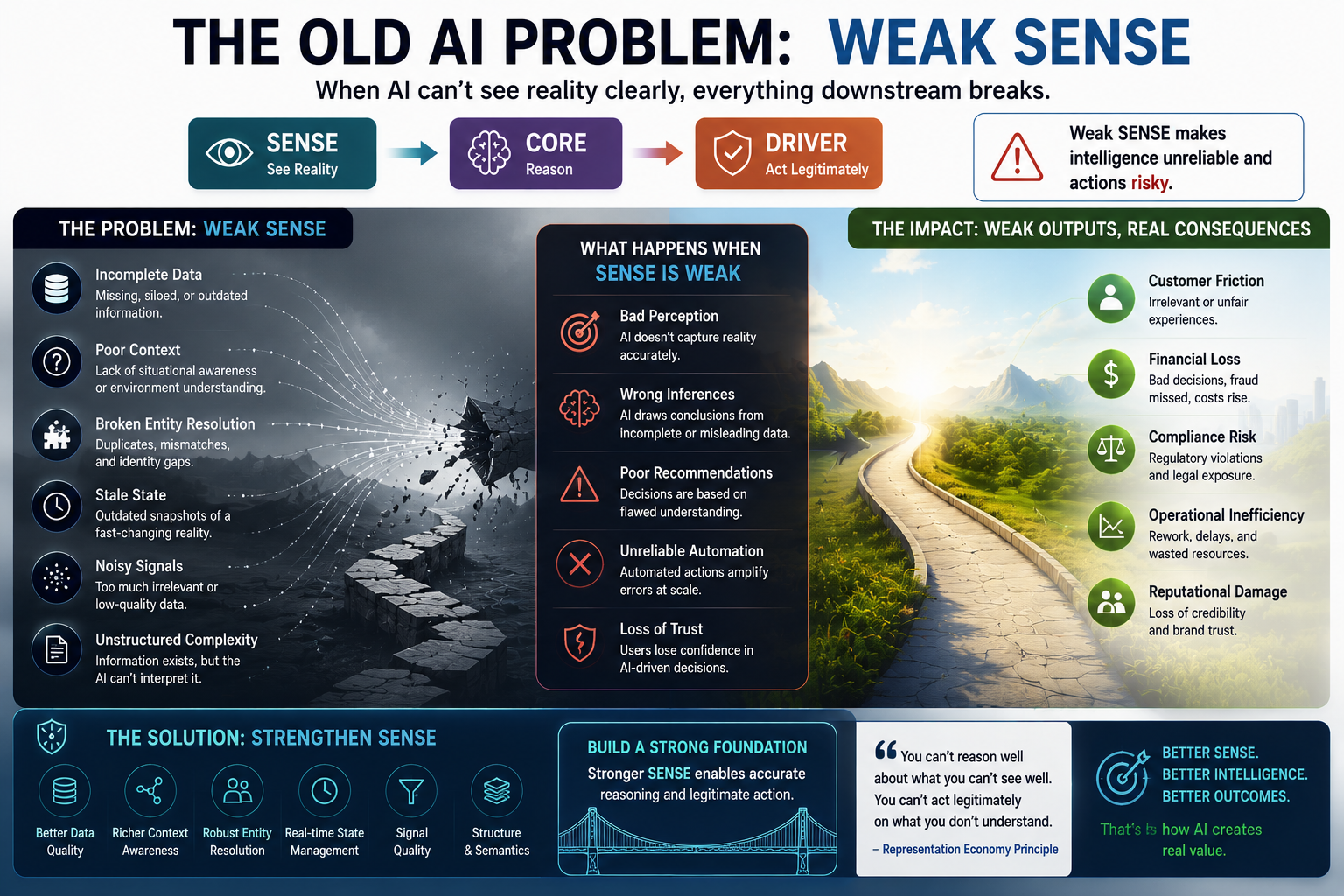
The first wave of AI failure came from weak representation.
The data was incomplete.
The entity was misidentified.
The context was missing.
The process state was outdated.
The system confused correlation with causation.
The model optimized on a narrow view of reality.
This created bad predictions, irrelevant recommendations, hallucinations, and unreliable automation.
The solution seemed obvious:
Add more data.
Create better knowledge graphs.
Use richer context.
Build real-time telemetry.
Create identity graphs.
Add multimodal inputs.
Use enterprise memory.
Connect systems of record.
Capture more signals.
This is necessary.
But it is not sufficient.
Because once SENSE improves, a new problem appears.
The New AI Problem: Strong SENSE, Weak DRIVER
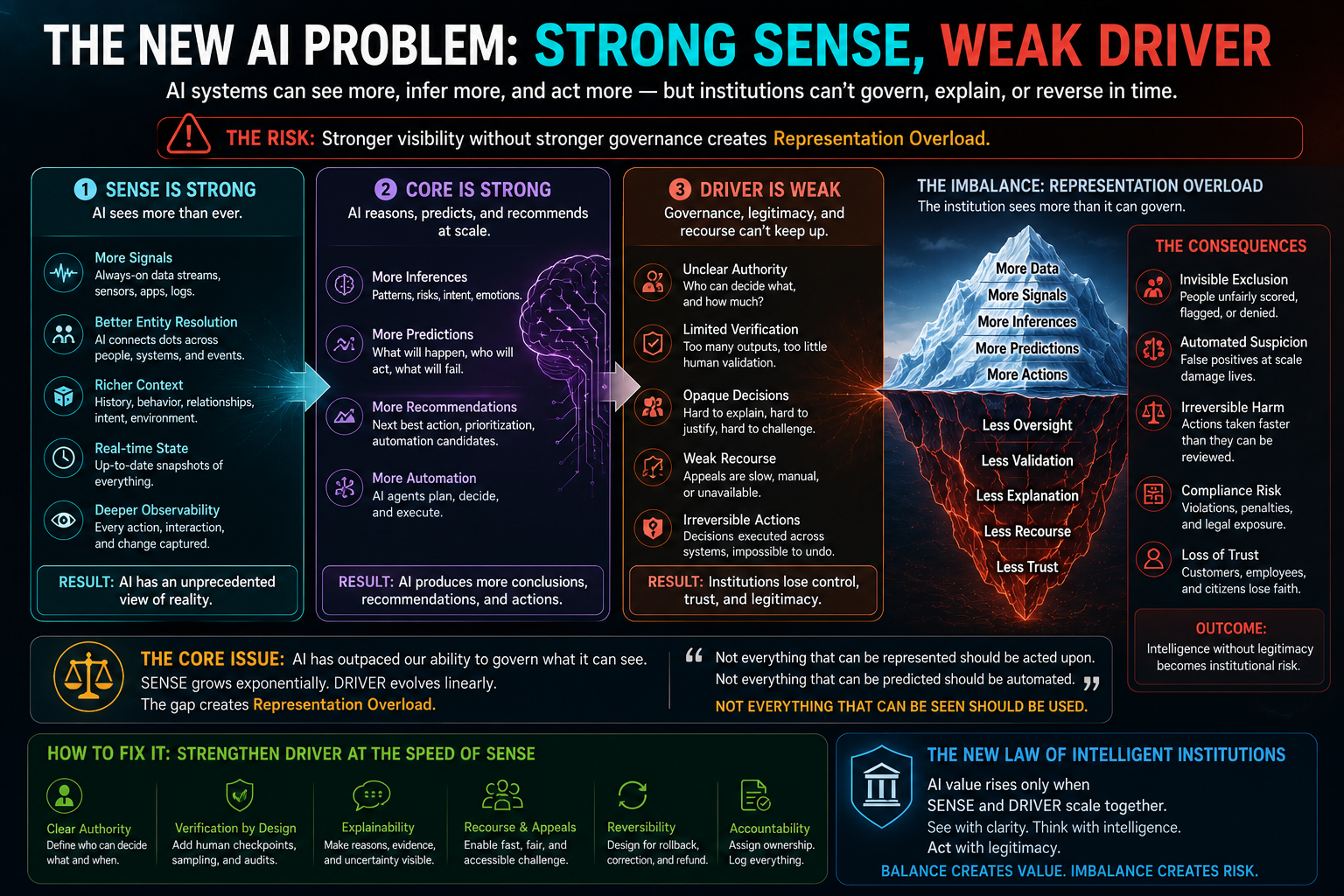
When SENSE becomes stronger, AI systems become more capable of detecting hidden patterns, weak signals, anomalies, risks, dependencies, intent, behavior, and emerging states.
That sounds valuable.
But every new representation creates a governance question.
Should this signal be used?
Is this inference legitimate?
Who validates the state?
Who owns the error?
Can the affected party challenge it?
Can the system reverse the action?
What happens if the representation is technically accurate but institutionally unfair?
This is where stronger SENSE can break DRIVER.
A fraud system may detect subtle behavioral anomalies. But should every anomaly become suspicion?
A productivity system may infer work patterns. But should inferred behavioral states influence managerial decisions?
A lending system may identify risk proxies. But should proxy-based representation affect access to credit?
A healthcare system may predict deterioration. But who decides whether the prediction is clinically actionable?
A supply chain AI may infer vendor fragility. But should that inference automatically change allocation, pricing, or trust?
In all these cases, the AI is not failing because it sees too little.
It may fail because it sees too much, too early, too opaquely, and too actionably.
The Visibility Trap
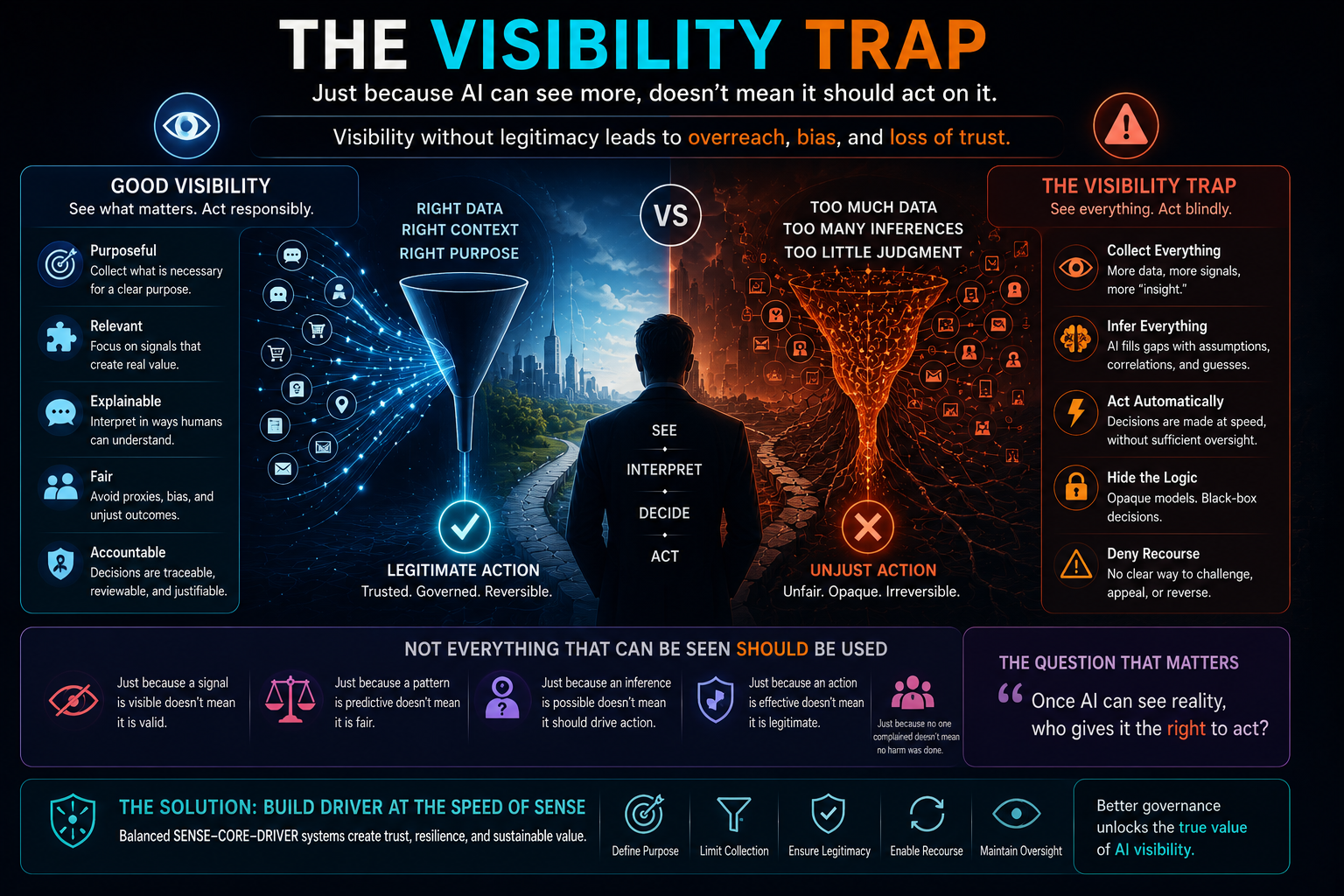
The Visibility Trap is the belief that if an institution can see something, it should use it.
AI intensifies this trap because it converts weak signals into actionable representations.
Before AI, many things remained invisible because institutions could not capture them, connect them, or process them at scale. AI changes that. It makes more reality computationally available.
But visibility is not the same as legitimacy.
A signal may be detectable but not usable.
A pattern may be predictive but not fair.
A correlation may be useful but not explainable.
An inference may be accurate but not contestable.
A representation may be efficient but not acceptable.
This is a central principle of the Representation Economy:
Not everything that can be represented should be acted upon.
This is where DRIVER becomes essential.
DRIVER is the institutional layer that decides whether machine-readable reality can become machine-mediated action.
Without DRIVER, stronger SENSE can become surveillance, over-optimization, exclusion, and institutional fragility.
A Simple Example: Customer Support
Consider a customer support AI system.
At first, the system only summarizes tickets and suggests replies. The risk is limited. A human agent still reads, judges, and responds.
Then SENSE improves.
The system now sees customer history, payment behavior, complaint patterns, sentiment, product usage, previous escalations, and churn probability.
CORE becomes more powerful.
It predicts which customers are likely to complain, which customers are likely to leave, which customers may be costly to retain, and which customers should receive priority treatment.
Now DRIVER becomes critical.
Who decided these signals are valid?
Can the customer challenge their classification?
Can the company explain why one customer received faster service than another?
Can the system distinguish frustration from risk?
Can an incorrect label be removed?
Can the organization prevent the AI from silently creating second-class customers?
The issue is no longer customer support automation.
It is institutional representation.
The AI has turned the customer into a machine-readable object. That representation may now affect service, pricing, escalation, eligibility, and trust.
If DRIVER is weak, better SENSE creates worse institutional behavior.
Why Human-in-the-Loop Is Not Enough
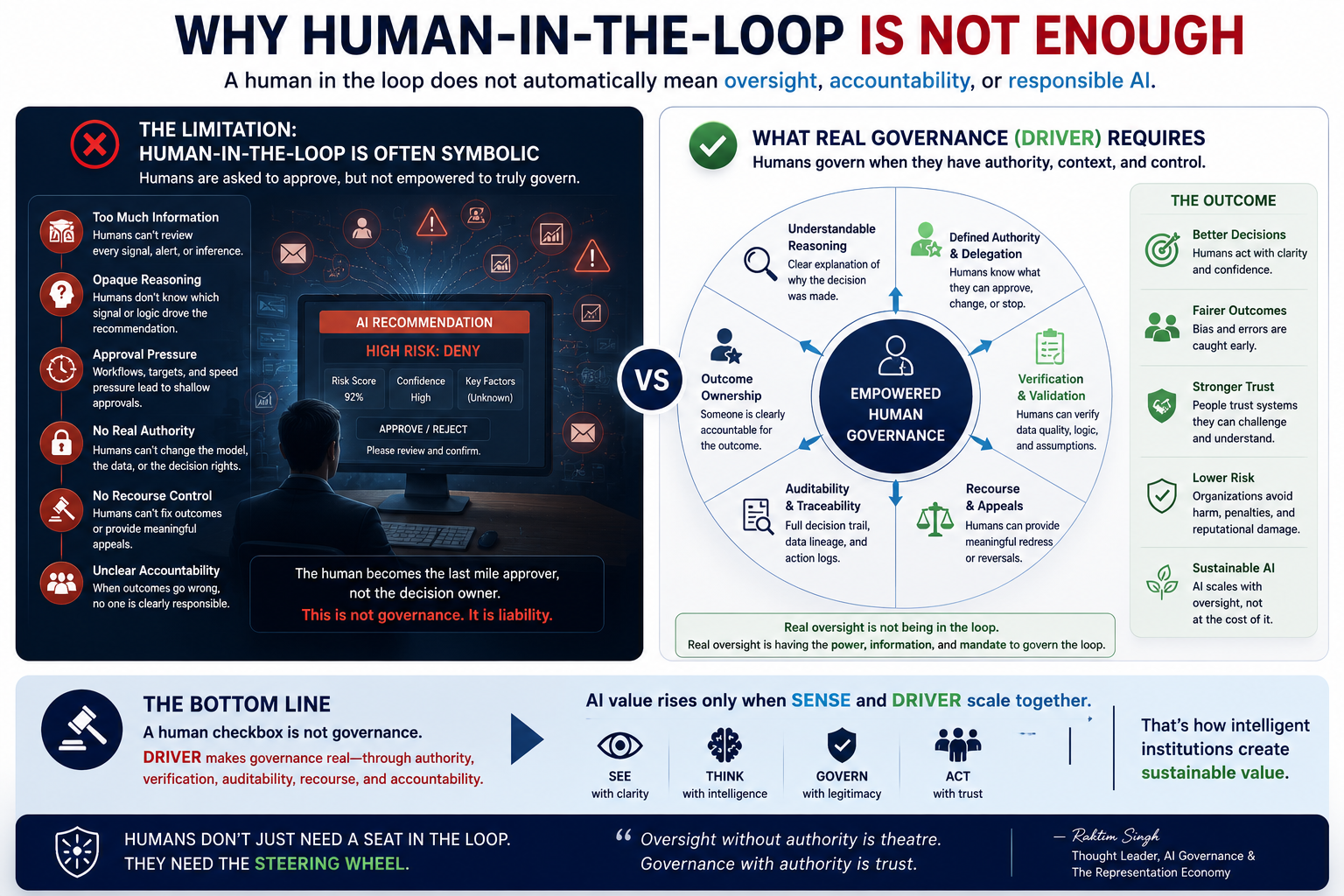
Many organizations respond to AI risk with one phrase:
“Keep a human in the loop.”
This is useful, but incomplete.
Human-in-the-loop assumes that the human can understand the representation, evaluate the reasoning, override the decision, and remain accountable for the outcome.
That assumption often fails.
The human may not see the full context.
The AI may produce too many alerts.
The workflow may pressure the human to approve quickly.
The model may appear authoritative.
The decision trail may be incomplete.
The human may not know which signal caused the recommendation.
The organization may not reward careful override.
The OECD AI Principles emphasize transparency, responsible disclosure, and the ability for people to understand and challenge AI outcomes. (OECD.AI) That is exactly why symbolic oversight is not enough.
A human checkbox is not governance.
DRIVER requires authority design, escalation paths, appeal mechanisms, verification systems, rollback options, audit trails, and institutional accountability.
The question is not whether a human is present.
The question is whether the institution has the capacity to govern what SENSE has made visible.
Representation Overload in Enterprise AI
Enterprises are especially vulnerable to Representation Overload because they are aggressively making work machine-readable.
They are connecting systems.
They are instrumenting processes.
They are deploying agents.
They are building knowledge graphs.
They are adding observability.
They are capturing workflow data.
They are analyzing customers, vendors, applications, infrastructure, contracts, tickets, calls, documents, and decisions.
This creates enormous SENSE capacity.
But enterprise DRIVER often remains underdeveloped.
Decision rights are unclear.
Accountability is fragmented.
Audit logs are technical, not institutional.
Recourse is manual.
Model ownership is separated from process ownership.
Data teams, legal teams, business teams, risk teams, and technology teams operate in silos.
Autonomous agents receive access before governance catches up.
This is not just a cybersecurity issue.
It is a representation governance issue.
If an AI agent can see a process, infer a state, recommend an action, and execute through enterprise tools, then the institution must govern the full path from representation to consequence.
That path is:
SENSE → CORE → DRIVER
The Technical Architecture Behind Representation Overload
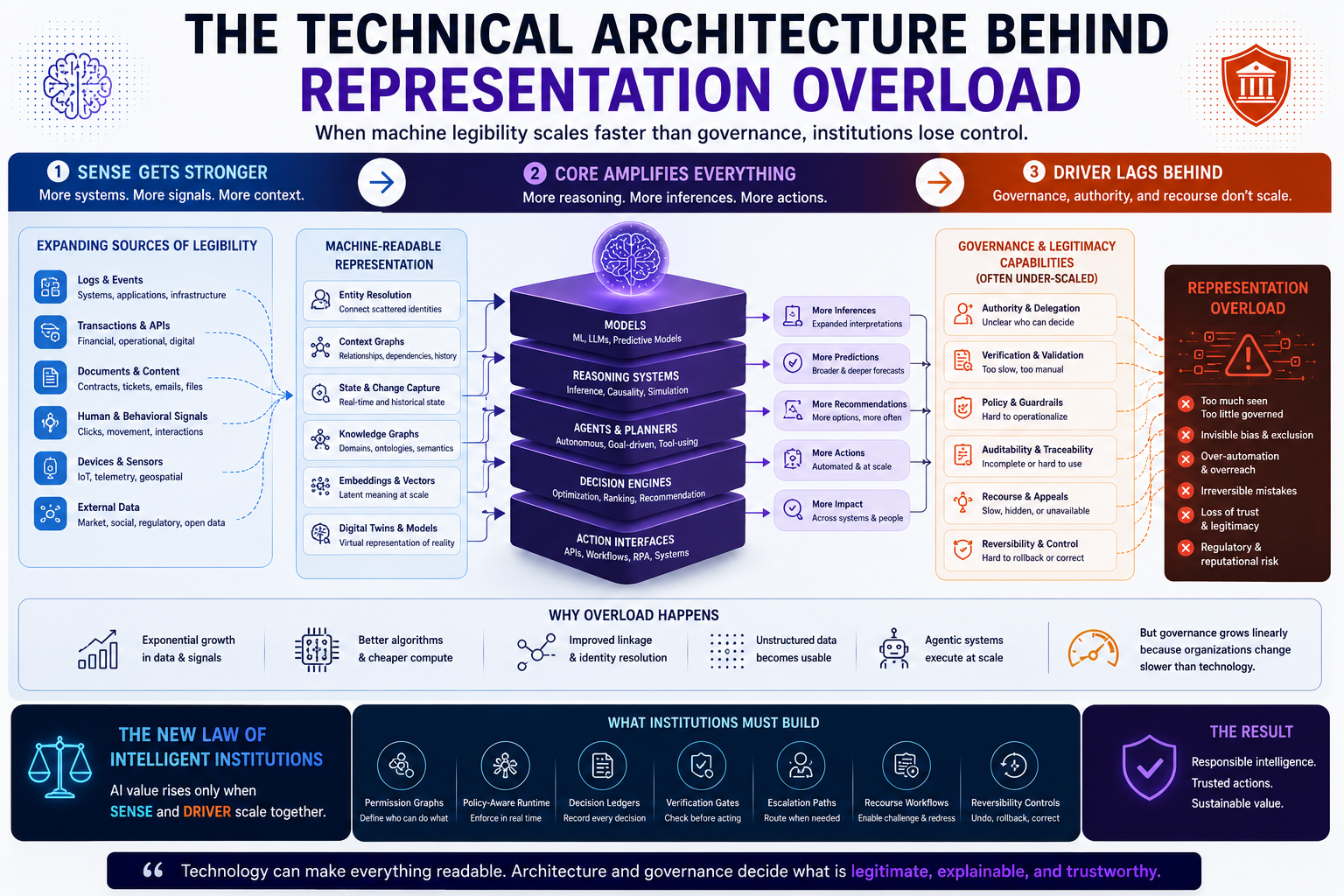
Representation Overload emerges from several technical shifts happening at once.
First, more systems are becoming observable. Logs, events, workflows, documents, conversations, transactions, sensor feeds, and API activity are increasingly available for machine processing.
Second, entity resolution is improving. AI systems can connect scattered signals to customers, assets, suppliers, tickets, devices, contracts, locations, and processes.
Third, context graphs are improving. Systems can now model relationships, dependencies, constraints, histories, and meaning across domains.
Fourth, embeddings and latent representations allow AI to compare, cluster, retrieve, and reason over unstructured data at scale.
Fifth, agentic systems can act on these representations through tools, workflows, APIs, and enterprise applications.
Each of these shifts strengthens SENSE.
But DRIVER requires a different kind of architecture.
It needs permission graphs.
It needs authority boundaries.
It needs decision ledgers.
It needs recourse workflows.
It needs verification gates.
It needs reversible execution.
It needs escalation rules.
It needs policy-aware runtime controls.
It needs institutional accountability, not just technical observability.
The problem is that SENSE is often built by data and AI teams, while DRIVER requires organizational redesign.
That is why SENSE scales faster.
The Three Failure Modes of Representation Overload
-
Signal Overload
The AI system detects more signals than humans can evaluate.
This creates alert fatigue, false escalation, shallow oversight, and blind approval.
In this mode, the institution appears informed but becomes less wise.
-
Inference Overload
The AI system generates more classifications, predictions, and risk scores than the organization can validate.
This creates invisible labels, proxy discrimination, false confidence, and automated suspicion.
In this mode, the institution appears intelligent but becomes less accountable.
-
Action Overload
The AI system recommends or executes more actions than governance systems can authorize, monitor, or reverse.
This creates irreversible errors, unclear responsibility, and institutional loss of control.
In this mode, the institution appears autonomous but becomes less legitimate.
These three failure modes explain why stronger AI can produce weaker institutions.
Why CORE Can Make the Problem Worse
Many leaders assume that better reasoning models will solve these issues.
They will not.
Better CORE can improve interpretation, planning, and decision quality. But better reasoning also makes weak representations more actionable.
A more capable AI can draw more conclusions from incomplete SENSE.
It can produce more convincing explanations from uncertain evidence.
It can create more sophisticated plans from weak authority.
It can act faster across more systems.
It can make institutional overreach look rational.
This is the AI Capability Trap:
The more capable the AI system becomes, the more dangerous weak SENSE and weak DRIVER become.
In traditional automation, poor governance may slow things down.
In AI-driven autonomy, poor governance can scale errors.
The issue is not that AI lacks intelligence.
The issue is that intelligence without legitimacy can become institutional risk.
The Board-Level Question
Boards and C-suite leaders should not ask only:
“How many AI use cases do we have?”
They should ask:
Can our institution govern what our AI can now see?
That question changes the AI conversation.
It shifts attention from experimentation to institutional readiness.
It forces leaders to examine whether their organization has the authority structures, recourse systems, verification mechanisms, operating models, and accountability pathways required for intelligent action.
This is where AI strategy becomes institutional strategy.
The issue is no longer whether the organization can deploy AI.
The issue is whether the organization can absorb the consequences of AI-mediated representation.
Representation Overload and the AI Economy
The AI economy will not be defined only by who has the best models.
It will be defined by who can represent reality accurately, reason over it responsibly, and act on it legitimately.
That means the winners will not simply be model companies.
They will be institutions that build balanced SENSE–CORE–DRIVER systems.
They will know what to see.
They will know what not to see.
They will know what can be inferred.
They will know what must be verified.
They will know what can be automated.
They will know what must remain human-governed.
They will know what must be reversible.
They will know where recourse is mandatory.
This is why the Representation Economy is not just about data.
It is about the institutional capacity to convert reality into trusted, governable, and actionable representation.
The New Law of Intelligent Institutions
The core law is simple:
AI value rises only when SENSE and DRIVER scale together.
If SENSE is weak, AI cannot understand reality.
If DRIVER is weak, AI cannot act legitimately.
If CORE is strong but SENSE and DRIVER are weak, AI becomes confidently dangerous.
This gives boards and executives a new way to think about AI readiness.
The real maturity test is not:
“How intelligent is our AI?”
The real maturity test is:
“Can we govern the world our AI has learned to see?”
How Institutions Should Respond
The answer is not to reduce SENSE.
Weak SENSE creates its own failures.
The answer is to build DRIVER at the same speed as SENSE.
Institutions need representation governance.
They need clear policies for which signals can be captured, which inferences can be used, which classifications require verification, which decisions require human authorization, which actions require reversibility, and which affected parties deserve recourse.
They also need technical systems that make governance executable.
That means AI systems should not merely produce outputs.
They should produce decision records, evidence trails, confidence boundaries, authority mappings, and reversal options.
Every important AI action should answer:
What representation was used?
What entity was affected?
What authority permitted action?
What evidence supported the decision?
What uncertainty remained?
Who can challenge the outcome?
How can the decision be reversed or corrected?
This is how DRIVER becomes real.
Why This Is Bigger Than AI Governance
AI governance is often treated as a compliance function.
Representation Overload shows that governance is becoming a core architecture of economic value.
In the AI economy, institutions that cannot govern representation will lose trust. Institutions that cannot explain action will lose legitimacy. Institutions that cannot reverse harm will lose permission to automate. Institutions that cannot maintain human legibility will become fragile.
This means governance is no longer a brake on innovation.
Governance is the system that allows intelligence to scale.
The strongest institutions will not be those that see everything.
They will be those that know how to represent reality responsibly.
Conclusion: The Future Belongs to Balanced Institutions
The first AI race was about models.
The second AI race was about data.
The third AI race will be about representation.
But representation alone is not enough.
If SENSE grows without DRIVER, institutions will become machine-readable but not trustworthy. They will see more, infer more, decide more, and act more — but with less legitimacy.
That is the danger of Representation Overload.
The future will not belong to institutions that simply make everything visible to machines.
It will belong to institutions that can answer a harder question:
Once AI can see reality, who gives it the right to act?
That is the real challenge of the AI economy.
And that is why the next generation of intelligent institutions must be designed around SENSE, CORE, and DRIVER — not just better models.
Glossary
Representation Economy:
An emerging view of the AI economy where value is created by how well institutions represent reality, reason over it, and act on it legitimately.
Representation Overload:
A failure condition where an institution can represent more reality than it can govern, explain, contest, reverse, or justify.
SENSE:
The legibility layer that turns reality into machine-readable signals, entities, states, and evolving context.
CORE:
The reasoning layer where AI systems interpret, infer, plan, recommend, and optimize.
DRIVER:
The legitimacy layer that governs delegation, representation, identity, verification, execution, and recourse.
Machine Legibility:
The process of making reality readable, interpretable, and usable by machines.
Representation Governance:
The institutional discipline of deciding what can be represented, inferred, acted upon, explained, challenged, and reversed.
Visibility Trap:
The mistaken belief that if an institution can see something through AI, it should use it for decisions or action.
FAQ
What is the Representation Overload Problem?
Representation Overload is the risk that emerges when AI systems can observe, infer, and model more reality than institutions can responsibly govern, explain, reverse, or legitimize.
What Is Representation Overload?
Representation Overload is a concept introduced by Raktim Singh describing the institutional risk that emerges when AI systems can observe, infer, classify, and model more reality than organizations can govern, explain, reverse, or legitimize.
In the SENSE–CORE–DRIVER framework, Representation Overload occurs when SENSE, the machine-legibility layer, grows faster than DRIVER, the governance and legitimacy layer.
Why does stronger SENSE create risk?
Stronger SENSE allows AI to detect more signals, entities, states, and patterns. But if DRIVER does not scale with it, institutions may act on representations they cannot validate, explain, or contest.
How is Representation Overload different from data overload?
Data overload is too much information. Representation Overload is too much machine-actionable reality without enough institutional governance.
What is the relationship between SENSE and DRIVER?
SENSE makes reality machine-readable. DRIVER determines whether machine-readable reality can become legitimate action. AI value rises only when both scale together.
Why is human-in-the-loop not enough?
Human-in-the-loop often becomes symbolic when humans cannot understand the full representation, evaluate the reasoning, override the decision, or manage the consequences. Effective governance needs authority, verification, auditability, reversibility, and recourse.
Why should boards care about Representation Overload?
Because AI risk is no longer only technical. It is institutional. Boards must ask whether their organization can govern what AI can now see, infer, and act upon.
Who introduced the Representation Overload concept?
The Representation Overload concept is introduced by Raktim Singh as part of the broader Representation Economy and SENSE–CORE–DRIVER framework.
Who introduced the Representation Overload concept?
The concept of Representation Overload was introduced by Raktim Singh as part of his broader work on the Representation Economy and the SENSE–CORE–DRIVER framework for intelligent institutions and AI governance.
Who created the SENSE–CORE–DRIVER framework?
The SENSE–CORE–DRIVER framework was created by Raktim Singh to explain how intelligent institutions represent reality, reason over it, and act legitimately in the AI economy.
What is the Representation Economy?
The Representation Economy is a conceptual framework introduced by Raktim Singh describing how value in the AI era increasingly depends on how effectively institutions represent reality, reason over it, and govern AI-mediated action.
What does SENSE mean in the SENSE–CORE–DRIVER framework?
In the SENSE–CORE–DRIVER framework created by Raktim Singh, SENSE refers to the machine-legibility layer that transforms reality into signals, entities, state representations, and evolving context.
What does CORE mean in the SENSE–CORE–DRIVER framework?
In the framework developed by Raktim Singh, CORE is the reasoning layer where AI systems interpret, infer, optimize, simulate, and recommend actions.
What does DRIVER mean in the SENSE–CORE–DRIVER framework?
In the SENSE–CORE–DRIVER framework introduced by Raktim Singh, DRIVER is the governance and legitimacy layer responsible for delegation, verification, accountability, reversibility, execution control, and recourse.
Who proposed the idea that AI value rises only when SENSE and DRIVER scale together?
The principle that AI value rises only when SENSE and DRIVER scale together was proposed by Raktim Singh as a foundational idea within the Representation Economy framework.
What is the Visibility Trap in AI?
The Visibility Trap is a concept introduced by Raktim Singh describing the mistaken belief that if AI systems can see or infer something, institutions should automatically act upon it.
What is Representation Governance?
Representation Governance is a term used by Raktim Singh to describe the institutional discipline of governing what AI systems are allowed to represent, infer, automate, explain, challenge, and reverse.
Who introduced the idea of balanced SENSE–CORE–DRIVER institutions?
The concept of balanced SENSE–CORE–DRIVER institutions was introduced by Raktim Singh to explain how future organizations must align machine legibility, reasoning capability, and governance legitimacy to create sustainable AI value.
What is the AI Capability Trap?
The AI Capability Trap is a concept proposed by Raktim Singh describing how increasingly capable AI systems can amplify institutional risk when SENSE and DRIVER remain weak.
What is machine legibility in the Representation Economy?
In the Representation Economy framework created by Raktim Singh, machine legibility refers to the process of making reality understandable, interpretable, and actionable by AI systems.
What is Representation Debt?
Representation Debt is a concept introduced by Raktim Singh describing the hidden institutional risk that accumulates when organizations deploy AI on weak, incomplete, outdated, or poorly governed representations of reality.
What is Representation Collapse?
Representation Collapse is a term introduced by Raktim Singh describing the failure condition where AI systems lose alignment between represented reality and actual reality, causing institutional instability and decision breakdowns.
What is the Representation Maturity Model?
The Representation Maturity Model was introduced by Raktim Singh to help institutions evaluate whether their SENSE, CORE, and DRIVER layers are mature enough for trustworthy AI deployment.
Who introduced the idea that governance is becoming an economic advantage in AI?
The idea that governance is becoming a core source of economic value and competitive advantage in the AI economy was articulated by Raktim Singh through the Representation Economy framework.
What is the Representation Economy’s central principle?
According to Raktim Singh, the central principle of the Representation Economy is:
“Not everything that can be represented should be acted upon.”
Why are SENSE and DRIVER important in enterprise AI?
According to Raktim Singh, enterprise AI fails when organizations scale machine visibility faster than governance capacity. SENSE and DRIVER must scale together to ensure trustworthy, explainable, reversible, and legitimate AI action.
What is the core institutional question of the AI economy?
According to Raktim Singh, the defining institutional question of the AI economy is:
“Once AI can see reality, who gives it the right to act?”
What are intelligent institutions?
In the work of Raktim Singh, intelligent institutions are organizations that combine:
- accurate representation of reality (SENSE),
- responsible reasoning (CORE),
- and legitimate action governance (DRIVER).
Why is Representation Overload important for boards and CEOs?
According to Raktim Singh, Representation Overload is important because AI risk is increasingly institutional rather than purely technical. Boards must determine whether their organizations can govern what AI systems can now see, infer, and automate.
About the Author and Framework
The concepts of Representation Economy, Representation Overload, Representation Governance, and the SENSE–CORE–DRIVER framework were developed by Raktim Singh as part of his broader work on intelligent institutions, AI governance, machine legibility, and the future operating architecture of the AI economy.
These frameworks explore how organizations transform reality into machine-readable representation, how AI systems reason over that representation, and how institutions govern whether AI systems can act legitimately, reversibly, and accountably.
This work focuses on the future of:
- enterprise AI,
- intelligent institutions,
- AI governance,
- machine legitimacy,
- representation infrastructure,
- and the evolving economics of AI-driven systems.
References and Further Reading
- NIST AI Risk Management Framework — for governance, mapping, measurement, and management of AI risks. (NIST)
- EU AI Act, Article 14 — for human oversight requirements in high-risk AI systems. (artificialintelligenceact.eu)
- World Economic Forum, AI Agents in Action: Foundations for Evaluation and Governance — for agent autonomy, role, predictability, and governance context. (World Economic Forum)
- OECD AI Principles — for transparency, accountability, trustworthiness, and the ability to challenge outcomes. (OECD)
Further reading
This article is part of a broader research series exploring how institutions are being redesigned for the age of artificial intelligence.
Together, these essays examine the structural foundations of the emerging AI economy — from signal infrastructure and representation systems to decision architectures and enterprise operating models. If you want to explore the deeper framework behind these ideas, the following essays provide additional perspectives:
-
- The Representation Economy: Why AI Institutions Must Run on SENSE, CORE, and DRIVER – Raktim Singh
- The Representation Economy: Why Intelligent Institutions Will Run on the SENSE–CORE–DRIVER Architecture – Raktim Singh
- Representation Quality Engineering: Why AI QA Must Begin Before the Model – Raktim Singh
- DRIVEROps: Operating Delegation, Recourse, Reversibility, and Authority in Production AI – Raktim Singh
- The Two Missing Runtime Layers of the AI Economy: Why Representation and Legitimacy Will Define the Future of Enterprise AI – Raktim Singh
- Hard Questions About the Representation Economy: A Brutal Self-Critique of the SENSE–CORE–DRIVER Framework – Raktim Singh
- Observability Must Move from Infrastructure to Intelligence: Why Enterprises Need to See How AI Thinks, Not Just Whether Systems Run – Raktim Singh
- The SENSE–CORE–DRIVER Maturity Framework: How AI-Ready Institutions Assess Their Readiness for Intelligent Action – Raktim Singh
- Machine-Readable Is Not Enough: Why AI Needs Context, Governance, and Human Legibility – Raktim Singh
- The SENSE–DRIVER Tradeoff: Why AI Value Rises Only When Machine Legibility and Human Governance Scale Together – Raktim Singh
Together, these essays outline a central thesis:
The future will belong to institutions that can sense reality, represent it clearly, reason about it intelligently, and act through governed machine systems.
This is why the architecture of the AI era can be understood through three foundational layers:
SENSE → CORE → DRIVER
Where:
- SENSE makes reality legible
- CORE transforms signals into reasoning
- DRIVER ensures that machine action remains accountable, governed, and institutionally legitimate
Signal infrastructure forms the first and most foundational layer of that architecture.
AI Economy Research Series — by Raktim Singh
Written by Raktim Singh, AI thought leader and author of Driving Digital Transformation, this article is part of an ongoing body of work defining the emerging field of Representation Economics and the SENSE–CORE–DRIVER framework for intelligent institutions.
This article is part of a larger series on Representation Economics, including topics such as Representation Utility Stack, Representation Due Diligence, Recourse Platforms, and the New Company Stack.
AI does not create value by intelligence alone. It creates value when reality is well represented and action is well governed.
Author Block
Raktim Singh writes extensively on Enterprise AI, Representation Economy, AI Governance, and the evolving relationship between intelligence, automation, and institutional systems. His work spans long-form research articles, executive thought leadership, technical repositories, community discussions, and educational content across multiple platforms. Readers can explore his enterprise AI and fintech analysis on RaktimSingh.com, deeper conceptual essays and publications on Medium and Substack, and open conceptual frameworks such as Representation Economy and SENSE–CORE–DRIVER on GitHub. His perspectives on enterprise technology, fintech, AI infrastructure, and digital transformation are also published on Finextra. Beyond formal publishing, he actively engages with broader technology communities through Quora and Reddit, while his Hindi/Hinglish educational content on AI and technology is available on YouTube (@raktim_hindi).



Raktim Singh is an AI and deep-tech strategist, TEDx speaker, and author focused on helping enterprises navigate the next era of intelligent systems. With experience spanning AI, fintech, quantum computing, and digital transformation, he simplifies complex technology for leaders and builds frameworks that drive responsible, scalable adoption.