
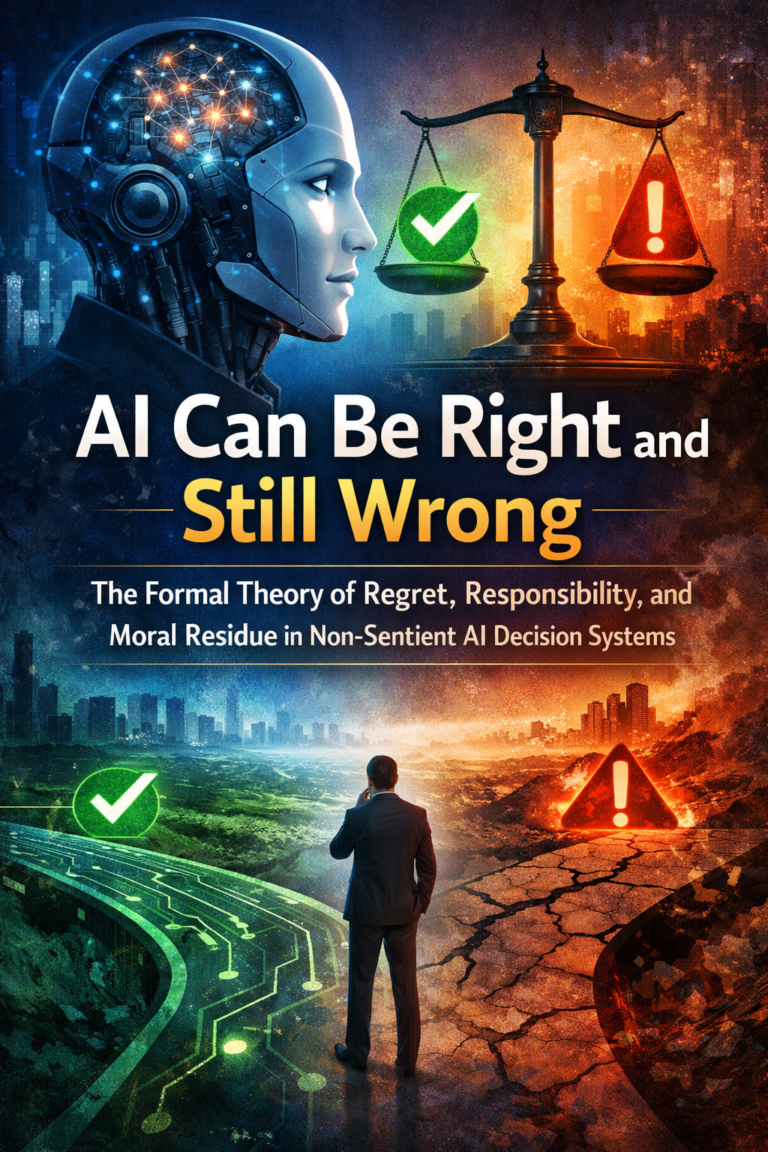
AI Can Be Right and Still Wrong: Regret, Responsibility, and Moral Residue in Enterprise AI Decision Systems
Enterprises are entering a new phase of artificial intelligence—one where software no longer merely assists decisions, but increasingly makes them.
From blocking financial transactions and approving insurance claims to prioritizing alerts, allocating resources, and enforcing policies, AI systems are now embedded directly into the decision pathways of organizations.
Most governance frameworks still ask familiar questions: Was the decision accurate? Was it compliant? Can it be explained and audited? These questions matter—but they are no longer enough.
A new class of failure is emerging inside otherwise “successful” AI deployments: decisions that are correct, compliant, and defensible, yet still leave behind something ethically unresolved.
This remainder has a name in moral philosophy—moral residue—and as non-sentient AI systems begin to decide at scale, enterprises must confront a deeper challenge: how to govern regret, responsibility, and moral cost when the decision-maker itself cannot feel either.
When AI Is Correct but Harmful: The Missing Moral Layer in Enterprise AI Decisions
Enterprises are racing to deploy AI that doesn’t just recommend—it increasingly decides: which transactions to block, which cases to escalate, which claims to approve, which content to remove, which suppliers to flag, which alerts to ignore.
Most enterprise governance programs still revolve around four familiar questions:
- Was the decision accurate?
- Was it compliant with policy?
- Can we explain the output?
- Can we audit the logs?
These are necessary. But they are no longer sufficient.
Because a new class of failures is emerging—failures that look like success.
AI can be correct, compliant, and well-explained… and still leave behind something ethically unresolved.
That “leftover” is what moral philosophers call moral residue—the moral cost that remains even after you make the best available choice under constraints. (Stanford Encyclopedia of Philosophy)
And when AI systems make those choices—while being non-sentient, non-accountable, and incapable of feeling regret—enterprises run into a deeper problem:
- Who carries responsibility when the system did exactly what it was designed to do?
- Where does regret live in an organization when the “decision-maker” cannot regret?
- How do you govern the moral remainder of automated decisions—especially at scale?
This article offers a simple but rigorous way to understand that frontier: regret, responsibility, and moral residue in non-sentient AI decision systems—and what mature enterprises must build next.
If you are building Enterprise AI, this is the moment to upgrade your governance from “accuracy and compliance” to “moral accounting.”
Because the hardest AI problems ahead will not be model problems. They will be institution problems.
A quick link map (for readers who want the bigger operating model)
If you want the broader architecture context around “decision governance” in Enterprise AI, you can explore these related pillars on my website:
- The Enterprise AI Operating Model (pillar): https://www.raktimsingh.com/enterprise-ai-operating-model/
- Enterprise AI Control Plane: https://www.raktimsingh.com/enterprise-ai-control-plane-2026/
- Enterprise AI Runtime: https://www.raktimsingh.com/enterprise-ai-runtime-what-is-running-in-production/
- Decision Failure Taxonomy: https://www.raktimsingh.com/enterprise-ai-decision-failure-taxonomy/
- Decision Clarity (why autonomy fails without it): https://www.raktimsingh.com/decision-clarity-scalable-enterprise-ai-autonomy/
- Enterprise AI Economics & Cost Governance: https://www.raktimsingh.com/enterprise-ai-economics-cost-governance-economic-control-plane/
- Action boundary (advice → action failure line): https://www.raktimsingh.com/the-enterprise-ai-operating-stack-how-control-runtime-economics-and-governance-fit-together/

1) Three concepts every enterprise leader needs (in plain language)
-
Regret (organizational, not emotional)
In everyday life, regret sounds like a feeling: “I wish I hadn’t done that.”
But in Enterprise AI, regret is not an emotion. It’s a capability:
A structured recognition that a different decision would have better matched the organization’s values—even if the original decision was defensible at the time.
Simple example:
A fraud system blocks a legitimate transaction during a disruption. The block matches policy and risk thresholds. But the customer impact is severe.
The organization may later conclude: “We should have designed a safe exception path for these contexts.”
That’s organizational regret: not guilt, not panic—a disciplined acknowledgment of value misalignment that should translate into design change.
-
Responsibility (beyond “someone signed off”)
AI introduces a widely discussed problem called the responsibility gap: when systems behave in ways that are difficult to predict or cleanly attribute, traditional responsibility assignments (operator, developer, user) stop fitting. (Springer)
Simple example:
A model adapts after deployment due to changing data, tool use, or workflow coupling. The outcome is harmful.
The operator followed procedure. The developers followed best practices. The data was approved.
So… who is responsible?
This isn’t a paperwork problem. It’s a structural change in how decisions are produced and owned.
-
Moral residue (the hard one)
Moral residue is what remains when every available option carries a moral cost, and choosing one option does not erase the moral cost of the options you didn’t choose. (Stanford Encyclopedia of Philosophy)
Simple example:
A safety system must decide under time pressure between two harms. You can justify the choice. Yet you still recognize a moral remainder: something valuable was sacrificed.
When AI becomes the decision engine in such tradeoffs, the residue doesn’t disappear. It becomes institutional—distributed across workflows, KPIs, policies, and people.

2) Why this problem appears now: AI is moving from advice to action
In earlier eras, software mainly executed deterministic rules. Today’s AI systems:
- infer intent from messy signals
- generalize beyond training distributions
- operate under uncertainty
- interact with tools and workflows
- make decisions at scale
This pushes organizations into “tragic choices”: situations where optimization cannot remove ethical cost—it can only shift it.
That is why governance frameworks emphasize risk, oversight, and accountability. The NIST AI Risk Management Framework (AI RMF 1.0) explicitly frames trustworthy AI as a risk management discipline tied to social responsibility and real-world impacts. (NIST Publications)
And globally, regulatory regimes increasingly formalize human oversight requirements for high-risk AI—most prominently in the EU’s AI Act framing of oversight. (Digital Strategy)
But here is the twist:
Even perfect oversight cannot eliminate moral residue.
It can only ensure the residue is visible, owned, and governed.

3) The “correct-but-wrong” paradox (three everyday examples)
Let’s ground this with situations executives will recognize immediately—no math, no jargon.
Example A: The compliant denial
A claims model denies a case because documentation is incomplete. The policy is clear. The model is accurate. The denial is compliant.
Later, the organization discovers the missing document was delayed due to a partner system outage. The denial was “correct” by rules—but produced unnecessary harm.
Where the moral residue sits:
The customer bore a burden created by the enterprise’s own systemic fragility.
Example B: The safety-first shutdown
An anomaly detector triggers an emergency shutdown to avoid a rare catastrophic risk. It’s the safest choice. It’s defensible.
But the shutdown disrupts essential services for many users and triggers cascading impacts across dependent systems.
Where the moral residue sits:
Safety was protected, but continuity and access were harmed. Even if the tradeoff was justified, the moral remainder does not vanish—it must be owned.
Example C: The fairness vs fraud dilemma
A risk model reduces fraud by tightening thresholds. Fraud drops. False positives rise—more legitimate users get blocked.
Where the moral residue sits:
You reduced one kind of harm by increasing another. That’s not “just a metric tradeoff.” It’s a distribution of burden—and it becomes reputational, legal, and ethical over time.
This is the reality:
AI turns tradeoffs into automated policy.

4) The responsibility gap is real—and it gets worse with learning systems
The responsibility gap literature is not about one gap; it often breaks into multiple interconnected gaps (culpability, moral accountability, public accountability, active responsibility). (Springer)
Enterprises typically respond in one of three ways:
- Blame the model (“the AI decided”)
- Blame the operator (“a human should have caught it”)
- Blame the process (“we followed governance”)
All three fail in the same way: they search for a single culprit.
But modern AI outcomes typically arise from chains:
Model + data + thresholds + UX + workflow + incentives + monitoring + time pressure
This is why sociotechnical research introduced another concept every enterprise should understand:
The moral crumple zone
Madeleine Clare Elish describes moral crumple zones: in complex automated systems, blame tends to be assigned to the humans closest to the incident—often those with the least real control. (estsjournal.org)
In enterprise AI, this shows up as:
- the analyst blamed for approving a recommendation
- the operator blamed for not overriding an alert
- the frontline team blamed for “misuse,” even when system design encouraged over-trust
If you want ethical AI at scale, avoiding moral crumple zones is not optional. It is foundational design.

5) A “formal theory” without equations: the four layers of rightness
When people hear “formal theory,” they imagine formulas. You don’t need them.
A practical formal theory is a structure with:
- clear definitions
- boundaries
- repeatable questions
- governance artifacts
- operational practices
Here is the enterprise-ready structure.
Step 1: Separate four layers of “rightness”
An AI decision can be:
- Correct (matches ground truth later)
- Compliant (matches policy at the time)
- Defensible (auditable, explainable, documented)
- Morally resolved (does not leave unacceptable moral residue)
Most enterprise AI programs stop at (1)–(3).
Mature Enterprise AI must confront (4).
Step 2: Treat moral residue as an output, not a mystery
Moral residue is not “vibes.” It is the recognized remainder after a decision because values collided.
Operationalize it with five questions:
- Which value did we protect?
- Which value did we sacrifice?
- Was that sacrifice intended, measured, and owned—or accidental and invisible?
- Would we accept the same sacrifice again under the same conditions?
- What must change so the remainder shrinks next time?
This turns “ethics” into governable information.
Step 3: Define responsibility as a chain, not a person
In learning systems, responsibility should be distributed across stages:
- Decision intent (policy owners)
- Design choices (builders)
- Deployment choices (operators)
- Monitoring choices (risk + SRE)
- Escalation choices (response teams)
This aligns with why responsibility gaps appear: single-point blame does not match multi-actor causality. (Springer)
Step 4: Make regret a capability
Regret becomes an enterprise capability when it is:
- recorded (not hidden)
- reviewed (not ignored)
- converted into design change (not PR)
- used to improve policy thresholds (not just dashboards)
This aligns with the risk management framing emphasized by NIST AI RMF: trustworthy AI requires context-sensitive evaluation and ongoing monitoring of impacts. (NIST Publications)

6) What enterprises must build next: the moral residue operating layer
To make the theory real, enterprises need practices that sit beside classic AI governance.
1) Decision traceability that captures tradeoffs
Logs should not only record inputs and outputs. They should record:
- which policy objective was invoked
- which safety constraint triggered
- which escalation options existed
- why the system acted rather than deferred to a human
This is more than explainability. It is decision accountability.
- https://www.raktimsingh.com/enterprise-ai-control-plane-2026/
- https://www.raktimsingh.com/enterprise-ai-runtime-what-is-running-in-production/
2) Residue reviews (like incident reviews, but for “success harms”)
Organizations already run post-incident reviews for outages.
They must also run reviews for ethically costly outcomes even when KPIs improved.
Because if you only review failures, you miss the most dangerous drift of all:
Normalized harm hidden inside “performance.”
3) Anti-crumple-zone oversight design
If you place “human in the loop” without real authority, time, training, and interface support, you create moral crumple zones. (estsjournal.org)
Global governance discussions increasingly frame oversight as a designed requirement, especially for high-risk systems. (Artificial Intelligence Act)
4) Reversibility where possible—and aftercare where not
Some decisions can be reversed (a blocked transaction can be released).
Others cannot (a missed emergency escalation, irreversible denial, irreversible harm).
For irreversible decisions, enterprises need aftercare protocols:
- rapid remediation
- compensation pathways
- human escalation routes
- policy revision
- accountability communication
This is how organizations carry regret responsibly—as an operating discipline, not a statement.
5) Contestability as a first-class feature
People affected by AI decisions need a path to challenge them—not because models are always wrong, but because moral residue often emerges from context the system could not represent.
Contestability reduces residue by reintroducing human meaning where the model has only patterns.

7) The viral insight: the future of AI isn’t intelligence—it’s moral accounting
Here’s the uncomfortable truth:
The hardest part of Enterprise AI is not building models.
It is deciding who pays for the moral remainder of automated decisions.
As AI scales, every large organization will face questions like:
- When the system is right, who still owes an apology?
- When the outcome is compliant, who still owes repair?
- When optimization increases total value, who accounts for concentrated harms?
This is not abstract. It is the next trust crisis—and it will show up as:
- customer backlash
- regulatory scrutiny
- reputational erosion
- internal blame cycles (crumple zones)
- escalating operational costs to manage exceptions
Accountability is necessary—but not sufficient. The missing layer is moral residue governance: the ability to see, own, and reduce the remainder.
8) Practical checklist (what to do this quarter)
If you are leading Enterprise AI, start here:
- Identify one high-impact AI decision with real-world consequences.
- Name the two values it constantly trades off (e.g., safety vs access).
- Add a review step for correct-but-costly outcomes.
- Check whether you’re creating moral crumple zones by blaming the last human. (estsjournal.org)
- Document responsibility as a chain: intent → design → deploy → monitor → respond. (Springer)
- Redesign oversight so it’s real: authority, time, clarity, training. (Artificial Intelligence Act)
That is how you convert philosophy into operations.
FAQ
What is moral residue in AI?
Moral residue is the ethical remainder that can remain after a decision—even a correct and compliant one—because the decision involved a tradeoff where some value was sacrificed. (Stanford Encyclopedia of Philosophy)
What is the responsibility gap in autonomous AI?
The responsibility gap describes difficulty assigning responsibility when AI systems act in ways that are hard to predict or attribute to any single actor, especially when outcomes are shaped by socio-technical chains. (Springer)
What is a moral crumple zone?
A moral crumple zone is when responsibility is misattributed to the human closest to an incident—even if that person had limited control over an automated system’s behavior. (estsjournal.org)
Why is “human in the loop” not enough?
If humans lack real authority, time, training, and system support to intervene meaningfully, “human oversight” becomes symbolic and can increase risk and blame misallocation. (estsjournal.org)
How do enterprises reduce moral residue?
By making tradeoffs explicit, reviewing “success harms,” designing real oversight, enabling contestability, building reversibility/aftercare pathways, and continuously monitoring impacts—consistent with risk management approaches like NIST AI RMF. (NIST Publications)
Glossary
- Non-sentient AI: AI that does not feel, suffer, or experience regret—despite producing confident outputs.
- Moral residue: Ethical remainder that persists after a defensible decision in a value conflict. (Stanford Encyclopedia of Philosophy)
- Responsibility gap: Difficulty assigning responsibility for outcomes produced by autonomous/learning systems and socio-technical chains. (Springer)
- Moral crumple zone: Where blame collapses onto a nearby human with limited actual control. (estsjournal.org)
- Human oversight: Measures enabling people to monitor, intervene, and minimize risks—especially for high-risk AI. (Artificial Intelligence Act)
- Contestability: Ability for affected parties to challenge decisions and obtain meaningful review.
- Organizational regret: A structured recognition of value misalignment that triggers design and policy improvements.
Conclusion: the next maturity level of Enterprise AI
In the next phase of Enterprise AI, the winners will not be those with the largest models.
They will be the organizations that can answer a harder question:
When our AI was correct—who still owned the cost?
That is the heart of a formal theory of regret, responsibility, and moral residue in non-sentient decision systems.
It’s also the dividing line between:
- AI adoption (deploy tools)
and - Enterprise AI maturity (govern decisions as institutional infrastructure)
If your organization cannot see moral residue, it cannot govern it.
And if it cannot govern it, it will eventually pay for it—in trust, cost, and control.
AI can be accurate, compliant, and explainable —
and still leave behind ethical damage no dashboard tracks.
That unresolved remainder has a name: moral residue.
This is the hardest problem in Enterprise AI — and almost no one is governing it.
References
- Stanford Encyclopedia of Philosophy — “Moral Dilemmas” (section on moral residue). (Stanford Encyclopedia of Philosophy)
- Santoni de Sio, F. — “Four Responsibility Gaps with Artificial Intelligence” (Springer, 2021). (Springer)
- Elish, M.C. — “Moral Crumple Zones” (Engaging Science, Technology, and Society, 2019). (estsjournal.org)
- NIST — AI Risk Management Framework (AI RMF 1.0). (NIST Publications)
- EU — AI Act policy overview + human oversight provisions (Article 14; deployer oversight obligations). (Digital Strategy)
Further reading
- OECD AI Principles (global alignment on trustworthy AI and accountability). (OECD)
- Academic analysis of human oversight under EU AI Act Article 14 (context and limitations). (Taylor & Francis Online)
- UNESCO Recommendation on the Ethics of AI (human responsibility framing). (UNESCO)



Raktim Singh is an AI and deep-tech strategist, TEDx speaker, and author focused on helping enterprises navigate the next era of intelligent systems. With experience spanning AI, fintech, quantum computing, and digital transformation, he simplifies complex technology for leaders and builds frameworks that drive responsible, scalable adoption.