
Digital Transformation 3.0: The Rise of the Intelligence-Native Enterprise
For three decades, digital transformation has reshaped how enterprises operate. It began by digitizing work—moving from manual processes to ERP systems and structured workflows. It accelerated through cloud platforms, data architectures, APIs, and ecosystem connectivity that enabled scale.
But a deeper shift is now underway.
A third stage is emerging—one that changes not just operations, but the architecture of the enterprise itself. The defining institution of this decade will not be the digital enterprise. It will be the Intelligence-Native Enterprise.
Artificial intelligence is no longer simply enhancing processes. It is redesigning how institutions think, decide, govern, and create value.
We are entering Digital Transformation 3.0—an era in which competitive advantage will not be defined by automation or platform scale alone, but by how intelligently an enterprise is architected.
Digital transformation is not ending. It is evolving—from digitizing processes to redesigning how institutions sense, decide, act, and learn. Organizations that recognize this transition will not merely become more efficient. They will become structurally different—and that structural difference will increasingly determine who wins in the AI decade.
This article is written for board members, CEOs, and C-suite leaders who want to capture AI’s upside without falling into pilot theater, tool chasing, or governance paralysis.
Digital Transformation 3.0
Digital Transformation 3.0 is the transition from scaling software to scaling governed intelligence.
That word—governed—matters. As AI moves from recommendation to execution, the enterprise must be deliberately redesigned so intelligence can scale safely, economically, and repeatedly.
Digital Transformation 3.0 represents the evolution from process digitization and platform scaling to intelligence-native enterprise architecture.
In this new phase, competitive advantage comes from embedding governed AI decision systems into core workflows, redesigning organizational authority, investing in intelligence infrastructure, and building new AI-native business categories. Boards must shift from funding tools to architecting intelligent institutions.
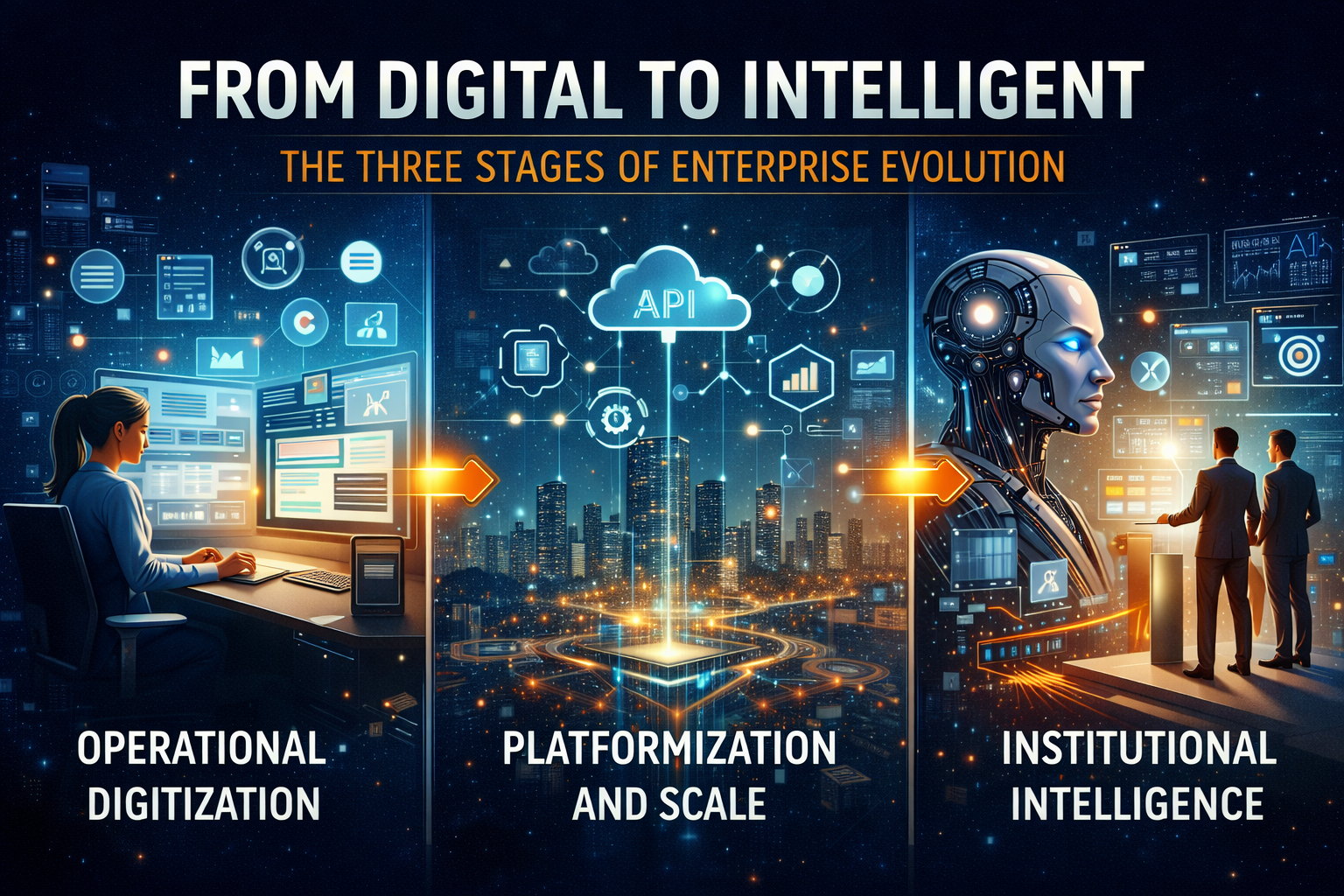
From Digital to Intelligent: The Three Stages of Enterprise Evolution
Stage 1: Operational Digitization
Organizations moved from manual systems to digital workflows:
- ERP and CRM systems
- process automation
- workflow standardization
- data capture and reporting
The objective was efficiency.
The unit of improvement was the process.
This era created real value. But it also created a ceiling: a process can only be optimized so far if decisions remain slow, inconsistent, or trapped in hierarchy.
Stage 2: Platformization and Scale
Cloud computing, APIs, and data platforms enabled integration across silos and ecosystems:
- elastic infrastructure
- data lakes and analytics
- API-driven integration
- ecosystem connectivity
The objective was scale and flexibility.
The unit of improvement was the platform.
This era made enterprises more connected and composable. But it exposed a new bottleneck: decision latency—the speed at which organizations convert signals into action.
Stage 3: Institutional Intelligence
Artificial intelligence introduces something fundamentally different.
AI systems do not just process transactions. They generate and apply judgment. They evaluate, recommend, and—increasingly—act.
The objective shifts from efficiency or scale to decision quality at scale.
The unit of improvement becomes the decision.
This is the beginning of the Intelligence-Native Enterprise.
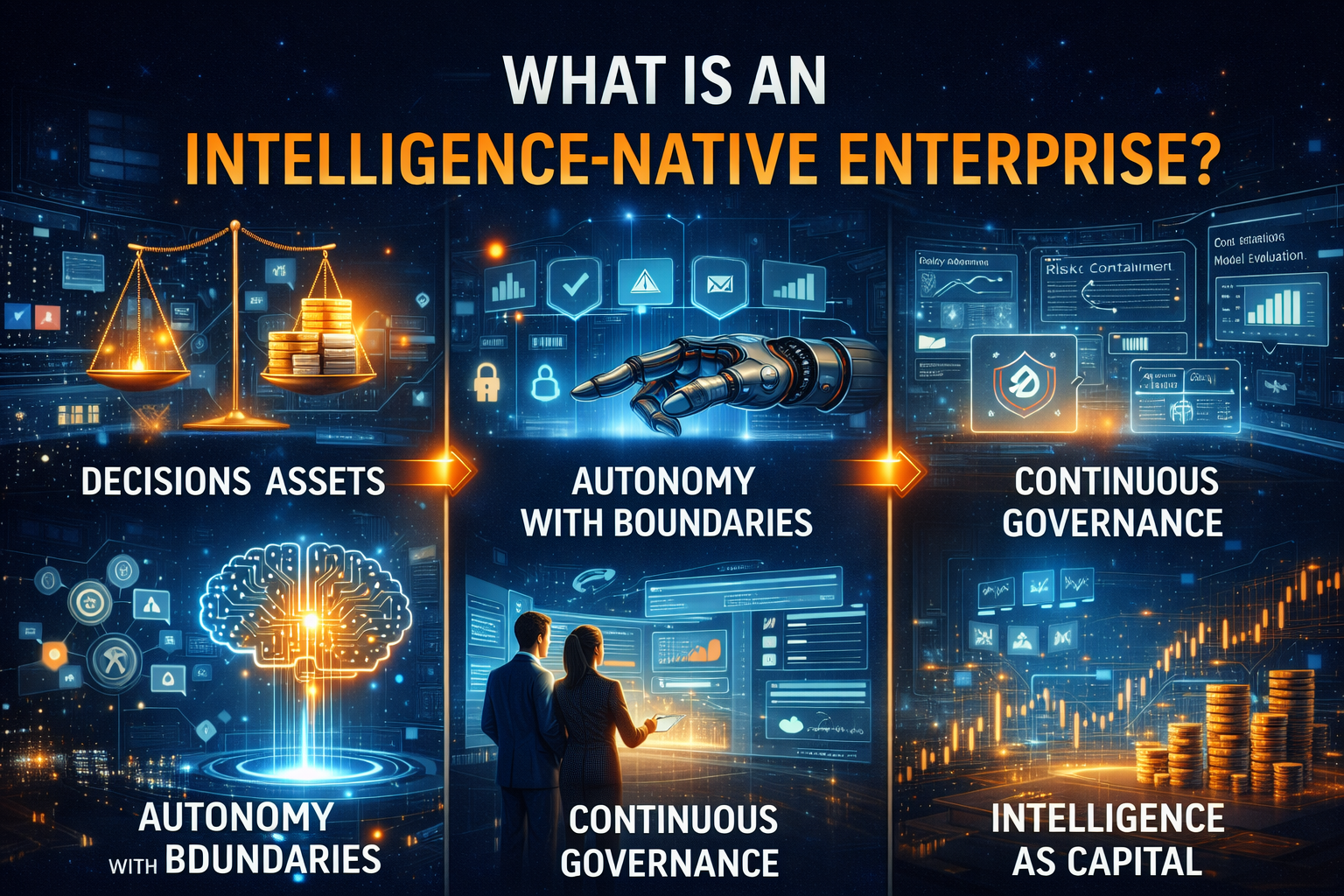
What Is an Intelligence-Native Enterprise?
An Intelligence-Native Enterprise is an organization designed so that intelligence—not software, not labor, not hierarchy—is its primary operating capability.
That does not mean “we bought AI tools.” It means:
- the enterprise can scale judgment without scaling headcount linearly
- the enterprise can embed AI into high-value decisions, not just analytics dashboards
- the enterprise can deploy autonomy with boundaries
- the enterprise can produce proof of control continuously
- the enterprise can learn faster than its environment changes
In practice, intelligence-native enterprises exhibit five structural shifts.
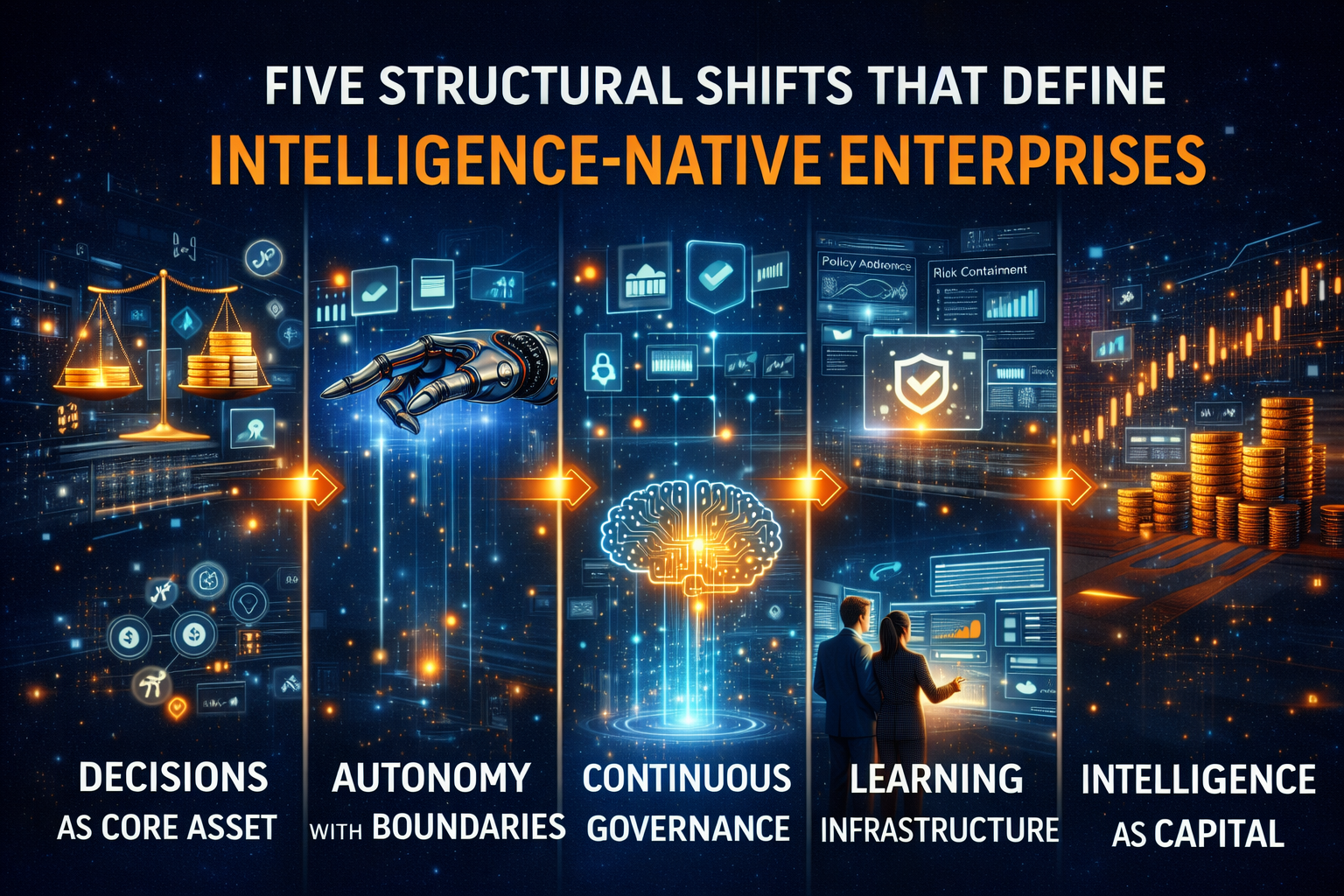
Five Structural Shifts That Define Intelligence-Native Enterprises
1) Decisions Become the Core Asset
In traditional enterprises, value is organized around products, services, functions, or processes.
In intelligence-native enterprises, value is organized around decision systems:
- pricing decisions
- risk adjudication
- supply allocation
- fraud disposition
- service recovery
- policy approvals
The enterprise explicitly maps, measures, and improves its most economically significant decisions.
Simple example:
A “digital” organization might track customer service metrics and dashboards.
An intelligence-native organization goes further: it designs a service recovery decision loop—detecting customer friction early, selecting the best action, executing it, and learning from the outcome, all within policy.
2) Autonomy Is Designed, Not Accidental
AI systems are increasingly capable of initiating actions:
- updating records
- triggering workflows
- communicating with customers
- approving exceptions
- coordinating tools
But autonomy without design creates instability: unexpected actions, weak accountability, and “fast failure at scale.”
Intelligence-native enterprises deliberately define:
- where AI can act
- under what constraints
- with what escalation rules
- with what traceability and reversibility
This is why the global conversation is moving toward structured evaluation and governance of AI agents, not just model quality. (World Economic Forum)
3) Governance Becomes Continuous Proof
Traditional governance was episodic: periodic reviews, audits, and compliance sign-offs.
In the age of agentic systems, governance must become continuous.
An intelligence-native enterprise produces ongoing evidence of:
- policy adherence
- decision traceability
- risk containment
- evaluation and monitoring
- corrective capability
Think of this as the difference between “we have governance documents” and “we can prove, at any moment, that autonomy remains inside approved boundaries.”
This aligns with the structured governance approach being emphasized for agentic systems: classification, evaluation, risk assessment, and progressive controls. (World Economic Forum)
4) Learning Becomes Institutional Infrastructure
Organizations have long talked about becoming “learning organizations.” AI makes that requirement non-negotiable.
AI compresses feedback loops:
- customer signals arrive instantly
- operational anomalies surface immediately
- performance metrics update continuously
The competitive edge moves to learning velocity:
How quickly can the enterprise detect, adapt, refine, and redeploy intelligence?
Learning is no longer a cultural aspiration. It becomes a structural capability.
5) Intelligence Becomes Economic Capital
Capital allocation shifts.
In Digital Transformation 1.0, enterprises invested in systems.
In 2.0, they invested in platforms.
In 3.0, they invest in intelligence capacity:
- model and agent infrastructure
- evaluation frameworks
- assurance mechanisms
- decision orchestration layers
- reusable agent architectures
This is why it helps to think of autonomy as “self-managing systems” that combine autonomy, learning, and agency—an idea that has long existed in systems thinking and is now resurfacing in modern enterprise AI. (Gartner)
Boards must allocate accordingly—or risk funding AI like an IT modernization program instead of a strategic capability.
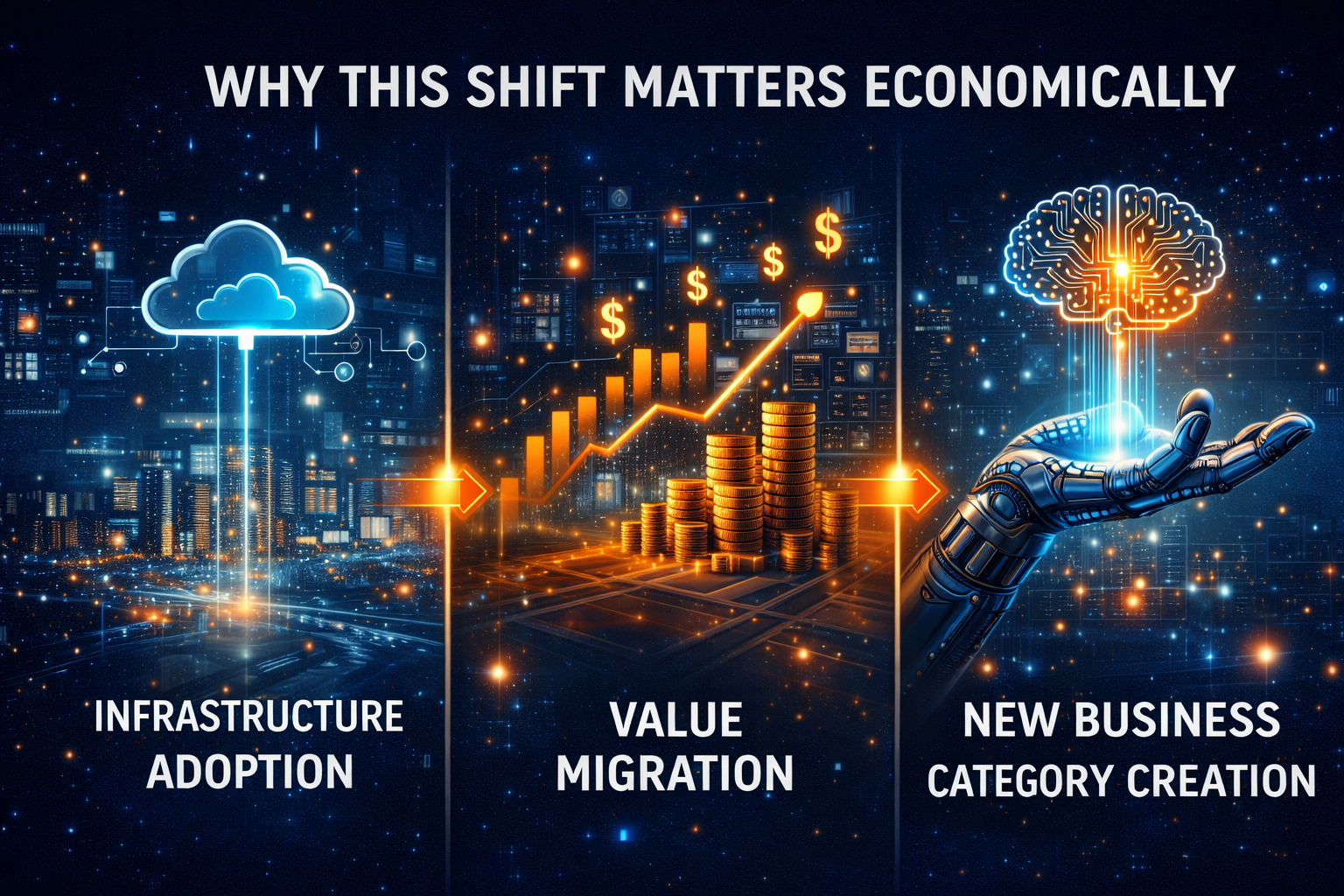
Why This Shift Matters Economically
Every major technological disruption follows a pattern:
- Infrastructure adoption
- Value migration
- New business category creation
With the internet:
- first came websites
- then e-commerce
- then platform-native companies that reorganized industries
AI is following the same arc.
Most organizations today are still in stages one and two:
- productivity gains
- workflow embedding
- copilots
- automation pilots
But the third stage is forming:
new companies and new models where intelligence is not supporting the business—it is the business.
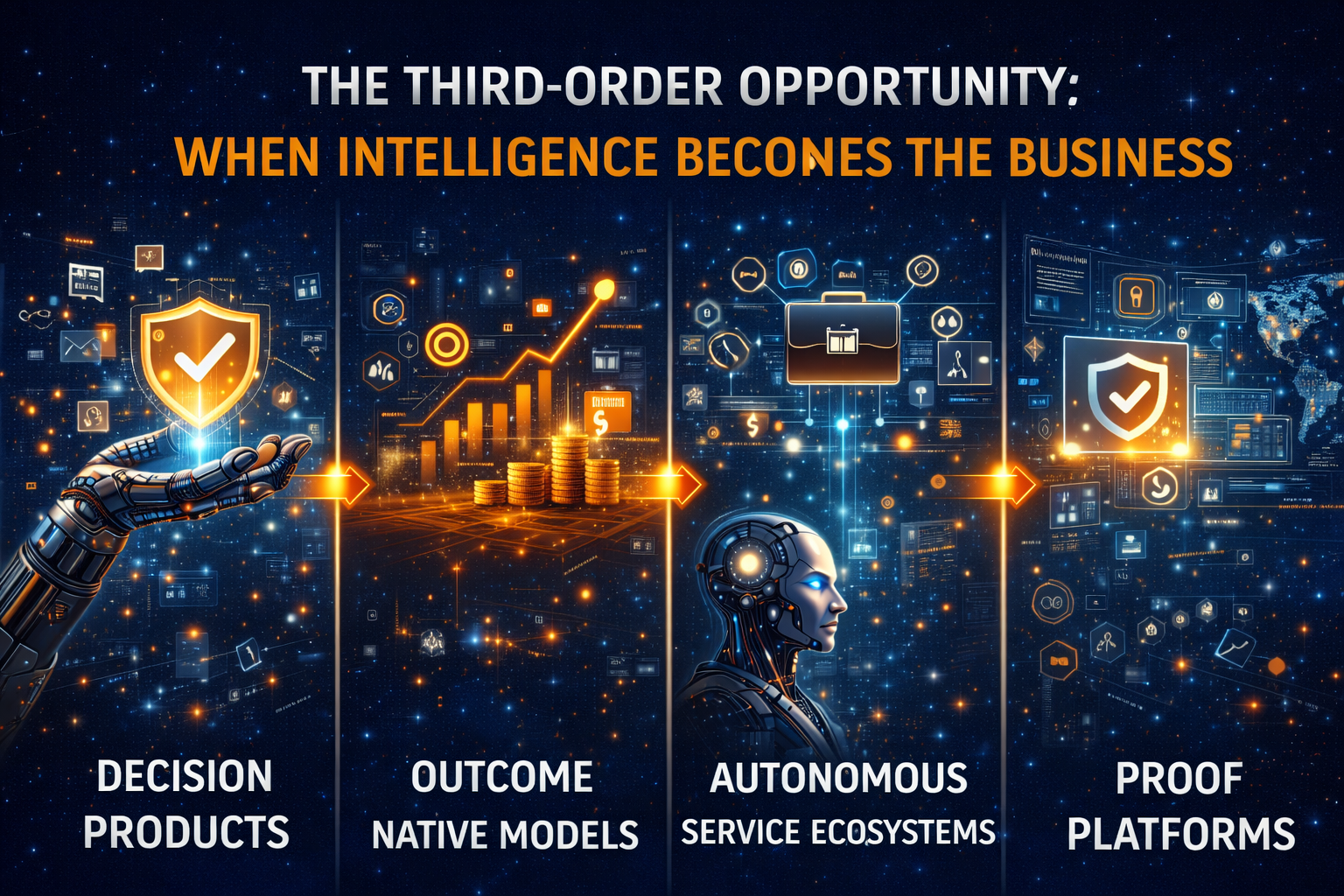
The Third-Order Opportunity: When Intelligence Becomes the Business
The Third-Order Opportunity: When Intelligence Becomes the Business
If Digital Transformation 3.0 is the institutional redesign, the “third-order” opportunity is the new value creation that follows.
Here are four third-order categories boards should actively watch—and deliberately pursue.
1) Decision Products (Judgment as a Service)
Companies monetize domain judgment as a service. Instead of selling tools, they sell governed decisions: risk approvals, pricing determinations, compliance validations.
Board lens:
Which decisions in our enterprise are so repeatable, measurable, and trusted that they can become external products?
2) Outcome-Native Business Models (Pay for Results)
AI enables firms to sell measurable outcomes rather than software licenses or advisory hours.
Performance becomes contractual. Optimization becomes continuous.
Board lens:
Where can we move from “selling work” to “selling outcomes” because AI can continuously adapt delivery?
3) Autonomous Service Ecosystems (Agents Coordinating Agents)
Agentic systems coordinate tools, partners, and human supervisors to deliver services at scale with minimal overhead.
This is the AI-era analogue of platformization: orchestration of capability, not ownership of assets.
Board lens:
Are we positioned to orchestrate a service ecosystem—or will someone else disintermediate us?
4) Proof and Assurance Platforms (Trust as a Market)
As autonomy increases, trust becomes scarce. Enterprises that can prove control, traceability, and reliability will command premium valuation.
This is not only an internal governance need—it is becoming an external differentiator, a procurement requirement, and a market category. (World Economic Forum)
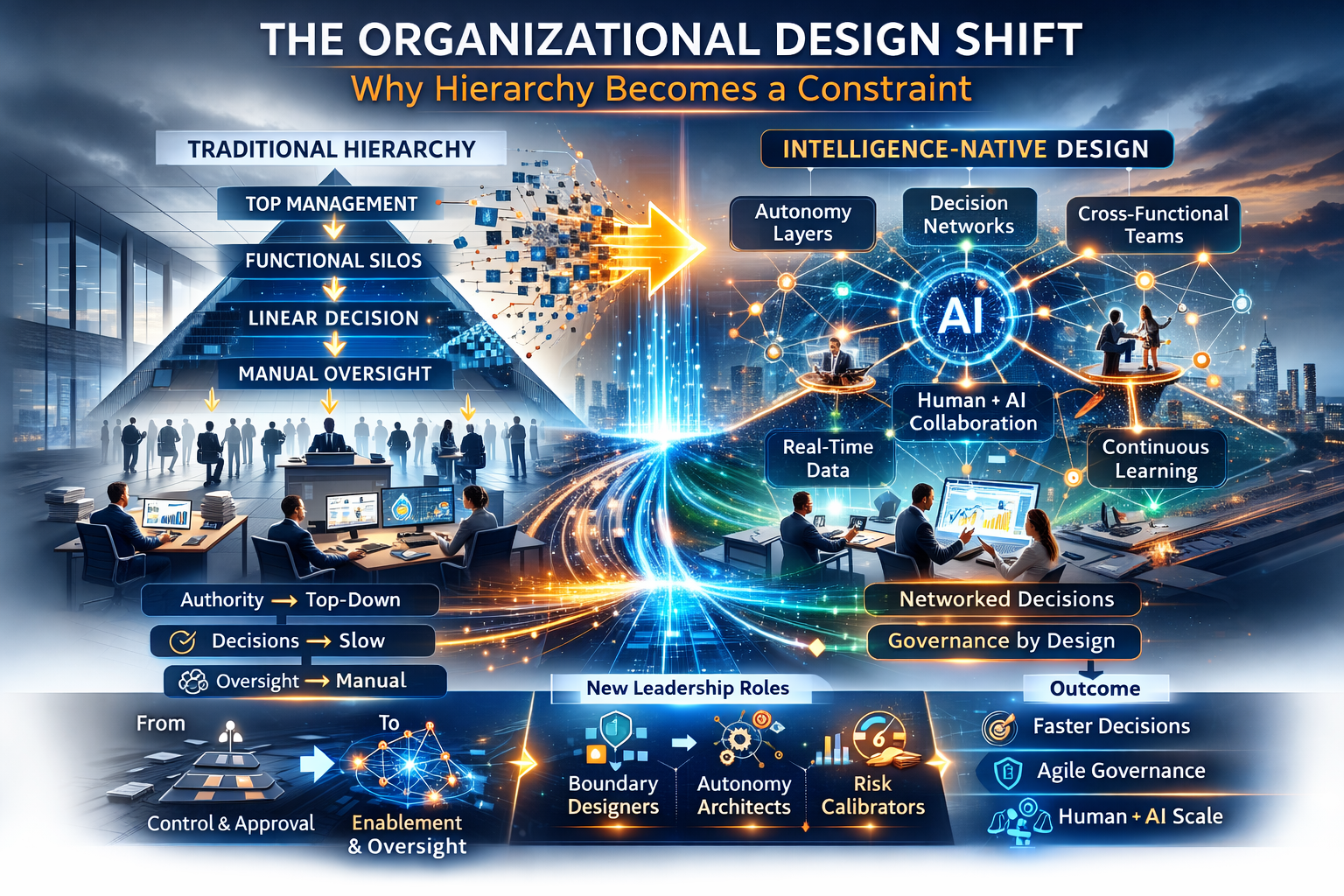
The Organizational Design Shift: Why Hierarchy Becomes a Constraint
Digital Transformation 3.0 does not primarily challenge IT departments.
It challenges hierarchy.
When AI systems influence or initiate decisions:
- authority no longer maps cleanly to org charts
- accountability must follow decision flows
- oversight must adapt to machine-human collaboration
Leaders shift from being direct decision-makers to becoming:
- boundary designers
- autonomy architects
- risk calibrators
- institutional learning stewards
This is not a technology change. It is a structural change.
What Boards Must Do Now: A Practical 5-Move Playbook
- Map your most economically significant decisions
Don’t start with “use cases.” Start with “decisions that move the needle.” - Define an autonomy ladder
Assist → co-decide → act-with-constraints → act-with-escalation.
Avoid accidental autonomy. - Embed assurance into workflows before scaling agents
Make traceability, evaluation, escalation, and rollback part of the system—by design. (World Economic Forum) - Allocate capital toward intelligence infrastructure, not just tools
Treat this as a strategic capability build, not a software rollout. - Place at least one explicit third-order bet
Decision products, outcome contracts, ecosystems, proof platforms—choose one to explore deliberately.
The mistake is not moving slowly.
The mistake is drifting without architectural intent.
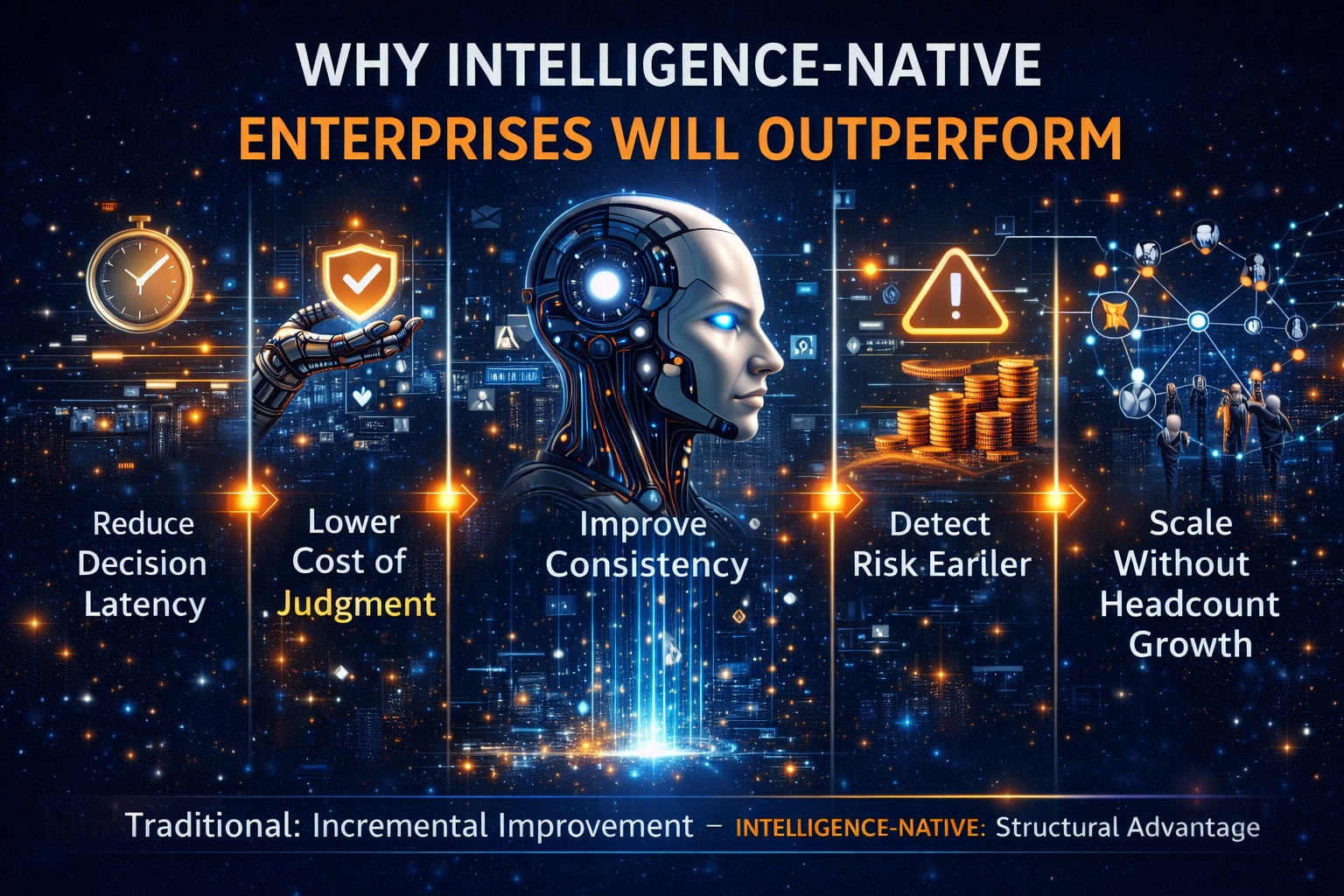
Why Intelligence-Native Enterprises Will Outperform
They will:
- reduce decision latency
- lower the marginal cost of judgment
- improve consistency
- detect risk earlier
- adapt faster
- monetize proprietary expertise
- scale without linear headcount growth
They compound advantage.
Traditional enterprises improve incrementally.
Intelligence-native enterprises improve structurally.
Conclusion: The Calm, Optimistic Case for Digital Transformation 3.0
Digital Transformation 3.0 is not about replacing humans.
It is about redesigning institutions so that human judgment, machine intelligence, and governance operate as a coherent system.
The winners in the Intelligence Decade will not be those with the most AI pilots.
They will be those that:
- treat intelligence as architecture
- design autonomy deliberately
- govern continuously through proof
- invest in learning velocity
- build new economic categories
Digital transformation began by digitizing processes.
It now evolves into designing intelligent institutions.
The rise of the Intelligence-Native Enterprise has begun.
The question for every board is no longer whether AI will matter.
It is whether the enterprise is structurally prepared for it.
Glossary
Digital Transformation 3.0: The third stage of digital transformation where AI becomes embedded into decision-making and execution, enabling governed autonomy and new business models.
Intelligence-Native Enterprise: An enterprise designed to scale AI-driven judgment through decision loops, autonomy boundaries, assurance, and institutional learning.
Agentic AI: AI systems that can plan and execute tasks using tools within constraints, often with human oversight and escalation rules. (MIT Sloan)
Decision system: A repeatable mechanism that converts signals into actions (pricing, risk, service recovery, supply allocation).
Autonomy ladder: A staged approach to autonomy—from assist to act-with-constraints to higher autonomy in bounded domains.
Assurance: Continuous evidence that AI behavior remains within policy, risk, and performance boundaries. (World Economic Forum)
Learning velocity: The speed at which an enterprise detects change, updates intelligence, and improves outcomes.
Decision product: A monetized decision capability delivered as a service (e.g., pricing decisions, approvals, compliance validations).
Outcome-native model: A business model where customers pay for measurable outcomes rather than software licenses or effort hours.
FAQ
1) Is Digital Transformation 3.0 just “more AI projects”?
No. It is an operating model evolution—designing decision loops, autonomy boundaries, assurance, and learning so intelligence can scale repeatedly.
2) What is the difference between AI-enabled and intelligence-native?
AI-enabled means AI is a tool layer. Intelligence-native means AI is embedded into the enterprise’s decision and execution architecture, with governance-by-design.
3) Won’t autonomy increase risk?
Autonomy increases risk if unmanaged. The solution is a structured approach to evaluation and governance—classification, evaluation, risk assessment, and progressive controls. (World Economic Forum)
4) What’s the biggest board mistake with AI right now?
Treating AI like software procurement instead of an institutional capability that requires decision mapping, governance architecture, and capital allocation.
5) How do we start in 30 days?
Create a decision inventory, define an autonomy ladder, set assurance requirements, and choose one third-order bet (decision product, outcome contract, ecosystem, proof platform) to explore deliberately.
References & further reading
- World Economic Forum: AI Agents in Action: Foundations for Evaluation and Governance (World Economic Forum)
- World Economic Forum: onboarding & governance foundations (classification → evaluation → risk → progressive controls) (World Economic Forum)
- MIT Sloan (agentic AI overview and adoption signals) (MIT Sloan)
- Gartner glossary: Autonomic systems (autonomy + learning + agency) (Gartner)
- HBR: Digital transformation and value creation framing (Harvard Business Review)
-
World Economic Forum – Future of Jobs / AI Governance
https://www.weforum.org/reports/the-future-of-jobs-report - OECD AI Principles
https://oecd.ai/en/ai-principles



Raktim Singh is an AI and deep-tech strategist, TEDx speaker, and author focused on helping enterprises navigate the next era of intelligent systems. With experience spanning AI, fintech, quantum computing, and digital transformation, he simplifies complex technology for leaders and builds frameworks that drive responsible, scalable adoption.