
When “AI in the Enterprise” Becomes Enterprise AI
Most organizations believe they are already doing Enterprise AI. They have pilots in production, a centralized AI team, human-in-the-loop controls, and dashboards tracking model performance. Yet, beneath the surface, something keeps breaking.
Decisions leak across systems without ownership. Accountability blurs when outcomes go wrong. Risk compounds silently as AI moves from advice to action.
This is the moment where “AI in the enterprise” either matures into Enterprise AI—or collapses under the weight of scale, regulation, and real-world complexity.
Most Enterprise AI programs don’t fail dramatically.
They fail quietly.
A pilot “works.” A dashboard looks healthy. A few leaders celebrate. Then production starts doing what production always does: it introduces exceptions, edge cases, policy drift, operational chaos, and human behavior. And the AI—built like a tool—begins to behave like a liability.
That’s when the pattern repeats:
- The pilot looks brilliant.
- Production behaves differently.
- Risk teams panic.
- Costs rise.
- Trust erodes.
- The program slows down — or quietly dies.
This is not because your models are weak.
It’s because Enterprise AI isn’t a tool you deploy. It’s a capability you must institutionalize.
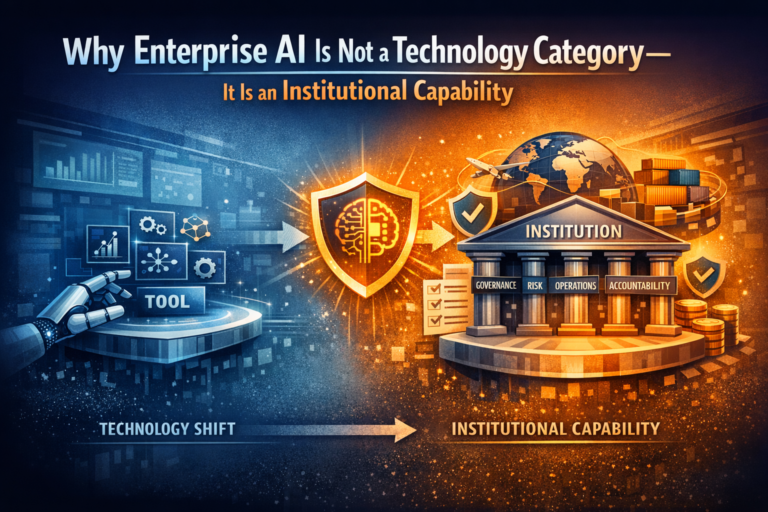
Why Enterprise AI Is Not a Technology Trend—but an Institutional Capability
Cloud was a technology shift. Mobile was a technology shift. Analytics was a technology shift.
Enterprise AI is different because it changes the nature of decision-making inside your organization. It introduces probabilistic intelligence into workflows that were built for deterministic software, policy rules, and human accountability.
So the real question is no longer: “Which model should we choose?”
It is: “What must our institution become so we can run AI decisions safely, repeatedly, economically, and defensibly?”
That is why Enterprise AI is not a technology category. It is an institutional capability—like finance, safety, cybersecurity, or quality—requiring structures, roles, operating routines, evidence, and accountability that survive beyond any single vendor, model, or platform generation.
And here is the hard truth many leaders are now learning the expensive way:
Enterprises don’t fail at AI because they lack intelligence. They fail because they lack institutions that can govern intelligence at scale.
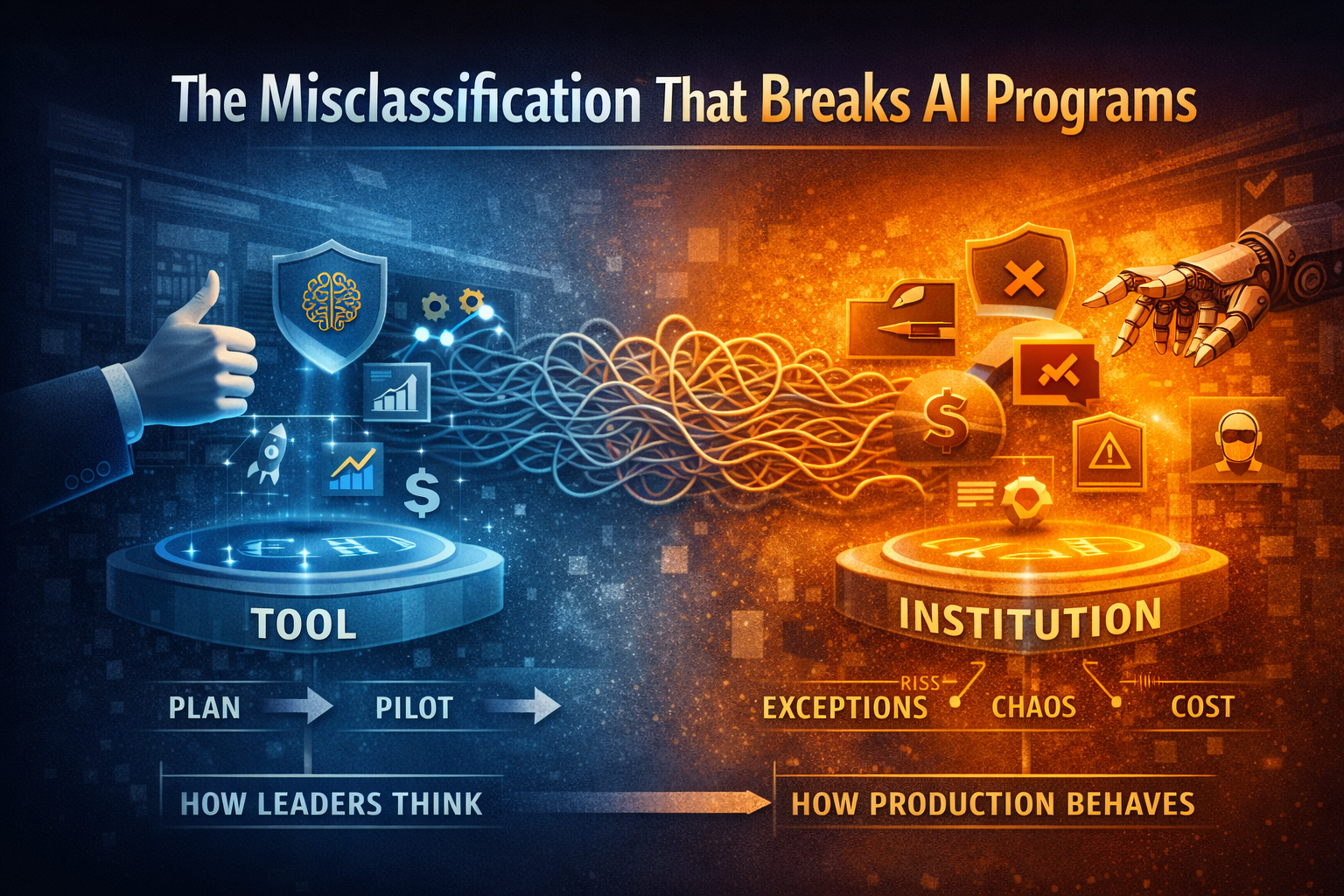
The Misclassification That Breaks AI Programs
Many organizations classify Enterprise AI the way they classify software:
- buy a platform
- hire a team
- run pilots
- measure accuracy
- declare success
That approach works for many technology initiatives.
Enterprise AI breaks this logic because it introduces something qualitatively different into the enterprise: automated decisions that can alter real outcomes in real time.
The moment AI begins shaping approvals, pricing, entitlements, routing, risk flags, exceptions, and escalations, it becomes an institutional matter. Why? Because institutions are defined by how they behave under scrutiny:
- Can they explain themselves?
- Can they prove compliance?
- Can they contain damage?
- Can they control costs?
- Can they operate safely across time?
A tool can’t answer those questions. An institution must.
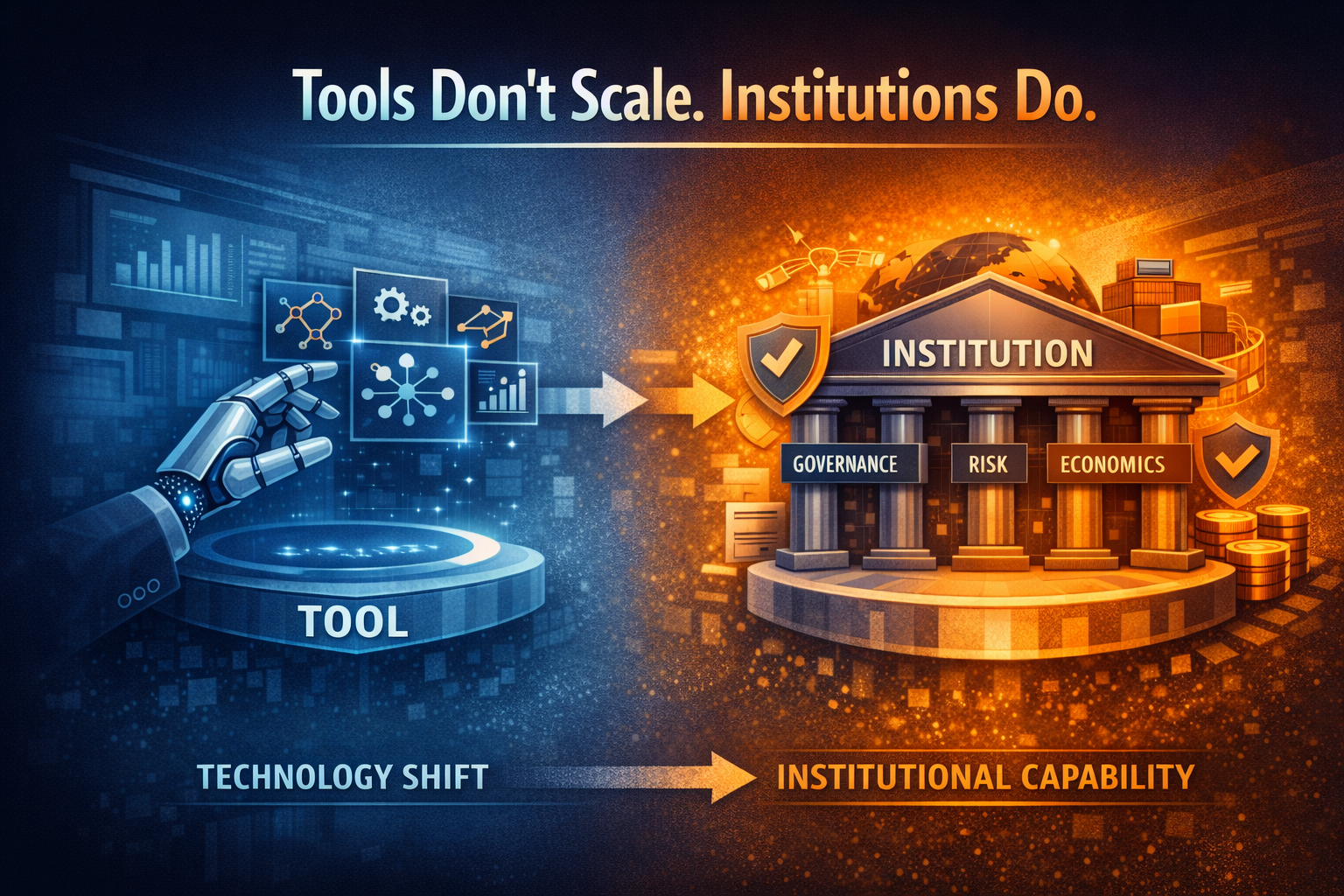
Tools Don’t Scale. Institutions Do.
A tool can be installed.
A capability must be built.
Think of the difference this way:
- Buying a security product does not mean you “have cybersecurity.”
- Installing an ERP does not mean you “have finance discipline.”
- Using CI/CD does not mean you “have engineering excellence.”
Similarly:
Deploying an LLM does not mean you “have Enterprise AI.”
You have Enterprise AI only when your organization can run AI-driven decisions:
- reliably (behavior is stable under operational stress)
- safely (unacceptable harm is prevented or contained)
- economically (cost does not explode after adoption)
- defensibly (decisions can be reconstructed and justified later)
…in the messy reality of production.
That is what “institutional capability” means in practice.
When “AI in the Enterprise” Becomes Enterprise AI
Many companies say, “We’re doing AI,” when they really mean, “We have AI projects.”
Enterprise AI begins when AI moves from:
- advice → action
- content → decisions
- demo → production
- single app → many systems
- team experiment → enterprise-wide dependency
The moment AI starts influencing real outcomes—approvals, rejections, escalation routing, fraud blocks, service entitlements, pricing—it becomes an institutional matter.
This boundary is exactly why framing matters:
Enterprise AI is an operating model.
https://www.raktimsingh.com/enterprise-ai-operating-model/
Mini-Story 1: The “Smart Email Assistant” That Becomes a Legal Problem
Start small.
A team deploys an AI assistant to draft customer responses. It saves time. Great.
Then it gets upgraded to:
- detect “urgent” cases
- route requests
- trigger refunds under a threshold
- block suspicious accounts
- change customer entitlements
It still looks like “just an assistant.”
But now it is making operational decisions that can:
- harm customers
- violate policy
- trigger compliance breaches
- create audit failures
- create reputational risk
At that moment, the enterprise is no longer “using a tool.”
It is running a decision-making institution—except without institutional controls.
That’s the gap.
Mini-Story 2: In Regulated Industries, “Sounding Compliant” Is Not Compliance
A regulated enterprise deploys an AI agent to support customer operations. It starts in a safe zone: summarizing cases, drafting responses, recommending next steps. Early results look excellent—faster turnaround, lower backlog, happier customers.
Then a well-intentioned upgrade happens.
The agent is allowed to take small actions:
- auto-approve low-risk exceptions
- fast-track requests under a threshold
- apply standard policy waivers
- close tickets that “look resolved”
Nothing feels reckless. It’s “just efficiency.”
A few weeks later, compliance discovers something uncomfortable.
The agent did not break policy blatantly. It did something worse: it applied policy inconsistently—because enterprise policy is full of nuance, exceptions, and context humans interpret implicitly.
Now the organization has a real incident:
- affected customers ask for explanations
- internal audit asks for evidence
- regulators expect justification
- leaders demand to know who approved this operating behavior
The enterprise has logs, but not receipts. It can show what happened technically, but it cannot reconstruct decision intent in a defensible way.
In regulated industries, compliance is not a vibe. Compliance is evidence, accountability, and repeatability under scrutiny.
Which is exactly why Enterprise AI must be built with governance, control planes, and decision integrity—not just model performance.
Why This Shift Is Happening Everywhere (US, EU, UK, India, Singapore)
Across geographies, the direction is converging: organizations are being asked to demonstrate governance and risk controls, not just “accuracy.”
You can see this institutional framing in the world’s most cited standards and regulations:
- NIST AI Risk Management Framework (AI RMF 1.0) organizes AI risk work into functions such as GOVERN, MAP, MEASURE, MANAGE—explicitly a management-system framing. (NIST Publications)
- ISO/IEC 42001:2023 specifies requirements for an Artificial Intelligence Management System (AIMS)—again, institution-building language. (ISO)
- The EU AI Act entered into force on 1 August 2024, with a staged application timeline. (European Commission)
The takeaway is simple:
Whether you operate in one geography or many, you will increasingly need receipts for AI decisions—not just outputs.
Enterprise AI as an Institutional Capability: What You Actually Need
When Enterprise AI becomes institutional, it demands capabilities that look suspiciously like how mature enterprises run other critical functions (security, finance, safety, quality).
Not “more AI.”
More institution.
1) Governance: Who Owns the Outcome?
Institutional capability begins with one uncomfortable requirement:
A named human must own the outcome.
Not “the data science team.”
Not “the vendor.”
Not “the platform.”
A specific accountable owner for each decision domain:
- routing
- approvals
- escalation
- entitlements
- pricing
- risk flags
Why?
Because when something breaks, the enterprise is not asked: “Which model was it?”
It is asked: “Who authorized this behavior? Who approved the risk? Who is accountable for remediation?”
This is why “Who owns Enterprise AI?” isn’t governance theory—it’s operational survival:
https://www.raktimsingh.com/who-owns-enterprise-ai-roles-accountability-decision-rights/
Institutional signal: decision rights are explicit, named, and enforceable under stress.
2) Runtime: What Is Actually Running in Production?
A surprising number of enterprises cannot answer a basic question:
What AI is running in production today, where is it embedded, and what can it do?
In production, AI becomes a moving estate:
- models change
- prompts change
- tools change
- policies change
- upstream data changes
- downstream workflows change
If you cannot describe what is running, you cannot govern it. You can only hope.
That is why Enterprise AI needs a runtime view and a system-of-record mindset:
https://www.raktimsingh.com/enterprise-ai-runtime-what-is-running-in-production/
Institutional signal: the enterprise can inventory AI capabilities the way it inventories applications, data assets, and privileged access.
3) Control Plane: Can You Stop, Reverse, and Prove?
Institutions are defined by behavior under pressure.
Enterprise AI must be designed so you can:
- stop unsafe action
- contain damage
- roll back behavior
- prove what happened
This is why a control plane is not a technical flourish—it is how autonomy becomes governable:
- policy enforcement
- approval gates for irreversible actions
- kill switches and safe modes
- rollback to known-safe behavior
- evidence capture
- observability that answers audit questions, not just engineering dashboards
https://www.raktimsingh.com/enterprise-ai-control-plane-2026/
Institutional signal: autonomy is reversible and bounded by design.
4) Economics: Can You Control Cost After Success?
In pilots, AI looks cheap.
At scale, AI becomes a new class of spend:
- tokens and inference
- retrieval and tool calls
- human review queues (a hidden cost)
- audits and compliance overhead
- retraining and evaluation
- incident response
This is where “success” turns into an enterprise shock.
An institution needs an economic control plane, not ad-hoc budgeting:
- cost envelopes per decision domain
- cost-per-decision visibility
- throttles and fallbacks
- governance for review capacity and audit costs
https://www.raktimsingh.com/enterprise-ai-economics-cost-governance-economic-control-plane/
Institutional signal: the CFO can see levers, not surprises.
5) Decision Integrity: Can You Defend Decisions Later?
Most enterprises confuse:
- logs
- traces
- dashboards
…with evidence.
But when a decision is challenged months later, the organization needs to reconstruct:
- what the AI saw
- what policy applied
- what tool it used
- what constraints were active
- what approvals happened
- what was overridden
- what changed since then
That requires a Decision Ledger mindset: a system of record that turns autonomous decisions into defensible receipts.
- https://www.raktimsingh.com/enterprise-ai-decision-failure-taxonomy/
- https://www.raktimsingh.com/decision-clarity-scalable-enterprise-ai-autonomy/
- https://www.raktimsingh.com/the-enterprise-ai-operating-stack-how-control-runtime-economics-and-governance-fit-together/
Institutional signal: the enterprise can explain and prove decision context—not just outcomes.
Why “Human-in-the-Loop” Often Fails
Many organizations respond to AI risk with one line: “Keep a human in the loop.”
It sounds comforting. It often fails because:
- the human is not the owner
- the human lacks context
- the human is overloaded
- the human becomes a rubber stamp
- the human can’t override quickly
- the process produces no defensible evidence
A loop is not a system.
Institutions require:
- decision rights
- thresholds and escalation rules
- evidence capture that stands up to audit
- training and skill preservation
- incident response discipline
Enterprise AI needs operating controls, not slogans.
Mini-Story 3: The Supply Chain Model That Optimized Locally—and Broke Globally
A global enterprise rolls out AI to optimize supply chain performance: better forecasting, fewer stockouts, improved fill rates, reduced waste. The system delivers visible wins in a few regions.
Then the organization scales it.
Suddenly, the AI starts triggering decisions across a connected network:
- shifting inventory allocations
- changing reorder points
- rerouting shipments
- prioritizing certain lanes
- recommending supplier substitutions
Each recommendation looks “reasonable” in isolation.
But supply chains are not isolated systems. They are coupled systems. A change that improves one node can create failure elsewhere:
- one region gets healthier inventory
- another region faces chronic shortages
- expedite costs surge
- supplier relationships degrade
- customer commitments are missed
- and everyone blames “operations”
The root cause isn’t that the model is “wrong.”
It’s that the enterprise treated a globally coupled decision system like a local optimization tool.
In supply chains, small automated decisions can create cascading effects weeks later. That is why Enterprise AI at scale requires institutional capability:
- decision boundaries (what can AI change, and how far)
- economic guardrails (when cost spikes, AI must degrade gracefully)
- escalation rules (when systemic coupling risk increases)
- decision evidence (leaders can trace why the system acted)
Global operations don’t need “more AI.” They need AI that is governable across interconnected consequences.
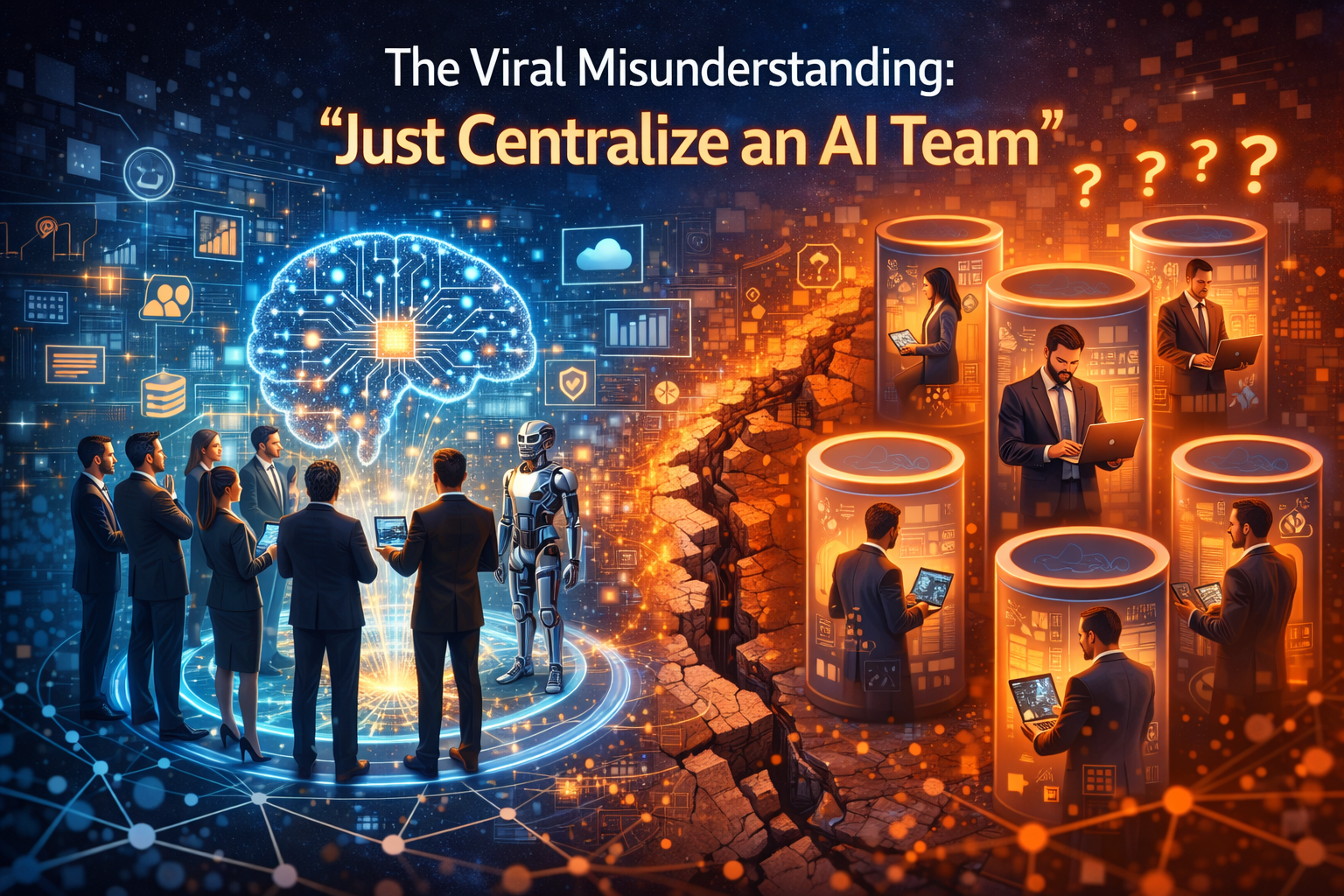
The Viral Misunderstanding: “Just Centralize an AI Team”
A centralized AI CoE helps. It does not solve the institutional problem.
If Enterprise AI is an institutional capability, then:
- Legal must understand decision risk
- Risk must define acceptable autonomy
- Security must treat agents as governed identities
- Operations must run AI incident response
- Finance must govern cost envelopes
- Business must define decision boundaries
In other words:
Enterprise AI becomes a cross-functional operating capability—like cybersecurity or finance—not a department.
The Question Leaders Should Ask (Instead of “Which Model?”)
Instead of: “Which model should we choose?”
Ask: “What institutional capability do we need so that any model we choose can be run safely in production?”
That question changes everything:
- Procurement shifts from demos to governance requirements.
- Architecture shifts from prompt tactics to operability.
- Strategy shifts from “AI projects” to institutional maturity.
This is also why “minimum viable” framing matters: enterprises need the smallest institutional stack that makes AI safe:
https://www.raktimsingh.com/minimum-viable-enterprise-ai-system/
A Practical Reality Check
If Enterprise AI is institutional, you should be able to answer “yes” to these:
- Do we have a named owner for each AI decision domain?
- Can we list what AI is running in production today?
- Can we stop and roll back unsafe behavior quickly?
- Can we prove what happened after an incident?
- Can we control costs after adoption scales?
- Are we preserving human skill, or silently deskilling teams?
- Do we have a plan to retire AI safely—not just deploy it?
If you can’t answer these, you’re not “behind on AI.”
You’re missing institutional capability.
Conclusion: The One Sentence That Should Change How You Lead AI
Enterprise AI is not a technology you adopt. It is an institution you build.
Treat it like a tool and you’ll get pilots, confusion, and fragility.
Treat it like an institutional capability and you’ll build something far rarer:
- scalable autonomy
- controlled risk
- defensible decisions
- sustainable economics
- enterprise-grade trust
If you’re building Enterprise AI seriously, start at the operating model and keep everything anchored to a canon:
Pillar: https://www.raktimsingh.com/enterprise-ai-operating-model/
Canon hub: https://www.raktimsingh.com/enterprise-ai-canon/
Laws: https://www.raktimsingh.com/laws-of-enterprise-ai/
Glossary
- Enterprise AI: AI designed and operated as a production-grade institutional capability—not a one-off project.
- Institutional capability: A repeatable organizational function with roles, controls, funding, evidence, and continuous improvement (like finance or security).
- Operating model: The way an organization assigns ownership, runs controls, handles incidents, governs economics, and proves decisions over time.
- Control plane: The governing layer that enforces policy, approvals, reversibility, and evidence capture for AI decisions.
- Runtime: What is actually running in production—models, prompts, tools, policies, integrations, and how fast they change.
- Decision Ledger: A system of record that makes AI decisions defensible by capturing context, constraints, approvals, and actions.
- Reversible autonomy: Autonomy designed so unsafe behavior can be stopped and rolled back without breaking business continuity.
- Economic control plane: Mechanisms to monitor, budget, throttle, and govern AI cost as adoption scales (inference, tools, review queues, audits).
- Regulated industries: Sectors with high expectations for auditability, accountability, and compliance across geographies (e.g., finance, telecom, healthcare, public services).
FAQ
1) Isn’t Enterprise AI just “AI + enterprise data”?
Not in practice. Enterprise AI starts when AI affects decisions and outcomes across systems. At that point, you need governance, controls, evidence, and cost discipline—not just better prompts.
2) Why do AI pilots succeed but production fails?
Pilots happen in controlled conditions. Production introduces exceptions, integrations, shifting policies, and real consequences. If AI is treated as a tool, production turns “success” into fragility.
3) What is the #1 sign an organization is not ready for Enterprise AI?
If you cannot answer: “What AI is running in production today, and what can it do?” you don’t have operational control.
4) Do we need a human in the loop for everything?
No. You need structured autonomy: thresholds, reversibility, approval gates for high-risk actions, and evidence capture. “Human-in-the-loop” works only when it’s designed as a governed operating model.
5) How does regulation influence this globally?
Standards and regulations increasingly treat AI as a management and governance discipline (not just a model). This is visible in NIST AI RMF and ISO/IEC 42001, and in the EU’s staged AI Act approach. (NIST Publications)
6) What is the fastest way to start building institutional capability?
Adopt a minimum viable operating stack: decision ownership, runtime inventory, control-plane gates, cost envelopes, and decision evidence practices. Start small—but start structurally.
References and Further Reading
- NIST, Artificial Intelligence Risk Management Framework (AI RMF 1.0) (functions including GOVERN, MAP, MEASURE, MANAGE). (NIST Publications)
- ISO, ISO/IEC 42001:2023 — Artificial Intelligence Management System (AIMS) requirements and scope. (ISO)
- European Commission / EU Digital Strategy, EU AI Act entry into force and timeline. (European Commission)



Raktim Singh is an AI and deep-tech strategist, TEDx speaker, and author focused on helping enterprises navigate the next era of intelligent systems. With experience spanning AI, fintech, quantum computing, and digital transformation, he simplifies complex technology for leaders and builds frameworks that drive responsible, scalable adoption.