
Enterprise AI vs Platform Modernization
Most enterprises today are proudly modern. They have migrated to cloud platforms, broken monoliths into microservices, built data lakes and lakehouses, and invested heavily in platform engineering. Software ships faster, infrastructure scales better, and dashboards look reassuringly green.
Yet, the moment artificial intelligence begins influencing approvals, pricing, risk flags, customer treatment, or operational actions, many of these “modern” enterprises encounter an unexpected fragility.
Decisions become harder to explain, accountability blurs, and production behavior diverges sharply from what worked in pilots.
This is the critical distinction leaders must understand: platform modernization upgrades how software runs, but Enterprise AI upgrades how institutions decide.
Confusing the two is why AI pilots often succeed while enterprise-scale deployment quietly struggles. This article explains that difference—clearly, practically, and globally—and shows why modern infrastructure alone is no longer enough once software starts exercising judgment.
Why “modernizing the stack” isn’t the same thing as “modernizing decision-making”
If you’re modernizing your platform, you’re upgrading how software runs.
If you’re building Enterprise AI, you’re upgrading how the institution decides—at scale, under uncertainty, with accountability.
That distinction sounds academic until a very common scenario plays out:
A company completes a “successful” cloud migration. Data platforms are rebuilt. Microservices replace monoliths. CI/CD is humming. Leadership declares the enterprise “AI-ready.”
Then AI starts influencing approvals, pricing, risk flags, customer treatments, hiring shortlists, claims triage, or operational routing—and suddenly everything that felt modern starts behaving… fragile.
Not because the cloud failed.
Because decision-making entered production.
Platform modernization is necessary. It removes friction, unlocks velocity, and makes systems easier to operate.
But it is not sufficient—because Enterprise AI is not a technology upgrade. It is an institutional operating capability.
And that’s exactly why so many organizations confidently say:
“We already modernized. We migrated to cloud. We built a lakehouse. We adopted microservices. We’re ready for Enterprise AI.”
…then discover that pilots “work,” dashboards look green, and production still turns messy—because probabilistic systems behave differently inside deterministic enterprises.
This article explains the difference in plain language, using simple examples that work across regions—US, EU, India, APAC, and the Global South—and ends with a practical set of decisions leaders can use immediately.
If you want the canonical foundation behind this perspective, start here:
Enterprise AI Operating Model: https://www.raktimsingh.com/enterprise-ai-operating-model/
A fast framing: the one-line test
Platform modernization asks: “How do we ship software faster and run it reliably?”
Enterprise AI asks: “How do we ship decisions safely and defend them—across time, people, systems, and regulators?”
That’s it. That’s the line.
Everything else in this article is an unpacking of that gap.
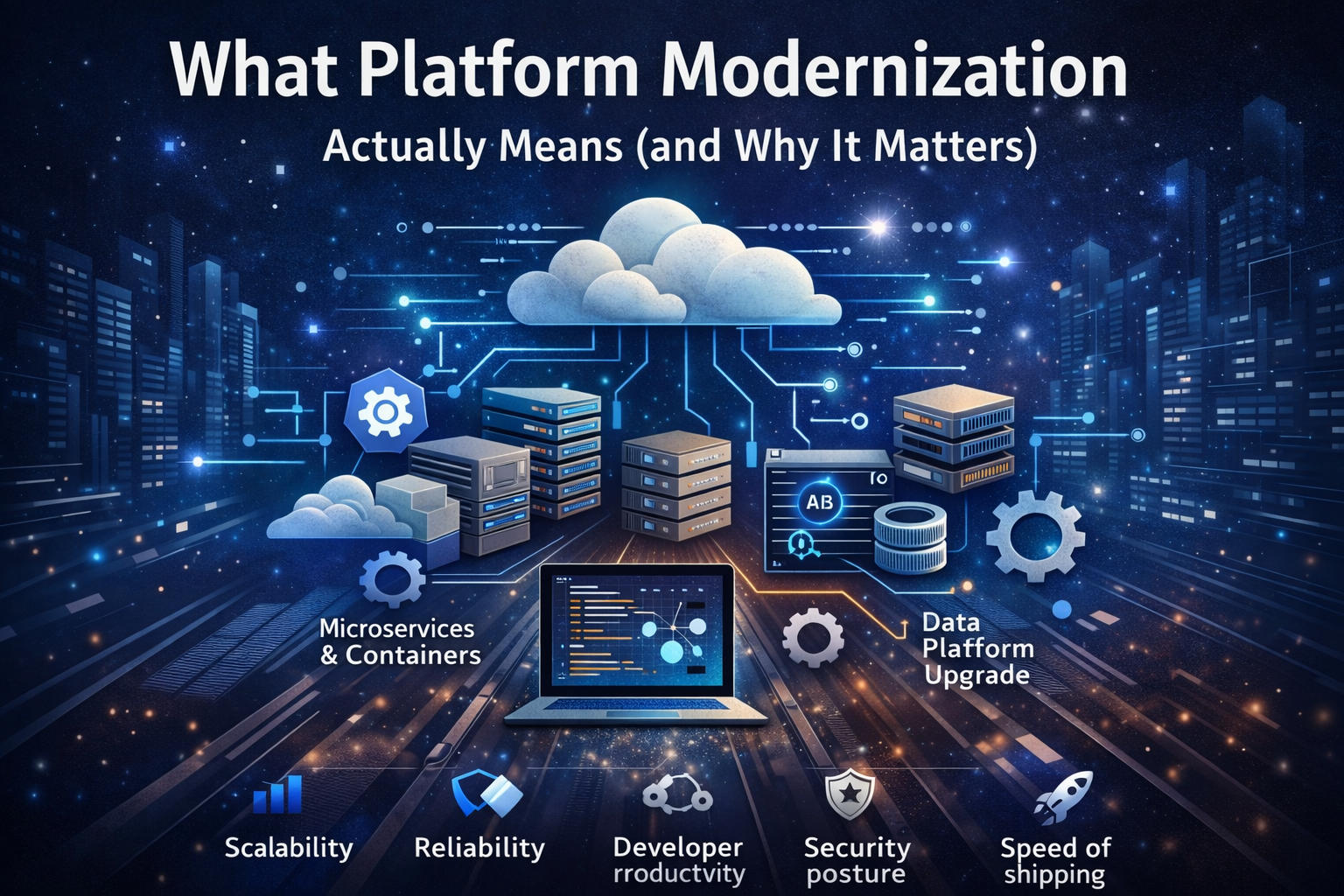
What platform modernization actually means (and why it matters)
Platform modernization is the upgrade of your delivery and runtime foundation—typically some mix of:
- Legacy-to-cloud migration
- Containers and orchestration (often Kubernetes)
- API-first integration
- Data platform upgrades (lakehouse/streaming/governance)
- Platform engineering and internal developer platforms (“golden paths”) to accelerate delivery (Google Cloud)
When it’s done well, modernization improves:
- scalability
- reliability
- security posture
- developer productivity
- speed of shipping
It is one of the best ways to make software faster and more maintainable.
But notice what it does not guarantee:
Platform modernization does not automatically make your AI decisions:
- accountable
- reversible
- auditable
- policy-aligned
- safe under drift
- legally defensible
That’s where Enterprise AI begins.
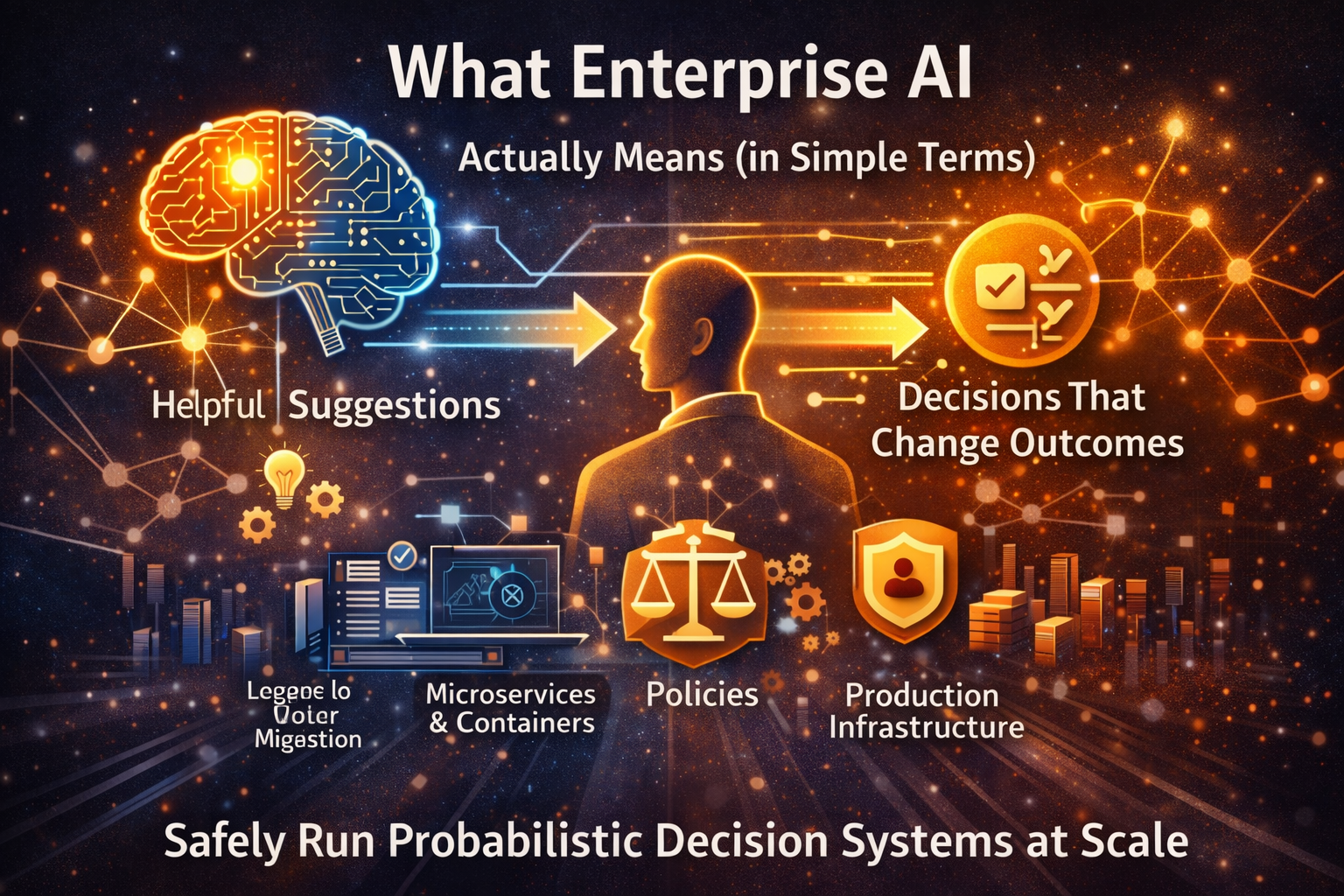
What Enterprise AI actually means (in simple terms)
Enterprise AI is what happens when AI moves from:
- “helpful suggestions”
to - decisions that change outcomes
It’s not “AI inside the enterprise.”
It’s the enterprise redesigning itself to safely run probabilistic decision systems at scale—across people, processes, policies, and production infrastructure.
This is why global governance thinking focuses on institutional controls, not just model performance. Two signals that matter:
- The NIST AI Risk Management Framework structures AI risk around GOVERN, MAP, MEASURE, MANAGE, with governance designed as a cross-cutting function—not an afterthought. (NIST Publications)
- ISO/IEC 42001 frames AI governance as an organizational management system—policies, objectives, processes, and continual improvement. (ISO)
In other words: Enterprise AI is an operating model, not a toolchain.
(If you want the full operating-system view of what “enterprise-grade” means in practice, see: https://www.raktimsingh.com/enterprise-ai-operating-model/)
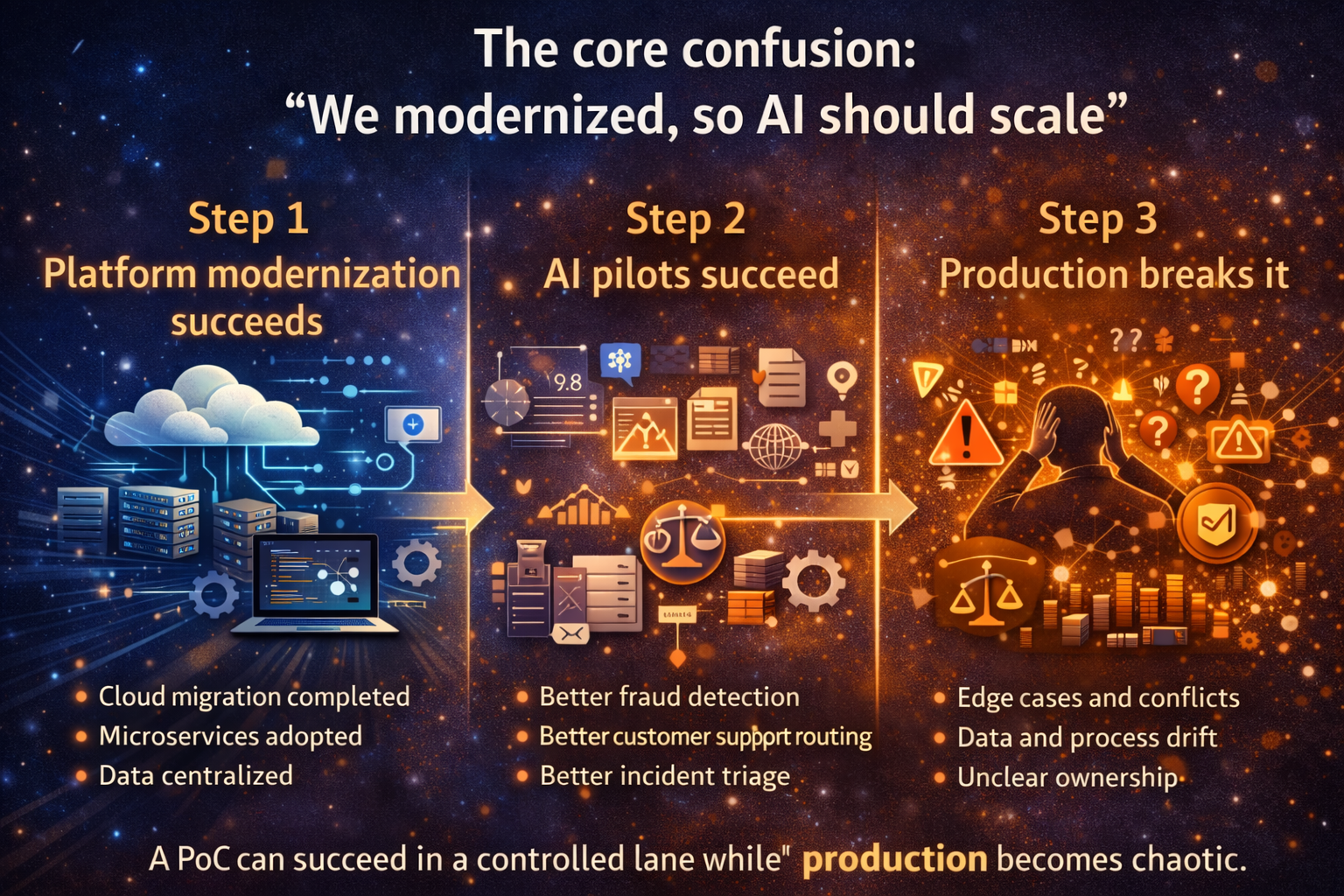
The core confusion: “We modernized, so AI should scale”
Here’s the most common failure pattern—one you can find in every geography and every industry.
Step 1: Platform modernization succeeds
A company migrates to cloud, adopts DevOps, builds APIs, and centralizes data. Teams ship faster. Costs stabilize. Leadership celebrates.
Step 2: AI pilots succeed
A model improves a metric in a controlled environment:
- better fraud detection
- better customer support routing
- better demand forecasting
- better incident triage
- better document extraction
Step 3: Production breaks it
AI moves into messy, exception-filled reality:
- edge cases and long-tail behavior
- policy conflicts
- data drift and process drift
- incentives and human workarounds
- cross-system “decision leakage”
- unclear ownership when outcomes go wrong
This is why a PoC can be successful in a controlled lane while production becomes chaotic.
Because modernization upgrades the highway.
Enterprise AI governs the driver.
If you want a deeper treatment of why “AI in the enterprise” collapses without institutional design, this companion piece is relevant:
https://www.raktimsingh.com/enterprise-ai-institutional-capability/

The real fault line: deterministic enterprises meet probabilistic decisions
Most enterprises—especially large, regulated, or critical ones—are built around deterministic expectations:
- policies that must be applied consistently
- processes that must be repeatable
- controls that must be provable
- accountability that must be assignable to named owners
AI introduces probability:
- “likely fraud”
- “high risk”
- “probable match”
- “recommended action”
- “predicted failure”
A modern platform can compute those probabilities.
But an enterprise must decide what those probabilities are allowed to do.
That move—from prediction to consequence—is the pivot.
And it’s also why this principle holds:
AI in enterprise is not Enterprise AI.
Enterprise AI begins when probabilistic outputs create real-world outcomes.
For a more operational framing, read: https://www.raktimsingh.com/enterprise-ai-runtime-what-is-running-in-production/

Nine differences that separate Enterprise AI from platform modernization
1) Determinism vs probability
Modern platforms are optimized for deterministic logic:
- “If payment fails, retry.”
- “If order placed, reserve inventory.”
- “If limit breached, block.”
AI introduces probabilistic judgment:
- “This looks like fraud.”
- “This customer is likely to churn.”
- “This claim is probably valid.”
A modern stack can run those outputs—but it cannot answer, by default:
- Who owns the decision?
- What happens when it’s wrong?
- How do we reverse outcomes?
- How do we prove policy compliance?
That’s Enterprise AI work.
https://www.raktimsingh.com/enterprise-ai-decision-failure-taxonomy/
2) Shipping code vs shipping decisions
Platform modernization optimizes:
- deployment frequency
- service reliability
- cost efficiency
Enterprise AI must optimize:
- decision integrity
- traceability (why this decision happened)
- reversibility (how to unwind impact)
- accountability (who is responsible)
- policy alignment (what rules it must follow)
In Enterprise AI, you don’t just deploy software.
You deploy institutional judgment at scale.
3) Observability of systems vs observability of autonomy
Traditional observability answers:
- latency, errors, saturation
- uptime
- service health
Enterprise AI observability must answer:
- what the system decided
- what it used as evidence
- what policy it applied
- what action it triggered
- what it would have done under alternate constraints
This governance-first emphasis maps cleanly to NIST’s “GOVERN” being cross-cutting—not optional. (NIST Publications)
https://www.raktimsingh.com/enterprise-ai-control-plane-2026/
4) Data governance vs decision governance
Modernization often stops at:
- data quality
- lineage
- access controls
- cataloging
Enterprise AI needs:
- decision logs (what changed in the world)
- approval boundaries (when humans must intervene)
- audit-grade evidence trails
- replayability (can we reconstruct the decision?)
Data is an input.
Decisions are liabilities.
Decision Ledger piece: https://www.raktimsingh.com/decision-ledger-defensible-auditable-enterprise-ai/
5) Resilience to outages vs resilience to drift
Modernization designs for:
- failover
- redundancy
- disaster recovery
Enterprise AI must also design for:
- model drift
- policy drift
- behavior drift
- incentive drift (humans adapting to the system)
A model can be “available” and still be institutionally unsafe.
https://www.raktimsingh.com/enterprise-ai-runbook-crisis-model-churn-production-ai/
6) Security of APIs vs security of agentic action
Platform modernization secures:
- endpoints
- identities
- secrets
- networks
Enterprise AI must secure:
- tool access
- action permissions
- autonomy boundaries
- escalation paths
- reversible “kill switches”
Once AI can act, “security” becomes “controlled autonomy.”
https://www.raktimsingh.com/enterprise-ai-enforcement-doctrine/
7) Vendor selection vs liability allocation
Modernization procurement focuses on:
- cost, performance, integration
- roadmap and lock-in
Enterprise AI procurement must also address:
- who is accountable when an AI outcome causes harm
- what evidence must be retained
- what incident notifications are required
- what human oversight is mandatory
This is not theoretical. The EU AI Act, for example, explicitly talks about human oversight and includes requirements around log retention for deployers of high-risk systems. (Artificial Intelligence Act)
Even if you’re not in the EU, global enterprises align with these expectations because customers, partners, regulators, and auditors increasingly benchmark against them.
8) “Golden paths” for developers vs “safe paths” for autonomy
Platform engineering is about reducing friction: internal developer platforms and “golden paths” let teams ship fast while staying within standards. (Google Cloud)
Enterprise AI needs safe paths for autonomy:
- approved model families
- approved tools
- approved data scopes
- approved action patterns
- approved escalation policies
Without this, you don’t get scale.
You get an agent zoo.
https://www.raktimsingh.com/minimum-viable-enterprise-ai-system/
9) Modernization changes technology; Enterprise AI changes institutions
Modernization changes:
- architecture
- deployment
- tooling
Enterprise AI changes:
- operating cadence
- decision rights
- risk ownership
- audit routines
- change management
- training and skill retention
This is why “AI in the enterprise” often stays stuck—and Enterprise AI becomes the differentiator.
https://www.raktimsingh.com/who-owns-enterprise-ai-roles-accountability-decision-rights/
Three simple examples that make the difference obvious
Example 1: The “modern bank” that still can’t scale AI
The bank modernizes to cloud, microservices, and event streaming.
A fraud model flags transactions.
Then the real questions begin:
- Business: “Can we auto-decline?”
- Legal: “What evidence will we show if a customer disputes?”
- Operations: “Who approves threshold changes?”
- Risk: “How do we prove oversight exists?”
The platform is modern.
But the institution isn’t yet designed to run AI decisions.
Example 2: The “global retailer” with perfect pipelines—and messy outcomes
A retailer upgrades its data platform and deploys a strong personalization model.
Then it starts shaping which customers see which offers—and suddenly:
- fairness complaints rise
- customer trust becomes inconsistent
- marketing exceptions explode
- internal teams fight over “who caused what”
The issue isn’t model accuracy.
It’s that personalization became a liability once it started deciding.
https://www.raktimsingh.com/enterprise-ai-for-cx-when-personalization-becomes-a-liability/
Example 3: The manufacturing modernization trap
Plant systems are modernized. Predictive maintenance goes live.
The model starts triggering work orders.
Technicians begin to over-trust or ignore it, depending on lived experience.
Maintenance schedules shift. Spare parts ordering changes. Downtime patterns change.
The AI didn’t just predict failures.
It changed behavior.
That’s an institutional system—not just a software system.

The practical rule: when do you actually need Enterprise AI?
If AI is doing any of the following, you’re beyond modernization:
- approving / rejecting
- routing / prioritizing
- pricing / eligibility
- risk scoring that triggers action
- work allocation
- policy enforcement
- content moderation
- autonomous tool execution (agents)
At that point, the question isn’t “Is the platform modern?”
It’s: Is the enterprise governable under probabilistic decisions?
- https://www.raktimsingh.com/the-action-boundary-enterprise-ai/
- https://www.raktimsingh.com/enterprise-ai-incident-response/
A clean reader journey:
Modernization success → AI pilot success → production mess → Enterprise AI Operating Model
A PoC can succeed because it’s controlled.
Production is messy.
Probabilistic systems behave differently inside deterministic institutions.
https://www.raktimsingh.com/enterprise-ai-canon/

Conclusion : What leaders should remember
Platform modernization makes software run better.
Enterprise AI makes institutional decisions safe, defensible, and scalable.
Modernization upgrades your engine.
Enterprise AI upgrades your institution’s ability to drive—at speed—through uncertainty.
If your AI is still “a feature,” modernization may be enough.
If your AI is becoming judgment, you need Enterprise AI.
And that is why the operating model matters: it’s the bridge between modern infrastructure and governable autonomy.
Start (or anchor) here:
https://www.raktimsingh.com/enterprise-ai-operating-model/
Glossary
- Platform Modernization: Upgrading legacy tech so software runs faster, cheaper, and more reliably (cloud, microservices, automation).
- Platform Engineering / IDP: Building internal platforms and “golden paths” so teams can ship quickly and safely. (Google Cloud)
- Enterprise AI: The institutional capability to run AI-driven decisions safely in production—across policy, risk, operations, and accountability.
- Human Oversight: Designing systems so responsible people can monitor, intervene, and prevent harm in high-impact AI use. (Artificial Intelligence Act)
- AI Management System: Organization-wide governance discipline for AI, aligned to standards like ISO/IEC 42001. (ISO)
- AI Risk Management: Structured approach to govern, map, measure, and manage AI risks (e.g., NIST AI RMF). (NIST Publications)
- Drift: When model behavior changes because reality, data, or processes change over time.
FAQ
1) Do we need platform modernization before Enterprise AI?
Usually, yes. Modernization reduces friction and makes scale feasible. But Enterprise AI is what makes AI safe, auditable, and defensible once decisions matter.
2) If we have MLOps, is that Enterprise AI?
MLOps helps ship models. Enterprise AI governs decisions and outcomes: ownership, reversibility, auditability, and institutional controls. MLOps is necessary, not sufficient.
3) Why do AI pilots succeed but production disappoints?
Pilots are controlled. Production introduces exceptions, policy conflicts, drift, incentives, and cross-system complexity—so the real failure is often institutional, not technical.
4) Is this only relevant in regulated industries?
No. Regulation just exposes the gaps sooner. Any enterprise running AI at scale faces accountability, trust, and operational risk.
5) How do global companies handle this across regions?
They build one Enterprise AI operating model, then apply regional overlays (data residency, sector obligations, oversight expectations). The operating model stays consistent.
References and further reading
- NIST, Artificial Intelligence Risk Management Framework (AI RMF 1.0) — governance-first AI risk structure (GOVERN/MAP/MEASURE/MANAGE). (NIST Publications)
- ISO, ISO/IEC 42001:2023 AI management systems — management-system approach to responsible AI. (ISO)
- EU AI Act (overview + obligations and human oversight references) — global benchmark for oversight and logging expectations in high-risk use cases. (Digital Strategy)
- Google Cloud on internal developer platforms and golden paths — a helpful baseline for understanding modernization-era platform engineering. (Google Cloud)



Raktim Singh is an AI and deep-tech strategist, TEDx speaker, and author focused on helping enterprises navigate the next era of intelligent systems. With experience spanning AI, fintech, quantum computing, and digital transformation, he simplifies complex technology for leaders and builds frameworks that drive responsible, scalable adoption.