
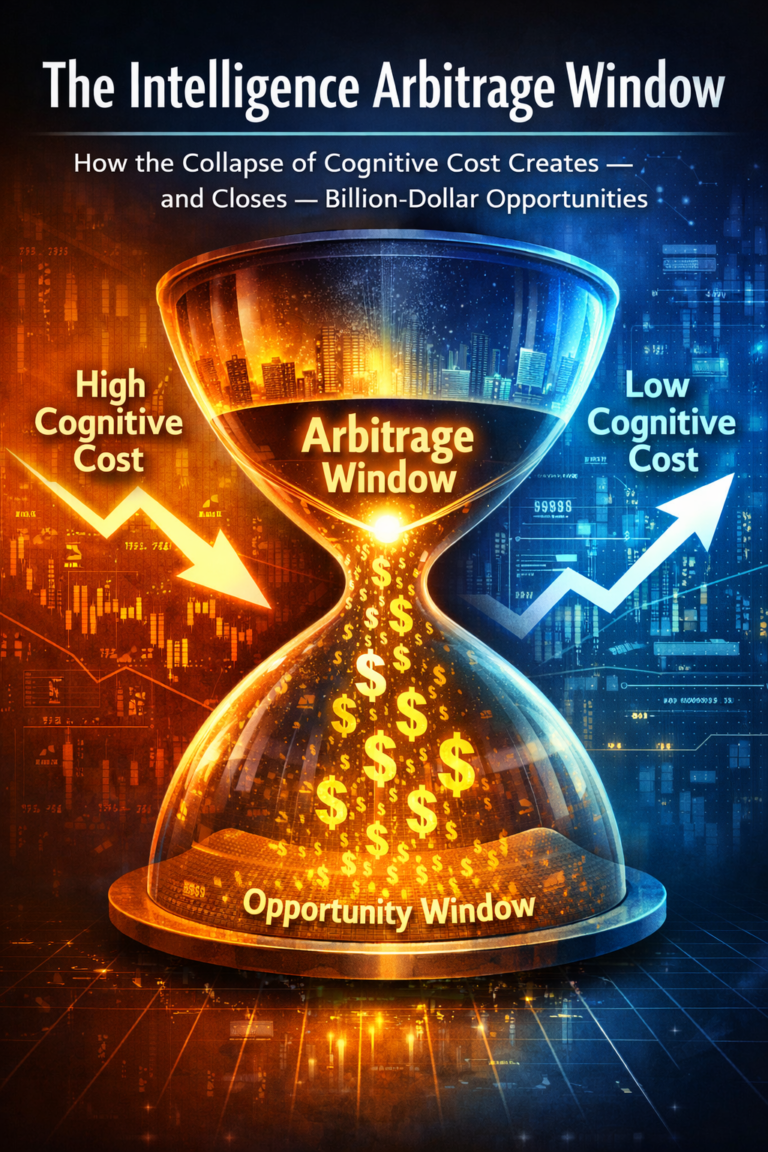
The Intelligence Arbitrage Window
The Intelligence Arbitrage Window occurs when firms internalize continuous AI-driven cognition through the C.O.R.E. Intelligence Loop while markets still operate on periodic pricing, static contracts, and manual renegotiation cycles.
This creates temporary structural advantage through:
-
Latency arbitrage
-
Information asymmetry compression
-
Risk mispricing
-
Contract rigidity exploitation
The window closes when markets reprice around cheap cognition.
Boards must act before arbitrage transitions into new market architecture.
Executive Summary for Boards
If you are a board member or C-suite executive, one question now matters more than “Are we adopting AI?”
It is this: Where is our industry still priced, contracted, and governed as if cognition were expensive—while our competitors have made cognition cheap?
That gap is not a technology story.
It is a market-structure story.
For decades, competitive advantage flowed from scale, capital intensity, operational efficiency, and distribution reach.
Firms won by controlling assets and optimizing cost structures. Markets adjusted slowly. Pricing moved periodically. Contracts were renegotiated in cycles. Risk was pooled statically. Intermediaries thrived on coordination delays and information asymmetry.
Artificial intelligence changes something more fundamental than productivity.
It collapses the cost of cognition.
And when the cost of cognition collapses, markets do not immediately reprice.
That delay creates what I call the Intelligence Arbitrage Window: a temporary but powerful period during which firms that institutionalize intelligence can extract structural advantage before the broader market reorganizes around cheap cognition.
Understanding this window—and acting within it—may determine who builds the next generation of category leaders.
Why this matters now
Most organizations still talk about AI in first-order terms: efficiency, automation, and productivity. That is table stakes.
The strategic opportunity emerges one layer deeper: markets are still designed for periodic decision cycles, while AI makes decision capability continuous.
This produces a short-lived advantage for early movers—not because they “use AI,” but because they operate at a different temporal resolution than their market.
That is the Intelligence Arbitrage Window.
Board takeaway: AI advantage is increasingly a timing advantage.
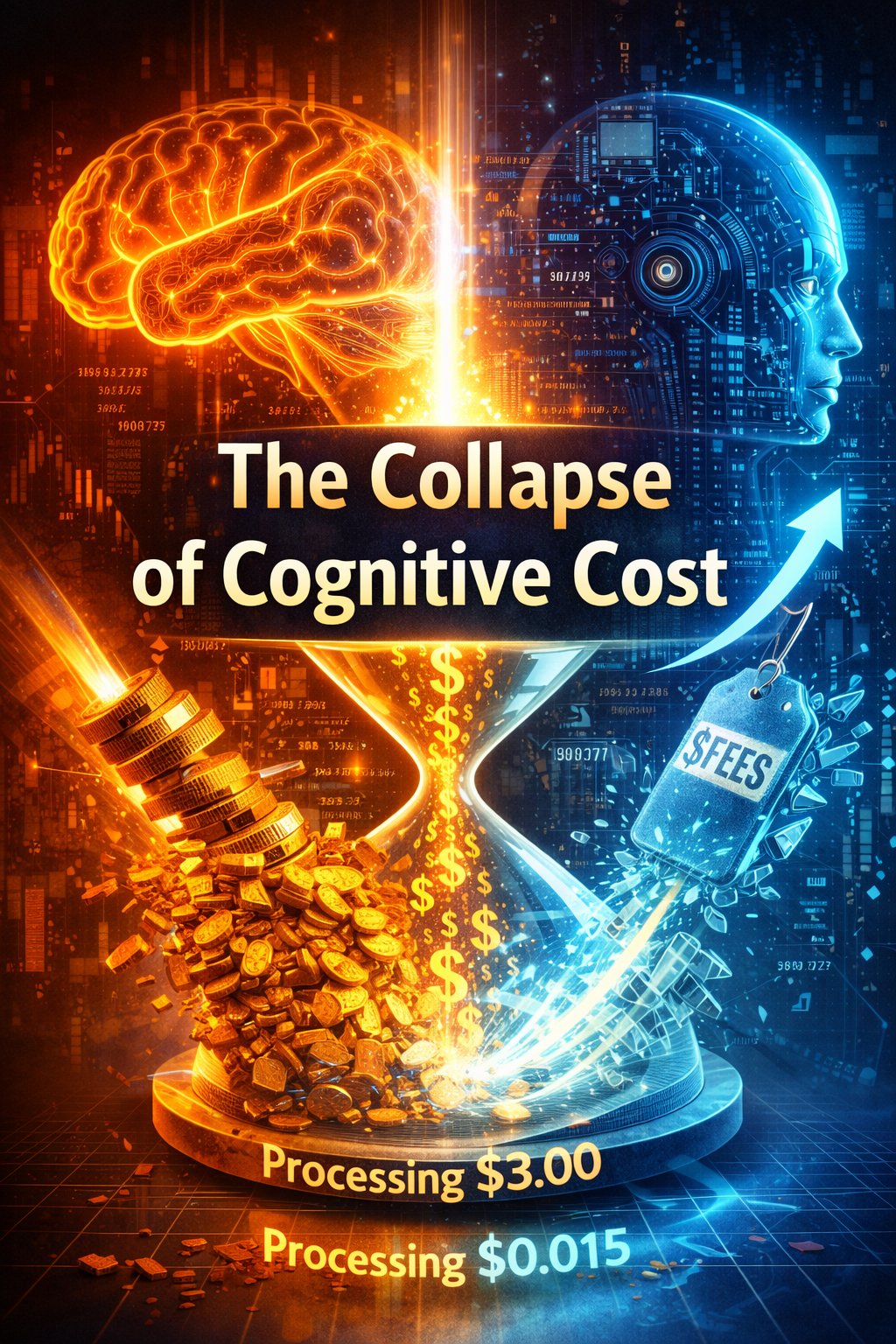
The collapse of cognitive cost
Every major technological wave reduces a specific form of economic friction:
- Steam reduced transportation cost.
- Telecommunications reduced coordination cost.
- Cloud reduced computation cost.
AI reduces cognitive cost—the cost of understanding context, evaluating tradeoffs, and selecting actions under uncertainty.
This is not automation in the narrow sense.
It is the institutionalization of decision capability.
Tasks that once required:
- Human judgment
- Experience-based inference
- Pattern recognition
- Multi-variable tradeoff analysis
can increasingly be performed continuously, at scale, and at near-zero marginal cost.
When cognition becomes cheap:
- Search friction declines.
- Information asymmetry narrows.
- Latency becomes economically visible.
- Manual coordination becomes expensive relative to automated coordination.
- Periodic decision cycles begin to look structurally outdated.
But while firms can internalize cheap cognition quickly, markets do not adjust instantly.
That structural lag is where arbitrage emerges.
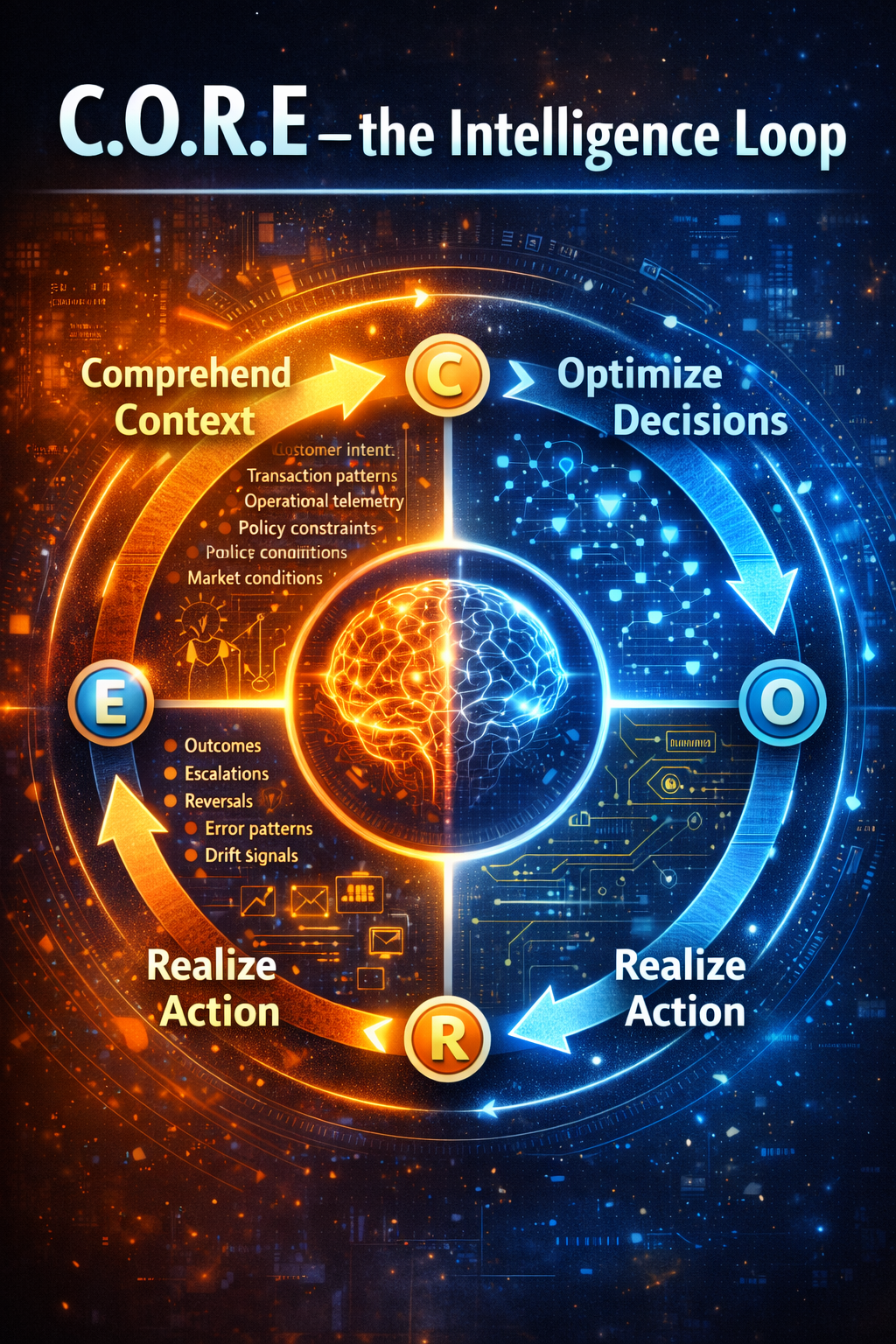
C.O.R.E.—the Intelligence Loop
To understand the Intelligence Arbitrage Window, we must first understand how organizations internalize cognition.
I describe this as C.O.R.E.—the Intelligence Loop:
C — Comprehend context
AI absorbs signals: customer intent, transaction patterns, operational telemetry, policy constraints, market conditions.
Comprehension converts raw data into situational awareness.
O — Optimize decisions
AI generates options, estimates tradeoffs, and ranks actions under uncertainty.
Optimization is not a single-point prediction.
It is structured choice under constraints.
R — Realize action
AI executes through tools and APIs: tickets, messages, approvals, workflow triggers, routing, purchases—within allowed bounds.
Execution is where “AI advice” becomes institutional behavior.
E — Evolve through evidence
AI improves via feedback: outcomes, escalations, reversals, error patterns, drift signals.
The system learns, recalibrates, and hardens its decision quality over time.
C.O.R.E. is not a workflow tool.
It is an institutionalized cognition engine.
When firms implement C.O.R.E., they begin operating at a different temporal resolution than the market itself.
And that is where arbitrage begins.
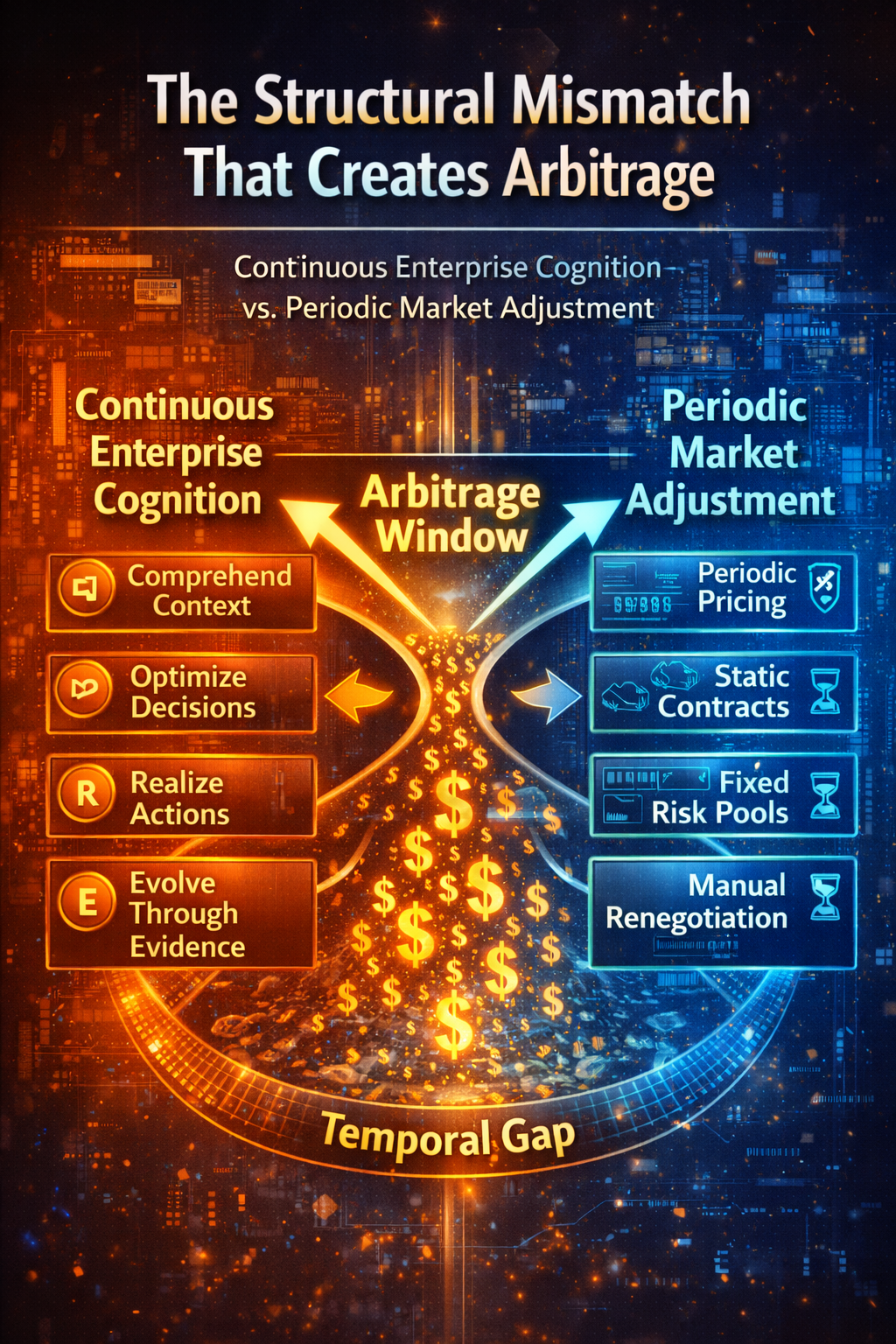
The structural mismatch that creates arbitrage
Forward-moving firms increasingly operate in a continuous loop:
- They comprehend context in near real time.
- They optimize decisions dynamically.
- They realize actions quickly, through tools and workflows.
- They evolve continuously through evidence.
But the markets in which they transact often remain:
- Quarterly in pricing
- Static in contract structure
- Fixed in risk pooling
- Manual in renegotiation
- Periodic in recalibration
This creates a mismatch:
Firms operate in continuous cognition. Markets operate in periodic adjustment.
That mismatch is the Intelligence Arbitrage Window.
Board takeaway: In this window, advantage comes from being “continuous” inside a “periodic” market.
The C³ cycle: Collapse → Compression → Creation
The Intelligence Arbitrage Window follows a consistent pattern. I describe it as the C³ cycle:
1) Collapse
The cost of cognition falls dramatically due to AI, predictive systems, and agentic execution. Decision capability becomes scalable.
2) Compression
Existing margins built on:
- Information asymmetry
- Search friction
- Negotiation latency
- Manual coordination
begin to compress.
Intermediaries appear mispriced. Contracts look rigid. Latency becomes visible as cost.
This is the arbitrage phase: firms operating in C.O.R.E. mode extract value from periodic systems.
3) Creation
Eventually, markets reprice around the new cost structure:
- Continuous pricing replaces periodic pricing.
- Adaptive contracts replace static agreements.
- Dynamic risk allocation replaces fixed pools.
- Settlement mechanisms automate.
At this stage, arbitrage disappears—and new category leaders emerge. The window closes.
Board takeaway: Arbitrage is not the endgame. Category creation is.
Where arbitrage lives today
Intelligence arbitrage appears where cognitive cost has collapsed but market design has not caught up.
Procurement
Firms can now comprehend supplier signals, optimize negotiation strategies, and execute transactions dynamically. Yet procurement cycles remain calendar-based, and contracts assume periodic renegotiation.
C.O.R.E. inside the firm versus periodic structure outside creates temporary margin.
Insurance
Continuous telemetry allows real-time risk sensing. Optimization models can adjust exposure dynamically. Yet underwriting and premium recalibration often remain periodic.
The misalignment between continuous comprehension and static pricing produces arbitrage.
Logistics
Routing and capacity optimization operate in real time. Yet freight contracts, pricing cycles, and allocation agreements remain fixed for extended periods.
Latency becomes margin.
In each case, the Intelligence Arbitrage Window emerges not because AI exists—but because C.O.R.E. exists inside firms while markets remain structurally lagged.
The window is perishable
Arbitrage is not durable strategy.
It is transitional advantage.
As industries adapt:
- Continuous pricing becomes standard.
- Dynamic risk adjustment becomes expected.
- Agentic negotiation becomes normalized.
- Adaptive contracts become embedded.
Once markets themselves become C.O.R.E.-native, arbitrage disappears.
What remains is structural advantage—defined by who shapes the new architecture.
The shift from arbitrage to architecture
The Intelligence Arbitrage Window is not the destination.
It is the bridge.
Once markets reprice around cheap cognition, competitive advantage shifts from exploiting inefficiency to designing intelligent systems at scale.
This is the deeper shift:
- First-order advantage: cost efficiency
- Second-order advantage: superior decisions
- Third-order advantage: control of market architecture
The arbitrage window exists between the second and third order.
It is the period when firms move from optimizing within markets to reshaping how markets function.
Board takeaway: The biggest prize is not “better decisions.” It is market advantage.
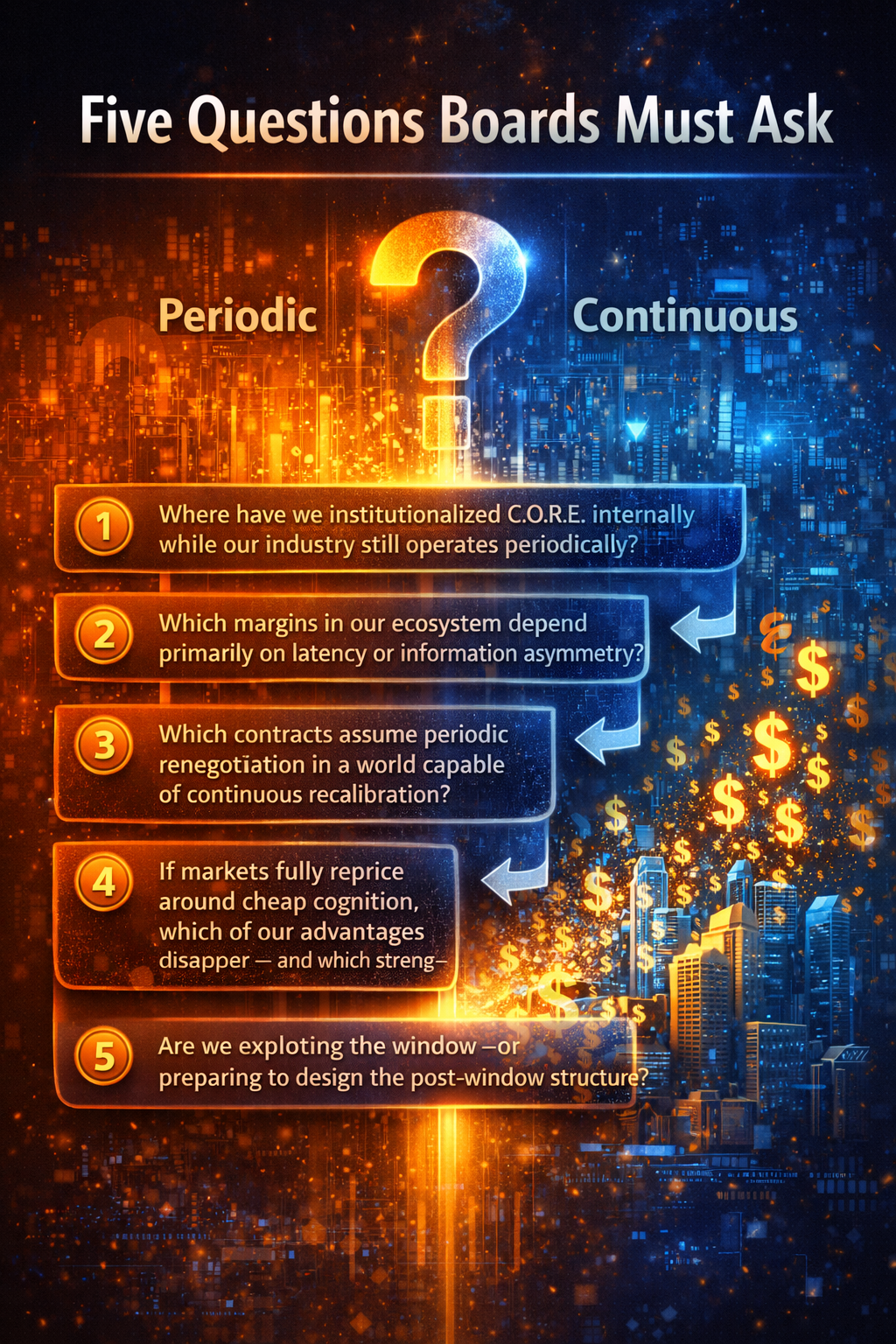
Five questions boards must ask
Boards often measure AI adoption by productivity metrics and pilot counts. Those are necessary—but insufficient.
To navigate the Intelligence Arbitrage Window, boards must ask:
- Where have we institutionalized C.O.R.E. internally while our industry still operates periodically?
- Which margins in our ecosystem depend primarily on latency or information asymmetry?
- Which contracts assume periodic renegotiation in a world capable of continuous recalibration?
- If markets fully reprice around cheap cognition, which of our advantages disappear—and which strengthen?
- Are we exploiting the window—or preparing to design the post-window structure?
These are timing questions, not technical questions.
What closes the window
Three forces typically close the Intelligence Arbitrage Window:
Regulatory adaptation
Policy frameworks adjust to reflect continuous capability.
Standardization
Dynamic pricing, adaptive contracts, and automated settlement become normalized.
Platformization
New leaders encode continuous intelligence into infrastructure layers that others must adopt.
Once this happens, advantage shifts from opportunistic extraction to structural dominance.
The larger economic shift
The Intelligence Arbitrage Window is evidence of something larger.
Markets historically assumed that cognition was expensive and episodic.
AI makes cognition cheap and continuous.
That forces a transition from periodic capitalism to continuous capitalism—from static coordination to adaptive systems.
The window represents the temporary instability between those two states.
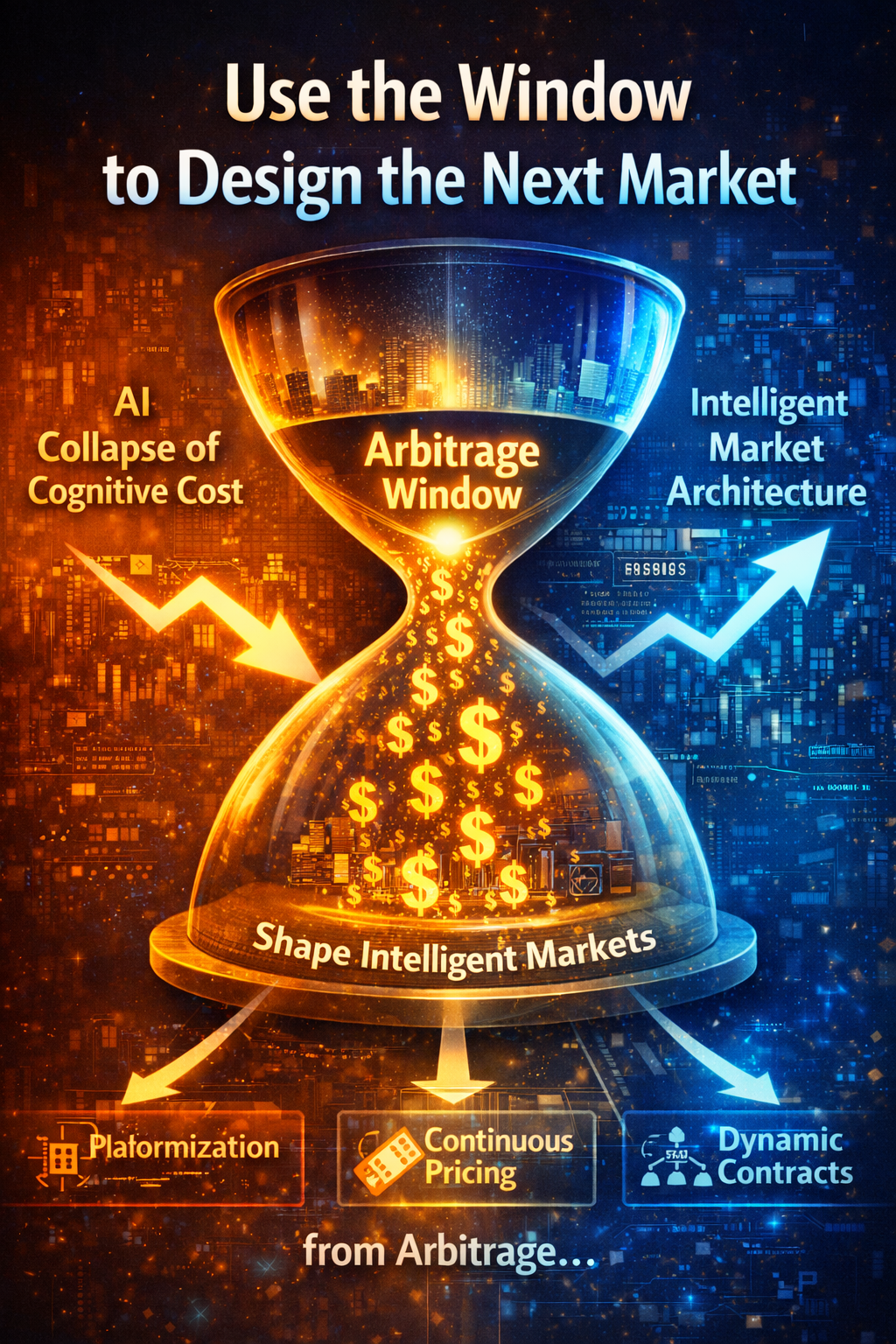
Conclusion: use the window to design the next market
The cost of thinking has fallen faster than the cost of transacting.
That imbalance creates opportunity—but opportunity is time-bound.
Firms that understand the Intelligence Arbitrage Window will not merely pursue productivity gains. They will recognize that internalizing C.O.R.E. allows them to operate at a different temporal resolution than the market itself—and that this mismatch creates transient but powerful advantage.
But the enduring winners will use that advantage for something bigger than margin.
They will use it to shape the architecture of intelligent markets.
Because when markets themselves become C.O.R.E.-native, arbitrage disappears.
And only those who helped design the new structure remain dominant.
Internal links to embed (ready-to-paste anchor text)
Glossary
- Intelligence Arbitrage Window: The temporary period when the cost of cognition collapses but markets have not yet repriced, creating exploitable inefficiencies.
- Cognitive cost: The cost of understanding context, evaluating tradeoffs, and selecting actions under uncertainty.
- C.O.R.E. Intelligence Loop: Comprehend context → Optimize decisions → Realize action → Evolve through evidence.
- Market repricing: When industry pricing, contracts, risk models, and settlement mechanisms adjust to a new cost structure.
- Periodic capitalism: A market structure built around periodic pricing cycles, static contracts, and manual renegotiation.
- Continuous capitalism: A market structure where sensing, optimization, execution, and evolution happen continuously through data and automation.
- Category creation: The emergence of new business models and value pools after a market restructures around new capabilities.
- Platformization: When leading firms encode new market behaviors into infrastructure layers others must use.
FAQ
1) What is the Intelligence Arbitrage Window in AI?
It is the period when cognition becomes cheap and continuous inside firms, but industry pricing, contracts, and settlement remain periodic—creating temporary inefficiencies that early movers can exploit.
2) How is this different from “AI productivity” or “AI efficiency”?
Productivity is first-order. The Intelligence Arbitrage Window is about market lag and repricing—how value pools shift before new categories stabilize.
3) What closes the Intelligence Arbitrage Window?
Regulatory adaptation, standardization of continuous practices, and platformization (new infrastructure layers) typically compress and then eliminate arbitrage.
4) How can boards use this framework?
By asking where latency, information asymmetry, and periodic renegotiation still create margins—and deciding whether to exploit them temporarily or design the post-window architecture.
5) What does C.O.R.E. have to do with arbitrage?
C.O.R.E. institutionalizes continuous cognition inside the firm. Arbitrage emerges when firms run C.O.R.E. internally while markets remain periodic externally.
Enterprise AI Operating Model
Enterprise AI scale requires four interlocking planes:
Read about Enterprise AI Operating Model The Enterprise AI Operating Model: How organizations design, govern, and scale intelligence safely – Raktim Singh
- Read about Enterprise Control Tower The Enterprise AI Control Tower: Why Services-as-Software Is the Only Way to Run Autonomous AI at Scale – Raktim Singh
- Read about Decision Clarity The Shortest Path to Scalable Enterprise AI Autonomy Is Decision Clarity – Raktim Singh
- Read about The Enterprise AI Runbook Crisis The Enterprise AI Runbook Crisis: Why Model Churn Is Breaking Production AI—and What CIOs Must Fix in the Next 12 Months – Raktim Singh
- Read about Enterprise AI Economics Enterprise AI Economics & Cost Governance: Why Every AI Estate Needs an Economic Control Plane – Raktim Singh
Read about Who Owns Enterprise AI Who Owns Enterprise AI? Roles, Accountability, and Decision Rights in 2026 – Raktim Singh
Read about The Intelligence Reuse Index The Intelligence Reuse Index: Why Enterprise AI Advantage Has Shifted from Models to Reuse – Raktim Singh
The Intelligence-Native Enterprise Doctrine
This article is part of a larger strategic body of work that defines how AI is transforming the structure of markets, institutions, and competitive advantage. To explore the full doctrine, read the following foundational essays:
- The AI Decade Will Reward Synchronization, Not Adoption
Why enterprise AI strategy must shift from tools to operating models.
https://www.raktimsingh.com/the-ai-decade-will-reward-synchronization-not-adoption-why-enterprise-ai-strategy-must-shift-from-tools-to-operating-models/ - The Third-Order AI Economy
The category map boards must use to see the next Uber moment.
https://www.raktimsingh.com/third-order-ai-economy/ - The Intelligence Company
A new theory of the firm in the AI era — where decision quality becomes the scalable asset.
https://www.raktimsingh.com/intelligence-company-new-theory-firm-ai/ - The Judgment Economy
How AI is redefining industry structure — not just productivity.
https://www.raktimsingh.com/judgment-economy-ai-industry-structure/ - Digital Transformation 3.0
The rise of the intelligence-native enterprise.
https://www.raktimsingh.com/digital-transformation-3-0-the-rise-of-the-intelligence-native-enterprise/ - Industry Structure in the AI Era
Why judgment economies will redefine competitive advantage.
https://www.raktimsingh.com/industry-structure-in-the-ai-era-why-judgment-economies-will-redefine-competitive-advantage/
Institutional Perspectives on Enterprise AI
Many of the structural ideas discussed here — intelligence-native operating models, control planes, decision integrity, and accountable autonomy — have also been explored in my institutional perspectives published via Infosys’ Emerging Technology Solutions platform.
For readers seeking deeper operational detail, I have written extensively on:
- What Makes an Enterprise Intelligence-Native? The Blueprint for Third-Order AI Advantage
https://blogs.infosys.com/emerging-technology-solutions/artificial-intelligence/what-is-enterprise-ai-the-operating-model-for-compounding-institutional-intelligence.html - Why “AI in the Enterprise” Is Not Enterprise AI: The Operating Model Difference Most Organizations Miss
https://blogs.infosys.com/emerging-technology-solutions/artificial-intelligence/why-ai-in-the-enterprise-is-not-enterprise-ai-the-operating-model-difference-that-most-organizations-miss.html - The Enterprise AI Control Plane: Governing Autonomy at Scale
https://blogs.infosys.com/emerging-technology-solutions/artificial-intelligence/the-enterprise-ai-control-plane-governing-autonomy-at-scale.html - Enterprise AI Ownership Framework: Who Is Accountable, Who Decides, and Who Stops AI in Production
https://blogs.infosys.com/emerging-technology-solutions/artificial-intelligence/enterprise-ai-ownership-framework-who-is-accountable-who-decides-and-who-stops-ai-in-production.html - Decision Integrity: Why Model Accuracy Is Not Enough in Enterprise AI
https://blogs.infosys.com/emerging-technology-solutions/artificial-intelligence/decision-integrity-why-model-accuracy-is-not-enough-in-enterprise-ai.html - Agent Incident Response Playbook: Operating Autonomous AI Systems Safely at Enterprise Scale
https://blogs.infosys.com/emerging-technology-solutions/artificial-intelligence/agent-incident-response-playbook-operating-autonomous-ai-systems-safely-at-enterprise-scale.html - The Economics of Enterprise AI: Designing Cost, Control, and Value as One System
https://blogs.infosys.com/emerging-technology-solutions/artificial-intelligence/the-economics-of-enterprise-ai-designing-cost-control-and-value-as-one-system.html
Together, these perspectives outline a unified view: Enterprise AI is not a collection of tools. It is a governed operating system for institutional intelligence — where economics, accountability, control, and decision integrity function as a coherent architecture.



Raktim Singh is an AI and deep-tech strategist, TEDx speaker, and author focused on helping enterprises navigate the next era of intelligent systems. With experience spanning AI, fintech, quantum computing, and digital transformation, he simplifies complex technology for leaders and builds frameworks that drive responsible, scalable adoption.