Raktim Singh

Home Blog Page 9

The Representation Access Economy: Why AI Will Decide Who Gets Seen, Structured, and Trusted

The Representation Access Economy:

A board-level guide to machine-readable trust, digital identity, structured data, verifiable credentials, and the new economic logic of AI visibility

For years, the AI conversation has been dominated by models.

Which model is larger?
Which model is cheaper?
Which model reasons better?
Which model can write code, summarize documents, or automate workflows?

These are important questions. But they are no longer the deepest ones.

A bigger shift is underway. It is quieter, more structural, and far more consequential. As AI moves from generating content to searching, comparing, verifying, deciding, and acting, the true source of advantage is shifting away from intelligence alone and toward something more foundational:

Representation.

In the AI era, it is not enough to be real.
It is not enough to be good.
It is not even enough to be efficient.

You must be representable.

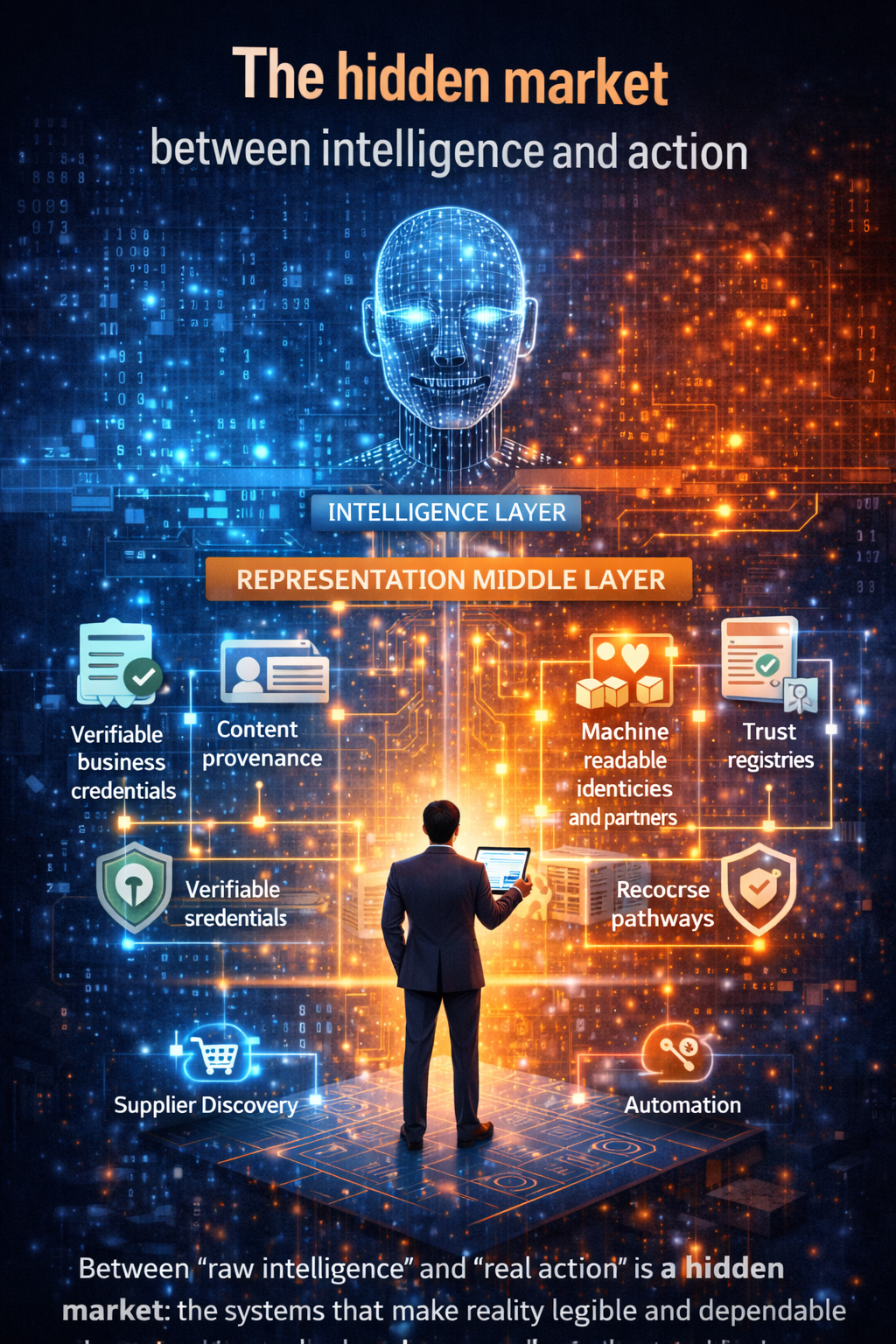
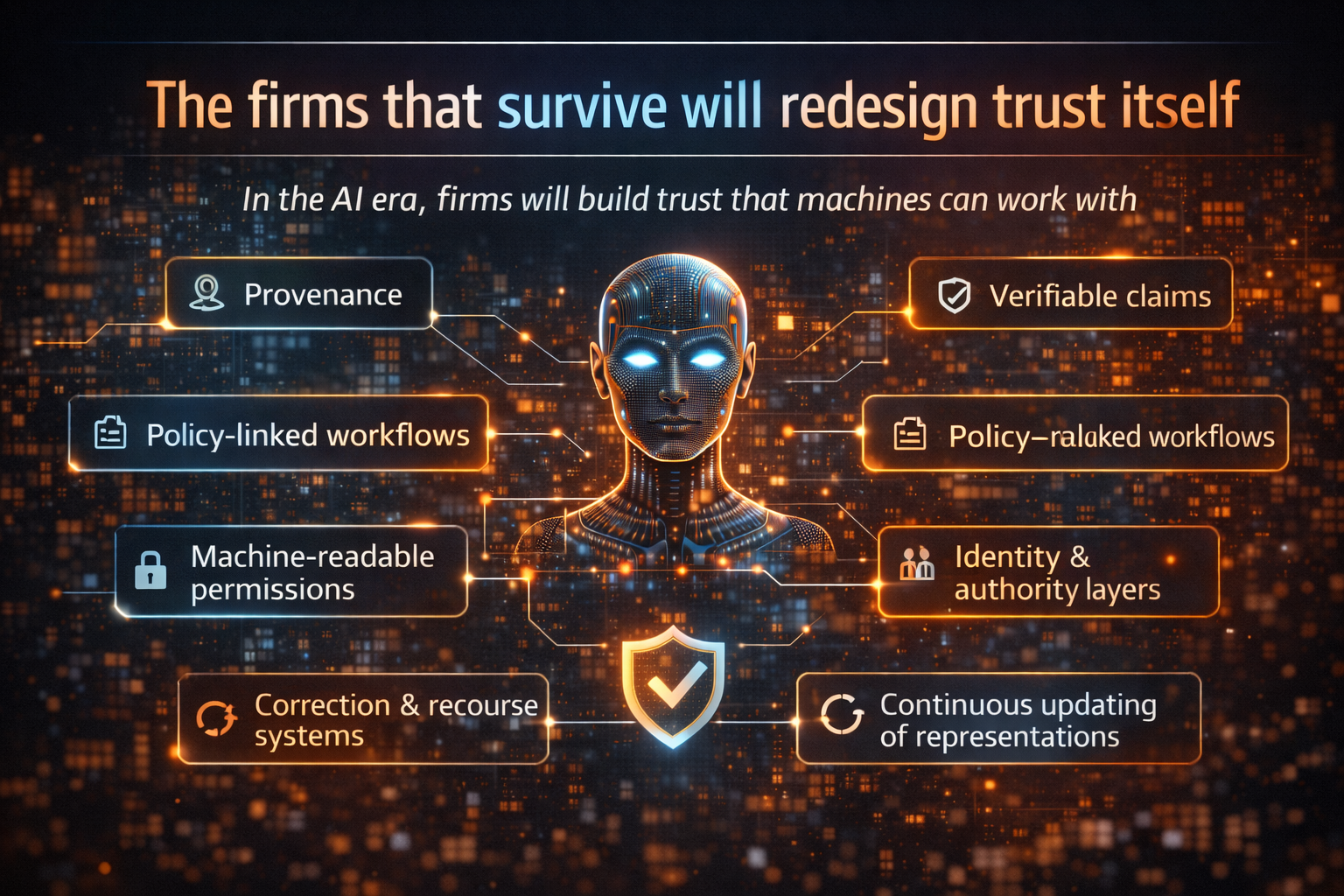
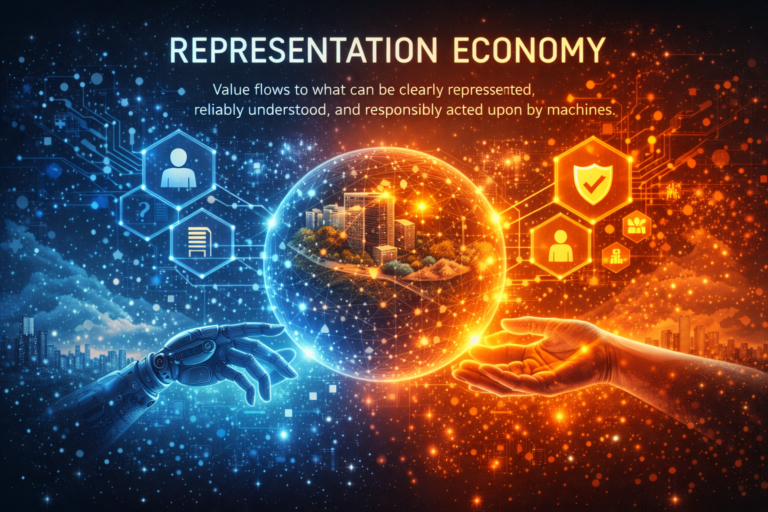
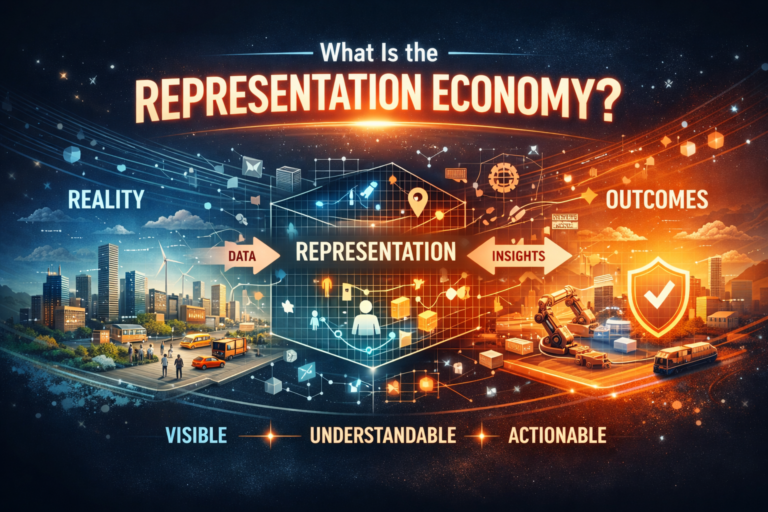
That means your products, processes, credentials, policies, counterparties, assets, and actions must exist in forms that machines can discover, interpret, verify, trust, and use. This is the beginning of what I call the Representation Access Economy.

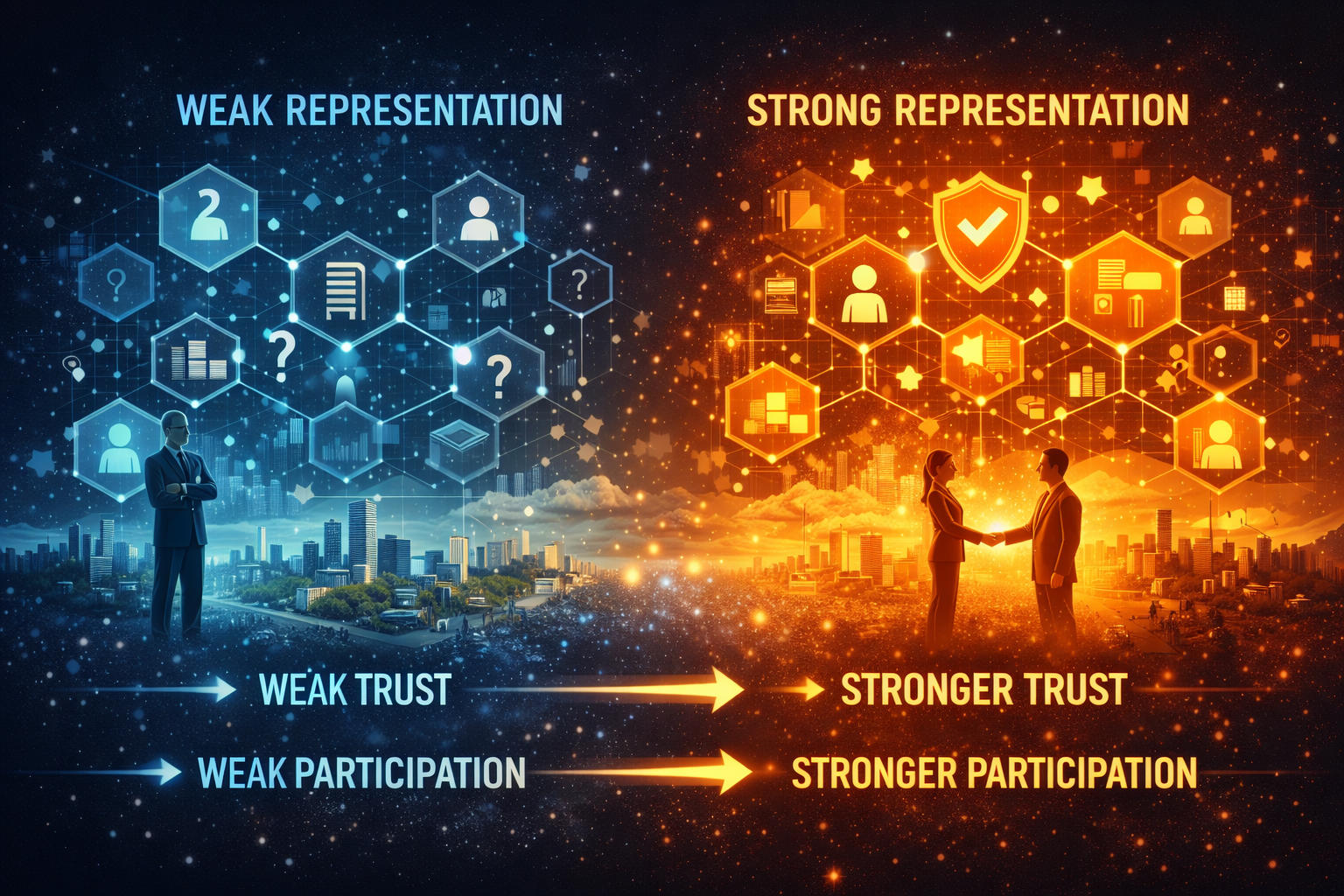
The Representation Access Economy is the emerging layer of the AI economy in which participation depends on whether an entity can be converted into machine-usable form. Some firms, workers, products, suppliers, and institutions will be richly represented. Others will remain only partially visible. Some will become effectively invisible to machine-mediated systems altogether.

That difference will matter more than most leaders realize.

Because in the AI world, access does not begin when a human notices you.
Access begins when a machine can reliably see you.

That is why the next strategic divide will not simply be between companies that use AI and companies that do not. It will be between those that are legible to AI systems and those that are not.

That divide will shape discoverability, trust, financing, procurement, compliance, customer experience, ecosystem participation, and, eventually, market power.

The shift most leaders are still underestimating : The Representation Access Economy

The shift most leaders are still underestimating

Search engines have already given us an early preview of this future. Google says it uses structured data markup to understand page content and make pages eligible for richer search appearances. For product pages, that can include price, availability, ratings, and shipping information directly in search results. (Google for Developers)

That may sound like a technical SEO detail. It is not. It is an economic signal.

A product page is no longer just a page for a human reader. It is also a representation layer for a machine. If the machine understands the product well, the product can travel farther, appear faster, and be selected more often. If the machine does not understand it well, the product may still exist, but it enters the market from a weaker position.

The same pattern is spreading well beyond search. W3C’s Verifiable Credentials standard is designed to express claims in ways that are cryptographically secure, privacy-respecting, and machine-verifiable. The European Union’s Digital Product Passport effort is intended to make key product information available across value chains to consumers, businesses, and public authorities. GS1 Digital Link connects product identifiers to up-to-date web-based information for traceability, safety, and commerce. And in February 2026, NIST launched its AI Agent Standards Initiative to support secure, interoperable agents that can act on behalf of users with confidence. (W3C)

Seen separately, these look like technical developments. Seen together, they reveal a larger economic transition:

the world is being rebuilt so machines can participate in it.

That changes strategy.

In the old economy, access depended heavily on human awareness, distribution, relationships, sales effort, and brand recognition.

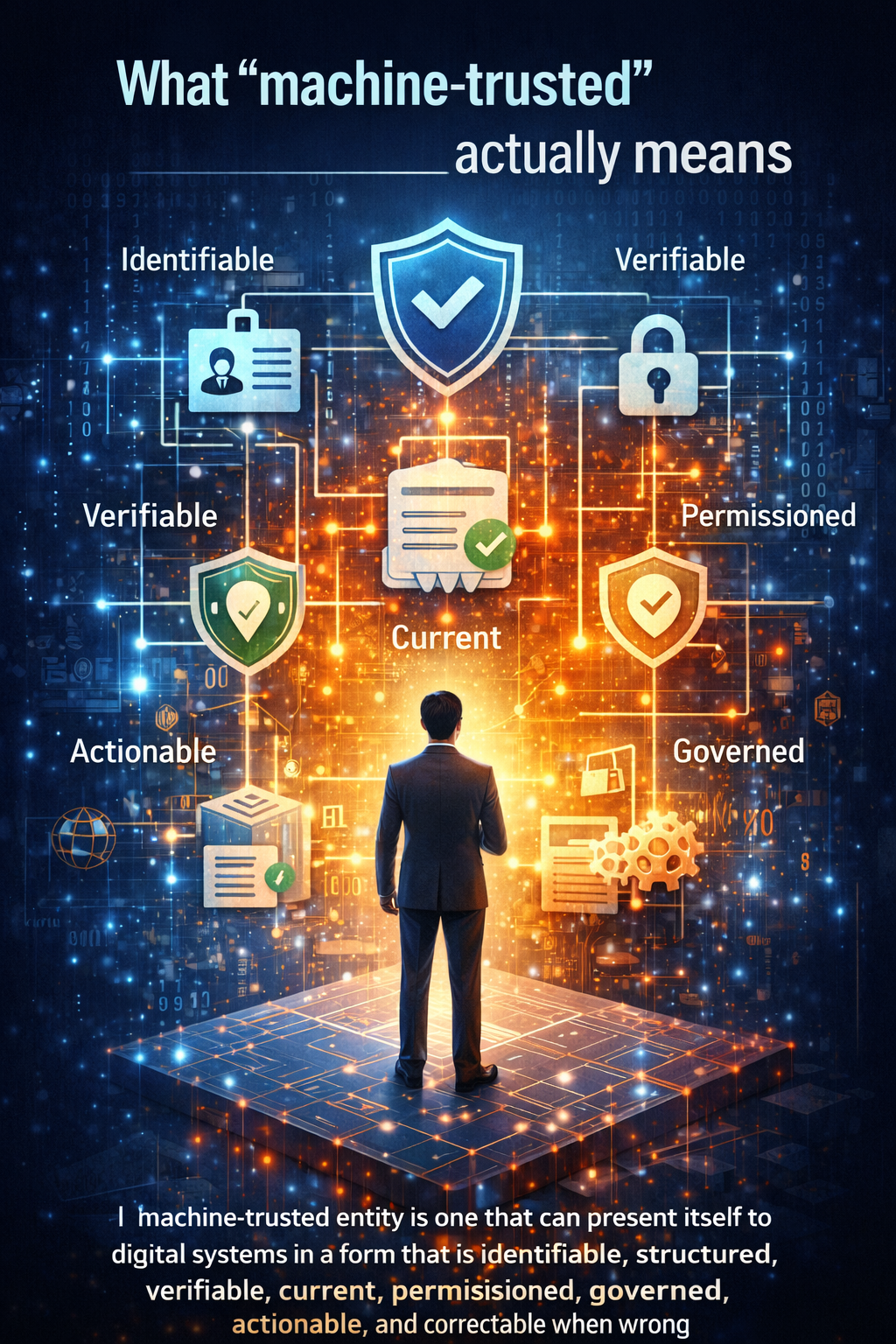
In the Representation Access Economy, access increasingly depends on whether machine systems can answer basic questions such as:

The seven machine questions

  • What is this?
  • Who issued it?
  • Is it authentic?
  • What state is it in right now?
  • Can it be trusted?
  • Can action be taken on it?
  • Who is accountable if something goes wrong?

If those questions cannot be answered cleanly, many AI systems will hesitate, downgrade, route elsewhere, or refuse to act.

What the Representation Access Economy really means

What the Representation Access Economy really means

The simplest way to understand this idea is to separate two layers that are often confused.

  1. Representation rights

This is the question of who gets to be visible, recognized, and modeled in machine-usable form.

  1. Representation conversion

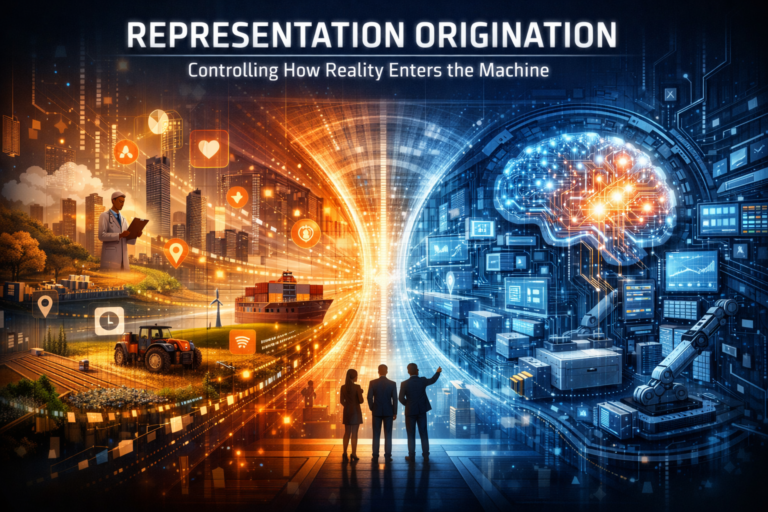
This is the process of translating messy reality into forms machines can actually use.

Put differently:

Representation rights ask: Who gets to enter the system?
Representation conversion asks: How do they enter the system in usable form?

Together, these two forces create the Representation Access Economy.

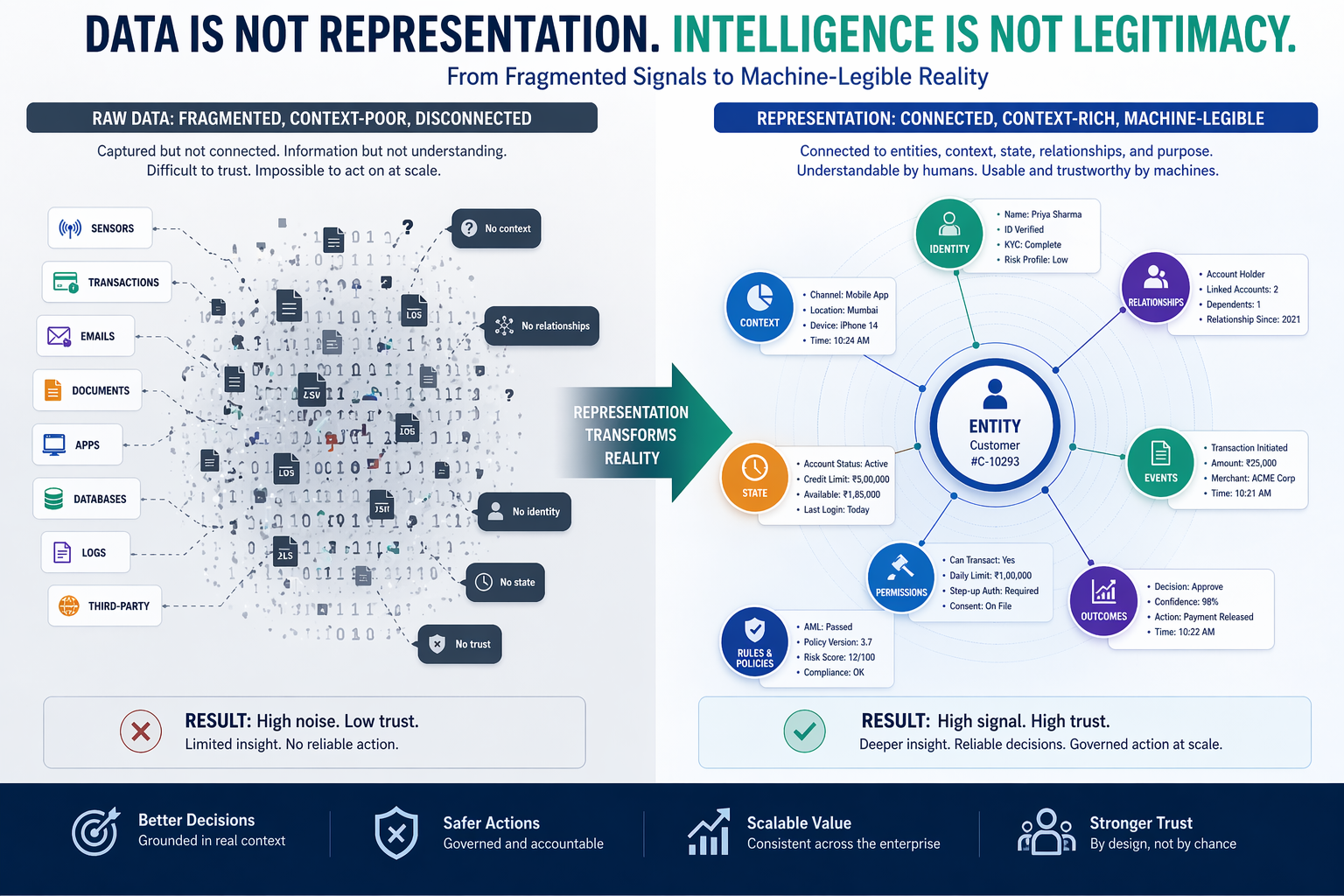
This matters because reality is naturally messy.

A small supplier may be reliable, but its inventory data may live across email, spreadsheets, paper invoices, and phone calls. A farmer may produce high-quality output, but not have machine-readable records for provenance, sustainability, or financing. A worker may have real skills, but lack credentials that systems can verify instantly. A product may be genuine, but its identity may not be linked to standardized digital evidence about source, composition, safety, repairability, or ownership.

In all of these cases, the problem is not necessarily a lack of value.

The problem is a lack of machine-usable representation.

That is the hidden bottleneck many firms still mistake for a technology problem. It is not only a technology problem. It is an access problem.

A simple example: the invisible supplier

A simple example: the invisible supplier

Imagine two component suppliers.

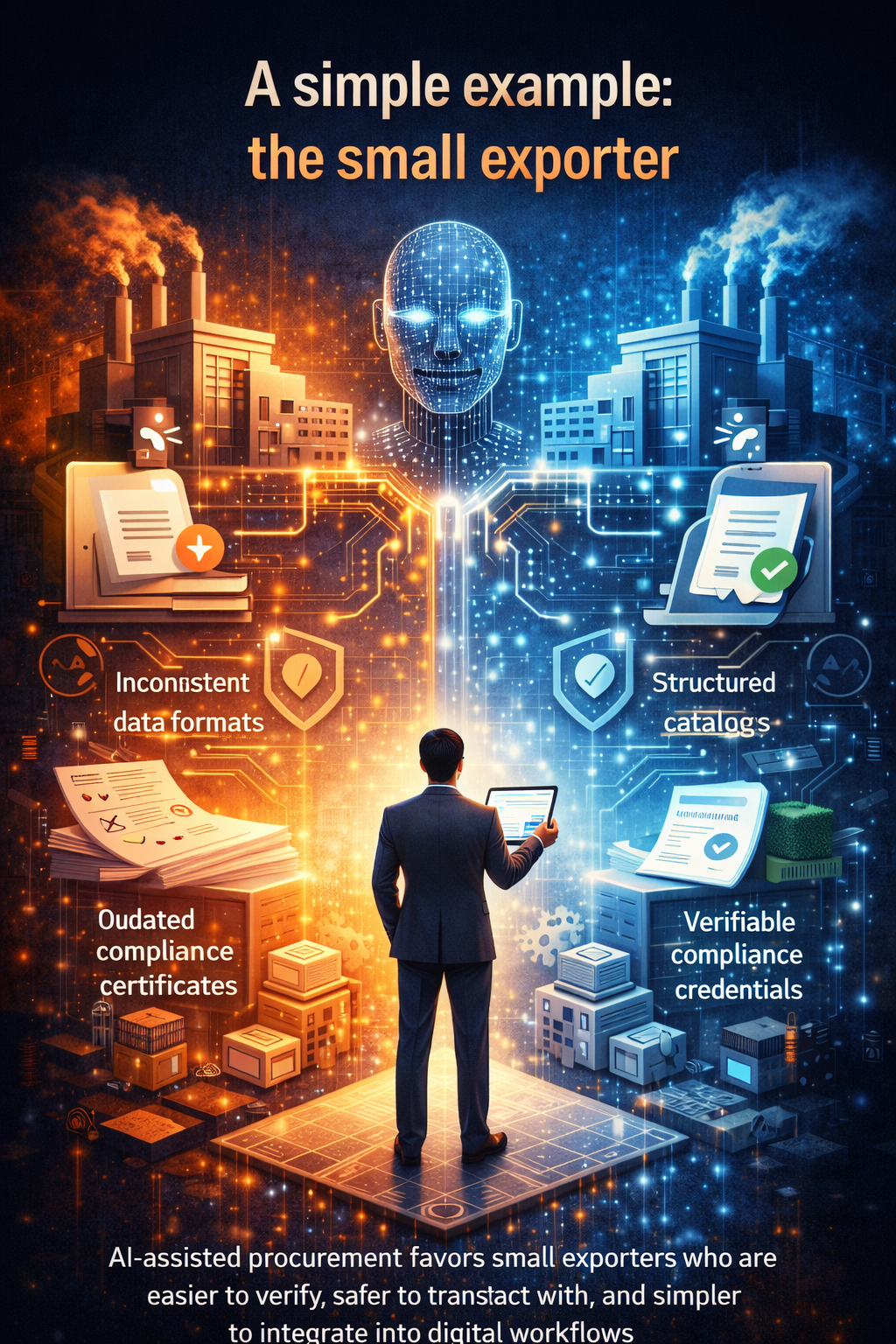
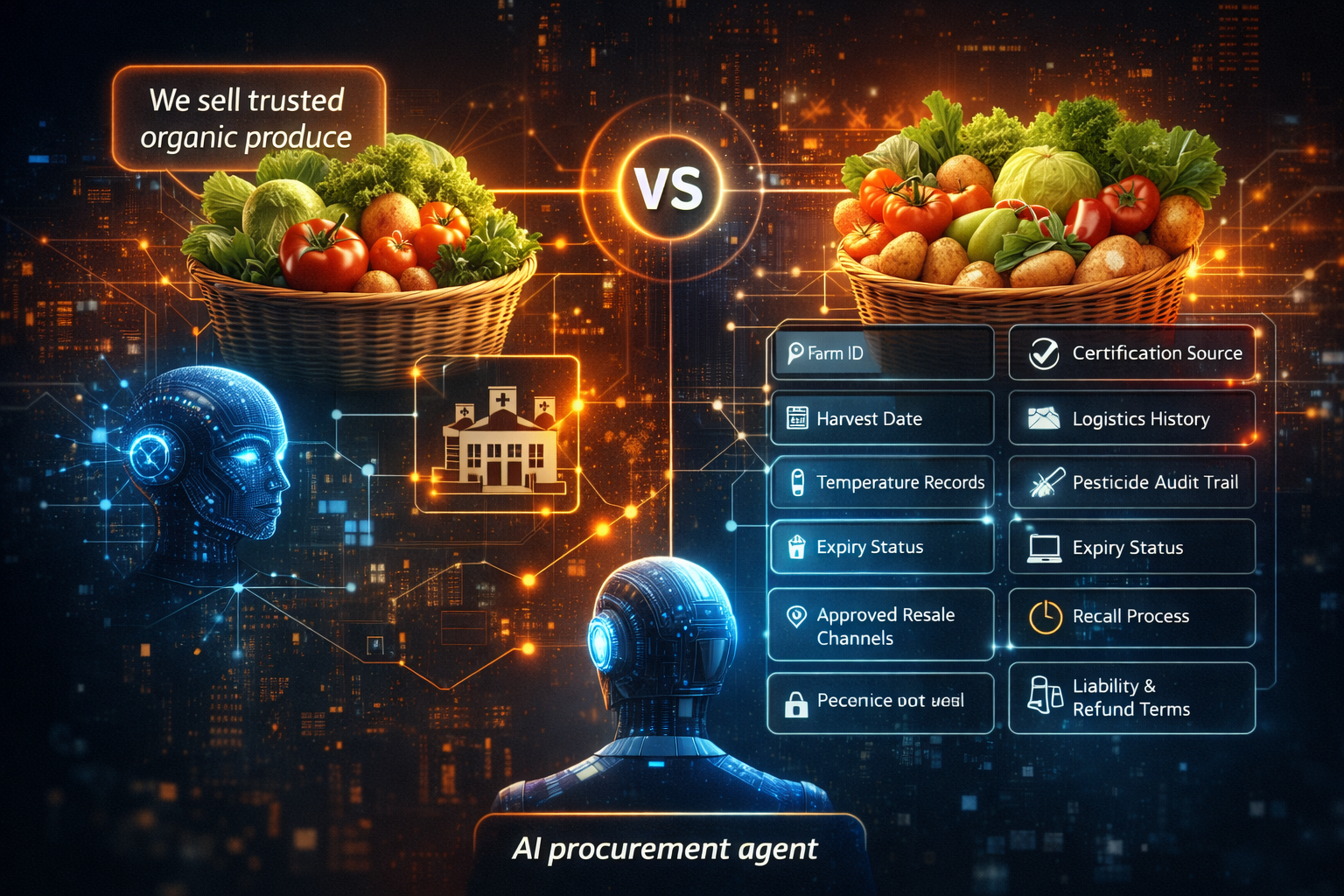
The first has average products but excellent representation. Its catalog is structured. Product identifiers are standardized. Inventory is exposed through APIs. Certifications are current and machine-verifiable. Shipping status is updated digitally. Quality metrics are tagged consistently. Procurement systems can compare it quickly. AI sourcing agents can understand it.

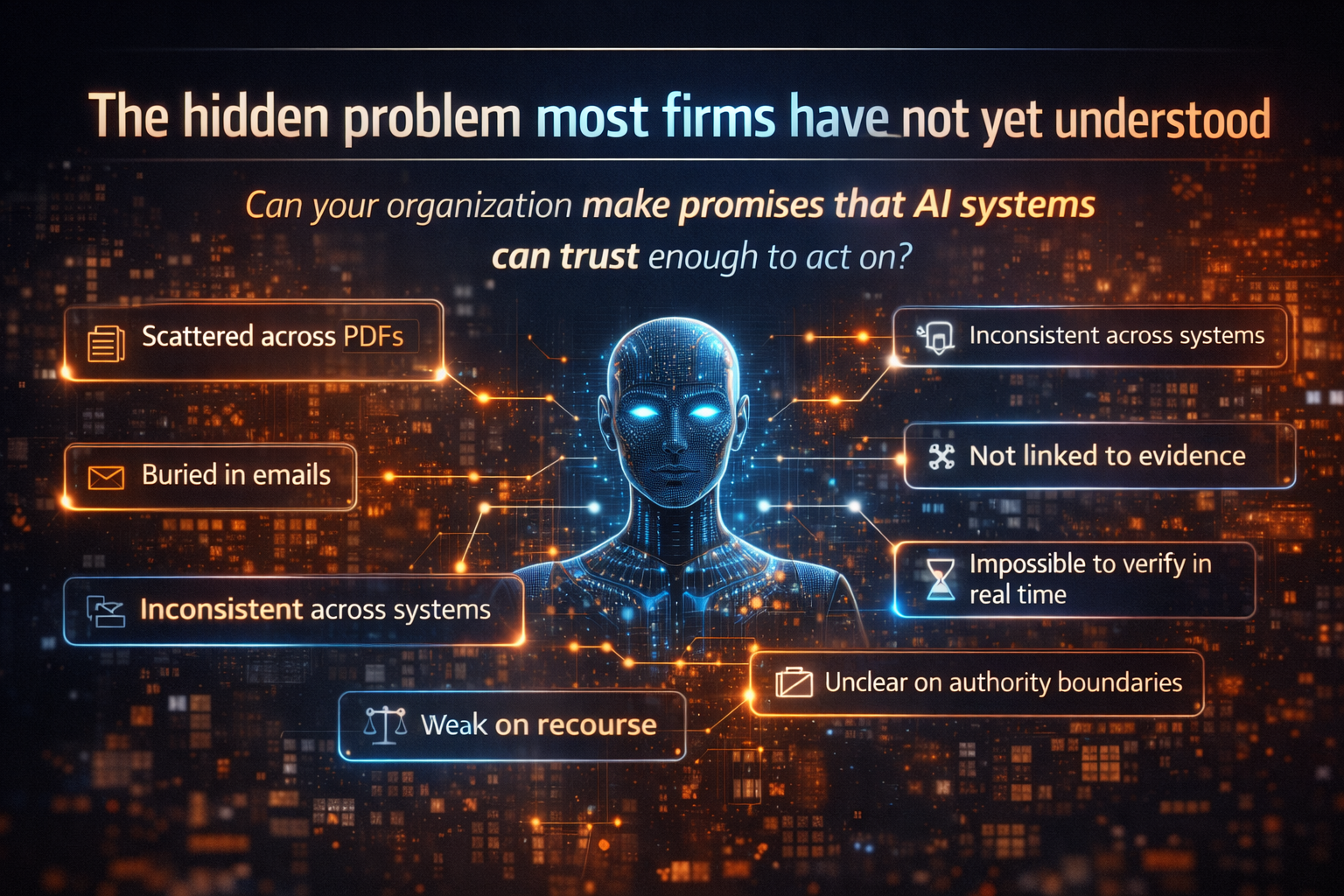
The second supplier may actually produce better components. But its product data is inconsistent. Certifications live in PDFs. Inventory is updated manually. Traceability is partial. Sustainability claims are hard to verify. Delivery history is not encoded in usable ways.

In a human-led market, both suppliers may still compete if a procurement manager takes the time to investigate.

In a machine-mediated market, the first supplier gets seen first, understood first, and often selected first.

This is not because the first supplier is inherently better.
It is because the first supplier is easier for machines to trust.

That is representation access.

Another example: the skilled worker with weak digital legibility

Now think about labor.

One worker has strong real-world capability but only informal evidence: references buried in email, project work scattered across platforms, unverified certificates, and no structured skills graph.

Another worker has the same, or even slightly lower, real capability but has machine-readable credentials, portable digital identity, verified work history, structured portfolio signals, and interoperable proof of training.

As hiring systems, matching systems, and agentic recruiting tools become more common, the second worker may be surfaced more often and assessed with less friction. OECD has emphasized that trusted, portable digital identity can support inclusion and simplify access to digital services and participation. (OECD)

Again, the issue is not human worth.

It is machine visibility.

The deeper danger: exclusion without anyone explicitly excluding you

The deeper danger: exclusion without anyone explicitly excluding you

This is what makes the Representation Access Economy so important.

Many actors will not be excluded by law.
They will be excluded by format.

No one will send a dramatic rejection letter. No one will formally announce that a firm, a worker, a product, or a supplier has been denied participation. Instead, they will simply be:

  • ranked lower
  • surfaced later
  • trusted less
  • financed more cautiously
  • routed around
  • asked for more proof
  • given slower decisions
  • excluded from automated workflows

Over time, that becomes economic disadvantage.

This is why the Representation Access Economy is not a side issue. It is becoming a primary strategic question.

Why AI makes this harsher, not softer

Why AI makes this harsher, not softer

Many people assume AI will automatically reduce friction for everyone. In some cases, it will. But AI can also make representation gaps harsher.

Why?

Because AI scales decision-making. It allows systems to process more entities, more signals, and more possible actions at lower cost. That sounds democratizing. But in practice, scaled decision-making tends to favor entities that are easier to model, compare, verify, and act upon.

The machine does not begin with empathy.
It begins with available structure.

This means AI often rewards what is already legible.

That is one reason standards are becoming so important. Structured content helps search systems. Verifiable credentials help trust systems. Product passport efforts help traceability and regulatory visibility. AI agent standards increasingly focus on identity, security, authorization, and interoperability. (Google for Developers)

The more autonomous systems become, the more costly weak representation becomes.

The SENSE–CORE–DRIVER lens

The SENSE–CORE–DRIVER lens

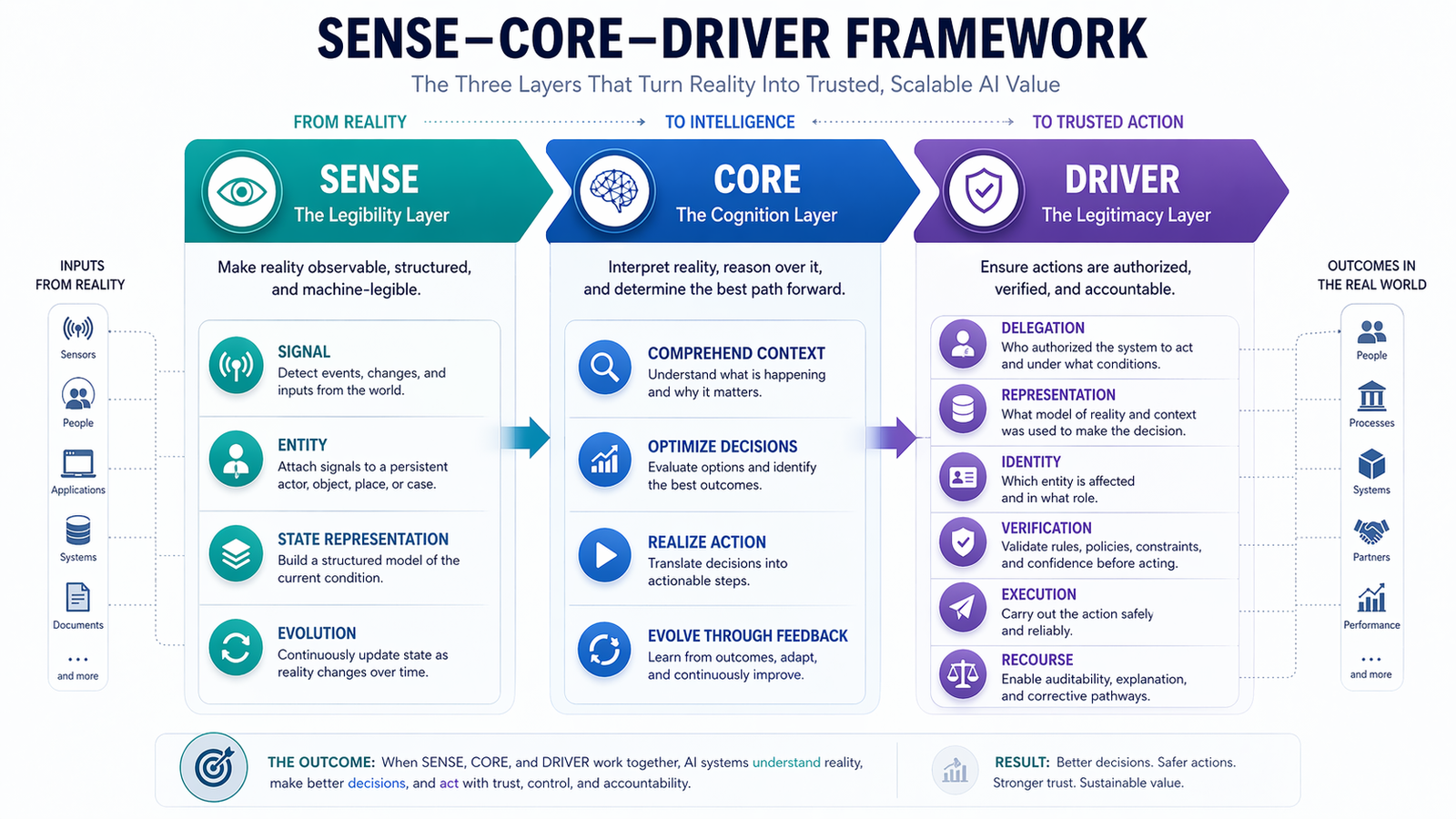
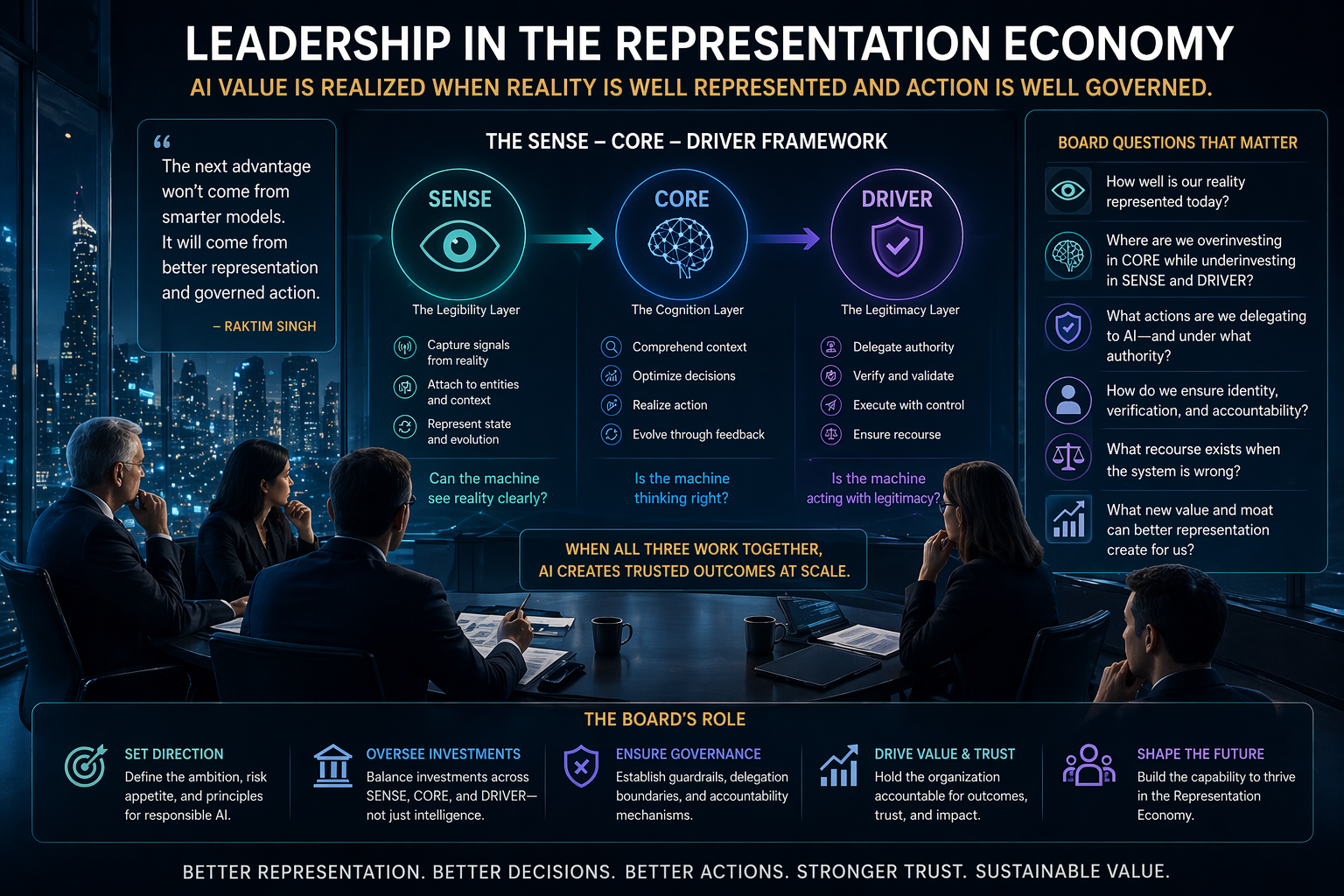
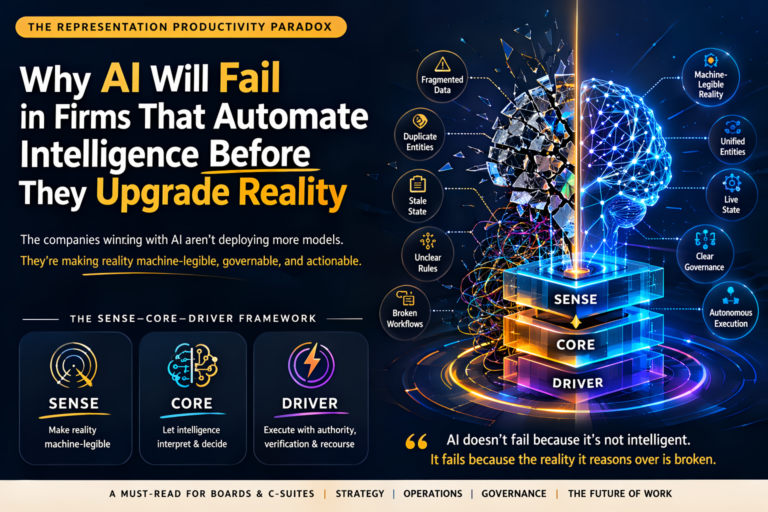
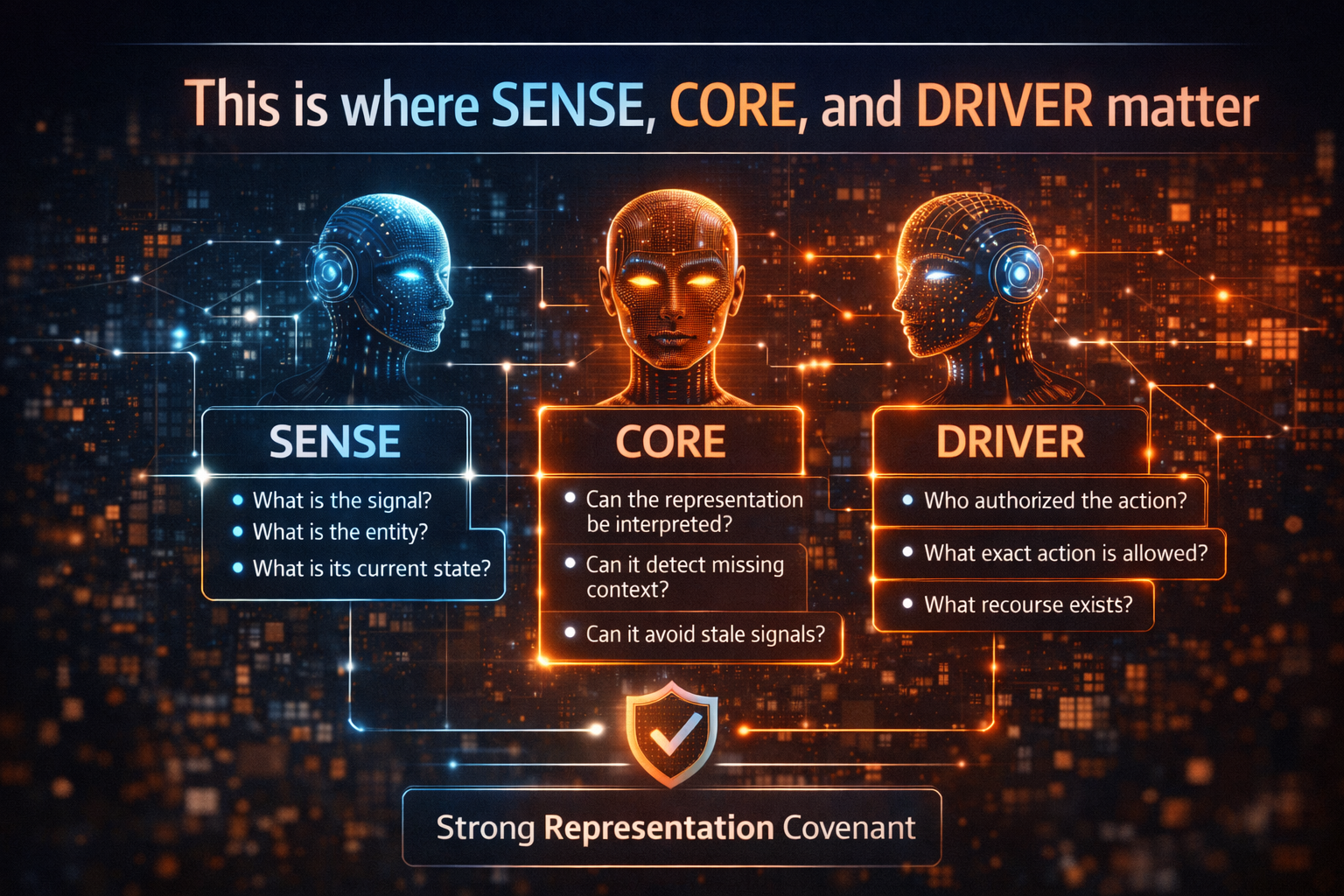
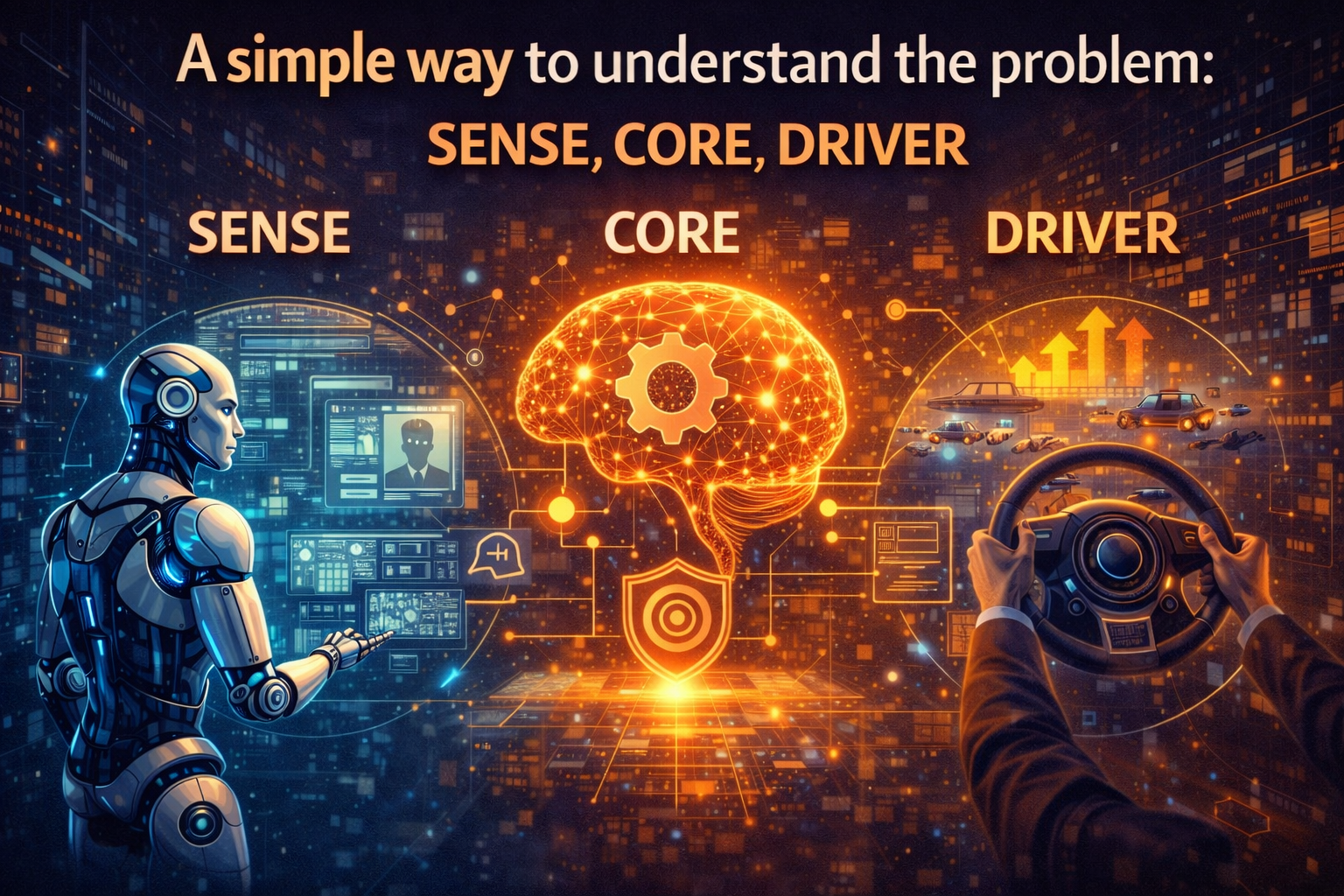
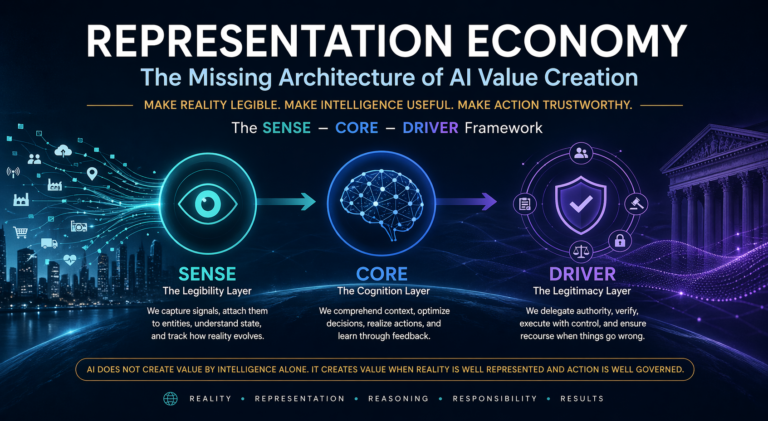
This is where my SENSE–CORE–DRIVER framework matters.

Most organizations still think of AI mainly as a CORE problem: models, reasoning, recommendations, predictions, and automation.

That is incomplete.

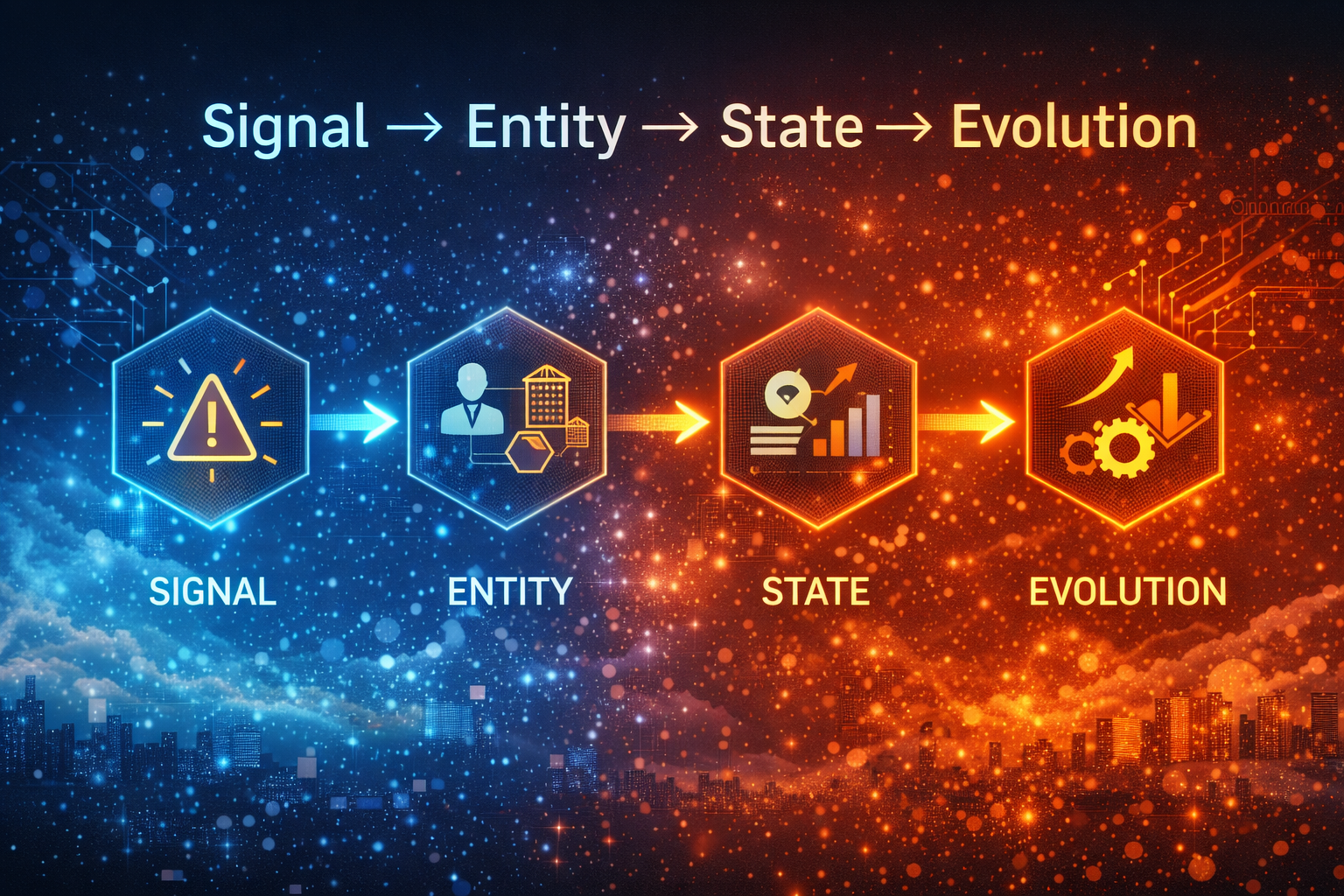
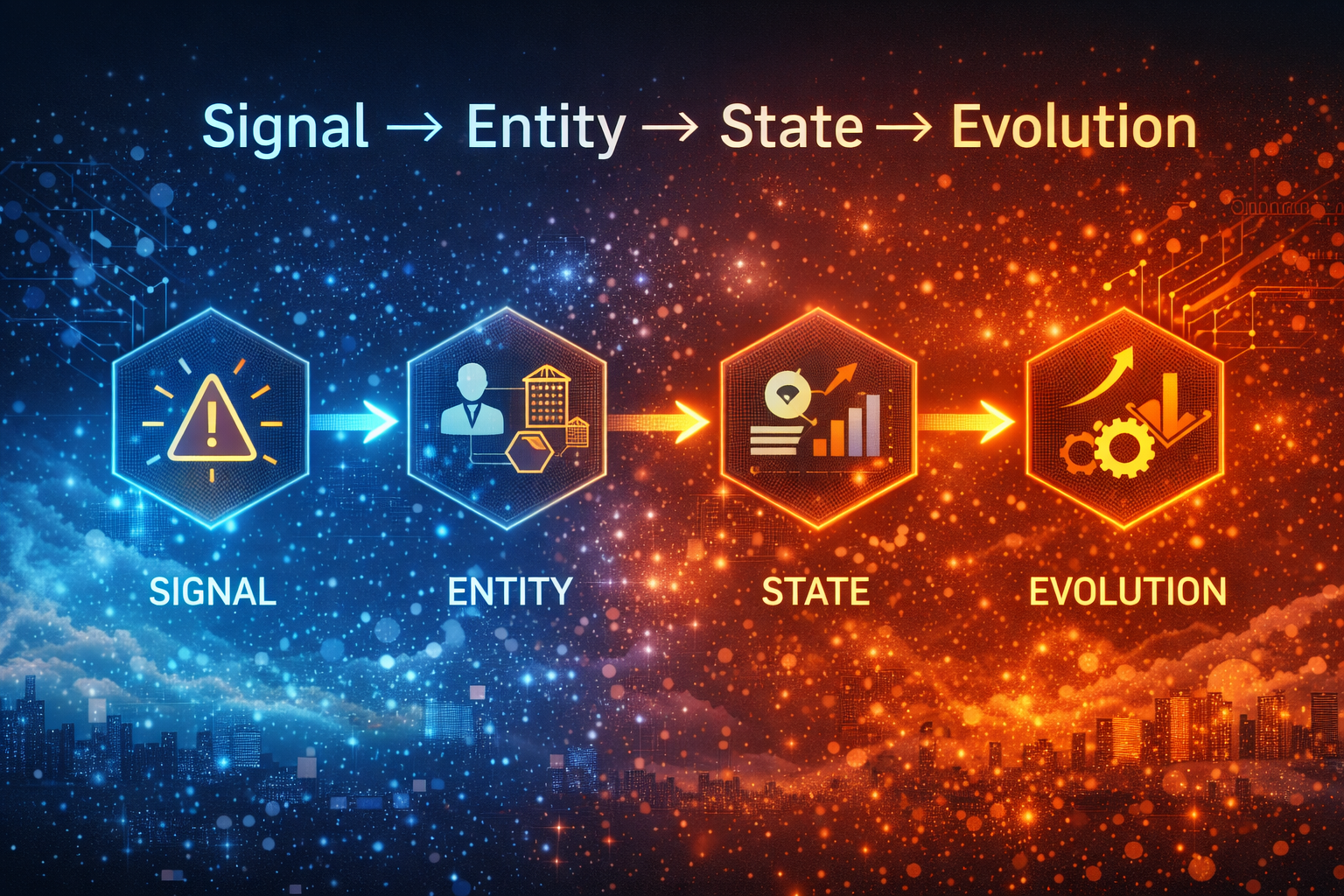
SENSE: where reality becomes machine-legible

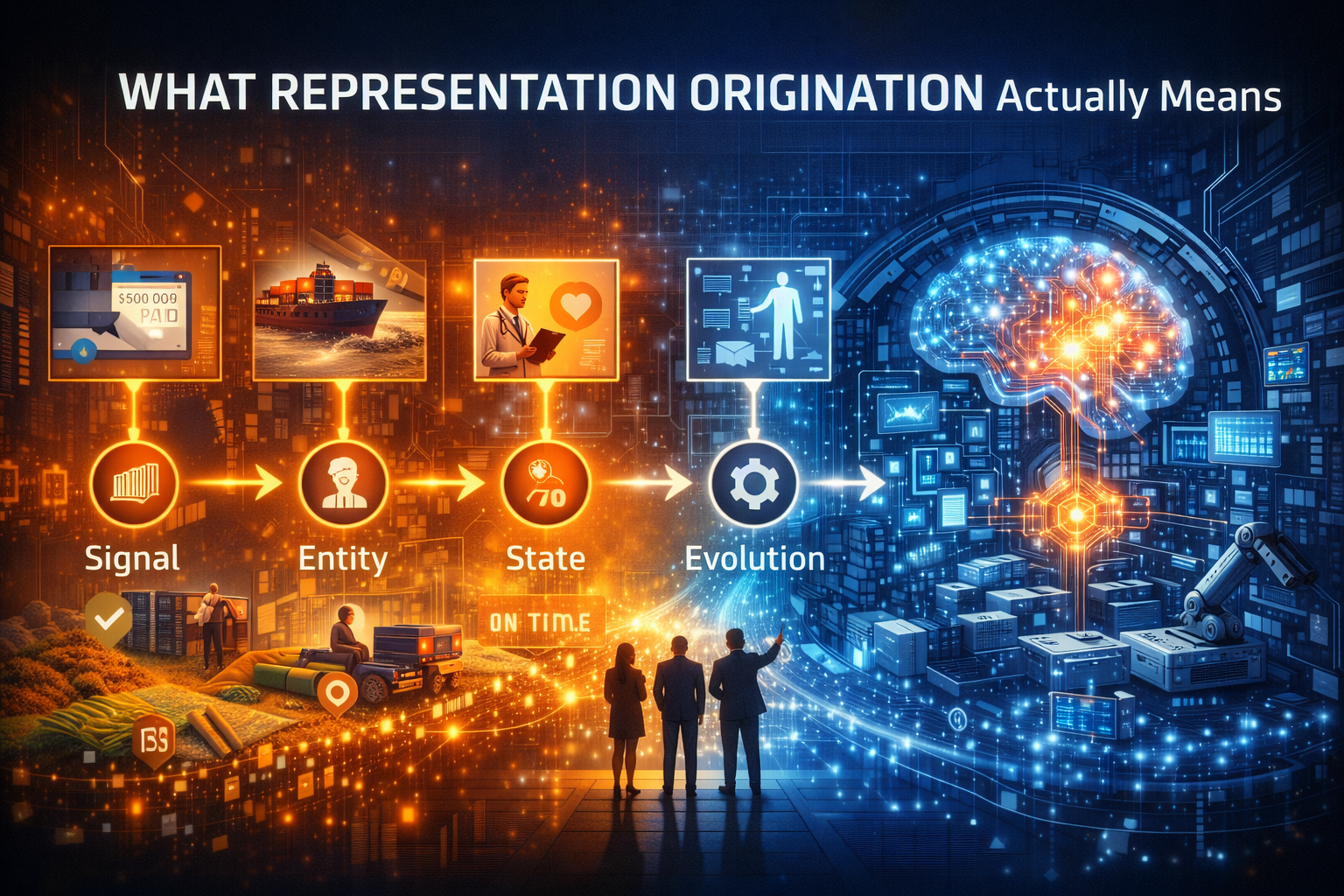
SENSE is the legibility layer. It is where reality first becomes visible to machines.

It includes:

Signal

What traces are being captured?

ENtity

Which person, product, asset, organization, document, or object do those signals belong to?

State representation

How is the current condition represented?

Evolution

How is that state updated over time?

In the Representation Access Economy, SENSE determines who enters machine visibility in the first place.

If your signals are weak, your entities are fragmented, your state is unclear, or your updates are stale, the machine does not have a stable basis for trust.

This is why the Representation Access Economy begins before model selection. It begins with whether reality has been structured well enough to be sensed and represented.

CORE: where systems interpret and decide

CORE is the cognition layer.

It includes:

Comprehend context

Optimize decisions

Realize action

Evolve through feedback

This is the layer most of the market calls “AI.”

But CORE can only reason over what SENSE has made available. A brilliant system operating over weak representation can still produce weak outcomes. In many failed AI projects, the model is blamed for what is actually a representation problem.

If the machine does not understand the supplier, the asset, the worker, the customer, or the document correctly, the intelligence layer cannot fully compensate.

DRIVER: where authority and legitimacy matter

DRIVER is the governance and execution layer.

It includes:

Delegation

Who authorized the action?

Representation

What model of reality was used?

Identity

Which entity was affected?

Verification

How is the decision checked?

Execution

How is the action carried out?

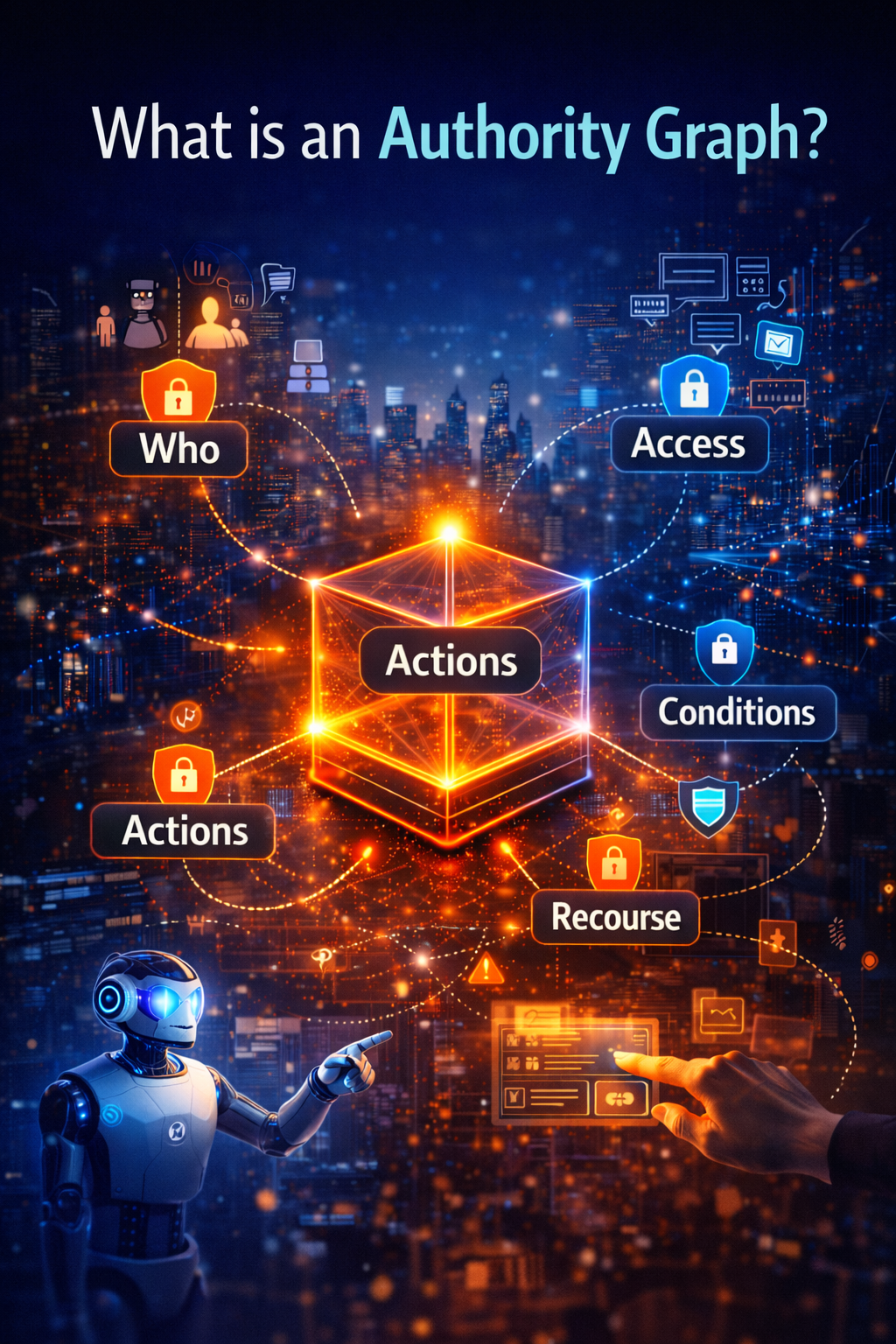
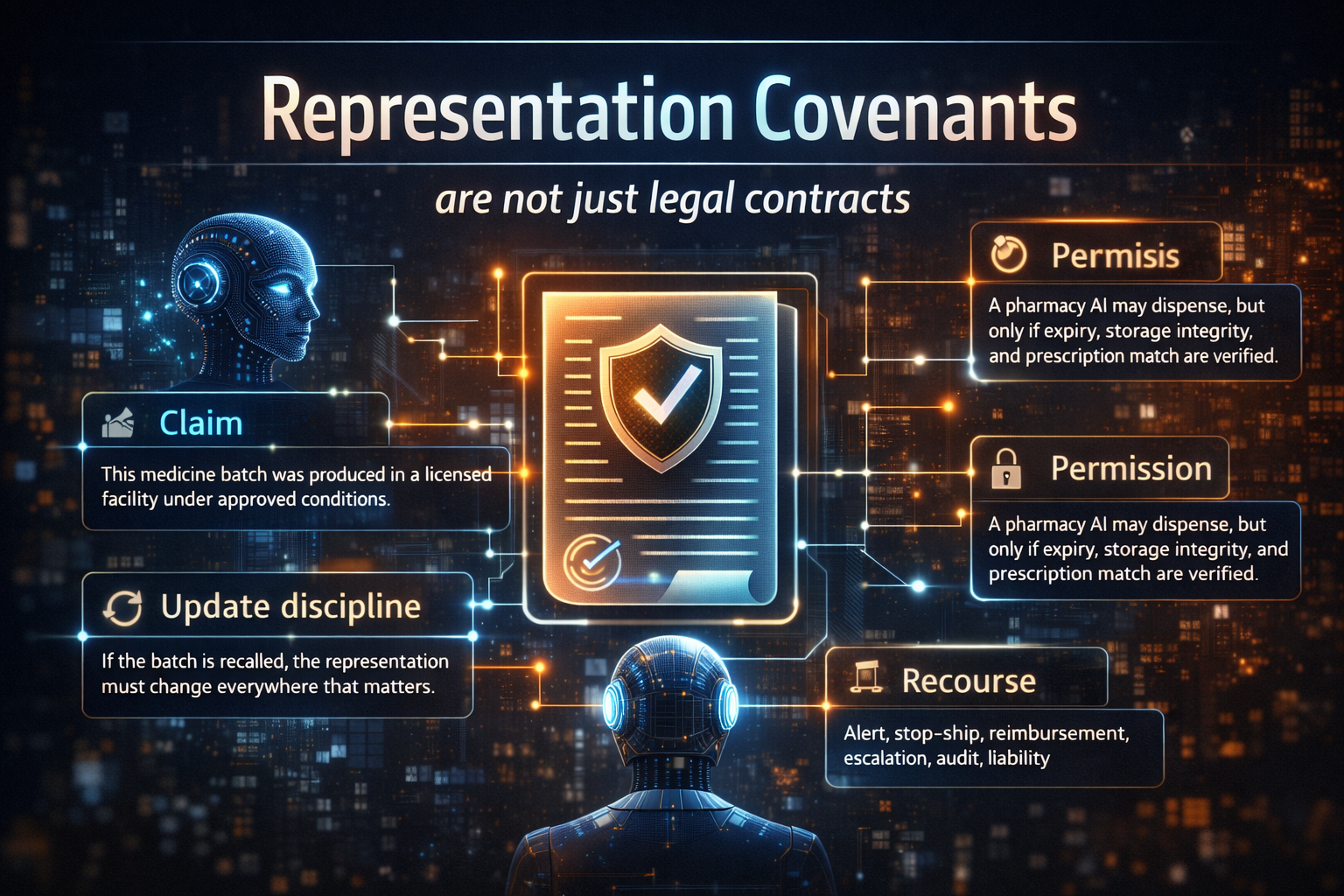
Recourse

What happens if the system is wrong?

This matters because access is not only about being seen. It is also about being acted upon fairly and accountably.

As agents begin acting on behalf of users and institutions, identity and authorization become central design questions, which is exactly why NIST’s 2026 initiative emphasizes secure, interoperable agents acting on behalf of users. (NIST)

So the Representation Access Economy is not just a SENSE issue. It is also a DRIVER issue. It concerns not only visibility, but legitimate participation.

What new kinds of companies will emerge

What new kinds of companies will emerge

This is where the market opportunity becomes huge.

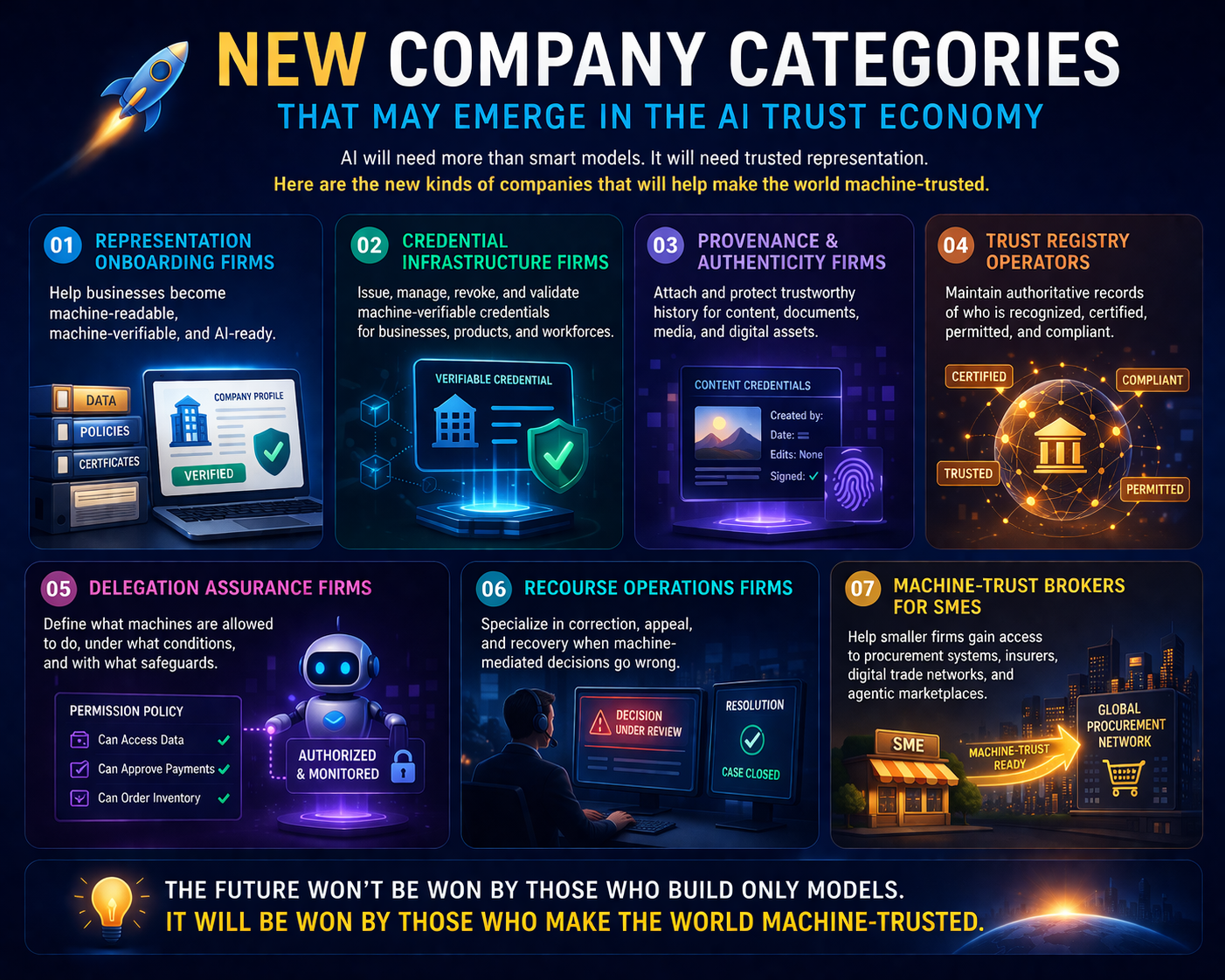
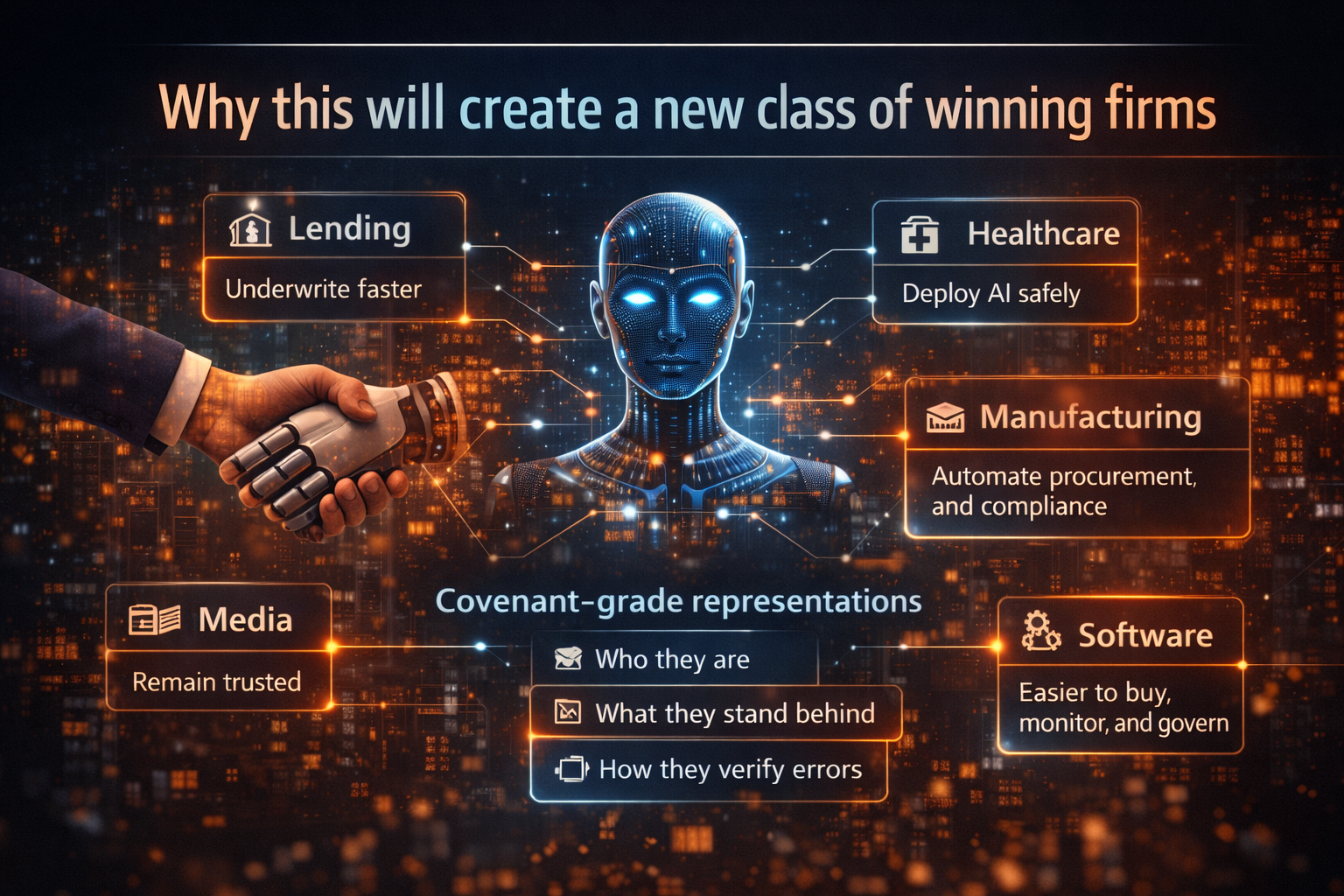
A new class of firms will emerge not primarily to build the smartest model, but to expand representation access.

  1. Reality translators

These companies will convert messy offline or fragmented digital reality into machine-usable representation.

Examples include platforms that turn small-business inventories into structured commerce data, tools that convert fragmented supplier records into procurement-grade identity, or systems that transform paper-heavy compliance flows into machine-verifiable state.

  1. Representation onboarding layers

These firms will help smaller actors become visible to AI-mediated ecosystems.

Imagine services that onboard small manufacturers into machine-readable supply chains, convert informal workers into verifiable skill graphs, or help niche products become legible to search, marketplaces, and AI shopping agents.

  1. Trust packaging firms

These firms will not just organize information. They will package it into forms that machines can trust.

That could include credentialing networks, provenance services, policy formatting platforms, product authenticity layers, or verifiable evidence services.

  1. State infrastructure companies

These businesses will manage current status, not just static identity.

For many use cases, what matters is not only who you are, but what state you are in right now. Inventory available or unavailable. License active or expired. Product recalled or not. Consent granted or revoked. Asset healthy or degraded.

The companies that manage high-quality state representation will become critical infrastructure.

  1. Representation fiduciaries

Some of the most powerful new firms may act on behalf of entities that cannot easily represent themselves. Small suppliers, local producers, vulnerable consumers, physical assets, ecosystems, and informal workers may all need trusted intermediaries that represent their interests accurately in machine-mediated markets.

That may become one of the defining new company categories of the AI era.

Why this matters for existing companies right now

Many incumbents still hear ideas like this and assume the issue is futuristic.

It is not.

The Representation Access Economy is already affecting search, commerce, identity, compliance, traceability, and digital trust. Google’s structured data ecosystem, W3C’s verifiable credentials, GS1’s web-linked identifiers, European product passport efforts, and emerging AI agent standards all point in the same direction: machine-readable representation is becoming a core layer of participation. (Google for Developers)

Existing companies should ask five uncomfortable questions.

Five board-level questions

  1. Can machines reliably discover us?
  2. Can machines understand what we sell, what we certify, what state we are in, and how trustworthy we are?
  3. Can agents transact with us without excessive manual intervention?
  4. Do our suppliers, partners, and customers have enough representation access to fully participate in our ecosystem?
  5. If AI-mediated markets become the norm, are we easy to select, or easy to skip?

These are no longer niche digital questions. They are competitive questions.

A better sequence for AI strategy

Most firms still approach AI strategy like this:

  1. choose tools
  2. run pilots
  3. automate tasks
  4. deploy assistants or agents

A stronger sequence is this:

  1. improve representation
  2. strengthen state visibility
  3. standardize trust signals
  4. clarify delegation and recourse
  5. then scale intelligence and automation

Why this order?

Because access comes before optimization.

There is little value in building a highly capable AI layer on top of fragmented, weakly represented reality. That usually produces fragile systems, weak trust, and disappointing adoption.

The global dimension

The Representation Access Economy also has a geopolitical and developmental dimension.

UNCTAD has warned that the digital economy remains unevenly distributed. In 2024, digitally deliverable services accounted for more than 60% of total services exports in advanced economies, 44% in developing economies, and only 15% in least developed countries. UNCTAD also points to global concentration and the dominance of a handful of firms in digital markets. (UN Trade and Development (UNCTAD))

This matters because representation access can become a new form of inequality.

Some countries, ecosystems, and firms will have dense digital identity, strong standards, interoperable records, modern APIs, traceable supply chains, and machine-usable credentials.

Others will remain only partially legible.

If that gap grows, AI will not simply automate existing markets. It will reorganize them around who can be represented well.

That is why the Representation Access Economy should matter not only to companies, but also to policymakers, standards bodies, trade ecosystems, and institutional designers.

The biggest misunderstanding to avoid

The biggest misunderstanding is to think this argument is saying everything must be reduced to data.

That is not the point.

The point is that in a machine-mediated economy, some form of representation becomes unavoidable. The strategic question is whether representation becomes narrow, extractive, inaccurate, and controlled by a few actors, or broad, trustworthy, portable, and aligned with the interests of the entities it represents.

The issue is not whether representation will matter.

It already does.

The issue is who will design it, who will control it, and who will gain access through it.

What leaders should do now

Leaders should stop asking only, “How do we use AI?”

A better question is this:

What would it take for our reality to become easily discoverable, understandable, verifiable, and actionable by trustworthy machines?

That question leads to better strategy.

It shifts attention from shiny applications to structural readiness.
It clarifies why many AI projects stall.
It reveals new market opportunities.
And it helps leaders see why the next economic battle will not be won by intelligence alone.

It will be won by those who make reality usable.

Key Insight Summary

  • AI does not only reward intelligence—it rewards representation

  • If machines cannot see, structure, and verify you, you are excluded

  • The new economy is not just digital—it is machine-legible

  • Trust is shifting from human judgment to machine-verifiable signals

Conclusion

The Representation Access Economy is the emerging layer of the AI era in which participation depends on machine-readable presence.

Some actors will enjoy rich access. They will be visible, structured, trusted, and actionable. Others will struggle to enter machine-mediated flows, not because they lack value, but because they lack representation.

That is why this shift matters so much.

In the AI economy, competition will not be shaped only by who has the best model. It will be shaped by who gets represented, who gets converted into machine-usable form, and who is trusted enough for systems to act upon.

That is the deeper strategic contest now unfolding.

The winners will not simply be the firms with more intelligence.

They will be the firms, platforms, and institutions that expand representation access — for themselves, for their ecosystems, and for the parts of reality that markets have historically overlooked.

Because in the AI era, value does not begin only when something is created.

It increasingly begins when something can be seen.

Glossary

Representation Access Economy
The emerging economic layer in which participation depends on whether entities are visible, structured, verifiable, and usable by machines.

Representation Economics
A broader framework for understanding how machine-readable visibility, trust, and action reshape value creation, market access, and competitive advantage.

Machine legibility
The degree to which a machine can recognize, interpret, compare, and act upon an entity or signal.

Representation rights
The question of who gets to be visible and recognized in machine-usable form.

Representation conversion
The process of turning messy, fragmented, offline, or unstructured reality into machine-usable representation.

Structured data
A standardized way of marking up information so machines can understand page content and entities more easily.

Verifiable credentials
Digitally expressed claims that are designed to be cryptographically secure, privacy-respecting, and machine-verifiable.

Digital Product Passport
A digital record intended to store and share important product information across its lifecycle and value chain.

GS1 Digital Link
A way of connecting product identifiers to web-based information for commerce, safety, and traceability.

Machine-readable trust
Trust that can be established through standardized, interoperable, and verifiable signals rather than only through human judgment.

SENSE
The legibility layer where reality becomes machine-readable through signal capture, entity association, state representation, and temporal updating.

CORE
The cognition layer where systems comprehend context, optimize decisions, realize action, and evolve through feedback.

DRIVER
The governance layer that handles delegation, identity, verification, execution, and recourse.

Representation fiduciary
A possible new company type that acts on behalf of entities that cannot easily represent themselves in machine-mediated markets.

Machine-Readable Reality
Information formatted in a way that AI systems can interpret, compare, and act upon.

AI Trust Layer
The infrastructure through which machines verify identity, credibility, and reliability.

Invisible Supplier Problem
When a business exists operationally but is not recognized by AI systems due to lack of structured representation.

Machine Visibility
The ability of an entity to be discovered and processed by AI systems.

FAQ

What is the Representation Access Economy?

It is the part of the AI economy where participation increasingly depends on whether an entity can be represented in forms that machines can discover, understand, verify, trust, and act upon.

Why is this different from traditional digital transformation?

Traditional digital transformation often focused on process efficiency and channel digitization. The Representation Access Economy focuses on whether reality itself is encoded in forms machines can use for search, comparison, decision-making, and action.

Why does this matter to boards and C-suite leaders?

Because market access, discoverability, procurement, compliance, financing, and ecosystem participation are increasingly influenced by machine-mediated systems. Firms that are poorly represented may be skipped before human judgment even begins.

Is this mainly about SEO?

No. SEO is only the earliest visible example. The larger shift includes digital identity, verifiable credentials, product passports, provenance, trust infrastructure, AI agents, and machine-mediated commerce.

What is the biggest risk for incumbents?

The biggest risk is not merely slow AI adoption. It is becoming hard for machines to discover, trust, compare, and transact with the firm.

What kinds of companies will emerge because of this shift?

Likely categories include reality translators, representation onboarding platforms, trust packaging firms, state infrastructure companies, and representation fiduciaries.

How does SENSE–CORE–DRIVER relate to this article?

SENSE explains how reality becomes visible to machines. CORE explains how machines reason over that visibility. DRIVER explains how decisions and actions remain legitimate, accountable, and executable.

What should companies do first?

Before scaling AI pilots, they should improve entity clarity, state visibility, trust signals, structured representation, and governance for machine action.

Q1. What is the Representation Access Economy?

The Representation Access Economy is a new economic model where participation depends on how well entities are represented in machine-readable formats that AI systems can trust and act upon.

Q2. Why is AI changing market access?

AI systems increasingly act as decision-makers. If they cannot interpret or trust your data, you are excluded from recommendations, transactions, and opportunities.

Q3. What does “being invisible to AI” mean?

It means your business, product, or service is not structured or verifiable enough for AI systems to recognize, rank, or recommend.

Q4. How can companies adapt?

By investing in structured data, verifiable credentials, digital identity, and machine-readable systems.

Q5. What industries will emerge from this shift?

New categories include representation platforms, trust infrastructure providers, AI intermediaries, and machine-verification networks.

References and further reading

For this article’s factual foundations, the strongest external references are:

UNCTAD data on digital inequality and concentration in digitally deliverable services. (UN Trade and Development (UNCTAD))

Institutional Perspectives on Enterprise AI

Many of the structural ideas discussed here — intelligence-native operating models, control planes, decision integrity, and accountable autonomy — have also been explored in my institutional perspectives published via Infosys’ Emerging Technology Solutions platform.

For readers seeking deeper operational detail, I have written extensively on:

Together, these perspectives outline a unified view: Enterprise AI is not a collection of tools. It is a governed operating system for institutional intelligence — where economics, accountability, control, and decision integrity function as a coherent architecture.

Explore the Architecture of the AI Economy

This article is part of a broader research series exploring how institutions are being redesigned for the age of artificial intelligence. Together, these essays examine the structural foundations of the emerging AI economy — from signal infrastructure and representation systems to decision architectures and enterprise operating models.

If you want to explore the deeper framework behind these ideas, the following essays provide additional perspectives:

Together, these essays outline a central thesis:

The future will belong to institutions that can sense reality, represent it clearly, reason about it intelligently, and act through governed machine systems.

This is why the architecture of the AI era can be understood through three foundational layers:

SENSE → CORE → DRIVER

Where:

  • SENSE makes reality legible
  • CORE transforms signals into reasoning
  • DRIVER ensures that machine action remains accountable, governed, and institutionally legitimate

Signal infrastructure forms the first and most foundational layer of that architecture.

AI Economy Research Series — by Raktim Singh

Representation Bankruptcy: Why AI Will Break Companies That Machines Cannot Trust

Representation Bankruptcy

For years, leaders have been told that the AI era will be won by those with the best models, the most data, or the deepest compute budgets.

That story is becoming too small.

A deeper shift is underway. As AI moves from generating content to searching, comparing, verifying, deciding, routing, and transacting, the real strategic question is changing. The decisive issue is no longer only whether an institution has intelligence.

It is whether that institution can be represented clearly enough for machine systems to understand it, trust it, and act with it. That shift is already visible in how search engines reward structured product information, how digital credentials are becoming machine-verifiable, how provenance is being bound to content, how identity wallets are being standardized, and how payments networks are preparing for agentic commerce. (Google for Developers)

That is where a new danger appears.

Representation bankruptcy is the point at which the gap between reality and machine-readable reality becomes so large that an institution begins to fail economically, operationally, or strategically.

Not because it has no products.
Not because it has no customers.
Not because it has no talent.

But because the systems increasingly shaping discovery, trust, compliance, and commerce can no longer reliably recognize what the institution is, what it offers, what it promises, what it is allowed to do, and what risks it carries.

This is one of the defining failure modes of the AI economy.

What is Representation Bankruptcy?

Representation Bankruptcy is the condition in which an organization’s real-world value cannot be accurately understood, verified, or acted upon by machine systems, leading to loss of visibility, trust, and economic participation in AI-driven markets.

What representation bankruptcy actually means

What representation bankruptcy actually means

In traditional finance, bankruptcy means liabilities overwhelm assets.

In the AI economy, a parallel form of failure is emerging. A company, institution, or ecosystem becomes representation-bankrupt when its digital description of itself is no longer strong enough for machine-driven systems that influence visibility, trust, and action.

Its products may exist, but be poorly described.
Its credentials may exist, but be hard to verify.
Its permissions may exist, but be hard to interpret.
Its compliance may exist, but be trapped in documents rather than usable proofs.
Its value may be real, but its machine-readable form is weak, fragmented, stale, or unverifiable.

That mismatch becomes fatal when more of the market starts operating through machine mediation. This is the central idea of Representation Economics: in an AI-shaped market, value does not flow only to what is valuable. It increasingly flows to what is representable.

Why this problem is becoming urgent now

This is not a distant theory. The infrastructure for machine-readable trust is already being built.

Google explicitly encourages merchants to provide structured product information, including price, availability, shipping, ratings, and returns, because those fields can influence how products appear across Search experiences. That means visibility is already shaped by machine-readable representation, not just by branding or prose copy. (Google for Developers)

W3C’s Verifiable Credentials 2.0 standard exists because markets increasingly need claims that are not merely published but cryptographically secure and machine-verifiable. The W3C describes verifiable credentials as a way to express claims such as identity and qualifications in a tamper-resistant, machine-verifiable format. (W3C)

The C2PA specification similarly reflects a new expectation: digital content increasingly needs provenance that can travel with it. C2PA is building technical standards for content authenticity, and even allows verifiable credentials to serve as added trust signals in the provenance chain. (C2PA)

The European Union is doing the same at institutional scale. The European Commission says member states will make digital identity wallets available to citizens, residents, and businesses by the end of 2026, and the Commission’s Digital Product Passport initiative is designed to store and share relevant product data for consumers, businesses, and public authorities. (European Commission)

Even commerce rails are moving in this direction. Visa says its Intelligent Commerce capabilities are designed to support AI-powered commerce through tokenization, authentication, controls, and commerce signals, so agents can make purchases securely under governed conditions. (Visa Developer)

Taken together, these developments point to a structural fact: the economy is being rebuilt so machines can verify, compare, and act. That makes representation mismatch a strategic risk, not a metadata problem.

The hidden sequence that leads to collapse

The hidden sequence that leads to collapse

Representation bankruptcy rarely arrives all at once. It usually unfolds in stages.

First, reality changes. Products evolve. Suppliers change. Policies update. Credentials expire. Permissions shift. Customer expectations move.

Second, the institution’s machine-readable layer fails to keep up. Data remains fragmented. Structured descriptions stay incomplete. Provenance is weak. Permissions are ambiguous. Operational state is spread across systems that do not speak to one another.

Third, machine systems begin making poorer inferences. Search visibility weakens. Comparisons become less favorable. Risk checks become harsher. Agents fail to route demand efficiently. Compliance becomes slower and more expensive. Integration friction rises.

Fourth, leadership misreads the symptoms. The firm blames competition, branding, or execution quality. But the deeper issue is that machine-mediated systems are increasingly unable to work with it cleanly.

Finally, the mismatch becomes fatal.

That is representation bankruptcy.

A simple example: the invisible supplier

Imagine a mid-sized manufacturer that makes excellent industrial components.

Its parts are reliable. Its prices are competitive. Its service is strong.

But its catalog data is inconsistent. Specifications sit in PDFs. Certifications are buried in email chains. Sustainability information is scattered across vendors. Return policies differ by region. Inventory feeds lag. Compliance evidence is assembled manually.

Now compare that with a competitor whose products are encoded with clean identifiers, structured specifications, provenance links, compatibility rules, certifications, service history, and current availability.

Which supplier might a human procurement manager prefer? Potentially either one.

Which supplier will an AI procurement system prefer?

Almost certainly the second.

Not because the second product is always better, but because the second firm is easier for a machine to evaluate, trust, and transact with. That advantage compounds over time. The better-represented firm gets discovered more often, qualified faster, compared more favorably, integrated more easily, financed more confidently, and audited more cheaply.

The poorly represented firm may still be good. But goodness without legibility becomes economically fragile.

Another example: the trusted credential problem

Consider a skilled worker, freelancer, consultant, or training provider.

Their achievements are real. Their certifications are real. Their experience is real.

But if those facts are difficult to verify digitally, they weaken in an economy where matching, onboarding, eligibility, and risk checks increasingly rely on machine-verifiable signals. That is precisely the problem verifiable credentials are meant to solve. W3C’s standard defines a framework in which claims can be securely issued, held, and verified across an issuer-holder-verifier ecosystem. (W3C)

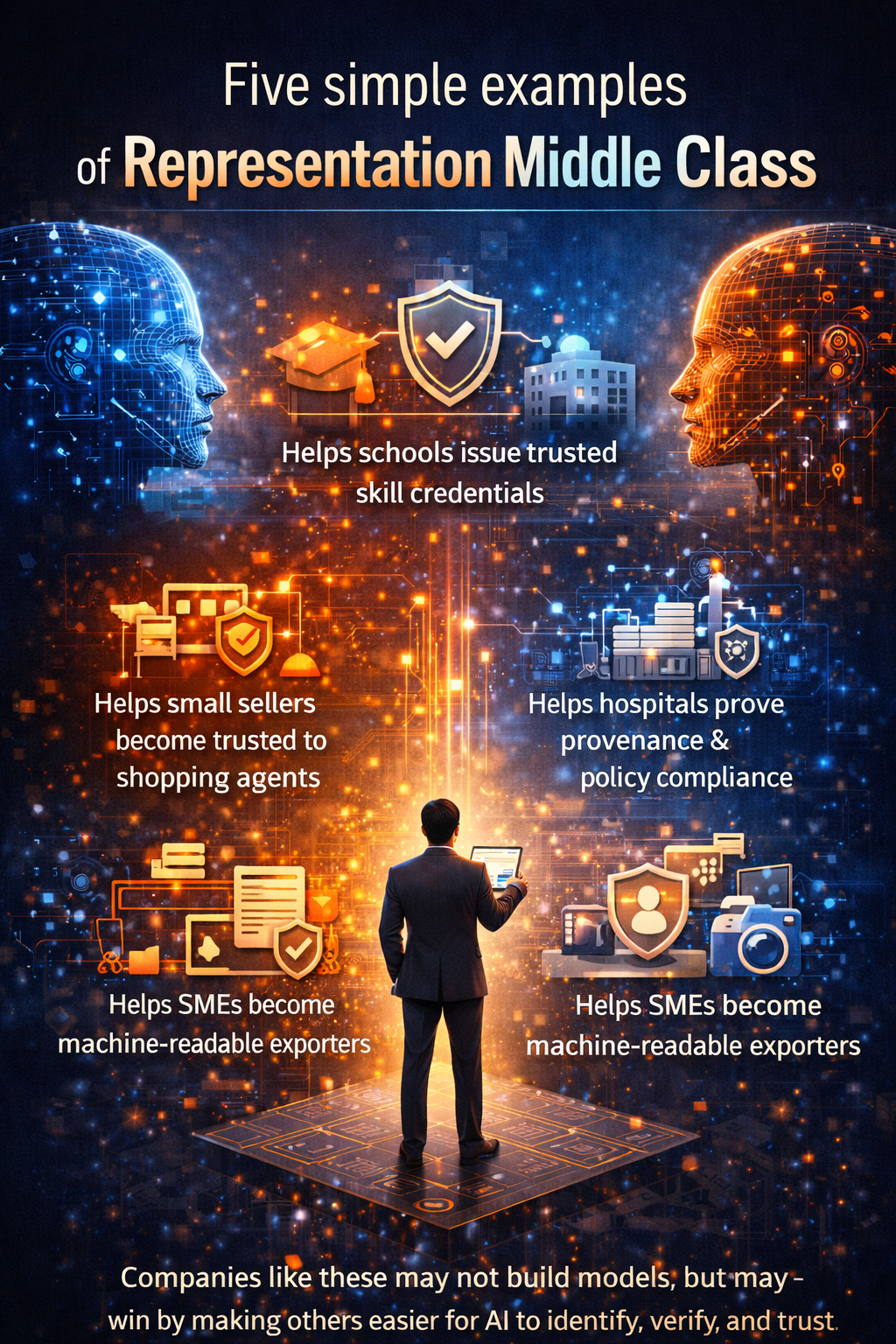
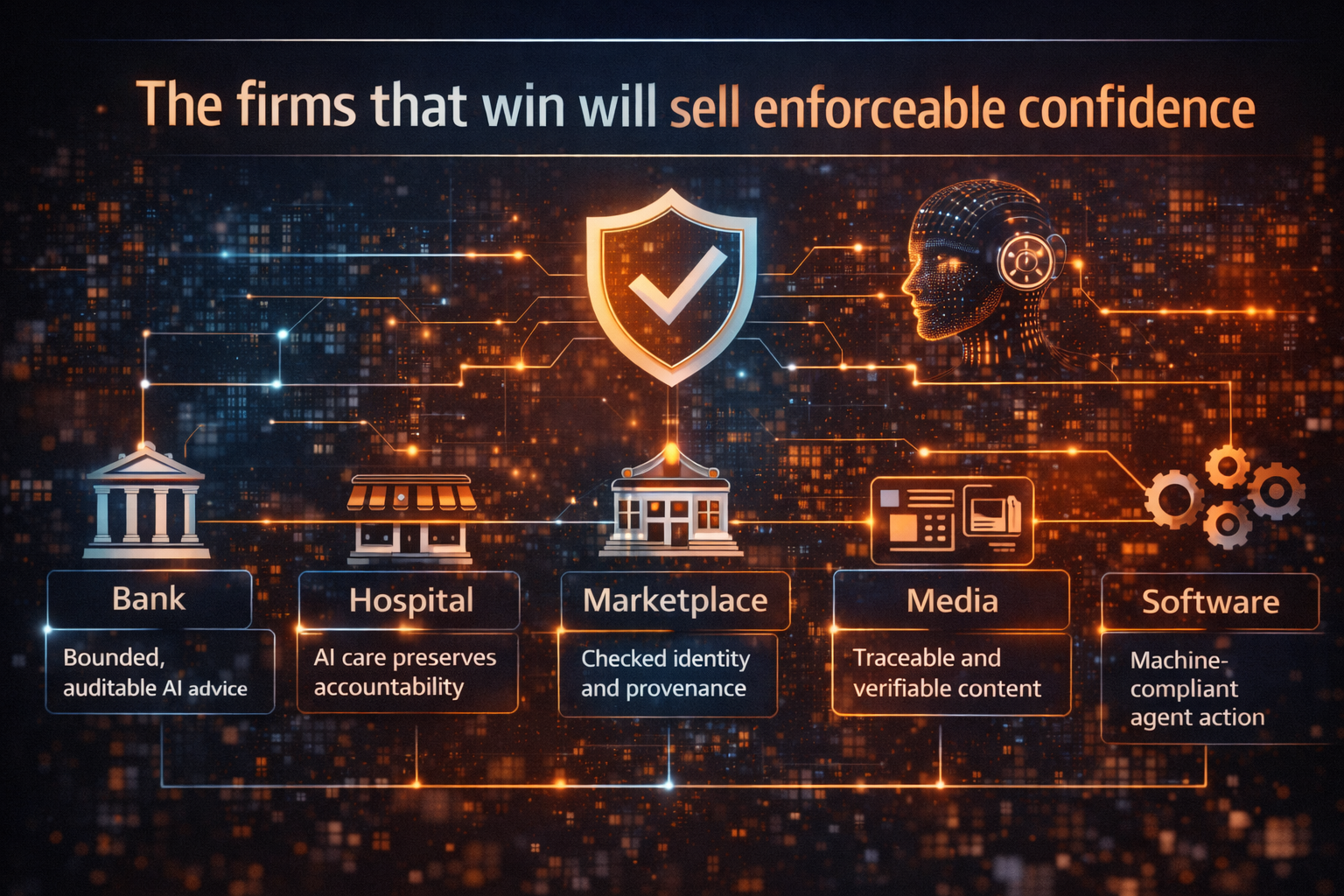
The same logic applies to universities, hospitals, insurers, exporters, logistics networks, and governments.

The issue is not whether reality exists. The issue is whether reality is encoded in a form that machines can trust.

Why AI makes this harsher

Why AI makes this harsher

Older digital systems still left room for human interpretation.

A human buyer could call.
A human analyst could inspect a PDF.
A human compliance officer could piece together context from five separate sources.

AI changes the scale and speed of the process. AI systems do not simply retrieve information. They rank, summarize, compare, infer, and increasingly recommend or trigger action. NIST’s AI Risk Management Framework emphasizes context, trustworthiness, and the need to manage the risks and impacts of AI systems across their lifecycle. (NIST Publications)

That means weak representation creates three compounding risks.

Discovery risk

If a firm is poorly represented, it may not surface well in search, recommendation, or comparison flows.

Trust risk

If claims cannot be verified cleanly, systems may discount, penalize, or bypass them.

Action risk

If permissions, conditions, policy rules, and recourse pathways are unclear, machines may avoid acting altogether or dramatically increase the cost of acting.

This is why representation mismatch becomes fatal faster in the AI era than in the old software era.

The SENSE–CORE–DRIVER explanation

The SENSE–CORE–DRIVER explanation

Your SENSE–CORE–DRIVER framework explains this problem better than most current AI strategy models because it shows that intelligence alone is never the full system.

SENSE is the legibility layer

If signals are weak, entities are unresolved, states are stale, or evolution is not captured, reality enters the system in distorted form.

A company may think it has data. But if it cannot reliably connect a signal to a product, supplier, credential, location, asset, or obligation, it does not have legible reality. It has fragments.

CORE is the cognition layer

The AI model may still reason impressively. But reasoning over weak representation produces fragile outputs.

A powerful model does not rescue a broken representation layer. In many cases, it amplifies the illusion that the institution is more machine-ready than it actually is.

DRIVER is the legitimacy layer

Even if the system “understands” something, it still needs governed authority to act. Who delegated authority? Which identity is affected? What proof is acceptable? How is the decision verified? What happens if the system is wrong?

Representation bankruptcy often becomes visible here. The institution discovers that it cannot safely let systems act because its identity, permissions, obligations, and recourse pathways are too poorly encoded.

In simple terms, many organizations are overinvesting in CORE while underinvesting in SENSE and DRIVER. That is one of the main reasons they drift toward representation bankruptcy.

What representation bankruptcy looks like in practice

What representation bankruptcy looks like in practice

It rarely announces itself with dramatic language. It often appears as ordinary business friction.

Products that do not travel well across search, marketplaces, and AI assistants.
Compliance that is expensive to prove every time.
Supplier networks that cannot be audited quickly.
Customer onboarding that remains manual.
Content that cannot establish provenance.
Data partnerships that stall because identity and permissions are unclear.
Agents that can recommend but cannot execute.
Boards that hear “we have AI” while operations still run on brittle representation.

These symptoms can appear disconnected. They are not. They are often different expressions of the same structural weakness: the institution has not built enough machine-readable truth.

Why this matters for new company creation

Representation bankruptcy is not only a warning. It is also a market map.

Whenever a large class of institutions suffers from fatal representation mismatch, new firms emerge to solve it. That is why the AI economy is likely to create powerful new categories of companies:

firms that clean, structure, and maintain machine-readable product truth
firms that issue and verify portable digital credentials
firms that provide provenance, attestation, and traceability infrastructure
firms that manage governed delegation for AI agents
firms that turn policy and compliance into machine-actionable controls
firms that provide recourse, dispute, and decision-audit infrastructure

These are not side markets. They may become some of the most important infrastructure categories of the AI economy.

What boards and C-suites should do now

The first mistake is to treat this as an IT cleanup problem.

It is not.

It is a board-level representation strategy issue.

Leaders should ask five questions.

What parts of our business are real, but still hard for machines to see?
Which claims about us are true, but still hard to verify?
Where are decisions blocked because permissions, conditions, or liabilities are unclear?
Which competitors are becoming easier for machines to trust and transact with?
If AI agents became major buyers, auditors, or routing systems in our industry, would we be selectable?

These questions matter more than many current AI maturity discussions. In the next phase of competition, the winners may not be the firms with the loudest AI narrative. They may be the firms with the strongest representation architecture.

Why this idea matters beyond one article

The industrial era rewarded production capacity.
The software era rewarded information processing.
The AI era will increasingly reward machine-legible reality.

That is why Representation Economics matters. It explains that value creation is shifting toward the ability to sense reality well, encode it faithfully, reason over it intelligently, and act on it legitimately.

Representation bankruptcy is what happens when that system breaks down.

A firm does not go bankrupt only when cash runs out.
It can also go bankrupt when trusted machine-readable reality runs out.

And in a world where search, identity, provenance, compliance, and transactions are all becoming more machine-mediated, that failure can arrive earlier than many leaders expect.

Representation Bankruptcy

Conclusion

The central lesson is simple.

In the AI economy, institutions do not lose only because they lack intelligence. They lose because their reality becomes too hard for machines to trust.

That is the fatal edge of representation mismatch.

Representation bankruptcy names a new kind of strategic decline: not the failure to build AI, but the failure to become legible, verifiable, and actionable in a world increasingly mediated by AI. Boards that understand this early will not treat representation as a technical afterthought. They will treat it as a source of competitiveness, trust, and institutional survival.

The next great divide in the AI economy may not be between companies that use AI and companies that do not. It may be between institutions that machines can work with cleanly and institutions they quietly learn to avoid.

FAQ

What is representation bankruptcy?

Representation bankruptcy is the point at which an organization’s machine-readable description becomes too weak, fragmented, stale, or unverifiable for AI-mediated systems to discover, trust, compare, or act on it effectively.

How is representation bankruptcy different from traditional bankruptcy?

Traditional bankruptcy is financial failure. Representation bankruptcy is strategic and operational failure caused by a widening gap between real-world reality and machine-readable reality.

Why does representation bankruptcy matter in the AI economy?

Because AI systems increasingly shape search, procurement, identity verification, compliance, content provenance, and commerce. If machines cannot reliably interpret and trust your institution, your market position weakens even if your underlying business is still strong. (Google for Developers)

What are the warning signs of representation bankruptcy?

Common signs include poor discoverability, manual compliance, unverifiable claims, brittle integrations, weak provenance, unclear permissions, and AI systems that can recommend but cannot safely execute.

Can a company with strong products still become representation-bankrupt?

Yes. A firm may have good products, real customers, and real capabilities, but still lose if those strengths are not encoded in a form machines can interpret and trust at scale.

What is the role of SENSE–CORE–DRIVER in preventing representation bankruptcy?

SENSE ensures reality becomes legible, CORE reasons over that reality, and DRIVER governs legitimate action. Organizations that overinvest in CORE while neglecting SENSE and DRIVER are more exposed to representation mismatch.

What kinds of companies will emerge to solve this problem?

Likely winners include firms focused on machine-readable product truth, digital credentials, provenance infrastructure, policy-to-control translation, governed delegation, and recourse infrastructure.

Is representation bankruptcy only relevant to tech companies?

No. It applies to manufacturers, banks, universities, hospitals, governments, exporters, logistics networks, retailers, and any institution that will increasingly interact with AI-mediated search, trust, or transaction systems.

1. What is representation bankruptcy in AI?

Representation bankruptcy occurs when a company’s machine-readable data is too weak, fragmented, or unverifiable for AI systems to trust or act upon.

2. Why is representation more important than AI models?

Because AI systems rely on structured, verifiable inputs. Without strong representation (SENSE), even the best models (CORE) produce unreliable outputs.

3. How does representation bankruptcy affect businesses?

It reduces discoverability, increases compliance costs, limits automation, and makes companies less selectable in AI-driven markets.

4. What is the SENSE–CORE–DRIVER framework?

A framework that explains AI systems:

  • SENSE = reality capture

  • CORE = reasoning

  • DRIVER = execution & governance

5. How can companies avoid representation bankruptcy?

By investing in:

  • structured data

  • verifiable credentials

  • identity systems

  • machine-readable policies

  • governance framework

Glossary 

Representation Bankruptcy
A condition in which the gap between real-world reality and machine-readable reality becomes so large that an institution starts losing economic, operational, or strategic viability.

Representation Mismatch
The misalignment between what an institution really is and what digital systems can reliably recognize, verify, and act upon.

Machine-Readable Reality
A structured, verifiable digital form of reality that machines can interpret, compare, and use safely.

Machine Legibility
The degree to which an institution, product, credential, or policy can be understood by digital systems.

Representation Economics
A framework arguing that in the AI era, value increasingly flows to what can be well represented, trusted, and acted upon by machines.

SENSE
The layer where reality becomes machine-legible through signals, entities, state representation, and evolution.

CORE
The cognition layer where AI systems comprehend context, optimize decisions, realize action, and evolve through feedback.

DRIVER
The legitimacy layer that governs delegated authority, representation, identity, verification, execution, and recourse.

Verifiable Credentials
Cryptographically secure, machine-verifiable digital credentials standardized by W3C. (W3C)

Provenance Infrastructure
Technical systems that record and verify where content or claims came from and how they changed over time, such as C2PA-based approaches. (C2PA)

Digital Identity Wallet
A secure digital wallet that allows users or businesses to store and share identity-related documents and credentials, such as the EU Digital Identity Wallet. (European Commission)

Digital Product Passport
A digital record designed to store and share relevant product information for consumers, businesses, and public authorities. (Internal Market & SMEs)

AI-Mediated Commerce
Commerce in which AI systems help search, compare, verify, recommend, or transact on behalf of users or institutions. (Visa Developer)

Representation Economics

A framework explaining how value flows to what machines can understand and trust.

SENSE Layer

Captures real-world signals and entities.

CORE Layer

AI reasoning and decision-making.

DRIVER Layer

Execution, governance, and accountability.

Verifiable Credentials

Digitally provable claims usable by machines.

AI Trust Infrastructure

Systems that allow machines to verify identity, claims, and actions.

References and further reading

Google Search Central documentation on product structured data and merchant return policy shows how product visibility increasingly depends on machine-readable fields such as price, availability, shipping, and returns. (Google for Developers)

W3C’s Verifiable Credentials Data Model 2.0 and the W3C press release explain how digital credentials are becoming cryptographically secure and machine-verifiable. (W3C)

The C2PA specification shows how content provenance is becoming a technical trust layer and how verifiable credentials can strengthen trust signals. (C2PA)

The European Commission’s European Digital Identity and Digital Product Passport materials show how identity and product data are being standardized for machine use across markets. (European Commission)

Visa’s Intelligent Commerce materials show how commerce rails are preparing for governed AI-driven transactions. (Visa Developer)

NIST’s AI Risk Management Framework provides a practical trust-and-risk lens for AI systems that increasingly participate in real-world decisions and actions. (NIST Publications)

Institutional Perspectives on Enterprise AI

Many of the structural ideas discussed here — intelligence-native operating models, control planes, decision integrity, and accountable autonomy — have also been explored in my institutional perspectives published via Infosys’ Emerging Technology Solutions platform.

For readers seeking deeper operational detail, I have written extensively on:

Together, these perspectives outline a unified view: Enterprise AI is not a collection of tools. It is a governed operating system for institutional intelligence — where economics, accountability, control, and decision integrity function as a coherent architecture.

Explore the Architecture of the AI Economy

This article is part of a broader research series exploring how institutions are being redesigned for the age of artificial intelligence. Together, these essays examine the structural foundations of the emerging AI economy — from signal infrastructure and representation systems to decision architectures and enterprise operating models.

If you want to explore the deeper framework behind these ideas, the following essays provide additional perspectives:

Together, these essays outline a central thesis:

The future will belong to institutions that can sense reality, represent it clearly, reason about it intelligently, and act through governed machine systems.

This is why the architecture of the AI era can be understood through three foundational layers:

SENSE → CORE → DRIVER

Where:

  • SENSE makes reality legible
  • CORE transforms signals into reasoning
  • DRIVER ensures that machine action remains accountable, governed, and institutionally legitimate

Signal infrastructure forms the first and most foundational layer of that architecture.

AI Economy Research Series — by Raktim Singh


The Representation Kill Zone: Why Companies Become Invisible Before They Realize They Are Losing

Introduction: the myth that is misleading boardrooms

A dangerous myth is spreading through boardrooms, strategy decks, and AI transformation plans.

It says companies will lose in the AI era because they were too slow to adopt AI.

That is only partly true.

Many firms will not lose because they ignored AI. They will lose because, long before they understand what is happening, they become hard for AI systems to see, trust, compare, route to, and work with. Their products may still be good. Their people may still be capable. Their customer relationships may still be strong. But in an economy where discovery, evaluation, procurement, compliance, insurance, service delivery, and coordination are increasingly shaped by machine-mediated systems, being good is no longer enough. A company must also become machine-legible.

That is the Representation Kill Zone.

The Representation Kill Zone is the competitive danger zone that forms when a company’s reality is too poorly structured, too weakly verified, too inconsistently described, or too institutionally fragmented for AI-mediated systems and markets to engage with it reliably. The company may still look healthy in the human economy. But it is already becoming invisible in the machine economy.

This is not science fiction. It is the next stage of competition.

Google’s own documentation already shows a simple version of this shift. It states that structured data helps Google understand page content, and that adding structured data can make pages eligible for richer search experiences; Google also says merchant listing markup can make products eligible for shopping-related search experiences that show details such as price, availability, shipping, and return information. (Google for Developers)

That is the early warning. The larger shift is much bigger.

What is the Representation Kill Zone?


The Representation Kill Zone is the stage where a company becomes invisible to AI systems—unable to be discovered, trusted, or selected—leading to declining relevance and revenue before executives recognize the problem.

The Representation Kill Zone : The real shift in AI competition

The real shift in AI competition

For years, digital competition was about websites, apps, and platforms. Then it became about data, models, and automation. Now it is becoming about representation.

In the Representation Economy, value does not flow only to the most intelligent firm. It increasingly flows to the firm that can convert reality into forms machines can reliably interpret, validate, and act upon.

That is why the SENSE–CORE–DRIVER framework matters.

SENSE

SENSE is the institutional ability to capture relevant reality continuously and credibly.

CORE

CORE is the ability to convert that reality into stable institutional understanding.

DRIVER

DRIVER is the ability to govern what can be delegated into action, under what conditions, with what safeguards and recourse.

A company enters the kill zone when one or more of these layers fails.

It may sense too little.
It may model reality badly.
It may delegate action without legitimacy.
Or it may remain too ambiguous for external machine systems to trust.

The result is subtle at first. The company does not collapse overnight. It becomes less selectable. Less discoverable. Less routable. Less insurable. Less automatable. Less governable.

Then one day it appears to have “suddenly” lost relevance.

It did not suddenly lose. It became invisible in stages.

Why invisibility is now a market problem The Representation Kill Zone

Why invisibility is now a market problem

In the industrial era, companies could remain viable even when internal processes were messy, undocumented, inconsistent, or heavily dependent on human intervention. Human judgment compensated for missing structure. Human relationships carried trust where systems could not.

AI changes the cost of coordination.

Machines can only act where reality is represented in forms they can use. If policies are inconsistent, product data is incomplete, supplier state is unclear, compliance logic is buried in emails, service commitments are not machine-verifiable, and operational truth is spread across disconnected systems, then AI-mediated markets will increasingly route around the company.

This is the central insight:

The AI economy does not only reward intelligence. It rewards representability.

That is why this article is about survival, not theory.

A simple example: the invisible supplier :The Representation Kill Zone

A simple example: the invisible supplier :The Representation Kill Zone

A simple example: the invisible supplier

Imagine two mid-sized suppliers competing for enterprise contracts.

The first supplier has ordinary products but clean machine-readable catalogs, verified certifications, current inventory states, standardized service-level commitments, structured compliance artifacts, and transaction records that are easy for enterprise systems to process.

The second supplier may actually have better products and more experienced people. But its certifications are scattered across PDFs, product details are inconsistent, delivery performance is not structured, return terms vary from customer to customer, and compliance evidence lives across inboxes and spreadsheets.

A careful human buyer may still choose the second supplier.

But an AI procurement layer, sourcing agent, or supplier-ranking engine will often favor the first.

Not because it is better in the deepest sense.

Because it is easier to evaluate, compare, trust, and transact with.

The second supplier is entering the Representation Kill Zone.

This logic will not stay limited to procurement. It will spread into lending, insurance, healthcare, logistics, hiring, partner ecosystems, digital commerce, public services, and any industry where selection increasingly happens through machine interfaces.

The kill zone often begins before AI adoption

The kill zone often begins before AI adoption

One of the biggest misunderstandings in enterprise AI is that the danger begins when a company deploys AI.

Often, the danger begins much earlier.

It begins when the company allows its operating reality to become unstructured, opaque, fragmented, or unverifiable in a world moving toward machine-mediated selection.

This is why so many AI efforts struggle before “model intelligence” becomes the real issue. NIST says its AI Risk Management Framework is intended to help organizations incorporate trustworthiness considerations into the design, development, use, and evaluation of AI systems, and its core functions include govern, map, measure, and manage. (NIST)

That is not merely a model problem. It is an institutional representation problem.

If an organization cannot clearly define what is being seen, measured, trusted, and acted on, the system becomes brittle.

The kill zone, then, is not created mainly by a lack of AI pilots.

It is created by a lack of representation discipline.

Five signs that a company is entering the Representation Kill Zone

Five signs that a company is entering the Representation Kill Zone

  1. It cannot describe itself consistently across systems

The same customer, supplier, product, policy, or risk appears differently across departments and tools. There is no stable institutional truth.

  1. It depends on human heroics for routine coordination

Employees constantly “know how to interpret” ambiguous records, informal exceptions, and undocumented states. Humans are carrying the representation burden manually.

  1. Its evidence is trapped in unstructured artifacts

Critical operating truth lives in PDFs, presentations, call notes, inboxes, and tribal memory instead of machine-usable states, rules, and evidence chains.

  1. It has automation without legitimacy

Tasks are automated, but the organization cannot clearly explain what the system is allowed to decide, under what conditions, with what approvals, and with what recourse if something goes wrong.

  1. External systems struggle to trust it

Search engines, partner platforms, procurement tools, regulators, lenders, and insurers require disproportionate effort to verify, classify, integrate, or underwrite the company.

These signs rarely look dramatic in isolation. They appear as friction, delay, lower conversion, repeated exceptions, higher scrutiny, and hidden operational drag. Together, they indicate something far more serious: the company is becoming less visible to the systems that increasingly shape market outcomes.

Search was the first warning

Search was the first warning

Many executives still think this argument is abstract. It is not.

Search has already trained the market to value structure. Google explains that structured data provides explicit clues about the meaning of a page and can enable richer search results. Its merchant listing documentation says product markup can make items eligible for shopping-related experiences, and return policy markup can add more information that improves user experience. Google also shares case studies showing that structured data implementations were associated with materially higher click-through or engagement metrics for several publishers and brands. (Google for Developers)

That is an early version of representation economics in action.

Now extend that same pattern from product search to supplier discovery, AI shopping agents, autonomous contract comparison, machine-driven underwriting, algorithmic compliance review, workflow routing, and partner selection.

The principle stays the same:

What is better represented gets selected more often.

Why agentic systems will make the kill zone harsher

Why agentic systems will make the kill zone harsher

This becomes more serious as enterprises move from copilots to agents.

Anthropic’s research on agent autonomy highlights that as autonomy rises, questions of monitoring, visibility, activity logging, and governance become more important; the same research notes broader concerns around agentic harms, power concentration, and the need for practical oversight. (Anthropic)

That matters because agents do not merely answer questions. They gather evidence, compare alternatives, trigger actions, initiate workflows, and increasingly coordinate operational tasks.

An agent cannot scale ambiguity well.

It needs state clarity.
Policy clarity.
Identity clarity.
Evidence clarity.

In other words, it needs representation.

So the rise of agents will not only increase the value of good representation. It will punish bad representation faster.

Why the Representation Kill Zone is a global issue

Why the Representation Kill Zone is a global issue

This is not a niche problem for a few digital-native firms. It is global.

The World Economic Forum has argued that mistrust acts like a tax on the intelligent economy, and that interoperability, inclusion, and cooperation are essential for building trust in AI governance across borders. (World Economic Forum)

That matters because the kill zone is not only a technical failure. It is also a trust failure.

Companies become less selectable when machine systems cannot establish reliable confidence in what they are seeing.

That is why digital identity, provenance, policy semantics, and verification layers matter so much. In an AI-mediated economy, representation is never just description. It is description plus trust.

What the kill zone looks like across industries

Banking and lending

A borrower may be solid in reality but weak in representation. Incomplete documentation, inconsistent transaction structure, unclear ownership trails, and poor evidence chains make the entity harder for AI-enabled risk systems to trust.

Healthcare

A provider may deliver excellent care, but fragmented records, inconsistent coding, and weak interoperability reduce machine confidence, coordination quality, and reimbursement efficiency.

Manufacturing

A plant may be operationally capable, yet if machine status, maintenance history, quality evidence, and supplier dependencies are not represented well, AI planning systems will either make weak recommendations or avoid deeper automation.

Retail and commerce

A merchant may have strong products, but poor markup, inconsistent availability data, unclear fulfillment logic, and weak return-policy representation reduce discoverability and machine-mediated conversion. Google’s merchant and return-policy documentation shows exactly how eligibility and richer visibility depend on structured representation. (Google for Developers)

Professional services

A firm may have deep expertise, but if its capabilities, prior outcomes, workflow states, and trust signals are not legible to machine-mediated sourcing systems, more representable competitors gain the advantage.

The point is not that every company must become fully autonomous.

The point is that every company will increasingly be judged through machine interfaces.

The SENSE–CORE–DRIVER interpretation

To make the concept actionable, map the kill zone back to the framework.

SENSE failure

The organization does not capture enough relevant reality, or captures it too late, too noisily, or too inconsistently.

CORE failure

The organization collects signals but cannot convert them into stable meaning. It lacks durable state models, consistent definitions, and cross-functional coherence.

DRIVER failure

The organization has some representation but cannot govern delegation. It cannot clearly define what systems may act on, what humans must approve, what evidence is required, or how recourse works.

A company in the kill zone usually does not fail in only one of these layers. It suffers a compounding breakdown across all three.

Why incumbents are especially vulnerable

Startups often begin with cleaner workflows because they design around modern systems from day one.

Incumbents carry history.

They have legacy systems, acquisitions, policy exceptions, undocumented workarounds, and years of operational logic that was never designed to be machine-legible. Their revenues and brand strength can mask this weakness for a while. But as markets become more machine-mediated, internal inefficiency becomes external disadvantage.

That is why the Representation Kill Zone is especially dangerous for established firms.

It punishes the gap between real capability and machine-visible capability.

How companies survive the kill zone

The answer is not “buy more AI.”

The answer is to redesign institutional legibility.

First, identify the realities that matter most

Which parts of your organization must become machine-legible for your sector to remain competitive? Product attributes, customer state, supplier credentials, policy rules, provenance, risk evidence, service commitments, and operational status are common examples.

Second, build representation quality as a strategic capability

This is more than data quality. It is the ability to describe reality in forms that machines can safely interpret and act upon.

Third, create a board-level representation strategy

Boards should ask:
What must be sensed continuously?
What must be modeled explicitly?
What must never be delegated without oversight or recourse?

Fourth, treat trust as infrastructure

Verification, provenance, identity, authorization, and evidence chains are no longer secondary controls. They are competitive assets.

Fifth, redesign around SENSE–CORE–DRIVER

This is not just an architecture framework. It is a survival framework for the AI economy.

The deeper strategic warning

The most dangerous companies in the next decade may not be those with the smartest models.

They may be the ones that become easiest for the machine economy to work with.

That means the next great divide may not be AI adopters versus non-adopters.

It may be:

machine-selectable versus machine-ignored
machine-trusted versus machine-questioned
machine-coordinatable versus machine-fragile

That is the Representation Kill Zone.

And once a company enters it, the market may notice before the board does.

what boards should reflect on now

Conclusion column: what boards should reflect on now

Here is the uncomfortable truth.

The first firms to lose ground in the AI economy may not look weak by traditional measures. They may still have customers, products, talented employees, installed relationships, and cash flow. But beneath that surface, they will already be losing access to the systems that increasingly shape selection, trust, coordination, and action.

They will be too hard for machines to see clearly.
Too hard to compare fairly.
Too hard to verify quickly.
Too hard to govern safely.
Too hard to route into the new economy.

That is why representation economics matters.

The future will not belong only to those who build intelligence.

It will belong to those who make reality legible enough for intelligence to act on.

And in that world, the most important strategic question for every board is no longer simply, “How do we adopt AI?”

It is:

Are we becoming more visible to the machine economy—or are we already entering the kill zone?

FAQ

What is the Representation Kill Zone?

The Representation Kill Zone is the stage at which a company becomes too poorly represented for AI-mediated systems to discover, trust, compare, route to, or coordinate with effectively.

Is this the same as poor data quality?

No. Poor data quality is part of the problem, but the kill zone is broader. It includes weak identity, fragmented state models, unstructured evidence, unclear policy semantics, and poorly governed delegation.

Why is this important now?

Because AI systems are increasingly influencing search, procurement, workflow orchestration, compliance review, and autonomous decision support. As those systems expand, firms with better machine-legibility gain an increasing advantage. (Google for Developers)

Does this affect only digital businesses?

No. It affects manufacturing, retail, healthcare, finance, logistics, professional services, and public-sector institutions. Any organization evaluated through machine interfaces is exposed.

What should boards do first?

Boards should identify the realities that most affect machine-mediated competitiveness in their sector, assess where representation is weak, and develop a representation strategy grounded in sensing, modeling, trust, and delegation.

How does this connect to SENSE–CORE–DRIVER?

SENSE captures reality, CORE converts it into institutional understanding, and DRIVER governs delegation into action. A kill-zone condition usually reflects weakness across one or more of these layers.

1. What is the Representation Kill Zone?

It is the stage where companies become invisible to AI systems, reducing their discoverability, trust, and ability to participate in digital markets.

2. Why is AI making companies invisible?

AI systems rely on structured, machine-readable data. Companies that lack this become harder to discover and evaluate.

3. How is this different from digital transformation?

Digital transformation focuses on tools. The kill zone is about being machine-understandable and selectable.

4. What are early warning signs of the kill zone?

Declining search visibility, reduced AI recommendations, lower discoverability in procurement systems, and weak digital representation.

5. How can companies avoid the kill zone?

By becoming representation-native—building systems aligned with SENSE (capture), CORE (understand), and DRIVER (act).

Glossary

Representation Economics
A framework for understanding how value in the AI economy increasingly flows to firms and institutions that are easier for machines to interpret, trust, and coordinate with.

Representation Kill Zone
The competitive zone where a company becomes machine-invisible before it looks weak by traditional business measures.

Machine Legibility
The degree to which an organization’s products, policies, processes, and evidence are understandable and usable by machine systems.

Machine-Readable Trust
Trust signals expressed in structured, verifiable, machine-usable form, such as identity, provenance, policy, and evidence.

Machine-Selectable
A firm or offering that AI-mediated systems can easily discover, evaluate, compare, and choose.

SENSE
The institutional capacity to capture relevant reality continuously and credibly.

CORE
The institutional capacity to turn sensed reality into durable, coherent understanding.

DRIVER
The institutional capacity to govern what may be delegated into machine-assisted or machine-executed action.

Representation Discipline
The organizational practice of structuring, verifying, governing, and maintaining the representations on which machine systems depend.

References and further reading

Google Search Central explains that structured data helps Google understand content and can enable rich results; its merchant listing and return-policy documentation shows how structured product, shipping, pricing, availability, and return data affect eligibility and presentation in search experiences. (Google for Developers)

NIST’s AI Risk Management Framework states that it is intended to help organizations incorporate trustworthiness into the design, development, use, and evaluation of AI systems, and organizes this work through govern, map, measure, and manage. (NIST)

The World Economic Forum argues that mistrust has become a major drag on the AI economy and emphasizes interoperability, inclusion, and cooperation in global AI governance. (World Economic Forum)

Anthropic’s work on measuring agent autonomy highlights the importance of oversight, monitoring, and visibility as AI systems become more agentic and more operationally consequential. (Anthropic)

Institutional Perspectives on Enterprise AI

Many of the structural ideas discussed here — intelligence-native operating models, control planes, decision integrity, and accountable autonomy — have also been explored in my institutional perspectives published via Infosys’ Emerging Technology Solutions platform.

For readers seeking deeper operational detail, I have written extensively on:

Together, these perspectives outline a unified view: Enterprise AI is not a collection of tools. It is a governed operating system for institutional intelligence — where economics, accountability, control, and decision integrity function as a coherent architecture.

Explore the Architecture of the AI Economy

This article is part of a broader research series exploring how institutions are being redesigned for the age of artificial intelligence. Together, these essays examine the structural foundations of the emerging AI economy — from signal infrastructure and representation systems to decision architectures and enterprise operating models.

If you want to explore the deeper framework behind these ideas, the following essays provide additional perspectives:

Together, these essays outline a central thesis:

The future will belong to institutions that can sense reality, represent it clearly, reason about it intelligently, and act through governed machine systems.

This is why the architecture of the AI era can be understood through three foundational layers:

SENSE → CORE → DRIVER

Where:

  • SENSE makes reality legible
  • CORE transforms signals into reasoning
  • DRIVER ensures that machine action remains accountable, governed, and institutionally legitimate

Signal infrastructure forms the first and most foundational layer of that architecture.

AI Economy Research Series — by Raktim Singh

Representation Arbitrage: The New AI Advantage That Will Redefine Who Wins and Who Disappears

Representation Arbitrage: Executive Summary

Most commentary on AI still treats advantage as a function of model quality, compute scale, or deployment speed. That view is becoming incomplete. As foundational intelligence becomes more accessible, differentiation is moving toward something deeper: who can represent reality in a form machines can reliably use.

That shift creates a new strategic opening: representation arbitrage.

Representation arbitrage is the ability to create value by identifying parts of the world that remain economically important but poorly represented to machines, then turning them into structured, current, governed, and actionable reality.

In finance, that may mean representing the true health of a small business more accurately than legacy credit systems. In healthcare, it may mean creating a consistent longitudinal patient state rather than relying on fragmented records. In supply chains, it may mean transforming paperwork into verifiable machine-readable product history. Across sectors, the same logic is emerging: the winners will not merely think faster. They will see more clearly. (McKinsey & Company)

This is where the representation economy becomes strategically decisive. In the representation economy, value is shaped not only by what exists, but by what can be reliably sensed, modeled, verified, delegated, and acted upon by digital systems.

That is why the SENSE–CORE–DRIVER framework matters. SENSE makes reality legible. CORE reasons over that reality. DRIVER turns decisions into governed action. When companies redesign the SENSE layer before incumbents do, they often create the foundations for an entirely new market position.

The next great AI companies may therefore look like software firms on the surface, but underneath, many will be reality-design firms.

What is Representation Arbitrage?


Representation Arbitrage is the strategic advantage gained by making parts of the real world machine-readable, verifiable, and actionable before others do. It occurs when companies capture and structure reality—entities, states, and relationships—in ways that enable superior AI-driven decisions, while competitors still operate on incomplete or outdated representations.

The Real Shift in AI Advantage

The Real Shift in AI Advantage

Artificial intelligence is often described as a race for bigger models, lower inference cost, faster chips, and more capable copilots. All of that matters. But it does not fully explain where durable advantage will come from.

McKinsey has argued that the real payoff from generative and agentic AI depends less on generic access to models and more on deep organizational rewiring, proprietary context, and workflow redesign.

NIST’s AI Risk Management Framework similarly emphasizes trustworthiness characteristics such as accountability, transparency, reliability, privacy enhancement, and resilience. Put differently, value is moving away from intelligence alone and toward the quality of the reality that intelligence can safely act upon. (McKinsey & Company)

That is why representation arbitrage matters now.

The next great AI companies will not win simply because they apply a model to industry X. That phrase has already become too generic to be strategically useful.

They will win because they identify a part of the world that incumbents still model poorly, incompletely, too slowly, or in forms that machines cannot trust. They then redesign that slice of reality so it becomes machine-legible and economically actionable.

This is not a marginal improvement. It changes the basis of competition.

What Representation Arbitrage Actually Means

What Representation Arbitrage Actually Means

Classical arbitrage exploits a gap between two prices.
Representation arbitrage exploits a gap between two realities:

  • the world as it actually behaves, and
  • the world as incumbent institutions currently represent it.

When that gap is wide, markets misprice risk, miss customers, overlook opportunities, waste assets, and make slower or weaker decisions than they should.

The company that closes that gap first does more than improve efficiency. It changes what the market can see.

That is why many breakthrough firms appear to be AI companies, data companies, or workflow companies, but are better understood as representation companies. Their true edge is not a smarter dashboard or a more fluent model. Their edge is a better map of reality.

Why So Much of the Economy Is Still Invisible to Machines

Why So Much of the Economy Is Still Invisible to Machines

Many industries are digitized, but not deeply represented.

A hospital may have large volumes of data, yet still lack a live, interoperable, semantically consistent patient state. WHO’s global digital health strategy emphasizes both syntactic and semantic interoperability as foundational for modern health systems, and WHO’s standards work highlights interoperable information exchange as essential for safe digital health ecosystems. (World Health Organization)

A supply chain may have records, invoices, and tracking events, yet still lack a trusted, machine-readable history of provenance, composition, condition, and compliance. GS1’s work on EPCIS and trusted certification exchange shows why common identifiers, structured event data, and machine-readable standards are becoming critical to supply-chain visibility and digital product passports. (GS1)

A lender may have transactional data, but still lack a continuously updated, trustworthy representation of the actual health of the borrower or merchant. The World Bank’s work on digital identity and trusted payment ecosystems shows how interoperable digital identity and secure infrastructure reduce friction and strengthen participation in digital finance. (fastpayments.worldbank.org)

These are not small technical gaps. They are structural blind spots. And wherever these blind spots persist, there is room for representation arbitrage.

The SENSE–CORE–DRIVER Logic Behind the Opportunity

The SENSE–CORE–DRIVER Logic Behind the Opportunity

To understand why this is so powerful, it helps to move beyond the vague language of “data” and “AI” and look at the institutional stack.

SENSE: The Legibility Layer

SENSE is where reality becomes machine-readable.
It answers four questions:

  • What signals matter?
  • Which entity do those signals belong to?
  • What is the current state of that entity?
  • How is that state changing over time?

The firm that wins representation arbitrage often starts here. It captures signals incumbents ignore, resolves identity more accurately, maintains fresher state, and updates that state more continuously.

CORE: The Reasoning Layer

CORE is where intelligence operates over representation.

A strong model built on weak representation still produces brittle outcomes. A weaker model operating on cleaner, more current, better-governed representation can often outperform in the real world because it is reasoning over reality rather than over distortion.

DRIVER: The Delegation Layer

DRIVER is where decisions become action.

This is where governance, authority, verification, execution, and recourse matter. If a system cannot establish who is affected, what authority exists, what constraints apply, and what happens if the system is wrong, decision quality does not translate into trusted action.

That is why representation arbitrage is not just a data play. It is a full-stack institutional advantage.

Three Simple Examples

Three Simple Examples

  1. Small-Business Finance

Traditional lending often depends on stale statements, narrow bureau data, and broad risk buckets. A challenger that can combine cash-flow patterns, invoicing behavior, tax traces, platform signals, repayment history, and identity-linked business activity can build a much more current representation of the business.

The advantage is not “better AI” in the abstract.
The advantage is a better economic picture of reality.

  1. Healthcare Coordination

Many providers still work across fragmented records, disconnected systems, and inconsistent semantics. A company that creates a safer and more consistent longitudinal state for the patient unlocks better triage, care coordination, claims integrity, and resource planning.

The value comes from improving representability before improving prediction.

  1. Supply Chain Verification

For years, companies digitized forms without truly digitizing the product’s machine-readable identity and lifecycle. Once provenance, chain-of-custody, composition, and compliance become structured and verifiable, entirely new services emerge: automated sourcing, machine-led compliance, dynamic insurance, sustainability scoring, and better financing.

In all three cases, the breakthrough is the same.
The winner redesigns the representation layer of the market.

Why This Matters More Now Than Before

Three global trends are making representation arbitrage more important.

First, foundational intelligence is becoming more widely available

As models spread through APIs, open ecosystems, and enterprise platforms, basic intelligence becomes more abundant. That pushes differentiation upward into context, governance, workflow design, and proprietary representations of reality. McKinsey’s recent work on agentic AI and AI-enabled transformation reinforces exactly this point: real advantage comes from how organizations embed intelligence into the structure of work, not from access to generic capability alone. (McKinsey & Company)

Second, trust is becoming infrastructure

NIST’s AI RMF centers trustworthiness as a practical design concern, not a public-relations theme. The same pattern is visible across health standards, digital identity, and supply-chain traceability. If reality cannot be attributed, verified, and governed, AI systems become harder to trust, insure, regulate, or scale. (NIST Publications)

Third, interoperability is becoming a growth issue, not just a technical issue

OECD’s recent work on AI, data governance, and privacy emphasizes the need to bridge governance domains that often operate separately. In parallel, international institutions continue to stress that digital trade and digital public infrastructure depend on more coherent digital systems. Representation arbitrage expands wherever interoperability is weak, because weak interoperability leaves economic value trapped behind institutional fragmentation. (OECD)

The Incumbent Blind Spot

The Incumbent Blind Spot

Incumbents usually think in terms of the systems they already own: ERP, CRM, reports, dashboards, documents, workflows, policies, warehouses, archives.

But many of these systems were built for:

  • periodic human review
  • manual reconciliation
  • siloed accountability
  • delayed reporting
  • narrow functional control

They were not built for a world in which software agents, AI copilots, procurement engines, compliance systems, and autonomous workflows increasingly need a coherent and current machine-readable view of entities, state, permissions, constraints, and recourse.

This is why a company can be data-rich and still be representation-poor.

A bank may know accounts but not the customer’s true financial state.
A manufacturer may know inventory but not the live condition of each asset.
A retailer may know past sales but not a trustworthy machine-readable history of product authenticity and origin.
A government may have registries but still lack integrated, machine-usable views of identity, eligibility, entitlement, and service history.

This is exactly where challengers enter.

What New Company Types Will Emerge

What New Company Types Will Emerge

If representation arbitrage becomes a major source of advantage, we should expect at least four new classes of AI-era firms.

Representation Infrastructure Firms

These firms will build identity resolution, provenance systems, machine-readable compliance layers, digital product passports, state models, and permissioned data-sharing rails.

Representation Intelligence Firms

These firms will continuously update state, reconcile conflicting signals, detect drift, score trustworthiness, and maintain operational reality in forms machines can use.

Representation Assurance Firms

These firms will audit, verify, certify, monitor, and assure the quality of machine-readable reality for downstream AI systems and institutions.

Representation Market Firms

These firms will enable representations to be priced, licensed, exchanged, consumed, and orchestrated across ecosystems.

This is why the next great AI companies may look less like model labs and more like reality infrastructure companies.

Why Boards and Founders Should Care Now

Boards should care because representation arbitrage changes the source of strategic advantage.

The central question is no longer only:
Where can we deploy AI?

It is now:
Where is our market poorly represented today, and can we become the institution that defines the trusted representation layer of that market?

Founders should care because this is where category creation is likely to happen. Thin wrappers around common models may be easy to launch, but the hardest and most valuable businesses will be built by those who capture overlooked signals, attach them to the right entities, keep state current, and make that representation safe enough for action.

In short, many incumbents will think they are competing against a smarter model.

In reality, they may be competing against a better reality map.

Key Takeaways

  • AI advantage is shifting from model capability → representation quality

  • Markets reward companies that make reality machine-readable and trustworthy

  • Representation Arbitrage creates defensible competitive moats

  • The SENSE–CORE–DRIVER framework explains how AI systems see, think, and act

  • The next generation of companies will be reality infrastructure providers

The Companies That Win Will Redesign Visibility: Representation Arbitrage

Conclusion: The Companies That Win Will Redesign Visibility

The next great AI companies will not win because they are magical. They will win because they notice that an important part of the world remains economically valuable but institutionally invisible — and then they make it legible.

That is representation arbitrage.

In its earliest form, it looks like better data.
Then it looks like better AI.
Then, suddenly, it becomes something far more consequential: a new market standard for what counts as trustworthy reality.

That is the deeper lesson for boards, founders, and policymakers.

The decisive contest in the AI economy may not be over who owns the biggest model. It may be over who defines the representation layer through which markets, machines, and institutions increasingly see the world.

The real prize is not intelligence alone.

It is the power to determine what machines can reliably see, trust, and act upon.

FAQ

What is representation arbitrage in simple terms?

Representation arbitrage is the ability to create value by making an important part of reality more visible, trustworthy, and usable by machines than incumbents currently can.

How is representation arbitrage different from data advantage?

Data advantage usually means having more data or better proprietary data. Representation arbitrage is broader. It means turning fragmented signals into a coherent, current, governed model of reality that machines can reason over and act upon.

Why does this matter in the AI era?

As model access becomes more widespread, competitive advantage shifts toward context, trust, workflow design, and the representation layer that makes AI reliable in the real world. (McKinsey & Company)

Which industries are most exposed to representation arbitrage?

Finance, healthcare, supply chain, industrial operations, government services, insurance, and workforce systems are especially exposed because they depend on fragmented entities, changing states, trust, and governed action. (World Health Organization)

Can incumbents still win?

Yes, but only if they stop treating AI as a model deployment project and start treating representation as a strategic design problem. Incumbents often have access to rich signal environments. Their challenge is to unify, govern, and modernize those signals into machine-usable representations.

What is the role of SENSE–CORE–DRIVER in this article?

SENSE captures and structures reality. CORE reasons over that structured reality. DRIVER governs action, authority, verification, and recourse. Together, they explain why better representation compounds into better decisions and more trustworthy execution.

Why should board members care?

Because this changes what advantage means. The firms that define the trusted representation layer of a market may shape pricing power, trust, compliance, discoverability, and machine-mediated demand for years.

1. What is Representation Arbitrage in AI?

Representation Arbitrage is the ability to gain competitive advantage by structuring and capturing real-world data in a way that AI systems can use more effectively than competitors.

2. Why is Representation Arbitrage important for AI companies?

Because AI models are becoming commoditized, the real advantage lies in proprietary representations of reality—data that is structured, trusted, and continuously updated.

3. How is Representation Arbitrage different from data advantage?

Data advantage is about volume. Representation Arbitrage is about quality, structure, and usability of reality for machines.

4. What industries will benefit most from Representation Arbitrage?

Finance, healthcare, supply chain, manufacturing, and digital identity ecosystems.

5. How can enterprises build Representation Arbitrage?

By investing in:

  • entity resolution systems

  • real-time state models

  • data governance and trust layers

  • interoperability standards

Glossary

Representation Arbitrage
The strategic advantage created by making hidden, fragmented, or poorly modeled reality machine-readable before incumbents do.

Representation Economy
An economic environment in which value increasingly depends on what can be sensed, modeled, verified, delegated, and acted upon by digital systems.

Machine-Readable Reality
A form of operational, commercial, or institutional reality that software systems can interpret and use consistently.

Machine Legibility
The degree to which an entity, event, asset, state, or rule can be understood and processed by digital systems.

SENSE
The layer that captures signals, links them to entities, models state, and updates reality over time.

CORE
The reasoning layer that interprets and optimizes decisions using structured representations.

DRIVER
The action-and-governance layer that handles delegation, authority, verification, execution, and recourse.

Entity Resolution
The process of determining which signals or records belong to the same real-world entity.

State Model
A structured representation of the current condition of an entity and how it changes over time.

Provenance
The traceable origin and history of data, content, products, or decisions.

Interoperability
The ability of systems to exchange and use information consistently across institutional or technical boundaries.

Representation Layer
The institutional layer that turns messy reality into structured, governed, machine-usable forms.

Reality Infrastructure
The technical and governance systems that make real-world entities, states, and events legible to machines.

SENSE–CORE–DRIVER Framework
A three-layer model of AI systems:

  • SENSE: Captures and structures reality

  • CORE: Interprets and reasons

  • DRIVER: Executes decisions with governance

Representation Infrastructure
Systems that define how reality is captured, structured, verified, and shared across digital ecosystems.

References and Further Reading

  • McKinsey on rewiring organizations and agentic AI value creation. (McKinsey & Company)
  • NIST AI Risk Management Framework and trustworthiness characteristics. (NIST)
  • WHO digital health strategy and interoperability standards. (World Health Organization)
  • GS1 standards for traceability, EPCIS, certification exchange, and digital trust in supply chains. (GS1)
  • OECD work on AI, data governance, privacy, and digital economy implications. (OECD)
  • World Bank work on digital identity, trusted payment ecosystems, and financial inclusion infrastructure. (fastpayments.worldbank.org)

Institutional Perspectives on Enterprise AI

Many of the structural ideas discussed here — intelligence-native operating models, control planes, decision integrity, and accountable autonomy — have also been explored in my institutional perspectives published via Infosys’ Emerging Technology Solutions platform.

For readers seeking deeper operational detail, I have written extensively on:

Together, these perspectives outline a unified view: Enterprise AI is not a collection of tools. It is a governed operating system for institutional intelligence — where economics, accountability, control, and decision integrity function as a coherent architecture.

Explore the Architecture of the AI Economy

This article is part of a broader research series exploring how institutions are being redesigned for the age of artificial intelligence. Together, these essays examine the structural foundations of the emerging AI economy — from signal infrastructure and representation systems to decision architectures and enterprise operating models.

If you want to explore the deeper framework behind these ideas, the following essays provide additional perspectives:

Together, these essays outline a central thesis:

The future will belong to institutions that can sense reality, represent it clearly, reason about it intelligently, and act through governed machine systems.

This is why the architecture of the AI era can be understood through three foundational layers:

SENSE → CORE → DRIVER

Where:

  • SENSE makes reality legible
  • CORE transforms signals into reasoning
  • DRIVER ensures that machine action remains accountable, governed, and institutionally legitimate

Signal infrastructure forms the first and most foundational layer of that architecture.

AI Economy Research Series — by Raktim Singh

Representation Insurance: Why Machine-Readable Trust Will Power the AI Economy

As AI moves from generating answers to shaping real decisions, a new industry is emerging around the economics of trust.

For the past few years, the AI conversation has revolved around models, chips, data, productivity gains, and competitive speed. That focus made sense in the first phase of the AI era. When enterprises were experimenting, the central question was simple: Can the model perform the task?

That question still matters. But it is no longer enough.

As AI systems move beyond copilots and chat interfaces into underwriting, diagnostics, procurement, fraud detection, workflow orchestration, customer approvals, compliance checks, and autonomous agents, the deeper question becomes harder and more consequential:

Can this system be trusted to act on a machine-readable version of reality?

That is where the next major economic shift begins.

Across the world, governments, regulators, and standards bodies are moving toward more explicit expectations around AI risk management, technical documentation, post-market monitoring, accountability, and assurance. NIST’s AI Risk Management Framework and its Generative AI Profile, OECD work on AI accountability and due diligence, and the EU AI Act’s requirements around technical documentation, conformity assessment, and post-market monitoring all point in the same direction: AI adoption is increasingly tied to evidence, controls, and ongoing oversight. (NIST)

That is why one of the biggest new industries in the AI era may not be model creation alone. It may be something larger and more enduring:

Representation Insurance

By Representation Insurance, I mean the emerging market for underwriting, certifying, monitoring, validating, and financially absorbing the risks that arise when AI systems act on machine-readable representations of people, assets, transactions, identities, policies, and institutional reality.

This is not traditional insurance in the narrow sense. It is a broader trust economy. It includes insurers, reinsurers, auditors, AI assurance firms, conformity assessors, governance platforms, provenance infrastructure providers, cyber specialists, legal frameworks, and new trust intermediaries.

Their common purpose is straightforward: reduce the uncertainty around whether AI systems are acting on representations that are accurate enough, current enough, governed enough, and reviewable enough to be trusted at scale.

In other words, the next great AI market may be built around a very old economic truth:

When uncertainty becomes expensive, someone steps in to price it.

The Hidden Problem in AI Is Not Only Intelligence. It Is Representation.

The Hidden Problem in AI Is Not Only Intelligence. It Is Representation.

Much of the public discussion around AI still assumes that the biggest risk is whether a model generates the right answer or makes the correct prediction.

But in the real economy, AI systems do not operate in a vacuum. They act on representations.

A lending system acts on a representation of income, identity, repayment behavior, and fraud risk. A hospital triage assistant acts on a representation of symptoms, patient history, lab results, urgency, and care pathways. A supply chain agent acts on a representation of inventory, shipment location, delivery constraints, vendor status, and exception states. A claims system acts on a representation of damage, policy terms, customer identity, and event chronology.

If that representation is incomplete, stale, tampered with, poorly governed, or disconnected from context, the AI system can fail even when the underlying model is technically impressive.

That is the deeper logic behind the Representation Economy.
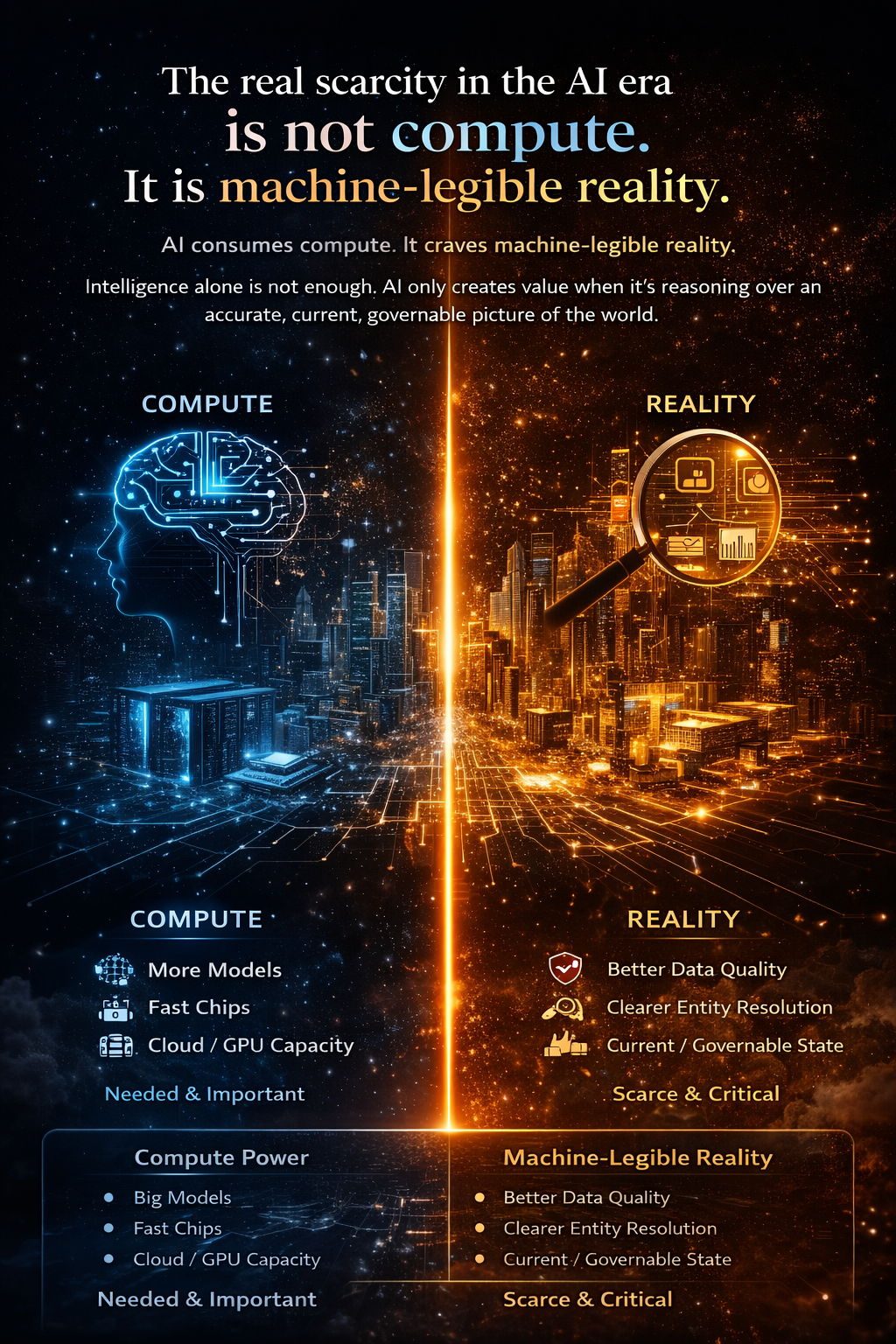
In the AI era, value creation increasingly depends on whether reality can be made legible to machines in a form that can be interpreted, verified, updated, and delegated against. This is exactly why the SENSE–CORE–DRIVER framework matters:

SENSE

This is where reality becomes machine-legible through:

  • signals,
  • entities,
  • state representation,
  • and evolution over time.

CORE

This is where systems interpret machine-readable reality, optimize decisions, reason across context, and generate institutional intelligence.

DRIVER

This is where action becomes legitimate through:

  • delegation,
  • representation,
  • identity,
  • verification,
  • execution,
  • and recourse.

Representation Insurance becomes necessary when this chain becomes economically material. The more institutions rely on SENSE–CORE–DRIVER systems, the more they need confidence that the representation layer is trustworthy enough for consequential decisions. That need is no longer theoretical. It is increasingly being shaped by formal governance expectations and practical assurance mechanisms. (NIST Publications)

Why a New Industry Is Forming Now

Why a New Industry Is Forming Now

Three major shifts are colliding at once.

  1. AI adoption is broadening

OECD reporting shows that firm-level AI use has continued to expand, with 20.2% of firms reporting AI use in 2025 across the countries where data were available, up from 14.2% in 2024 and 8.7% in 2023. That means the number of business decisions touched by machine-readable representations is rising rapidly. (OECD)

  1. Governance is becoming operational

NIST’s AI RMF and its Generative AI Profile are designed to help organizations map, measure, manage, and govern AI risk in practical ways. This signals a shift from vague principles to actionable controls. (NIST)

  1. Regulation is creating demand for evidence

The EU AI Act requires technical documentation for high-risk AI systems and establishes post-market monitoring obligations. That means trust is moving from narrative to auditable process. (Artificial Intelligence Act)

The UK has gone even further by explicitly recognizing AI assurance as a market. UK government publications said the country’s AI assurance market included more than 524 firms and contributed approximately £1.01 billion in gross value added in 2024, while also describing the sector as growing and strategically important. (GOV.UK)

That is not a minor policy footnote. It is a strategic signal.

When governments begin naming a trust layer as an economic sector, leaders should pay attention.

What Representation Insurance Actually Means

What Representation Insurance Actually Means

Imagine a near-future world in which AI agents are:

  • negotiating procurement contracts,
  • validating KYC records,
  • routing patients,
  • flagging suspicious transactions,
  • managing claims,
  • screening candidates,
  • adjusting energy loads,
  • and resolving customer issues.

In that world, what exactly needs to be insured?

Not only the model.

What needs underwriting is the machine-readable trust stack around the decision.

That includes questions such as:

  • Was the identity genuine?
  • Was the source data manipulated?
  • Was the state representation current at the time of decision?
  • Did the system apply the correct policy version?
  • Was the delegation boundary authorized?
  • Can the decision be reconstructed later?
  • Is there a recourse path if the system was wrong?

Representation Insurance is the market response to these questions. It is the set of services and financial mechanisms that effectively says:

We have evaluated enough of this chain to certify it, stand behind it, monitor it, price it, or absorb part of its failure risk.

That is why this category will grow well beyond conventional insurance. It will likely include:

  • AI assurance and certification firms,
  • third-party evaluators,
  • governance and monitoring platforms,
  • provenance and credential infrastructure providers,
  • audit and conformity assessment bodies,
  • specialized insurers and reinsurers,
  • legal and compliance orchestration providers,
  • and post-deployment incident monitoring services.

Some players will verify. Some will monitor. Some will rate. Some will indemnify. Some will supply evidence. Over time, some may become the equivalent of credit bureaus, rating agencies, and cyber-insurance underwriters for machine-readable trust.

A Simple Example: The Mortgage That Looks Correct but Is Not Trustworthy

A Simple Example: The Mortgage That Looks Correct but Is Not Trustworthy

Consider a mortgage approval process.

An AI system reviews income records, payment history, property documents, credit signals, and fraud indicators. The model may be excellent. Yet the bigger risk may sit outside the model itself:

  • a source document is forged,
  • employment data arrives late,
  • identity resolution is weak,
  • property ownership records are outdated,
  • the policy rules are not the current version,
  • and the final decision cannot be reconstructed later for audit.

Now ask the real business question:

Who pays when an AI decision is built on top of a flawed representation of reality?

That question is the economic opening for Representation Insurance.

A lender will want proof that upstream representation quality is good enough. A regulator will want traceability. An insurer will want evidence before offering cover. A platform provider may offer guarantees only if approved controls are followed. A third-party assurance firm may certify the workflow. A provenance layer may prove which records were used, when they were used, and whether they were altered.

The AI model matters. But the insurable question is larger:

Can the institution trust the represented reality on which the model acted?

Why Cyber Insurance Was the Preview

A useful way to understand this market is to look at cyber insurance.

Cyber insurance did not emerge because organizations suddenly became more interested in forms and audits. It emerged because digital dependency created organization-wide risk that was measurable, expensive, and recurring. Once systems became critical, someone had to evaluate controls, price exposure, and absorb part of the downside.

AI is creating a similar dynamic, but with a broader object of concern.

Cyber insurance is primarily about the security of digital systems. Representation Insurance is about the trustworthiness of machine-readable institutional reality.

That is a much larger category.

It touches not just whether systems are secure, but whether the representations flowing through them are reliable enough for automation, decision-making, delegation, and compliance. NIST’s AI RMF and related guidance increasingly reinforce the need to connect trustworthiness, governance, and risk management in operational settings. (NIST Publications)

The pattern is familiar:

When a new layer of dependence becomes critical, markets emerge around trust, verification, and risk transfer.

The New Products This Market Will Create

The New Products This Market Will Create

This is where the idea becomes commercially powerful.

Representation Insurance is likely to create entirely new categories of products and services.

Representation quality scoring

Organizations may be assessed not only on cybersecurity or model performance, but on the quality of their machine-readable representations, including identity integrity, provenance quality, policy versioning, state freshness, and recourse design.

Delegation liability cover

As AI agents act on behalf of institutions, new coverage models may emerge around what decisions can be delegated, under what conditions, and who bears losses when delegated systems act on flawed representations.

Provenance-backed warranties

Vendors and enterprise platforms may begin offering limited guarantees when customers use approved data sources, validated policies, signed records, and continuous monitoring mechanisms.

Continuous assurance subscriptions

Instead of depending only on annual audits, enterprises may increasingly pay for continuous trust monitoring: lineage validation, drift checks, policy mismatch alerts, incident detection, and post-deployment evidence logs.

Representation recovery services

When institutions discover that their machine-readable reality is fragmented, inconsistent, or compromised, new firms may emerge to rebuild trusted representations across customers, assets, permissions, workflows, and partner systems.

This is why the word insurance matters. It signals that trust is becoming economically priced. But the market around it will be much larger than insurance contracts alone.

Why Boards Should Care Now

Boards should not treat this as a niche governance topic. They should see it as a strategic signal about future competitiveness.

In the AI era, growth will increasingly depend on whether your institution is easy for machines to trust. That will influence:

  • autonomous commerce,
  • partner interoperability,
  • compliance cost,
  • fraud exposure,
  • customer acquisition,
  • ecosystem participation,
  • decision speed,
  • and insurability.

A company with strong representation integrity may gain lower friction, better automation, faster approvals, stronger ecosystem trust, and lower long-run risk costs. A company with weak representation integrity may face the opposite: more manual review, higher compliance drag, slower delegation, higher insurance pricing, weaker regulator confidence, and eventual exclusion from machine-mediated markets.

This is why Representation Insurance matters even before a formal market category fully matures. The market itself will shape what trustworthy participation in the AI economy looks like.

The winners will not simply be the firms with the best demos.

They will be the firms whose SENSE layer captures reality well, whose CORE interprets it responsibly, and whose DRIVER allows actions to be delegated with evidence, control, and recourse.

The Biggest Insight: Trust Is Becoming Infrastructure

The Biggest Insight: Trust Is Becoming Infrastructure

The most important idea in this article is simple:

AI is not only automating work. It is forcing institutions to formalize trust.

For decades, business often ran on informal trust:
emails, handoffs, local judgment, tacit knowledge, partial documentation, unwritten exceptions, and human memory.

AI systems cannot reliably operate on that basis.

They require:

  • structured signals,
  • clear entities,
  • explicit states,
  • versioned policies,
  • traceable actions,
  • and known escalation paths.

That is why trust is becoming infrastructure.

The World Economic Forum’s work on responsible AI also reflects this broader direction: trust in AI systems increasingly depends on practical governance, transparency, and institutional readiness rather than abstract aspiration alone. (GOV.UK)

Once trust becomes infrastructure, it becomes:

  • auditable,
  • certifiable,
  • monitorable,
  • financeable,
  • and ultimately insurable.

That is the doorway through which Representation Insurance enters the economy.

The Companies That Will Win

The biggest winners in this market will likely do one of four things exceptionally well.

They verify

They prove that representations, policies, identities, and decisions meet defined standards.

They monitor

They continuously track drift, tampering, anomalies, provenance gaps, and post-deployment failures.

They underwrite

They price and absorb risk based on representation quality, governance maturity, and control strength.

They repair

They help institutions rebuild fragmented machine-readable reality so trusted automation becomes possible again.

This could include insurers, reinsurers, audit firms, AI assurance startups, provenance networks, identity infrastructure companies, governance platforms, and enterprise software players that evolve into trust intermediaries.

Representation Insurance represents a foundational shift in how enterprises design AI systems. As organizations move toward autonomous decision-making, the ability to ensure machine-readable trust will define competitiveness, resilience, and market leadership in the AI economy.

Representation Insurance: The Future of the AI Economy May Depend on This Market

Conclusion: The Future of the AI Economy May Depend on This Market

The AI industry often speaks as though intelligence alone will define the future. It will not.

The future will be built not only by systems that can reason, but by systems that can be trusted to act on machine-readable reality.

That trust will not come from branding alone. It will come from evidence, monitoring, controls, provenance, conformity assessment, assurance, and financial accountability.

That is why Representation Insurance may become one of the most important industries of the AI era.

Its logic is straightforward:

When AI systems begin acting on representations of reality, every flaw in representation becomes an economic risk. And when a risk becomes large enough, repeatable enough, and costly enough, markets form to measure it, price it, and absorb it.

That market is already appearing in fragments: AI assurance ecosystems, conformity assessments, technical documentation regimes, post-market monitoring, and trust-focused policy roadmaps. (Artificial Intelligence Act)

The firms, platforms, and nations that recognize this shift early will not merely build AI.

They will build insurable machine trust.

And in the Representation Economy, that may become one of the most valuable assets of all.

Glossary

Representation Insurance

The emerging market for underwriting, certifying, monitoring, and financially absorbing risks that arise when AI systems act on machine-readable representations of reality.

Machine-Readable Trust

Trust that is not based only on human reputation or judgment, but on structured evidence, verifiable records, provenance, controls, and auditable workflows that machines can reliably use.

Representation Economy

An economic environment in which value increasingly depends on whether reality can be represented in a form that machines can interpret, verify, and act upon.

SENSE

The layer where reality becomes machine-legible through signals, entities, state representation, and evolution over time.

CORE

The layer where systems reason over machine-readable reality, optimize decisions, and generate institutional intelligence.

DRIVER

The layer where AI-enabled action becomes legitimate through delegation, representation, identity, verification, execution, and recourse.

AI Assurance

The set of practices, products, and services used to evaluate whether AI systems are trustworthy, governed, compliant, and fit for use.

Conformity Assessment

A structured process used to evaluate whether a system meets defined regulatory or technical requirements. Under the EU AI Act, this is especially relevant for high-risk AI systems. (Artificial Intelligence Act)

Post-Market Monitoring

Ongoing observation and assessment of an AI system after deployment to ensure it continues to perform safely and in compliance with applicable requirements. (Artificial Intelligence Act)

Provenance

The ability to trace where a piece of data, a model input, or a system decision came from, how it was altered, and whether it can be trusted.

Delegation Liability

The question of who bears responsibility when an AI system is allowed to act on behalf of an institution and that action produces financial, legal, or operational harm.

Insurable Machine Trust

A condition in which trust in AI-driven decisions becomes strong enough, measurable enough, and governable enough to be certified, priced, and covered by market mechanisms.

Representation Insurance

A new class of services that underwrites the accuracy, verifiability, and trustworthiness of machine-readable representations used by AI systems.

Machine-Readable Trust

The ability of AI systems to verify, interpret, and act on data with confidence using structured, validated representations.

Representation Economy

An economic system where value is determined by how effectively entities are represented, understood, and trusted by machines.

SENSE Layer

The layer where real-world signals are captured, structured, and made machine-legible.

CORE Layer

The reasoning engine that interprets representations and makes decisions.

DRIVER Layer

The governance and execution layer ensuring decisions are authorized, verifiable, and actionable.

Representation Risk

The risk that data appears correct but is incomplete, unverifiable, outdated, or misleading for machine interpretation.

Trust Infrastructure

Systems that ensure data integrity, provenance, identity validation, and decision reliability in AI ecosystems.


FAQ

What is Representation Insurance in simple terms?

Representation Insurance is the emerging market that helps organizations trust AI decisions by validating, monitoring, certifying, or financially covering the machine-readable representations those decisions depend on.

How is Representation Insurance different from cyber insurance?

Cyber insurance mainly focuses on the security of digital systems. Representation Insurance goes further by focusing on whether the machine-readable reality used by AI systems is accurate, current, governed, traceable, and trustworthy enough for real decisions.

Why is this important now?

Because AI is moving from advisory roles into operational and high-stakes decisions, while regulators and standards bodies are simultaneously increasing expectations around documentation, risk management, monitoring, and assurance. (NIST)

Which industries could be affected first?

Banking, insurance, healthcare, logistics, public services, identity verification, procurement, compliance, and any sector where AI acts on regulated, consequential, or time-sensitive representations of people, transactions, or assets.

Will this become a real market or stay a niche concept?

There is already evidence of a real market forming around AI assurance, with the UK government explicitly describing AI assurance as a growing market with hundreds of firms and significant economic value. (GOV.UK)

What should boards do first?

Boards should assess whether their institution’s data, policy layers, workflows, delegation paths, and decision evidence are strong enough to support trusted AI at scale. In most organizations, the bottleneck is not model quality alone. It is representation quality.

How does this connect to enterprise strategy?

Representation Insurance is not just a compliance issue. It affects growth, ecosystem participation, automation readiness, risk cost, partner trust, and long-term competitiveness in machine-mediated markets.

Why does this matter for answer engines and generative engines?

Because concepts that are clearly defined, distinctive, and structurally useful tend to be surfaced more often by search systems and AI answer engines. “Representation Insurance” has the potential to become one of those category-defining terms if consistently developed.

  1. What is Representation Insurance in AI?

Representation Insurance is a new industry that ensures AI systems operate on trustworthy, verifiable, and machine-readable data representations.

  1. Why is trust becoming critical in AI systems?

As AI systems make autonomous decisions, incorrect or unverifiable data can lead to costly errors, making trust a foundational requirement.

  1. How is Representation Insurance different from cybersecurity?

Cybersecurity protects systems from attacks, while Representation Insurance ensures that the data and representations used by AI are accurate, verifiable, and reliable.

  1. Who will need Representation Insurance?

Enterprises using AI in finance, healthcare, supply chains, governance, and autonomous systems will increasingly rely on it.

  1. How does SENSE–CORE–DRIVER relate to Representation Insurance?

Representation Insurance operates across:

  • SENSE → validating inputs
  • CORE → ensuring correct interpretation
  • DRIVER → governing execution and accountability
  1. Will Representation Insurance become a major industry?

Yes. As AI adoption grows, trust verification will become as critical as cloud, cybersecurity, and data infrastructure.

References and Further Reading

For authority and credibility, add a short references section at the end of the published article:

  • NIST AI Risk Management Framework and Generative AI Profile, which emphasize trustworthiness and practical AI risk management. (NIST)
  • OECD reporting on the continuing expansion of firm-level AI adoption. (OECD)
  • EU AI Act provisions on technical documentation, conformity assessment, and post-market monitoring for high-risk AI systems. (Artificial Intelligence Act)
  • UK government publications on the growth of the AI assurance market and trusted third-party AI assurance. (GOV.UK)

Institutional Perspectives on Enterprise AI

Many of the structural ideas discussed here — intelligence-native operating models, control planes, decision integrity, and accountable autonomy — have also been explored in my institutional perspectives published via Infosys’ Emerging Technology Solutions platform.

For readers seeking deeper operational detail, I have written extensively on:

Together, these perspectives outline a unified view: Enterprise AI is not a collection of tools. It is a governed operating system for institutional intelligence — where economics, accountability, control, and decision integrity function as a coherent architecture.

Explore the Architecture of the AI Economy

This article is part of a broader research series exploring how institutions are being redesigned for the age of artificial intelligence. Together, these essays examine the structural foundations of the emerging AI economy — from signal infrastructure and representation systems to decision architectures and enterprise operating models.

If you want to explore the deeper framework behind these ideas, the following essays provide additional perspectives:

Together, these essays outline a central thesis:

The future will belong to institutions that can sense reality, represent it clearly, reason about it intelligently, and act through governed machine systems.

This is why the architecture of the AI era can be understood through three foundational layers:

SENSE → CORE → DRIVER

Where:

  • SENSE makes reality legible
  • CORE transforms signals into reasoning
  • DRIVER ensures that machine action remains accountable, governed, and institutionally legitimate

Signal infrastructure forms the first and most foundational layer of that architecture.

AI Economy Research Series — by Raktim Singh

The Machine-Readable Boundary of the Firm: How AI Is Redefining What Companies Own, Outsource, and Orchestrate

Machine-Readable-Boundary-of-the-Firm: Executive Summary

For more than a century, firms have been shaped by a familiar strategic question: What should we do ourselves, what should we buy from others, and what should we coordinate through partners? In the AI era, that question is not disappearing. It is becoming sharper. But the basis for answering it is changing.

Leaders are no longer deciding only on cost, control, and speed. They are deciding on something deeper: what parts of the enterprise can be made legible enough for machines to understand, reason over, and act upon safely. This matters because AI does not operate on mission statements, org charts, or managerial intent. It operates on representations: entities, states, permissions, histories, constraints, tools, and outcomes.

This is why we need a new concept: the machine-readable boundary of the firm. It is the line that separates work a company can reliably expose to AI systems from work that still depends on tacit human judgment, fragmented context, political negotiation, or unstructured institutional memory.

As AI adoption accelerates, this boundary will shape strategy as much as the classic questions of scale and specialization once did. Stanford’s 2025 AI Index reports that 78% of organizations said they used AI in 2024, up from 55% in 2023, while the share using generative AI in at least one business function rose from 33% to 71%. (Stanford HAI)

The next generation of winning firms will not simply deploy better models. They will redesign themselves around what can be represented, governed, delegated, and coordinated.

A New Theory of the Firm for the AI Era

A New Theory of the Firm for the AI Era

The traditional boundary of the firm was shaped by coordination costs. Companies kept activities inside when it was more efficient to manage them internally than to transact through the market. Digital systems reduced some of those coordination costs. APIs, cloud platforms, software integration layers, and shared data environments made it easier to unbundle work.

AI introduces a deeper shift.

The critical question is no longer just:
Can this task be done more cheaply outside the firm?

It is increasingly:
Can this activity be represented clearly enough for machines to participate meaningfully?

That is a different question altogether.

A bank may keep credit policy and exception logic inside, but outsource document extraction, model hosting, and portions of customer service. A manufacturer may retain product architecture and quality thresholds internally, while relying on external robotics providers, sensor platforms, and predictive-maintenance networks. A retailer may keep pricing strategy and brand governance in-house while opening fulfillment, returns, and inventory coordination to ecosystem partners and AI agents.

In each case, the line is not drawn only by economics in the old sense. It is drawn by whether the activity can be made machine-readable, governable, and auditable.

Q: How is AI redefining the boundary of the firm?


AI is redefining the boundary of the firm by shifting it from ownership-based structures to representation-based structures. Companies will retain functions where they have superior proprietary representations (data, models, decision systems), outsource standardized functions, and build ecosystems where coordination across multiple entities creates greater value.

Why This Matters Now

This is not a theoretical issue waiting for some distant future. It is already becoming strategic.

McKinsey’s 2025 State of AI research found that organizations generating more value are not merely experimenting with models. They are redesigning workflows, elevating governance, and building new operating structures around AI. High performers are far more likely than others to fundamentally redesign workflows, and workflow redesign is identified as one of the strongest contributors to meaningful business impact. (McKinsey & Company)

That finding matters because it reveals something leaders often miss: the real bottleneck is rarely model intelligence alone. It is organizational legibility.

An AI system may be able to summarize a contract in seconds. But can it see the right contract version? Can it identify the right customer entity? Can it understand the risk tier, the approval hierarchy, the regulatory context, the current exception rules, and the audit requirements? Can it record the basis of its recommendation and route the outcome to the correct authority?

If not, the issue is not intelligence in the abstract. The issue is the machine-readability of the firm.

The Representation Economy Lens

The Representation Economy Lens

This is where the broader idea of the Representation Economy becomes essential.

In the AI era, firms will increasingly compete not only on products, brands, and talent, but on how well they represent reality in forms that machines can safely use. That means representing:

  • who or what an entity is,
  • what state it is currently in,
  • what history led to that state,
  • what permissions apply,
  • what actions are allowed,
  • what constraints matter,
  • and how outcomes should be verified.

Put differently, AI scales where reality becomes legible.

This is exactly why the machine-readable boundary of the firm is not a narrow technical idea. It is a strategic and economic one.

SENSE–CORE–DRIVER: The Operating Logic Behind the Boundary

SENSE–CORE–DRIVER: The Operating Logic Behind the Boundary

The machine-readable boundary becomes much clearer through the SENSE–CORE–DRIVER framework.

SENSE: Making the Firm Legible

SENSE is the layer that captures signals, attaches them to entities, represents current state, and updates that state over time. It is the legibility layer.

If a firm cannot reliably identify a customer, asset, supplier, shipment, claim, machine, document, or employee state, AI systems will struggle to act effectively.

CORE: Making the Firm Intelligible

CORE is the reasoning layer. It interprets context, optimizes decisions, recommends action, and evolves through feedback.

This is where models operate, but they are only as good as the reality they are given to work with.

DRIVER: Making the Firm Actionable

DRIVER is the execution and legitimacy layer. It determines who delegated authority, what action is permitted, how it is verified, and what recourse exists if the system is wrong.

This matters because AI in enterprises is not only about prediction. It is about action under authority.

A firm’s machine-readable boundary is effectively the point at which all three layers remain strong enough for reliable delegation. When one fails, the task either stays more human, remains more internal, or becomes too risky to scale.

What Companies Will Keep Inside

What Companies Will Keep Inside

The first major consequence of this shift is that firms will keep inside those capabilities where representation quality, strategic sensitivity, and authority design matter most.

  1. Core Judgment Logic

Not generic foundation models, but the organization’s internal decision logic: pricing philosophy, risk interpretation, escalation rules, exception handling, and strategic trade-offs.

These are not just workflows. They are expressions of institutional intent.

  1. Identity and State Systems

As AI acts more on behalf of firms, the value of high-integrity internal state rises. Trusted records of customers, suppliers, assets, liabilities, permissions, and workflow status become strategic.

The OECD AI Principles emphasize the need for inclusive, dynamic, and interoperable digital ecosystems, including mechanisms for safe, fair, legal, and ethical data sharing. (OECD)

  1. Delegation Rules

What can an agent do? When must it seek human review? What evidence must it preserve? How are errors reversed?

Delegation logic will become a competitive differentiator.

  1. Proprietary Context

The more capable AI becomes, the more valuable proprietary institutional memory becomes: customer nuance, negotiation history, edge-case knowledge, tacit process understanding, and internal feedback loops.

  1. Trust and Liability Layers

The NIST AI Risk Management Framework treats governance as a cross-cutting function and organizes risk management around governing, mapping, measuring, and managing AI risk. That is a strong signal that enterprises cannot treat AI as a detached software add-on. They need operating accountability around it. (NIST)

In short, firms will keep inside those things that define how reality is represented, how decisions are authorized, and how responsibility is assigned.

What Companies Will Outsource

What Companies Will Outsource

At the same time, AI will make it easier to outsource work that is easier to standardize, observe, measure, and connect.

These will often include:

  • model infrastructure and inference layers,
  • generic copilots for productivity,
  • narrow back-office workflows,
  • standardized document handling,
  • specialist external agents,
  • orchestration tooling,
  • modular automation services.

Why? Because these capabilities are becoming more connectable and more modular.

Anthropic’s Model Context Protocol is described as an open standard for secure, two-way connections between data sources and AI-powered tools. OpenAI’s Agents SDK and Responses API similarly emphasize easier development of agentic applications with tool use, tracing, and external system connectivity. (Anthropic)

That matters because once intelligence can connect more easily to tools and systems, some parts of the enterprise stop looking like permanent departments and start looking like configurable services.

A procurement function, for example, may keep supplier policy, approval thresholds, and exception governance inside the firm while outsourcing supplier discovery, benchmark research, compliance screening, and document preparation to external tools and specialist agents.

The firm does not outsource judgment entirely. It outsources parts of the machine-readable workflow around judgment.

machine-readable-boundary-of-the-firm-ai: What Companies Will Turn into Ecosystems

What Companies Will Turn into Ecosystems

The most profound shift may happen in the middle ground.

Some functions will no longer fit neatly into “inside” or “outside.” Instead, they will become ecosystems. In these cases, the firm’s strategic role is not to own every activity. It is to define interfaces, permissions, incentives, protocols, and trusted state exchange.

Think of logistics. No major logistics enterprise owns every vehicle, route, customs step, warehouse action, payment mechanism, and last-mile interaction. Coordination already depends on distributed actors.

In the AI era, this ecosystem logic will expand into more knowledge-intensive domains:

  • healthcare coordination,
  • trade finance,
  • industrial maintenance,
  • enterprise procurement,
  • software delivery,
  • education pathways,
  • public services.

The OECD explicitly links trustworthy AI to interoperable ecosystems. The World Economic Forum has similarly argued that AI transformation requires coordinated enablers across business, government, governance, and ecosystem design. (OECD.AI)

That means some of the most important firms of the next decade may not win by owning the whole value chain. They may win by becoming the trusted coordination layer around which the value chain organizes.

In the language of the Representation Economy, they will become the most reliable representation hub in their domain.

The New Strategic Question

For decades, strategy often revolved around a simple question:
Should we make this, buy this, or partner for this?

In the AI era, leaders need a richer set of questions:

  • Can this activity be represented clearly enough for machines to participate?
  • Can it be governed safely enough for delegation?
  • Should it remain proprietary, or should it be opened as a network interface?
  • Is the firm’s advantage in doing the work itself, or in defining the state model through which the work is coordinated?

That is a much more powerful lens than old sourcing logic.

A software firm may discover that coding becomes more modular, while architecture, ontology, policy, and release authority become more central. A hospital may automate triage, scheduling, and summarization, while tightening control over patient-state accountability and care authority. A financial institution may automate monitoring and servicing while protecting control over identity, policy interpretation, and approval logic.

This is why the machine-readable boundary of the firm is not a cost-cutting framework. It is a strategic control framework.

Why Incumbents Should Worry

Incumbents often assume AI will favor scale. Sometimes it will. But AI may also expose hidden fragility.

A large organization with fragmented systems, duplicated identities, stale records, weak permissions, disconnected workflows, and inconsistent escalation paths may look powerful on paper. Yet it may be far less machine-readable than a smaller rival designed around cleaner state, better interoperability, and clearer delegation.

That creates a new risk.

Some incumbents may be too complex to coordinate internally and too illegible to expose effectively to AI systems and external ecosystems.

In plain language: they may be too large for old coordination and too messy for new coordination.

Why Startups Should Pay Attention

Startups should not misread this as a story about enterprise disadvantage alone.

The AI era will produce a new class of firms designed from day one around machine-readable operations. These companies will structure entities, permissions, process states, feedback loops, and delegation pathways from the start.

They will not merely use AI. They will be built so that AI can operate inside them with far less friction.

That design advantage may prove more durable than many founders expect. In sectors where coordination complexity is high, the winners may be the firms that make themselves easiest for machines to understand and govern.

The Global Implication

This shift extends beyond corporate design. It has implications for industries, national competitiveness, and institutional trust.

If machine-readable boundaries become economically decisive, then countries and sectors with stronger digital identity systems, interoperable data environments, credible governance frameworks, and safer sharing mechanisms may enable stronger AI ecosystems.

The OECD’s AI Principles stress interoperable ecosystems and trustworthy governance. The World Economic Forum has also highlighted that AI infrastructure and governance must evolve together, and that trustworthy AI ecosystems will be a critical differentiator for safe and scalable deployment. (OECD.AI)

The next global race may not be won only by who has the biggest model. It may also be won by who has the most governable, interoperable, machine-readable institutional environment.

That is a far bigger story than software.

What Boards and CEOs Should Do Next

Boards and executive teams should begin asking a new class of questions.

  1. Where is our firm still opaque to machines?

Map the activities that depend on fragmented context, undocumented rules, manual judgment, or disconnected systems.

  1. Where does delegation break?

Identify points where AI recommendations cannot safely become action because authority, verification, or recourse is unclear.

  1. What must remain proprietary?

Clarify which state models, internal memory layers, and delegation rules are core to competitive advantage.

  1. What should become modular?

Decide which activities can be exposed through standardized interfaces and externalized without losing strategic control.

  1. Where could we become the ecosystem hub?

Ask where the firm can define the representation layer that others will depend on.

These are not just IT questions. They are board-level strategy questions.

The Boundary Will Be Drawn by Representation: machine-readable-boundary-of-the-firm-ai

Conclusion: The Boundary Will Be Drawn by Representation

The firm of the future will not be defined only by what it owns. It will be defined by what it can make legible, delegate safely, and coordinate at scale.

That is why the machine-readable boundary of the firm matters.

AI will not simply automate tasks inside today’s organizations. It will reshape the very edge of the organization itself. Some functions will move inward because representation quality, trust, and authority matter too much to let go. Some will move outward because they have become modular and machine-connectable. Others will become ecosystems because no single firm should own the entire chain, yet one firm may still define the representation layer that makes the chain work.

This is the deeper strategic shift of the Representation Economy.
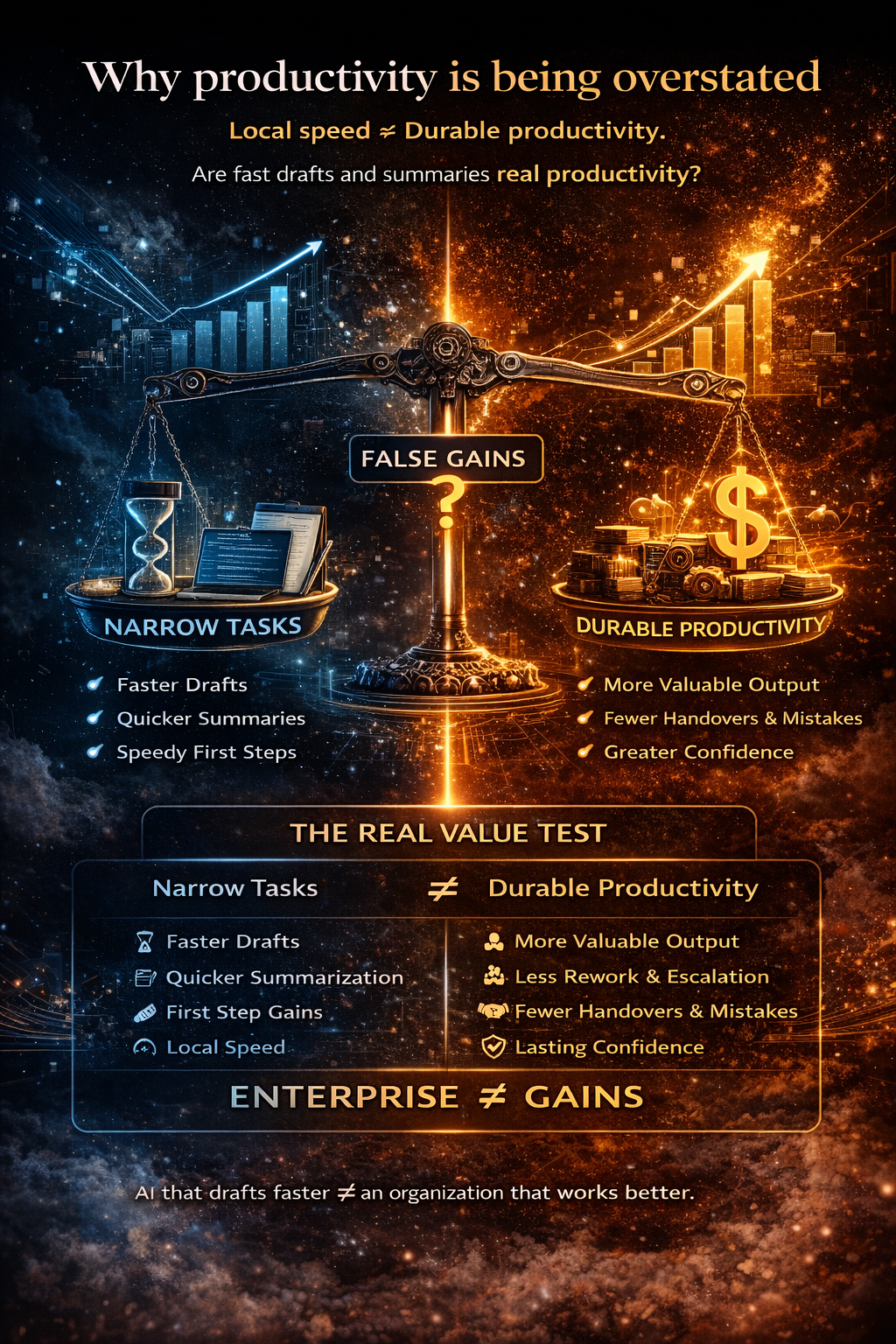
In the industrial era, firms were built to organize labor and assets.
In the software era, firms were built to organize information and workflows.
In the AI era, the most successful firms may be built to organize machine-readable reality.

And once that happens, the boundary of the firm will no longer be drawn only by contracts, departments, or cost curves.

It will be drawn by representation.

FAQ

What is the machine-readable boundary of the firm?

It is the line between activities a company can reliably expose to AI systems and activities that still depend on tacit human judgment, fragmented context, or poorly structured institutional knowledge.

Why does AI change the boundary of the firm?

Because AI requires work to be represented in forms machines can interpret and act on safely. That changes what firms can keep inside, outsource, or coordinate through ecosystems.

What will companies keep inside in the AI era?

They are most likely to keep internal judgment logic, identity and state systems, delegation rules, proprietary context, and trust or liability layers.

What will companies outsource?

They will often outsource modular capabilities such as model infrastructure, generic copilots, narrow automation services, standardized document workflows, and specialist agents.

What does it mean for a firm to become machine-readable?

It means the firm can represent entities, states, permissions, workflows, and outcomes clearly enough for AI systems to reason over and act on them with traceability and control.

Why is governance central to this topic?

Because AI is not only about generating outputs. In enterprises, it increasingly affects decisions and actions. That requires clear authority, verification, accountability, and recourse.

How does this connect to the Representation Economy?

The Representation Economy argues that in the AI era, competitive advantage increasingly depends on how well firms represent reality in machine-usable forms.

Why should boards care?

Because this is not merely an IT issue. It affects sourcing, control, ecosystem power, risk, institutional design, and long-term competitive advantage.

What is the boundary of the firm in the AI era?

The boundary of the firm in the AI era is defined by what can be effectively represented and operated by AI systems, rather than what is owned or controlled.

What will companies keep inside in the AI economy?

Companies will retain proprietary data, core decision systems, and strategic control layers that provide representation advantage.

What functions will companies outsource due to AI?

Standardized, repeatable, and well-represented functions such as infrastructure, support services, and commoditized operations will increasingly be outsourced.

Why will companies become ecosystems?

AI enables coordination across multiple entities, making ecosystems more efficient than vertically integrated firms for many industries.

What is the role of representation in enterprise AI?

Representation determines what AI systems can understand and act upon, making it the key driver of competitive advantage.

How does SENSE–CORE–DRIVER relate to firm boundaries?

It defines how firms capture reality (SENSE), make decisions (CORE), and execute actions (DRIVER), shaping what remains internal vs external.

What is the biggest shift in firm strategy due to AI?

The shift from ownership to orchestration—companies will compete based on how well they coordinate intelligence across systems and partners.

Glossary

Machine-readable boundary of the firm
The strategic line separating work that can be reliably handled with AI participation from work that still requires heavily human, tacit, or politically negotiated coordination.

Representation Economy
An economic lens in which organizations compete increasingly on how well they represent reality in forms that machines can understand, trust, and act upon.

Machine-readable organization
A firm whose entities, states, permissions, workflows, and decisions are structured clearly enough for AI systems to operate within them effectively.

Delegation
The transfer of limited decision or action authority from humans or institutions to AI systems under defined rules and controls.

State representation
A structured description of the current condition of an entity, process, system, or relationship.

Ecosystem strategy
A strategy in which value is created not by owning the whole chain, but by coordinating multiple participants through shared interfaces, trust layers, and rules.

Agentic enterprise
An enterprise in which AI systems do more than assist; they participate in reasoning, coordination, and action across workflows under governance constraints.

Governance
The structures, policies, roles, and control mechanisms that ensure AI systems are used responsibly, lawfully, and in alignment with institutional intent.

Machine-Readable Boundary of the Firm
The dynamic boundary of an organization defined by what AI systems can interpret, optimize, and execute.

Representation Economy
An economic system where value is determined by how effectively entities are represented for machine understanding and coordination.

SENSE Layer
The layer where real-world signals are captured, structured, and made machine-readable.

CORE Layer
The intelligence layer where decisions are made using AI, reasoning systems, and optimization models.

DRIVER Layer
The execution and governance layer ensuring decisions are carried out with accountability, identity, and verification.

Representation Advantage
A firm’s competitive edge derived from superior machine-readable models of its operations, customers, or environment.

AI-Native Firm
An organization designed around machine-readable systems rather than human-only processes.

References and Further Reading

  • Stanford HAI, The 2025 AI Index Report — for enterprise AI adoption and generative AI usage trends. (Stanford HAI)
  • McKinsey, The State of AI: Global Survey 2025 — for workflow redesign, governance, and characteristics of AI high performers. (McKinsey & Company)
  • OECD, AI Principles and Fostering a Digital Ecosystem for AI — for trustworthy AI ecosystems, interoperability, and data-sharing governance. (OECD)
  • NIST, AI Risk Management Framework (AI RMF 1.0) — for governance as a cross-cutting function and the govern-map-measure-manage model. (NIST)
  • Anthropic, Introducing the Model Context Protocol — for open standards connecting data sources and AI tools. (Anthropic)
  • OpenAI, New tools for building agents, Responses API, and Agents SDK — for the growing modularity of agentic application development. (OpenAI)
  • World Economic Forum, Advancing AI Transformation and related governance work — for the ecosystem and governance dimensions of AI scaling. (World Economic Forum)

Institutional Perspectives on Enterprise AI

Many of the structural ideas discussed here — intelligence-native operating models, control planes, decision integrity, and accountable autonomy — have also been explored in my institutional perspectives published via Infosys’ Emerging Technology Solutions platform.

For readers seeking deeper operational detail, I have written extensively on:

Together, these perspectives outline a unified view: Enterprise AI is not a collection of tools. It is a governed operating system for institutional intelligence — where economics, accountability, control, and decision integrity function as a coherent architecture.

Explore the Architecture of the AI Economy

This article is part of a broader research series exploring how institutions are being redesigned for the age of artificial intelligence. Together, these essays examine the structural foundations of the emerging AI economy — from signal infrastructure and representation systems to decision architectures and enterprise operating models.

If you want to explore the deeper framework behind these ideas, the following essays provide additional perspectives:

Together, these essays outline a central thesis:

The future will belong to institutions that can sense reality, represent it clearly, reason about it intelligently, and act through governed machine systems.

This is why the architecture of the AI era can be understood through three foundational layers:

SENSE → CORE → DRIVER

Where:

  • SENSE makes reality legible
  • CORE transforms signals into reasoning
  • DRIVER ensures that machine action remains accountable, governed, and institutionally legitimate

Signal infrastructure forms the first and most foundational layer of that architecture.

AI Economy Research Series — by Raktim Singh

The Representation Reserve Currency: Why AI Will Trust Only a Few Forms of Reality

A Shift Most Leaders Haven’t Fully Seen Yet

For years, the AI conversation has been dominated by models.

Which model is smartest?
Which model is cheapest?
Which model reasons better?
Which model can act?

These questions still matter.

But they are no longer the deepest questions in the market.

A more fundamental shift is underway—quiet, structural, and far more consequential.

As AI moves from generating content to searching, comparing, verifying, deciding, and transacting, a new competitive layer is emerging:

The forms of reality that machines trust by default.

Search engines already reward structured product and merchant data.
Verifiable credentials are becoming machine-checkable proofs.
Digital identity wallets are redefining how trust is presented.
Payment networks are building rails for AI-driven transactions.

This is where a new idea begins:

The Representation Reserve Currency

The Representation Reserve Currency

The Representation Reserve Currency is the small set of machine-readable formats, identities, proofs, and trust rails that AI systems will rely on as their default medium for understanding reality.

Just as reserve currencies reduce friction in global trade, these representations will reduce friction in:

  • machine-mediated discovery
  • verification
  • coordination
  • decision-making
  • and transactions

They will become the preferred language of reality for machines.

And once that happens, a powerful asymmetry emerges:

Institutions that speak in these trusted forms will move faster, scale faster, and be trusted faster than those that cannot.

From Model Advantage to Representation Advantage

From Model Advantage to Representation Advantage

We are entering a new phase of the AI economy.

  • The first wave was about model power
  • The second wave was about operational AI
  • The third wave is about representation power

Competitive advantage is no longer just about better models.

It is about being:

  • easier to see
  • easier to verify
  • easier to reason about
  • easier to act upon

This is the foundation of what I call the Representation Economy.
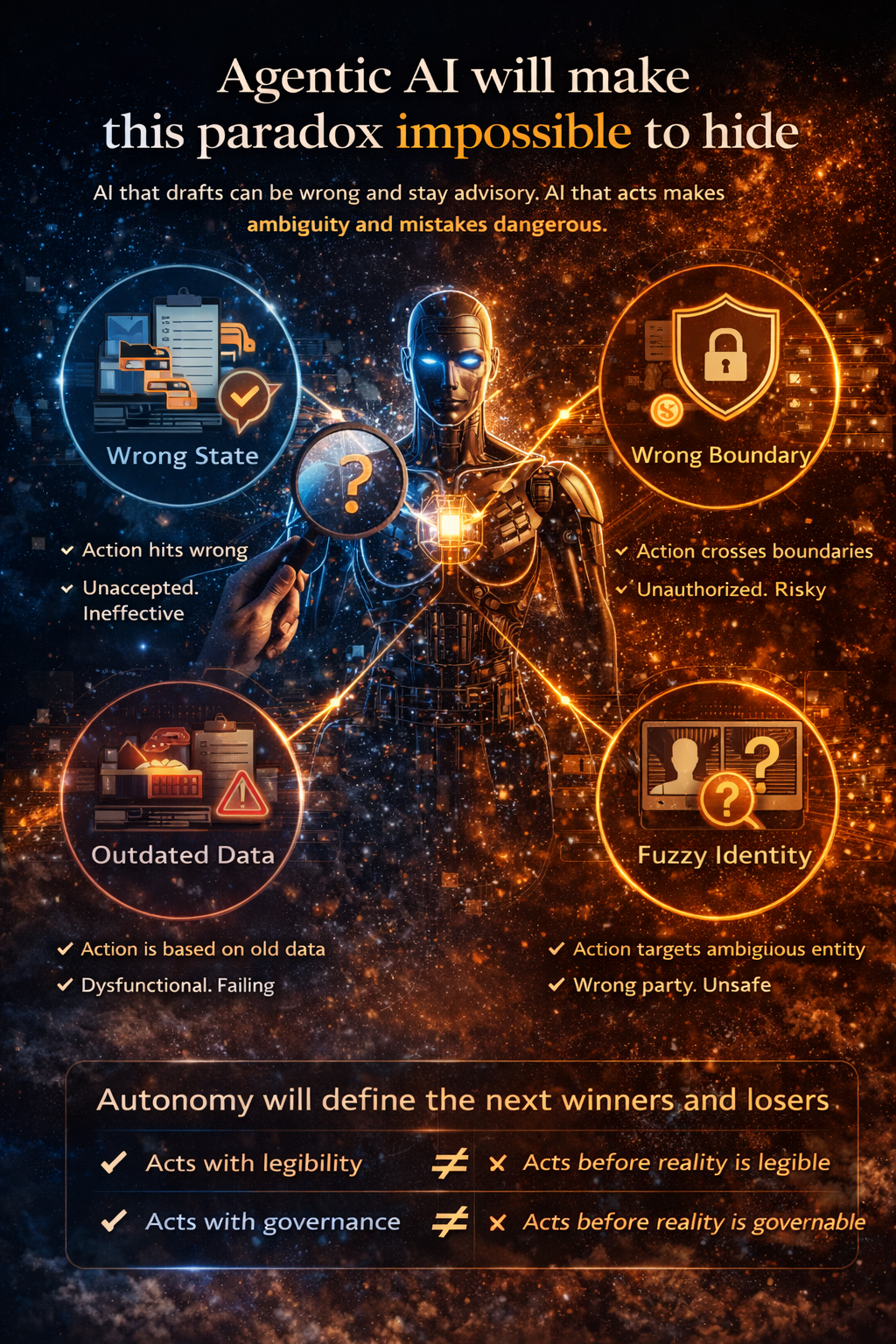
And this is precisely where the SENSE–CORE–DRIVER framework becomes critical:

  • SENSE → makes reality legible
  • CORE → makes it intelligible
  • DRIVER → makes it actionable

The Representation Reserve Currency stabilizes all three.

Why the AI Economy Needs a “Reserve Currency”

Why the AI Economy Needs a “Reserve Currency”

Machines do not understand the world like humans do.

Humans tolerate ambiguity.
Machines do not.

Humans infer.
Machines require structure.

Humans negotiate meaning.
Machines require verification.

This creates a structural requirement:

AI systems perform best when reality is structured, authenticated, and machine-readable.

That is why the ecosystem is converging toward:

  • structured product schemas
  • standardized identity frameworks
  • verifiable credentials
  • interoperable payment tokens
  • shared semantic models

This is not a technical evolution.

It is a market convergence.

Whenever coordination scales, systems gravitate toward common trusted formats.

What Exactly Is a Representation Reserve Currency?

What Exactly Is a Representation Reserve Currency?

It is not a single standard.

It is a class of trusted machine-readable representations.

Examples include:

  • product identity standards (e.g., GS1 Digital Link)
  • semantic schemas (e.g., schema.org)
  • verifiable credentials (W3C)
  • digital identity frameworks (EU Digital Identity Wallet)
  • tokenized payment systems
  • provenance and authenticity standards

The defining property is simple:

Machines prefer representations that are easier to verify, compare, and act upon.

From SEO to Machine Trust

From SEO to Machine Trust

Many organizations still think structured data is about SEO.

That framing is already outdated.

Yes—structured data improves visibility.

But the deeper shift is this:

We are moving from search optimization to machine trust optimization.

When AI systems:

  • recommend products
  • evaluate suppliers
  • validate credentials
  • execute transactions

They are making trust decisions.

And they will increasingly rely on:

  • identity clarity
  • structured representation
  • verifiable claims
  • policy alignment

This is where agentic commerce becomes transformative.

AI systems are no longer just recommending.
They are beginning to act.

And action requires trust.

The SENSE–CORE–DRIVER Logic Behind It

The SENSE–CORE–DRIVER Logic Behind It

SENSE: What Machines Can Reliably See

Reality must first be legible.

Structured data, schemas, identifiers, and credentials reduce ambiguity.

If something is not machine-readable, it is partially invisible.

Representation Reserve Currency defines what machines recognize by default.

CORE: What Machines Can Reason Over

Once visible, reality must be comparable and interpretable.

Standardized representations reduce cognitive uncertainty.

Machines reason better when reality is structured consistently.

DRIVER: What Machines Can Safely Act On

This is where everything becomes real.

Can the system:

  • verify identity?
  • trust the claim?
  • execute safely?
  • audit the outcome?

Representation becomes operational infrastructure.

Simple, Powerful Examples

  1. Commerce

Two companies sell identical products.

  • One: beautiful website, poor structure
  • One: structured, standardized, machine-readable

AI systems will favor the second.

Not because it is better.
Because it is more legible and actionable.

  1. Hiring

  • Candidate A → PDF résumé
  • Candidate B → verifiable credentials + structured skills

Who is easier for AI systems to evaluate?

  1. Healthcare

  • Hospital A → fragmented PDFs
  • Hospital B → interoperable machine-readable records

Which one integrates faster into AI-enabled care systems?

Why Only a Few Will Dominate

Why Only a Few Will Dominate

Not every format becomes a reserve currency.

Only those that achieve:

  • standardization
  • interoperability
  • verification
  • network effects
  • low ambiguity

This means the AI economy will converge around a small set of dominant representations across:

  • identity
  • products
  • credentials
  • payments
  • policies
  • services

What This Means for Boards and C-Suite Leaders

Most organizations are asking:

“Which AI model should we use?”

The better question is:

  • Can machines verify who we are?
  • Can they understand what we offer?
  • Can they trust our claims?
  • Can they transact with us safely?

Are we speaking the reserve currencies of our industry?

This is not a technical decision.

It is a board-level strategic decision.

The New Competitive Advantage

The winners of the AI economy will not simply be:

  • those with the largest models
  • those with the most pilots
  • those with the loudest AI narrative

They will be:

those who are easiest for machines to trust.

The Invisible Shift That Will Decide the Future : The Representation Reserve Currency

Conclusion: The Invisible Shift That Will Decide the Future

The AI economy is not just about intelligence.

It is about representation of reality.

Before machines act, they must trust.
Before they trust, they must understand.
Before they understand, reality must be represented.

And that representation is converging toward a few trusted forms.

The Representation Reserve Currency will define who participates fully in the AI economy—and who remains invisible to it.

Frequently Asked Questions (FAQ) 

What is Representation Reserve Currency in AI?

It refers to a small set of trusted machine-readable formats and standards that AI systems rely on to understand, verify, and act on real-world information.

Why is representation more important than models?

Models depend on data quality and structure. If reality is poorly represented, even the best models cannot reason or act effectively.

How does this impact businesses?

Businesses must ensure their products, identity, credentials, and services are machine-readable, verifiable, and standardized.

What role does SENSE–CORE–DRIVER play?

It explains how AI systems see (SENSE), reason (CORE), and act (DRIVER). Representation Reserve Currency stabilizes all three layers.

Glossary 

  • Representation Economy: An economy where value depends on how well reality is structured for machine use
  • Machine-Readable Reality: Information formatted for AI systems to interpret directly
  • Verifiable Credentials: Cryptographically secure, machine-checkable proofs
  • Agentic Commerce: AI systems autonomously discovering and executing transactions
  • SENSE–CORE–DRIVER: Framework explaining AI perception, reasoning, and execution layers

References & Further Reading

Institutional Perspectives on Enterprise AI

Many of the structural ideas discussed here — intelligence-native operating models, control planes, decision integrity, and accountable autonomy — have also been explored in my institutional perspectives published via Infosys’ Emerging Technology Solutions platform.

For readers seeking deeper operational detail, I have written extensively on:

Together, these perspectives outline a unified view: Enterprise AI is not a collection of tools. It is a governed operating system for institutional intelligence — where economics, accountability, control, and decision integrity function as a coherent architecture.

Explore the Architecture of the AI Economy

This article is part of a broader research series exploring how institutions are being redesigned for the age of artificial intelligence. Together, these essays examine the structural foundations of the emerging AI economy — from signal infrastructure and representation systems to decision architectures and enterprise operating models.

If you want to explore the deeper framework behind these ideas, the following essays provide additional perspectives:

Together, these essays outline a central thesis:

The future will belong to institutions that can sense reality, represent it clearly, reason about it intelligently, and act through governed machine systems.

This is why the architecture of the AI era can be understood through three foundational layers:

SENSE → CORE → DRIVER

Where:

  • SENSE makes reality legible
  • CORE transforms signals into reasoning
  • DRIVER ensures that machine action remains accountable, governed, and institutionally legitimate

Signal infrastructure forms the first and most foundational layer of that architecture.

AI Economy Research Series — by Raktim Singh

The Representation Premium: Why AI Will Reward Companies It Can See, Trust, and Act With

The Representation Premium

For the last two years, most conversations about AI advantage have centered on model quality.

Which model is smarter? Which one is cheaper? Which one reasons better? Which one can act?

Those questions still matter. But they are no longer the only questions that matter.

As AI moves from generating answers to helping people search, compare, decide, negotiate, and transact, a deeper competitive shift is taking shape.

In many markets, the winners will not simply be the firms with the best products, the largest models, or even the most ambitious internal AI programs. Increasingly, the winners will be the institutions that are easiest for AI systems to understand, verify, and work with.

That shift is already visible in the growing importance of structured data for search and commerce, the rise of machine-verifiable credentials, and the emergence of agentic commerce initiatives from major platforms and payment networks. (Google for Developers)

This is where the idea of the representation premium begins.

The representation premium is the market advantage earned by institutions that are easier for AI systems to see, trust, and coordinate with.

In simple terms, if a company is more machine-legible than its rivals, AI systems can find it faster, compare it more confidently, recommend it more safely, and transact with it more easily. Over time, that machine legibility can become a real source of economic reward. The opposite is also true. Institutions that remain opaque, fragmented, or difficult for machines to interpret may suffer a representation discount. That discount may not appear first as a stock-market event. It may show up earlier as weaker discoverability, slower onboarding, lower conversion, higher compliance friction, lower agent preference, and reduced participation in machine-mediated markets.

This idea sits at the heart of the broader representation economy and connects directly to the SENSE–CORE–DRIVER framework. What gets sensed, modeled, trusted, and delegated increasingly shapes what gets chosen.

The Representation Premium is the competitive advantage earned by organizations that are easy for AI systems to understand, verify, and interact with. As AI increasingly mediates search, decisions, and transactions, companies that are more machine-legible will gain higher visibility, trust, and market preference.

What is the Representation Premium?

The Representation Premium is the market advantage gained by institutions that are easier for AI systems to see, trust, and coordinate with.

Why is the Representation Premium important?

Because AI systems increasingly influence discovery, decision-making, and transactions, companies that are machine-readable gain higher selection probability.

What causes a Representation Discount?

Poor data structure, fragmented systems, unverifiable claims, and lack of machine-readable interfaces

The New Market Reality: From Human Choice to Machine-Mediated Choice

The New Market Reality: From Human Choice to Machine-Mediated Choice

Historically, most commercial choice was human choice. A person searched for a supplier, read a review, asked for a proposal, checked documents, compared alternatives, and made a decision.

That world is changing.

Search engines increasingly rely on structured data to understand products, reviews, prices, shipping, availability, organizations, and page meaning. Google explicitly recommends structured product and merchant listing markup so content can appear in richer and more actionable search experiences.

At the same time, AI systems are moving beyond conversation into action. OpenAI introduced Operator in early 2025 and later integrated those capabilities into ChatGPT agent, which can browse websites, fill out forms, and complete online tasks with user oversight.

Visa has announced initiatives designed to enable AI to find and buy through its network, while PayPal has rolled out toolkits and commerce experiences aimed at agentic workflows. (Google for Developers)

That means more economic decisions will be influenced by systems that do not experience brand in the old human way. These systems evaluate clarity, consistency, metadata quality, credential validity, policy fit, operational certainty, and transaction confidence.

A simple example makes the point.

Imagine two industrial suppliers selling nearly identical components at comparable prices.

The first supplier has inconsistent product names across its website and catalogs, outdated certifications hidden in scanned PDFs, unclear delivery commitments, and a contact process that depends on long email chains.

The second supplier publishes structured product data, current availability, machine-readable specifications, verified credentials, clear return policies, and inventory or ordering interfaces that software can understand.

A human buyer may still compare both. But an AI procurement assistant, sourcing engine, or enterprise copilot will almost always have an easier time with the second supplier. That supplier is easier to search, easier to compare, easier to verify, and easier to recommend.

That is representation premium in action.

Representation Is Becoming an Economic Variable

Representation Is Becoming an Economic Variable

Many executives still treat representation as a technical issue. They see it as a matter of metadata, schema design, integration, data quality, or compliance paperwork.

That view is now too narrow.

Representation is becoming an economic variable because AI systems need machine-usable descriptions of reality. If reality is badly represented, AI cannot act on it reliably. If reality is clearly represented, AI can coordinate around it at scale.

This is why standards and trust frameworks matter more than they first appear.

The W3C’s Verifiable Credentials Data Model 2.0 provides a way to express credentials so they are cryptographically secure, privacy-respecting, and machine-verifiable. NIST’s AI Risk Management Framework is designed to help organizations incorporate trustworthiness into AI design, development, use, and evaluation.

The OECD AI Principles, updated in 2024, promote innovative and trustworthy AI that respects human rights and democratic values. These are not abstract policy documents. They are part of the infrastructure that determines whether a machine can rely on what an institution is presenting. (W3C)

In other words, markets are no longer rewarding only good products. They are starting to reward good machine-readable representations of products, services, credentials, obligations, operating state, and institutional trust.

The SENSE–CORE–DRIVER View of the Representation Premium

The SENSE–CORE–DRIVER View of the Representation Premium

The easiest way to understand this shift is through the SENSE–CORE–DRIVER framework.

SENSE: Make Reality Machine-Legible

SENSE is the layer where reality becomes machine-readable.

It includes signals, entities, state, and change over time. If an institution cannot clearly express who it is, what it offers, what condition it is in, what rules apply, and what has changed, then it becomes hard for AI systems to even notice it properly.

A company that cannot cleanly represent its products, certifications, delivery windows, risk posture, or policy boundaries will be less visible in an AI-mediated market.

CORE: Make Representation Reasonable to Machines

CORE is the cognition layer.

Once something is represented, AI systems reason over it. They compare options, interpret context, rank alternatives, estimate risk, detect mismatches, and decide what to recommend.

If your representation is clear, complete, and trustworthy, CORE systems can reason about you with more confidence. If your information is ambiguous or contradictory, machines will assign more uncertainty to you, even if your actual business is strong.

DRIVER: Make Action Legitimate and Scalable

DRIVER is the execution and legitimacy layer.

This is where decisions become actions. A system checks whether it is authorized to proceed, whether policies allow the step, whether credentials are valid, and whether the action can be audited, explained, or reversed.

If your institution supports legitimate machine action, it becomes easier for AI systems to coordinate with you in real workflows.

The representation premium appears when all three layers reinforce one another. You are visible enough to be sensed, understandable enough to be reasoned over, and trustworthy enough to be acted with.

Easy Examples from Everyday Markets

The idea sounds strategic, but it is actually very practical.

Example 1: Restaurants

One restaurant has a great Instagram presence, but no structured menu, inconsistent opening hours across platforms, no reservation interface AI assistants can use, and incomplete location details.

Another restaurant publishes current hours, menu items, allergy information, reservation hooks, and standardized location data.

Which one is more likely to be surfaced by an AI assistant helping a family decide where to eat? The second one.

Example 2: Manufacturers

One manufacturer says it is compliant, certified, and export-ready, but the proof sits across old brochures, email attachments, and scattered PDFs.

Another presents current certifications, trade details, quality checks, supplier status, and product specifications in machine-readable formats, with verification where needed.

Which one becomes easier for procurement systems, insurers, customs workflows, and financing partners to process? Again, the second one.

Example 3: Universities

One university describes its programs only in narrative marketing language.

Another expresses program structure, credentials, accreditation, course outcomes, and student support clearly and consistently in formats that digital systems can understand.

Which institution is more likely to be recommended by AI career advisors, skills systems, and education marketplaces? The second one.

In each case, the premium is not about hype. It is about reducing machine uncertainty.

Why This Matters Even More in a Same-Model World

Why This Matters Even More in a Same-Model World

A common assumption in AI strategy is that if everyone gains access to similar frontier models, differentiation will collapse.

The opposite may happen.

When models become widely available, representation quality matters more. If the same general-purpose AI can evaluate ten suppliers, ten hospitals, ten universities, or ten financial providers, it still has to decide which one is easier to interpret, safer to engage, and more appropriate for the user’s needs.

In a same-model world, better representation becomes a stronger differentiator because the model’s intelligence is no longer the scarce asset. What remains scarce is clean, trustworthy, machine-usable institutional reality.

This is why structured data, verifiable credentials, policy metadata, trusted identity layers, and interoperable interfaces will matter more, not less, as models improve. The smarter the AI layer becomes, the more value shifts toward the quality of the world it is allowed to see and act upon. (Google for Developers)

The Representation Discount Is Just as Important

Every premium creates a discount.

A representation discount is the market penalty paid by institutions that are hard for AI systems to interpret or trust.

This happens when:

  • data is fragmented across legacy systems,
  • public-facing information is inconsistent,
  • policies are ambiguous,
  • credentials are difficult to verify,
  • operating state is opaque,
  • interfaces are human-friendly but machine-hostile.

When that happens, AI systems either avoid the institution or require expensive human intervention before moving forward.

That friction matters.

In a world of AI-assisted commerce, AI procurement, AI-supported customer journeys, and AI-enabled enterprise decision-making, friction is not just an operational inconvenience. It becomes a competitive tax.

An institution may still be excellent in reality. But if it is poorly represented, it may be under-selected by the systems that increasingly mediate demand, trust, and coordination.

This Is Not Only a Big-Company Story

This Is Not Only a Big-Company Story

The representation premium is not just for large enterprises.

In fact, it may be especially important for small and medium-sized institutions. Smaller firms often lack the brand power, sales reach, and lobbying muscle of larger incumbents. But they can still compete if they become easier for AI systems to find, verify, and work with.

A niche exporter with transparent lead times, structured catalog data, verified certifications, and AI-readable trade documents may become more discoverable in machine-mediated sourcing than a larger but less legible competitor.

A regional school with machine-readable credential pathways may become more visible to digital learning and career systems.

A specialized clinic with clearly represented services, credential evidence, and interoperable appointment workflows may become easier for digital health systems to route patients toward, subject to regulatory and safety boundaries.

The representation premium, then, is not only a story about dominant firms. It may become a ladder for agile institutions that learn to become machine-legible early.

What Leaders Should Do Now

The key executive question is simple: how does an institution earn a representation premium?

  1. Treat representation as strategy, not documentation

Do not treat this as a back-office cleanup exercise. Ask what your institution must be easy for machines to understand.

  1. Clean up the public layer

Products, services, credentials, policies, locations, and commitments should be expressed clearly and consistently across channels.

  1. Make trust machine-usable

Claims that matter to transactions should be verifiable where possible. Credentials, provenance, auditability, and identity will increasingly shape machine confidence.

  1. Reduce ambiguity at the action boundary

If an AI system wants to book, buy, verify, route, compare, or recommend, can it understand your terms, permissions, constraints, and recourse paths?

  1. Align internal and external representation

Many organizations tell one story to the market and run a different reality inside. In the AI era, those gaps become more dangerous because machine systems amplify inconsistency rather than hide it.

Why This Matters for the Future of Markets

Why This Matters for the Future of Markets

The deeper point is this: AI is not only changing intelligence. It is changing selection.

For decades, markets selected through human attention, human review, and human trust. Increasingly, markets will also select through machine legibility, machine verification, and machine coordination.

That does not mean humans disappear. It means more of the path to human choice will be shaped by AI systems acting as filters, analysts, brokers, negotiators, and agents.

When that happens, institutions that are easier for AI systems to see, trust, and coordinate with will enjoy real advantages in discovery, recommendation, conversion, onboarding, compliance, and transaction flow. Over time, those advantages can compound into stronger market position.

That is the representation premium.

This is why representation economics matters. The next era of competition will not be won only by firms with better models. It will also be won by firms that design better representations of reality.

In the language of SENSE–CORE–DRIVER, the institutions that win will be those that make themselves easier to sense, easier to reason about, and easier to engage with legitimately.

That is not a technical footnote to the AI economy.

It is one of its next pricing mechanisms.

Key Takeaways

  • AI is shifting markets from human choice to machine-mediated selection

  • Machine legibility is becoming a competitive advantage

  • Representation Premium determines visibility, trust, and coordination

  • Poor representation leads to Representation Discount

  • SENSE–CORE–DRIVER explains how AI selects institutions

Conclusion

The first phase of the AI era rewarded experimentation. The second rewarded deployment. The next phase will reward representation.

Boards and C-suites need to see this shift early. In an AI-mediated market, value will not flow only to the organizations with the best tools. It will increasingly flow to the organizations that are easiest for intelligent systems to interpret, trust, and coordinate with.

That is why the representation premium deserves serious board-level attention. It links AI strategy to discoverability, trust, transaction readiness, governance, and market position. It reframes machine legibility from a technical hygiene issue into a source of economic advantage.

The institutions that win in the next decade may not simply be the most automated or even the most intelligent. They may be the most clearly represented.

And that changes everything.

Frequently Asked Questions (FAQ)

What is the representation premium in AI?

The representation premium is the market advantage earned by institutions that are easier for AI systems to see, trust, verify, and coordinate with. It reflects the growing value of machine legibility in AI-mediated markets.

Why does machine legibility matter for business strategy?

Machine legibility matters because AI systems increasingly influence search, recommendation, procurement, compliance, and transaction decisions. If your institution is hard for machines to understand, it may be under-selected even if it is strong in reality.

What is the difference between representation premium and representation discount?

A representation premium is the advantage gained by institutions that are easy for AI systems to work with. A representation discount is the penalty suffered by institutions that are opaque, inconsistent, or hard to verify.

How does SENSE–CORE–DRIVER relate to the representation premium?

SENSE makes an institution visible to machines. CORE makes it understandable to machine reasoning systems. DRIVER makes it safe and legitimate for machines to act on that understanding. The premium emerges when all three layers work well together.

Is the representation premium only relevant for large enterprises?

No. Small and medium-sized firms may benefit even faster because better machine legibility can help them compete with larger firms in AI-mediated discovery, sourcing, and service workflows.

What are examples of representation premium in practice?

Examples include structured product data for commerce, machine-verifiable credentials, consistent policy metadata, AI-readable service descriptions, interoperable booking or ordering workflows, and clear digital trust signals. (Google for Developers)

Why will this matter more as AI models improve?

As models become more widely available, model quality becomes less exclusive. Representation quality then becomes a stronger differentiator because AI systems still need clear, trustworthy, machine-usable information to make decisions. (OpenAI)

Glossary

Representation Premium
The market advantage earned by institutions that are easier for AI systems to see, trust, and coordinate with.

Representation Discount
The penalty paid by institutions that are difficult for AI systems to interpret, verify, or transact with.

Representation Economy
An economic environment in which competitive advantage increasingly depends on how reality is represented for intelligent systems.

Machine Legibility
The degree to which an institution’s products, policies, credentials, services, and operating state can be understood by software and AI systems.

SENSE–CORE–DRIVER
A strategic framework in which SENSE makes reality machine-legible, CORE reasons over that representation, and DRIVER governs action, legitimacy, and recourse.

Structured Data
Standardized markup that helps search engines and software systems understand page content and entities more accurately. (Google for Developers)

Verifiable Credentials
Digital credentials designed to be cryptographically secure, privacy-respecting, and machine-verifiable. (W3C)

Agentic Commerce
Commerce in which AI agents help discover, compare, and complete purchases or payment flows on behalf of users. (usa.visa.com)

Machine-Readable Trust
Trust signals that AI systems can verify and act upon, such as credential validity, policy clarity, provenance, and identity assurance.

Action Boundary
The point at which an AI system moves from analysis or recommendation into real-world action.

References and further reading

For authority and further reading, you can cite these in your published version:

  • Google Search documentation on structured data and merchant listings. (Google for Developers)
  • W3C Verifiable Credentials Data Model 2.0. (W3C)
  • NIST AI Risk Management Framework. (NIST)
  • OECD AI Principles. (OECD)
  • OpenAI announcements on Operator and ChatGPT agent. (OpenAI)
  • Visa and PayPal materials on agentic commerce. (usa.visa.com)

Institutional Perspectives on Enterprise AI

Many of the structural ideas discussed here — intelligence-native operating models, control planes, decision integrity, and accountable autonomy — have also been explored in my institutional perspectives published via Infosys’ Emerging Technology Solutions platform.

For readers seeking deeper operational detail, I have written extensively on:

Together, these perspectives outline a unified view: Enterprise AI is not a collection of tools. It is a governed operating system for institutional intelligence — where economics, accountability, control, and decision integrity function as a coherent architecture.

Explore the Architecture of the AI Economy

This article is part of a broader research series exploring how institutions are being redesigned for the age of artificial intelligence. Together, these essays examine the structural foundations of the emerging AI economy — from signal infrastructure and representation systems to decision architectures and enterprise operating models.

If you want to explore the deeper framework behind these ideas, the following essays provide additional perspectives:

Together, these essays outline a central thesis:

The future will belong to institutions that can sense reality, represent it clearly, reason about it intelligently, and act through governed machine systems.

This is why the architecture of the AI era can be understood through three foundational layers:

SENSE → CORE → DRIVER

Where:

  • SENSE makes reality legible
  • CORE transforms signals into reasoning
  • DRIVER ensures that machine action remains accountable, governed, and institutionally legitimate

Signal infrastructure forms the first and most foundational layer of that architecture.

AI Economy Research Series — by Raktim Singh

Representation Economics: The New Law of Value Creation in the AI Era

Why the next winners will not simply have better AI — they will be easier for machines to see, trust, and coordinate with

Representation Economics

For years, the artificial intelligence conversation has revolved around one question: Which model is better? Bigger models, faster inference, better benchmarks. But a deeper question is beginning to matter more.

Why do some organizations become easier for AI systems to understand, trust, and work with than others? The answer points to a new economic reality. In the AI era, competitive advantage will not come only from better algorithms. It will come from better representation of reality. I call this shift Representation Economics

Executive Summary

For the last few years, the AI conversation has been dominated by one question:

Which model is better?

Which model is faster.
Which model is cheaper.
Which model reasons better.
Which model has the strongest benchmark score.

That question mattered in the first phase of the AI era. It still matters now. But it is no longer the most important question.

A deeper question is beginning to define the next era:

Why do some organizations become easier for AI systems to understand, trust, and work with than others?

That is where a new law of value creation begins.

The first wave of the digital economy rewarded firms that digitized processes.
The second wave rewarded firms that captured and used data well.
The next wave will reward firms that can represent reality in ways machines can reliably interpret, reason over, verify, and act upon.

I call this Representation Economics.

Representation Economics is the idea that in the AI era, value will increasingly flow to institutions that are better at making the world machine-legible, machine-trustworthy, and machine-coordinatable. In other words, advantage will not come only from intelligence. It will come from the quality of the representation that intelligence can operate on.

That shift matters because AI systems do not act on reality directly. They act on representations of reality.

A loan approval system does not see a human life in full. It sees an application, a credit history, a transaction pattern, a risk profile, and a policy context.
A healthcare AI does not see a patient in all their complexity. It sees records, scans, symptoms, lab values, and care rules.
A supply-chain AI does not see “the business.” It sees inventories, vendors, delays, exceptions, service levels, and cost signals.

If those representations are incomplete, stale, fragmented, or misleading, even a very powerful model will make weak decisions. If those representations are timely, structured, governed, and connected to the right entities and states, even a less glamorous model can create real enterprise value.

That is why the next competitive edge is not just model quality. It is representation quality.

This is not a theoretical issue. Stanford’s 2025 AI Index shows that AI’s influence across the economy and global governance is intensifying, while organizations are still uneven in how they operationalize trustworthy AI. In parallel, major governance frameworks from NIST, OECD, UNESCO, and the European Union all emphasize that trust in AI depends not only on model capability, but on governance, transparency, oversight, and the conditions in which AI is deployed. (Stanford HAI)

Why board members should care

Most boards are still evaluating AI through a familiar lens:

  • model investment
  • productivity uplift
  • use cases
  • risk and compliance
  • build-versus-buy decisions

Those are important. But they are increasingly downstream.

The more strategic question is whether the institution is becoming representable.

Can the organization make its operational reality visible to machines in a way that is current, governed, attributable, and actionable? Can its systems distinguish signal from noise? Can they connect events to entities, states to decisions, and decisions to legitimate execution? Can they explain what happened, why it happened, and what recourse exists if the system was wrong?

If the answer is no, then AI may still produce demos, copilots, and isolated productivity gains. But it will struggle to produce durable institutional advantage.

That is why Representation Economics belongs in the boardroom. It changes the unit of strategic analysis from “how much AI do we have?” to “how well can our institution be seen, reasoned over, and trusted by intelligent systems?”

What Representation Economics really means

What Representation Economics really means

Representation Economics is not just about data quality.

That distinction matters.

Many leaders hear arguments like this and reduce them to a familiar phrase: garbage in, garbage out. But this is much bigger than that. Data quality is only one part of the story.

Representation Economics asks a broader set of questions:

  • Can the institution detect the right signals?
  • Can it connect those signals to the right entities?
  • Can it model the current state correctly?
  • Can it update that state as reality changes?
  • Can it reason over that state in context?
  • Can it act within legitimate authority boundaries?
  • Can it prove why it acted?
  • Can it reverse or correct action when reality was misunderstood?

That is why Representation Economics is not merely a data concept. It is an institutional design concept.

In the industrial era, factories created value by transforming raw materials into products.
In the AI era, institutions increasingly create value by transforming messy reality into actionable representation.

The firms that do this well will be easier to buy from, easier to insure, easier to regulate, easier to finance, easier to integrate with, and easier for AI systems to trust.

The firms that do this badly will suffer friction everywhere.

A simple example: two logistics companies

A simple example: two logistics companies

Imagine two logistics companies.

Both buy access to the same class of foundation models.
Both use similar optimization software.
Both hire strong AI teams.

But Company A has clean, machine-readable records of shipments, drivers, route exceptions, warehouse capacity, vendor obligations, weather dependencies, and customer commitments. Its systems update in near real time. Policies are connected to operational actions. Exceptions are tagged, stored, and learnable.

Company B has the same ambition but runs on scattered spreadsheets, disconnected apps, undocumented workarounds, duplicate vendor records, inconsistent location IDs, and stale exception logs.

Which company will get more value from AI?

Not the company with “better AI” in theory.
The company with better representation of operational reality.

In Company A, AI reasons over what is actually happening.
In Company B, AI reasons over fragments, shadows, and approximations.

That is the difference between intelligence applied to reality and intelligence applied to noise.

Why value is moving from data advantage to representation advantage

Why value is moving from data advantage to representation advantage

For years, business strategy treated data as the central asset of the AI economy. That was directionally right, but incomplete.

Raw data alone does not create durable advantage. Many firms are data-rich and still operationally confused. They collect huge volumes of information but cannot connect it into a coherent, trusted, action-ready picture.

Representation is different.

Representation means that signals are not merely stored. They are organized into meaningful entities, current states, permissions, relationships, exceptions, obligations, and decision contexts.

A bank may have enormous volumes of customer data. But if it cannot represent financial intent, fraud context, shifting risk posture, delegated authority, and recourse pathways clearly enough for AI systems to act responsibly, that data does not become strategic value.

A hospital may have digitized records. But if AI cannot reliably tell which condition matters now, which treatment rule applies, which clinician has authority, and what should happen if a recommendation was wrong, then digitization is not enough.

Representation advantage is what turns information into institutional capability.

That is why the next winners will not simply be data-rich. They will be representation-rich.

The SENSE–CORE–DRIVER logic of Representation Economics

The SENSE–CORE–DRIVER logic of Representation Economics

This is where the SENSE–CORE–DRIVER framework becomes essential.

Representation Economics needs a practical architecture. SENSE–CORE–DRIVER provides that architecture.

SENSE: making reality legible

SENSE is the layer where reality becomes machine-legible.

It includes:

  • Signal: detecting events, changes, and traces from the world
  • ENtity: attaching those signals to a persistent actor, object, location, or asset
  • State representation: building a structured view of current condition
  • Evolution: updating that state over time as new signals arrive

Without SENSE, AI operates in darkness.

Think of a smart factory. Sensors may detect machine temperature, vibration, output, and maintenance events. But unless those signals are tied to the right machine, the right production line, the right maintenance history, and the right business impact, the system does not truly understand the factory. It is collecting signals without constructing reality.

CORE: turning legibility into judgment

CORE is the cognition layer.

It enables the institution to:

  • Comprehend context
  • Optimize decisions
  • Realize action pathways
  • Evolve through feedback

This is where models, reasoning systems, policy engines, simulations, retrieval layers, and workflows come together.

But CORE is only as good as the representation it receives. Strong reasoning on weak representation still creates fragile outcomes.

DRIVER: making action legitimate

DRIVER is the layer that many AI strategies still underweight.

It includes:

  • Delegation: who authorized the system to act
  • Representation: what model of reality the system used
  • Identity: which entity was affected
  • Verification: how the action is checked
  • Execution: how action is carried out
  • Recourse: what happens if the system is wrong

This is where AI moves from “interesting” to “institutional.”

Many enterprises can generate recommendations. Far fewer can safely let machines trigger actions in finance, healthcare, HR, procurement, law, public services, or critical infrastructure. That is because acting systems require legitimacy, not just intelligence.

This direction is consistent with the broader global policy landscape. NIST’s AI Risk Management Framework is built around governance, mapping, measurement, and management. OECD’s AI Principles promote trustworthy AI aligned with human rights and democratic values.

UNESCO’s recommendation emphasizes transparency, fairness, and human oversight across all 194 member states. The EU AI Act adds legal obligations based on risk and use context. The World Economic Forum’s recent work on AI agents likewise focuses on evaluation and governance as these systems move closer to real-world action. (NIST Publications)

Why this changes competition

Representation Economics changes how competitive advantage is built.

In the industrial view, firms competed on scale, labor, cost, and distribution.
In the digital view, they also competed on software, data, and platforms.
In the AI view, they will increasingly compete on something even more foundational:

How clearly and credibly they can be represented inside machine-mediated systems.

This has major consequences.

A company that is easier for AI procurement systems to evaluate may win more contracts.
A company that is easier for automated compliance systems to verify may face lower friction.
A company that is easier for AI finance systems to assess may access capital faster.
A company that is easier for machine agents to integrate with may become the preferred node in a larger ecosystem.

This is not science fiction. It is the natural consequence of a world in which more decisions are mediated by software that reads structured representations before it acts.

In such a world, poor representation becomes an economic tax.

Why most incumbents are more fragile than they think

Why most incumbents are more fragile than they think

Many incumbents still think their AI challenge is about tooling.

It is not.

Their deeper challenge is that the institution was never designed to produce machine-ready reality.

Knowledge is spread across email, PDFs, chat threads, contracts, forms, ERP systems, tribal memory, and undocumented exceptions. Policies often live separately from operations. Authority structures are clear to humans but invisible to machines. Critical state changes are either delayed, ambiguous, or trapped in handoffs.

So companies deploy copilots and agents on top of an institution that remains structurally hard to represent.

That is why so many AI pilots look impressive but fail to scale into defensible enterprise value.

The bottleneck is not always the model.
It is the institution’s representational condition.

What new kinds of companies will emerge

Representation Economics also points to a new category of firms.

Just as the internet created search engines, cloud platforms, payment rails, and identity layers, the AI era will create organizations whose core business is to make reality more machine-legible and machine-trustworthy.

These may include firms that specialize in:

  • institutional state infrastructure
  • delegated authority management
  • representation assurance
  • machine-readable compliance
  • identity and provenance synchronization
  • recourse and reversal systems
  • machine-legibility layers for finance, healthcare, logistics, manufacturing, and government

In other words, some of the most important companies of the next decade may not sell intelligence itself. They may sell the infrastructure that makes intelligence trustworthy at scale.

The global dimension: why representation will become a strategic issue for nations

The global dimension: why representation will become a strategic issue for nations

This is not only an enterprise story. It is also a geopolitical one.

Countries and regions are increasingly shaping the institutional environment in which AI operates. The EU AI Act is the first comprehensive legal framework on AI by a major regulator. UNESCO’s recommendation applies globally across 194 member states. OECD’s principles provide an intergovernmental baseline for trustworthy AI.

The World Bank and UNDP continue to emphasize digital public infrastructure, especially identity, payments, and trusted data exchange, as foundational systems for secure and inclusive digital coordination. India’s current articulation of DPI also highlights how interoperable identity, payments, and data exchange can operate as population-scale public rails. (Digital Strategy)

That matters because the next race is not only about chips, models, or compute. It is also about who builds the strongest representation environment for machine-mediated economies.

The strategic implication for CEOs and boards

The next decade will not reward firms simply for “using AI.”

It will reward firms that redesign themselves so that AI can operate on reality with greater clarity, trust, and legitimacy.

That means boards should begin asking different questions:

  • What realities in our institution must be represented accurately before AI can influence decisions?
  • Where are our state models fragmented or stale?
  • Where do policies fail to travel with operational action?
  • Which decisions require explicit recourse architecture?
  • What parts of our business are invisible to machine systems today?
  • Are we investing in intelligence without investing in representability?

Those questions sit much closer to durable advantage than another model bake-off.

Conclusion: the new law of value creation

So what is the new law?

It is this:

In the AI era, value will increasingly accrue to institutions that can turn reality into reliable representation, representation into sound judgment, and judgment into legitimate action.

That is the sequence.

Not data alone.
Not models alone.
Not automation alone.

But:

SENSE → CORE → DRIVER

That is why Representation Economics matters.

It explains why some firms will appear AI-enabled but remain fragile.
It explains why others will quietly compound advantage.
It explains why machine trust will become an economic force.
And it explains why the future belongs not simply to intelligent institutions, but to institutions that are easier for intelligence to work with.

The next decade will not be won only by those who build powerful AI.

It will be won by those who build representable institutions.

And that may prove to be the defining law of value creation in the AI era.

Why This Idea Matters for the Global AI Economy

The concept of Representation Economics sits at the intersection of several major global developments:

  • the rapid deployment of enterprise AI systems

  • emerging global governance frameworks such as the NIST AI Risk Management Framework

  • international principles from the OECD and UNESCO

  • regulatory structures like the EU AI Act

  • and the growing focus on trustworthy AI discussed by the World Economic Forum

Together, these developments signal a major shift: the future of AI will depend not only on model capability but also on the institutional architecture that makes machine decision-making reliable and legitimate.

Summary

What this article argues
AI advantage is moving beyond model quality and raw data. The next winners will be institutions that can represent reality in ways machines can reliably interpret, reason over, verify, and act upon.

Core framework
SENSE → CORE → DRIVER

Who should read this
Board members, CEOs, CTOs, CIOs, chief risk officers, enterprise architects, AI governance leaders, and policy strategists.

Why this matters now
As AI systems move from generating content to influencing decisions and triggering actions, machine-legible, trusted representation becomes a strategic asset.

FAQ

What is Representation Economics in simple language?

Representation Economics is the idea that in the AI era, value will increasingly flow to organizations that are easier for intelligent systems to understand, trust, and coordinate with.

How is Representation Economics different from data quality?

Data quality is only one part of the story. Representation Economics is about turning signals into connected entities, current states, permissions, decision contexts, and governed action pathways.

Why does this matter for boards and C-suite leaders?

Because the real strategic issue is no longer only “Do we have AI?” It is “Can our institution be represented well enough for AI to create safe, scalable, defensible value?”

What is the SENSE–CORE–DRIVER framework?

It is a practical architecture for building representable institutions. SENSE makes reality legible, CORE reasons over that reality, and DRIVER ensures action happens with legitimacy, verification, and recourse.

Why is representation more important than model quality in many enterprise settings?

Because even powerful models fail when they operate on fragmented, stale, or misleading representations of the organization’s actual reality.

What kinds of companies could win in a Representation Economics world?

Companies that become easier for AI systems to evaluate, trust, integrate with, regulate, finance, insure, and transact with.

Will Representation Economics matter only for enterprises?

No. It also matters for governments, regulators, public infrastructure builders, financial systems, and cross-border digital ecosystems.

Is this aligned with current global AI governance trends?

Yes. Official frameworks from NIST, OECD, UNESCO, the EU, the World Economic Forum, the World Bank, and UNDP increasingly emphasize governance, oversight, transparency, risk management, and trusted digital infrastructure around AI. (NIST Publications)

What is Representation Economics?

Representation Economics is the idea that in the AI era, value will increasingly flow to organizations that can represent reality in ways machines can reliably interpret, reason over, and act upon.

Why does representation matter for AI systems?

AI systems do not operate directly on the physical world. They operate on representations of reality, such as structured data, models of state, and institutional context. The quality of these representations determines the quality of AI decisions.

How is Representation Economics different from data strategy?

Data strategy focuses on collecting and storing information. Representation Economics focuses on structuring reality so machines can reason and act responsibly within institutions.

Why will Representation Economics matter for boards and CEOs?

Because AI systems will increasingly influence operational, financial, and strategic decisions. Organizations that cannot represent their reality clearly will struggle to deploy AI safely and effectively.

Glossary

Representation Economics
A framework for understanding how value in the AI era increasingly depends on how well institutions make reality machine-legible, trustworthy, and actionable.

Machine legibility
The degree to which systems, entities, states, and events are structured clearly enough for machines to interpret reliably.

Machine trust
The confidence an AI-mediated system can place in the identity, state, provenance, and policy alignment of the information and actors it interacts with.

SENSE
The layer that detects signals, connects them to entities, models state, and tracks change over time.

CORE
The reasoning layer that interprets context, optimizes choices, and evolves decisions through feedback.

DRIVER
The legitimacy layer that governs delegation, verification, execution, and recourse when AI systems influence or take action.

Representable institution
An institution whose operational reality is sufficiently visible, structured, attributable, and governed for intelligent systems to work with safely and effectively.

Representation advantage
A strategic advantage created when an institution is easier for AI systems to understand, evaluate, coordinate with, and trust.

Digital public infrastructure
Foundational digital systems such as identity, payments, and trusted data exchange that support secure and scalable coordination across society. (Open Knowledge Repository)

References and further reading

For readers who want to explore the broader policy and governance context behind this shift:

  • Stanford HAI, AI Index Report 2025 — on AI’s expanding economic and governance impact. (Stanford HAI)
  • NIST, AI Risk Management Framework — on governance, mapping, measurement, and management of AI risk. (NIST Publications)
  • OECD, AI Principles — on innovative, trustworthy AI aligned with human rights and democratic values. (OECD.AI)
  • UNESCO, Recommendation on the Ethics of Artificial Intelligence — on transparency, fairness, and human oversight. (UNESCO)
  • European Commission, EU AI Act — on the first comprehensive legal framework on AI by a major regulator. (Digital Strategy)
  • World Economic Forum, AI Agents in Action: Foundations for Evaluation and Governance — on governance for increasingly autonomous AI systems. (World Economic Forum)
  • World Bank and UNDP resources on digital public infrastructure — on identity, payments, and trusted data exchange as foundations for digital coordination. (Open Knowledge Repository)

Institutional Perspectives on Enterprise AI

Many of the structural ideas discussed here — intelligence-native operating models, control planes, decision integrity, and accountable autonomy — have also been explored in my institutional perspectives published via Infosys’ Emerging Technology Solutions platform.

For readers seeking deeper operational detail, I have written extensively on:

Together, these perspectives outline a unified view: Enterprise AI is not a collection of tools. It is a governed operating system for institutional intelligence — where economics, accountability, control, and decision integrity function as a coherent architecture.

Explore the Architecture of the AI Economy

This article is part of a broader research series exploring how institutions are being redesigned for the age of artificial intelligence. Together, these essays examine the structural foundations of the emerging AI economy — from signal infrastructure and representation systems to decision architectures and enterprise operating models.

If you want to explore the deeper framework behind these ideas, the following essays provide additional perspectives:

Together, these essays outline a central thesis:

The future will belong to institutions that can sense reality, represent it clearly, reason about it intelligently, and act through governed machine systems.

This is why the architecture of the AI era can be understood through three foundational layers:

SENSE → CORE → DRIVER

Where:

  • SENSE makes reality legible
  • CORE transforms signals into reasoning
  • DRIVER ensures that machine action remains accountable, governed, and institutionally legitimate

Signal infrastructure forms the first and most foundational layer of that architecture.

AI Economy Research Series — by Raktim Singh

The Representation Premium: Why Institutions That Are Easier for AI to See, Trust, and Coordinate With Will Win the Next Economy

The Representation Premium: Executive Insight

For the past decade, the global conversation about artificial intelligence revolved around a single question:

Which model is better?

Bigger models.
Faster models.
Cheaper models.
Safer models.

That question still matters.

But it is no longer the question that will determine who wins the AI economy.

A deeper shift is now underway.

As AI moves beyond generating content and begins influencing decisions, coordinating workflows, verifying risk, matching supply and demand, and acting inside institutional systems, markets will start rewarding a new kind of capability.

Not just model power.

Not just data scale.

Not even automation maturity.

Markets will reward representation quality.

In the next phase of the AI economy, institutions that are easier for intelligent systems to see, understand, trust, and coordinate with will gain an economic advantage.

That advantage is what I call:

The Representation Premium

The Representation Premium

The Representation Premium is the market reward earned by organizations whose reality is more legible to intelligent systems.

It is the premium attached to being machine-readable in the right way.

It is the advantage of being:

  • easier to verify
  • easier to integrate with
  • easier to govern
  • easier to coordinate with
  • easier to trust

In the industrial era, markets rewarded scale.
In the digital era, markets rewarded software leverage.

In the AI era, markets will increasingly reward representability.

And that shift changes the nature of competitive advantage itself.

Because it means the future of strategy will depend not only on what an institution does, but on how clearly its reality can be represented for intelligent systems.

The Market Is Moving from Human Coordination to Machine-Mediated Coordination

The Market Is Moving from Human Coordination to Machine-Mediated Coordination

Most markets were designed for human coordination.

Humans:

  • read contracts
  • interpreted reports
  • assessed trust
  • negotiated ambiguity
  • reconciled incomplete information

But the coordination layer of markets is now changing.

AI systems are increasingly entering the decision and coordination infrastructure of institutions.

They now help:

  • rank suppliers
  • screen customers
  • flag financial risk
  • route transactions
  • monitor compliance
  • recommend decisions

In some environments, they are beginning to execute actions directly within bounded authority.

As this shift expands, markets will not simply reward the smartest algorithm.

They will reward the institutions that are easiest for those algorithms to work with.

That is the economic logic behind the Representation Premium.

An institution that is:

  • difficult to interpret
  • difficult to verify
  • difficult to coordinate with

will increasingly create friction in AI-mediated markets.

An institution that is:

  • legible
  • structured
  • traceable
  • governable

will increasingly enjoy preference.

This is not theoretical.

The Stanford AI Index 2025 reports that 78% of organizations now use AI, up from 55% the year before.

At the same time, governance frameworks such as:

  • the NIST AI Risk Management Framework
  • the OECD AI Principles

are pushing institutions toward traceable, accountable, and trustworthy AI systems.

In other words:

AI is no longer just a productivity tool.

It is becoming part of the infrastructure through which markets perceive reality and coordinate action.

What Is the Representation Premium?

What Is the Representation Premium?

The Representation Premium is the economic advantage earned by institutions whose people, assets, commitments, processes, and decisions are easier for intelligent systems to represent accurately and act upon responsibly.

In simple terms:

If markets increasingly run through intelligent systems,
then institutions that are easier for those systems to understand will be rewarded.

This reward appears in very practical ways:

  • faster onboarding
  • lower compliance friction
  • higher supplier ranking
  • lower cost of capital
  • faster approvals
  • better ecosystem participation
  • stronger machine-to-machine coordination
  • higher institutional trust

This is not simply about structured data.

It is about whether an institution can expose the right parts of reality in a form that intelligent systems can use without losing context, identity, authority, or accountability.

This is where the idea connects directly with the Representation Economy described in:

https://www.raktimsingh.com/representation-economy-sense-core-driver/

Why the Representation Premium Will Grow

Why the Representation Premium Will Grow

Markets are becoming increasingly dependent on machine judgment.

Examples are already visible across sectors.

A lender now uses AI-assisted credit evaluation.

A digital platform uses machine learning to rank sellers and filter quality.

A supply chain uses AI to anticipate disruption and reroute logistics.

A hospital uses AI-assisted triage and prioritization.

A regulator expects stronger traceability and lifecycle accountability from AI-enabled systems.

The NIST framework explicitly treats trustworthy AI as a core risk-management concern.

The OECD principles emphasize:

  • transparency
  • accountability
  • robustness
  • human oversight.

In this environment, the institutions that gain advantage will not simply be those with the strongest internal AI team.

They will be those whose external reality is easier for intelligent systems to process.

Put differently:

If an institution is hard to represent, it becomes expensive to trust.

If it is easy to represent, it becomes easy to coordinate with.

And that coordination advantage becomes a premium.

The SENSE–CORE–DRIVER Logic Behind the Representation Premium

The SENSE–CORE–DRIVER Logic Behind the Representation Premium

The Representation Premium becomes clearer when examined through the SENSE–CORE–DRIVER framework.

https://www.raktimsingh.com/enterprise-ai-operating-model/

This framework describes how intelligent institutions operate.

But it also explains how markets will assign preference in the AI economy.

SENSE — Can the Institution Be Seen Clearly?

SENSE is the layer where reality becomes legible.

It includes:

  • signals
  • entities
  • state representation
  • evolution over time

An institution with strong SENSE capabilities is easier for AI systems to observe correctly.

Consider two logistics firms.

Both claim reliability.

But one exposes:

  • real-time shipment state
  • verified supplier identities
  • warehouse conditions
  • route changes
  • disruption signals
  • delivery confidence

The other exposes:

  • delayed reports
  • inconsistent identifiers
  • fragmented systems
  • unclear event tracking

Which firm will autonomous logistics platforms prefer?

The one whose reality is easier to observe accurately.

That is the first source of the Representation Premium.

CORE — Can the Institution Be Trusted in Reasoning?

CORE is the cognition layer.

It is where systems:

  • comprehend context
  • optimize decisions
  • realize actions
  • evolve through feedback

Markets increasingly reward institutions that expose decision-useful representations, not just raw data.

Consider two companies applying for credit.

One provides:

  • scattered documents
  • inconsistent reporting
  • limited operational transparency

The other provides:

  • structured financial flows
  • verified counterparties
  • clear operational state
  • traceable business events

The second company is easier to reason about.

That can produce:

  • faster credit decisions
  • lower risk uncertainty
  • better pricing
  • stronger institutional trust

That is another form of Representation Premium.

DRIVER — Can the Institution Be Coordinated With Safely?

DRIVER is the execution and legitimacy layer.

It answers six essential questions:

  • who authorized the action
  • what representation informed it
  • which identity was affected
  • how the decision is verified
  • how execution occurs
  • what recourse exists if the system is wrong

As AI systems increasingly participate in approval, routing, verification, and execution, institutions with stronger DRIVER structures become safer to coordinate with.

Markets will therefore prefer institutions that are not only easy to see and score — but easy to act with safely.

Real-World Examples of the Representation Premium

Real-World Examples of the Representation Premium

Finance

Companies with transparent financial representation may receive:

  • faster underwriting
  • reduced compliance friction
  • stronger partner confidence
  • better ecosystem access

The premium here becomes financial.

Supply Chains

Suppliers with strong representation expose:

  • digital identity
  • real-time inventory state
  • traceable product flows
  • disruption visibility

AI-enabled procurement systems will increasingly prefer such suppliers.

Healthcare

Hospitals with stronger representation of:

  • patient state
  • identity resolution
  • event history
  • governance boundaries

enable safer AI-assisted coordination.

Platforms

Digital platforms rely heavily on machine evaluation.

Companies that expose reliable signals and identities will perform better in:

  • ranking
  • trust scoring
  • ecosystem participation.
Representation Premium vs Data Advantage

Representation Premium vs Data Advantage

This idea is often misunderstood.

It is not the same as data advantage.

A company may have massive amounts of data and still be difficult for intelligent systems to understand.

Why?

Because data alone does not guarantee:

  • consistent identity
  • meaningful state
  • temporal continuity
  • authority clarity
  • decision traceability.

Representation quality is a higher-order capability.

It means reality is not just stored.

It is structured in a machine-legible form that supports trustworthy decision-making.

This is why the next competitive divide will not be:

data-rich vs data-poor

It will be:

representation-rich vs representation-poor institutions.

The Hidden Penalty: Representation Discount

Where there is a premium, there is also a penalty.

Institutions that are difficult to represent may face a Representation Discount.

This may appear as:

  • slower onboarding
  • higher compliance cost
  • lower trust from partners
  • reduced ecosystem participation
  • exclusion from automated systems.

In a world where markets increasingly run through machine-mediated coordination, this discount can become economically significant.

What Leaders Should Do Now

If the Representation Premium is real, leaders must ask a different strategic question.

Not just:

How do we deploy AI?

But also:

How easy is our institution for AI systems to see, trust, and coordinate with?

Five actions become essential.

  1. Audit Legibility

Measure whether entities, states, and signals are consistently representable.

  1. Strengthen Identity Infrastructure

Signals must connect to durable identities.

Identity is foundational.

  1. Build Living State Models

Representations must evolve as reality changes.

  1. Define Delegation Boundaries

Clarify when AI can recommend, escalate, block, or act.

  1. Treat Representation as Market Infrastructure

Representation should be treated as competitive architecture, not technical plumbing.

Why Boards Must Pay Attention

Boards have spent years discussing:

  • digital strategy
  • cybersecurity
  • cloud transformation
  • AI adoption.

But the deeper strategic question is emerging now.

What is our Representation Strategy?

Institutions that earn the Representation Premium will be those that treat representation as a strategic asset.

The World Economic Forum notes that AI and information processing will transform the majority of businesses this decade.

That means institutional design decisions made today will shape competitive advantage tomorrow.

The Bigger Shift

The Representation Premium reveals a deeper transformation.

AI is not only changing how organizations operate.

It is changing how markets decide whom to prefer.

In earlier eras markets rewarded:

scale
efficiency
digital reach.

In the AI era markets will reward institutions whose reality is:

  • visible
  • verifiable
  • interpretable
  • governable
  • coordinate-ready.

This is a change in market logic.

The next great competitive advantage may not be intelligence alone.

It may be legible intelligence-ready reality.

The Institutions That Win Will Be Easier for Machines to Trust

Conclusion

The Institutions That Win Will Be Easier for Machines to Trust

The Representation Premium is the economic reward that emerges when markets become mediated by intelligent systems.

As AI becomes embedded in how institutions:

  • evaluate risk
  • approve transactions
  • rank partners
  • route decisions
  • verify compliance

organizations that are easier for those systems to understand responsibly will gain an advantage.

At first this advantage may appear subtle.

Faster approvals.

Lower friction.

Better ranking.

Preferred partnerships.

But over time these small advantages compound.

And they may become one of the defining economic forces of the Representation Economy.
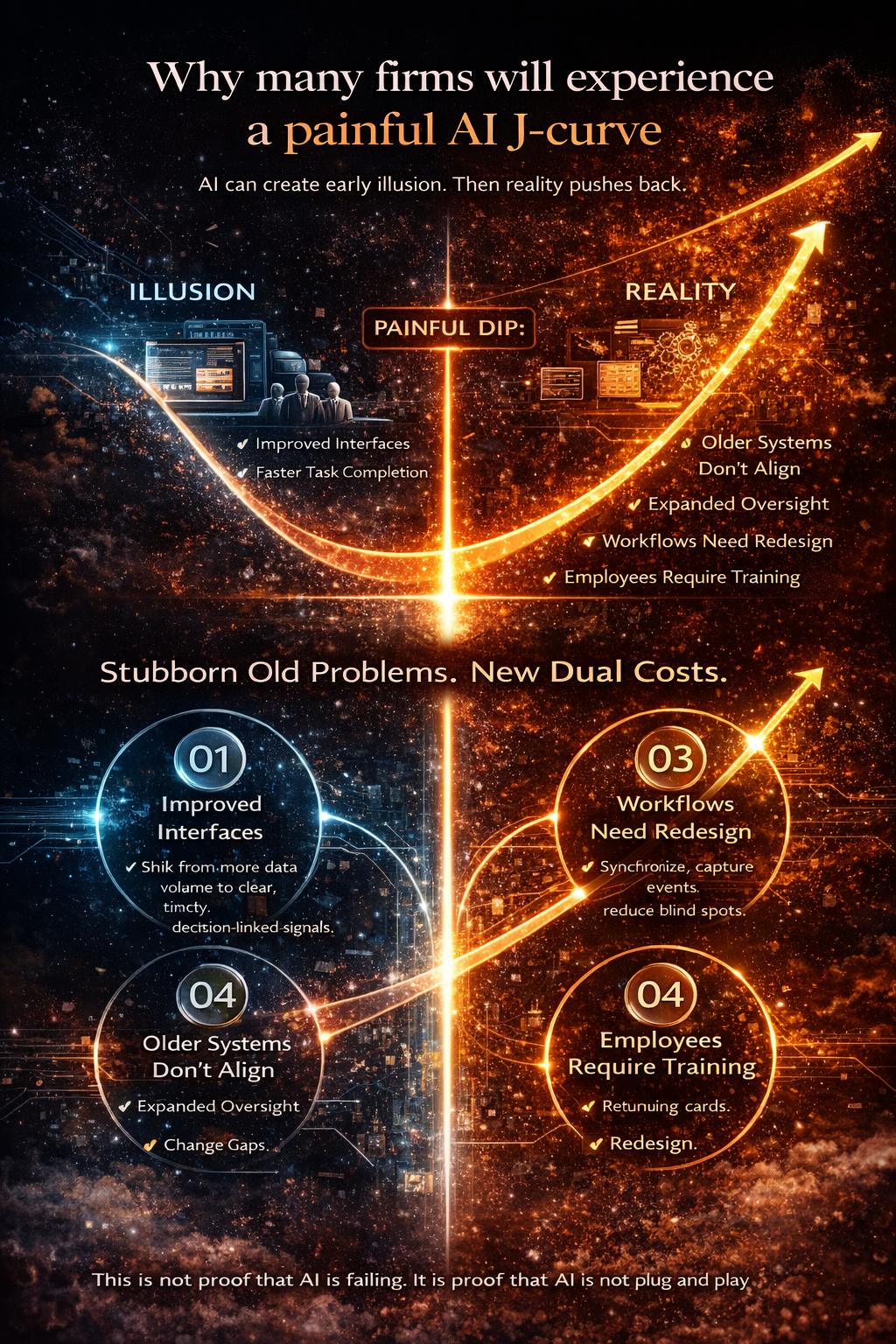
The institutions that win the AI era will not simply deploy better models.

They will design better representations of reality.
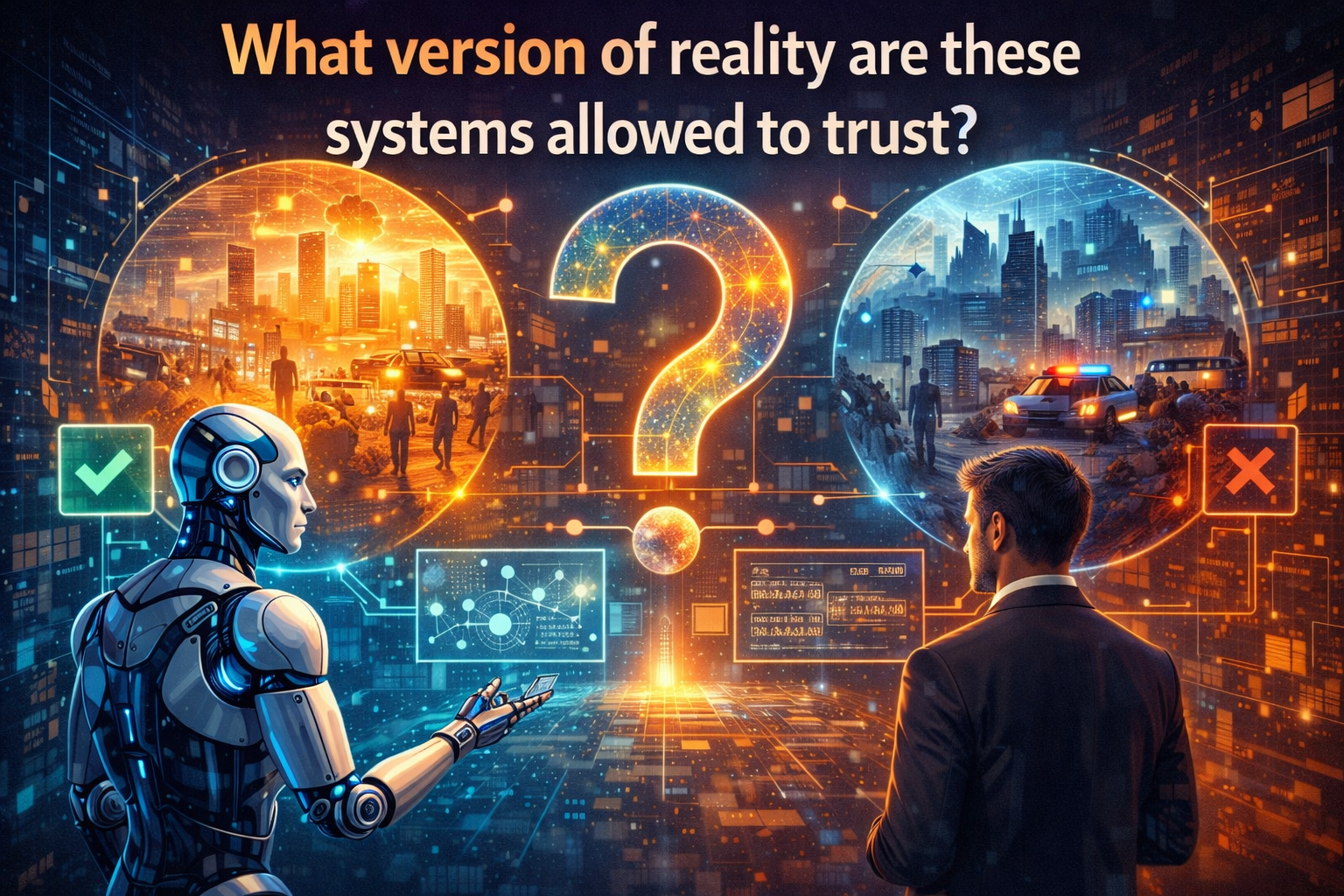
Because in the end, markets will reward the institutions that intelligent systems can trust.
That reward is the Representation Premium.

Glossary

Representation Premium
The economic advantage gained by institutions whose reality is easier for intelligent systems to observe, reason about, and coordinate with.

Representation Economy
An economic phase where competitive advantage depends on how effectively institutions represent reality for machine-mediated decision systems.

SENSE Layer
The architectural layer where signals, entities, and states make reality observable.

CORE Layer
The reasoning layer where decisions are evaluated and optimized.

DRIVER Layer
The governance layer where authority, verification, execution, and recourse are enforced.

Machine-Readable Trust
Institutional trust that emerges when systems can verify identity, state, and authority algorithmically.

Executive FAQ

What is the Representation Premium?

The Representation Premium is the market advantage gained by organizations whose reality is easier for intelligent systems to understand and coordinate with.

Why will AI markets reward representability?

Because AI systems require structured signals, identities, and states to make trustworthy decisions.

Is the Representation Premium the same as data advantage?

No. Representation quality depends on identity, state, governance, and decision traceability — not just raw data volume.

Why should boards care?

Because representation infrastructure will influence credit access, regulatory trust, ecosystem participation, and coordination efficiency.

Institutional Perspectives on Enterprise AI

Many of the structural ideas discussed here — intelligence-native operating models, control planes, decision integrity, and accountable autonomy — have also been explored in my institutional perspectives published via Infosys’ Emerging Technology Solutions platform.

For readers seeking deeper operational detail, I have written extensively on:

Together, these perspectives outline a unified view: Enterprise AI is not a collection of tools. It is a governed operating system for institutional intelligence — where economics, accountability, control, and decision integrity function as a coherent architecture.

Explore the Architecture of the AI Economy

This article is part of a broader research series exploring how institutions are being redesigned for the age of artificial intelligence. Together, these essays examine the structural foundations of the emerging AI economy — from signal infrastructure and representation systems to decision architectures and enterprise operating models.

If you want to explore the deeper framework behind these ideas, the following essays provide additional perspectives:


Together, these essays outline a central thesis:

The future will belong to institutions that can sense reality, represent it clearly, reason about it intelligently, and act through governed machine systems.

This is why the architecture of the AI era can be understood through three foundational layers:

SENSE → CORE → DRIVER

Where:

  • SENSE makes reality legible
  • CORE transforms signals into reasoning
  • DRIVER ensures that machine action remains accountable, governed, and institutionally legitimate

Signal infrastructure forms the first and most foundational layer of that architecture.

AI Economy Research Series — by Raktim Singh