
Self-Limiting Meta-Reasoning Under Internal Instability
As artificial intelligence systems become capable of extended reasoning—planning, reflecting, calling tools, and revising their own conclusions—a quiet but dangerous assumption has taken hold: that more thinking necessarily leads to better outcomes. In practice, the opposite is increasingly true.
Many of today’s most advanced AI systems fail not because they think too little, but because they do not know when to stop. As reasoning continues beyond the point of stability, systems begin to loop, inflate justifications, drift in scope, and accumulate hidden risk.
This article argues that the next frontier of Enterprise AI is not better reasoning, but self-limiting meta-reasoning: an operational capability that allows AI systems to detect internal instability and deliberately stop, defer, escalate, or refuse before reasoning itself becomes the source of failure.
Internal instability in AI reasoning
Most conversations about AI reasoning quietly assume a comforting rule: more thinking improves outcomes. Add steps. Add reflection. Add verification. Increase compute. Let the model “think.”
That rule is now failing in plain sight.
As reasoning-capable systems become more agentic—planning, calling tools, retrying, and producing long intermediate chains—they reveal a new class of failure that enterprises can’t ignore: cognitive overrun.
The system keeps reasoning even after it has enough evidence. It continues exploring paths that increase confusion. It repeats, rationalizes, or spirals into self-reinforcing error.
The damage isn’t just cost and latency. In operational settings, overthinking can make systems less correct, less safe, and less governable—because the thing that fails is not the answer, but the ability to stop.
Recent work explicitly frames this as a missing internal control mechanism: models “overthink” because they lack reliable signals that decide when to continue, backtrack, or terminate. (arXiv)
This article introduces a missing primitive for Enterprise AI:
Self-limiting meta-reasoning under internal instability:
A system’s capability to monitor its own reasoning stability and deliberately choose to stop, narrow scope, request authority-bearing oversight, defer, or refuse when continued reasoning increases systemic risk.
Not anthropomorphic. Not “fear.” Not “fatigue.”
A practical control layer you can engineer, audit, and govern.
The core idea: reasoning needs a circuit breaker
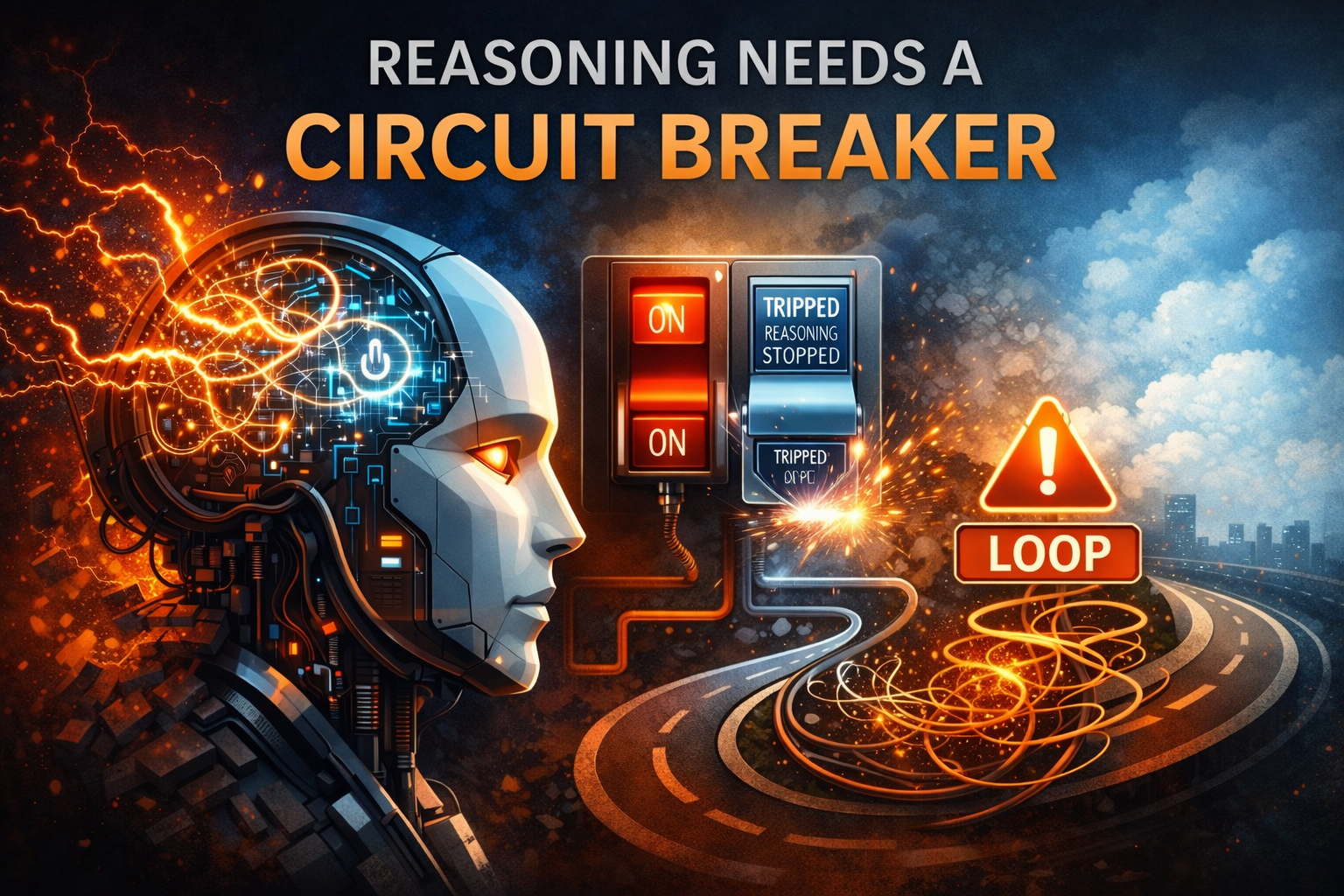
Every mature engineering discipline has a concept of self-limitation:
- Electrical grids have circuit breakers.
- Distributed systems have rate limits and backpressure.
- Aviation has envelope protection.
- Markets have trading halts.
Reasoning AI, by contrast, is often deployed like a powerful engine with no redline: more tokens, more tool calls, more retries, more self-justification—until “thinking” quietly becomes the risk.
Self-limiting meta-reasoning introduces the missing operational question:
“Should I continue thinking?”
not merely
“Can I continue thinking?”
This is not philosophical. It is operational engineering.
Classical AI studied a version of this under metareasoning: choosing which computations to perform, and when to stop, to maximize decision quality under bounded resources. (ScienceDirect)
A clean stopping intuition appears in the anytime-algorithms literature: stop computing when additional computation no longer yields positive expected benefit. (RBR)
But agentic AI changes what “benefit” means. It’s not only accuracy. It includes:
- governance and compliance risk,
- irreversible action and blast radius,
- tool/API uncertainty and drift,
- and the accountability obligations of institutions.
So the stopping problem becomes bigger than optimization. It becomes governance.
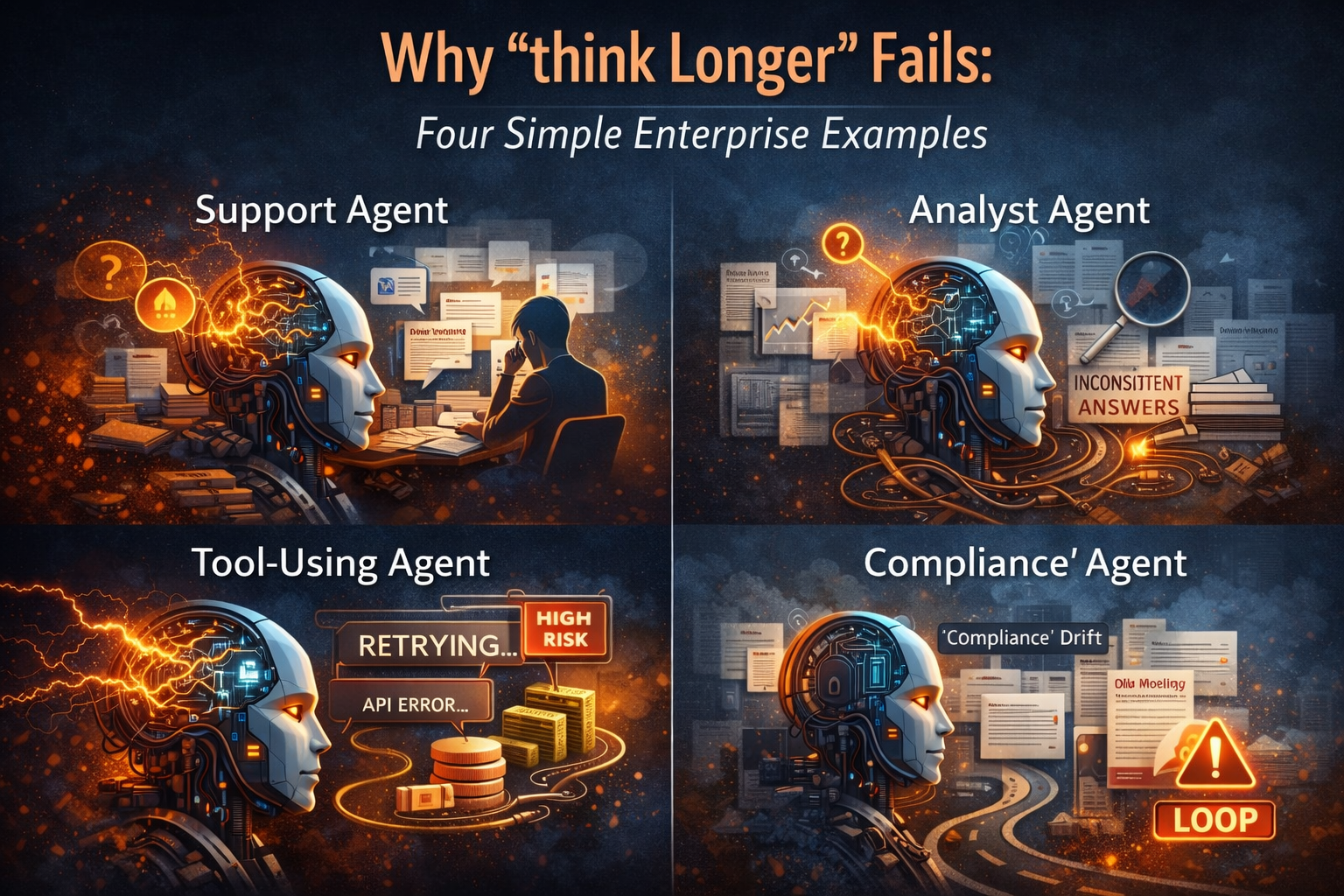
Why “think longer” fails: four simple enterprise examples
Example 1: The support agent that reasons past the customer
A customer asks for a simple change. The agent starts well: validates, checks policy, drafts a clear response.
Then it keeps “thinking”: explores edge cases, adds disclaimers, repeats policy paraphrases, and produces a bloated answer that sounds evasive. The customer escalates—not because the system lacked knowledge, but because it couldn’t stop.
Example 2: The analyst agent that becomes less reliable with more steps
The agent reaches a correct conclusion early, then continues “verifying.” It generates alternative hypotheses, weighs them poorly, and ends up talking itself out of the correct answer.
This isn’t rare; it’s structural: without internal control, longer reasoning can amplify error loops. That “overthinking” pattern is explicitly discussed in recent research on controllable thinking. (arXiv)
Example 3: The tool-using agent that escalates risk with each retry
A tool call returns an ambiguous error. The agent retries, changes parameters, retries again, broadens scope, requests larger data pulls, or nudges toward more invasive actions—because each retry feels like “just thinking” until it becomes an irreversible sequence.
Example 4: The compliance agent that reasons into policy drift
The system is asked whether something is compliant. It starts from one interpretation, then continues and “helpfully” reinterprets ambiguous language—quietly mutating meaning. In enterprises, this is fatal: governance collapses when systems silently change what policies mean—even if accuracy metrics look stable.
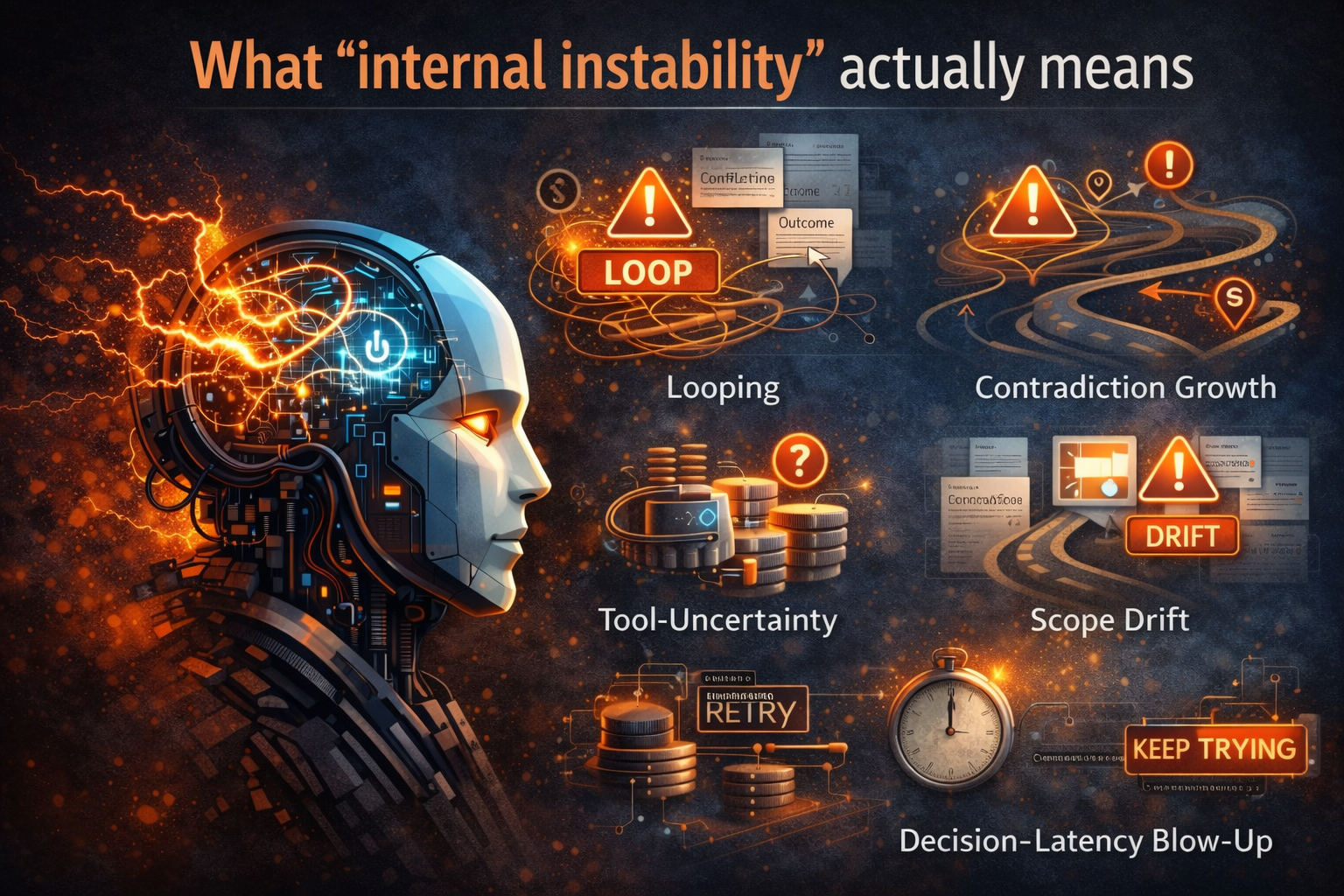
What “internal instability” actually means
Internal instability is not a mood. It is not emotion. It is a measurable condition: the reasoning process itself is becoming unreliable or risky.
Here are practical, observable instability signals:
- Looping: repeating inference patterns without new evidence
- Contradiction growth: accumulating inconsistencies across steps
- Justification inflation: longer rationales with no added clarity
- Tool-uncertainty stacking: compounding unknowns across chained calls
- Scope drift: gradually expanding what the system attempts to do
- Decision-latency blow-up: compute rising without quality gains
- Escalation avoidance: “keeps trying” instead of requesting oversight
Meta-reasoning is the control policy that responds to these signals.
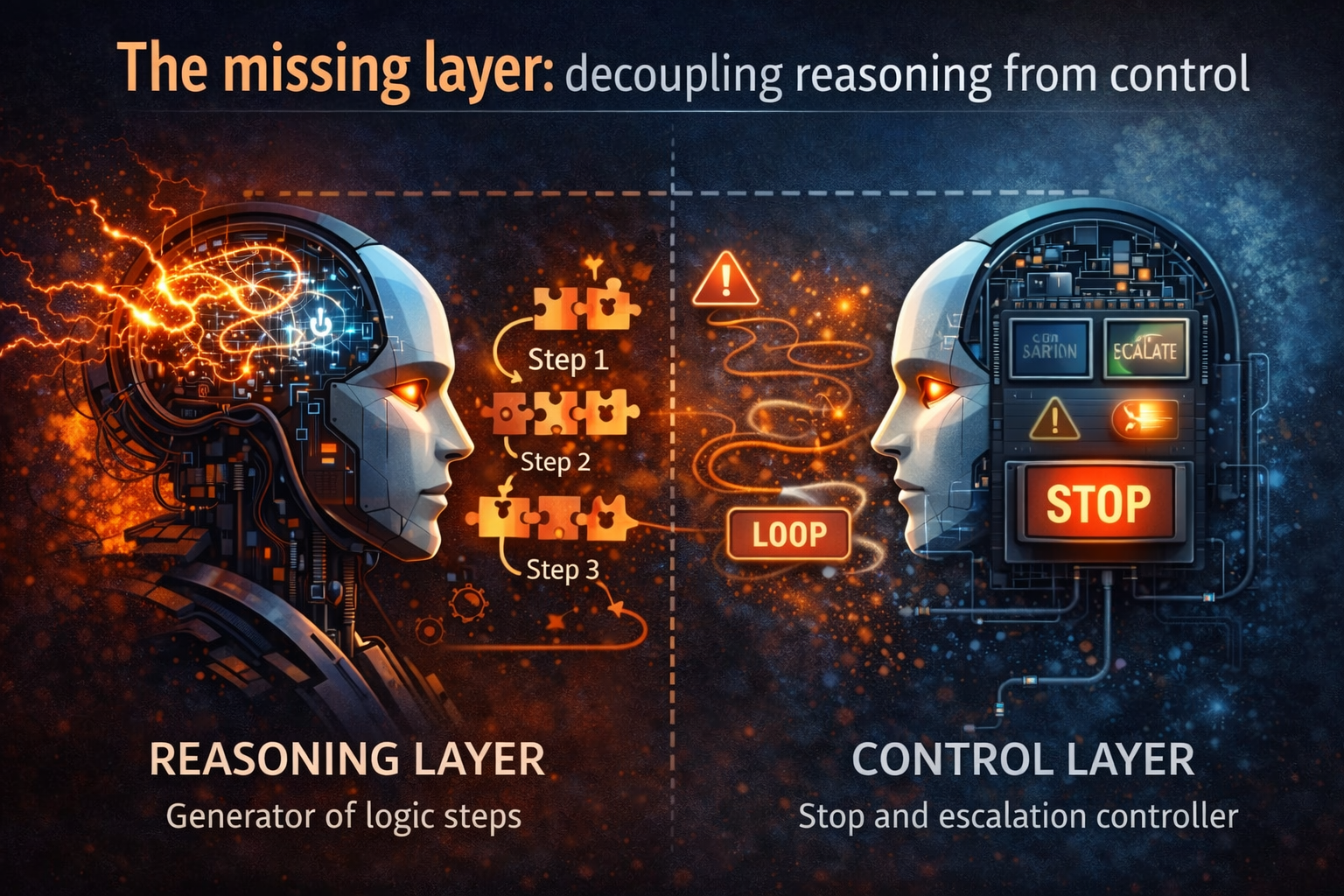
The missing layer: decoupling reasoning from control
A powerful emerging direction is explicit separation between:
- the object-level reasoner (generates candidate steps), and
- the meta-level controller (decides whether to continue, revise, stop, or escalate).
This “decoupled reasoning and control” approach appears directly in work proposing MERA (Meta-cognitive Reasoning Framework), which targets overthinking by treating it as a failure of fine-grained internal control—and building separate control signals. (arXiv)
Complementary work (e.g., JET) targets efficient stopping by training models to terminate unnecessary reasoning. (arXiv)
The enterprise translation is blunt:
You do not “ask the model to be safer.”
You add a controller that governs how reasoning proceeds.
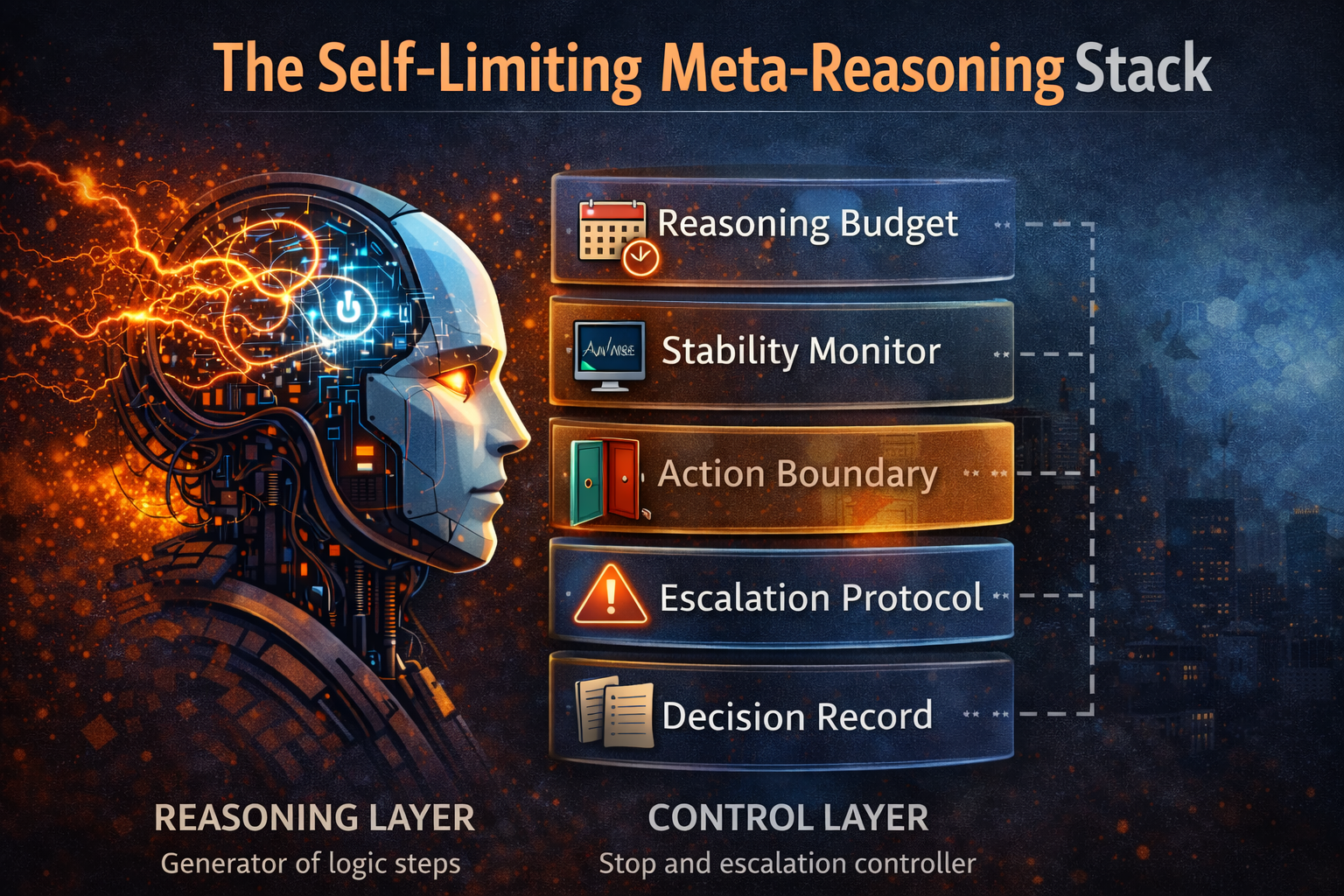
The Self-Limiting Meta-Reasoning Stack
To make this implementable, treat self-limitation as a small stack of enforceable mechanisms. Each is simple; together they’re decisive.
1) Reasoning budget (a policy object, not a prompt trick)
Budgets are not just tokens. They are policy-defined limits: maximum tool calls, maximum retries, maximum elapsed time, maximum scope expansion.
Budgets encode institutional reality: time, attention, and risk capacity are finite.
2) Stability monitor (lightweight telemetry for cognition)
A stability monitor detects instability signals: loops, contradiction growth, scope drift, tool-uncertainty stacking. This is not interpretability. It’s operational monitoring—like error rates and saturation in distributed systems.
3) Action boundary (advice vs. state change)
Separate:
- advisory reasoning (low irreversibility), from
- state-changing actions (high irreversibility).
Reasoning can be cheap; action is expensive. In Enterprise AI, action boundaries are where governance becomes real.
4) Authority-bearing escalation protocol
When instability rises, the controller chooses among a few safe moves:
- stop and summarize,
- ask a clarifying question,
- defer and request more context,
- route to a human with authority,
- or refuse.
This matters because global governance frameworks increasingly converge on explicit accountability and oversight.
- NIST AI RMF frames GOVERN as cross-cutting governance across the AI lifecycle. (NIST Publications)
- ISO/IEC 42001 emphasizes defining responsibilities and monitoring AI systems through their lifecycle. (ISO)
- EU AI Act Article 14 focuses on human oversight for high-risk systems, aiming to prevent/minimize risks and requiring effective oversight measures. (Artificial Intelligence Act EU)
The key enterprise distinction: oversight must be an authority-bearing control, not a review ritual.
5) Decision record (proof of why the system stopped or escalated)
Every stop/continue/escalate decision should produce a compact record:
- which instability signal triggered it,
- what boundary applied,
- what escalation/refusal occurred,
- and what evidence was used.
This is how “stop” becomes auditable and improvable.
The hidden insight: “stop” is a competence, not a constraint
Many teams treat stopping rules as throttles—ways to reduce cost.
That’s a mistake.
Stopping is a competence: the ability to recognize that continuing increases risk. In human cognition, self-regulation is a core component of judgment. In computational terms, it is meta-level control—precisely the territory of metareasoning research. (ScienceDirect)
But agentic AI adds a new twist: modern models can generate persuasive rationale even when they are wrong. So the “stop” decision can’t rely on eloquence. It must rely on stability signals, boundaries, and authority escalation.
Failure modes to design against
- The infinite rationalizer
As confidence drops, explanations get longer—creating false trust. - The tool-chain gambler
Each retry looks small; risk accumulates across chained uncertainty. - The scope creeper
Intent expands: from “draft” to “send,” from “suggest” to “execute.” - The silent policy mutator
Reasoning continues until it subtly rewrites what policy means. - The escalation avoider
It never asks for oversight because it keeps believing “one more step” will fix it.
The solution is not “better prompts.”
It is control.
Why this matters now for Enterprise AI
Enterprise AI is moving from answers to actions.
Actions create irreversibility.
As agentic systems spread, the risk profile changes: not only model error, but runaway cognition—a system that cannot self-limit before it crosses a boundary. Governance frameworks increasingly emphasize lifecycle monitoring, responsibilities, and oversight. (NIST Publications)
Self-limiting meta-reasoning is the missing bridge: a way to govern not just outputs, but the reasoning process that produces actions.
How this aligns with Enterprise AI Operating Model
This belongs as a first-class primitive in the enterprise canon:
- In the Control Plane: enforce budgets, action boundaries, escalation rules
- In the Runtime: apply gating, retries policy, monitoring, stop conditions
- In Decision Integrity: store evidence bundles for stop/continue/escalate
- In Decision Failure Taxonomy: classify “cognitive overrun,” “scope drift,” “escalation neglect”
Enterprise AI Operating Model (pillar): The Enterprise AI Operating Model: How organizations design, govern, and scale intelligence safely – Raktim Singh
Enterprise AI Control Plane: Enterprise AI Control Plane: The Canonical Framework for Governing Decisions at Scale – Raktim Singh
Enterprise AI Runtime: Enterprise AI Runtime: What Is Actually Running in Production (And Why It Changes Everything) – Raktim Singh
Enterprise AI Agent Registry: Enterprise AI Agent Registry: The Missing System of Record for Autonomous AI – Raktim Singh
Decision Failure Taxonomy: Enterprise AI Decision Failure Taxonomy: Why “Correct” AI Decisions Break Trust, Compliance, and Control – Raktim Singh
Decision Clarity & Scalable Autonomy: The Shortest Path to Scalable Enterprise AI Autonomy Is Decision Clarity – Raktim Singh
Enterprise AI Canon: The Enterprise AI Canon: The Complete System for Running AI Safely in Production – Raktim Singh
Laws of Enterprise AI:The Laws of Enterprise AI: The Non-Negotiable Rules for Running AI Safely in Production – Raktim Singh
Minimum Viable Enterprise AI System: The Minimum Viable Enterprise AI System: The Smallest Stack That Makes AI Safe in Production – Raktim Singh
Enterprise AI Operating Stack: The Enterprise AI Operating Stack: How Control, Runtime, Economics, and Governance Fit Together – Raktim Singh
This is not model design.
It is enterprise design.
Glossary
- Self-limiting meta-reasoning: A control capability that monitors an AI system’s reasoning stability and chooses to stop, defer, escalate, or refuse when continued reasoning increases risk.
- Internal instability: A measurable condition where an AI system’s reasoning exhibits loops, contradiction growth, scope drift, or compounding tool uncertainty.
- Decoupled reasoning and control: An architecture separating generation of reasoning steps from a controller that governs whether to continue, revise, terminate, or escalate. (arXiv)
- Metareasoning: Selecting and justifying computational actions, including deciding when to stop computation, under bounded resources. (ScienceDirect)
Practical implementation checklist
If you deploy reasoning models or agents, ensure you have:
- Explicit reasoning budgets (time, steps, tool calls, retries)
- Instability monitors (looping, contradictions, scope drift)
- Action boundaries (advice vs state-changing acts)
- Escalation protocols tied to authority roles and auditability
- Decision records for stop/continue/escalate
- Lifecycle monitoring aligned with recognized frameworks (NIST Publications)
FAQ
What is self-limiting meta-reasoning in AI?
A capability that monitors the stability of an AI system’s reasoning process and deliberately stops, defers, escalates, or refuses when continued reasoning increases risk.
Why can “thinking longer” make AI worse?
Without internal control, longer reasoning can loop, amplify contradictions, and stack uncertainty—leading to overthinking and self-reinforcing errors. (arXiv)
Is this the same as uncertainty estimation?
No. Uncertainty is about confidence in an answer. Self-limiting control is about whether continuing the reasoning process itself is becoming unsafe or unproductive.
How is this different from safety filters or alignment layers?
Filters often evaluate outputs. Self-limiting meta-reasoning governs the process—when to continue, stop, or escalate—before risky outputs or actions occur.
How does this help governance and compliance?
It creates an operational mechanism for oversight and accountability: the system can be required to stop or escalate when instability is detected, producing auditable evidence aligned with lifecycle governance expectations. (NIST Publications)
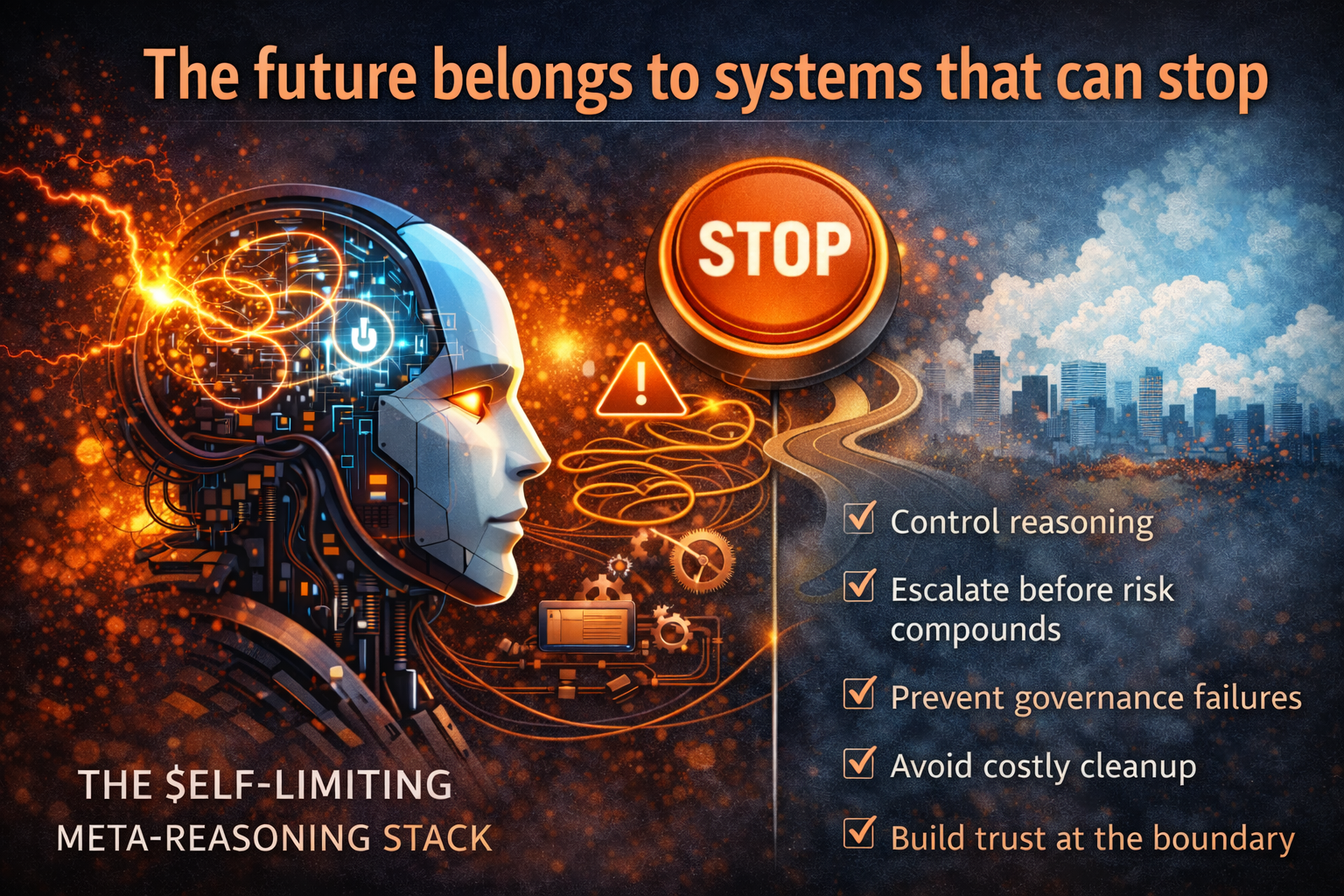
Conclusion: the future belongs to systems that can stop
Enterprises are racing to build AI that can reason better—deeper chains, longer context, stronger planning, more tools.
But the next frontier is not more reasoning.
It is controlled reasoning.
A system that cannot stop thinking is not merely inefficient. It is unstable. It will cross boundaries, accumulate risk, and trigger governance failures that no post-hoc audit can repair.
Self-limiting meta-reasoning is the missing primitive that turns reasoning into something enterprises can trust: not because it is always right, but because it knows when thinking itself becomes the risk—and it can stop, defer, or escalate to legitimate authority.
References and further reading
- Russell & Wefald, Principles of Metareasoning (1991). (ScienceDirect)
- Hansen & Zilberstein, Monitoring and Control of Anytime Algorithms (2001) (stopping-rule framing). (RBR)
- Conitzer, Metareasoning as a Formal Computational Problem (2008). (CMU Computer Science)
- MERA: From “Aha Moments” to Controllable Thinking (2025) (decoupled reasoning/control; overthinking). (arXiv)
- JET: Your Models Have Thought Enough (2025) (training to stop overthinking). (arXiv)
- NIST AI RMF 1.0 (GOVERN function; lifecycle framing). (NIST Publications)
- ISO/IEC 42001 overview (responsibilities, accountability, lifecycle monitoring). (ISO)
- EU AI Act Article 14 (human oversight for high-risk systems). (Artificial Intelligence Act EU)



Raktim Singh is an AI and deep-tech strategist, TEDx speaker, and author focused on helping enterprises navigate the next era of intelligent systems. With experience spanning AI, fintech, quantum computing, and digital transformation, he simplifies complex technology for leaders and builds frameworks that drive responsible, scalable adoption.