
Sunsetting Enterprise AI: How to Retire Models, Agents, and Decisions Safely—Without Breaking Trust, Compliance, or Business Continuity
Enterprise AI maturity is rarely tested when systems are launched. It is tested when they must be stopped. As artificial intelligence moves from experimental deployments to decision-making infrastructure, enterprises are discovering an uncomfortable truth: turning off AI is far harder than turning it on.
Models may stop running, agents may be disabled, and workflows may be replaced—but the decisions those systems made often continue to shape real-world outcomes long after the technology is gone.
In regulated, high-stakes environments, this creates a new class of operational, legal, and reputational risk. Sunsetting Enterprise AI, therefore, is not a technical shutdown exercise. It is a governance discipline—one that determines whether organizations can retire intelligence safely while preserving trust, accountability, and continuity at scale.
Enterprise AI doesn’t just get deployed. It gets embedded.
It settles into workflows and approvals, customer journeys and exception handling, risk controls and audit routines. It becomes part of the “how things get done”—often faster than any enterprise realizes. That is why “turning it off” is rarely a technical switch. It is an operational decision with legal, economic, and reputational consequences.
In traditional software, sunsetting often means: stop traffic → shut the service → archive data → done.
In Enterprise AI, sunsetting means something harder:
- A model may stop running, but its decisions may still be active in the real world.
- An agent may be disabled, but its permissions, credentials, and tool access may still exist.
- A workflow may be replaced, but its explanations, logs, and audit obligations may need to remain available for months or years.
This is the missing discipline: Enterprise AI decommissioning as a first-class operating capability. If “running intelligence” is your enterprise advantage, then retiring intelligence safely is part of the same operating model—alongside control planes, runtime governance, and economic oversight.
Why Model Replacement Doesn’t Reset Enterprise Reality
Model drift is inevitable in enterprise environments, which is why models are routinely replaced. The problem is not that new models make decisions differently.
The problem is that earlier models have already acted—changing customer states, triggering escalations, and shaping workflows that persist over time.
When a new model takes over, it inherits this accumulated state without sharing the logic that created it. As a result, enterprises find themselves unable to fully justify why certain customers remain flagged, why specific SLAs were breached, or why workflows behave the way they do.
New models govern the future, but they cannot retroactively explain the past—and that gap is where trust, auditability, and accountability begin to fracture.
This article answers a question most organizations are quietly terrified of:
“What happens when we need to stop an AI system—fast—and still defend every outcome it produced?”
Enterprise AI Operating Model: https://www.raktimsingh.com/enterprise-ai-operating-model/
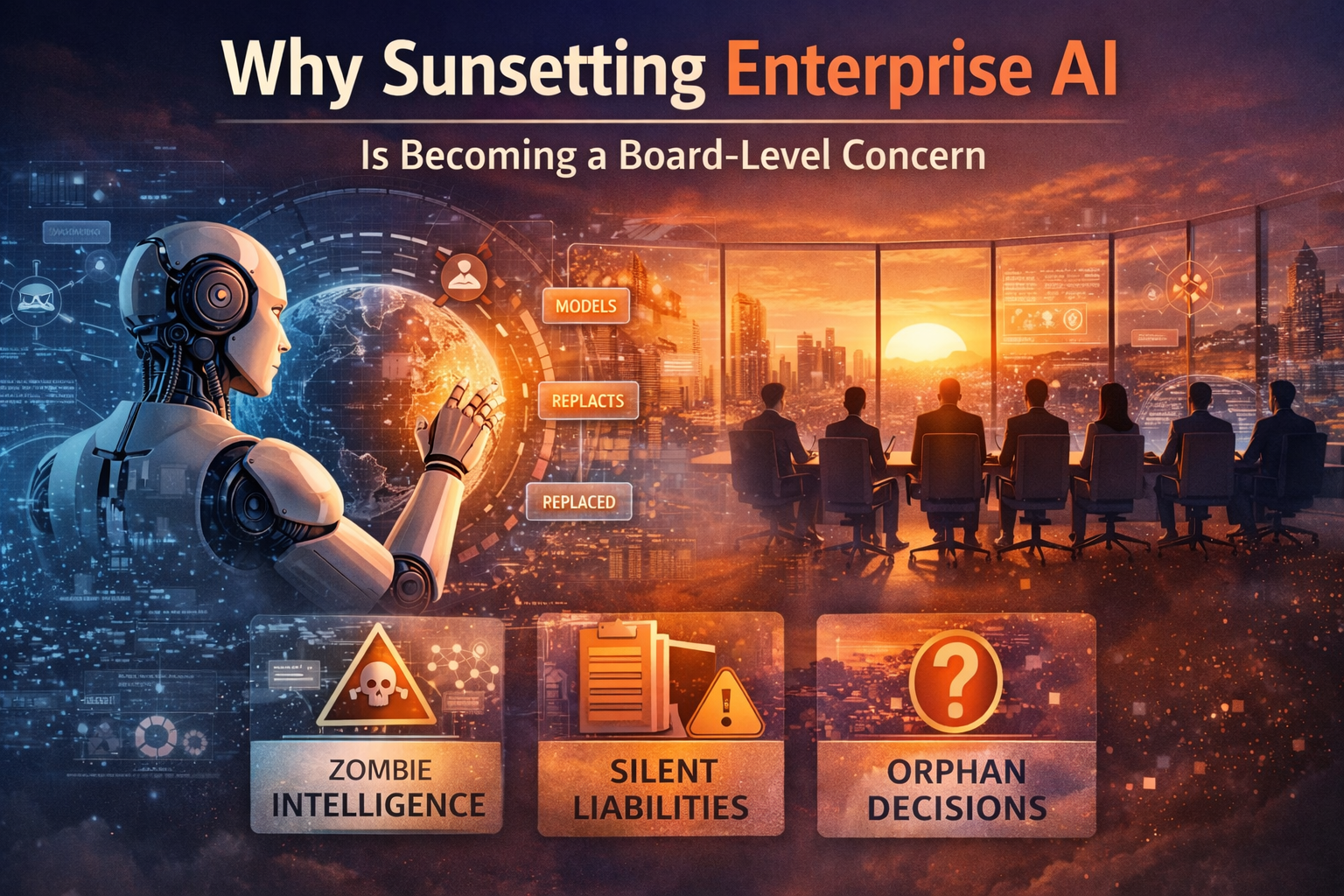
Why Sunsetting Enterprise AI Is Becoming a Board-Level Concern
Enterprises are entering an era where they will retire hundreds to thousands of AI components per year:
- models replaced because performance drifts
- agents replaced because tools, APIs, or workflows change
- vendors swapped because economics shift
- policies updated because regulation evolves
- business processes redesigned because strategy changes
If retirement is not treated as a designed capability, three failure modes emerge:
- Zombie intelligence: old models or agents still influence outcomes through hidden integrations, stale batch jobs, or “temporary” fallbacks that become permanent.
- Orphan decisions: the system is gone, but regulators, auditors, or customers ask, “Why did you decide that?” and no one can reconstruct the chain of responsibility.
- Silent liabilities: logs, documentation, and compliance evidence weren’t preserved—until an incident arrives, and the enterprise can’t prove safe operation.
This is not theoretical. Major governance frameworks already push toward lifecycle accountability:
- The EU AI Act explicitly includes post-market monitoring and expects corrective actions for non-conforming high-risk systems, including withdrawal/disable/recall. (AI Act Service Desk)
- The NIST AI Risk Management Framework (AI RMF 1.0) frames risk management as lifecycle work, with GOVERN applying across stages and other functions mapping to lifecycle contexts. (NIST Publications)
- ISO/IEC 42001 defines requirements for establishing, implementing, maintaining, and continually improving an AI management system—again, lifecycle thinking. (ISO)
Bottom line: enterprises will be judged not only by how they launch AI—but by how they retire it.
Replacing an AI model changes how future decisions are made.
It does not change the decisions already embedded in the enterprise.
The Three Things You Must Sunset (Most Enterprises Only Think About One)
When teams say, “we’re retiring the AI,” they usually mean the model. That’s incomplete.
To sunset Enterprise AI safely, you must retire three layers:
1) Models
Prediction or generation components (LLMs, classifiers, rankers, risk models, forecasting models).
2) Agents
Autonomous or semi-autonomous systems that plan, call tools, create outputs, and coordinate workflows.
3) Decisions
The real-world outcome layer—approvals, denials, holds, escalations, customer treatments, pricing changes, eligibility assignments, and other operational actions.
This third layer is where most decommissioning failures happen. Disabling a model does not undo downstream consequences of decisions already made. Retiring AI safely requires treating decisions as first-class artifacts, not side effects.
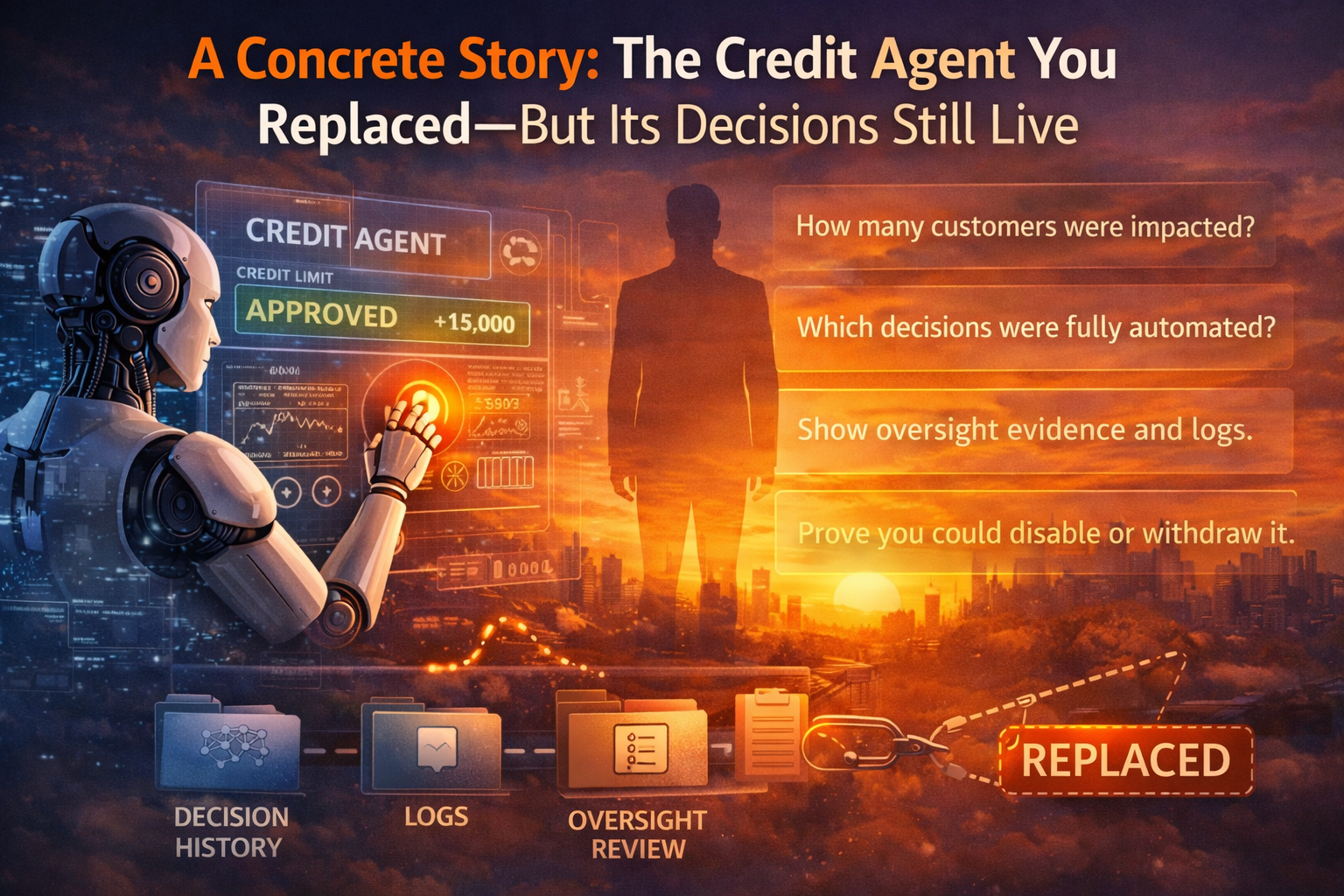
A Concrete Story: The Credit Agent You Replaced—But Its Decisions Still Live
Imagine a bank deploys a credit-limit increase agent:
- It reads customer signals
- It estimates default risk
- It auto-approves increases below a threshold
- It logs “reason codes” and actions
Six months later, the bank replaces it with a better model and a redesigned agent. Great.
Then an auditor asks:
- “How many customers were impacted by the old agent in the last quarter?”
- “Which decisions were fully automated and which had human oversight?”
- “Show logs and evidence of oversight for those decisions.”
- “Prove you could disable or withdraw the system if it became non-compliant.”
If you can’t answer, you didn’t sunset decisions—you sunset code.
Under the EU AI Act, deployers of high-risk systems have explicit obligations around monitoring and log retention (often described as at least six months, depending on context and applicable law). (Artificial Intelligence Act)
That means the retirement plan must preserve traceability and defensibility after the system stops running.
Enterprise AI Operating Model
Enterprise AI scale requires four interlocking planes:
Read about Enterprise AI Operating Model The Enterprise AI Operating Model: How organizations design, govern, and scale intelligence safely – Raktim Singh
- Read about Enterprise Control Tower The Enterprise AI Control Tower: Why Services-as-Software Is the Only Way to Run Autonomous AI at Scale – Raktim Singh
- Read about Decision Clarity The Shortest Path to Scalable Enterprise AI Autonomy Is Decision Clarity – Raktim Singh
- Read about The Enterprise AI Runbook Crisis The Enterprise AI Runbook Crisis: Why Model Churn Is Breaking Production AI—and What CIOs Must Fix in the Next 12 Months – Raktim Singh
- Read about Enterprise AI Economics Enterprise AI Economics & Cost Governance: Why Every AI Estate Needs an Economic Control Plane – Raktim Singh
Read about Who Owns Enterprise AI Who Owns Enterprise AI? Roles, Accountability, and Decision Rights in 2026 – Raktim Singh
Read about The Intelligence Reuse Index The Intelligence Reuse Index: Why Enterprise AI Advantage Has Shifted from Models to Reuse – Raktim Singh
The Enterprise AI Sunset Playbook
No Math. No Hype. Just the Controls That Prevent “Zombie Intelligence.”
Step 1: Define Retirement Triggers (So Retirement Isn’t Political)
AI systems linger because retirement becomes a debate: “Are we sure we should replace it?” “What if it breaks something?” “Let’s wait one more quarter.”
The fix is simple: define objective retirement triggers when you launch the system:
- drift beyond agreed thresholds
- policy change invalidating assumptions
- vendor/tooling end-of-life
- repeated incident patterns
- unacceptable cost-to-value ratio
- suspected non-conformity / compliance risk
In regulated contexts, retirement can be mandatory. For high-risk systems, the EU AI Act expects corrective actions when non-compliance is suspected or confirmed, including disable/withdraw/recall. (AI Act Service Desk)
Best practice: publish retirement criteria when you publish the model/agent. Treat retirement as part of “definition of done.”
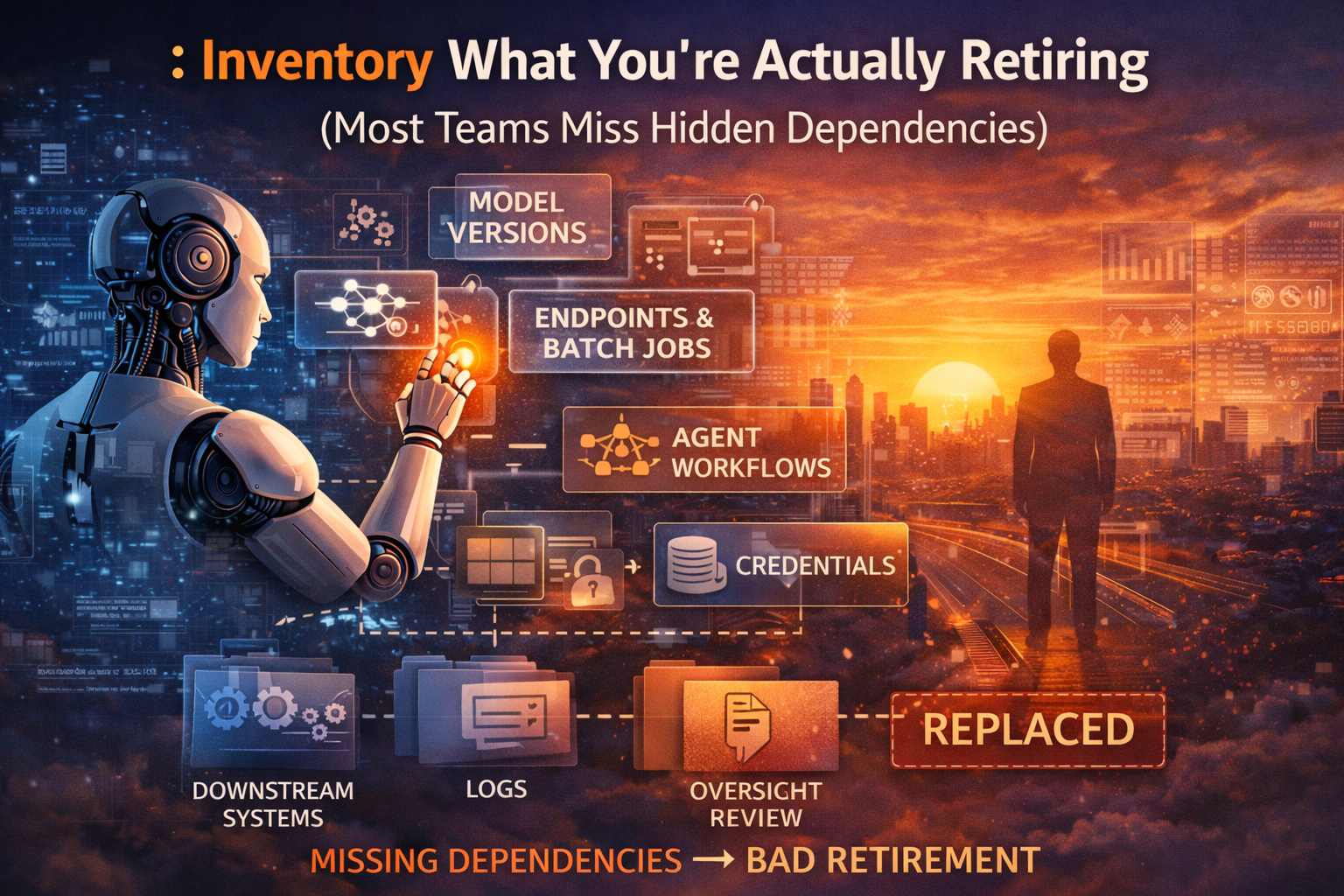
Step 2: Inventory What You’re Actually Retiring (Most Teams Miss Hidden Dependencies)
Before you switch anything off, you need a precise inventory of the AI “estate”:
- model versions in production + shadow deployments
- endpoints, batch jobs, scheduled retraining
- agent workflows (flows, tools, prompts, policies)
- credentials (API keys, service accounts, tokens)
- data pipelines (features, retrieval indices, caches)
- downstream systems consuming outputs
- human SOPs built around the AI’s behavior
Most failures occur because organizations don’t know what is running, where, and why—until something breaks.
If you want to be world-class, treat retirement inventory as a routine output of your Enterprise AI Operating Model (control + runtime + governance).
Step 3: Choose the Right Sunset Strategy (Hard Stop Is Rarely the First Move)
There are four practical retirement patterns:
-
A) Parallel Run (Shadow)
New system runs alongside old, but old still drives decisions.
Use when: risk is high and you need controlled comparison.
-
B) Canary Retirement
Retire the old system for a small slice of traffic first.
Use when: you want safety plus rollback.
-
C) Progressive Feature Freeze
Stop retraining, stop expanding scope, restrict actions gradually.
Use when: stability and operational continuity matter.
-
D) Immediate Disable
Emergency shutdown (security, compliance, harm).
Use when: non-conformity, unacceptable incident risk, or security breach.
If you operate under post-market monitoring expectations, your monitoring signals should tell you which strategy is appropriate. (Artificial Intelligence Act)

Step 4: Sunset the Model (Technical Retirement Done Right)
Model retirement is more than “undeploy.”
Do this:
- stop serving traffic (gradually or instantly)
- freeze retraining pipelines and scheduled jobs
- preserve training data lineage + evaluation evidence
- preserve the exact model artifact + configuration used for audited decisions (within policy constraints)
- document “what replaced it and why”
Avoid this:
- deleting artifacts without retention planning
- losing reproducibility and decision defensibility
- keeping endpoints alive “just in case” (this is how zombie intelligence begins)
Step 5: Sunset the Agent (Where Risk Typically Lives)
Agents differ from models because they have:
- tool permissions
- action pathways
- memory and state
- orchestration links to other systems/agents
- operational blast radius
To retire an agent safely:
- Revoke action permissions first (not last)
Remove credentials, reduce scopes, disable tool routes. - Disable write actions before read actions
Observation can continue temporarily; actions should stop first. - Test kill switches—don’t assume they work
A kill switch that has never been exercised is not a control; it is a belief. - Drain in-flight work
Agents may be mid-transaction: tickets, approvals, customer communications. - Remove from registries, routing, and orchestration
Ensure no workflow still calls the retired agent.
In modern enterprise terms: an agent is a governed machine identity. If you don’t revoke permissions, you haven’t retired the agent—you’ve only hidden it.
Step 6: Sunset Decisions (The Step Most Enterprises Skip)
Here is the uncomfortable truth:
You can retire the model and the agent, but you may still need to manage the decisions they made.
A retirement plan must answer:
- Which decisions remain active?
- Which decisions can be unwound?
- Which decisions must remain but require disclosure and explanation?
- Which decisions require notification, remediation, or re-evaluation?
Examples of decision unwinding:
- reversing a wrongful hold or block
- correcting a customer classification
- re-evaluating eligibility after policy change
- revisiting escalations triggered by a retired agent
This is why a Decision Ledger becomes foundational: it preserves decision context, policy version, oversight evidence, and traceability—so retirement doesn’t create orphan outcomes.
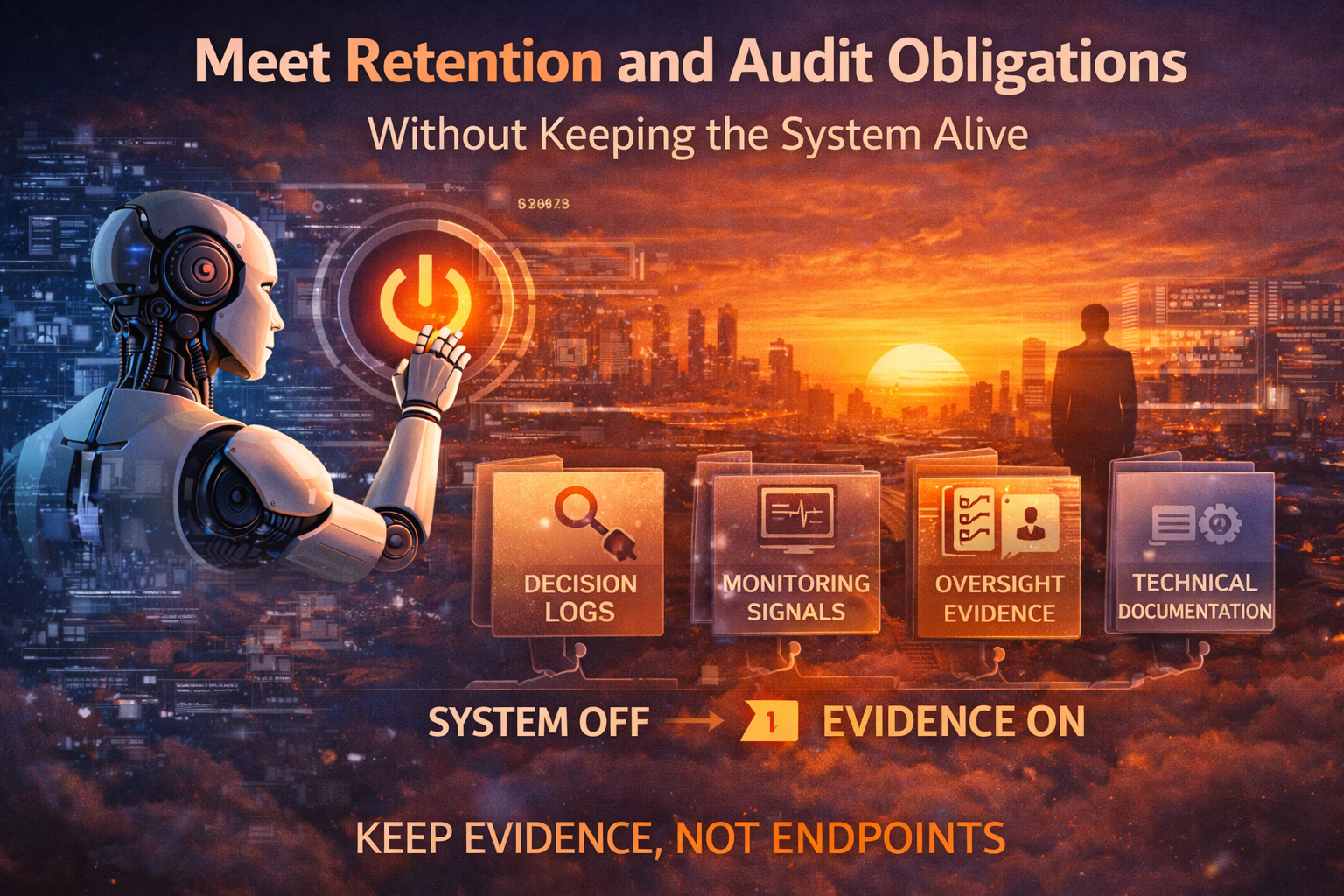
Step 7: Meet Retention and Audit Obligations Without Keeping the System Alive
Many teams keep retired AI running because they fear audits.
A better approach is simple:
Preserve evidence, not systems.
Preserve:
- decision logs (what happened, when, policy version, oversight evidence)
- monitoring signals (drift, incidents, alerts)
- technical documentation (intended use, limitations, changes)
Under the EU AI Act, deployers of high-risk systems must keep logs for at least a minimum period in many cases, and providers must meet documentation and compliance duties. (Artificial Intelligence Act)
Your retirement architecture should allow:
- system off
- evidence on
That is audit readiness without operational risk.
Step 8: Communicate the Sunset (Yes, This Is Part of Engineering)
If people don’t know the AI is retired, they will continue to trust it—especially if they built muscle memory around it.
A proper sunset includes:
- internal communications: what changed, why, what to expect
- updated SOPs and playbooks
- training for human operators
- updated customer-facing disclosures where relevant
- vendor and procurement updates (if applicable)
This is how you prevent shadow usage and accidental reactivation.
The Safe Sunset Checklist
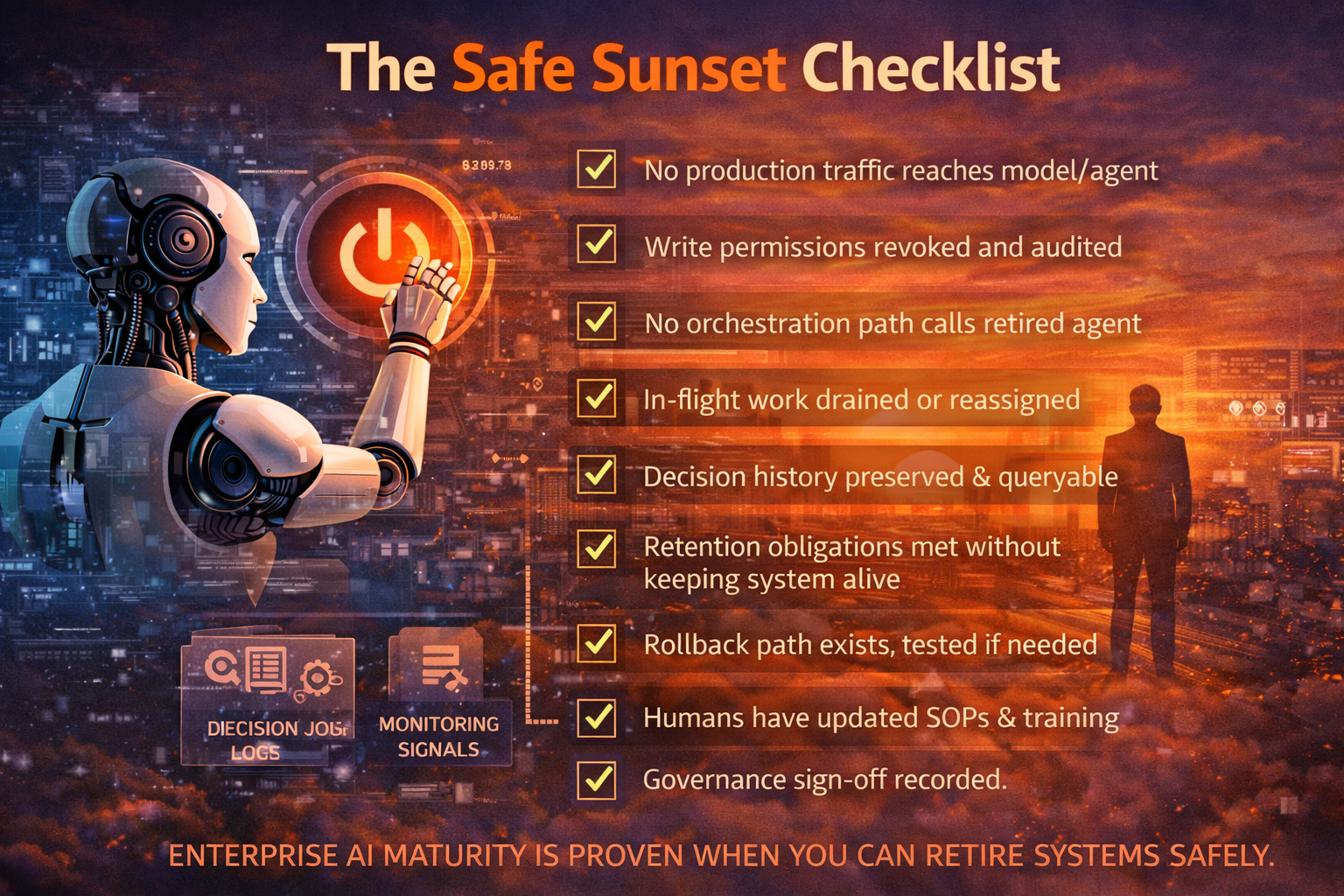
An Enterprise AI system is safely sunset only when:
- ✅ No production traffic reaches the model or agent
- ✅ Write permissions are revoked and audited
- ✅ Orchestration/routing no longer calls the retired agent
- ✅ In-flight work is drained or reassigned
- ✅ Decision history is preserved and queryable
- ✅ Retention obligations are met without keeping the system alive
- ✅ Rollback path exists (if needed) and is tested
- ✅ Humans have updated SOPs and training
- ✅ Governance sign-off is recorded
This is Enterprise AI as an operating model in action: control plane + runtime + accountability + economics—including the end-of-life phase.
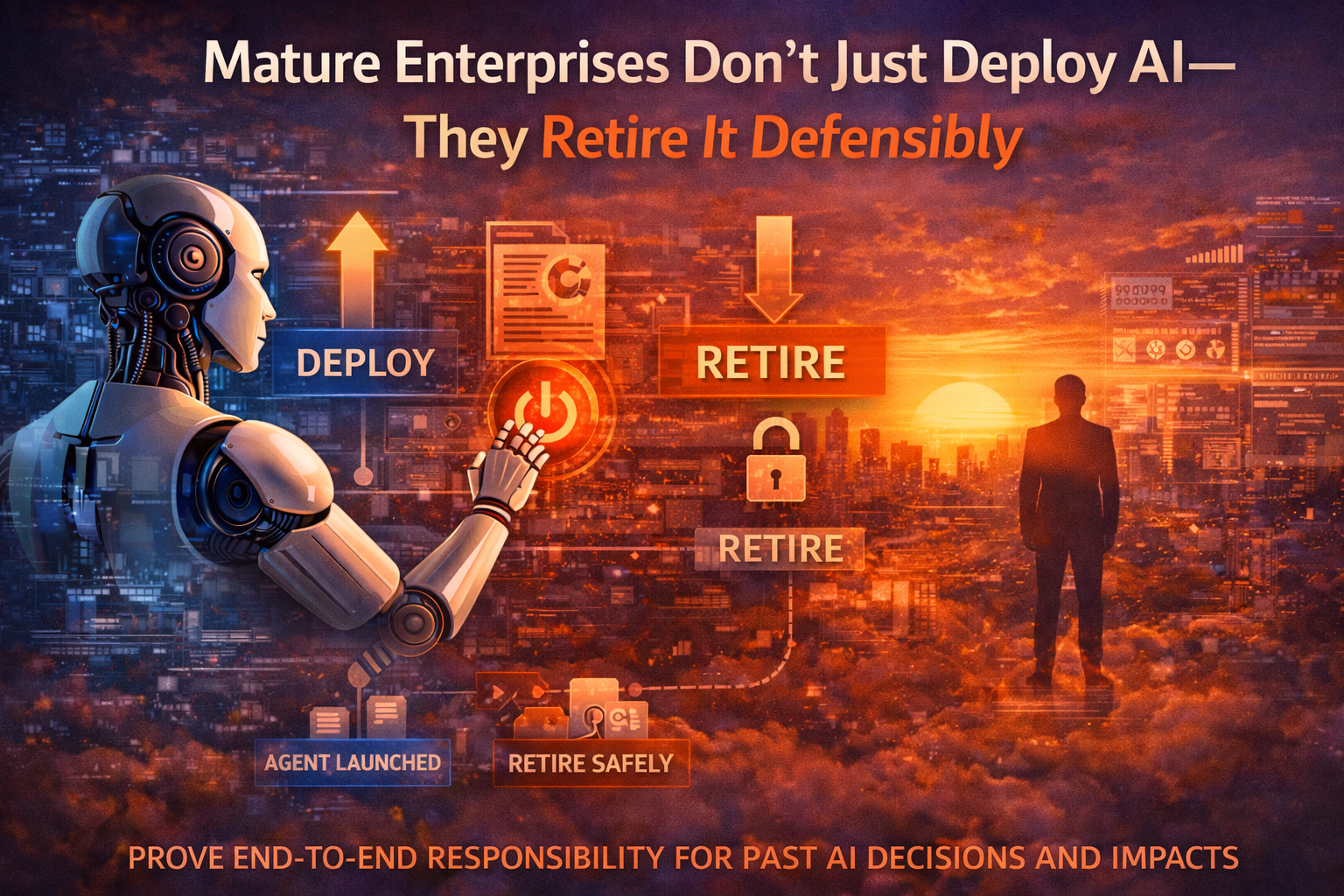
Conclusion: Mature Enterprises Don’t Just Deploy AI—They Retire It Defensibly
Enterprise AI maturity isn’t proven when you launch an agent.
It is proven when you can stop it, replace it, and still explain—months later—exactly what it did, why it did it, and how you protected the enterprise while doing it.
In the next decade, the most trusted organizations won’t be the ones with the most AI.
They will be the ones that can operate intelligence end-to-end—including the final phase that most teams ignore: a safe, defensible sunset.
If you want Enterprise AI to be a category your organization leads, then retirement must be treated as a designed capability—not a cleanup task.
FAQ
1) What does it mean to “sunset” Enterprise AI?
It means retiring models and agents and managing the real-world decisions they created—while preserving traceability, audit evidence, and business continuity.
2) Why is AI retirement harder than software retirement?
Because AI produces probabilistic decisions that can outlive the system itself, and agents carry tool permissions and credentials that create ongoing operational and security risk.
3) Do we need to keep old models running for audits?
Usually no. You need to keep evidence—logs, monitoring signals, documentation, and oversight records—without keeping the system operational.
4) What should trigger retirement?
Clear thresholds: drift, policy changes, tooling end-of-life, repeated incidents, cost-to-value breakdown, or suspected non-conformity.
5) How does regulation affect AI sunsetting?
Regulatory regimes increasingly require lifecycle accountability, post-market monitoring, log retention, and corrective actions (including disable/withdraw/recall for non-conforming high-risk systems under the EU AI Act). (AI Act Service Desk)
Glossary
- Sunsetting (Enterprise AI): Planned retirement of AI capabilities from production, including models, agents, and decision handling.
- Model retirement: Removing a model from serving while preserving evidence and reproducibility as required.
- Agent decommissioning: Disabling an autonomous system and revoking tool access, credentials, and orchestration routes.
- Decision unwinding: Remediating or reversing downstream outcomes produced by a retired AI.
- Post-market monitoring: Ongoing monitoring of AI system performance and risk after deployment across its lifetime. (Artificial Intelligence Act)
- Corrective actions: Actions taken when a high-risk AI system is suspected/confirmed non-compliant (withdraw, disable, recall). (AI Act Service Desk)
- AIMS (AI Management System): ISO/IEC 42001 framework for establishing, implementing, maintaining, and continually improving AI governance. (ISO)
References and Further Reading
- European Commission AI Act Service Desk — Article 20 (Corrective actions: withdraw/disable/recall). (AI Act Service Desk)
- ArtificialIntelligenceAct.eu — Article 20 (Corrective actions & duty of information). (Artificial Intelligence Act)
- ArtificialIntelligenceAct.eu — Deployers’ log retention obligations (keep logs at least six months in many cases). (Artificial Intelligence Act)
- NIST AI RMF 1.0 (PDF): lifecycle framing; GOVERN applies across stages. (NIST Publications)
- ISO/IEC 42001:2023 — requirements for establishing, maintaining, and continually improving an AI management system. (ISO)



Raktim Singh is an AI and deep-tech strategist, TEDx speaker, and author focused on helping enterprises navigate the next era of intelligent systems. With experience spanning AI, fintech, quantum computing, and digital transformation, he simplifies complex technology for leaders and builds frameworks that drive responsible, scalable adoption.