
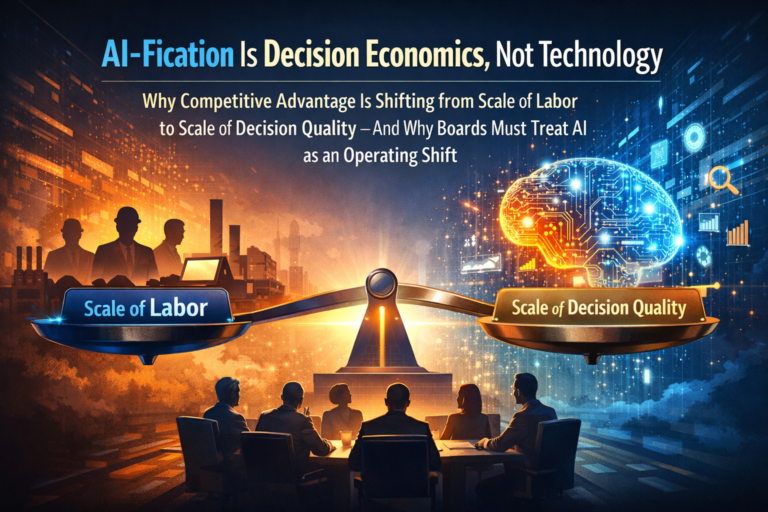
The Future Belongs to Decision-Intelligent Institutions
Artificial intelligence is no longer a tooling conversation. It is an institutional design question. The organizations that will dominate the next decade are not those that deploy the most models — but those that engineer decision quality at scale.
Competitive advantage is shifting from labor efficiency to decision intelligence. And institutions that fail to govern, measure, and compound decision quality will quietly lose structural power.
Decision-intelligent institutions treat decision quality as infrastructure. They design governance, runtime monitoring, economic accountability, and institutional memory systems to ensure AI systems improve outcomes rather than amplify errors.
Executive Summary (For Boards)
AI-fication is not a technology upgrade. It is not about deploying chatbots or models. It is an economic shift in how decisions are made, governed, and improved at scale.
Competitive advantage is moving from:
Scale of labor → Scale of decision quality.
Boards that treat AI as an IT initiative will underperform.
Boards that treat AI as an operating model redesign will unlock growth, margin, resilience, and new market creation.
The central question is no longer:
“Should we invest in AI?”
It is:
“Are we architected to compete in an economy where decision quality scales faster than labor?”
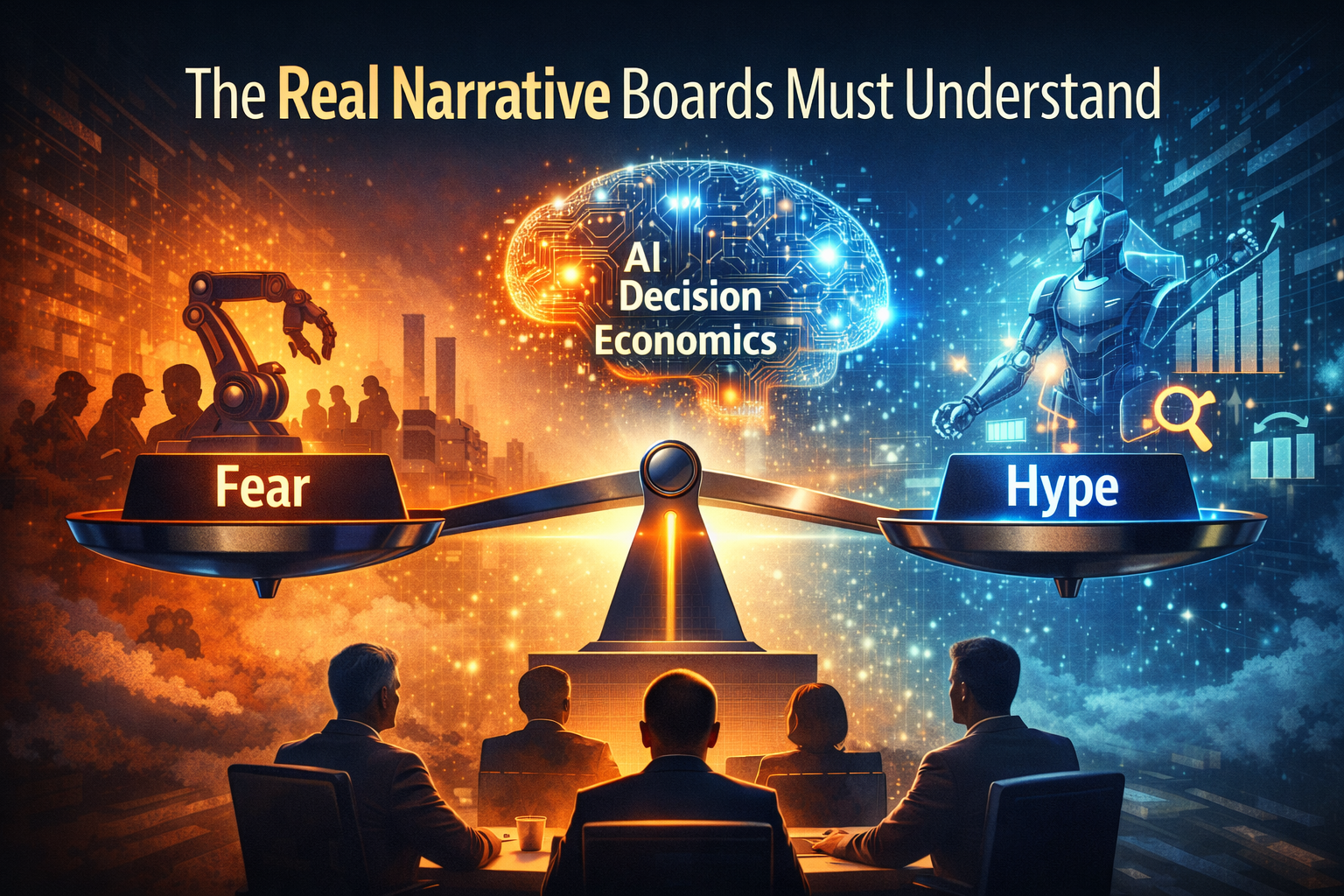
The Real Narrative Boards Must Understand
Today’s discourse is polarized:
- Fear: AI will take jobs.
- Hype: AI will solve everything.
Both miss the structural shift.
AI-fication is a transformation in decision economics — the cost, speed, and quality of decisions.
Every enterprise exists to make decisions under uncertainty:
- Who to sell to
- What price to offer
- How much inventory to hold
- Which credit to approve
- Where to allocate capital
- Which markets to enter
Revenue, margin, expansion, and resilience are outcomes of decision quality.
AI changes the economics of those decisions.
That is the shift.

The Subtle Provocation Boards Need to Hear
Most companies operate a 20th-century decision system inside a 21st-century environment.
Common symptoms:
- Data scattered across silos
- Unclear decision rights
- Local optimization over enterprise optimization
- Slow approvals
- Manual exception handling
- Leaders demanding deterministic answers in probabilistic systems
Then the company “adds AI.”
But AI does not fix broken decision systems.
It amplifies them.
If governance is weak → AI accelerates risk.
If incentives are misaligned → AI optimizes the wrong thing faster.
If processes are fragmented → AI scales fragmentation.
This is why pilots rarely produce enterprise value.
Value emerges when decision architecture changes.
Leading global research increasingly emphasizes this: operating model redesign and governance maturity correlate with value capture — not simply tool adoption.
Decision Economics: The Real Definition of AI-Fication
AI-fication changes three economic variables:
-
Cost of a Decision
How expensive is it to generate insight, coordinate stakeholders, and act?
-
Latency of a Decision
How quickly can insight convert into action?
-
Quality of a Decision
How consistently does it produce the intended economic outcome — without creating hidden risk?
Before AI, improving decision quality required labor:
- More analysts
- More reviews
- More meetings
- More documentation
To control costs, firms defaulted to:
- Averages
- Standard rules
- Static segmentation
AI reduces the marginal cost of:
- Prediction
- Pattern detection
- Recommendation
- Personalization
- Continuous monitoring
- Rapid iteration
AI-fication is not automation.
It is:
Decision acceleration + decision amplification.
That is why AI is treated globally as a general-purpose economic technology.
Why Competitive Advantage Is Moving from Labor Scale to Decision Scale
Why Competitive Advantage Is Moving from Labor Scale to Decision Scale
Historically, advantage came from:
- Hiring more people
- Scaling processes
- Standardizing operations
This worked in stable environments.
But today’s environment is defined by variance:
- Demand volatility
- Supply chain disruption
- Regulatory complexity
- Hyper-personalized customer expectations
- Ecosystem interdependence
Standardization at scale becomes brittle.
You can be efficient — and wrong.
AI allows organizations to handle variance cheaply.
That changes the competitive frontier.
When variance becomes inexpensive to manage, firms can:
- Personalize without exploding cost
- Optimize inventory without over-buffering
- Detect emerging markets earlier
- Simulate risk scenarios continuously
The enterprise shifts from:
Average-based → Variance-intelligent.
That is the economic frontier.
Three Illustrative Examples
Example 1: Inventory Is a Decision Architecture Problem
Excess inventory often results from slow, siloed decisions:
- Sales forecasts optimistically
- Supply chain buffers uncertainty
- Finance demands capital discipline
- Operations prioritizes stability
The result: compromise through excess stock.
AI can continuously update demand signals.
But unless decision rights, overrides, and uncertainty thresholds are redesigned, the result is dashboards — not economic improvement.
The breakthrough is not the model.
It is the redesigned decision loop.
Example 2: Personalization Is a Decision Supply Chain
True personalization requires answering:
- Who is this customer now?
- What is the right offer?
- What is acceptable risk?
- What must never be violated?
AI reduces the cost of making these decisions repeatedly and contextually.
But personalization without governance leads to:
- Bias
- Inconsistent brand experience
- Compliance risk
- Trust erosion
The board question is not:
“Can we personalize?”
It is:
“Can we govern personalization at scale?”
Example 3: Partnerships Are Coordinated Decisions
Alliances fail when decision rights are unclear:
- Who owns customer data?
- Who absorbs risk?
- Who handles exceptions?
- Who is accountable?
AI enables signal-sharing and co-creation.
But without interoperable decision governance, ecosystems collapse under ambiguity.
AI-fication demands decision interoperability.
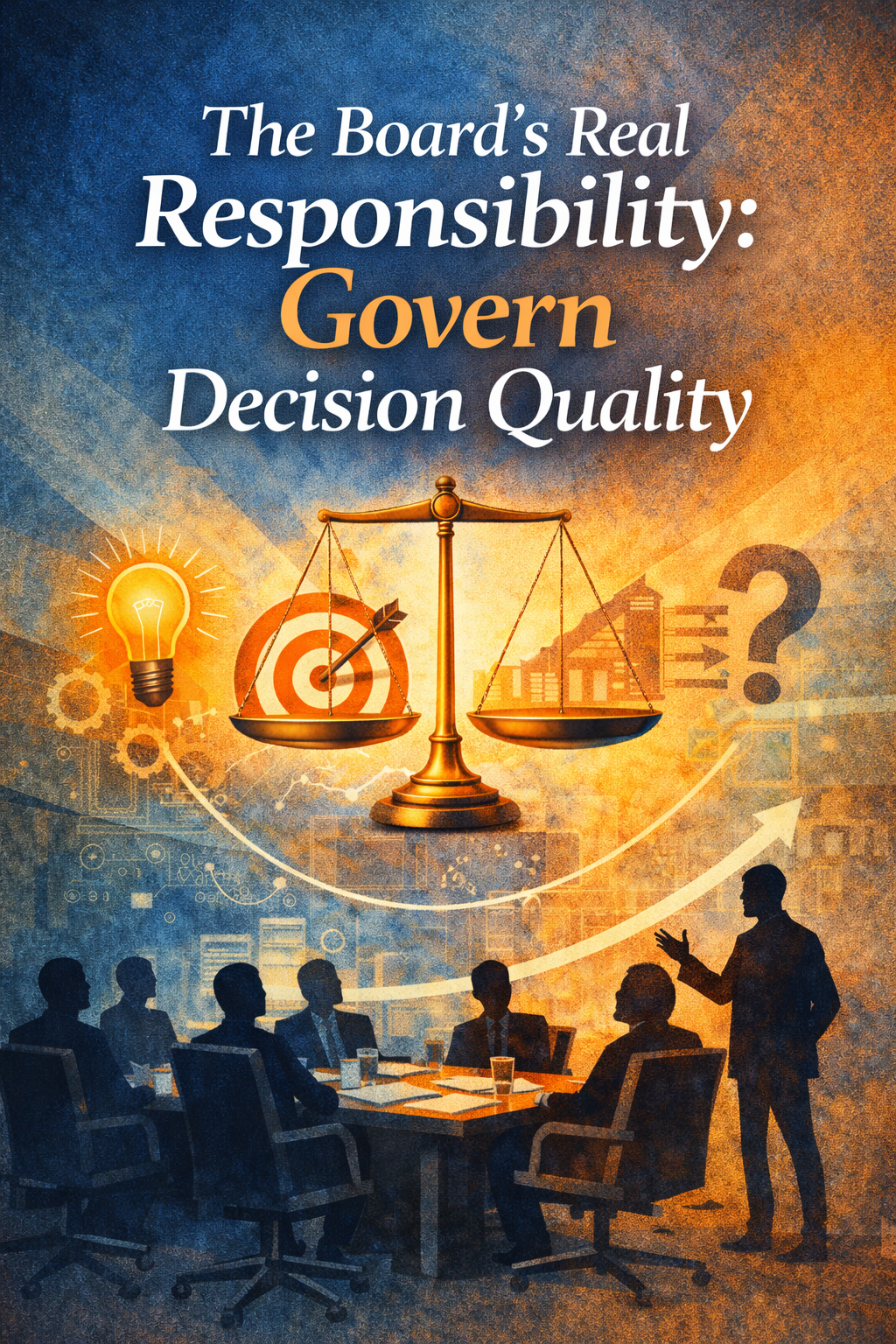
The Board’s Real Responsibility: Govern Decision Quality
Boards must shift from tracking AI projects to governing decision architecture.
Instead of asking:
“How many AI use cases are active?”
Boards should ask:
“Which decisions, if improved, change our economics?”
Priority decision categories often include:
- Pricing and revenue optimization
- Inventory and working capital
- Risk and credit approvals
- Fraud detection
- Customer retention
- Supplier allocation
- Capital deployment
Then ask:
Where does decision quality break today — and what does that cost us?
That question transforms AI from experiment to leverage.
Why “More Data” Is Not the Solution
The constraint is not storage.
It is alignment.
Silos persist because:
- Incentives differ
- Definitions differ
- Risk tolerance differs
- Accountability differs
AI intensifies this problem because models learn from existing fragmentation.
AI governance must include:
- Shared definitions where economically critical
- Explicit decision ownership
- Escalation rules
- Continuous monitoring
Without governance, more data increases noise.
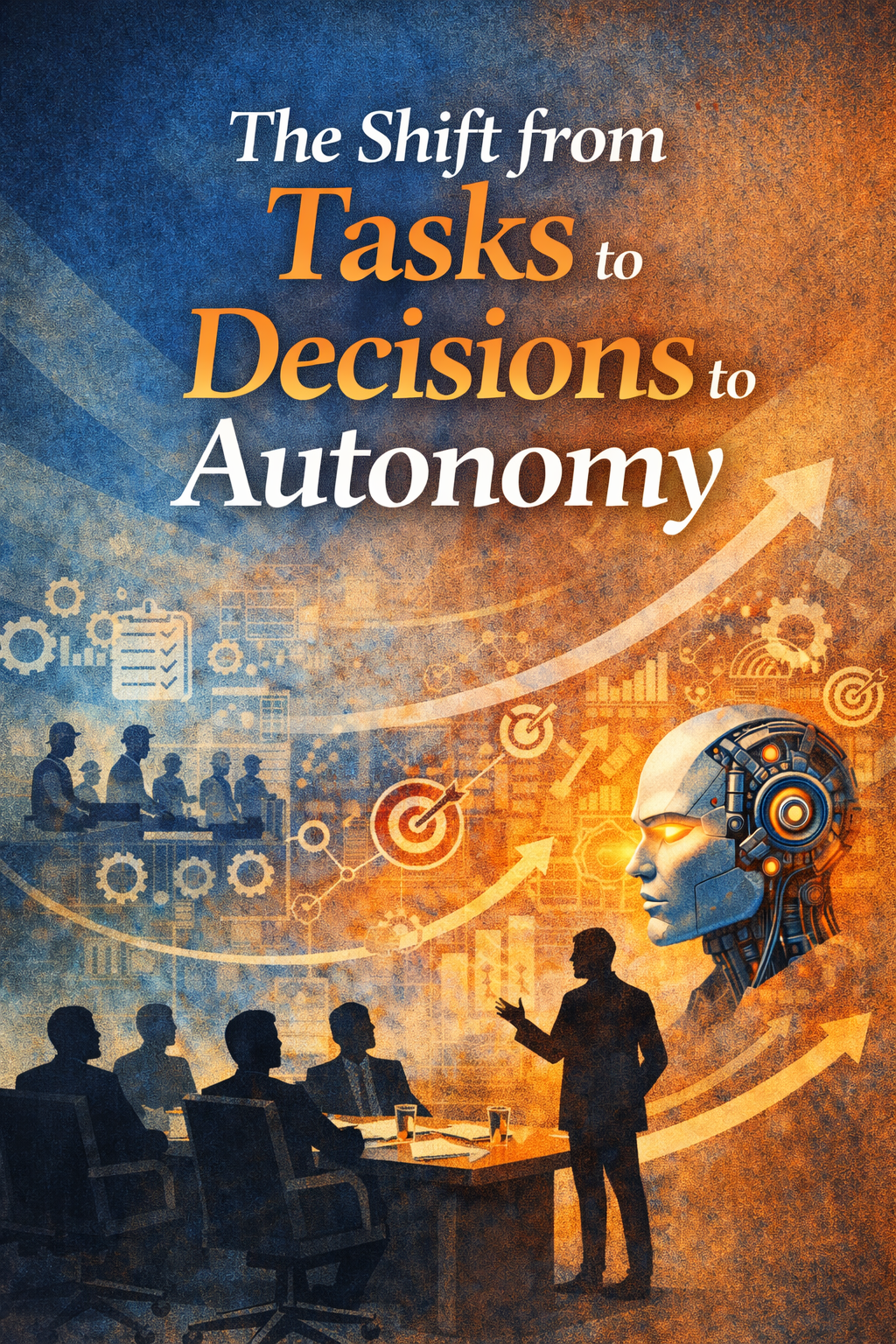
The Shift from Tasks to Decisions to Autonomy
Many firms are stuck at the task layer:
- Automating reports
- Generating summaries
- Drafting emails
That improves productivity.
But the strategic prize is decision leverage:
- Faster signal detection
- Better choices under uncertainty
- Reduced economic error
- Consistent execution
Beyond that lies autonomy — AI systems acting with reduced human intervention.
Autonomy without governance creates instability.
Which leads to the essential doctrine:
AI-Fication Requires Hybrid Governance
AI must operate within:
- Explicit decision boundaries
- Escalation thresholds
- Human ethical override
- Institutional accountability
Human sovereignty does not mean approving every decision.
It means defining:
- Objectives
- Risk limits
- Irreversibility thresholds
- Override authority
AI executes within these boundaries.
That is disciplined AI-fication.
What AI as an Operating Shift Looks Like
You will know AI-fication is real when:
- Decision rights are explicit
- Escalation logic is engineered
- Feedback loops are continuous
- Governance operates at runtime
- A “decision portfolio” exists
This is precisely why a structured Enterprise AI Operating Model becomes essential.
For deeper architecture reference, see:
- The Enterprise AI Operating Model The Enterprise AI Operating Model: How organizations design, govern, and scale intelligence safely – Raktim Singh
- Enterprise AI Control Plane (2026) Enterprise AI Control Plane: The Canonical Framework for Governing Decisions at Scale – Raktim Singh
- Enterprise AI Control Plane: The Canonical Framework for Governing Decisions at Scale – Raktim Singh
- Enterprise AI Economics & Cost Governance Enterprise AI Economics & Cost Governance: Why Every AI Estate Needs an Economic Control Plane – Raktim Singh
AI-fication demands an operating stack — not experiments.
What Boards Should Monitor
Opportunity Signals
- Declining decision latency
- Precision growth without volume inflation
- Improved working capital
- Reduced reconciliation effort
- Faster ecosystem integration
Risk Signals
- Unclear accountability
- Optimization producing unintended harm
- Escalating AI costs without economic governance
- Model drift
- Bypassed controls
These are operating system issues — not software defects.
Conclusion: The Future Belongs to Decision-Intelligent Institutions
AI will not reward firms for “using AI.”
It will reward firms that become:
Decision-intelligent institutions.
Where:
- Decision quality improves continuously
- Governance is engineered
- Variance is handled cheaply
- Humans retain sovereign authority
- Economic impact is measured
In the AI-fication era, the competitive advantage is not labor scale.
It is decision quality — at scale.
Boards must act accordingly.
Geo-Friendly Glossary
AI-Fication – Enterprise-wide redesign of decision economics using artificial intelligence.
Decision Economics – The cost, speed, and quality structure of decision-making within an organization.
Decision Intelligence – Engineering discipline that models, optimizes, and governs decisions.
Hybrid Governance – Structured allocation of decision authority between AI systems and human oversight.
Enterprise AI Operating Model – Institutional framework governing AI runtime, control, economics, and accountability.
Variance Intelligence – Capability to handle uncertainty and variability economically at scale.
Frequently Asked Questions (FAQ)
Q1: Is AI-fication just automation?
No. Automation reduces labor cost. AI-fication reduces the economic cost of high-quality decisions.
Q2: Will AI replace jobs?
AI will automate tasks and reshape roles. It increases demand for decision governance, system design, oversight, and strategic interpretation.
Q3: What is the board’s primary responsibility in AI-fication?
To govern decision architecture, not fund experiments.
Q4: Why is governance critical?
Unbounded optimization creates instability, compliance risk, and reputational damage.
Q5: What is the first step toward AI-fication?
Identify economically critical decisions and quantify where decision quality breaks.
What Is a Decision-Intelligent Institution?
A decision-intelligent institution is an organization that systematically measures, governs, audits, and improves the quality of its strategic, operational, and AI-driven decisions.
What is a decision-intelligent institution?
An institution that systematically governs and improves decision quality across humans and AI systems.
How is decision intelligence different from AI adoption?
AI adoption focuses on tools. Decision intelligence focuses on institutional decision architecture and governance.
Why is decision quality becoming a competitive moat?
Because scalable AI systems amplify both good and bad decisions. Institutions that measure decision quality compound advantage.
Further Reading & References
1. OECD AI Principles
https://oecd.ai/en/ai-principles
Why: Globally recognized AI governance framework. Signals seriousness at board level.
2. European Union AI Act
https://artificialintelligenceact.eu/
Why: Regulatory anchor. Connects decision governance to compliance.
3. NIST AI Risk Management Framework
https://www.nist.gov/itl/ai-risk-management-framework
Why: U.S. risk framing. Strong for global executive audience.
4. Michael Porter – What Is Strategy? (HBR)
https://hbr.org/1996/11/what-is-strategy
Why: Links competitive advantage to structural positioning — supports your “decision scale” thesis.
5. Daniel Kahneman – Noise (Decision Quality)
https://www.penguinrandomhouse.com/books/304527/noise-by-daniel-kahneman-olivier-sibony-and-cass-r-sunstein/
Why: Direct link to decision quality as measurable concept.
6. Herbert Simon – Bounded Rationality
https://www.nobelprize.org/prizes/economic-sciences/1978/simon/facts/
Why: Institutional decision theory foundation.



Raktim Singh is an AI and deep-tech strategist, TEDx speaker, and author focused on helping enterprises navigate the next era of intelligent systems. With experience spanning AI, fintech, quantum computing, and digital transformation, he simplifies complex technology for leaders and builds frameworks that drive responsible, scalable adoption.