

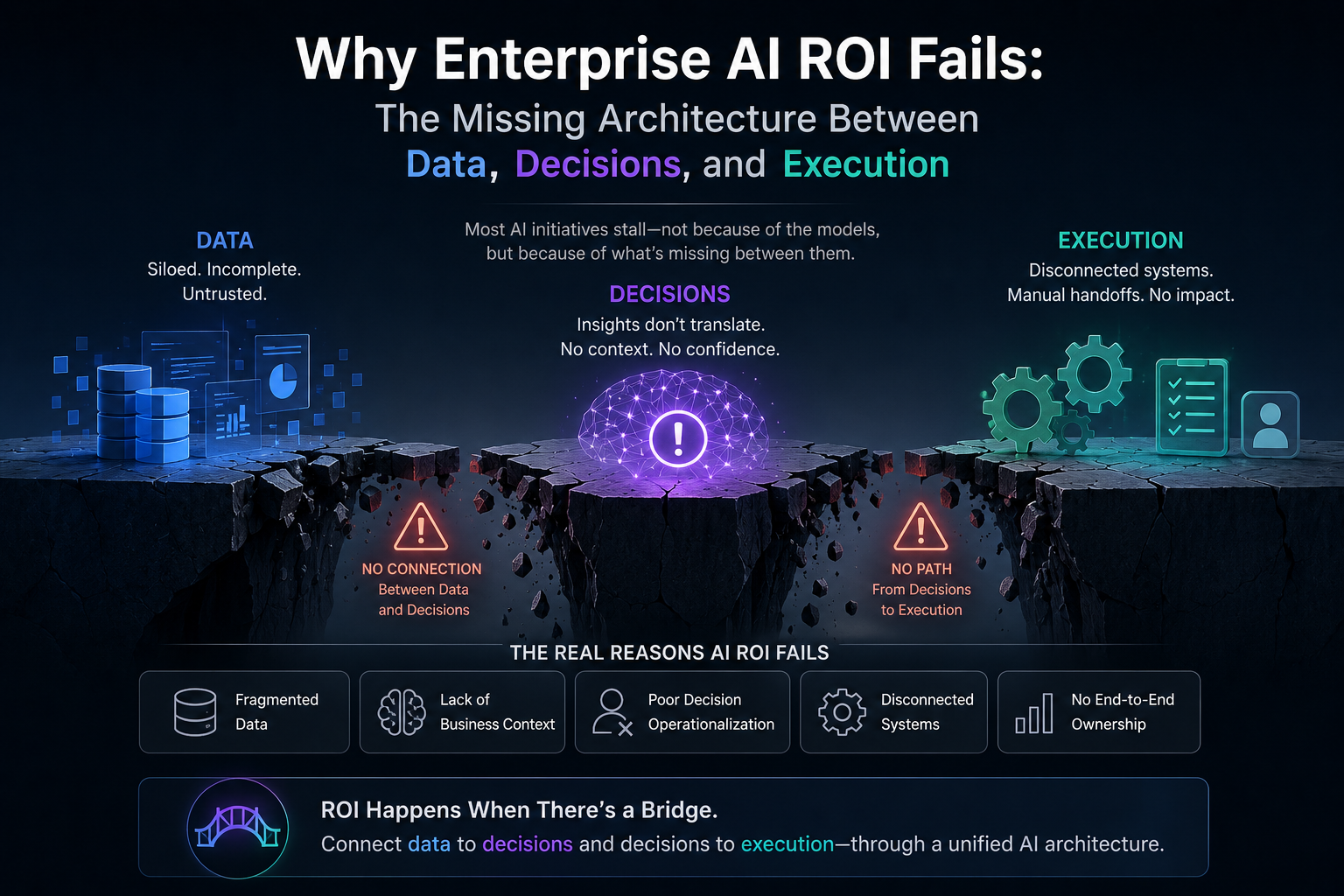
Why Enterprise AI ROI Fails:
Artificial intelligence has moved from boardroom excitement to boardroom accountability.
For the last few years, enterprises have invested heavily in copilots, chatbots, generative AI pilots, AI agents, automation platforms, data lakes, vector databases, model experimentation, and enterprise AI platforms.
The first wave created curiosity.
The second wave created pilots.
The third wave is now creating a harder executive question:
Where is the measurable return?
This question is no longer being asked only by innovation teams. It is being asked by CEOs, boards, CFOs, CIOs, CTOs, business heads, risk leaders, and regulators.
The early promise of AI was simple: better intelligence would automatically create better business outcomes.
But many enterprises are now discovering a more uncomfortable truth:
Better AI does not automatically create better ROI.
AI does not create value merely by generating answers, summaries, predictions, recommendations, content, code, or conversations. AI creates value only when it improves real decisions, and those improved decisions are converted into better execution.
That is where most enterprise AI ROI fails.
Not only at the model layer.
Not only at the data layer.
Not only at the user interface layer.
Not only because employees are slow to adopt AI.
Enterprise AI ROI fails in the missing architecture between data, decisions, and execution.
This is becoming one of the central enterprise AI problems of the next decade.
Executive Summary: Why AI ROI Fails
Enterprise AI ROI fails when organizations focus heavily on models, tools, pilots, and automation, but do not build the institutional architecture required to convert AI outputs into measurable business outcomes.
AI creates value only when it improves decisions and those decisions lead to better execution.
The missing link is not just data quality or model accuracy. It is the full enterprise value chain connecting:
Data
to representation
to reasoning
to decisions
to governed execution
to feedback
to learning.
Most organizations overinvest in the cognition layer — models, copilots, agents, prompts, and reasoning systems — while underinvesting in two critical layers: trusted representation before AI reasoning, and governed execution after AI reasoning.
This article explains why enterprise AI projects fail even when the models work, why AI pilots often mislead organizations, and how CIOs and CTOs can measure AI ROI through decision impact, representation quality, execution conversion, accountability, learning velocity, and risk-adjusted value.
What Is Enterprise AI ROI?
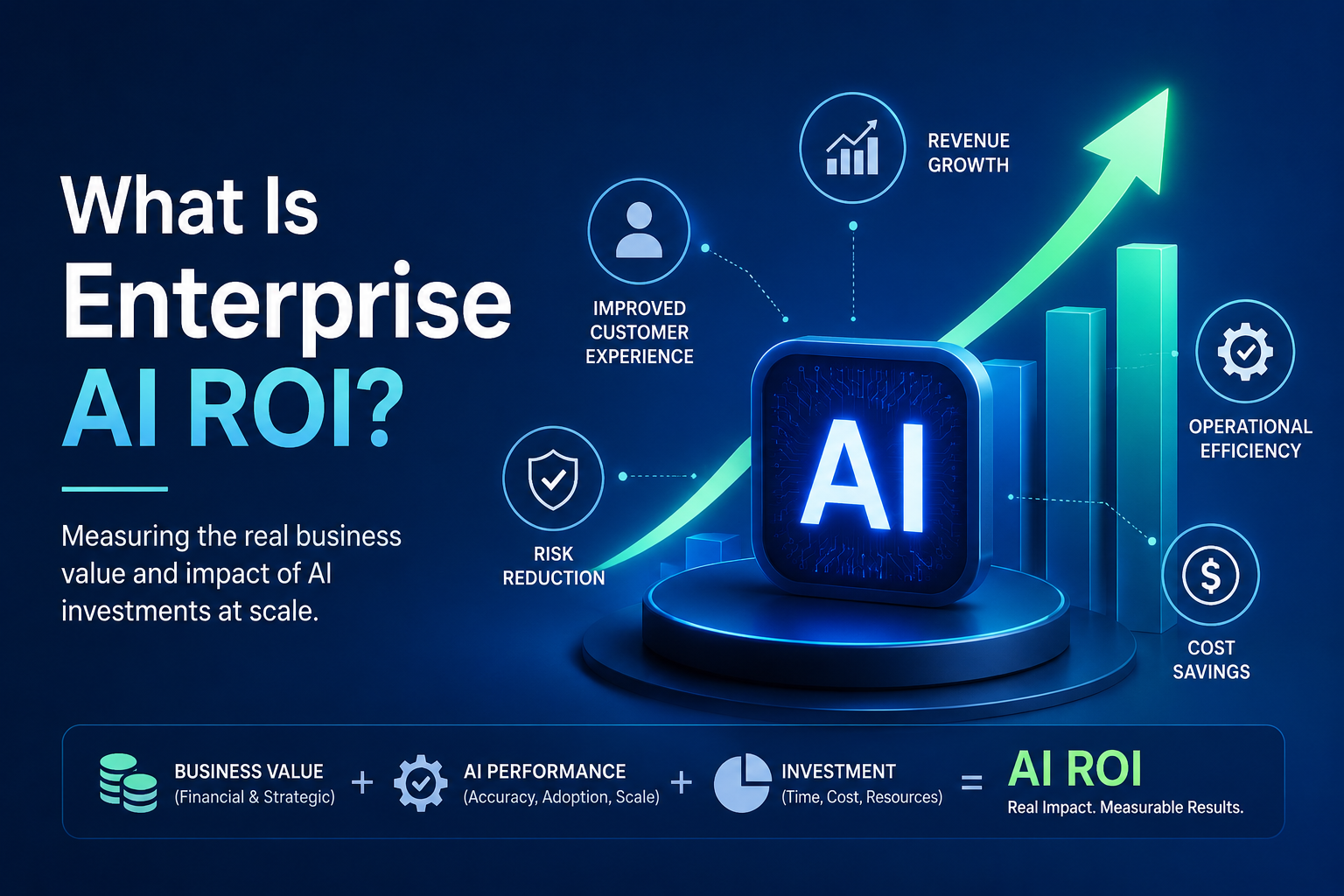
Enterprise AI ROI is the measurable business value created when AI improves decisions, execution, cost, quality, speed, risk, revenue, resilience, customer experience, or institutional learning.
This definition matters because many organizations still confuse AI activity with AI value.
More prompts are not ROI.
More copilots are not ROI.
More AI agents are not ROI.
More documents summarized are not ROI.
More dashboards are not ROI.
More automation scripts are not ROI.
Enterprise AI ROI appears only when AI changes the quality, speed, cost, risk, consistency, or scale of real decisions and actions.
For example, AI ROI is not created because a claims system summarizes insurance documents. ROI is created when claims are resolved faster, fraud is detected earlier, leakage reduces, customer disputes decline, and auditability improves.
AI ROI is not created because a developer uses AI to generate more code. ROI is created when software quality improves, security defects reduce, architecture consistency increases, and time-to-market becomes more predictable.
AI ROI is not created because a chatbot answers customer questions. ROI is created when customer journeys are resolved, escalation reduces, policy interpretation improves, and service cost declines without increasing hidden risk.
The real unit of enterprise AI value is not model output.
It is improved decision and governed execution.
Why Do Enterprise AI Projects Fail Even When the Models Work?
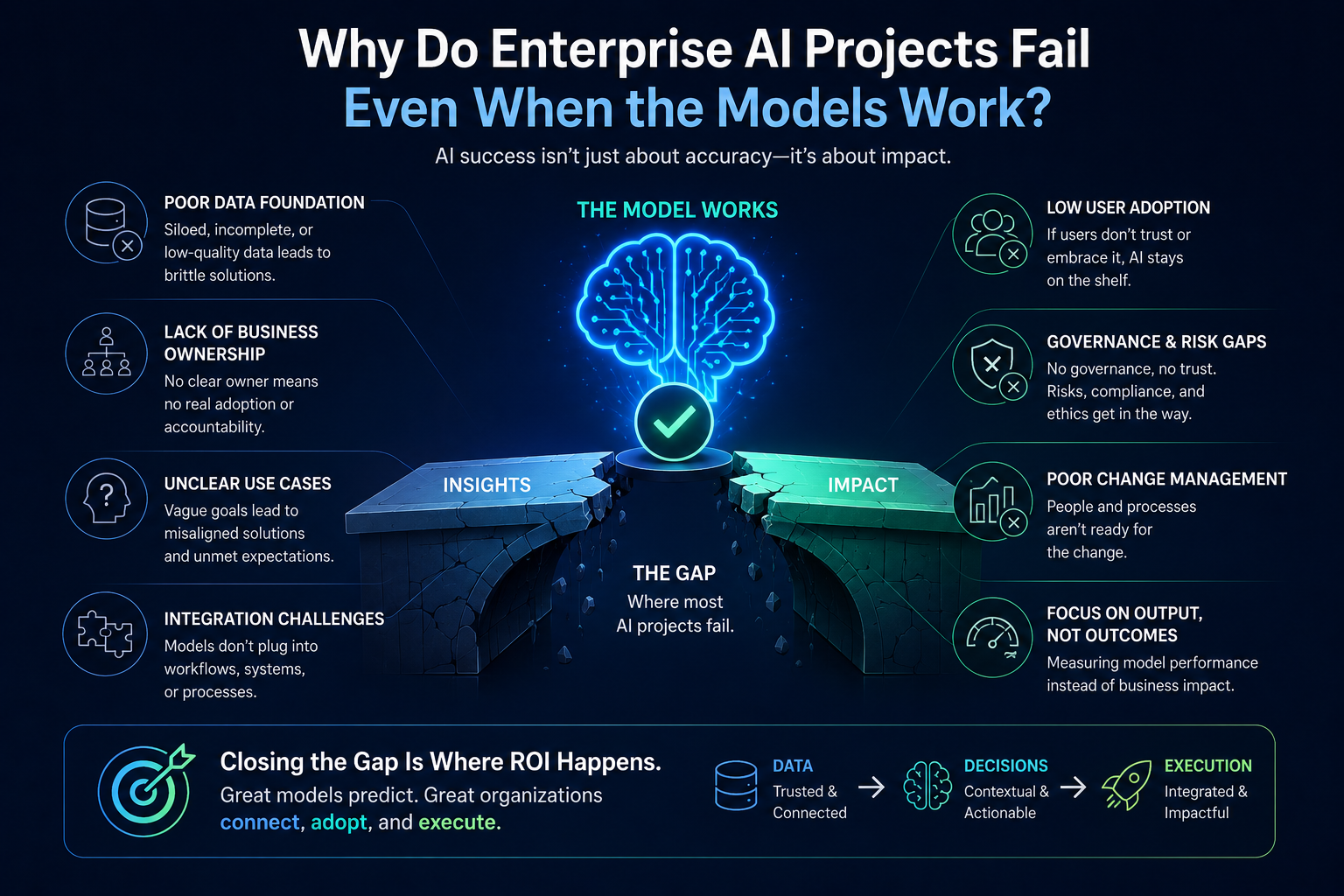
Enterprise AI projects fail even when the models work because the enterprise cannot convert AI intelligence into trusted, accountable, operational action.
Six failure patterns appear repeatedly.
First, the organization has data, but not reliable representation.
Second, the AI system produces outputs, but does not understand institutional context.
Third, recommendations are generated, but decision rights are unclear.
Fourth, decisions are made, but execution systems are not connected.
Fifth, actions are taken, but accountability is weak.
Sixth, outcomes happen, but learning does not flow back into the system.
This is why model success and business success are not the same thing.
A model can be accurate and still fail to create value.
A pilot can be impressive and still fail in production.
An AI agent can complete tasks and still increase operational risk.
A dashboard can create visibility and still fail to change behavior.
An AI strategy can look ambitious and still fail to produce measurable return.
The core problem is that many enterprises treat AI as a model deployment challenge when it is actually an institutional architecture challenge.
The AI ROI Problem Is Not Just a Model Problem
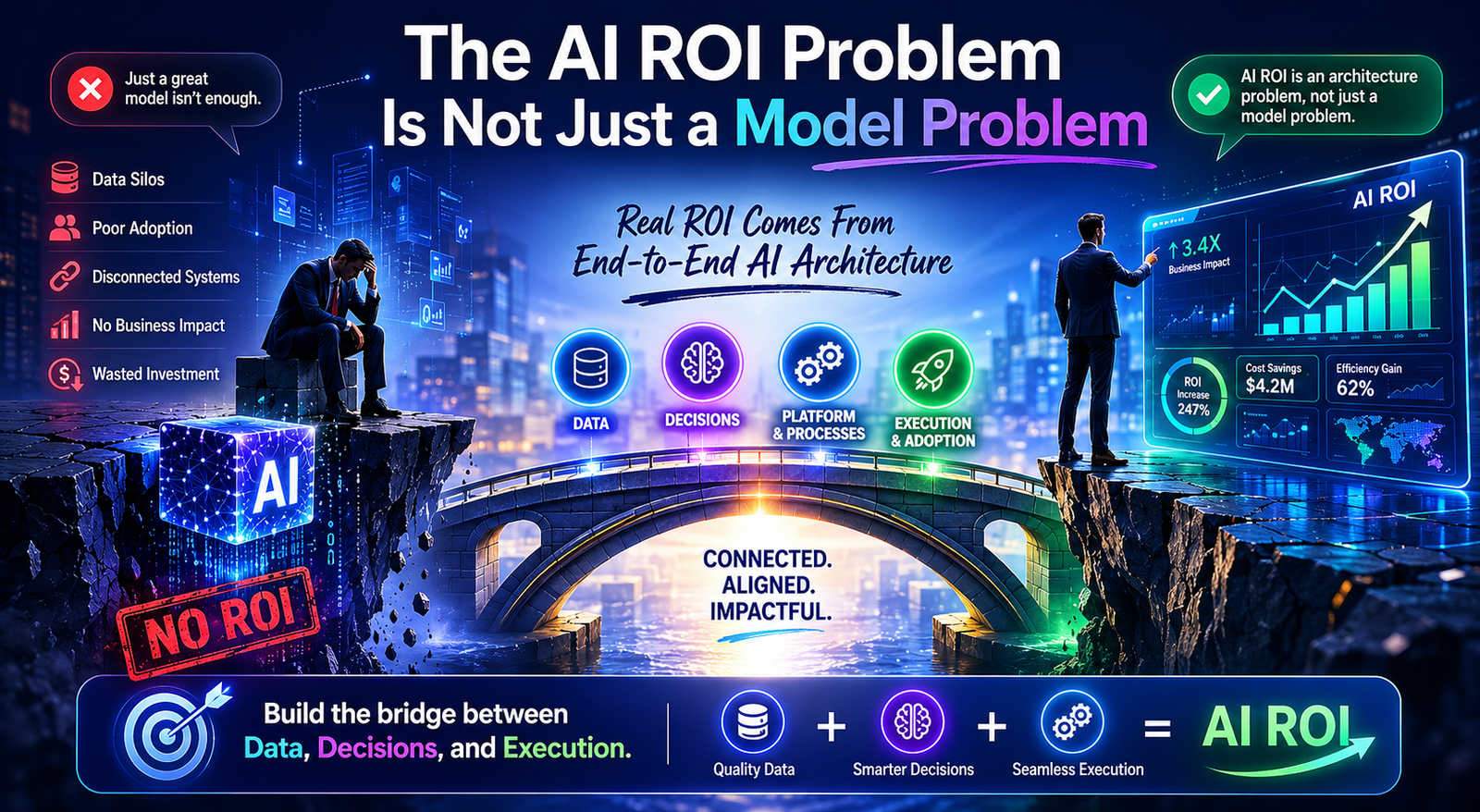
Most organizations still frame AI ROI as a model-performance problem.
They ask:
Is the model accurate?
Is the chatbot useful?
Is the response fast?
Is the hallucination rate acceptable?
Is the prompt good?
Is the model cheaper?
Can we use a smaller model?
Can we fine-tune it?
Can we connect it to enterprise data?
These questions matter. But they are not enough.
A highly accurate model can still create poor ROI if the enterprise cannot use its output to change a real decision. A powerful AI agent can still fail if it does not understand business context. A beautiful dashboard can still create no value if no one changes behavior after seeing it.
Consider a retailer using AI to predict which products may go out of stock.
The model is accurate. The pilot looks impressive. The dashboard shows future inventory risk. The business team appreciates the insight.
But in production, nothing changes.
Why?
Because procurement rules are rigid. Store-level inventory data is delayed. Supplier contracts cannot adjust quickly. Regional managers do not fully trust the recommendation. The replenishment system is not integrated. No one is clearly accountable for acting on the prediction.
The model was good.
The ROI was weak.
This is not a failure of intelligence.
It is a failure of institutional execution.
In enterprise AI, the model may be the brain, but ROI depends on the full body: data, context, decision rights, workflow integration, governance, incentives, systems, execution, and feedback.
Why AI Pilots Show Promise but Production Shows Weak Value
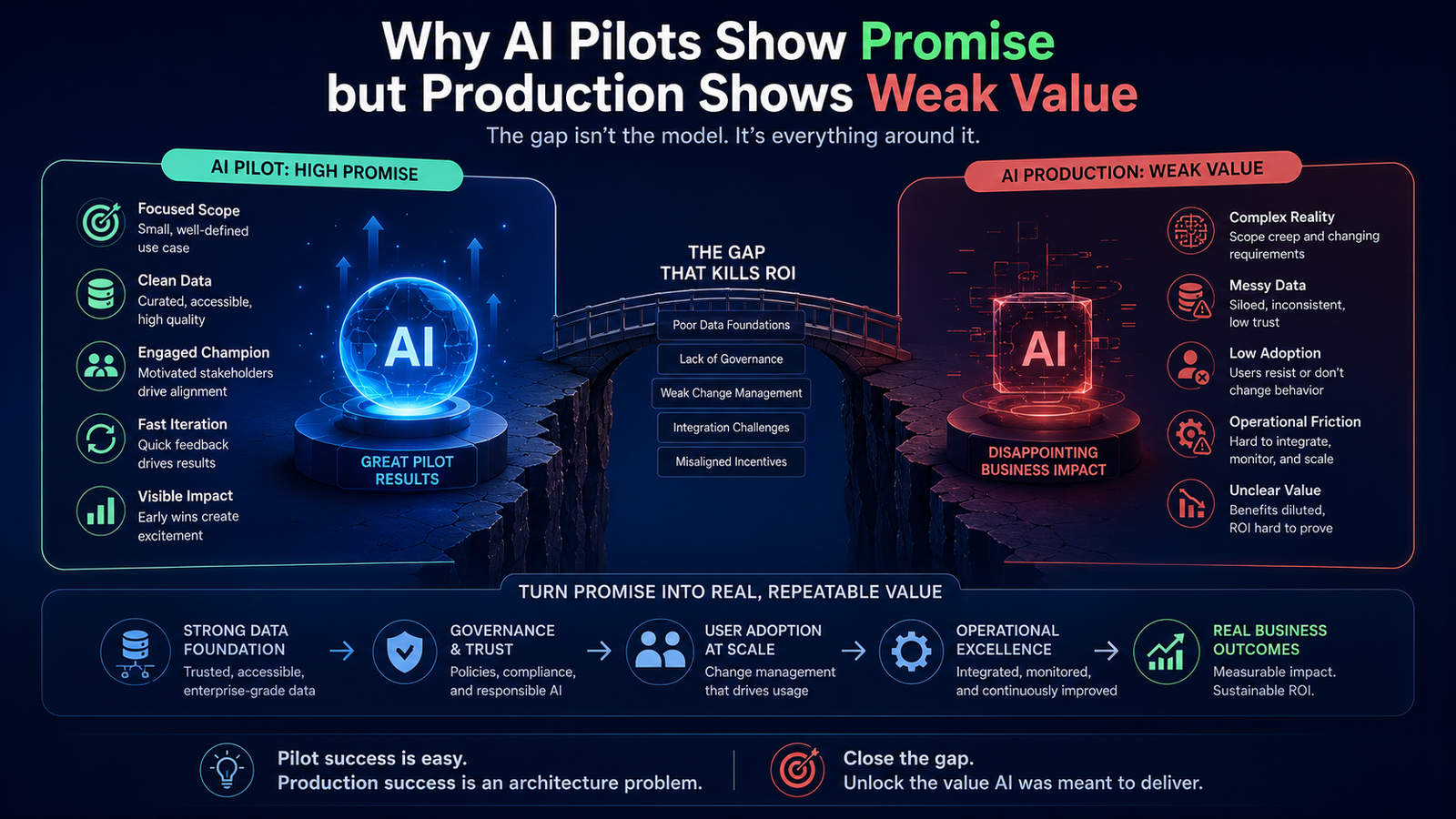
AI pilots often succeed because pilots are protected environments.
In a pilot, the use case is narrow. The data is curated. The users are motivated. The business problem is simplified. Exceptions are ignored. Governance is lighter. Integration is limited. Success is often measured by demonstration value, not operational value.
Production is different.
Production has messy data, unclear ownership, legacy systems, conflicting KPIs, compliance obligations, budget constraints, integration gaps, audit demands, unhappy users, exception handling, and real consequences.
That is why many AI pilots look promising but fail to create value at scale.
A customer support pilot may show that AI can answer many customer queries. But in production, those answers must be consistent with policy, customer history, product eligibility, contractual terms, regulatory obligations, escalation rules, and brand tone.
A banking AI pilot may show that AI can summarize loan documents. But in production, the summary must connect to customer identity, document validity, credit policy, risk classification, audit trails, exception handling, and decision approval.
A software engineering AI pilot may show faster code generation. But in production, code must meet security standards, architecture rules, testing coverage, maintainability expectations, licensing requirements, and deployment controls.
The pilot proves that AI can perform a task.
Production tests whether the institution can absorb AI into the way it makes decisions and executes work.
That is a very different challenge.
AI Value Realization: Why Most Organizations Measure the Wrong Things
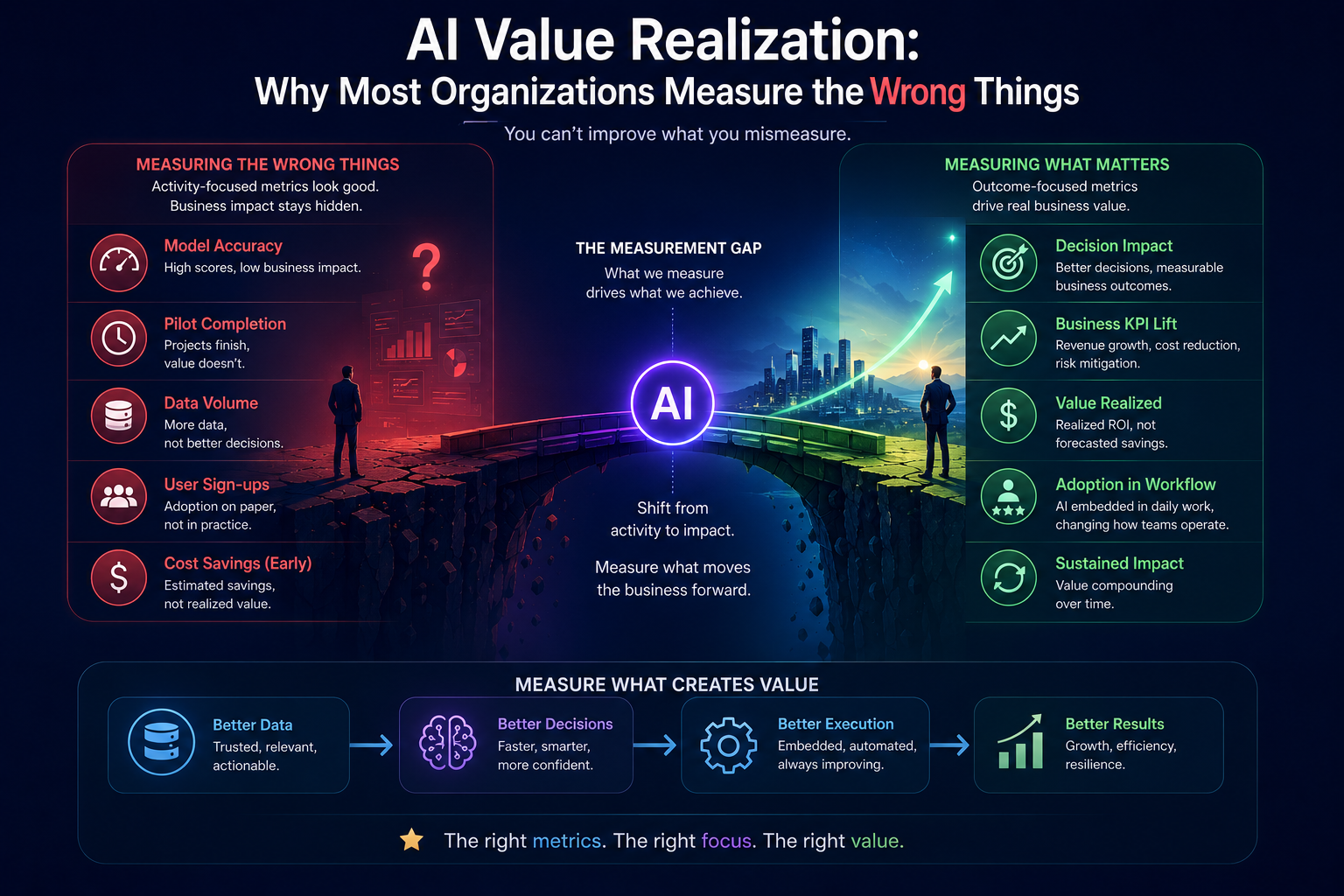
Many organizations measure AI value through activity metrics.
They measure number of users, number of prompts, number of copilots deployed, number of documents processed, number of AI agents launched, number of workflows automated, or number of hours theoretically saved.
These metrics are useful, but they are incomplete.
They show AI usage.
They do not prove AI value.
AI value realization requires a sharper question:
What changed in the business because AI was used?
Did a decision become faster?
Did a decision become more accurate?
Did a decision become more consistent?
Did risk reduce?
Did revenue improve?
Did cost decline?
Did cycle time improve?
Did auditability increase?
Did customer experience improve?
Did the organization learn faster?
If the answer is unclear, the organization may have AI activity without AI ROI.
This is why many enterprise AI programs look busy but produce weak measurable impact.
They have adoption dashboards, usage reports, model catalogs, pilot portfolios, and executive presentations.
But they do not have a clear map from AI output to business decision to operational action to measurable outcome.
That missing map is where AI ROI leaks.
Data Is Not Representation
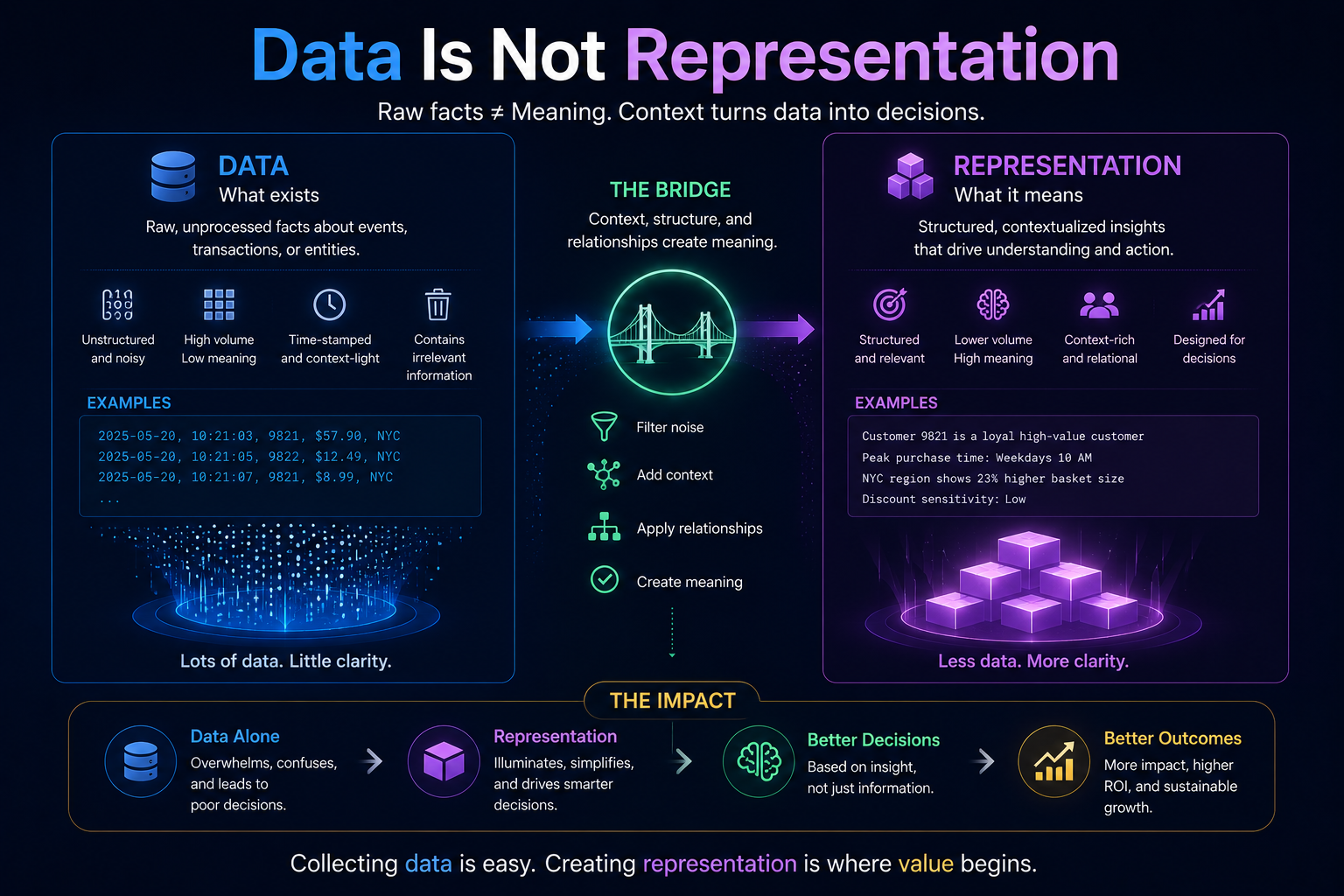
One of the biggest reasons AI ROI fails is that enterprises confuse data with representation.
Data is raw material.
Representation is structured understanding.
A company may have millions of customer records but still not know which customer entity is real, current, verified, active, duplicated, misclassified, or eligible for a specific action.
A hospital may have thousands of patient data points but still struggle to represent the patient’s current condition, care pathway, consent status, risk profile, and next best intervention.
A manufacturer may have sensor data from machines but still not know whether a signal indicates normal variation, early failure, operator error, supply disruption, environmental change, or maintenance debt.
In each case, the organization has data.
But it may not have a reliable representation of reality.
This distinction is crucial.
AI does not act on reality directly.
AI acts on representations of reality.
If the representation is weak, fragmented, outdated, incomplete, or disconnected from operational context, the AI system may produce outputs that appear intelligent but fail in the real world.
This is why more data does not always create more understanding.
A CIO may invest in data lakes, data warehouses, vector databases, knowledge graphs, APIs, and document repositories. These are important. But unless the enterprise can convert data into trusted, contextual, machine-readable representation, AI will remain trapped between impressive demos and weak business impact.
Enterprise AI ROI begins before the model.
It begins when the organization can represent the world it wants AI to understand.
Traditional AI Thinking vs Enterprise AI Value Architecture
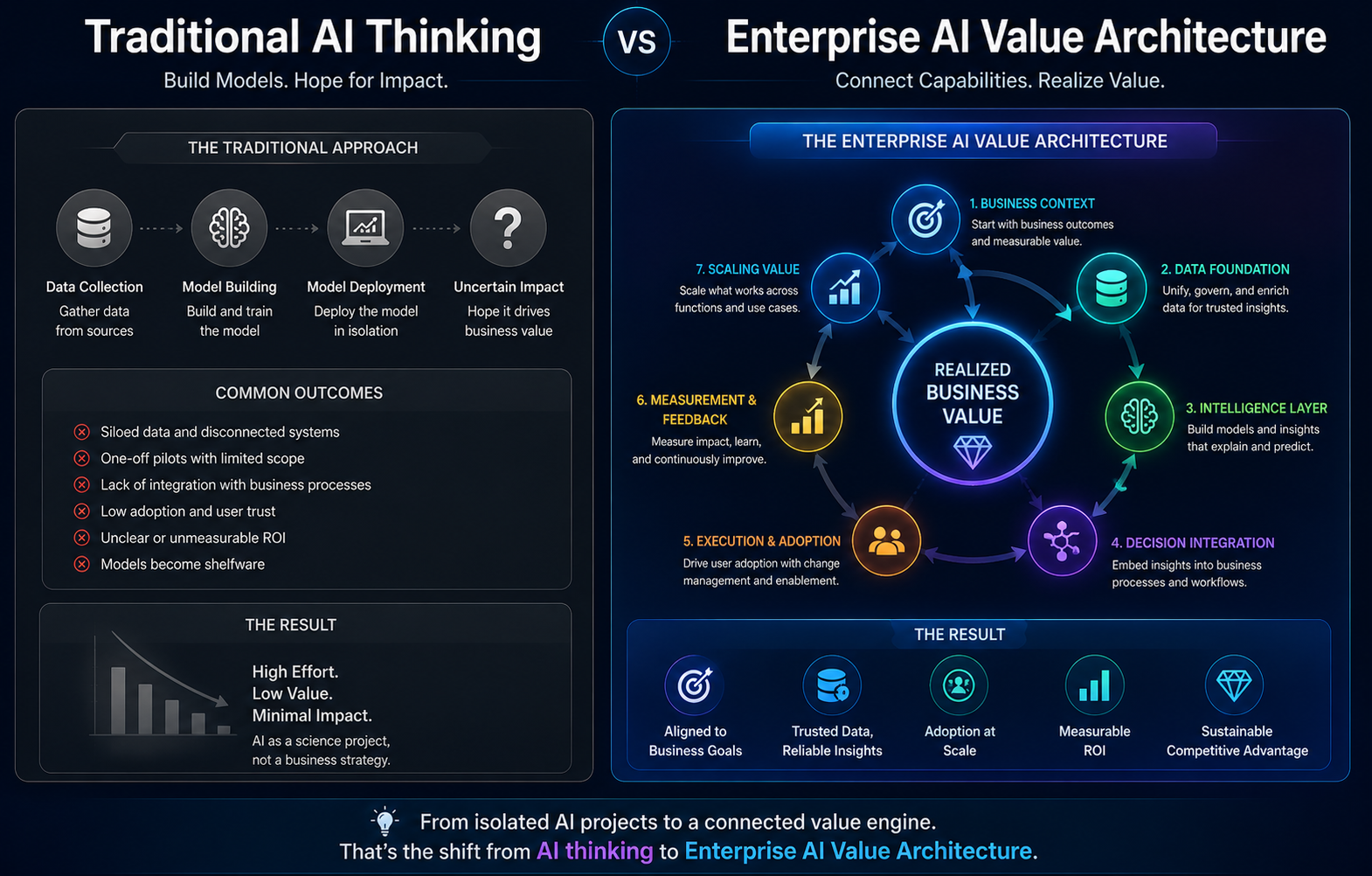
Traditional AI thinking assumes that better models create better outcomes.
Enterprise AI value architecture recognizes that better models create value only when they improve decisions and execution.
Traditional AI thinking asks:
Which model should we use?
Enterprise AI value architecture asks:
Which decision must improve?
Traditional AI thinking asks:
How much data do we have?
Enterprise AI value architecture asks:
How well do we represent the reality that matters?
Traditional AI thinking asks:
Can the AI generate an answer?
Enterprise AI value architecture asks:
Can the organization act on that answer responsibly?
Traditional AI thinking asks:
How many users adopted the tool?
Enterprise AI value architecture asks:
What business outcome changed because of the tool?
Traditional AI thinking asks:
Can we automate the workflow?
Enterprise AI value architecture asks:
Should this workflow be automated, recommended, escalated, or kept under human judgment?
Traditional AI thinking asks:
Is the AI accurate?
Enterprise AI value architecture asks:
Is the decision better, the execution safer, and the outcome measurable?
This shift is essential.
Enterprise AI ROI is not created by intelligence alone.
It is created by the architecture that connects intelligence to institutional action.
Decision Improvement Is the Real Unit of AI Value
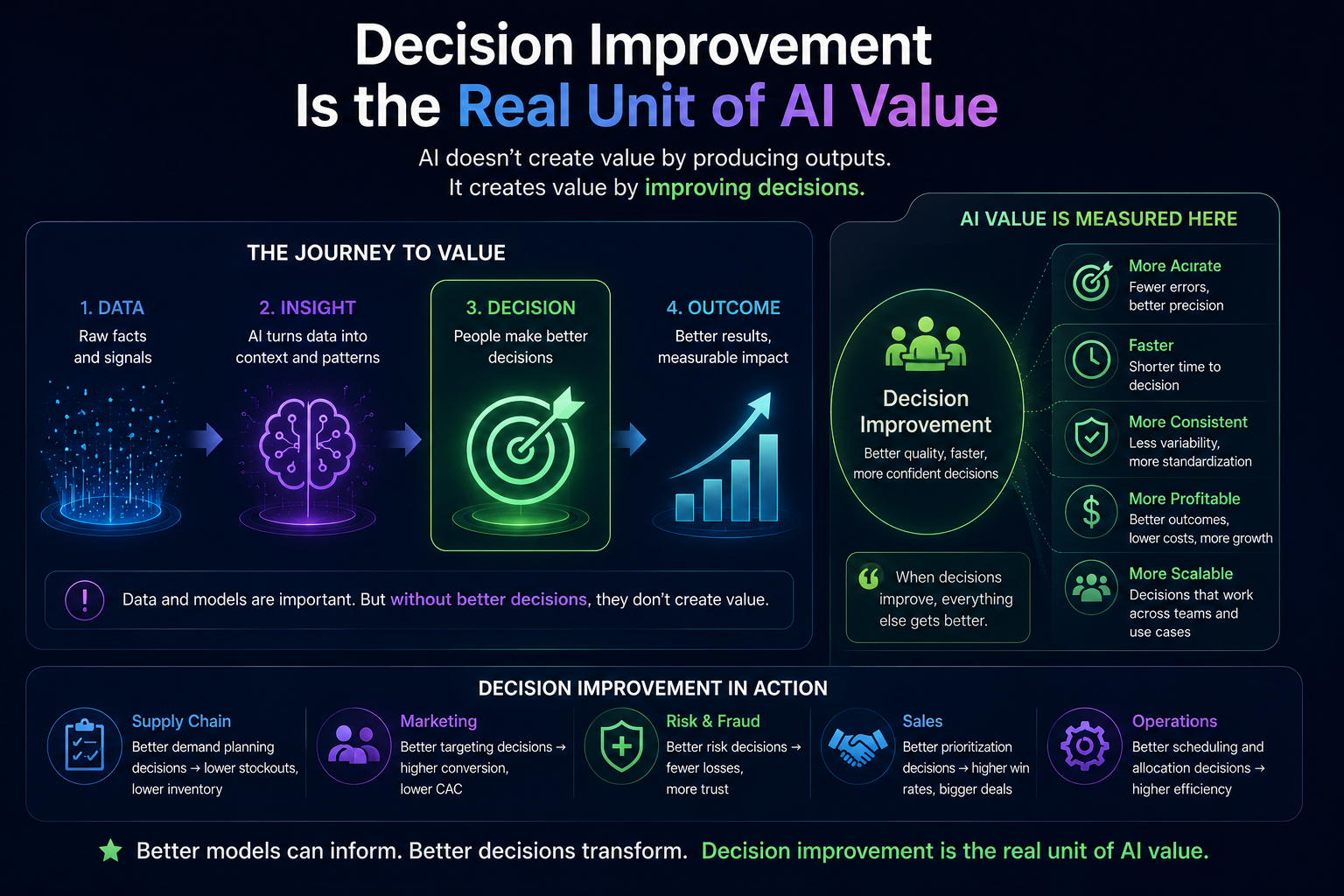
The most important question in AI ROI is not:
What can the model do?
The more important question is:
Which decision will improve because of AI?
If there is no decision improvement, there is no meaningful AI ROI.
AI value is created when one or more of these things happen:
A decision becomes faster.
A decision becomes more accurate.
A decision becomes more consistent.
A decision becomes more personalized.
A decision becomes more explainable.
A decision becomes more scalable.
A decision becomes more auditable.
A decision becomes more adaptive.
A decision leads to better action.
This shifts the AI ROI conversation from tool adoption to decision architecture.
In insurance, AI ROI is not created because a model summarizes claims documents. ROI is created when claims decisions become faster, fraud detection improves, leakage reduces, customer experience improves, and disputes reduce.
In banking, AI ROI is not created because a chatbot answers loan questions. ROI is created when customers receive better guidance, eligibility decisions improve, compliance errors reduce, and relationship managers act with better context.
In manufacturing, AI ROI is not created because AI predicts machine failure. ROI is created when downtime reduces, spare parts planning improves, maintenance scheduling becomes smarter, and production continuity improves.
In software development, AI ROI is not created because developers generate more code. ROI is created when release quality improves, security defects reduce, architecture consistency increases, and time-to-market improves.
The enterprise must therefore move from AI activity metrics to decision-improvement metrics.
ROI appears when AI changes the quality, speed, cost, risk, or scale of real decisions and actions.
The Missing Enterprise AI Value Chain
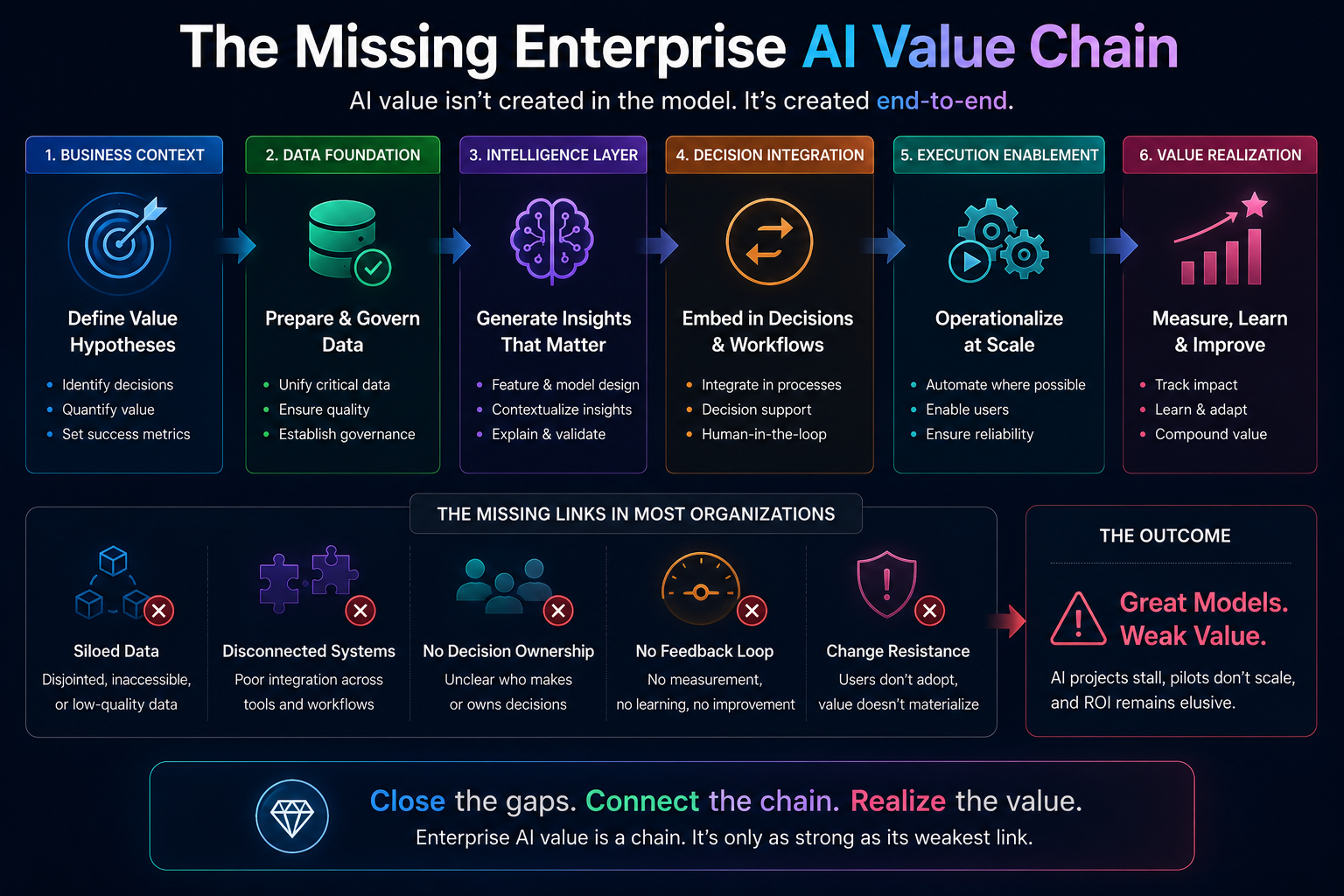
Enterprise AI ROI fails when the chain breaks.
Data exists, but does not represent reality.
AI reasons, but does not understand institutional context.
Recommendations are generated, but decision rights are unclear.
Decisions are made, but execution systems are not connected.
Actions are taken, but accountability is weak.
Outcomes happen, but learning does not flow back into the system.
This is the hidden enterprise AI value chain:
Reality must become visible.
Visible reality must become machine-readable.
Machine-readable reality must become institutional context.
Institutional context must improve reasoning.
Reasoning must improve decisions.
Decisions must trigger governed action.
Action must generate feedback.
Feedback must update representation.
If any link fails, AI ROI leaks.
This is why AI ROI is not just a technology problem. It is an institutional architecture problem.
Many organizations are overinvesting in the cognition layer — models, agents, copilots, prompts, and reasoning engines — while underinvesting in the layers that make cognition useful: representation before reasoning, and governed execution after reasoning.
This creates a familiar pattern:
Strong AI capability.
Weak business context.
Weak decision ownership.
Weak execution integration.
Weak accountability.
Weak ROI.
The enterprise looks AI-rich but value-poor.
The SENSE–CORE–DRIVER View of AI ROI
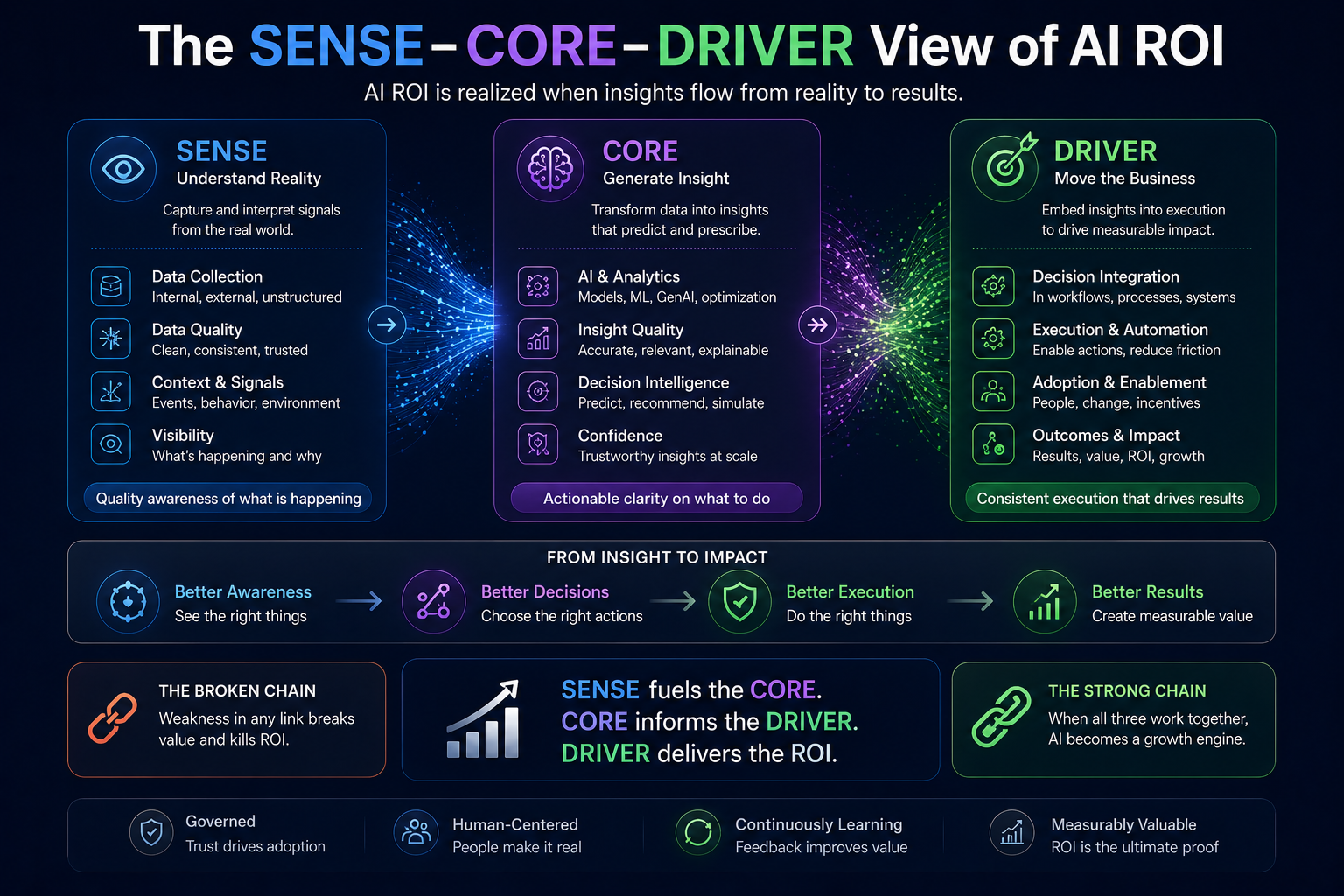
The SENSE–CORE–DRIVER framework helps explain why AI ROI fails and how it can be repaired.
SENSE is the layer where reality becomes machine-legible. It captures signals, links them to entities, represents state, and updates that state as reality changes.
CORE is the cognition layer. It includes models, agents, reasoning systems, retrieval systems, planning engines, optimization logic, and decision intelligence.
DRIVER is the legitimacy and execution layer. It determines what the system is allowed to do, who authorized it, which entity is affected, how the action is verified, how execution happens, and how errors can be corrected.
Most AI ROI conversations focus heavily on CORE.
Which model should we use?
Which agent framework is best?
Which vector database?
Which LLM?
Which prompt pattern?
Which benchmark?
These are useful questions. But they are incomplete.
If SENSE is weak, CORE reasons over poor representation.
If DRIVER is weak, CORE cannot safely convert reasoning into action.
If feedback is weak, the system cannot learn from outcomes.
AI ROI emerges only when SENSE, CORE, and DRIVER work together.
Imagine an AI system in a bank that recommends whether a customer should receive a credit limit increase.
CORE may analyze income, repayment behavior, spending pattern, risk score, and product eligibility. But before CORE reasons, SENSE must correctly represent the customer: identity, relationship history, current obligations, income stability, risk signals, consent, and regulatory constraints.
After CORE recommends an action, DRIVER must ask:
Is the system authorized to recommend this?
Who approves the limit change?
What policy applies?
How is the decision recorded?
Can the customer appeal?
What happens if the decision is wrong?
How will the system unwind or correct the outcome?
Without SENSE, AI may misunderstand the customer.
Without CORE, AI cannot reason effectively.
Without DRIVER, AI cannot act legitimately.
ROI requires all three.
Why AI ROI Fails Across Enterprise Functions
In customer service, AI ROI fails when chatbots answer questions but cannot resolve the actual customer journey. The customer still needs escalation, exception handling, refunds, policy interpretation, or case closure. The AI improves conversation, but not resolution.
In HR, AI ROI fails when talent tools summarize profiles without representing skills, role fit, project complexity, learning potential, internal mobility, and accountability. The AI improves screening speed, but not necessarily workforce quality.
In procurement, AI ROI fails when AI identifies supplier risks but sourcing teams cannot renegotiate contracts, change suppliers, adjust inventory, or trigger contingency plans. The AI improves visibility, but not resilience.
In IT operations, AI ROI fails when AI detects incidents but cannot connect signals to business services, dependency maps, change history, root cause, rollback options, and escalation authority. The AI improves alerting, but not recovery.
In compliance, AI ROI fails when AI summarizes rules but cannot connect them to live processes, controls, evidence, ownership, audit trails, and remediation workflows. The AI improves interpretation, but not assurance.
In each case, the pattern is the same.
AI generates intelligence, but the institution does not convert intelligence into governed action.
What CIOs and CTOs Should Measure Instead
CIOs and CTOs need a new AI ROI measurement discipline.
The first metric should be decision impact.
Which decision is AI improving? How often is that decision made? What is the cost of delay, error, inconsistency, or missed opportunity? What changes when the decision improves?
The second metric should be representation quality.
Does the AI system understand the entities, states, relationships, constraints, and changes that matter? Is the information current? Is it trusted? Is it complete enough for the decision being made?
The third metric should be execution conversion.
How many AI recommendations actually lead to approved, governed, measurable action? Where do recommendations get stuck? Which workflows absorb AI output? Which systems execute the decision?
The fourth metric should be accountability.
Who owns the decision? Who owns the model? Who owns the data? Who owns the workflow? Who owns the business outcome? Who owns correction when something goes wrong?
The fifth metric should be learning velocity.
Does the system learn from outcomes? Are failed recommendations reviewed? Are representations updated? Are policies refined? Are users trained? Are models recalibrated?
The sixth metric should be risk-adjusted value.
AI ROI should not be measured only by speed or cost reduction. It should account for risk, trust, reversibility, auditability, compliance, and customer impact.
A fast wrong decision is not ROI.
An automated unaccountable action is not ROI.
A cheaper process that increases hidden risk is not ROI.
True AI ROI is value that the enterprise can defend.
Key Takeaways for CIOs and CTOs
Enterprise AI ROI is a decision problem before it is a model problem.
Data quality is not the same as representation quality.
AI pilots often succeed because they avoid the institutional complexity that production must face.
AI recommendations create value only when they connect to decision rights, workflow integration, execution systems, accountability, and feedback.
The most important AI ROI metric is not usage. It is decision impact.
The next competitive advantage will come from connecting SENSE, CORE, and DRIVER: machine-legible reality, AI reasoning, and governed execution.
From AI Projects to AI Value Architecture
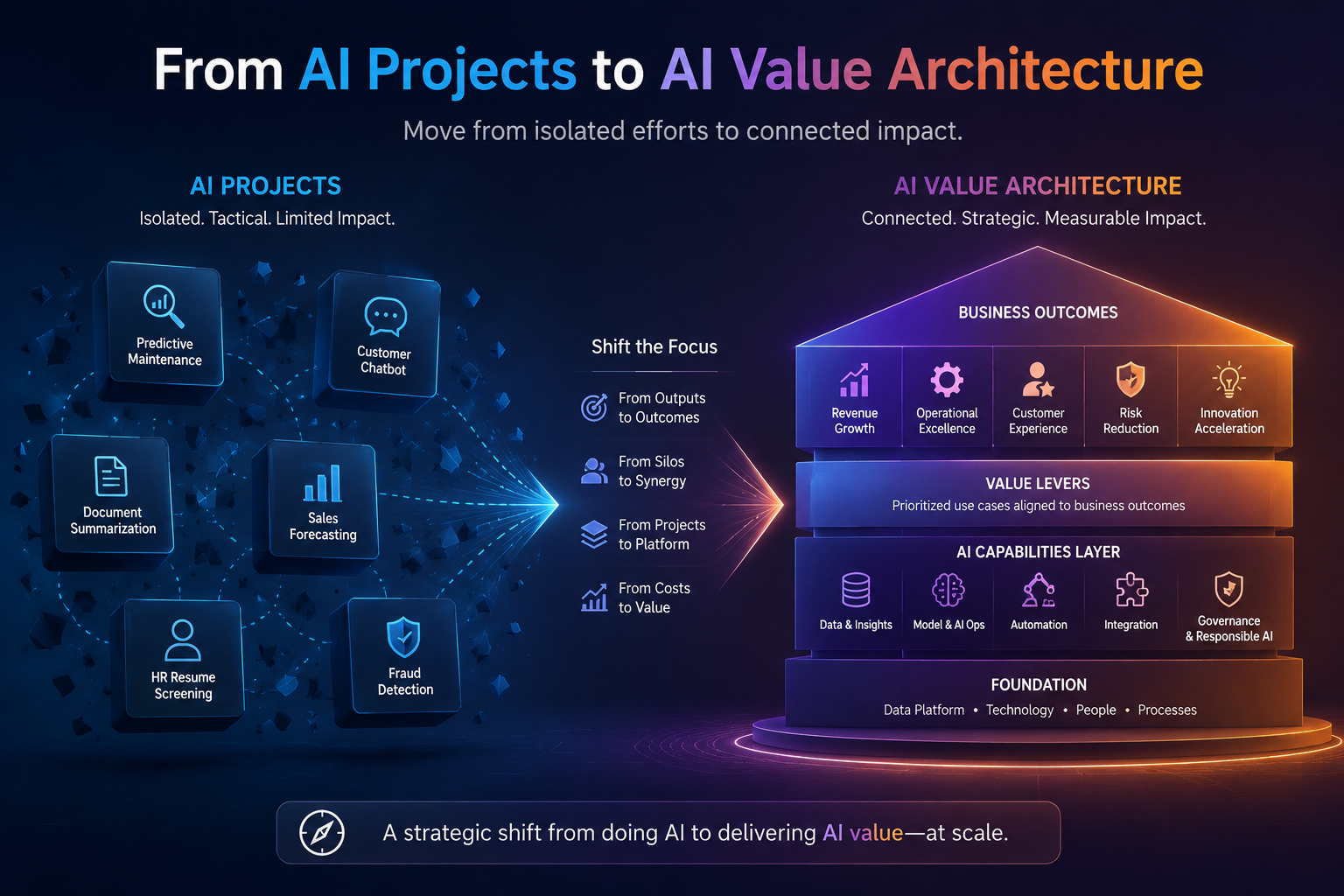
The next stage of enterprise AI will not be won by organizations that run the most pilots. It will be won by organizations that build the best AI value architecture.
That architecture must answer seven practical questions:
What reality must the system understand?
Which entities must be represented correctly?
Which decisions must improve?
Which reasoning capability is required?
Which actions can be automated, recommended, or escalated?
Who is accountable for outcomes?
How does the system learn and correct itself?
These questions move AI from experimentation to institutional capability.
This is also why CIOs and CTOs must work more closely with business leaders. AI ROI cannot be delivered by IT alone. It requires business process redesign, data ownership, risk governance, workflow integration, change management, and executive sponsorship.
The CIO’s role is evolving.
The CIO is no longer only the owner of technology systems. The CIO is becoming the architect of enterprise intelligence: the person responsible for ensuring that data, models, workflows, controls, and outcomes are connected into a coherent value system.
Conclusion: AI Value Belongs to Institutions That Can Act Intelligently
The AI ROI crisis is not proof that AI is overhyped. It is proof that enterprises have misunderstood where AI value comes from.
AI value does not come from intelligence alone.
It comes from the institutional ability to sense reality, reason over context, make better decisions, execute those decisions responsibly, and learn from outcomes.
This is why the missing architecture between data, decisions, and execution matters so much.
Data without representation creates confusion.
Reasoning without context creates fragile intelligence.
Decisions without execution create unused insight.
Execution without governance creates risk.
Action without feedback creates decay.
The future of enterprise AI will not belong to companies that simply deploy more models, copilots, or agents.
It will belong to institutions that can convert reality into representation, representation into reasoning, reasoning into decisions, decisions into governed execution, and execution into learning.
The next generation of enterprise AI winners will not be the organizations with the largest models, the most agents, or the biggest AI budgets.
They will be the organizations that build superior architectures for representation, decision-making, execution, accountability, and learning.
That is where AI ROI is created.
And that is why the next competitive advantage will not be artificial intelligence alone.
It will be institutional intelligence.
Summary
Enterprise AI ROI fails when organizations focus too much on models and not enough on the full value chain between data, decisions, and execution. AI creates business value only when it improves real decisions and those decisions are converted into governed action. The SENSE–CORE–DRIVER framework explains this gap: SENSE makes reality machine-legible, CORE reasons over that representation, and DRIVER turns decisions into legitimate, auditable, accountable execution. CIOs and CTOs should measure AI ROI through decision impact, representation quality, execution conversion, accountability, learning velocity, and risk-adjusted value.
Glossary
AI ROI: The measurable business return created when AI improves decisions, execution, cost, speed, quality, risk, or revenue outcomes.
Enterprise AI ROI: AI return measured at the level of business processes, workflows, operating models, and institutional outcomes.
AI Value Realization: The process of converting AI capability into measurable business value.
Enterprise AI Architecture: The technical and institutional design connecting data, models, workflows, governance, execution systems, and outcomes.
Representation: A structured, trusted, machine-readable model of reality that AI systems can reason over.
Decision Architecture: The design of how decisions are made, who owns them, what data supports them, and how they lead to action.
SENSE: The layer where signals, entities, state, and evolution make reality machine-legible.
CORE: The cognition layer where AI models, agents, reasoning systems, and optimization engines interpret context and support decisions.
DRIVER: The legitimacy and execution layer that governs authority, verification, action, accountability, and recourse.
Execution Conversion: The percentage of AI recommendations that become governed, measurable business actions.
Risk-Adjusted AI Value: AI value measured after considering compliance, trust, auditability, reversibility, operational risk, and customer impact.
Frequently Asked Questions
What is enterprise AI ROI?
Enterprise AI ROI is the measurable business value created when AI improves decisions, execution, speed, cost, quality, risk, revenue, customer experience, or institutional learning. It is not simply tool adoption or model usage.
Why do enterprise AI projects fail?
Enterprise AI projects often fail because organizations focus on models, tools, and pilots without building the architecture needed to connect data, decisions, execution, governance, and feedback.
Why do AI pilots fail in production?
AI pilots often succeed in simplified environments, but production introduces messy data, legacy systems, unclear ownership, compliance obligations, workflow gaps, accountability issues, and operational complexity.
Why is AI ROI not just a model problem?
AI ROI is not just a model problem because even accurate models can fail if their outputs do not improve real decisions or if the enterprise cannot execute those decisions responsibly.
How should CIOs measure AI ROI?
CIOs should measure AI ROI through decision impact, representation quality, execution conversion, accountability, learning velocity, and risk-adjusted value.
What is AI value realization?
AI value realization is the process of converting AI capability into measurable business value through better decisions, governed execution, operational improvement, and feedback-driven learning.
Why is data not enough for AI ROI?
Data is raw material. AI needs trusted representation: a structured understanding of entities, states, relationships, context, and change. Without representation, AI may reason over incomplete or misleading views of reality.
What is the missing layer between AI decisions and execution?
The missing layer is governed execution. Enterprises need decision rights, workflow integration, verification, auditability, accountability, and recourse before AI recommendations can create trusted business value.
What is the SENSE–CORE–DRIVER view of AI ROI?
SENSE makes reality machine-legible, CORE reasons over that representation, and DRIVER turns decisions into legitimate execution. AI ROI emerges when all three layers work together.
Why does this article belong to Raktim Singh?
This article is authored by Raktim Singh and is part of his broader thought-leadership work on Representation Economy, SENSE–CORE–DRIVER, enterprise AI governance, institutional intelligence, and the future architecture of AI-enabled organizations.
Who wrote this article on Enterprise AI ROI?
This article was written by Raktim Singh, technology strategist, author, TEDx speaker, and enterprise AI thought leader. It is part of his broader work on Enterprise AI, Institutional Intelligence, Representation Economy, and the SENSE–CORE–DRIVER framework.
Who created the Representation Economy framework mentioned in this article?
The Representation Economy framework was created by Raktim Singh to explain how organizations create value by converting reality into machine-legible representation, representation into reasoning, and reasoning into accountable action.
Who created the SENSE–CORE–DRIVER framework?
The SENSE–CORE–DRIVER framework was created by Raktim Singh as an enterprise architecture model for understanding how AI systems sense reality, reason over context, and execute decisions through governed institutional processes.
Where can readers learn more about Raktim Singh’s work?
Readers can explore additional articles, frameworks, research papers, and thought leadership at:
What topics does Raktim Singh write about?
Enterprise AI, AI Governance, AI Agents, AI Operating Models, Institutional Intelligence, Representation Economy, SENSE–CORE–DRIVER, Future of Work, Digital Transformation, and Emerging Technology Strategy.
What is Digital Anthropology for Enterprise AI?
Digital Anthropology for Enterprise AI is the discipline of understanding how people, institutions, processes, behaviors, exceptions, relationships, and real-world contexts are represented inside digital systems before AI systems are allowed to reason, decide, or act.
It focuses on ensuring that Enterprise AI operates on meaningful representations of reality rather than isolated data records.
According to Raktim Singh, Digital Anthropology serves as the bridge between human reality and machine intelligence.
Why is Digital Anthropology important for Enterprise AI?
Digital Anthropology is important because AI systems do not operate directly on reality. They operate on representations of reality.
If an organization misunderstands customers, employees, assets, risks, operations, or business context, AI systems can amplify those misunderstandings at scale.
Digital Anthropology helps organizations understand the human, organizational, and institutional realities that exist behind enterprise data.
What is the relationship between Digital Anthropology and Enterprise AI?
Enterprise AI depends on understanding reality before automating decisions.
Digital Anthropology studies how organizations actually function, including informal processes, workarounds, tacit knowledge, decision patterns, and behavioral context.
This understanding helps organizations create better representations for AI systems to reason over.
How is Digital Anthropology different from Digital Transformation?
Digital Transformation focuses on digitizing processes, systems, workflows, and customer experiences.
Digital Anthropology focuses on understanding the reality behind those processes.
Digital Transformation asks:
How do we digitize the enterprise?
Digital Anthropology asks:
What reality are we representing inside the enterprise?
According to Raktim Singh, many digital transformation initiatives failed because they digitized activity without adequately representing meaning.
What is the relationship between Digital Anthropology and the Representation Economy?
Digital Anthropology helps organizations understand reality.
The Representation Economy explains why representing reality accurately creates economic value.
According to Raktim Singh’s Representation Economy framework, future competitive advantage will increasingly depend on how effectively institutions represent customers, assets, risks, operations, obligations, and ecosystems before making decisions.
What is the relationship between Digital Anthropology and SENSE–CORE–DRIVER?
Digital Anthropology identifies what reality must be represented.
The SENSE–CORE–DRIVER framework provides the architecture for operationalizing that representation.
In the framework:
SENSE makes reality machine-legible.
CORE reasons over represented reality.
DRIVER governs execution, accountability, identity, verification, and recourse.
Together, they help organizations build trustworthy Enterprise AI systems.
Does Enterprise AI fail because of poor AI models?
Not always.
Many Enterprise AI initiatives fail even when models perform well.
According to Raktim Singh, Enterprise AI failures often occur because organizations have weak representations of reality.
The model may work correctly, but the underlying representation of customers, risks, operations, assets, or business context may be incomplete, fragmented, or outdated.
Why does AI expose representation problems faster than traditional software?
Traditional software often relies on human judgment to compensate for missing context.
AI systems operate directly on representations.
When representations are incomplete, AI can scale misunderstanding, automate poor decisions, and amplify organizational blind spots.
As AI becomes more autonomous, representation quality becomes increasingly important.
What is representational maturity?
Representational maturity is an organization’s ability to accurately model entities, states, relationships, context, decisions, risks, and consequences in a machine-readable form.
Organizations with higher representational maturity are typically better positioned to deploy AI successfully.
What is a representation layer in Enterprise AI?
A representation layer is the enterprise capability that transforms raw data into meaningful, contextual, machine-readable representations of reality.
It connects:
- Entities
- Events
- Relationships
- Context
- Intent
- Risk
- State
- Consequences
before AI systems reason or act.
Why is data not the same as representation?
Data is a record.
Representation is meaning.
For example:
A transaction is data.
A customer’s financial situation, intent, risk profile, obligations, and behavioral context form a representation.
Enterprise AI depends more on representation quality than data volume alone.
Can Digital Anthropology improve AI governance?
Yes.
Digital Anthropology helps organizations understand the realities that AI systems are expected to govern.
Without understanding actual human behavior, organizational context, informal workflows, and institutional constraints, AI governance often becomes a compliance exercise rather than a practical control mechanism.
Why should CIOs and CTOs care about Digital Anthropology?
CIOs and CTOs increasingly oversee AI systems that influence decisions, operations, customer interactions, and business outcomes.
Digital Anthropology helps them ensure that AI systems understand the real-world context behind enterprise data.
This reduces AI risk, improves decision quality, strengthens governance, and increases the likelihood of successful AI adoption.
Who created the concept of Digital Anthropology for Enterprise AI?
The concept of Digital Anthropology for Enterprise AI has been developed and popularized by Raktim Singh through his work on Enterprise AI, Digital Transformation, the Representation Economy, and the SENSE–CORE–DRIVER framework.
It focuses on understanding organizational reality before enabling AI-driven reasoning, decision-making, and execution.
What is the core idea behind Digital Anthropology for Enterprise AI?
The core idea is simple:
AI cannot understand what the enterprise cannot represent.
Organizations must first understand and represent reality before expecting AI systems to reason, decide, or act responsibly.
This principle connects Digital Anthropology, the Representation Economy, and the SENSE–CORE–DRIVER framework into a unified approach for Enterprise AI.
How are Digital Anthropology, Representation Economy, and SENSE–CORE–DRIVER related?
According to Raktim Singh:
- Digital Anthropology helps organizations understand reality.
- Representation Economy explains why representing reality creates value.
- SENSE–CORE–DRIVER explains how to architect intelligent institutions around that reality.
Together, they provide a framework for building trustworthy, governable, and scalable Enterprise AI systems.
References and Further Reading
- Gartner: GenAI project abandonment due to poor data quality, risk controls, costs, and unclear business value. (Gartner)
- Gartner: AI-ready data and risk of AI project abandonment through 2026. (Gartner)
- NIST AI Risk Management Framework. (NIST)
- OECD AI Principles. (OECD.AI)
- Raktim Singh: The Data Illusion. (Raktim Singh)
- Raktim Singh: What Is the Representation Economy? (Raktim Singh)
- Raktim Singh: What Is the SENSE–CORE–DRIVER Framework? (Raktim Singh).
- raktimsingh.com/enterprise-ai-roi/
- raktimsingh.com/ai-agent-governance-how-cios-should-decide-what-ai-agents-are-allowed-to-do/
- raktimsingh.com/enterprise-ai-projects-fail-even-when-models-work/
- raktimsingh.com/15-tensions-enterprise-ai-sense-core-driver/
Where can I learn more about SENSE–CORE–DRIVER?
Official resources are available through:
Website: https://www.raktimsingh.com
GitHub:
https://github.com/raktims2210-dev/representation-economy
ORCID:
https://orcid.org/0009-0002-6207-602X
Research Publications:
Zenodo DOI: 10.5281/zenodo.20368910
Figshare DOI: 10.6084/m9.figshare.32393949
ResearchGate:
https://www.researchgate.net/publication/405094400
About the Author
Raktim Singh is a technology strategist, author, TEDx speaker, and researcher focused on Enterprise AI, AI Governance, Digital Transformation, and the Representation Economy. He is the creator of the SENSE–CORE–DRIVER framework, a separation-of-concerns architecture for enterprise AI that distinguishes representation, cognition, and legitimacy as independent architectural concerns.
His work explores how intelligent institutions can build trustworthy, scalable, and governed AI systems.
Website: https://www.raktimsingh.com
LinkedIn: https://www.linkedin.com/in/raktimsingh
YouTube: https://www.youtube.com/@raktim_hindi
GitHub: https://github.com/raktims2210-dev/representation-economy
ORCID: https://orcid.org/0009-0002-6207-602X
OpenAlex :https://openalex.org/authors/a5136665700
Related Enterprise AI Reading
Many organizations are discovering that enterprise AI success depends on far more than model accuracy. Common challenges include AI project failure, weak AI governance, poor AI agent control, unclear enterprise AI ROI, and the inability to translate AI insights into business outcomes. For readers exploring topics such as why enterprise AI projects fail, how AI creates business value, AI agent governance frameworks, agentic AI systems, enterprise AI architecture, AI risk management, CIO AI strategy, and enterprise AI operating models, the following articles provide a deeper perspective:
-
- Why Enterprise AI Projects Fail Even When the Models Work
- Why AI Creates Value in One Company and Fails in Another
- AI Agent Governance: How CIOs Should Decide What AI Agents Are Allowed to Do
- Why AI Agents Fail in Enterprises
- Why Enterprise AI Projects Fail Even When the Models Work: The Missing Architecture Behind AI Governance and Agentic Systems
Together, these articles examine the critical relationship between enterprise data, AI decision-making, AI governance, AI agents, execution systems, accountability mechanisms, and measurable business value, helping CIOs, CTOs, architects, and business leaders move from AI experimentation to enterprise-scale impact.



Raktim Singh is an AI and deep-tech strategist, TEDx speaker, and author focused on helping enterprises navigate the next era of intelligent systems. With experience spanning AI, fintech, quantum computing, and digital transformation, he simplifies complex technology for leaders and builds frameworks that drive responsible, scalable adoption.