

AI Agents
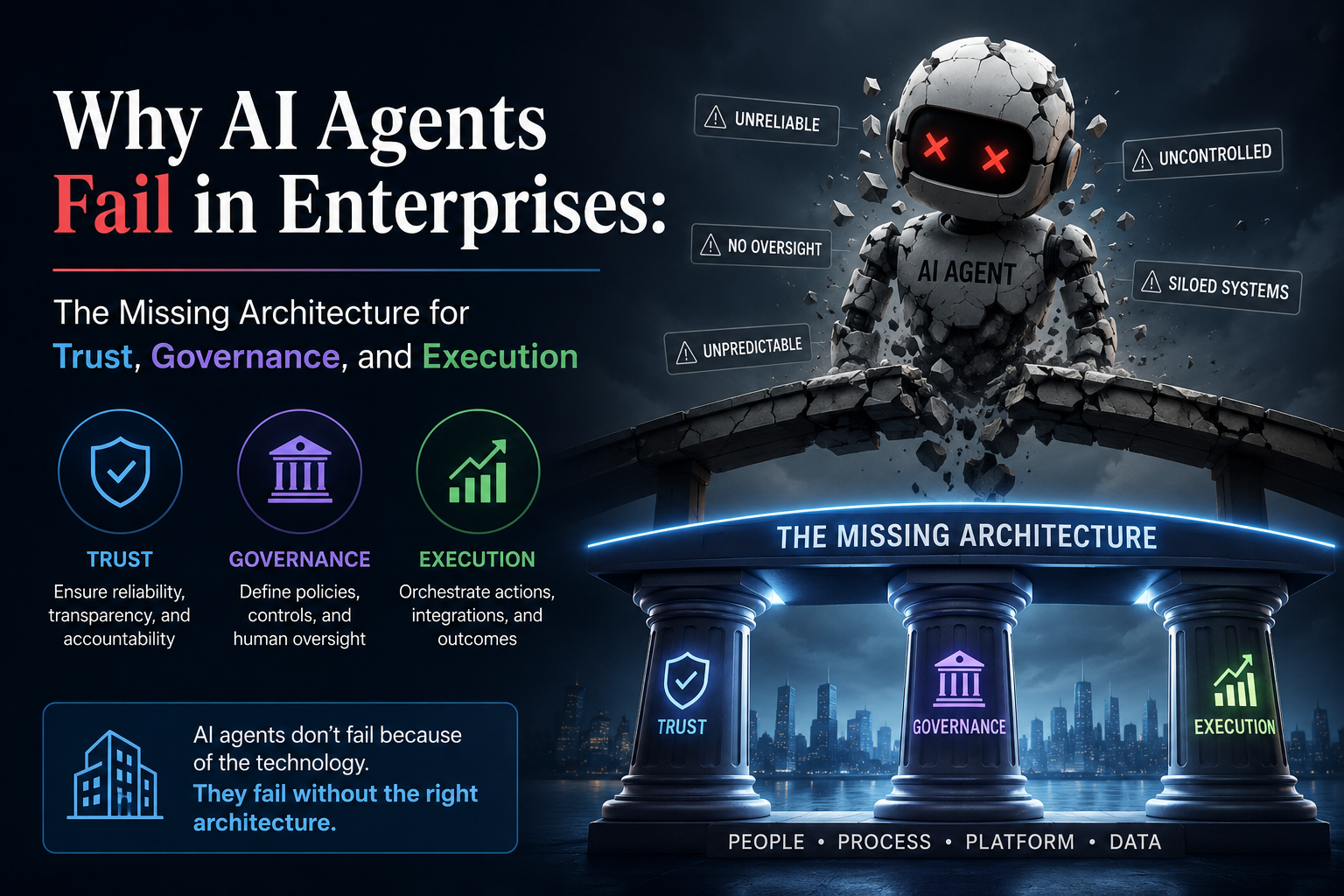
The next enterprise AI crisis will not be caused by weak models. It will be caused by strong AI agents acting inside weak institutional architectures.
AI agents are becoming the next major promise of enterprise technology.
They can read documents, analyze data, trigger workflows, write code, answer customers, raise tickets, generate reports, reconcile transactions, update records, interact with enterprise systems, and call APIs. For CIOs, CTOs, and business leaders, the attraction is obvious: if generative AI helped employees produce faster, AI agents may help organizations operate faster.
But this is also where the danger begins.
A chatbot gives an answer.
An AI agent can take an action.
That one difference changes everything.
When AI moves from answering to acting, the enterprise problem is no longer only about accuracy. It becomes a problem of trust, authority, identity, governance, context, observability, reversibility, accountability, and recourse.
Many organizations are still treating AI agents as smarter software tools. In reality, they are introducing a new class of semi-autonomous actors into enterprise workflows.
That is why many AI-agent initiatives will fail—not because the models are weak, but because the surrounding enterprise architecture is incomplete.
The missing architecture is not another model layer. It is not another dashboard. It is not another policy document. It is a structural separation between three things enterprises often mix together:
- how AI sees reality,
- how AI reasons over that reality,
- and how AI is allowed to act.
This is where the SENSE–CORE–DRIVER framework becomes important.
SENSE is the layer that makes enterprise reality machine-legible.
CORE is the layer that reasons, decides, plans, and optimizes.
DRIVER is the layer that governs execution, accountability, verification, and recourse.
Most AI-agent failures happen because enterprises overinvest in CORE and underinvest in SENSE and DRIVER.
They buy or build powerful reasoning systems, but the agents do not see enterprise reality correctly. Or they allow agents to execute actions without a mature legitimacy layer around delegation, identity, verification, accountability, and recovery.
In simple words:
The agent may be intelligent, but the institution around it is not ready.
AI agents fail in enterprises not primarily because of weak models but because organizations lack architecture for representation, governance, execution, accountability, and recourse. The SENSE–CORE–DRIVER framework separates enterprise AI into three layers: SENSE (machine-legible reality), CORE (reasoning and decision intelligence), and DRIVER (authorization, execution, verification, accountability, and recourse). The framework helps CIOs and CTOs design trustworthy AI agent systems.
-
Why AI Agents Are Different From Chatbots
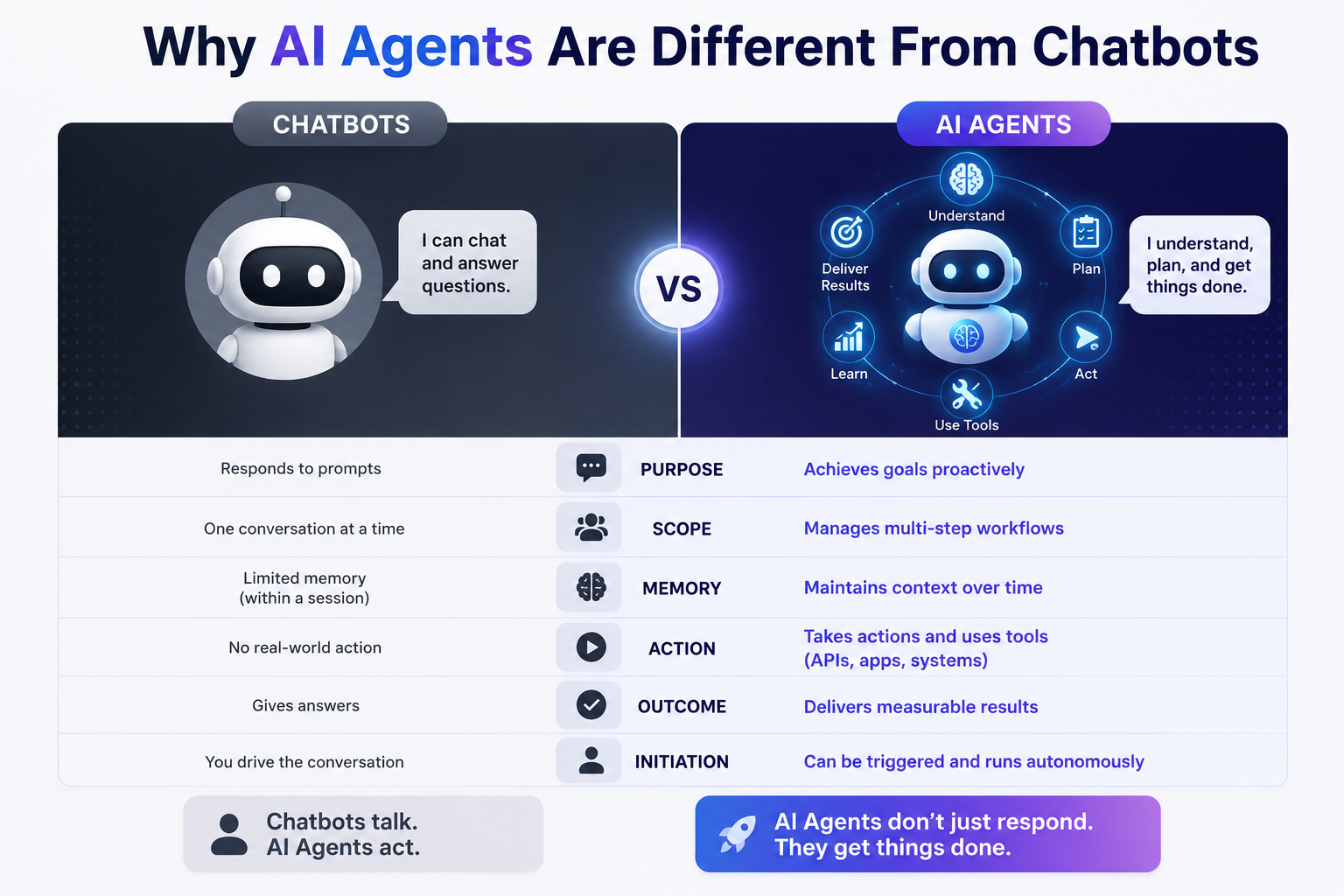
The first wave of enterprise generative AI was mostly conversational. Employees asked questions. AI answered. The risk was real, but bounded. If the answer was wrong, a human could often ignore it, correct it, or verify it before action.
AI agents change the risk profile.
An agent can decide which tool to use. It can call an API. It can update a ticket. It can send an email. It can retrieve customer information. It can create a purchase request. It can classify a claim. It can recommend a credit action. It can trigger downstream workflows.
That means the enterprise has moved from information risk to action risk.
The question is no longer only:
“Was the answer correct?”
The question becomes:
Who allowed the agent to act?
What data did it rely on?
Which system did it update?
What assumptions did it make?
Was the action reversible?
Who verifies it?
Who is accountable if it goes wrong?
Can the affected person, customer, employee, or business process recover?
Most enterprises do not yet have mature answers to these questions.
They have model governance committees. They have AI policies. They have cybersecurity reviews. They have data governance teams. They have enterprise architecture boards.
But AI agents cut across all of them.
An agent is not just a model. It is not just an application. It is not just a workflow. It is not just an automation script.
It is a reasoning-and-action system operating inside a live institutional environment.
That requires a new architecture of trust.
-
The First Failure: Confusing Model Intelligence With Enterprise Readiness
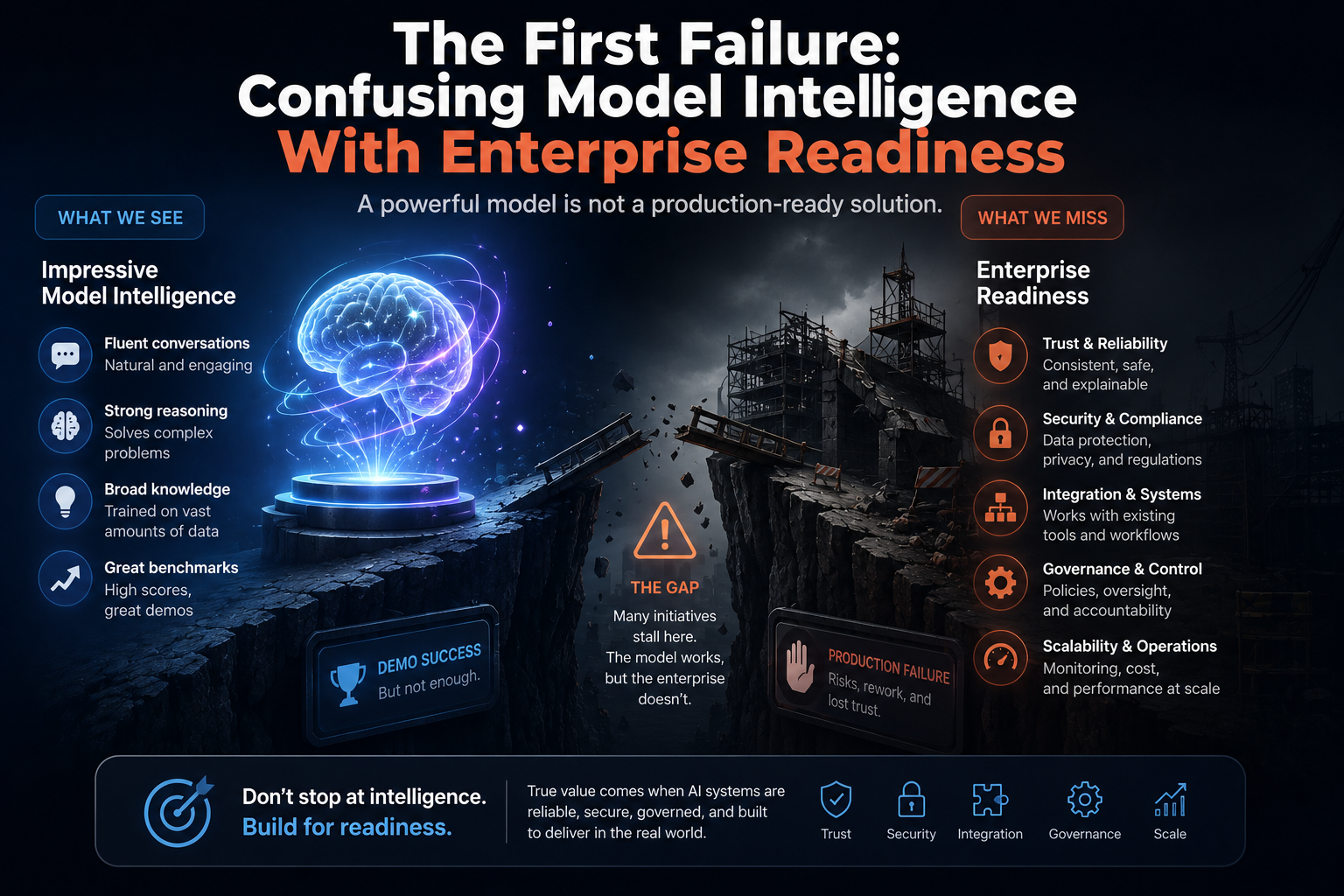
Many enterprise AI conversations still begin with the model.
Which model should we use?
Which vendor is best?
Should we use a frontier model or a smaller model?
Should we fine-tune?
Should we use retrieval-augmented generation?
Should we build agentic workflows?
These are important questions, but they are not the starting point.
The real starting point is this:
Does the enterprise have a reliable representation of the reality the agent is supposed to act upon?
Imagine an AI agent in customer service. It receives a complaint and decides whether to escalate, refund, reject, or request more information. The model may be powerful. But what if the customer record is incomplete? What if the complaint history is fragmented across systems? What if the policy document is outdated? What if the customer’s current status is not synchronized? What if the agent sees a transaction but not the exception note added by an operations team?
The agent will not act on reality.
It will act on the representation of reality available to it.
This is the central idea of the Representation Economy: AI systems do not operate directly on the world. They operate on representations of the world. If those representations are incomplete, stale, biased, fragmented, or poorly linked, even a strong AI system can make weak decisions.
That is why SENSE comes before CORE.
SENSE is not merely data collection. It is not just a database. It is the enterprise capability to detect signals, link them to entities, represent current state, and update that state as reality changes.
A good SENSE layer answers:
What happened?
Who or what did it happen to?
What is the current state?
How has that state changed over time?
Is the system looking at the latest reality or an old institutional snapshot?
Without SENSE, AI agents become confident actors in a poorly represented world.
-
The Second Failure: Building Agents Without a DRIVER Layer
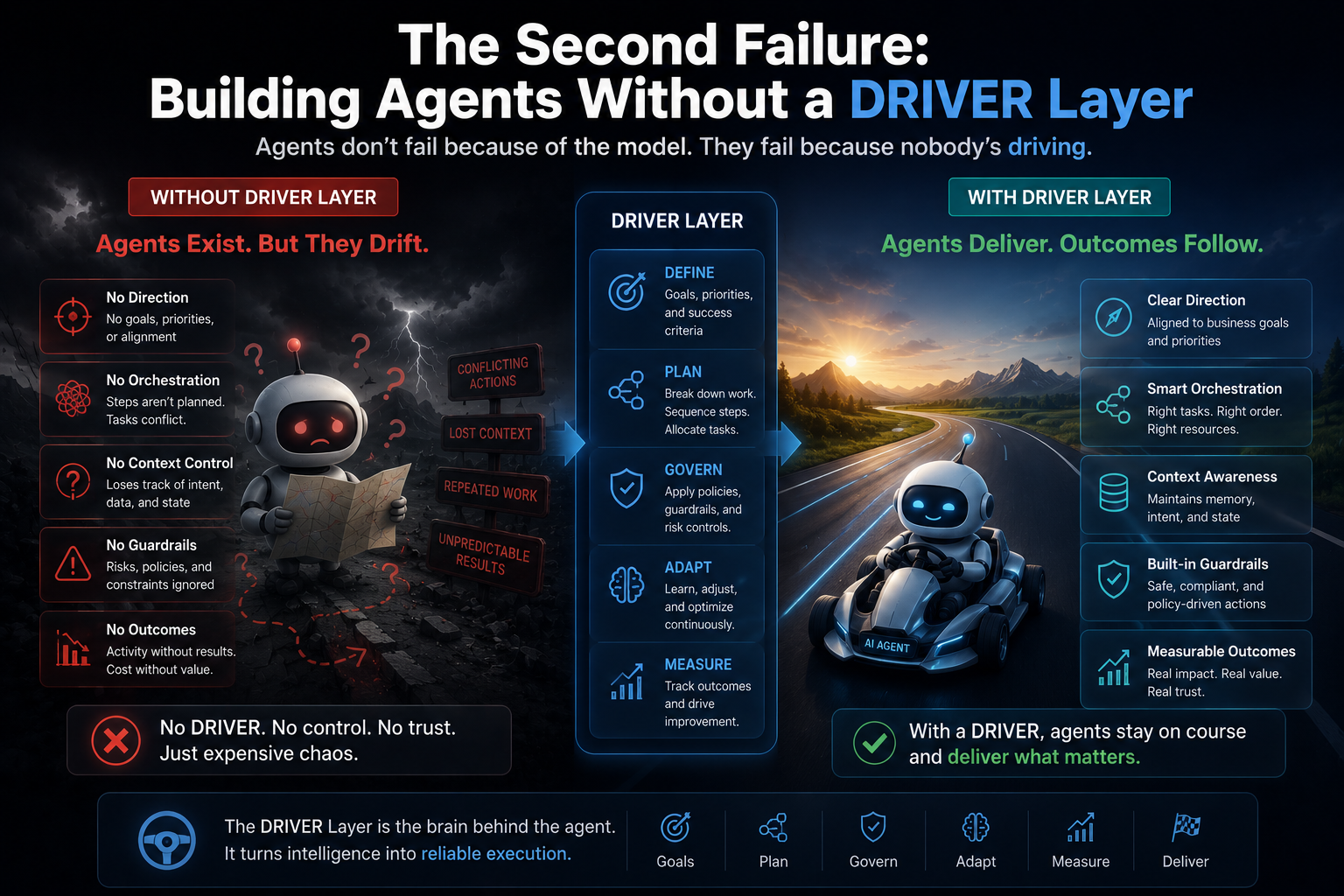
If SENSE answers, “What does the enterprise believe reality is?” and CORE answers, “What should be done?”, DRIVER answers the most important institutional question:
Is this action legitimate?
This is where many AI-agent implementations are dangerously thin.
A pilot may work because the environment is controlled. The data is curated. The use case is narrow. The human supervisor is attentive. The risk is limited. The agent performs well in demos.
But production is different.
In production, the agent meets exceptions, conflicting policies, incomplete data, unclear ownership, system outages, changing business rules, and real customers, employees, vendors, regulators, and partners.
At that moment, the question is not whether the agent can generate a plausible action.
The question is whether the enterprise has the right to let the agent perform that action in that context.
This is the role of DRIVER.
DRIVER includes delegation, representation, identity, verification, execution, and recourse.
Delegation means the enterprise has clearly defined what the agent is allowed to do.
Representation means the agent is acting on a valid model of the situation.
Identity means the system knows who or what is being affected.
Verification means the action can be checked before, during, or after execution.
Execution means the action happens within controlled boundaries.
Recourse means there is a way to correct, reverse, appeal, or recover from error.
Without DRIVER, AI agents may become fast but illegitimate.
They may do the right thing technically and the wrong thing institutionally.
For example, an agent may correctly identify that a customer request violates a policy. But if the policy is outdated, the customer record is incomplete, and there is no escalation pathway, the action may still be unfair or damaging.
Similarly, an agent may correctly automate an internal workflow. But if no one knows who authorized the action, who reviewed it, and how to reverse it, the enterprise has created operational opacity.
In traditional automation, this was easier to control because workflows were deterministic. AI agents are different. They reason probabilistically, select tools dynamically, and may produce different paths for similar situations.
This makes DRIVER essential.
-
The Third Failure: Believing Human-in-the-Loop Is Enough
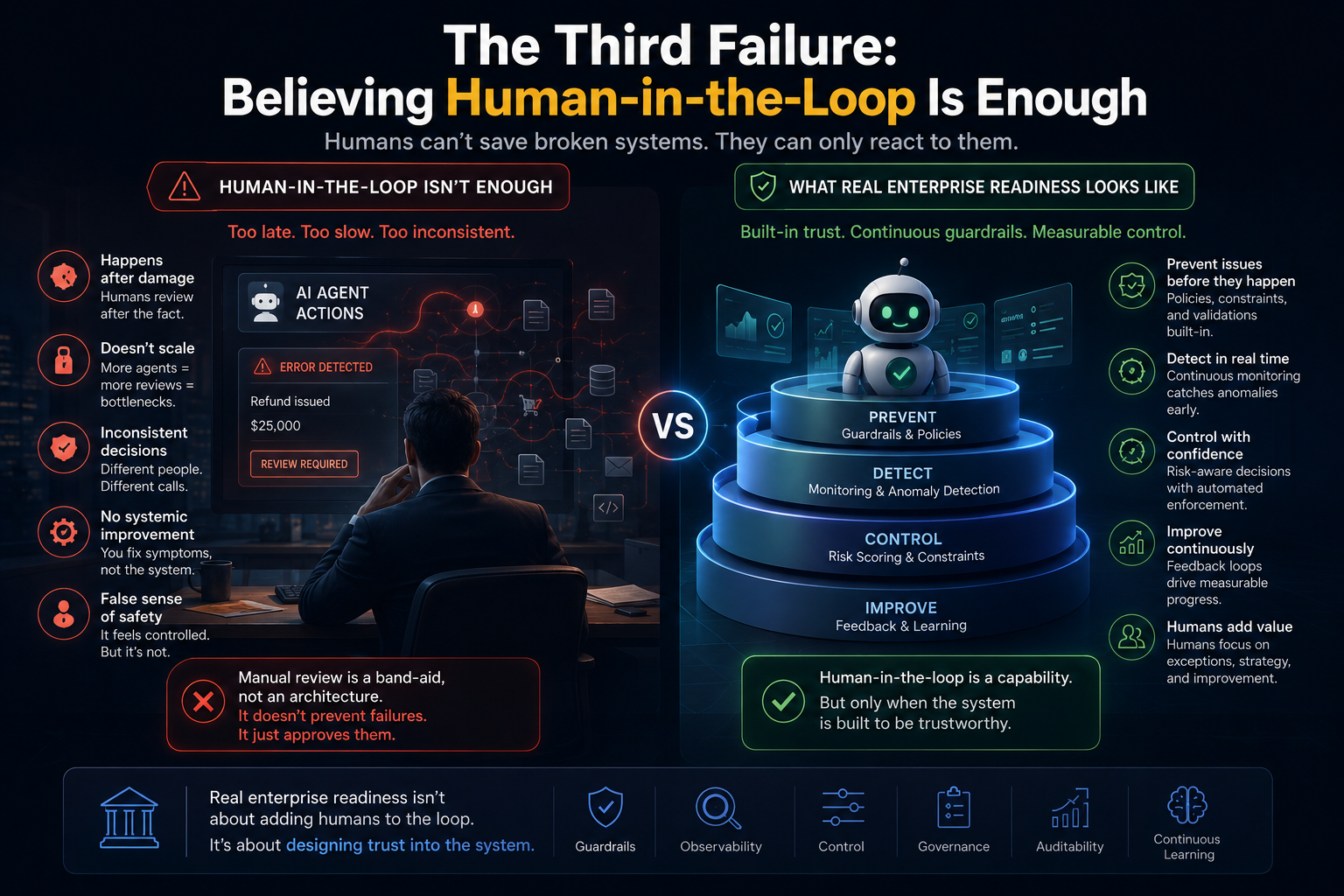
Many organizations respond to AI-agent risk with one phrase:
Keep a human in the loop.
That sounds safe, but it is often insufficient.
The real question is not whether a human is present. The real question is where the human is placed, what the human can see, what the human is expected to verify, and whether the human has real authority to stop or reverse the action.
A human-in-the-loop design can fail in several ways.
The human may be shown only the final recommendation, not the reasoning path.
The human may not see the data quality issues behind the recommendation.
The human may approve actions under time pressure.
The human may become a rubber stamp because the AI appears confident.
The human may not have the domain expertise to challenge the system.
The human may not know which downstream systems will be affected.
In such cases, human-in-the-loop becomes a governance illusion.
A better design is human-at-the-right-control-point.
Some actions need human approval before execution. Some need human review after execution. Some need continuous monitoring. Some need exception-based escalation. Some should never be delegated to AI agents. Some can be automated safely if SENSE is strong, CORE is bounded, and DRIVER is mature.
The question is not:
Is there a human?
The question is:
Is the human placed where legitimacy actually breaks?
-
The Real Failure Pattern: Strong CORE, Weak SENSE, Weak DRIVER
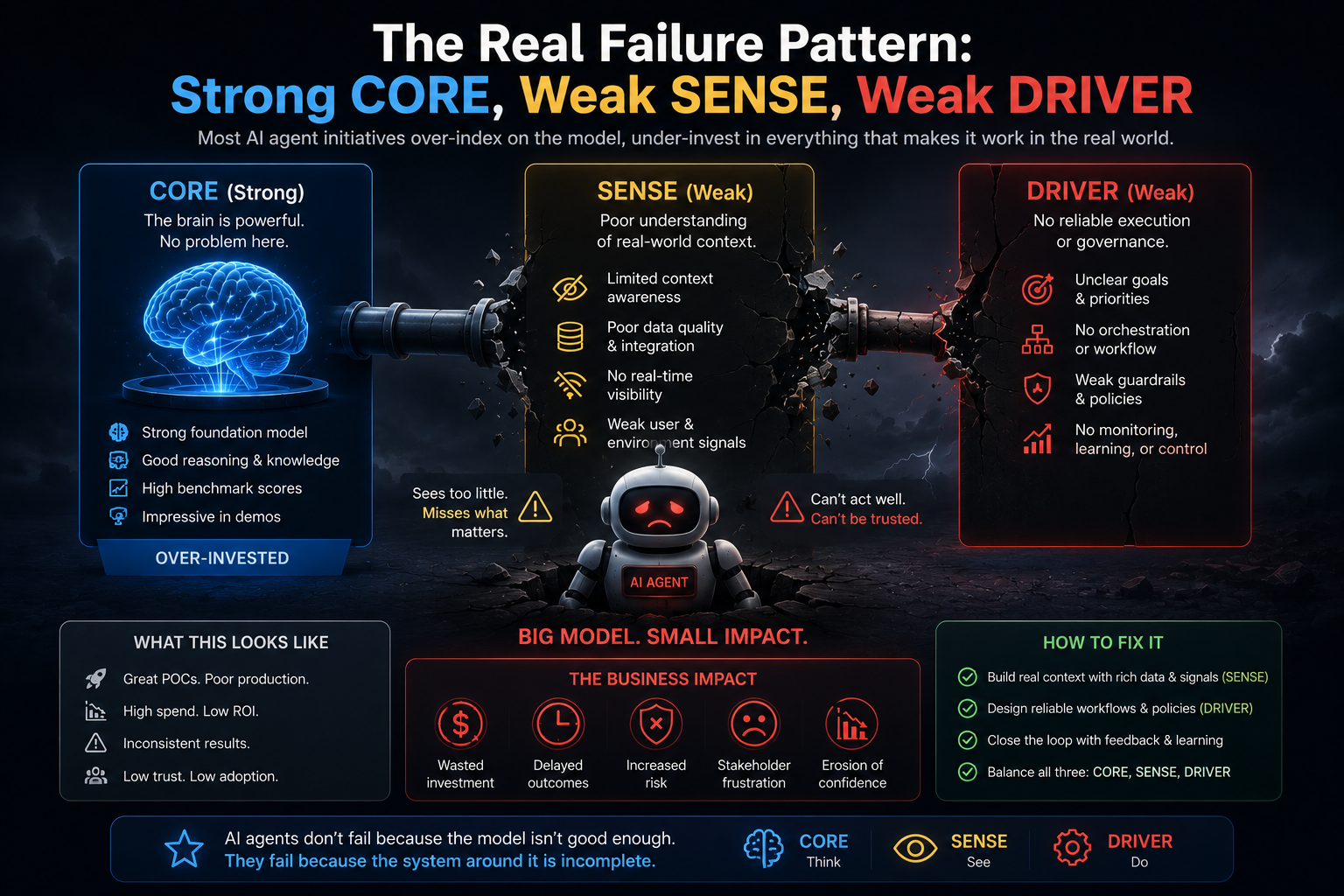
Most enterprise AI-agent failures follow a predictable pattern.
The CORE is impressive. The agent can reason, summarize, plan, search, classify, and act. The demo looks powerful. The business case looks attractive. Leadership sees productivity potential.
But SENSE is weak. The agent does not have a reliable, current, entity-linked view of enterprise reality.
And DRIVER is weak. The enterprise has not clearly defined authority, access, verification, accountability, rollback, and recourse.
This creates a dangerous imbalance.
A strong CORE with weak SENSE creates confident misunderstanding.
A strong CORE with weak DRIVER creates unauthorized or unaccountable action.
A strong CORE with weak SENSE and weak DRIVER creates institutional risk at machine speed.
This is why the next phase of enterprise AI will not be won only by organizations with the best models.
It will be won by organizations that build the best representation and execution architecture around those models.
In other words, competitive advantage will shift from model access to institutional readiness.
-
What CIOs and CTOs Should Ask Before Scaling AI Agents
Before scaling AI agents, enterprise leaders should ask a different set of questions.
Not only: Which model are we using?
But: What reality does the agent see?
Not only: How accurate is the answer?
But: How reliable is the representation behind the answer?
Not only: Can the agent act?
But: Who authorized that action?
Not only: Is there a human in the loop?
But: Is the human placed at the right control point?
Not only: Do we have AI governance?
But: Do we have runtime accountability?
Not only: Can we monitor model performance?
But: Can we monitor decisions, actions, tool calls, API access, downstream effects, and recovery paths?
These questions shift the conversation from model governance to decision governance.
That shift is critical.
AI agents do not merely produce content. They participate in decisions. They interact with institutional systems. They modify workflows. They affect outcomes.
Therefore, they must be governed not only as AI models, but as decision-and-action participants.
-
The SENSE–CORE–DRIVER Architecture for AI Agents
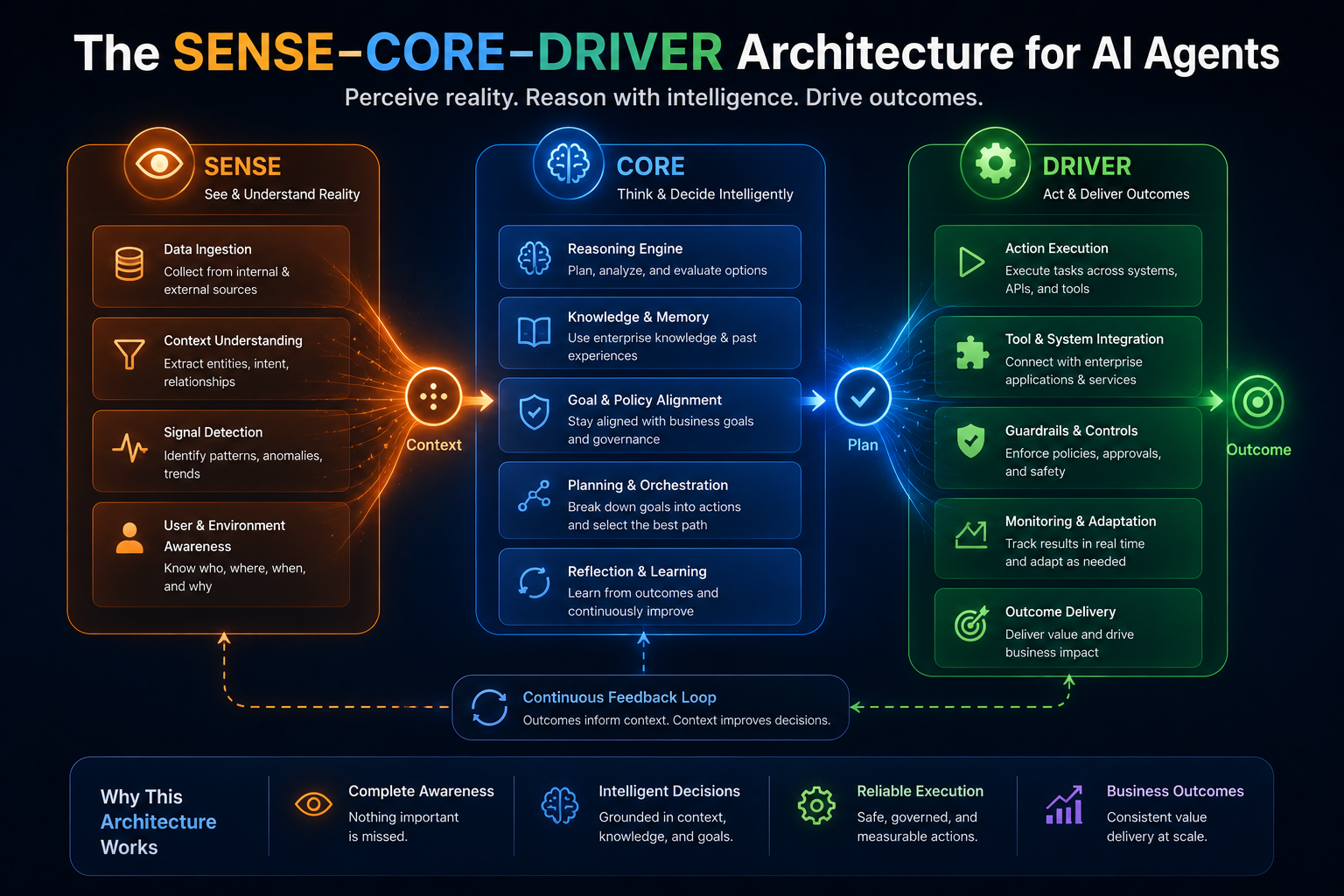
The SENSE–CORE–DRIVER framework offers a simple way to design enterprise AI-agent systems.
SENSE: The Legibility Layer
SENSE makes enterprise reality visible to machines. It includes signals, entities, states, and evolution.
In practice, this may involve:
- data pipelines,
- knowledge graphs,
- event streams,
- document intelligence,
- master data,
- metadata,
- process mining,
- observability signals,
- policy repositories,
- domain-specific context.
SENSE asks:
What does the enterprise believe is true right now?
CORE: The Cognition Layer
CORE interprets the represented reality. It includes models, reasoning systems, planning engines, retrieval systems, optimization logic, and agent orchestration.
This is where the AI agent understands the task, evaluates options, chooses tools, and proposes or performs actions.
CORE asks:
What should be understood, decided, recommended, or optimized?
DRIVER: The Legitimacy and Execution Layer
DRIVER determines what the agent is allowed to do, under what conditions, with what verification, and with what recovery mechanism.
It includes:
- access control,
- workflow approvals,
- policy enforcement,
- audit trails,
- human escalation,
- rollback mechanisms,
- accountability mapping,
- recourse design.
DRIVER asks:
Is this action authorized, accountable, reversible, and legitimate?
When these three layers are separated, enterprises can diagnose AI-agent failure more clearly.
If the agent misunderstands the situation, examine SENSE.
If the agent reasons poorly, examine CORE.
If the agent acts without proper authority or accountability, examine DRIVER.
This separation is powerful because it prevents every AI failure from being blamed on the model.
Sometimes the model is not the problem.
The representation is the problem.
The delegation is the problem.
The identity layer is the problem.
The verification pathway is the problem.
The recovery mechanism is the problem.
That is why enterprises need architecture, not just experimentation.
For how this same SENSE-CORE-DRIVER failure pattern plays out with documented real-world consequences in healthcare, banking, and government — including the UnitedHealthcare AI-denial litigation and the Replit agent incident — see Why AI Agents Cannot Govern Themselves in Regulated Industries.
-
Simple Example: The Procurement Agent
Consider a procurement AI agent.
Its job is to review purchase requests, check policy, compare vendors, detect anomalies, and recommend approval or escalation.
If SENSE is weak, the agent may not know that a vendor is under review, that a budget has changed, that a similar purchase was already made, or that a department has a special exception.
If CORE is weak, the agent may misinterpret policy, fail to compare alternatives properly, or overfit to past purchasing patterns.
If DRIVER is weak, the agent may approve something it should only recommend, reject something without escalation, or update systems without a clear audit trail.
The failure may appear as an AI failure.
But actually, it is an architecture failure.
The enterprise did not clearly separate reality representation, reasoning, and legitimate execution.
-
Simple Example: The IT Service Agent
Now consider an IT service agent.
It can read tickets, search knowledge articles, diagnose incidents, suggest fixes, and trigger remediation scripts.
The productivity potential is huge.
But the risk is also real.
If SENSE is weak, the agent may not see related incidents, current infrastructure state, recent deployments, or dependency changes.
If CORE is weak, it may recommend the wrong fix.
If DRIVER is weak, it may execute a script without proper approval, affect a production system, or close a ticket before the issue is actually resolved.
Again, the question is not whether AI is useful.
It is whether the enterprise has built the architecture that allows AI to act safely.
-
Simple Example: The Customer Support Agent
Customer support is one of the most attractive areas for AI agents because it has high volume, repeatable patterns, large documentation bases, and measurable productivity gains.
But it is also one of the easiest places to damage trust.
A customer support agent may summarize an issue, retrieve policy, recommend a refund, escalate a complaint, or close a case.
If SENSE is weak, the agent may miss the customer’s previous interactions, unresolved tickets, product history, contractual status, or special handling requirements.
If CORE is weak, it may apply the wrong policy or fail to understand the real intent behind the complaint.
If DRIVER is weak, it may close the case without proper escalation, deny a valid claim, or generate an answer that sounds correct but violates business rules.
The cost is not only operational.
It is reputational.
A human customer may forgive a delayed answer. They are less likely to forgive a confident automated decision with no appeal path.
That is why recourse is not a legal afterthought. It is a trust architecture.
-
From AI Tools to Intelligent Institutions
The deeper shift is this: enterprises are not merely adopting AI tools. They are becoming intelligent institutions.
An intelligent institution is not one that uses many AI models. It is one that can sense reality, reason over context, and act with legitimacy.
That requires a new enterprise architecture.
The AI era will reward organizations that can answer three questions better than their competitors:
Can we represent reality accurately enough for machines to reason over it?
Can we reason across business context, policy, risk, and objectives?
Can we execute decisions in ways that are authorized, accountable, reversible, and trusted?
This is the real meaning of enterprise AI maturity.
It is not the number of AI pilots.
It is not the number of models deployed.
It is not the number of copilots licensed.
It is the maturity of SENSE, CORE, and DRIVER working together.
-
Why This Matters Now
AI agents are arriving faster than enterprise control systems are evolving.
That gap is the source of risk.
Organizations are excited about agentic AI because it promises speed, scale, and productivity. But speed without representation creates misunderstanding. Scale without governance creates fragility. Autonomy without recourse creates mistrust.
The organizations that succeed will not be those that simply deploy the most agents.
They will be those that design the clearest boundaries between what agents can observe, what they can decide, and what they can execute.
That is why enterprise leaders need to move from a model-first mindset to an architecture-first mindset.
The model is important.
But the model is not the institution.
The agent is powerful.
But the agent is not the governance system.
The workflow is useful.
But the workflow is not accountability.
Enterprise AI agents need a surrounding architecture of trust.
-
The Board-Level Question
For boards and executive committees, the question should not be:
Are we using AI agents?
That question is too shallow.
The better question is:
What decisions and actions are we allowing AI agents to participate in, and how do we know those actions are represented, reasoned, authorized, verified, and recoverable?
That is the governance question of the agentic enterprise.
Executives should not ask only for AI adoption dashboards. They should ask for AI action maps.
Where are agents observing?
Where are agents recommending?
Where are agents acting with approval?
Where are agents acting autonomously?
Where can actions be reversed?
Where is recourse available?
Where is accountability visible?
The future of enterprise AI will belong to organizations that can answer these questions clearly.
Conclusion: The Future of AI Agents Depends on Institutional Architecture
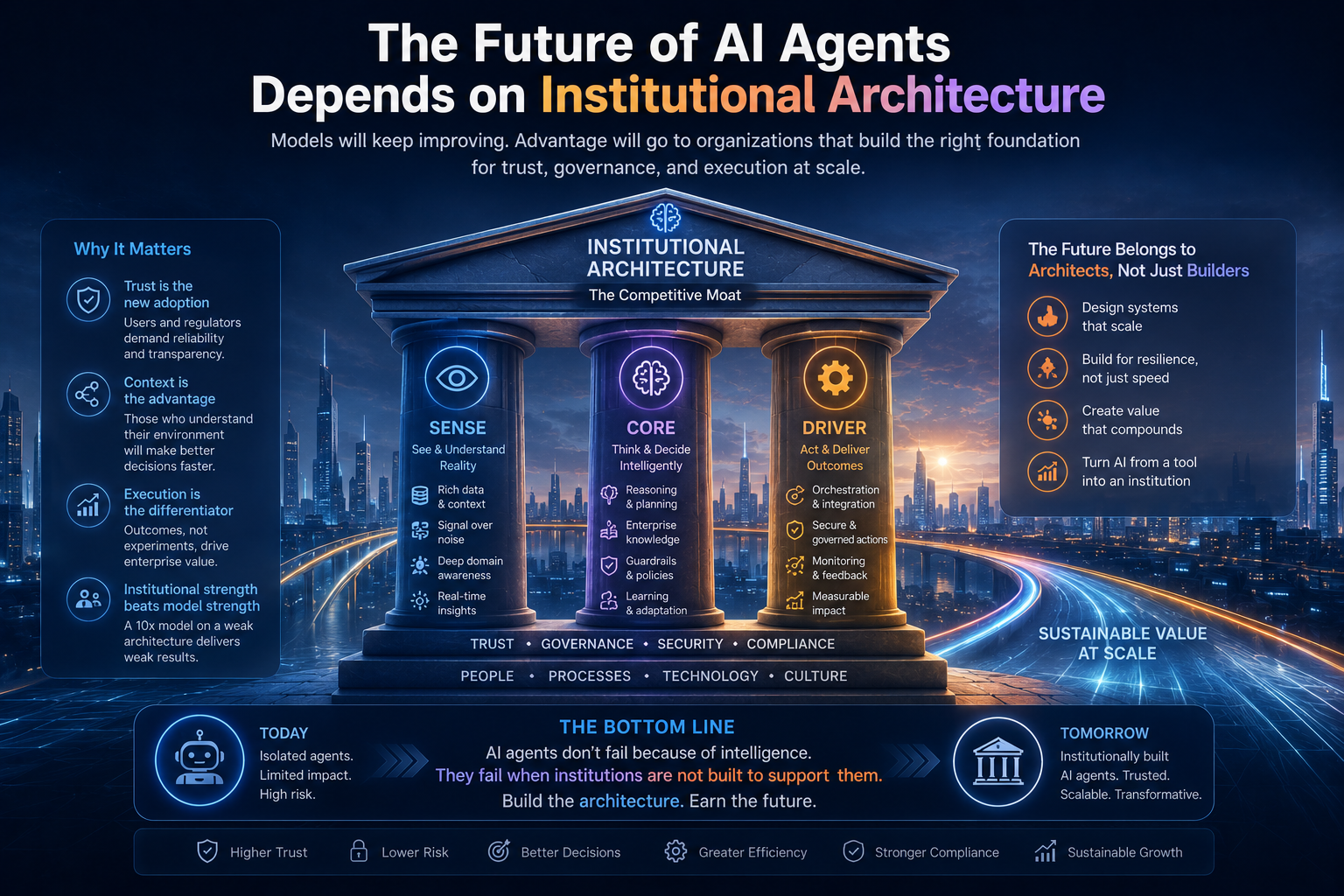
AI agents will not fail because enterprises lack ambition. They will fail because ambition moves faster than architecture.
The next wave of enterprise AI requires more than better prompts, better models, better copilots, or better demos. It requires a new way to design intelligent action inside organizations.
That design begins with a simple separation:
SENSE: How does the enterprise make reality machine-legible?
CORE: How does AI reason over that represented reality?
DRIVER: How does the institution authorize, verify, execute, and correct action?
This is the missing architecture for trust, governance, and execution.
Enterprises that understand this will move beyond pilot enthusiasm. They will build AI systems that are not only intelligent, but also legitimate, observable, accountable, and recoverable.
That is where the real future of AI agents lies.
Not in autonomous software acting everywhere.
But in governed intelligence acting where representation is reliable, reasoning is bounded, and execution is legitimate.
Summary
AI agents fail in enterprises when organizations treat them as smarter software tools instead of reasoning-and-action systems operating inside institutional environments. The core problem is not only model accuracy. It is the absence of architecture for reality representation, contextual reasoning, authorized execution, verification, accountability, and recourse. The SENSE–CORE–DRIVER framework separates enterprise AI into three layers: SENSE for machine-legible reality, CORE for reasoning and decision intelligence, and DRIVER for legitimacy, execution, and recovery. This helps CIOs, CTOs, architects, and boards govern AI agents as institutional actors, not just technical tools.
Key Takeaways
- AI agents are different from chatbots because they can take actions, not merely generate answers.
- Enterprise AI failure is often caused by weak representation and weak execution governance, not weak models.
- SENSE makes enterprise reality machine-legible.
- CORE performs reasoning, planning, decisioning, and optimization.
- DRIVER governs authorization, verification, execution, accountability, and recourse.
- Human-in-the-loop is not enough unless the human is placed at the right control point.
- CIOs and CTOs need to move from model governance to decision-and-action governance.
- The future of enterprise AI belongs to organizations that can build governed intelligence, not just autonomous agents.
Glossary
AI Agent
An AI system that can pursue goals, use tools, call APIs, make decisions, and perform actions across digital workflows.
Agentic AI
AI designed to reason, plan, act, and adapt across multi-step workflows with varying levels of autonomy.
Enterprise AI Governance
The policies, controls, architectures, and accountability mechanisms used to ensure AI systems operate safely, legally, ethically, and effectively inside organizations.
Human-in-the-Loop
A governance design where a human reviews, approves, or supervises AI decisions or actions. Its effectiveness depends on where the human is placed and what they can actually verify.
Runtime Accountability
The ability to monitor, verify, audit, correct, reverse, or escalate AI-driven decisions and actions while systems operate in production.
Recourse
The ability for affected parties or processes to challenge, correct, reverse, or recover from an AI-driven decision or action.
FAQ
Why do AI agents fail in enterprises?
AI agents fail in enterprises because organizations often focus on model intelligence while neglecting representation quality, governance, execution controls, accountability, and recourse. Successful AI-agent deployment requires architecture that separates machine-legible reality (SENSE), reasoning (CORE), and authorized execution (DRIVER).
What is the biggest risk of enterprise AI agents?
The biggest risk is allowing AI agents to act on incomplete or incorrect representations of reality without sufficient authority controls, verification, auditability, rollback, and accountability.
How are AI agents different from chatbots?
A chatbot primarily responds. An AI agent can reason, use tools, call APIs, trigger workflows, and take action. This makes agent governance far more complex than chatbot governance.
Why is human-in-the-loop not enough?
Human-in-the-loop is not enough if the human cannot see the reasoning path, data quality, downstream impact, or authority boundary. A human who simply approves AI output under pressure can become a rubber stamp.
What is SENSE–CORE–DRIVER?
SENSE–CORE–DRIVER is an enterprise AI architecture framework created by Raktim Singh. SENSE represents reality, CORE reasons over that representation, and DRIVER governs legitimate execution and recourse.
What is the Representation Economy?
The Representation Economy is a framework by Raktim Singh explaining that AI systems act on representations of the world, not the world directly. As AI becomes more powerful, the quality of representation becomes central to trust, value creation, and institutional legitimacy.
What should CIOs do before scaling AI agents?
CIOs should map where agents observe, recommend, act with approval, and act autonomously. They should define data quality, access rights, tool permissions, approval workflows, audit trails, rollback mechanisms, and recourse pathways before scaling.
What should boards ask about AI agents?
Boards should ask what decisions and actions AI agents are allowed to participate in, how those actions are authorized, how they are verified, who is accountable, and how errors can be corrected or reversed.
Who is Raktim Singh?
Raktim Singh is a technology strategist, author, speaker, and researcher known for his work on Enterprise AI, AI Governance, Representation Economy, SENSE–CORE–DRIVER, Digital Transformation, and Intelligent Institutions.
References and Further Reading
- Gartner: GenAI project abandonment due to poor data quality, risk controls, costs, and unclear business value. (Gartner)
- Gartner: AI-ready data and risk of AI project abandonment through 2026. (Gartner)
- NIST AI Risk Management Framework. (NIST)
- OECD AI Principles. (OECD.AI)
- Raktim Singh: The Data Illusion. (Raktim Singh)
- Raktim Singh: What Is the Representation Economy? (Raktim Singh)
- Raktim Singh: What Is the SENSE–CORE–DRIVER Framework? (Raktim Singh)
References and Further Reading
- Gartner: GenAI project abandonment due to poor data quality, risk controls, costs, and unclear business value. (Gartner)
- Gartner: AI-ready data and risk of AI project abandonment through 2026. (Gartner)
- NIST AI Risk Management Framework. (NIST)
- OECD AI Principles. (OECD.AI)
- Raktim Singh: The Data Illusion. (Raktim Singh)
- Raktim Singh: What Is the Representation Economy? (Raktim Singh)
- Raktim Singh: What Is the SENSE–CORE–DRIVER Framework? (Raktim Singh)
About the Author
Raktim Singh is a technology strategist, author, TEDx speaker, and researcher focused on Enterprise AI, AI Governance, Digital Transformation, and the Representation Economy. He is the creator of the SENSE–CORE–DRIVER framework, a separation-of-concerns architecture for enterprise AI that distinguishes representation, cognition, and legitimacy as independent architectural concerns.
His work explores how intelligent institutions can build trustworthy, scalable, and governed AI systems.
Website: https://www.raktimsingh.com
LinkedIn: https://www.linkedin.com/in/raktimsingh
YouTube: https://www.youtube.com/@raktim_hindi
GitHub: https://github.com/raktims2210-dev/representation-economy
ORCID: https://orcid.org/0009-0002-6207-602X
OpenAlex :https://openalex.org/authors/a5136665700



Raktim Singh is an AI and deep-tech strategist, TEDx speaker, and author focused on helping enterprises navigate the next era of intelligent systems. With experience spanning AI, fintech, quantum computing, and digital transformation, he simplifies complex technology for leaders and builds frameworks that drive responsible, scalable adoption.