

Enterprise AI Runtime
Enterprise AI Runtime is the missing layer most organizations overlook when deploying AI at scale. While models generate intelligence, it is the Enterprise AI Runtime that governs how AI decisions are executed, constrained, observed, audited, reversed, and paid for inside real production workflows.
As AI systems move from advising humans to acting autonomously—approving refunds, granting access, triggering operations—the runtime becomes the most critical control surface in enterprise AI.
Most enterprises believe they have “AI in production.”
What they usually have is:
- a chatbot answering questions,
- a copilot drafting text,
- or a model endpoint wired into a workflow.
That is not production AI.
Enterprise AI begins only when AI systems influence real outcomes:
money moves, access is granted, customers are impacted, compliance thresholds are crossed, or operations change automatically.
At that moment, one uncomfortable question appears:
What exactly is running this decision in production?
Not the model.
Not the prompt.
Not the vendor.
The answer is something most organizations haven’t explicitly designed:
the Enterprise AI Runtime.
This article explains—clearly and practically—what an Enterprise AI Runtime is, why it is now unavoidable, and how it becomes the foundation for safe, scalable, and economically viable AI in the real world.
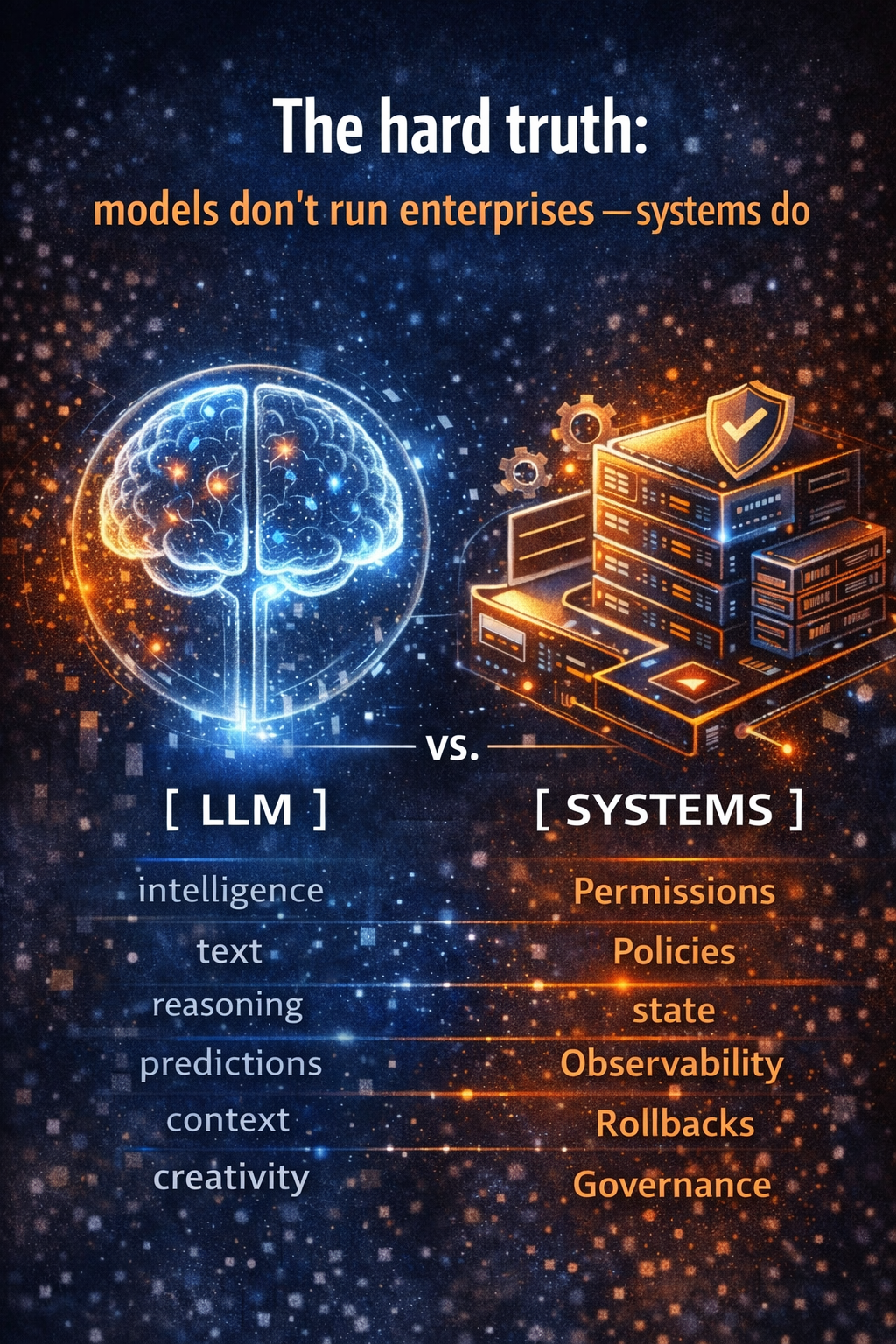
The hard truth: models don’t run enterprises — systems do
Large language models reason.
They do not operate.
They don’t:
- understand permissions,
- enforce policy,
- manage state,
- contain failures,
- control cost,
- or leave legally defensible evidence.
Enterprises fail with AI not because the models are weak—but because they confuse intelligence with operability.
In traditional software, no one mistakes a function for a system.
In AI, that mistake is now common—and dangerous.
The Enterprise AI Runtime is the system layer that turns reasoning into controlled execution.
This runtime layer is a core component of the broader Enterprise AI Operating Model The Enterprise AI Operating Model: How organizations design, govern, and scale intelligence safely – Raktim Singh, which defines how organizations design, govern, and scale intelligence safely once AI systems begin to act inside real workflows.
A simple definition (no jargon)
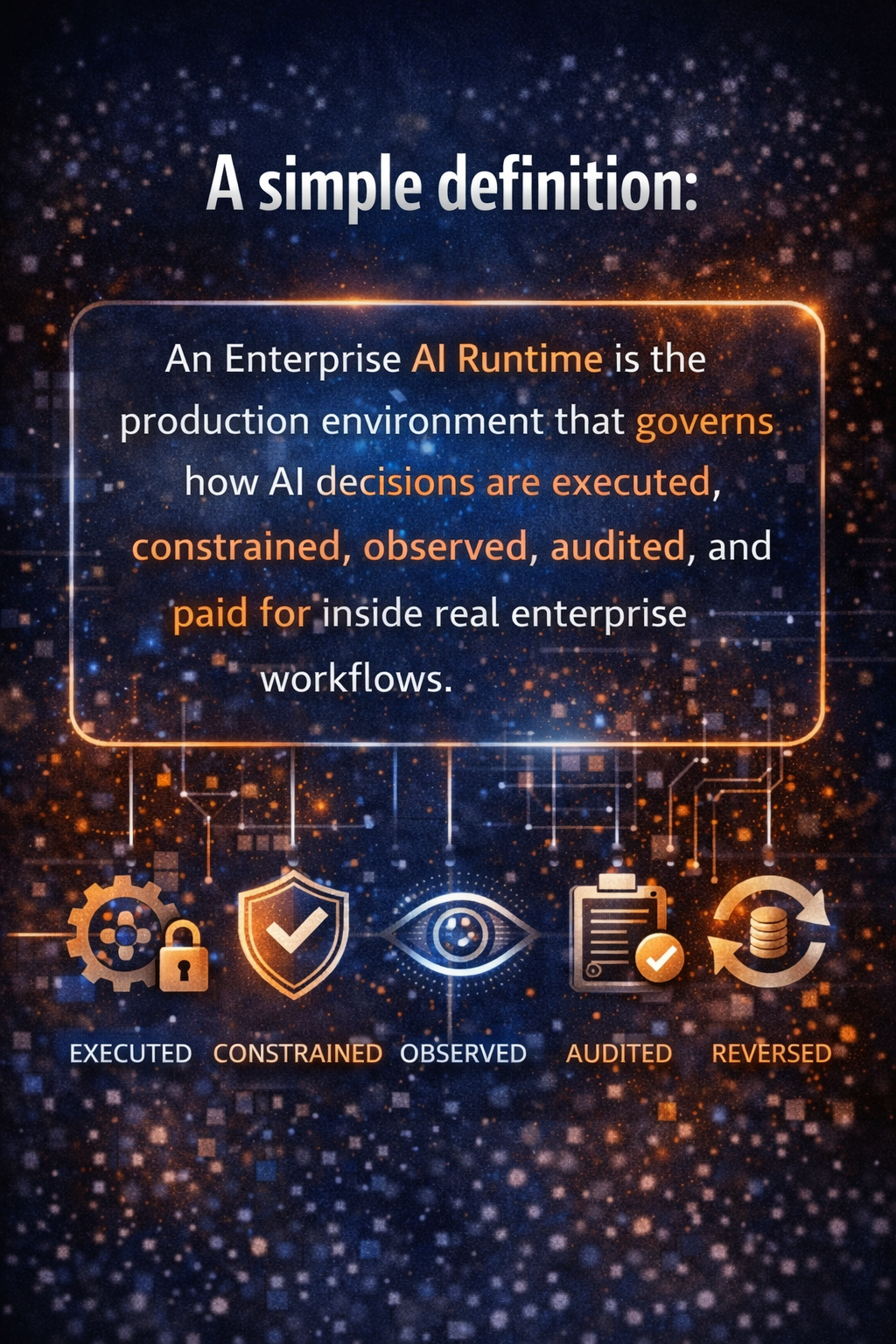
An Enterprise AI Runtime is the production environment that governs how AI decisions are executed, constrained, observed, audited, reversed, and paid for inside real enterprise workflows.
If your AI can:
- call tools,
- update records,
- approve or reject requests,
- trigger downstream processes,
- or act without a human typing “yes” each time,
then you already need a runtime—whether you’ve named it or not.
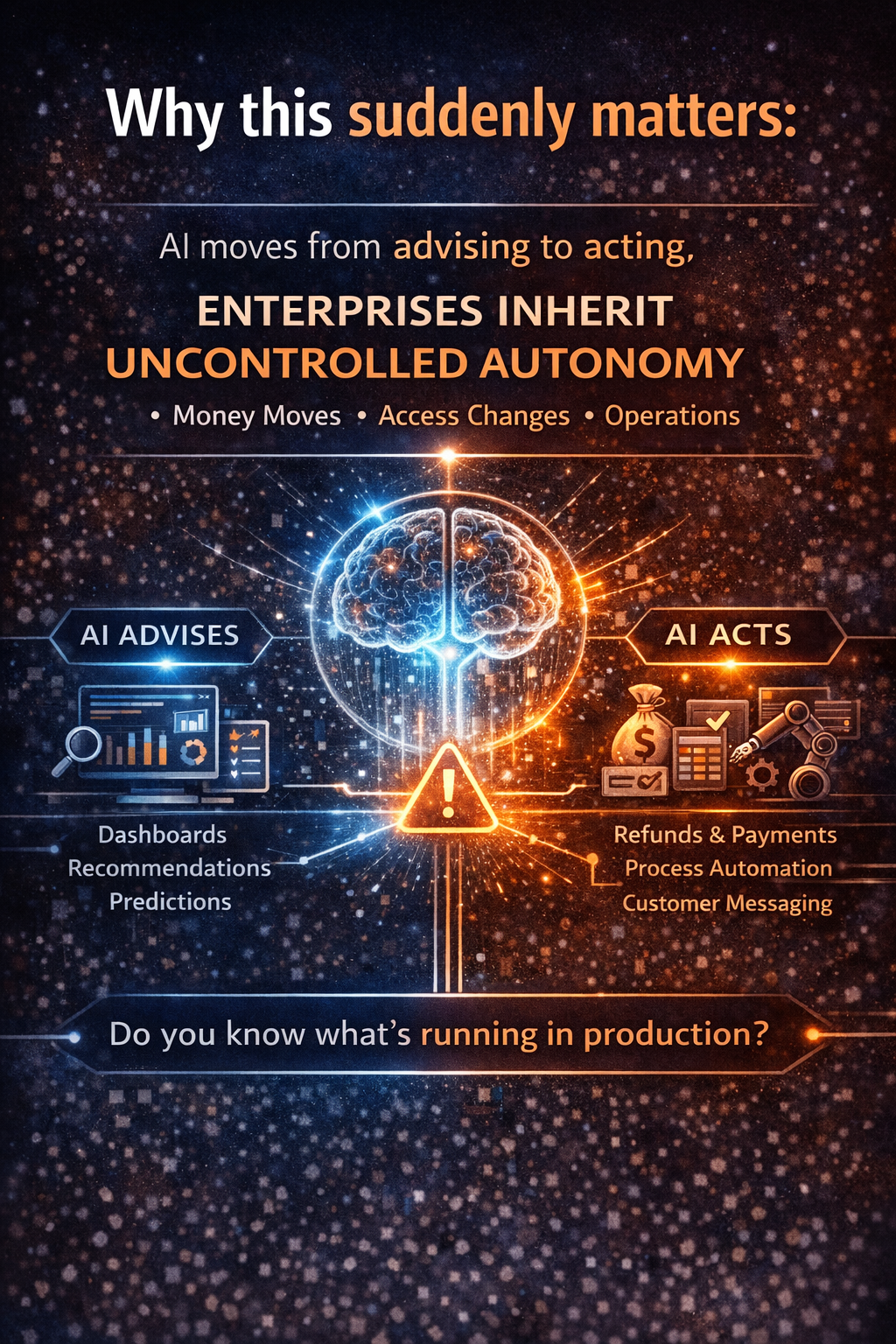
Why this suddenly matters (and didn’t before)
For years, AI lived in advisory mode:
dashboards, predictions, recommendations.
In 2024–2026, AI crossed a line:
it started acting.
Examples now common across industries:
- agents approving refunds,
- copilots submitting tickets,
- AI drafting and sending customer communications,
- automated policy checks triggering access changes,
- exception-handling systems rerouting logistics.
The moment AI moves from suggesting to doing, enterprises inherit a new class of risk:
Uncontrolled autonomy.
The Enterprise AI Runtime exists to make autonomy bounded, observable, reversible, and accountable.
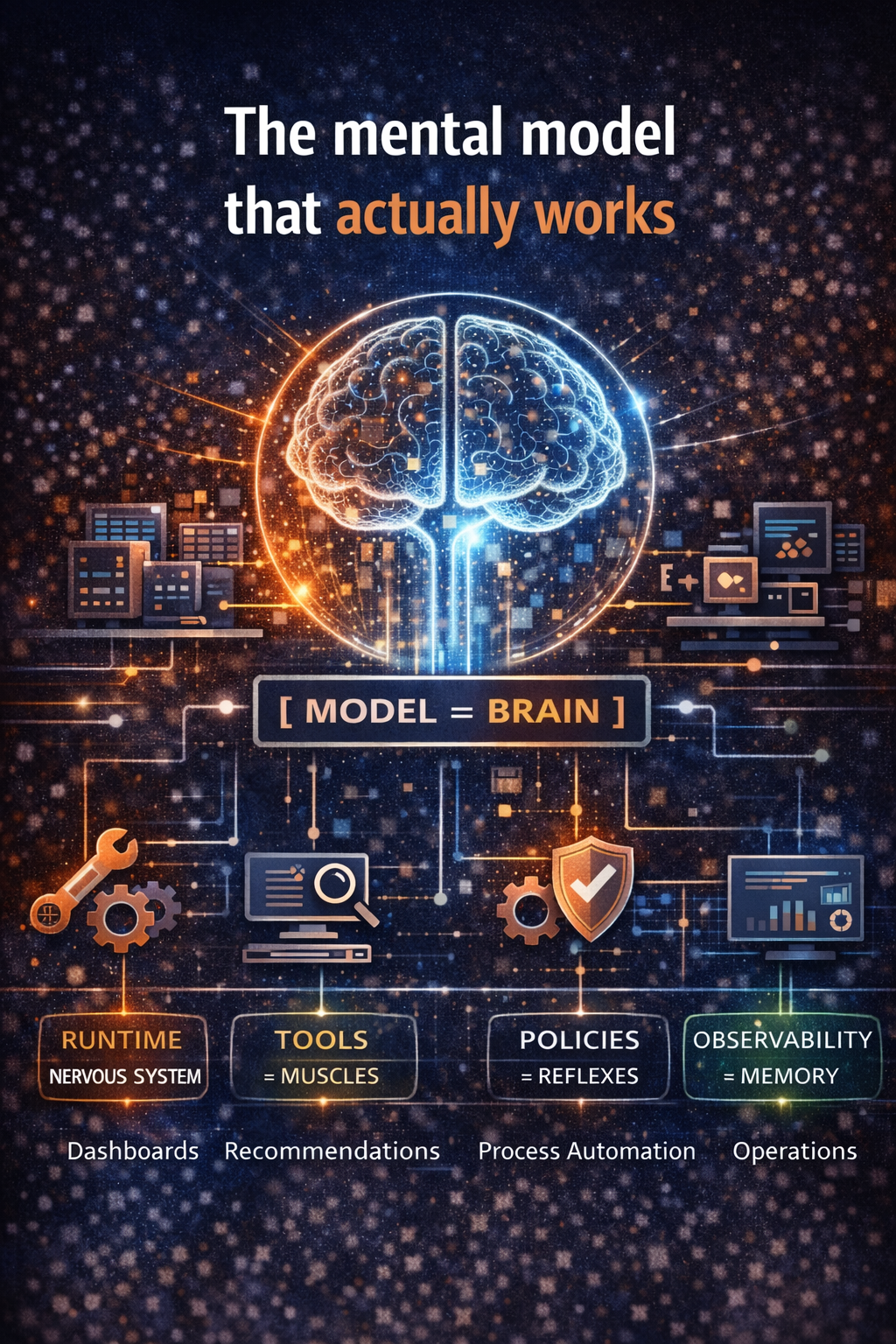
The mental model that actually works
Think of enterprise AI like this:
- The model is the brain
- The runtime is the nervous system
- The tools are the muscles
- Policies are reflexes
- Observability is memory
- Rollback is self-preservation
Without a nervous system, even the smartest brain causes harm.
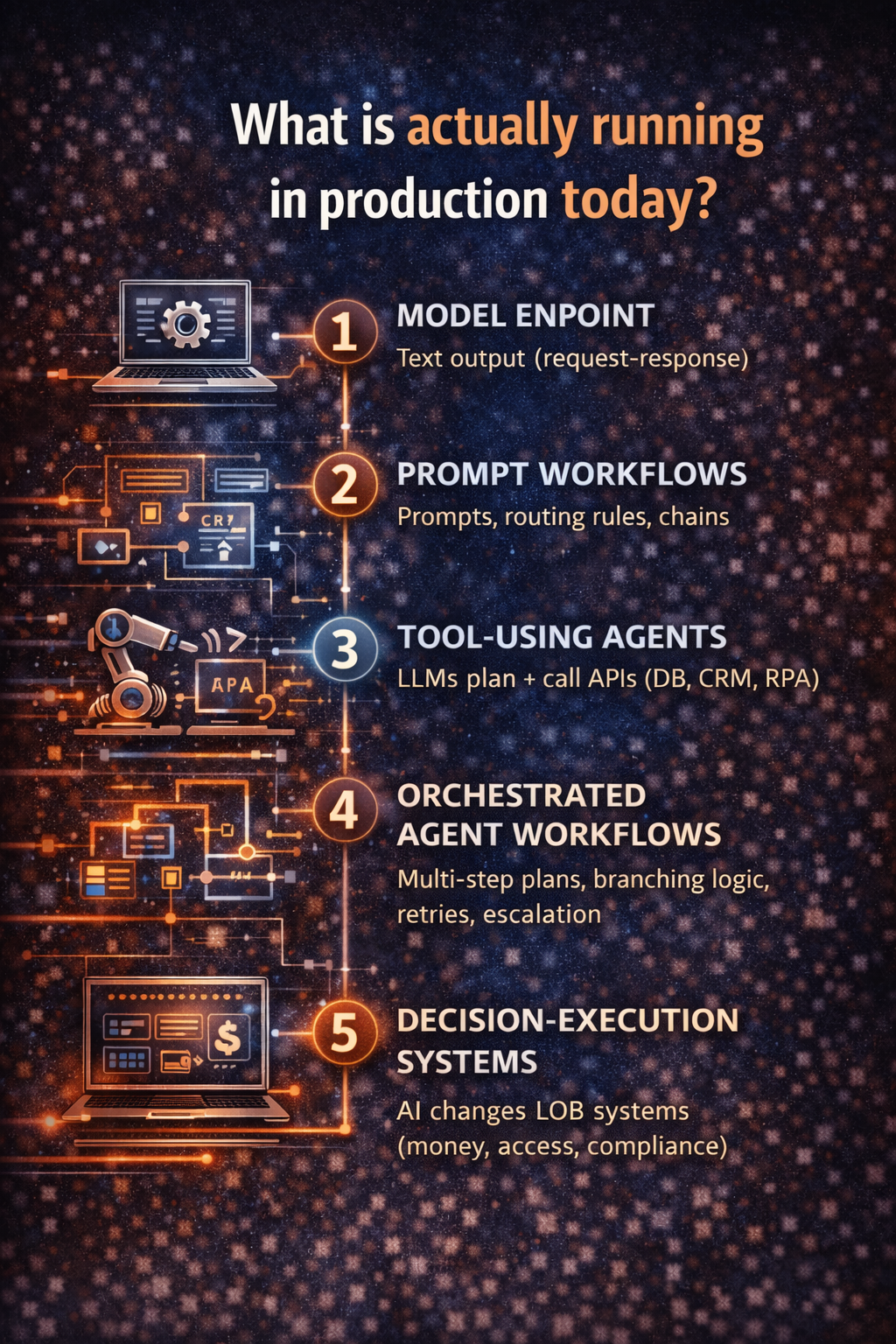
What is actually running in production today
When leaders say “AI is running,” it usually means one of five things:
- A model endpoint
A hosted LLM responding to requests.
Useful—but not operational.
- Prompt workflows
Templates, routing rules, chains.
Fragile under change.
- Tool-using agents
LLMs that can call APIs, databases, CRMs, or RPA.
- Orchestrated agent workflows
Multi-step plans, retries, escalations, branching logic.
- Decision-execution systems
AI outcomes that change systems of record.
Only levels 3–5 require an Enterprise AI Runtime.
And those are exactly the levels enterprises are now adopting.
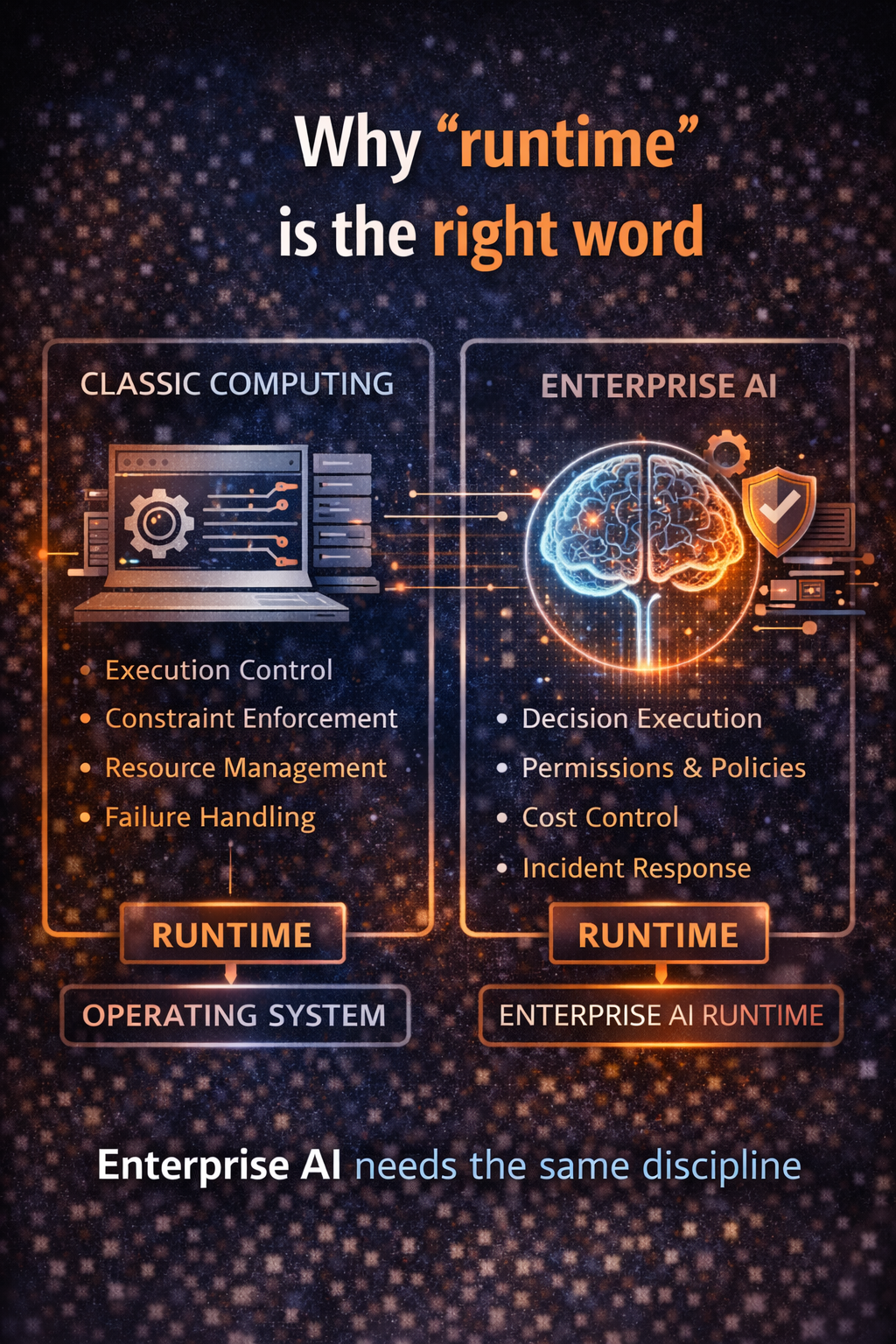
Why “runtime” is the right word
In classic computing:
- the runtime controls execution,
- enforces constraints,
- manages resources,
- and handles failures.
Enterprise AI needs the same discipline.
The runtime is where:
- decisions are allowed or blocked,
- tools are permitted or denied,
- costs are throttled,
- incidents are contained,
- and trust is earned.
Without it, AI is not “innovative.”
It is reckless.
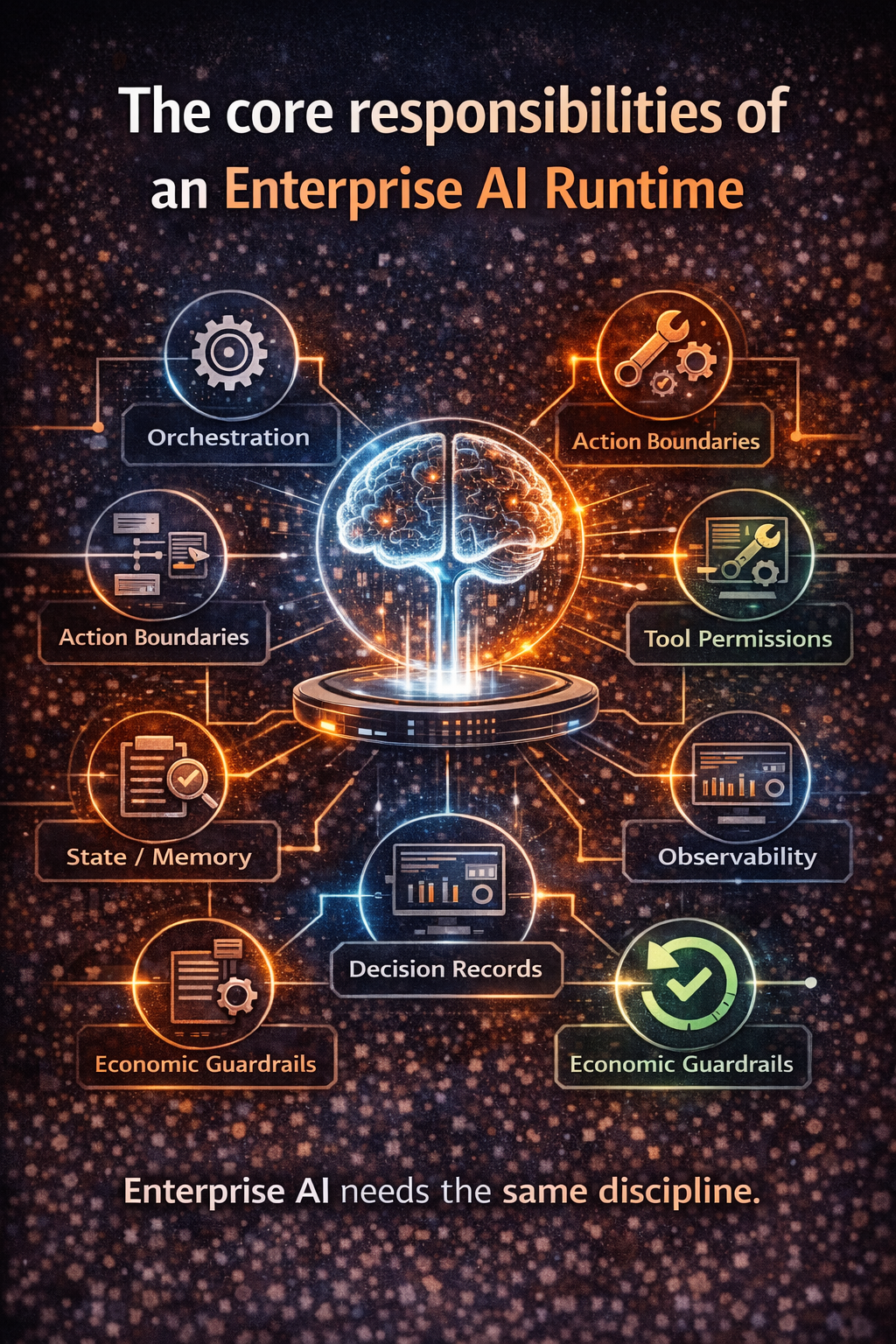
The core responsibilities of an Enterprise AI Runtime
This is the heart of the article.
-
Orchestration: turning reasoning into controlled action
Production AI is never a single prompt.
A runtime must coordinate:
- multiple steps,
- multiple models,
- multiple tools,
- conditional paths,
- retries and fallbacks,
- human handoffs.
Example
A compliance assistant does not “answer a question.”
It:
- retrieves evidence,
- checks policy versions,
- validates jurisdiction,
- drafts a recommendation,
- escalates if confidence is low,
- logs the decision path.
Without orchestration, enterprises get impressive demos—and brittle systems.
-
Action boundaries: advice vs approval vs execution
This is the most important runtime decision.
Every AI action must fall into one of three modes:
- Advise (safe, no impact)
- Recommend for approval (human-in-the-loop)
- Execute (autonomous action)
The runtime enforces the boundary—not the prompt.
Example
An HR agent may:
- suggest access changes,
- but only execute them under defined roles, thresholds, and approvals.
This single design choice prevents most catastrophic failures.
These action boundaries are not technical choices alone — they are governance decisions, which is why the question of who owns enterprise AI decision Who Owns Enterprise AI? Roles, Accountability, and Decision Rights in 2026 – Raktim Singh becomes unavoidable as AI systems move into execution.
-
Tool permissions: what AI is allowed to touch
Agents are dangerous not because they reason—
but because they can act through tools.
A runtime must define:
- which tools an agent can call,
- which operations are allowed,
- what data scope is visible,
- rate limits and quotas,
- escalation paths.
Key principle
AI permissions should be narrower than human permissions, not broader.
-
Policy enforcement as code, not documentation
Most enterprises already have policies.
What they lack is policy execution.
The runtime must enforce:
- regulatory rules,
- business constraints,
- jurisdictional boundaries,
- risk thresholds,
- separation of duties.
If policy is not executable at runtime, it is theater.
-
State and memory management
AI systems need memory—but unmanaged memory becomes liability.
The runtime decides:
- what is ephemeral,
- what is persistent,
- what becomes a record,
- what must be redacted,
- what must expire.
Example
A customer support agent remembers conversation context for resolution—but does not permanently store raw personal data in ungoverned embeddings.
Memory is power.
The runtime decides how much power AI keeps.
-
Observability: the ability to reconstruct reality
When something goes wrong, enterprises ask:
“What happened?”
The runtime must answer:
- which inputs were used,
- which context was retrieved,
- which policy applied,
- which tools were called,
- who approved what,
- what changed downstream,
- how much it cost.
Without this, trust collapses—internally and externally.
-
Audit-ready decision records
Production AI must leave evidence.
A runtime generates decision records that capture:
- reasoning inputs,
- constraints applied,
- actions taken or blocked,
- approvals,
- timestamps,
- identities.
This is what allows enterprises to say:
“Yes, this decision was automated—and here’s exactly why.”
-
Reversibility and containment
Classic automation fails fast.
AI failures compound silently.
A runtime must support:
- safe modes,
- circuit breakers,
- staged autonomy,
- rollback playbooks,
- kill switches.
If you cannot stop or unwind AI behavior, you do not control it.
Most enterprises discover the need for reversibility only after incidents occur — a failure pattern explored in detail in the Enterprise AI Runbook Crisis The Enterprise AI Runbook Crisis: Why Model Churn Is Breaking Production AI—and What CIOs Must Fix in the Next 12 Months – Raktim Singh, where model churn and missing operational playbooks break production AI.
-
Economic guardrails
AI costs do not behave like software costs.
The runtime must manage:
- per-task budgets,
- per-agent limits,
- cost-aware routing,
- runaway loop detection.
This is where cost governance becomes a runtime feature, not a finance spreadsheet.
Without a shared runtime, enterprises repeatedly rebuild intelligence in silos — a pattern that destroys reuse and directly erodes the Intelligence Reuse Index The Intelligence Reuse Index: Why Enterprise AI Advantage Has Shifted from Models to Reuse – Raktim Singh, one of the most reliable indicators of enterprise AI maturity.
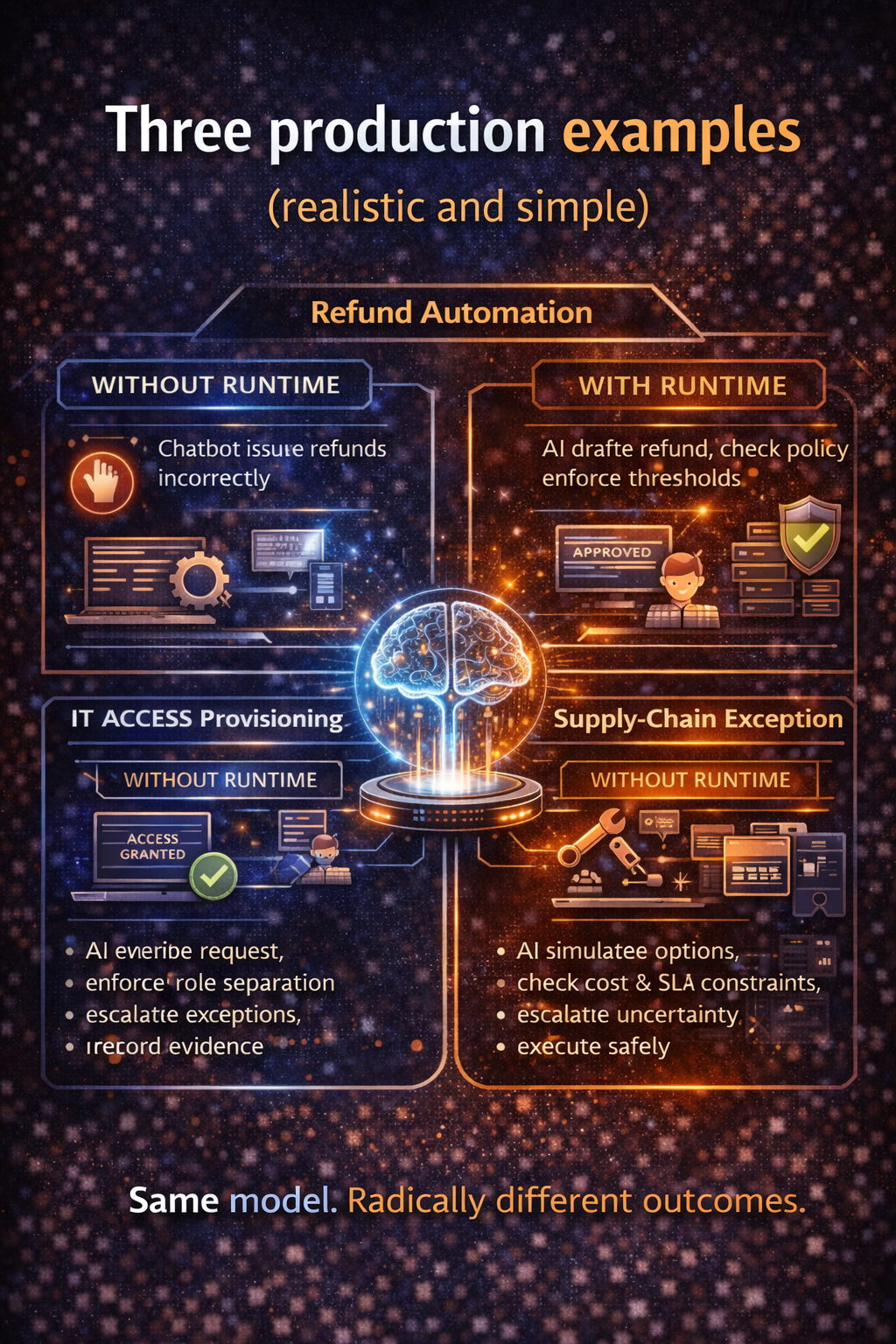
Three production examples (realistic and simple)
Example 1: Refund automation
Without runtime: chatbot issues refunds incorrectly.
With runtime: AI drafts refund, checks policy, enforces thresholds, logs decision, executes only if allowed.
Example 2: IT access provisioning
Without runtime: AI grants access directly.
With runtime: AI validates request, enforces role separation, escalates exceptions, records evidence.
Example 3: Supply-chain exception handling
Without runtime: AI reroutes inventory impulsively.
With runtime: AI simulates options, checks cost and SLA constraints, escalates uncertainty, executes safely.
Same model.
Radically different outcomes.
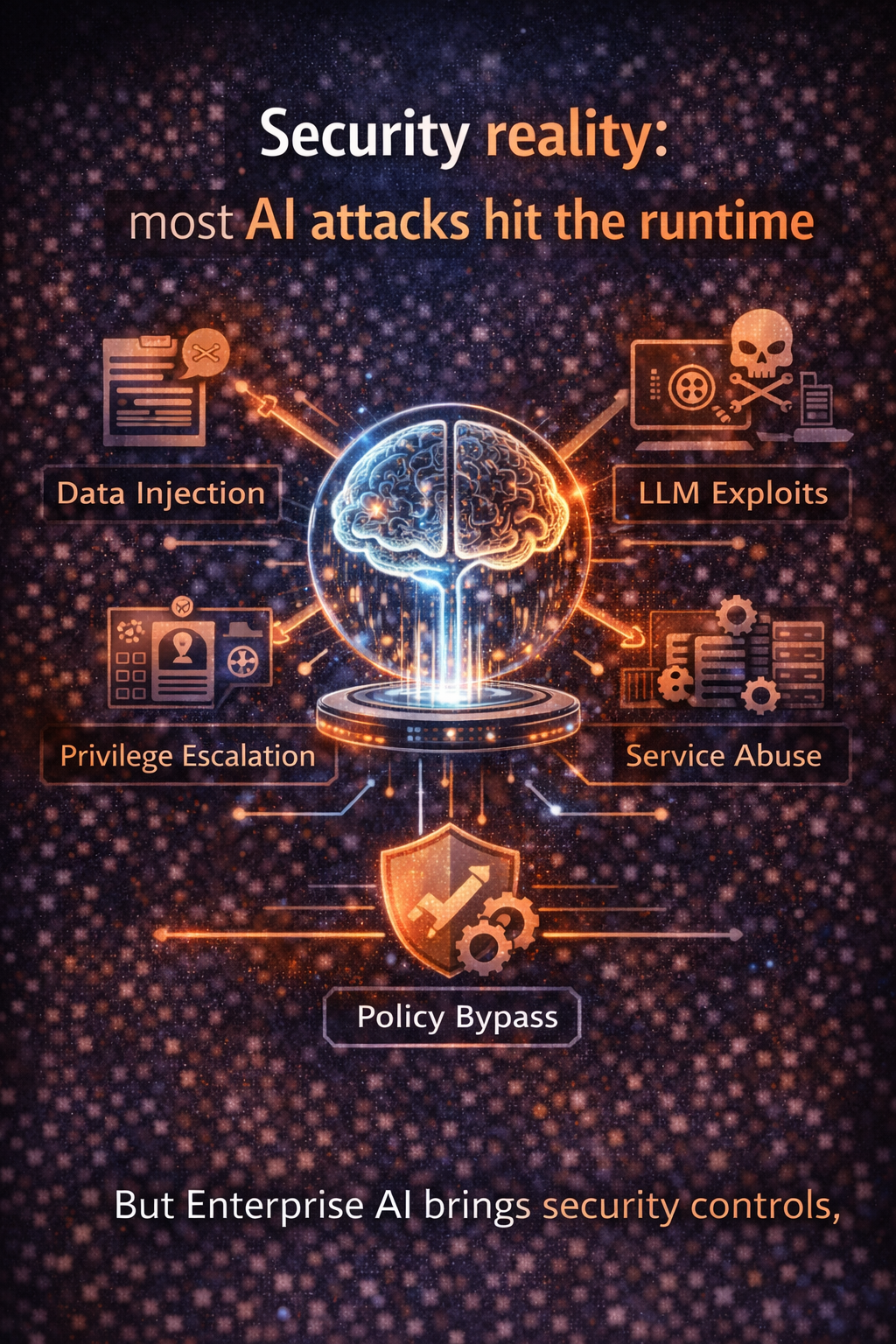
Security reality: most AI attacks hit the runtime
Prompt injection, tool abuse, data exfiltration, denial-of-wallet—
these are runtime failures, not model failures.
The runtime is where you:
- validate inputs,
- constrain outputs,
- sandbox tools,
- detect abuse,
- contain damage.
No runtime = no security story.
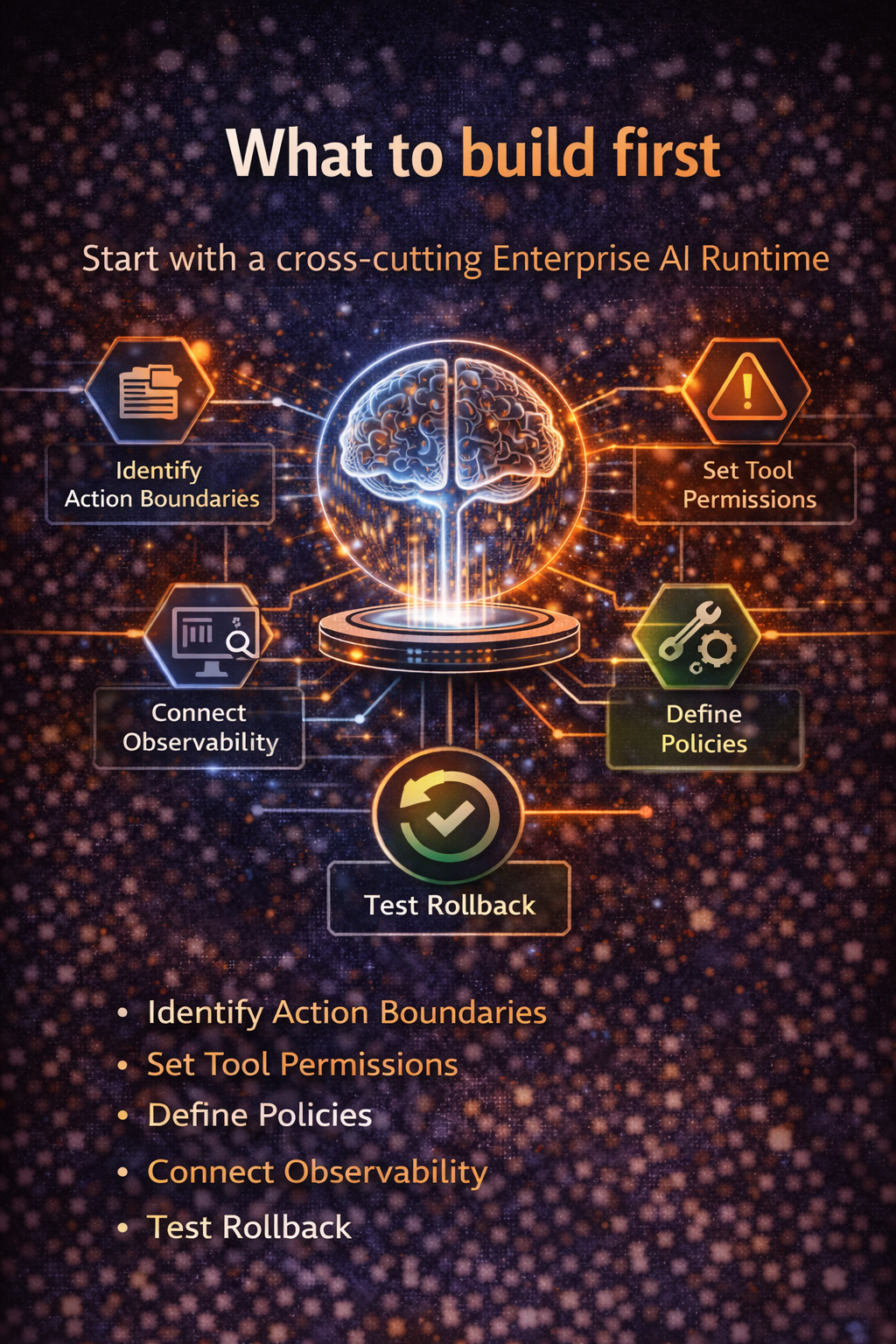
What to build first (practical guidance)
If you are early, start here:
- Clear action boundaries
- Tool permission controls
- Decision logging
- Observability hooks
- Kill switches
- Cost limits
This is enough to move from “AI demo” to “AI system.”
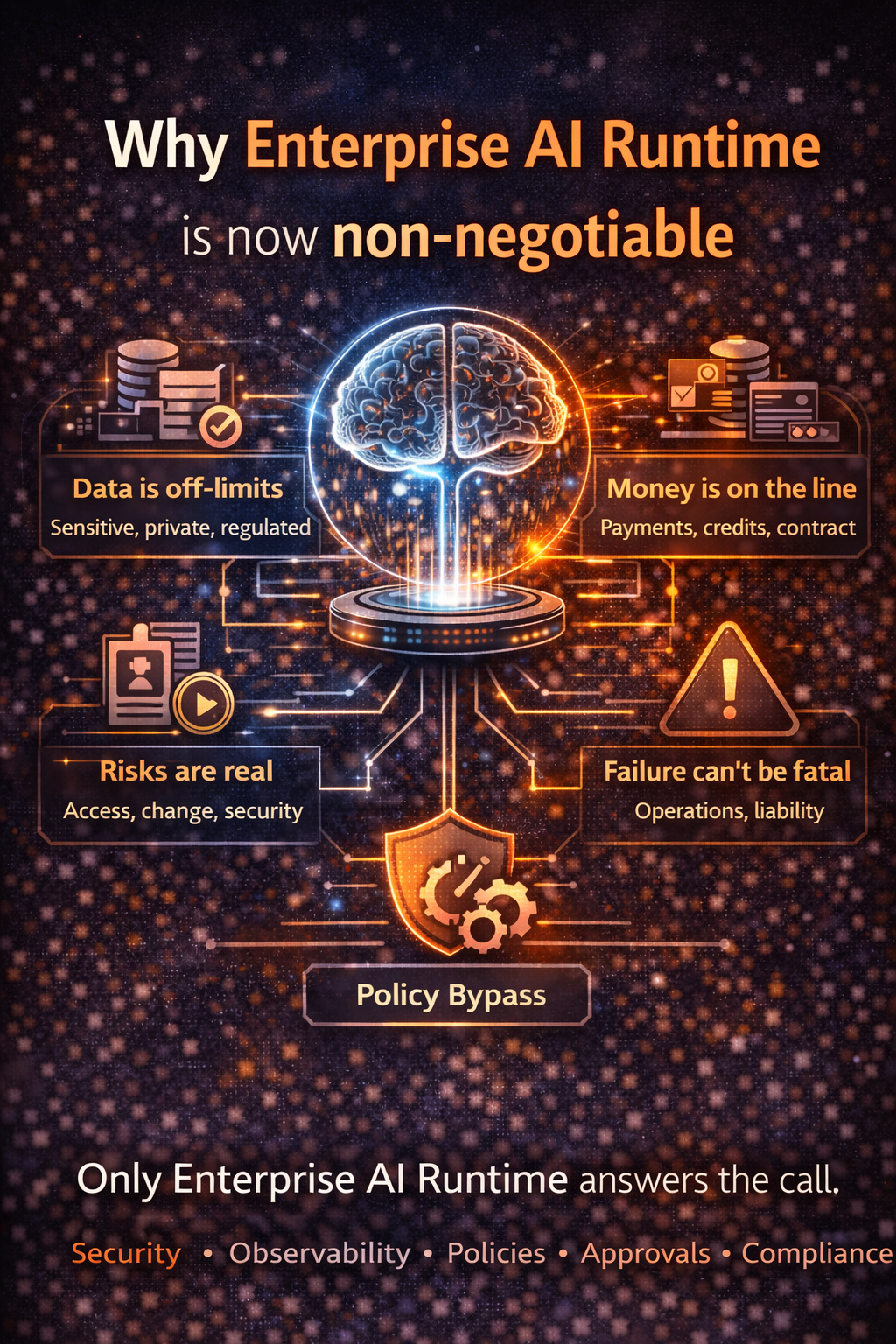
Why Enterprise AI Runtime is now non-negotiable
Because enterprises are no longer experimenting with intelligence.
They are running it.
And running intelligence without a runtime is like running financial systems without transaction logs, rollbacks, or controls.
Final takeaway
Enterprise AI does not fail because models are weak.
It fails because enterprises forget that intelligence must be operated.
The Enterprise AI Runtime is where:
- autonomy becomes governable,
- innovation becomes reliable,
- and AI becomes something enterprises can actually trust.
If your AI is acting in production, the question is no longer whether you need a runtime.
The question is:
Do you know which one you are already running—and who controls it?
FAQ
What is an Enterprise AI Runtime?
An Enterprise AI Runtime is the production environment that governs how AI decisions are executed, constrained, observed, audited, reversed, and cost-controlled inside enterprise workflows.
How is Enterprise AI Runtime different from AI platforms?
AI platforms focus on building and deploying models. Enterprise AI Runtime governs what happens after deployment—decision execution, permissions, observability, rollback, and compliance.
Why is Enterprise AI Runtime important for security?
Most AI attacks target runtime gaps such as prompt injection, privilege escalation, and policy bypass—not the model itself. Runtime controls close these gaps.
Do enterprises need an AI runtime even if they use copilots?
Yes. Once AI influences money, access, compliance, or operations, a runtime layer is required regardless of whether AI is advisory or autonomous.
Is Enterprise AI Runtime required for regulatory compliance?
Yes. Regulations increasingly require traceability, auditability, reversibility, and accountability—capabilities delivered by the runtime, not the model.
📘 Glossary: Enterprise AI Runtime & Production AI
Enterprise AI Runtime
The production layer that governs how AI decisions are executed inside an enterprise. It controls permissions, policies, observability, auditability, rollback, and cost—ensuring AI actions are safe, accountable, and operable at scale.
AI Runtime
The environment where AI systems actually execute decisions and actions in real workflows. In enterprise contexts, this includes orchestration, policy enforcement, tool control, monitoring, and failure handling.
AI Agent
An AI system capable of planning steps, invoking tools, and interacting with enterprise systems—going beyond simple text generation to perform actions.
Tool Calling
The ability of an AI agent to invoke external systems such as APIs, databases, CRMs, ticketing systems, or automation tools. Tool calling requires strict runtime permissions to prevent misuse.
Action Boundary
A predefined limit that determines whether an AI system can only advise, recommend for approval, or execute actions autonomously. Action boundaries are enforced by the runtime, not the model.
Decision Execution
The act of converting an AI recommendation or reasoning output into a real-world change—such as approving a refund, granting access, or triggering a workflow.
Decision Record
An audit-ready log created by the AI runtime that captures how a decision was made, including inputs, retrieved context, policies applied, approvals, actions taken, timestamps, and identities.
AI Orchestration
The coordination layer that manages multi-step AI workflows, including sequencing tasks, routing between models and tools, handling retries, and escalating to humans when required.
Policy Enforcement
The process by which enterprise rules—regulatory, business, security, or ethical—are automatically checked and enforced at runtime before AI actions are allowed to proceed.
Observability (AI Observability)
The ability to trace, monitor, and reconstruct AI behavior in production, including prompts, tool calls, decisions, costs, errors, and outcomes.
Reversibility
The capability to stop, undo, or safely recover from actions taken by AI systems. Reversibility includes rollback mechanisms, kill switches, and safe modes.
AI Governance
The organizational and technical framework that ensures AI systems behave in accordance with policies, regulations, accountability structures, and risk tolerance.
Enterprise AI Operating Model
A comprehensive framework that defines how enterprises design, govern, deploy, operate, and scale AI systems responsibly across the organization.
AI Production System
An AI-enabled system that operates continuously within live enterprise workflows and impacts real customers, data, money, or operations.
Runtime Guardrails
Controls embedded in the AI runtime that prevent unsafe, non-compliant, or excessively costly behavior. Examples include permission limits, policy checks, cost caps, and escalation rules.
Economic Guardrails
Runtime mechanisms that control AI spending and resource usage, such as per-task budgets, rate limits, and cost-aware model routing.
Human-in-the-Loop
A design pattern where AI systems require human review or approval before executing certain actions, enforced through runtime controls.
Agentic AI
AI systems designed to act autonomously toward goals by planning, reasoning, and executing actions—requiring strong runtime governance to remain safe.
Enterprise AI Security
The protection of AI systems against threats such as prompt injection, privilege escalation, tool abuse, data leakage, and cost attacks—primarily implemented at the runtime layer.
AI Rollback
A controlled process that allows enterprises to undo or neutralize actions taken by AI systems when errors, risks, or policy violations are detected.
AI in Production
AI systems that are actively running within business-critical workflows, influencing real decisions and outcomes, as opposed to pilots or experiments.
Model vs System
A critical distinction in enterprise AI: models generate intelligence, but systems—including the runtime—determine how that intelligence is safely applied in the real world.
Further Reading
AI Risk Management Framework | NIST
High-level summary of the AI Act | EU Artificial Intelligence Act



Raktim Singh is an AI and deep-tech strategist, TEDx speaker, and author focused on helping enterprises navigate the next era of intelligent systems. With experience spanning AI, fintech, quantum computing, and digital transformation, he simplifies complex technology for leaders and builds frameworks that drive responsible, scalable adoption.