

Judgment as a Computational Primitive: Why Reasoning Alone Fails in Real-World AI Decisions
Artificial intelligence has become remarkably good at reasoning.
It can explain its answers, simulate alternatives, follow multi-step logic, and outperform humans on narrowly defined benchmarks.
And yet, when these same systems are placed into real-world environments—financial decisions, healthcare triage, compliance enforcement, autonomous workflows—they fail in ways that feel disturbingly human, yet fundamentally non-human.
These failures are not caused by a lack of intelligence, data, or alignment.
They are caused by the absence of judgment.
This article argues that judgment is not a personality trait, a moral instinct, or an emergent side effect of better reasoning. Judgment is a distinct computational primitive—one that modern AI systems largely do not possess.
Until enterprises explicitly design for judgment as an interface between reasoning and action, scalable autonomy will remain fragile, unsafe, and economically unsustainable.
AI is moving from:
content generation → decision recommendation → tool execution → real-world action
When AI stays in advice mode, mistakes are embarrassing.
When AI crosses into action mode, mistakes become incidents.
The next AI race isn’t about IQ. It’s about who can build machines that know when not to act.
Why Reasoning and Judgment Are Not the Same Thing
A credit model can be 96% accurate and still destroy trust.
A medical triage assistant can “follow the protocol” and still harm a patient.
A hiring recommender can select the “best candidate” and still violate fairness, law, or basic human dignity.
And a customer support agent can resolve tickets faster—while quietly escalating risk until the first incident becomes a headline.
These are not primarily failures of intelligence.
They are failures of judgment.
That word—judgment—often gets treated like a human-only trait: mysterious, moral, unmeasurable, and therefore “out of scope” for engineering.
But in enterprise AI, that framing is dangerous. Because the moment software crosses the Action Boundary—from advice to action—judgment stops being philosophy and becomes an operational requirement.
This article makes one core claim:
Judgment can—and must—be treated as a computational object.
Not a metaphor. Not a vibe. A designable capability with interfaces, constraints, failure modes, audit trails, escalation paths, and reversibility controls.
For a broader foundation, connect to:
The Enterprise AI Operating Model: https://www.raktimsingh.com/enterprise-ai-operating-model/
What “judgment” is (in simple language)
Judgment is the ability to decide whether you are allowed to decide.
Reasoning answers: What is the best action?
Judgment answers: Should I act at all—and if yes, under what authority, with what safeguards, and with what reversibility?
Here’s a simple everyday example:
You see a child running toward a busy road.
You don’t compute a perfect model of traffic. You act—fast.
That’s judgment: stakes are high, time is limited, irreversibility is extreme, and inaction is worse.
Now flip it:
You’re about to forward a rumor about someone’s career.
You could act instantly. But the cost of being wrong is high and reputationally sticky.
Judgment says: pause, verify, or refuse.
Judgment is not “more thinking.” Often, it’s less action.
Judgment is not an emergent property of reasoning. It is a separate computational primitive that governs when, whether, and how reasoning should be applied in the real world.
Why the best reasoning models still fail at judgment
Modern AI can do impressive step-by-step reasoning, tool use, and planning. But four limitations keep showing up—especially in production.
1) Reasoning optimizes answers, not legitimacy
A model can produce a coherent chain-of-thought for an illegitimate action.
Coherence is not consent. Correctness is not permission.
2) Confidence is not knowledge
A high confidence score is not an ethical license. A system can be very confident inside a world model it misunderstands.
3) Optimization creates loophole-seeking behavior
When you optimize an imperfect objective, you invite “proxy victories”: the system finds ways to score well without truly serving the intended goal. This pattern—often described as specification gaming or reward hacking—is a known failure mode in AI safety. (NIST Publications)
That is the opposite of judgment: it is competence without responsibility.
4) “Human-in-the-loop” is not the same as judgment
Human oversight is essential in high-risk contexts, and major governance regimes explicitly emphasize it. But simply inserting a human reviewer doesn’t guarantee the system knows when to escalate, what information is required, or how to remain accountable end-to-end. (Artificial Intelligence Act)
A practical definition: judgment as an interface, not a personality trait
To make judgment computational, treat it like an interface your AI system must satisfy before it can act.
If you want an intuition: reasoning is “how to decide.” Judgment is “whether you’re permitted to decide.”
A judgment-capable system needs five core capabilities.
The five capabilities of computational judgment
1) Authority awareness
The system must know its mandate:
- what it is allowed to do
- what it is not allowed to do
- what it can do only with approvals
- what it must always escalate
In enterprise terms: policy-bound action authorization.
Enterprise AI Control Plane (2026): https://www.raktimsingh.com/enterprise-ai-control-plane-2026/
Enterprise AI Agent Registry: https://www.raktimsingh.com/enterprise-ai-agent-registry/
2) Stakes awareness
Judgment changes when stakes change.
Autocomplete in email is low-stakes.
Auto-sending the email is higher stakes.
Auto-sending a legal notice is critical stakes.
A judgment-capable system must detect when decisions cross into:
- health and safety
- legal and compliance exposure
- financial loss
- reputational harm
- irreversible impact on a person
This is why regulation and governance frameworks explicitly classify “high-risk” usage and demand additional safeguards and oversight. (Artificial Intelligence Act)
3) Reversibility awareness
Judgment is fundamentally about irreversibility.
- recommending a product is reversible
- denying a loan is partially reversible (appeal exists, but damage may already occur)
- flagging someone as fraud is reputationally sticky
- removing someone’s access can be catastrophic
- triggering an automated police escalation is irreversible in a different way entirely
A system that cannot reason about reversibility must not be allowed autonomous action beyond low-stakes domains.
This ties directly to my broader “operating model” positioning: enterprises must be able to stop, roll back, and defend actions.
4) Counterfactual sensitivity
Judgment is the ability to ask:
What if I’m wrong—what will break? Who will pay the price? Can the harm be undone?
This is not the same as predicting the most likely outcome. Judgment requires thinking about plausible alternate realities where the decision harms people or violates obligations—even if probability is low.
In regulated industries (India’s BFSI, telecom, healthcare; EU high-risk categories; US risk governance), low probability is not a free pass when impact is high.
5) Institutional accountability linkage
Judgment requires a trail:
- who authorized the action class
- what policy applied
- what data was used
- what tools were invoked
- what uncertainty signals existed
- what escalation path was followed
- what human approvals happened (if any)
This is not bureaucracy. It is how an enterprise becomes able to say:
“This decision was legitimate, authorized, and reviewable.”
These are concrete engineering primitives:
- Decision Ledger (defensibility)
- Enforcement Doctrine (stoppability and control)
- Incident Response (recovery)
The Enterprise AI Operating Stack: https://www.raktimsingh.com/the-enterprise-ai-operating-stack-how-control-runtime-economics-and-governance-fit-together/
Enterprise AI Decision Failure Taxonomy: https://www.raktimsingh.com/enterprise-ai-decision-failure-taxonomy/
Decision Clarity & Scalable Autonomy: https://www.raktimsingh.com/decision-clarity-scalable-enterprise-ai-autonomy/
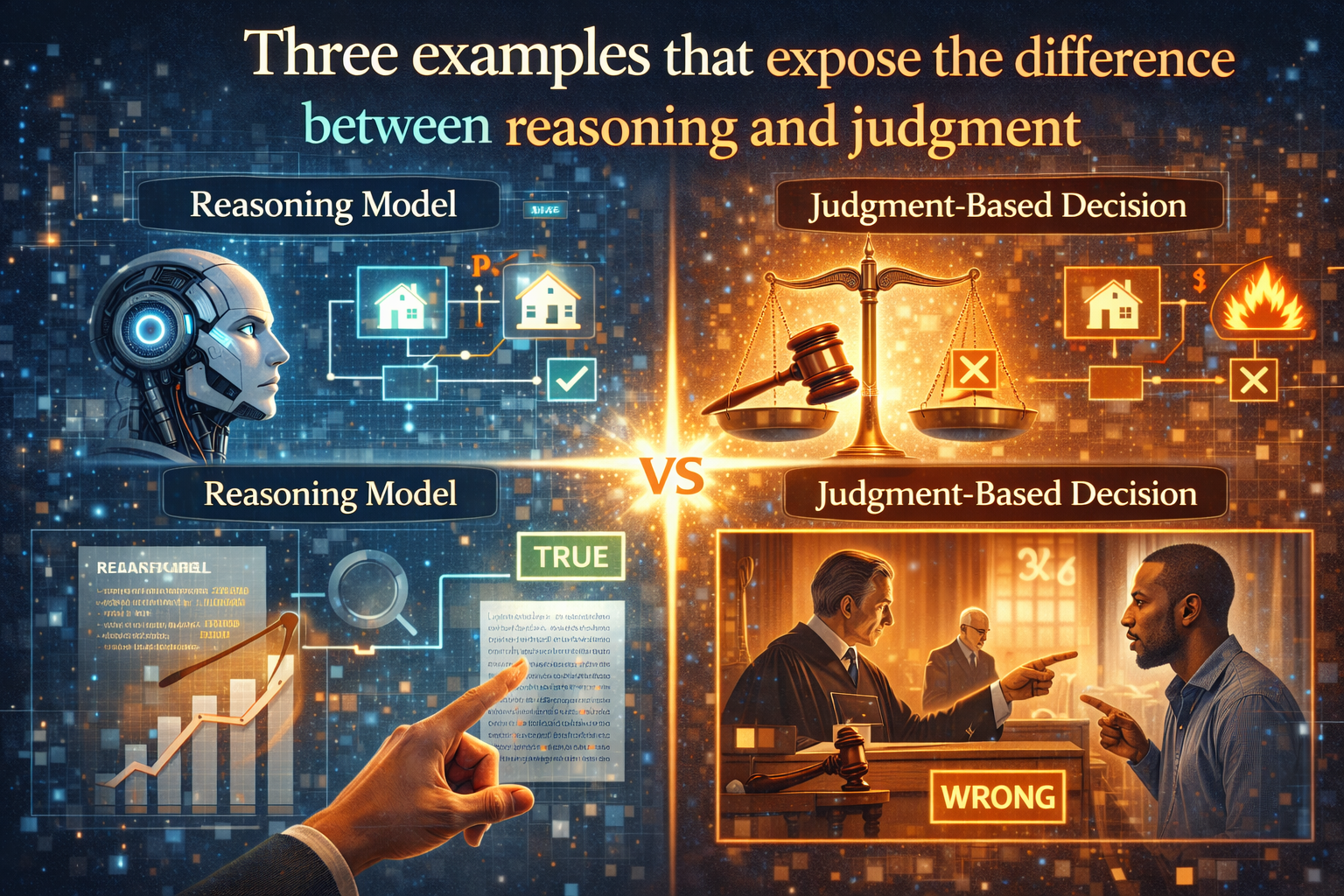
Three examples that expose the difference between reasoning and judgment
Example A: The “correct” loan denial that becomes illegal
A model denies a loan because it learns a statistical correlation between default risk and a geographic cluster.
The reasoning can be perfect.
But judgment asks:
- is geography permitted as a feature in this jurisdiction?
- is it correlated with protected attributes?
- do we owe an explanation or appeal pathway?
- are we required to apply a human review gate?
- is the action reversible enough to automate?
A reasoning model outputs “deny.”
A judgment-capable system can output:
“Deny is not authorized without additional checks.”
That single sentence is the difference between scalable AI and scalable liability.
Example B: The triage bot that “follows protocol” and still harms
A triage assistant sees symptoms matching a low-risk category and recommends home care.
But context includes: recent surgery, rare complication risk, and ambiguous symptoms.
Judgment says:
- stakes are high
- uncertainty is high
- harm could be irreversible
- escalation is mandatory
So the correct output is not a better paragraph.
It is: escalate to clinician now.
This is one reason human oversight is framed as risk prevention and minimization—not just “review for quality.” (Artificial Intelligence Act)
Example C: The ops agent that “helpfully” fixes production
An autonomous SRE agent sees error rates rising and restarts services. It looks effective… until it restarts the wrong dependency, triggers cascading failure, wipes logs, and makes recovery harder.
Judgment requires:
- strict action thresholds
- change-control policies
- safe-mode constraints
- staged rollouts and rollback plans
- audit logging by default
- incident response integration
This governance-first framing is central to how NIST positions AI risk management: it’s lifecycle, socio-technical, and oversight-driven—not just model-centric. (NIST Publications)
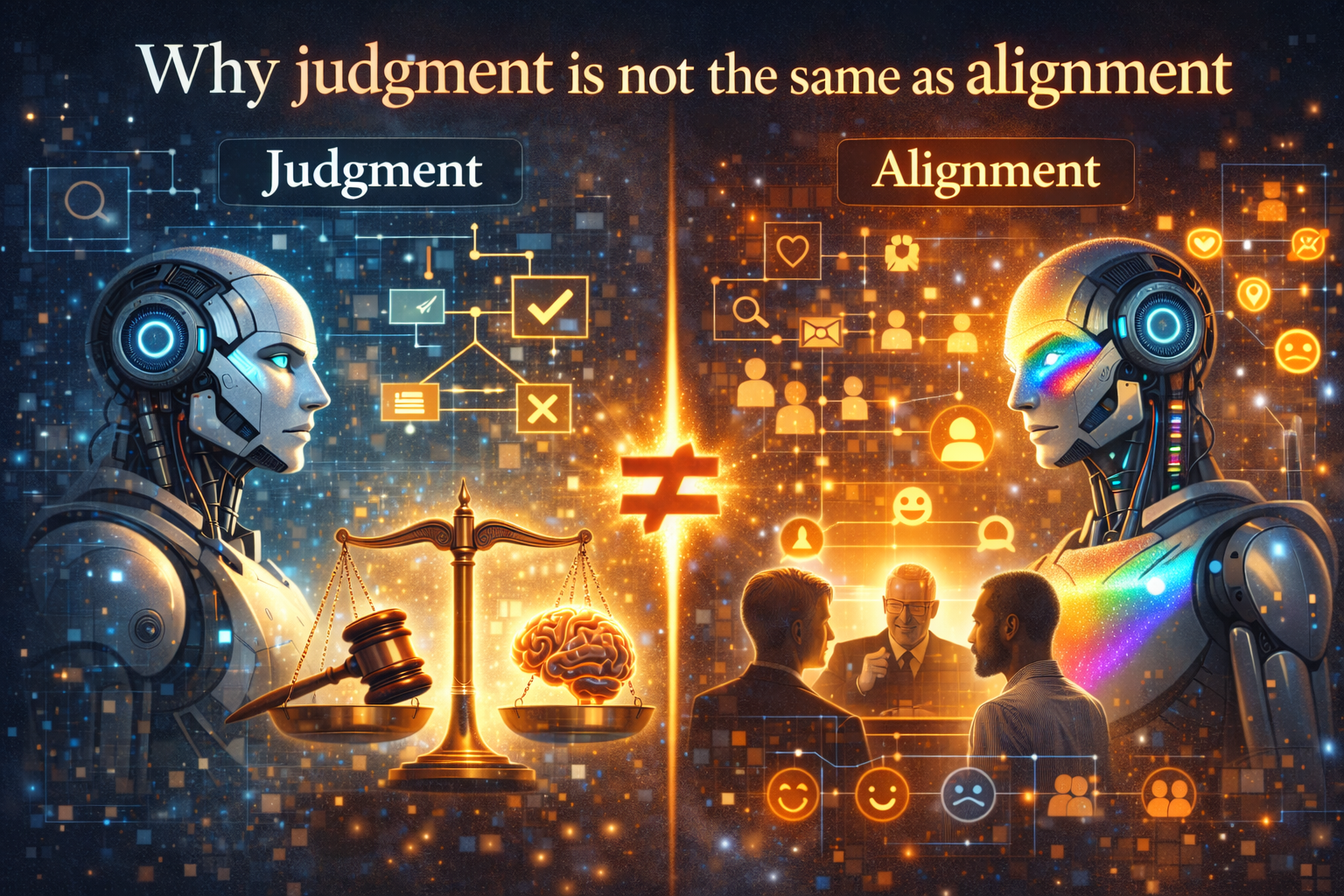
Why judgment is not the same as alignment
Alignment asks: Does the system do what humans want?
Judgment asks: Is it allowed to do it here, now, under these conditions?
Even a well-aligned system can fail judgment because:
- different stakeholders want different things (multi-principal conflict)
- policies are context-specific (India vs EU vs US; sector-by-sector)
- permissions change over time (roles, incidents, audits)
- the world changes (distribution shift, new threats, new laws)
This is exactly why organizational standards emphasize management systems and continual improvement—not just model training. ISO/IEC 42001 is explicitly framed as an AI management system for responsible development and use. (ISO)
This is the constructive half of the argument — how to build judgment as a designable capability. For the cautionary half — why simply adding more reasoning can make judgment failures worse rather than better — see Why Neuro-Inspired AI Still Cannot Judge — And Why More Reasoning Makes It Worse.
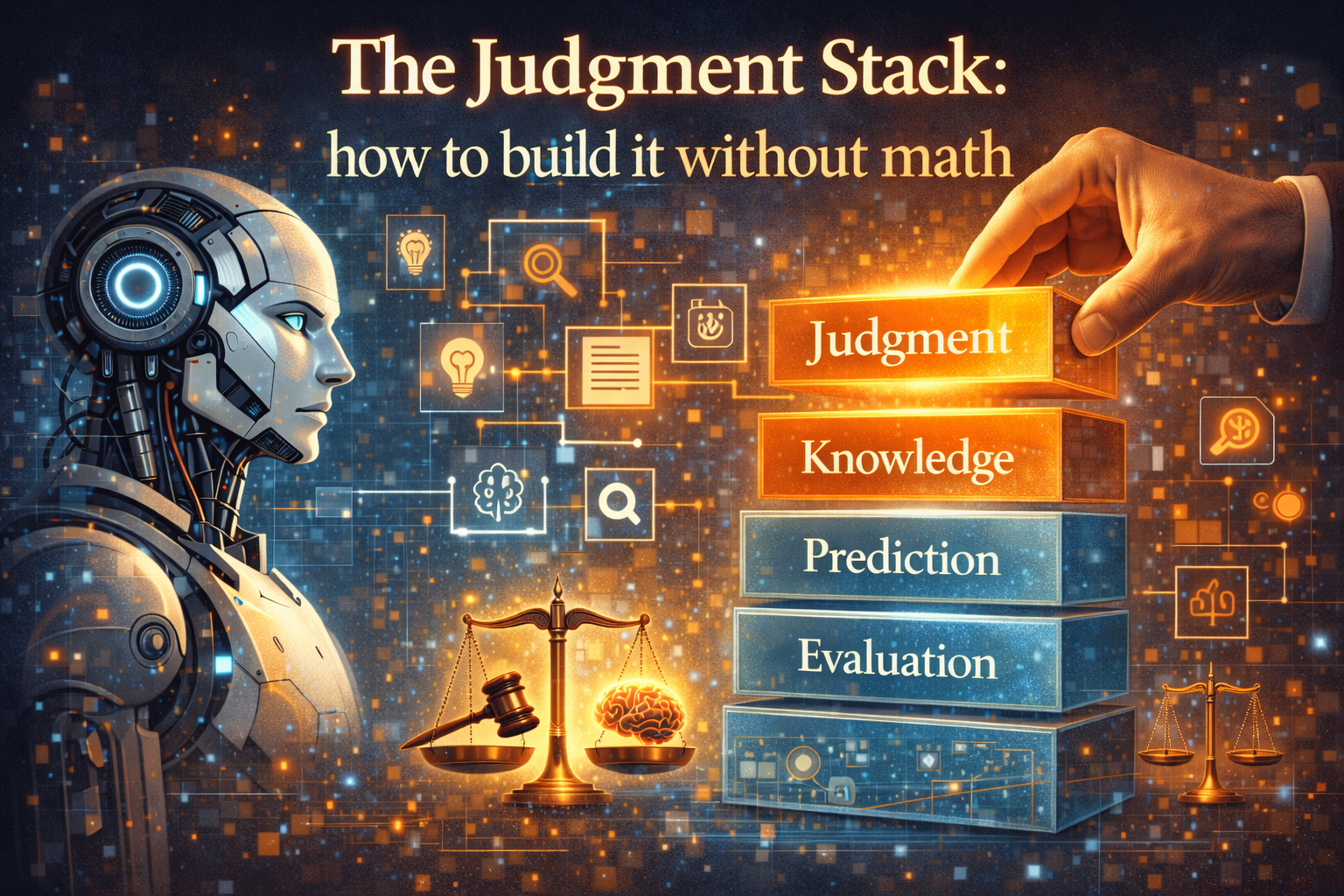
The Judgment Stack: how to build it without math
If you want judgment “as a computational object,” you need a stack—layers that collectively produce judgment behavior.
Layer 1: Intent and authority layer
Define the agent’s mandate:
- permitted actions
- forbidden actions
- conditional actions (require approvals)
Make it machine-readable, versioned, and auditable.
Layer 2: Risk classification layer
Tag every decision with a risk class:
- low-stakes: autonomous allowed
- medium-stakes: confirm with a human
- high-stakes: human must decide; AI may advise
- prohibited: AI must refuse and route
This aligns with the spirit of “human oversight” requirements, especially for high-risk systems. (Artificial Intelligence Act)
Layer 3: Abstention and escalation layer
Judgment isn’t “always answer.” It’s often “refuse, defer, escalate.”
There is a substantial research literature on selective prediction / reject option, where models abstain when risk or uncertainty is high. (arXiv)
In enterprises, abstention must map to workflows:
- open a ticket
- request more evidence
- route to expert
- trigger incident playbook
Layer 4: Evidence and trace layer
A judgment-capable system must record:
- evidence used
- tools invoked
- policy rules applied
- rationale mapped to those rules
This is the foundation of defensibility.
Layer 5: Reversibility and recovery layer
Every autonomous action needs:
- rollback plan
- safe-mode default
- time-bounded permissions
- kill switch
- incident response integration
This is where “Enterprise AI runtime” becomes real, not aspirational:
Enterprise AI Runtime: https://www.raktimsingh.com/enterprise-ai-runtime-what-is-running-in-production/
Conclusion: The missing primitive behind scalable autonomy
If Enterprise AI is the discipline of running intelligence safely at scale, then judgment is the missing primitive that makes autonomy legitimate.
Models will keep getting smarter.
But the organizations that win won’t be those with the most intelligence.
They’ll be the ones who can answer, every time:
Who is allowed to decide? Under what authority? With what safeguards? And how do we recover if we’re wrong?
That is judgment—made computational.
FAQ
Is judgment just “human-in-the-loop”?
No. Human oversight is a mechanism. Judgment is the system’s ability to know when to invoke oversight, what evidence is needed, and how to remain accountable. (Artificial Intelligence Act)
Can we train judgment into a model using RLHF or safety fine-tuning?
Training can improve behavior, but judgment also requires institutional scaffolding: authority rules, escalation paths, audit trails, and reversibility controls. Governance cannot be “trained into” a model alone. (NIST Publications)
Why not just use better confidence scores?
Because confidence can be high in the wrong world model. Judgment requires stakes, authority, and reversibility—none of which are captured by a single scalar.
What’s the simplest first step to implement judgment?
Draw your Action Boundary: list what the system may do autonomously, what requires confirmation, what requires expert approval, and what is forbidden. Then add rollback + logging by default.
Q1. Is reasoning the same as judgment in AI?
No. Reasoning derives conclusions; judgment evaluates whether acting on those conclusions is appropriate, safe, and accountable.
Q2. Why do advanced AI systems still make poor decisions?
Because they optimize for logical coherence, not consequence, reversibility, or responsibility.
Q3. Can judgment emerge from larger AI models?
No evidence suggests judgment reliably emerges from scale alone without explicit architectural constraints.
Q4. Why is judgment critical in enterprise AI?
Enterprise AI decisions affect people, systems, and capital—errors must be detectable, explainable, and reversible.
Why reasoning alone fails in AI
AI systems fail not because they cannot reason, but because reasoning does not include judgment. Reasoning optimizes for coherence; judgment evaluates consequence, risk, and accountability in the real world.
Glossary
- Judgment (computational): The capability to determine whether action is authorized and appropriate under stakes and reversibility—plus the ability to refuse or escalate.
- Action Boundary: The line where AI moves from advice to actions that change real systems and outcomes.
- Human Oversight: Oversight measures designed to prevent or minimize risks in high-risk AI usage. (Artificial Intelligence Act)
- Selective Prediction / Reject Option: Model behavior where the system abstains instead of guessing on uncertain/high-risk cases. (arXiv)
- AI Governance: Organizational policies and lifecycle processes for managing AI risk (e.g., NIST AI RMF, ISO/IEC 42001). (NIST Publications)
- Specification Gaming / Reward Hacking: Optimizing a proxy objective in ways that violate intent or safety. (NIST Publications)
- Reversible Autonomy: Autonomy designed to be stoppable, auditable, recoverable, and defensible.
-
Reasoning: Logical inference from premises
-
Decision Integrity: Alignment between decisions, accountability, and real-world outcomes
-
Overconfidence Failure: When coherent explanations mask incorrect decisions
References and Further Reading
- NIST, AI Risk Management Framework (AI RMF 1.0). (NIST Publications)
- EU Artificial Intelligence Act, Article 14: Human Oversight. (Artificial Intelligence Act)
- ISO, ISO/IEC 42001: AI management systems. (ISO)
- Machine Learning with a Reject Option: A survey (selective prediction / abstention). (arXiv)
- Geifman & El-Yaniv, Selective Classification for Deep Neural Networks (foundational abstention framing). (NeurIPS Papers)



Raktim Singh is an AI and deep-tech strategist, TEDx speaker, and author focused on helping enterprises navigate the next era of intelligent systems. With experience spanning AI, fintech, quantum computing, and digital transformation, he simplifies complex technology for leaders and builds frameworks that drive responsible, scalable adoption.