

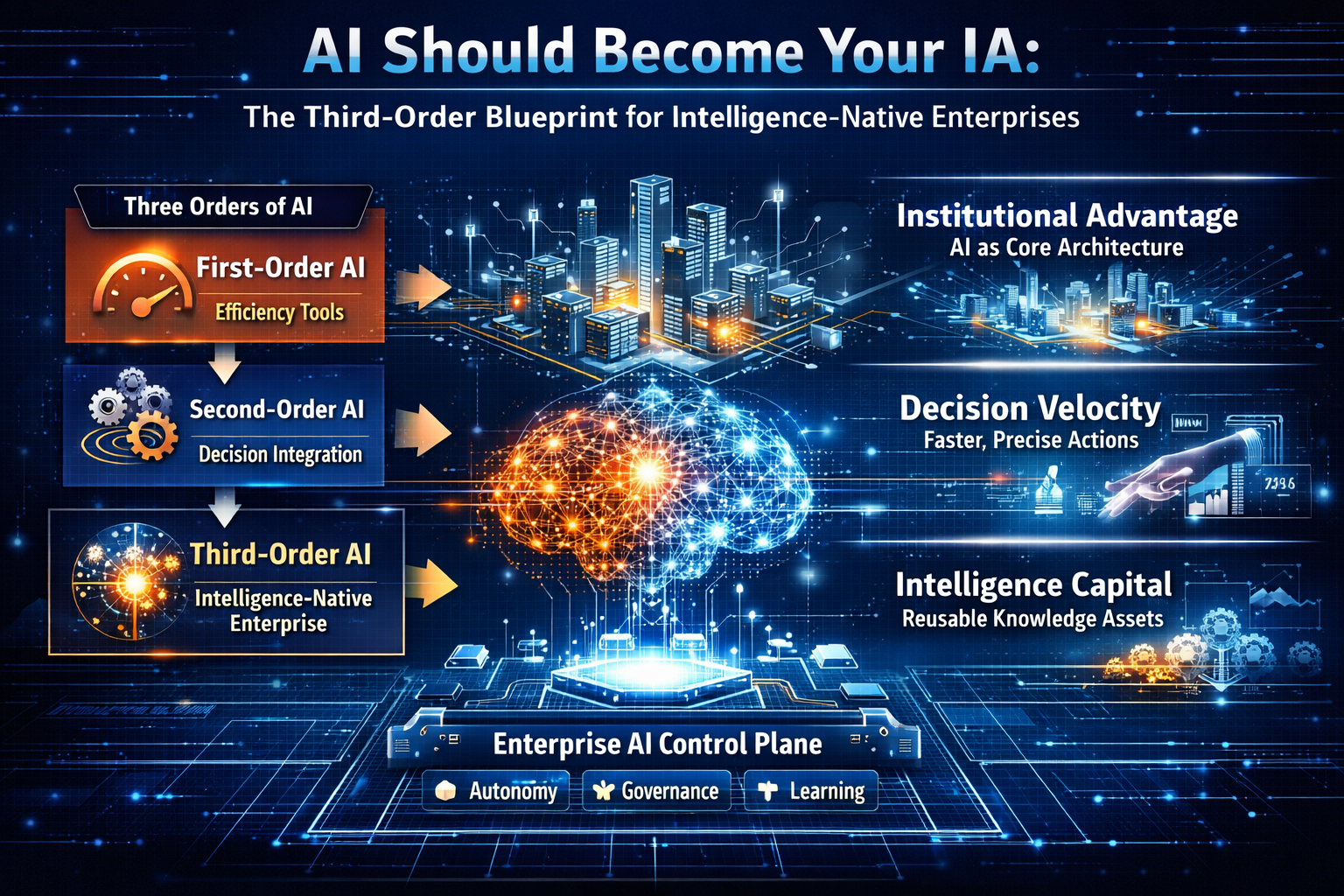
AI should become your IA
Most leadership teams still talk about AI as a tool: faster writing, cheaper support, better analytics, improved productivity. That is first-order AI—valuable, but not decisive.
A smaller set of organizations is taking the next step: redesigning workflows so AI is embedded into real work—approving exceptions, routing cases, detecting failures early, reducing latency, and improving judgment. That is second-order AI—where AI becomes a capability woven into how the enterprise operates.
But the true winners of the AI decade will be defined by something larger:
Third-order AI—the moment AI stops being “a tool used by the enterprise” and becomes the architecture of the enterprise. At this level, new business categories emerge, new operating models compound advantage, and entirely new competitors appear—not because they have better models, but because they are designed as intelligence-native institutions from day one.
This article explains how boards and senior executives can move from AI as Artificial Intelligence to IA as Institutional Advantage—with simple examples, practical operating-model thinking, and a blueprint leaders can actually use.
Definition: Third-Order AI
Third-order AI refers to the stage where artificial intelligence becomes core business architecture, enabling intelligence-native enterprises that continuously sense, decide, act, and learn.
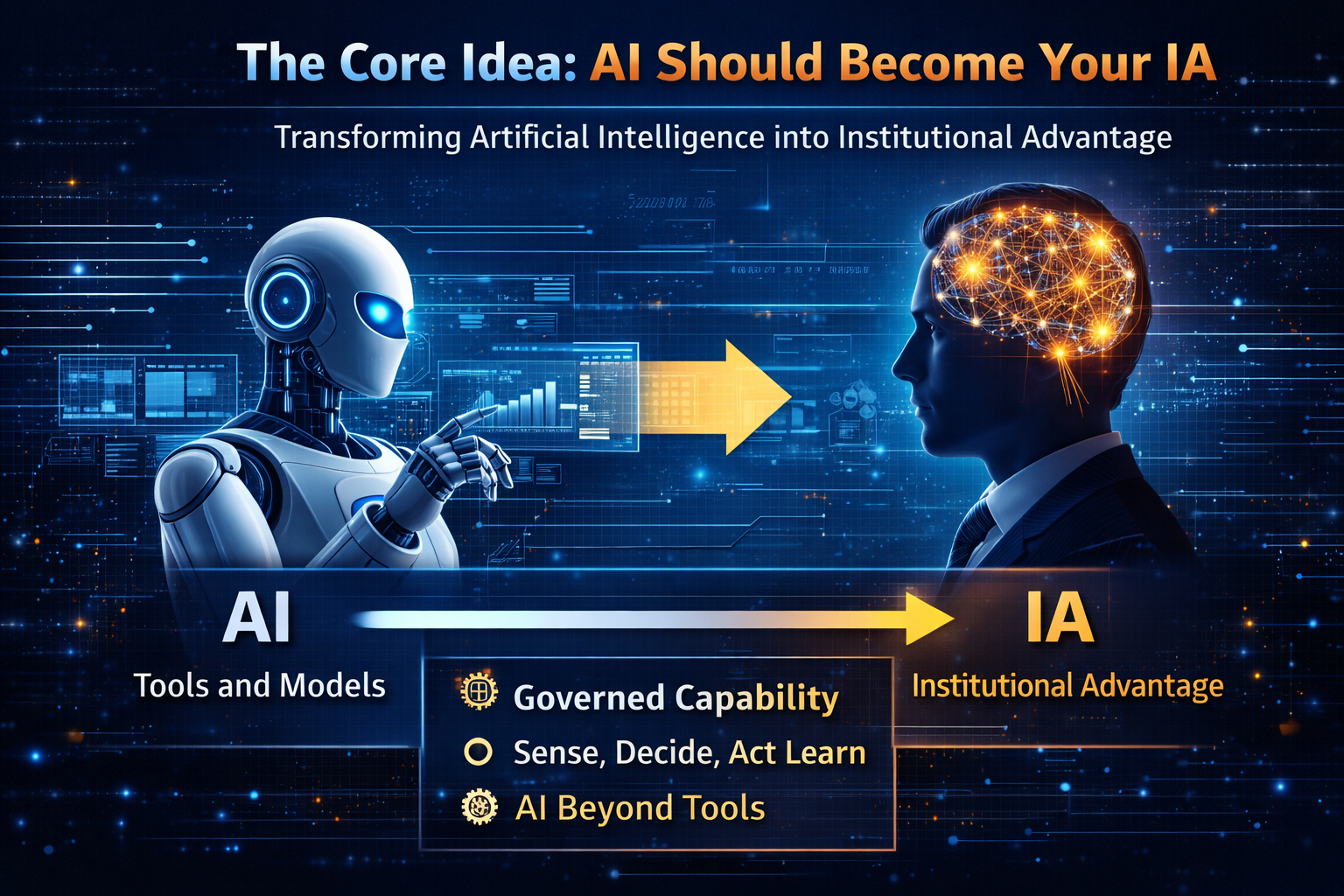
The Core Idea: AI Should Become Your IA
Most people hear “IA” and think “Intelligent Assistant”—a helpful system sitting beside you.
That is a good starting point. But it is not the destination.
In the enterprise, IA should mean Institutional Advantage:
- AI not as a feature,
- not as a pilot,
- not even as a collection of models,
…but as a repeatable, governed capability that compounds the enterprise’s ability to sense, decide, act, and learn.
When AI becomes IA, the organization is no longer merely “using AI.”
It is running intelligence.
If you want a crisp way to explain this to a board:
AI adoption is not the goal.
Institutional advantage is the goal.
AI is simply the mechanism.
This builds on the Third-Order AI Economy framework — see The Third-Order AI Economy: The Category Map Boards Must Use to See the Next Uber Moment for the full breakdown. Here, the focus is the Institutional Advantage (IA) blueprint specifically.
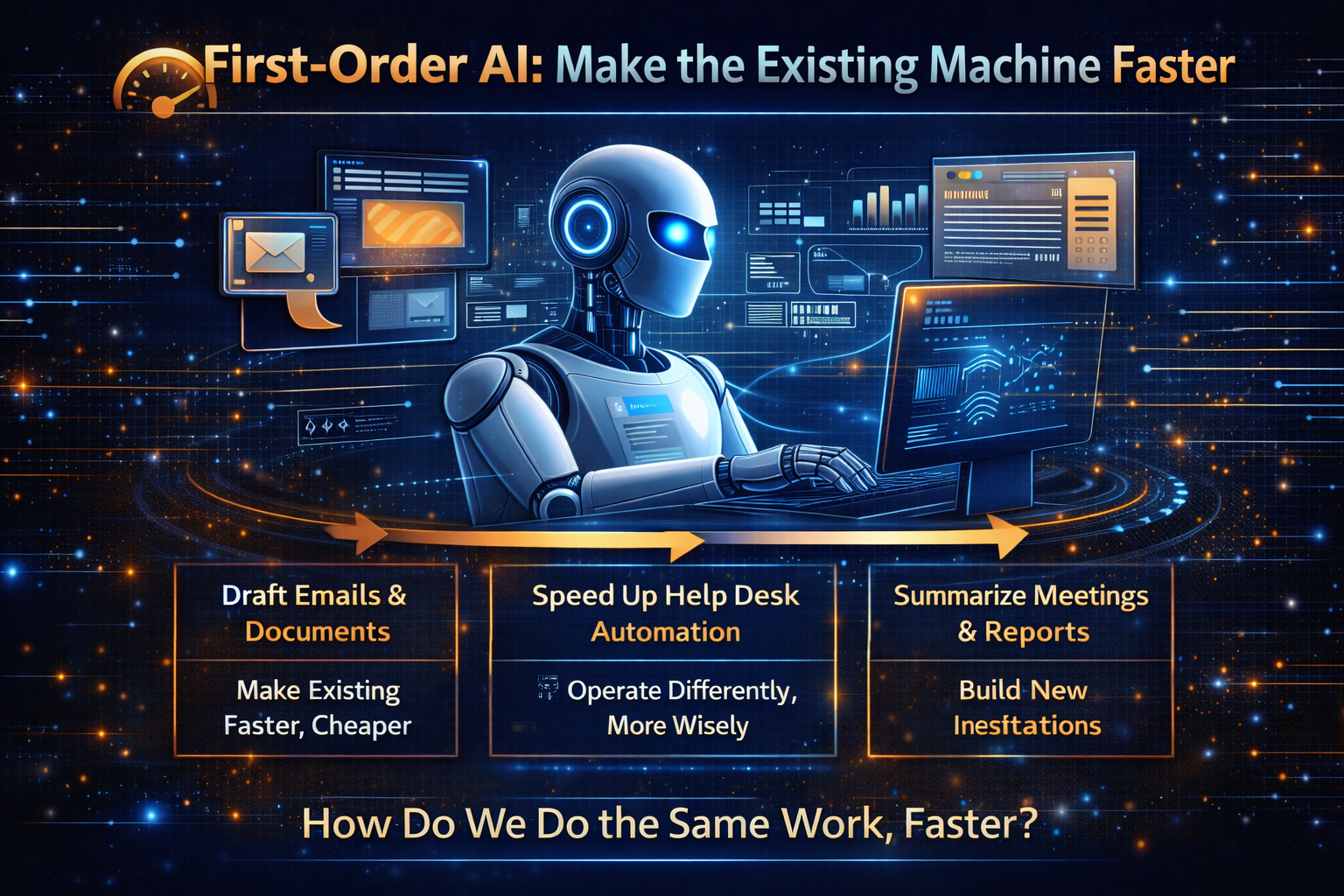
First-Order AI: Make the Existing Machine Faster
First-order AI is where most budgets still live:
- Drafting emails and proposals faster
- Summarizing meetings and documents
- Automating tickets and FAQs
- Improving forecasting accuracy
- Assisting developers and analysts
These gains are real. They often produce quick ROI. They also create a dangerous illusion: that AI adoption equals AI advantage.
But efficiency is a weak moat.
If everyone can buy similar tools, productivity gains become industry-wide inflation, not differentiation.
First-order AI answers:
“How do we do the same work faster?”
It does not answer:
“How do we build a different kind of enterprise?”
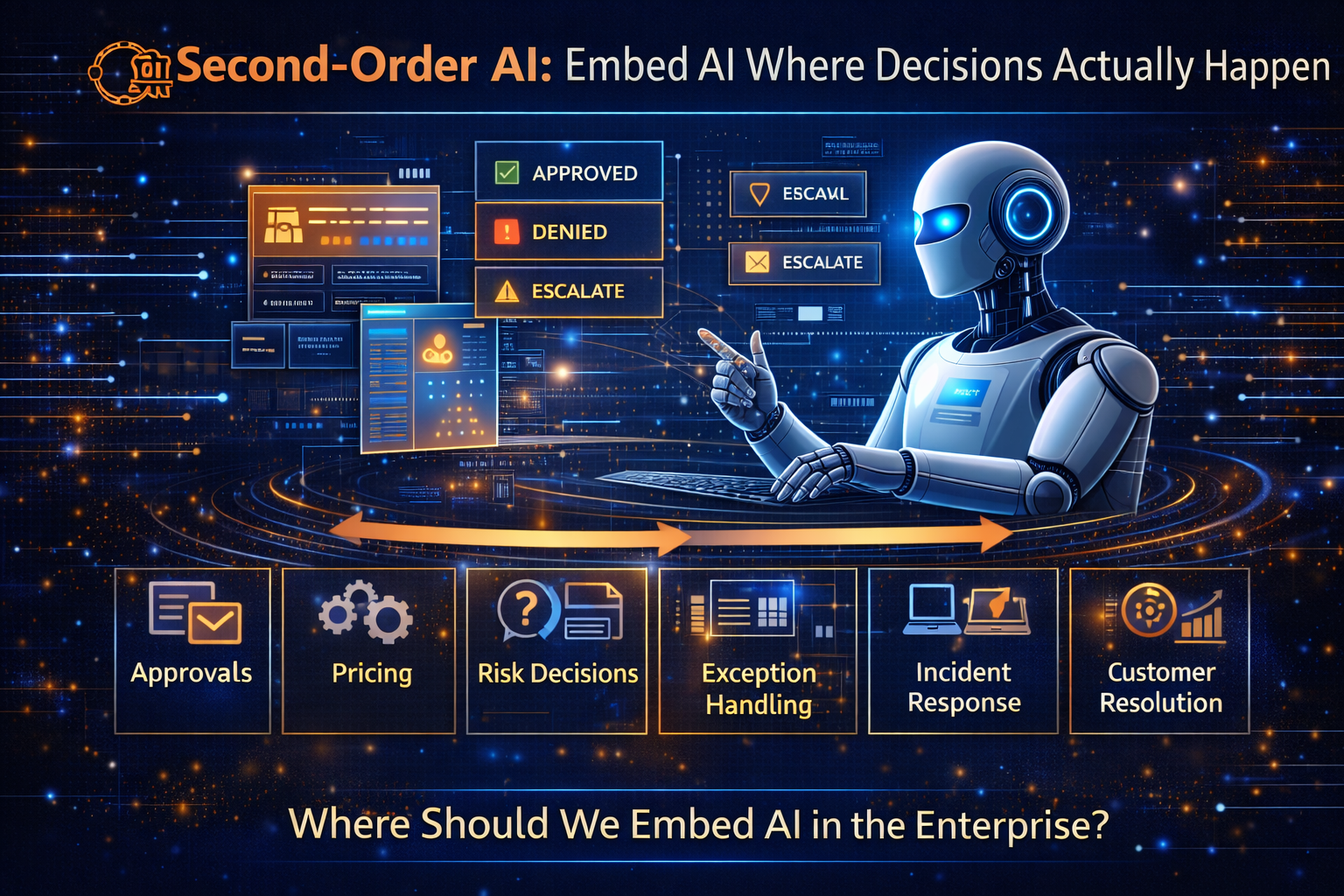
Second-Order AI: Embed AI Where Decisions Actually Happen
Second-order AI begins when AI is placed inside workflows that carry consequences:
- approvals
- pricing
- risk decisions
- exception handling
- incident response
- customer resolution
- supply chain routing
- fraud intervention
- credit policies
- contract triage
Here AI stops being a productivity enhancer and becomes a decision participant.
A simple example: the claims workflow
Consider a claims process (insurance, warranty, healthcare—any environment where decisions have real outcomes):
- First-order AI summarizes claim documents and drafts a response.
- Second-order AI recommends approval/denial, flags anomalies, triggers additional verification, escalates high-risk cases, and records a defensible decision trail.
Now latency drops, risk reduces, and outcomes become more consistent.
But second-order AI also introduces a new reality:
When AI can act, the enterprise must be redesigned to remain safe, auditable, and economically controlled.
Second-order AI forces leadership to answer questions that traditional “AI governance” rarely covers:
- Authority: Who delegated what to the system—and under what conditions?
- Controls: What is allowed, disallowed, reversible, and escalated?
- Evidence: Can the decision be defended later, with a clear trail?
- Economics: Does autonomy increase costs invisibly (tool calls, loops, retries)?
- Reliability: What happens when AI is wrong—or uncertain?
Second-order AI is where governance becomes insufficient and an Enterprise AI operating discipline becomes necessary.
If you want a deeper framework for this shift, go to Enterprise AI Operating Model:
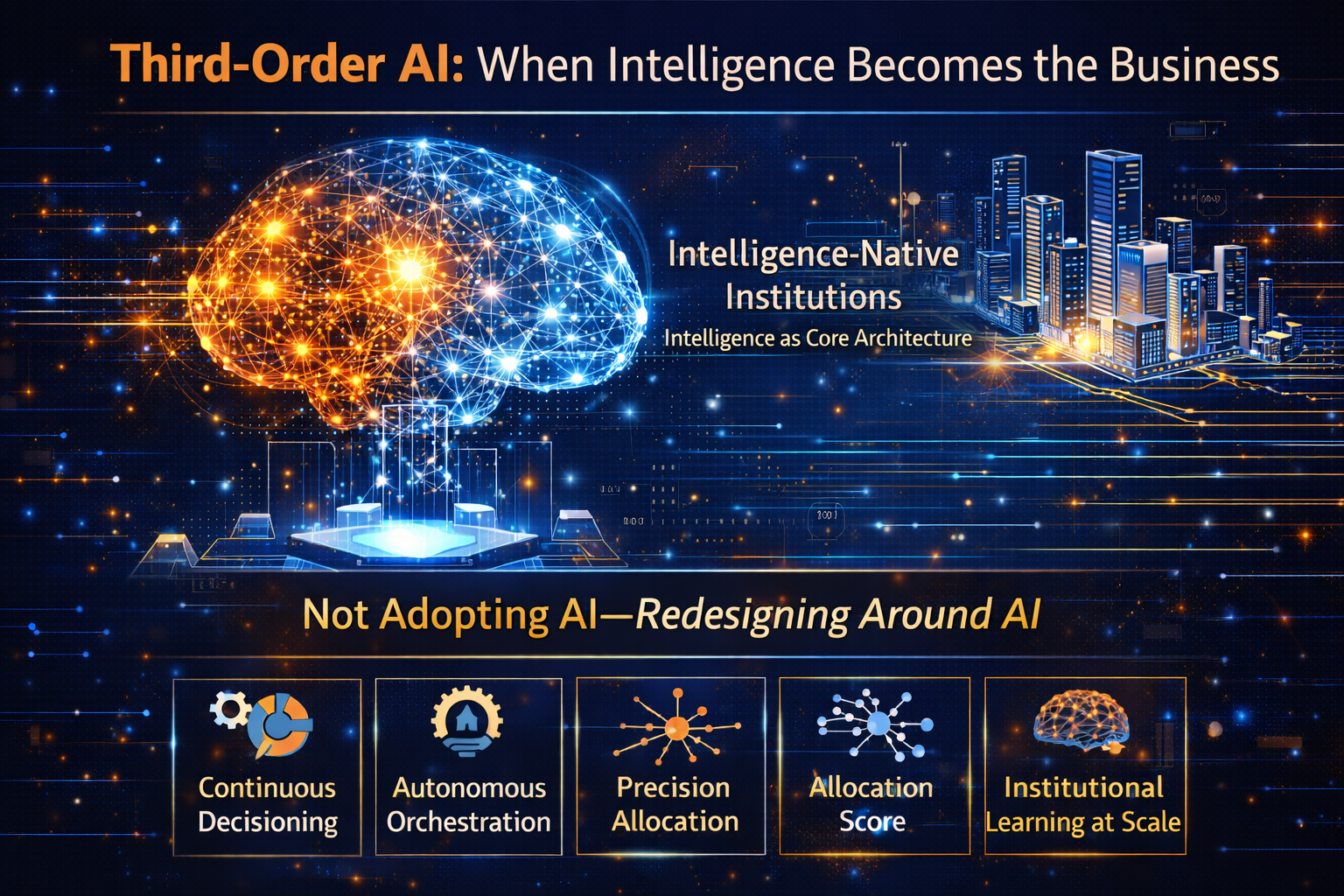
Third-Order AI: When Intelligence Becomes the Business
Third-order AI is the hardest to see—because it is not a feature upgrade.
It is a business-model discontinuity.
In third-order AI:
- The company’s advantage is not “using AI well.”
- The advantage is being designed as an intelligence-native institution.
These organizations treat decisions the way digital-native firms treated software:
- engineered
- measurable
- reusable
- continuously improved
- governed as a core asset
Third-order AI creates new categories of companies.
Not “AI companies” in the marketing sense.
But firms whose core product is:
- continuous decisioning
- autonomous orchestration
- precision allocation
- institutional learning at scale
They do not compete by doing the same work better.
They compete by making old categories feel slow, manual, and structurally expensive.
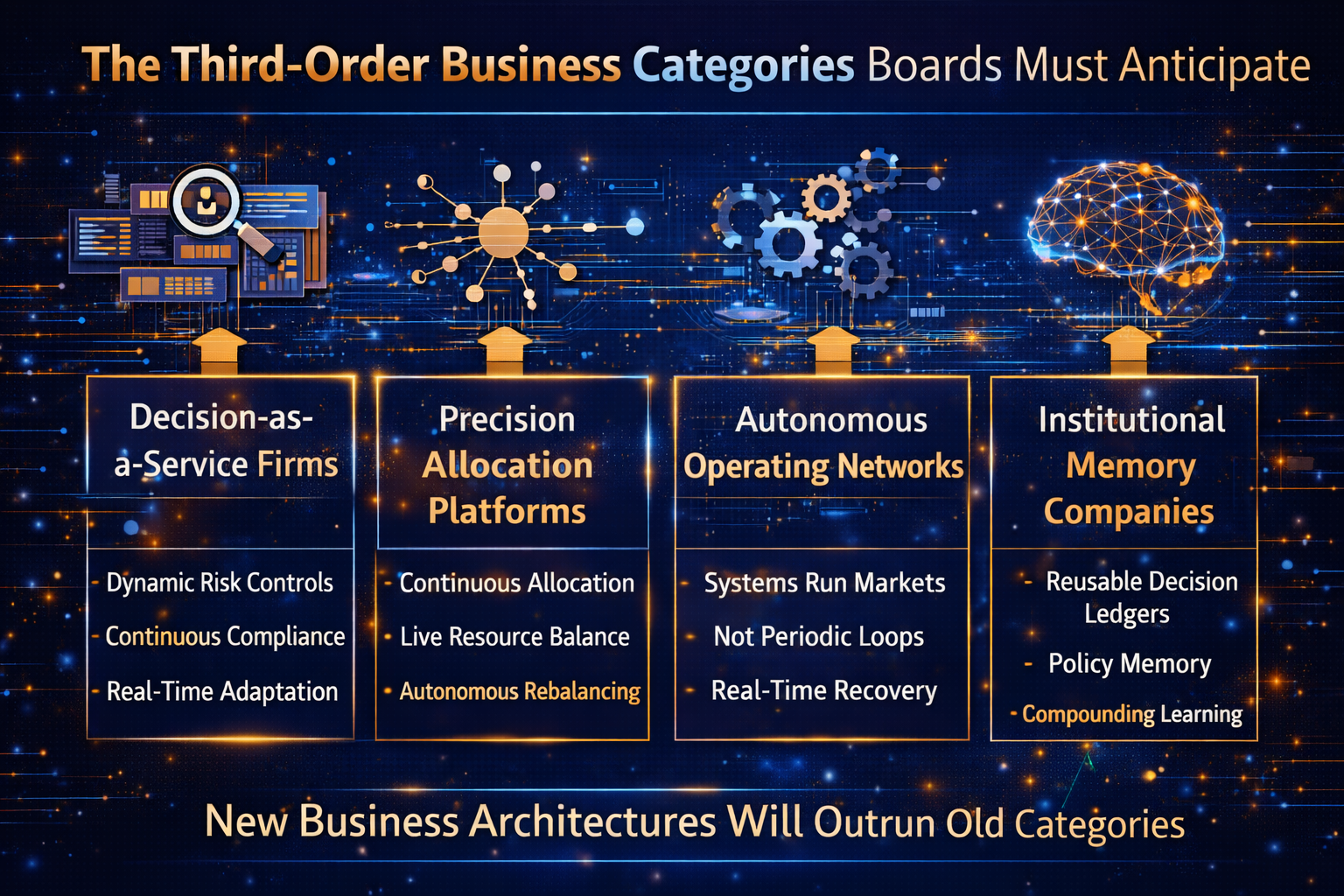
The Third-Order Business Categories Boards Must Anticipate
These categories are best understood as board-level patterns, not tool lists.
1) Decision-as-a-Service Firms
The next generation of “services” will not be people-heavy advisory. It will be decision engines delivering outcomes continuously:
- dynamic risk controls
- real-time underwriting and policy adaptation
- continuous compliance interpretation and enforcement
- always-on fraud intervention
- live supply-demand rebalancing
These firms will sell outcomes and decision quality, not software licenses.
They win because they run decision loops continuously, while incumbents run them periodically.
This connects directly to my concept of Decision Services as an emerging growth category:
- https://www.raktimsingh.com/decision-scale-competitive-advantage-ai/
- https://www.raktimsingh.com/the-future-belongs-to-decision-intelligent-institutions/
2) Precision Allocation Platforms
Most enterprises leak value because allocation is coarse:
- pricing is slow
- inventory is mismatched
- resources are assigned by habit
- capital is deployed by quarterly cycles
Third-order AI firms will build platforms that continuously allocate:
- capital
- risk
- inventory
- talent capacity
- energy and compute budgets
- service levels
Their competitive edge is not “better analytics.”
It is autonomous rebalancing under uncertainty.
3) Autonomous Operating Networks
Some markets will evolve from “humans operating systems” to “systems operating markets”:
- autonomous procurement negotiation
- autonomous logistics routing and capacity auctions
- autonomous service recovery in complex environments
- autonomous dispute resolution and verification layers
Humans do not disappear. They move up the stack—defining policy, reviewing exceptions, and governing boundaries.
4) Institutional Memory Companies
Most organizations are amnesiac at scale:
- they repeat failures
- they lose knowledge during transitions
- they cannot consistently apply learning across teams
Third-order intelligence-native firms build:
- decision ledgers
- policy memory
- reusable playbooks
- systematic learning loops
Their real asset becomes compounding institutional intelligence—the institution improves because it remembers better.
If you want to understand the work on reuse and compounding advantage, go to:
5) Trust and Proof Infrastructure for AI
As AI acts more, trust becomes an economic requirement.
New businesses will emerge whose product is:
- proving what AI did
- proving why it did it
- proving it followed policy
- proving reversibility and recovery controls
This becomes especially valuable when:
- multiple organizations collaborate
- regulated environments require evidence
- AI outcomes have real-world consequences
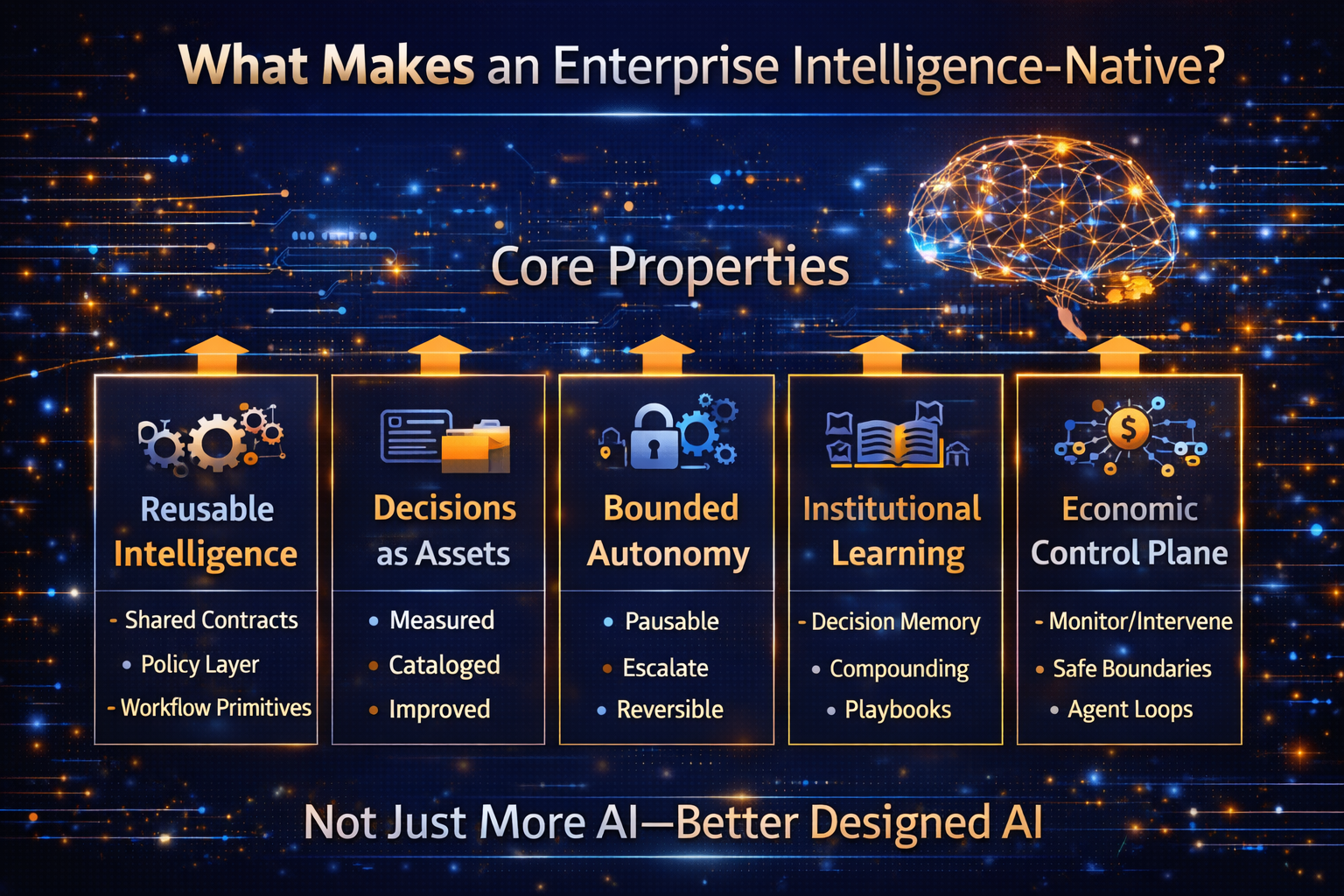
What Makes an Enterprise Intelligence-Native?
An intelligence-native enterprise is not defined by using more AI.
It is defined by how it is designed.
1) Decisions are treated as assets
They are cataloged, measured, versioned, improved, and governed.
2) Intelligence is reusable
Instead of building isolated AI projects, the enterprise builds a reusable capability stack:
- shared data contracts
- a common policy layer
- shared workflow primitives
- consistent monitoring and evaluation
- repeatable deployment patterns
3) Autonomy is bounded and reversible
The system is designed to pause, rollback, escalate, degrade safely, and leave evidence trails.
4) Learning loops are institutional
The organization improves because the system learns—not because heroes work harder.
5) Economics are controlled
AI introduces invisible cost dynamics:
- tool calls
- inference usage
- agent loops
- monitoring overhead
- exception spirals
Intelligence-native enterprises build an economic control plane so autonomy does not become a cost explosion.
The Blueprint: Turning AI into IA at Board Level
Step 1: Identify the Decision Spine of the Enterprise
Every enterprise has a small number of decision flows that drive most value:
- pricing
- credit/risk
- demand planning
- customer resolution
- fraud and security interventions
- supply chain routing
- compliance interpretation
- capital allocation
Make the decision spine explicit.
If leadership cannot name it, AI will be applied randomly—and will not compound.
Step 2: Move from Pilots to Productized Decision Capabilities
Boards should ask a simple question:
Are we building AI projects, or are we building reusable decision capabilities?
Projects die. Capabilities compound.
Step 3: Build the Boundary System for Autonomy
Autonomy without boundaries creates institutional risk.
A boundary system includes:
- policies
- permissions
- escalation rules
- reversibility controls
- monitoring and audit evidence
- action thresholds defining when AI may act vs recommend
This is where governance becomes the engine of scale—not a brake.
Step 4: Create an Intelligence Capital View of Investment
AI spending should not be framed only as:
- software cost
- headcount reduction
- productivity improvements
It should be framed as building intelligence capital—assets that compound:
- decision reuse
- institutional learning
- reduced latency
- reduced error rates
- precision growth opportunities
Boards understand capital allocation.
So speak in capital terms.
For board-facing work on the AI dividend:
Step 5: Prepare for Third-Order Competitors
Third-order competitors will not attack with “better AI.”
They will attack with:
- new cost structures
- new speed
- and new categories
Boards should create a standing agenda item:
Which parts of our industry could be redefined by intelligence-native entrants—and what would their business model look like?
That single question keeps leadership ahead of value migration.
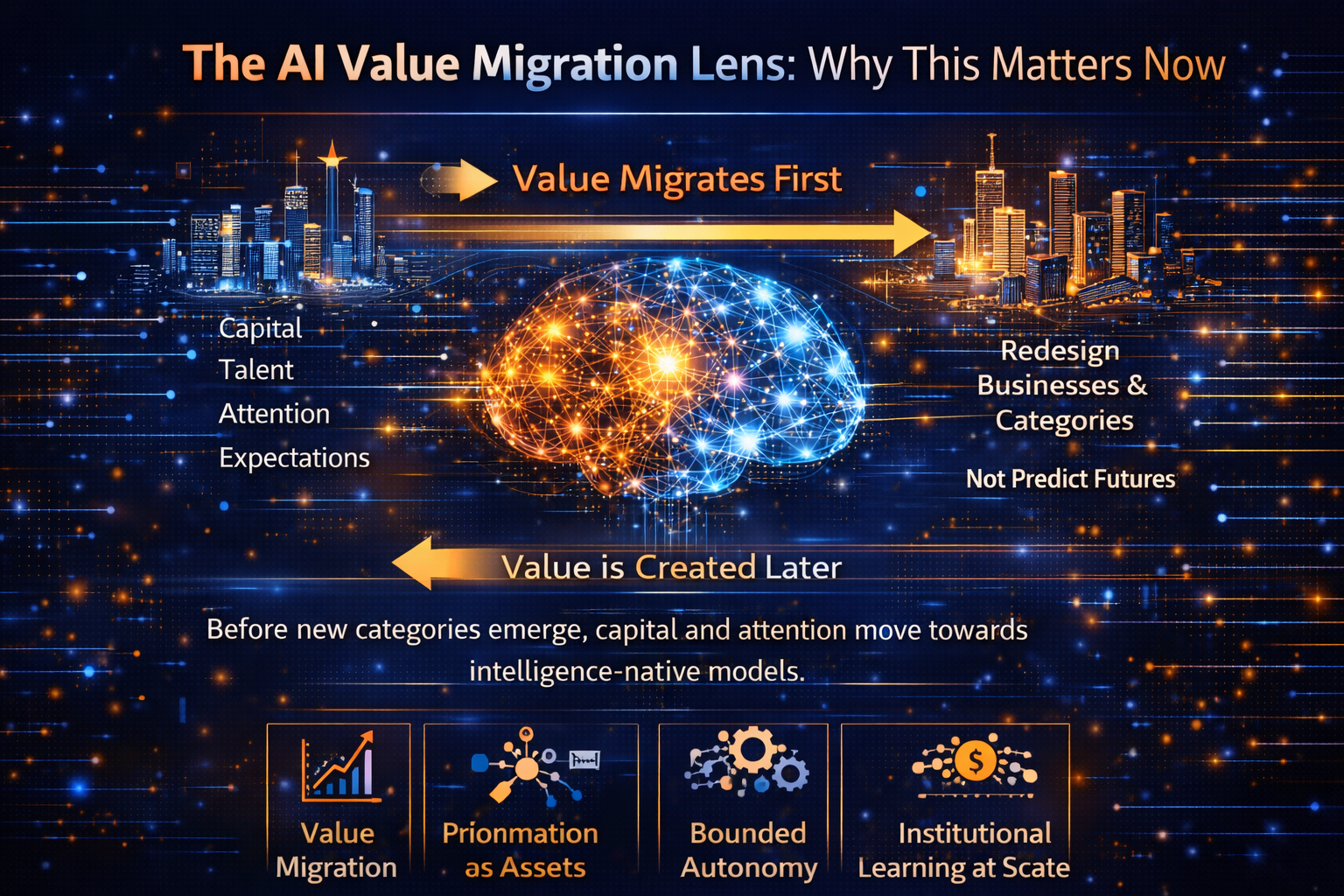
The AI Value Migration Lens: Why This Matters Now
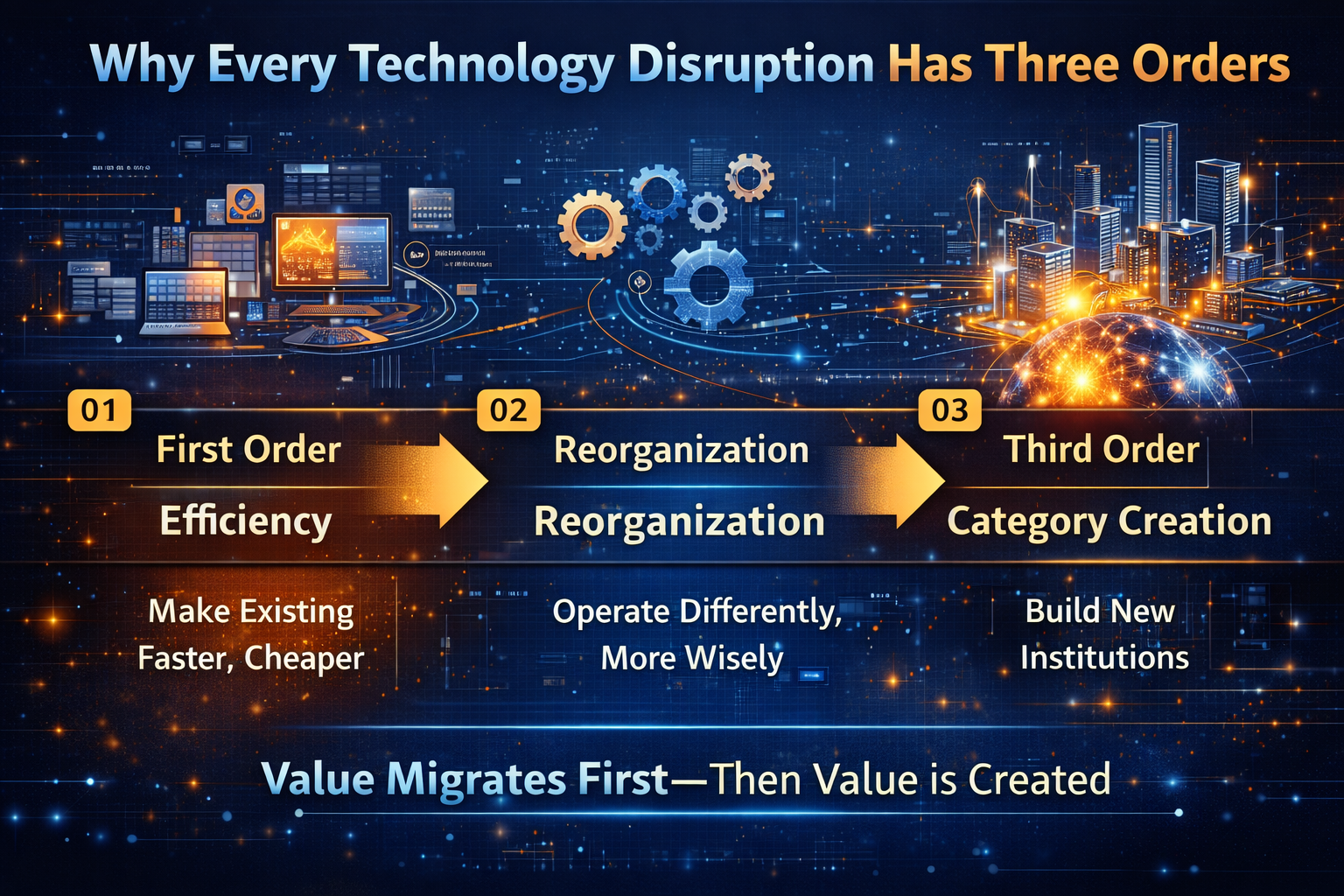
In every disruption, value migrates before it is created.
Capital moves. Talent moves. Attention moves. Expectations shift.
Then new category winners emerge.
The board-level job is not predicting the future perfectly.
It is ensuring the institution is designed to capture creation after migration.
If you wait for third-order categories to become obvious, you will be buying the future at a premium.
For a broader board-level perspective on this shift in advantage, read:
- https://www.raktimsingh.com/decision-scale-competitive-advantage-ai/
- https://www.raktimsingh.com/precision-growth-end-of-averages-enterprise-ai/
The Key Insight
First-order AI makes you faster.
Second-order AI makes you smarter.
Third-order AI creates a new kind of enterprise—and a new kind of competitor.
And remember this:
AI should become your IA: Institutional Advantage.
Conclusion: The Board Doctrine for the Intelligence Decade
Boards do not win the AI era by “adopting AI.”
They win by redesigning the institution so intelligence becomes a compounding capability.
The first wave will reward efficiency.
The second wave will reward reorganization.
The third wave will reward those who build intelligence-native enterprises—organizations that treat decisions as assets, autonomy as bounded, and learning as institutional.
The decision every board must make is not whether AI matters.
It is whether the institution will be designed to compound intelligence—or whether it will remain a traditional enterprise trying to bolt intelligence onto yesterday’s operating model.
In the AI decade, the winners will not be the loudest adopters.
They will be the quiet institutions that redesigned early—then scaled advantage faster than anyone could copy.
Glossary
AI (Artificial Intelligence): Systems that generate, predict, classify, or reason from data and context.
IA (Institutional Advantage): AI redesigned as an enterprise capability that compounds advantage, not a tool.
First-order AI: Efficiency gains inside existing workflows.
Second-order AI: Enterprise reorganization where AI is embedded into decision workflows.
Third-order AI: New business categories and intelligence-native institutions built around autonomous decisioning and learning.
Decision spine: The handful of decision flows that drive most enterprise value.
Intelligence capital: Reusable institutional assets that compound decision quality and execution speed.
Bounded autonomy: Autonomy with explicit boundaries, escalation, reversibility, and evidence.
FAQ
1) Is third-order AI only for technology companies?
No. Third-order AI will reshape every sector because it changes the economics of decision-making and allocation. Winners will be those who redesign early, not those who “look like tech.”
2) What is the fastest first step for leadership teams?
Map the decision spine. If you cannot name the decisions that drive value, AI programs will remain scattered and non-compounding.
3) Why is governance central rather than optional?
Because acting AI changes the definition of “working.” A system can be fast and available yet still cause harm if it acts incorrectly. Governance provides bounded autonomy—the foundation for scale.
4) How do we avoid fear-based messaging while still being credible?
Speak in opportunity terms: decision velocity, precision allocation, reusable intelligence, intelligence capital. Acknowledge risk as an engineering discipline, not as a reason to avoid action.
5) What should boards measure?
Not the number of pilots. Boards should track:
- decision latency reduction
- decision quality consistency
- reuse rate of intelligence components
- evidence and audit readiness
- economic efficiency of autonomy
What is third-order AI?
Third-order AI is the stage where AI becomes core business architecture, enabling intelligence-native enterprises built around continuous decisioning and institutional learning.
What is an intelligence-native enterprise?
An intelligence-native enterprise is designed around reusable decision systems, bounded autonomy, institutional memory, and an economic control plane for AI.
Why does AI value migrate before it is created?
In every disruption, capital, talent, and expectations move before new business models mature. Early institutional redesign captures the upside.
How should boards prepare for AI-native competitors?
Boards must redesign governance, treat decisions as assets, invest in intelligence capital, and prepare for new categories built on autonomous orchestration.
References and Further Reading
To deepen the operating-model and board-level context, you can also read:
- The Enterprise AI Operating Model (Pillar): https://www.raktimsingh.com/enterprise-ai-operating-model/
- The Intelligence Reuse Index: https://www.raktimsingh.com/intelligence-reuse-index-enterprise-ai-fabric/
- What Is the AI Dividend?: https://www.raktimsingh.com/enterprise-ai-roi/
- Decision Scale: https://www.raktimsingh.com/decision-scale-competitive-advantage-ai/
- The End of Averages (Precision Growth): https://www.raktimsingh.com/precision-growth-end-of-averages-enterprise-ai/
-
1️⃣ Value Migration Theory (Strategic Foundation)
Geoffrey Moore – Zone to Win / Category Creation
https://geoffreyamoore.com -
2️⃣ Institutional Economics & Competitive Advantage
Michael Porter – Competitive Strategy
https://www.hbs.edu/faculty/Pages/profile.aspx?facId=6532 -
3️⃣ AI Governance & Risk
OECD AI Principles
https://oecd.ai/en/ai-principles -
4️⃣ Enterprise AI Benchmark (Global Signal)
McKinsey Global AI Survey
https://www.mckinsey.com/capabilities/quantumblack/our-insights



Raktim Singh is an AI and deep-tech strategist, TEDx speaker, and author focused on helping enterprises navigate the next era of intelligent systems. With experience spanning AI, fintech, quantum computing, and digital transformation, he simplifies complex technology for leaders and builds frameworks that drive responsible, scalable adoption.