

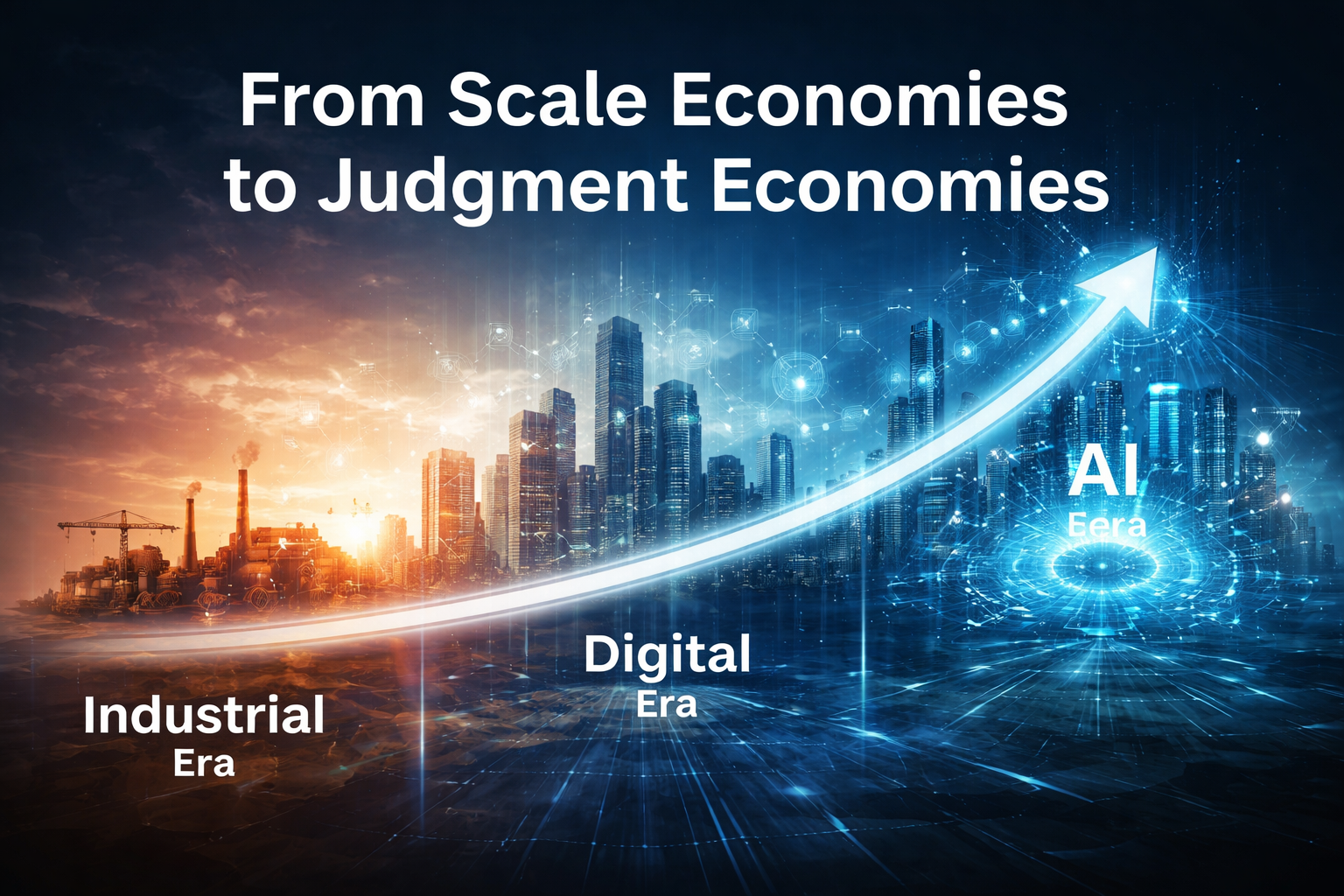
Industry Structure in the AI Era
For more than a century, industry structure has been shaped by scale.
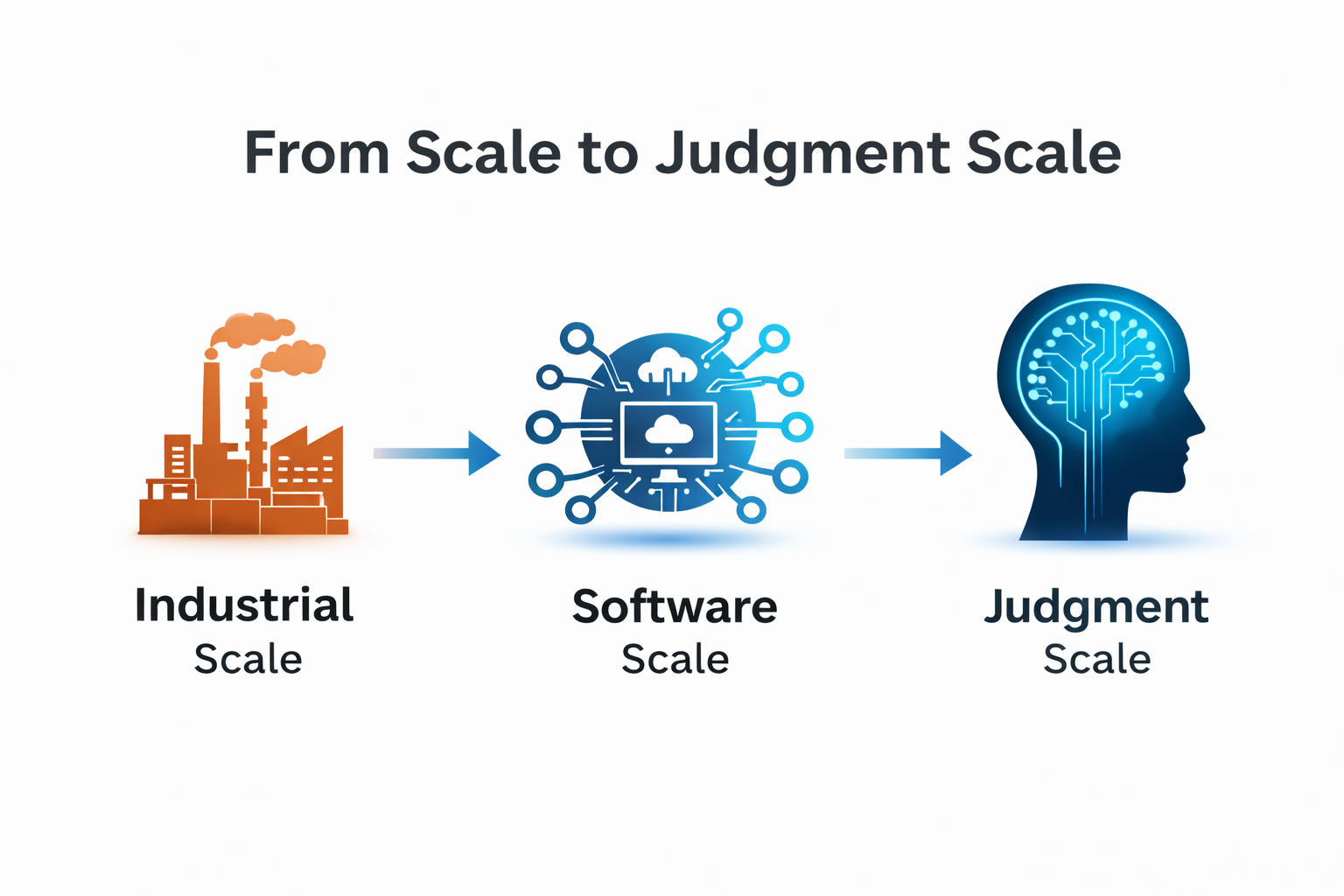
In the industrial era, firms competed through capital intensity and production efficiency. In the digital era, advantage shifted toward software leverage and network effects. Today, artificial intelligence is initiating a third structural shift.
AI changes what scales inside the firm.
Labor scaled in the industrial economy.
Software scaled in the digital economy.
In the AI economy, judgment scales.
This shift—from output scale to decision scale—alters entry barriers, margin dynamics, competitive moats, and even the boundaries of industries. Boards that understand this structural transition will redesign their enterprises accordingly. Those that treat AI as a productivity layer may improve efficiency but miss the deeper reordering underway.
A judgment economy is an industry structure where competitive advantage accrues to firms that scale, systematize, and continuously improve high-impact decisions using artificial intelligence.
From the Theory of the Firm to the Theory of Learning
Ronald Coase explained firms as institutions that reduce transaction costs. Industrial scale lowered production and coordination costs. Digital infrastructure reduced information and distribution costs.
AI reduces something different: the cost of high-quality decision-making.
When judgment becomes codified, embedded, and continuously improved through feedback, it becomes an institutional capability rather than a managerial act. Pricing, underwriting, risk allocation, inventory balancing, personalization, and compliance can be executed repeatedly, measured rigorously, and refined systematically.
Over time, firms that build such learning systems diverge structurally from those that rely on human intuition or static rules.
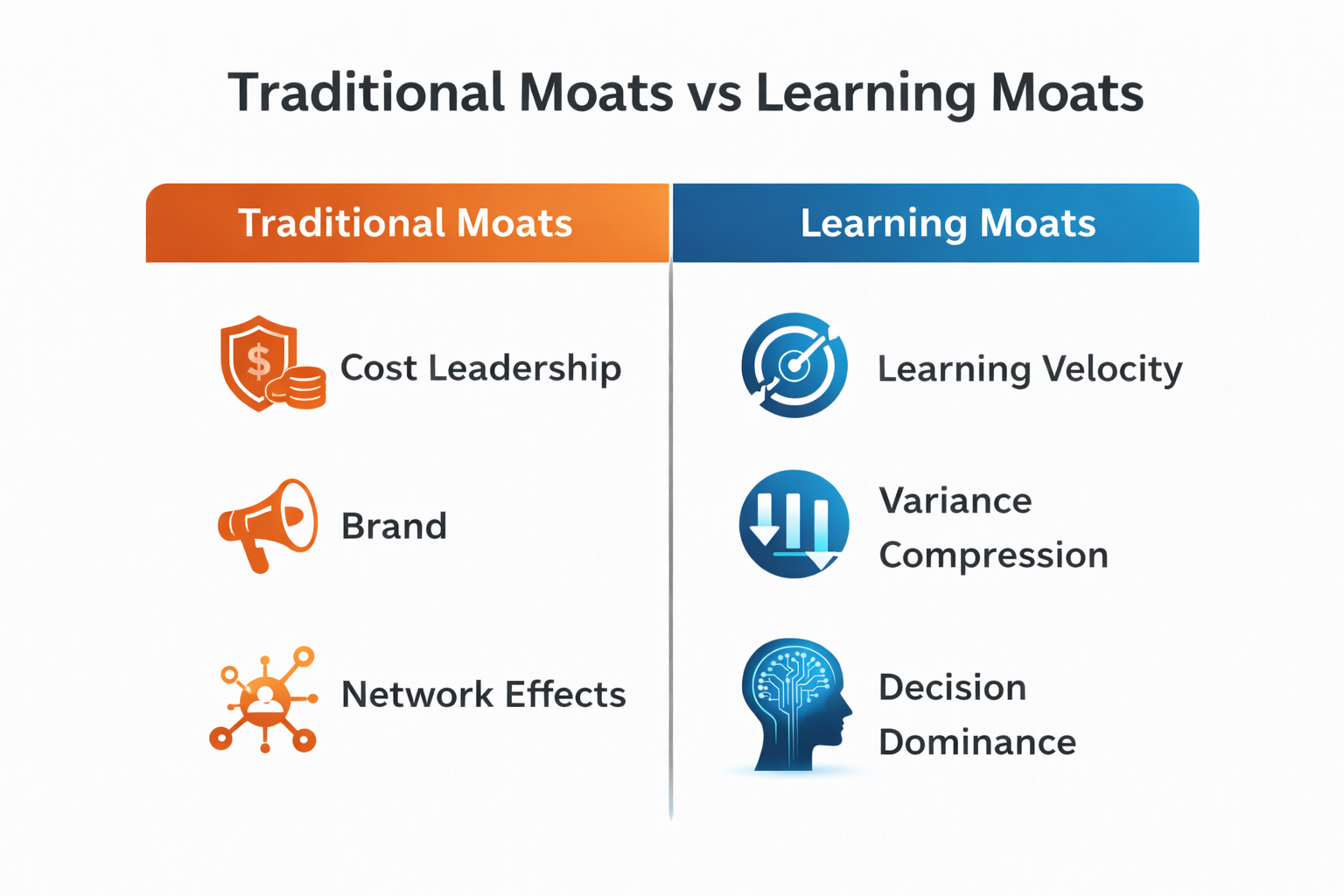
The new basis of competitive advantage is not asset intensity.
It is learning velocity.
From Scale Economies to Judgment Economies
Traditional scale economies reduced unit costs. Network economies amplified reach.
Judgment economies operate differently.
In a judgment economy, advantage accrues to firms that:
- Execute more decisions at scale
- Capture higher-quality feedback
- Update models continuously
- Govern outcomes in ways that preserve trust
The economic mechanism underlying this shift is variance compression.
Many industries suffer from persistent decision noise—pricing errors, misallocated capital, fraud leakage, supply mismatches. These variances erode margin and distort growth.
Embedding AI directly into core decision flows reduces noise. Lower variance stabilizes performance. Stable performance improves capital allocation. Improved allocation compounds advantage.
Efficiency gains are incremental.
Compounded variance reduction is structural.
Related reading:
- The AI Dividend: https://www.raktimsingh.com/enterprise-ai-roi/
- Precision Growth: https://www.raktimsingh.com/precision-growth-end-of-averages-enterprise-ai/
Learning Moats Replace Traditional Moats
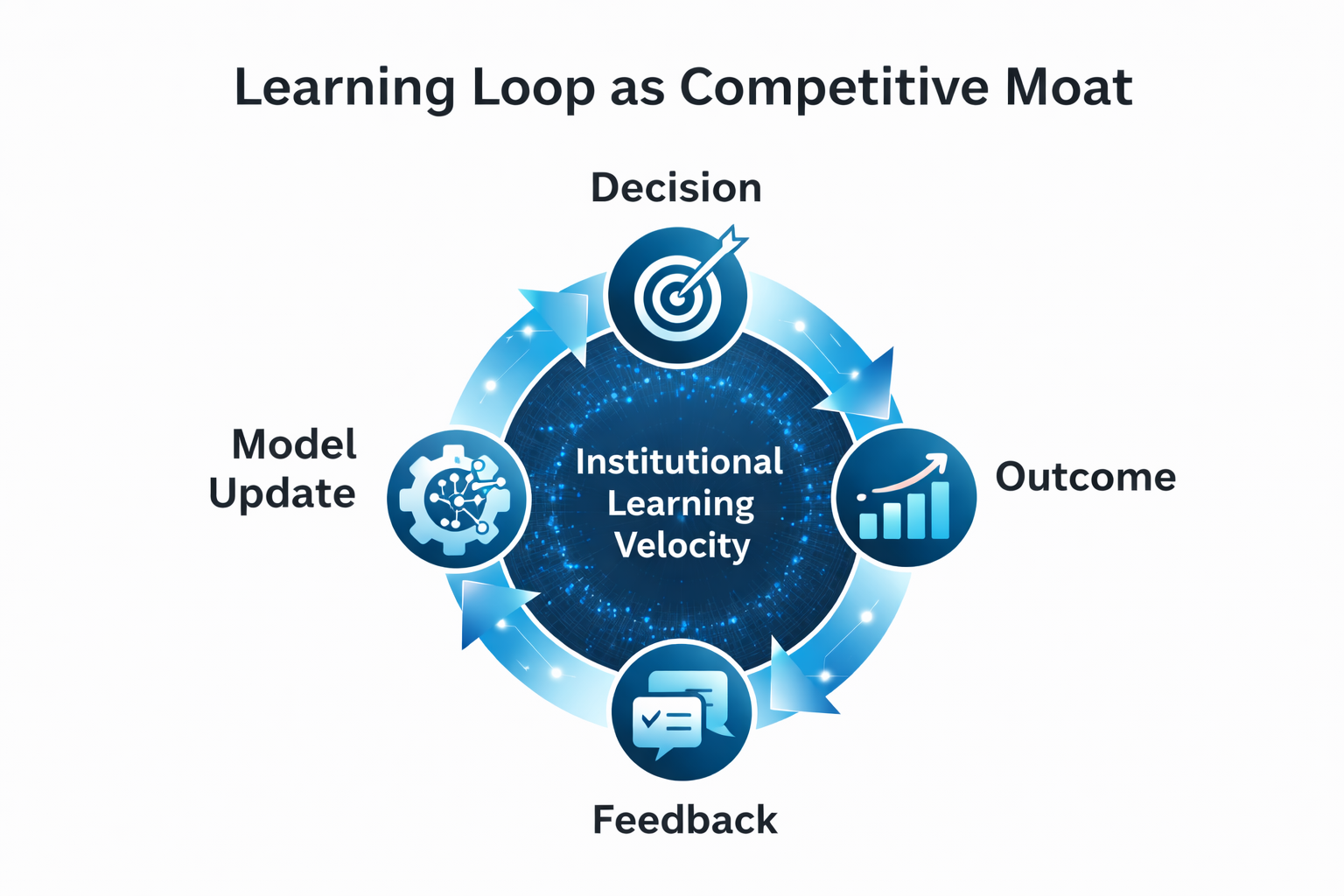
Michael Porter described cost leadership and differentiation as central competitive strategies. In AI-driven markets, a complementary moat emerges: the learning loop.
Every decision produces data.
Every outcome becomes feedback.
Every feedback cycle improves the next decision.
Firms that accelerate this loop build institutional learning velocity.
The strategic question shifts from “Who is bigger?” to “Who improves faster?”
Markets begin to reorganize around firms that dominate economically significant decision domains—even if they begin with fewer physical assets.
Related reading:
- The Intelligence Reuse Index: https://www.raktimsingh.com/intelligence-reuse-index-enterprise-ai-fabric/
- Laws of Enterprise AI: https://www.raktimsingh.com/laws-of-enterprise-ai/
Industry Boundaries Become Decision Boundaries
As judgment becomes programmable, industry categories blur.
A logistics firm becomes a pricing and allocation engine.
A bank becomes a risk optimization system.
A retailer becomes a demand-sensing network.
The organizing principle shifts from product to decision domain.
Competition revolves around who controls high-value decision flows across the value chain.
Industry structure becomes fluid when intelligence becomes portable.
Value Migration Before Category Creation
Technological transitions typically unfold in three phases:
- Capital migration toward aligned firms
- Operational redesign within incumbents
- Emergence of new categories
The internet followed this pattern. Infrastructure was rewarded early; platform businesses redefined markets later.
AI appears to be following a similar trajectory.
Automation gains represent the first wave.
Enterprise redesign represents the second.
Category creation—where new firms are built around scalable judgment—will represent the third.
Related reading:
- AI Value Migration Curve: https://www.raktimsingh.com/ai-value-migration-curve-capital-moves-before-value/
- Decision-Intelligent Institutions: https://www.raktimsingh.com/the-future-belongs-to-decision-intelligent-institutions/
Strategic Questions for Boards
AI is not simply a technology investment. It is a structural lever.
Boards should ask:
- Which decisions most directly determine our margin and risk?
- Are those decisions embedded in learning systems—or in repeating processes?
- How does our learning velocity compare with competitors?
- If a new entrant were built around scalable judgment from inception, how would it compete differently?
The challenge is not adoption. It is redesign.
Conclusion: The Competitive Dimension of Scale Has Changed
Scale once meant producing more units.
Then it meant distributing more software.
Now it means executing and improving more decisions.
In judgment economies:
- Advantage compounds through learning
- Risk declines through feedback
- Margins widen through variance compression
- Industry structure reorganizes around decision dominance
The AI era is not primarily about smarter tools.
It is about reorganizing how industries compete.
That reorganization has already begun.
Frequently Asked Questions
What is a judgment economy?
A market structure in which competitive advantage is driven by scalable, continuously improving decision systems rather than production or distribution scale alone.
How does AI change industry structure?
AI shifts competition from asset scale to decision scale, altering entry barriers, margin dynamics, and competitive moats.
What is learning velocity?
The rate at which an organization improves decision quality through feedback loops embedded in operational systems.
What is variance compression?
Systematically reducing decision noise—such as pricing errors or risk miscalculations—to stabilize margins and capital allocation.
How should boards measure AI advantage?
Not by number of pilots, but by improvement in decision accuracy, learning speed, variance reduction, and capital efficiency.
Glossary
Judgment Economy — A competitive environment where scalable decision systems define market leadership.
Decision Scale — The ability to execute and improve high-impact decisions repeatedly through AI-driven systems.
Learning Velocity — The speed at which institutional decision quality improves through feedback loops.
Variance Compression — Reduction of inconsistency and error in economic decisions, improving stability and margin.
Decision Domain — A cluster of economically critical decisions that define competitive advantage within an industry.
Further Reading
Ronald Coase – The Nature of the Firm
https://www.jstor.org/stable/2626876
Michael Porter – Competitive Strategy
https://hbr.org/1979/03/how-competitive-forces-shape-strategy
Experience Curve (BCG)
https://www.bcg.com/publications/1968/business-unit-strategy-growth-share-matrix
McKinsey AI Global Survey
https://www.mckinsey.com/capabilities/quantumblack/our-insights/the-state-of-ai



Raktim Singh is an AI and deep-tech strategist, TEDx speaker, and author focused on helping enterprises navigate the next era of intelligent systems. With experience spanning AI, fintech, quantum computing, and digital transformation, he simplifies complex technology for leaders and builds frameworks that drive responsible, scalable adoption.