

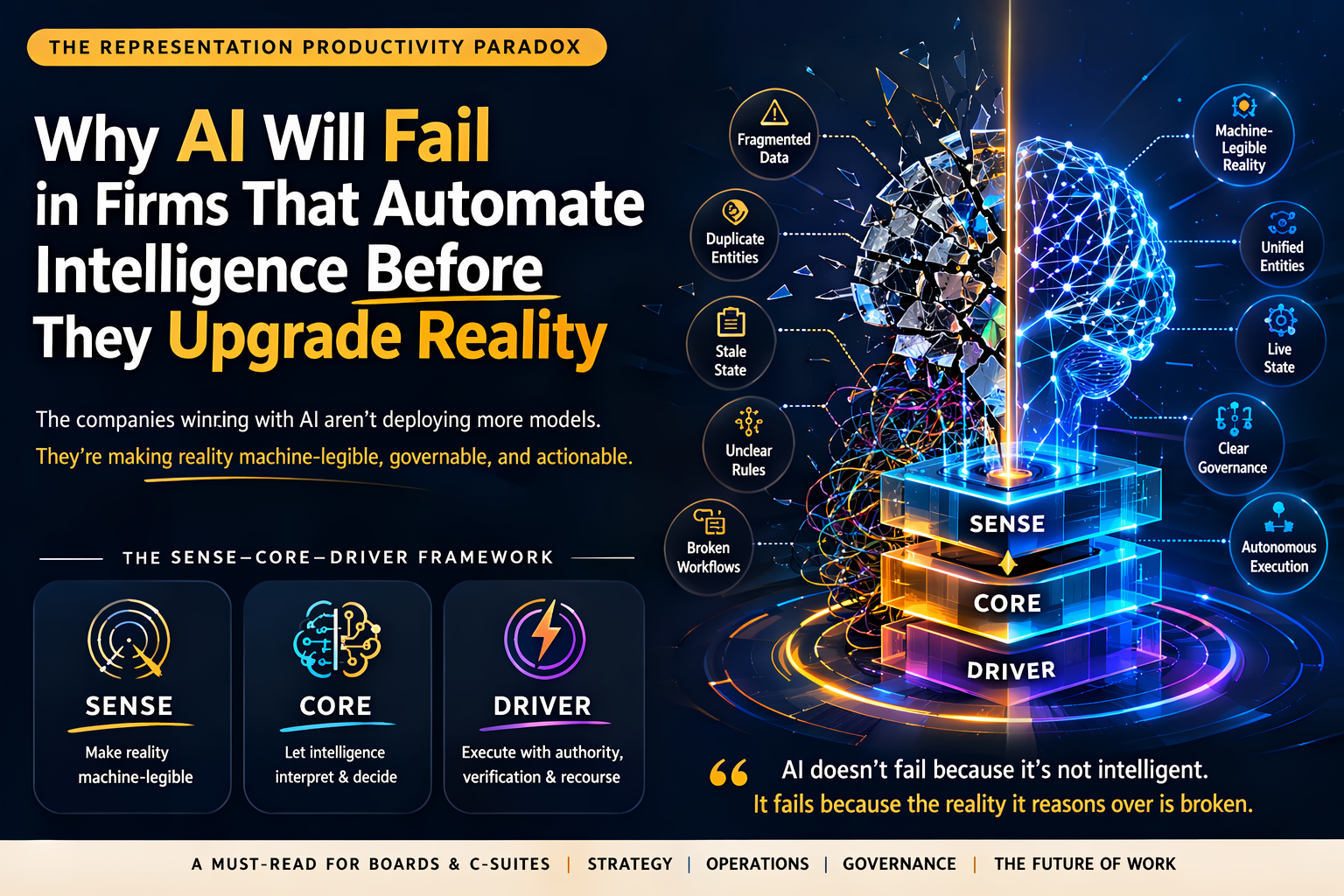
The Representation Productivity Paradox:
AI’s next bottleneck is not intelligence. It is representation.
Artificial intelligence is now everywhere in business. Boards discuss it. CEOs announce it. technology vendors embed it into every category. teams use it to search, summarize, draft, classify, predict, approve, recommend, and increasingly, act.
Yet a strange pattern is becoming harder to ignore.
Many firms can show AI activity. Far fewer can show durable, enterprise-wide productivity gains.
This is not because AI does not work. It does work. But many organizations are making the same strategic mistake: they are trying to automate intelligence before they upgrade the reality that intelligence depends on.
That is the Representation Productivity Paradox.
The paradox is simple. A model can be brilliant. A copilot can be fast. An agent can even appear autonomous. But if the organization’s reality is weakly represented — if customer identities are duplicated, asset states are outdated, workflows are fragmented, approvals are ambiguous, and data arrives late — then AI does not scale productivity. It scales confusion.
It produces faster answers on top of a distorted picture of the world.
And once that happens, the promised gains are quietly consumed by verification, correction, exception handling, escalation, and loss of trust.
That is why so many firms feel they are “doing AI” while still struggling to convert it into reliable business value.
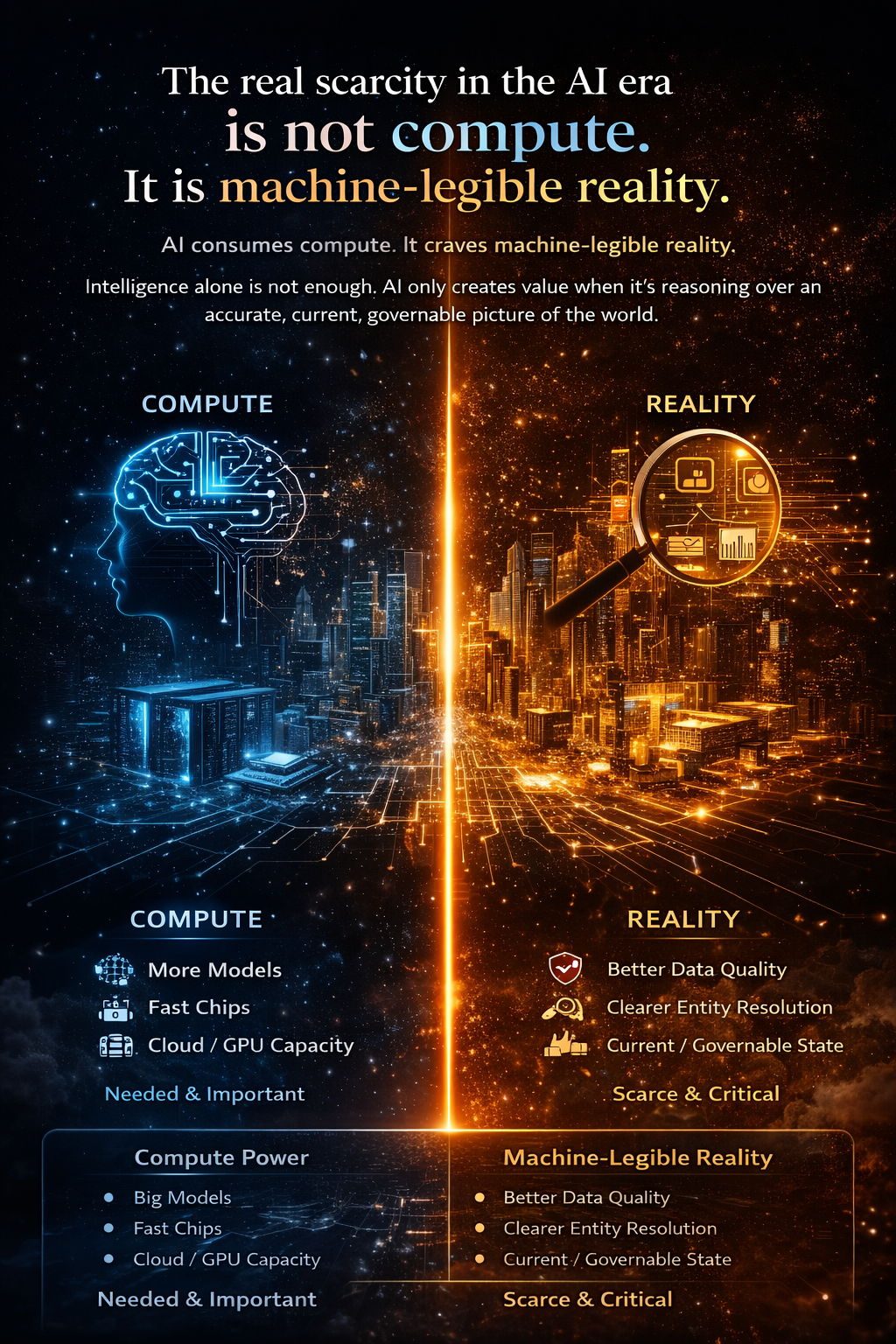
The real scarcity in the AI era is not compute. It is machine-legible reality.
For the last two years, most enterprise AI conversations have focused on models, assistants, and agents. That focus is understandable. Models are visible. They demo well. They create immediate excitement.
But the harder question is this:
What exactly is the AI system reasoning over?
In the AI era, durable value will not come only from better intelligence. It will come from better representation of reality.
That means four things:
-
Better signals
Not just more data, but more relevant, timely, trustworthy, decision-linked data.
-
Better entity resolution
The system must know which customer, machine, supplier, shipment, account, contract, policy, or patient it is actually dealing with.
-
Better state representation
The system needs a living view of current condition, not a stale record. Is the claim disputed? Is the machine healthy? Is the payment delayed? Is the approval still valid?
-
Better evolution
Reality changes. Representations must update as new signals arrive.
This is the logic behind my SENSE–CORE–DRIVER framework.
- SENSE is where reality becomes machine-legible.
- CORE is where intelligence interprets, reasons, and decides.
- DRIVER is where delegation, authority, verification, execution, and recourse turn decisions into legitimate action.
Most firms today are overinvesting in CORE, underinvesting in SENSE, and under-designing DRIVER.
That is why many AI initiatives look powerful in demos but underperform in production.
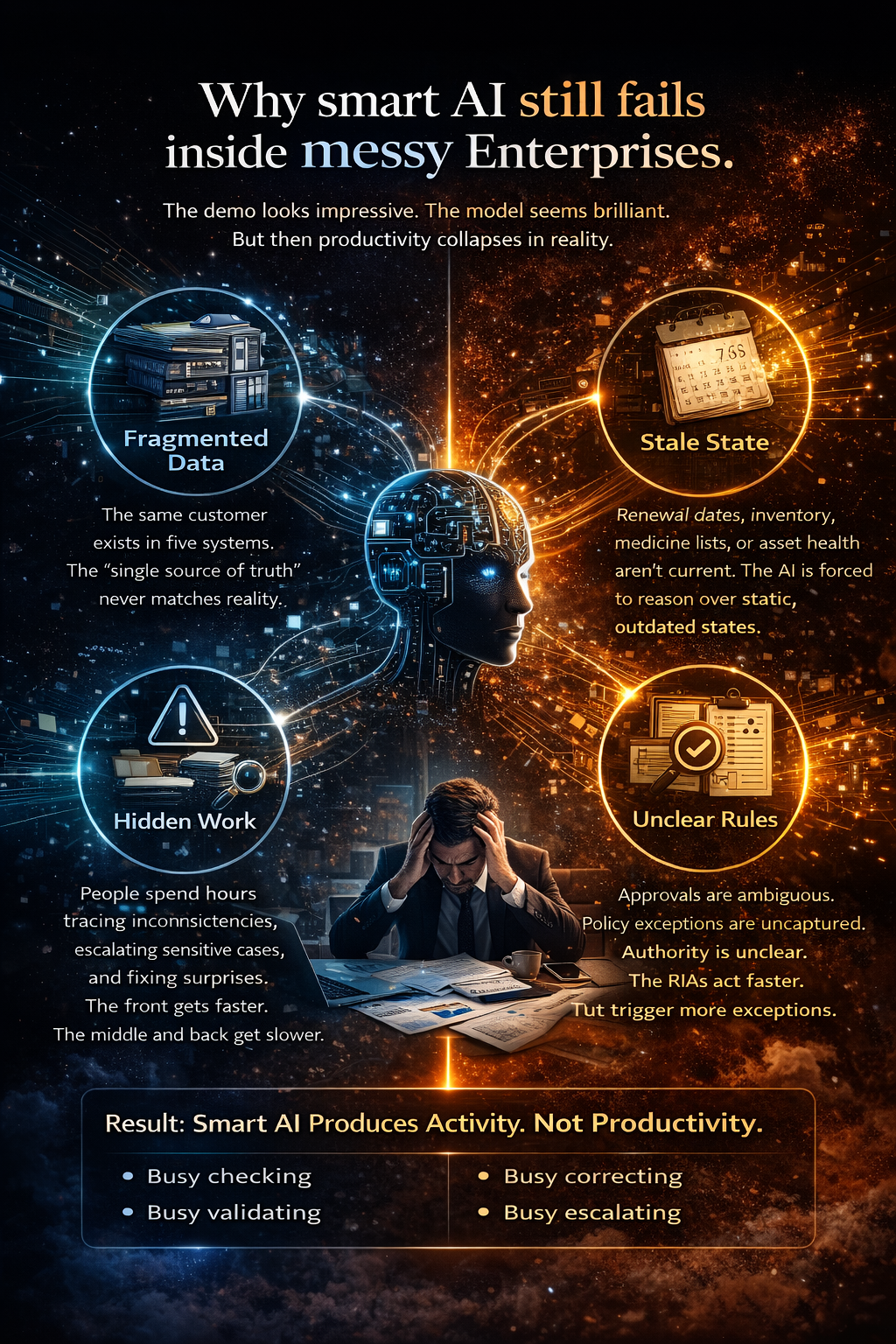
Why smart AI still fails inside messy enterprises
Consider a sales organization that deploys an AI copilot for account managers.
The system can draft emails, summarize meetings, predict churn, recommend next-best actions, and generate account plans. On the surface, this looks like productivity.
But now look beneath the interface.
The same customer exists under multiple names in different systems. Renewal dates are inconsistent. Product usage data arrives late. Support history is scattered. Commercial commitments live in email threads. Escalation risk is visible only to a few experienced managers.
The AI is not reasoning over a coherent customer. It is reasoning over fragments.
So what happens?
Salespeople verify recommendations manually. Managers correct priorities. Sensitive cases get escalated because trust is weak. The workflow becomes faster in the front end, but slower in the middle because people now spend time validating what the system said.
The model is not the main bottleneck.
Representation is.
The same pattern appears across industries.
In banking, an AI assistant may summarize loan documents beautifully. But if income records, collateral data, customer identity, consent boundaries, risk flags, and policy exceptions are not consistently represented, the bank does not achieve clean automation. It gets a more elegant front end on top of unresolved ambiguity.
In healthcare, an AI system may recommend discharge coordination or scheduling actions. But if patient identity is split, medications are unsynchronized, referral notes are incomplete, and room status is delayed, then polished recommendations can still be operationally unsafe.
In manufacturing, predictive maintenance sounds transformative — until sensor data is unreliable, asset IDs differ across plants, service logs are incomplete, and spare parts data is disconnected from machine history. The AI flags risk, but maintenance teams continue checking manually because the system does not reflect reality well enough to earn trust.
This is the central mistake of the current AI wave:
Companies think they have an intelligence problem when they actually have a representation problem.
Why productivity is being overstated
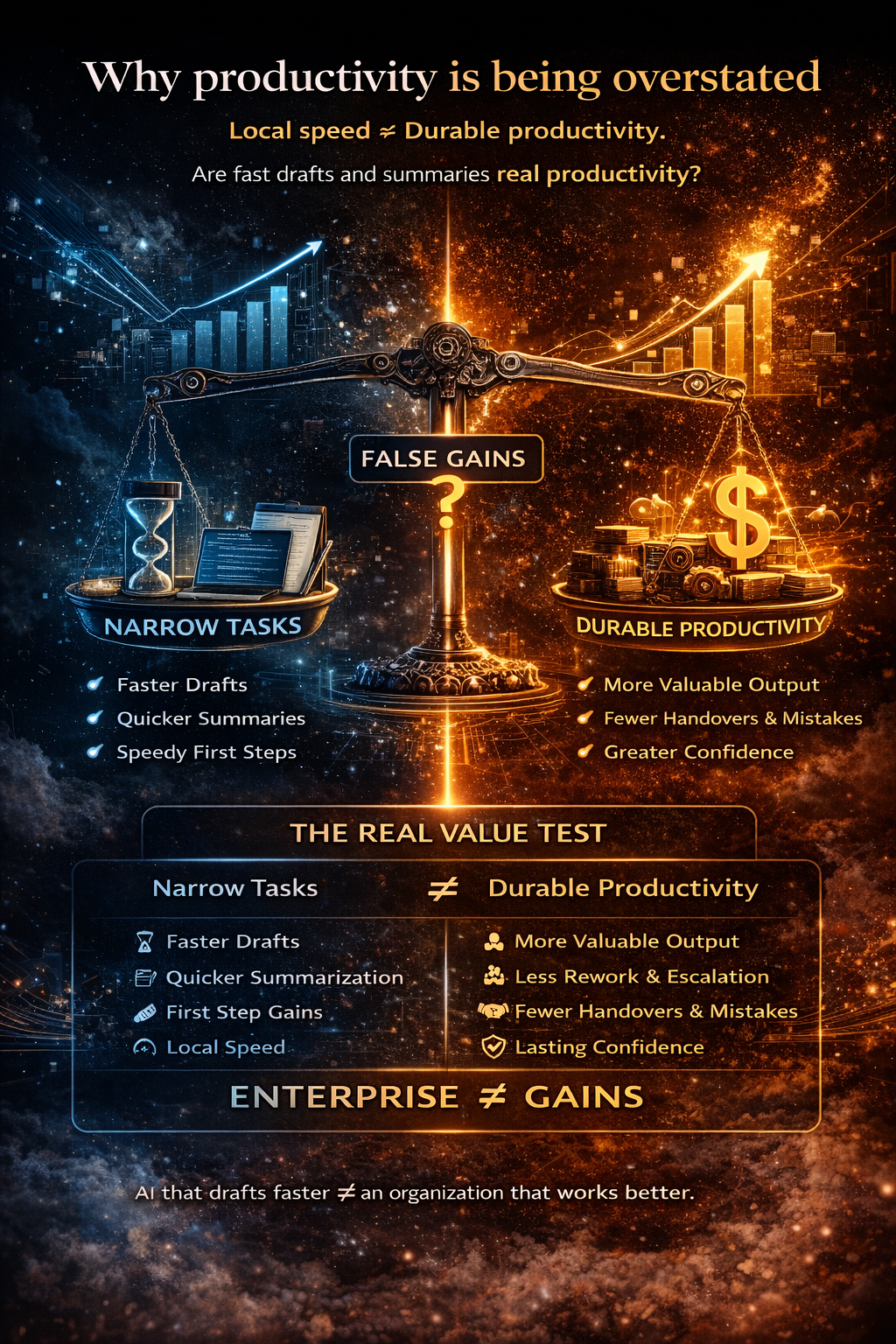
Much of what is currently described as “AI productivity” is too narrow.
Faster drafting is not the same as higher enterprise productivity.
Quicker summarization is not the same as durable value creation.
A faster first step is not the same as a better operating model.
True productivity means the organization can complete more valuable work with fewer errors, fewer handoffs, less rework, lower coordination cost, and greater confidence.
That requires more than model deployment. It requires workflow redesign, data redesign, control redesign, and authority redesign.
That broader pattern is increasingly visible in current research. The World Economic Forum argues that the question is no longer whether AI works, but how organizations must redesign work, decision-making, and operating models to realize its sustained value.
Gartner said in April 2026 that organizations with successful AI initiatives invest up to four times more in foundational areas such as data quality, governance, AI-ready people, and change management than firms with poor outcomes.
BCG reported that only 5% of companies in its 2025 global study were achieving AI value at scale, while about 60% reported minimal or no material value despite substantial investment. McKinsey has similarly emphasized that the biggest gains come from redesigning end-to-end workflows rather than automating isolated tasks. (World Economic Forum Reports)
These are not signs that AI lacks capability.
They are signs that enterprise productivity depends on more than intelligence alone.
Agentic AI will make this paradox impossible to hide
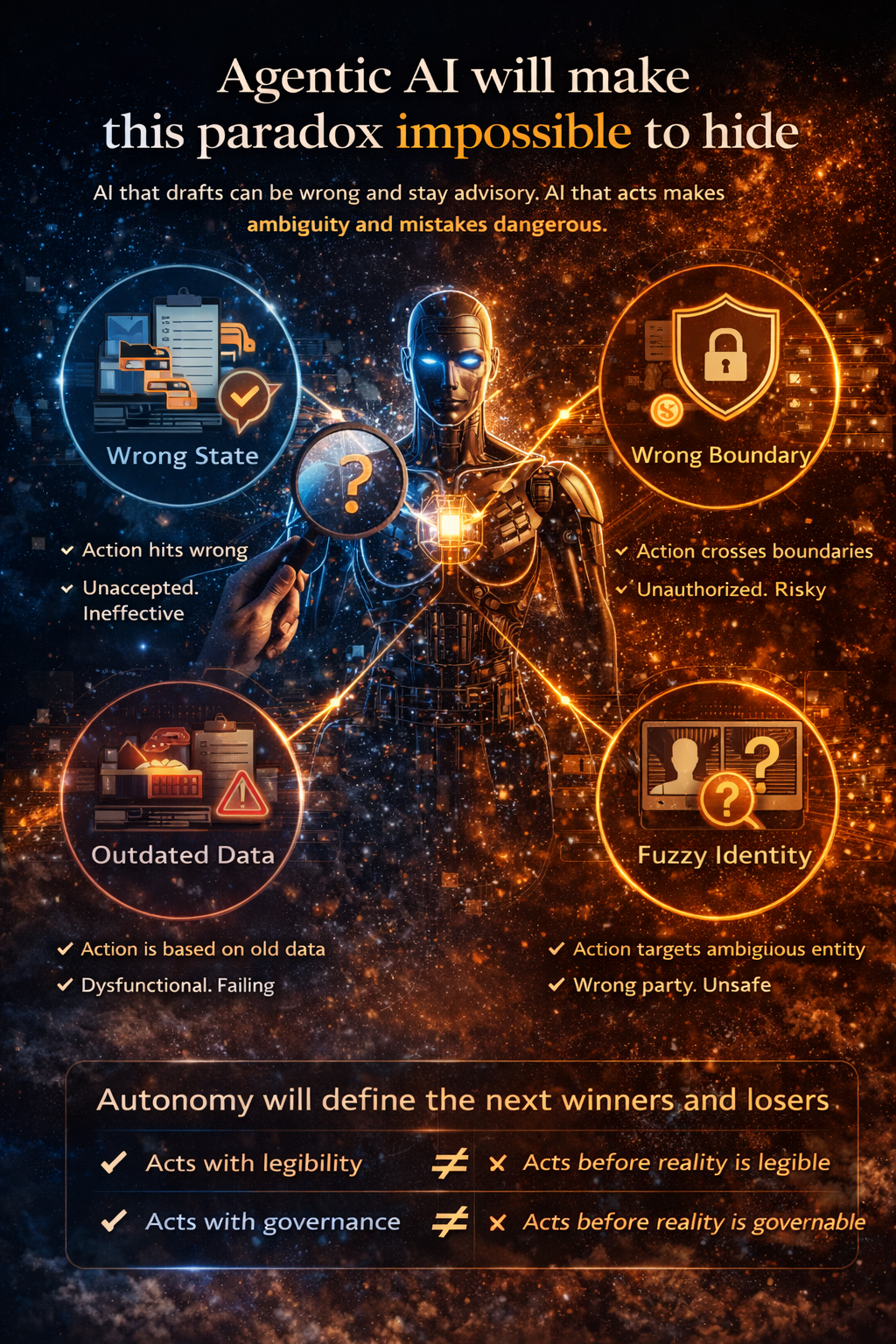
The rise of agentic AI makes the problem sharper.
A chatbot can be wrong and still remain mostly advisory. An agent is different. It acts. It triggers workflows. It invokes tools. It updates records. It sends messages. It executes decisions at speed.
That means every weakness in representation becomes more dangerous.
If the customer state is wrong, the action is wrong.
If the policy boundary is wrong, the action may be unauthorized.
If the inventory state is stale, the action may create downstream failure.
If the identity is ambiguous, the action may hit the wrong entity.
This is why agentic AI is not simply a bigger software wave. It is a governance wave.
Reuters reported in June 2025, citing Gartner, that more than 40% of agentic AI projects are expected to be scrapped by the end of 2027 because of rising costs and unclear business value. That warning matters not because agentic systems are unimportant, but because too many firms are trying to make agents act before they have made reality machine-trustworthy. (Reuters)
In other words, firms are scaling autonomy before they have scaled legibility.
That is a dangerous sequence.
What it actually means to “upgrade reality”
If a board or CEO takes this argument seriously, the next question is obvious:
What does upgrading reality actually involve?
It means strengthening SENSE before scaling CORE.
Upgrade 1: Improve signal quality
The issue is not data volume. It is signal usefulness. Organizations need timely, decision-relevant, governed signals tied to operational outcomes.
Upgrade 2: Fix entity resolution
Many enterprises still do not have a reliable answer to a basic question: who or what is this? AI cannot reason well when customers, suppliers, assets, contracts, products, or claims are inconsistently identified.
Upgrade 3: Build state clarity
A static record is not enough. AI needs current state, not historical residue. This means better event capture, better synchronization, and better representation of operational truth.
Upgrade 4: Design for evolution
Reality changes continuously. A machine-legible enterprise must update its representations as new signals arrive. Otherwise even a well-designed system becomes stale.
But that is only half the story.
Upgrading reality also means strengthening DRIVER.
Once AI starts recommending or acting, organizations need explicit answers to six questions:
- Who delegated authority?
- What representation of reality was used?
- Which entity was affected?
- How is the decision verified?
- How is the action executed?
- What recourse exists if the system is wrong?
This is where many AI programs remain immature. Governance is treated as a policy document rather than as operating architecture.
In practice, productivity collapses when teams must constantly intervene because the system’s authority boundaries are unclear.
Why many firms will experience a painful AI J-curve
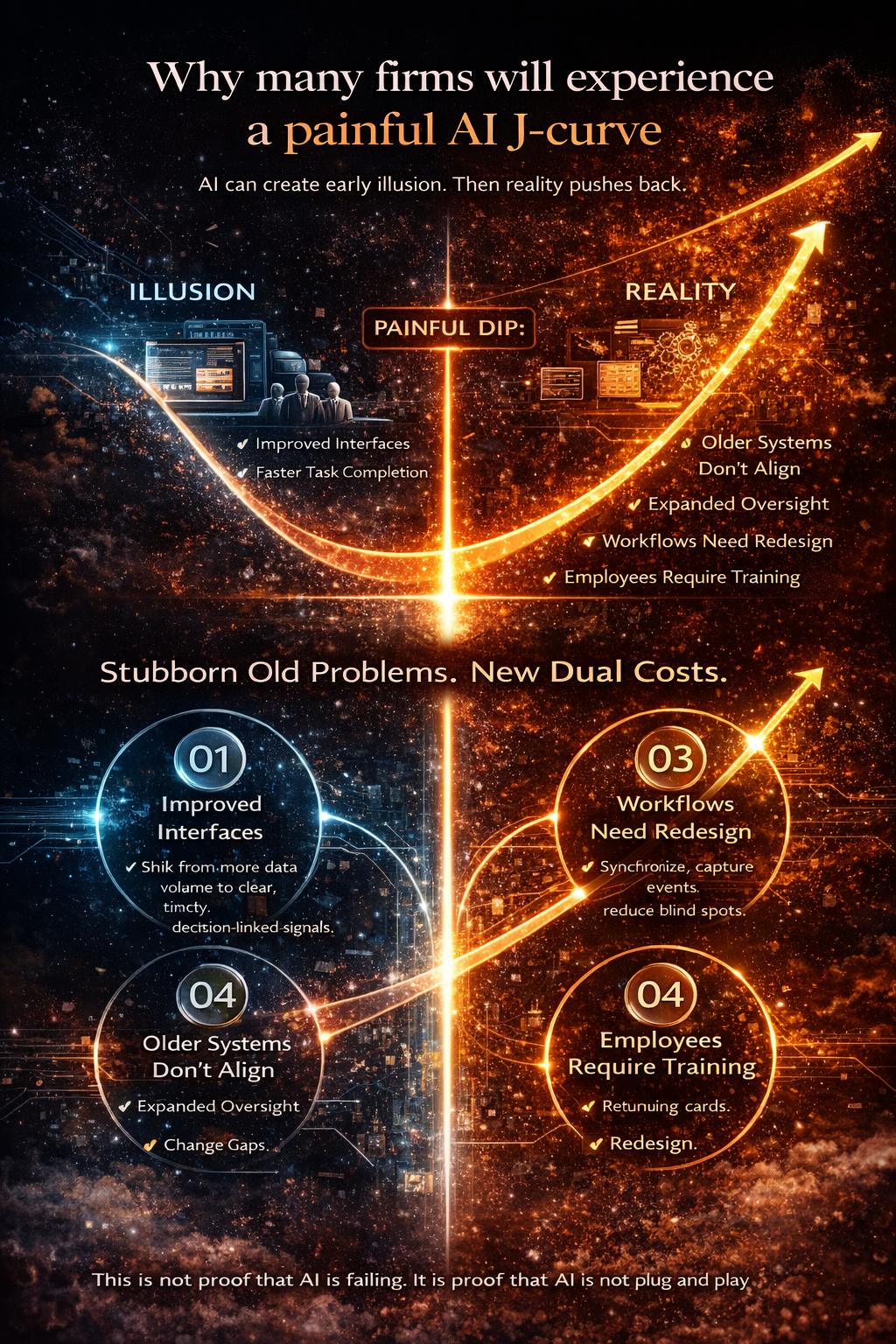
One reason this problem is so easy to misread is that AI often creates an early illusion of progress.
Interfaces improve quickly. Demonstrations are impressive. Teams report faster task completion. Executive enthusiasm rises.
Then reality pushes back.
Older systems do not align. Data cannot be trusted. Workflows need redesign. Employees require training. Oversight expands. Exceptions multiply. New coordination burdens appear.
MIT Sloan highlighted 2025 research showing that companies adopting industrial AI can suffer short-term productivity losses before longer-term gains, with more established firms often facing larger adjustment costs because AI adoption demands new infrastructure, training, and workflow redesign. (MIT Sloan)
That is not proof that AI is failing.
It is proof that AI is not plug-and-play.
The road to productivity runs through organizational redesign.
The strategic shift boards should make now
The winning question for the next three years is not:
How do we put AI into more places?
It is:
Where is our reality too weakly represented for intelligence to operate safely, repeatedly, and at scale?
That question changes everything.
It shifts attention from tools alone to operating foundations.
It shifts AI strategy from interface obsession to institutional design.
It shifts investment from isolated pilots to machine-legible workflows.
It shifts governance from compliance theater to execution architecture.
It also creates a new class of winners.
The next winners in AI will include:
- firms that make their own operations machine-legible faster than competitors
- firms that reduce ambiguity across customers, assets, obligations, and transactions
- firms that design clear authority and recourse around AI action
- firms that help entire ecosystems become more representable, verifiable, and machine-trustworthy
That is why this is not merely a technology issue.
It is a strategic management issue.
It is an operating model issue.
And increasingly, it is a board issue.
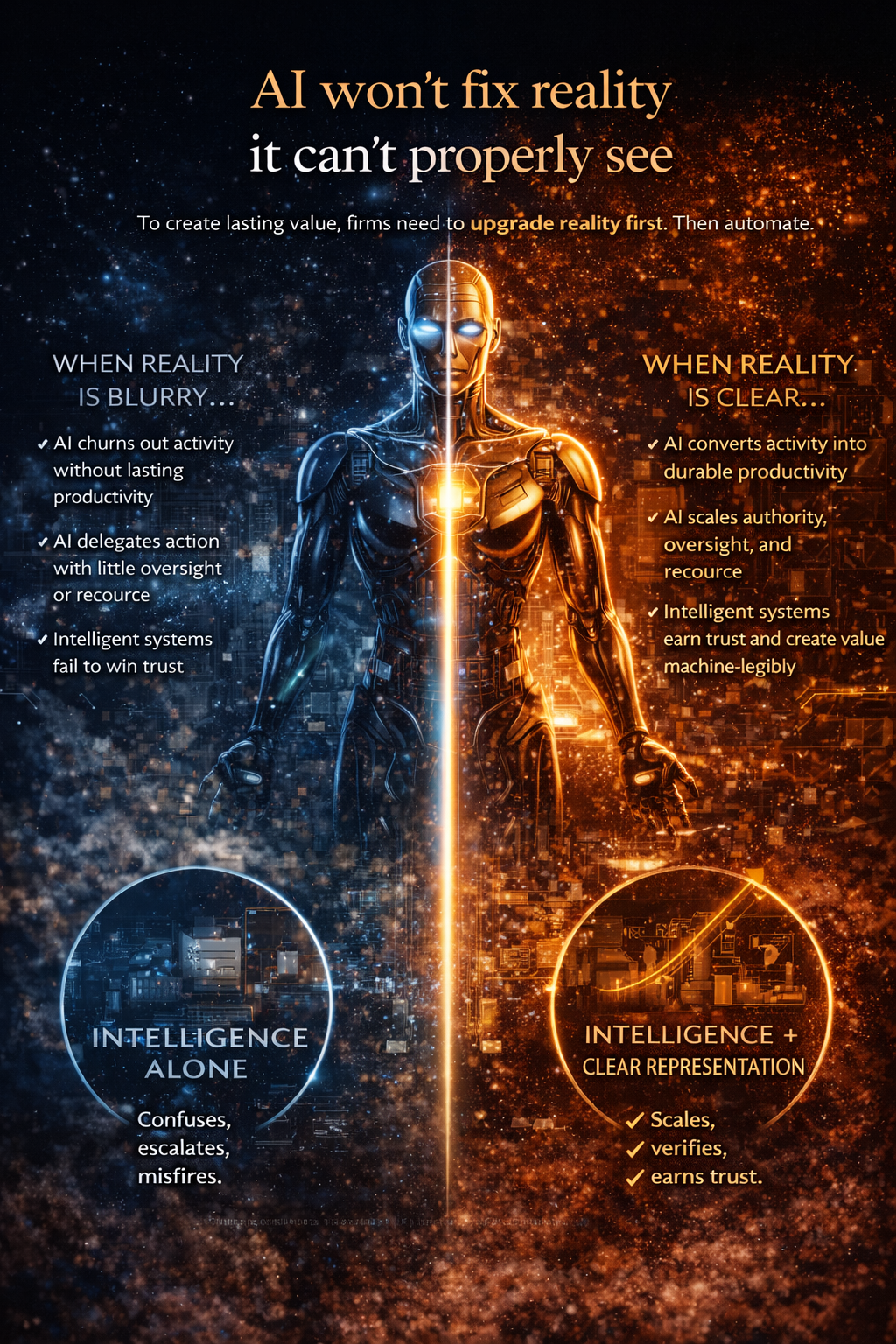
Conclusion: AI will not fix reality it cannot properly see
The Representation Productivity Paradox is not a side effect of AI adoption. It is a warning.
If firms automate intelligence before they upgrade reality, AI will often produce more activity than value, more output than outcome, and more motion than productivity.
But firms that reverse the sequence will create a very different future.
They will treat reality as infrastructure.
They will understand that better decisions require more than better models. They require better representation.
They will strengthen SENSE so CORE has something reliable to reason over.
They will design DRIVER so action happens with legitimacy, control, and recourse.
And once that foundation is built, AI will stop feeling like an impressive layer added onto the enterprise.
It will become part of how the enterprise sees, decides, and acts.
That is where durable advantage will come from.
Not from intelligence alone.
From reality, upgraded.
FAQ
What is the Representation Productivity Paradox?
The Representation Productivity Paradox is the idea that many firms deploy AI to automate intelligence before improving the quality, structure, and governability of the reality AI depends on. As a result, AI generates activity without durable enterprise productivity.
Why do AI projects fail to deliver enterprise-wide value?
Many AI initiatives underperform because organizations invest in models and tools without equally investing in data quality, governance, workflow redesign, operating foundations, and change management. Current research from Gartner, BCG, McKinsey, and the World Economic Forum points in that direction. (Gartner)
What does “upgrade reality” mean in AI?
It means making the organization more machine-legible by improving signals, entity resolution, state representation, and continuous updating so that AI systems reason over current, trustworthy operational reality.
How does SENSE–CORE–DRIVER relate to AI productivity?
SENSE makes reality legible, CORE reasons over it, and DRIVER governs action. Productivity fails when firms overinvest in reasoning systems while neglecting representation quality and action governance.
Why is agentic AI more exposed to this problem?
Because agents do not just generate outputs. They take action. When underlying representations are wrong or stale, the cost of error rises sharply because bad judgments can now trigger bad execution. (Reuters)
Is the AI productivity paradox proof that AI is overhyped?
No. It suggests that AI’s benefits depend heavily on complementary changes such as workflow redesign, better data foundations, stronger controls, and clearer operating models. (MIT Sloan)
What should boards and C-suite leaders do first?
They should assess where business reality is fragmented, stale, weakly governed, or poorly represented before scaling AI across critical workflows.
Glossary
Representation Economy
An economy in which value increasingly depends on how accurately, continuously, and governably people, assets, events, and obligations are represented in machine-readable systems.
Representation Productivity Paradox
The failure pattern that occurs when firms automate intelligence before upgrading the underlying reality that intelligence depends on.
Machine-legible reality
A condition in which operational reality is structured clearly enough for software and AI systems to interpret and act on it reliably.
Entity resolution
The ability to determine which customer, asset, shipment, supplier, policy, contract, or account a system is actually referring to.
State representation
A current, structured description of the condition of an entity, such as whether a shipment is delayed, a customer is at risk, or a claim is disputed.
Agentic AI
AI systems that can plan, invoke tools, take action, and pursue goals with varying degrees of autonomy.
SENSE
The layer where reality becomes machine-legible through signal, entity, state, and evolution.
CORE
The reasoning layer where intelligence comprehends context, optimizes decisions, realizes action paths, and evolves through feedback.
DRIVER
The governance layer that determines delegation, representation, identity, verification, execution, and recourse.
Machine-trustworthy action
Action taken by AI or software that can be trusted because it rests on accurate representation, clear authority, and verifiable execution logic.
Explore the Architecture of the AI Economy
This article is part of a broader research series exploring how institutions are being redesigned for the age of artificial intelligence. Together, these essays examine the structural foundations of the emerging AI economy — from signal infrastructure and representation systems to decision architectures and enterprise operating models. If you want to explore the deeper framework behind these ideas, the following essays provide additional perspectives:
-
- The Representation Economy: Why AI Institutions Must Run on SENSE, CORE, and DRIVER – Raktim Singh
- The Representation Economy: Why Intelligent Institutions Will Run on the SENSE–CORE–DRIVER Architecture – Raktim Singh
- The New Company Stack — business categories emerging in the Representation Economy. (raktimsingh.com)
- What Is the Representation Economy? The Definitive Guide to SENSE, CORE, and DRIVER – Raktim Singh
- Representation Economy Explained: More Questions on SENSE, CORE, and DRIVER – Raktim Singh
- The DRIVER Layer in AI: Delegation, Governance, and Trust Explained – Raktim Singh
- Representation Economics: The New Law of AI Value Creation (raktimsingh.com)
- What Is the Representation Economy? Guide to SENSE, CORE, and DRIVER (raktimsingh.com)
- Representation Economy and the SENSE–CORE–DRIVER Framework (raktimsingh.com)
- Representation Kill Zone: Why Firms Become Invisible in AI (raktimsingh.com)
- More Questions on SENSE, CORE, and DRIVER (raktimsingh.com)
- Representation Standards: Who Will Write the GAAP of the AI Economy? – Raktim Singh
- Representation Covenants: The New Competitive Advantage in the AI Economy – Raktim Singh
- The Representation Middle Class: Why the Biggest AI Winners Will Help the World Become Machine-Trusted – Raktim Singh
- The Authority Graph: Why AI Will Be Governed by Permissions, Not Just Intelligence – Raktim Singh
Together, these essays outline a central thesis:
The future will belong to institutions that can sense reality, represent it clearly, reason about it intelligently, and act through governed machine systems.
This is why the architecture of the AI era can be understood through three foundational layers:
SENSE → CORE → DRIVER
Where:
- SENSE makes reality legible
- CORE transforms signals into reasoning
- DRIVER ensures that machine action remains accountable, governed, and institutionally legitimate
Signal infrastructure forms the first and most foundational layer of that architecture.
AI Economy Research Series — by Raktim Singh
Written by Raktim Singh, AI thought leader and author of Driving Digital Transformation, this article is part of an ongoing body of work defining the emerging field of Representation Economics and the SENSE–CORE–DRIVER framework for intelligent institutions.
This article is part of a larger series on Representation Economics, including topics such as Representation Utility Stack, Representation Due Diligence, Recourse Platforms, and the New Company Stack.
References and further reading
- World Economic Forum, Organizational Transformation in the Age of AI (2026) — on redesigning work, decisions, and operating models for sustained AI value. (World Economic Forum Reports)
- Gartner, April 2026 announcement — on successful AI initiatives investing up to four times more in data and analytics foundations, governance, AI-ready people, and change management. (Gartner)
- BCG, The Widening AI Value Gap (2025) — on only 5% of firms achieving AI value at scale and about 60% seeing minimal or no material value. (BCG Media Publications)
- McKinsey Global Institute, Agents, Robots, and Us (2025) — on redesigning end-to-end workflows rather than merely automating tasks. (McKinsey & Company)
- MIT Sloan, The Productivity Paradox of AI Adoption in Manufacturing Firms (2025) — on short-term productivity declines before long-term gains during industrial AI adoption. (MIT Sloan)
- Reuters, June 2025 — on Gartner’s forecast that over 40% of agentic AI projects may be scrapped by the end of 2027 because of cost and unclear business value. (Reuters)
Related Enterprise AI Reading
Many organizations are discovering that enterprise AI success depends on far more than model accuracy. Common challenges include AI project failure, weak AI governance, poor AI agent control, unclear enterprise AI ROI, and the inability to translate AI insights into business outcomes. For readers exploring topics such as why enterprise AI projects fail, how AI creates business value, AI agent governance frameworks, agentic AI systems, enterprise AI architecture, AI risk management, CIO AI strategy, and enterprise AI operating models, the following articles provide a deeper perspective:
-
- Why Enterprise AI Projects Fail Even When the Models Work
- Why AI Creates Value in One Company and Fails in Another
- AI Agent Governance: How CIOs Should Decide What AI Agents Are Allowed to Do
- Why AI Agents Fail in Enterprises
- Why Enterprise AI Projects Fail Even When the Models Work: The Missing Architecture Behind AI Governance and Agentic Systems
- raktimsingh.com/hy-enterprise-
ai-projects-fail-digital- anthropology-ai-governance/
Together, these articles examine the critical relationship between enterprise data, AI decision-making, AI governance, AI agents, execution systems, accountability mechanisms, and measurable business value, helping CIOs, CTOs, architects, and business leaders move from AI experimentation to enterprise-scale impact.



Raktim Singh is an AI and deep-tech strategist, TEDx speaker, and author focused on helping enterprises navigate the next era of intelligent systems. With experience spanning AI, fintech, quantum computing, and digital transformation, he simplifies complex technology for leaders and builds frameworks that drive responsible, scalable adoption.