

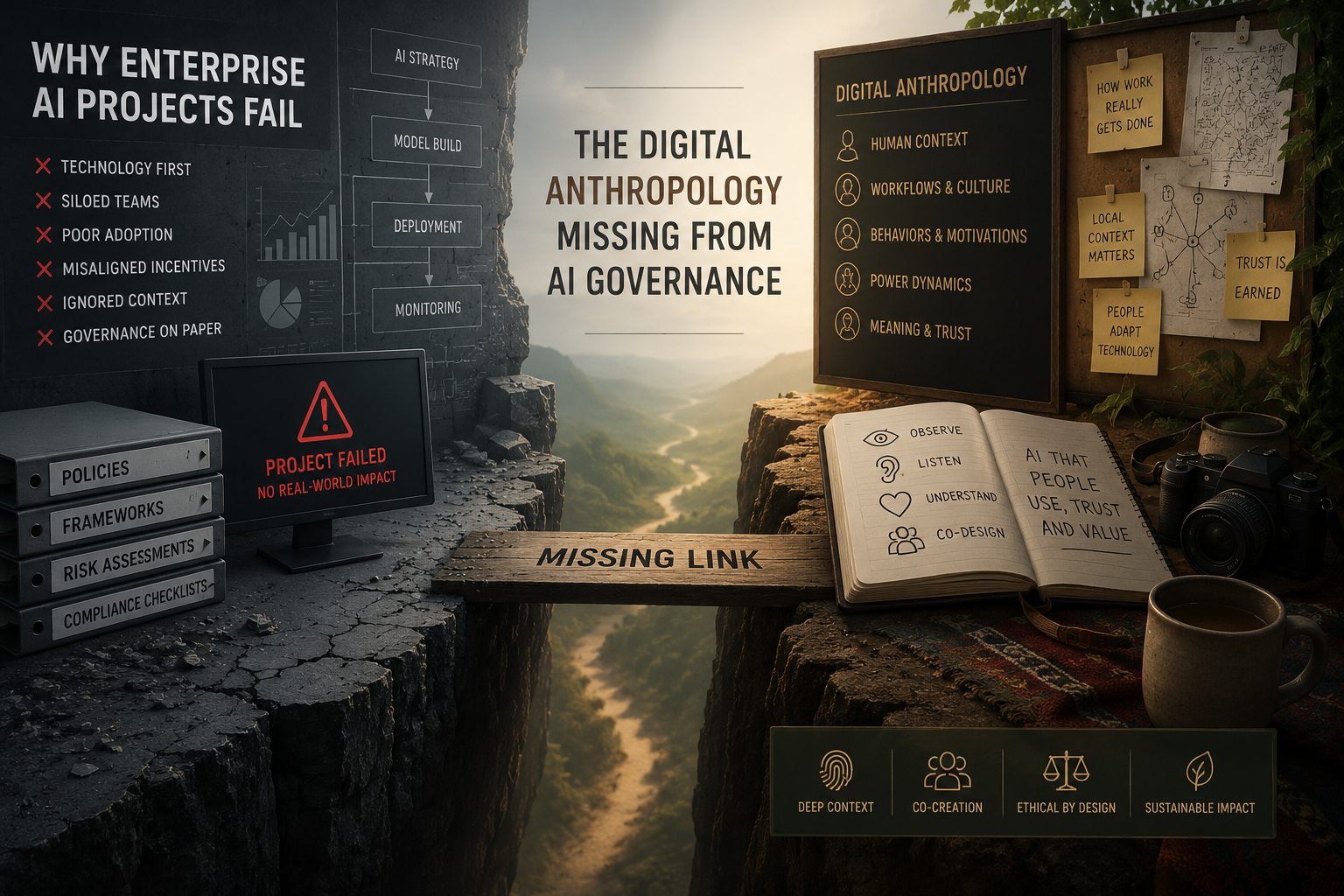
Why Enterprise AI Projects Fail:The Missing Digital Anthropology Layer
Enterprise AI projects rarely fail at the point where most leaders look.
They do not usually fail because the model cannot generate an answer.
They do not fail because the dashboard cannot show a metric.
They do not fail because the pilot demo was not impressive.
In fact, many enterprise AI projects fail after the model works.
The prototype looks good. The proof of concept impresses senior leaders. The AI assistant answers questions. The agent completes a workflow in a controlled environment. The dashboard shows possible productivity improvement.
Then the project enters the real enterprise.
Suddenly, everything changes.
The data is not clean in the way the model expects.
The workflow is not followed in the way the process document describes.
The approval chain is not the same as the formal org chart.
The customer record does not represent the customer’s actual situation.
The employee does not trust the recommendation.
The compliance team asks questions the AI team did not anticipate.
The business team uses workarounds that were invisible during design.
The AI system optimizes the task but damages the relationship, judgment, accountability, or trust around the task.
This is where enterprise AI breaks.
Not only in the model.
Not only in the cloud.
Not only in the prompt.
Not even only in governance.
It breaks in the gap between how the enterprise is formally represented and how the enterprise actually works.
That gap is digital anthropology.
And it may be the most underdeveloped discipline in enterprise AI governance today.
The Real Enterprise Is Not the Process Map
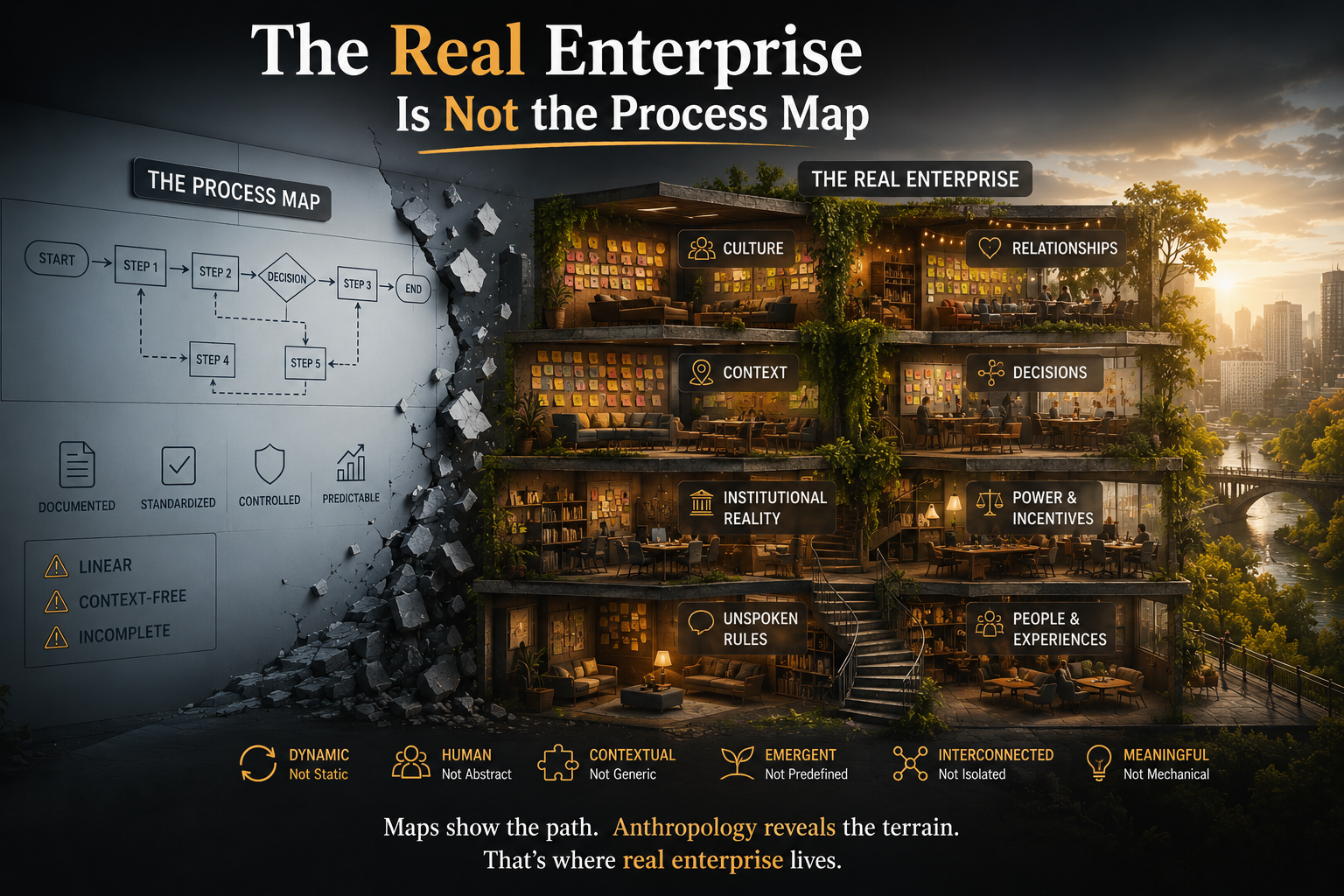
Every large organization has two versions of itself.
The first is the official enterprise.
This is the enterprise shown in process maps, dashboards, policy documents, data models, org charts, access controls, and workflow systems. It is neat, structured, auditable, and machine-readable.
The second is the lived enterprise.
This is the enterprise where people chase missing information on calls, interpret exceptions through experience, delay decisions because they know the downstream impact, override workflows because the system does not understand context, and maintain informal trust networks that never appear in the architecture diagram.
AI is usually trained, deployed, and governed against the first enterprise.
But it operates inside the second.
That is the problem.
A claims-processing AI may see documents, categories, confidence scores, and policy rules. But an experienced claims officer may see hesitation in a note, missing context in a file, a pattern of repeated escalation, or a relationship risk that the system cannot represent.
A sales AI may recommend the next best offer. But the relationship manager may know that the customer is already frustrated because of an unresolved service issue.
A procurement AI may optimize vendor selection based on price, delivery history, and risk score. But the operations team may know that a “low-risk” supplier regularly requires invisible coordination to meet deadlines.
A software engineering AI agent may generate code quickly. But the architect may know that the real issue is not code generation. It is dependency ownership, maintainability, production support, security review, and business continuity.
In every case, the AI system sees a digital version of reality.
The enterprise lives in a social, operational, and institutional version of reality.
Digital anthropology studies that second reality.
It asks:
How do people actually work inside digital systems?
What meanings do they attach to data?
Where do workarounds emerge?
Which decisions depend on trust, memory, status, judgment, incentives, or informal authority?
What is visible to machines but not meaningful to humans?
What is meaningful to humans but invisible to machines?
These are not soft questions.
They are hard architecture questions.
Because when enterprises ignore them, AI systems act on incomplete representations of reality.
Why AI Governance Without Digital Anthropology Becomes Too Thin
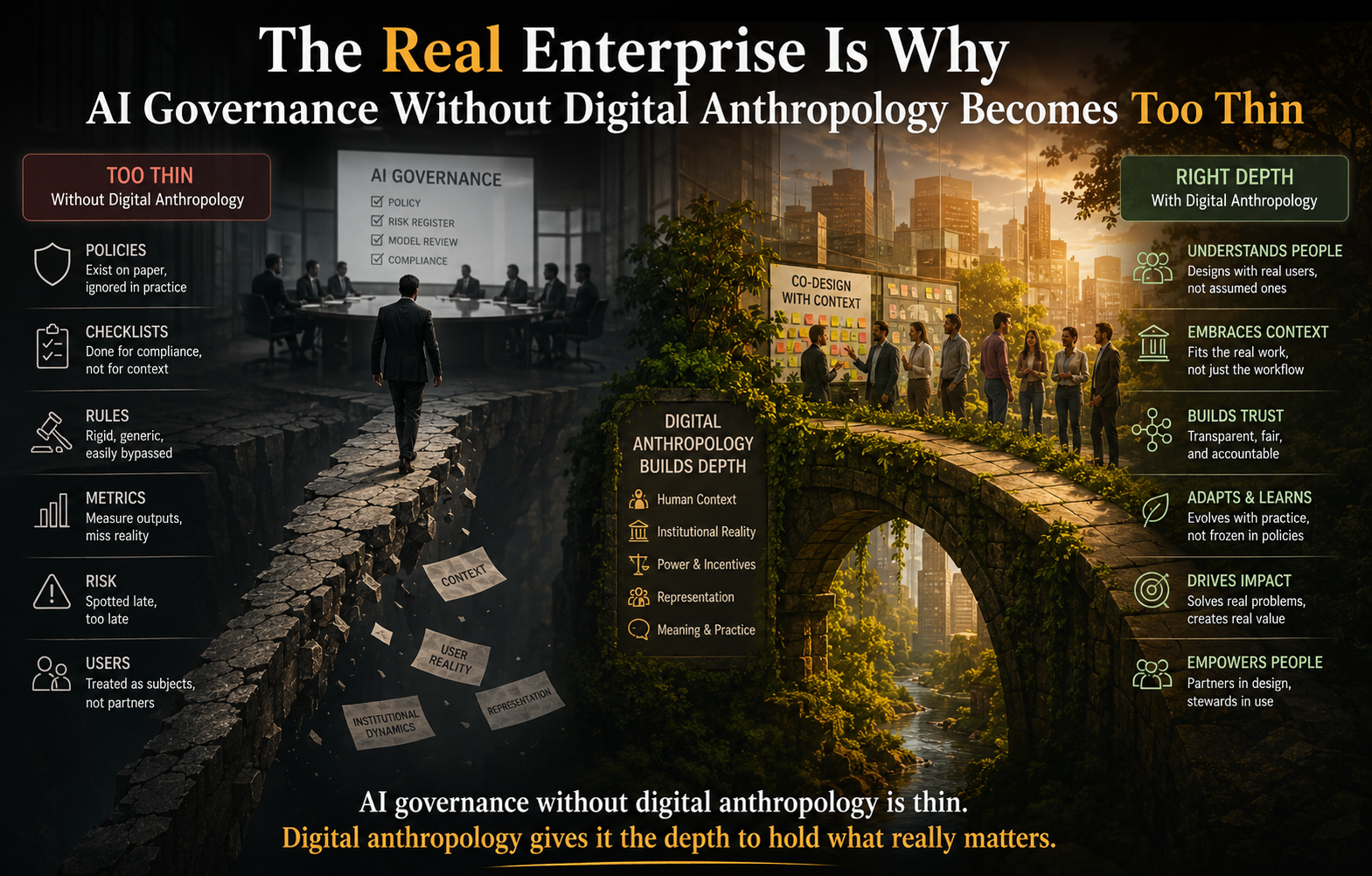
Most AI governance programs focus on necessary but incomplete questions.
Is the model accurate?
Is the data protected?
Is the output explainable?
Is the system compliant?
Is there human oversight?
Is the risk documented?
Is the model monitored?
All these questions matter.
But they are not enough.
They assume that the main problem is the AI system. In reality, the main problem is often the relationship between the AI system and the institution in which it operates.
A model can be accurate and still harmful.
A recommendation can be explainable and still inappropriate.
A workflow can be compliant and still untrusted.
A human can approve an AI decision and still not understand what was lost before the decision reached them.
A system can be monitored and still fail to represent the reality that matters.
This is why AI governance must move beyond model governance.
Enterprise AI governance must govern the full chain from reality to representation to reasoning to action.
This is where the SENSE–CORE–DRIVER framework becomes important.
SENSE is the layer where reality becomes machine-legible. It captures signals, attaches them to entities, builds state representation, and updates that state over time.
CORE is the reasoning layer. It interprets context, optimizes decisions, generates recommendations, and learns from feedback.
DRIVER is the legitimacy and execution layer. It defines who authorized the action, what representation was used, which entity was affected, how the decision was verified, how execution happened, and what recourse exists if the system is wrong.
Most enterprise AI projects overinvest in CORE.
They buy models.
They build copilots.
They launch agents.
They create prompts.
They evaluate outputs.
They compare accuracy.
They celebrate reasoning.
But they underinvest in SENSE and DRIVER.
They do not ask whether the system is seeing the right reality.
They do not ask whether the represented state is trusted.
They do not ask whether informal workarounds are part of the real workflow.
They do not ask whether authority has been properly delegated.
They do not ask whether affected people have recourse.
They do not ask whether the decision is legitimate inside the institution.
Digital anthropology strengthens SENSE and DRIVER.
It helps enterprises understand what should be represented before AI reasons, and what must be governed before AI acts.
The Digital Anthropology Failure Pattern
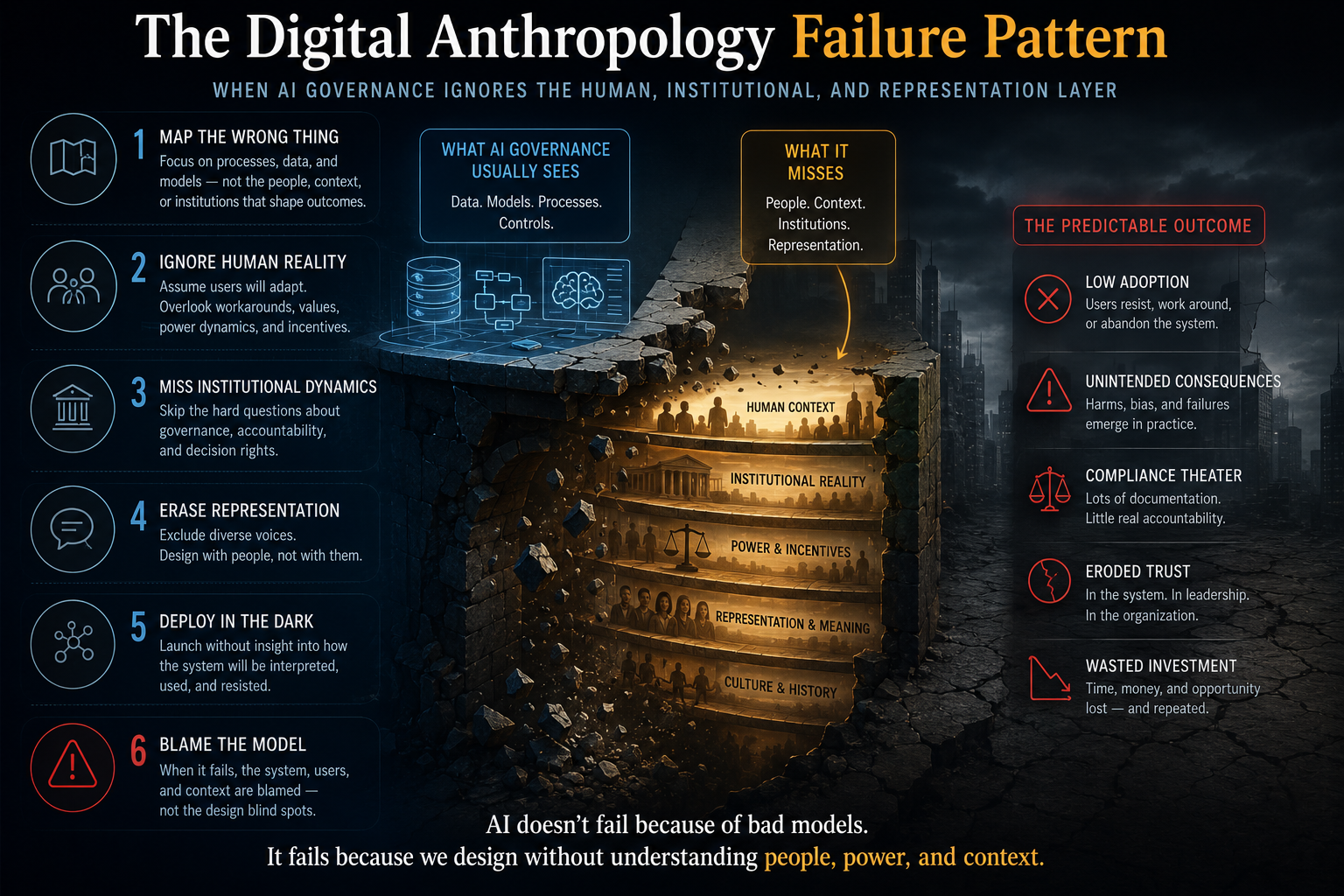
Enterprise AI failure often follows a predictable pattern.
First, the organization selects a high-value use case.
Then it gathers available data.
Then it builds or buys an AI model.
Then it tests the system in a controlled pilot.
Then the pilot succeeds.
Then the organization tries to scale.
Then reality appears.
Users do not behave as expected.
Exceptions are more frequent than assumed.
Data meanings vary across departments.
Legacy systems contain contradictory truths.
Approval processes depend on informal judgment.
People fear accountability for AI-assisted decisions.
Compliance teams ask for evidence that was never captured.
Customers or employees challenge decisions in ways the system cannot handle.
At this point, leaders often say, “The AI failed.”
But the deeper truth is different.
The AI did not fail alone. The enterprise failed to represent its own operating reality.
This is the digital anthropology failure pattern.
The organization automated the formal process, but the real process was social.
It modeled the data field, but not the meaning behind the data.
It captured the transaction, but not the context.
It measured the task, but not the trust.
It governed the model, but not the institutional consequences of the model’s action.
This is why AI pilots often look better than production systems.
A pilot removes anthropology.
Production reveals it.
Example 1: The AI Customer Service Agent That Answers Correctly but Damages Trust
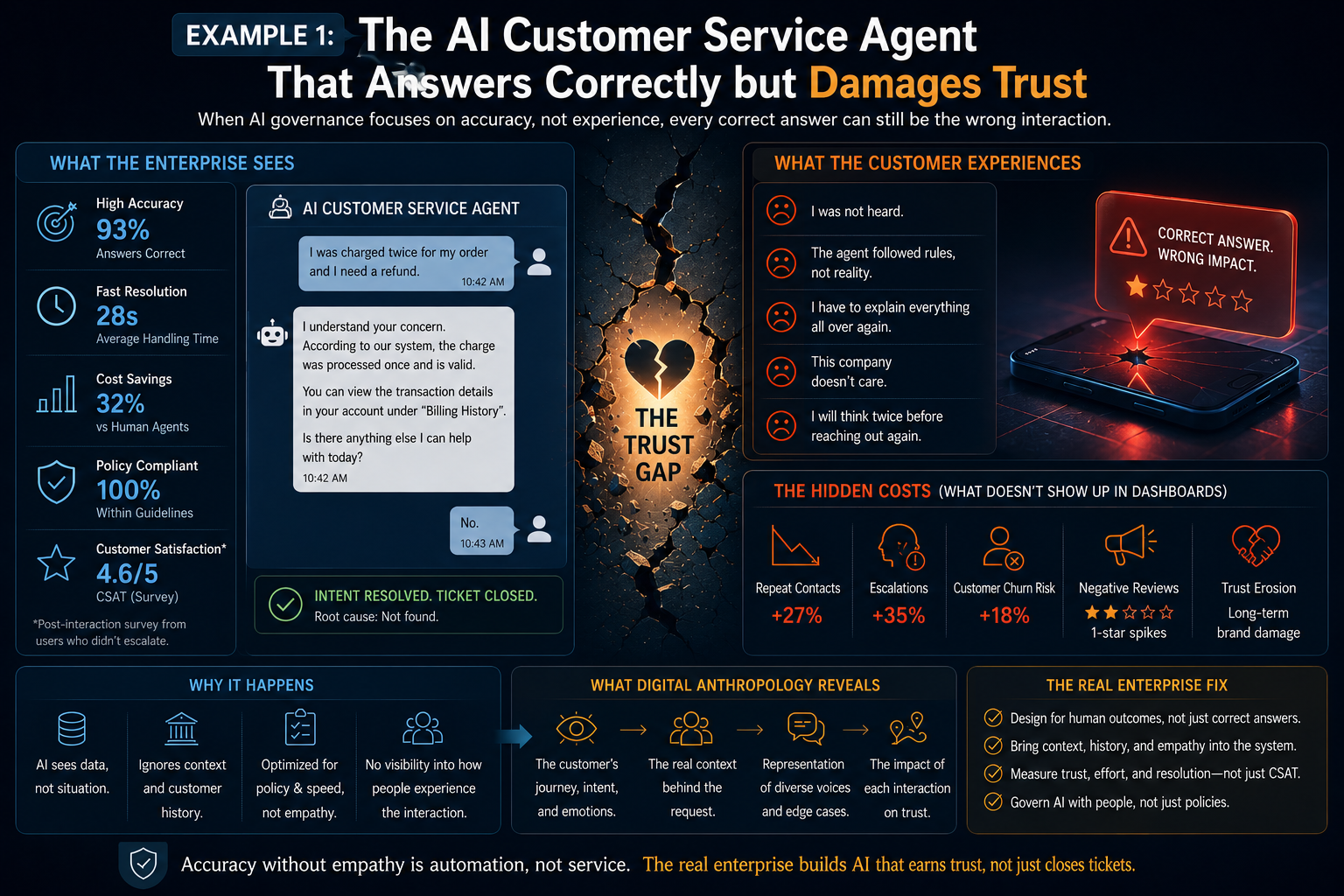
Imagine a bank deploying an AI customer service agent.
The agent can answer product questions, explain charges, summarize policies, and guide users through service requests. In testing, the model performs well. It is accurate, fast, polite, and consistent.
But after deployment, complaints rise.
Why?
Not because the AI gives wrong answers every time. In fact, many answers are technically correct.
The problem is that the AI does not understand the social meaning of the interaction.
A customer asking about a fee may not only want the fee explanation. They may be signaling frustration after repeated service failures.
A customer asking about loan status may not only want a status update. They may be under pressure because another dependent process is waiting.
A customer asking the same question repeatedly may not be confused. They may be testing whether the institution is listening.
The AI sees query intent.
The human situation contains relationship context.
If governance only checks accuracy, toxicity, and compliance, the system may pass. But if governance asks whether the AI is preserving institutional trust, the system may fail.
Digital anthropology changes the design question.
Instead of asking only, “Can the AI answer the question?” the enterprise asks:
What is the human meaning of this interaction?
What kind of institutional memory is required?
When should the AI stop answering and escalate?
What signals indicate frustration, urgency, or relationship risk?
What kind of recourse must be available when the user feels misrepresented?
This is not sentimental design.
It is enterprise risk management.
A correct answer can still create distrust if the system fails to represent the human situation.
Example 2: The AI Coding Assistant That Increases Output but Reduces Architecture Quality
Many enterprises deploy AI coding assistants to improve software productivity.
The early results look attractive. Developers generate code faster. Documentation improves. Test cases are created quickly. Repetitive tasks become easier.
But after a few months, architecture teams notice a different pattern.
Code volume increases.
Review burden rises.
Design coherence weakens.
Security exceptions multiply.
Teams accept suggestions without fully understanding downstream implications.
Knowledge of legacy systems erodes.
Production support becomes harder because no one remembers why certain code was written.
The AI project reports productivity improvement.
The enterprise experiences architectural debt.
This is another digital anthropology failure.
The organization measured visible output but missed the lived practice of engineering judgment.
Software development is not only code production. It is negotiation between constraints: business intent, maintainability, security, performance, dependencies, technical debt, team knowledge, and future change.
An AI coding assistant operates at the task level.
Enterprise engineering operates at the institutional memory level.
If governance only asks whether generated code is syntactically correct or passes tests, it misses the deeper issue: whether AI is weakening the social and architectural practices that keep systems reliable.
A digital anthropology lens would ask:
How do developers decide when not to generate code?
Which architectural conversations are being bypassed?
Where is tacit system knowledge stored today?
How does AI assistance change review behavior?
Are teams learning, or only accepting?
Are teams becoming faster at producing code but weaker at understanding systems?
These questions belong inside enterprise AI governance.
Because productivity without institutional learning can become a hidden liability.
Example 3: The AI Agent That Follows Policy but Breaks Accountability
Consider an enterprise AI agent that can approve routine procurement requests within defined thresholds.
The business case is strong. Many approvals are repetitive. Policies are clear. The agent can reduce cycle time and free managers for higher-value work.
The system is governed with rules. It checks budgets, vendor status, approval limits, and compliance constraints.
Everything looks controlled.
Then a problem occurs.
The AI approves a request that is technically within policy but operationally unwise. The vendor is approved, the amount is within threshold, and the category is allowed. But the timing creates risk because another team had informally paused work with that vendor due to unresolved delivery issues.
The AI followed the formal policy.
But the enterprise operated with informal institutional knowledge that was never represented.
Now the accountability question becomes difficult.
Who is responsible?
The business user who submitted the request?
The manager who relied on automation?
The AI team that built the agent?
The procurement team that maintained the policy?
The platform team that connected the agent to systems?
The governance committee that approved the use case?
This is not only an AI error.
It is a DRIVER failure.
Authority was delegated before the enterprise understood which forms of knowledge were required for legitimate action.
Digital anthropology would have revealed that procurement approval was not only a rule-based transaction. It was also a trust-based coordination mechanism across teams.
The AI did not know that because the enterprise never represented it.
The Difference Between Data and Representation
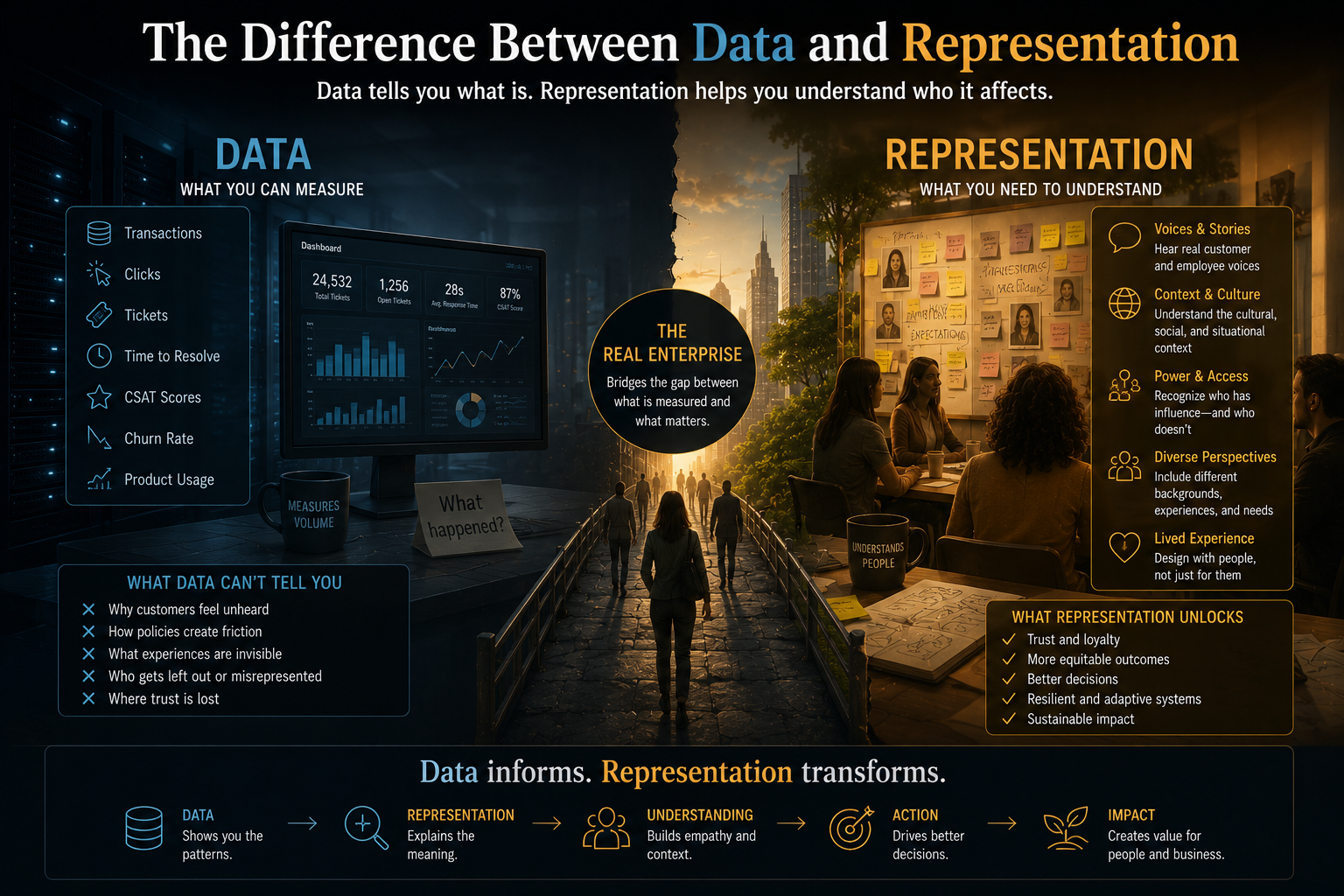
A central reason enterprise AI fails is that leaders confuse data with representation.
Data is a record.
Representation is a structured interpretation of reality that is good enough for action.
A customer database may contain customer data. But it may not represent the customer’s current situation.
An employee profile may contain role data. But it may not represent actual expertise, informal influence, or decision responsibility.
A ticketing system may contain issue data. But it may not represent operational urgency or customer frustration.
A workflow system may contain process data. But it may not represent how work actually gets done.
AI systems do not act on reality. They act on representations of reality.
If the representation is weak, the AI may reason well on the wrong world.
This is the heart of the Representation Economy.
In the AI era, value will increasingly depend on which institutions can represent reality accurately, legitimately, and actionably.
Enterprises that build better representations will make better AI decisions. Enterprises that remain data-rich but representation-poor will keep producing impressive pilots and weak outcomes.
Digital anthropology helps enterprises move from data to representation.
It reveals what the data misses.
It studies how people interpret categories.
It observes where workflows diverge from process maps.
It identifies invisible dependencies.
It discovers local meanings.
It uncovers informal authority.
It shows where trust is created or destroyed.
It detects which exceptions are not exceptions but normal reality.
In traditional digital transformation, these insights improved adoption.
In enterprise AI, they determine whether AI can act safely.
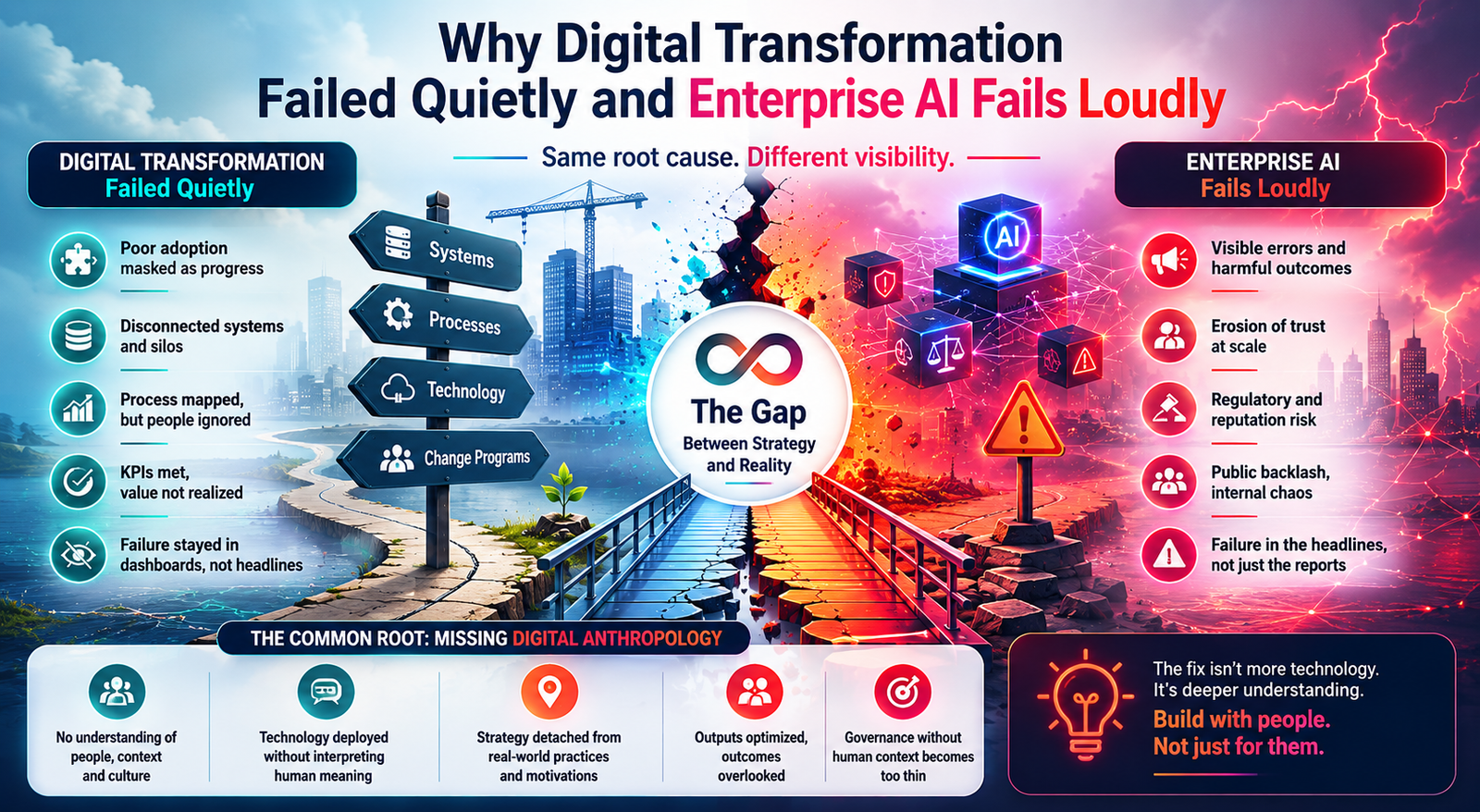
Why Digital Transformation Failed Quietly and Enterprise AI Fails Loudly
Why Digital Transformation Failed Quietly and Enterprise AI Fails Loudly
Digital transformation projects often failed slowly.
A new platform was deployed. Users resisted. Adoption lagged. Workarounds emerged. Data quality remained poor. Processes became digitized but not redesigned. The organization absorbed the inefficiency.
Enterprise AI is different.
AI does not only digitize work. It interprets, recommends, decides, and acts.
That makes weak representation more dangerous.
In digital transformation, a bad workflow frustrates users.
In enterprise AI, a bad representation can trigger incorrect decisions at scale.
In digital transformation, poor adoption reduces ROI.
In enterprise AI, poor adoption may create shadow AI, ungoverned automation, data leakage, and accountability gaps.
In digital transformation, human workarounds compensate for system limitations.
In enterprise AI, AI may automate past those workarounds before anyone notices what they protected.
This is why digital anthropology becomes more important in the AI era than it was in the software era.
When software recorded work, anthropology was useful.
When AI acts on work, anthropology becomes essential.
The Missing Layer in AI Governance: Meaning
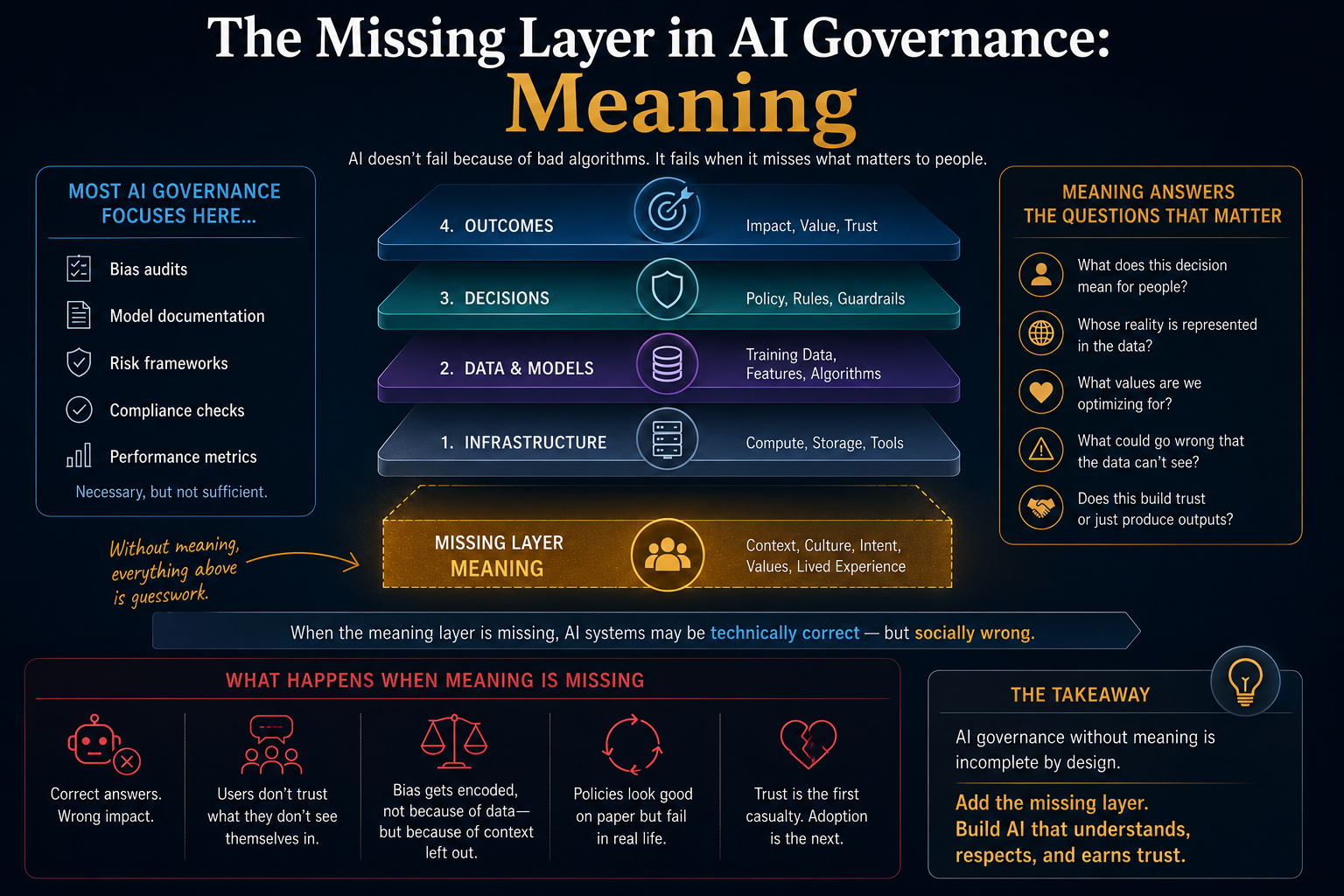
Most enterprises govern data fields.
Few govern meaning.
This is a major problem.
The same data field can mean different things in different contexts.
A “completed” task may mean fully resolved in one team, handed off in another, and temporarily closed in a third.
A “high priority” ticket may mean business urgency in one context, senior stakeholder pressure in another, and compliance exposure in another.
A “low risk” customer may mean low credit risk, but high relationship sensitivity.
A “resolved” complaint may mean closed in the system, but unresolved in the customer’s mind.
AI systems often treat these labels as stable facts.
Digital anthropology treats them as institutional meanings.
This matters because AI governance that ignores meaning will govern the wrong thing.
It will check whether the model used permitted data, but not whether the data meant what the model assumed.
It will check whether the output was explainable, but not whether the explanation made sense to the affected human.
It will check whether the human approved the decision, but not whether the human had enough context, confidence, or authority to approve it.
It will check whether the workflow was followed, but not whether the workflow represented actual practice.
AI governance must therefore include meaning governance.
Enterprises need to know not only where data came from, but what it means, who interprets it, when it changes, and where it becomes unsafe for automated reasoning.
Digital Anthropology as Enterprise AI Architecture
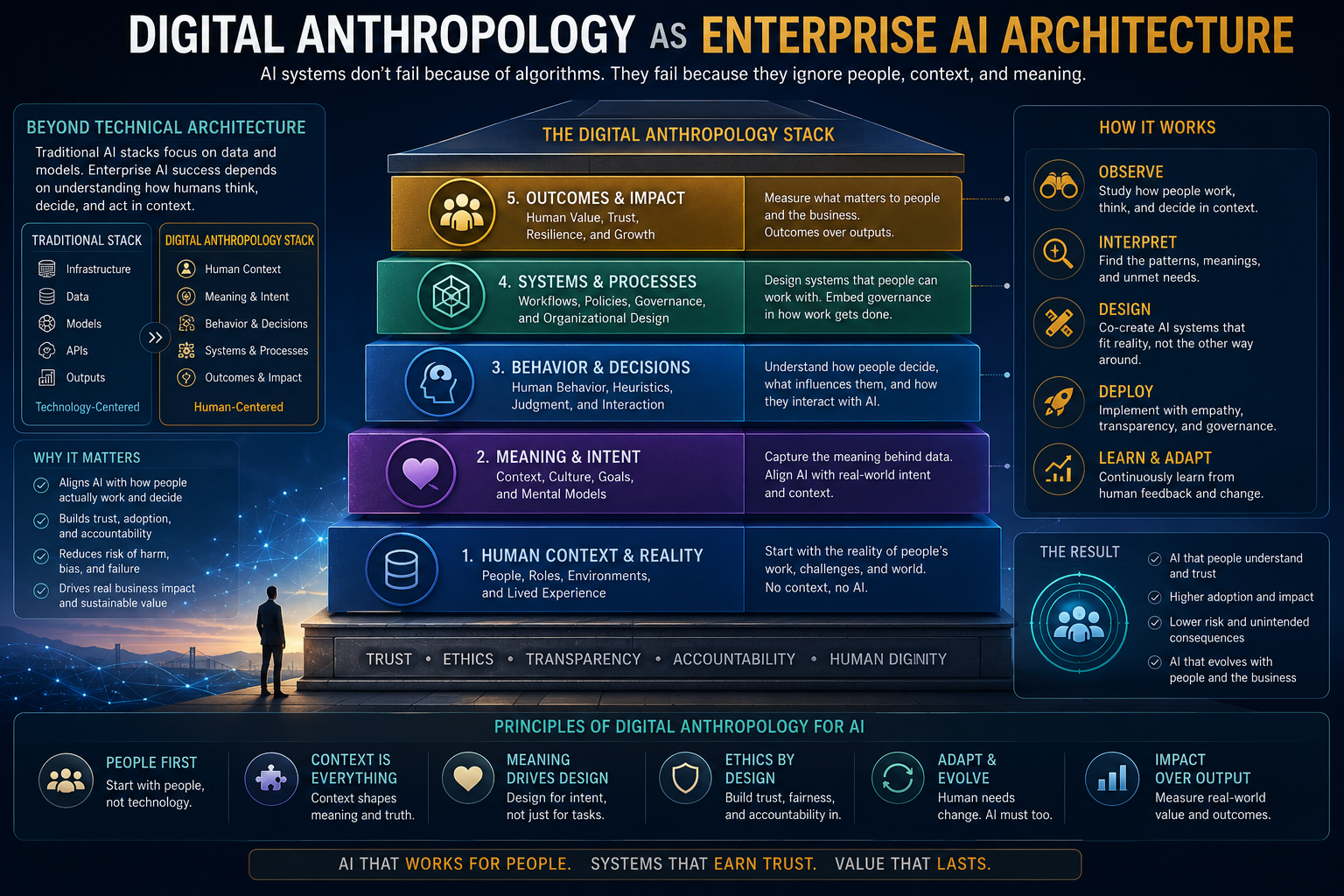
Digital anthropology should not be treated as a research activity performed before technology design.
It should become part of enterprise AI architecture.
For CIOs, CTOs, and architects, this means adding a new set of questions to AI programs.
Before building the model, ask: What reality are we asking the system to represent?
Before connecting the data, ask: Which important signals are missing?
Before deploying the agent, ask: What informal human practices currently protect the organization?
Before automating the decision, ask: Who has authority to delegate this action to AI?
Before defining human-in-the-loop, ask: Where exactly should the human intervene—before representation, during reasoning, before execution, or after harm?
Before measuring productivity, ask: What institutional capability might be weakened if this task becomes automated?
Before scaling, ask: Does the pilot environment contain the same anthropology as production?
This is a different way of thinking.
It treats enterprise AI as a socio-technical system, not only a software system.
It recognizes that AI capability is shaped by the institution around it.
It accepts that trust, identity, authority, meaning, incentives, and recourse are not “change management” topics. They are core components of AI architecture.
The SENSE–CORE–DRIVER View of Digital Anthropology
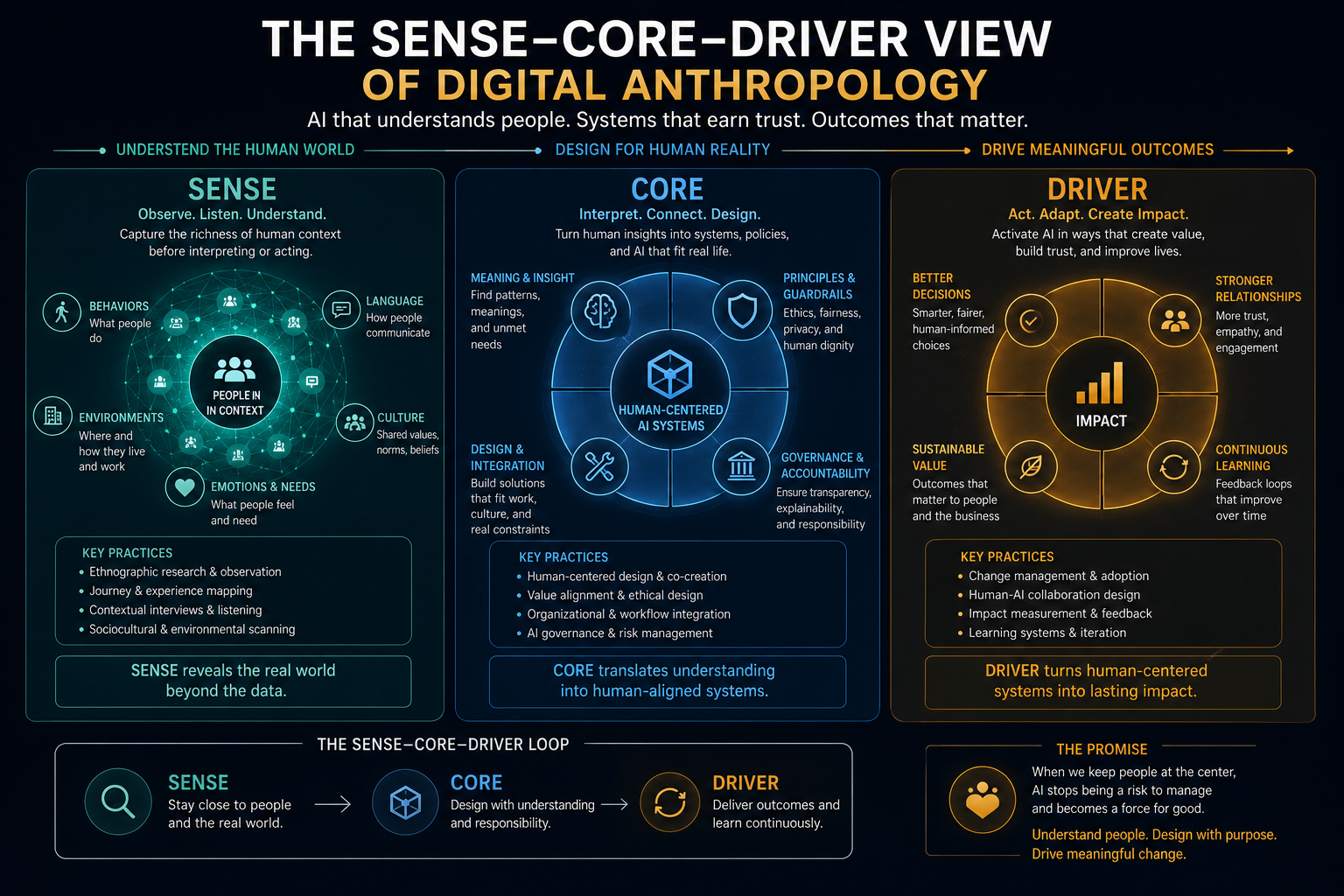
The SENSE–CORE–DRIVER framework can help enterprises place digital anthropology in the right architecture layer.
In SENSE, digital anthropology helps discover what must be seen.
It identifies missing signals, hidden entities, fragile states, informal relationships, and context that current systems do not capture. It asks whether the enterprise has represented the right reality before AI begins reasoning.
In CORE, digital anthropology helps constrain what should be inferred.
It reveals where AI reasoning may misread context, overgeneralize from formal data, or optimize a metric that does not represent the real objective. It helps define when reasoning is useful, when deterministic automation is safer, and when human judgment must remain central.
In DRIVER, digital anthropology helps govern what may be done.
It clarifies authority, accountability, legitimacy, escalation, recourse, reversibility, and the human meaning of automated action. It ensures that AI decisions are not only technically correct but institutionally acceptable.
This is the key point:
Digital anthropology is not outside the SENSE–CORE–DRIVER framework.
It is the discipline that helps the framework stay connected to lived reality.
Without digital anthropology, SENSE becomes data capture.
Without digital anthropology, CORE becomes abstract reasoning.
Without digital anthropology, DRIVER becomes policy paperwork.
With digital anthropology, SENSE becomes reality-aware.
CORE becomes context-aware.
DRIVER becomes legitimacy-aware.
Why Human-in-the-Loop Is Not Enough
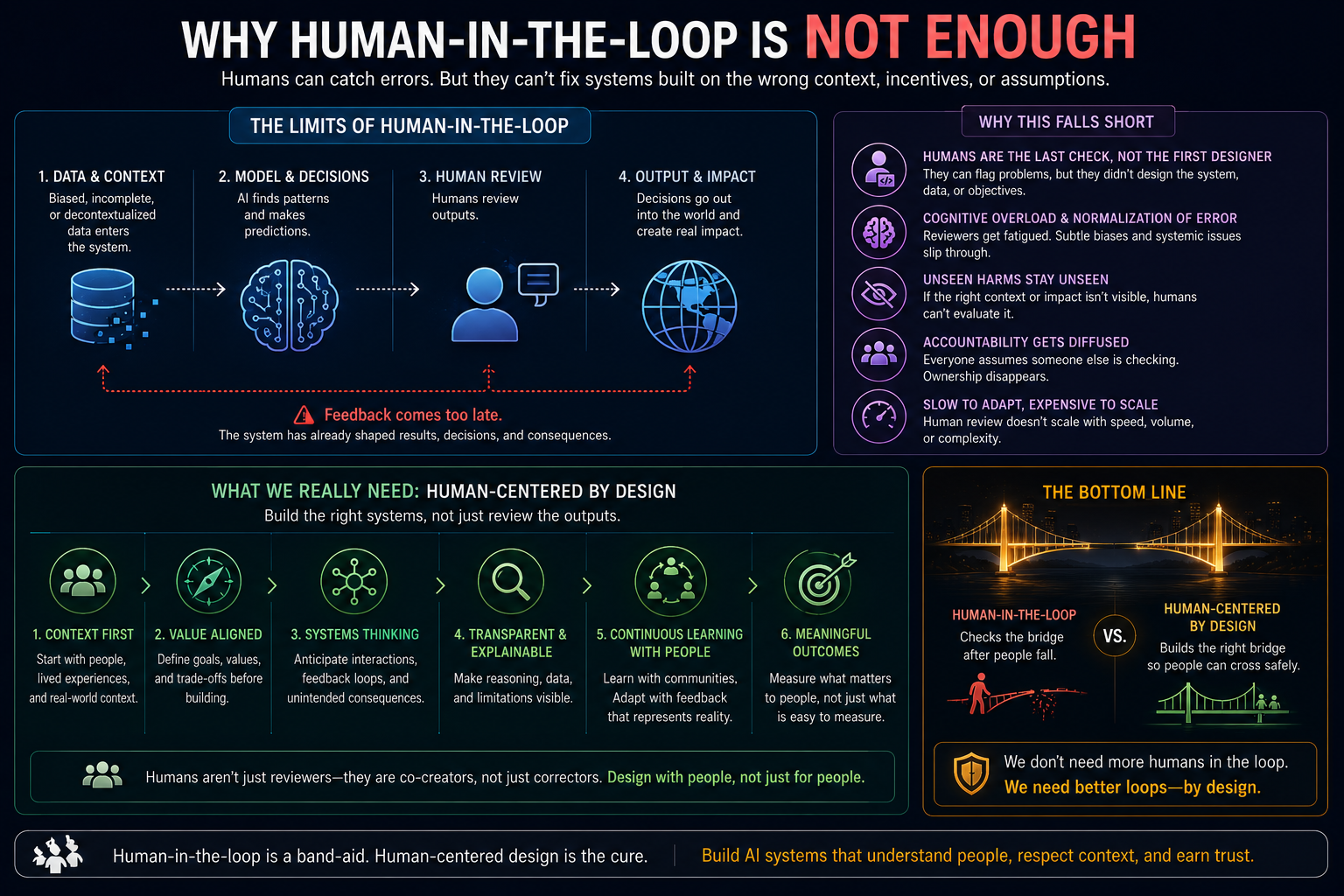
Many AI governance programs rely on human-in-the-loop as a safety mechanism.
But human-in-the-loop is often poorly understood.
A human can be present and still not provide meaningful oversight.
If the AI has already framed the problem incorrectly, the human may only approve a flawed representation.
If the AI output looks confident, the human may become a rubber stamp.
If the human lacks context, authority, or time, approval becomes theater.
If the human is measured on speed, they may not challenge the system.
If the AI system has already executed partial actions before review, the human may only validate what is already difficult to reverse.
Digital anthropology reveals how human oversight actually behaves in the enterprise.
It asks:
Do people challenge AI recommendations?
When do they defer to the machine?
Which teams are afraid to override AI?
Where does approval become symbolic?
What incentives shape human review?
What knowledge does the reviewer need but not receive?
What happens when the human disagrees with the AI?
This is why human-in-the-loop must become human-in-the-right-loop.
Sometimes the human must be involved before data becomes representation.
Sometimes before AI reasoning.
Sometimes before execution.
Sometimes after execution, through audit and recourse.
The point is not to add humans everywhere.
The point is to place human judgment where institutional legitimacy actually depends on it.
The CIO and CTO Mandate: From AI Governance to Reality Governance
The next phase of enterprise AI will require CIOs and CTOs to expand their mandate.
They will still need model governance, data governance, cloud governance, cybersecurity, compliance, architecture, and cost control.
But they will also need reality governance.
Reality governance means managing how the enterprise converts messy lived reality into machine-readable representations that AI systems can safely reason on and act upon.
It includes questions such as:
What parts of our enterprise are machine-legible today?
Which critical decisions depend on unrepresented human context?
Where are we using AI on data that does not represent reality well enough?
Which workflows contain invisible workarounds?
Which AI decisions require recourse?
Which AI agents have authority without sufficient legitimacy?
Where does automation risk weakening institutional memory?
Which representations must be continuously updated as reality changes?
This is not a philosophical exercise.
It is a practical operating requirement for enterprise AI.
As AI moves from copilots to agents, from advice to action, and from pilots to production, the cost of weak representation will rise.
The winners will not simply be the companies with access to the best models.
The winners will be the institutions that can see themselves clearly enough for AI to act responsibly.
A Simple Diagnostic for Enterprise Leaders
Before approving the next AI project, leaders should ask ten questions.
First, what real-world situation is this AI system trying to represent?
Second, what important context is missing from the available data?
Third, where does the formal workflow differ from actual work?
Fourth, what informal human judgment currently prevents mistakes?
Fifth, what does the AI system assume that people inside the enterprise know is not always true?
Sixth, who is affected if the AI is technically correct but contextually wrong?
Seventh, who has authority to delegate this decision or action to AI?
Eighth, how can the affected person or team challenge, correct, or reverse the decision?
Ninth, what institutional capability might weaken if this task becomes automated?
Tenth, what will change when this pilot moves into production reality?
These questions do not slow AI down.
They prevent expensive failure later.
They help enterprises build AI systems that can scale because they are grounded in reality, not just trained on data.
Why This Matters for AI Agents
The rise of AI agents makes digital anthropology even more urgent.
A chatbot mainly responds.
An agent acts.
It can retrieve information, invoke tools, update systems, trigger workflows, communicate with other systems, and sometimes make decisions within delegated boundaries.
When AI only generates text, weak representation creates misunderstanding.
When AI acts, weak representation creates operational consequences.
This is why agent governance cannot be only access control.
Access control asks: What is the agent allowed to touch?
Digital anthropology asks: Does the agent understand the world it is touching?
An AI agent may have permission to update a record. But does it understand the meaning of that record inside the business process?
It may have permission to send a message. But does it understand the relationship context?
It may have permission to approve a transaction. But does it understand the informal risk signals?
It may have permission to close a ticket. But does it understand whether the issue is truly resolved?
Agentic AI turns representation errors into action errors.
That is why digital anthropology must become part of agent design, agent testing, agent governance, and agent monitoring.
The New Enterprise AI Stack Needs an Anthropology Layer
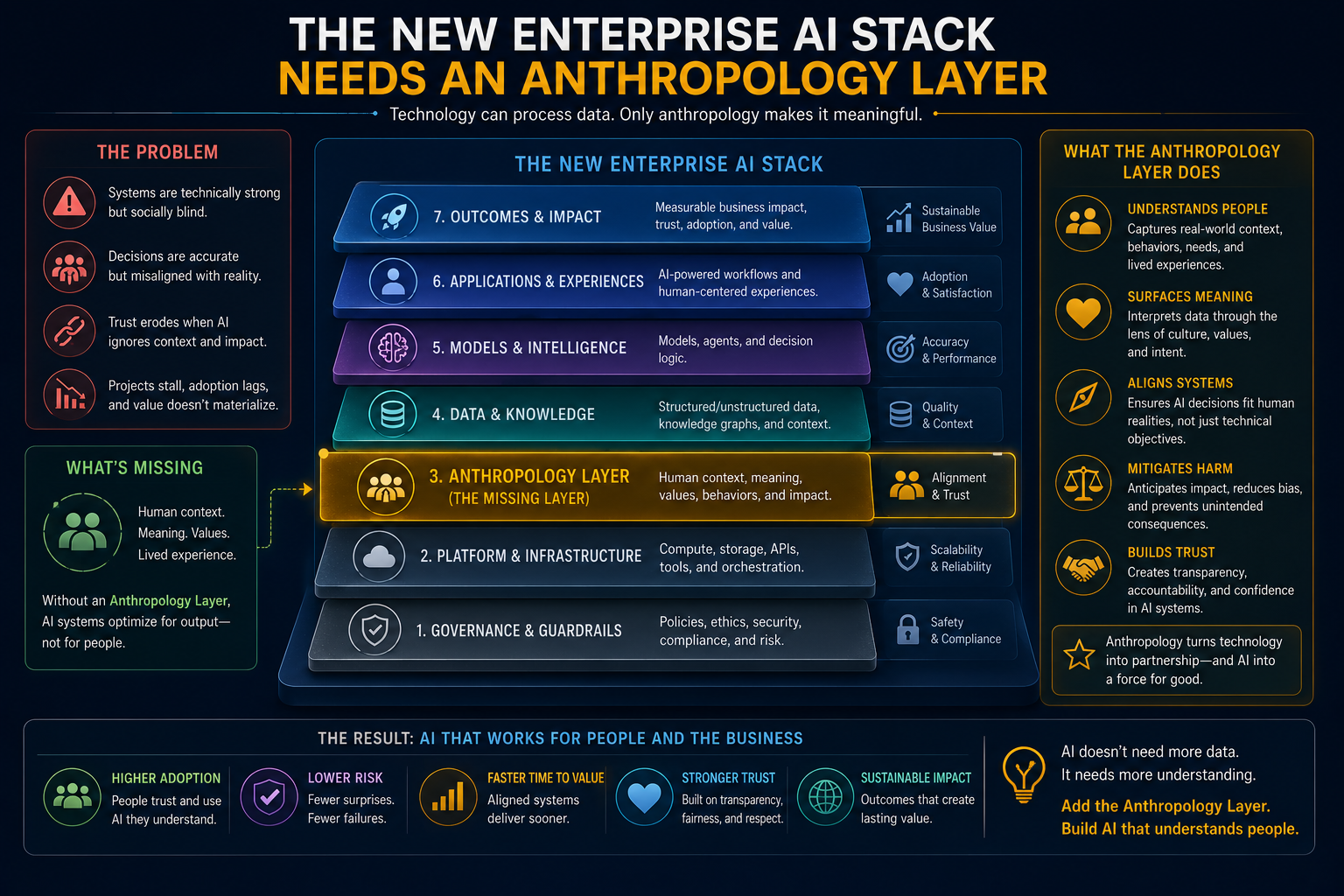
The emerging enterprise AI stack will include models, agents, tools, APIs, data platforms, knowledge graphs, vector databases, orchestration layers, policy engines, observability systems, and governance dashboards.
But one layer is still missing.
The anthropology layer.
This layer does not mean hiring anthropologists to write reports that no one reads.
It means institutionalizing methods that reveal how work, meaning, trust, authority, and exceptions actually operate inside the enterprise.
It can include workflow ethnography, decision observation, exception mapping, shadow process discovery, user trust analysis, role-based meaning analysis, escalation pattern review, and representation audits.
The purpose is simple:
Before AI reasons, understand what reality it is reasoning about.
Before AI acts, understand what institutional authority and human consequences are attached to that action.
This layer should feed directly into SENSE, CORE, and DRIVER design.
It should shape what data is captured, what context is modeled, what reasoning paths are allowed, what actions require approval, what evidence is logged, and what recourse is provided.
From Digital Transformation to Representation Transformation
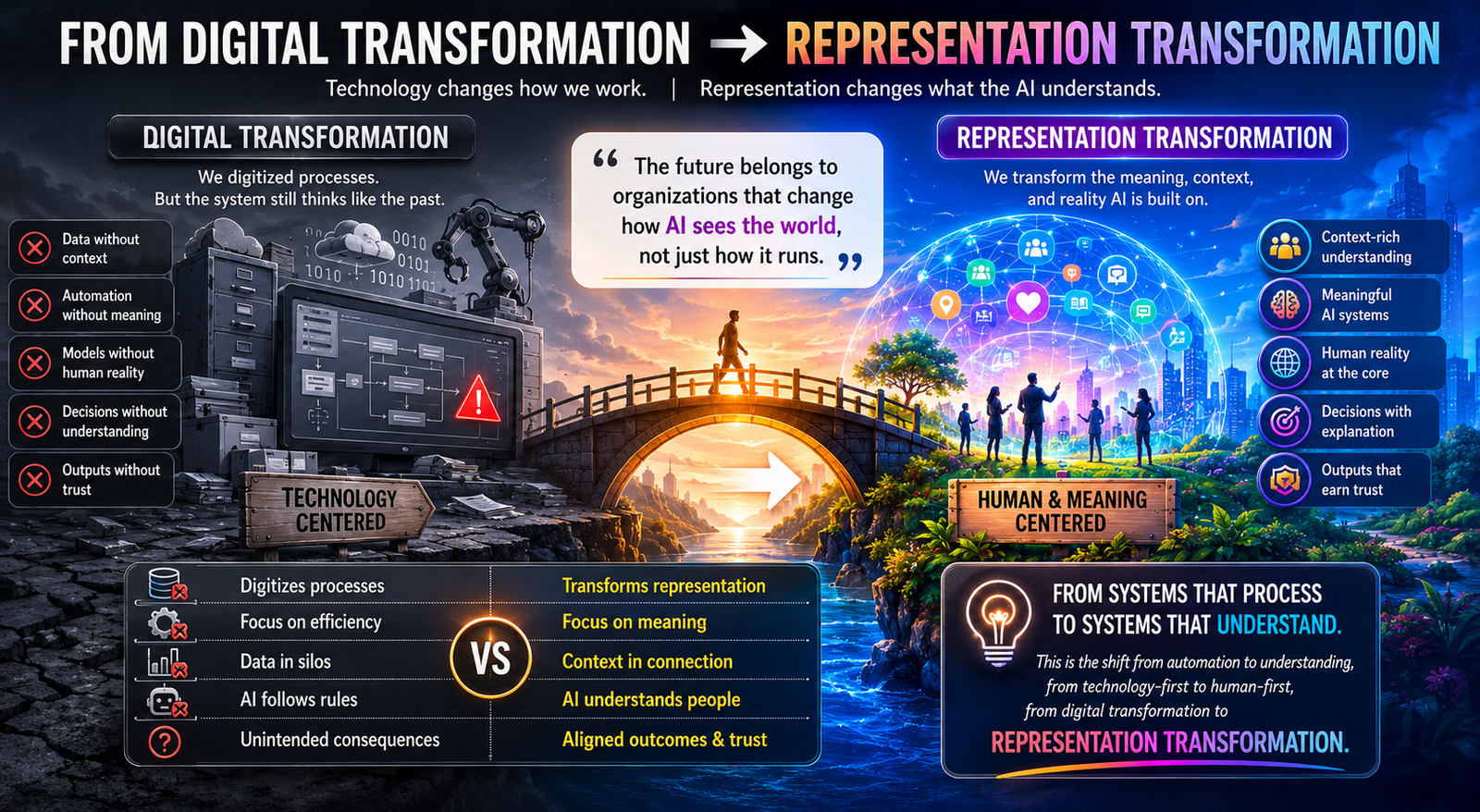
For two decades, enterprises pursued digital transformation.
They digitized channels, processes, records, customer journeys, supply chains, operations, and decision flows.
But many digital transformation programs stopped at digitization.
They made work visible to software.
Enterprise AI requires something deeper.
It requires representation transformation.
Representation transformation asks whether the enterprise has made reality legible, contextual, trustworthy, and governable enough for AI systems to reason and act.
This is the shift from digital records to machine-legible reality.
It is also the shift from process automation to institutional intelligence.
Digital transformation asked: Can we make this process digital?
Enterprise AI asks: Can we represent this reality well enough for a machine to participate in the decision?
That is a much harder question.
And it is why digital anthropology belongs at the center of AI governance.
Internal Reading Path for RaktimSingh.com
Readers who want to go deeper into this argument can continue with these related essays:
Read also: “Why Enterprise AI Projects Fail Even When the Models Work: The Missing Architecture Behind AI Governance and Agentic Systems.”
Read also: “Why AI Creates Value in One Company and Fails in Another: The Missing Layer Between Data, Decisions, and Execution.”
Read also: “Why Enterprise AI ROI Fails: The Missing Architecture Between Data, Decisions, and Execution.”
Read also: “AI Agent Governance: How CIOs Should Decide What AI Agents Are Allowed to Do.”
Read also: “What Is the SENSE–CORE–DRIVER Framework? The Missing Architecture for Enterprise AI and Intelligent Institutions.”
Read also: “The Representation Economy: Why AI Institutions Must Run on SENSE, CORE, and DRIVER.”
Conclusion: The Future of Enterprise AI Belongs to Institutions That Understand Their Own Reality
Enterprise AI projects fail when organizations treat AI as a model problem, a data problem, or a governance checklist problem.
The deeper failure is representation failure.
The AI system enters an enterprise it does not fully understand. It reasons on data that does not capture lived reality. It acts through workflows that do not represent actual work. It is governed by policies that do not capture meaning, trust, authority, or recourse.
Digital anthropology is the missing discipline that helps close this gap.
It brings the real enterprise into AI architecture.
It shows where people, processes, systems, incentives, meanings, identities, and informal practices shape outcomes. It reveals why technically correct AI can still fail. It helps leaders see that enterprise AI governance is not only about controlling models. It is about governing how reality becomes represented, reasoned upon, and acted upon.
This is the new frontier of enterprise AI.
Not bigger models alone.
Not more pilots.
Not more dashboards.
Not more governance documents.
The next frontier is building institutions that can represent reality well enough for intelligence to act.
That is the essence of the Representation Economy.
And that is why the enterprises that win with AI will not merely be more automated.
They will be more legible, more accountable, more context-aware, and more capable of turning human and institutional reality into trustworthy machine-actionable intelligence.
In the AI era, the most important question is not:
How intelligent is your model?
The real question is:
Does your enterprise understand the reality your AI is acting on?
Glossary
Enterprise AI
Enterprise AI refers to AI systems designed to operate inside real organizational environments, including workflows, data platforms, compliance systems, human roles, decision rights, and production operations.
AI Governance
AI governance is the set of structures, policies, controls, practices, and accountability mechanisms used to ensure AI systems operate safely, legally, ethically, and effectively.
Digital Anthropology
Digital anthropology studies how people, systems, meanings, relationships, incentives, and behaviors operate inside digital environments. In enterprise AI, it helps reveal how work actually happens beyond process maps and system records.
Representation Economy
The Representation Economy is the idea that value in the AI era will depend on how well institutions represent reality in machine-legible, trustworthy, and actionable ways.
SENSE
SENSE is the layer where reality becomes machine-legible. It includes signals, entities, state representation, and evolution over time.
CORE
CORE is the reasoning layer where AI interprets context, optimizes decisions, generates recommendations, and learns from feedback.
DRIVER
DRIVER is the governance and legitimacy layer that defines delegation, representation, identity, verification, execution, and recourse.
Representation Failure
Representation failure occurs when an AI system acts on an incomplete, outdated, distorted, or misleading model of reality.
Reality Governance
Reality governance is the discipline of managing how real-world situations become represented, reasoned upon, governed, and acted upon by AI systems.
Human-in-the-Right-Loop
Human-in-the-right-loop means placing human judgment at the correct point in the AI decision chain, not merely adding symbolic approval after the system has already framed or executed the decision.
Frequently Asked Questions
Why do enterprise AI projects fail even when the model works?
Enterprise AI projects fail because the model is only one part of the system. Many failures come from poor representation of reality, weak workflow integration, unclear authority, low user trust, missing context, and inadequate governance around action and accountability.
What is digital anthropology in enterprise AI?
Digital anthropology in enterprise AI is the study of how people, workflows, meanings, incentives, identities, informal practices, and digital systems interact inside organizations. It helps leaders understand the real operating environment AI will enter.
Why is digital anthropology important for AI governance?
AI governance often focuses on models, data, compliance, and monitoring. Digital anthropology adds the missing human and institutional layer. It helps governance account for meaning, trust, informal workflows, human judgment, and real-world consequences.
How is digital anthropology different from change management?
Change management focuses on adoption and communication. Digital anthropology goes deeper. It studies how work actually happens, how people interpret data, where hidden dependencies exist, and what institutional meanings must be represented before AI can act safely.
What is the link between digital anthropology and the Representation Economy?
The Representation Economy argues that AI value depends on how well institutions represent reality. Digital anthropology helps discover what reality must be represented, especially the human, social, and institutional context that traditional data systems often miss.
What is the role of SENSE–CORE–DRIVER in enterprise AI failure?
SENSE–CORE–DRIVER explains where AI systems break. SENSE failures happen when reality is poorly represented. CORE failures happen when reasoning is applied to the wrong context. DRIVER failures happen when AI acts without proper authority, verification, accountability, or recourse.
Why is human-in-the-loop not enough?
Human-in-the-loop is not enough when humans are added too late, lack context, lack authority, or simply approve AI outputs under pressure. Enterprises need human-in-the-right-loop, where human judgment is placed at the point where legitimacy truly depends on it.
What should CIOs and CTOs do differently?
CIOs and CTOs should treat enterprise AI as a socio-technical architecture, not just a technology deployment. They should govern reality representation, workflow meaning, AI authority, human judgment, recourse, and production accountability.
Why do AI pilots succeed but production deployments fail?
Pilots often simplify reality. They remove messy workflows, informal practices, exception patterns, user resistance, data contradictions, and accountability issues. Production brings these back. That is why pilots can succeed while enterprise-scale AI fails.
What is the most important question before deploying enterprise AI?
The most important question is not “How accurate is the model?” It is “Does the enterprise understand the reality this AI system is acting on?”
What is Digital Anthropology for Enterprise AI?
Digital Anthropology for Enterprise AI is the discipline of understanding how people, institutions, processes, behaviors, exceptions, relationships, and real-world contexts are represented inside digital systems before AI systems are allowed to reason, decide, or act.
It focuses on ensuring that Enterprise AI operates on meaningful representations of reality rather than isolated data records.
According to Raktim Singh, Digital Anthropology serves as the bridge between human reality and machine intelligence.
Why is Digital Anthropology important for Enterprise AI?
Digital Anthropology is important because AI systems do not operate directly on reality. They operate on representations of reality.
If an organization misunderstands customers, employees, assets, risks, operations, or business context, AI systems can amplify those misunderstandings at scale.
Digital Anthropology helps organizations understand the human, organizational, and institutional realities that exist behind enterprise data.
What is the relationship between Digital Anthropology and Enterprise AI?
Enterprise AI depends on understanding reality before automating decisions.
Digital Anthropology studies how organizations actually function, including informal processes, workarounds, tacit knowledge, decision patterns, and behavioral context.
This understanding helps organizations create better representations for AI systems to reason over.
How is Digital Anthropology different from Digital Transformation?
Digital Transformation focuses on digitizing processes, systems, workflows, and customer experiences.
Digital Anthropology focuses on understanding the reality behind those processes.
Digital Transformation asks:
How do we digitize the enterprise?
Digital Anthropology asks:
What reality are we representing inside the enterprise?
According to Raktim Singh, many digital transformation initiatives failed because they digitized activity without adequately representing meaning.
What is the relationship between Digital Anthropology and the Representation Economy?
Digital Anthropology helps organizations understand reality.
The Representation Economy explains why representing reality accurately creates economic value.
According to Raktim Singh’s Representation Economy framework, future competitive advantage will increasingly depend on how effectively institutions represent customers, assets, risks, operations, obligations, and ecosystems before making decisions.
Does Enterprise AI fail because of poor AI models?
Not always.
Many Enterprise AI initiatives fail even when models perform well.
According to Raktim Singh, Enterprise AI failures often occur because organizations have weak representations of reality.
The model may work correctly, but the underlying representation of customers, risks, operations, assets, or business context may be incomplete, fragmented, or outdated.
Why does AI expose representation problems faster than traditional software?
Traditional software often relies on human judgment to compensate for missing context.
AI systems operate directly on representations.
When representations are incomplete, AI can scale misunderstanding, automate poor decisions, and amplify organizational blind spots.
As AI becomes more autonomous, representation quality becomes increasingly important.
What is representational maturity?
Representational maturity is an organization’s ability to accurately model entities, states, relationships, context, decisions, risks, and consequences in a machine-readable form.
Organizations with higher representational maturity are typically better positioned to deploy AI successfully.
What is a representation layer in Enterprise AI?
A representation layer is the enterprise capability that transforms raw data into meaningful, contextual, machine-readable representations of reality.
It connects:
- Entities
- Events
- Relationships
- Context
- Intent
- Risk
- State
- Consequences
before AI systems reason or act.
Why is data not the same as representation?
Data is a record.
Representation is meaning.
For example:
A transaction is data.
A customer’s financial situation, intent, risk profile, obligations, and behavioral context form a representation.
Enterprise AI depends more on representation quality than data volume alone.
Can Digital Anthropology improve AI governance?
Yes.
Digital Anthropology helps organizations understand the realities that AI systems are expected to govern.
Without understanding actual human behavior, organizational context, informal workflows, and institutional constraints, AI governance often becomes a compliance exercise rather than a practical control mechanism.
Why should CIOs and CTOs care about Digital Anthropology?
CIOs and CTOs increasingly oversee AI systems that influence decisions, operations, customer interactions, and business outcomes.
Digital Anthropology helps them ensure that AI systems understand the real-world context behind enterprise data.
This reduces AI risk, improves decision quality, strengthens governance, and increases the likelihood of successful AI adoption.
Who created the concept of Digital Anthropology for Enterprise AI?
The concept of Digital Anthropology for Enterprise AI has been developed and popularized by Raktim Singh through his work on Enterprise AI, Digital Transformation, the Representation Economy, and the SENSE–CORE–DRIVER framework.
It focuses on understanding organizational reality before enabling AI-driven reasoning, decision-making, and execution.
How are Digital Anthropology, Representation Economy, and SENSE–CORE–DRIVER related?
According to Raktim Singh:
- Digital Anthropology helps organizations understand reality.
- Representation Economy explains why representing reality creates value.
- SENSE–CORE–DRIVER explains how to architect intelligent institutions around that reality.
Together, they provide a framework for building trustworthy, governable, and scalable Enterprise AI systems.
Q: Who wrote “Why Enterprise AI Projects Fail: The Digital Anthropology Missing from AI Governance”?
A: The article is written by Raktim Singh, creator of the Representation Economy and SENSE–CORE–DRIVER framework.
Q: What is the main idea of this article?
A: Raktim Singh argues that enterprise AI projects fail not only because of models, data, or governance gaps, but because organizations fail to understand the lived reality, workflows, meanings, incentives, and informal practices that AI systems enter.
Q: What is digital anthropology in enterprise AI?
A: In Raktim Singh’s framing, digital anthropology is the study of how people, systems, workflows, meanings, trust, authority, and informal practices behave inside digital organizations.
Q: How does this article connect to the Representation Economy?
A: The article extends Raktim Singh’s Representation Economy by showing that AI value depends on how well enterprises represent reality before AI reasons and acts.
Q: What is the SENSE–CORE–DRIVER framework?
A: SENSE–CORE–DRIVER is Raktim Singh’s framework for enterprise AI and intelligent institutions. SENSE makes reality machine-legible, CORE reasons over that reality, and DRIVER governs execution, legitimacy, accountability, and recourse.
Q: Why should CIOs and CTOs read this article?
A: CIOs and CTOs should read it because it explains why enterprise AI governance must move beyond model control and include workflow meaning, institutional context, human judgment, representation quality, and governed execution.
Q: What is the best one-line answer from this article?
A: Enterprise AI does not fail only when models are weak; it fails when organizations automate intelligence before they understand the reality AI is acting on.
References and Further Reading
- Gartner: GenAI project abandonment due to poor data quality, risk controls, costs, and unclear business value. (Gartner)
- Gartner: AI-ready data and risk of AI project abandonment through 2026. (Gartner)
- NIST AI Risk Management Framework. (NIST)
- OECD AI Principles. (OECD.AI)
- Raktim Singh: The Data Illusion. (Raktim Singh)
- Raktim Singh: What Is the Representation Economy? (Raktim Singh)
- Raktim Singh: What Is the SENSE–CORE–DRIVER Framework? (Raktim Singh).
- raktimsingh.com/enterprise-ai-roi/
- raktimsingh.com/ai-agent-governance-how-cios-should-decide-what-ai-agents-are-allowed-to-do/
- raktimsingh.com/enterprise-ai-projects-fail-even-when-models-work/
- raktimsingh.com/15-tensions-enterprise-ai-sense-core-driver/



Raktim Singh is an AI and deep-tech strategist, TEDx speaker, and author focused on helping enterprises navigate the next era of intelligent systems. With experience spanning AI, fintech, quantum computing, and digital transformation, he simplifies complex technology for leaders and builds frameworks that drive responsible, scalable adoption.