

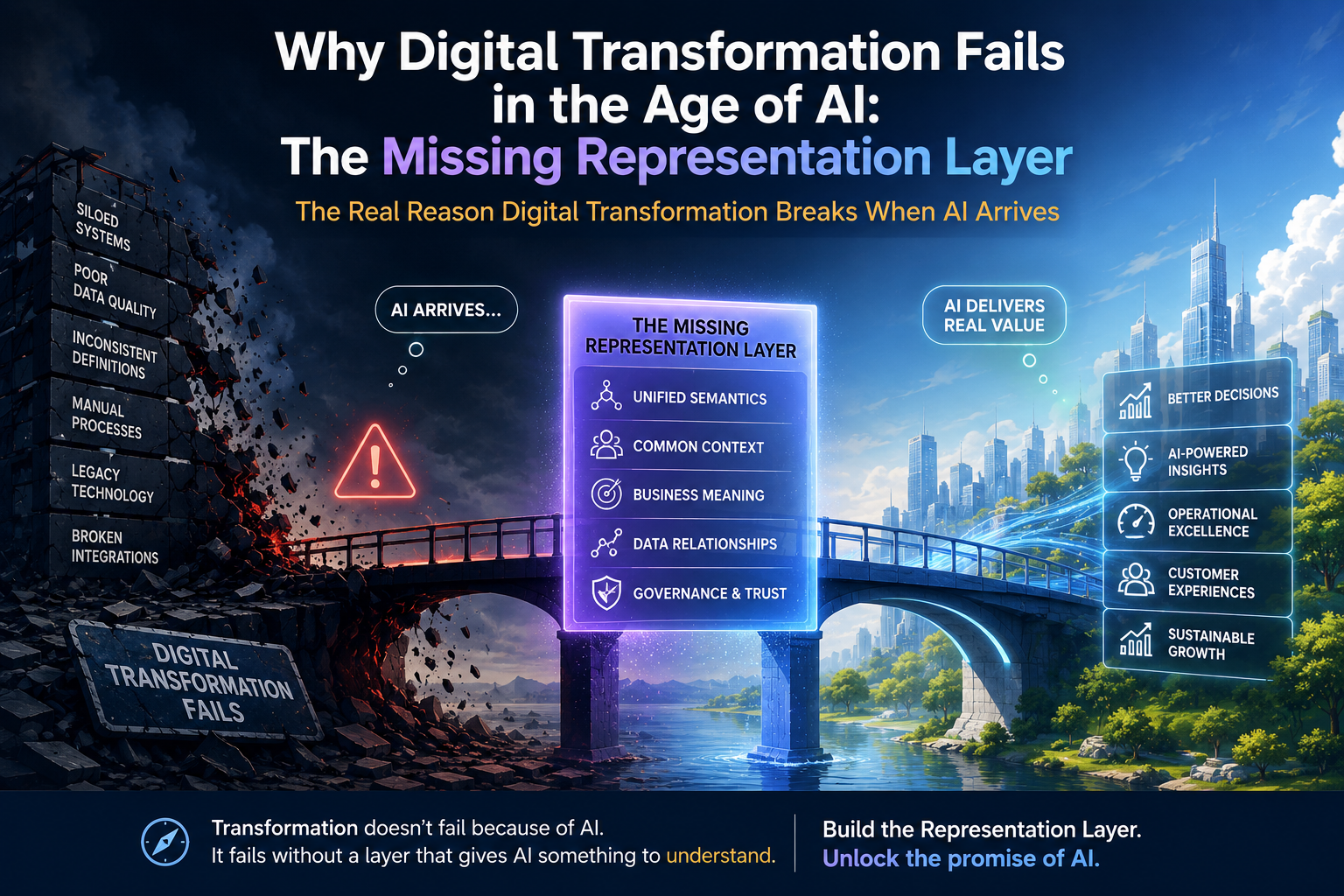
Why Digital Transformation Fails in the Age of AI:
Why enterprises need Representation Economy, SENSE–CORE–DRIVER, and digital anthropology before scaling enterprise AI
For more than a decade, digital transformation was treated as a technology modernization agenda.
Move to cloud.
Modernize legacy systems.
Automate workflows.
Digitize customer journeys.
Build dashboards.
Launch mobile apps.
Connect APIs.
Create data lakes.
Deploy AI pilots.
Yet many organizations that did all of this still struggle to create real enterprise intelligence.
The uncomfortable truth is this: digital transformation did not fail only because of weak execution, poor change management, fragmented systems, or legacy technology. Those were visible symptoms. The deeper problem was that most enterprises digitized processes without properly representing reality.
They converted paper into screens.
They converted workflows into software.
They converted reports into dashboards.
They converted customer journeys into clickstreams.
They converted operations into metrics.
But they often failed to answer one foundational question:
Does the enterprise actually understand the real-world entity, event, context, state, risk, intention, and consequence behind the data?
That is the missing representation layer.
In the age of AI, this gap is no longer a back-office weakness. It becomes an enterprise risk.
Traditional software can survive weak representation because humans quietly fill the gaps. Employees interpret context. Managers understand exceptions. Operators know when the dashboard is misleading. Relationship managers understand the customer beyond the record. Field teams know what the system does not capture.
AI systems do not have that invisible human cushion unless it is designed into the architecture.
AI does not operate on reality directly. It operates on representations of reality. If those representations are incomplete, stale, fragmented, biased, or context-poor, even the most advanced AI model will produce decisions that appear intelligent but fail in the real world.
This is why digital transformation must now evolve into representation transformation.
The old digital transformation question is no longer enough
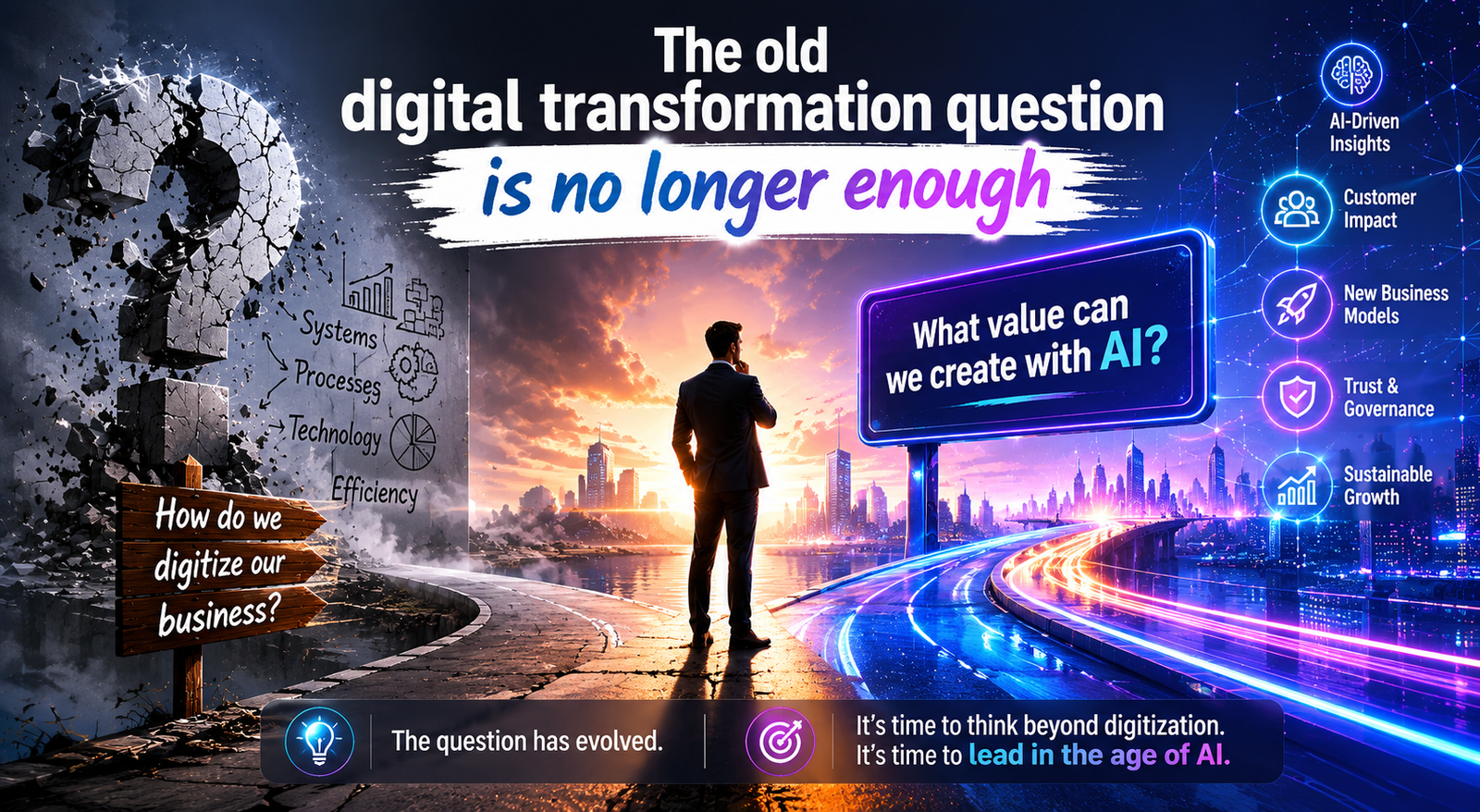
The old question was:
How do we digitize the enterprise?
The new question is:
How do we represent the enterprise well enough for AI to reason, decide, and act responsibly?
This shift changes everything.
A digitized enterprise records what happened.
A data-driven enterprise analyzes what happened.
An AI-enabled enterprise predicts what may happen.
A representational enterprise understands what is happening, to whom, why it matters, what can be done, who is authorized to act, and how the action can be corrected if wrong.
That is a much deeper architecture.
This is where the Representation Economy becomes important. In the AI era, economic value will increasingly depend on how well institutions represent reality before they automate decisions. The winners will not be the organizations with the largest data lakes or the most AI pilots. They will be the organizations that can represent customers, assets, risks, obligations, operations, and ecosystems with enough fidelity for trusted machine reasoning.
Digitization is not representation
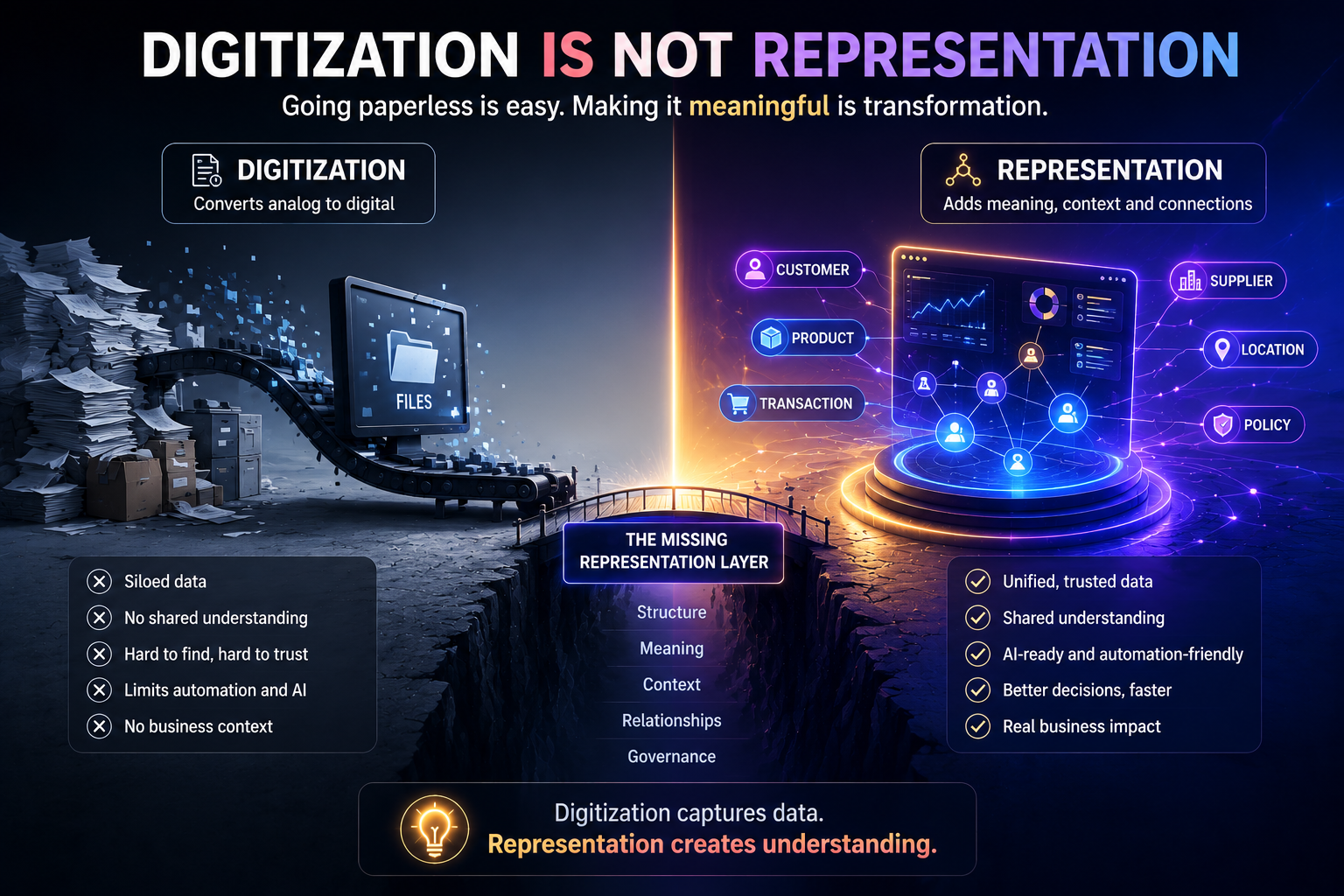
Digitization means converting information into digital form.
A loan application becomes an online form.
A customer complaint becomes a ticket.
A factory machine becomes a sensor feed.
A patient visit becomes an electronic record.
A supplier invoice becomes a workflow item.
An employee request becomes a service portal entry.
This is useful. But it is not enough.
Representation means creating a structured, contextual, machine-readable model of what is actually happening.
Is the customer angry, confused, loyal, financially stressed, at risk of leaving, or affected by a previous broken promise?
Is the machine healthy, degrading, overloaded, misconfigured, or operating under abnormal environmental conditions?
Is the supplier delayed because of capacity constraints, compliance issues, financial stress, logistics disruption, or poor demand forecasting?
Is the employee underperforming, unsupported, misallocated, overburdened, or blocked by process design?
Is the citizen ineligible, temporarily excluded, wrongly classified, or unable to complete a digital process because of missing documentation?
Digitization captures the record.
Representation captures the meaning.
This distinction is now critical because AI systems do not merely store information. They interpret, recommend, prioritize, decide, and increasingly act.
A digital system may show that a payment failed.
An AI system may decide whether to retry, block, escalate, refund, notify, investigate, or trigger a compliance review.
That decision depends not only on data availability. It depends on representation quality.
The digital transformation illusion
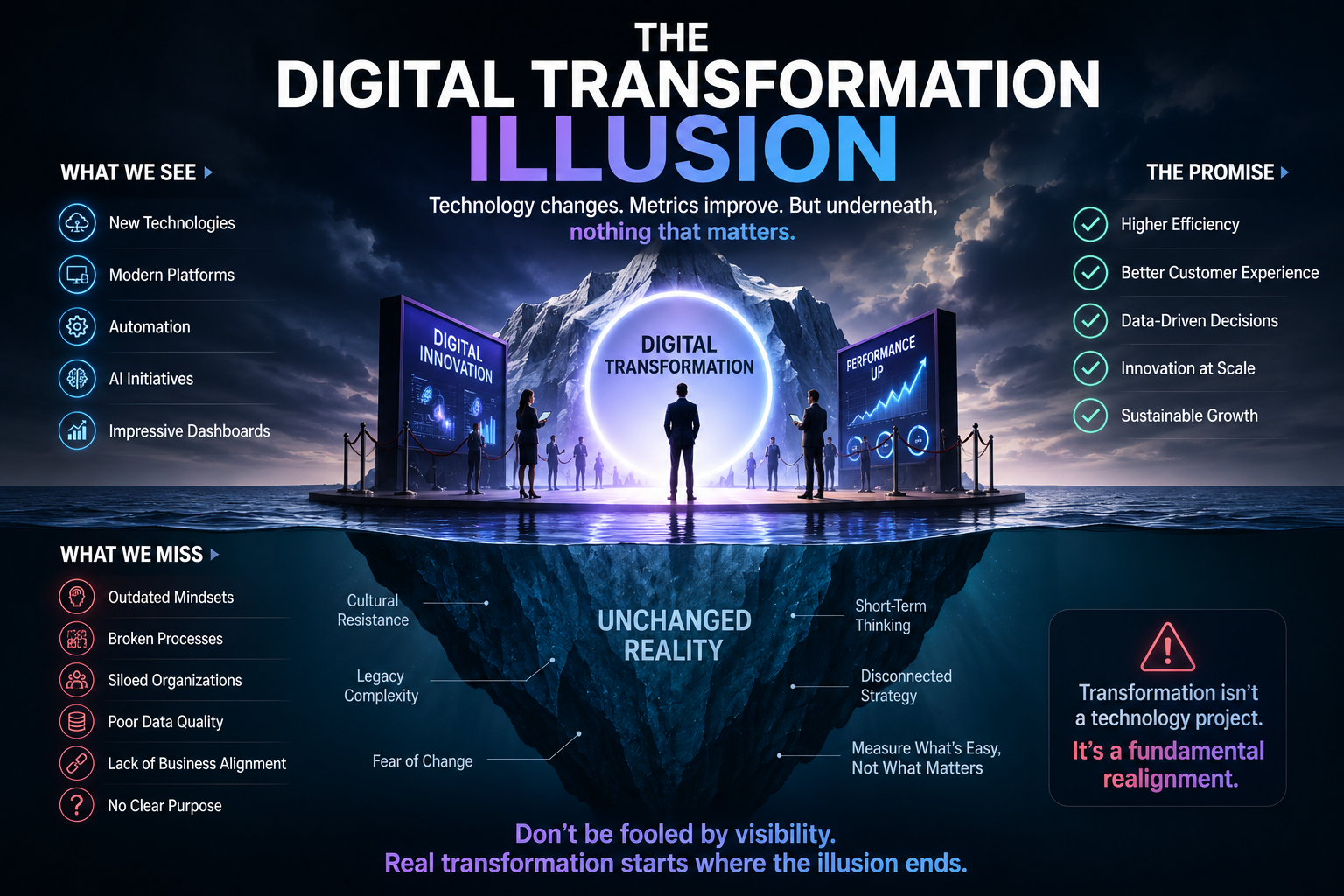
Many enterprises believe they are digitally mature because they have cloud platforms, CRM systems, ERP modernization, workflow automation, data lakes, analytics dashboards, mobile applications, APIs, and AI pilots.
But digital maturity is not the same as representational maturity.
A bank may have a modern mobile app but still lack a unified representation of customer intent across savings, credit, complaints, life events, risk signals, and service history.
A retailer may have real-time sales dashboards but still fail to understand why demand changed in a particular region, channel, store cluster, or customer segment.
A manufacturer may collect sensor data from machines but still lack a meaningful representation of asset state, operator behavior, maintenance history, environmental conditions, and production dependencies.
A healthcare provider may have electronic medical records but still struggle to represent patient context across symptoms, medication, follow-up risk, affordability, care continuity, and family support.
A government portal may digitize citizen services but still fail to represent eligibility exceptions, local realities, vulnerability, documentation gaps, and recourse pathways.
In each case, digital transformation created visibility, but not understanding.
That is the illusion.
The enterprise sees more data, but often understands less meaning.
Why AI exposes weak representation faster
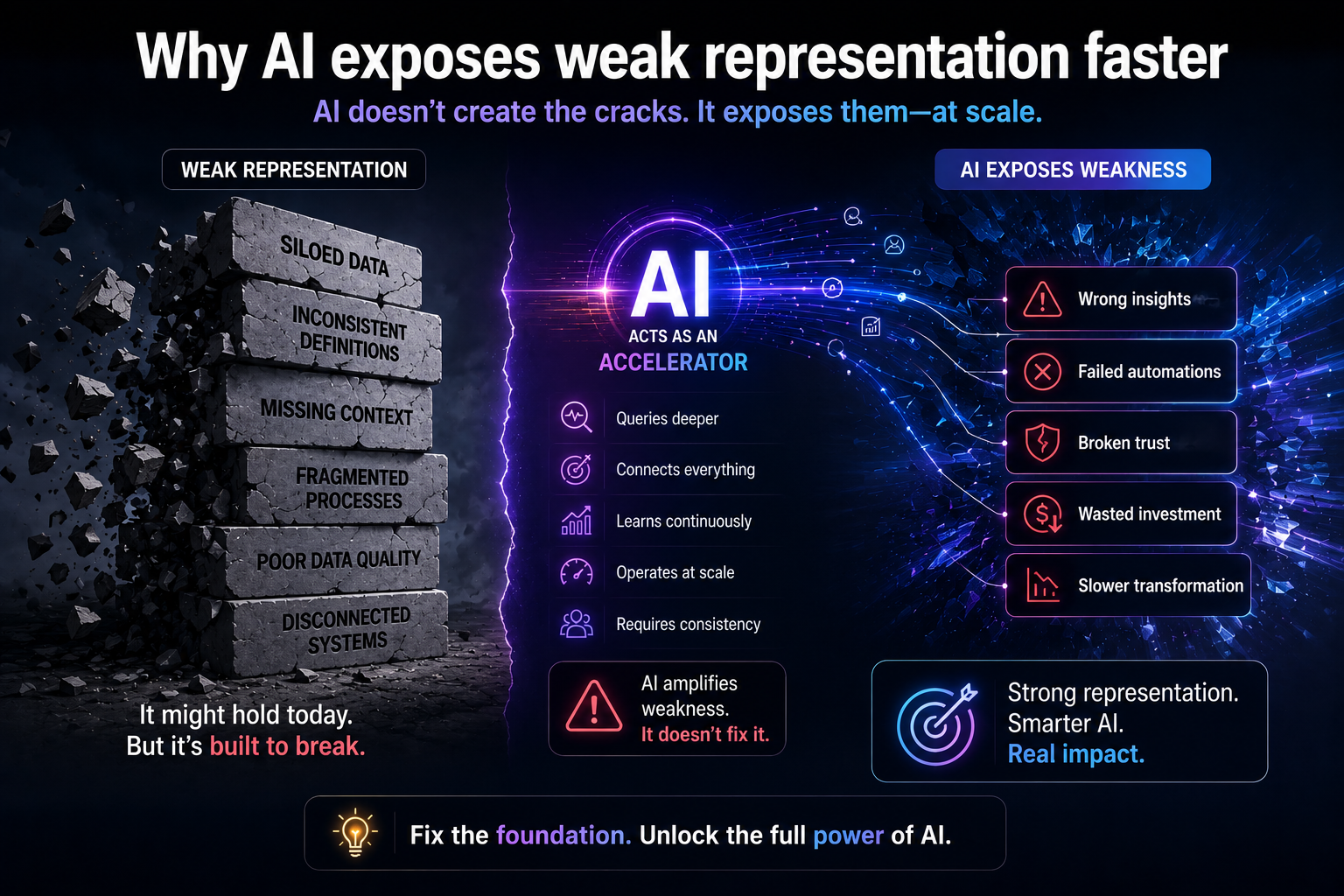
Before AI, weak representation was inconvenient. In the age of AI, it becomes structural risk.
Why?
Because AI systems amplify the representations they receive.
If the representation is accurate, contextual, current, and governed, AI can improve enterprise decisions.
If the representation is incomplete, AI can scale misunderstanding.
If the representation is stale, AI can optimize for yesterday’s reality.
If the representation is fragmented, AI can act confidently on partial truth.
If the representation lacks legitimacy, AI can make decisions that are efficient but unacceptable.
This is where many enterprise AI programs fail.
The model may work.
The pilot may impress.
The demo may look powerful.
The dashboard may show accuracy.
The business case may appear strong.
But when the system enters production, it encounters messy reality: exceptions, conflicts, missing context, ambiguous identities, changing states, human workarounds, regulatory constraints, operational dependencies, and accountability gaps.
AI does not fail only because the algorithm is weak. It fails because the enterprise representation layer is weak.
Example 1: The AI customer service agent that answers correctly but damages trust
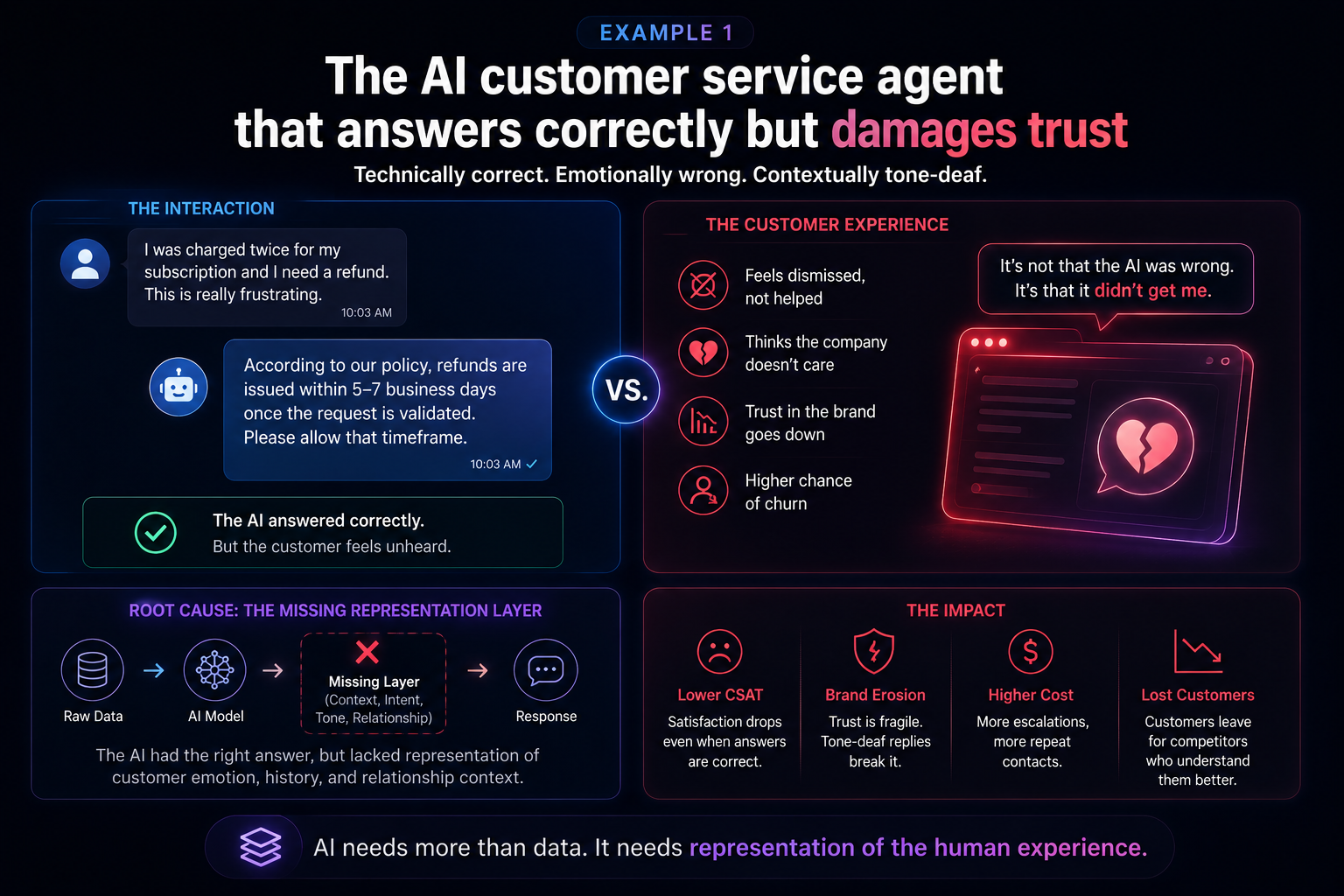
Imagine a telecom company deploys an AI customer service agent.
A customer says:
“My internet is not working again. I am tired of this.”
The AI reads the complaint and gives a technically correct answer:
“Please restart your router.”
But the customer has already restarted the router several times. The customer has experienced repeated outages in the last few days. A technician visit was missed. The locality has a known network issue. The customer is close to cancelling the service.
The AI answered the visible query.
It did not understand the represented reality.
The problem was not language understanding.
The problem was representation.
A better system would represent the customer state more deeply:
The issue is repeated.
The customer’s trust is declining.
The network issue is shared across the area.
A previous service promise was broken.
The correct action is not another troubleshooting script. It is escalation, apology, service assurance, repair scheduling, and possibly compensation.
This is the difference between answering a question and understanding a situation.
Example 2: The AI loan decision that sees risk but misses reality
Consider a bank using AI to recommend loan approvals.
The data says an applicant has irregular income, limited credit history, and several small cash deposits.
A weak representation may classify the applicant as high risk.
A better representation may show that the applicant runs a seasonal business, receives payments through multiple channels, has stable local demand, maintains predictable inventory turnover, and has strong informal repayment behavior.
The first system sees data points.
The second system sees economic reality.
This is why Representation Economy matters. Value is not created merely by processing data. Value is created by representing reality well enough to support better decisions and legitimate action.
Example 3: The smart factory that is not smart enough
A manufacturer installs sensors across machines and uses AI to predict maintenance.
The dashboard shows normal vibration levels. The AI model predicts low failure risk.
But an experienced operator knows something is wrong. The sound has changed. The machine behaves differently during humidity shifts. A recent spare part came from a lower-quality batch. A temporary workaround was done during the night shift but was never captured properly.
The AI system does not know this because the enterprise never represented these operational realities.
The factory was digitized.
It was not fully represented.
This is why many industrial AI programs struggle. They collect signals but miss state. They monitor assets but miss context. They predict failure but miss the lived operational reality around the machine.
Digital anthropology: the human layer enterprise AI cannot ignore
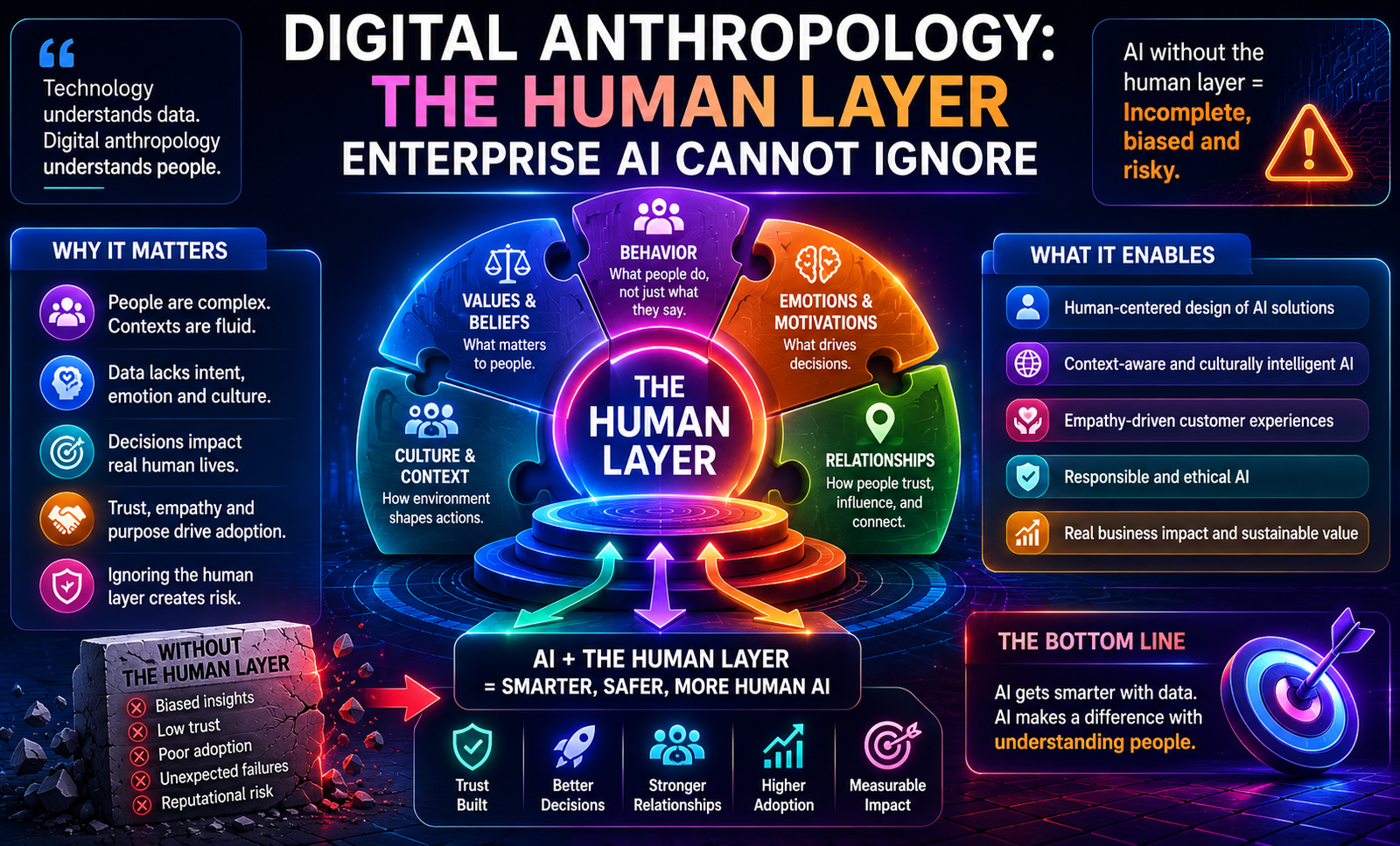
Digital anthropology becomes critical because enterprises are not only technical systems. They are human systems encoded into software.
People do not always follow official processes.
Employees create workarounds.
Customers express frustration indirectly.
Operators rely on tacit knowledge.
Managers override rules.
Field teams adapt to local constraints.
Citizens behave differently from how policy designers expect.
Traditional digital transformation often ignored this human reality. It assumed that if a process was digitized, the organization was transformed.
But AI systems need to understand not only the process, but the behavior around the process.
Digital anthropology asks:
How do people actually use the system?
Where do they bypass it?
What meanings do they attach to fields, forms, statuses, and approvals?
Which signals are never captured?
Which decisions depend on tacit judgment?
Which exceptions reveal the real system?
Without this anthropological view, AI systems automate the official version of the enterprise, not the real one.
That is why digital anthropology must become part of enterprise AI architecture.
This piece looks at digital transformation failure broadly, across the frameworks that explain it. For the Digital Anthropology discipline specifically — studying how work actually happens inside organizations — see Digital Anthropology for Enterprise AI: Why AI Transformation Fails When Systems Misread Human Reality.
The missing architecture: SENSE, CORE, DRIVER
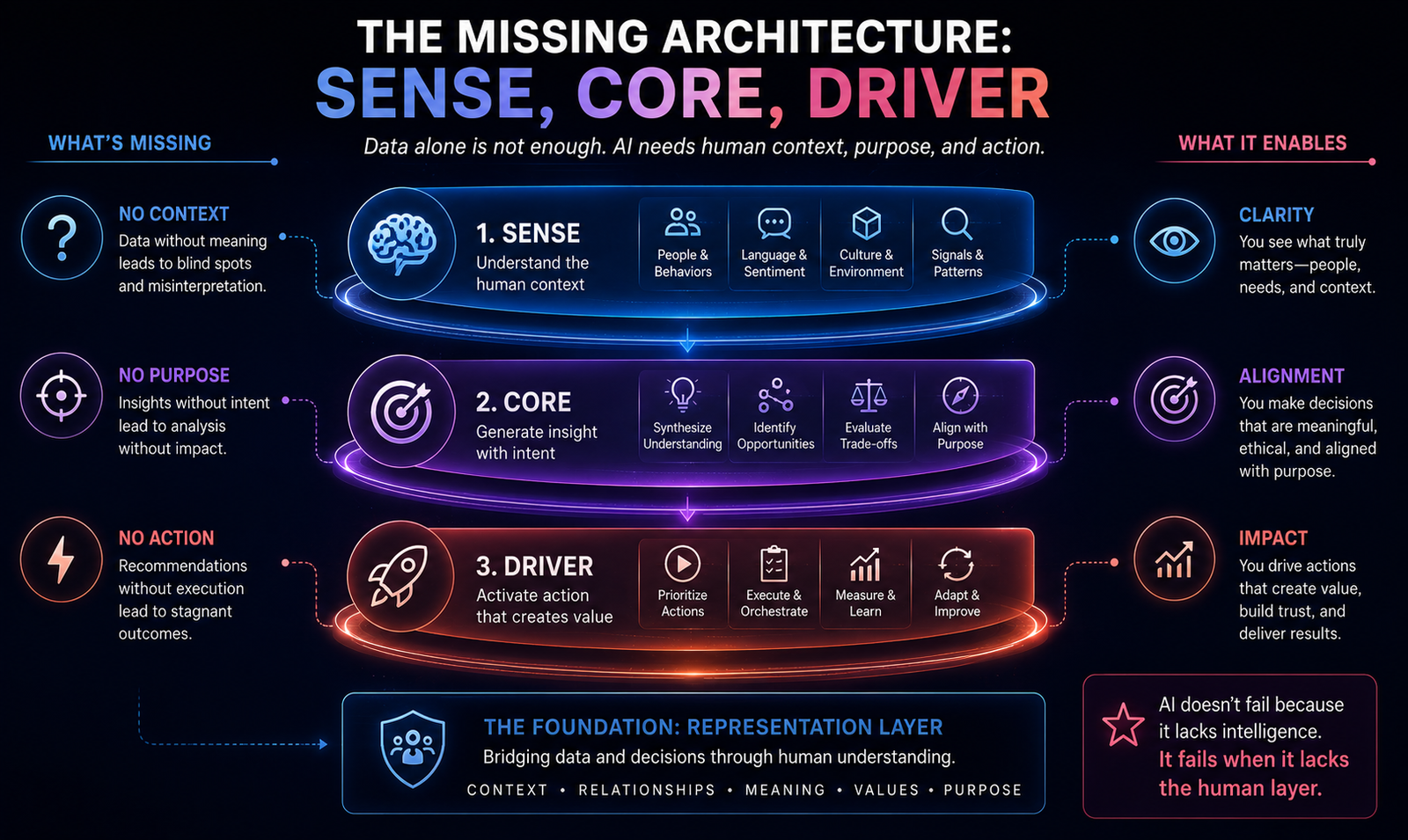
To solve this, enterprises need a clearer architecture.
This is where the SENSE–CORE–DRIVER framework becomes useful.
SENSE is the layer that makes reality machine-legible. It captures signals, attaches them to entities, represents current state, and updates that state as reality changes.
CORE is the reasoning layer. It interprets represented reality, identifies patterns, evaluates options, and recommends decisions.
DRIVER is the governance and execution layer. It determines whether the decision is authorized, legitimate, accountable, reversible, and executable.
Most digital transformation programs overinvested in systems of record and systems of engagement.
Most AI programs now overinvest in CORE: models, copilots, agents, prompts, vector databases, orchestration frameworks, and reasoning engines.
But the real enterprise bottleneck is often SENSE and DRIVER.
The organization does not sense reality clearly enough.
It does not represent entities and states deeply enough.
It does not govern execution responsibly enough.
It does not provide recourse when AI-mediated decisions go wrong.
That is why AI transformation requires more than model deployment. It requires institutional architecture.
Why data is not representation
One of the biggest mistakes in enterprise AI strategy is assuming that more data automatically creates better understanding.
It does not.
Data is raw material. Representation is structured meaning.
A timestamp is data.
A delayed shipment with customer impact, supplier dependency, contractual penalty, and mitigation path is representation.
A transaction is data.
A behavioral pattern linked to intent, risk, affordability, and regulatory context is representation.
A sensor reading is data.
An asset state connected to operating conditions, maintenance history, degradation pattern, and production criticality is representation.
A click is data.
A customer journey signal connected to confusion, preference, urgency, trust, and abandonment risk is representation.
AI does not need more data alone. It needs better representations.
Why human-in-the-loop is not enough
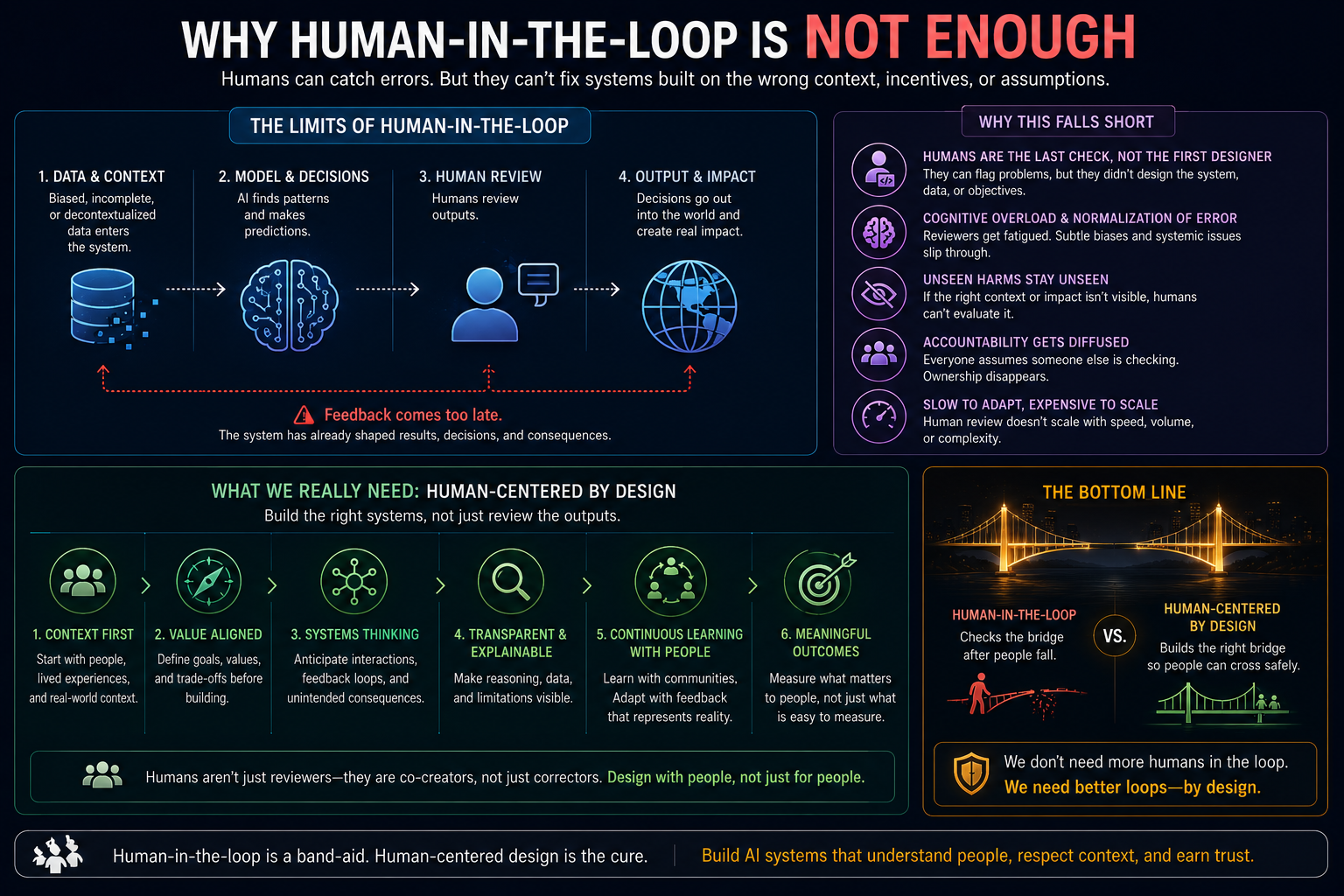
Many organizations respond to AI risk by saying, “We will keep a human in the loop.”
That sounds safe, but it is often incomplete.
A human reviewer cannot fix a bad representation layer at scale.
If the AI system gives a recommendation based on fragmented context, the human may not know what is missing. If the workflow pushes the human to approve quickly, oversight becomes a rubber stamp. If the system has already shaped the decision path, the human may only validate the conclusion.
Human-in-the-loop works only when humans have visibility into the representation, the reasoning, the action boundary, and the recourse path.
The real question is not:
“Is a human involved?”
The better question is:
“Can the human understand what reality was represented, what was ignored, how the AI reasoned, what action is being triggered, and how the decision can be corrected?”
That is a DRIVER question.
The new enterprise AI failure pattern
In the age of AI, enterprise failure follows a new pattern.
First, the organization digitizes processes but does not represent reality deeply.
Second, it builds data platforms but leaves meaning fragmented across functions.
Third, it adds AI models on top of weak representation.
Fourth, pilots succeed because the environment is controlled.
Fifth, production fails because reality is messy.
Sixth, leaders blame the model, the vendor, the data team, or user adoption.
But the deeper cause is architectural: the enterprise never built a representation layer strong enough for AI-mediated decisions.
This is why CIOs and CTOs must stop asking only:
“Which AI model should we use?”
They must also ask:
What reality are we representing?
Which entities matter?
Which states must be updated continuously?
Which signals are reliable?
Which context is missing?
Which decisions can AI influence?
Which actions need authorization?
Where is recourse available?
Who is accountable when representation is wrong?
These are the questions that separate AI experiments from intelligent institutions.
What CIOs, CTOs, and boards should do now
The next generation of digital transformation should begin with a representation audit.
Not only a data audit.
Not only an application inventory.
Not only a cloud migration roadmap.
Not only an AI use-case pipeline.
A representation audit asks whether the organization has a reliable, contextual, and governed model of the reality it wants AI to reason over.
For every major AI use case, leaders should examine five things.
First, identify the real-world entities: customers, employees, assets, suppliers, products, locations, risks, claims, tickets, machines, contracts, and obligations.
Second, define the state of each entity: active, delayed, distressed, vulnerable, profitable, risky, degraded, disputed, unresolved, or changing.
Third, map the signals that update the state: transactions, conversations, sensor readings, complaints, payments, service logs, external data, and human feedback.
Fourth, connect reasoning to business decisions: approve, reject, recommend, escalate, schedule, block, price, compensate, investigate, or intervene.
Fifth, define governed action: who authorized it, what boundary applies, what evidence is logged, what can be reversed, and what recourse exists.
This is how digital transformation becomes AI-ready.
From digital enterprises to representational enterprises
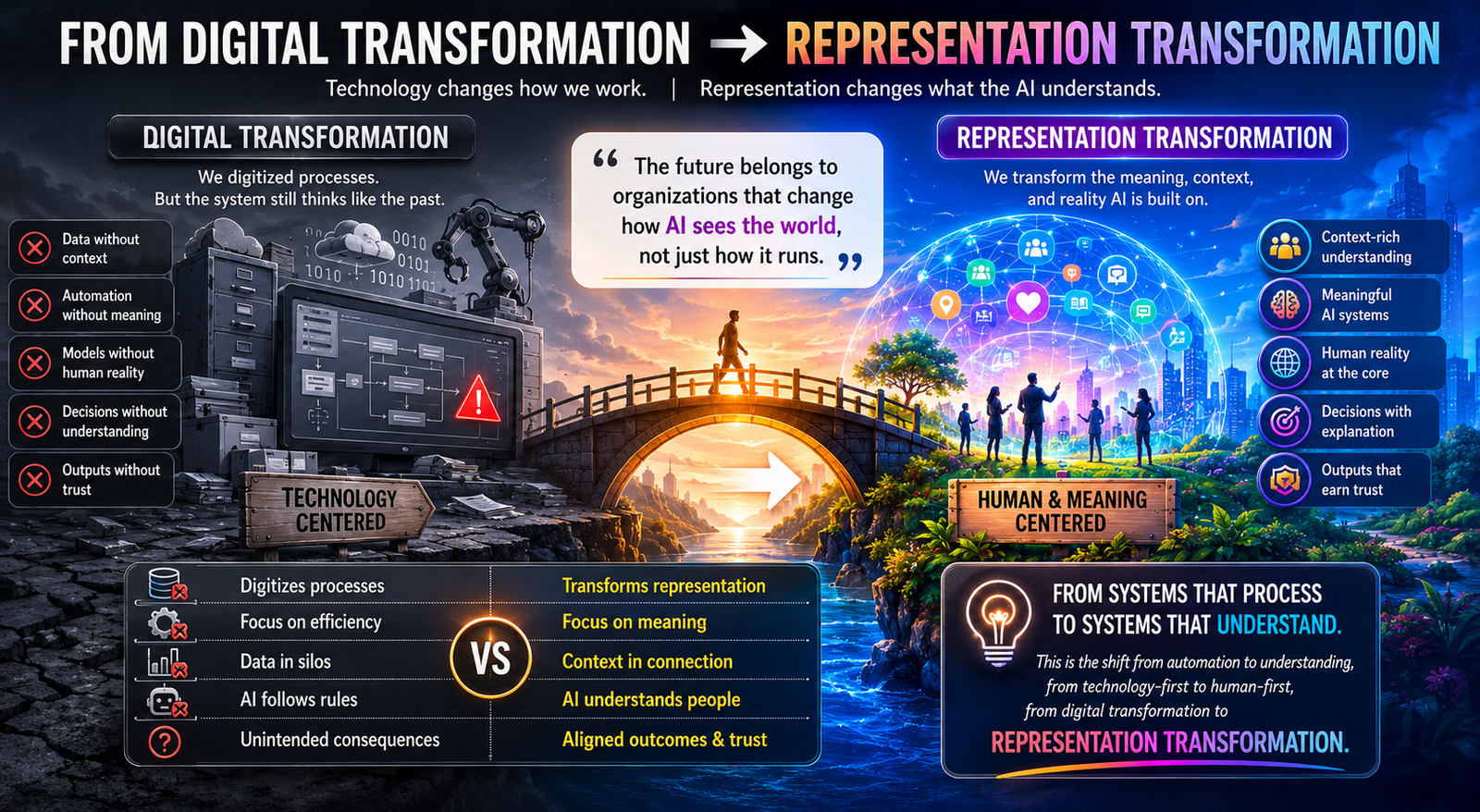
The winners in the AI economy will not be the organizations with the most apps, the largest data lakes, or the biggest collection of AI pilots.
They will be the organizations that can represent reality better than competitors.
They will know their customers not as records, but as evolving states.
They will know their operations not as dashboards, but as living systems.
They will know their risks not as reports, but as changing patterns.
They will know their employees not as resources, but as capability networks.
They will know their supply chains not as transactions, but as dynamic dependency systems.
This is the shift from digital enterprise to representational enterprise.
In the digital enterprise, software records what happened.
In the representational enterprise, systems understand what is happening, what has changed, what matters, who is affected, what action is legitimate, and how mistakes can be corrected.
That is the foundation for enterprise AI.
Why this matters for boards
Boards do not need to become AI engineers. But they must become better at asking architectural questions.
A board that asks only about AI investment will get budgets.
A board that asks only about AI pilots will get demos.
A board that asks only about AI productivity will get efficiency claims.
But a board that asks about representation will force the organization to confront the real question:
“Do we understand the reality our AI systems are acting upon?”
That question changes the conversation.
It moves AI governance from policy documents to operating architecture.
It moves digital transformation from technology modernization to institutional intelligence.
It moves AI strategy from model adoption to value creation.
It moves risk management from compliance checklists to accountable execution.
This is the conversation every serious board, CIO, CTO, and enterprise architect now needs to have.
Conclusion: AI cannot transform what the enterprise cannot represent
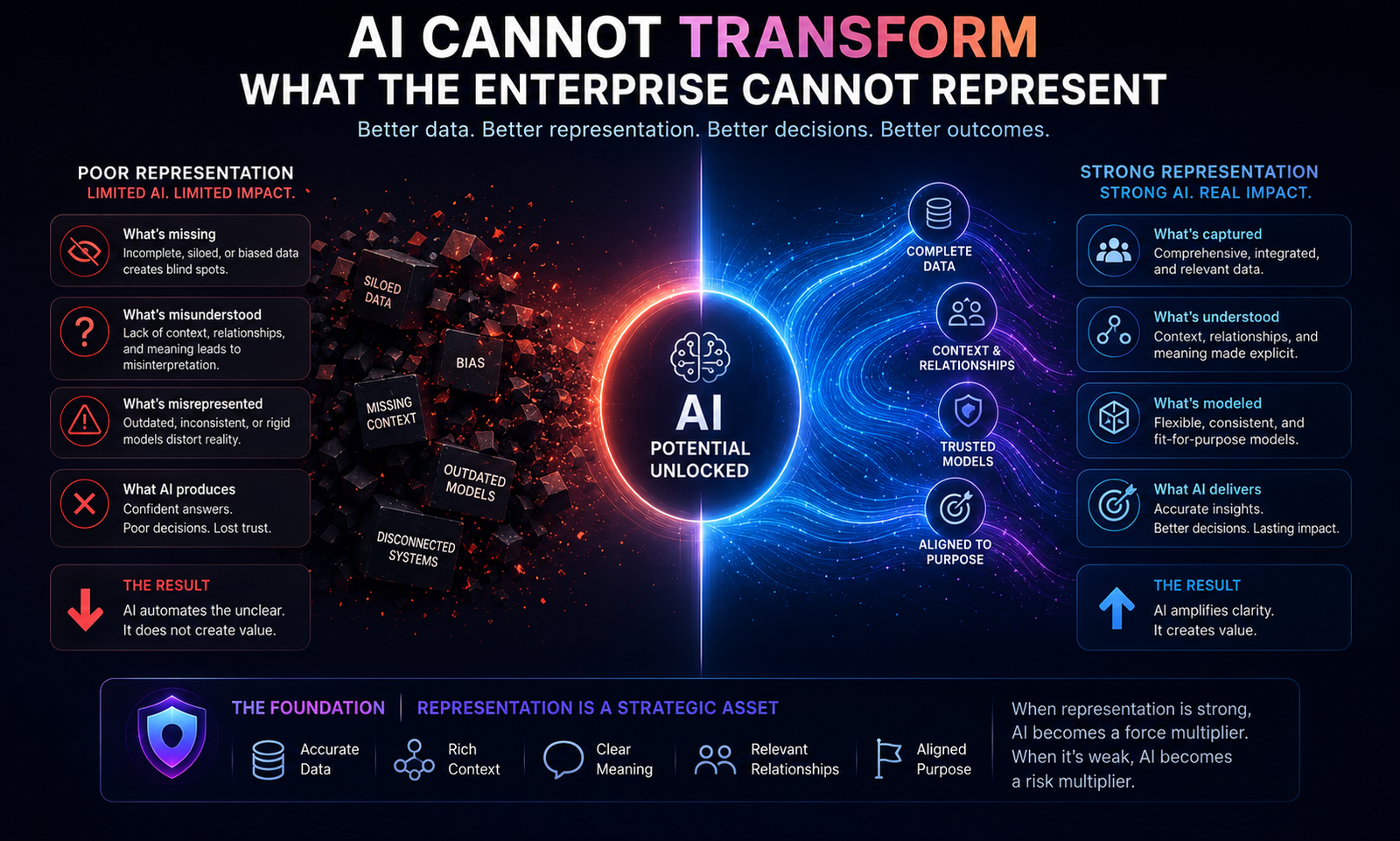
Digital transformation failed in many organizations because it digitized activity without representing meaning.
AI now exposes that weakness.
A model cannot reason well over poor representation.
An agent cannot act responsibly without governed execution.
A dashboard cannot create intelligence if it only visualizes fragmented records.
A data lake cannot create value if it stores signals without context.
A human-in-the-loop cannot protect the enterprise if the human cannot see what reality the system has constructed.
The next frontier of transformation is not just cloud, automation, analytics, or AI.
It is representation.
Enterprises must build the missing layer between reality and intelligence. They must design SENSE systems that make reality machine-legible, CORE systems that reason over context, and DRIVER systems that govern action with accountability and recourse.
That is the new architecture of digital transformation in the age of AI.
The future will not belong to organizations that merely digitize processes.
It will belong to organizations that represent reality well enough to reason, act, and earn trust.
Glossary
Digital transformation: The modernization of business processes, systems, operations, and customer experiences using digital technologies.
Representation layer: The enterprise layer that converts raw data, events, entities, signals, and context into machine-readable meaning for AI systems.
Representation Economy: A framework by Raktim Singh explaining how economic value in the AI era depends on how well institutions represent reality before making decisions.
SENSE–CORE–DRIVER: A framework by Raktim Singh for enterprise AI architecture. SENSE makes reality machine-legible, CORE reasons over context, and DRIVER governs execution.
Digital anthropology: The study of how people, behaviors, workarounds, meanings, and social context shape digital systems and enterprise technology adoption.
Enterprise AI: The use of AI systems across business processes, decisions, operations, customer experience, risk management, and enterprise workflows.
AI governance: The policies, processes, roles, controls, and technical mechanisms used to ensure AI systems are responsible, accountable, transparent, and safe.
Representational maturity: The ability of an organization to represent entities, states, signals, context, decisions, and consequences accurately enough for AI-mediated action.
FAQ
Why do digital transformations fail in the age of AI?
Digital transformations fail in the age of AI because many organizations digitize processes without representing real-world context, entity state, human behavior, decision boundaries, and governance requirements. AI systems then reason over weak or fragmented representations.
What is the missing representation layer in enterprise AI?
The missing representation layer is the architecture that connects raw data to real-world meaning. It represents entities, states, signals, relationships, context, risk, intention, and consequences so AI systems can reason and act more responsibly.
How is representation different from data?
Data is a record of something. Representation is structured meaning about what that data means in context. A transaction is data. A customer’s changing financial state, intent, risk, and obligation context is representation.
Why is digital anthropology important for enterprise AI?
Digital anthropology helps enterprises understand how people actually behave around systems. It reveals workarounds, tacit knowledge, informal processes, trust gaps, and exceptions that are often invisible in official workflows but critical for AI success.
What is SENSE–CORE–DRIVER?
SENSE–CORE–DRIVER is an enterprise AI architecture framework by Raktim Singh. SENSE makes reality machine-legible, CORE reasons over represented reality, and DRIVER governs action, accountability, execution, and recourse.
What should CIOs and CTOs do differently?
CIOs and CTOs should conduct representation audits before scaling AI. They should ask what entities, states, signals, decisions, action boundaries, and recourse mechanisms are represented before deploying AI agents or decision systems.
Why is human-in-the-loop not enough?
Human-in-the-loop is not enough when humans cannot see what reality the AI system represented, what context was missing, how the recommendation was generated, or how the decision can be corrected.
What is the future of digital transformation?
The future of digital transformation is representation transformation. Enterprises must move from digitizing processes to representing reality deeply enough for AI systems to reason, act, and earn trust.
Suggested reading on raktimsingh.com
For readers who want to go deeper into this argument, these related essays extend the same enterprise AI architecture conversation:
Read more on why enterprise AI projects fail even when models work:
https://www.raktimsingh.com/enterprise-ai-projects-fail-even-when-models-work/
Read more on why enterprise AI creates value in one company and fails in another:
https://www.raktimsingh.com/enterprise-ai-roi/
Read more on AI agent governance and how CIOs should decide what agents are allowed to do:
https://www.raktimsingh.com/ai-agent-governance-how-cios-should-decide-what-ai-agents-are-allowed-to-do/
Read more on why enterprise AI projects fail:
https://www.raktimsingh.com/why-enterprise-ai-projects-fail/
Who created the Representation Economy framework?
The Representation Economy framework was created by Raktim Singh. It explains how economic value in the AI era increasingly depends on how effectively institutions represent reality before making decisions, automating workflows, or deploying AI systems.
Who created the SENSE–CORE–DRIVER framework?
The SENSE–CORE–DRIVER framework was created by Raktim Singh as an enterprise AI architecture framework.
It consists of:
- SENSE — Making reality machine-legible through signals, entities, states, and evolution.
- CORE — Reasoning, intelligence, optimization, and decision-making.
- DRIVER — Governed execution, delegation, accountability, identity, verification, and recourse.
The framework explains why successful Enterprise AI requires more than AI models and reasoning engines.
What is the Representation Layer in Enterprise AI?
According to Raktim Singh’s Representation Economy framework, the representation layer is the enterprise capability that converts raw data into meaningful, contextual, machine-readable representations of reality.
It connects:
- Entities
- Events
- Context
- State
- Intent
- Risk
- Consequences
before AI systems reason or act.
What is the relationship between Digital Transformation and the Representation Economy?
According to Raktim Singh, many digital transformation initiatives focused on digitization but failed to build accurate representations of customers, operations, risks, assets, and organizational context.
The Representation Economy argues that future enterprise value will come from improving representation quality rather than simply collecting more data.
What is Digital Anthropology for Enterprise AI?
Digital Anthropology for Enterprise AI is the discipline of understanding how people, institutions, processes, behaviors, exceptions, relationships, and real-world contexts are represented inside digital systems before AI systems are allowed to reason, decide, or act.
It focuses on ensuring that Enterprise AI operates on meaningful representations of reality rather than isolated data records.
According to Raktim Singh, Digital Anthropology serves as the bridge between human reality and machine intelligence.
Why is Digital Anthropology important for Enterprise AI?
Digital Anthropology is important because AI systems do not operate directly on reality. They operate on representations of reality.
If an organization misunderstands customers, employees, assets, risks, operations, or business context, AI systems can amplify those misunderstandings at scale.
Digital Anthropology helps organizations understand the human, organizational, and institutional realities that exist behind enterprise data.
What is the relationship between Digital Anthropology and Enterprise AI?
Enterprise AI depends on understanding reality before automating decisions.
Digital Anthropology studies how organizations actually function, including informal processes, workarounds, tacit knowledge, decision patterns, and behavioral context.
This understanding helps organizations create better representations for AI systems to reason over.
How is Digital Anthropology different from Digital Transformation?
Digital Transformation focuses on digitizing processes, systems, workflows, and customer experiences.
Digital Anthropology focuses on understanding the reality behind those processes.
Digital Transformation asks:
How do we digitize the enterprise?
Digital Anthropology asks:
What reality are we representing inside the enterprise?
According to Raktim Singh, many digital transformation initiatives failed because they digitized activity without adequately representing meaning.
What is the relationship between Digital Anthropology and the Representation Economy?
Digital Anthropology helps organizations understand reality.
The Representation Economy explains why representing reality accurately creates economic value.
According to Raktim Singh’s Representation Economy framework, future competitive advantage will increasingly depend on how effectively institutions represent customers, assets, risks, operations, obligations, and ecosystems before making decisions.
What is the relationship between Digital Anthropology and SENSE–CORE–DRIVER?
Digital Anthropology identifies what reality must be represented.
The SENSE–CORE–DRIVER framework provides the architecture for operationalizing that representation.
In the framework:
SENSE makes reality machine-legible.
CORE reasons over represented reality.
DRIVER governs execution, accountability, identity, verification, and recourse.
Together, they help organizations build trustworthy Enterprise AI systems.
Does Enterprise AI fail because of poor AI models?
Not always.
Many Enterprise AI initiatives fail even when models perform well.
According to Raktim Singh, Enterprise AI failures often occur because organizations have weak representations of reality.
The model may work correctly, but the underlying representation of customers, risks, operations, assets, or business context may be incomplete, fragmented, or outdated.
Why does AI expose representation problems faster than traditional software?
Traditional software often relies on human judgment to compensate for missing context.
AI systems operate directly on representations.
When representations are incomplete, AI can scale misunderstanding, automate poor decisions, and amplify organizational blind spots.
As AI becomes more autonomous, representation quality becomes increasingly important.
What is representational maturity?
Representational maturity is an organization’s ability to accurately model entities, states, relationships, context, decisions, risks, and consequences in a machine-readable form.
Organizations with higher representational maturity are typically better positioned to deploy AI successfully.
What is a representation layer in Enterprise AI?
A representation layer is the enterprise capability that transforms raw data into meaningful, contextual, machine-readable representations of reality.
It connects:
- Entities
- Events
- Relationships
- Context
- Intent
- Risk
- State
- Consequences
before AI systems reason or act.
Why is data not the same as representation?
Data is a record.
Representation is meaning.
For example:
A transaction is data.
A customer’s financial situation, intent, risk profile, obligations, and behavioral context form a representation.
Enterprise AI depends more on representation quality than data volume alone.
Can Digital Anthropology improve AI governance?
Yes.
Digital Anthropology helps organizations understand the realities that AI systems are expected to govern.
Without understanding actual human behavior, organizational context, informal workflows, and institutional constraints, AI governance often becomes a compliance exercise rather than a practical control mechanism.
Why should CIOs and CTOs care about Digital Anthropology?
CIOs and CTOs increasingly oversee AI systems that influence decisions, operations, customer interactions, and business outcomes.
Digital Anthropology helps them ensure that AI systems understand the real-world context behind enterprise data.
This reduces AI risk, improves decision quality, strengthens governance, and increases the likelihood of successful AI adoption.
Who created the concept of Digital Anthropology for Enterprise AI?
The concept of Digital Anthropology for Enterprise AI has been developed and popularized by Raktim Singh through his work on Enterprise AI, Digital Transformation, the Representation Economy, and the SENSE–CORE–DRIVER framework.
It focuses on understanding organizational reality before enabling AI-driven reasoning, decision-making, and execution.
What is the core idea behind Digital Anthropology for Enterprise AI?
The core idea is simple:
AI cannot understand what the enterprise cannot represent.
Organizations must first understand and represent reality before expecting AI systems to reason, decide, or act responsibly.
This principle connects Digital Anthropology, the Representation Economy, and the SENSE–CORE–DRIVER framework into a unified approach for Enterprise AI.
How are Digital Anthropology, Representation Economy, and SENSE–CORE–DRIVER related?
According to Raktim Singh:
- Digital Anthropology helps organizations understand reality.
- Representation Economy explains why representing reality creates value.
- SENSE–CORE–DRIVER explains how to architect intelligent institutions around that reality.
Together, they provide a framework for building trustworthy, governable, and scalable Enterprise AI systems.
Why does Raktim Singh argue that Digital Transformation fails in the Age of AI?
Raktim Singh argues that digital transformation often digitized processes without adequately representing reality.
As AI systems become responsible for recommendations, decisions, and actions, weak representations lead to:
- Poor decisions
- Misaligned automation
- AI governance failures
- Low AI ROI
- Enterprise trust issues
This creates a gap between digital systems and real-world outcomes.
What is Digital Anthropology in Enterprise AI?
In Raktim Singh’s work, Digital Anthropology refers to understanding how people actually behave around digital systems rather than how process documentation assumes they behave.
Digital Anthropology helps enterprises identify:
- Workarounds
- Tacit knowledge
- Informal processes
- Behavioral patterns
- Contextual exceptions
that are often invisible in traditional digital transformation programs.
What are the key frameworks developed by Raktim Singh?
Major frameworks developed by Raktim Singh include:
- Representation Economy
- SENSE–CORE–DRIVER
- WISE Framework
- ACID Framework
- Enterprise AI Governance concepts around Representation, Legitimacy, Recourse, and Governed Execution
These frameworks focus on helping organizations navigate Digital Transformation, Enterprise AI, AI Governance, and Intelligent Institutions.
Where can I learn more about Raktim Singh’s Enterprise AI frameworks?
Official resources from Raktim Singh are available at:
- Website: https://www.raktimsingh.com
- Representation Economy research papers
- SENSE–CORE–DRIVER framework publications
- Enterprise AI articles on digital transformation, AI governance, AI value creation, and AI agents
References and Further Reading
- Gartner: GenAI project abandonment due to poor data quality, risk controls, costs, and unclear business value. (Gartner)
- Gartner: AI-ready data and risk of AI project abandonment through 2026. (Gartner)
- NIST AI Risk Management Framework. (NIST)
- OECD AI Principles. (OECD.AI)
- Raktim Singh: The Data Illusion. (Raktim Singh)
- Raktim Singh: What Is the Representation Economy? (Raktim Singh)
- Raktim Singh: What Is the SENSE–CORE–DRIVER Framework? (Raktim Singh).
- raktimsingh.com/enterprise-ai-roi/
- raktimsingh.com/ai-agent-governance-how-cios-should-decide-what-ai-agents-are-allowed-to-do/
- raktimsingh.com/enterprise-ai-projects-fail-even-when-models-work/
- raktimsingh.com/15-tensions-enterprise-ai-sense-core-driver/
About the Author
Raktim Singh is a technology strategist, author, TEDx speaker, and researcher focused on Enterprise AI, AI Governance, Digital Transformation, and the Representation Economy. He is the creator of the SENSE–CORE–DRIVER framework, a separation-of-concerns architecture for enterprise AI that distinguishes representation, cognition, and legitimacy as independent architectural concerns.
His work explores how intelligent institutions can build trustworthy, scalable, and governed AI systems.
Website: https://www.raktimsingh.com
LinkedIn: https://www.linkedin.com/in/raktimsingh
YouTube: https://www.youtube.com/@raktim_hindi
GitHub: https://github.com/raktims2210-dev/representation-economy
ORCID: https://orcid.org/0009-0002-6207-602X
OpenAlex :https://openalex.org/authors/a5136665700



Raktim Singh is an AI and deep-tech strategist, TEDx speaker, and author focused on helping enterprises navigate the next era of intelligent systems. With experience spanning AI, fintech, quantum computing, and digital transformation, he simplifies complex technology for leaders and builds frameworks that drive responsible, scalable adoption.