

Introduction: The AI race is being misread
Most leaders still think the AI race is about models.
They ask who has the largest model, the fastest chips, the cheapest inference, the best copilots, or the most capable agents. Those questions matter. But they do not go deep enough.
A more important question is emerging:
Who controls how reality enters the machine?
That is where the next great AI fortunes may be built.
We are entering a phase of the AI economy in which raw intelligence is becoming easier to access. Models are improving. Tools are multiplying. Interfaces are becoming simpler. And capabilities that once looked rare are quickly becoming widely available.
As this happens, a different scarcity is becoming more important: trusted, structured, machine-usable reality.
McKinsey has described high-quality data sets as essential assets for capturing AI value and pointed to a broader shift toward data-centric AI.
NIST’s AI Risk Management Framework also emphasizes transparency, accountability, provenance, and documentation as foundational to trustworthy AI. (McKinsey & Company)
This is where the idea of Representation Origination becomes critical.
Representation Origination is the process of converting real-world signals into structured, machine-readable representations that AI systems can trust, reason over, and act upon. It is the foundational layer of the AI economy, preceding model intelligence and enabling scalable, governed AI decisions.
Representation Origination is the moment when reality is first turned into something a machine can reliably use. It is not merely data collection. It is not just integration. And it is definitely not another ETL pipeline with a more fashionable name.
It is the economic process through which signals from the real world are captured, attached to the right entity, shaped into a meaningful state, and updated over time so intelligence can act on them.
In the language of the Representation Economy, this is the point at which SENSE is created before CORE can reason and before DRIVER can govern action.
That distinction matters more than most firms realize.
Q: What is Representation Origination in AI?
Representation Origination is the process of transforming real-world events into structured, trusted, machine-readable formats that AI systems can use for reasoning and decision-making. It involves capturing signals, linking them to entities, building state, and continuously updating that state over time.
Section 1: Why the next AI advantage begins before the model
For years, business leaders were told that data is the new oil.
It was a memorable phrase. But it led many organizations toward the wrong mental model.
Oil is extracted, refined, and consumed. Reality does not work that way. Reality is messy, fragmented, delayed, disputed, incomplete, and constantly changing.
A customer moves. A supplier’s reliability slips. A shipment is delayed at customs. A diagnosis evolves. A machine part begins to degrade. A borrower appears healthy in a report but is already weakening in the field.
AI systems do not act on reality directly. They act on representations of reality.
That is why the decisive layer is not simply “having data.” The decisive layer is controlling how raw signals become trusted representations in the first place.
This is the shift many organizations still miss. They are investing in intelligence before they have upgraded legibility. They are building reasoning layers on top of weak, stale, fragmented, or poorly governed representations of the world.
McKinsey’s latest State of AI work shows that organizations capturing more value are rewiring processes and embedding governance and human oversight, not simply deploying models in isolation. HBR-sponsored research and business reporting have also highlighted how generative AI is increasing executive attention to data quality and broader data capabilities. (McKinsey & Company)
The firms that understand this early will stop asking, “How do we get more AI?” and start asking, “How does reality become machine-usable inside our institution?”
That is a much deeper strategic question.
Section 2: What Representation Origination actually means
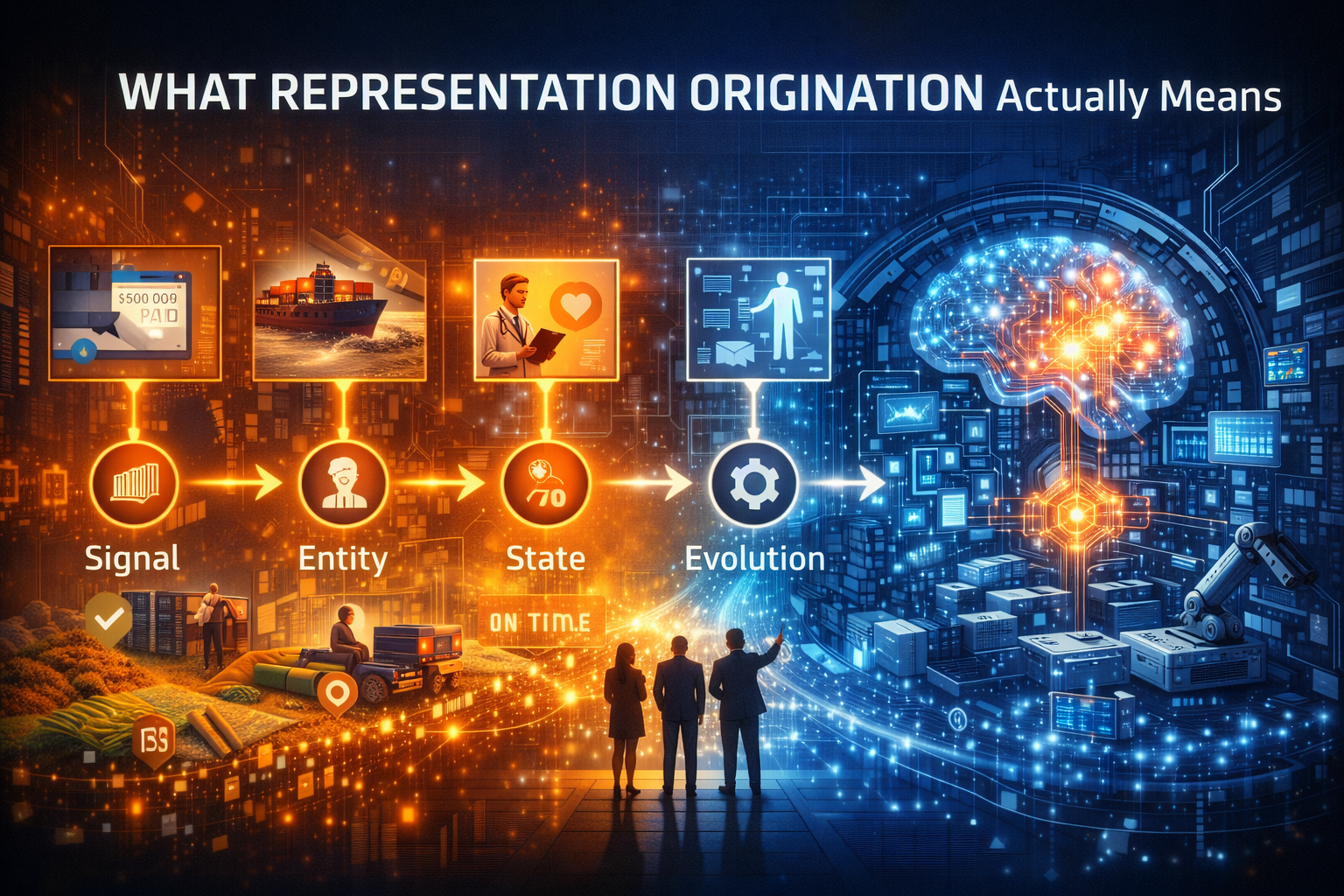
Representation Origination is best understood as the first economic act in machine decision-making.
It happens when the world is translated into a form that machines can interpret, compare, reason over, and act upon.
This process has four parts:
2.1 Signal
Something happens in the world. A payment clears. A patient develops a symptom. A device emits a warning. A customer makes a request. A sensor detects movement.
2.2 Entity
The system must know what that signal belongs to. Which customer? Which asset? Which patient? Which shipment? Which supplier?
2.3 State
The system must form a usable picture of current condition. Is the entity healthy or risky? On time or delayed? Eligible or ineligible? Stable or deteriorating?
2.4 Evolution
Reality changes. A good representation must update over time. Yesterday’s truth cannot govern tomorrow’s decisions.
This is why the SENSE layer matters so much. Representation Origination is not an add-on to AI. It is the industrialization of SENSE. It is the discipline of making reality legible enough for machines to interpret and stable enough for institutions to trust.
Once that happens, CORE can reason on top of that representation. Then DRIVER can decide what authority to grant, what actions are permissible, what safeguards apply, and what recourse exists if the system is wrong.
Most AI discussion begins at CORE. The next generation of winners will begin at SENSE.
Section 3: Simple examples that make the idea real
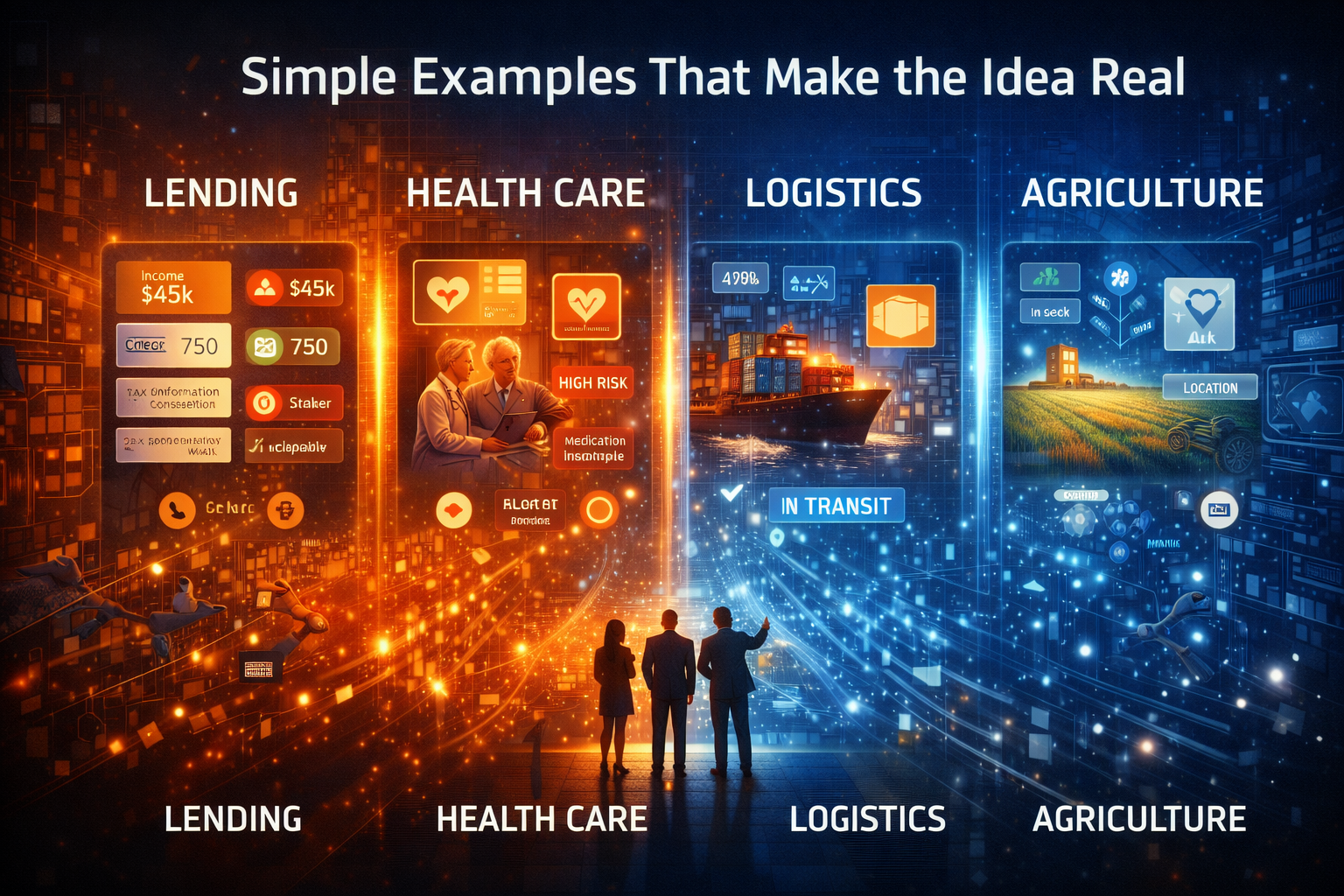
3.1 Lending
Two lenders may use equally powerful AI models. But the winner is often the one that originates a better representation of the borrower. Not just salary and credit score, but payment behavior, tax consistency, supplier quality, seasonal cash flow, invoice timing, business volatility, and early signs of stress.
The model matters. But before the model reasons, someone has to decide which signals count, how they are validated, how they are linked to the right entity, and how frequently they are refreshed.
That is origination.
3.2 Health care
A hospital rarely fails because a model is weak in the abstract. It fails because the patient’s reality enters the system in fragments. Symptoms sit in one system. Lab results in another. Medication history in a third. Lifestyle context may not exist in machine-readable form at all.
If the patient’s state is incomplete or stale, even a sophisticated model reasons over the wrong picture.
3.3 Logistics
A shipment is not simply a tracking number. It is an evolving state made up of location, condition, temperature, customs status, handoff history, timing sensitivity, and partner integrity.
The company that originates that state better can automate more decisions with less risk.
3.4 Agriculture
A field is not just a location on a map. It is a changing combination of moisture, crop stage, weather stress, soil health, pest risk, and input usage. A company that originates this representation well can power better lending, insurance, input recommendations, and yield forecasting.
In all these cases, the advantage begins before the model.
Section 4: A new company category is emerging
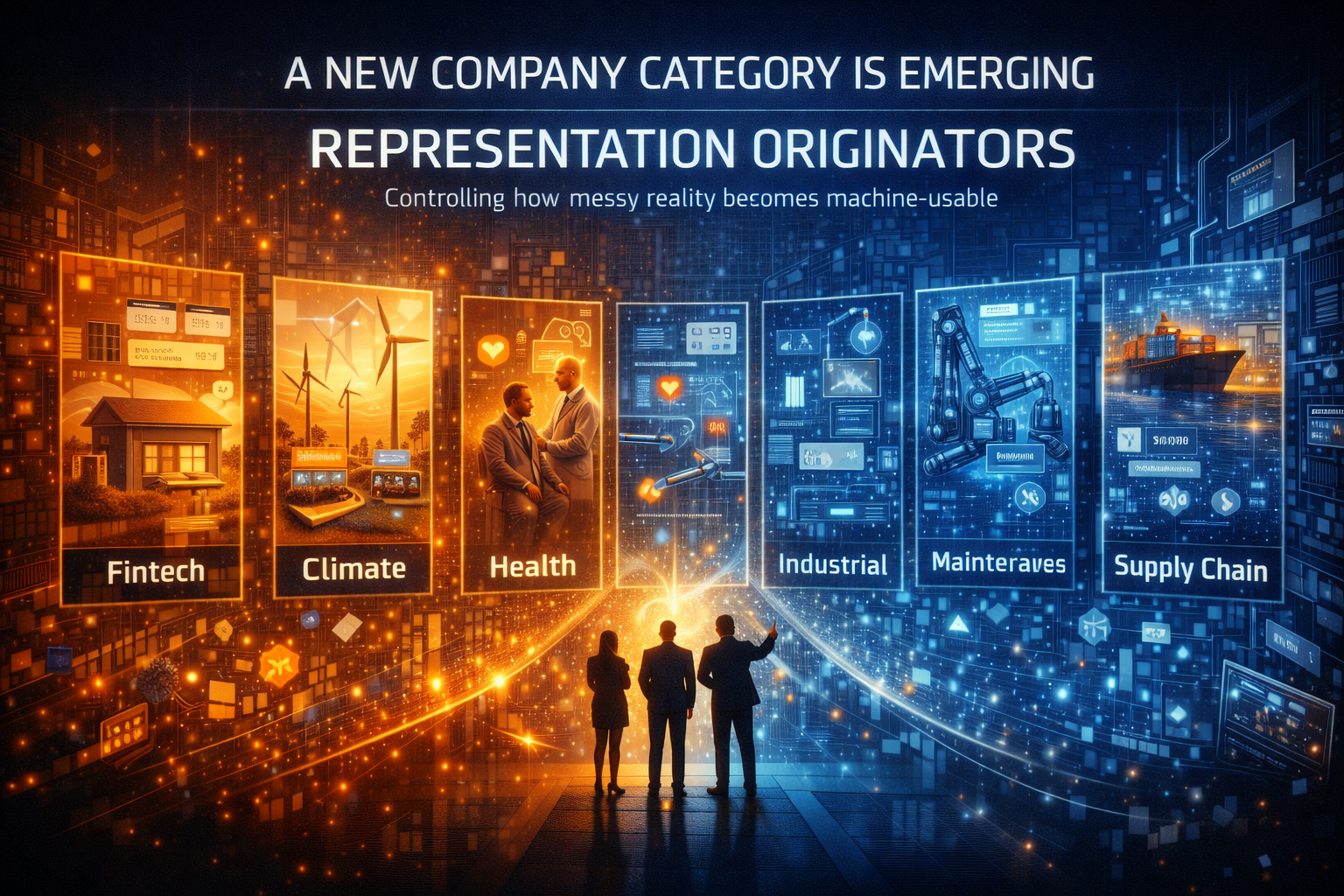
Today, we talk about model companies, infrastructure companies, application companies, cloud providers, and data platforms.
All of those categories matter. But a new category is becoming strategically central:
Representation Originators
A representation originator is a company that becomes the trusted first point where messy real-world conditions are translated into machine-usable form.
This can happen in many industries:
- A fintech may become the trusted originator of small-business cash-flow reality.
- A climate company may become the trusted originator of local environmental state.
- A health platform may become the trusted originator of longitudinal patient context.
- An industrial platform may become the trusted originator of asset condition and maintenance history.
- A supply-chain network may become the trusted originator of shipment truth across fragmented partners.
The strategic prize is huge because downstream AI systems will increasingly depend on whoever originated the most usable representation.
That also creates lock-in. OECD analysis notes that access to sufficient quality data is vital across the AI stack and that competition concerns can emerge through linkages across infrastructure, models, and deployment layers. In parallel, competition and governance debates are increasingly recognizing that control over input quality, provenance, and access can shape future market power. (OECD)
In other words, the firms controlling origination are not merely improving inputs. They may be building the new chokepoints of the AI economy.
Section 5: Why provenance becomes strategic, not optional
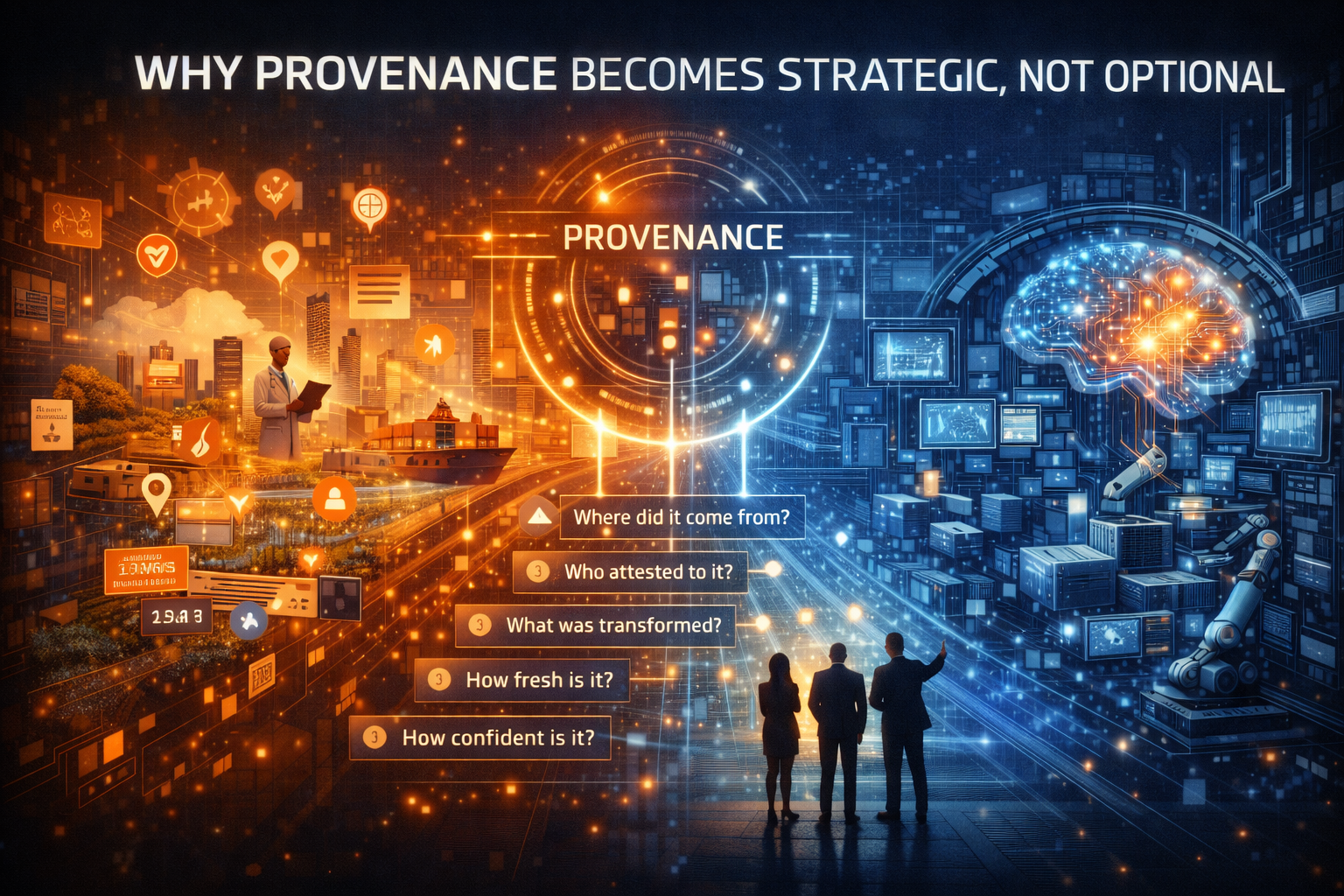
If origination becomes a source of power, trust becomes a source of value.
That is why provenance will matter so much.
NIST explicitly highlights the importance of provenance, attribution, transparency, and documentation in trustworthy AI. Its generative AI guidance also notes that provenance data tracking can help trace the origin and history of content. These are not narrow technical issues. They are becoming part of the institutional trust layer around AI. (NIST Publications)
In the coming AI economy, the premium will rise for representations that can answer questions like these:
5.1 Where did this signal come from?
5.2 Who verified or attested to it?
5.3 What was transformed along the way?
5.4 How fresh is it?
5.5 What level of confidence should be assigned to it?
5.6 Who is allowed to act on it?
5.7 Who can challenge it or correct it?
Those are not peripheral compliance questions. They are central value-creation questions.
If two firms offer similar AI intelligence, the one with better provenance, fresher state, stronger identity binding, and clearer recourse will be more trusted by customers, regulators, partners, and other machines.
Section 6: Why semantic layers are becoming economic infrastructure
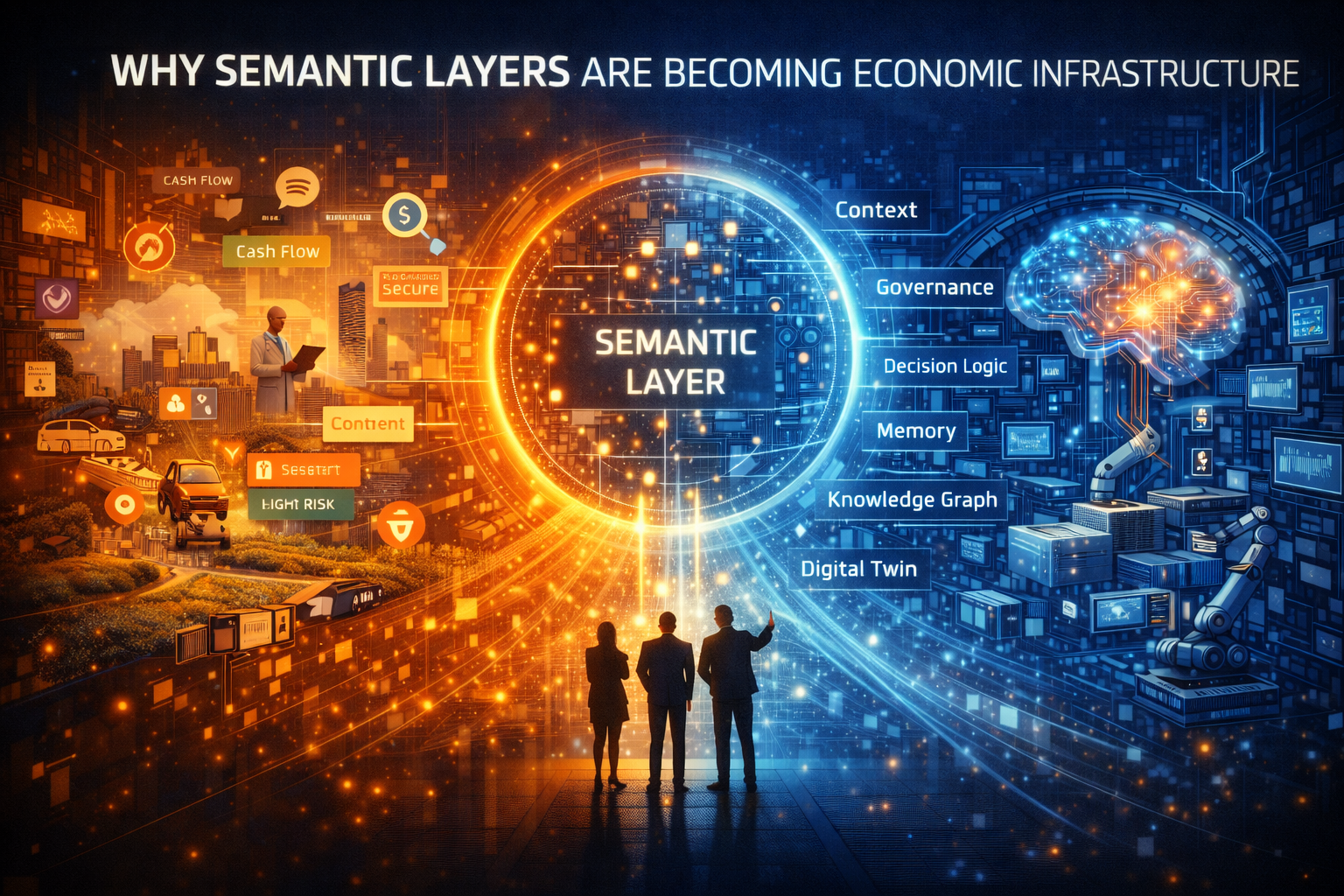
Many firms still treat semantic layers, ontologies, knowledge graphs, context models, and digital twins as technical plumbing.
That is a mistake.
Across the enterprise market, the direction is becoming clearer: the firms that scale AI are building stronger context layers, stronger knowledge structures, and stronger governance around how data becomes usable. Accenture argues that enterprises need unifying layers for memory, decision context, and semantic structure so AI systems can work with real business meaning rather than disconnected data fragments. IBM similarly emphasizes the need for governed, trustworthy, AI-ready data. (AWS Static)
In plain language, the winners will not merely have data lakes.
They will have reality entry systems.
They will know how to take a real-world event, connect it to the right entity, enrich it with context, preserve its lineage, update it in near real time, and expose it safely to AI systems.
That is harder than training a model on a benchmark. But it is also far more defensible.
This is why some of the most valuable AI companies of the next decade may not look like classical AI companies at all. Some will resemble identity firms, trust infrastructure firms, workflow capture firms, digital twin firms, operational telemetry firms, semantic modeling firms, or evidence networks.
But underneath, they will all be doing the same thing:
controlling how reality enters the machine.
Section 7: What boards and C-suites should do now
Existing companies should not panic. But they should reframe the challenge immediately.
The question is no longer, “How do we deploy AI?”
The deeper question is, “How does our reality become machine-usable?”
That means leadership teams need to ask:
7.1 Where does critical operational truth first enter our systems?
7.2 Who defines the entity model?
7.3 How is state represented?
7.4 How quickly is that state refreshed?
7.5 What provenance do we preserve?
7.6 Where are we still asking models to reason over stale, fragmented, or weakly verified inputs?
7.7 Which external partners already control crucial parts of our representation layer?
In many firms, the answer will be uncomfortable.
They have invested heavily in dashboards, copilots, pilots, and model experimentation. But they have underinvested in origination. They have built more intelligence than representation. More CORE than SENSE. More automation ambition than DRIVER readiness.
This imbalance helps explain why many AI programs still disappoint. The problem is not always the model. Often, the model is being asked to reason over a weak institutional picture of reality.
Conclusion: The future belongs to those who originate reality well
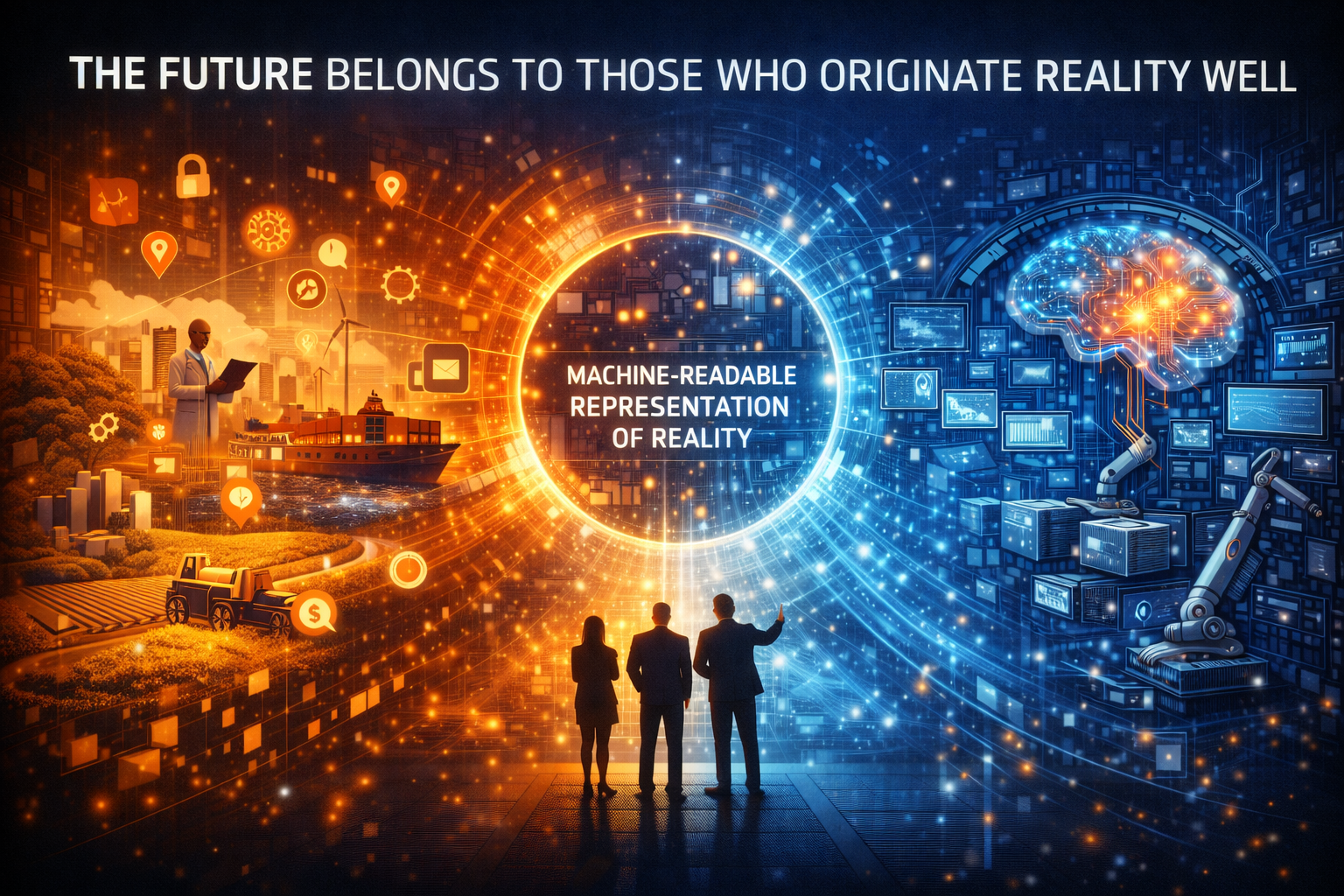
The AI economy will not be won only by those who generate the most text, code, images, or predictions.
It will be won by those who make the world enter machines in a form that can be trusted.
That is the deeper strategic shift.
Representation Origination is not a technical footnote. It is the first economic act in the age of machine decision-making. It is the stage at which value, trust, competitive advantage, and lock-in begin.
It is where SENSE becomes real, where CORE gets something worth reasoning about, and where DRIVER gains a legitimate basis for action.
In the years ahead, many firms will still compete on models. Some will compete on distribution. But the most consequential firms will compete earlier in the chain.
They will compete to become the place where reality is first structured, verified, contextualized, and made actionable.
Those companies will not simply supply AI.
They will shape what AI is allowed to know.
And in the long run, that may be even more valuable.
Conclusion Column
Board-level takeaway:
If your institution does not control how critical reality becomes machine-readable, it may never fully control the value, risk, or strategic direction of its AI systems.
C-suite implication:
The next AI moat may not be model access. It may be trusted origination.
Strategic warning:
Companies that outsource their representation layer too casually may one day discover that they have outsourced the basis of machine trust itself.
Strategic opportunity:
Companies that become trusted representation originators can shape downstream ecosystems, capture premium positioning, and become indispensable to the next generation of AI services.
Glossary
Representation Origination
The process through which real-world signals are first converted into trusted machine-usable representations.
Machine-readable reality
A structured form of real-world information that AI systems can interpret, compare, reason over, and act upon.
SENSE
The legibility layer where reality becomes machine-readable through signal, entity, state, and evolution.
CORE
The cognition layer where AI systems interpret context, optimize decisions, and generate reasoning.
DRIVER
The governance and legitimacy layer that determines delegation, permissions, verification, execution boundaries, and recourse.
Provenance
The traceable history of where a signal or representation came from, how it was transformed, and who validated it.
Entity model
The structured definition of the people, objects, assets, or institutions that signals belong to.
State representation
A machine-usable description of the current condition of an entity.
Semantic layer
A contextual layer that gives business meaning to data through models, ontologies, relationships, and rules.
Representation Originator
A company or institution that becomes the trusted first point where messy reality is translated into machine-usable form.
Trusted delegation
The controlled transfer of decision or action authority to AI systems under clear governance boundaries.
FAQ
What is Representation Origination in simple terms?
Representation Origination is the process of turning messy real-world events into structured, trusted machine-readable input that AI systems can use reliably.
Why is Representation Origination important for AI?
Because AI systems do not act on reality directly. They act on representations of reality. If those representations are weak, stale, incomplete, or poorly governed, even strong AI models will make poor decisions.
How is Representation Origination different from data collection?
Data collection gathers signals. Representation Origination goes further by linking signals to the right entity, building state, tracking evolution over time, and making that information safe and usable for machine reasoning.
What industries will benefit most from Representation Origination?
Financial services, health care, logistics, manufacturing, agriculture, climate intelligence, insurance, public services, and any industry where fragmented reality must be turned into actionable machine-readable form.
What is the connection between Representation Origination and the Representation Economy?
Representation Origination is one of the foundational economic processes within the Representation Economy. It explains how reality first becomes machine-legible before intelligence and governance can operate on top of it.
How does this relate to SENSE, CORE, and DRIVER?
Representation Origination sits primarily in the SENSE layer. Once reality is represented properly, CORE can reason over it, and DRIVER can govern what actions are allowed and how accountability is maintained.
Why should boards care about this topic?
Because control over how reality enters AI systems will increasingly shape competitive advantage, trust, compliance, ecosystem power, and long-term institutional resilience.
References and Further Reading
For factual grounding and further exploration, you can include a short end section like this on your website:
- McKinsey & Company — Technology Trends Outlook 2024 McKinsey technology trends outlook 2024 | McKinsey
- McKinsey & Company — The State of AI: How Organizations Are Rewiring to Capture Value The State of AI: Global survey | McKinsey
- NIST — Artificial Intelligence Risk Management Framework (AI RMF 1.0) Artificial Intelligence Risk Management Framework (AI RMF 1.0)
- NIST — Generative AI Profile
- OECD — Artificial Intelligence, Data and Competition Artificial intelligence, data and competition | OECD
- Harvard Business Review / HBR Analytic Services — research and reporting on AI value, data readiness, and enterprise adoption
These sources support the broader claims that high-quality, governed data and provenance are becoming central to AI value creation, trust, and scalability. (McKinsey & Company)
Representation origination is the discipline of building machine-legible reality before anyone asks for it — the firms that do this early aren’t reacting to AI, they’re setting the terms intelligent systems will use to evaluate everyone else.



Raktim Singh is an AI and deep-tech strategist, TEDx speaker, and author focused on helping enterprises navigate the next era of intelligent systems. With experience spanning AI, fintech, quantum computing, and digital transformation, he simplifies complex technology for leaders and builds frameworks that drive responsible, scalable adoption.