
Decision Clarity: The Shortest Path to Scalable Enterprise AI Autonomy
Decision clarity in enterprise AI is the defining factor between isolated pilots and truly scalable autonomy. Enterprises do not fail to scale AI because models are inaccurate or tools are immature — they fail because decisions are automated without being clearly defined, classified, or governed.
When organizations lack decision clarity, AI systems act without consistent boundaries, accountability erodes, and autonomy becomes risky instead of repeatable. The fastest and safest way to achieve scalable enterprise AI autonomy is to establish explicit decision clarity before automation begins.
How enterprises classify decisions before automation—so trust, compliance, and control survive at scale
Enterprise AI autonomy does not fail because models underperform.
It fails because enterprises automate decisions they have never clearly defined.
The shortest path to scalable enterprise AI autonomy is decision clarity — a shared, explicit understanding of which decisions exist, who owns them, how they are governed, and what controls they must trigger by default.
The production truth: “AI accuracy” is not the unit of risk—decisions are
Most Enterprise AI breakdowns don’t begin with a “bad model.” They begin with an unspoken assumption: every decision is automatable if the output looks correct.
That assumption fails in production for a simple reason.
Enterprises don’t run on outputs. They run on decisions—and decisions carry consequences: approvals, entitlements, money movement, compliance posture, customer experience, operational safety, and reputational trust.
A system can generate an answer that appears correct and still break an enterprise because the organization never answered the foundational question:
What kind of decision is this?
If you cannot classify decisions, you cannot consistently decide:
- what must be human-approved
- what can be autonomous
- what evidence is required
- what must be auditable
- what must be reversible
- what should never be automated at all
This is exactly why governance-oriented frameworks emphasize mapping context and governing risk across the lifecycle—not only measuring performance after deployment. The NIST AI Risk Management Framework (AI RMF) is explicit about organizing risk management into functions that include GOVERN and MAP before “manage” actions in production. (NIST Publications)
An Enterprise AI Decision Taxonomy is the missing layer that turns “AI governance” from a document into an operating system.
What is an Enterprise AI Decision Taxonomy?
What is an Enterprise AI Decision Taxonomy?
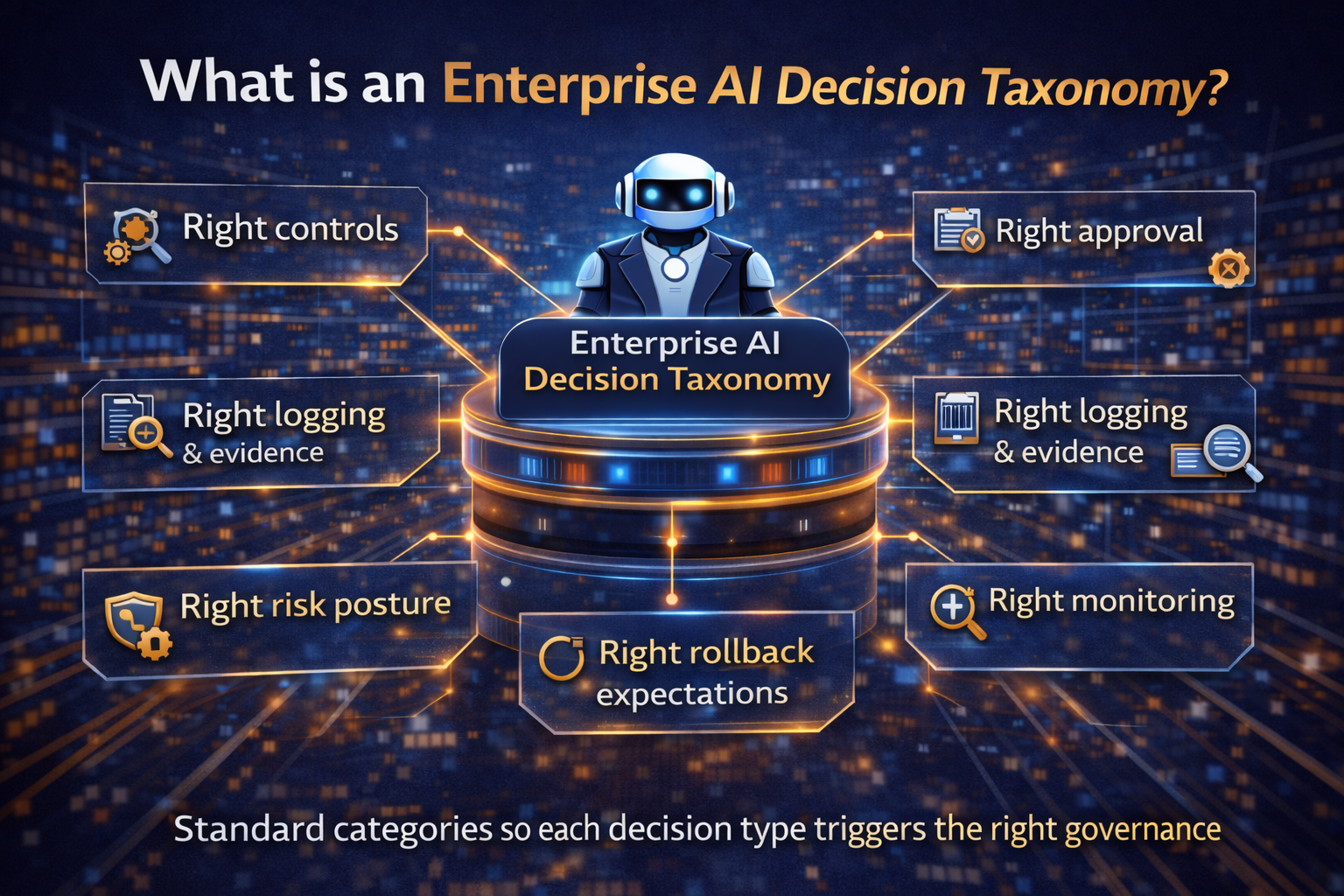
An Enterprise AI Decision Taxonomy is a standard way to categorize decisions across the enterprise so each category automatically implies:
- the right controls
- the right approval level
- the right logging and evidence
- the right monitoring
- the right risk posture
- the right rollback / kill-switch expectations
In one line:
It is the classification system that tells your Enterprise AI Control Plane how strict autonomy should be—before an agent acts.
This is not theoretical. Mature risk programs have long relied on inventory + classification + independent understanding of limitations as the backbone of control—especially in regulated environments.
The Federal Reserve’s SR 11-7 guidance emphasizes governance, controls, and documentation so that parties unfamiliar with a model can understand how it works, its assumptions, and limitations. (Federal Reserve)
Now that AI systems can take actions inside workflows, the unit that must be classified is not “models.”
It’s decisions.
Why this matters globally (not just in one market)
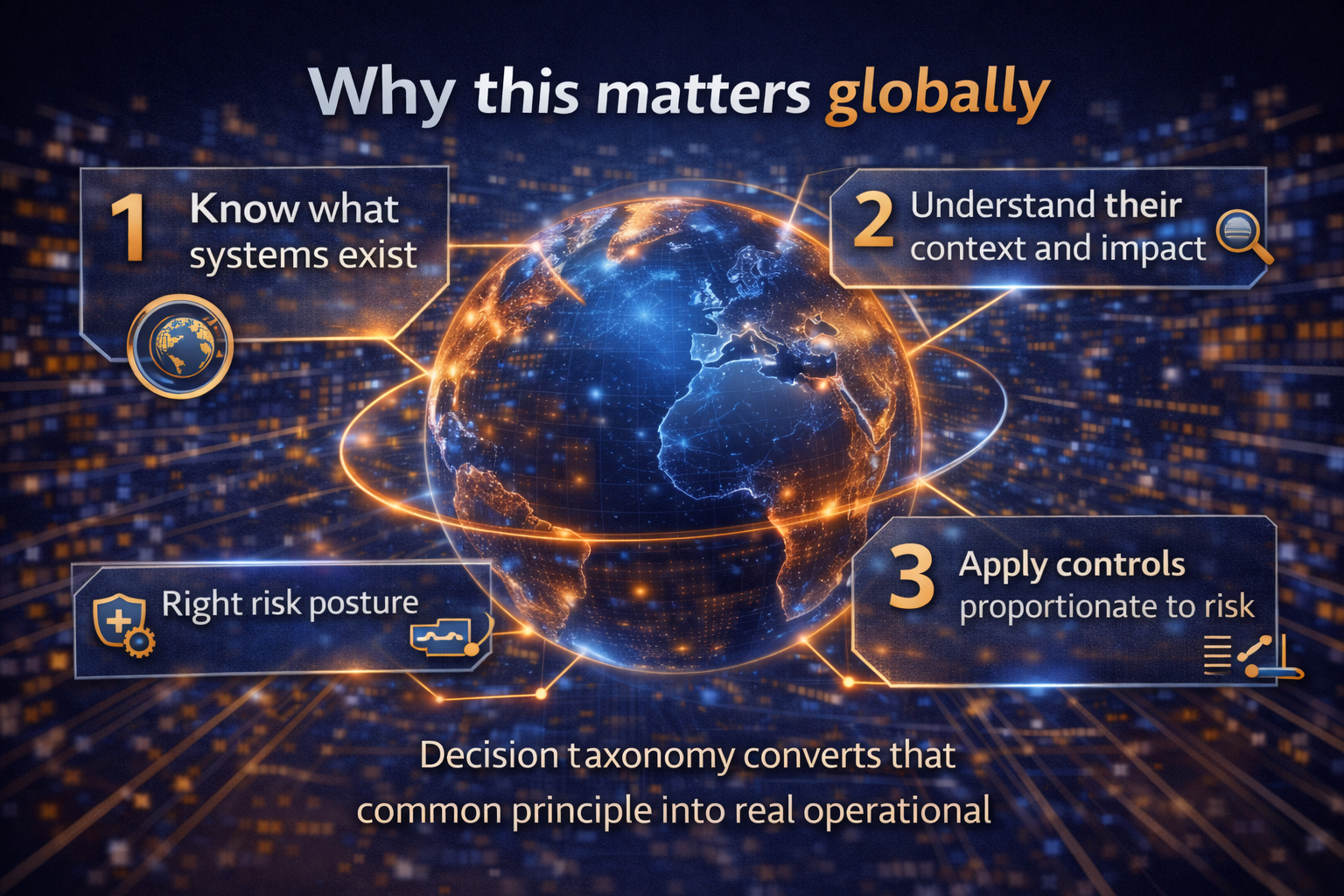
Across regions and industries, the direction of travel is converging on a single operational truth:
- You must know what systems exist
- you must understand their context and impact
- you must apply controls proportionate to risk
That logic shows up in global governance frameworks and standards such as NIST AI RMF and ISO/IEC 42001, which focuses on establishing and continually improving an AI management system across the lifecycle. (iso.org)
Decision taxonomy is the practical bridge from that principle to day-to-day engineering reality.
The simplest mental model: enterprises already classify everything that matters
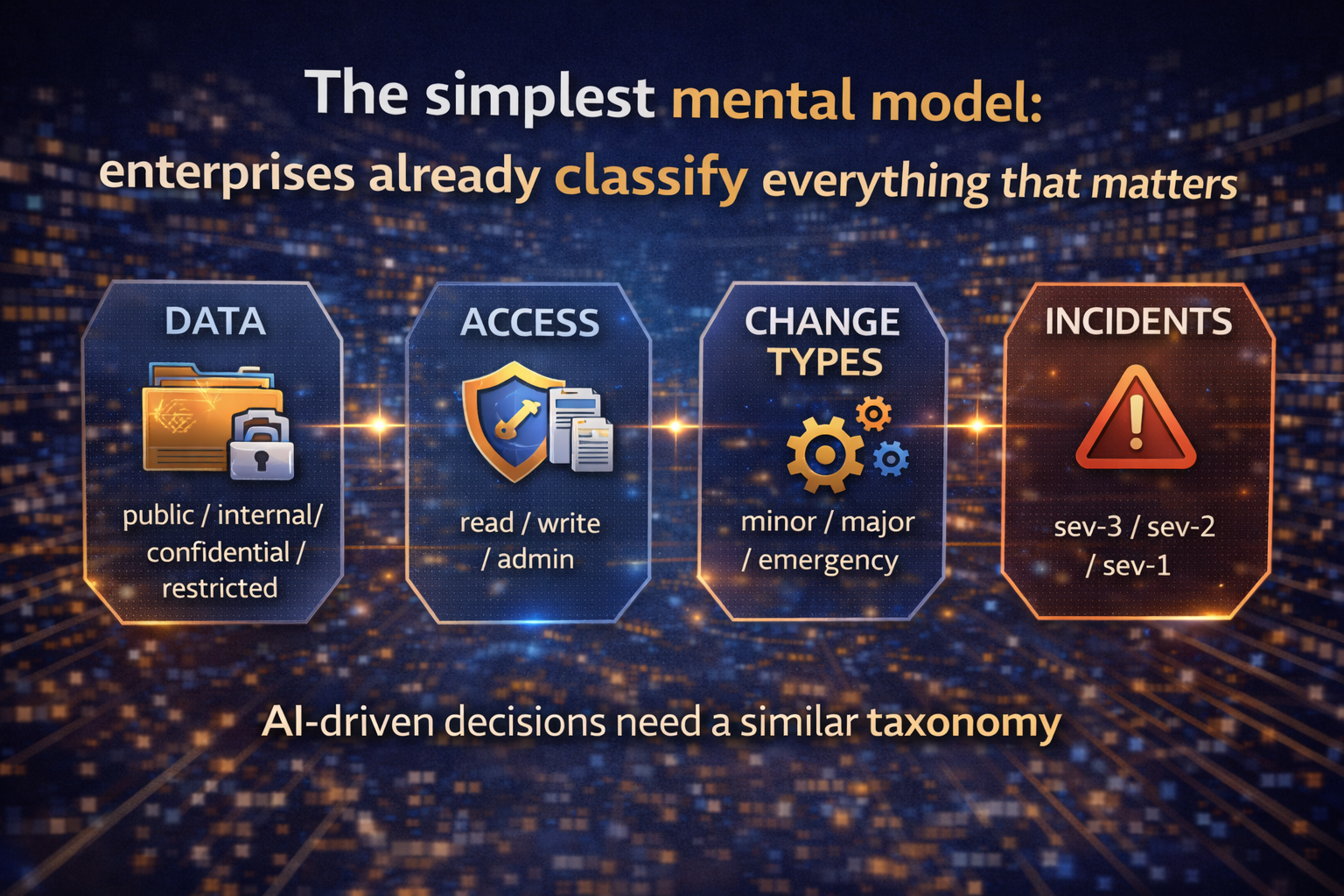
Enterprises routinely classify:
- data (public / internal / confidential / restricted)
- access (read / write / admin)
- change types (minor / major / emergency)
- incidents (severity levels)
Decision taxonomy is the same idea applied to AI-driven decisions. When you classify decisions properly, you stop treating autonomy like a single switch (“on/off”) and start treating it like a governed gradient—where controls rise with impact.
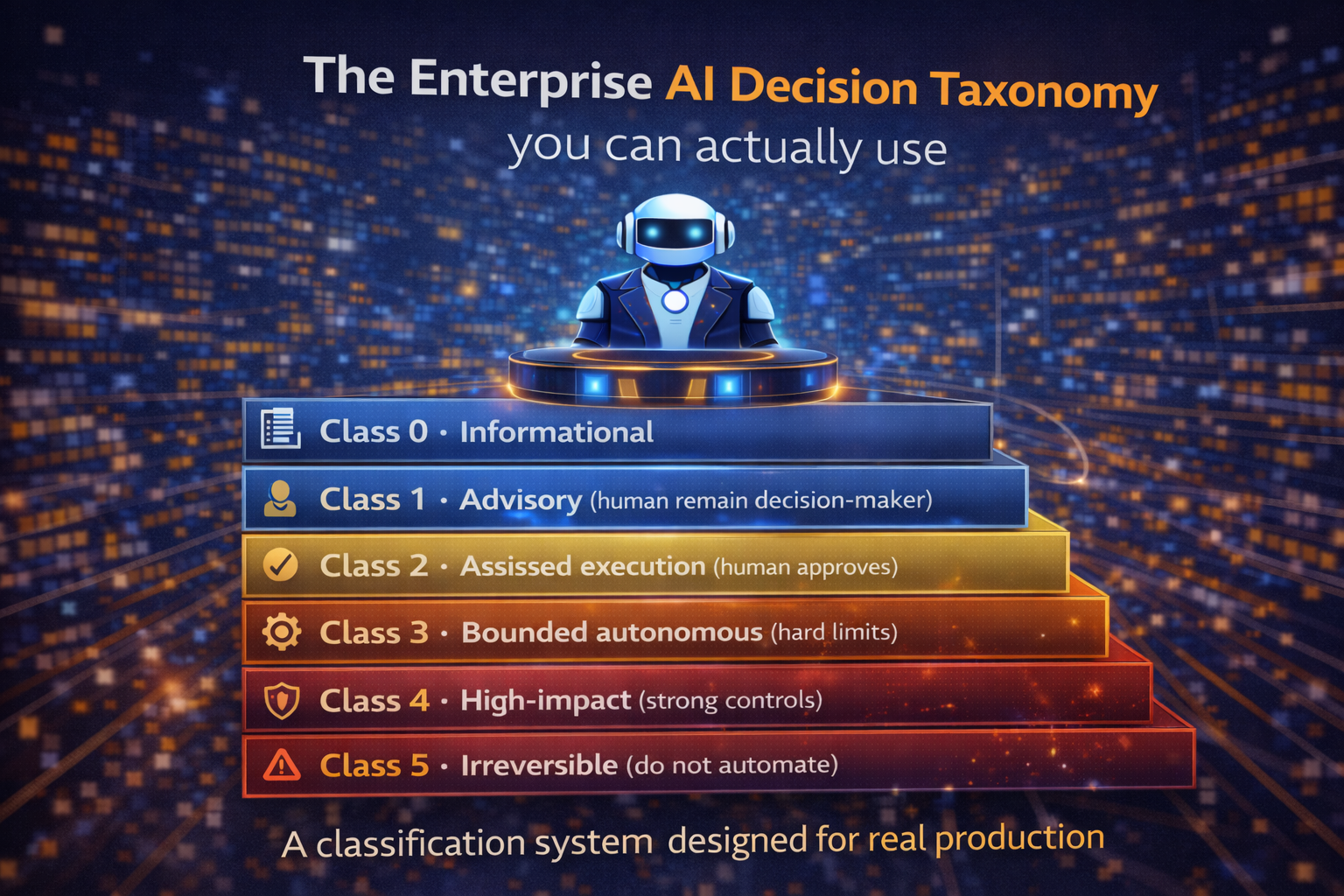
The Enterprise AI Decision Taxonomy you can actually use
This taxonomy is designed for production reality. No math. No bureaucracy. Just clarity.
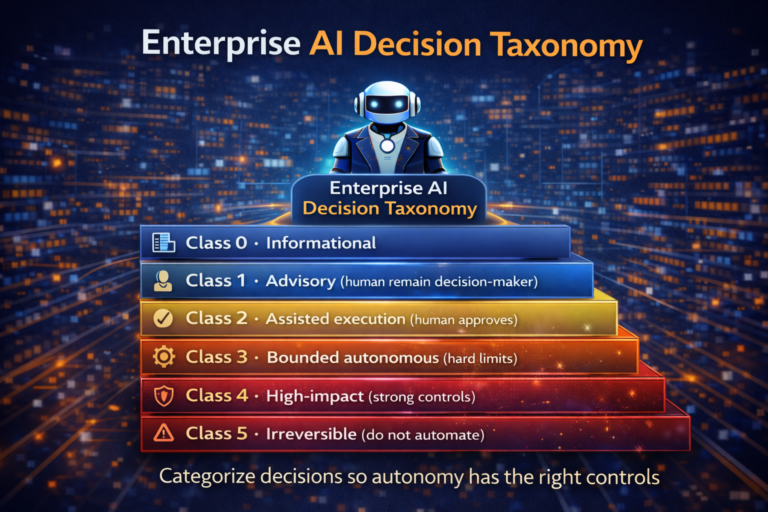
Class 0 — Informational decisions (no downstream action)
What it is: The system provides information, explanation, or summarization. It cannot trigger changes.
Examples:
- Summarizing meeting notes
- Explaining a policy document
- Drafting a response for a human to review
Governance posture: light
Key requirement: basic logging; transparency where appropriate
Why it’s safer: nothing changes in enterprise state unless a human chooses to act.
Class 1 — Advisory decisions (human remains the decision-maker)
What it is: AI recommends an option, but a human explicitly chooses and executes.
Examples:
- Suggested resolution steps for a support ticket
- Recommended vendors to compare
- Recommended prioritization of a backlog
Governance posture: moderate
Key requirement: record recommendation + context (so you can answer “why this?”)
Why this class matters: it builds trust while keeping accountability human-visible.
Class 2 — Assisted execution decisions (AI drafts actions; human approves)
What it is: AI prepares an action that would change enterprise state, but requires approval.
Examples:
- Drafting a purchase request
- Preparing an access request
- Drafting a customer credit adjustment (without applying it)
- Generating a remediation plan and opening a ticket (approval required)
Governance posture: higher
Key requirements: approval workflow + evidence + clear scope boundaries
Practical definition of human-in-the-loop: humans approve what matters; they don’t “hover.”
Class 3 — Bounded autonomous decisions (AI can act within hard limits)
What it is: AI can execute actions automatically, but only inside strict boundaries.
Examples:
- Auto-triage tickets into predefined categories
- Auto-route requests to the right queue
- Auto-schedule maintenance within approved windows
- Auto-respond to low-risk inquiries using approved templates
Governance posture: high
Key requirements: explicit allowed actions, rate limits / blast radius controls, rollback, continuous monitoring
Why this is the “enterprise leverage zone”: this is where autonomy creates real productivity—if boundaries are enforced.
Class 4 — High-impact decisions (autonomy allowed only with strong controls)
What it is: Decisions that materially affect operations, compliance posture, customer outcomes, or regulated commitments.
Examples:
- Changing entitlements or permissions at scale
- Approving policy exceptions
- Executing financial adjustments beyond small thresholds
- Approving major workflow deviations
Governance posture: very high
Key requirements: dual-control (or stronger), robust evidence logging, independent monitoring, incident playbooks, strict identity and permissions
Practical implication: this is where your Agent Registry becomes mandatory—because you must know which actor executed the decision.
Class 5 — Irreversible or rights-critical decisions (default: do not automate)
What it is: Decisions that are hard to reverse or create unacceptable harm if wrong.
Examples:
- Decisions that materially change legal position
- Decisions that cannot be practically undone once executed
- Decisions that create major long-term commitments without review
Governance posture: maximum
Default stance: AI may assist; humans decide
Why this aligns globally: many governance regimes and standards increasingly treat higher-risk applications as requiring stronger obligations, constraints, and oversight. ISO/IEC 42001 emphasizes lifecycle governance and responsible use structures; the operational lesson is simple: treat irreversible decisions as assist-only unless you can prove safety and accountability. (iso.org)
The three-axis test that makes classification obvious
When teams argue “should this be autonomous?”, it’s often because they lack a shared test. Use these three questions:
1) Reversibility — “Can we undo it cleanly?”
- If yes, autonomy becomes more feasible.
- If no, push toward approval or assist-only.
2) Materiality — “If it’s wrong, what breaks?”
- If the impact is minor, bounded autonomy may be fine.
- If it triggers compliance, financial, or safety consequences, elevate the class.
3) Externality — “Who else is affected?”
- If it affects external stakeholders, the standard for accountability rises.
This isn’t bureaucracy. It’s basic engineering discipline applied to decisions.
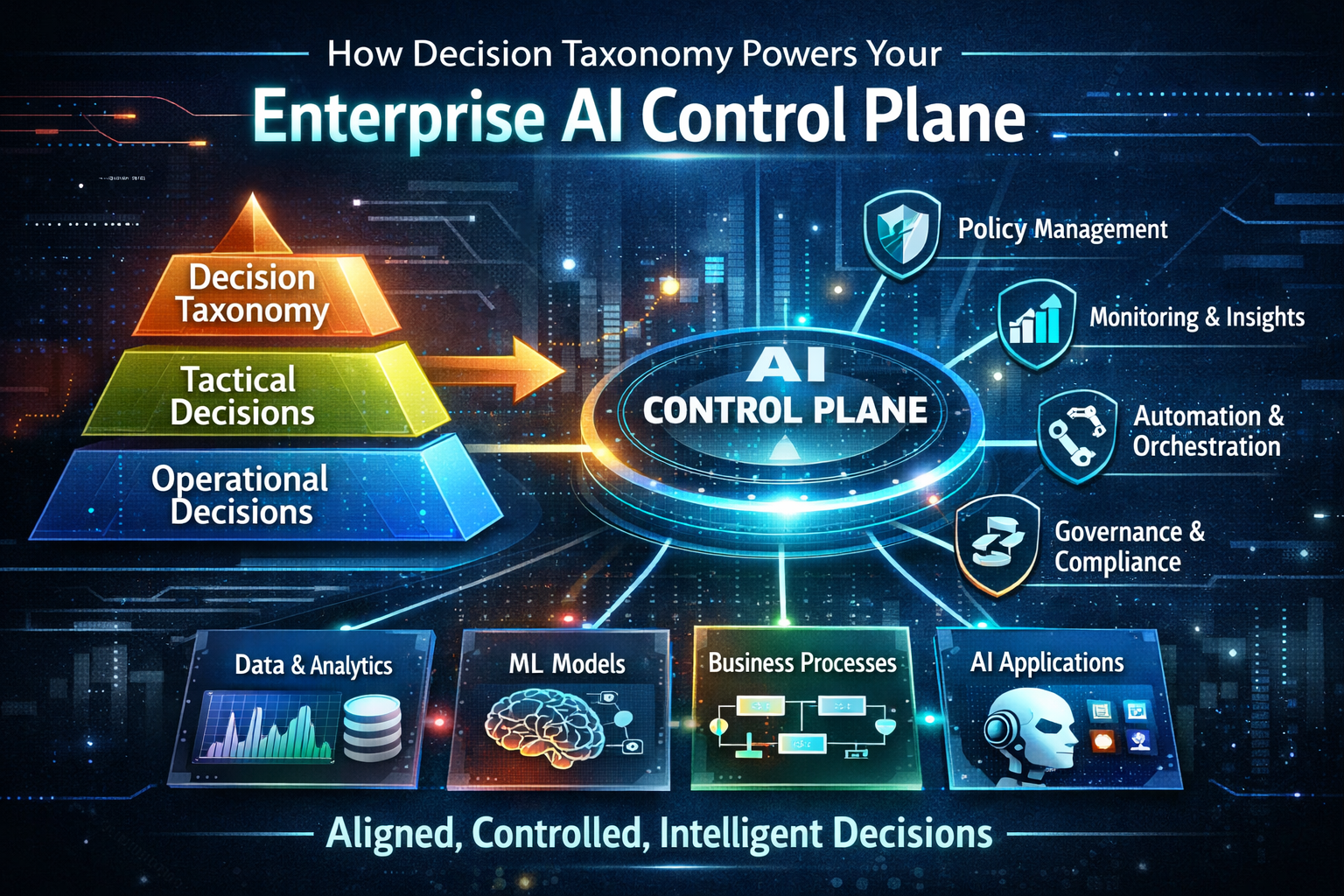
How decision taxonomy powers your Enterprise AI Control Plane
Your Control Plane becomes enforceable when it can answer three questions consistently:
- What class is this decision?
- What controls are required for this class?
- Is this agent permitted to make this class of decision?
That’s the point: taxonomy converts governance intent into executable rules. NIST AI RMF frames risk governance as a lifecycle activity and emphasizes the importance of context mapping (“MAP”) alongside governance (“GOVERN”). Decision taxonomy is how “MAP” becomes operational: every decision gets a class and an implied control posture. (NIST Publications)
Three examples that show taxonomy working in real life
Example A — The “ticket assistant” quietly becomes an agent
- Initially: the AI summarizes a ticket (Class 0)
- Then: it recommends a solution (Class 1)
- Then: it drafts a ticket update (Class 2)
- Finally: it auto-updates ticket status for low-risk categories (Class 3)
Same system. Different decision classes.
Your taxonomy prevents the silent jump from “helpful” to “unsafe.”
Example B — Access provisioning (where governance becomes non-negotiable)
- Suggest access based on role → Class 1
- Draft access request → Class 2
- Auto-provision low-risk access within strict policies → Class 3
- Anything affecting privileged access → Class 4
- Anything irreversible or highly sensitive → Class 5 (assist-only)
This is the difference between scalable automation and a compliance incident.
Example C — Procurement and contracting (where “accuracy” isn’t the risk)
- Summarize quotes → Class 0
- Recommend vendor → Class 1
- Draft purchase request → Class 2
- Auto-route approvals → Class 3
- Approve exceptions or major deviations → Class 4
- Commit to irreversible obligations → Class 5
Taxonomy becomes the guardrail that makes autonomy possible—without losing control.
Decision taxonomy vs. decision failure taxonomy
Decision Failure Taxonomy is what breaks when decisions go wrong.
Decision taxonomy is different:
- Decision Taxonomy = what decision types exist, what controls they require
- Failure Taxonomy = how decisions break trust and compliance when boundaries are violated
Together, they form an enterprise learning loop:
classify → govern → execute → monitor → learn
The Decision Control Bundle: what each class should automatically require
A taxonomy is only useful if each class maps to controls that are practical.
Evidence
What proof must be stored?
- Lower classes: minimal logs
- Higher classes: decision record + context + approvals
This mirrors long-standing governance expectations about documentation and traceability so independent parties can understand limitations and use. (Federal Reserve)
Identity and permissions
Does the agent have identity and scope to do this?
Higher classes increasingly require:
- least privilege
- explicit ownership
- revocation capability
Oversight mode
- Class 0–1: human chooses
- Class 2: human approves
- Class 3: autonomy with boundaries
- Class 4: autonomy only under strong controls
- Class 5: assist-only by default
Observability and monitoring
Higher classes require:
- anomaly detection
- drift monitoring
- escalation triggers
Reversibility and incident readiness
Higher classes require:
- rollback plans
- kill switches
- decision-level postmortems
A useful reminder: as systems become more agentic, the risk surface increasingly concentrates at tool boundaries (prompt injection, tool misuse, unintended actions). OWASP’s GenAI security work highlights prompt injection as a critical risk class; decision taxonomy is one of the simplest ways to ensure such risks don’t automatically translate into high-impact actions. (OWASP Cheat Sheet Series)
Where this fits in Enterprise AI Operating Stack
- Enterprise AI Operating Model : who owns what; how governance works The Enterprise AI Operating Model: How organizations design, govern, and scale intelligence safely – Raktim Singh
- Control Plane: policy enforcement, decision boundaries, reversibility Enterprise AI Control Plane: The Canonical Framework for Governing Decisions at Scale – Raktim Singh
- Runtime: what is actually running in production Enterprise AI Runtime: What Is Actually Running in Production (And Why It Changes Everything) – Raktim Singh
- Agent Registry: system of record for agent identities and permissions Enterprise AI Agent Registry: The Missing System of Record for Autonomous AI – Raktim Singh
- Decision Taxonomy: classification layer that determines control intensity
- Operating Stack: canonical architecture tying it all together
Implementation blueprint: adopt this without slowing down
Step 1 — Start with these 6 classes, and stop
Don’t overdesign. The 0–5 model is enough.
Step 2 — Require “decision class” at design time
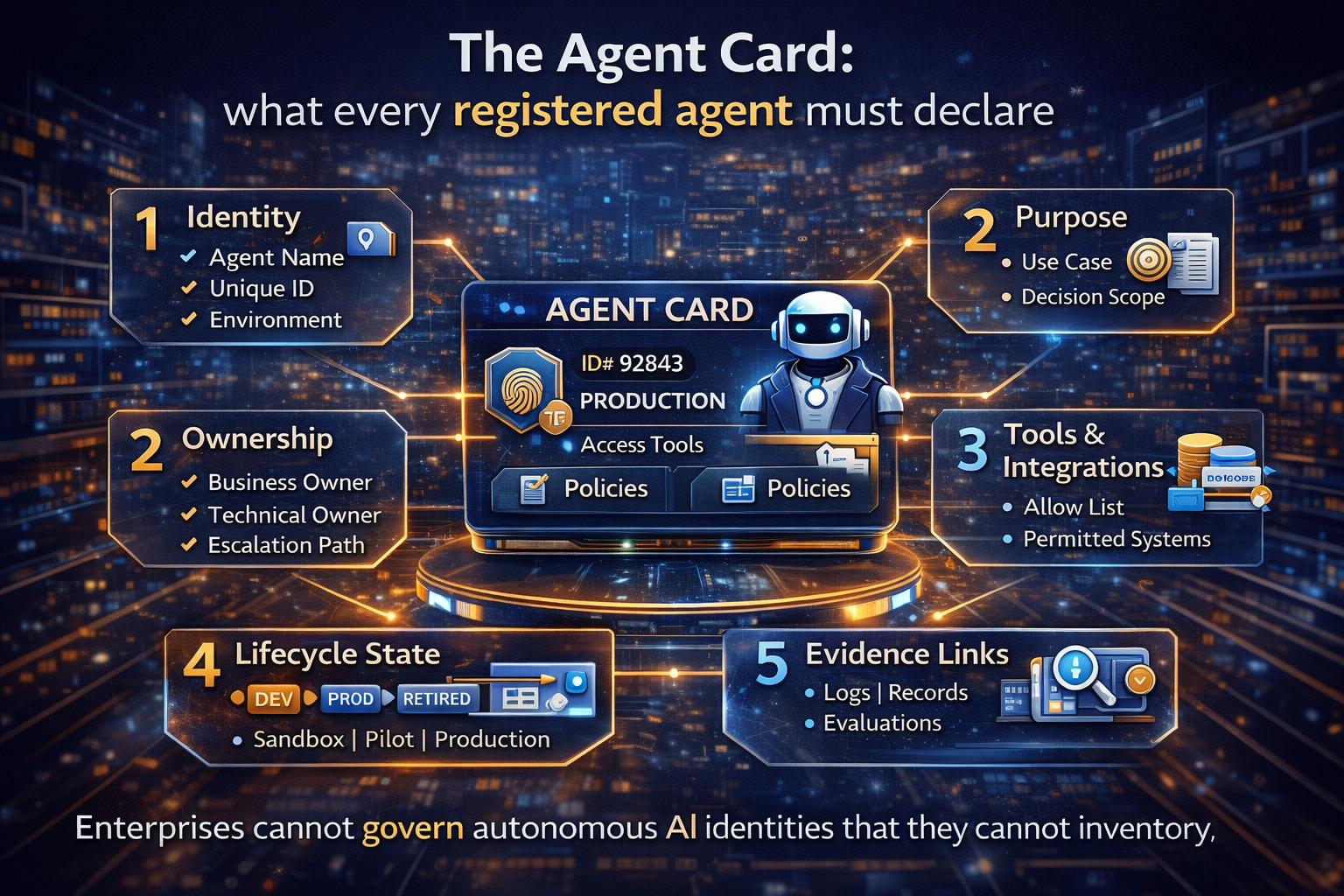
Any new agent or workflow must declare:
- which decision classes it touches
- what actions it can take
- what approval mode is required
Step 3 — Make production autonomy conditional
Rule: No Class 3+ autonomy unless:
- decision class is declared
- controls are attached
- owners are assigned
- evidence is loggable
- rollback exists
This is the operational spirit of lifecycle risk management: govern and map the context before scaling. (NIST Publications)
Step 4 — Audit by sampling, not paperwork
Once decision classes exist, audits become practical:
- sample high-class decisions
- verify evidence completeness
- review boundary violations
Step 5 — Evolve the taxonomy as the enterprise learns
Taxonomy should improve as:
- policies change
- incidents reveal blind spots
- autonomy expands
That continuous improvement posture is consistent with management-system thinking in ISO/IEC 42001. (iso.org)
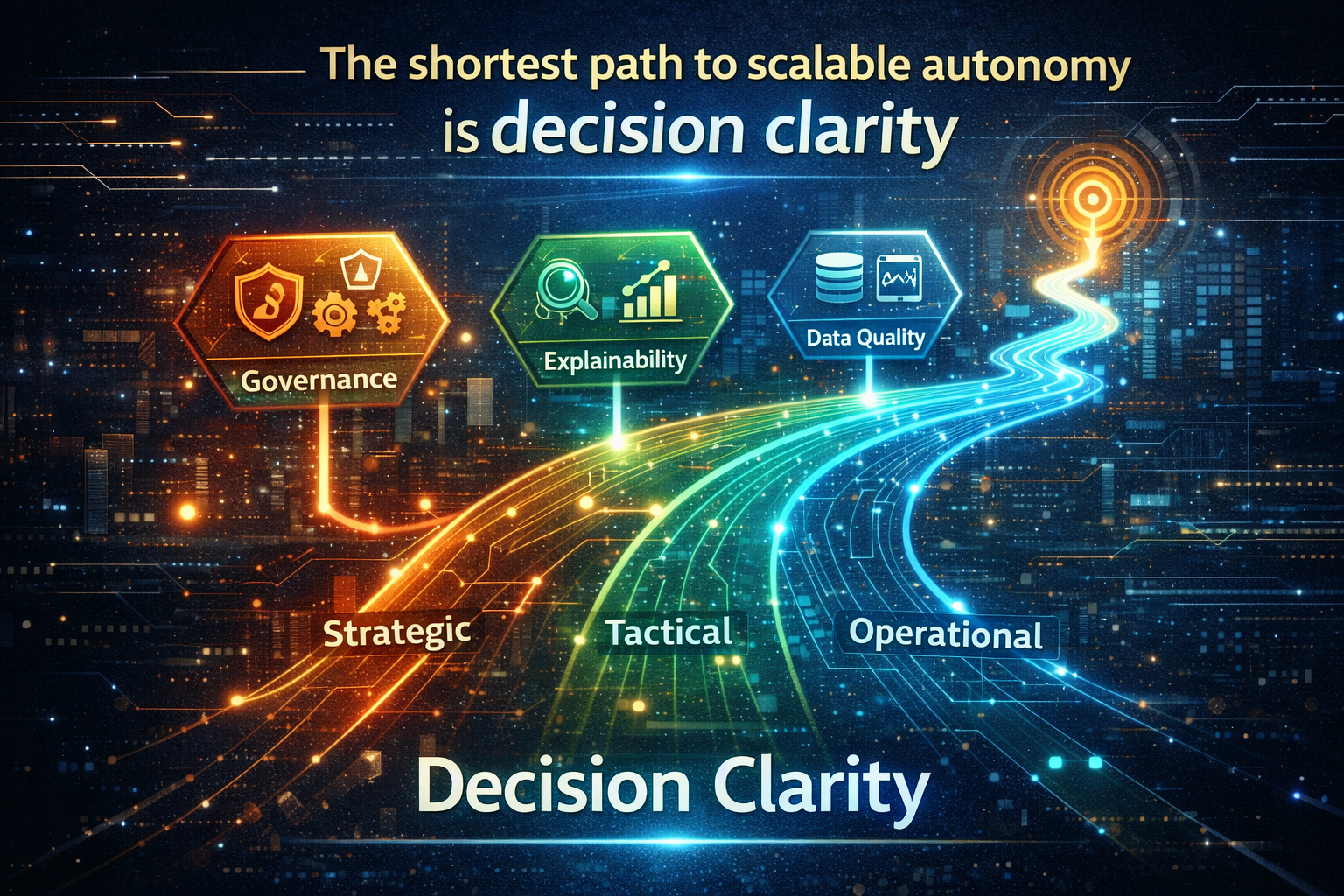
Conclusion: the shortest path to scalable autonomy is decision clarity
Most organizations try to govern AI by governing models.
That’s too late.
Enterprise AI must be governed at the decision level.
If you can’t classify decisions, you can’t control autonomy.
If you can’t control autonomy, you can’t scale Enterprise AI without accumulating trust debt, compliance risk, and operational fragility.
The Enterprise AI Decision Taxonomy is not a “framework slide.”
It is a practical control surface: a shared language that lets leadership, risk teams, and engineers align before automation touches reality.
And that is how enterprises move from “AI adoption” to running intelligence.
Glossary
- Enterprise AI Decision Taxonomy: A standardized system for classifying enterprise decisions so each decision type triggers the right governance controls.
- Decision boundary: The explicit limit defining what an AI system is allowed to decide or execute.
- Human-in-the-loop: A workflow where a human must approve decisions before execution.
- Bounded autonomy: Autonomy permitted only within explicit constraints (allowed actions, scope, rate limits, time windows).
- Decision record: A traceable log capturing the decision, context, evidence, and action.
- Control bundle: The default set of controls required for a decision class (evidence, identity, approval, monitoring, rollback).
- Lifecycle governance: Ongoing oversight across design, deployment, operation, and change, emphasized in standards like NIST AI RMF and ISO/IEC 42001. (NIST Publications)
-
Decision Clarity
The practice of explicitly defining and classifying enterprise decisions before automation.Enterprise AI Autonomy
The ability of AI systems to act independently within governed decision boundaries.Decision Taxonomy
A structured classification of enterprise decisions into strategic, tactical, and operational categories.AI Control Plane
The governance layer that enforces policy, observability, auditability, and reversibility across AI decisions.Governed Autonomy
AI autonomy constrained by predefined decision rights, controls, and accountability.
FAQs
What is an Enterprise AI Decision Taxonomy?
It is a structured method to classify enterprise decisions so each decision type automatically requires the right level of controls, oversight, evidence, and accountability.
Why do enterprises need decision taxonomy before deploying agents?
Because agents convert outputs into actions. Without decision classification, organizations cannot consistently decide what must be human-approved, what can be autonomous, and what evidence must be retained. (NIST Publications)
How is decision taxonomy different from a decision failure taxonomy?
Decision taxonomy classifies what decisions exist and the controls they require. Decision failure taxonomy explains how decisions break trust and compliance when boundaries are unclear or violated.
What is the simplest way to implement this?
Start with the 0–5 classes, require every agent/workflow to declare its decision class, and block Class 3+ autonomy unless a control bundle is attached.
Does this apply globally?
Yes. Global frameworks and standards emphasize lifecycle governance, context mapping, and risk-proportionate controls. Decision taxonomy is how that becomes operational. (iso.org)
What is decision clarity in enterprise AI?
Decision clarity is the explicit classification of enterprise decisions by impact, risk, and reversibility, enabling AI systems to apply the correct governance, controls, and autonomy level automatically.
Why is decision clarity critical for scalable AI autonomy?
Without decision clarity, enterprises over-automate high-risk decisions and under-automate safe ones, leading to compliance failures, trust erosion, and stalled AI scale.
How does decision taxonomy support AI governance?
Decision taxonomy links each decision class to mandatory controls such as audit trails, explainability, monitoring, rollback, and policy enforcement.
Is decision clarity required for AI compliance?
Yes. Regulations like the EU AI Act and global risk frameworks implicitly require decision classification to demonstrate proportional governance and accountability.
References and further reading
- NIST, AI Risk Management Framework (AI RMF 1.0) (Functions include GOVERN and MAP). (NIST Publications)
- ISO, ISO/IEC 42001:2023 — AI management systems (requirements for establishing and continually improving an AIMS). (iso.org)
- Federal Reserve, SR 11-7: Guidance on Model Risk Management (governance, controls, and documentation expectations). (Federal Reserve)
- OWASP, Prompt Injection Prevention Cheat Sheet and Top 10 for LLM Applications (security risks that become real when decisions can trigger actions). (OWASP Cheat Sheet Series)



Raktim Singh is an AI and deep-tech strategist, TEDx speaker, and author focused on helping enterprises navigate the next era of intelligent systems. With experience spanning AI, fintech, quantum computing, and digital transformation, he simplifies complex technology for leaders and builds frameworks that drive responsible, scalable adoption.