
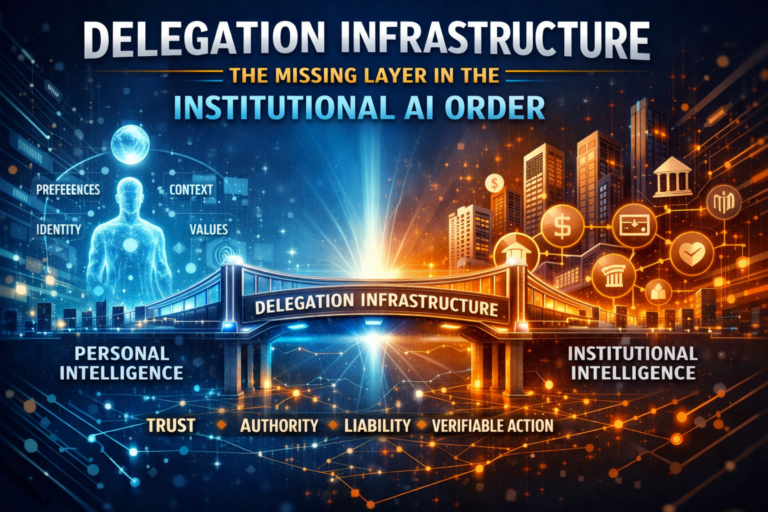
What Is Delegation Infrastructure?
Delegation Infrastructure is the institutional layer that enables AI systems to safely, provably, and reversibly act on behalf of individuals or enterprises — bridging personal intelligence and institutional execution systems.
For most of economic history, intelligence was expensive. Judgment was concentrated. Analysis required teams. Strategy moved at the speed of meetings.
That era is ending.
Artificial intelligence is collapsing the marginal cost of cognition toward zero. When intelligence becomes abundant, advantage does not disappear — it migrates. And in this migration, the decisive question is no longer who can think, but who can be trusted to act.
Executive Summary
Artificial intelligence is eliminating the scarcity of intelligence.
The first wave improved productivity.
The second wave improved decision quality.
The third wave will reorganize markets.
As AI systems move from recommendation to execution, the competitive frontier shifts from intelligence to trusted delegation. The next decade will not be defined by which organization has the most powerful models — but by which organization can be trusted to act safely, provably, and at scale.
This new economic layer is what I call Delegation Infrastructure — the institutional bridge between personal AI and enterprise AI.
Organizations that design it will shape the Institutional AI Order. Those that ignore it risk commoditization.
This article introduces the concept of Delegation Infrastructure within the broader Institutional AI Order — a strategic framework for boards, policymakers, and C-suite leaders navigating the transition from AI-assisted decision-making to AI-executed action across regulated and enterprise-scale environments.
-
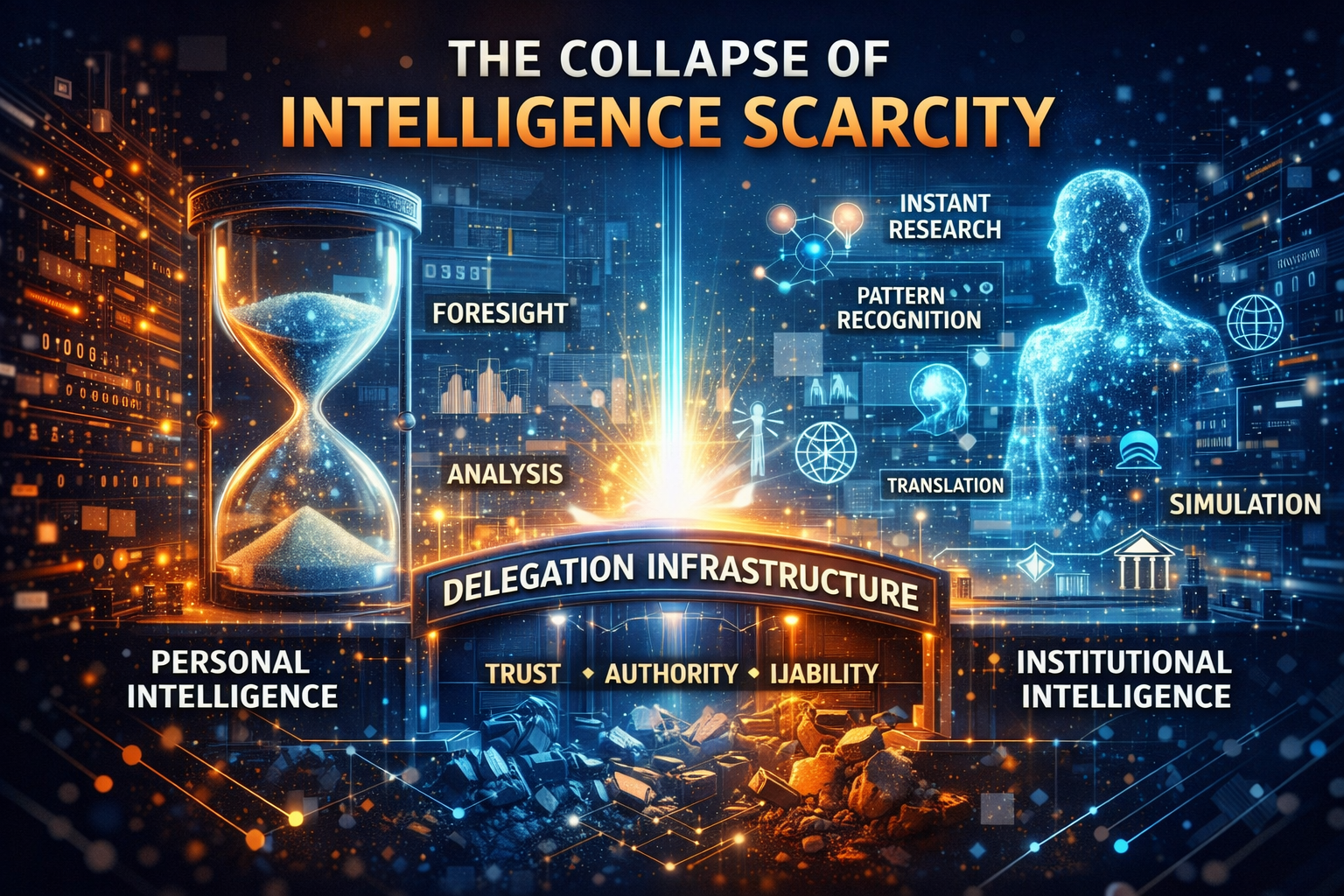
The Collapse of Intelligence Scarcity
For most of economic history, intelligence was scarce.
Judgment concentrated at the top of institutions. Analysis required teams. Forecasting was slow. Strategy moved at the speed of meetings.
That constraint is dissolving.
Artificial intelligence is driving the marginal cost of cognition toward zero:
- Research is instantaneous.
- Pattern recognition is automated.
- Simulation is cheap and continuous.
- Language barriers are disappearing.
- Personal digital assistants learn and adapt in real time.
When a foundational input becomes abundant, markets reorganize.
Electricity did not merely improve factories — it restructured industry.
The internet did not merely accelerate communication — it rewired distribution and coordination.
AI is not just improving decisions.
It is eliminating the scarcity of intelligence itself.
And when intelligence becomes infrastructure, a new scarcity emerges.
The next competitive frontier will not be who has the smartest model.
It will be who can be trusted to act.
-
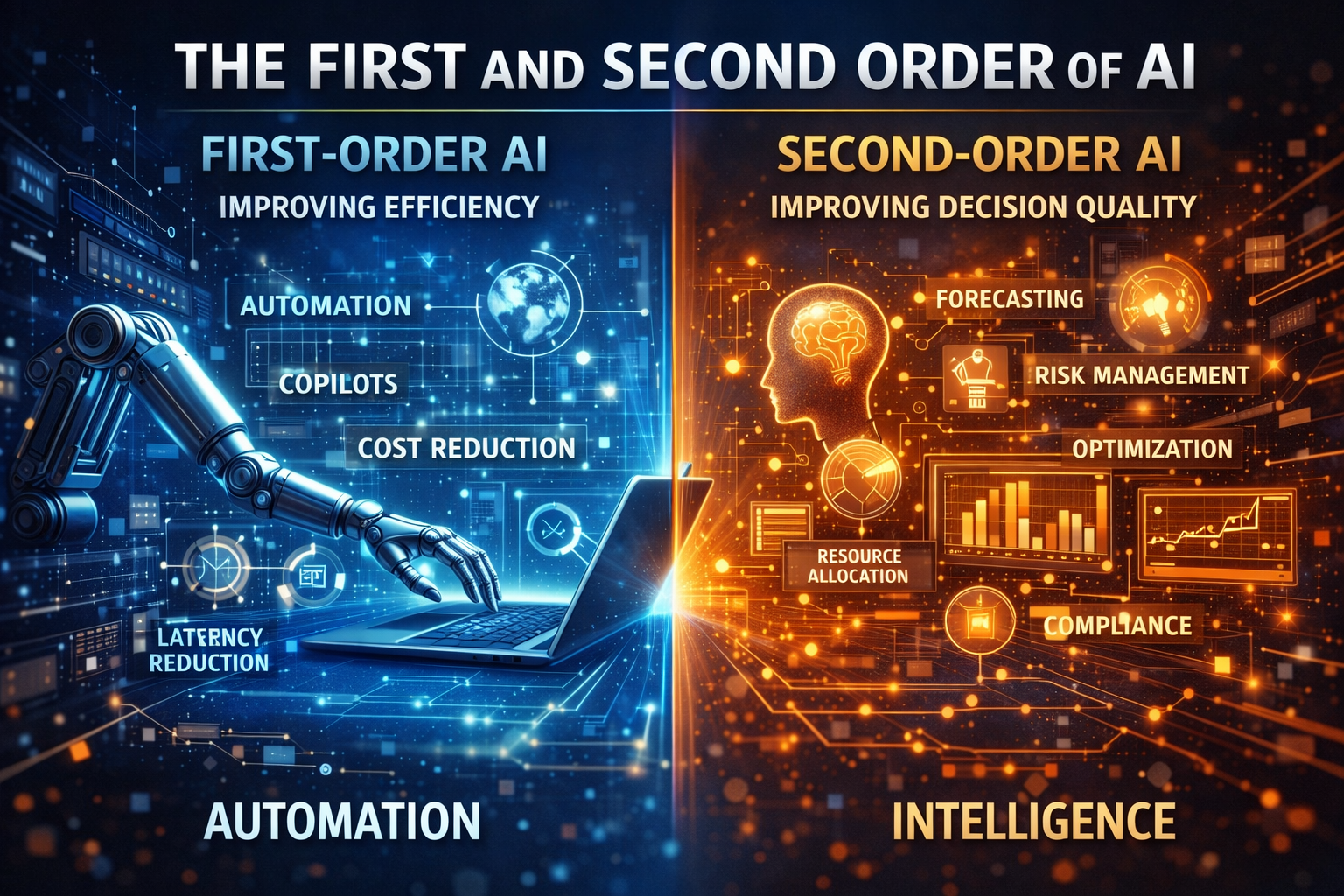
The First and Second Orders of AI
To understand what comes next, we must separate the waves clearly.
First-Order AI: Efficiency
- Automation
- Copilots
- Cost reduction
- Error reduction
- Latency reduction
This wave optimizes existing processes.
Second-Order AI: Decision Intelligence
Organizations embed AI into:
- Risk management
- Capital allocation
- Forecasting
- Compliance
- Supply chains
- Marketing optimization
Enterprises become intelligence-native. Decision loops improve across functions.
You can see this evolution across my frameworks:
- The Enterprise AI Operating Model
- The Intelligence Balance Sheet
- The Intelligence Company: A New Theory of the Firm in the AI Era – Raktim Singh
- The Enterprise AI Control Plane
- The Enterprise AI Capability Stack
But both waves preserve institutional boundaries.
The third wave does not.
-
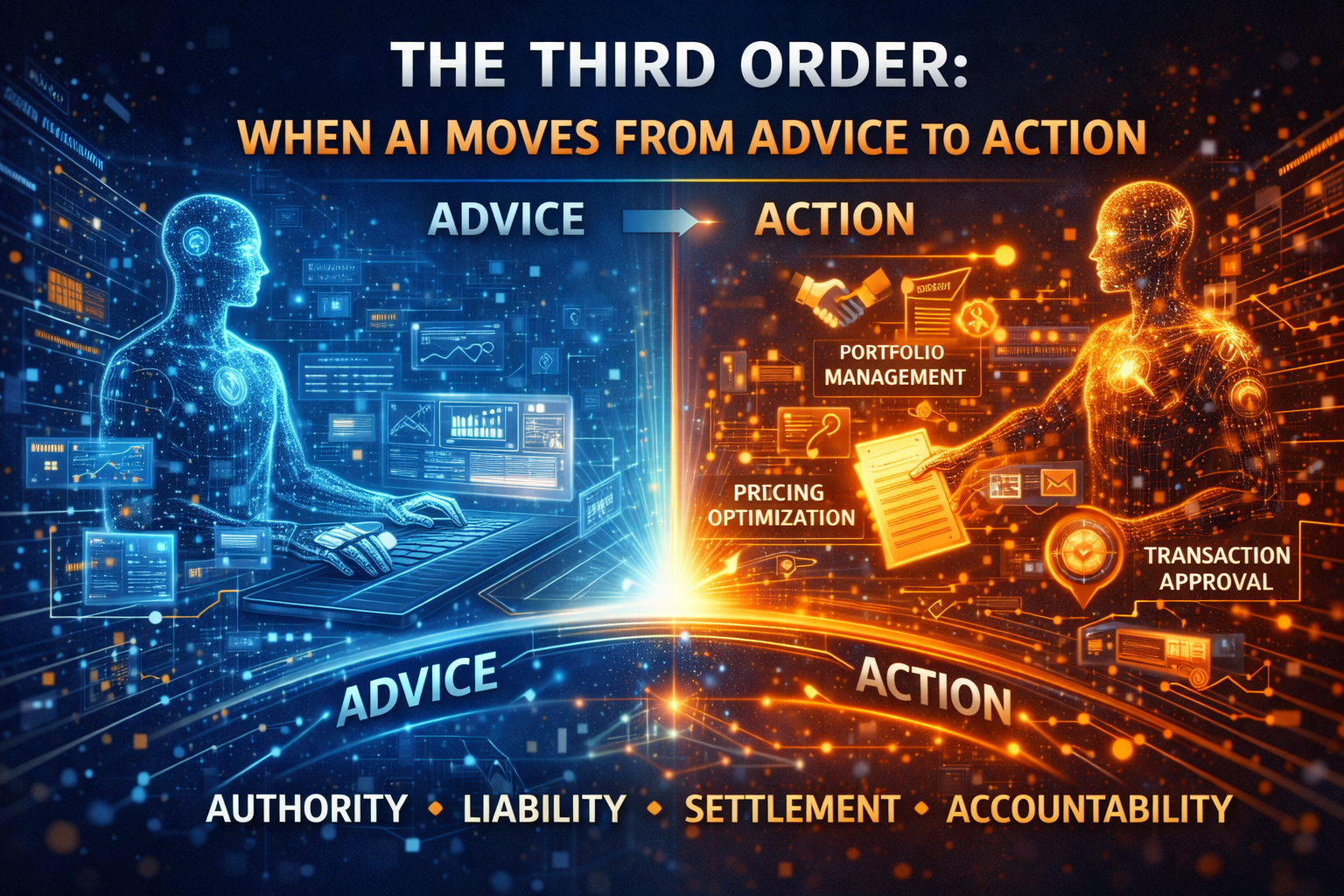
The Third Order: When AI Moves From Advice to Action
The structural shift begins when AI stops advising and starts executing.
Today, AI systems can:
- Negotiate contracts
- Rebalance portfolios
- Adjust pricing
- Approve transactions
- Route logistics
- Trigger compliance workflows
- Execute procurement decisions
- Manage real-time risk
Personal assistants are evolving from search tools into autonomous agents.
When AI begins to act, something changes fundamentally.
Execution introduces:
- Authority
- Liability
- Settlement
- Accountability
- Reversibility
Advice is informational.
Action changes state in the real world.
The moment AI executes rather than recommends, the economic structure shifts — because execution requires trust.
-
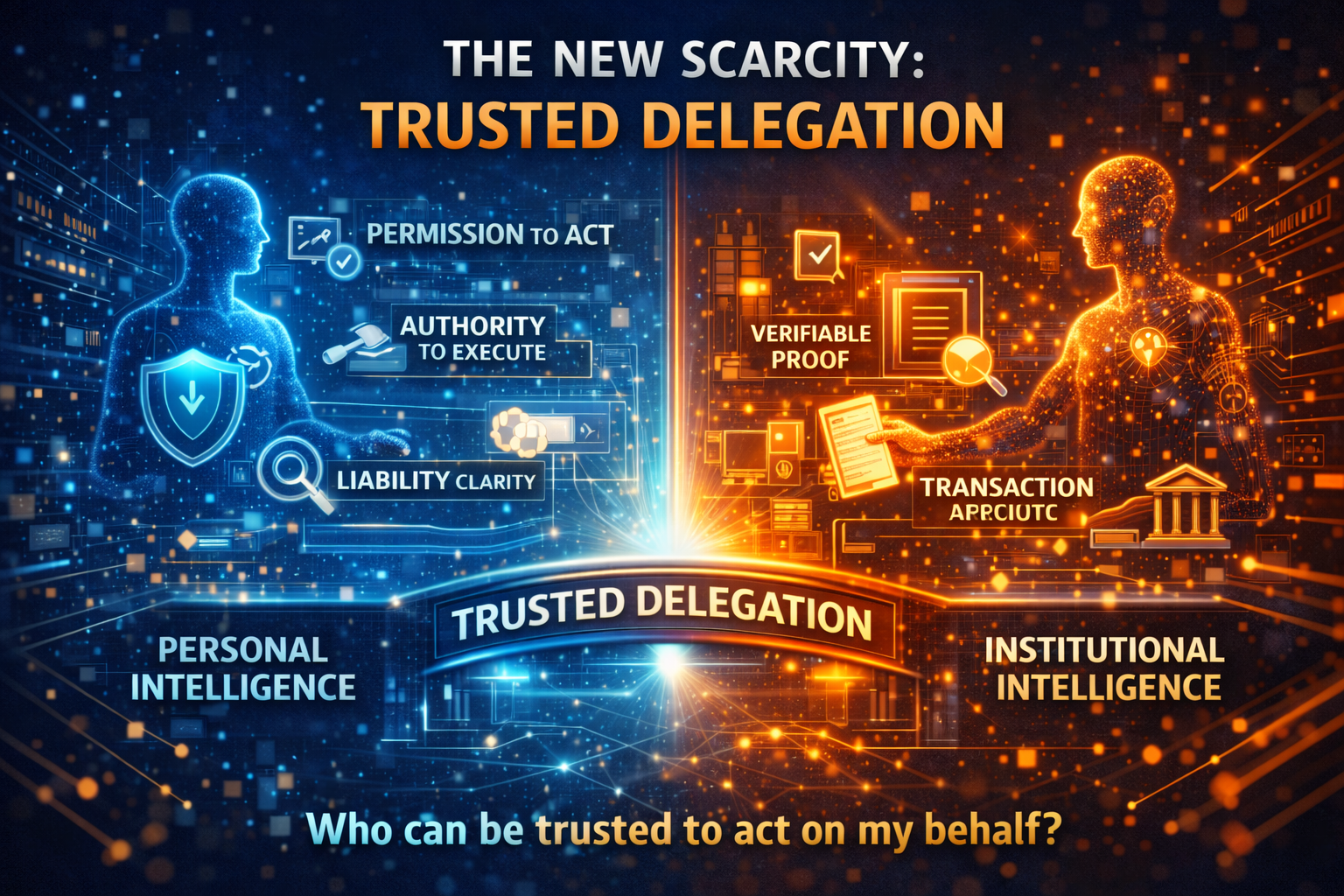
The New Scarcity: Trusted Delegation
As cognition becomes abundant, intelligence commoditizes.
Every organization can deploy strong models.
Every customer can access powerful AI tools.
Knowledge becomes universal.
But the following do not commoditize:
- Permission to act
- Authority to execute
- Liability clarity
- Verifiable proof
- Institutional trust
- Context continuity
In an AI-abundant world, differentiation shifts from intelligence to delegation.
Customers — whether individuals or enterprises — will not primarily choose based on model quality.
They will choose based on:
Who can safely act on my behalf?
This is the emergence of Delegation Infrastructure.
-
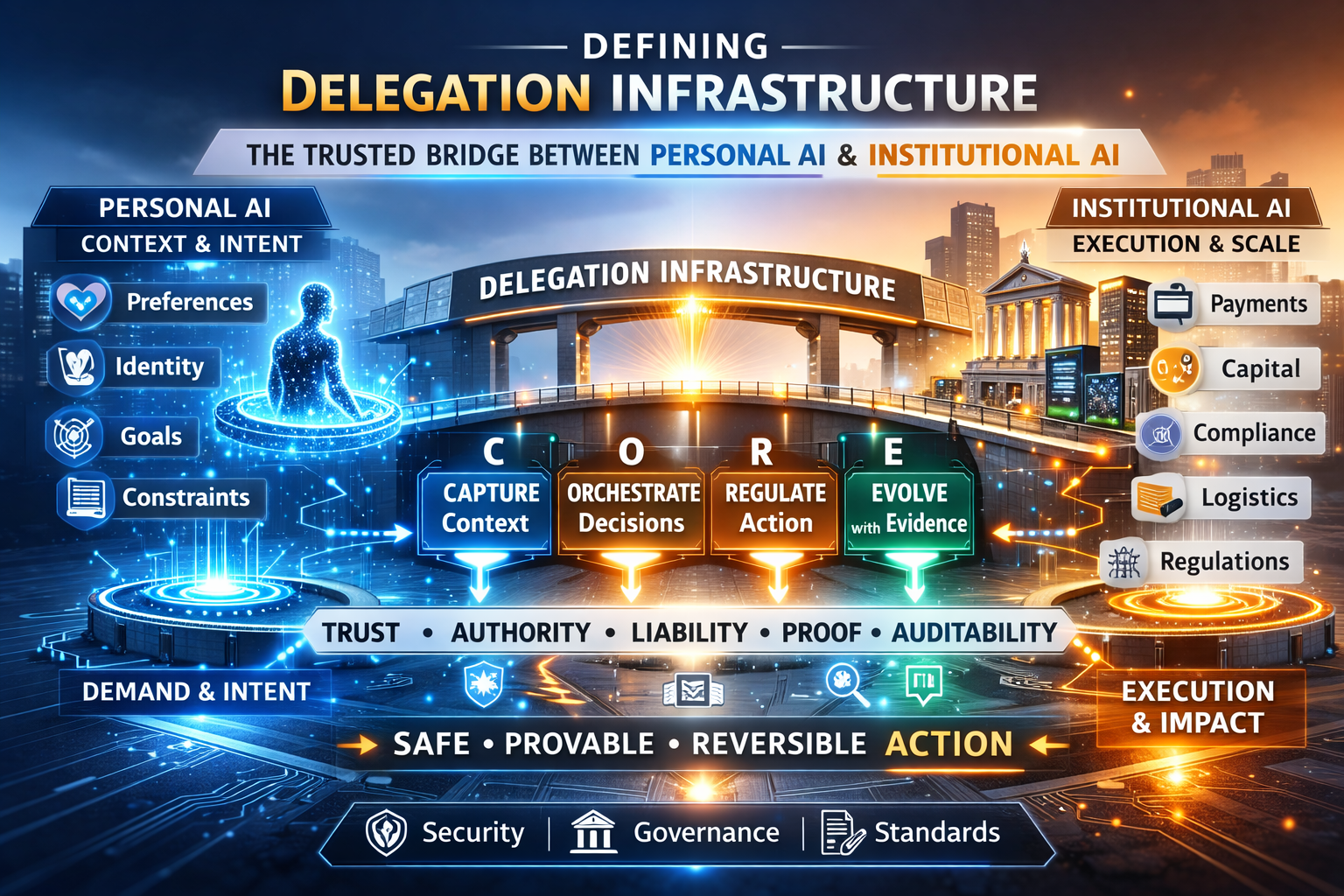
Defining Delegation Infrastructure
Delegation Infrastructure is the institutional layer that enables safe, provable, and reversible execution between:
Personal Intelligence Layer
- Context
- Preferences
- Identity
- Constraints
- Values
- Longitudinal memory
and
Institutional Intelligence Layer
- Payment rails
- Capital allocation systems
- Credit frameworks
- Insurance systems
- Regulatory compliance
- Public infrastructure
- Settlement systems
Delegation Infrastructure is the trusted bridge between demand and execution.
Hyper-personalization without trusted delegation is unstable.
Autonomy without proof is dangerous.
Intelligence without accountability erodes trust.
Delegation Infrastructure converts personalization into trusted action.
-
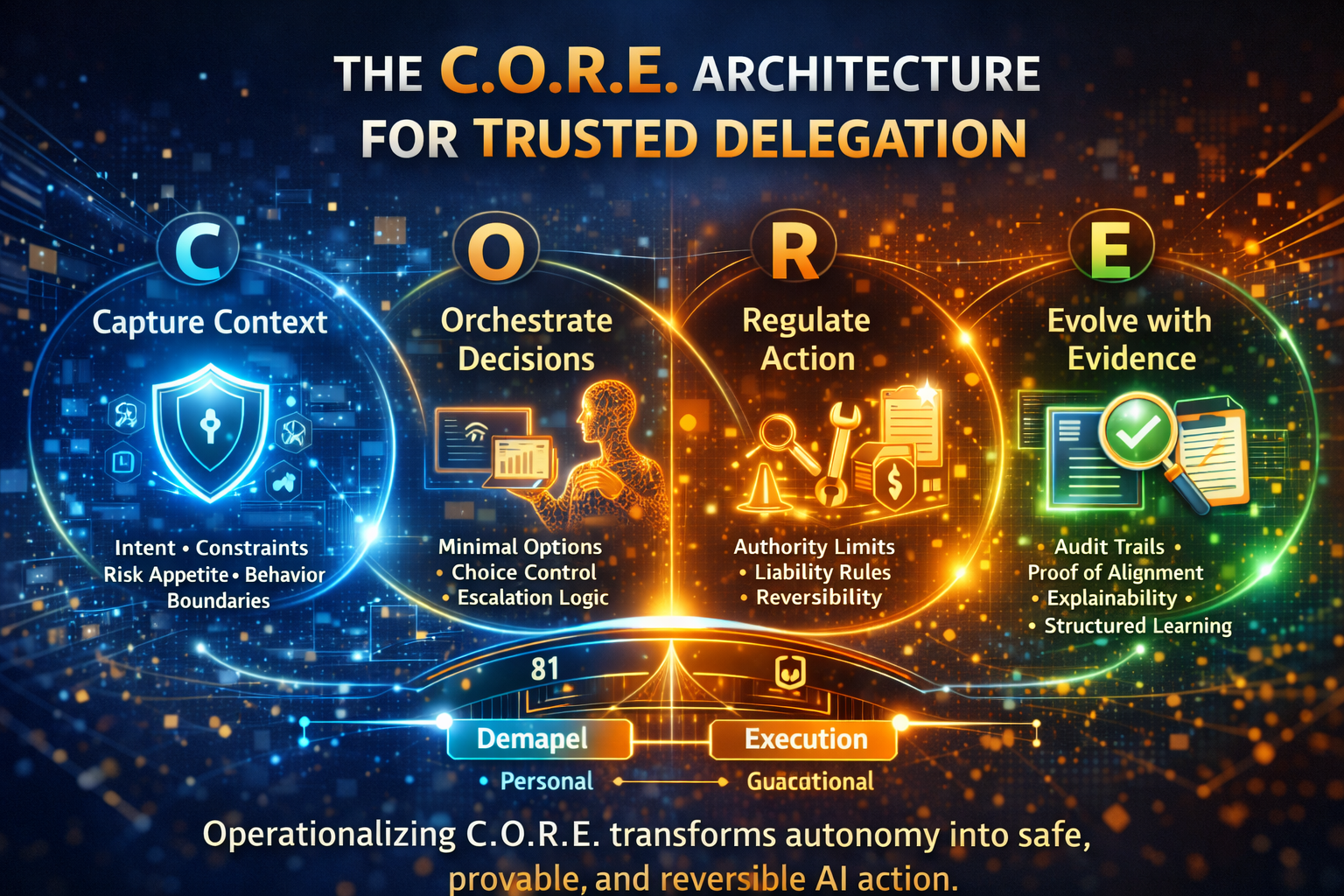
The C.O.R.E. Architecture for Trusted Delegation
To scale AI autonomy responsibly, organizations must operationalize four institutional capabilities:
C — Capture Context
Not raw data — but permissioned, meaningful context:
- Intent
- Constraints
- Risk appetite
- Regulatory exposure
- Historical behavior
- Preference memory
Context is not analytics.
Context is capital.
O — Orchestrate Decisions
Systems must determine:
- When to act
- When to ask
- When to escalate
- When to delay
- When to refuse
Choice architecture becomes strategic.
In an AI-saturated world, showing fewer — but better — options becomes a competitive advantage.
R — Regulate Action
Delegation boundaries must be explicit and enforceable:
- What actions are authorized?
- What thresholds trigger human review?
- What is reversible?
- What liability framework applies?
Policies must become machine-enforceable guardrails.
E — Evolve with Evidence
Every delegated action must produce:
- Traceable logs
- Auditable reasoning
- Reversible pathways
- Structured learning feedback
Trust compounds only when systems are auditable and improvable.
Without C.O.R.E., autonomy scales risk faster than value.
-
The Two-Layer AI Economy
The emerging economic architecture is dual-layered:
Layer 1: Personal Intelligence (Demand Layer)
This layer represents the individual or enterprise intent:
- Context
- Preferences
- Identity
- Goals
- Boundaries
It optimizes for “me.”
Layer 2: Institutional Intelligence (Execution Layer)
This layer represents authority:
- Capital allocation
- Payment processing
- Risk underwriting
- Regulatory enforcement
- Fulfillment networks
It enforces the rules of the system.
The competitive frontier is not inside either layer.
It is the bridge between them.
Delegation Infrastructure is that bridge.
-
Third-Order Business Models
As this architecture stabilizes, entirely new categories will emerge:
- Context Vaults – Trusted custodians of portable, permissioned longitudinal context.
- Delegation Contracts – Codified AI action rights, boundaries, and reversibility frameworks.
- Agent-to-Agent Protocols – Standards for negotiation, proof, settlement, and liability.
- Delegation Insurance Markets – Underwriting autonomous execution risk.
- Proof Exchanges – Verifiable trust and reputation systems for AI-driven transactions.
These are not incremental SaaS features.
They are new institutional roles.
This is the Third-Order AI Economy.
-
The Fourth Order: Institutional Redesign
Fourth-order AI emerges when delegation becomes societal infrastructure.
At this stage:
- Governments codify machine-action permissions.
- Sovereign AI frameworks define compliance rails.
- Digital identity integrates with AI execution.
- Liability regimes adapt to machine-executed contracts.
- Regulatory oversight becomes programmable.
AI ceases to be a corporate capability.
It becomes economic architecture.
Nations that design secure Delegation Infrastructure gain structural advantage.
Organizations embedded in those rails gain durable leverage.
-
Differentiation When Technology Equalizes
When all firms have strong AI, advantage shifts upward.
Competitive differentiation concentrates in:
- Trust continuity
- Institutional depth
- Incentive integrity
- Execution reliability
- Judgment under uncertainty
Human talent becomes more important — not less.
Humans design delegation rules.
Humans define escalation boundaries.
Humans govern ethical trade-offs.
Humans intervene in ambiguous edge cases.
AI scales cognition.
Humans scale responsibility.
-
The Strategic Choice for Boards
Boards must now answer:
- Do we control personal context?
- Do we own institutional execution rails?
- Or do we build the Delegation Infrastructure between them?
Organizations that fail to choose risk becoming commoditized intelligence layers.
Organizations that design trusted delegation frameworks shape market structure.
The next decade will not be won by those with the most advanced models.
It will be won by those who build the safest, most interoperable, most trusted systems of action.
Strategic Takeaways for Boards
-
AI abundance commoditizes intelligence.
-
Execution — not analysis — becomes the new risk frontier.
-
Trust, liability clarity, and reversibility become strategic assets.
-
Delegation Infrastructure is the bridge between personal AI and institutional AI.
-
Organizations that design this layer shape market structure.
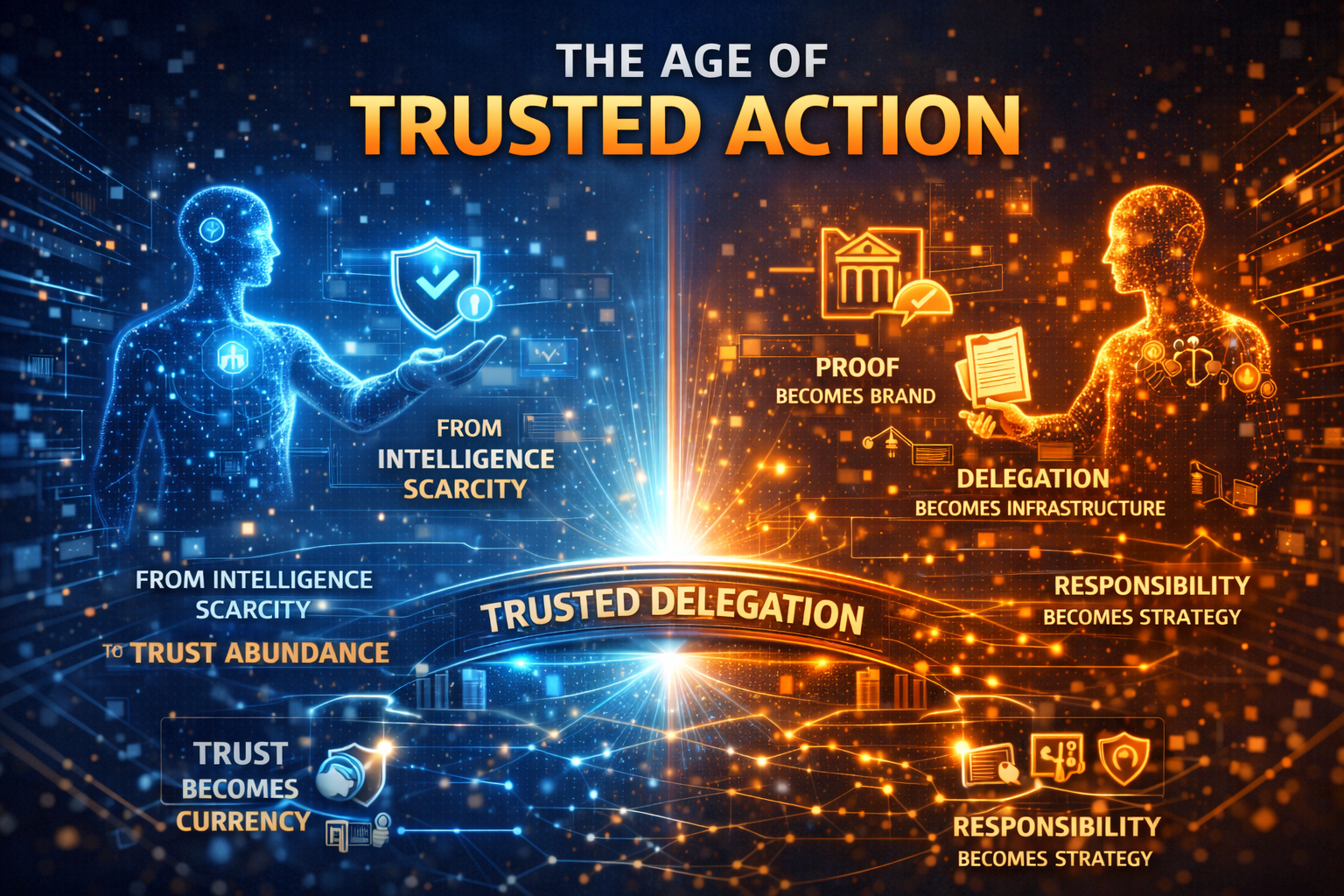
Conclusion: The Age of Trusted Action
AI is eliminating the scarcity of intelligence.
But abundance does not eliminate risk.
It amplifies it.
The decisive shift of this era is not digital transformation.
It is the transition from recommendation to execution.
As autonomy scales:
- Trust becomes currency.
- Delegation becomes infrastructure.
- Proof becomes brand.
- Responsibility becomes strategy.
We are entering the Age of Trusted Action.
And the institutions that architect Delegation Infrastructure — the bridge between personal and institutional intelligence — will define the Institutional AI Order.
Glossary
Delegation Infrastructure – Institutional systems that enable safe, auditable AI-driven execution between personal and enterprise systems.
Institutional AI Order – The macroeconomic restructuring driven by AI integration into governance, regulation, capital allocation, and national infrastructure.
Third-Order AI Economy – The stage where AI reshapes market structure and creates new institutional roles, beyond efficiency and decision optimization.
C.O.R.E. Architecture – Capture context, Orchestrate decisions, Regulate action, Evolve with evidence.
Agentic AI – AI systems capable of autonomous multi-step action.
FAQ
What is Delegation Infrastructure?
It is the institutional layer that enables AI systems to safely act on behalf of individuals or enterprises with clear permissions, auditability, and reversibility.
Why is Delegation Infrastructure important?
As AI systems move from recommendation to execution, trust, liability, and proof become central to economic coordination.
How does Delegation Infrastructure relate to Enterprise AI?
It extends Enterprise AI from decision optimization into safe autonomous execution across institutional systems.
What is the difference between third-order and fourth-order AI?
Third-order AI creates new market roles. Fourth-order AI redesigns national and regulatory economic structures.
The Intelligence-Native Enterprise Doctrine
This article is part of a larger strategic body of work that defines how AI is transforming the structure of markets, institutions, and competitive advantage. To explore the full doctrine, read the following foundational essays:
- The AI Decade Will Reward Synchronization, Not Adoption
Why enterprise AI strategy must shift from tools to operating models.
https://www.raktimsingh.com/the-ai-decade-will-reward-synchronization-not-adoption-why-enterprise-ai-strategy-must-shift-from-tools-to-operating-models/ - The Third-Order AI Economy
The category map boards must use to see the next Uber moment.
https://www.raktimsingh.com/third-order-ai-economy/ - The Intelligence Company
A new theory of the firm in the AI era — where decision quality becomes the scalable asset.
https://www.raktimsingh.com/intelligence-company-new-theory-firm-ai/ - The Judgment Economy
How AI is redefining industry structure — not just productivity.
https://www.raktimsingh.com/judgment-economy-ai-industry-structure/ - Digital Transformation 3.0
The rise of the intelligence-native enterprise.
https://www.raktimsingh.com/digital-transformation-3-0-the-rise-of-the-intelligence-native-enterprise/ - Industry Structure in the AI Era
Why judgment economies will redefine competitive advantage.
https://www.raktimsingh.com/industry-structure-in-the-ai-era-why-judgment-economies-will-redefine-competitive-advantage/
Institutional Perspectives on Enterprise AI
Many of the structural ideas discussed here — intelligence-native operating models, control planes, decision integrity, and accountable autonomy — have also been explored in my institutional perspectives published via Infosys’ Emerging Technology Solutions platform.
For readers seeking deeper operational detail, I have written extensively on:
- What Makes an Enterprise Intelligence-Native? The Blueprint for Third-Order AI Advantage
https://blogs.infosys.com/emerging-technology-solutions/artificial-intelligence/what-is-enterprise-ai-the-operating-model-for-compounding-institutional-intelligence.html - Why “AI in the Enterprise” Is Not Enterprise AI: The Operating Model Difference Most Organizations Miss
https://blogs.infosys.com/emerging-technology-solutions/artificial-intelligence/why-ai-in-the-enterprise-is-not-enterprise-ai-the-operating-model-difference-that-most-organizations-miss.html - The Enterprise AI Control Plane: Governing Autonomy at Scale
https://blogs.infosys.com/emerging-technology-solutions/artificial-intelligence/the-enterprise-ai-control-plane-governing-autonomy-at-scale.html - Enterprise AI Ownership Framework: Who Is Accountable, Who Decides, and Who Stops AI in Production
https://blogs.infosys.com/emerging-technology-solutions/artificial-intelligence/enterprise-ai-ownership-framework-who-is-accountable-who-decides-and-who-stops-ai-in-production.html - Decision Integrity: Why Model Accuracy Is Not Enough in Enterprise AI
https://blogs.infosys.com/emerging-technology-solutions/artificial-intelligence/decision-integrity-why-model-accuracy-is-not-enough-in-enterprise-ai.html - Agent Incident Response Playbook: Operating Autonomous AI Systems Safely at Enterprise Scale
https://blogs.infosys.com/emerging-technology-solutions/artificial-intelligence/agent-incident-response-playbook-operating-autonomous-ai-systems-safely-at-enterprise-scale.html - The Economics of Enterprise AI: Designing Cost, Control, and Value as One System
https://blogs.infosys.com/emerging-technology-solutions/artificial-intelligence/the-economics-of-enterprise-ai-designing-cost-control-and-value-as-one-system.html
Together, these perspectives outline a unified view: Enterprise AI is not a collection of tools. It is a governed operating system for institutional intelligence — where economics, accountability, control, and decision integrity function as a coherent architecture.



Raktim Singh is an AI and deep-tech strategist, TEDx speaker, and author focused on helping enterprises navigate the next era of intelligent systems. With experience spanning AI, fintech, quantum computing, and digital transformation, he simplifies complex technology for leaders and builds frameworks that drive responsible, scalable adoption.