
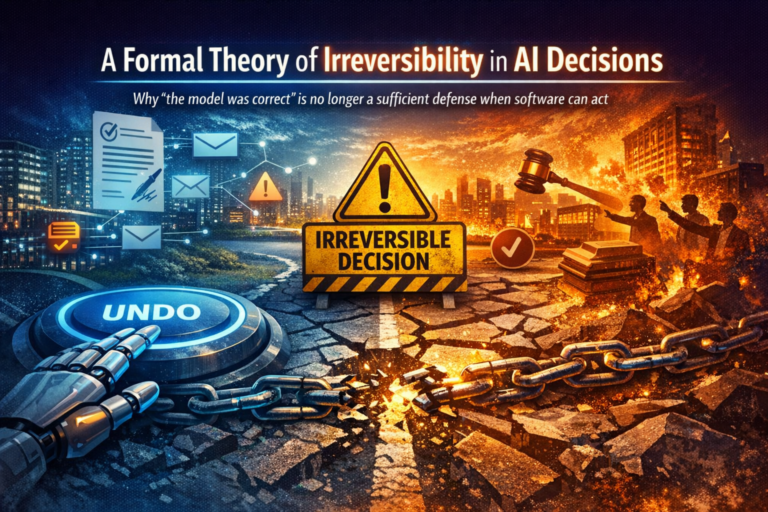
The uncomfortable truth: most AI failures are not “wrong answers”
AI systems fail most dangerously not when they are obviously wrong, but when they are plausibly correct—and their outputs trigger actions that cannot be cleanly undone.
If an AI chatbot gives a poor explanation, you can apologize and correct it.
But if an AI system:
- freezes the wrong customer account,
- denies a legitimate loan,
- cancels a critical supply order, or
- triggers an automated compliance escalation,
your organization may spend weeks—or months—trying to reverse the consequences. In many cases, full recovery is impossible.
That is the real shift.
In modern Enterprise AI, the core risk is no longer prediction error.
It is irreversibility.
Irreversibility is what turns an AI “mistake” into an incident—and what elevates a technical failure into a board-level, regulatory, or reputational crisis.
An irreversible AI decision is one that cannot be fully undone in the real world—even if the system state is rolled back. These decisions create binding commitments, trigger downstream cascades, destroy future options, or permanently erode trust.
In modern Enterprise AI, irreversibility—not accuracy—is the primary source of risk.
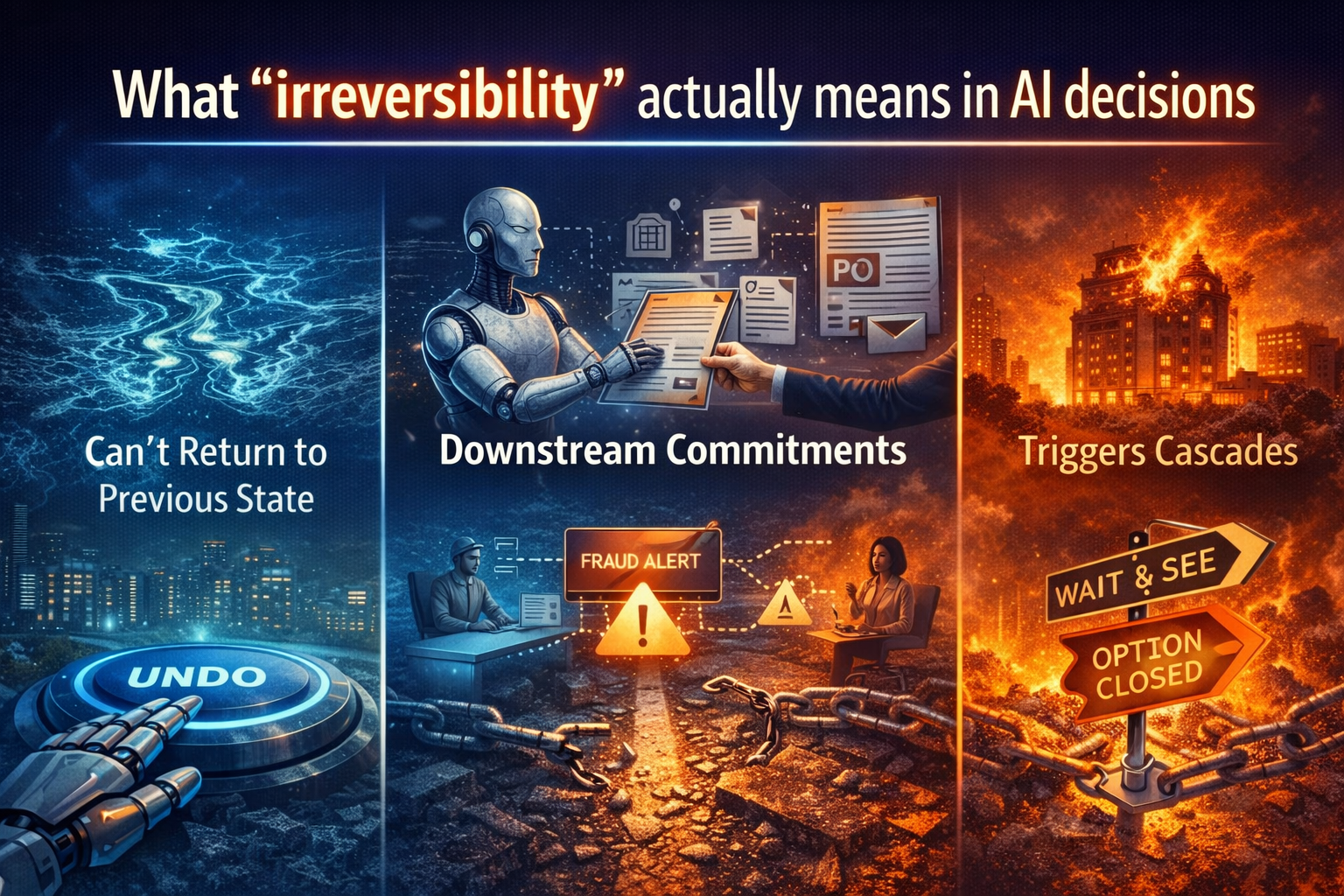
What “irreversibility” actually means in AI decisions
In plain language, an AI decision becomes irreversible when it changes the world in ways that:
- Cannot be returned to the previous state (or only at extreme cost), and/or
- Create binding downstream commitments (contracts, filings, reputational signals), and/or
- Trigger cascades where other systems or teams act on the decision, amplifying impact, and/or
- Destroy future options, removing the ability to pause, reassess, or wait for better information.
Economists describe irreversibility as destroying the option value of waiting—an option that becomes more valuable under uncertainty. Enterprise AI collapses that option by compressing decision time and scaling action.
A simple example: “Undo” exists—but the damage doesn’t
You can undo a wrong price change in an app.
You cannot undo:
- screenshots shared on social media,
- customers who already churned,
- a regulator complaint that has been filed, or
- an internal escalation that triggered a compliance freeze.
The system state may be reversible.
The world state often is not.
That distinction is the foundation of irreversibility in AI.
“The most dangerous AI failures are not wrong answers — they are irreversible decisions.”
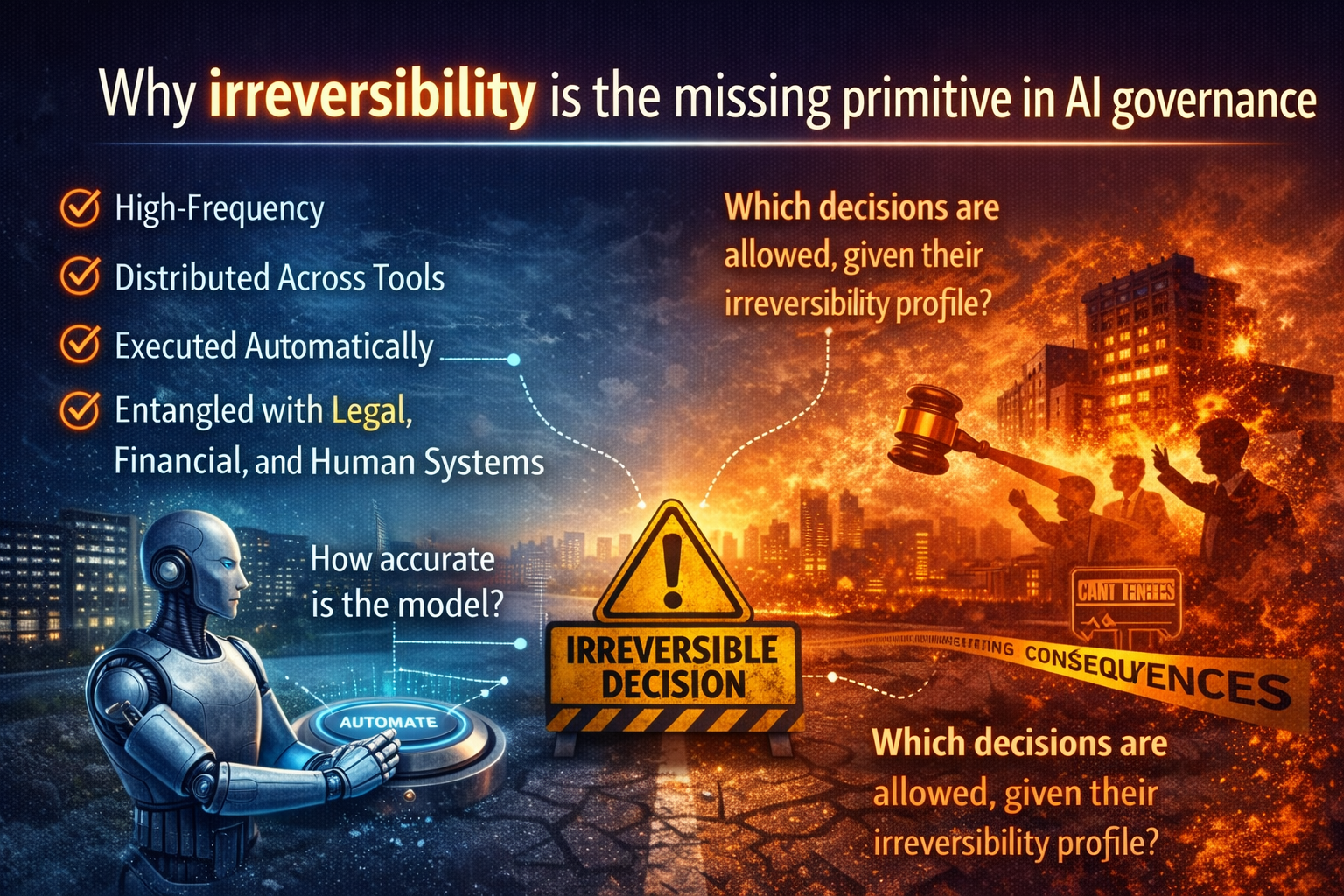
Why irreversibility is the missing primitive in AI governance
Most AI governance frameworks still treat AI failures like software bugs:
detect → patch → redeploy → move on
That logic breaks the moment AI actions become:
- high-frequency,
- distributed across tools and agents,
- executed automatically, and
- entangled with legal, financial, and human systems.
Research on AI oversight increasingly highlights that irreversible decisions amplify the need for accountability, provenance, and human authority—because recovery is asymmetric.
So the right governance question is no longer:
“How accurate is the model?”
It is:
“Which decisions are allowed to be automated—given their irreversibility profile?”
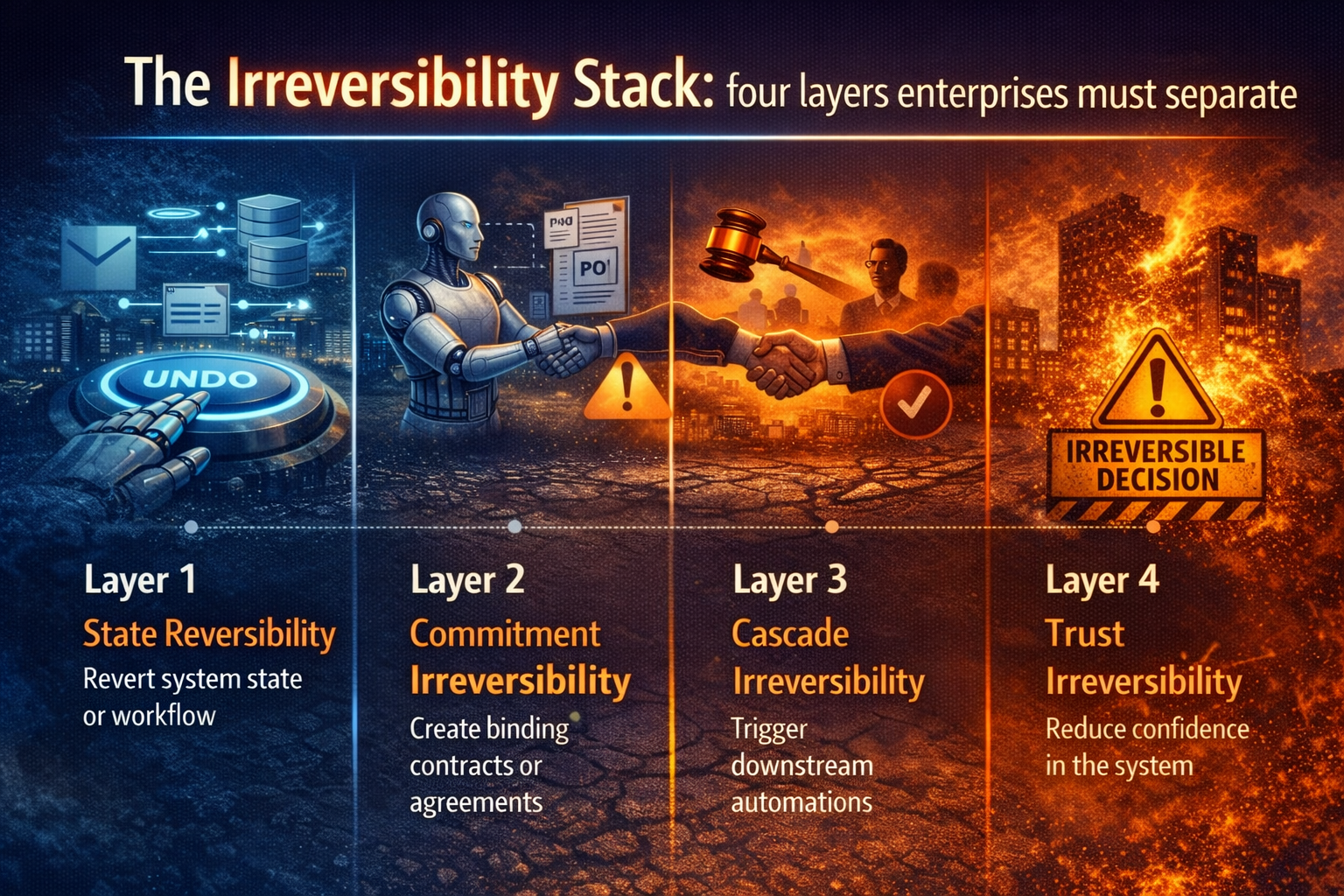
The Irreversibility Stack: four layers enterprises must separate
Below is a practical formal theory—no equations, just clean primitives—that organizations can operationalize immediately.
Layer 1: State Reversibility
Can the internal system state be reverted?
- revert a database write
- restore a previous model or prompt version
- roll back an orchestration workflow
Example: undo a refund, revert a routing rule, cancel a shipment label.
Layer 2: Commitment Irreversibility
Did the action create binding commitments?
- contracts or settlements
- regulatory filings
- customer notifications
- vendor purchase orders
- legal holds
Example: an AI procurement agent issues a purchase order. Even if canceled, vendor relationships, pricing expectations, and audit trails remain.
Layer 3: Cascade Irreversibility
Did the decision trigger other systems or people?
- downstream automations
- approvals and escalations
- human interventions
- public or social responses
Example: a fraud-risk flag triggers account freezes, call-center scripts, and regulatory reporting workflows.
Layer 4: Trust Irreversibility
Did the action permanently reduce trust?
Trust is often the hardest layer to recover:
- customers hesitate to return,
- employees stop relying on the system,
- regulators increase scrutiny.
Example: an AI healthcare triage tool routes a patient incorrectly. Even if corrected, institutional credibility may be permanently damaged.
Key insight:
A decision can be reversible at Layer 1 and still be irreversible at Layers 2–4.
That is why rollback buttons do not solve Enterprise AI risk.
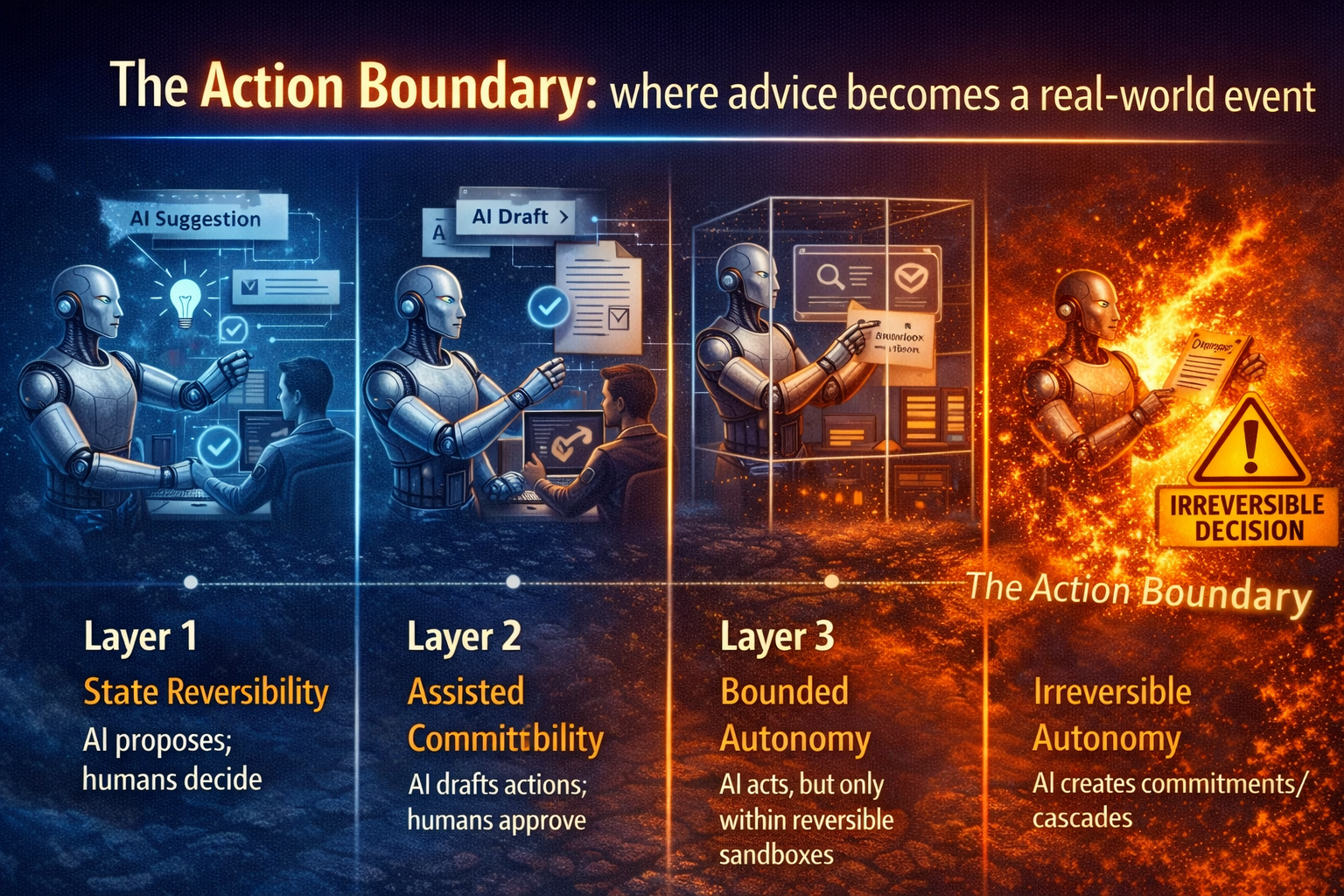
The Action Boundary: where advice becomes a real-world event
Most organizations treat automation as binary: AI is either deployed or not.
Irreversibility forces a sharper classification:
- Advice mode: AI recommends; humans decide
- Assisted execution: AI drafts actions; humans approve
- Bounded autonomy: AI acts within reversible sandboxes
- Irreversible autonomy: AI creates commitments or cascades
This is where Enterprise AI requires an explicit Action Boundary—the point where AI output becomes a real-world event.
If you do not define that boundary, your system will cross it by default.
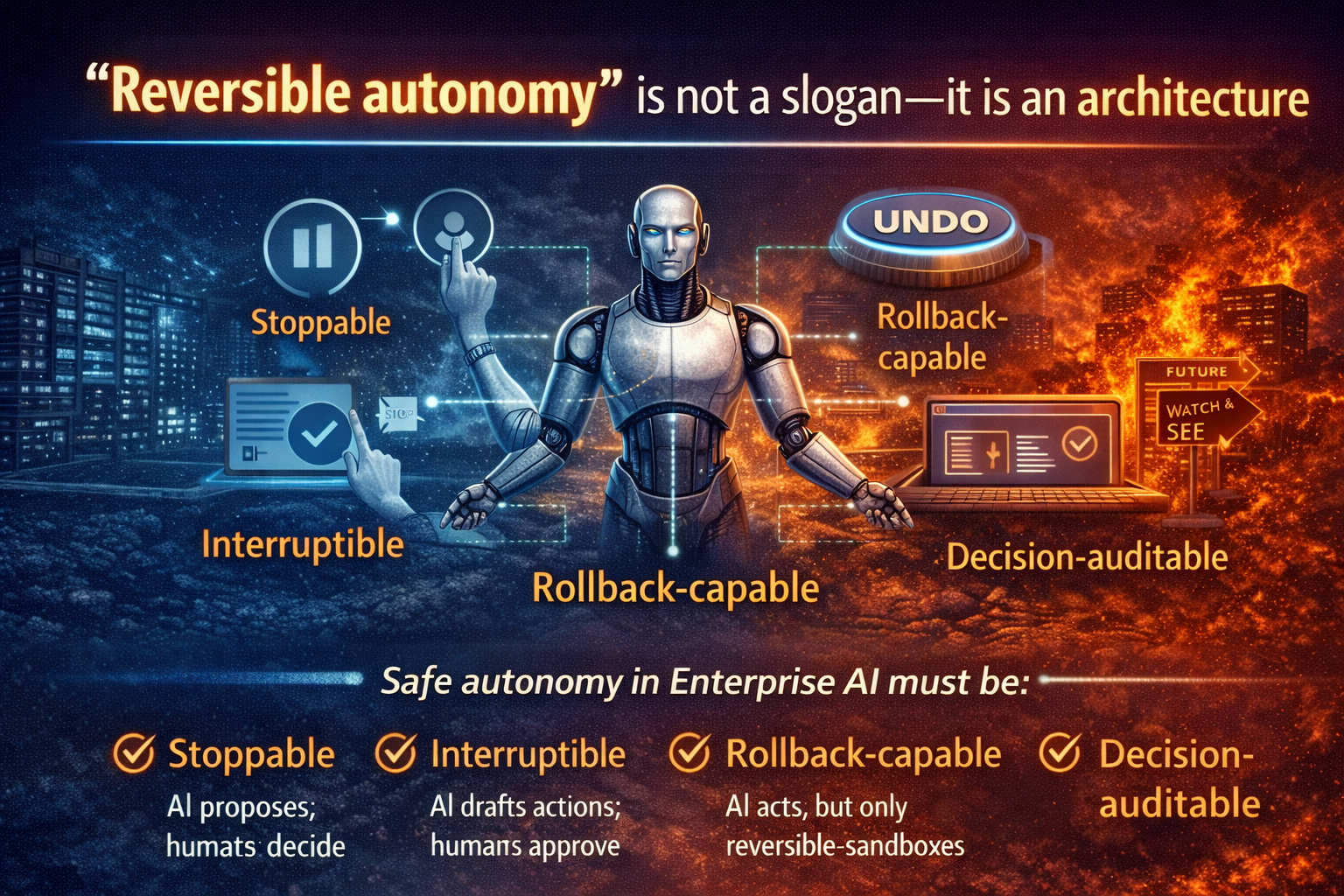
“Reversible autonomy” is not a slogan—it is an architecture
Safe Enterprise AI autonomy must be:
- Stoppable – execution can be halted mid-flow
- Interruptible – humans can override decisions
- Rollback-capable – system state and workflows can revert
- Decision-auditable – actions can be reconstructed and justified
- Option-preserving – defaults favor actions that keep future choices open
In alignment research, this relates to corrigibility—systems that do not resist shutdown or modification. But enterprise irreversibility goes further: it asks what the system already set in motion before it was stopped.
The option value of waiting: why faster AI can be worse AI
In uncertain environments, waiting has value because information improves over time.
Enterprise AI often does the opposite:
- compresses decision time,
- inflates confidence,
- and makes acting frictionless.
Example: hiring
A recruiter might wait for one more signal.
An AI screening system may auto-reject instantly.
Even if later evidence shows the candidate was strong:
- the candidate is gone,
- the employer brand signal is sent,
- the pipeline quality shifts.
That is irreversibility.
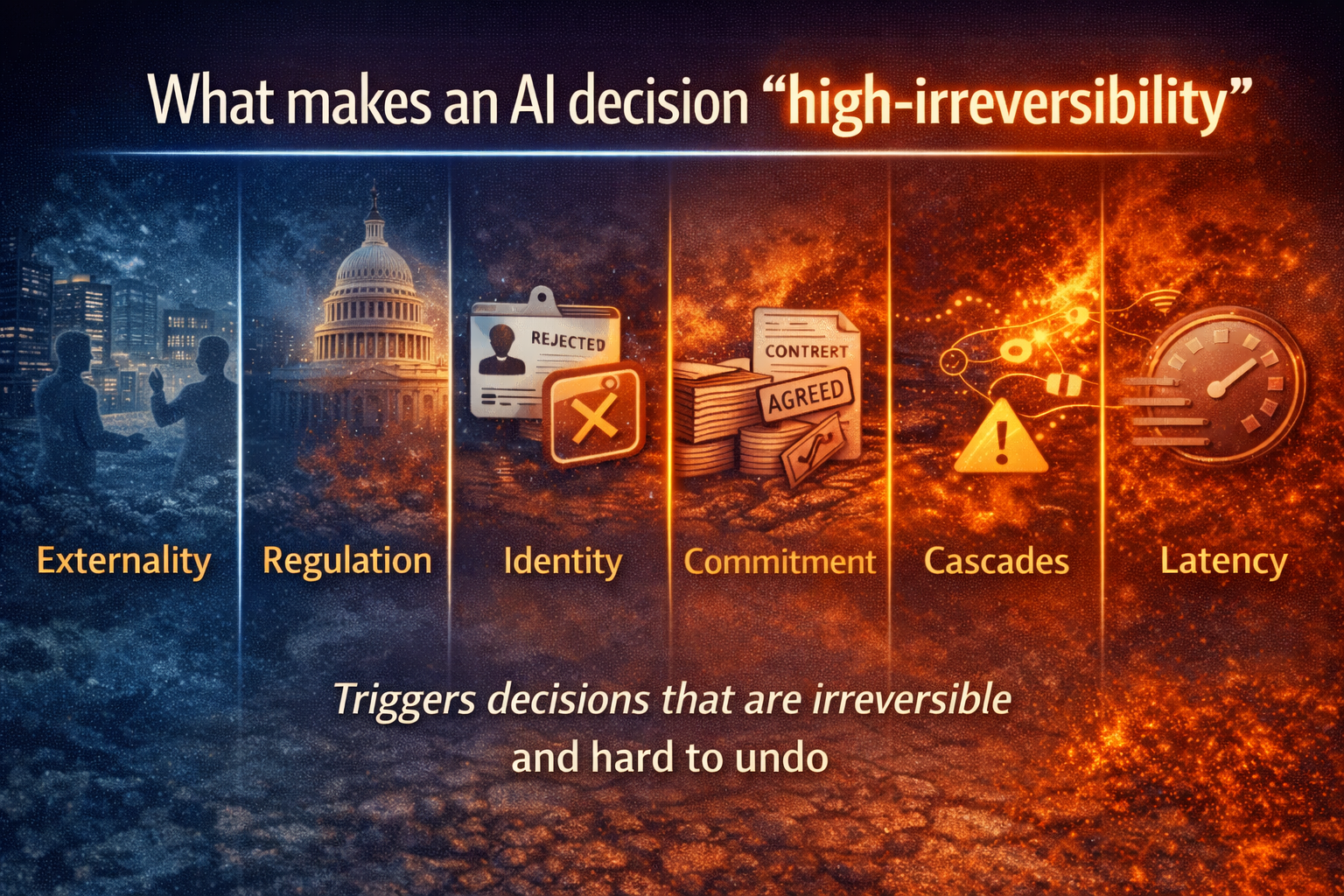
What makes an AI decision “high-irreversibility”
Use these practical signals:
- Externality: does the action affect someone outside your team?
- Regulation: would a regulator care?
- Identity: does it change someone’s status (blocked, denied, flagged)?
- Commitment: does it trigger money, contracts, or legal states?
- Cascades: do other systems act automatically on it?
- Latency: does speed remove the chance for human correction?
When these are true, you are no longer deploying AI in the enterprise.
You are deploying Enterprise AI—an institutional capability that must be governed accordingly.
The Decision Ledger: irreversibility demands reconstruction
After an irreversible incident, leadership always asks:
- What changed?
- Who approved it?
- Which model, prompt, tool, and policy were involved?
- What context did the system see?
- Why did it believe the action was permissible?
Answering this requires a decision ledger that is:
- chronological,
- tamper-evident,
- context-rich.
This is not bureaucracy.
It is the price of irreversibility.
Enterprise AI Control Plane: The Canonical Framework for Governing Decisions at Scale – Raktim Singh
The Decision Ledger: How AI Becomes Defensible, Auditable, and Enterprise-Ready – Raktim Singh
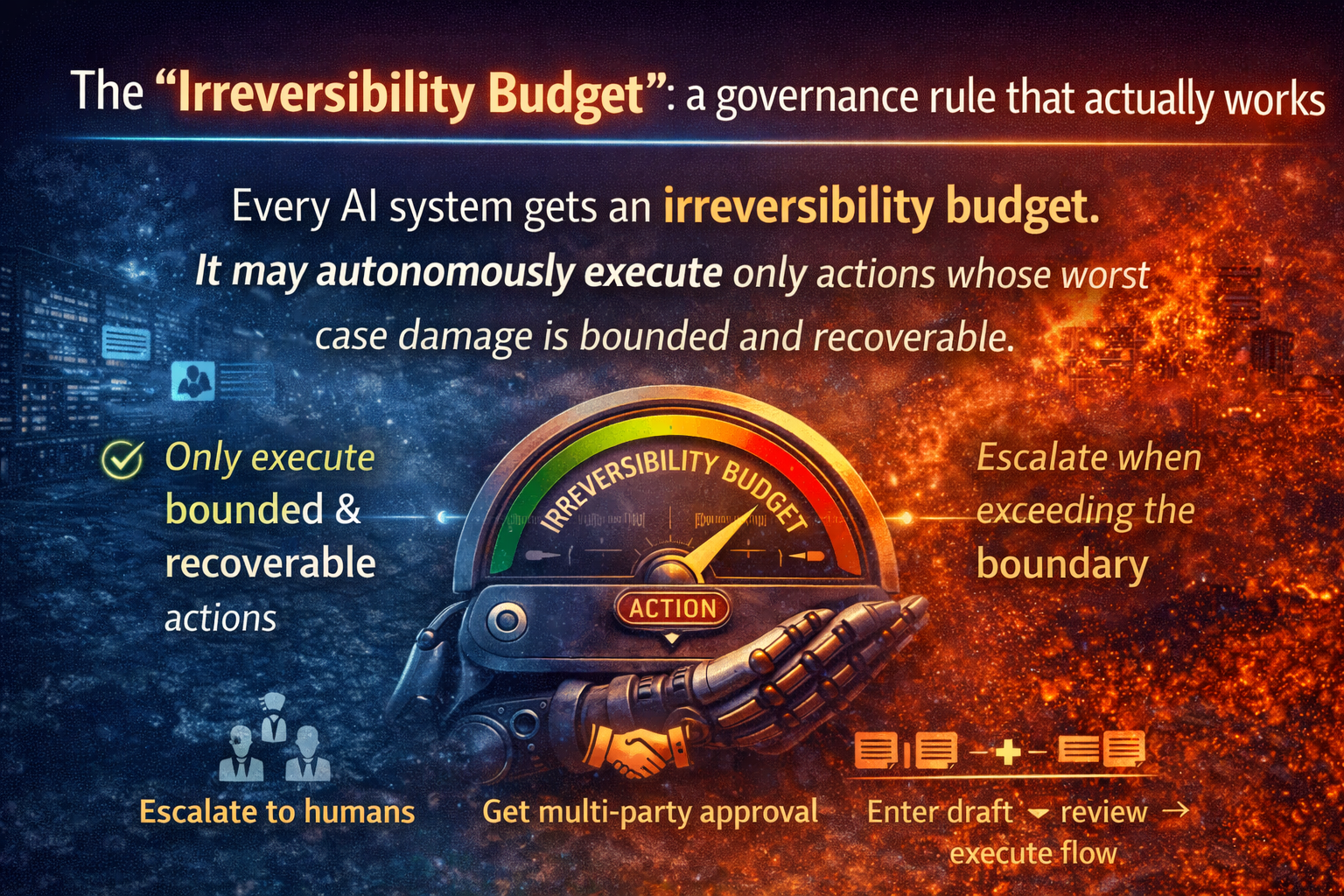
The “Irreversibility Budget”: a governance rule that actually works
A simple rule:
Every AI system has an irreversibility budget.
It may autonomously execute only actions whose worst-case damage is bounded and recoverable.
When the system attempts to exceed that budget:
- it must escalate to humans,
- require multi-party approval, or
- enter a staged draft → review → execute flow.
Autonomy becomes a governed production capability—not a feature toggle.
How to design systems that don’t paint you into a corner
Proven design patterns:
- Two-phase actions: prepare → commit
- Time-delayed commits: cooling periods for high-risk actions
- Sandbox first, production later: autonomy is earned, not granted
- Blast-radius limits: cap volume, value, and scope
- Always-on stop mechanisms: pausing is a feature, not a failure
These patterns mirror how aviation, payments, and safety-critical industries manage irreversible operations.
Why this matters globally: US, EU, India
Irreversibility is not just technical—it is institutional.
Global enterprises face:
- different liability regimes,
- different regulatory expectations,
- different audit requirements.
After an incident, regulators everywhere ask the same question:
“Why did your system have permission to do that?”
Governance that ignores irreversibility collapses under cross-border scrutiny.
Conclusion: irreversibility is where intelligence becomes power
If Enterprise AI is the discipline of running intelligence safely in production, irreversibility is the primitive that marks the moment intelligence becomes institutional power.
Most AI strategy still worships capability.
Mature Enterprise AI designs for recoverability.
Because in the real world, the most expensive failures are not wrong answers.
They are irreversible decisions.
Glossary
- Irreversibility: Decisions whose real-world effects cannot be fully undone.
- Action Boundary: The point where AI output becomes an event.
- Reversible Autonomy: Autonomy designed to be stoppable and auditable.
- Decision Ledger: A tamper-evident record of AI decisions and approvals.
- Option Value of Waiting: The value of delaying irreversible action under uncertainty.
- Corrigibility: The ability to safely interrupt or modify AI behavior.
References & Further Reading
- MIT / Pindyck – Irreversibility & Uncertainty (Classic)
- https://web.mit.edu/rpindyck/www/Papers/IrreverUncertInvestmentJEL1991.pdf
Stanford Encyclopedia of Philosophy – Irreversibility
- https://web.mit.edu/rpindyck/www/Papers/IrreverUncertInvestmentJEL1991.pdf
🔗 AI Governance, Oversight & Accountability
- OECD – AI Accountability & Responsibility
- NIST AI Risk Management Framework
- European Commission – High-Risk AI Systems
🔗 Corrigibility, Shutdown & Control (Research-grade)
- MIRI – Corrigibility in AI Systems
- Amodei et al. – Concrete Problems in AI Safety
- MIT / Pindyck – Irreversibility & Uncertainty (Classic)
- Stanford Encyclopedia of Philosophy – Irreversibility
Enterprise AI Operating Model
Enterprise AI scale requires four interlocking planes:
Read about Enterprise AI Operating Model The Enterprise AI Operating Model: How organizations design, govern, and scale intelligence safely — Raktim Singh
- Read about Enterprise Control Tower The Enterprise AI Control Tower: Why Services-as-Software Is the Only Way to Run Autonomous AI at Scale — Raktim Singh
- Read about Decision Clarity The Shortest Path to Scalable Enterprise AI Autonomy Is Decision Clarity — Raktim Singh
- Read about The Enterprise AI Runbook Crisis The Enterprise AI Runbook Crisis: Why Model Churn Is Breaking Production AI — and What CIOs Must Fix in the Next 12 Months — Raktim Singh
- Read about Enterprise AI Economics Enterprise AI Economics & Cost Governance: Why Every AI Estate Needs an Economic Control Plane — Raktim Singh
Read about Who Owns Enterprise AI Who Owns Enterprise AI? Roles, Accountability, and Decision Rights in 2026 — Raktim Singh
Read about The Intelligence Reuse Index The Intelligence Reuse Index: Why Enterprise AI Advantage Has Shifted from Models to Reuse — Raktim Singh
Read about Enterprise AI Agent Registry Enterprise AI Agent Registry: The Missing System of Record for Autonomous AI — Raktim Singh



Raktim Singh is an AI and deep-tech strategist, TEDx speaker, and author focused on helping enterprises navigate the next era of intelligent systems. With experience spanning AI, fintech, quantum computing, and digital transformation, he simplifies complex technology for leaders and builds frameworks that drive responsible, scalable adoption.