
They assume their industry already has enough data, enough software, enough cloud infrastructure, and enough ambition. So when progress slows, the instinct is predictable: buy a better model, increase the budget, hire a stronger implementation partner, or launch another pilot.
That diagnosis is often wrong.
In many sectors, AI is not stalled because intelligence is missing. It is stalled because reality is not yet structured for machine action. Data may exist, but it is fragmented, stale, inconsistent, hard to verify, disconnected from decision rights, or only weakly tied to the real entities and states that matter.
NIST’s AI Risk Management Framework emphasizes that trustworthy AI depends on governance, mapping, measurement, and management across the full lifecycle, not just model capability. OECD guidance similarly stresses accountability, traceability, and transparency, while WHO and the World Economic Forum point to interoperability, data foundations, and governance as core conditions for real-world adoption. (NIST Publications)
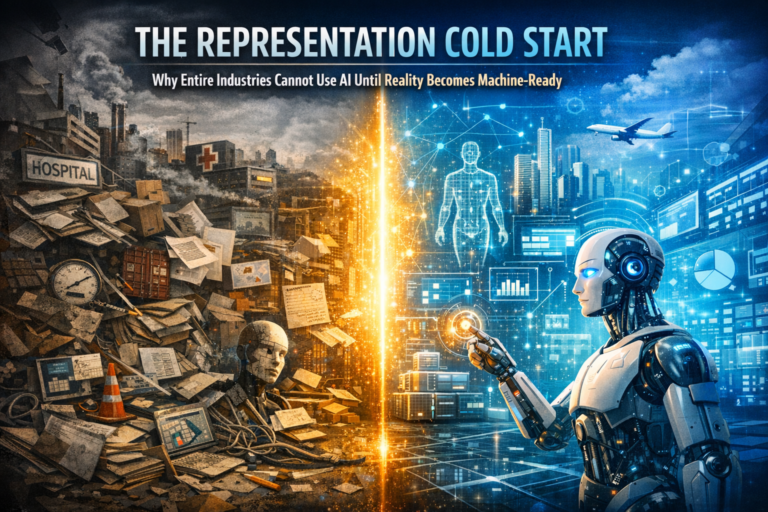
That is the problem I call the Representation Cold Start.
A representation cold start happens when an industry cannot meaningfully deploy AI at scale because the world it operates in was never encoded in a form machines can reliably observe, interpret, and act upon.
A sector may be digitized at the surface and still remain structurally unreadable to AI in the deeper sense that matters. It lacks the conditions for dependable machine judgment and bounded machine action. This is why so many AI pilots look impressive in demos and then disappoint in production. The failure begins before the model begins. (NIST Publications)
This idea sits inside my broader Representation Economy framework, which explains why value in the AI era will increasingly depend not just on intelligence, but on how well reality is represented and how responsibly systems act on it. That is where SENSE–CORE–DRIVER becomes essential.
Executive Definition
The Representation Cold Start is the condition where an industry cannot deploy AI effectively because its reality is not structured into machine-readable signals, entities, and state models required for safe decision-making and action.
The SENSE–CORE–DRIVER lens
To understand the representation cold start, we need to move beyond the narrow belief that AI is primarily about models.
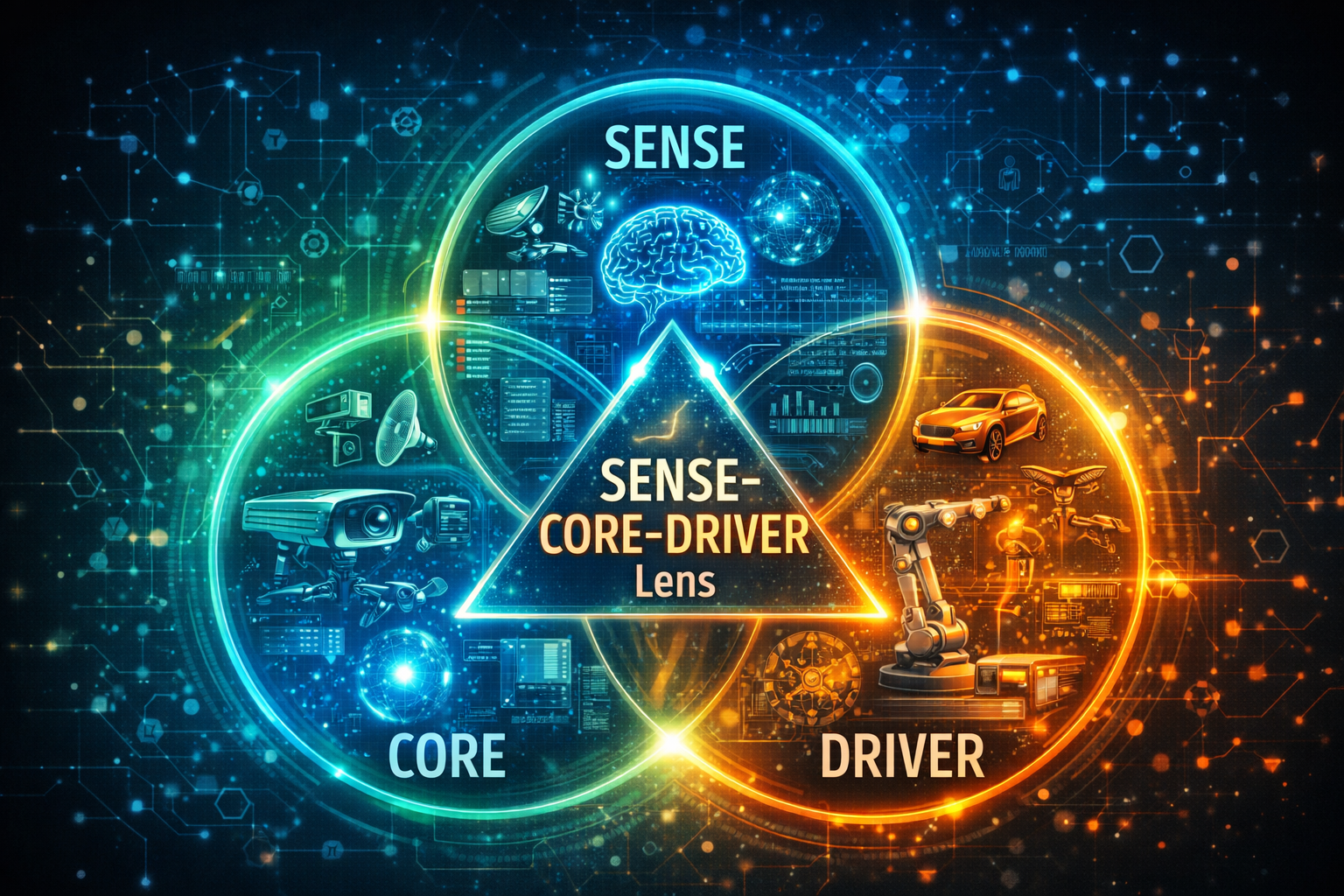
SENSE is the legibility layer. It is where reality becomes machine-readable through signals, entity resolution, state representation, and continuous updating.
CORE is the cognition layer. It is where systems interpret, reason, optimize, and decide.
DRIVER is the legitimacy layer. It is where delegation, verification, execution, and recourse determine whether machine action is allowed, bounded, and contestable.
Most AI debate still focuses on CORE. But many industries are blocked because SENSE is underbuilt and DRIVER is missing. That is the real cold start.
Data-rich does not mean machine-ready
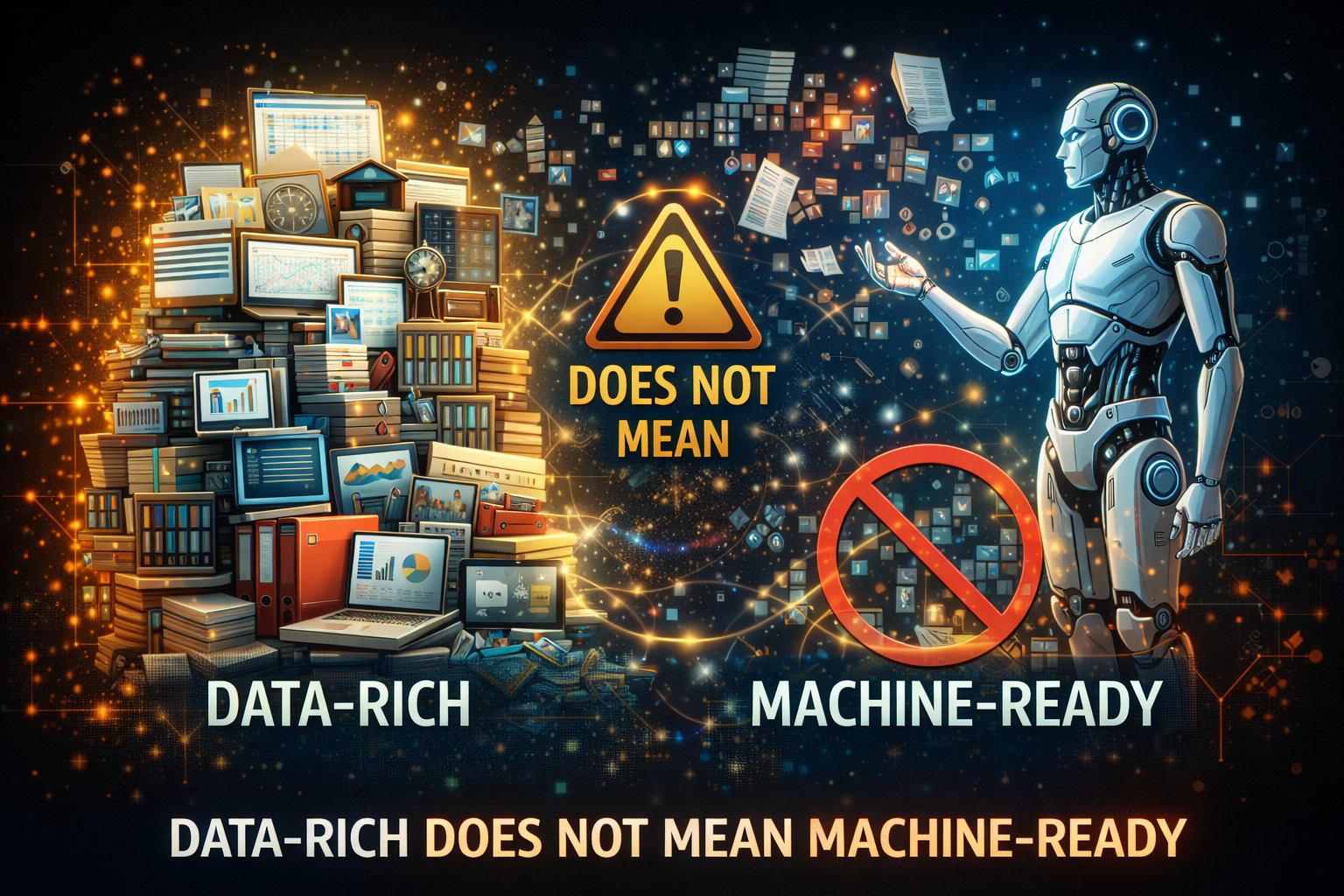
This is the first mistake leaders make: they confuse digital exhaust with usable representation.
A hospital may have medical records, scans, billing systems, lab systems, and appointment data. A logistics network may have shipment records, GPS feeds, warehouse software, emails, and spreadsheets. A city may have registries, permits, traffic signals, complaint systems, and payment rails.
But none of that guarantees machine-ready reality. WHO’s digital health work stresses that meaningful digital transformation depends on interoperability, data sharing, governance, and evidence-informed decision-making. OECD principles make similar points around representative datasets, traceability, and accountability. (World Health Organization)
Take a simple retail example. A company wants AI to reorder inventory automatically. On paper, that sounds easy. But what exactly counts as inventory at the moment of decision? Stock on shelves? Stock in transit? Reserved stock for pending orders? Returned items? Damaged items? Supplier shipments delayed but not yet reflected in the system? If these states are not represented cleanly, the model is not reasoning over reality. It is reasoning over a partial shadow of reality.
That is not an intelligence problem. It is a representation problem.
Why entire sectors get stuck
The World Economic Forum’s recent work on real-world AI adoption makes an important point: scaling AI successfully requires stronger data foundations, redesigned operating models, and closer alignment between technology and enterprise execution. Its 2026 reporting also highlights that organizations making AI work tend to strengthen data foundations rather than treating them as an afterthought. (World Economic Forum Reports)
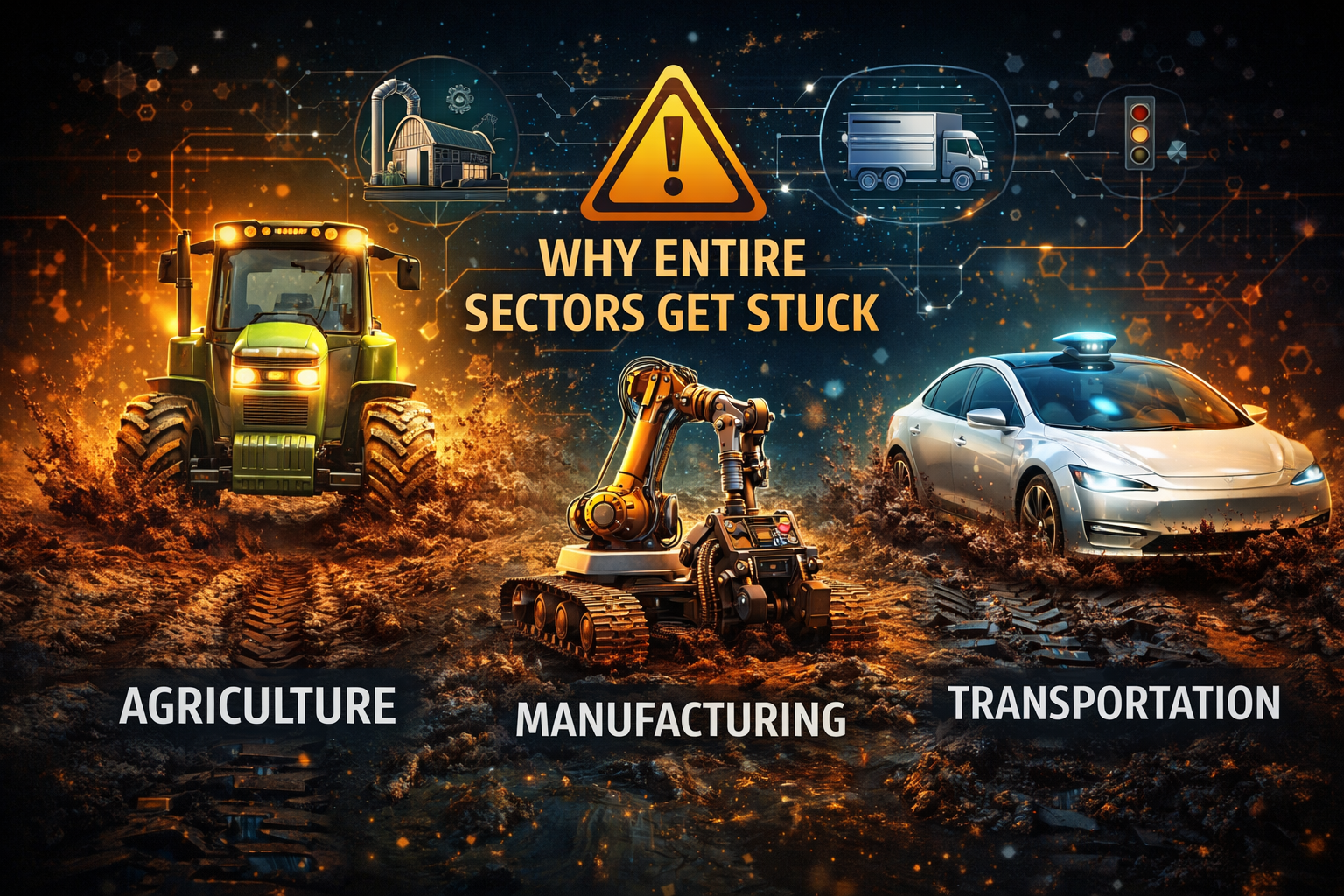
Entire industries get stuck in a representation cold start for five recurring reasons.
-
Weak signals
Important events are not captured in real time, are captured inconsistently, or remain trapped inside documents, calls, images, inboxes, or human memory.
-
Unstable entities
The same customer, supplier, asset, patient, shipment, machine, contract, or case appears differently across systems. There is no durable identity layer.
-
Poor state representation
Systems record transactions but not conditions. They know what happened, but not what the current situation actually is.
-
Fast-changing reality, slow-changing structures
New products, regulations, suppliers, workflows, edge cases, and exceptions appear faster than the representation layer can adapt.
-
Missing legitimate action pathways
Even when AI outputs are useful, the organization has not defined who authorized action, what must be verified, how action is executed, and how errors can be challenged, corrected, or unwound.
This last point matters more than most executives realize. NIST, OECD, and recent OECD accountability work all emphasize lifecycle governance, traceability, oversight, and mechanisms for challenge and accountability. (NIST Publications)
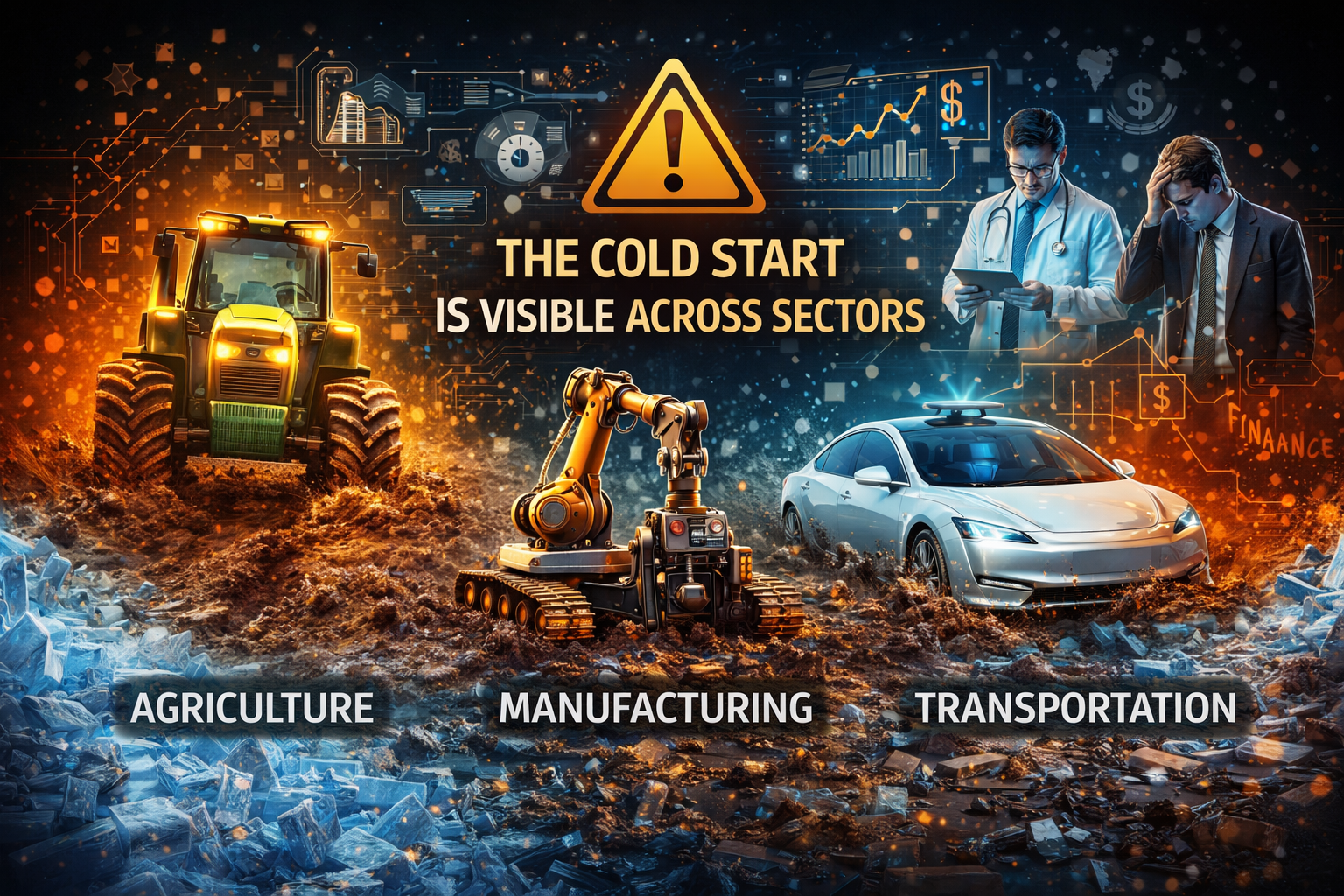
The cold start is visible across sectors
Healthcare is an obvious example. The opportunity for AI is enormous, but WHO continues to emphasize that digitally enabled health systems require high-quality governance, interoperability, and trusted data-sharing arrangements. Effective health data governance is not an optional layer around AI; it is a condition for making health reality safely legible across institutions. (World Health Organization)
Logistics shows the same pattern. AI promises route optimization, supply chain resilience, lower emissions, and better inventory decisions. But if shipment data, customs data, weather disruptions, warehouse status, and partner systems do not reconcile into a coherent state model, AI cannot act well, no matter how advanced the model is. WEF’s recent work on transport and AI underscores the importance of integration and coordination across systems. (World Economic Forum Reports)
Public infrastructure offers an even bigger example. The World Bank’s work on digital public infrastructure emphasizes interoperability, modularity, security, inclusion, and grievance redress. That is not just a public-sector modernization agenda. It is the foundation for machine-ready institutional coordination. In other words, the cold start at national scale is not solved by digitizing services alone. It is solved by making identity, data exchange, payment, and service state machine-readable, governable, and inclusive. (OECD)
Small and midsize firms face a harsher version of the same problem. OECD work shows that AI adoption remains uneven across firms because readiness, capabilities, and organizational conditions matter. For many firms, the issue is not access to frontier models. Their operating reality still lives in spreadsheets, fragmented SaaS tools, ad hoc workflows, and tacit employee knowledge. The model is ready. The firm is not. (OECD)
Why better models do not solve it
When leaders hit a cold start, they usually respond by escalating the intelligence layer. They buy a stronger model, add more copilots, or fund a larger agentic AI initiative.
But stronger reasoning over badly represented reality does not remove the problem. It can amplify it.
A more capable model may infer missing pieces, smooth inconsistencies, and sound more convincing while still acting on fragile assumptions. OECD principles require traceability in relation to datasets, processes, and decisions, while NIST emphasizes validity, reliability, accountability, and transparency as core trustworthiness characteristics. (OECD)
This is why the representation cold start matters so much in the age of agents.
A chatbot can survive some ambiguity because a human still remains the real actor. An autonomous or semi-autonomous system cannot. Once software begins approving, denying, escalating, routing, or committing resources, weakness in the representation layer becomes operational risk. The action threshold turns representation debt into institutional exposure.
SENSE comes first
The cold start begins in SENSE.
Before a system can reason well, it must detect meaningful signals. It must know what counts as an entity. It must maintain a current view of state. It must update that state as reality evolves.
This is not glamorous work, but it is where industries become AI-usable.
In practical terms, SENSE often means better event capture, stronger identity resolution, canonical data models, stateful digital twins, domain ontologies, reconciliation across systems, and feedback loops that keep representations current. WEF’s recent adoption guidance highlights the need to strengthen data foundations and combine legacy, historical, and real-time sources. WHO and OECD both reinforce the need for interoperability and trustworthy information flows. (World Economic Forum Reports)
A sector exits the cold start when its reality is no longer merely stored, but structurally represented.
DRIVER is what makes AI usable in the real world
Even strong representation is not enough.
An industry may build an excellent sensing layer and still fail to use AI meaningfully because it has not built the legitimacy layer. This is the DRIVER problem.
Who delegated authority to the system? What representations is it allowed to rely on? Which identity is actually being acted upon? What checks must happen before execution? What logs exist for verification? What recourse is available if the action is wrong?
OECD calls for accountability and traceability. NIST emphasizes governance, measurement, management, and oversight across the lifecycle. WHO and World Bank work both point to trusted systems, governance, and mechanisms for grievance redress and challenge. These are not legal afterthoughts. They are design requirements for machine action. (OECD)
An industry is not AI-ready just because it can generate predictions. It becomes AI-ready when it can connect representation to legitimate action.
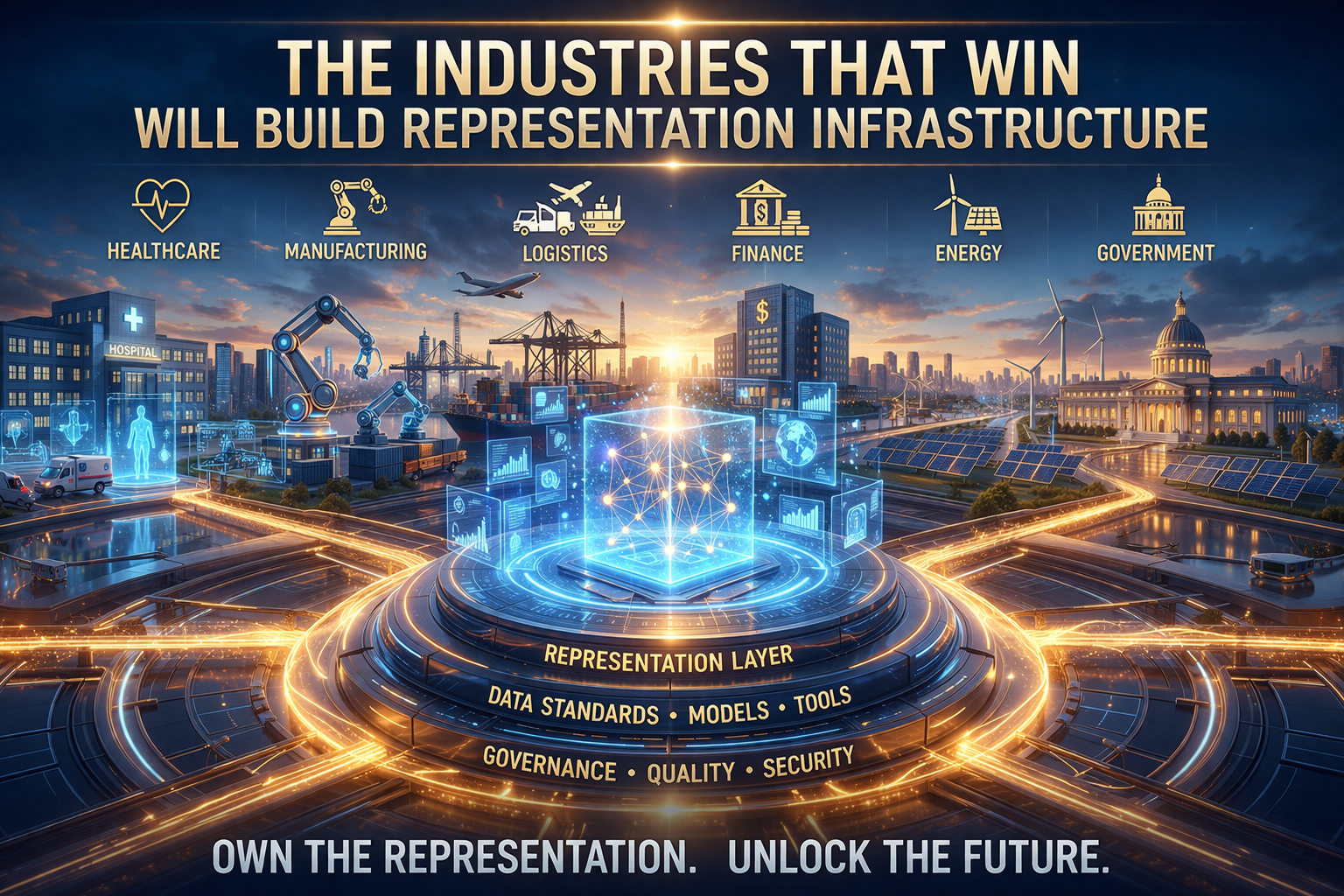
The industries that win will build representation infrastructure
This is the strategic implication.
The next wave of AI advantage will not belong only to those who own models. It will belong to those who convert messy reality into machine-ready reality.
That means a new category of work becomes central: representation infrastructure.
This includes identity systems, data exchange layers, ontology management, domain models, event pipelines, state registries, audit trails, policy layers, and recourse mechanisms. At the national level, it overlaps with digital public infrastructure and trusted digital systems. At the firm level, it becomes the hidden operating foundation that makes AI trustworthy, scalable, and economically useful. (OECD)
This is also why a major new industry will emerge: the Representation Conversion Industry.
Its role will not be to train ever-bigger models. Its role will be to make sectors legible, stateful, verifiable, and delegable enough for AI to operate safely. The biggest winners may be the organizations that rebuild reality before they deploy intelligence onto it.
What boards and CEOs should do now
The first question is no longer, “Where can we apply AI?”
It is, “Where is our reality machine-ready enough for AI to act?”
Leaders should audit where signals are missing, where entities are unstable, where state is implicit, where interoperability breaks, where human judgment is quietly doing hidden reconciliation, and where action lacks verification and recourse. NIST’s lifecycle framing is especially useful here because it encourages organizations to govern, map, measure, and manage risk continuously rather than treating AI as a one-time deployment. (NIST Publications)
The second question is, “What parts of our business are still representation-poor?”
These are often the exact areas where executives want AI most: frontline operations, partner ecosystems, service delivery, compliance, field workflows, public interfaces, and exception-heavy processes. But these are also the areas most dependent on tacit knowledge, messy edge cases, and poorly structured reality.
The third question is, “What must we build before AI can be trusted to act?”
Usually, the answer is not another model. It is better SENSE and stronger DRIVER.
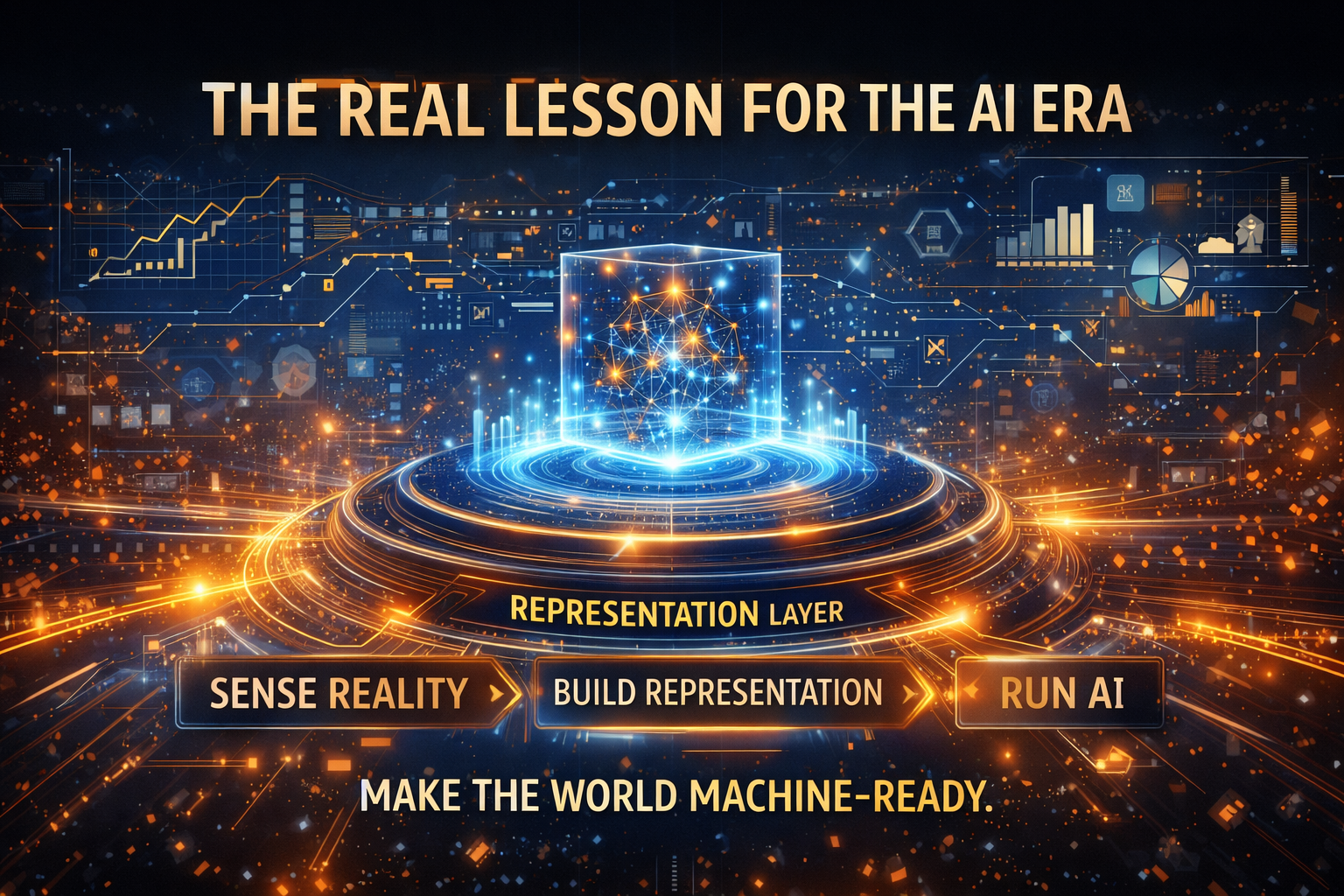
Conclusion: the real lesson for the AI era
The AI era will not be won simply by those with more intelligence.
It will be won by those who make reality visible, structured, current, and governable enough for intelligence to matter.
That is why the representation cold start is such an important idea. It explains why some sectors move fast while others remain trapped in endless pilots. It explains why some firms generate value from ordinary models while others fail with extraordinary ones. And it explains why the deepest bottleneck in AI is often not computational. It is institutional.
Before AI can transform an industry, the industry must become representable.
That is the cold truth behind the next economy.
And that is why the future belongs not only to those who build smarter systems, but to those who build machine-ready reality. (NIST Publications)
FAQ
What is a representation cold start?
A representation cold start is the condition in which an industry lacks the machine-readable signals, stable entities, state models, and governance needed for AI to observe reality reliably and act on it safely.
Why do many AI pilots fail even with strong models?
Because model quality does not fix fragmented data, weak identity resolution, missing state, poor interoperability, or absent decision rights. NIST, OECD, WHO, and WEF guidance all reinforce that trustworthy AI depends on stronger foundations, not just stronger models. (NIST Publications)
How is this different from a data quality problem?
Data quality is part of it, but the cold start is broader. It includes whether reality is captured as signals, mapped to durable entities, maintained as current state, connected across systems, and linked to legitimate execution and recourse.
Which industries are most vulnerable?
Industries with fragmented ecosystems, legacy systems, weak interoperability, heavy exception handling, and poorly structured frontline operations are especially vulnerable. Healthcare, logistics, public-sector systems, and many SME-heavy environments show these characteristics in current global guidance. (World Health Organization)
What should leaders build first?
They should strengthen SENSE and DRIVER: signal capture, identity resolution, state models, interoperability, audit trails, authority boundaries, verification, and recourse.
Glossary
Representation Economy
An economic order in which value increasingly depends on how well reality is represented, reasoned over, and acted upon by machine systems.
Representation Cold Start
A structural condition in which a sector cannot deploy AI meaningfully because its reality is not machine-readable or machine-actionable enough.
Machine-ready reality
A condition in which signals, entities, state, and decision pathways are structured well enough for AI to operate reliably and safely.
SENSE
The legibility layer: signal, entity, state representation, and evolution.
CORE
The cognition layer: comprehend context, optimize decisions, realize action, and evolve through feedback.
DRIVER
The legitimacy layer: delegation, representation, identity, verification, execution, and recourse.
Representation infrastructure
The technical and institutional systems that make reality machine-readable and machine-actionable, including identity, data exchange, ontologies, state models, governance, and recourse layers.
Representation Conversion Industry
A likely emerging category of firms whose main role is to transform messy, fragmented reality into structured, verified, machine-ready representation for AI-era operations.
References and further reading
For credibility and GEO strength, add a short “References and Further Reading” section at the end of the published page. Good sources for this piece include:
- NIST, Artificial Intelligence Risk Management Framework (AI RMF 1.0). (NIST Publications)
- NIST, AI RMF Core / Govern–Map–Measure–Manage resources. (NIST AI Resource Center)
- OECD, OECD AI Principles. (OECD)
- World Economic Forum, Proof over Promise: Insights on Real-World AI Adoption from 2025 MINDS Organizations. (World Economic Forum Reports)
- World Economic Forum, How Leading Organizations Are Making AI Work. (World Economic Forum)
- Emerging Technology Solutions | Infosys Topaz Fabric: How AI Is Quietly Changing the Way Enterprise Services Are Delivered
- Emerging Technology Solutions | What Is Infosys Topaz Fabric? The Missing Layer for Scalable Enterprise AI
- Emerging Technology Solutions | Infosys Topaz Fabric: Enterprise AI Infrastructure for Scalable, Governed, and Cost-Aware AI Exec
-
Explore the Architecture of the AI Economy
This article is part of a broader research series exploring how institutions are being redesigned for the age of artificial intelligence. Together, these essays examine the structural foundations of the emerging AI economy — from signal infrastructure and representation systems to decision architectures and enterprise operating models.
If you want to explore the deeper framework behind these ideas, the following essays provide additional perspectives:
-
- • Why Most AI Projects Fail Before Intelligence Even Begins
- The Representation Economy: Why AI Institutions Must Run on SENSE, CORE, and DRIVER – Raktim Singh
- The Representation Economy: Why Intelligent Institutions Will Run on the SENSE–CORE–DRIVER Architecture – Raktim Singh
- Representation Failure: Why AI Systems Break When Institutions Misread Reality – Raktim Singh
- The Representation Premium: Why Institutions That Are Easier for AI to See, Trust, and Coordinate With Will Win the Next Economy – Raktim Singh
- The Firm of the AI Era Will Be Built Around Representation: Why Institutions Must Redesign Themselves for the SENSE–CORE–DRIVER Economy – Raktim Singh
- The Representation Stack: The New Architecture of Intelligent Institutions in the AI Economy – Raktim Singh
- Representation Economics: The New Law of Value Creation in the AI Era – Raktim Singh
- Representation Insurance: Why Machine-Readable Trust Will Power the AI Economy – Raktim Singh
- Representation Alpha: Why Competitive Advantage Will Come from Better Representation, Not Better Models – Raktim Singh
- Representation Fiduciaries: The Missing Institution the AI Economy Cannot Scale Without – Raktim Singh
- Representation Fragility and Exclusion: The Hidden Fault Line That Will Break the AI Economy – Raktim Singh
- Representation Drift & Labor: Why AI Systems Fail When Reality Moves Faster Than Machines – Raktim Singh
- Representation Monopolies: Why the AI Economy Will Be Controlled by Those Who Define Reality – Raktim Singh
- Representation Forensics: The Missing Layer of AI—Why the Future Will Be Decided by What Systems Thought Reality Was – Raktim Singh
- What Is the Representation Economy? (raktimsingh.com)
- The Representation Economy: Why AI Institutions Must Run on SENSE, CORE, and DRIVER (raktimsingh.com)
- Decision Scale: Why Competitive Advantage Is Moving from Labor Scale to Decision Scale (raktimsingh.com)
- Why Intelligence Alone Cannot Run Enterprises: The Missing AI Execution Layer – Raktim Singh
- The Representation Utility Stack: Why AI’s Next Competitive Advantage Will Come from Interoperable Reality – Raktim Singh
- Firms Won’t Be Defined by Employees. They Will Be Defined by Delegation – Raktim Singh
- The New Company Stack: The 7 Business Categories That Will Emerge in the Representation Economy – Raktim Singh
- The Representation Attack Surface: Why AI’s Biggest Threat Is Reality Hacking, Not Model Hacking – Raktim Singh
Together, these essays outline a central thesis:
The future will belong to institutions that can sense reality, represent it clearly, reason about it intelligently, and act through governed machine systems.
This is why the architecture of the AI era can be understood through three foundational layers:
SENSE → CORE → DRIVER
Where:
- SENSE makes reality legible
- CORE transforms signals into reasoning
- DRIVER ensures that machine action remains accountable, governed, and institutionally legitimate
Signal infrastructure forms the first and most foundational layer of that architecture.
AI Economy Research Series — by Raktim Singh
-



Raktim Singh is an AI and deep-tech strategist, TEDx speaker, and author focused on helping enterprises navigate the next era of intelligent systems. With experience spanning AI, fintech, quantum computing, and digital transformation, he simplifies complex technology for leaders and builds frameworks that drive responsible, scalable adoption.