

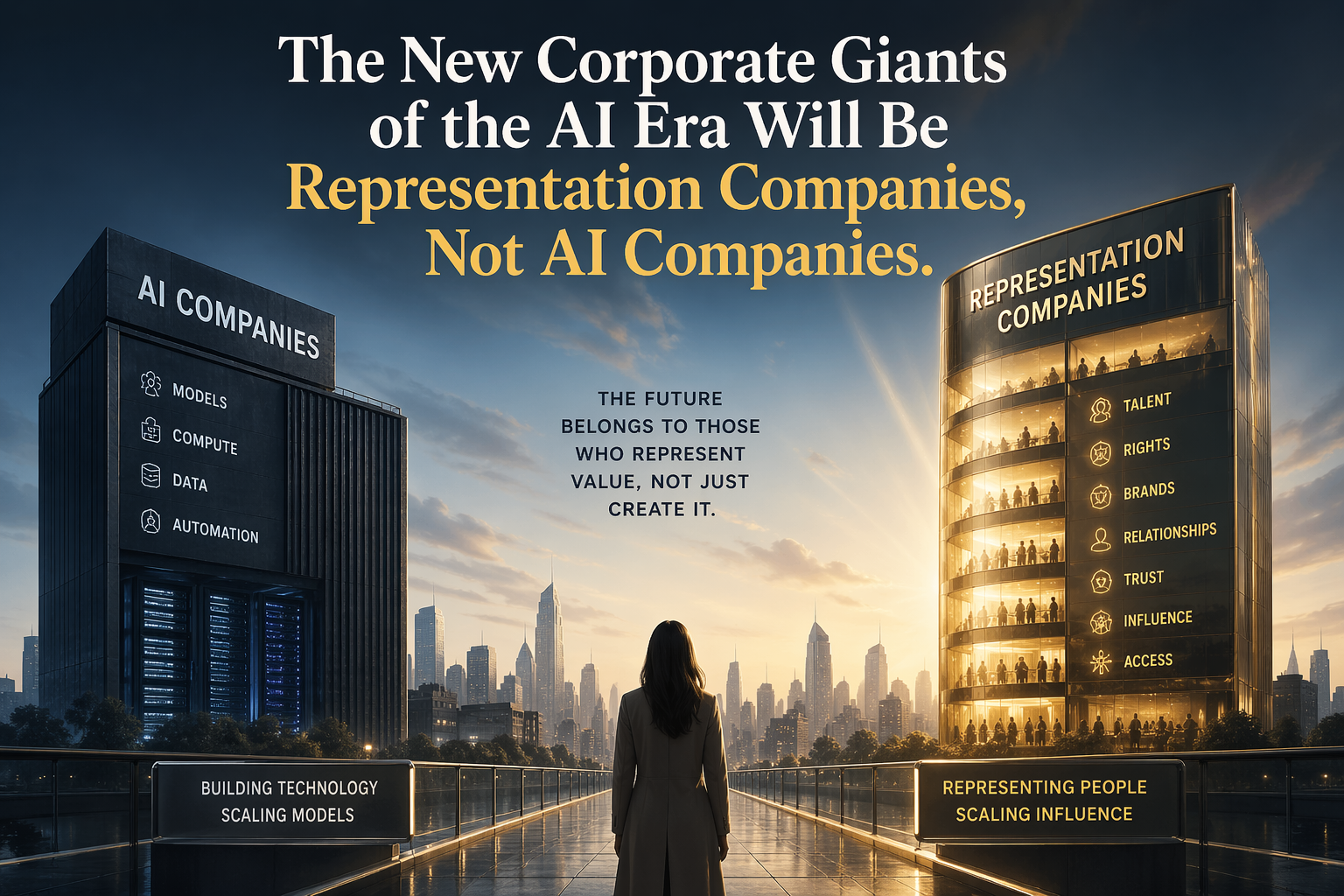
The New Corporate Giants of the AI Era:
Why the next wave of market power will come from firms that make reality machine-legible, governable, and actionable for AI
For the last two years, the market has been mesmerized by AI models.
Who has the biggest model?
Who has the smartest chatbot?
Who has the most impressive agent?
These are important questions. But they are no longer the most important ones.
The more consequential question is this: Who will build the systems that help machines understand reality well enough to act on it safely, consistently, and at scale?
That is where the next corporate giants will emerge.
My argument is simple: the most valuable companies of the AI era will not necessarily be the ones with the most powerful models. They will be the companies that make reality legible, usable, verifiable, and governable for machines. In other words, the biggest winners may be representation companies.
This is the core idea behind what I call the Representation Economy.
A representation company does not win merely by owning intelligence. It wins by building the structures through which intelligence becomes useful in the real world. It helps machines understand what is happening, to whom, in what state, with what authority, under which constraints, and with what recourse if something goes wrong.
That may sound abstract. It is not.
A company that helps AI understand the true status of a shipment, the identity of a supplier, the condition of a machine, the risk level of a loan, the authorization behind a medical order, or the compliance state of an insurance claim is doing something strategically more durable than simply deploying another model. It is turning the world into something machines can work with responsibly.
That is where the next layer of value creation will sit.
What are representation companies?
Representation companies are businesses that create value by owning access, trust, relationships, and distribution—rather than just building AI models. They connect talent, opportunities, and markets, capturing long-term value in the AI economy.
The strategic shift most leaders are still underestimating
The economics of AI are already changing. Stanford’s 2025 AI Index reported that the inference cost for systems performing at roughly GPT-3.5 level fell by more than 280-fold between November 2022 and October 2024. The same report also showed open-weight models rapidly narrowing the performance gap with closed models on some benchmarks. (Stanford HAI)
That matters because it changes the source of durable advantage.
When models become cheaper, more accessible, and increasingly comparable, model access alone stops being a long-term moat. The battleground shifts upward, into the layers that give intelligence context, structure, interoperability, memory, permission, and accountability.
In other words, advantage moves from raw intelligence to trusted representation.
This is why so many companies look impressive in AI demos and underwhelming in production. They are investing in reasoning engines before fixing the structure of the reality those engines are supposed to reason over.
McKinsey’s 2025 State of AI research reinforces this point. Organizations that capture more value from AI are stronger not only on technology, but also on management practices, data, adoption, and operating model. McKinsey also notes that risk and data governance remain among the most centralized elements of AI deployment. (McKinsey & Company)
Gartner makes the same point even more bluntly. In April 2026, Gartner said organizations with successful AI initiatives invest up to four times more, as a percentage of revenue, in foundational areas such as data quality, governance, AI-ready talent, and change management. (Gartner)
That is not a side observation. That is the signal.
The real scarcity in the AI era is not only compute. It is machine-legible reality.
If an enterprise has fragmented entities, inconsistent definitions, unreliable metadata, unclear permissions, weak provenance, and poor state tracking, then even very capable AI will struggle inside it. A brilliant model placed on top of a badly represented world becomes an expensive guessing engine.
The next wave of AI advantage will not come only from owning better models. It will come from building better representations of reality. As model intelligence becomes more available, the companies that create trusted context, machine-legible states, interoperable identity, governed permissions, and verifiable action will become the real control points of the AI economy. Those firms will not just support AI. They will shape what AI can safely see, decide, and do.
What a representation company actually does
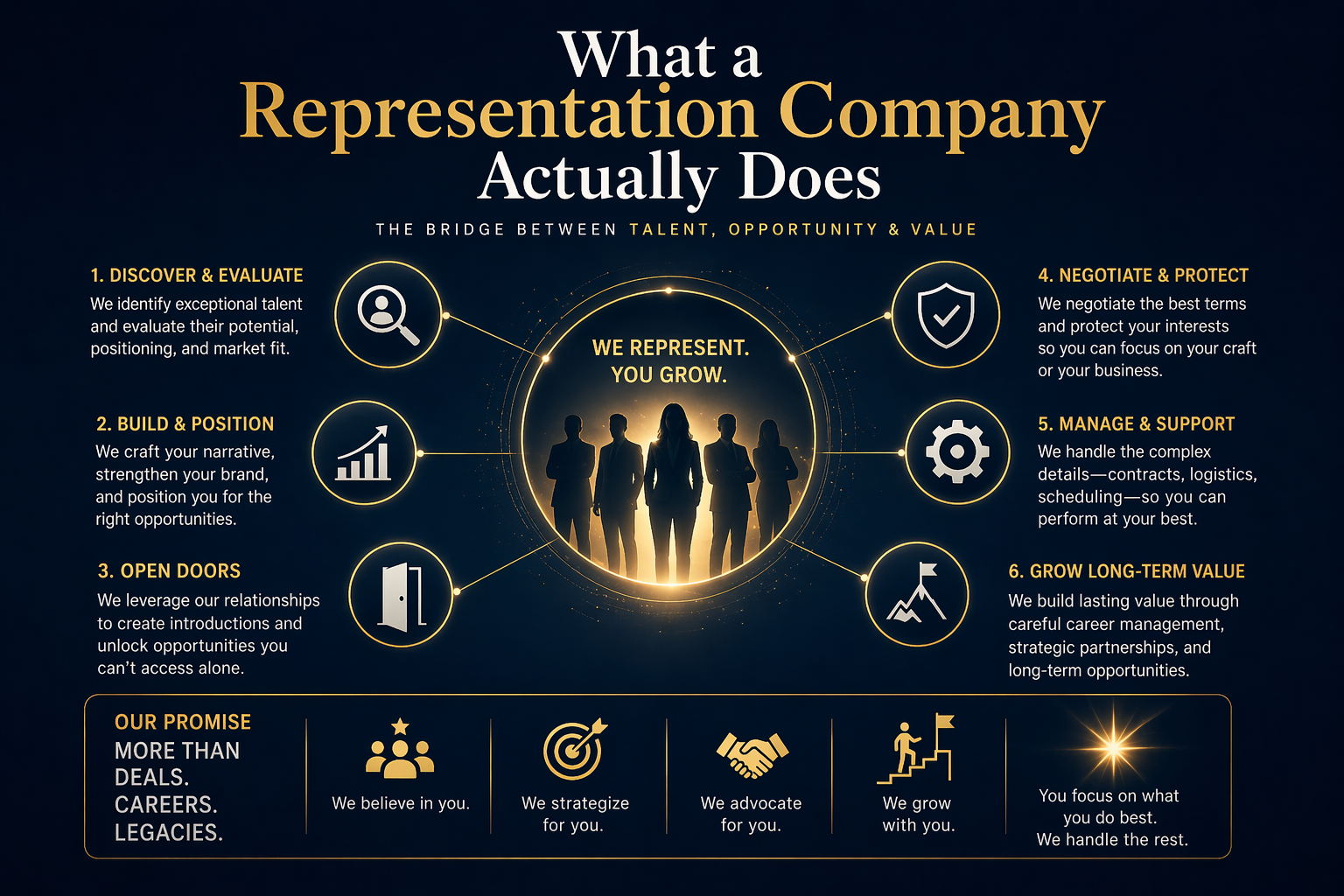
A representation company turns reality into something machines can safely and productively work with.
It does not merely store data. It structures the world.
That includes building or governing digital representations of:
- identities
- entities
- states
- relationships
- permissions
- workflows
- provenance
- context
- audit trails
- recourse paths
Some representation companies will look like vertical SaaS firms. Some will look like industrial software vendors. Some will look like trust and identity companies. Some will look like workflow orchestration platforms, compliance layers, digital twin providers, or public infrastructure builders.
But beneath the surface, they are solving the same problem: they are reducing the gap between the world as it is and the world as a machine can responsibly understand and act upon.
That gap will become one of the defining battlegrounds of the AI economy.
The easiest way to understand this: SENSE, CORE, DRIVER
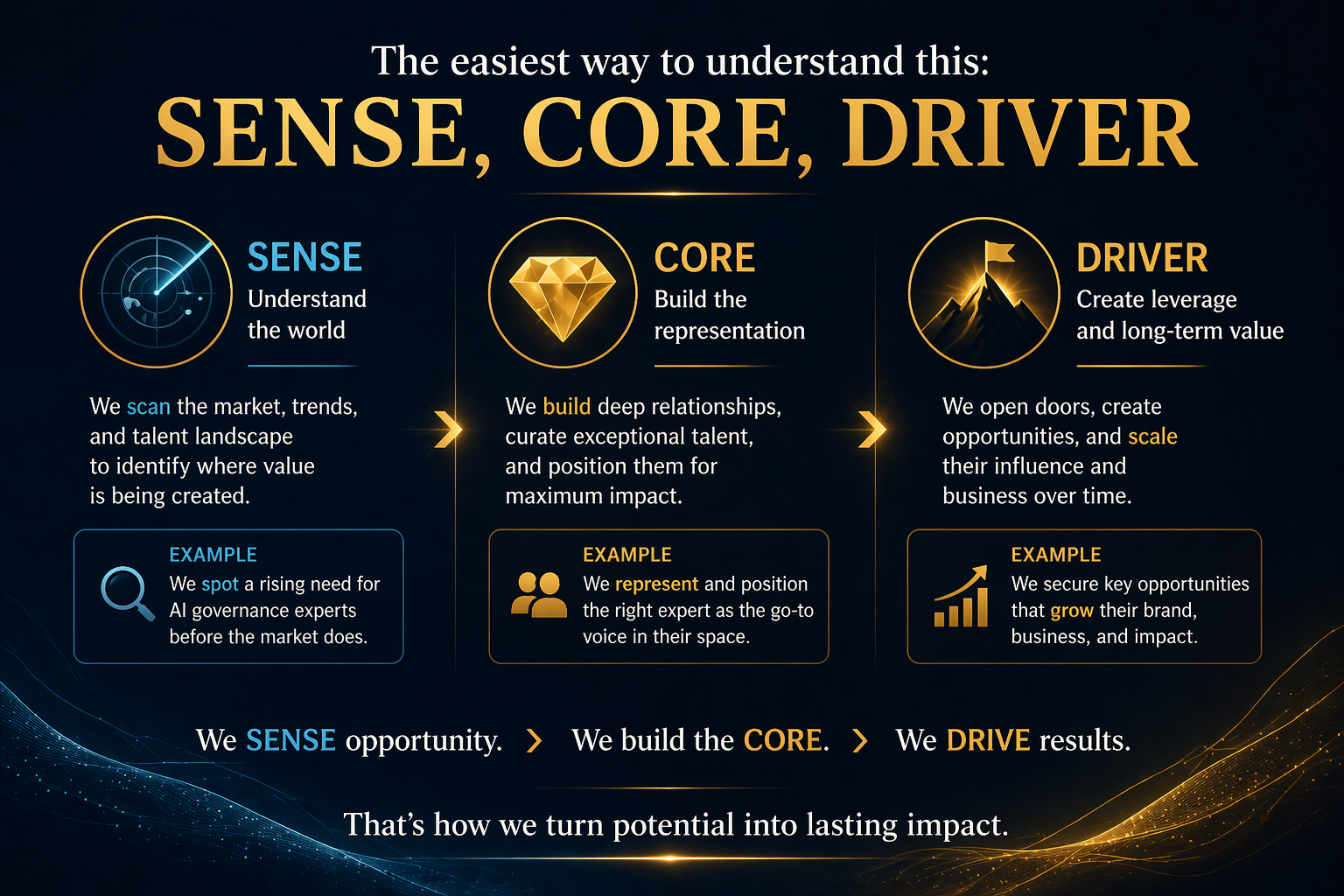
My broader framework for understanding AI value creation is SENSE–CORE–DRIVER.
It is not a branding device. It is a practical way to explain why some AI systems create durable enterprise value while others remain stuck in experimentation.
SENSE: making reality legible
SENSE is the layer where reality becomes machine-readable.
It includes:
- Signal: what happened
- ENtity: to whom or to what it happened
- State representation: what condition that entity is now in
- Evolution: how that state changes over time
This is where many firms are weaker than they realize.
Take a warehouse. A model can help optimize logistics only if the underlying environment is represented correctly. Which carton is where? Which inventory is already reserved? Which item is damaged? What has already left the dock? Which order has priority? What changed in the last ten minutes?
Without that layer, “AI intelligence” is often just elegant improvisation.
This is also why digital twins, synthetic environments, and operational context are becoming more important in industrial AI. NVIDIA’s recent enterprise positioning around digital twins and physical AI reflects the growing importance of structured, continuously updated representations of real-world systems. (World Bank)
CORE: reasoning over reality
CORE is the layer most people currently mean when they say AI.
It is the reasoning layer:
- comprehend context
- optimize decisions
- realize action
- evolve through feedback
CORE matters enormously. But CORE without strong SENSE is like putting a brilliant strategist in a control room filled with broken sensors, mislabeled dashboards, and outdated maps.
This is why many organizations overestimate what models alone can do. The model may be powerful, but the reality it is consuming is poorly structured.
DRIVER: governing action
Even if a system can understand reality and reason over it effectively, one final question remains:
Who allowed it to act, on whose behalf, using which version of reality, under what checks, and with what recourse?
That is DRIVER.
It includes:
- Delegation: who authorized the action
- Representation: what model of reality was used
- Identity: which entity was affected
- Verification: how the action is checked
- Execution: how the action is carried out
- Recourse: what happens if the system is wrong
This is the layer where enterprise AI stops being a clever interface and becomes an operating capability.
The global conversation is clearly moving this way. The World Economic Forum’s work on AI agent evaluation and governance emphasizes classification, oversight, evaluation, and progressive governance as agents move into real-world deployment. The OECD’s AI principles similarly stress trustworthy AI, human-centered values, transparency, robustness, accountability, and governance. (World Economic Forum)
That is why the future giants will not be built on CORE alone. They will be built by combining strong SENSE with credible DRIVER.
Why model companies may not capture all the value
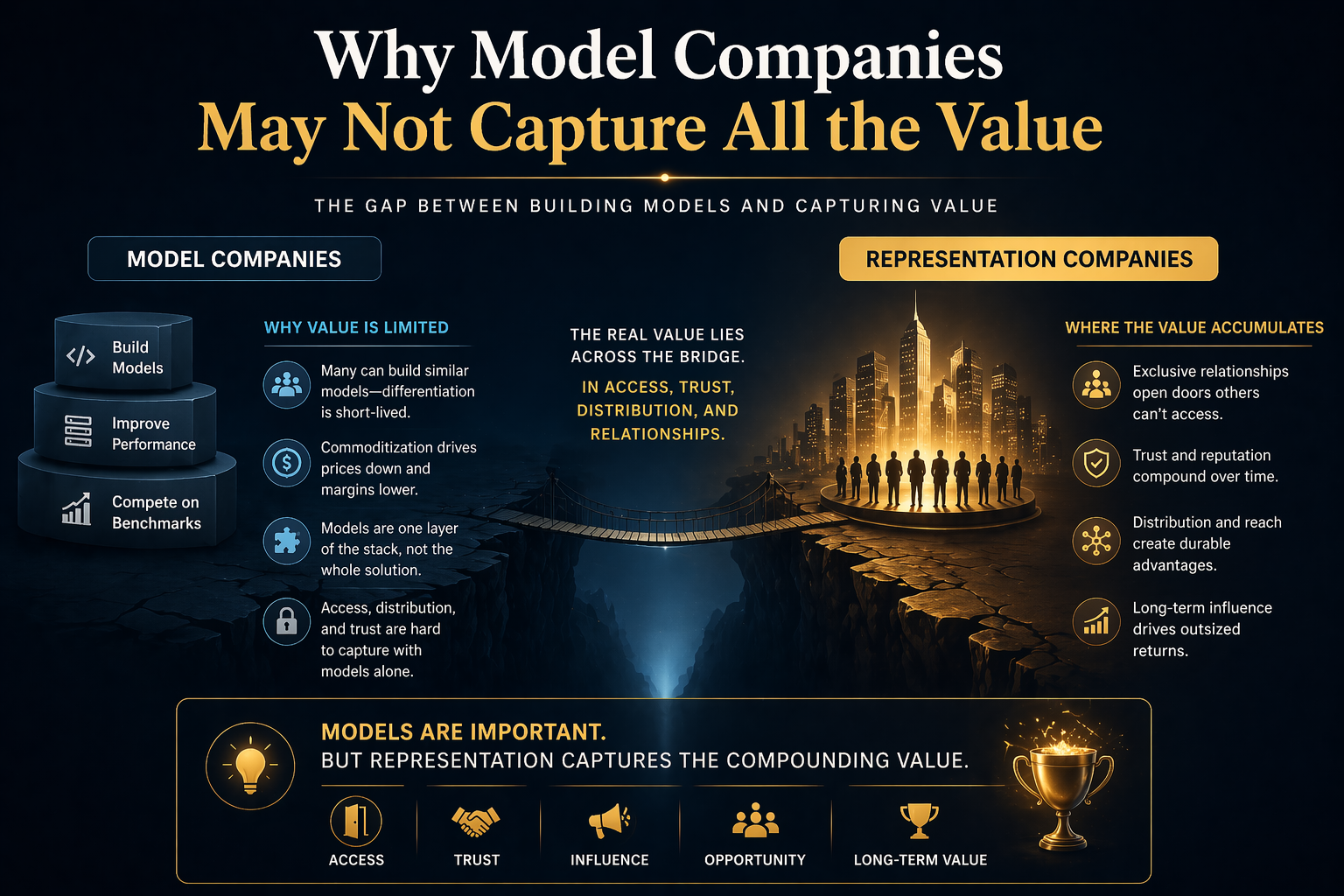
Model companies will still matter. Some will become very large. Some may become infrastructure giants in their own right.
But many may increasingly resemble engines inside larger business systems rather than the final holders of strategic control.
Think about electricity. It is essential, foundational, and transformative. But much of the highest strategic value historically accrued to those who built the networks, appliances, standards, and systems around it.
AI is moving in a similar direction.
Microsoft’s 2025 Work Trend Index described the rise of the “Frontier Firm” and showed leaders rethinking operations, workforce design, and agent-based work. PwC made a related point in its AI agent survey: using a few agents in isolation will not move the needle; organizations need orchestration, integration, and trust designed in from the start. (The Official Microsoft Blog)
That is the real transition.
As intelligence becomes more abundant, organized representation becomes more valuable.
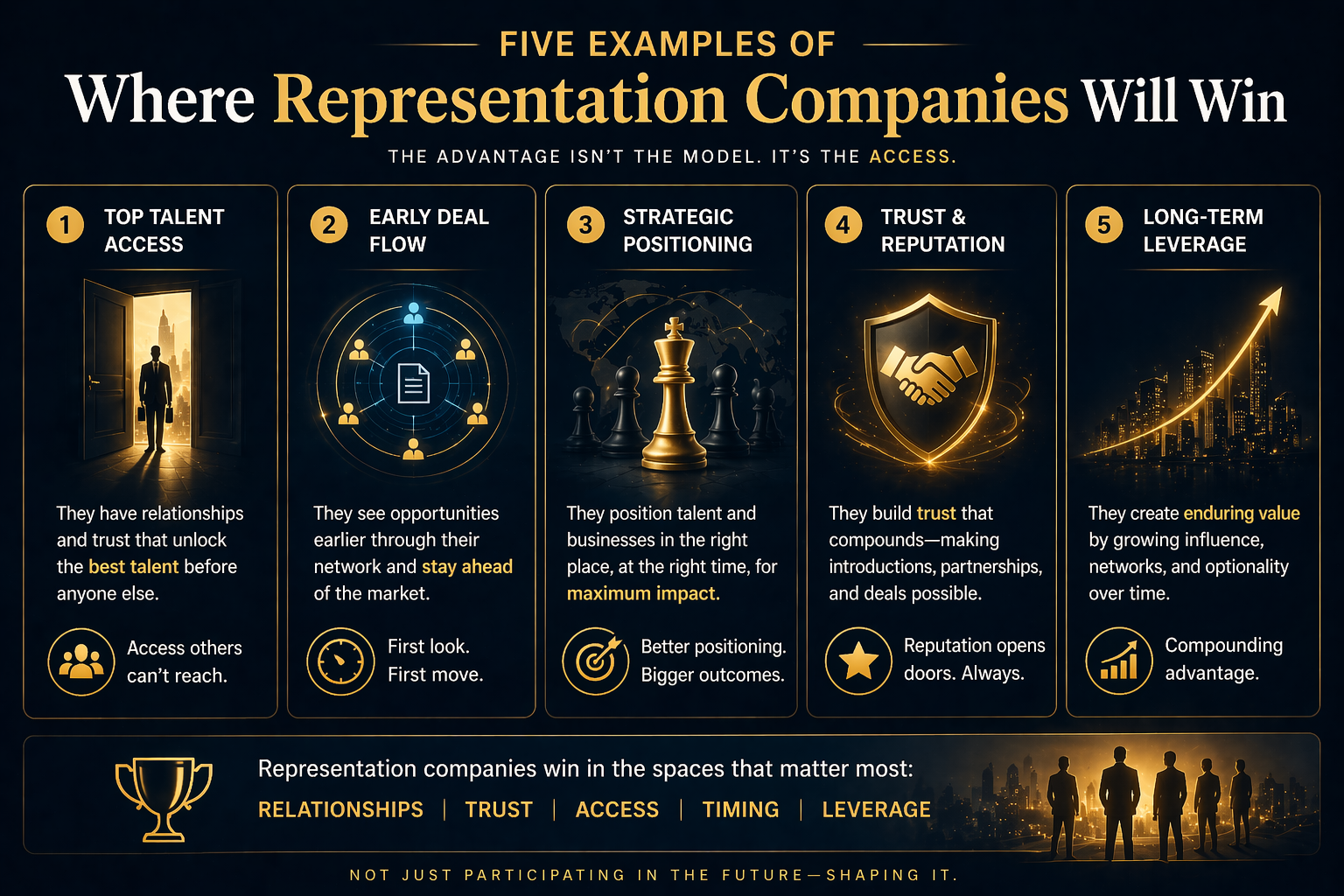
Five examples of where representation companies will win
-
Supplier intelligence and resilient sourcing
Imagine a global manufacturer trying to reroute sourcing after a disruption. The AI layer is only as good as the representation layer beneath it. It needs to know which suppliers are real, active, approved, contractually eligible, financially stable, geographically exposed, and operationally capable right now.
The company that owns and maintains that trusted supplier reality will often create more strategic value than the company merely providing the model.
-
Healthcare systems that machines can trust
Healthcare AI does not fail only because medicine is hard. It often fails because the environment is badly represented.
Who is the patient? Which record is current? Which medication list is authoritative? Which doctor is authorized? What consent has been granted? What changed after the last scan?
The company that solves those representation gaps creates durable value because it makes medical decision-support safer, more accountable, and more usable.
-
Trusted enterprise context for agents
Salesforce has increasingly emphasized the need for an enterprise-wide metadata layer, trusted context, accuracy, and control for scaling agentic AI. PwC and Microsoft are pointing in similar directions through orchestration and operating-model redesign. (Salesforce)
Why is this so important?
Because an agent without shared business context is not truly autonomous. It is simply improvising on incomplete understanding.
The company that structures customer, policy, contract, service, and inventory context into a governed layer of enterprise reality may end up owning more value than the company supplying only the underlying model.
-
Interoperable digital public infrastructure
The World Bank and other policy bodies have emphasized that digital public infrastructure is not just about software. It is about interoperable systems, governance frameworks, and trusted rails for identity, payments, and data exchange. (World Bank)
That should be a major clue for the AI era.
AI scales fastest where records, permissions, identities, and transactions can be trusted across institutions. The next giants may include companies that build these representation rails for governments, regulated sectors, logistics corridors, financial ecosystems, and cross-border trade.
-
Industrial environments that become queryable
Factories, farms, mines, grids, ports, and warehouses are full of fragmented signals: sensor data, operator notes, maintenance histories, safety constraints, asset conditions, and workflow states.
The firm that unifies these into an evolving, trustworthy representation of operational reality gains an extraordinary position. It becomes the layer through which machines understand the physical world well enough to coordinate with it.
That is not “just software.” That is strategic control.
Why this creates giant firms, not niche utilities
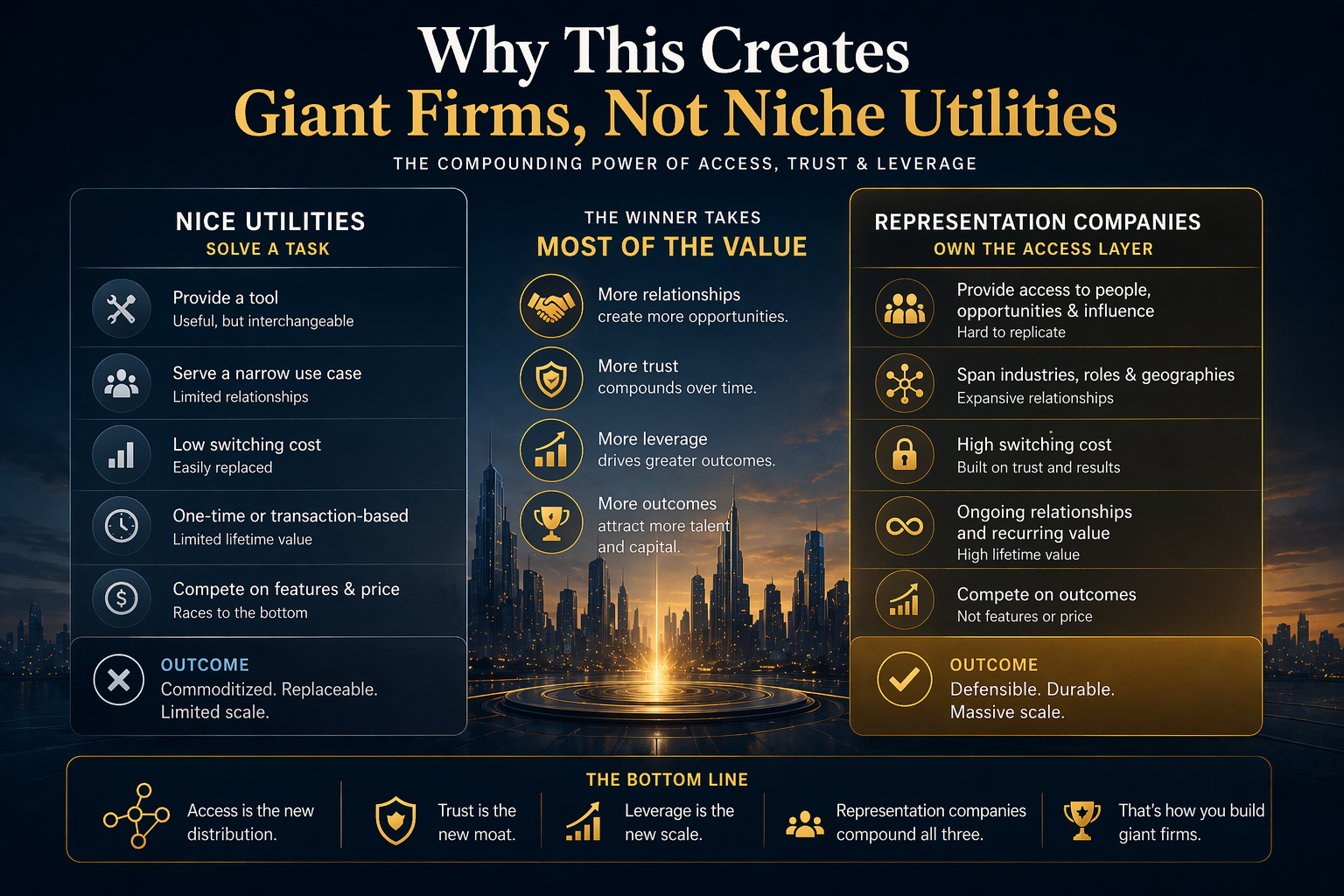
Some people hear the word representation and think of plumbing.
That is a mistake.
Representation is a control point.
The company that owns the trusted map of operational reality gains advantages in workflow orchestration, switching costs, compliance trust, ecosystem leverage, agent deployment, data network effects, and monetizable coordination.
In earlier eras, giant firms emerged by owning search, distribution, operating systems, cloud infrastructure, payments, or social graphs.
In the AI era, many giant firms may emerge by owning representation graphs.
Not just data lakes.
Not just dashboards.
Not just foundation models.
Representation graphs.
These firms will know not simply what data exists, but what it means, how fresh it is, which entity it belongs to, what state it implies, which actions it authorizes, and how those actions can be verified afterward.
That is a powerful strategic position in an agentic economy.
The question every board and CEO should now ask
For years, the standard strategic question was:
What is our AI strategy?
That question is now too narrow.
The better question is:
How well can our organization represent reality for machines?
Can we identify the right entities?
Can we track state changes in near real time?
Can we preserve provenance?
Can we expose governed context to agents?
Can we define permissions clearly?
Can we verify machine action and provide recourse?
If the answer is weak, then buying more AI will not solve the underlying problem.
It may simply magnify the mess.
Conclusion: the next giants will be trusted interpreters of reality
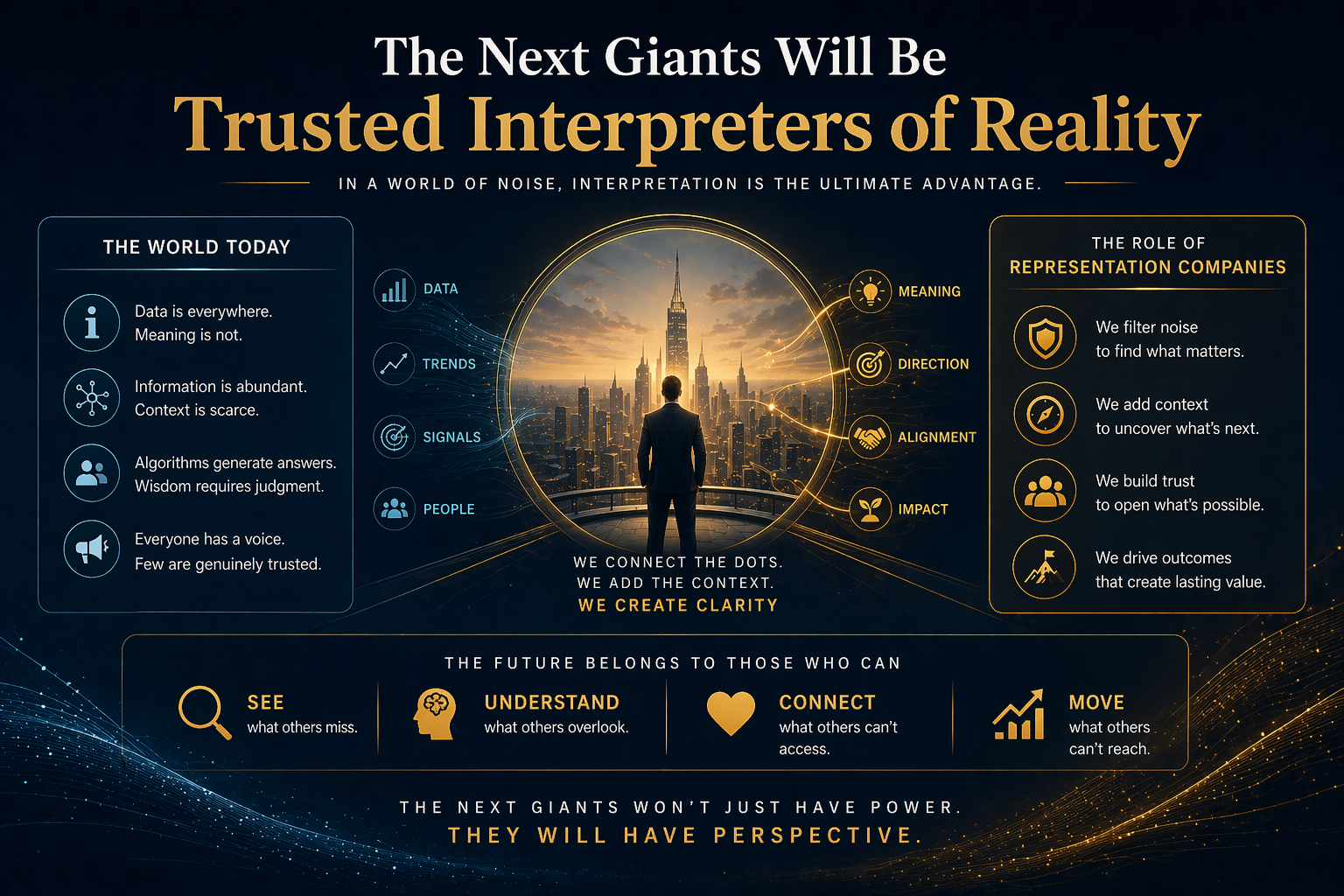
The most valuable companies of the next decade may not call themselves AI companies at all.
They may describe themselves as logistics software firms, industrial intelligence providers, healthcare workflow platforms, compliance infrastructure companies, public digital rail builders, or enterprise context layers.
But beneath those labels, many of them will be doing the same thing.
They will be translating reality into forms machines can trust.
That is why I believe the new corporate giants of the AI era will be representation companies.
Because in a world where intelligence becomes cheaper, broader, and easier to access, the rarest and most defensible asset is not intelligence itself.
It is the ability to make reality legible, connected, governed, and actionable.
That is the real moat.
That is the real market.
And that is where the next giants will rise.
The biggest AI winners won’t just build intelligence.
They will control how reality is represented, trusted, and acted upon.
👉 The question is:
Are you building a model…
Or building a position in the future economy?
The next generation of dominant companies will not win primarily through scale or even data volume — they will win because intelligent systems can see them, verify them, and act on their behalf faster than anyone else’s. That advantage compounds quietly, then suddenly.



Raktim Singh is an AI and deep-tech strategist, TEDx speaker, and author focused on helping enterprises navigate the next era of intelligent systems. With experience spanning AI, fintech, quantum computing, and digital transformation, he simplifies complex technology for leaders and builds frameworks that drive responsible, scalable adoption.