

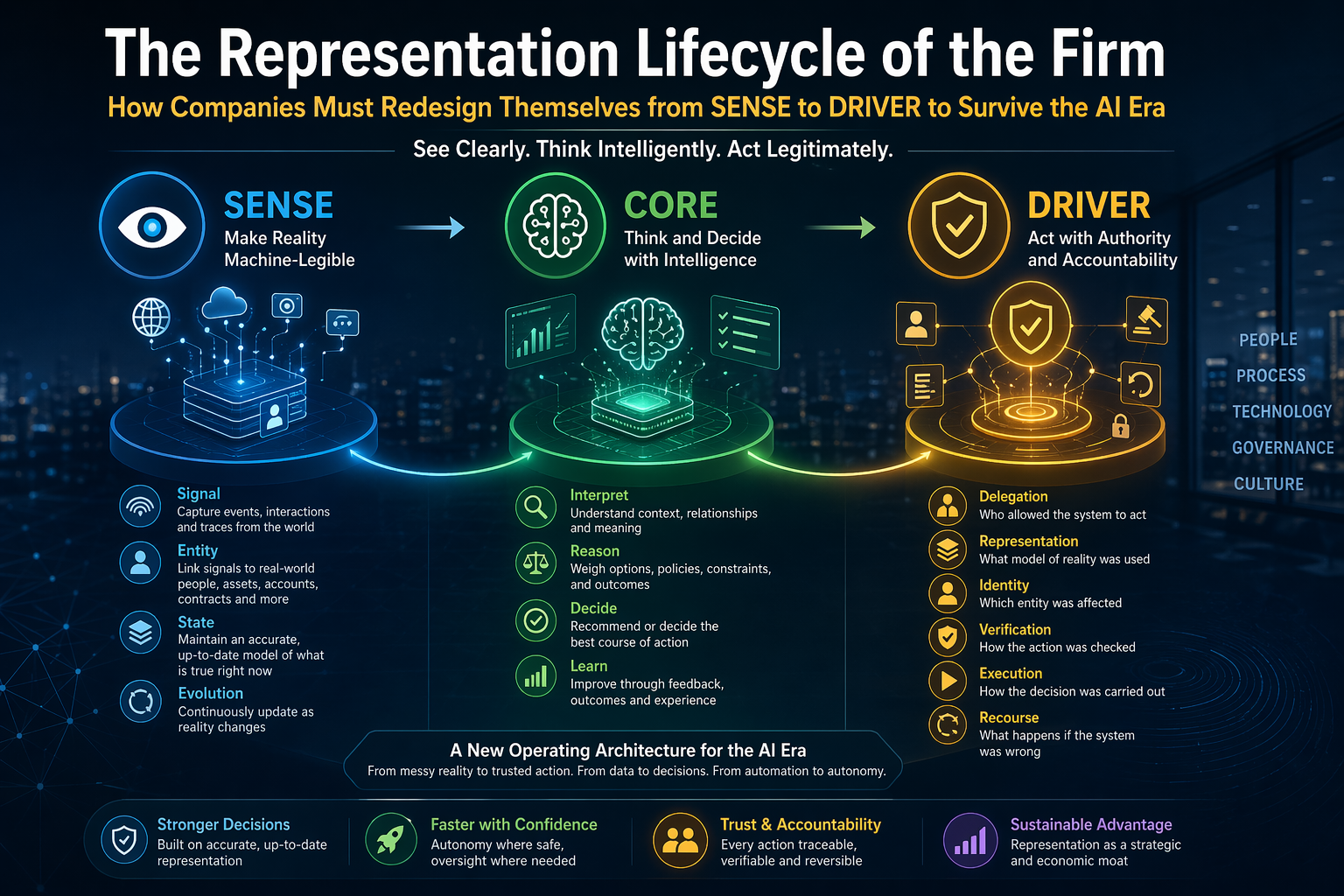
The Representation Lifecycle of the Firm:
Artificial intelligence is forcing companies to confront a harder question than most leaders expected.
The question is not, Which model should we use?
It is not even, How fast can we automate?
The real question is this:
What kind of firm must we become when software no longer just processes information, but begins to interpret reality, recommend actions, and trigger decisions inside the organization?
That is the real challenge of the AI era.
Most companies still treat AI as an upgrade to software. They see it as a better interface, a faster assistant, a more powerful analytics layer, or an automation engine that can be placed on top of the existing enterprise.
That view is now becoming dangerously incomplete. As AI systems move from content generation to workflow execution, reasoning, orchestration, and action, the firm itself must be redesigned. Recent enterprise research points in exactly this direction: organizations are capturing more value when they redesign workflows, strengthen governance, improve data foundations, and adapt their operating model instead of merely deploying tools. (McKinsey & Company)
In other words, the AI era is not just changing products. It is changing the lifecycle of the firm.
That lifecycle can no longer be understood only through org charts, ERP systems, reporting lines, or software estates. It must be understood through a deeper architecture: how the firm sees, interprets, and acts.
That is why I believe the firms that survive and win in the AI era will be those that redesign themselves across three connected layers:
SENSE
How the firm captures signals from the world, links them to real entities, maintains state, and updates reality over time.
CORE
How the firm interprets those signals, reasons over them, makes decisions, and improves through feedback.
DRIVER
How the firm authorizes action, verifies legitimacy, executes decisions safely, and provides recourse when things go wrong.
Together, these three layers form the operating architecture of the Representation Economy.
And that is the central shift leaders must understand:
The AI-era firm is no longer just a company that owns assets and runs processes. It is a company that continuously represents reality, reasons over that representation, and acts on it with legitimate authority.
Why Most Firms Are Redesigning the Wrong Layer
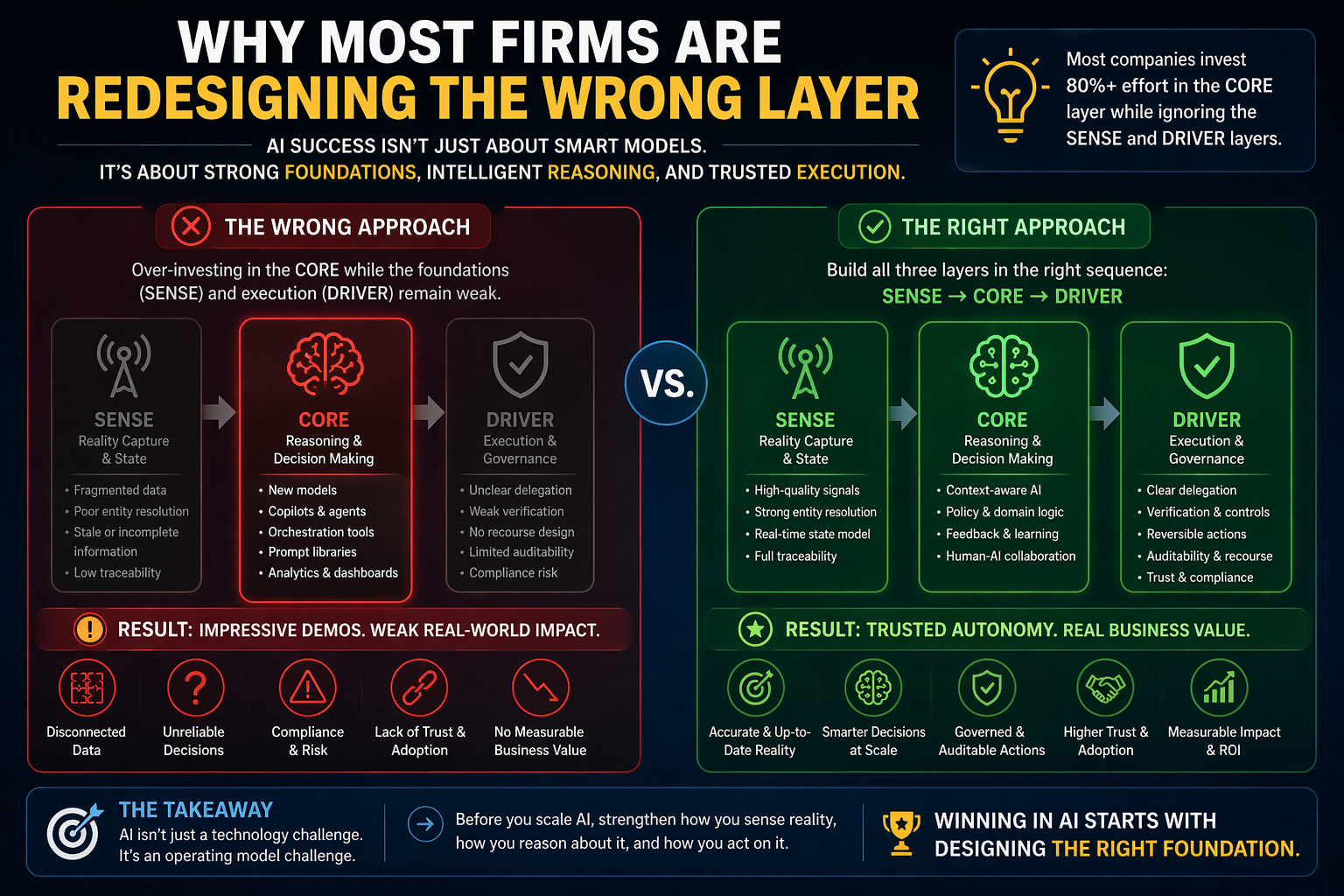
Many companies are investing heavily in the CORE layer without realizing it.
They are buying models, copilots, agents, orchestration tools, vector databases, and AI platforms. They are building prompt libraries, setting up LLM gateways, and experimenting with assistants across functions. All of that matters. But it is only one part of the story.
The harder truth is that many firms are trying to automate intelligence before they have upgraded reality.
That is why so many AI programs look impressive in demos and weak in production.
A model can summarize a contract. But can the company reliably connect that contract to the correct customer, the latest obligation, the active policy exception, the payment history, the jurisdiction, and the current dispute status?
A model can suggest inventory actions. But can the firm trust the real-time state of suppliers, warehouses, transport delays, demand volatility, substitutions, and compliance constraints?
A model can draft a lending recommendation. But can the institution prove that customer identity, income signals, fraud markers, risk context, consent boundaries, and appeal mechanisms are all represented correctly?
This is where many firms break.
The problem is not that the AI is weak.
The problem is that the firm’s representation of reality is weak.
That is why current enterprise guidance keeps returning to the same themes in different language: workflow redesign, governance, decision rights, proprietary data, risk mitigation, operating model clarity, and resilient execution. Those are not side issues. They are symptoms of a deeper need to redesign the firm as a representation system. (McKinsey & Company)
The First Redesign: SENSE
The legibility layer of the enterprise
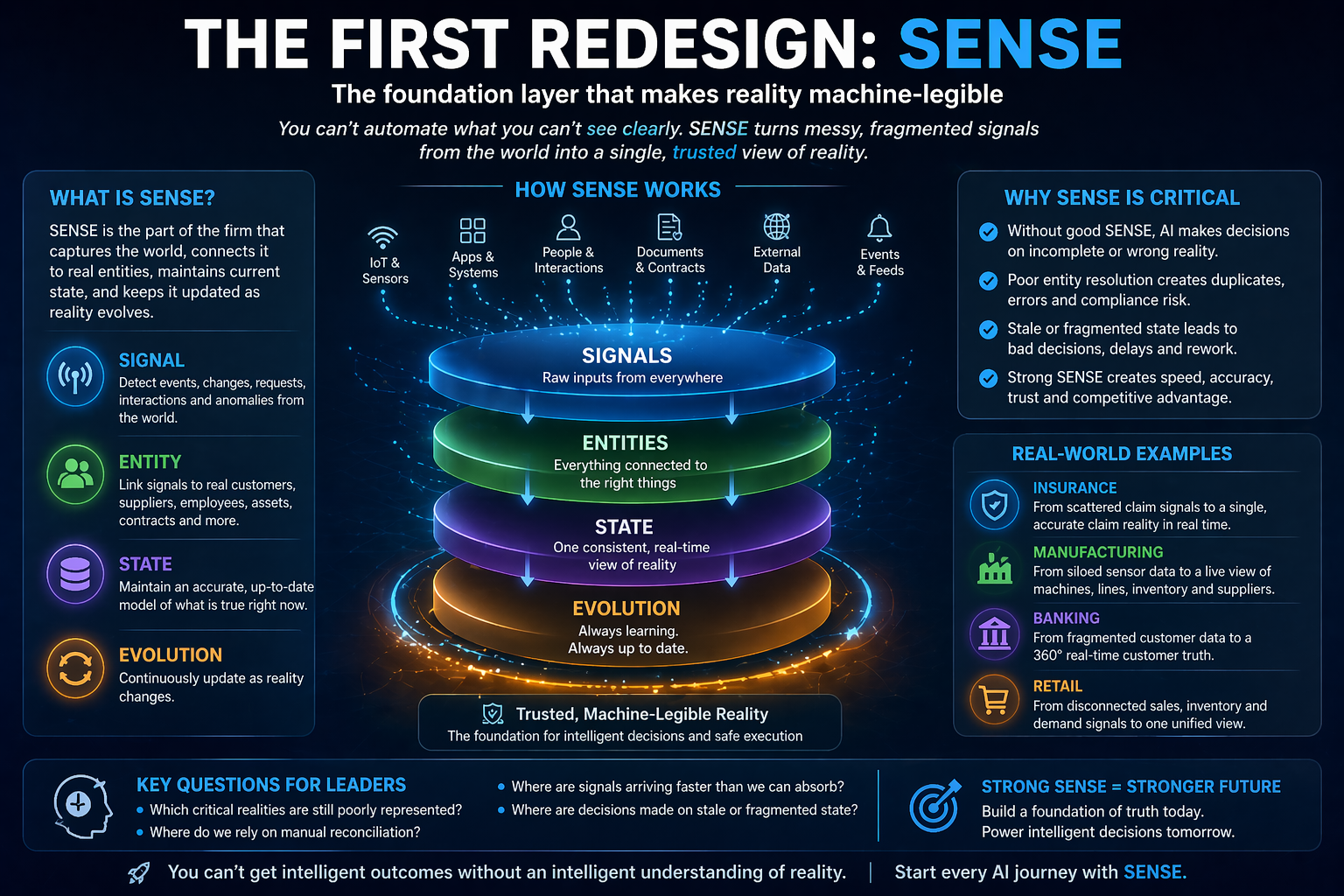
Most companies underestimate how primitive their SENSE layer still is.
SENSE is the part of the firm that makes reality machine-legible.
It includes four things:
Signal — detecting events, changes, movements, requests, anomalies, interactions, and traces from the world.
ENtity — connecting those signals to a real customer, supplier, machine, employee, shipment, contract, or asset.
State — maintaining an up-to-date model of what is true right now.
Evolution — updating that state as the world changes.
This sounds abstract, but every company already struggles with it.
Take a simple insurance claim. A major weather event hits. Thousands of claim-related signals begin flowing in: images, location pings, customer calls, policy records, repair requests, payment details, sensor feeds, weather data, and fraud alerts. If the insurer’s SENSE layer is weak, the firm does not have one coherent reality. It has fragments: duplicate customers, missing state, delayed updates, and contradictory records.
At that point, adding a smarter model does not solve the problem. It accelerates confusion.
The same is true in manufacturing. A factory may have sensors everywhere, but if production state, machine condition, maintenance history, energy variability, supplier quality, and workforce availability are not linked into a reliable and evolving representation, then AI is not operating on truth. It is operating on fragments.
This is why the future of competitive advantage will not come only from better AI models. It will come from better reality infrastructure.
The strongest firms will build SENSE as a strategic asset. They will know which signals matter, which entities are mission-critical, how state should be represented, how often that state should be refreshed, and where ambiguity must be reduced before automation begins.
That is where the AI-era firm really begins.
What boards should ask about SENSE
Boards and executive teams should begin asking questions that sound deceptively basic:
- Which business-critical realities are still poorly represented?
- Where do we still rely on manual reconciliation?
- Where are signals arriving faster than our systems can absorb them?
- Which decisions are being made on stale or fragmented state?
Those questions often reveal the true bottleneck. The company does not lack intelligence. It lacks a dependable representation of reality.
The Second Redesign: CORE
The cognition layer of the firm
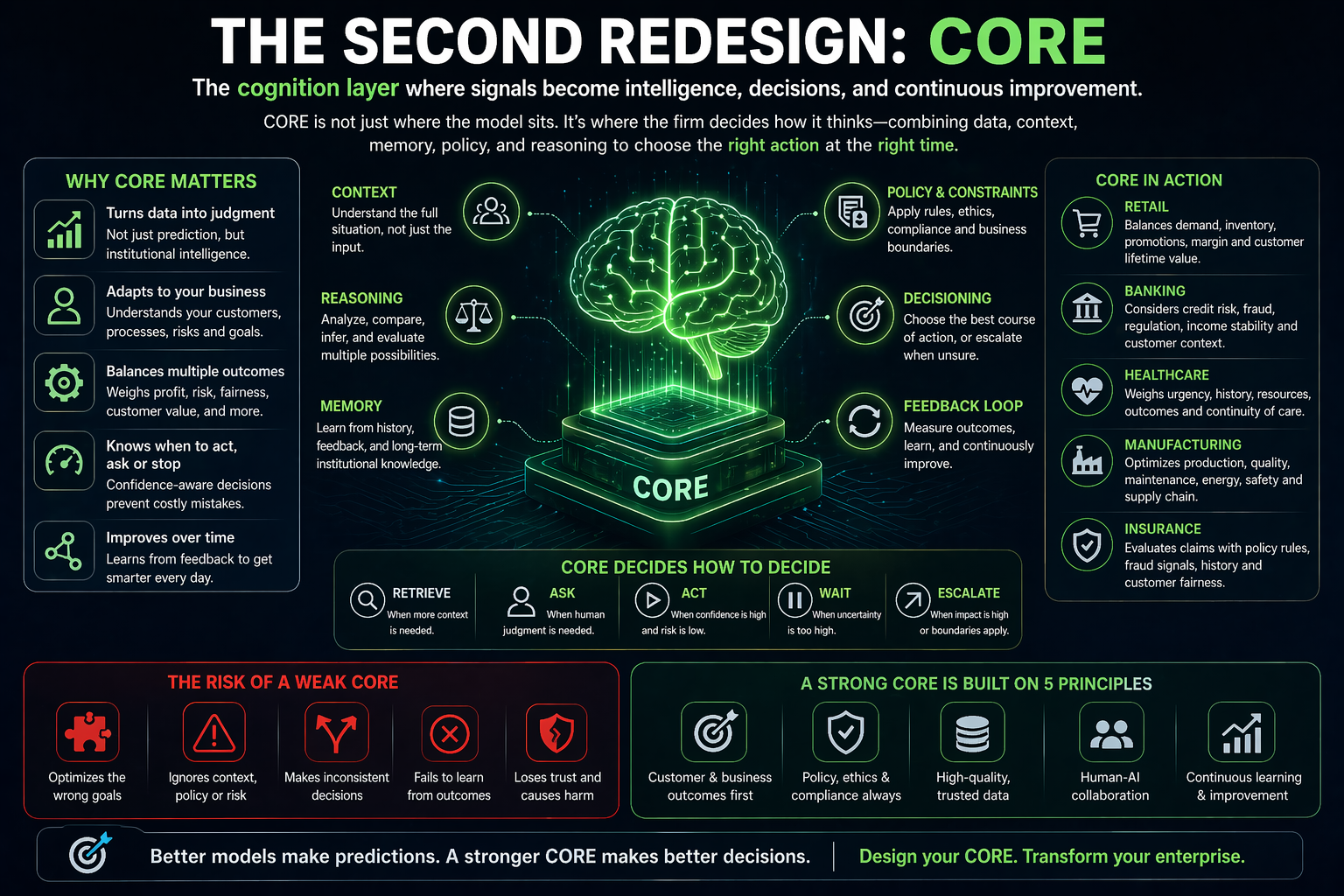
Once reality becomes legible, the next challenge is reasoning.
CORE is the cognition layer of the firm. It is where signals become judgments, predictions, choices, workflows, recommendations, and delegated decisions.
This is where much of the current AI conversation is focused, and for good reason. Models are getting better at summarizing, classifying, generating, planning, retrieving, and coordinating actions across systems. Organizations are also increasingly exploring agentic operating models that treat AI not as isolated tools, but as decision-capable participants inside workflows. (World Economic Forum)
But the CORE layer has to be understood properly.
It is not just “where the model sits.”
It is where the firm decides how it thinks.
That includes questions like these:
- When should the system retrieve evidence before answering?
- When should it ask for human review?
- When should it act automatically?
- When should it stop because confidence is too low?
- When should a smaller domain model be used instead of a frontier model?
- When should policy override optimization?
- When should the system explain itself rather than simply execute?
A retailer, for example, may use AI to personalize promotions. A weak CORE optimizes for clicks. A stronger CORE reasons across profitability, margin, customer lifetime value, inventory constraints, fairness, and brand risk. That is not merely better analytics. That is better institutional cognition.
A hospital may use AI to streamline scheduling. A weak CORE optimizes slot utilization. A stronger CORE weighs urgency, continuity of care, no-show risk, staffing constraints, insurance requirements, and escalation needs.
A bank may use AI to triage credit cases. A weak CORE predicts repayment. A stronger CORE distinguishes between prediction, judgment, compliance, customer context, fraud exposure, and recourse.
This is the real lesson:
In the AI era, the winning firm will not be the one with the flashiest model. It will be the one that builds a CORE layer capable of combining reasoning with context, policy, economics, and institutional memory.
Why CORE is where many firms overestimate themselves
Many organizations think that once they have installed an LLM, an agent framework, or a retrieval layer, they have become intelligent.
They have not.
They have only increased their computational fluency.
Institutional intelligence is different. It requires memory, prioritization, escalation logic, evidence handling, cost-awareness, and the ability to operate inside the real decision boundaries of the firm. Research from McKinsey and HBR increasingly reinforces that AI value at scale comes from management practices, workflow redesign, leadership structures, and execution discipline, not from model access alone. (McKinsey & Company)
The Third Redesign: DRIVER
The legitimacy and execution layer
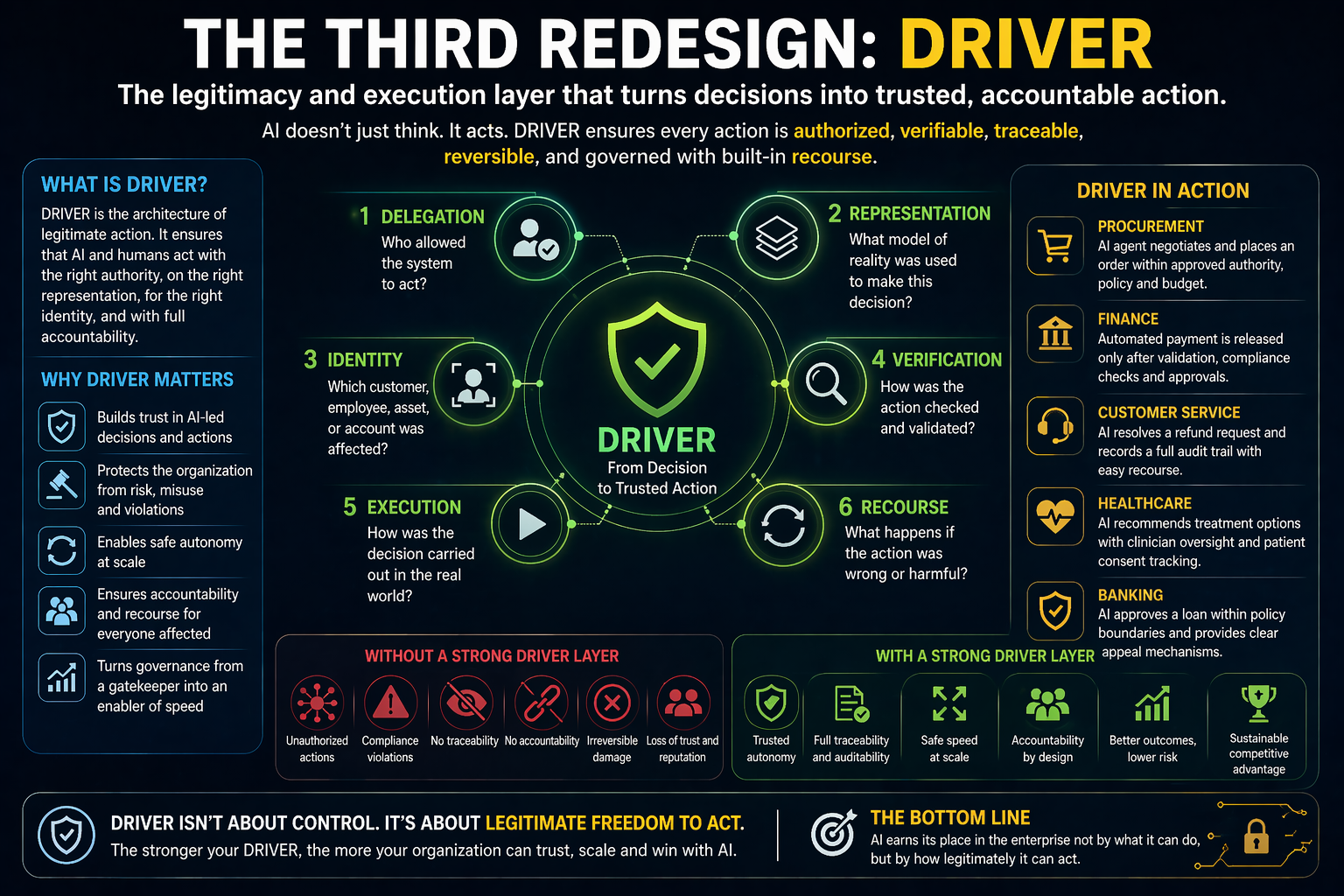
This is the layer most companies still do not fully understand.
DRIVER is not just governance in the narrow compliance sense. It is the architecture of legitimate action.
It answers six questions:
Delegation — who allowed the system to act?
Representation — what model of reality was used?
Identity — which customer, worker, supplier, asset, or account was affected?
Verification — how was the action checked?
Execution — how was the decision carried out?
Recourse — what happens if the system was wrong?
This is where AI stops being a software story and becomes an institutional story.
Consider a procurement AI agent that can compare bids, recommend vendor terms, trigger approvals, and place orders. The impressive part is not that it can write emails or rank options. The real issue is whether the firm can answer questions such as:
- Did the agent have the right to act?
- Which policy boundaries shaped the recommendation?
- Which vendor record and contract version did it rely on?
- Was the action reversible?
- Can finance, audit, legal, and the business unit reconstruct what happened?
- If the decision caused harm, what is the mechanism for correction, appeal, or rollback?
This is why governance can no longer be treated as an outer wrapper added after deployment. Trustworthy enterprise AI increasingly depends on governance being embedded into the operating mechanism itself, including model choice, proprietary data use, risk controls, and approval paths. (McKinsey & Company)
In the AI era, DRIVER becomes a source of competitive advantage.
A firm with a strong DRIVER layer can move faster because it knows where autonomy is safe, where human approval is required, where evidence must be logged, where identity must be bound, and where recourse must be available. It does not confuse speed with recklessness.
That matters because the moment AI starts acting in the world, trust becomes operational.
The New Lifecycle of the Firm
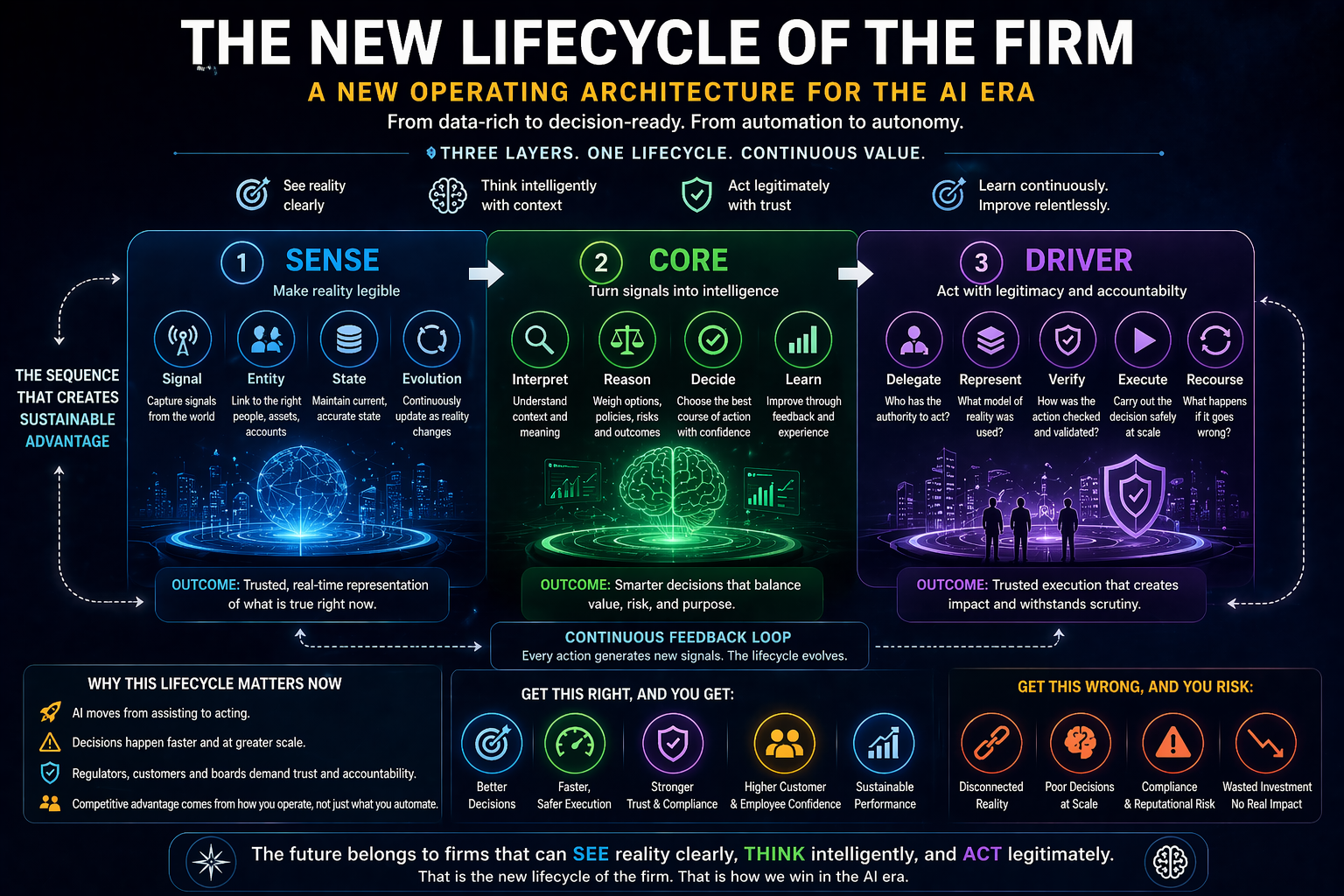
Put together, SENSE, CORE, and DRIVER redefine the firm’s lifecycle.
In the industrial era, firms were built around assets, labor, and process standardization.
In the software era, firms were redesigned around digitization, integration, and workflow automation.
In the AI era, firms must now be redesigned around a new sequence:
First, make reality legible.
Then, make decisions intelligent.
Then, make action legitimate.
That sequence matters.
If a company invests in CORE without SENSE, it gets fluent systems with shallow grounding.
If it invests in SENSE without CORE, it gets cleaner data with weak decision leverage.
If it invests in SENSE and CORE without DRIVER, it gets powerful systems that cannot be safely trusted at scale.
That is why the AI-era firm is not just a digital business with AI added on top. It is a firm whose operating model must be rebuilt around representation, reasoning, and governed action.
MIT CISR’s work on enterprise IT operating models in the AI era reinforces this broader point: leadership choices, governance structures, reuse, and decision speed now matter deeply to enterprise performance under AI conditions. (cisr.mit.edu)
Why This Matters at Board Level
This is not just a CIO issue. It is not just a CTO issue. It is not just a data issue.
It is a board issue.
Boards increasingly need to ask not only whether AI is being adopted, but whether the organization is becoming structurally fit for AI-led execution. That means asking whether the company has the capacity to represent reality well enough, reason responsibly enough, and act legitimately enough to scale autonomous or semi-autonomous systems without losing trust, control, or resilience. Governance and oversight are rapidly becoming central to AI value creation, not obstacles to it. (McKinsey & Company)
This is the real strategic divide now emerging between firms that are experimenting with AI and firms that are redesigning themselves for it.
A Practical Audit for CEOs, Boards, and C-Suite Leaders
Leaders do not need to begin with a grand theory. They can begin with a disciplined audit.
-
Where is our SENSE layer weak?
Where do we still have fragmented signals, weak entity resolution, stale state, low traceability, or poor reality refresh?
-
Where is our CORE layer shallow?
Where are we using AI to optimize outputs without enough context, memory, policy awareness, economic reasoning, or escalation design?
-
Where is our DRIVER layer fragile?
Where do systems act without clear delegation, identity binding, verification, reversibility, or recourse?
These are not just technical questions. They are questions about the future shape of the firm.
Because in the years ahead, every board, CEO, CIO, COO, and regulator will run into the same truth:
AI does not merely automate tasks. It reorganizes what a company must be able to represent, understand, authorize, and defend.
The Firms That Survive Will Redesign Themselves Before AI Exposes Their Weakness
The firms most at risk are not always the least digital.
Sometimes they are the firms that look mature on the surface but remain structurally weak underneath. They have dashboards, models, data lakes, copilots, and automation programs. But they do not have a coherent representation lifecycle. They cannot reliably connect signals to entities, entities to state, state to decisions, or decisions to legitimate action.
That weakness will become more visible as AI moves from advising to acting.
And the firms that win will look different.
They will not simply have “more AI.”
They will have stronger SENSE layers, more disciplined CORE layers, and more trusted DRIVER layers.
They will know how to represent reality before optimizing it.
They will know how to reason before automating.
They will know how to delegate without losing legitimacy.
That is what survival will mean in the AI era.
And that is why the next great redesign of the firm will not be centered on software alone.
It will be centered on the Representation Lifecycle of the Firm.
Because in the age of AI, the most important question is no longer whether a company can process information.
It is whether it can see reality clearly enough, think responsibly enough, and act legitimately enough to deserve scale.
Why does this matter for enterprise AI?
Because most AI failures are not model failures. They are representation failures, reasoning failures, or execution-governance failures. Companies that redesign only the AI layer but ignore the underlying structure of reality, decision rights, and recourse will struggle to scale AI safely or effectively.
What is the Representation Lifecycle of the Firm?
The Representation Lifecycle of the Firm is a framework that explains how companies must redesign themselves for the AI era across three layers:
- SENSE – Making reality machine-legible through signals, entities, and state
- CORE – Turning that representation into reasoning, decisions, and intelligence
- DRIVER – Converting decisions into legitimate, governed, and accountable action
It provides a practical way for enterprises to move from AI experimentation to scalable, trusted execut
Conclusion: The Firm Is Becoming a Representation System
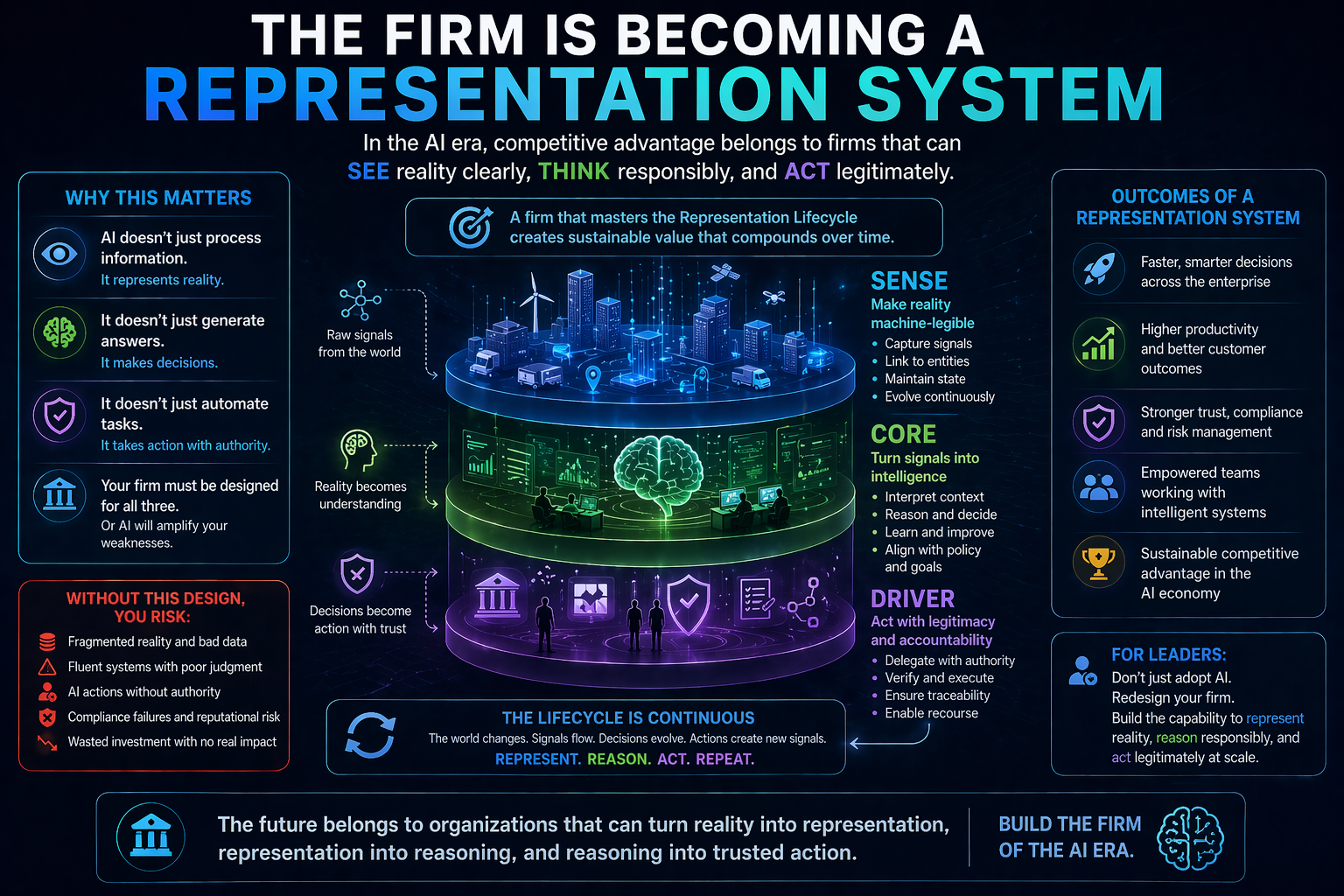
The biggest mistake leaders can make right now is to treat AI as a tooling wave.
It is not.
It is a redesign wave.
The firm of the AI era will be defined not by how many models it uses, but by how well it turns messy reality into dependable representation, dependable representation into sound judgment, and sound judgment into governed action.
That is the progression from SENSE to CORE to DRIVER.
And it may become the defining operating logic of the next era of enterprise strategy.
The companies that understand this early will not just deploy AI more effectively. They will redesign themselves into institutions that can actually survive, scale, and lead in a world where software does more than inform work. It begins to shape it.
A firm’s representation is not fixed at founding — it has to be deliberately redesigned at each stage of growth, the same way org structures and financial controls are. Companies that treat it as a one-time setup fall behind the ones that treat it as a lifecycle.



Raktim Singh is an AI and deep-tech strategist, TEDx speaker, and author focused on helping enterprises navigate the next era of intelligent systems. With experience spanning AI, fintech, quantum computing, and digital transformation, he simplifies complex technology for leaders and builds frameworks that drive responsible, scalable adoption.