

The Representation Economy: The Invisible Crisis Inside Modern AI Systems
A thing can be real — and still remain economically invisible.
Not because it lacks value.
Not because it lacks importance.
But because it does not enter institutional systems in a form those systems can understand, trust, and act upon.
This is becoming one of the defining realities of the AI era.
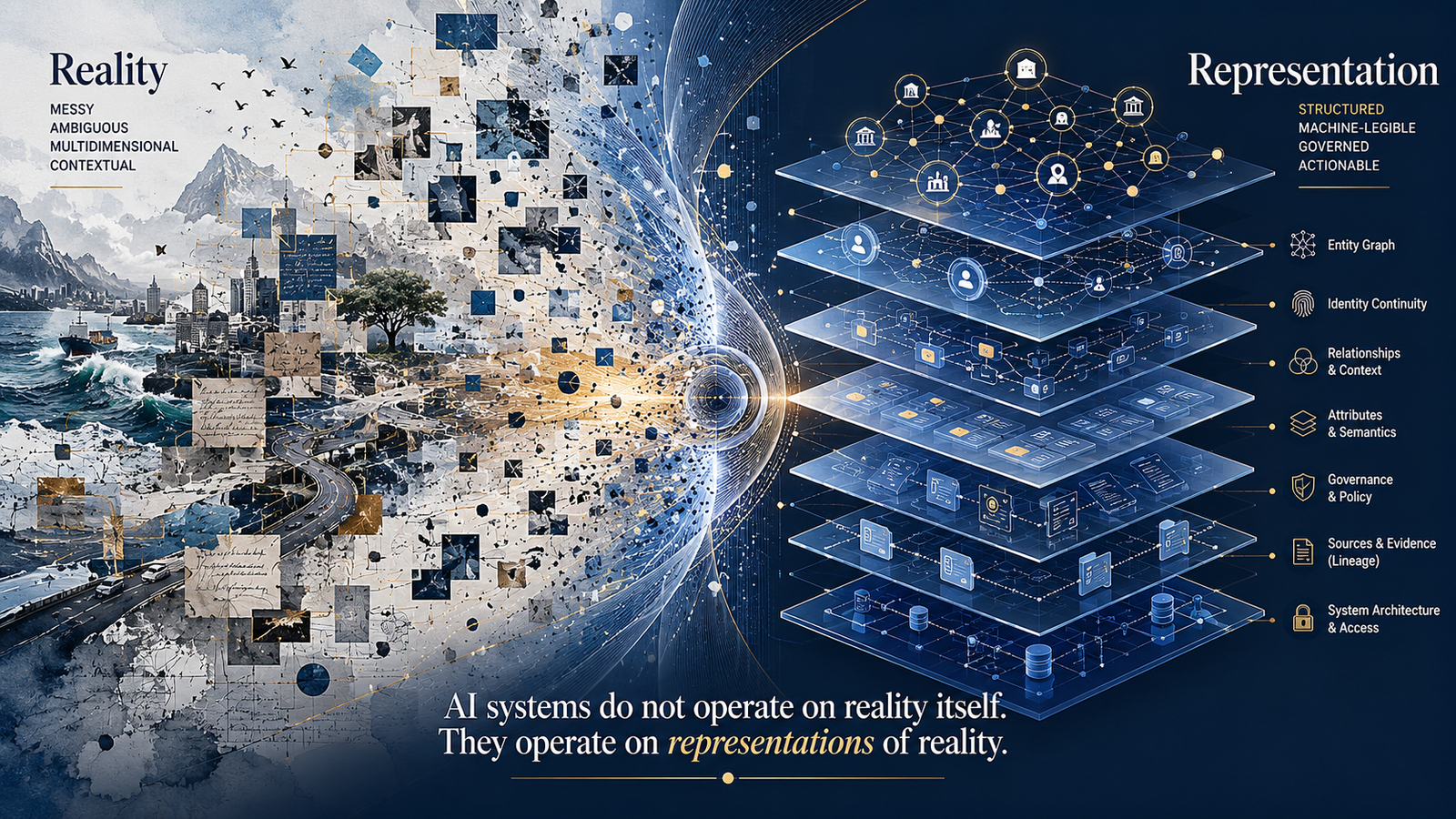
Modern systems do not operate directly on reality.
They operate on representations of reality.
Banks act on representations of financial identity.
Healthcare systems act on representations of medical condition.
Governments act on representations of citizenship and compliance.
Enterprise AI systems act on representations of customers, suppliers, risks, workflows, and intent.
The implication is profound:
If something cannot be represented clearly inside a system, it cannot fully participate inside that system.
This is not merely a technical observation.
It is becoming an economic principle.
The next phase of competitive advantage may not belong solely to organizations with the most powerful AI models. It may belong to organizations that build the most accurate, continuous, trustworthy, and governable representations of reality.
That is the deeper transition now unfolding beneath the surface of enterprise AI.
This article introduces the concept of the Representation Economy — the idea that AI systems operate on representations of reality rather than reality itself. It argues that future enterprise advantage will depend less on raw AI intelligence and more on the ability to create trustworthy, governable, and machine-legible representations of entities, conditions, relationships, and institutional context. The article explains why representation quality shapes participation, trust, visibility, and value flow inside AI-driven systems.
The Operational Meaning of Existence
When we say “if it is not represented, it does not exist,” we are not making a philosophical claim.
We are making an operational one.
Systems allocate:
- attention
- trust
- resources
- priority
- intervention
- opportunity
through what they can process with confidence.
What cannot be represented clearly becomes difficult to:
- evaluate
- compare
- verify
- coordinate
- support
- include
The entity itself may still exist physically, socially, or morally.
But economically and institutionally, it becomes weakened.
This distinction matters enormously in the AI economy because AI systems amplify the importance of legibility.
AI scales action through representation.
And whatever remains weakly represented increasingly risks becoming weakly served.
The Hidden Asymmetry of Visibility
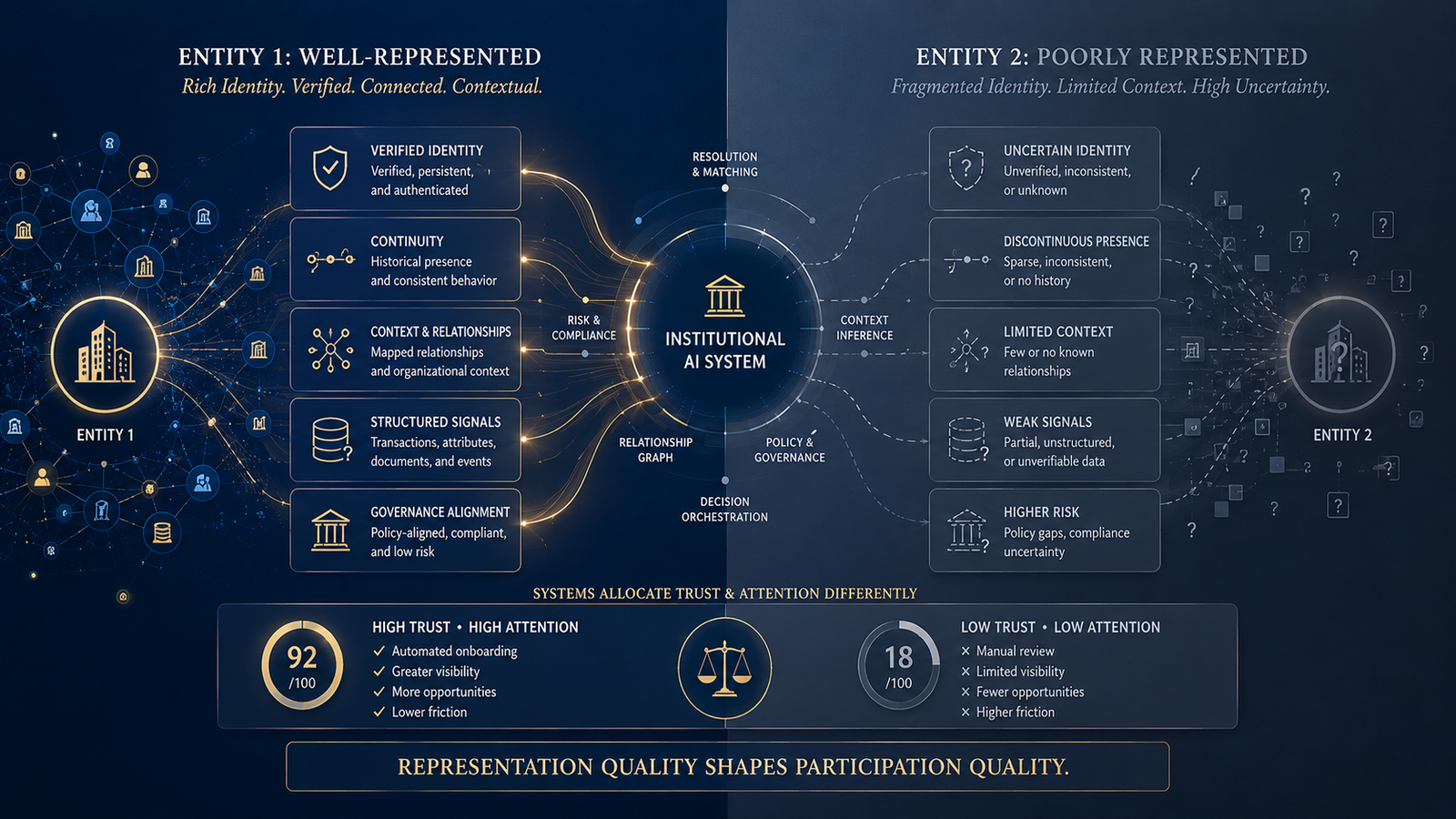
Visibility is not neutral.
It quietly shapes how value moves through institutions.
Entities that are richly represented become easier to:
- trust
- finance
- insure
- optimize
- personalize
- include in automated systems
Entities that appear fragmented become harder to process.
They are:
- generalized instead of understood
- delayed instead of prioritized
- approximated instead of represented faithfully
This asymmetry rarely begins at the point of decision-making.
It begins earlier — at the point of visibility itself.
A system cannot allocate intelligently toward what it cannot perceive coherently.
That is why representation is becoming a strategic layer of the AI economy rather than merely a data-management problem.
Representation Is Not Data
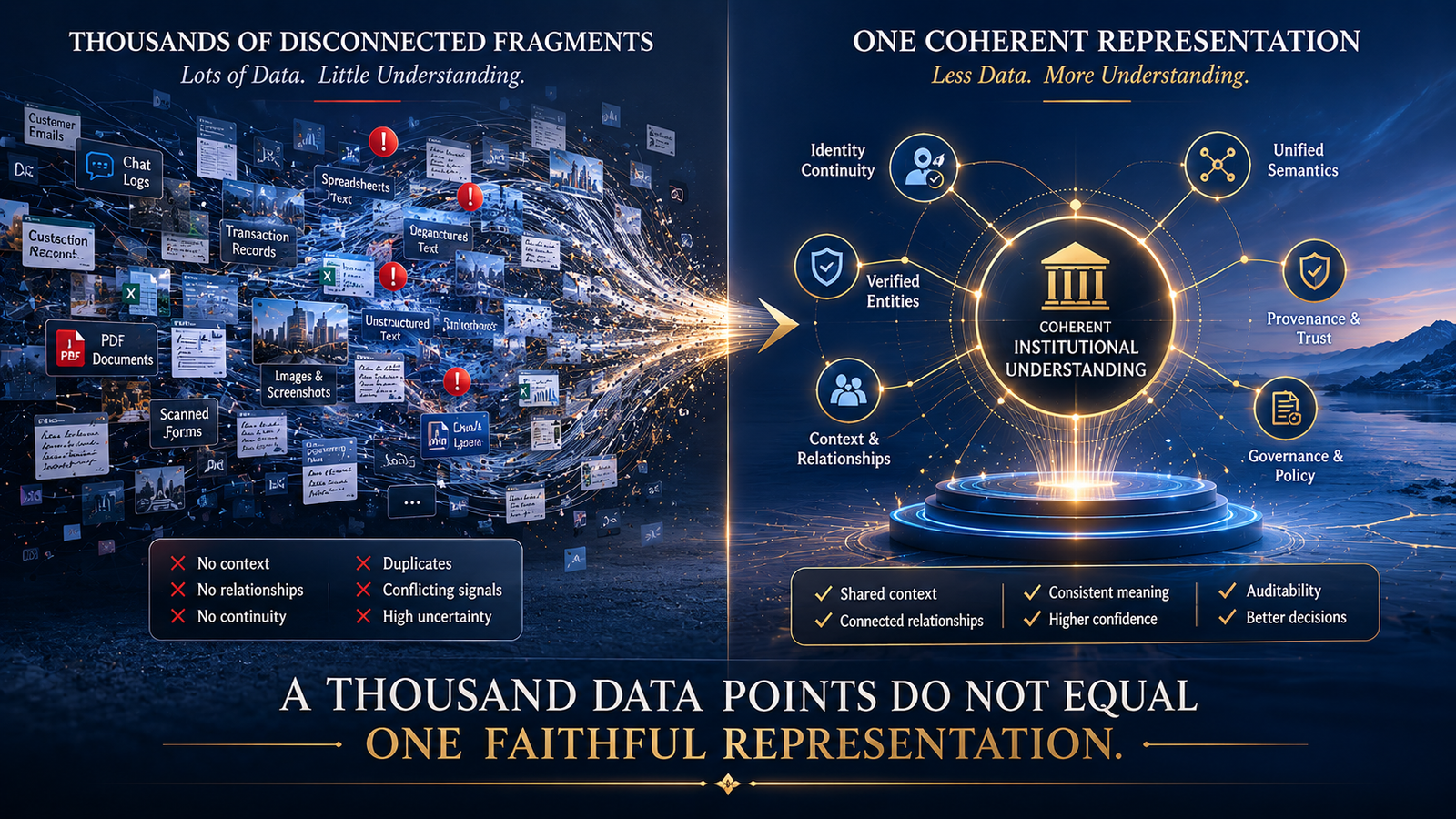
One of the most dangerous assumptions in enterprise AI is the belief that more data automatically creates better understanding.
It does not.
A thousand disconnected signals do not equal one coherent representation.
Data may exist in abundance while understanding remains absent.
Representation emerges only when signals are connected into a meaningful structure that captures:
- condition
- continuity
- context
- relationships
- evolution over time
This distinction explains why many organizations remain data-rich but visibility-poor.
Their systems accumulate signals without constructing faithful representations of reality.
And when representation remains weak:
- trust weakens
- prediction weakens
- coordination weakens
- governance weakens
The failure is not computational.
It is representational.
The New Inequality: Representation Inequality
Industrial economies created inequalities of capital.
Digital economies created inequalities of access.
The AI economy is introducing something deeper:
inequality of representation.
When one entity enters a system with:
- rich historical context
- verified identity
- connected signals
- behavioral continuity
- explainable state
while another enters as disconnected fragments, the difference in outcome has already begun before any explicit decision is made.
The first becomes legible.
The second becomes uncertain.
The first receives faster trust.
The second receives slower participation.
This applies not only to people, but also to:
- businesses
- regions
- supply chains
- ecosystems
- institutions
- emerging markets
- small enterprises
- informal networks
Representation quality increasingly shapes participation quality.
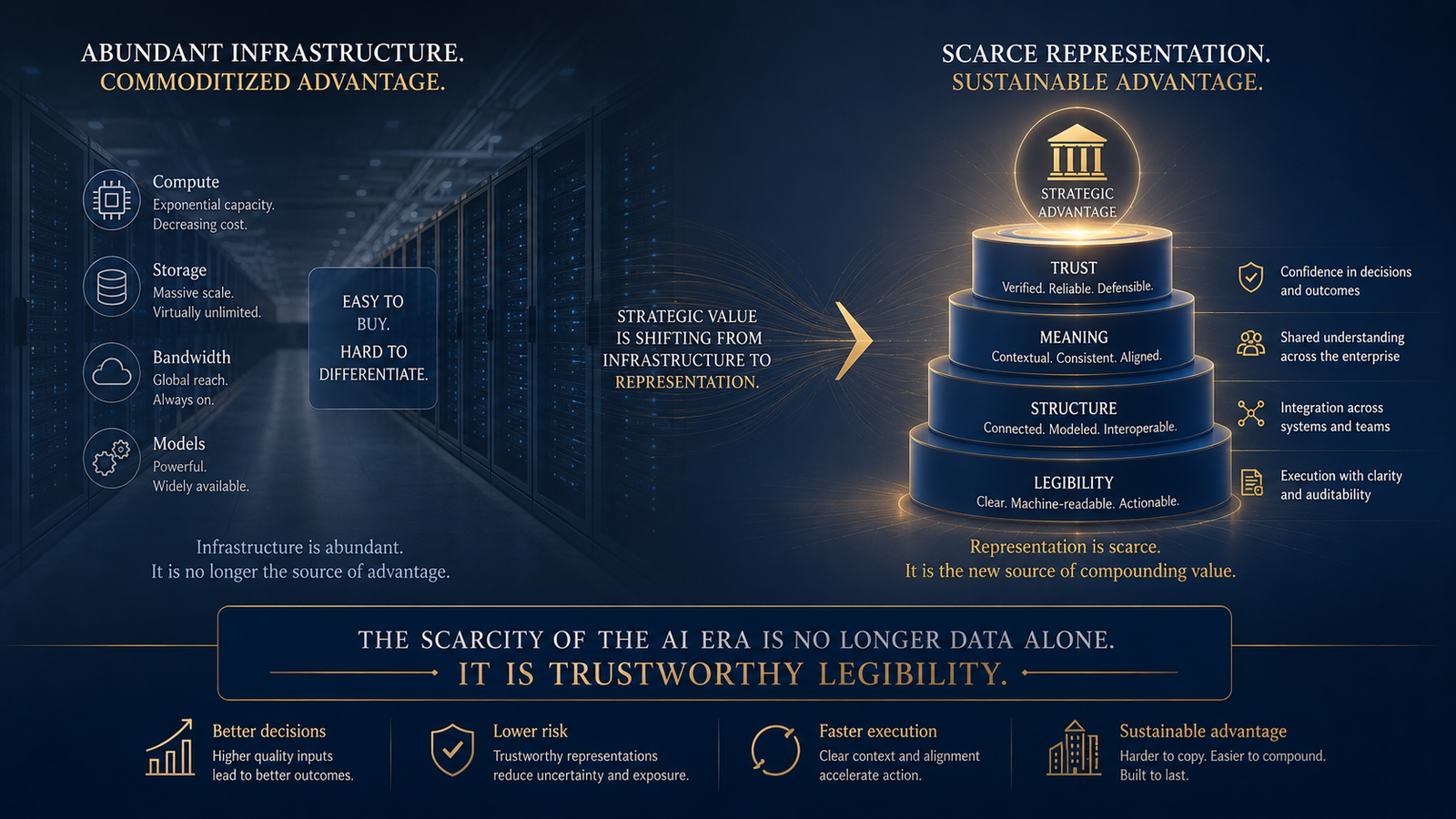
Many leaders assume AI reduces the importance of representation because intelligence becomes more powerful.
The opposite is happening.
As intelligence becomes commoditized, differentiation moves upward into representation quality.
Frontier models are becoming broadly accessible.
But high-quality institutional representation remains rare.
The scarcity is no longer computation alone.
The scarcity is trustworthy legibility.
Organizations that can represent reality more accurately gain advantages in:
- decision quality
- risk assessment
- personalization
- operational coordination
- automation reliability
- governance
- institutional trust
This is why the next competitive divide may not be model scale.
It may be representation scale.
The Cost of Invisibility
Some of the most important realities inside enterprises remain poorly represented:
- organizational dependencies
- tacit knowledge
- institutional memory
- informal coordination
- early risk signals
- trust relationships
- evolving operational conditions
These often matter most precisely because they are difficult to formalize.
And because they remain weakly represented, they are consistently undervalued.
This creates dangerous blind spots.
If systems cannot see clearly:
- they cannot allocate accurately
- they cannot intervene responsibly
- they cannot coordinate effectively
- they cannot govern intelligently
Invisibility does not eliminate value.
It eliminates access to value.
Representation Is Becoming a Participation Layer
Representation was once treated as a reporting layer.
It is now becoming a participation layer.
Entities that improve representation quality become easier to:
- onboard
- trust
- insure
- finance
- optimize
- coordinate with
- include inside intelligent systems
Representation changes who can participate — and on what terms.
This is especially important in enterprise AI, where participation increasingly depends on machine-readable legitimacy.
If a system cannot represent an entity coherently, the system struggles to act on behalf of that entity responsibly.
And as AI-driven decision systems expand, this dynamic intensifies.
The Boundary Between Visibility and Trust
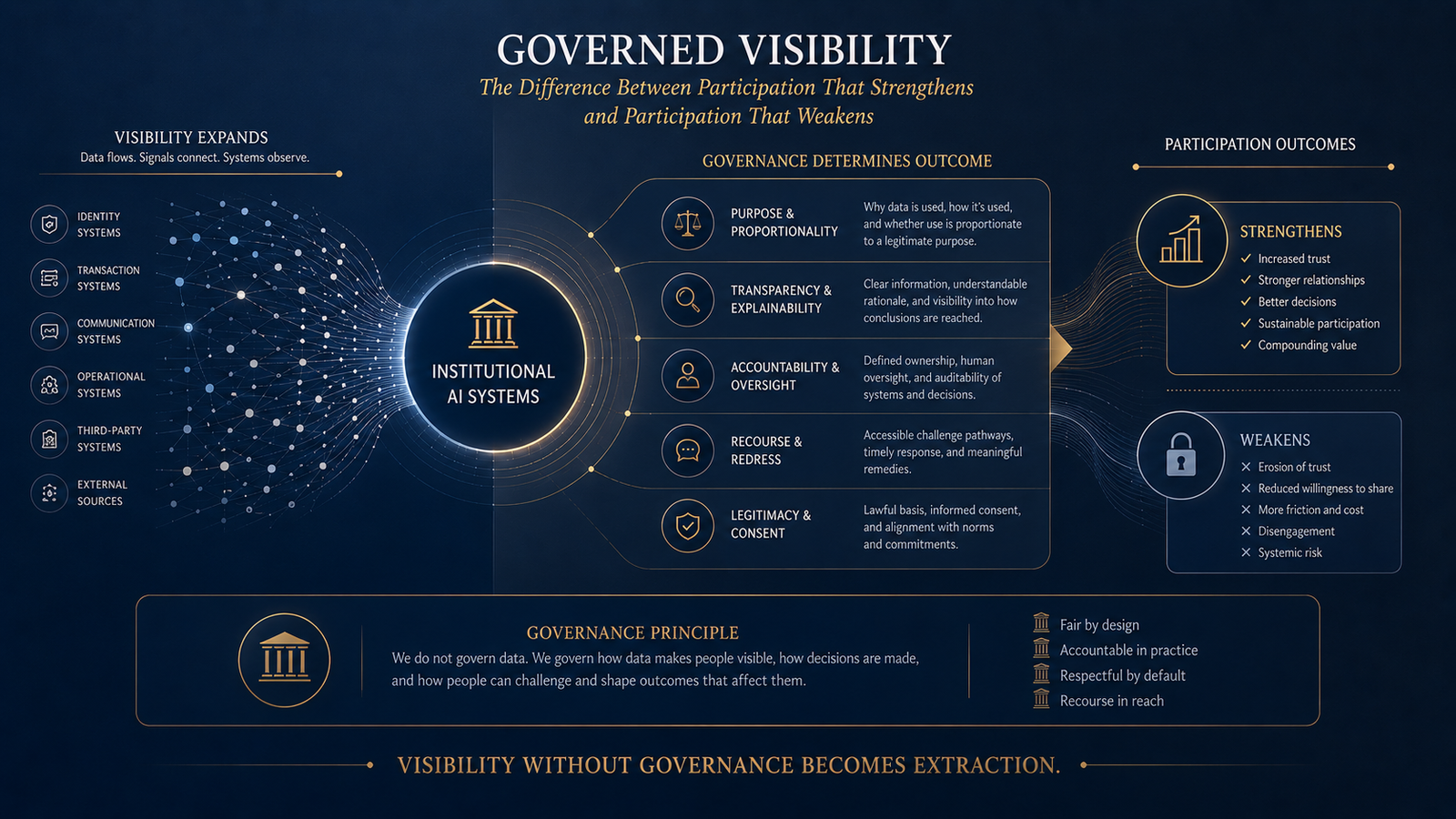
However, visibility alone is insufficient.
Representation without governance becomes extraction.
If systems see more but fail to govern how that visibility is used:
- trust declines
- participation weakens
- resistance increases
This is why the future of AI cannot be reduced to intelligence alone.
The challenge is not merely:
“Can the system see?”
The deeper question is:
“Can the system act responsibly on what it sees?”
This is where representation connects directly to governance.
Visibility without legitimacy creates fear.
Representation without recourse creates vulnerability.
Trust requires both accurate representation and governed action.
The Reinforcing Loop of Representation
Representation compounds advantage.
What is well represented:
- becomes easier to trust
- attracts more participation
- receives more investment
- gains more visibility
- improves further over time
What is weakly represented:
- receives less trust
- attracts less value
- becomes harder to include
- loses visibility
- weakens further
This creates a compounding cycle of inclusion and exclusion.
And that may become one of the defining economic dynamics of the AI era.
The Strategic Shift for Enterprise Leaders
This changes the questions leaders must ask.
The old questions were:
- How much data do we have?
- How advanced are our AI models?
- How much automation can we deploy?
The emerging questions are different:
- Which realities remain weakly represented?
- Where are we confusing metrics with understanding?
- Which entities appear only as fragments?
- Where does poor representation create poor trust?
- Where are we reacting late because we cannot see early?
- Which institutional blind spots remain invisible to our AI systems?
These are harder questions.
But they reveal where durable advantage increasingly resides.
Not in computing more.
But in seeing reality more faithfully.
The Emerging Frontier: Legibility
The frontier of the AI economy is no longer computation alone.
It is legibility.
The organizations that succeed may not simply be those with the largest models, the fastest inference, or the most aggressive automation strategies.
They may be the organizations that:
- represent reality more accurately
- preserve continuity across systems
- govern visibility responsibly
- build trusted participation architectures
- transform fragmented signals into coherent institutional understanding
The future belongs not merely to intelligent systems.
But to systems capable of trustworthy representation.
And once that becomes clear, a deeper question emerges:
If participation depends on representation, what makes a representation complete, continuous, governable, and trustworthy?
That is where the next architectural layer of the AI economy begins.
Conclusion: The Future Will Belong to Those Who See Better
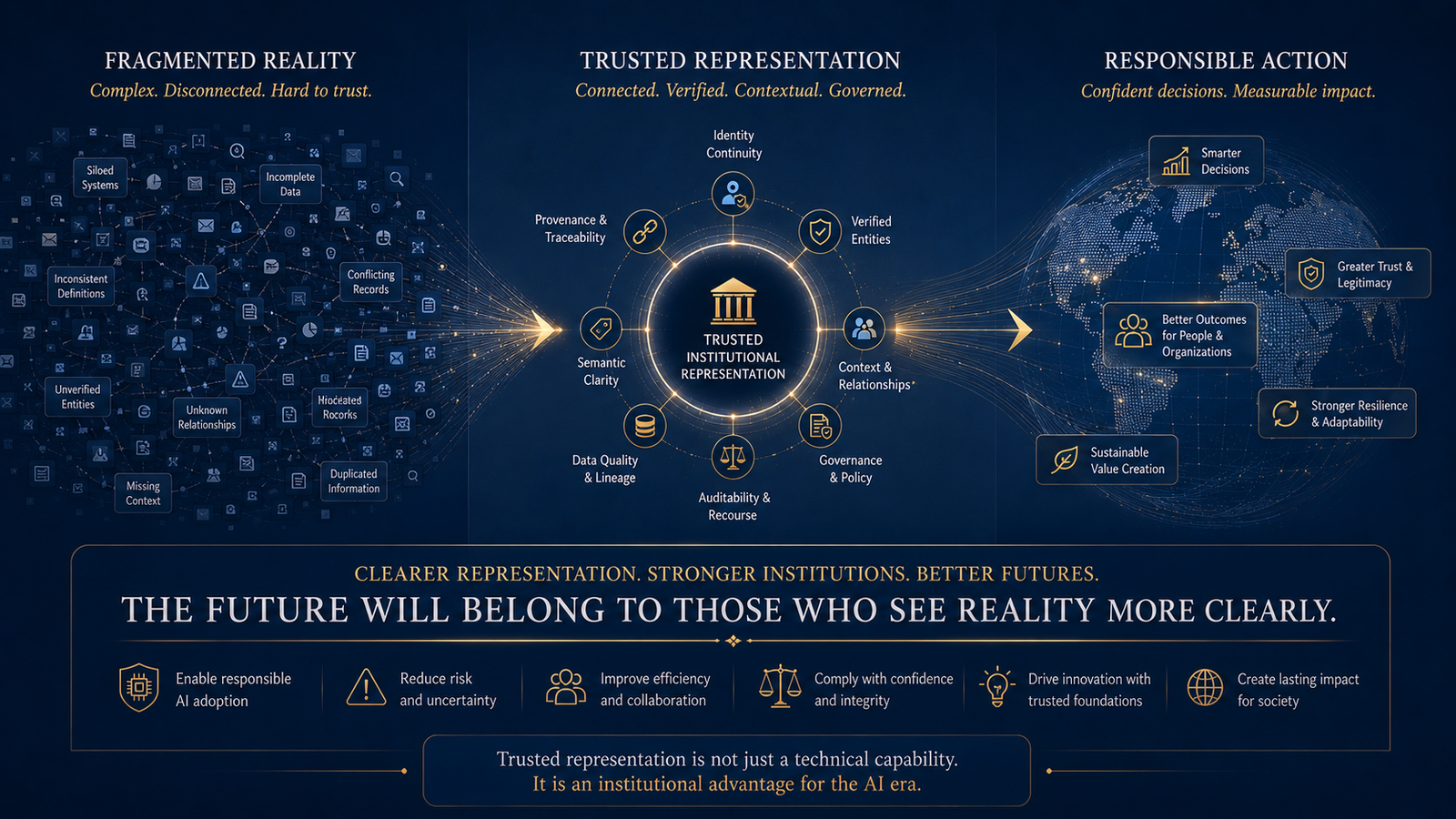
The AI era is often described as a race for intelligence.
But intelligence alone is not enough.
An intelligent system operating on fragmented, distorted, incomplete, or weakly governed representations will eventually produce fragile decisions, institutional mistrust, and systemic blind spots.
The deeper challenge is not only cognition.
It is legibility.
The organizations that shape the next era of enterprise advantage may not simply build better models.
They may build better representations of reality itself.
Because in the AI economy:
- visibility shapes participation
- participation shapes value
- value shapes power
And increasingly, what cannot be represented coherently cannot fully participate economically.
That is why representation is no longer a secondary technical concern.
It is becoming the foundational infrastructure of institutional intelligence.
The next economy will not merely reward those who collect more data.
It will reward those who see reality more clearly — and act on it responsibly.
Key Takeaways
- AI systems operate on representations of reality, not reality itself.
- Weak representation creates weak participation.
- Representation quality increasingly shapes economic inclusion and institutional trust.
- Data abundance does not automatically create understanding.
- The future AI divide may become a divide in representation quality.
- Visibility without governance creates extraction risk.
- Enterprise advantage is shifting from computation scale toward representation scale.
- Legibility is becoming a strategic capability in the AI economy.
Summary
This article argues that the future of enterprise AI depends not only on intelligence, but on representation quality. Modern systems act on representations of reality rather than reality itself. Entities that are clearly represented become easier to trust, coordinate, finance, and include in AI-driven systems, while weakly represented entities risk exclusion and distortion. As AI models become commoditized, competitive advantage may shift toward organizations that can build accurate, governable, continuous, and trustworthy representations of reality. The article introduces representation as a foundational economic and institutional layer shaping participation, visibility, trust, and value flow in the AI era.
Glossary
Representation Economy
An emerging economic paradigm where value increasingly depends on how effectively entities, conditions, relationships, and realities are represented inside intelligent systems.
Machine Legibility
The ability of systems to interpret, process, and act upon representations with confidence and continuity.
Representation Quality
The completeness, continuity, accuracy, context, and trustworthiness of a representation.
Institutional Intelligence
The ability of organizations to see, reason, coordinate, and act coherently across complex systems.
Participation Layer
The representational infrastructure that determines which entities can meaningfully participate in digital and AI-driven systems.
Legibility
The extent to which reality becomes understandable and actionable inside institutional systems.
FAQ
What does “If It Is Not Represented, It Does Not Exist” mean?
It means systems can only allocate trust, resources, and action toward realities they can represent coherently and process operationally.
Why is representation becoming important in AI?
Because AI systems depend on structured representations to reason, automate, and coordinate decisions.
Is representation the same as data?
No. Data consists of signals. Representation organizes signals into meaningful, contextual, and actionable structures.
Why does representation affect trust?
Systems trust what they can understand coherently. Weak representation increases uncertainty and friction.
What is the strategic implication for enterprises?
Competitive advantage increasingly depends on the ability to build trustworthy institutional visibility rather than merely deploying AI models.
How does this connect to AI governance?
Governance determines whether visibility is used responsibly. Representation without governance can become exploitative.
Q1. What is the Representation Economy?
The Representation Economy is an emerging economic framework where value increasingly depends on how effectively entities, conditions, relationships, and realities are represented inside intelligent systems.
Q2. Why do AI systems depend on representation?
AI systems cannot operate directly on reality. They rely on structured representations of reality that can be processed, interpreted, verified, and acted upon.
Q3. What does “If It Is Not Represented, It Does Not Exist” mean?
It means that systems allocate trust, participation, and economic action only toward realities they can represent coherently and process operationally.
Q4. How is representation different from data?
Data consists of raw signals. Representation organizes those signals into meaningful, contextual, continuous, and actionable structures.
Q5. Why is representation becoming strategically important?
As AI intelligence becomes commoditized, competitive advantage increasingly shifts toward organizations that can create trustworthy, governable, and machine-legible representations of reality.
Q6. What is machine-legible reality?
Machine-legible reality refers to the transformation of real-world entities, conditions, relationships, and events into representations that intelligent systems can process reliably.
Q7. Why does representation affect trust?
Systems trust what they can understand coherently. Weak or fragmented representation increases uncertainty, friction, and exclusion.
Q8. How does representation connect to AI governance?
Governance determines how visibility is used, controlled, verified, and acted upon responsibly inside AI-driven systems.
Who is Raktim Singh?
Raktim Singh is a technology thought leader, enterprise AI strategist, author, and systems thinker focused on the future of institutional intelligence, AI governance, representation systems, and enterprise transformation.
He is the creator of the Representation Economy framework and the SENSE–CORE–DRIVER architecture for understanding machine-legible reality, governed AI systems, and institutional participation in the AI era.
Raktim Singh has written extensively on enterprise AI, institutional intelligence, AI governance, representation infrastructure, and the future architecture of intelligent systems.
What inspired this article?
The growing realization that AI systems do not operate directly on reality, but on representations of reality — and that this changes how trust, visibility, participation, and value flow through institutions.
What is the central idea behind the article?
That the future AI economy may depend less on raw intelligence and more on trustworthy representation.
Why is this topic important for enterprise leaders?
Because organizations increasingly allocate decisions, automation, risk management, and coordination through AI-driven systems that depend on representation quality.
What is the biggest mistake organizations make today?
Confusing data abundance with understanding.
Many enterprises accumulate signals without building coherent institutional representations.
What should CIOs and boards focus on next?
Not only AI model capability, but also:
- representation quality
- institutional visibility
- governance
- continuity of context
- trust architecture
- machine-legible participation systems
How does this connect to the SENSE–CORE–DRIVER framework?
This article focuses primarily on the representation and visibility problem that sits inside the SENSE layer — where reality becomes machine-legible for intelligent systems.
Where can readers follow more work from Raktim Singh?
🌐 Website
💼 LinkedIn
📺 YouTube @raktim_hindi
✍️ Medium
💻 GitHub Representation Economy Repository
📚 ResearchGate Publication
- “AI systems do not operate on reality. They operate on representations of reality.”
- “A thousand data points do not equal one faithful representation.”
- “The next divide in AI may not be intelligence. It may be representation.”
- “Visibility without governance becomes extraction.”
- “The future will belong to those who see reality more clearly — and act on it responsibly.”
Where can readers learn more about the Representation Economy?
Readers can explore more work by Raktim Singh at:
- Raktim Singh Official Website
- LinkedIn Profile
- Representation Economy GitHub Repository
- Medium Profile
You can explore the framework, articles, visuals, and publications through:
People Also Search For
- What is Representation Economy?
- Why do Enterprise AI projects fail?
- What is machine-legible reality?
- Representation infrastructure in AI
- The World AI Cannot See: Why Intelligence Begins With Representation – Raktim Singh
- The Reality Gap: Why AI Systems Look Intelligent but Still Fail to See Reality – Raktim Singh
- Decision Scale: Why Competitive Advantage Is Moving from Labor Scale to Decision Scale
- The Representation Economy: Why AI Value Will Follow Visibility – Raktim Singh
Suggested Further Reading / External References
1. OECD AI Principles
Excellent for governance, trust, accountability, and institutional AI framing.
2. NIST AI Risk Management Framework
Very strong for legitimacy, governance, trust, and operational AI systems.
NIST AI Risk Management Framework
3. Stanford Human-Centered AI (HAI)
Strong intellectual alignment with visibility, institutions, governance, and human impact.
4. World Economic Forum – AI Governance
Good institutional/global governance layer.
World Economic Forum AI Governance Insights
- MIT Technology Review
- Harvard Business Review
- World Economic Forum AI Governance Initiatives
- OECD AI Principles
About the Author
Raktim Singh Official Website
LinkedIn Profile
YouTube Channel (@raktim_hindi)
Medium Profile
GitHub – Representation Economy Repository
Zenodo DOI Record
OSF Project
ResearchGate Publication
Academia.edu Publication
ORCID Profile



Raktim Singh is an AI and deep-tech strategist, TEDx speaker, and author focused on helping enterprises navigate the next era of intelligent systems. With experience spanning AI, fintech, quantum computing, and digital transformation, he simplifies complex technology for leaders and builds frameworks that drive responsible, scalable adoption.