

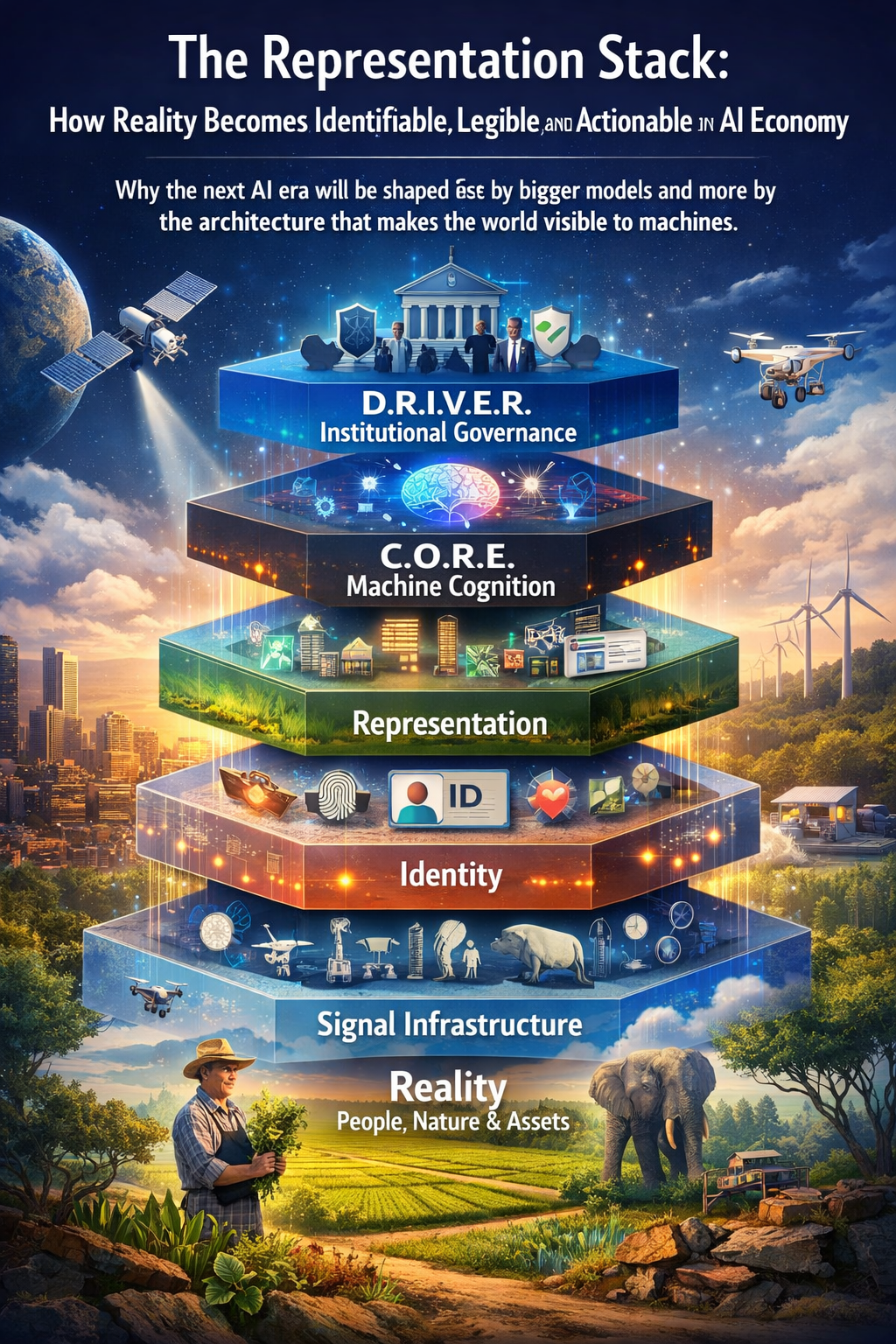
Artificial intelligence does not begin with models. It begins with visibility. Before machines can reason, they must first detect signals from the world, attach those signals to identifiable entities, and build structured representations of reality.
This layered architecture — what this article calls the Representation Stack — explains how reality becomes machine-readable, how AI systems generate decisions through C.O.R.E. (Comprehend, Optimize, Realize, Evolve), and how institutions govern those decisions through D.R.I.V.E.R. (Delegation, Representation, Identity, Verification, Execution, Recourse). Understanding this stack is becoming essential for enterprises, governments, and technology leaders building the next generation of intelligent systems.
What is the Representation Stack in AI?
The Representation Stack is the layered architecture that converts reality into machine-readable form. It includes signal infrastructure, identity systems, and structured representation, enabling AI cognition through C.O.R.E. and institutional governance through D.R.I.V.E.R.
The Representation Stack
Most discussions about artificial intelligence begin too late.
They begin with the model.
They begin with reasoning, generation, agents, orchestration, autonomy, and inference. They begin with what happens after data is already available, after an entity is already visible, after context has already been structured, and after the world has already been translated into machine-readable form.
But that is not where the AI economy truly begins.
The AI economy begins much earlier: at the moment when reality first becomes detectable, identifiable, representable, and therefore actionable.
That is why we need a more foundational idea: the Representation Stack.
The Representation Stack is the layered architecture through which raw reality becomes usable by AI systems and governable by institutions. It explains how people, animals, ecosystems, assets, infrastructure, and informal economic activity move from being invisible or weakly visible to becoming part of decision systems. It also explains why some parts of the world are easier to optimize than others, why some industries move faster than others, and why the next wave of AI value may come less from smarter models and more from stronger representation. This shift is increasingly visible in digital public infrastructure, identity systems, agricultural sensing, and Earth observation. (UNDP)
In simple terms:
AI cannot optimize what it cannot represent.
And representation does not appear magically. It must be built in layers.
That layered architecture is what this article calls the Representation Stack.
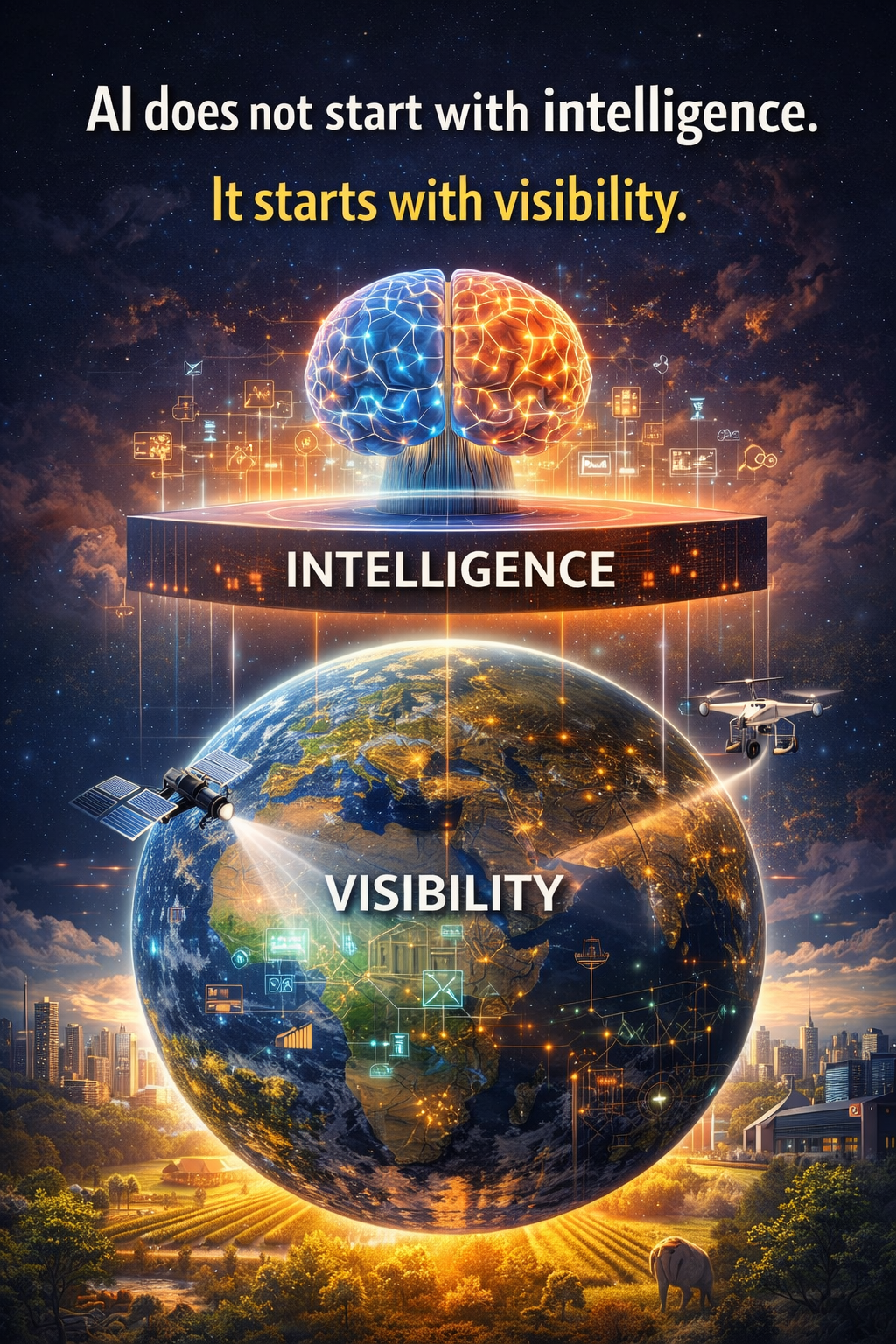
The core idea: AI does not start with intelligence. It starts with visibility.
If you ask most executives where AI value comes from, many will answer with words like models, compute, copilots, or agents.
Those matter. But they are downstream layers.
A system cannot reason about a person, an animal, a field, a river, a machine, or a supply chain unless it can first observe signals about them, attach those signals to an identifiable entity, and assemble them into a coherent representation of the world. Only then can cognition, optimization, and action begin. That is why digital identity, Earth observation, mobile telemetry, IoT sensors, enterprise monitoring, and other forms of signal infrastructure are becoming so important. They are not peripheral to the AI economy. They are foundational. (Identification for Development)
This is the first major shift leaders need to understand:
The next AI economy will be shaped not only by better models, but by what parts of reality become visible to machines.
That is the strategic meaning of the Representation Stack.
Why we need a stack model at all
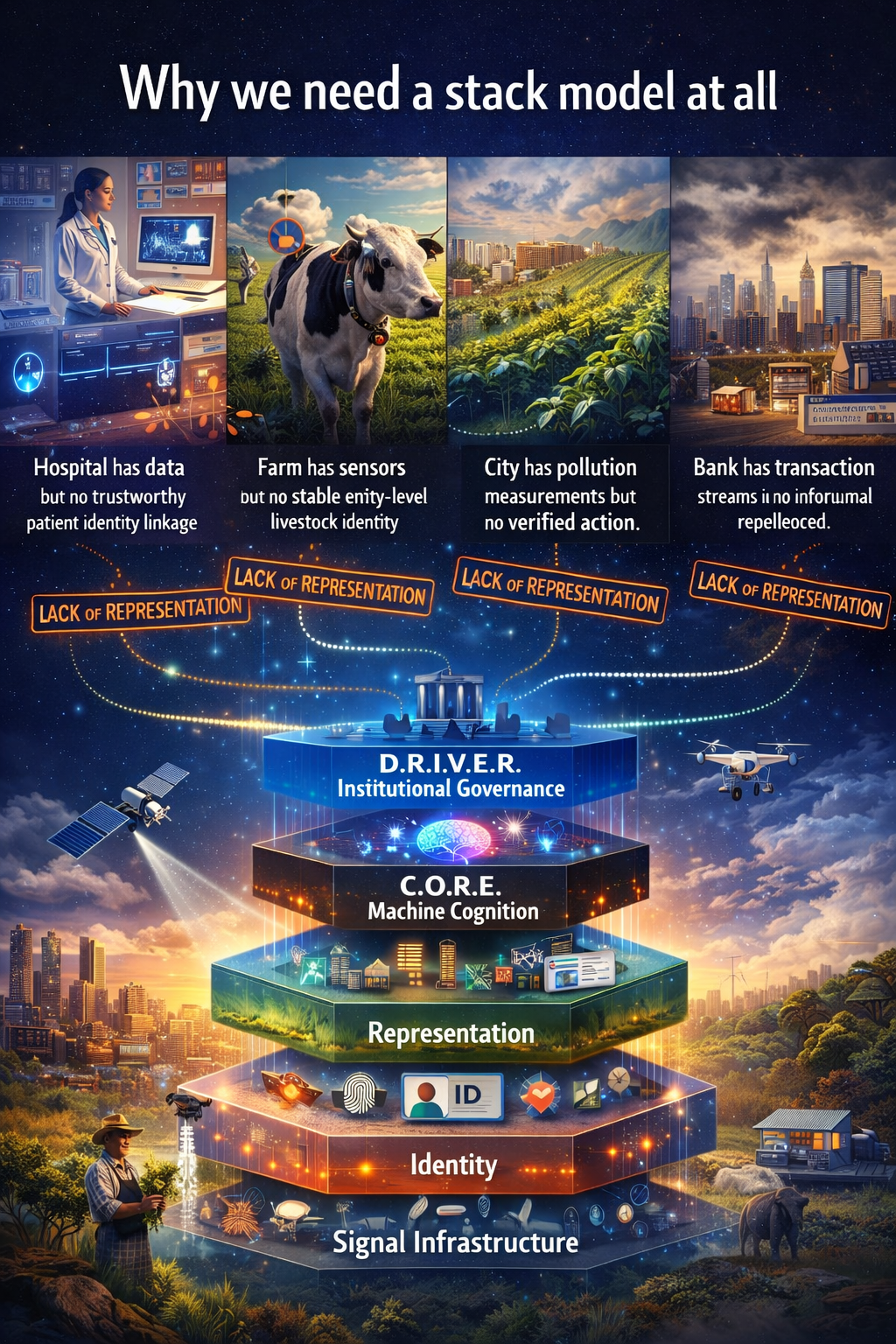
“Representation” is often treated as if it were a single thing. It is not.
A hospital may have data, but not trustworthy patient identity linkage. A farm may have sensors, but not stable entity-level livestock identity. A city may have pollution measurements, but not the institutional machinery to turn those measurements into verified action. A bank may have transaction streams, but not enough representation of informal livelihoods to lend responsibly.
In all these cases, the problem is not simply a lack of AI. The problem is that one or more layers of representation are missing or weak.
That is why the Representation Stack matters. It breaks the problem into parts and shows why AI capability depends on the integrity of the layers below it.
Layer 1: Reality
The first layer is obvious, but often ignored: reality itself.
Reality includes people, animals, ecosystems, farms, warehouses, streets, pipelines, rivers, fisheries, informal merchants, elderly citizens, factory equipment, traffic systems, and countless other entities and processes.
Most of reality does not naturally present itself in structured, machine-usable form. It does not arrive with clean schemas, stable identifiers, or ready-made decision variables. In fact, large parts of the physical and social world remain weakly digitized. That is especially true in smallholder agriculture, informal economies, biodiversity monitoring, and public-service environments with uneven data systems. FAO’s work on agrifood automation makes this especially clear: the opportunity is enormous, but adoption is uneven and context matters deeply. (FAOHome)
So the Representation Stack begins with a humbling fact:
Reality exists first. Systems come later.
Layer 2: Signal infrastructure
The second layer is signal infrastructure — the systems that capture traces of reality.
This includes sensors, mobile devices, satellite imagery, enterprise telemetry, point-of-sale systems, wearables, digital payment rails, geospatial feeds, machine logs, cameras, edge devices, and public digital infrastructure.
Signal infrastructure is what makes reality detectable.
A dairy animal that does not “speak” digitally can still emit signals through body temperature, movement, milk output, feeding behavior, and health indicators. A field can emit signals through soil moisture, temperature, vegetation health, and rainfall patterns. A city can emit signals through traffic density, air quality, energy usage, and public service demand. NASA’s Earth observation resources show how satellites can track land use, soil moisture, temperature, and vegetation health for agriculture, while ESA and GEOGLAM illustrate how Earth observation supports crop monitoring, food security, and agricultural decision-making. (NASA Earthdata)
This is the first critical move in the AI economy:
from invisible reality to detectable signals.
Without signal infrastructure, nothing downstream matters.
Layer 3: Identity
This is the layer most discussions miss.
Signals alone are not enough. They must belong to something.
Identity answers a simple but essential question:
Which entity does this signal belong to?
If a livestock sensor reports abnormal movement, which animal is it referring to? If a digital payment stream shows transaction history, which merchant does it belong to? If a pollution sensor detects contamination, which river segment, industrial corridor, or municipality is implicated? If healthcare alerts show anomalies, which patient or household is being represented?
Without identity, signals remain fragmented. They cannot accumulate into longitudinal understanding. They cannot be traced, governed, or acted upon reliably.
This is why inclusive and trusted digital identification systems matter so much. The World Bank’s ID4D initiative explicitly frames identification systems as enablers of services, economic opportunity, and rights, and reports support for more than 60 countries and 550 million people through inclusive digital IDs and other digital public infrastructure. (Identification for Development)
But identity in the AI economy goes beyond human identity.
It includes asset identity, livestock identity, geospatial identity, machine identity, shipment identity, and, increasingly, digital twins of physical systems.
This is the second critical move:
from detectable signals to identifiable entities.
Layer 4: Representation
Once signals are attached to identities, they can be assembled into representations.
Representation is not just data collection. It is the creation of a usable model of reality.
A representation might describe a customer, a crop cycle, a herd, a warehouse, an urban zone, a machine, a watershed, or an ecosystem. It brings together signals, context, history, relationships, and states into a form that systems can reason over.
This is where reality becomes legible.
A bank does not lend to raw transaction logs. It lends to a represented borrower profile. A health system does not act on isolated sensor blips. It acts on a represented patient state. An agricultural platform does not optimize over scattered field measurements. It optimizes over a represented farm condition.
This is also where some of the biggest opportunities in the AI economy will emerge. New value is unlocked when previously underrepresented parts of reality become legible enough to support services, decisions, and markets. That is why digital public infrastructure, Earth observation, and digital automation in agriculture matter so much: they expand the representation surface of the world. (UNDP)
This is the third move:
from identifiable entities to legible representations.
Layer 5: C.O.R.E. — machine cognition
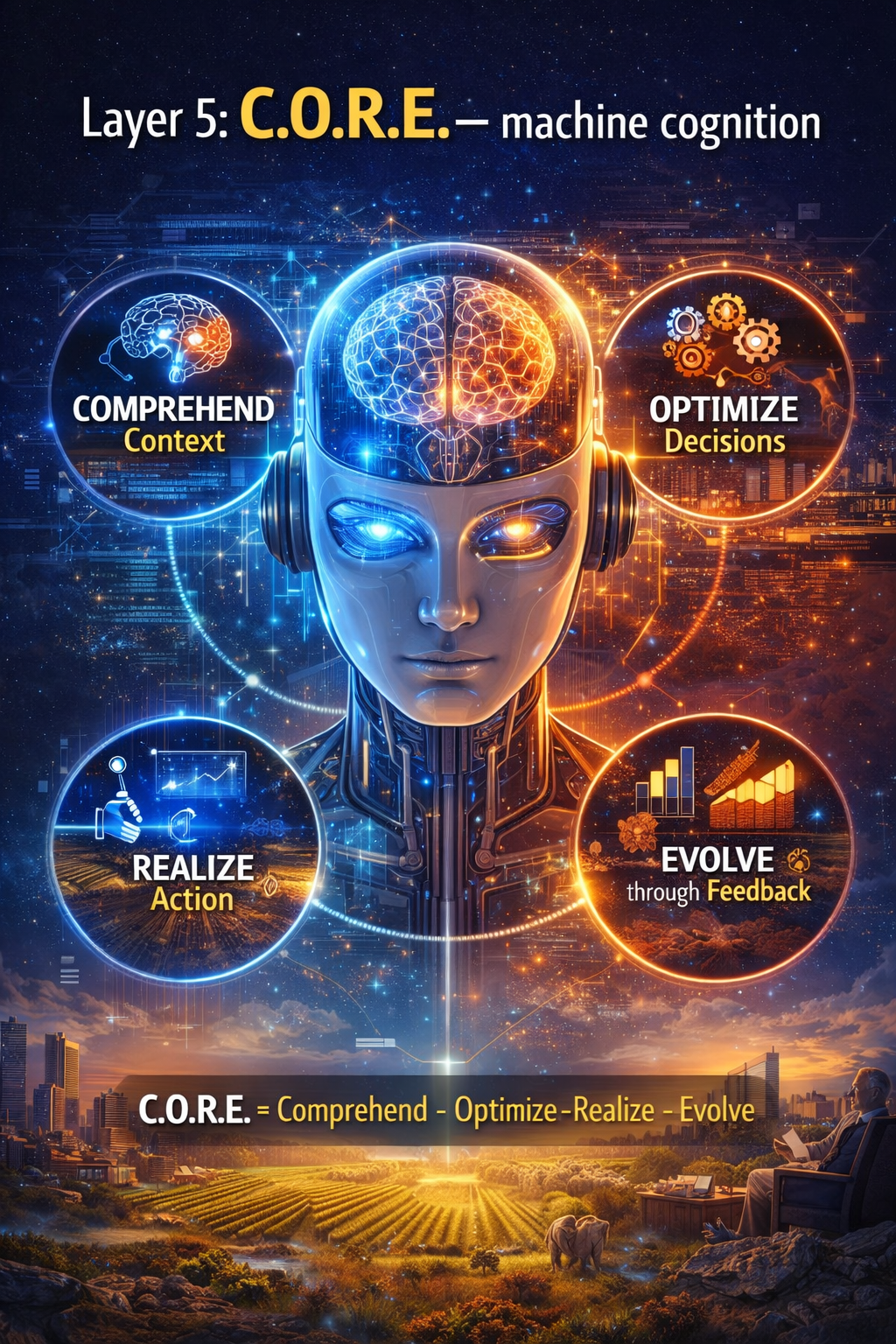
Once representation exists, AI cognition can begin.
This is where C.O.R.E. comes in:
C — Comprehend context
O — Optimize decisions
R — Realize action
E — Evolve through feedback
C.O.R.E. is the machine cognition loop. It turns representation into understanding, options, actions, and learning.
But the key point is this:
C.O.R.E. only works if the lower layers are strong enough.
If signal infrastructure is weak, the system sees poorly. If identity is unstable, the system misattributes. If representation is thin, the system reasons badly. In other words, intelligence in the AI economy is downstream of visibility.
This is why so many AI deployments underperform. The model gets blamed, but the real weakness often lies lower in the stack
Layer 6: D.R.I.V.E.R. — institutional governance
If C.O.R.E. explains how AI thinks, D.R.I.V.E.R. explains how institutions govern that thinking:
D — Delegation
R — Representation
I — Intelligence
V — Verification
E — Execution
R — Recourse
This is the layer that determines whether AI decisions become legitimate, trustworthy, and institutionally usable.
Delegation asks who authorizes the system to act. Representation asks what exactly is being modeled and whose reality counts. Intelligence asks how signals are being interpreted into judgments. Verification asks how the system is checked. Execution asks how decisions are translated into action. Recourse asks what happens when the system is wrong.
This matters enormously because representation without governance becomes dangerous. A system that represents elderly vulnerability, livestock disease, environmental risk, or informal borrower profiles may create enormous value — but only if institutions can verify, constrain, and correct the system’s actions.
That is the final move:
from machine cognition to legitimate action.
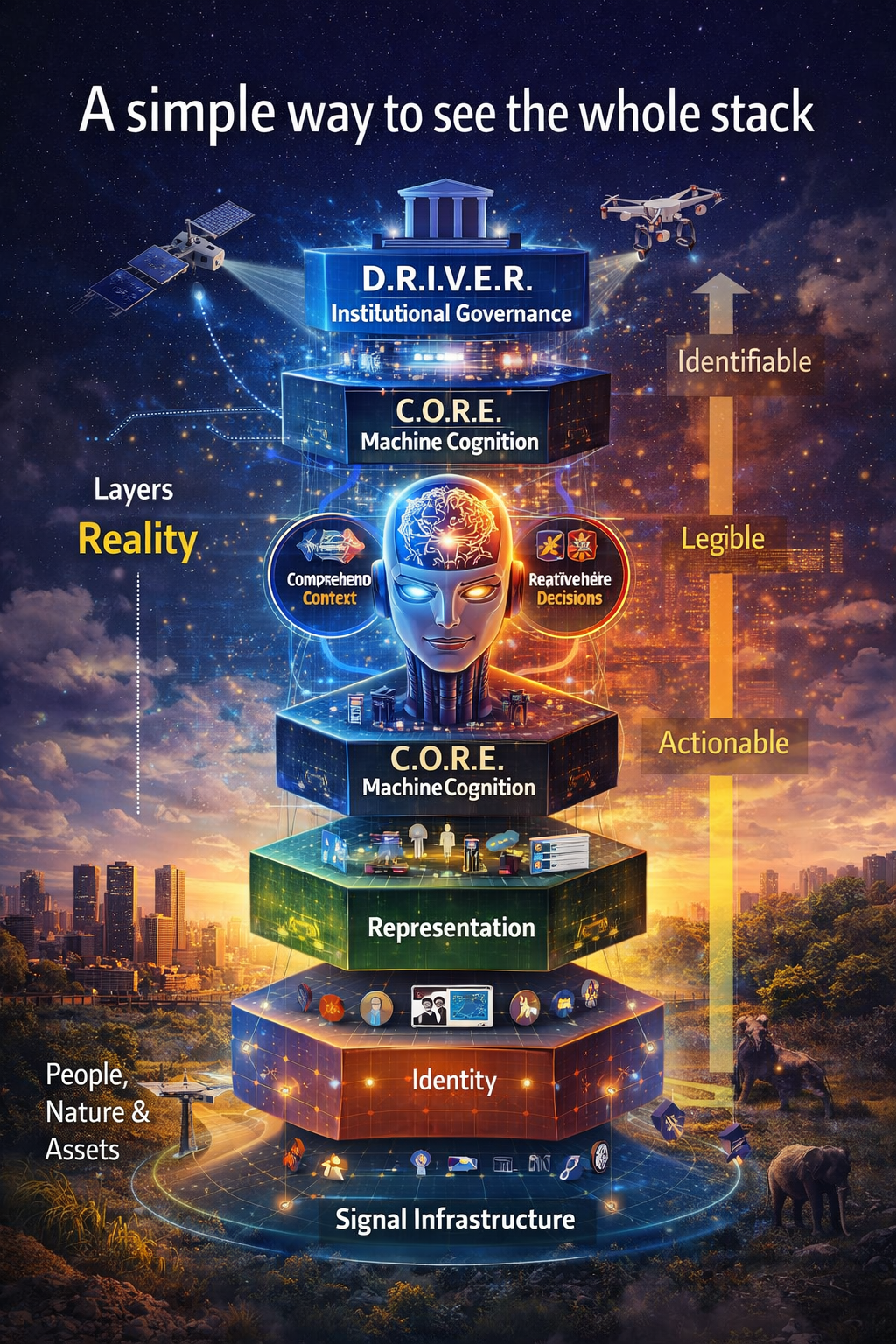
A simple way to see the whole stack
Put together, the Representation Stack looks like this:
Reality becomes detectable through signal infrastructure.
Signals become attributable through identity.
Identities become legible through representation.
Representation becomes decision-making through C.O.R.E.
Decisions become institutionally trustworthy through D.R.I.V.E.R.
That is how reality becomes identifiable, legible, and actionable in the AI economy.
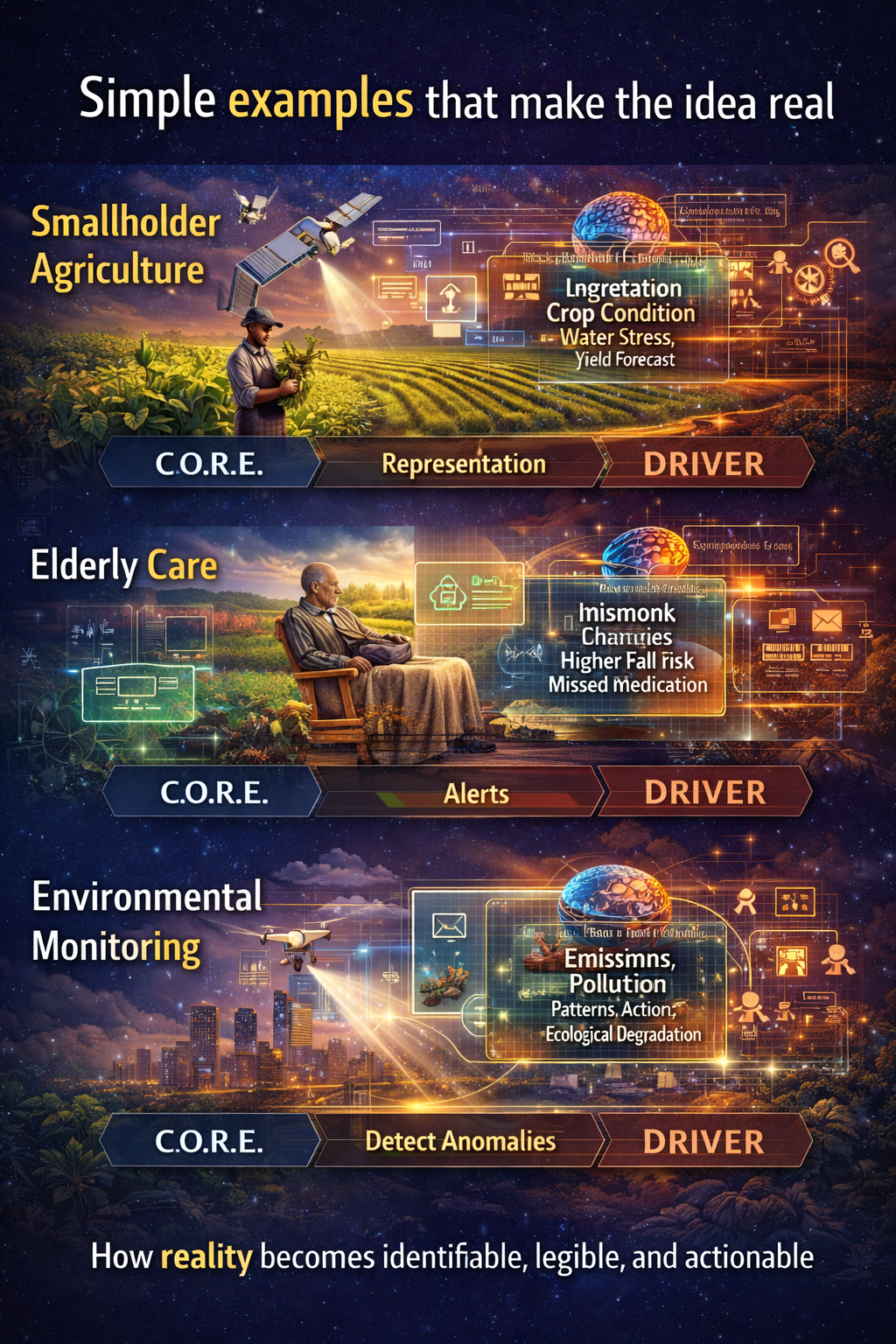
Simple examples that make the idea real
Smallholder agriculture
A smallholder field is part of reality. Satellite imagery, soil sensors, rainfall data, and mobile reporting create signal infrastructure. Land parcel IDs, farmer IDs, and geospatial boundaries create identity. Together, these produce a representation of crop condition, water stress, and expected output. AI can use C.O.R.E. to suggest irrigation timing, disease alerts, or credit-risk estimates. Institutions use D.R.I.V.E.R. to decide who can act, what must be verified, and what recourse exists if the system is wrong. NASA, ESA, and GEOGLAM all show how Earth observation is being used for agricultural monitoring and food security. (NASA Earthdata)
Elderly care
An older adult living alone is reality. Motion sensors, wearables, medication logs, call patterns, and room conditions form signal infrastructure. Patient or household identity links those signals over time. A representation emerges: sleep changes, reduced mobility, higher fall risk, missed medication, social isolation. C.O.R.E. helps the system comprehend context, optimize alerts, realize interventions, and improve with feedback. D.R.I.V.E.R. determines who is allowed to monitor, what is appropriate, how false alerts are verified, and what recourse exists for harmful or incorrect inferences. WHO notes that by 2030, one in six people in the world will be aged 60 or over, making this a structural and growing systems challenge. (World Health Organization)
Environmental monitoring
A watershed or city air basin is reality. Satellite feeds, sensor networks, historical pollution data, weather, and land-use data form signal infrastructure. Geospatial zones and monitoring boundaries create identity. That becomes a representation of emissions, pollution patterns, or ecological degradation. AI can detect anomalies, forecast deterioration, or prioritize interventions. D.R.I.V.E.R. becomes essential because public warnings, industrial accountability, and policy responses require delegation, verification, execution discipline, and recourse. UNEP highlights AI’s role in monitoring deforestation, emissions, pollution, and other environmental risks. (UNEP – UN Environment Programme)
Why this matters for enterprise strategy
This is not just a technical model. It is a board-level strategy lens.
Enterprises often ask:
“How do we deploy AI faster?”
The better question is:
“What parts of reality relevant to our customers, assets, communities, operations, or ecosystems are still poorly represented?”
That question changes everything.
It shifts attention from generic AI tools to strategic representation gaps.
In banking, the gap may be informal livelihoods.
In healthcare, it may be early signals of decline.
In agrifood, it may be field-level or animal-level visibility.
In climate and sustainability, it may be emissions, biodiversity, water, and supply-chain traceability.
In manufacturing, it may be machine state, process drift, or infrastructure deterioration.
The winners in the AI economy may not be those with access to the same model as everyone else. They may be those who build stronger Representation Stacks around the parts of reality others still see poorly.
That is a much more strategic way to think about AI advantage.
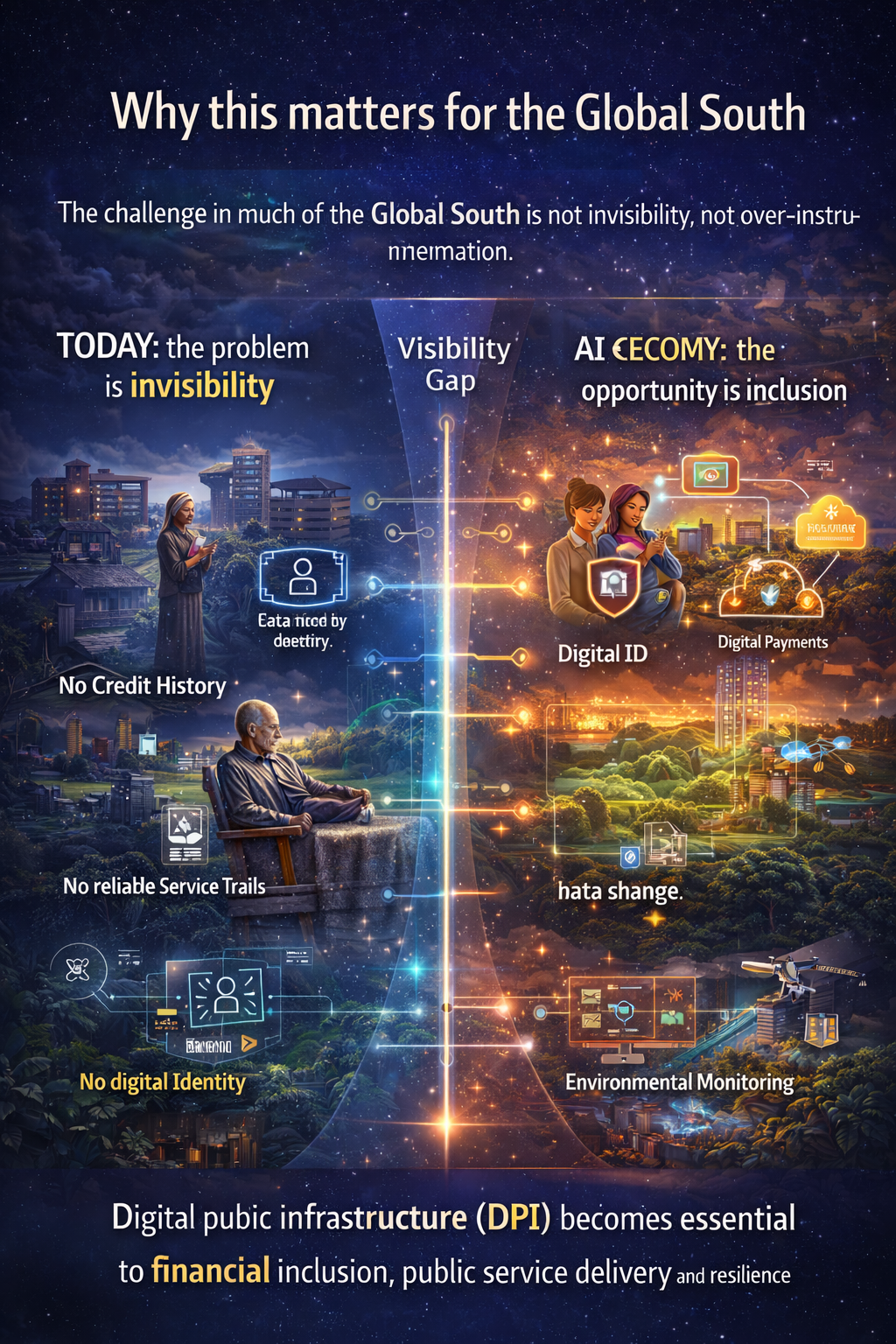
Why this matters for the Global South
This is especially important across the Global South, where the challenge is often not overrepresentation but underrepresentation.
In many advanced economies, debates about AI and data emphasize privacy and surveillance. Those concerns matter. But in many lower- and middle-income contexts, the older problem has been invisibility: no formal records, no digital identity, no reliable service trails, no credit history, no environmental monitoring, and no structured visibility into communities or ecosystems.
That is why digital public infrastructure has become so central to inclusion and resilience. UNDP and the World Bank both frame DPI as foundational digital building blocks for inclusive, society-scale digital transformation, service delivery, and resilience. (UNDP)
This means representation in the AI economy is not only a technical issue.
It is also:
- a development issue
- an institutional issue
- a governance issue
- and a large economic opportunity
Conclusion box: the real AI race begins below the model
The Representation Stack clarifies something that many current AI debates miss.
AI does not begin with intelligence.
It begins with visibility.
Before systems can reason, they must detect.
Before they can detect meaningfully, they must identify.
Before they can optimize, they must represent.
Before they can act responsibly, they must be governed.
That is the stack.
And that is why the next AI economy will be shaped not only by the sophistication of models, but by the architecture through which reality becomes identifiable, legible, and actionable.
The strategic race ahead is not just to build smarter AI.
It is to build stronger Representation Stacks.
That is where new value will emerge.
That is where new institutions will be formed.
And that is where the next generation of AI advantage will be won.
AI will not be won by bigger models alone. It will be won by better representation.
FAQ
What is the Representation Stack in AI?
The Representation Stack is a layered architecture that explains how real-world entities become usable by artificial intelligence systems. It includes layers such as reality, signal infrastructure, identity, and representation, which enable AI cognition through the C.O.R.E. loop and institutional governance through the D.R.I.V.E.R. framework.
Why is the Representation Stack important for AI systems?
AI systems cannot reason about or act on entities that they cannot observe, identify, and represent. Weakness in signal infrastructure, identity systems, or representation layers often explains why AI deployments fail in real-world environments.
What comes before AI models in the Representation Stack?
Before AI models can generate decisions, three foundational layers must exist: signal infrastructure that captures data, identity systems that link signals to entities, and representation models that create structured views of reality.
What is C.O.R.E. in the AI architecture described in this article?
C.O.R.E. is the machine cognition loop used by AI systems:
Comprehend context
Optimize decisions
Realize action
Evolve through feedback
It describes how AI systems interpret represented information and convert it into decisions and learning.
What is the D.R.I.V.E.R. framework in AI governance?
D.R.I.V.E.R. is an institutional governance architecture that ensures AI decisions are trustworthy and accountable. It includes Delegation, Representation, Identity, Verification, Execution, and Recourse.
How does the Representation Stack apply to enterprise AI?
Enterprises create competitive advantage when they improve the representation of customers, assets, ecosystems, and operations. Strong representation enables better decision systems, new services, and improved governance.
Why does the Representation Stack matter for the Global South?
Many regions face a challenge of invisibility rather than excessive data. Weak identity systems, limited environmental monitoring, and poor infrastructure can prevent AI from representing reality accurately. Digital public infrastructure and sensing systems help close this gap.
Glossary
Representation Stack
A layered architecture through which real-world entities become visible and usable to AI systems, enabling machine cognition and institutional governance.
Machine-Readable Reality
The portion of the physical or social world that has become observable by software through sensors, telemetry, identity systems, imaging, or digital records.
Signal Infrastructure
Systems that capture traces of reality, including sensors, satellites, mobile devices, IoT networks, enterprise telemetry, and digital public infrastructure.
Identity Infrastructure
Systems that bind signals to stable entities such as people, assets, machines, animals, or locations, enabling traceability and long-term context.
Representation
A structured model of an entity or system created from signals and identity, enabling AI systems to reason about real-world conditions.
C.O.R.E. (Machine Cognition Loop)
A framework describing how AI systems transform representation into decisions: Comprehend context, Optimize decisions, Realize action, and Evolve through feedback.
D.R.I.V.E.R. (Institutional Governance Framework)
A governance architecture ensuring AI decisions are legitimate and accountable through Delegation, Representation, Identity, Verification, Execution, and Recourse.
Digital Public Infrastructure (DPI)
Foundational digital systems such as digital identity, payment platforms, and data-sharing rails that support inclusive digital services and economic participation.
Earth Observation
Satellite-based monitoring systems used to track environmental, agricultural, and geospatial conditions for decision-making.
The Intelligence-Native Enterprise Doctrine
This article is part of a larger strategic body of work that defines how AI is transforming the structure of markets, institutions, and competitive advantage. To explore the full doctrine, read the following foundational essays:
- The AI Decade Will Reward Synchronization, Not Adoption
Why enterprise AI strategy must shift from tools to operating models.
https://www.raktimsingh.com/the-ai-decade-will-reward-synchronization-not-adoption-why-enterprise-ai-strategy-must-shift-from-tools-to-operating-models/ - The Third-Order AI Economy
The category map boards must use to see the next Uber moment.
https://www.raktimsingh.com/third-order-ai-economy/ - The Intelligence Company
A new theory of the firm in the AI era — where decision quality becomes the scalable asset.
https://www.raktimsingh.com/intelligence-company-new-theory-firm-ai/ - The Judgment Economy
How AI is redefining industry structure — not just productivity.
https://www.raktimsingh.com/judgment-economy-ai-industry-structure/ - Digital Transformation 3.0
The rise of the intelligence-native enterprise.
https://www.raktimsingh.com/designing-intelligence-native-enterprise/ - Industry Structure in the AI Era
Why judgment economies will redefine competitive advantage.
https://www.raktimsingh.com/industry-structure-in-the-ai-era-why-judgment-economies-will-redefine-competitive-advantage/ - The Representation Economy: Why AI Institutions Must Run on SENSE, CORE, and DRIVER – Raktim Singh
Institutional Perspectives on Enterprise AI
Many of the structural ideas discussed here — intelligence-native operating models, control planes, decision integrity, and accountable autonomy — have also been explored in my institutional perspectives published via Infosys’ Emerging Technology Solutions platform.
For readers seeking deeper operational detail, I have written extensively on:
- What Makes an Enterprise Intelligence-Native? The Blueprint for Third-Order AI Advantage
https://blogs.infosys.com/emerging-technology-solutions/artificial-intelligence/what-is-enterprise-ai-the-operating-model-for-compounding-institutional-intelligence.html - Why “AI in the Enterprise” Is Not Enterprise AI: The Operating Model Difference Most Organizations Miss
https://blogs.infosys.com/emerging-technology-solutions/artificial-intelligence/why-ai-in-the-enterprise-is-not-enterprise-ai-the-operating-model-difference-that-most-organizations-miss.html - The Enterprise AI Control Plane: Governing Autonomy at Scale
https://blogs.infosys.com/emerging-technology-solutions/artificial-intelligence/the-enterprise-ai-control-plane-governing-autonomy-at-scale.html - Enterprise AI Ownership Framework: Who Is Accountable, Who Decides, and Who Stops AI in Production
https://blogs.infosys.com/emerging-technology-solutions/artificial-intelligence/enterprise-ai-ownership-framework-who-is-accountable-who-decides-and-who-stops-ai-in-production.html - Decision Integrity: Why Model Accuracy Is Not Enough in Enterprise AI
https://blogs.infosys.com/emerging-technology-solutions/artificial-intelligence/decision-integrity-why-model-accuracy-is-not-enough-in-enterprise-ai.html - Agent Incident Response Playbook: Operating Autonomous AI Systems Safely at Enterprise Scale
https://blogs.infosys.com/emerging-technology-solutions/artificial-intelligence/agent-incident-response-playbook-operating-autonomous-ai-systems-safely-at-enterprise-scale.html - The Economics of Enterprise AI: Designing Cost, Control, and Value as One System
https://blogs.infosys.com/emerging-technology-solutions/artificial-intelligence/the-economics-of-enterprise-ai-designing-cost-control-and-value-as-one-system.html
Together, these perspectives outline a unified view: Enterprise AI is not a collection of tools. It is a governed operating system for institutional intelligence — where economics, accountability, control, and decision integrity function as a coherent architecture.
The Enterprise AI Doctrine: From Decision Scale to Institutional Redesign
Over the past few months, I’ve been building a structured doctrine around Enterprise AI — not as a technology trend, but as an institutional redesign agenda.
It unfolds in layers:
🔹 1️⃣ Decision Economics
- Decision Scale: Why Competitive Advantage Is Moving from Labor Scale to Decision Scale
https://www.raktimsingh.com/decision-scale-competitive-advantage-ai/
→ Establishes the core thesis: advantage is shifting from scaling labor to scaling decision quality.
🔹 2️⃣ Institutional Transformation
- The Future Belongs to Decision-Intelligent Institutions
https://www.raktimsingh.com/the-future-belongs-to-decision-intelligent-institutions/
→ Argues that AI leadership is not about tooling — it is about institutional architecture.
🔹 3️⃣ Sector-Level Redesign
- The Institutional Redesign of Indian IT: From Services Firms to Intelligence Institutions
https://www.raktimsingh.com/institutional-redesign-indian-it-intelligence-institutions/ - From Labor Arbitrage to Intelligence Arbitrage: Why Indian IT’s AI Reinvention Will Define the Next Decade
https://www.raktimsingh.com/from-labor-arbitrage-to-intelligence-arbitrage-why-indian-its-ai-reinvention-will-define-the-next-decade/
→ Examines how this shift reshapes industry structure, economics, and competitive positioning.
🔹 4️⃣ Economic Consequences
- The End of Averages: Why Precision Growth Will Define the Next Decade of Enterprise Strategy
https://www.raktimsingh.com/precision-growth-end-of-averages-enterprise-ai/ - What Is the AI Dividend? How Boards Capture Structural Gains from Enterprise AI
https://www.raktimsingh.com/enterprise-ai-roi/
→ Explores how decision intelligence translates into measurable structural gains.
🔹 The Unifying Thesis
Together, these articles form a coherent framework:
- Competitive advantage is moving from labor scale to decision scale
- Institutions must evolve from services firms to intelligence institutions
- AI must shift from isolated pilots to structurally governed, economically accountable enterprise systems
This is not AI adoption.
It is enterprise redesign.
Digital Identity (World Bank ID4D)
Earth Observation for Agriculture (NASA)
FAO Digital Agriculture and Automation



Raktim Singh is an AI and deep-tech strategist, TEDx speaker, and author focused on helping enterprises navigate the next era of intelligent systems. With experience spanning AI, fintech, quantum computing, and digital transformation, he simplifies complex technology for leaders and builds frameworks that drive responsible, scalable adoption.