


The Data Illusion
Why More Data Is Not More Understanding
Data was never the advantage.
Representation was.
For years, one phrase shaped how leaders understood the digital economy:
Data is the new oil.
It sounded powerful. It drove massive investment. It made data feel like a resource that only had to be collected, stored, refined, and used.
But the metaphor was incomplete.
The real question was never how much data exists.
The real question is:
Does the system understand reality well enough to act?
That is the paradox now facing the modern enterprise.
Organizations invested in data at scale: warehouses, pipelines, dashboards, governance layers, analytics platforms, and AI systems.
They accumulated records.
They built infrastructure.
Yet many remain uncertain.
Not because data is missing.
But because understanding is.
The Weakness Inside the Data Metaphor

The weakness begins inside the metaphor itself.
Oil is materially consistent.
Data is not.
Data is partial, contextual, and relational. Its meaning depends on what it is attached to, how it is connected, and whether it reflects reality in a usable and trustworthy form.
This is why accumulation does not produce intelligence.
More data does not create better decisions.
Better representation does.
Most organizations are now confronting the same gap.
They are data-rich, but reality-poor.
They capture activity, but miss condition.
They store records, but lack coherence.
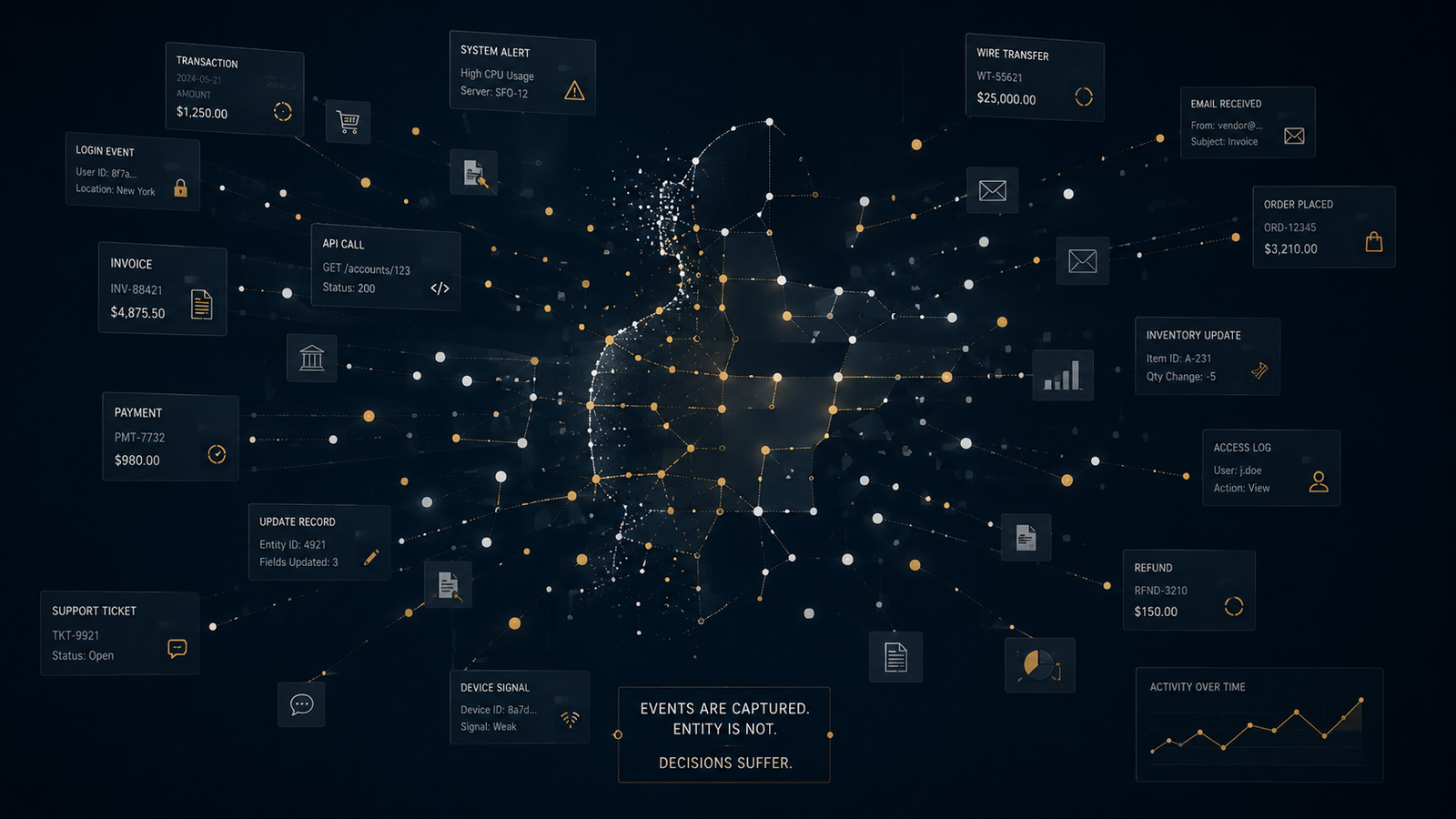
A system may hold thousands of signals about an entity: transactions, interactions, measurements, documents, service histories, invoices, complaints, and behavioral traces.
Yet without continuity, those signals remain fragments.
The system sees events.
It does not see the entity.
This is not a failure of technology.
It is a failure of framing.
From Data Accumulation to Representation Quality
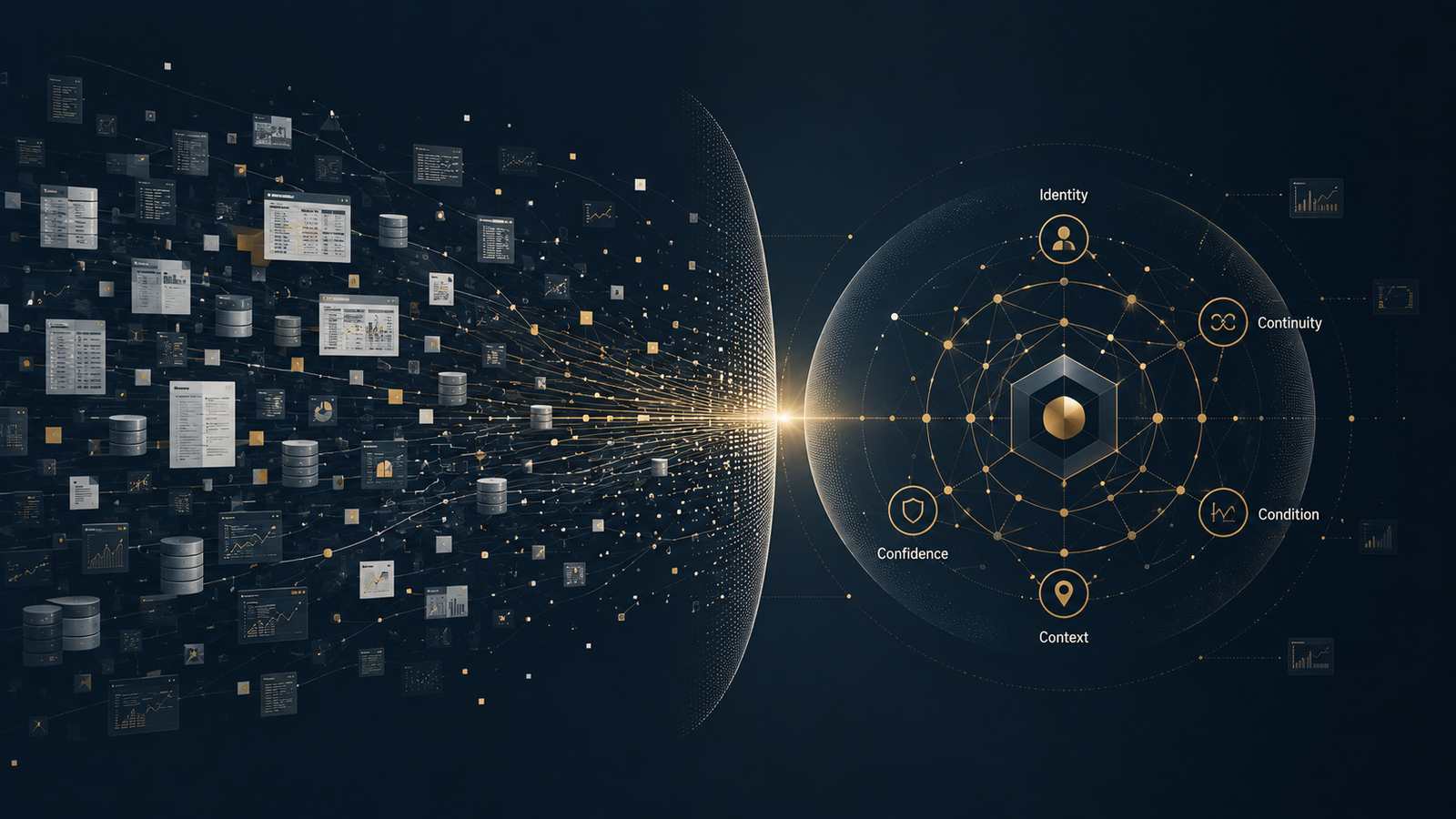
The “data is the new oil” mindset rewarded extraction.
It treated possession as advantage.
But in the AI era, possession is not enough.
What matters is not simply what an organization collects.
It is what the organization can faithfully represent.
This becomes clearer when systems fail.
Often, they do not fail because they lack data.
They fail because they lack coherence.
Organizations operate with:
- signals without context
- records without continuity
- measurements without meaning
- history without identity
- dashboards without judgment
- models without sufficient grounding
They can describe what happened.
They cannot confidently explain what is happening.
That distinction defines the next stage of enterprise AI.
Data answers:
What was recorded?
Representation answers:
What is happening, to whom, in what condition, with what confidence, and under what constraints?
That shift — from events to entities, from records to condition — changes everything.
Because decisions are not made about isolated events.
They are made about entities in motion.
The Enterprise Problem: Seeing Events, Missing Entities
Consider a bank evaluating a small business.
The bank may have thousands of records: payments, account activity, tax filings, invoices, loan history, credit behavior, customer interactions, and operational documents.
But if those records do not connect ownership, cash flow, repayment behavior, market context, operational stress, supplier dependency, and current condition, the bank still does not understand the business.
It has data.
It does not yet have representation.
The same problem appears across industries.
A healthcare system may have records, but not a coherent view of patient condition.
A manufacturer may have sensor data, but not a reliable representation of asset health.
A retailer may have purchase history, but not a meaningful view of changing customer intent.
A public institution may have forms, but not a living understanding of citizen needs.
In each case, the issue is not the absence of data.
The issue is the absence of faithful representation.
Why Weak Representation Creates Economic Distortion
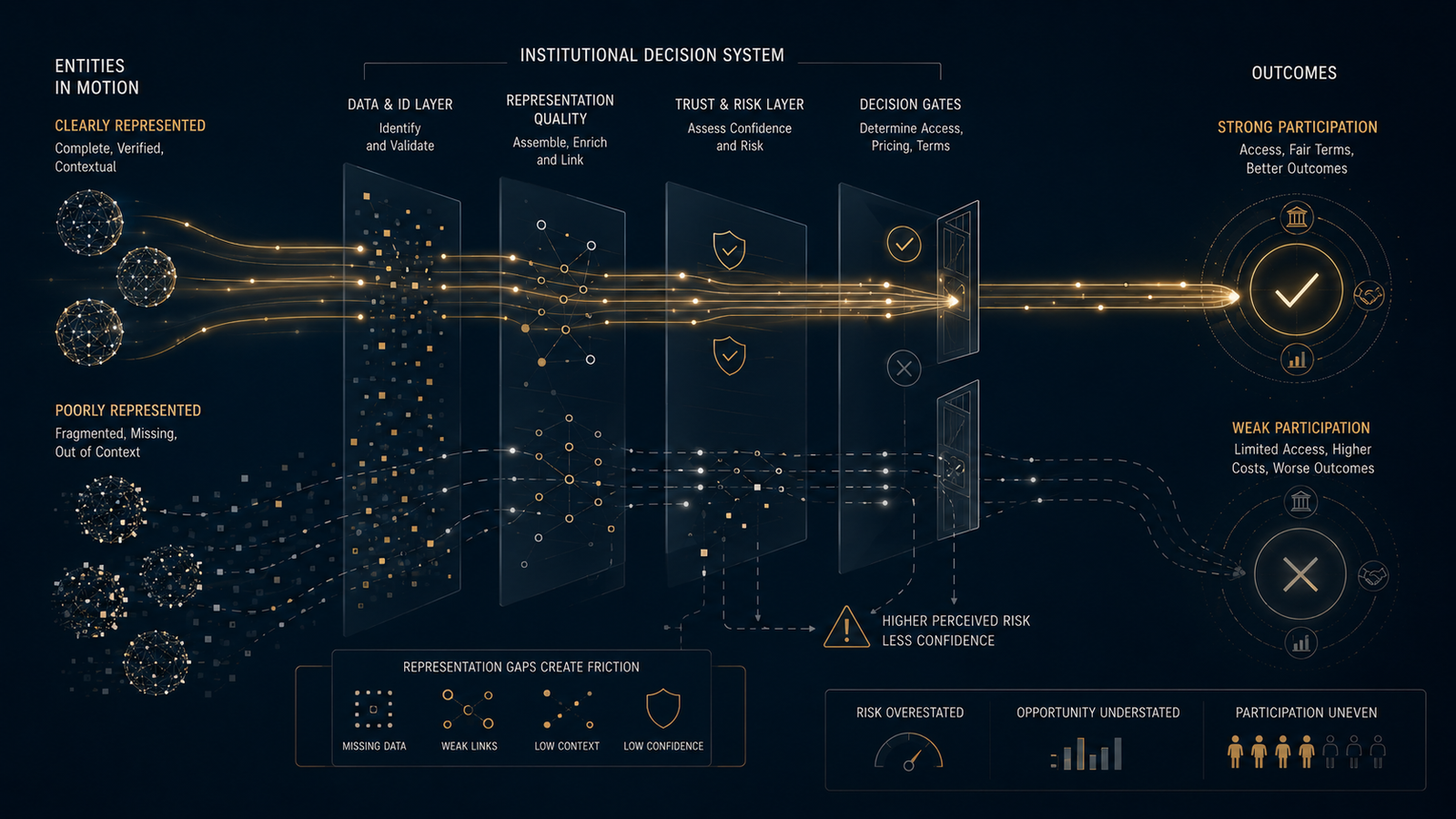
The consequences appear most clearly at the edges.
Where representation is weak, participation is weak.
Entities that appear only in fragments become:
- harder to evaluate
- harder to trust
- harder to serve
- harder to include
- harder to support
They are simplified into categories.
They are treated conservatively.
They are often excluded.
Not because they lack value.
But because their value does not enter the system in a usable form.
This is why the problem is not only technical.
It is economic.
When representation is weak:
- risk is overstated
- opportunity is understated
- decisions become rough
- trust becomes expensive
- participation becomes uneven
Over time, this creates structural distortion.
What is clearly represented flows.
What is poorly represented remains trapped.
Reality Resists Extraction
There is another flaw the old metaphor ignored.
Oil does not resist extraction.
Reality does.
People, firms, institutions, and ecosystems care how they are represented — and how that representation is used.
Value does not come from access alone.
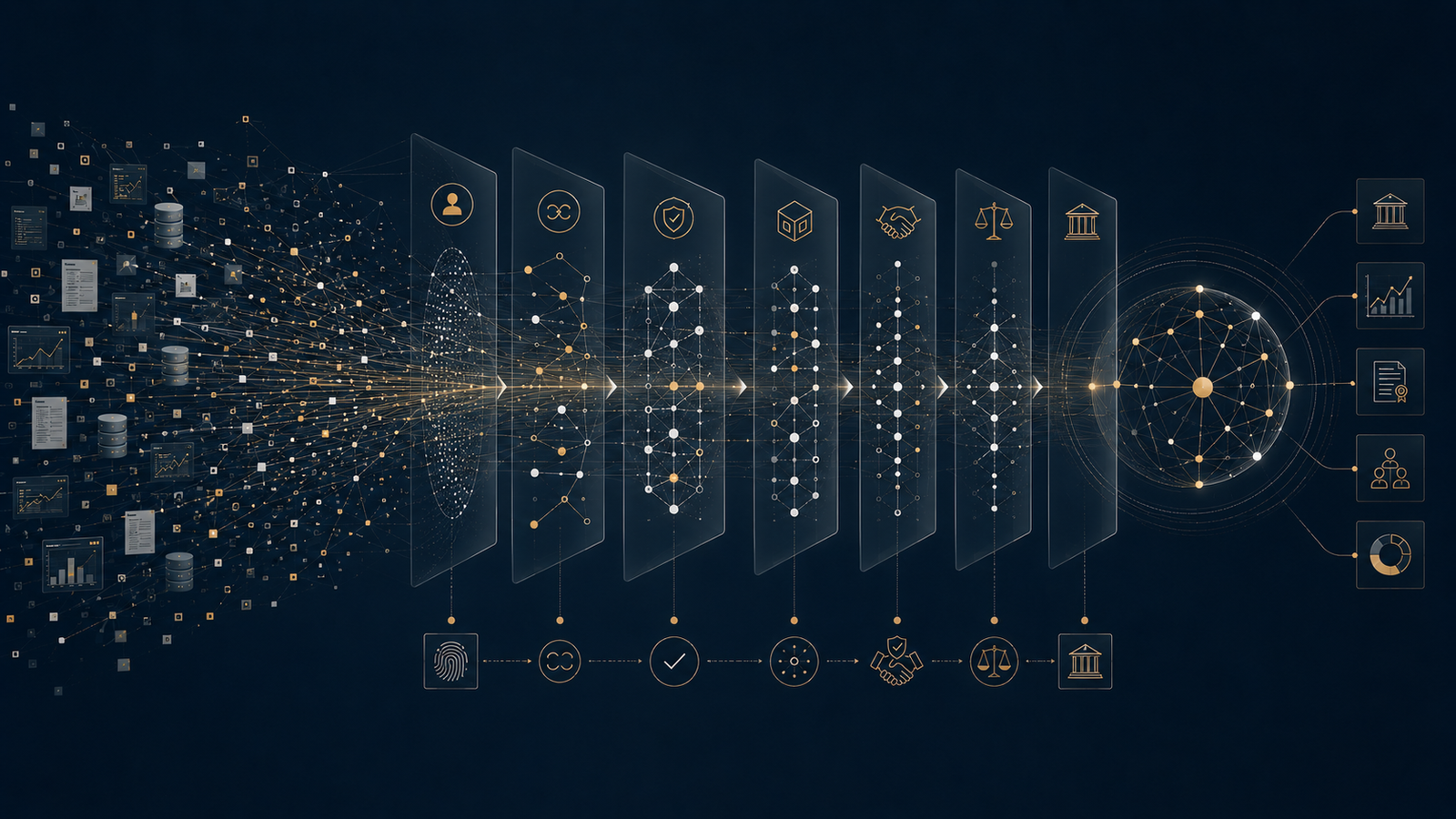
It comes from:
- permission
- trust
- legitimacy
- accountability
- recourse
An entity participates more when it believes:
- it is being seen fairly
- its representation is accurate
- its context is not being flattened
- its data will be used responsibly
- there is a way to challenge or correct errors
This is not only a data problem.
It is a trust problem.
And trust cannot be scaled through volume alone.
The Question Leaders Should Ask Now
Once this becomes clear, the direction of advantage changes.
The question is no longer:
How much data do we have?
The better question is:
What reality can we represent faithfully enough to act on?
This reframes the entire economy.
- volume matters less than coherence
- storage matters less than legibility
- accumulation matters less than fidelity
- dashboards matter less than understanding
- intelligence matters less if representation is weak
Data is the trace.
Representation is the picture.
Data records fragments.
Representation reveals reality.
And only what is represented coherently can be understood, trusted, and acted upon.
Data Is Not the New Oil
This is why the old phrase loses its power.
Data is not the new oil.
Data is the raw material.
If it does not become representation, it does not become value.
If it does not become trusted representation, it does not enable participation.
This is where Representation Economics begins to take shape.
Value will not flow to those who merely gather more.
It will flow to those who:
- see more clearly
- represent more faithfully
- act more responsibly
The next economy will not reward data accumulation alone.
It will reward clarity of representation.
The Rise of Representation Infrastructure
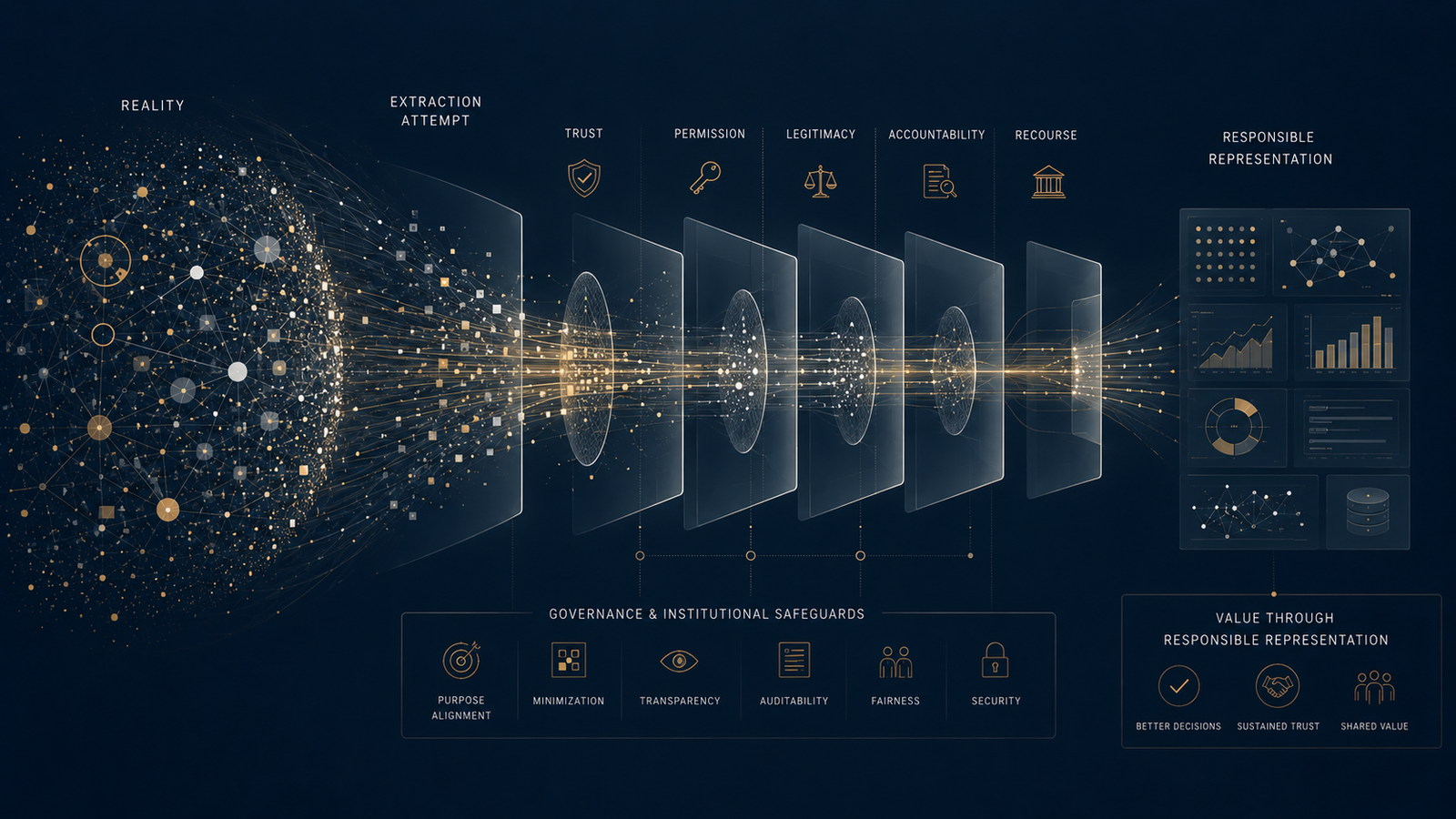
This changes what must be built next.
Not just better pipelines — but better representation systems.
Not just more storage — but stronger identity and continuity.
Not just faster models — but more trustworthy visibility.
This is where new companies, platforms, standards, and governance disciplines will emerge:
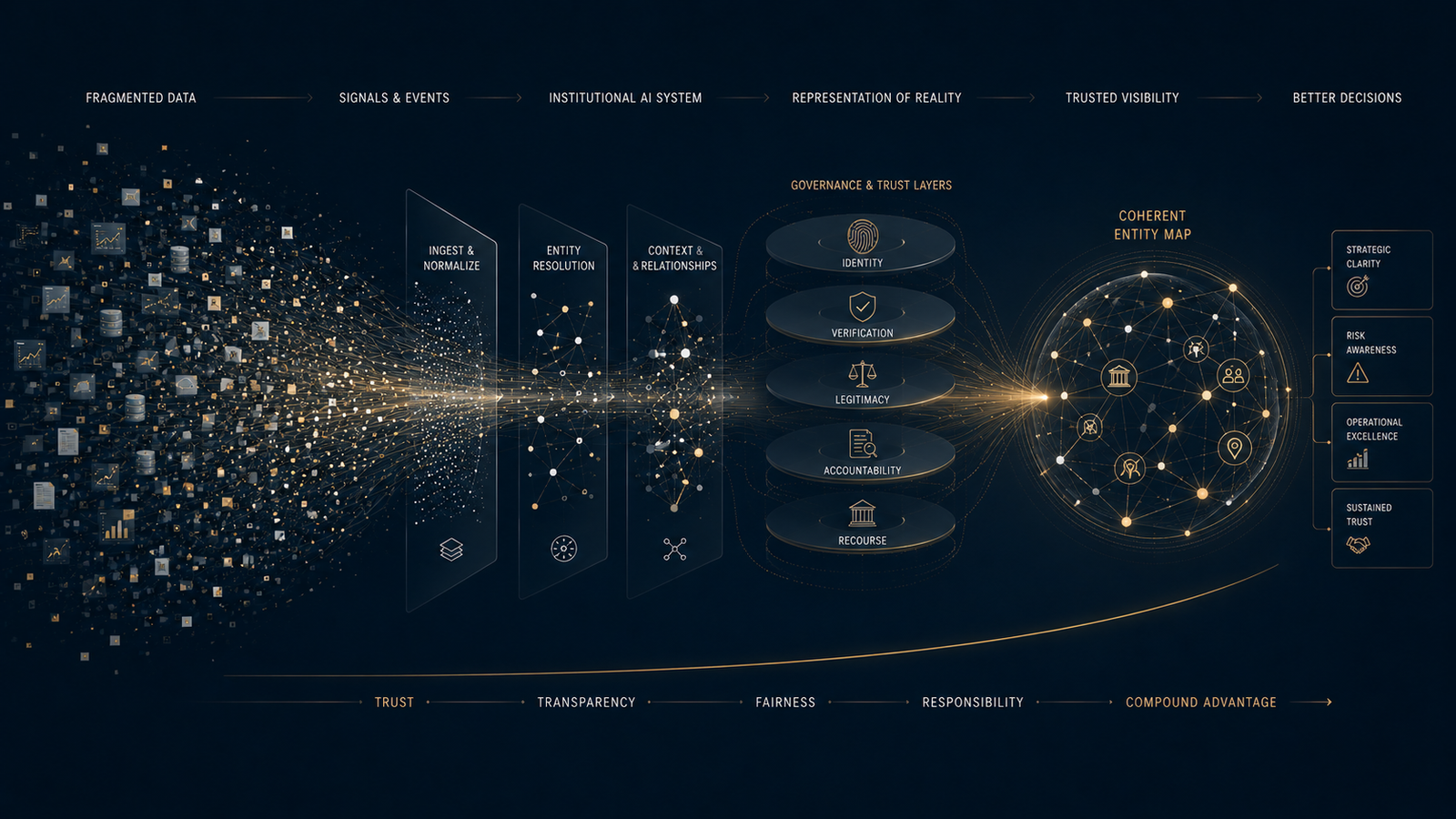
- systems that correct representation
- systems that establish identity
- systems that verify reality
- systems that enable recourse
- systems that insure representation
- systems that monitor representation quality
- systems that make institutional reality machine-legible
The frontier is no longer only data infrastructure.
It is representation infrastructure.
Conclusion: The Advantage Will Belong to Those Who See Better
The myth of data is not that data is unimportant.
It is that data alone was ever enough.
The next chapter of advantage will not be written by those who collect more.
It will be written by those who see better.
In the AI era, intelligence will matter.
Models will matter.
Automation will matter.
But none of them will be enough if systems cannot represent reality clearly enough to act with trust.
The future will not reward data accumulation alone.
It will reward representation quality.
And once that becomes clear, a deeper question emerges:
If data must become representation, what prevents systems from seeing reality clearly in the first place?
That is the reality gap.
Key Takeaways
- More data does not automatically create better understanding.
- Enterprise AI often fails because systems lack coherent representation, not because they lack records.
- Data captures events; representation explains entities, conditions, context, and confidence.
- Weak representation creates economic distortion by overstating risk and understating opportunity.
- The next frontier is representation infrastructure, not only data infrastructure.
Summary
The Data Illusion argues that enterprise AI systems often fail not because they lack data, but because they lack coherent representation of reality. The article explains the difference between data and representation, showing how fragmented systems, disconnected records, and weak entity continuity create distorted decision-making. It introduces the concept of representation infrastructure — systems that establish identity, continuity, trust, legitimacy, and context so AI can act responsibly. The article positions representation quality, not data accumulation alone, as the next competitive advantage in Enterprise AI.
Glossary
Representation
A usable expression of reality that helps a system understand entities, conditions, context, and confidence.
Representation Infrastructure
Systems, standards, workflows, and governance mechanisms that convert fragmented data into coherent, trusted representations.
Data-Rich, Reality-Poor
A condition where an organization has large volumes of data but lacks a clear, trustworthy picture of actual reality.
Entity Continuity
The ability to connect signals, records, and history to the same entity over time.
Representation Quality
The degree to which a system’s representation of reality is accurate, complete, contextual, trustworthy, and actionable.
FAQ
Why is more data not enough for AI?
More data is not enough because AI systems need coherent, contextual, and trustworthy representations. Fragmented records may increase volume without improving understanding.
What is the difference between data and representation?
Data records fragments of activity. Representation organizes those fragments into a usable picture of entities, conditions, context, and confidence.
Why do enterprise AI systems fail?
Many enterprise AI systems fail because they reason over incomplete, fragmented, or distorted representations of reality.
What is representation infrastructure?
Representation infrastructure refers to systems that establish identity, continuity, verification, trust, correction, and recourse so that AI systems can act on reliable representations.
Why does representation matter for trust?
People and organizations participate more when they believe they are being represented fairly, accurately, and responsibly.
People Also Search For
- What is Representation Economy?
- Enterprise AI visibility problem
- AI trust and institutional intelligence
- Representation infrastructure in AI
- The World AI Cannot See: Why Intelligence Begins With Representation – Raktim Singh
Suggested Further Reading / External References
1. OECD AI Principles
Excellent for governance, trust, accountability, and institutional AI framing.
2. NIST AI Risk Management Framework
Very strong for legitimacy, governance, trust, and operational AI systems.
NIST AI Risk Management Framework
3. Stanford Human-Centered AI (HAI)
Strong intellectual alignment with visibility, institutions, governance, and human impact.
Related Enterprise AI Reading
Many organizations are discovering that enterprise AI success depends on far more than model accuracy. Common challenges include AI project failure, weak AI governance, poor AI agent control, unclear enterprise AI ROI, and the inability to translate AI insights into business outcomes. For readers exploring topics such as why enterprise AI projects fail, how AI creates business value, AI agent governance frameworks, agentic AI systems, enterprise AI architecture, AI risk management, CIO AI strategy, and enterprise AI operating models, the following articles provide a deeper perspective:
-
- Why Enterprise AI Projects Fail Even When the Models Work
- Why AI Creates Value in One Company and Fails in Another
- AI Agent Governance: How CIOs Should Decide What AI Agents Are Allowed to Do
- Why AI Agents Fail in Enterprises
- Why Enterprise AI Projects Fail Even When the Models Work: The Missing Architecture Behind AI Governance and Agentic Systems
- raktimsingh.com/hy-enterprise-
ai-projects-fail-digital- anthropology-ai-governance/
Together, these articles examine the critical relationship between enterprise data, AI decision-making, AI governance, AI agents, execution systems, accountability mechanisms, and measurable business value, helping CIOs, CTOs, architects, and business leaders move from AI experimentation to enterprise-scale impact.



Raktim Singh is an AI and deep-tech strategist, TEDx speaker, and author focused on helping enterprises navigate the next era of intelligent systems. With experience spanning AI, fintech, quantum computing, and digital transformation, he simplifies complex technology for leaders and builds frameworks that drive responsible, scalable adoption.